Moving from Concept Note
to Full Proposal for USAID
©Cheryl Hooper
Hello and a Very
Warm Welcome!
A full application
for USAID builds
on the first stage
Concept Note.
2
Learning
Outcomes
1. Gain a practical
understanding of USAID’s
requirements and how to
answer specific questions.

2. Increased confidence in
how to approach a full
proposal.
3
Full application basic
instructions
’People of Excellence
go the extra mile to do
what’s right’
Joel Osteen
4
Cover Sheet
Fundamentals
5
Deadline
Format
Follow the format stated
(fonts, size, margins & any
other instructions)
Page Limits
Keep exactly to the page limit
and word or character count
stated for each section
Evidence/
Data
Always include verifiable
sources, data & statistics to
back up any narrative or
rationale used.
Do not
under-estimate the time
needed to complete the
application
Cover Sheet
Fundamentals
6
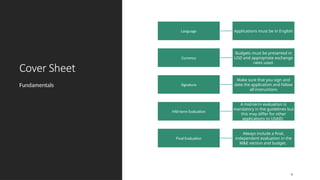
Language
Currency
Budgets must be presented in
USD and appropriate exchange
rates used.
Signature
Make sure that you sign and
date the application and follow
all instructions
Mid-term Evaluation
A mid-term evaluation is
mandatory in the guidelines but
this may differ for other
applications to USAID.
Final Evaluation
Always include a final,
independent evaluation in the
M&E section and budget.
Applications must be in English
Section 1
project
description
Project Description
Maximum 250 Words
Not Assessed on Points
7
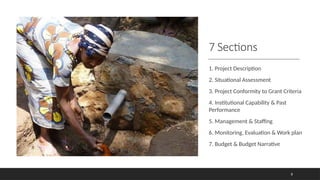
7 Sections
1. Project Description
2. Situational Assessment
3. Project Conformity to Grant Criteria
4. Institutional Capability & Past
Performance
5. Management & Staffing
6. Monitoring, Evaluation & Work plan
7. Budget & Budget Narrative
8
9
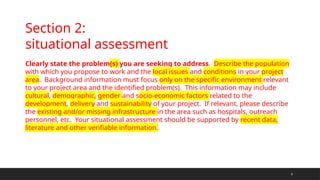
Section 2:
situational assessment
Clearly state the problem(s) you are seeking to address. Describe the population
with which you propose to work and the local issues and conditions in your project
area. Background information must focus only on the specific environment relevant
to your project area and the identified problem(s). This information may include
cultural, demographic, gender and socio-economic factors related to the
development, delivery and sustainability of your project. If relevant, please describe
the existing and/or missing infrastructure in the area such as hospitals, outreach
personnel, etc. Your situational assessment should be supported by recent data,
literature and other verifiable information.
1. SITUATIONAL ASSESSMENT
2. SOLUTION & TECHNICAL
APPROACH
3. GENDER AND EQUITY
All 3 elements make up the
Project Description with equal
weighting!
10
Situational analysis
broken down
1. The problems & challenges that the project
seeks to address?
2. Describe the beneficiaries disaggregated by
gender, age, disability, etc.
3. The LOCAL issues affected by the problems
4. Cultural, demographic, gender & socio-
economic factors
5. Existing and missing infrastructure if relevant
6. HOW the project will address the problems &
be sustained
7. Data, facts & evidence to back up
11
Section 2
Solution & Technical approach
Based on the information you provided in the situational
assessment and your description of the problem you are
seeking to address, clearly state your proposed solution(s).
Please provide a clear rationale for the solution(s) based on
your situational assessment. Provide a clear and detailed
narrative of your project objective(s) and the activities you
are proposing to undertake to accomplish your objective(s).
This information should be directly related to your Work Plan
(see below and Attachment F). If relevant, please include a
discussion about how your solution links to local/national
health systems. Partnerships should also be identified.
12
Section 2
Solution & Technical
approach Broken Down
1. Your solution to the problem
2. The rationale for your approach
3. The project objectives
4. The project activities
5. Relate answers to the work plan
6. How the solution supports
local/national health systems
20XX SAMPLE FOOTER TEXT 13
14
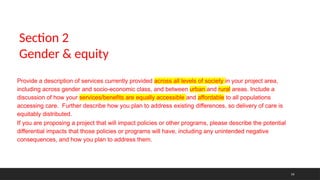
Provide a description of services currently provided across all levels of society in your project area,
including across gender and socio-economic class, and between urban and rural areas. Include a
discussion of how your services/benefits are equally accessible and affordable to all populations
accessing care. Further describe how you plan to address existing differences, so delivery of care is
equitably distributed.
If you are proposing a project that will impact policies or other programs, please describe the potential
differential impacts that those policies or programs will have, including any unintended negative
consequences, and how you plan to address them.
Section 2
Gender & equity
Gender & equity
section broken
down
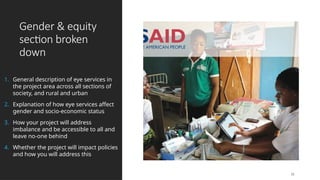
1. General description of eye services in
the project area across all sections of
society, and rural and urban
2. Explanation of how eye services affect
gender and socio-economic status
3. How your project will address
imbalance and be accessible to all and
leave no-one behind
4. Whether the project will impact policies
and how you will address this
15
Section 3 project
conformity to
grant criteria
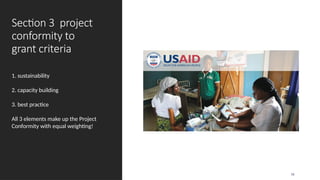
1. sustainability
2. capacity building
3. best practice
All 3 elements make up the Project
Conformity with equal weighting!
16
Section 3 Sustainability
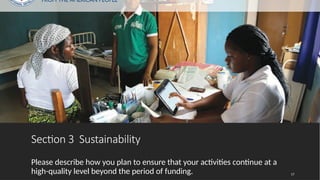
Please describe how you plan to ensure that your activities continue at a
high-quality level beyond the period of funding. 17
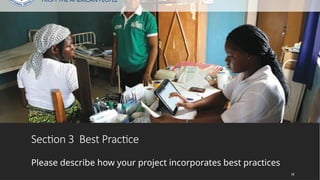
Section 3 Best Practice
Please describe how your project incorporates best practices
18
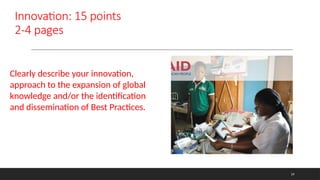
Innovation: 15 points
2-4 pages
Clearly describe your innovation,
approach to the expansion of global
knowledge and/or the identification
and dissemination of Best Practices.
19
Section 4 institutional
capabilities & past
performance
1. organisational capacity
2. past performance
Both elements will be assessed
together
SAMPLE FOOTER TEXT 20XX 20
This Photo by Unknown Author is licensed under CC BY-SA-NC
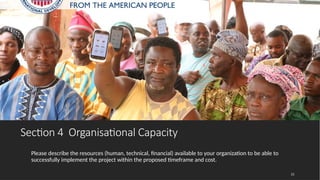
Section 4 Organisational Capacity
Please describe the resources (human, technical, financial) available to your organization to be able to
successfully implement the project within the proposed timeframe and cost.
21
Section 4 Previous
Experience in the
proposed area
Please provide a detailed but concise
description of your previous or ongoing
experience implementing similar
activities. If you have been a prior
grantee provide a description of the
project, major accomplishments and
project implementation dates.
22
Section 5: Management and Staffing
Both elements will be assessed together
23
Section 5: Management and staffing
Please describe how the proposed project will be effectively managed. Specifically, identify the key
personnel and provide the following information for each key personnel position:
◦ Key qualifications of the proposed individual
◦ Roles and responsibilities for each position
◦ Reporting and lines of authority for each position. An organizational chart may be included to
illustrate this information. If relevant to your project, describe the relationship between
Headquarters offices and country or field offices.
◦ Amount of time that the person will be dedicating to this project
◦ Where the position will be located (in the project country, the United States, a third country)
24
Section 6:
Monitoring &
Evaluation (M&E)
and Work Plan
Please fill in the M&E Plan Template,
Attachment C, as required in the
narrative section of the plan. Indicators
and targets must be realistic given
proposed activities, past performance
and experience and based on the budget.
Information regarding the method(s) of
data collection, data storage, review and
on-going monitoring are also requested.
20XX SAMPLE FOOTER TEXT 25
This Photo by Unknown Author is licensed under CC BY-NC-ND
Section 6: Monitoring &
Evaluation (M&E) and
Work Plan
The Work Plan, Attachment D,
requires the selection of
milestones based on major
accomplishments of the project.
Please ensure these are realistic
and measurable. Activities leading
to the completion of each
milestone must be detailed in the
template.
26
Section 7: Budget & Budget Narrative
Please use the Full Application Budget Template provided
in Attachment E to submit your budget. Detailed
instructions regarding the completion of the budget
template are included in Attachment F: Budget Instructions
and Cost Principles. Please provide all cost information in
United States Dollars. The cost categories provided are
standard and not all may be applicable to your project. You
should modify your budget depending on your proposed
start and end dates. Applicants must provide a Budget
Narrative to explain each line item of the budget (Please
refer to Attachment G for a sample Budget Narrative). The
budget narrative is limited to three (3) pages.
27
Recap of Sections
5 SECTIONS WHICH
HAVE MORE THAN ONE
ELEMENT OR
QUESTIONS WITHIN
QUESTIONS. HAVE YOU
ANSWERED
EVERYTHING ?!
20XX SAMPLE FOOTER TEXT 28
Section 1: Project Summary
A short paragraph of 250 words explaining:
What – what is the project?
Where – where does it take place?
Why – why is the project needed?
Who – who will the project benefit and how many?
When – when will the project start and the duration
What – what is the proposed outcomes and anticipated
impact?
29
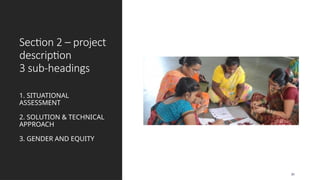
Section 2 – project
description
3 sub-headings
1. SITUATIONAL
ASSESSMENT
2. SOLUTION & TECHNICAL
APPROACH
3. GENDER AND EQUITY
30
Section 3 project
conformity to grant
criteria
3 sub-headings
1. sustainability
2. capacity building
3. best practice
31
Section 4 institutional
capabilities & past
performance
2 sub-headings
1. organisational capacity
2. past performance
20XX SAMPLE FOOTER TEXT 32
Section 5
management &
staffing
2 sub-headings
1. management
2. staffing
33
Section 6: Budget & Budget Narrative
34
Key lessons I’ve learned and always apply
35
I. If your project
genuinely fits the
criteria on every level
you should apply
2. Thorough
preparation is key
.
3. You need to really
know the community or
project context to write
a convincing proposal
Follow the format
stated (fonts, size,
margins & any other
instructions)
Do not under-
estimate the time
needed to complete
the application
Keep exactly to the
page limit and word
or character count
stated for each
section
Key lessons I’ve learned and always apply
36
7. Always include
verifiable sources, data
& statistics to back up
any narrative or
rationale used.
8. Budgets must be
presented in USD and
appropriate exchange
rates used
.
9. All narrative should be
relevant for each section
and questions
10. Make sure that you
sign and date the
application and follow all
instructions
11. Always include a
final, independent
evaluation in the M&E
section and budget
12. A mid-term
evaluation is mandatory
in these guidelines but
this may differ for other
applications to USAID.
Thank you
© Cheryl Hooper
E: consultancyoptions@live.co.uk
Tel: +44 07898951009
37

fundsforNGOs Doc. training materials for NGOs

  • 1.
    Moving from ConceptNote to Full Proposal for USAID ©Cheryl Hooper
  • 2.
    Hello and aVery Warm Welcome! A full application for USAID builds on the first stage Concept Note. 2
  • 3.
    Learning Outcomes 1. Gain apractical understanding of USAID’s requirements and how to answer specific questions. 2. Increased confidence in how to approach a full proposal. 3
  • 4.
    Full application basic instructions ’Peopleof Excellence go the extra mile to do what’s right’ Joel Osteen 4
  • 5.
    Cover Sheet Fundamentals 5 Deadline Format Follow theformat stated (fonts, size, margins & any other instructions) Page Limits Keep exactly to the page limit and word or character count stated for each section Evidence/ Data Always include verifiable sources, data & statistics to back up any narrative or rationale used. Do not under-estimate the time needed to complete the application
  • 6.
    Cover Sheet Fundamentals 6 Language Currency Budgets mustbe presented in USD and appropriate exchange rates used. Signature Make sure that you sign and date the application and follow all instructions Mid-term Evaluation A mid-term evaluation is mandatory in the guidelines but this may differ for other applications to USAID. Final Evaluation Always include a final, independent evaluation in the M&E section and budget. Applications must be in English
  • 7.
  • 8.
    7 Sections 1. ProjectDescription 2. Situational Assessment 3. Project Conformity to Grant Criteria 4. Institutional Capability & Past Performance 5. Management & Staffing 6. Monitoring, Evaluation & Work plan 7. Budget & Budget Narrative 8
  • 9.
    9 Section 2: situational assessment Clearlystate the problem(s) you are seeking to address. Describe the population with which you propose to work and the local issues and conditions in your project area. Background information must focus only on the specific environment relevant to your project area and the identified problem(s). This information may include cultural, demographic, gender and socio-economic factors related to the development, delivery and sustainability of your project. If relevant, please describe the existing and/or missing infrastructure in the area such as hospitals, outreach personnel, etc. Your situational assessment should be supported by recent data, literature and other verifiable information.
  • 10.
    1. SITUATIONAL ASSESSMENT 2.SOLUTION & TECHNICAL APPROACH 3. GENDER AND EQUITY All 3 elements make up the Project Description with equal weighting! 10
  • 11.
    Situational analysis broken down 1.The problems & challenges that the project seeks to address? 2. Describe the beneficiaries disaggregated by gender, age, disability, etc. 3. The LOCAL issues affected by the problems 4. Cultural, demographic, gender & socio- economic factors 5. Existing and missing infrastructure if relevant 6. HOW the project will address the problems & be sustained 7. Data, facts & evidence to back up 11
  • 12.
    Section 2 Solution &Technical approach Based on the information you provided in the situational assessment and your description of the problem you are seeking to address, clearly state your proposed solution(s). Please provide a clear rationale for the solution(s) based on your situational assessment. Provide a clear and detailed narrative of your project objective(s) and the activities you are proposing to undertake to accomplish your objective(s). This information should be directly related to your Work Plan (see below and Attachment F). If relevant, please include a discussion about how your solution links to local/national health systems. Partnerships should also be identified. 12
  • 13.
    Section 2 Solution &Technical approach Broken Down 1. Your solution to the problem 2. The rationale for your approach 3. The project objectives 4. The project activities 5. Relate answers to the work plan 6. How the solution supports local/national health systems 20XX SAMPLE FOOTER TEXT 13
  • 14.
    14 Provide a descriptionof services currently provided across all levels of society in your project area, including across gender and socio-economic class, and between urban and rural areas. Include a discussion of how your services/benefits are equally accessible and affordable to all populations accessing care. Further describe how you plan to address existing differences, so delivery of care is equitably distributed. If you are proposing a project that will impact policies or other programs, please describe the potential differential impacts that those policies or programs will have, including any unintended negative consequences, and how you plan to address them. Section 2 Gender & equity
  • 15.
    Gender & equity sectionbroken down 1. General description of eye services in the project area across all sections of society, and rural and urban 2. Explanation of how eye services affect gender and socio-economic status 3. How your project will address imbalance and be accessible to all and leave no-one behind 4. Whether the project will impact policies and how you will address this 15
  • 16.
    Section 3 project conformityto grant criteria 1. sustainability 2. capacity building 3. best practice All 3 elements make up the Project Conformity with equal weighting! 16
  • 17.
    Section 3 Sustainability Pleasedescribe how you plan to ensure that your activities continue at a high-quality level beyond the period of funding. 17
  • 18.
    Section 3 BestPractice Please describe how your project incorporates best practices 18
  • 19.
    Innovation: 15 points 2-4pages Clearly describe your innovation, approach to the expansion of global knowledge and/or the identification and dissemination of Best Practices. 19
  • 20.
    Section 4 institutional capabilities& past performance 1. organisational capacity 2. past performance Both elements will be assessed together SAMPLE FOOTER TEXT 20XX 20 This Photo by Unknown Author is licensed under CC BY-SA-NC
  • 21.
    Section 4 OrganisationalCapacity Please describe the resources (human, technical, financial) available to your organization to be able to successfully implement the project within the proposed timeframe and cost. 21
  • 22.
    Section 4 Previous Experiencein the proposed area Please provide a detailed but concise description of your previous or ongoing experience implementing similar activities. If you have been a prior grantee provide a description of the project, major accomplishments and project implementation dates. 22
  • 23.
    Section 5: Managementand Staffing Both elements will be assessed together 23
  • 24.
    Section 5: Managementand staffing Please describe how the proposed project will be effectively managed. Specifically, identify the key personnel and provide the following information for each key personnel position: ◦ Key qualifications of the proposed individual ◦ Roles and responsibilities for each position ◦ Reporting and lines of authority for each position. An organizational chart may be included to illustrate this information. If relevant to your project, describe the relationship between Headquarters offices and country or field offices. ◦ Amount of time that the person will be dedicating to this project ◦ Where the position will be located (in the project country, the United States, a third country) 24
  • 25.
    Section 6: Monitoring & Evaluation(M&E) and Work Plan Please fill in the M&E Plan Template, Attachment C, as required in the narrative section of the plan. Indicators and targets must be realistic given proposed activities, past performance and experience and based on the budget. Information regarding the method(s) of data collection, data storage, review and on-going monitoring are also requested. 20XX SAMPLE FOOTER TEXT 25 This Photo by Unknown Author is licensed under CC BY-NC-ND
  • 26.
    Section 6: Monitoring& Evaluation (M&E) and Work Plan The Work Plan, Attachment D, requires the selection of milestones based on major accomplishments of the project. Please ensure these are realistic and measurable. Activities leading to the completion of each milestone must be detailed in the template. 26
  • 27.
    Section 7: Budget& Budget Narrative Please use the Full Application Budget Template provided in Attachment E to submit your budget. Detailed instructions regarding the completion of the budget template are included in Attachment F: Budget Instructions and Cost Principles. Please provide all cost information in United States Dollars. The cost categories provided are standard and not all may be applicable to your project. You should modify your budget depending on your proposed start and end dates. Applicants must provide a Budget Narrative to explain each line item of the budget (Please refer to Attachment G for a sample Budget Narrative). The budget narrative is limited to three (3) pages. 27
  • 28.
    Recap of Sections 5SECTIONS WHICH HAVE MORE THAN ONE ELEMENT OR QUESTIONS WITHIN QUESTIONS. HAVE YOU ANSWERED EVERYTHING ?! 20XX SAMPLE FOOTER TEXT 28
  • 29.
    Section 1: ProjectSummary A short paragraph of 250 words explaining: What – what is the project? Where – where does it take place? Why – why is the project needed? Who – who will the project benefit and how many? When – when will the project start and the duration What – what is the proposed outcomes and anticipated impact? 29
  • 30.
    Section 2 –project description 3 sub-headings 1. SITUATIONAL ASSESSMENT 2. SOLUTION & TECHNICAL APPROACH 3. GENDER AND EQUITY 30
  • 31.
    Section 3 project conformityto grant criteria 3 sub-headings 1. sustainability 2. capacity building 3. best practice 31
  • 32.
    Section 4 institutional capabilities& past performance 2 sub-headings 1. organisational capacity 2. past performance 20XX SAMPLE FOOTER TEXT 32
  • 33.
    Section 5 management & staffing 2sub-headings 1. management 2. staffing 33
  • 34.
    Section 6: Budget& Budget Narrative 34
  • 35.
    Key lessons I’velearned and always apply 35 I. If your project genuinely fits the criteria on every level you should apply 2. Thorough preparation is key . 3. You need to really know the community or project context to write a convincing proposal Follow the format stated (fonts, size, margins & any other instructions) Do not under- estimate the time needed to complete the application Keep exactly to the page limit and word or character count stated for each section
  • 36.
    Key lessons I’velearned and always apply 36 7. Always include verifiable sources, data & statistics to back up any narrative or rationale used. 8. Budgets must be presented in USD and appropriate exchange rates used . 9. All narrative should be relevant for each section and questions 10. Make sure that you sign and date the application and follow all instructions 11. Always include a final, independent evaluation in the M&E section and budget 12. A mid-term evaluation is mandatory in these guidelines but this may differ for other applications to USAID.
  • 37.
    Thank you © CherylHooper E: consultancyoptions@live.co.uk Tel: +44 07898951009 37

Editor's Notes

  • #2 Sometimes a concept note can be ten pages long and so when you are invited to put forward a full proposal, you may wonder what else you could add to the application that you hadn’t already done in the Concept note without repeating yourself. Start the planning of the final application on the basis that USAID has assessed your idea and principles behind your project and thinks it is good enough to want more information. Therefore, you are more than 50% towards the finish line. The final application is to build on the information you have already provided and to go into more detail.
  • #3 A practical understanding of USAID’s requirements and how to answer specific questions Increased confidence in how to approach a full proposal Today’s training session will help you to gain a practical understanding of USAID’s requirements and how to answer specific questions . It’s not always easy and I don’t have all the answers but what you should get through today’s webinar, is how I would approach a final stage application, and my interpretation of how best to answer the questions. In my last webinar, we looked at developing a concept note for a donor like USAID, and I used the format and questions from a previously published call for proposals to help guide you through the answers. Today, I hope to do the same so that the webinar uses a real application form that was used for a 2nd stage application to USAID, having passed the concept note stage of the application.
  • #4 The purpose of this quote is to remind you that you really need to go the extra mile to stand out amongst the competition. That doesn’t mean filling in your application with lots of facts and figures and rambling narrative. It’s about making sure that every answer you write, is strong, relevant and answers every aspect of the question.
  • #5 So before we begin looking at the typical questions in a full proposal for USAID, let’s cover some fundamentals which if you don’t follow, will affect your chance of success.
  • #6 More things to point out about what is expected at the second stage of the process. (go through the points)
  • #7 You may have already written a project description in the Concept Note. In the full application expect to write a longer description of your project and what the project sets out to achieve or the difference it will make. Remember each application form may be presented slightly differently but let’s just take this tutorial as following the basic principles you are likely to need to adopt for any full USAID proposal. Now you will see from this slide that on this particular application form, you are asked to write the project description and keep to a maximum of 250 words. If I were tackling this section I wouldn’t necessarily just write the same words as in the Concept Note without checking that you have explained the project in the best way possible. 250 words is about 2 paragraphs and as the guidance says there are no points allocated to this section, the purpose of this would be purely to give an Assessor an overview of your project, what is the most significant change it will make and what the problem or challenge the project is responding to? This section needs to excite the Assessor so that from the very start, they can see that the project idea is strong, that it responds to a real need, and that the change you intend to make is not only possible but also sustainable. In addition to this, the basic details fo the project needs to be understood so What is the project? Meaning is it about? Who is it supporting – meaning who are the beneficiaries and how many will be reached; where is the project taking place; why is the project needed and how is it responding to these challenges; and when is it taking place i.e. the duration.
  • #8 In this particular application, there are 7 sections that have the broad headings detailed in the slide but within each section are further criteria that must be addressed. What I’m going to do now, is go through each section in more detail and pull out the main things you would need to think about when writing your answer.
  • #9 This is the guidance under the heading of Situational Assessment. As you will see, there’s a lot of information to take in and a lot of expectations from USAID. What I’ve done is to highlight the important things you need to address in this section. You will see that USAID is interested in local issues and conditions and so your data needs to be localized.
  • #10 Section 2 has a general heading of Project Description but underneath this there are 3 different headings that need to addressed. The situational assessment is an explanation of the social, environmental and political context of the project and the challenges that have emerged as a result; The second heading is your solution to the challenges you identified and the third is about how the project addresses gender and equity to ensue that no one is left behind.
  • #11 Let’s break down how you might answer this section. Because the section description is long and there is a lot of information required. Don’t give the Assessor the chance to mark you down because you haven’t answered every point they were looking for. The best way to ensure that you don’t leave anything out is to break down the section and write a list of each point so that you can make sure that you cover every point that USAID wants you to cover. If you tackle each element of the section in this way you can make sure that your answer is logical and in the sequence that is stated in the section description. You can if you have sufficient space, use these headings and put your answers beneath each heading. If you can’t do that because of lack of space, then use paragraphs to separate the information. Remember when you are describing the problem your project is seeking to address, it is important to put this into the wider national context but then refer specifically to the local area where the project is to take place. For example, if your project is about vocational training for women and girls, you may want to cite national statistics and facts about employment opportunities for women and girls, but then focus specifically on how the wider national problem affects your beneficiary group at the local level and back this up with local data and facts.
  • #12 The important aspect of this section is to make sure that your problem as stated in the previous section, is addressed and the solution you propose is logical, makes sense, and is realistic. USAID want the rationale or in other words, the reason for your approach. The guidance shows that USAID wants a detailed narrative of the project objectives and activities and it is also expecting to see this reflected in the work plan which will be one of the accompanying documents which forms part of the final submission. The main thing to remember here is that if you put in certain activities or objectives then make sure that you include the same in the work plan. You will also see that USAID is interested in seeing how your project links or supports existing infrastructure which in this case is local and or national health systems. This particular example of a full USAID proposal focuses specifically on health because the funding opportunity is based on health, but the main thing to note here is that it is important to demonstrate in your full proposal how your project supports local and national strategies and planning.
  • #13 So once again I’ve broken down this section so that you can see specifically what USAID is looking for. You have already explained the problem your project addresses in the first section of the situational analysis. As before, you can make this section easier to answer by breaking down the guidance and giving answers to each element. So you can begin with solution – for example. This should be a simple explanation of what the project is about and how it provides a solution to the problem you have identified. You can then follow this with the rationale or reason for the approach you have taken. Why is your methodology or approach likely to be more effective than other ideas, is it because you are building on experience and lessons you’ve learned, is it because you have consulted beneficiaries, is it because you have engaged with community leaders to sustain it, or is it a combination of all these things and more. The main thing here is to justify to the assessor why your approach is appropriate, why and how it can be sustained, and why it will create the impact you seek. In the guidance you will see that they have asked for detailed narrative of the project objectives and activities. Therefore, they don’t just want the objectives and activities listed. I would probably approach this by explaining the objectives which you could list, then take each objective, write down why and how it relates to the solution and supports local or national health systems or strategies. You could also write an opening paragraph that explains how the objectives connect and move the project along to achieve its overall goal, then take each objective and go into more detail about why and how it is relevant but keep the language simple and straight forward.
  • #14 This opportunity is about eye care services but remember that for the purposes of training, I am using this as an example of a full USAID full proposal application which follows a typical format if you are invited to apply after a successful concept note. Depending on the specific funding opportunity what is being asked will differ slightly but essentially, even if the explanation changes what USAID requires will be the same. So in Section 2 of the full proposal, one of the headings under Project Description is ‘gender and equity’. So USAID here in this example wants your answer to reflect gender and equity. Let’s take a look at breaking this down once again.
  • #15 Again, break down the guidance to really understand what USAID is looking for and provide a detailed answer under each heading. This section is about understanding the local context and what provision or services are in place. Then assessors want to know, how accessible are the services? Can everybody access the health services equally or are there gaps in provision? If you are poor, do you have the same right of access than somebody who is more privileged? Can people with a disability access services easily and if not, why not? Do women and girls and older people know where and how to access the services? How will your project ensure that you meet all these questions? How will your project address the imbalance of care? Remember, equity means that services should be easily available for all members of the community, and especially the most vulnerable such as children, girls and women, people living with a disability and the elderly. So when you design your project make sure that you take this into consideration and can demonstrate in your answer that your project is fully inclusive and leaves no-one behind.
  • #16 The whole of section 3 comprises information on sustainability and how you will sustain the project after funding ends, capacity building, which is about how you will build capacity in your organisation and a locally either through local partners and or the local community, and finally best practice which is about setting and maintaining standards for high quality service provision.
  • #17 Giving a convincing explanation of how your project will be sustained after the funding period is essential when responding to this section. Remember USAID says it isn’t just about sustaining the project but also continuing with activities at a high quality level so you answer needs to reflect not just the sustainability aspect but also the quality of services. This might be connected with training people in the community, it might be about working closely with existing service providers, it might be about recruiting and training volunteers, or it might be about seconding retired health professionals. Whatever you decide is the best way to maintain high quality services and enable them to continue after the grant ends, make sure that your answer is sufficiently detailed and convincing. It won’t be enough to just mention things or not provide a level of detail that proves you have thought this through properly.
  • #18 Remember the reference to continuing high quality services in the sustainability section earlier? Well this continues with the theme and so your answer should focus on how your project will set standards and incorporate best practice. To strengthen your answer, think about lessons that you have learned from previous interventions and how you might set standards for high quality service delivery, might this be through refresher training, or accreditation, or might it include additional services that current providers do not offer such as psych social support. Also quality might also be reflected in how your project makes services inclusive and accessible for everybody including those users who may have a disability. Other things might include ensuring that correct signage in different languages is available, an interpretation service and other things. At the end of the day, I’m trying to demonstrate how you can add value to your project and the different things you might offer which incorporate best practice and standard setting for high quality delivery.
  • #19 This section has a weighting of 15 points which is the same weighting score as all other narrative sections, therefore it might sound obvious but it is as important as every other section. This section is about understanding why and how your project is innovative but more importantly, what have you learned from previous projects and how has this informed the development of this particular project. It’s a complicated section and so the best way to tackle this is to break it down and then answer each element. For example, think about other projects you have developed or worked on, what was the key learning from these? How can you apply the lessons learned to the design of the project you are applying for? How will this knowledge be shared and disseminated. Be careful not to repeat yourself by saying the same things as in previous answers. Try and keep your answer relevant to each particular heading.
  • #20 This section is all about proving to USAID that your NGO has the capacity and experience required to implement the project and deliver the proposed outcomes and anticipated impact. Assessors are not just wanting to hear that you are capable of delivering and achieving your planned outcomes, they also want evidence that you have successfully done this before. Make sure that you do not undersell the expertise and skills within your NGO. Often NGOs take for granted the work they do and do not fully explain their achievements. If you haven’t had a big grant before, remember if you have got this far in the selection process you can be sure that USAID is interested in your project. This section is to reassure them that you have the capacity and capability to deliver what you promise so it’s good to focus on outcomes and demonstrate the changes and impact your work has made but be sure to back this up with evidence as much as possible.
  • #21 Whilst your project proposal may be strong, if the Assessor is not convinced that your NGO has the capacity and capability of delivering the proposed outcomes, then you will be marked down. This is a crucial element of the full application and so you need to make sure that you can prove that you have the resources and capacity as well as skills and experience required. Therefore with this section because it has been broken down, don’t make the mistake of writing about your experience here. Focus on what the guidance is asking for which is the human, technical and financial resources available to successfully implement the project. In this section you can refer to the implementing team, and demonstrate that they are integral to the project design and the skills they have; technical resources might refer to your approach to M&E; financial could include your ability to manage the grant, the financial reporting and ensuring transparency. This section needs to reassure the assessor that USAID’s investment will be safe and that the grant will be managed correctly and to the highest standards.
  • #22 The first sentence in the guidance uses the word ‘concise’ this means that USAID is not looking for a long, rambling answer to this question. The assessor wants to see that you have the ability to deliver what you promise and whilst the previous answer was about the skills and expertise of your implementing team and how you would manage the grant, this section is about evidence. Even if you haven’t has a USAID grant before, you can still use examples of other projects that you have successfully managed and where the outcomes and impact are proven. So if you have been successfully working in the relevant field and have some practical outcomes of your work, then this is the section to say your achievements. Don’t hold back here and be shy, its important to show the assessor that you know what you are talking about. For example, you could say your NGO has been working in the field of health prevention for more than 10 years, that during that time you have successfully delivered a vaccination programme to xx communities, reaching xx women and girls etc. Whatever you say, make sure that it is relevant and helps endorse your expertise in the area of your project application.
  • #23 This section is all about proving to USAID that your NGO has the capacity and experience required to implement the project and deliver the proposed outcomes and anticipated impact.
  • #24 The Assessor will be looking for a logical easy to understand explanation of how the project will be managed and who is doing what. Imagine somebody assessing a multi year programme, they won’t want to know every detail of all staff but they do need a realistic feel for the staffing, which of course will also be reflected in the work plan. Therefore think about the key functions that would be required to not only deliver your project, but also manage it and evaluate its progress and outcomes. I would attempt this section with an overview paragraph that explains how the project is structured and then go into the key functions and associated staffing. For example, your overview might be something like, ‘This 3 year programme will be implemented by our local partner who will be responsible for implementation at a local level. Key areas of responsibility are etc. then you can explain your role. Be sure to explain who is the lead partner and who will be responsible for reporting to USAID not just on the outcomes but also the financial monitoring and reporting against expenditure. Be careful to answer each bullet point but you can do this succinctly by just giving the key information required, for example: programme manager Masters degree in international development; responsible for overall management of the implementing team ensuring delivery of programme outcomes against the work plan. LOE 100% full time based in and so on..
  • #25 Section 6 focuses on 2 things. Firstly the M&E and how you will monitor the project, and then secondly the work plan which should explain how you will deliver and manage the project. Most full applications for USAID have an M&E template which needs to be filled in. I think this is better than you being asked to write an M&E plan as all answers and the format will be standardized. So let’s focus on what they are looking for. When you begin planning how you will monitor and evaluate your project, you need to begin with your project objectives. You will already have identified these as part of the project design but you can change them in the final application as long as the outcomes are the same and they are not too far from the original ones in your concept note. For example, you might want to strengthen them a bit, or change the wording slightly. Anyway, agree your project objectives and keep them as simple and as straightforward as possible. I would usually think about the outcomes you want to achieve as a result of your project and then set the objectives that will help you achieve the outcomes. If you keep to a maximum of 4 objectives you will probably find that linking indicators to the objectives will be easier. Don’t be overly ambitious here, make sure that the project objectives are realistic, achievable and can be tracked. Then develop indicators against each objective which are relevant and meaningful. The indicators are the markers which will help you not only track the progress of the project against the workplan and set activities, but they will also help you to understand what is working and what isn’t. Don’t forget to put in a baseline in the M&E plan so that you have something to measure against. Include the method of data collection, the frequency and who will be responsible for this.
  • #26 In this full proposal application, the work plan has to include a selection of milestones and so again I would go back to the objectives and decide what would be a key milestone that can be a guide or a bench mark that you are working towards. So when doing the work plan, decide on the key milestones and the time line for each milestone for the duration of the project. For example, some milestones might be spread across the duration of the project and at different times. Once you have identified them, you can put in the relevant activities, key staff responsible for delivering the activities, the reporting timeline and the delivery or implementation time line. Think of it as a visual table of your project sot aht the whole project is clearly laid out with clear objectives, key milestones, activities, timeline and key personnel and all these need to feed into the M&E plan.
  • #27 And finally we get to the Budget Section. The main thing to be sure about is that you follow the guidance closely and have a clear understanding of what is allowed and what USAID will not pay for. Usually there is guidance on salaries and how to lay out or separate salaries, pensions and other on-costs but just follow what is required. Cost principals will include things like travel allowances, per diams and how much you can include for overheads and administration. In some applications, I have known USAID to want to understand the proportion of office space required to manage and operate the project. So for example rather than include the entire rent and utilities for your NGO, you would be expected to work out the proportionate costs and include them. Make sure that you include an explanation or narrative against the different budget lines so that the assessor can understand your thinking. And remember, make sure that you keep your project budget in proportion to the size and experience of your NGO. If the maximum grant is £500k for example, and you are a small NGO which has never managed a USAID grant, I would be careful to make sure that your project and budget reflects the size and capacity of your NGO. Also, one tip I would give is to produce the full budget in a separate internal budget where you can include more narrative and workings on why certain figures are included, then transpose this on to the USAID template.
  • #28 Let’s remind ourselves of what I said earlier. In this particular example of a full application for USAID there are 5 sections in the full proposal and each one has a number of sub-headings that must be addressed.
  • #29 This is the first thing an assessor will read and it will set the tone of the application and should ‘sell’ the idea so that the assessor is keen to know more. Therefore even though there aren’t any points allocated to this, it is an important section and you should make it as strong as possible.
  • #30 Make sure that you provide facts, figures and statistics to back up your case for support; you can explain the national situation to give the broader picture but you must demonstrate what the situation is like locally where your project takes place; solution and technical approach refers to how the project responds to the challenges you describe and why and how your method is the most appropriate. Gender equity and leaving no one behind is essential and so you must demonstrate how the project is designed to support all members of the community and especially those who are most vulnerable, and to strengthen the answer you might want to say how many girls or other vulnerable groups will benefit.
  • #31 This section is about setting standards and demonstrating the quality and added value of the project; how it is designed on best practice, how it strengthens local communities, and how it will continue after the grant period comes to an end.
  • #32 Section 4 is about your capability and experience as an NGO to deliver the promised outcomes and ability to manage the grant with robust systems in place for financial reporting and monitoring outcome.s
  • #33 Section 5 should be where you can prove the expertise of your staff team and ability to deliver.
  • #34 Section 6 is the budget and budget narrative. The narrative is important here because it is to show USAID your thinking and how the budget has been worked out. Remember that you should explain clearly how certain costs have been worked out and aim to demonstrate effectiveness, equity, efficiency, and value for money. For example you may have a cost against training and this cost decreases in year 2 of a project because it might be refresher training and not as long, the main thing is to try and explain this in the narrative.
  • #35 So here I’ve listed some key lessons that I have learned over the years (read bullets)