CEO Regression Analysis.1
Jay Gajjar, BS Accounting, School of Business Administration, Philadelphia University, School
House Lane and Henry Ave, Philadelphia, PA 19144
Email: gajjar2908@mail.philau.edu; Phone: 215-360-8076
Matthew Jacques, Add Here Saint Joseph's University, City Ave, Philadelphia, PA 19131
Email: mj582744@sju.edu; Phone: Add Here
Abstract
In the report, we decided to look at the determinants of CEO compensation and test if company
performance had an impact in determining compensation. There have been many analyses on the
relation between the CEO salary and the risks CEOs take; but in our study we wanted to see if
risk factors were the only determinants of salary or if company performance have a major impact
as well. We collected data from the 30 Dow Jones companies over a 4-year time frame from
2008-2011 to determine if company performance had an impact on salary. We chose to stack the
data from 2008-2011 to examine the impact the recession had on the company’s performance
and how that affected CEO salary. The determinants we found to be significant were; age,
revenue, return on asset, average stock price, earning per-share, and company tenure. After
conducting the regression analysis we discovered that company performance had a significant
impact in determining CEO compensation.
1
Mentor: Dr. Anusua Datta, Associate Professorof Economics,School of BusinessAdministration,
PhiladelphiaUniversity,School House Lane andHenryAve,Philadelphia,PA 19144; Email:
Dattaa@philau.edu;Phone:215-951-2810; Fax: 215- 951-2652
Jacques& Gajjar 1
I. Introduction
From 1978 to 2011, CEO compensation increased more than 725 percent, an increase that
is substantially larger than the increase in worker pay of 5.7 percent (Waldron, 2012). Compared
to other company employees, CEOs make 202.3 times more than the average worker, which
indicates that they are considered to be more valuable. This begs the question of; how do
companies compensate CEOs for their valuable work? In addition, what factors contribute to
these CEO’s salaries? To answer this question, a statistical analysis of 30 companies and their
previous CEO's from 2008-2011 will be conducted to examine the factors that link CEO
compensation and performance. Explanatory variables such as: company tenure, age, return on
assets, earnings pre-share, revenue, and stock prices will be examined.
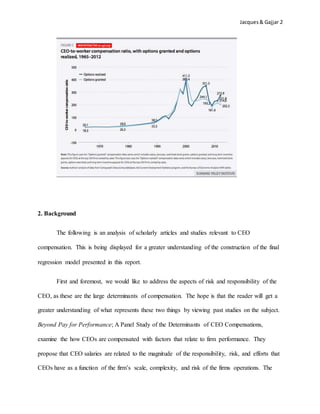
The graph below show the relation between CEO compansation and average worker
salaries. The graph illustrates that since the 1970s CEO pay has been increaing, until the the
early 2000s where there is a drop in pay and in 2008 when the recession occured. This graph also
poses a question; Why do CEO’s get paid almost 203 times more than average workers. We
believe that looking at the data from 2008-2011 will make our model insufficent for prediction,
but it will indicate if preformance is significant in determining CEO pay.
Jacques& Gajjar 2
2. Background
The following is an analysis of scholarly articles and studies relevant to CEO
compensation. This is being displayed for a greater understanding of the construction of the final
regression model presented in this report.
First and foremost, we would like to address the aspects of risk and responsibility of the
CEO, as these are the large determinants of compensation. The hope is that the reader will get a
greater understanding of what represents these two things by viewing past studies on the subject.
Beyond Pay for Performance; A Panel Study of the Determinants of CEO Compensations,
examine the how CEOs are compensated with factors that relate to firm performance. They
propose that CEO salaries are related to the magnitude of the responsibility, risk, and efforts that
CEOs have as a function of the firm’s scale, complexity, and risk of the firms operations. The
Jacques& Gajjar 3
variables that were used by Cordeior and Veliyath were return on assets, sales, CEO duality, and
CEO Tenure. The authors mainly set out to test if what other factors other than performance
impact CEO compensation; they concluded that one of the biggest factors that affect
compensation is the responsibility of the CEO and the riskiness of the industry. To account for
responsibility Cordeior and Veliyath used the same variable that would account for performance
like CEO tenure. CEO tenure was used to represent responsibility because they concluded that
the higher the tenure the more responsibility the CEO has. Riskiness was represented by
variables like accounting performance and total risk in the industry. These variables represent the
ability of the CEO in a high-risk industry and the impact that has on CEO compensation
Many experts like who consult companies to help set CEO compensation, believe that
certain factors should be taken in account to set CEO salaries (Leckie & Rodda 2012). These key
considerations are; company performance, individual performance, alignment with pay decisions
for other executives, market size, external messaging, and internal messaging. Company
performance, personal performance, and market size are three of the most important factors that
should be taken in account when setting CEO compensation (Leckie & Rodda 2012). If the
company is not doing well or the CEO is not making decisions in the best interest of the
shareholders the stock holders will sell their stocks and cause the company to be undervalued
and affect their market size (Finkelstein & Boyd 1998).
According to Finkelstein and Boyd (1998), CEOs have to make judgments such as
closing locations and increasing budget to the research and development department, which
impact the entire company. However, all decisions that CEOs and the board of directors make
must aim at creating value for the shareholders as well as insuring that companies provide CEO
salary that compensates them for the level of decision they make. Providing high compensations
Jacques& Gajjar 4
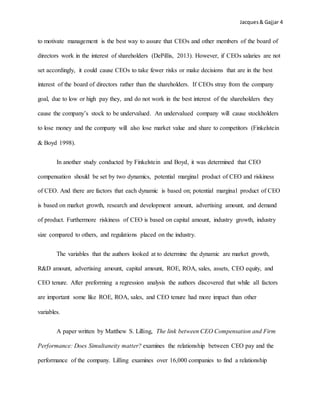
to motivate management is the best way to assure that CEOs and other members of the board of
directors work in the interest of shareholders (DePillis, 2013). However, if CEOs salaries are not
set accordingly, it could cause CEOs to take fewer risks or make decisions that are in the best
interest of the board of directors rather than the shareholders. If CEOs stray from the company
goal, due to low or high pay they, and do not work in the best interest of the shareholders they
cause the company’s stock to be undervalued. An undervalued company will cause stockholders
to lose money and the company will also lose market value and share to competitors (Finkelstein
& Boyd 1998).
In another study conducted by Finkelstein and Boyd, it was determined that CEO
compensation should be set by two dynamics, potential marginal product of CEO and riskiness
of CEO. And there are factors that each dynamic is based on; potential marginal product of CEO
is based on market growth, research and development amount, advertising amount, and demand
of product. Furthermore riskiness of CEO is based on capital amount, industry growth, industry
size compared to others, and regulations placed on the industry.
The variables that the authors looked at to determine the dynamic are market growth,
R&D amount, advertising amount, capital amount, ROE, ROA, sales, assets, CEO equity, and
CEO tenure. After preforming a regression analysis the authors discovered that while all factors
are important some like ROE, ROA, sales, and CEO tenure had more impact than other
variables.
A paper written by Matthew S. Lilling, The link between CEO Compensation and Firm
Performance: Does Simultaneity matter? examines the relationship between CEO pay and the
performance of the company. Lilling examines over 16,000 companies to find a relationship
Jacques& Gajjar 5
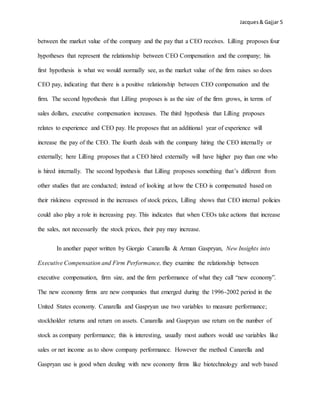
between the market value of the company and the pay that a CEO receives. Lilling proposes four
hypotheses that represent the relationship between CEO Compensation and the company; his
first hypothesis is what we would normally see, as the market value of the firm raises so does
CEO pay, indicating that there is a positive relationship between CEO compensation and the
firm. The second hypothesis that Lilling proposes is as the size of the firm grows, in terms of
sales dollars, executive compensation increases. The third hypothesis that Lilling proposes
relates to experience and CEO pay. He proposes that an additional year of experience will
increase the pay of the CEO. The fourth deals with the company hiring the CEO internally or
externally; here Lilling proposes that a CEO hired externally will have higher pay than one who
is hired internally. The second hypothesis that Lilling proposes something that’s different from
other studies that are conducted; instead of looking at how the CEO is compensated based on
their riskiness expressed in the increases of stock prices, Lilling shows that CEO internal policies
could also play a role in increasing pay. This indicates that when CEOs take actions that increase
the sales, not necessarily the stock prices, their pay may increase.
In another paper written by Giorgio Canarella & Arman Gaspryan, New Insights into
Executive Compensation and Firm Performance, they examine the relationship between
executive compensation, firm size, and the firm performance of what they call “new economy”.
The new economy firms are new companies that emerged during the 1996-2002 period in the
United States economy. Canarella and Gaspryan use two variables to measure performance;
stockholder returns and return on assets. Canarella and Gaspryan use return on the number of
stock as company performance; this is interesting, usually most authors would use variables like
sales or net income as to show company performance. However the method Canarella and
Gaspryan use is good when dealing with new economy firms like biotechnology and web based
Jacques& Gajjar 6
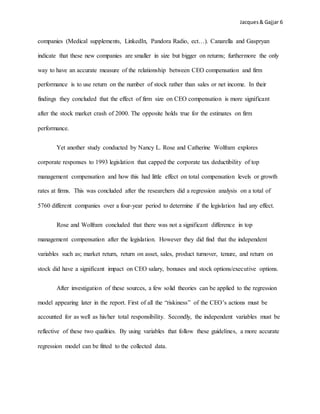
companies (Medical supplements, LinkedIn, Pandora Radio, ect…). Canarella and Gaspryan
indicate that these new companies are smaller in size but bigger on returns; furthermore the only
way to have an accurate measure of the relationship between CEO compensation and firm
performance is to use return on the number of stock rather than sales or net income. In their
findings they concluded that the effect of firm size on CEO compensation is more significant
after the stock market crash of 2000. The opposite holds true for the estimates on firm
performance.
Yet another study conducted by Nancy L. Rose and Catherine Wolfram explores
corporate responses to 1993 legislation that capped the corporate tax deductibility of top
management compensation and how this had little effect on total compensation levels or growth
rates at firms. This was concluded after the researchers did a regression analysis on a total of
5760 different companies over a four-year period to determine if the legislation had any effect.
Rose and Wolfram concluded that there was not a significant difference in top
management compensation after the legislation. However they did find that the independent
variables such as; market return, return on asset, sales, product turnover, tenure, and return on
stock did have a significant impact on CEO salary, bonuses and stock options/executive options.
After investigation of these sources, a few solid theories can be applied to the regression
model appearing later in the report. First of all the “riskiness” of the CEO’s actions must be
accounted for as well as his/her total responsibility. Secondly, the independent variables must be
reflective of these two qualities. By using variables that follow these guidelines, a more accurate
regression model can be fitted to the collected data.
Jacques& Gajjar 7
II. Regression Model
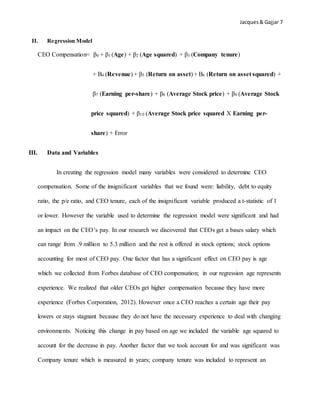
CEO Compensation= β0 + β1 (Age) + β2 (Age squared) + β3 (Company tenure)
+ Β4 (Revenue) + β5 (Return on asset) + Β6 (Return on asset squared) +
β7 (Earning per-share) + β8 (Average Stock price) + β9 (Average Stock
price squared) + β10 (Average Stock price squared X Earning per-
share) + Error
III. Data and Variables
In creating the regression model many variables were considered to determine CEO
compensation. Some of the insignificant variables that we found were: liability, debt to equity
ratio, the p/e ratio, and CEO tenure, each of the insignificant variable produced a t-statistic of 1
or lower. However the variable used to determine the regression model were significant and had
an impact on the CEO’s pay. In our research we discovered that CEOs get a bases salary which
can range from .9 million to 5.3 million and the rest is offered in stock options; stock options
accounting for most of CEO pay. One factor that has a significant effect on CEO pay is age
which we collected from Forbes database of CEO compensation; in our regression age represents
experience. We realized that older CEOs get higher compensation because they have more
experience (Forbes Corporation, 2012). However once a CEO reaches a certain age their pay
lowers or stays stagnant because they do not have the necessary experience to deal with changing
environments. Noticing this change in pay based on age we included the variable age squared to
account for the decrease in pay. Another factor that we took account for and was significant was
Company tenure which is measured in years; company tenure was included to represent an
Jacques& Gajjar 8
individual’s performance in the company before the CEO position. The longer an individual is in
the company the higher the performance will be once the individual become a CEO; this was
also included to represent the CEOs comprehension of the internal affairs of a CEO. We
discovered that when a CEO is with a company for many years the pay is higher (Forbes
Corporation, 2012). However CEO tenure was not significant, years of holding the CEO position
did not matter as much as being in a company for many years. Company tenure was collected
from Forbes and Executive pay info.
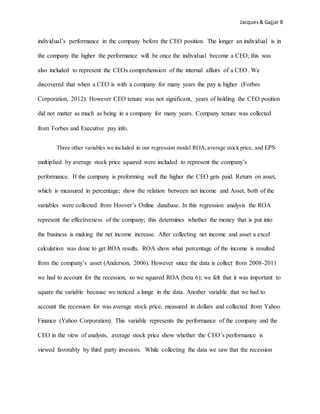
Three other variables we included in our regression model ROA,average stock price, and EPS
multiplied by average stock price squared were included to represent the company’s
performance. If the company is preforming well the higher the CEO gets paid. Return on asset,
which is measured in percentage; show the relation between net income and Asset, both of the
variables were collected from Hoover’s Online database. In this regression analysis the ROA
represent the effectiveness of the company; this determines whether the money that is put into
the business is making the net income increase. After collecting net income and asset a excel
calculation was done to get ROA results. ROA show what percentage of the income is resulted
from the company’s asset (Anderson, 2006). However since the data is collect from 2008-2011
we had to account for the recession, so we squared ROA (beta 6); we felt that it was important to
square the variable because we noticed a lunge in the data. Another variable that we had to
account the recession for was average stock price, measured in dollars and collected from Yahoo
Finance (Yahoo Corporation). This variable represents the performance of the company and the
CEO in the view of analysts, average stock price show whether the CEO’s performance is
viewed favorably by third party investors. While collecting the data we saw that the recession
Jacques& Gajjar 9
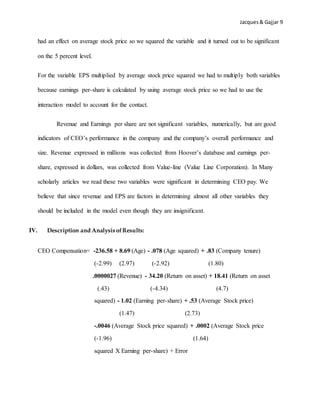
had an effect on average stock price so we squared the variable and it turned out to be significant
on the 5 percent level.
For the variable EPS multiplied by average stock price squared we had to multiply both variables
because earnings per-share is calculated by using average stock price so we had to use the
interaction model to account for the contact.
Revenue and Earnings per share are not significant variables, numerically, but are good
indicators of CEO’s performance in the company and the company’s overall performance and
size. Revenue expressed in millions was collected from Hoover’s database and earnings per-
share, expressed in dollars, was collected from Value-line (Value Line Corporation). In Many
scholarly articles we read these two variables were significant in determining CEO pay. We
believe that since revenue and EPS are factors in determining almost all other variables they
should be included in the model even though they are insignificant.
IV. Description and Analysis ofResults:
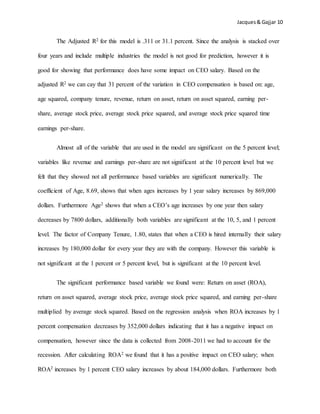
CEO Compensation= -236.58 + 8.69 (Age) - .078 (Age squared) + .83 (Company tenure)
(-2.99) (2.97) (-2.92) (1.80)
.0000027 (Revenue) - 34.20 (Return on asset) + 18.41 (Return on asset
(.43) (-4.34) (4.7)
squared) - 1.02 (Earning per-share) + .53 (Average Stock price)
(1.47) (2.73)
-.0046 (Average Stock price squared) + .0002 (Average Stock price
(-1.96) (1.64)
squared X Earning per-share) + Error
Jacques& Gajjar 10
The Adjusted R2 for this model is .311 or 31.1 percent. Since the analysis is stacked over
four years and include multiple industries the model is not good for prediction, however it is
good for showing that performance does have some impact on CEO salary. Based on the
adjusted R2 we can cay that 31 percent of the variation in CEO compensation is based on: age,
age squared, company tenure, revenue, return on asset, return on asset squared, earning per-
share, average stock price, average stock price squared, and average stock price squared time
earnings per-share.
Almost all of the variable that are used in the model are significant on the 5 percent level;
variables like revenue and earnings per-share are not significant at the 10 percent level but we
felt that they showed not all performance based variables are significant numerically. The
coefficient of Age, 8.69, shows that when ages increases by 1 year salary increases by 869,000
dollars. Furthermore Age2 shows that when a CEO’s age increases by one year then salary
decreases by 7800 dollars, additionally both variables are significant at the 10, 5, and 1 percent
level. The factor of Company Tenure, 1.80, states that when a CEO is hired internally their salary
increases by 180,000 dollar for every year they are with the company. However this variable is
not significant at the 1 percent or 5 percent level, but is significant at the 10 percent level.
The significant performance based variable we found were: Return on asset (ROA),
return on asset squared, average stock price, average stock price squared, and earning per-share
multiplied by average stock squared. Based on the regression analysis when ROA increases by 1
percent compensation decreases by 352,000 dollars indicating that it has a negative impact on
compensation, however since the data is collected from 2008-2011 we had to account for the
recession. After calculating ROA2 we found that it has a positive impact on CEO salary; when
ROA2 increases by 1 percent CEO salary increases by about 184,000 dollars. Furthermore both
Jacques& Gajjar 11
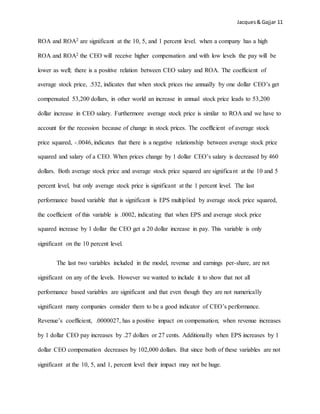
ROA and ROA2 are significant at the 10, 5, and 1 percent level. when a company has a high
ROA and ROA2 the CEO will receive higher compensation and with low levels the pay will be
lower as well; there is a positive relation between CEO salary and ROA. The coefficient of
average stock price, .532, indicates that when stock prices rise annually by one dollar CEO’s get
compensated 53,200 dollars, in other world an increase in annual stock price leads to 53,200
dollar increase in CEO salary. Furthermore average stock price is similar to ROA and we have to
account for the recession because of change in stock prices. The coefficient of average stock
price squared, -.0046, indicates that there is a negative relationship between average stock price
squared and salary of a CEO. When prices change by 1 dollar CEO’s salary is decreased by 460
dollars. Both average stock price and average stock price squared are significant at the 10 and 5
percent level, but only average stock price is significant at the 1 percent level. The last
performance based variable that is significant is EPS multiplied by average stock price squared,
the coefficient of this variable is .0002, indicating that when EPS and average stock price
squared increase by 1 dollar the CEO get a 20 dollar increase in pay. This variable is only
significant on the 10 percent level.
The last two variables included in the model, revenue and earnings per-share, are not
significant on any of the levels. However we wanted to include it to show that not all
performance based variables are significant and that even though they are not numerically
significant many companies consider them to be a good indicator of CEO’s performance.
Revenue’s coefficient, .0000027, has a positive impact on compensation; when revenue increases
by 1 dollar CEO pay increases by .27 dollars or 27 cents. Additionally when EPS increases by 1
dollar CEO compensation decreases by 102,000 dollars. But since both of these variables are not
significant at the 10, 5, and 1, percent level their impact may not be huge.
Jacques& Gajjar 12
V. Conclusion
We believe that our model is not good for prediction but it is good in showing that
performance does have an impact on determining CEO compensation. Factors like return on
asset, average stock price, revenue, and earnings per-share are good indicators of
performance and most of them were significant. Collecting the data on the companies during
the recession time period gave us a better understanding of the factors that were really
significant. When compensation data is collected during times of growth and stability in the
market, we believe, it does not show what really determines a CEO’s pay since their pay will
keep on increasing during the time period. But when compensation is look at during a
recession or a down-turn, determinates of CEO pay really stand out. We collected data on
many other variables which were really insignificant; variables like asset, liability, owners’
equity produced many insignificant values. Other variables like P/E ratio, Liability/Equity
ratio also produced insignificant results. However the most astonishing result came from
CEO tenure; when looked at CEO tenure was really insignificant but Company tenure was
which was unexpected. In conclusion our model is not good for predicting but is god for
testing the relevancy of performance on CEO compensation.
Bibliography
Anderson,A.(2006). Company Overviews.RetrievedNovember2013, from Hoover's:A D&B company:
http://ezproxy.philau.edu:3760/H/company360/overview.html?companyId=10796000000000
DePillis,L.(2013, June 26). Congrats,CEOs!You’remaking 273 times thepay of theaverageworker.
RetrievedfromWashingtonPost:http://www.washingtonpost.com/
Finkelstein,B.(1998). How Much Deosthe CEO Matter? The Role of Managerial DiscretioninSettingof
CEO Compensation. Academy f ManagementJournal,pp.179-199.
Jacques& Gajjar 13
ForbesCorporation.(2012). Americas Higest Paid CEOs.RetrievedOctober2013, fromForbes:
http://www.forbes.com/lists/2012/12/ceo-compensation-12_rank.html
Rodda,A. L. (n.d.). Setting CEOCompensation. RetrievedfromNYSEGovernance Services:Corporate
Board Members:https://www.boardmember.com
Value Line Corporation.(n.d.).Research Hub.RetrievedNovember2013, fromValue Line:
http://ezproxy.philau.edu:2872/secure/vlispdf/stk5000/index.aspx
Waldron,T. (2012, May 3). Study:CEO Pay Increased FasterThan WorkerPay Over Last30 Years.
RetrievedfromThinkProcess:http://www.thinkprocess.com
Yahoo Corporation.(n.d.). Yahoo Finance.RetrievedNovember2013, fromYahoo:
http://finance.yahoo.com/
Rose, N. L. (1998). Regulating Executive Pay: Using the Tax Code to Influence Chief Executive Officer
Compensation. National Bureau of Economic Research.
Crumley,C.R.(2006). A study of the relationship between firmperformanceand CEOcompensation in
the United Statescommercial banking industry (Master'sthesis,NovaSoutheasternUniversity,
2006) (pp.1-256).
Appendix 1: Variables and their descriptions
Variable Name Definition Units Data Source
Age The age of the CEO Number of years Forbes.com
Age2 CEO age multiplied
by CEO age.
Number of years
Company Tenure The number of years a
individual is with the
company
Number of Years Forbes.com
ExecutivePay.info
ROA The calculation of Net
income divided by
total Asset
Percentage Hover’s Online
database.
Jacques& Gajjar 14
ROA2 ROA multiplied by
ROA
Percentage
Average Stock Price The annual average
stock price of the
company
Dollar amount Finance.yahoo.com
Average Stock Price2 The calculation of
average stock price
multiplied by average
stock price.
Dollar amount
Revenue Total income for a
company before taxes
and expenses
Measured in Millions
of dollars
Hoover’s online
database
Earnings per-share Total net income
divided by shares out
standing
Measured in dollars Value line
Earnings per-share
multiplied by Average
stock price
The calculation of
EPS multiplied by the
annual average stock
price of the company
Measured in dollars
Appendix 2: Hypothesis Test
Jacques& Gajjar 15
Ho: βi = 0 (I= 0,1,2,3,4,5,6,7,8,9,10)
Ha: βi ≠ 0
Beta Variable T-stat 10% (1.645) 5% (1.960) 1% (2.58)
0 Intecept -2.99 reject reject reject
1 Age 2.97 reject reject reject
2 Age2 -2.92 reject reject reject
3 Company
Tenure
1.80 reject Accept Accept
5 ROA -4.34 reject reject Reject
6 ROA2 4,70 reject reject Reject
8 Average Stock
Price
2.73 reject reject Reject
9
Average Stock
Price2
-1.96 reject Accept Accept
4 Revenue .43 Accept Accept Accept
7 Earnings per-
share
1.47 Accept Accept Accept
Jacques& Gajjar 16
10 Earnings per-
share
multiplied by
Average stock
price
1.64 reject Accept Accept

CEO Regression Analysis

  • 1.
    CEO Regression Analysis.1 JayGajjar, BS Accounting, School of Business Administration, Philadelphia University, School House Lane and Henry Ave, Philadelphia, PA 19144 Email: gajjar2908@mail.philau.edu; Phone: 215-360-8076 Matthew Jacques, Add Here Saint Joseph's University, City Ave, Philadelphia, PA 19131 Email: mj582744@sju.edu; Phone: Add Here Abstract In the report, we decided to look at the determinants of CEO compensation and test if company performance had an impact in determining compensation. There have been many analyses on the relation between the CEO salary and the risks CEOs take; but in our study we wanted to see if risk factors were the only determinants of salary or if company performance have a major impact as well. We collected data from the 30 Dow Jones companies over a 4-year time frame from 2008-2011 to determine if company performance had an impact on salary. We chose to stack the data from 2008-2011 to examine the impact the recession had on the company’s performance and how that affected CEO salary. The determinants we found to be significant were; age, revenue, return on asset, average stock price, earning per-share, and company tenure. After conducting the regression analysis we discovered that company performance had a significant impact in determining CEO compensation. 1 Mentor: Dr. Anusua Datta, Associate Professorof Economics,School of BusinessAdministration, PhiladelphiaUniversity,School House Lane andHenryAve,Philadelphia,PA 19144; Email: Dattaa@philau.edu;Phone:215-951-2810; Fax: 215- 951-2652
  • 2.
    Jacques& Gajjar 1 I.Introduction From 1978 to 2011, CEO compensation increased more than 725 percent, an increase that is substantially larger than the increase in worker pay of 5.7 percent (Waldron, 2012). Compared to other company employees, CEOs make 202.3 times more than the average worker, which indicates that they are considered to be more valuable. This begs the question of; how do companies compensate CEOs for their valuable work? In addition, what factors contribute to these CEO’s salaries? To answer this question, a statistical analysis of 30 companies and their previous CEO's from 2008-2011 will be conducted to examine the factors that link CEO compensation and performance. Explanatory variables such as: company tenure, age, return on assets, earnings pre-share, revenue, and stock prices will be examined. The graph below show the relation between CEO compansation and average worker salaries. The graph illustrates that since the 1970s CEO pay has been increaing, until the the early 2000s where there is a drop in pay and in 2008 when the recession occured. This graph also poses a question; Why do CEO’s get paid almost 203 times more than average workers. We believe that looking at the data from 2008-2011 will make our model insufficent for prediction, but it will indicate if preformance is significant in determining CEO pay.
  • 3.
    Jacques& Gajjar 2 2.Background The following is an analysis of scholarly articles and studies relevant to CEO compensation. This is being displayed for a greater understanding of the construction of the final regression model presented in this report. First and foremost, we would like to address the aspects of risk and responsibility of the CEO, as these are the large determinants of compensation. The hope is that the reader will get a greater understanding of what represents these two things by viewing past studies on the subject. Beyond Pay for Performance; A Panel Study of the Determinants of CEO Compensations, examine the how CEOs are compensated with factors that relate to firm performance. They propose that CEO salaries are related to the magnitude of the responsibility, risk, and efforts that CEOs have as a function of the firm’s scale, complexity, and risk of the firms operations. The
  • 4.
    Jacques& Gajjar 3 variablesthat were used by Cordeior and Veliyath were return on assets, sales, CEO duality, and CEO Tenure. The authors mainly set out to test if what other factors other than performance impact CEO compensation; they concluded that one of the biggest factors that affect compensation is the responsibility of the CEO and the riskiness of the industry. To account for responsibility Cordeior and Veliyath used the same variable that would account for performance like CEO tenure. CEO tenure was used to represent responsibility because they concluded that the higher the tenure the more responsibility the CEO has. Riskiness was represented by variables like accounting performance and total risk in the industry. These variables represent the ability of the CEO in a high-risk industry and the impact that has on CEO compensation Many experts like who consult companies to help set CEO compensation, believe that certain factors should be taken in account to set CEO salaries (Leckie & Rodda 2012). These key considerations are; company performance, individual performance, alignment with pay decisions for other executives, market size, external messaging, and internal messaging. Company performance, personal performance, and market size are three of the most important factors that should be taken in account when setting CEO compensation (Leckie & Rodda 2012). If the company is not doing well or the CEO is not making decisions in the best interest of the shareholders the stock holders will sell their stocks and cause the company to be undervalued and affect their market size (Finkelstein & Boyd 1998). According to Finkelstein and Boyd (1998), CEOs have to make judgments such as closing locations and increasing budget to the research and development department, which impact the entire company. However, all decisions that CEOs and the board of directors make must aim at creating value for the shareholders as well as insuring that companies provide CEO salary that compensates them for the level of decision they make. Providing high compensations
  • 5.
    Jacques& Gajjar 4 tomotivate management is the best way to assure that CEOs and other members of the board of directors work in the interest of shareholders (DePillis, 2013). However, if CEOs salaries are not set accordingly, it could cause CEOs to take fewer risks or make decisions that are in the best interest of the board of directors rather than the shareholders. If CEOs stray from the company goal, due to low or high pay they, and do not work in the best interest of the shareholders they cause the company’s stock to be undervalued. An undervalued company will cause stockholders to lose money and the company will also lose market value and share to competitors (Finkelstein & Boyd 1998). In another study conducted by Finkelstein and Boyd, it was determined that CEO compensation should be set by two dynamics, potential marginal product of CEO and riskiness of CEO. And there are factors that each dynamic is based on; potential marginal product of CEO is based on market growth, research and development amount, advertising amount, and demand of product. Furthermore riskiness of CEO is based on capital amount, industry growth, industry size compared to others, and regulations placed on the industry. The variables that the authors looked at to determine the dynamic are market growth, R&D amount, advertising amount, capital amount, ROE, ROA, sales, assets, CEO equity, and CEO tenure. After preforming a regression analysis the authors discovered that while all factors are important some like ROE, ROA, sales, and CEO tenure had more impact than other variables. A paper written by Matthew S. Lilling, The link between CEO Compensation and Firm Performance: Does Simultaneity matter? examines the relationship between CEO pay and the performance of the company. Lilling examines over 16,000 companies to find a relationship
  • 6.
    Jacques& Gajjar 5 betweenthe market value of the company and the pay that a CEO receives. Lilling proposes four hypotheses that represent the relationship between CEO Compensation and the company; his first hypothesis is what we would normally see, as the market value of the firm raises so does CEO pay, indicating that there is a positive relationship between CEO compensation and the firm. The second hypothesis that Lilling proposes is as the size of the firm grows, in terms of sales dollars, executive compensation increases. The third hypothesis that Lilling proposes relates to experience and CEO pay. He proposes that an additional year of experience will increase the pay of the CEO. The fourth deals with the company hiring the CEO internally or externally; here Lilling proposes that a CEO hired externally will have higher pay than one who is hired internally. The second hypothesis that Lilling proposes something that’s different from other studies that are conducted; instead of looking at how the CEO is compensated based on their riskiness expressed in the increases of stock prices, Lilling shows that CEO internal policies could also play a role in increasing pay. This indicates that when CEOs take actions that increase the sales, not necessarily the stock prices, their pay may increase. In another paper written by Giorgio Canarella & Arman Gaspryan, New Insights into Executive Compensation and Firm Performance, they examine the relationship between executive compensation, firm size, and the firm performance of what they call “new economy”. The new economy firms are new companies that emerged during the 1996-2002 period in the United States economy. Canarella and Gaspryan use two variables to measure performance; stockholder returns and return on assets. Canarella and Gaspryan use return on the number of stock as company performance; this is interesting, usually most authors would use variables like sales or net income as to show company performance. However the method Canarella and Gaspryan use is good when dealing with new economy firms like biotechnology and web based
  • 7.
    Jacques& Gajjar 6 companies(Medical supplements, LinkedIn, Pandora Radio, ect…). Canarella and Gaspryan indicate that these new companies are smaller in size but bigger on returns; furthermore the only way to have an accurate measure of the relationship between CEO compensation and firm performance is to use return on the number of stock rather than sales or net income. In their findings they concluded that the effect of firm size on CEO compensation is more significant after the stock market crash of 2000. The opposite holds true for the estimates on firm performance. Yet another study conducted by Nancy L. Rose and Catherine Wolfram explores corporate responses to 1993 legislation that capped the corporate tax deductibility of top management compensation and how this had little effect on total compensation levels or growth rates at firms. This was concluded after the researchers did a regression analysis on a total of 5760 different companies over a four-year period to determine if the legislation had any effect. Rose and Wolfram concluded that there was not a significant difference in top management compensation after the legislation. However they did find that the independent variables such as; market return, return on asset, sales, product turnover, tenure, and return on stock did have a significant impact on CEO salary, bonuses and stock options/executive options. After investigation of these sources, a few solid theories can be applied to the regression model appearing later in the report. First of all the “riskiness” of the CEO’s actions must be accounted for as well as his/her total responsibility. Secondly, the independent variables must be reflective of these two qualities. By using variables that follow these guidelines, a more accurate regression model can be fitted to the collected data.
  • 8.
    Jacques& Gajjar 7 II.Regression Model CEO Compensation= β0 + β1 (Age) + β2 (Age squared) + β3 (Company tenure) + Β4 (Revenue) + β5 (Return on asset) + Β6 (Return on asset squared) + β7 (Earning per-share) + β8 (Average Stock price) + β9 (Average Stock price squared) + β10 (Average Stock price squared X Earning per- share) + Error III. Data and Variables In creating the regression model many variables were considered to determine CEO compensation. Some of the insignificant variables that we found were: liability, debt to equity ratio, the p/e ratio, and CEO tenure, each of the insignificant variable produced a t-statistic of 1 or lower. However the variable used to determine the regression model were significant and had an impact on the CEO’s pay. In our research we discovered that CEOs get a bases salary which can range from .9 million to 5.3 million and the rest is offered in stock options; stock options accounting for most of CEO pay. One factor that has a significant effect on CEO pay is age which we collected from Forbes database of CEO compensation; in our regression age represents experience. We realized that older CEOs get higher compensation because they have more experience (Forbes Corporation, 2012). However once a CEO reaches a certain age their pay lowers or stays stagnant because they do not have the necessary experience to deal with changing environments. Noticing this change in pay based on age we included the variable age squared to account for the decrease in pay. Another factor that we took account for and was significant was Company tenure which is measured in years; company tenure was included to represent an
  • 9.
    Jacques& Gajjar 8 individual’sperformance in the company before the CEO position. The longer an individual is in the company the higher the performance will be once the individual become a CEO; this was also included to represent the CEOs comprehension of the internal affairs of a CEO. We discovered that when a CEO is with a company for many years the pay is higher (Forbes Corporation, 2012). However CEO tenure was not significant, years of holding the CEO position did not matter as much as being in a company for many years. Company tenure was collected from Forbes and Executive pay info. Three other variables we included in our regression model ROA,average stock price, and EPS multiplied by average stock price squared were included to represent the company’s performance. If the company is preforming well the higher the CEO gets paid. Return on asset, which is measured in percentage; show the relation between net income and Asset, both of the variables were collected from Hoover’s Online database. In this regression analysis the ROA represent the effectiveness of the company; this determines whether the money that is put into the business is making the net income increase. After collecting net income and asset a excel calculation was done to get ROA results. ROA show what percentage of the income is resulted from the company’s asset (Anderson, 2006). However since the data is collect from 2008-2011 we had to account for the recession, so we squared ROA (beta 6); we felt that it was important to square the variable because we noticed a lunge in the data. Another variable that we had to account the recession for was average stock price, measured in dollars and collected from Yahoo Finance (Yahoo Corporation). This variable represents the performance of the company and the CEO in the view of analysts, average stock price show whether the CEO’s performance is viewed favorably by third party investors. While collecting the data we saw that the recession
  • 10.
    Jacques& Gajjar 9 hadan effect on average stock price so we squared the variable and it turned out to be significant on the 5 percent level. For the variable EPS multiplied by average stock price squared we had to multiply both variables because earnings per-share is calculated by using average stock price so we had to use the interaction model to account for the contact. Revenue and Earnings per share are not significant variables, numerically, but are good indicators of CEO’s performance in the company and the company’s overall performance and size. Revenue expressed in millions was collected from Hoover’s database and earnings per- share, expressed in dollars, was collected from Value-line (Value Line Corporation). In Many scholarly articles we read these two variables were significant in determining CEO pay. We believe that since revenue and EPS are factors in determining almost all other variables they should be included in the model even though they are insignificant. IV. Description and Analysis ofResults: CEO Compensation= -236.58 + 8.69 (Age) - .078 (Age squared) + .83 (Company tenure) (-2.99) (2.97) (-2.92) (1.80) .0000027 (Revenue) - 34.20 (Return on asset) + 18.41 (Return on asset (.43) (-4.34) (4.7) squared) - 1.02 (Earning per-share) + .53 (Average Stock price) (1.47) (2.73) -.0046 (Average Stock price squared) + .0002 (Average Stock price (-1.96) (1.64) squared X Earning per-share) + Error
  • 11.
    Jacques& Gajjar 10 TheAdjusted R2 for this model is .311 or 31.1 percent. Since the analysis is stacked over four years and include multiple industries the model is not good for prediction, however it is good for showing that performance does have some impact on CEO salary. Based on the adjusted R2 we can cay that 31 percent of the variation in CEO compensation is based on: age, age squared, company tenure, revenue, return on asset, return on asset squared, earning per- share, average stock price, average stock price squared, and average stock price squared time earnings per-share. Almost all of the variable that are used in the model are significant on the 5 percent level; variables like revenue and earnings per-share are not significant at the 10 percent level but we felt that they showed not all performance based variables are significant numerically. The coefficient of Age, 8.69, shows that when ages increases by 1 year salary increases by 869,000 dollars. Furthermore Age2 shows that when a CEO’s age increases by one year then salary decreases by 7800 dollars, additionally both variables are significant at the 10, 5, and 1 percent level. The factor of Company Tenure, 1.80, states that when a CEO is hired internally their salary increases by 180,000 dollar for every year they are with the company. However this variable is not significant at the 1 percent or 5 percent level, but is significant at the 10 percent level. The significant performance based variable we found were: Return on asset (ROA), return on asset squared, average stock price, average stock price squared, and earning per-share multiplied by average stock squared. Based on the regression analysis when ROA increases by 1 percent compensation decreases by 352,000 dollars indicating that it has a negative impact on compensation, however since the data is collected from 2008-2011 we had to account for the recession. After calculating ROA2 we found that it has a positive impact on CEO salary; when ROA2 increases by 1 percent CEO salary increases by about 184,000 dollars. Furthermore both
  • 12.
    Jacques& Gajjar 11 ROAand ROA2 are significant at the 10, 5, and 1 percent level. when a company has a high ROA and ROA2 the CEO will receive higher compensation and with low levels the pay will be lower as well; there is a positive relation between CEO salary and ROA. The coefficient of average stock price, .532, indicates that when stock prices rise annually by one dollar CEO’s get compensated 53,200 dollars, in other world an increase in annual stock price leads to 53,200 dollar increase in CEO salary. Furthermore average stock price is similar to ROA and we have to account for the recession because of change in stock prices. The coefficient of average stock price squared, -.0046, indicates that there is a negative relationship between average stock price squared and salary of a CEO. When prices change by 1 dollar CEO’s salary is decreased by 460 dollars. Both average stock price and average stock price squared are significant at the 10 and 5 percent level, but only average stock price is significant at the 1 percent level. The last performance based variable that is significant is EPS multiplied by average stock price squared, the coefficient of this variable is .0002, indicating that when EPS and average stock price squared increase by 1 dollar the CEO get a 20 dollar increase in pay. This variable is only significant on the 10 percent level. The last two variables included in the model, revenue and earnings per-share, are not significant on any of the levels. However we wanted to include it to show that not all performance based variables are significant and that even though they are not numerically significant many companies consider them to be a good indicator of CEO’s performance. Revenue’s coefficient, .0000027, has a positive impact on compensation; when revenue increases by 1 dollar CEO pay increases by .27 dollars or 27 cents. Additionally when EPS increases by 1 dollar CEO compensation decreases by 102,000 dollars. But since both of these variables are not significant at the 10, 5, and 1, percent level their impact may not be huge.
  • 13.
    Jacques& Gajjar 12 V.Conclusion We believe that our model is not good for prediction but it is good in showing that performance does have an impact on determining CEO compensation. Factors like return on asset, average stock price, revenue, and earnings per-share are good indicators of performance and most of them were significant. Collecting the data on the companies during the recession time period gave us a better understanding of the factors that were really significant. When compensation data is collected during times of growth and stability in the market, we believe, it does not show what really determines a CEO’s pay since their pay will keep on increasing during the time period. But when compensation is look at during a recession or a down-turn, determinates of CEO pay really stand out. We collected data on many other variables which were really insignificant; variables like asset, liability, owners’ equity produced many insignificant values. Other variables like P/E ratio, Liability/Equity ratio also produced insignificant results. However the most astonishing result came from CEO tenure; when looked at CEO tenure was really insignificant but Company tenure was which was unexpected. In conclusion our model is not good for predicting but is god for testing the relevancy of performance on CEO compensation. Bibliography Anderson,A.(2006). Company Overviews.RetrievedNovember2013, from Hoover's:A D&B company: http://ezproxy.philau.edu:3760/H/company360/overview.html?companyId=10796000000000 DePillis,L.(2013, June 26). Congrats,CEOs!You’remaking 273 times thepay of theaverageworker. RetrievedfromWashingtonPost:http://www.washingtonpost.com/ Finkelstein,B.(1998). How Much Deosthe CEO Matter? The Role of Managerial DiscretioninSettingof CEO Compensation. Academy f ManagementJournal,pp.179-199.
  • 14.
    Jacques& Gajjar 13 ForbesCorporation.(2012).Americas Higest Paid CEOs.RetrievedOctober2013, fromForbes: http://www.forbes.com/lists/2012/12/ceo-compensation-12_rank.html Rodda,A. L. (n.d.). Setting CEOCompensation. RetrievedfromNYSEGovernance Services:Corporate Board Members:https://www.boardmember.com Value Line Corporation.(n.d.).Research Hub.RetrievedNovember2013, fromValue Line: http://ezproxy.philau.edu:2872/secure/vlispdf/stk5000/index.aspx Waldron,T. (2012, May 3). Study:CEO Pay Increased FasterThan WorkerPay Over Last30 Years. RetrievedfromThinkProcess:http://www.thinkprocess.com Yahoo Corporation.(n.d.). Yahoo Finance.RetrievedNovember2013, fromYahoo: http://finance.yahoo.com/ Rose, N. L. (1998). Regulating Executive Pay: Using the Tax Code to Influence Chief Executive Officer Compensation. National Bureau of Economic Research. Crumley,C.R.(2006). A study of the relationship between firmperformanceand CEOcompensation in the United Statescommercial banking industry (Master'sthesis,NovaSoutheasternUniversity, 2006) (pp.1-256). Appendix 1: Variables and their descriptions Variable Name Definition Units Data Source Age The age of the CEO Number of years Forbes.com Age2 CEO age multiplied by CEO age. Number of years Company Tenure The number of years a individual is with the company Number of Years Forbes.com ExecutivePay.info ROA The calculation of Net income divided by total Asset Percentage Hover’s Online database.
  • 15.
    Jacques& Gajjar 14 ROA2ROA multiplied by ROA Percentage Average Stock Price The annual average stock price of the company Dollar amount Finance.yahoo.com Average Stock Price2 The calculation of average stock price multiplied by average stock price. Dollar amount Revenue Total income for a company before taxes and expenses Measured in Millions of dollars Hoover’s online database Earnings per-share Total net income divided by shares out standing Measured in dollars Value line Earnings per-share multiplied by Average stock price The calculation of EPS multiplied by the annual average stock price of the company Measured in dollars Appendix 2: Hypothesis Test
  • 16.
    Jacques& Gajjar 15 Ho:βi = 0 (I= 0,1,2,3,4,5,6,7,8,9,10) Ha: βi ≠ 0 Beta Variable T-stat 10% (1.645) 5% (1.960) 1% (2.58) 0 Intecept -2.99 reject reject reject 1 Age 2.97 reject reject reject 2 Age2 -2.92 reject reject reject 3 Company Tenure 1.80 reject Accept Accept 5 ROA -4.34 reject reject Reject 6 ROA2 4,70 reject reject Reject 8 Average Stock Price 2.73 reject reject Reject 9 Average Stock Price2 -1.96 reject Accept Accept 4 Revenue .43 Accept Accept Accept 7 Earnings per- share 1.47 Accept Accept Accept
  • 17.
    Jacques& Gajjar 16 10Earnings per- share multiplied by Average stock price 1.64 reject Accept Accept