Social Media Handles:
Instagram:Himanshisinghofficial
Facebook Page: letslearnforctet
Telegram Channel: LETSLEARNSQUAD
Himanshi.edu10@gmail.com
4.
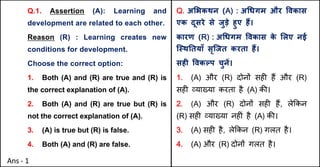
Q.1. Assertion (A):Learning and
development are related to each other.
Reason (R) : Learning creates new
conditions for development.
Choose the correct option:
1. Both (A) and (R) are true and (R) is
the correct explanation of (A).
2. Both (A) and (R) are true but (R) is
not the correct explanation of (A).
3. (A) is true but (R) is false.
4. Both (A) and (R) are false.
Q. अ"भकथन (A) : अ(धगम और .वकास
एक दूसरे से जुड़े हुए ह:।
कारण (R) : अ(धगम .वकास क
े "लए नई
ि@थAतयाँ सृिजत करता ह:।
सहF .वकGप चुनJ।
1. (A) और (R) दोन' सह* ह+ और (R)
सह* ,या/या करता है (A) क3।
2. (A) और (R) दोन' सह* ह+, ले8कन
(R) सह* ,या/या नह*ं है (A) क3।
3. (A) सह* है, ले8कन (R) गलत है।
4. (A) और (R) दोन' गलत है।
Ans - 1
5.
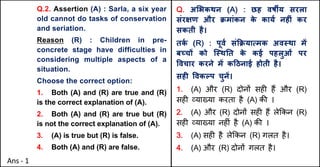
Q.2. Assertion (A): Sarla, a six year
old cannot do tasks of conservation
and seriation.
Reason (R) : Children in pre-
concrete stage have difficulties in
considering multiple aspects of a
situation.
Choose the correct option:
1. Both (A) and (R) are true and (R)
is the correct explanation of (A).
2. Both (A) and (R) are true but (R)
is not the correct explanation of (A).
3. (A) is true but (R) is false.
4. Both (A) and (R) are false.
Q. अ"भकथन (A) : छह वषMय सरला
संरOण और Pमांकन क
े कायQ नहFं कर
सकती है।
तक
Q (R) : पूवQ संTPयाUमक अव@था मJ
बWचX को ि@थAत क
े कई पहलुओं पर
.वचार करने मJ क[ठनाई होती है।
सहF .वकGप चुनJ।
1. (A) और (R) दोन' सह* ह+ और (R)
सह* ,या/या करता है (A) क3 ।
2. (A) और (R) दोन' सह* ह+ ले8कन (R)
सह* ,या/या नह*ं है (A) क3 ।
3. (A) सह* है ले8कन (R) गलत है।
4. (A) और (R) दोन' गलत है।
Ans - 1
6.
Q.3. Assertion (A):In middle school,
teachers should encourage boys to
study mathematics and sciences
rather than languages.
Reason (R) : Boys do not have the
inherent abilities to study languages.
Choose the correct option.
1. Both (A) and (R) are true and (R)
is the correct explanation of (A).
2. Both (A) and (R) are true but (R) is
not the correct explanation of (A).
3. (A) is true but (R) is false.
4. Both (A) and (R) are false.
Q. कथन (A) : मा]य"मक @क
ू ल मJ
"शOकX को लड़कX को भाषा पढ़ने क
े
बजाए ग`णत व .वaान क
े .वषयX को
पढ़ने क
े "लए bोUसा[हत करना चा[हए।
तक
Q (R) : लड़कX मJ भाषा को पढ़ने कc
जdमजात Oमता नहFं होती।
सहF .वकGप चुनJ।
1. (A) और (R) दोन' सह* ह+ और (R)
सह* ,या/या करता है (A) क3 ।
2. (A) और (R) दोन' सह* ह+ ले8कन (R)
सह* ,या/या नह*ं है (A) क3 ।
3. (A) सह* है ले8कन (R) गलत है।
4. (A) और (R) दोन' गलत है।
Ans - 4
7.
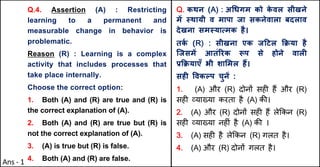
Q.4. Assertion (A): Restricting
learning to a permanent and
measurable change in behavior is
problematic.
Reason (R) : Learning is a complex
activity that includes processes that
take place internally.
Choose the correct option:
1. Both (A) and (R) are true and (R) is
the correct explanation of (A).
2. Both (A) and (R) are true but (R) is
not the correct explanation of (A).
3. (A) is true but (R) is false.
4. Both (A) and (R) are false.
Q. कथन (A) : अ(धगम को क
े वल सीखने
मJ @थायी व मापा जा सकनेवाला बदलाव
देखना सम@याUमक है।
तक
Q (R) : सीखना एक ज[टल TPया है
िजसमJ आतंhरक iप से होने वालF
bTPयाएँ भी शा"मल ह:।
सहF .वकGप चुनJ :
1. (A) और (R) दोन' सह* ह+ और (R)
सह* ,या/या करता है (A) क3।
2. (A) और (R) दोन' सह* ह+ ले8कन (R)
सह* ,या/या नह*ं है (A) क3 ।
3. (A) सह* है ले8कन (R) गलत है।
4. (A) और (R) दोन' गलत है।
Ans - 1
8.
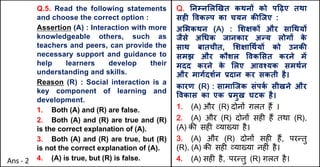
Q.5. Read thefollowing statements
and choose the correct option :
Assertion (A) : Interaction with more
knowledgeable others, such as
teachers and peers, can provide the
necessary support and guidance to
help learners develop their
understanding and skills.
Reason (R) : Social interaction is a
key component of learning and
development.
1. Both (A) and (R) are false.
2. Both (A) and (R) are true and (R)
is the correct explanation of (A).
3. Both (A) and (R) are true, but (R)
is not the correct explanation of (A).
4. (A) is true, but (R) is false.
Q. Aनkन"ल`खत कथनX को प[ढ़ए तथा
सहF .वकGप का चयन कcिजए :
अ"भकथन (A) : "शOकX और सा(थयX
जैसे अ(धक जानकार अdय लोगX क
े
साथ बातचीत, "शOा(थQयX को उनकc
समझ और कौशल .वक"सत करने मJ
मदद करने क
े "लए आवpयक समथQन
और मागQदशQन bदान कर सकती है।
कारण (R) : सामािजक संपक
Q सीखने और
.वकास का एक bमुख घटक है।
1. (A) और (R) दोन' ग़लत ह+ ।
2. (A) और (R) दोन' सह* ह+ तथा (R),
(A) क3 सह* ,या/या है।
3. (A) और (R) दोन' सह* ह+, पर>तु
(R), (A) क3 सह* ,या/या नह*ं है।
4. (A) सह* है, पर>तु (R) ग़लत है।
Ans - 2
9.
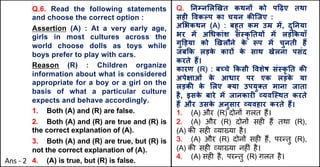
Q.6. Read thefollowing statements
and choose the correct option :
Assertion (A) : At a very early age,
girls in most cultures across the
world choose dolls as toys while
boys prefer to play with cars.
Reason (R) : Children organize
information about what is considered
appropriate for a boy or a girl on the
basis of what a particular culture
expects and behave accordingly.
1. Both (A) and (R) are false.
2. Both (A) and (R) are true and (R) is
the correct explanation of (A).
3. Both (A) and (R) are true, but (R) is
not the correct explanation of (A).
4. (A) is true, but (R) is false.
Q. !न#न$ल&खत कथन+ को प.ढ़ए तथा
सह4 5वक7प का चयन क:िजए :
अ$भकथन (A) : बहुत कम उE मF, दु!नया
भर मF अJधकांश संNकृ !तय+ मF लड़Qकयाँ
गुTड़या को &खलौने क
े Wप मF चुनती हY
जबQक लड़क
े कार+ क
े साथ खेलना पसंद
करते हY।
कारण (R) : बचे Qकसी 5वशेष संNकृ !त क:
अपे^ाओं क
े आधार पर एक लड़क
े या
लड़क: क
े $लए aया उपयुaत माना जाता
है, इसक
े बारे मF जानकार4 dयविNथत करते
हY और उसक
े अनुसार dयवहार करते हY।
1. (A) और (R) दोन' ग़लत ह,।
2. (A) और (R) दोन' सह/ ह, तथा (R),
(A) क3 सह/ 4या6या है।
3. (A) और (R) दोन' सह/ ह,, पर:तु (R),
(A) क3 सह/ 4या6या नह/ं है।
4. (A) सह/ है, पर:तु (R) ग़लत है।
Ans - 2
10.
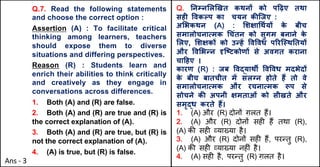
Q.7. Read thefollowing statements
and choose the correct option :
Assertion (A) : To facilitate critical
thinking among learners, teachers
should expose them to diverse
situations and differing perspectives.
Reason (R) : Students learn and
enrich their abilities to think critically
and creatively as they engage in
conversations across differences.
1. Both (A) and (R) are false.
2. Both (A) and (R) are true and (R) is
the correct explanation of (A).
3. Both (A) and (R) are true, but (R) is
not the correct explanation of (A).
4. (A) is true, but (R) is false.
Q. !न#न$ल&खत कथन+ को प.ढ़ए तथा
सह4 5वक7प का चयन क:िजए :
अ$भकथन (A) : $श^ाJथfय+ क
े बीच
समालोचनाgमक Jचंतन को सुगम बनाने क
े
$लए, $श^क+ को उhहF 5व5वध पiरिNथ!तय+
और 5व$भhन jिkटकोण+ से अवगत कराना
चा.हए ।
कारण (R) : जब 5वmयाथn 5व5वध मदभेद+
क
े बीच बातचीत मF संलoन होते हY तो वे
समालोचनाgमक और रचनाgमक Wप से
सोचने क: अपनी ^मताओं को सीखते और
समृmध करते हY।
1. (A) और (R) दोन' ग़लत ह,।
2. (A) और (R) दोन' सह/ ह, तथा (R),
(A) क3 सह/ 4या6या है।
3. (A) और (R) दोन' सह/ ह,, पर:तु (R),
(A) क3 सह/ 4या6या नह/ं है।
4. (A) सह/ है, पर:तु (R) ग़लत है।
Ans - 3
11.
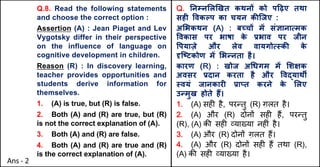
Q.8. Read thefollowing statements
and choose the correct option :
Assertion (A) : Jean Piaget and Lev
Vygotsky differ in their perspective
on the influence of language on
cognitive development in children.
Reason (R) : In discovery learning,
teacher provides opportunities and
students derive information for
themselves.
1. (A) is true, but (R) is false.
2. Both (A) and (R) are true, but (R)
is not the correct explanation of (A).
3. Both (A) and (R) are false.
4. Both (A) and (R) are true and (R)
is the correct explanation of (A).
Q. Aनkन"ल`खत कथनX को प[ढ़ए तथा
सहF .वकGप का चयन कcिजए :
अ"भकथन (A) : बWचX मJ संaानाUमक
.वकास पर भाषा क
े bभाव पर जीन
.पयाज़े और लेव वायगोU@कc क
े
sिtटकोण मJ "भdनता है।
कारण (R) : खोज अ(धगम मJ "शOक
अवसर bदान करता है और .वuयाथM
@वयं जानकारF bाvत करने क
े "लए
उdमुख होते ह:।
1. (A) सह* है, पर>तु (R) ग़लत है।
2. (A) और (R) दोन' सह* ह+, पर>तु
(R), (A) क3 सह* ,या/या नह*ं है।
3. (A) और (R) दोन' ग़लत ह+।
4. (A) और (R) दोन' सह* ह+ तथा (R),
(A) क3 सह* ,या/या है।
Ans - 2
12.
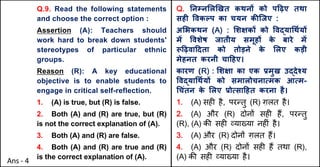
Q.9. Read thefollowing statements
and choose the correct option :
Assertion (A): Teachers should
work hard to break down students'
stereotypes of particular ethnic
groups.
Reason (R): A key educational
objective is to enable students to
engage in critical self-reflection.
1. (A) is true, but (R) is false.
2. Both (A) and (R) are true, but (R)
is not the correct explanation of (A).
3. Both (A) and (R) are false.
4. Both (A) and (R) are true and (R)
is the correct explanation of (A).
Q. Aनkन"ल`खत कथनX को प[ढ़ए तथा
सहF .वकGप का चयन कcिजए :
अ"भकथन (A) : "शOकX को .वuया(थQयX
मJ .वशेष जातीय समूहX क
े बारे मJ
i[ढ़वा[दता को तोड़ने क
े "लए कड़ी
मेहनत करनी चा[हए।
कारण (R) : "शOा का एक bमुख उuदेpय
.वuया(थQयX को समालोचनाUमक आUम-
(चंतन क
े "लए bोUसा[हत करना है।
1. (A) सह* है, पर>तु (R) ग़लत है।
2. (A) और (R) दोन' सह* ह+, पर>तु
(R), (A) क3 सह* ,या/या नह*ं है।
3. (A) और (R) दोन' ग़लत ह+।
4. (A) और (R) दोन' सह* ह+ तथा (R),
(A) क3 सह* ,या/या है।
Ans - 4
13.
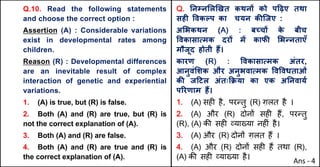
Q.10. Read thefollowing statements
and choose the correct option :
Assertion (A) : Considerable variations
exist in developmental rates among
children.
Reason (R) : Developmental differences
are an inevitable result of complex
interaction of genetic and experiential
variations.
1. (A) is true, but (R) is false.
2. Both (A) and (R) are true, but (R) is
not the correct explanation of (A).
3. Both (A) and (R) are false.
4. Both (A) and (R) are true and (R) is
the correct explanation of (A).
Q. Aनkन"ल`खत कथनX को प[ढ़ए तथा
सहF .वकGप का चयन कcिजए :
अ"भकथन (A) : बWचX क
े बीच
.वकासाUमक दरX मJ काफc "भdनताएँ
मौजूद होती ह:।
कारण (R) : .वकासाUमक अंतर,
आनुवं"शक और अनुभवाUमक .व.वधताओं
कc ज[टल अंतःTPया का एक अAनवायQ
पhरणाम ह:।
1. (A) सह* है, पर>तु (R) ग़लत है ।
2. (A) और (R) दोन' सह* ह+, पर>तु
(R), (A) क3 सह* ,या/या नह*ं है।
3. (A) और (R) दोन' ग़लत ह+ ।
4. (A) और (R) दोन' सह* ह+ तथा (R),
(A) क3 सह* ,या/या है।
Ans - 4
14.
Q.11. Read thefollowing statements
and choose the correct option :
Assertion (A) : Every year Lata, a
Class VII teacher invites a female
maths professor and a male nurse to
her class to discuss careers in these
fields.
Reason (R) : Gender differences are
innate and not acquired through
society.
1. (A) is true, but (R) is false.
2. Both (A) and (R) are true, but (R) is
not the correct explanation of (A).
3. Both (A) and (R) are false .
4. Both (A) and (R) are true and (R) is
the correct explanation of (A).
Q. Aनkन"ल`खत कथनX को प[ढ़ए तथा
सहF .वकGप का चयन कcिजए :
अ"भकथन (A) : bUयेक वषQ लता, जो Tक
कOा VII कc "शzOका है, उनक
े Oे{X मJ
क
ै hरयर पर चचाQ करने क
े "लए एक
म[हला ग`णत bोफ़
े सर और एक पु}ष नसQ
को अपनी कOा मJ आमं~{त करती है।
कारण (R) : ल:(गक (जJडर) अंतर
जdमजात ह: और समाज क
े मा]यम से
अ(ध•[हत नहFं ह:।
1. (A) सह* है, पर>तु (R) ग़लत है।
2. (A) और (R) दोन' सह* ह+, पर>तु (R),
(A) क3 सह* ,या/या नह*ं है।
3. (A) और (R) दोन' ग़लत ह+।
4. (A) और (R) दोन' सह* ह+ तथा (R),
(A) क3 सह* ,या/या है। Ans - 1
15.
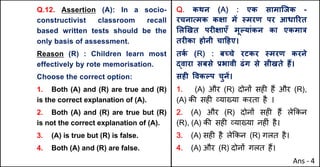
Q.12. Assertion (A):In a socio-
constructivist classroom recall
based written tests should be the
only basis of assessment.
Reason (R) : Children learn most
effectively by rote memorisation.
Choose the correct option:
1. Both (A) and (R) are true and (R)
is the correct explanation of (A).
2. Both (A) and (R) are true but (R)
is not the correct explanation of (A).
3. (A) is true but (R) is false.
4. Both (A) and (R) are false.
Q. कथन (A) : एक सामािजक -
रचनाUमक कOा मJ @मरण पर आधाhरत
"ल`खत परFOाएँ मूGयांकन का एकमा{
तरFका होनी चा[हए।
तक
Q (R) : बWचे रटकर @मरण करने
uवारा सबसे bभावी ढंग से सीखते ह:।
सहF .वकGप चुनJ।
1. (A) और (R) दोन' सह* ह+ और (R),
(A) क3 सह* ,या/या करता है ।
2. (A) और (R) दोन' सह* ह+ ले8कन
(R), (A) क3 सह* ,या/या नह*ं है।
3. (A) सह* है ले8कन (R) गलत है।
4. (A) और (R) दोन' गलत ह+।
Ans - 4
16.
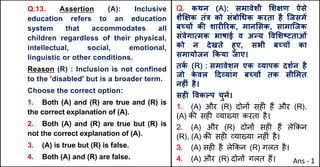
Q.13. Assertion (A):Inclusive
education refers to an education
system that accommodates all
children regardless of their physical,
intellectual, social, emotional,
linguistic or other conditions.
Reason (R) : Inclusion is not confined
to the 'disabled' but is a broader term.
Choose the correct option:
1. Both (A) and (R) are true and (R) is
the correct explanation of (A).
2. Both (A) and (R) are true but (R) is
not the correct explanation of (A).
3. (A) is true but (R) is false.
4. Both (A) and (R) are false.
Q. कथन (A): समावेशी "शOण ऐसे
शैzOक तं{ को संबो(धक करता है िजसमJ
बWचX कc शारFhरक, मान"सक, सामािजक
संवेगाUमक भाषाई व अdय .व"शtटताओं
को न देखते हुए, सभी बWचX का
समायोजन Tकया जाए।
तक
Q (R) : समावेशन एक „यापक दशQन है
जो क
े वल [द„यांग बWचX तक सी"मत
नहFं है।
सहF .वकGप चुनJ।
1. (A) और (R) दोन' सह* ह+ और (R),
(A) क3 सह* ,या/या करता है।
2. (A) और (R) दोन' सह* ह+ ले8कन
(R), (A) क3 सह* ,या/या नह*ं है।
3. (A) सह* है ले8कन (R) गलत है।
4. (A) और (R) दोन' गलत ह+। Ans - 1
17.
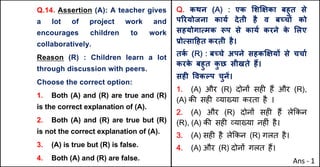
Q.14. Assertion (A):A teacher gives
a lot of project work and
encourages children to work
collaboratively.
Reason (R) : Children learn a lot
through discussion with peers.
Choose the correct option:
1. Both (A) and (R) are true and (R)
is the correct explanation of (A).
2. Both (A) and (R) are true but (R)
is not the correct explanation of (A).
3. (A) is true but (R) is false.
4. Both (A) and (R) are false.
Q. कथन (A) : एक "शzOका बहुत से
पhरयोजना कायQ देती है व बWचX को
सहयोगाUमक iप से कायQ करने क
े "लए
bोUसा[हत करती है।
तक
Q (R) : बWचे अपने सहकzOयX से चचाQ
करक
े बहुत क
ु छ सीखते ह:।
सहF .वकGप चुनJ।
1. (A) और (R) दोन' सह* ह+ और (R),
(A) क3 सह* ,या/या करता है ।
2. (A) और (R) दोन' सह* ह+ ले8कन
(R), (A) क3 सह* ,या/या नह*ं है।
3. (A) सह* है ले8कन (R) गलत है।
4. (A) और (R) दोन' गलत ह+।
Ans - 1
18.
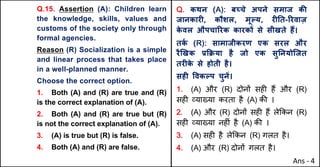
Q.15. Assertion (A):Children learn
the knowledge, skills, values and
customs of the society only through
formal agencies.
Reason (R) Socialization is a simple
and linear process that takes place
in a well-planned manner.
Choose the correct option.
1. Both (A) and (R) are true and (R)
is the correct explanation of (A).
2. Both (A) and (R) are true but (R)
is not the correct explanation of (A).
3. (A) is true but (R) is false.
4. Both (A) and (R) are false.
Q. कथन (A): बWचे अपने समाज कc
जानकारF, कौशल, मूGय, रFAत-hरवाज़
क
े वल औपचाhरक कारकX से सीखते ह:।
तक
Q (R): सामाजीकरण एक सरल और
रै`खक bTPया है जो एक सुAनयोिजत
तरFक
े से होती है।
सहF .वकGप चुनJ।
1. (A) और (R) दोन' सह* ह+ और (R)
सह* ,या/या करता है (A) क3 ।
2. (A) और (R) दोन' सह* ह+ ले8कन (R)
सह* ,या/या नह*ं है (A) क3 ।
3. (A) सह* है ले8कन (R) गलत है।
4. (A) और (R) दोन' गलत है।
Ans - 4
19.
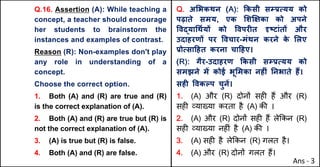
Q.16. Assertion (A):While teaching a
concept, a teacher should encourage
her students to brainstorm the
instances and examples of contrast.
Reason (R): Non-examples don't play
any role in understanding of a
concept.
Choose the correct option.
1. Both (A) and (R) are true and (R)
is the correct explanation of (A).
2. Both (A) and (R) are true but (R) is
not the correct explanation of (A).
3. (A) is true but (R) is false.
4. Both (A) and (R) are false.
Q. अ"भकथन (A): Tकसी सkbUयय को
पढ़ाते समय, एक "शzOका को अपने
.वuया(थQयX को .वपरFत stटांतX और
उदाहरणX पर .वचार-मंथन करने क
े "लए
bोUसा[हत करना चा[हए।
(R): गैर-उदाहरण Tकसी सkbUयय को
समझने मJ कोई भू"मका नहFं Aनभाते ह:।
सहF .वकGप चुनJ।
1. (A) और (R) दोन' सह* ह+ और (R)
सह* ,या/या करता है (A) क3 ।
2. (A) और (R) दोन' सह* ह+ ले8कन (R)
सह* ,या/या नह*ं है (A) क3 ।
3. (A) सह* है ले8कन (R) गलत है।
4. (A) और (R) दोन' गलत ह+।
Ans - 3
20.
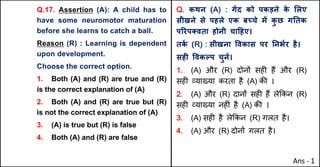
Q.17. Assertion (A):A child has to
have some neuromotor maturation
before she learns to catch a ball.
Reason (R) : Learning is dependent
upon development.
Choose the correct option.
1. Both (A) and (R) are true and (R)
is the correct explanation of (A)
2. Both (A) and (R) are true but (R)
is not the correct explanation of (A)
3. (A) is true but (R) is false
4. Both (A) and (R) are false
Q. कथन (A) : गJद को पकड़ने क
े "लए
सीखने से पहले एक बWचे मJ क
ु छ गAतक
पhरप…वता होनी चा[हए।
तक
Q (R) : सीखना .वकास पर AनभQर है।
सहF .वकGप चुनJ।
1. (A) और (R) दोन' सह* ह+ और (R)
सह* ,या/या करता है (A) क3 ।
2. (A) और (R) दान' सह* ह+ ले8कन (R)
सह* ,या/या नह*ं है (A) क3 ।
3. (A) सह* है ले8कन (R) गलत है।
4. (A) और (R) दोन' गलत है।
Ans - 1
21.
Q.18. Assertion (A):While teaching
problem-solving, teachers should
discourage the children to think
about their own thinking and
focusing on how to learn.
Reason (R): Development of
metacognitive abilities hinder
problem-solving.
Choose the correct option.
1. Both (A) and (R) are true and (R)
is the correct explanation of (A)
2. Both (A) and (R) are true but (R)
is not the correct explanation of (A)
3. (A) is true but (R) is false
4. Both (A) and (R) are false
Q. कथन (A): सम@या समाधान पढ़ाते
समय, "शOकX को चा[हए Tक वे बWचX
को अपनी सोच क
े बारे मJ सोचने और
सीखने क
े तरFक
े पर ]यान क
J [†त करने
क
े "लए हतोUसा[हत करJ।
संaानाUमक Oमताओं का .वकास
सम@या समाधान मJ बाधा डालता है।
तक
Q (R) : सहF .वकGप चुनJ।
1. (A) और (R) दोन' सह* ह+ और (A)
क3 (R) सह* ,या/या करता है।
2. (A) और (R) दोन' सह* ह+ ले8कन (A)
क3 (R) सह* ,या/या नह*ं करता है
3. (A) सह* है ले8कन (R) गलत है।
4. (A) और (R) दोन' गलत है।
Ans - 4
22.
Q.19. Assertion (A):Teachers should
tell middle school students exactly in
details what they have to do including
what, how and when to learn.
Reason (R) : Middle school children do
not have the capacity to self-regulate
their learning.
Choose the correct option.
1. Both (A) and (R) are true and (R) is
the correct explanation of (A)
2. Both (A) and (R) are true but (R) is
not the correct explanation of (A)
3. (A) is true but (R) is false
4. Both (A) and (R) are false
Q. कथन (A) : "शOकX को म]य
.वuयालय क
े छा{X को .व@तार से बताना
चा[हए Tक उdहJ …या करना है, िजसमJ
…या, क
ै से और कब सीखना है।
तक
Q (R) : "म‡डल @क
ू ल क
े बWचX मJ
अपने अ(धगम को @व-Aनयमन करने कc
Oमता नहFं होती है।
सहF .वकGप चुनJ।
1. (A) और (R) दोन' सह* ह+ और (A)
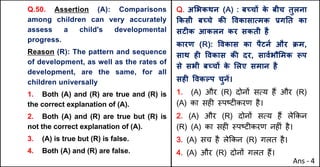
क3 (R) सह* ,या/या करता है।
2. (A) और (R) दोन' सह* ह+ ले8कन (A)
क3 (R) सह* ,या/या नह*ं करता है।
3. (A) सह* है ले8कन (R) गलत है
4. (A) और (R) दोन' गलत है।
Ans - 4
23.
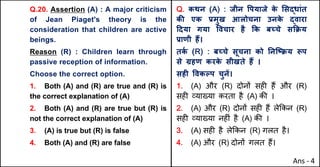
Q.20. Assertion (A): A major criticism
of Jean Piaget's theory is the
consideration that children are active
beings.
Reason (R) : Children learn through
passive reception of information.
Choose the correct option.
1. Both (A) and (R) are true and (R) is
the correct explanation of (A)
2. Both (A) and (R) are true but (R) is
not the correct explanation of (A)
3. (A) is true but (R) is false
4. Both (A) and (R) are false
Q. कथन (A) : जीन .पयाजे क
े "सuधांत
कc एक bमुख आलोचना उनक
े uवारा
[दया गया .वचार है Tक बWचे सTPय
bाणी ह:।
तक
Q (R) : बWचे सूचना को AनिtPय iप
से •हण करक
े सीखते ह: ।
सहF .वकGप चुनJ।
1. (A) और (R) दोन' सह* ह+ और (R)
सह* ,या/या करता है (A) क3 ।
2. (A) और (R) दोन' सह* ह+ ले8कन (R)
सह* ,या/या नह*ं है (A) क3 ।
3. (A) सह* है ले8कन (R) गलत है।
4. (A) और (R) दोन' गलत ह+।
Ans - 4
24.
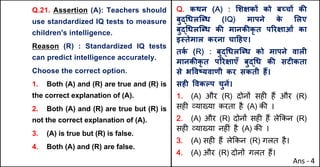
Q.21. Assertion (A):Teachers should
use standardized IQ tests to measure
children's intelligence.
Reason (R) : Standardized IQ tests
can predict intelligence accurately.
Choose the correct option.
1. Both (A) and (R) are true and (R) is
the correct explanation of (A).
2. Both (A) and (R) are true but (R) is
not the correct explanation of (A).
3. (A) is true but (R) is false.
4. Both (A) and (R) are false.
Q. कथन (A) : "शOकX को बWचX कc
बुu(धलिˆध (IQ) मापने क
े "लए
बुu(धलिˆध कc मानकcकृ त पhरOाओं का
इ@तेमाल करना चा[हए।
तक
Q (R) : बुu(धलिˆध को मापने वालF
मानकcकृ त पhरOाएँ बुu(ध कc सटFकता
से भ.वtयवाणी कर सकती ह:।
सहF .वकGप चुनJ।
1. (A) और (R) दोन' सह* ह+ और (R)
सह* ,या/या करता है (A) क3 ।
2. (A) और (R) दोन' सह* ह+ ले8कन (R)
सह* ,या/या नह*ं है (A) क3 ।
3. (A) सह* ह+ ले8कन (R) गलत है।
4. (A) और (R) दोन' गलत ह+।
Ans - 4
25.
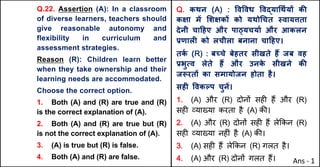
Q.22. Assertion (A):In a classroom
of diverse learners, teachers should
give reasonable autonomy and
flexibility in curriculum and
assessment strategies.
Reason (R): Children learn better
when they take ownership and their
learning needs are accommodated.
Choose the correct option.
1. Both (A) and (R) are true and (R)
is the correct explanation of (A).
2. Both (A) and (R) are true but (R)
is not the correct explanation of (A).
3. (A) is true but (R) is false.
4. Both (A) and (R) are false.
Q. कथन (A) : .व.वध .वuया(थQयX कc
कOा मJ "शOकX को यथो(चत @वायŠता
देनी चा[हए और पा‹यचयाQ और आकलन
bणालF को लचीला बनाना चा[हए।
तक
Q (R) : बWचे बेहतर सीखते ह: जब वह
bभुUव लेते ह: और उनक
े सीखने कc
जiरतX का समायोजन होता है।
सहF .वकGप चुनJ।
1. (A) और (R) दोन' सह* ह+ और (R)
सह* ,या/या करता है (A) क3।
2. (A) और (R) दोन' सह* ह+ ले8कन (R)
सह* ,या/या नह*ं है (A) क3।
3. (A) सह* ह+ ले8कन (R) गलत है।
4. (A) और (R) दोन' गलत ह+। Ans - 1
26.
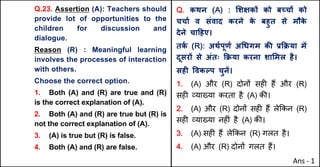
Q.23. Assertion (A):Teachers should
provide lot of opportunities to the
children for discussion and
dialogue.
Reason (R) : Meaningful learning
involves the processes of interaction
with others.
Choose the correct option.
1. Both (A) and (R) are true and (R)
is the correct explanation of (A).
2. Both (A) and (R) are true but (R) is
not the correct explanation of (A).
3. (A) is true but (R) is false.
4. Both (A) and (R) are false.
Q. कथन (A) : "शOकX को बWचX को
चचाQ व संवाद करने क
े बहुत से मौक
े
देने चा[हए।
तक
Q (R): अथQपूणQ अ(धगम कc bTPया मJ
दूसरX से अंतः TPया करना शा"मल है।
सहF .वकGप चुनJ।
1. (A) और (R) दोन' सह* ह+ और (R)
सह* ,या/या करता है (A) क3।
2. (A) और (R) दोन' सह* ह+ ले8कन (R)
सह* ,या/या नह*ं है (A) क3।
3. (A) सह* ह+ ले8कन (R) गलत है।
4. (A) और (R) दोन' गलत ह+।
Ans - 1
27.
Q.24. Assertion (A):It is important for
middle school teachers to enable the
students to look at the portrayal of
gender stereotypes in the media
critically.
Reason (R) : Media is an important
socialising agency.
Choose the correct option.
1. Both (A) and (R) are true and (R) is
the correct explanation of (A).
2. Both (A) and (R) are true but (R) is
not the correct explanation of (A).
3. (A) is true but (R) is false.
4. Both (A) and (R) are false.
Q. कथन (A) : मा]य"मक @क
ू ल क
े
"शOकX क
े "लए यह महUवपूणQ है Tक वे
मी‡डया मJ जJडर i[ढ़वा[दता क
े (च{ण
को आलोचनाUमक iप से देखने क
े "लए
छा{X को सOम करJ।
तक
Q (R) : मी‡डया सामािजकरण कc एक
महUवपूणQ सं@था है।
सहF .वकGप चुनJ।
1. (A) और (R) दोन' सह* ह+ और (R)
सह* ,या/या करता है (A) क3 ।
2. (A) और (R) दोन' सह* ह+ ले8कन (R)
सह* ,या/या नह*ं है (A) क3 ।
3. (A) सह* है ले8कन (R) गलत है।
4. (A) और (R) दोन' गलत ह+।
Ans - 1
28.
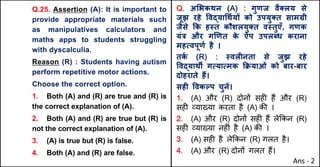
Q.25. Assertion (A):It is important to
provide appropriate materials such
as manipulatives calculators and
maths apps to students struggling
with dyscalculia.
Reason (R) : Students having autism
perform repetitive motor actions.
Choose the correct option.
1. Both (A) and (R) are true and (R) is
the correct explanation of (A).
2. Both (A) and (R) are true but (R) is
not the correct explanation of (A).
3. (A) is true but (R) is false.
4. Both (A) and (R) are false.
Q. अ"भकथन (A) : गुणज वै…लय से
जूझ रहे .वuया(थQयX को उपयु…त साम•ी
जैसे Tक ह@त कौशलयु…त व@तुएँ, गणक
यं{ और ग`णत क
े ऐप उपलˆध कराना
महUवपूणQ है ।
तक
Q (R) : @वलFनता से जुझ रहे
.वuयाथM गUयाUमक TPयाओं को बार-बार
दोहराते ह:।
सहF .वकGप चुनJ।
1. (A) और (R) दोन' सह* ह+ और (R)
सह* ,या/या करता है (A) क3 ।
2. (A) और (R) दोन' सह* ह+ ले8कन (R)
सह* ,या/या नह*ं है (A) क3 ।
3. (A) सह* है ले8कन (R) गलत है।
4. (A) और (R) दोन' गलत ह+।
Ans - 2
29.
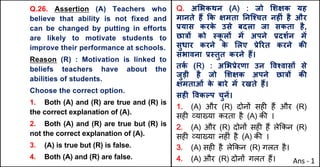
Q.26. Assertion (A)Teachers who
believe that ability is not fixed and
can be changed by putting in efforts
are likely to motivate students to
improve their performance at schools.
Reason (R) : Motivation is linked to
beliefs teachers have about the
abilities of students.
Choose the correct option.
1. Both (A) and (R) are true and (R) is
the correct explanation of (A).
2. Both (A) and (R) are true but (R) is
not the correct explanation of (A).
3. (A) is true but (R) is false.
4. Both (A) and (R) are false.
Q. अ"भकथन (A) : जो "शOक यह
मानते ह: Tक Oमता Aनिpचत नहFं है और
bयास करक
े उसे बदला जा सकता है,
छा{X को @क
ू लX मJ अपने bदशQन मJ
सुधार करने क
े "लए bेhरत करने कc
संभावना b@तुत करने ह:।
तक
Q (R) : अ"भbेरणा उन .वpवासX से
जुड़ी है जो "शOक अपने छा{X कc
Oमताओं क
े बारे मJ रखते ह:।
सहF .वकGप चुनJ।
1. (A) और (R) दोन' सह* ह+ और (R)
सह* ,या/या करता है (A) क3 ।
2. (A) और (R) दोन' सह* ह+ ले8कन (R)
सह* ,या/या नह*ं है (A) क3 ।
3. (A) सह* है ले8कन (R) गलत है।
4. (A) और (R) दोन' गलत ह+। Ans - 1
30.
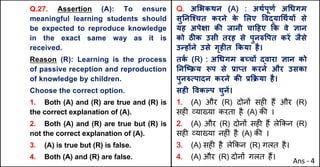
Q.27. Assertion (A):To ensure
meaningful learning students should
be expected to reproduce knowledge
in the exact same way as it is
received.
Reason (R): Learning is the process
of passive reception and reproduction
of knowledge by children.
Choose the correct option.
1. Both (A) and (R) are true and (R) is
the correct explanation of (A).
2. Both (A) and (R) are true but (R) is
not the correct explanation of (A).
3. (A) is true but (R) is false.
4. Both (A) and (R) are false.
Q. अ"भकथन (A) : अथQपूणQ अ(धगम
सुAनिpचत करने क
े "लए .वuया(थQयX से
यह अपेOा कc जानी चा[हए Tक वे aान
को ठŒक उसी तरह से पुन}.पत करJ जैसे
उdहXने उसे गृहFत Tकया है।
तक
Q (R) : अ(धगम बWचX uवारा aान को
AनिtPय iप से bाvत करने और उसका
पुन}Uपादन करने कc bTPया है।
सहF .वकGप चुनJ।
1. (A) और (R) दोन' सह* ह+ और (R)
सह* ,या/या करता है (A) क3 ।
2. (A) और (R) दोन' सह* ह+ ले8कन (R)
सह* ,या/या नह*ं है (A) क3 ।
3. (A) सह* है ले8कन (R) गलत है।
4. (A) और (R) दोन' गलत ह+।
Ans - 4
31.
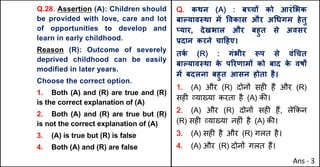
Q.28. Assertion (A):Children should
be provided with love, care and lot
of opportunities to develop and
learn in early childhood.
Reason (R): Outcome of severely
deprived childhood can be easily
modified in later years.
Choose the correct option.
1. Both (A) and (R) are true and (R)
is the correct explanation of (A)
2. Both (A) and (R) are true but (R)
is not the correct explanation of (A)
3. (A) is true but (R) is false
4. Both (A) and (R) are false
Q. कथन (A) : बWचX को आरं"भक
बाGयाव@था मJ .वकास और अ(धगम हेतु
vयार, देखभाल और बहुत से अवसर
bदान करने चा[हए।
तक
Q (R) : गंभीर iप से वं(चत
बाGयाव@था क
े पhरणामX को बाद क
े वष•
मJ बदलना बहुत आसन होता है।
1. (A) और (R) दोन' सह* ह+ और (R)
सह* ,या/या करता है (A) क3।
2. (A) और (R) दोन' सह* ह+, ले8कन
(R) सह* ,या/या नह*ं है (A) क3।
3. (A) सह* है और (R) गलत है।
4. (A) और (R) दोन' गलत ह+।
Ans - 3
32.
Q.29. Assertion (A):A teacher
should not design learning tasks
that encourage children to seek out
knowledge from sites other than the
textbook.
Reason (R): Learning and
knowledge is 'transmitted' and not
sought or constructed.
Choose the correct option.
1. Both (A) and (R) are true and (R)
is the correct explanation of (A)
2. Both (A) and (R) are true but (R)
is not the correct explanation of (A)
3. (A) is true but (R) is false
4. Both (A) and (R) are false
Q. कथन (A) : एक अ]यापक को ऐसी
अ(धगम कायQ नहFं अ"भकिGपत करने
चा[हए जो बWचX को पा‹य-पु@तक क
े
अलावा Tकसी और Žोत से aान-अजQन
को बढ़ावा दे।
तक
Q (R) : अ(धगम और aान संbे.षत
होते ह: और इिWछत या सृिजत नहFं है।
1. (A) और (R) दोन' सह* ह+ और (R)
सह* ,या/या करता है (A) क3।
2. (A) और (R) दोन' सह* ह+, ले8कन
(R) सह* ,या/या नह*ं है (A) क3।
3. (A) सह* है और (R) गलत है।
4. (A) और (R) दोन' गलत ह+।
Ans - 4
33.
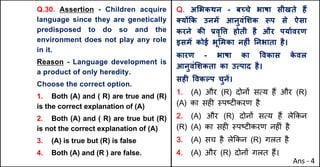
Q.30. Assertion -Children acquire
language since they are genetically
predisposed to do so and the
environment does not play any role
in it.
Reason - Language development is
a product of only heredity.
Choose the correct option.
1. Both (A) and ( R) are true and (R)
is the correct explanation of (A)
2. Both (A) and ( R) are true but (R)
is not the correct explanation of (A)
3. (A) is true but (R) is false
4. Both (A) and (R ) are false.
Q. अ"भकथन - बWचे भाषा सीखते ह:
…यXTक उनमJ आनुवं"शक iप से ऐसा
करने कc bवृ.Š होती है और पयाQवरण
इसमJ कोई भू"मका नहFं Aनभाता है।
कारण - भाषा का .वकास क
े वल
आनुवं"शकता का उUपाद है।
सहF .वकGप चुनJ।
1. (A) और (R) दोन' सAय ह+ और (R)
(A) का सह* BपCट*करण है
2. (A) और (R) दोन' सAय ह+ ले8कन
(R) (A) का सह* BपCट*करण नह*ं है
3. (A) सच है ले8कन (R) गलत है
4. (A) और (R) दोन' गलत ह+।
Ans - 4
34.
Q.31. Assertion (A):Ahmed
encourages children to his
classroom to think of analogies to
promote effective problem solving.
Reason (R): Children learn
meaningfully when the teachers
enable them to make connections
with what they already know.
Choose the correct option.
1. Both (A) and (R) are true and (R) is
the correct explanation of (A)
2. Both (A) and (R) are true and (R) is
not the correct explanation of (A)
3. (A) is true but (R) is false
4. Both (A) and (R) are false.
Q. अ"भकथन (A) : अहमद bभावशालF
सम@या समाधान को समुdनत करने क
े
"लए अपनी कOा क
े बWचX को समानांतर
iप से सोचने क
े "लए कहता है।
कारण (R) : बWचे साथQक तरFक
े से
सीखते ह: जब अ]यापक उdहJ मौका देते
ह: Tक वे पहले से जो जानते ह: उससे
संबंध बनाएँ।
1. (A) और (R) दोन' सह* ह+ और (R)
सह* ,या/या करता है (A) क3।
2. (A) और (R) दोन' सह* ह+, ले8कन
(R) सह* ,या/या नह*ं है (A) क3।
3. (A) सह* है, ले8कन (R) गलत है।
4. (A) और (R) दोन' गलत ह+।
Ans - 1
35.
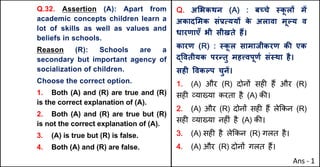
Q.32. Assertion (A):Apart from
academic concepts children learn a
lot of skills as well as values and
beliefs in schools.
Reason (R): Schools are a
secondary but important agency of
socialization of children.
Choose the correct option.
1. Both (A) and (R) are true and (R)
is the correct explanation of (A).
2. Both (A) and (R) are true but (R)
is not the correct explanation of (A).
3. (A) is true but (R) is false.
4. Both (A) and (R) are false.
Q. अ"भकथन (A) : बWचे @क
ू लX मJ
अकाद"मक संbUययX क
े अलावा मूGय व
धारणाएँ भी सीखते ह:।
कारण (R) : @क
ू ल सामाजीकरण कc एक
u.वतीयक परdतु मह•वपूणQ सं@था है।
सहF .वकGप चुनJ।
1. (A) और (R) दोन' सह* ह+ और (R)
सह* ,या/या करता है (A) क3।
2. (A) और (R) दोन' सह* ह+ ले8कन (R)
सह* ,या/या नह*ं है (A) क3।
3. (A) सह* है ले8कन (R) गलत है।
4. (A) और (R) दोन' गलत ह+।
Ans - 1
36.
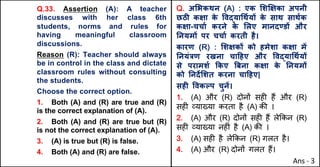
Q.33. Assertion (A):A teacher
discusses with her class 6th
students, norms and rules for
having meaningful classroom
discussions.
Reason (R): Teacher should always
be in control in the class and dictate
classroom rules without consulting
the students.
Choose the correct option.
1. Both (A) and (R) are true and (R)
is the correct explanation of (A).
2. Both (A) and (R) are true but (R)
is not the correct explanation of (A).
3. (A) is true but (R) is false.
4. Both (A) and (R) are false.
Q. अ"भकथन (A) : एक "शzOका अपनी
छठŒ कOा क
े .वuया(थQयX क
े साथ साथQक
कOा-चचाQ करने क
े "लए मानद•डX और
AनयमX पर चचाQ करती है।
कारण (R) : "शOकX को हमेशा कOा मJ
Aनयं{ण रखना चा[हए और .वuया(थQयX
से परामशQ Tकए ~बना कOा क
े AनयमX
को Aनद‘"शत करना चा[हए|
सहF .वकGप चुनJ।
1. (A) और (R) दोन' सह* ह+ और (R)
सह* ,या/या करता है (A) क3 ।
2. (A) और (R) दोन' सह* ह+ ले8कन (R)
सह* ,या/या नह*ं है (A) क3 ।
3. (A) सह* है ले8कन (R) गलत है।
4. (A) और (R) दोन' गलत ह+।
Ans - 3
37.
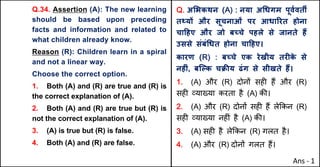
Q.34. Assertion (A):The new learning
should be based upon preceding
facts and information and related to
what children already know.
Reason (R): Children learn in a spiral
and not a linear way.
Choose the correct option.
1. Both (A) and (R) are true and (R) is
the correct explanation of (A).
2. Both (A) and (R) are true but (R) is
not the correct explanation of (A).
3. (A) is true but (R) is false.
4. Both (A) and (R) are false.
Q. अ"भकथन (A) : नया अ(धगम पूवQवतM
त“यX और सूचनाओं पर आधाhरत होना
चा[हए और जो बWचे पहले से जानते ह:
उससे संबं(धत होना चा[हए।
कारण (R) : बWचे एक रेखीय तरFक
े से
नहFं, बिGक चPcय ढंग से सीखते ह:।
1. (A) और (R) दोन' सह* ह+ और (R)
सह* ,या/या करता है (A) क3।
2. (A) और (R) दोन' सह* ह+ ले8कन (R)
सह* ,या/या नह*ं है (A) क3।
3. (A) सह* है ले8कन (R) गलत है।
4. (A) और (R) दोन' गलत ह+।
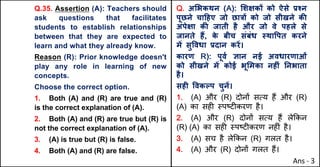
Ans - 1
38.
Q.35. Assertion (A):Teachers should
ask questions that facilitates
students to establish relationships
between that they are expected to
learn and what they already know.
Reason (R): Prior knowledge doesn't
play any role in learning of new
concepts.
Choose the correct option.
1. Both (A) and (R) are true and (R)
is the correct explanation of (A).
2. Both (A) and (R) are true but (R) is
not the correct explanation of (A).
3. (A) is true but (R) is false.
4. Both (A) and (R) are false.
Q. अ"भकथन (A): "शOकX को ऐसे bpन
पूछने चा[हए जो छा{X को जो सीखने कc
अपेOा कc जाती है और जो वे पहले से
जानते ह:, क
े बीच संबंध @था.पत करने
मJ सु.वधा bदान करJ।
कारण R): पूवQ aान नई अवधारणाओं
को सीखने मJ कोई भू"मका नहFं Aनभाता
है।
सहF .वकGप चुनJ।
1. (A) और (R) दोन' सAय ह+ और (R)
(A) का सह* BपCट*करण है।
2. (A) और (R) दोन' सAय ह+ ले8कन
(R) (A) का सह* BपCट*करण नह*ं है।
3. (A) सच है ले8कन (R) गलत है।
4. (A) और (R) दोन' गलत ह+।
Ans - 3
39.
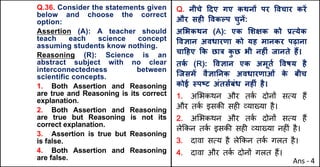
Q.36. Consider thestatements given
below and choose the correct
option:
Assertion (A): A teacher should
teach each science concept
assuming students know nothing.
Reasoning (R): Science is an
abstract subject with no clear
interconnectedness between
scientific concepts.
1. Both Assertion and Reasoning
are true and Reasoning is its correct
explanation.
2. Both Assertion and Reasoning
are true but Reasoning is not its
correct explanation.
3. Assertion is true but Reasoning
is false.
4. Both Assertion and Reasoning
are false.
Q. नीचे [दए गए कथनX पर .वचार करJ
और सहF .वकGप चुनJ:
अ"भकथन (A): एक "शOक को bUयेक
.वaान अवधारणा को यह मानकर पढ़ाना
चा[हए Tक छा{ क
ु छ भी नहFं जानते ह:।
तक
Q (R): .वaान एक अमूतQ .वषय है
िजसमJ वैaाAनक अवधारणाओं क
े बीच
कोई @पtट अंतस”बंध नहFं है।
1. अHभकथन और तक
J दोन' सAय ह+
और तक
J इसक3 सह* ,या/या है।
2. अHभकथन और तक
J दोन' सAय ह+
ले8कन तक
J इसक3 सह* ,या/या नह*ं है।
3. दावा सAय है ले8कन तक
J गलत है।
4. दावा और तक
J दोन' गलत ह+।
Ans - 4
40.
Q.37. Assertion (A):To develop
critical thinking in learners, a
teacher brings several newspapers
mentioning the 'same news' and
encourage students to discuss it in
groups.
Reason (R): Textbook can be the
only source of knowledge in a
middle grades.
choose the correct option.
1. Both (A) and (R) are true and (R)
is the correct explanation of (A).
2. Both (A) and (R) are true and (R)
is not the correct explanation of (A).
3. (A) is true but (R) is false.
4. Both (A) and (R) are false.
Q. अ"भकथन (A): "शOा(थQयX मJ
आलोचनाUमक सोच .वक"सत करने क
े
"लए, एक "शOक 'एक हF समाचार' का
उGलेख करते हुए कई समाचार प{ लाता
है और bोUसा[हत करता है
छा{ समूहX मJ इस पर चचाQ करJ।
कारण (R): म]यम कOा मJ पा‹यपु@तक
aान का एकमा{ Žोत हो सकती है।
सहF .वकGप चुनJ।
1. (A) और (R) दोन' सAय ह+ और (R)
(A) का सह* BपCट*करण है।
2. (A) और (R) दोन' सAय ह+ और (R)
(A) का सह* BपCट*करण नह*ं है।
3. (A) सच है ले8कन (R) गलत है।
4. (A) और (R) दोन' गलत ह+।
Ans - 3
41.
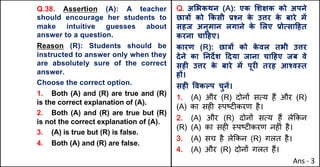
Q.38. Assertion (A):A teacher
should encourage her students to
make intuitive guesses about
answer to a question.
Reason (R): Students should be
instructed to answer only when they
are absolutely sure of the correct
answer.
Choose the correct option.
1. Both (A) and (R) are true and (R)
is the correct explanation of (A).
2. Both (A) and (R) are true but (R)
is not the correct explanation of (A).
3. (A) is true but (R) is false.
4. Both (A) and (R) are false.
Q. अ"भकथन (A): एक "शOक को अपने
छा{X को Tकसी bpन क
े उŠर क
े बारे मJ
सहज अनुमान लगाने क
े "लए bोUसा[हत
करना चा[हए।
कारण (R): छा{X को क
े वल तभी उŠर
देने का Aनद‘श [दया जाना चा[हए जब वे
सहF उŠर क
े बारे मJ पूरF तरह आpव@त
हX।
सहF .वकGप चुनJ।
1. (A) और (R) दोन' सAय ह+ और (R)
(A) का सह* BपCट*करण है।
2. (A) और (R) दोन' सAय ह+ ले8कन
(R) (A) का सह* BपCट*करण नह*ं है।
3. (A) सच है ले8कन (R) गलत है।
4. (A) और (R) दोन' गलत ह+।
Ans - 3
42.
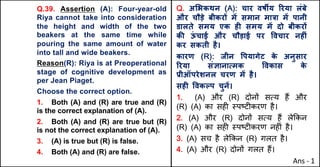
Q.39. Assertion (A):Four-year-old
Riya cannot take into consideration
the height and width of the two
beakers at the same time while
pouring the same amount of water
into tall and wide beakers.
Reason(R): Riya is at Preoperational
stage of cognitive development as
per Jean Piaget.
Choose the correct option.
1. Both (A) and (R) are true and (R)
is the correct explanation of (A).
2. Both (A) and (R) are true but (R)
is not the correct explanation of (A).
3. (A) is true but (R) is false.
4. Both (A) and (R) are false.
Q. अ"भकथन (A): चार वषMय hरया लंबे
और चौड़े बीकरX मJ समान मा{ा मJ पानी
डालते समय एक हF समय मJ दो बीकरX
कc ऊ
ं चाई और चौड़ाई पर .वचार नहFं
कर सकती है।
कारण (R): जीन .पयागेट क
े अनुसार
hरया संaानाUमक .वकास क
े
bीऑपरेशनल चरण मJ है।
सहF .वकGप चुनJ।
1. (A) और (R) दोन' सAय ह+ और
(R) (A) का सह* BपCट*करण है।
2. (A) और (R) दोन' सAय ह+ ले8कन
(R) (A) का सह* BपCट*करण नह*ं है।
3. (A) सच है ले8कन (R) गलत है।
4. (A) और (R) दोन' गलत ह+।
Ans - 1
43.
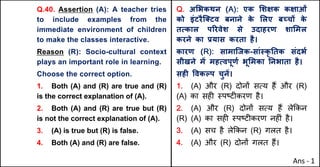
Q.40. Assertion (A):A teacher tries
to include examples from the
immediate environment of children
to make the classes interactive.
Reason (R): Socio-cultural context
plays an important role in learning.
Choose the correct option.
1. Both (A) and (R) are true and (R)
is the correct explanation of (A).
2. Both (A) and (R) are true but (R)
is not the correct explanation of (A).
3. (A) is true but (R) is false.
4. Both (A) and (R) are false.
Q. अ"भकथन (A): एक "शOक कOाओं
को इंटरैि…टव बनाने क
े "लए बWचX क
े
तUकाल पhरवेश से उदाहरण शा"मल
करने का bयास करता है।
कारण (R): सामािजक-सां@कृ Aतक संदभQ
सीखने मJ महUवपूणQ भू"मका Aनभाता है।
सहF .वकGप चुनJ।
1. (A) और (R) दोन' सAय ह+ और (R)
(A) का सह* BपCट*करण है।
2. (A) और (R) दोन' सAय ह+ ले8कन
(R) (A) का सह* BपCट*करण नह*ं है।
3. (A) सच है ले8कन (R) गलत है।
4. (A) और (R) दोन' गलत ह+।
Ans - 1
44.
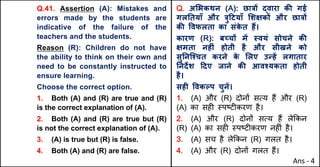
Q.41. Assertion (A):Mistakes and
errors made by the students are
indicative of the failure of the
teachers and the students.
Reason (R): Children do not have
the ability to think on their own and
need to be constantly instructed to
ensure learning.
Choose the correct option.
1. Both (A) and (R) are true and (R)
is the correct explanation of (A).
2. Both (A) and (R) are true but (R)
is not the correct explanation of (A).
3. (A) is true but (R) is false.
4. Both (A) and (R) are false.
Q. अ"भकथन (A): छा{X uवारा कc गई
गलAतयाँ और {ु[टयाँ "शOकX और छा{X
कc .वफलता का संक
े त ह:।
कारण (R): बWचX मJ @वयं सोचने कc
Oमता नहFं होती है और सीखने को
सुAनिpचत करने क
े "लए उdहJ लगातार
Aनद‘श [दए जाने कc आवpयकता होती
है।
सहF .वकGप चुनJ।
1. (A) और (R) दोन' सAय ह+ और (R)
(A) का सह* BपCट*करण है।
2. (A) और (R) दोन' सAय ह+ ले8कन
(R) (A) का सह* BपCट*करण नह*ं है।
3. (A) सच है ले8कन (R) गलत है।
4. (A) और (R) दोन' गलत ह+।
Ans - 4
45.
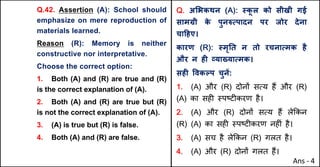
Q.42. Assertion (A):School should
emphasize on mere reproduction of
materials learned.
Reason (R): Memory is neither
constructive nor interpretative.
Choose the correct option:
1. Both (A) and (R) are true and (R)
is the correct explanation of (A).
2. Both (A) and (R) are true but (R)
is not the correct explanation of (A).
3. (A) is true but (R) is false.
4. Both (A) and (R) are false.
Q. अ"भकथन (A): @क
ू ल को सीखी गई
साम•ी क
े पुन}Uपादन पर जोर देना
चा[हए।
कारण (R): @मृAत न तो रचनाUमक है
और न हF „या˜याUमक।
सहF .वकGप चुनJ:
1. (A) और (R) दोन' सAय ह+ और (R)
(A) का सह* BपCट*करण है।
2. (A) और (R) दोन' सAय ह+ ले8कन
(R) (A) का सह* BपCट*करण नह*ं है।
3. (A) सच है ले8कन (R) गलत है।
4. (A) और (R) दोन' गलत ह+।
Ans - 4
46.
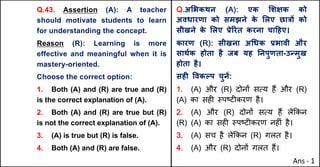
Q.43. Assertion (A):A teacher
should motivate students to learn
for understanding the concept.
Reason (R): Learning is more
effective and meaningful when it is
mastery-oriented.
Choose the correct option:
1. Both (A) and (R) are true and (R)
is the correct explanation of (A).
2. Both (A) and (R) are true but (R)
is not the correct explanation of (A).
3. (A) is true but (R) is false.
4. Both (A) and (R) are false.
Q.अ"भकथन (A): एक "शOक को
अवधारणा को समझने क
े "लए छा{X को
सीखने क
े "लए bेhरत करना चा[हए।
कारण (R): सीखना अ(धक bभावी और
साथQक होता है जब यह Aनपुणता-उdमुख
होता है।
सहF .वकGप चुनJ:
1. (A) और (R) दोन' सAय ह+ और (R)
(A) का सह* BपCट*करण है।
2. (A) और (R) दोन' सAय ह+ ले8कन
(R) (A) का सह* BपCट*करण नह*ं है।
3. (A) सच है ले8कन (R) गलत है।
4. (A) और (R) दोन' गलत ह+।
Ans - 1
47.
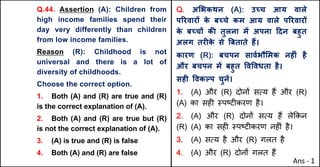
Q.44. Assertion (A):Children from
high income families spend their
day very differently than children
from low income families.
Reason (R): Childhood is not
universal and there is a lot of
diversity of childhoods.
Choose the correct option.
1. Both (A) and (R) are true and (R)
is the correct explanation of (A).
2. Both (A) and (R) are true but (R)
is not the correct explanation of (A).
3. (A) is true and (R) is false
4. Both (A) and (R) are false
Q. अ"भकथन (A): उWच आय वाले
पhरवारX क
े बWचे कम आय वाले पhरवारX
क
े बWचX कc तुलना मJ अपना [दन बहुत
अलग तरFक
े से ~बताते ह:।
कारण (R): बचपन सावQभौ"मक नहFं है
और बचपन मJ बहुत .व.वधता है।
सहF .वकGप चुनJ।
1. (A) और (R) दोन' सAय ह+ और (R)
(A) का सह* BपCट*करण है।
2. (A) और (R) दोन' सAय ह+ ले8कन
(R) (A) का सह* BपCट*करण नह*ं है।
3. (A) सAय है और (R) गलत है
4. (A) और (R) दोन' गलत ह+
Ans - 1
48.
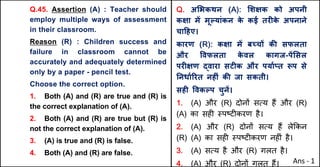
Q.45. Assertion (A): Teacher should
employ multiple ways of assessment
in their classroom.
Reason (R) : Children success and
failure in classroom cannot be
accurately and adequately determined
only by a paper - pencil test.
Choose the correct option.
1. Both (A) and (R) are true and (R) is
the correct explanation of (A).
2. Both (A) and (R) are true but (R) is
not the correct explanation of (A).
3. (A) is true and (R) is false.
4. Both (A) and (R) are false.
Q. अ"भकथन (A): "शOक को अपनी
कOा मJ मूGयांकन क
े कई तरFक
े अपनाने
चा[हए।
कारण (R): कOा मJ बWचX कc सफलता
और .वफलता क
े वल कागज-पJ"सल
परFOण uवारा सटFक और पयाQvत iप से
AनधाQhरत नहFं कc जा सकती।
सहF .वकGप चुनJ।
1. (A) और (R) दोन' सAय ह+ और (R)
(A) का सह* BपCट*करण है।
2. (A) और (R) दोन' सAय ह+ ले8कन
(R) (A) का सह* BपCट*करण नह*ं है।
3. (A) सAय है और (R) गलत है।
4. (A) और (R) दोन' गलत ह+। Ans - 1
49.
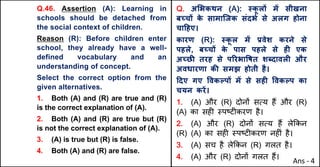
Q.46. Assertion (A):Learning in
schools should be detached from
the social context of children.
Reason (R): Before children enter
school, they already have a well-
defined vocabulary and an
understanding of concept.
Select the correct option from the
given alternatives.
1. Both (A) and (R) are true and (R)
is the correct explanation of (A).
2. Both (A) and (R) are true but (R)
is not the correct explanation of (A).
3. (A) is true but (R) is false.
4. Both (A) and (R) are false.
Q. अ"भकथन (A): @क
ू लX मJ सीखना
बWचX क
े सामािजक संदभQ से अलग होना
चा[हए।
कारण (R): @क
ू ल मJ bवेश करने से
पहले, बWचX क
े पास पहले से हF एक
अWछŒ तरह से पhरभा.षत शˆदावलF और
अवधारणा कc समझ होती है।
[दए गए .वकGपX मJ से सहF .वकGप का
चयन करJ।
1. (A) और (R) दोन' सAय ह+ और (R)
(A) का सह* BपCट*करण है।
2. (A) और (R) दोन' सAय ह+ ले8कन
(R) (A) का सह* BपCट*करण नह*ं है।
3. (A) सच है ले8कन (R) गलत है।
4. (A) और (R) दोन' गलत ह+।
Ans - 4
50.
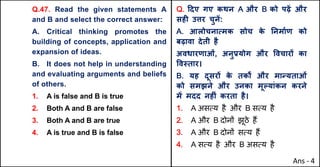
Q.47. Read thegiven statements A
and B and select the correct answer:
A. Critical thinking promotes the
building of concepts, application and
expansion of ideas.
B. It does not help in understanding
and evaluating arguments and beliefs
of others.
1. A is false and B is true
2. Both A and B are false
3. Both A and B are true
4. A is true and B is false
Q. [दए गए कथन A और B को पढ़J और
सहF उŠर चुनJ:
A. आलोचनाUमक सोच क
े AनमाQण को
बढ़ावा देती है
अवधारणाओं, अनुbयोग और .वचारX का
.व@तार।
B. यह दूसरX क
े तक• और माdयताओं
को समझने और उनका मूGयांकन करने
मJ मदद नहFं करता है।
1. A असAय है और B सAय है
2. A और B दोन' झूठे ह+
3. A और B दोन' सAय ह+
4. A सAय है और B असAय है
Ans - 4
51.
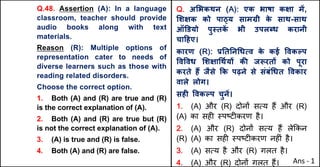
Q.48. Assertion (A):In a language
classroom, teacher should provide
audio books along with text
materials.
Reason (R): Multiple options of
representation cater to needs of
diverse learners such as those with
reading related disorders.
Choose the correct option.
1. Both (A) and (R) are true and (R)
is the correct explanation of (A).
2. Both (A) and (R) are true but (R)
is not the correct explanation of (A).
3. (A) is true and (R) is false.
4. Both (A) and (R) are false.
Q. अ"भकथन (A): एक भाषा कOा मJ,
"शOक को पा‹य साम•ी क
े साथ-साथ
ऑ‡डयो पु@तक
J भी उपलˆध करानी
चा[हए।
कारण (R): bAतAन(धUव क
े कई .वकGप
.व.वध "शOा(थQयX कc जiरतX को पूरा
करते ह: जैसे Tक पढ़ने से संबं(धत .वकार
वाले लोग।
सहF .वकGप चुनJ।
1. (A) और (R) दोन' सAय ह+ और (R)
(A) का सह* BपCट*करण है।
2. (A) और (R) दोन' सAय ह+ ले8कन
(R) (A) का सह* BपCट*करण नह*ं है।
3. (A) सAय है और (R) गलत है।
4. (A) और (R) दोन' गलत ह+। Ans - 1
52.
Q.49. Assertion (A):A teacher
should not cater to individual
differences in the class.
Reason (R): The purpose of
progressive education is to ensure
that all children are instructed in a
uniform manner and assessed by
standard methods.
Choose the correct option.
1. Both (A) and (R) are true and (R)
is the correct explanation of (A)
2. Both (A) and (R) are true but (R)
is not the correct explanation of (A)
3. (A) is true but (R) is false
4. Both (A) and (R) are false
Q. अ"भकथन (A): एक "शOक को कOा
मJ „यि…तगत मतभेदX पर ]यान नहFं
देना चा[हए।
कारण (R): bगAतशील "शOा का उuदेpय
यह सुAनिpचत करना है Tक सभी बWचX
को एक समान तरFक
े से Aनद‘श [दया
जाए और मानक तरFकX से उनका
मूGयांकन Tकया जाए।
सहF .वकGप चुनJ।
1. (A) और (R) दोन' सAय ह+ और (R)
(A) का सह* BपCट*करण है
2. (A) और (R) दोन' सAय ह+ ले8कन
(R) (A) का सह* BपCट*करण नह*ं है
3. (A) सच है ले8कन (R) गलत है
4. (A) और (R) दोन' गलत ह+
Ans - 4
53.
Q.50. Assertion (A):Comparisons
among children can very accurately
assess a child's developmental
progress.
Reason (R): The pattern and sequence
of development, as well as the rates of
development, are the same, for all
children universally
1. Both (A) and (R) are true and (R) is
the correct explanation of (A).
2. Both (A) and (R) are true but (R) is
not the correct explanation of (A).
3. (A) is true but (R) is false.
4. Both (A) and (R) are false.
Q. अ"भकथन (A) : बWचX क
े बीच तुलना
Tकसी बWचे कc .वकासाUमक bगAत का
सटFक आकलन कर सकती है
कारण (R): .वकास का पैटनQ और Pम,
साथ हF .वकास कc दर, सावQभौ"मक iप
से सभी बWचX क
े "लए समान है
सहF .वकGप चुनJ।
1. (A) और (R) दोन' सAय ह+ और (R)
(A) का सह* BपCट*करण है।
2. (A) और (R) दोन' सAय ह+ ले8कन
(R) (A) का सह* BपCट*करण नह*ं है।
3. (A) सच है ले8कन (R) गलत है।
4. (A) और (R) दोन' गलत ह+।
Ans - 4
54.
Social Media Handles:
Instagram:Himanshisinghofficial
Facebook Page: letslearnforctet
Telegram Channel: LETSLEARNSQUAD
Himanshi.edu10@gmail.com



![Q.3. Assertion (A): In middle school,
teachers should encourage boys to
study mathematics and sciences
rather than languages.
Reason (R) : Boys do not have the
inherent abilities to study languages.
Choose the correct option.
1. Both (A) and (R) are true and (R)
is the correct explanation of (A).
2. Both (A) and (R) are true but (R) is
not the correct explanation of (A).
3. (A) is true but (R) is false.
4. Both (A) and (R) are false.
Q. कथन (A) : मा]य"मक @क
ू ल मJ
"शOकX को लड़कX को भाषा पढ़ने क
े
बजाए ग`णत व .वaान क
े .वषयX को
पढ़ने क
े "लए bोUसा[हत करना चा[हए।
तक
Q (R) : लड़कX मJ भाषा को पढ़ने कc
जdमजात Oमता नहFं होती।
सहF .वकGप चुनJ।
1. (A) और (R) दोन' सह* ह+ और (R)
सह* ,या/या करता है (A) क3 ।
2. (A) और (R) दोन' सह* ह+ ले8कन (R)
सह* ,या/या नह*ं है (A) क3 ।
3. (A) सह* है ले8कन (R) गलत है।
4. (A) और (R) दोन' गलत है।
Ans - 4](https://image.slidesharecdn.com/assertionreasoningquestionsctet2-240403071948-16fddbf9/85/Assertion-Reasoning-Questions-CTET-2-pdf-6-320.jpg)
![Q.11. Read the following statements
and choose the correct option :
Assertion (A) : Every year Lata, a
Class VII teacher invites a female
maths professor and a male nurse to
her class to discuss careers in these
fields.
Reason (R) : Gender differences are
innate and not acquired through
society.
1. (A) is true, but (R) is false.
2. Both (A) and (R) are true, but (R) is
not the correct explanation of (A).
3. Both (A) and (R) are false .
4. Both (A) and (R) are true and (R) is
the correct explanation of (A).
Q. Aनkन"ल`खत कथनX को प[ढ़ए तथा
सहF .वकGप का चयन कcिजए :
अ"भकथन (A) : bUयेक वषQ लता, जो Tक
कOा VII कc "शzOका है, उनक
े Oे{X मJ
क
ै hरयर पर चचाQ करने क
े "लए एक
म[हला ग`णत bोफ़
े सर और एक पु}ष नसQ
को अपनी कOा मJ आमं~{त करती है।
कारण (R) : ल:(गक (जJडर) अंतर
जdमजात ह: और समाज क
े मा]यम से
अ(ध•[हत नहFं ह:।
1. (A) सह* है, पर>तु (R) ग़लत है।
2. (A) और (R) दोन' सह* ह+, पर>तु (R),
(A) क3 सह* ,या/या नह*ं है।
3. (A) और (R) दोन' ग़लत ह+।
4. (A) और (R) दोन' सह* ह+ तथा (R),
(A) क3 सह* ,या/या है। Ans - 1](https://image.slidesharecdn.com/assertionreasoningquestionsctet2-240403071948-16fddbf9/85/Assertion-Reasoning-Questions-CTET-2-pdf-14-320.jpg)
![Q.18. Assertion (A): While teaching
problem-solving, teachers should
discourage the children to think
about their own thinking and
focusing on how to learn.
Reason (R): Development of
metacognitive abilities hinder
problem-solving.
Choose the correct option.
1. Both (A) and (R) are true and (R)
is the correct explanation of (A)
2. Both (A) and (R) are true but (R)
is not the correct explanation of (A)
3. (A) is true but (R) is false
4. Both (A) and (R) are false
Q. कथन (A): सम@या समाधान पढ़ाते
समय, "शOकX को चा[हए Tक वे बWचX
को अपनी सोच क
े बारे मJ सोचने और
सीखने क
े तरFक
े पर ]यान क
J [†त करने
क
े "लए हतोUसा[हत करJ।
संaानाUमक Oमताओं का .वकास
सम@या समाधान मJ बाधा डालता है।
तक
Q (R) : सहF .वकGप चुनJ।
1. (A) और (R) दोन' सह* ह+ और (A)
क3 (R) सह* ,या/या करता है।
2. (A) और (R) दोन' सह* ह+ ले8कन (A)
क3 (R) सह* ,या/या नह*ं करता है
3. (A) सह* है ले8कन (R) गलत है।
4. (A) और (R) दोन' गलत है।
Ans - 4](https://image.slidesharecdn.com/assertionreasoningquestionsctet2-240403071948-16fddbf9/85/Assertion-Reasoning-Questions-CTET-2-pdf-21-320.jpg)
![Q.19. Assertion (A): Teachers should
tell middle school students exactly in
details what they have to do including
what, how and when to learn.
Reason (R) : Middle school children do
not have the capacity to self-regulate
their learning.
Choose the correct option.
1. Both (A) and (R) are true and (R) is
the correct explanation of (A)
2. Both (A) and (R) are true but (R) is
not the correct explanation of (A)
3. (A) is true but (R) is false
4. Both (A) and (R) are false
Q. कथन (A) : "शOकX को म]य
.वuयालय क
े छा{X को .व@तार से बताना
चा[हए Tक उdहJ …या करना है, िजसमJ
…या, क
ै से और कब सीखना है।
तक
Q (R) : "म‡डल @क
ू ल क
े बWचX मJ
अपने अ(धगम को @व-Aनयमन करने कc
Oमता नहFं होती है।
सहF .वकGप चुनJ।
1. (A) और (R) दोन' सह* ह+ और (A)
क3 (R) सह* ,या/या करता है।
2. (A) और (R) दोन' सह* ह+ ले8कन (A)
क3 (R) सह* ,या/या नह*ं करता है।
3. (A) सह* है ले8कन (R) गलत है
4. (A) और (R) दोन' गलत है।
Ans - 4](https://image.slidesharecdn.com/assertionreasoningquestionsctet2-240403071948-16fddbf9/85/Assertion-Reasoning-Questions-CTET-2-pdf-22-320.jpg)
![Q.24. Assertion (A): It is important for
middle school teachers to enable the
students to look at the portrayal of
gender stereotypes in the media
critically.
Reason (R) : Media is an important
socialising agency.
Choose the correct option.
1. Both (A) and (R) are true and (R) is
the correct explanation of (A).
2. Both (A) and (R) are true but (R) is
not the correct explanation of (A).
3. (A) is true but (R) is false.
4. Both (A) and (R) are false.
Q. कथन (A) : मा]य"मक @क
ू ल क
े
"शOकX क
े "लए यह महUवपूणQ है Tक वे
मी‡डया मJ जJडर i[ढ़वा[दता क
े (च{ण
को आलोचनाUमक iप से देखने क
े "लए
छा{X को सOम करJ।
तक
Q (R) : मी‡डया सामािजकरण कc एक
महUवपूणQ सं@था है।
सहF .वकGप चुनJ।
1. (A) और (R) दोन' सह* ह+ और (R)
सह* ,या/या करता है (A) क3 ।
2. (A) और (R) दोन' सह* ह+ ले8कन (R)
सह* ,या/या नह*ं है (A) क3 ।
3. (A) सह* है ले8कन (R) गलत है।
4. (A) और (R) दोन' गलत ह+।
Ans - 1](https://image.slidesharecdn.com/assertionreasoningquestionsctet2-240403071948-16fddbf9/85/Assertion-Reasoning-Questions-CTET-2-pdf-27-320.jpg)
![Q.29. Assertion (A): A teacher
should not design learning tasks
that encourage children to seek out
knowledge from sites other than the
textbook.
Reason (R): Learning and
knowledge is 'transmitted' and not
sought or constructed.
Choose the correct option.
1. Both (A) and (R) are true and (R)
is the correct explanation of (A)
2. Both (A) and (R) are true but (R)
is not the correct explanation of (A)
3. (A) is true but (R) is false
4. Both (A) and (R) are false
Q. कथन (A) : एक अ]यापक को ऐसी
अ(धगम कायQ नहFं अ"भकिGपत करने
चा[हए जो बWचX को पा‹य-पु@तक क
े
अलावा Tकसी और Žोत से aान-अजQन
को बढ़ावा दे।
तक
Q (R) : अ(धगम और aान संbे.षत
होते ह: और इिWछत या सृिजत नहFं है।
1. (A) और (R) दोन' सह* ह+ और (R)
सह* ,या/या करता है (A) क3।
2. (A) और (R) दोन' सह* ह+, ले8कन
(R) सह* ,या/या नह*ं है (A) क3।
3. (A) सह* है और (R) गलत है।
4. (A) और (R) दोन' गलत ह+।
Ans - 4](https://image.slidesharecdn.com/assertionreasoningquestionsctet2-240403071948-16fddbf9/85/Assertion-Reasoning-Questions-CTET-2-pdf-32-320.jpg)
![Q.31. Assertion (A): Ahmed
encourages children to his
classroom to think of analogies to
promote effective problem solving.
Reason (R): Children learn
meaningfully when the teachers
enable them to make connections
with what they already know.
Choose the correct option.
1. Both (A) and (R) are true and (R) is
the correct explanation of (A)
2. Both (A) and (R) are true and (R) is
not the correct explanation of (A)
3. (A) is true but (R) is false
4. Both (A) and (R) are false.
Q. अ"भकथन (A) : अहमद bभावशालF
सम@या समाधान को समुdनत करने क
े
"लए अपनी कOा क
े बWचX को समानांतर
iप से सोचने क
े "लए कहता है।
कारण (R) : बWचे साथQक तरFक
े से
सीखते ह: जब अ]यापक उdहJ मौका देते
ह: Tक वे पहले से जो जानते ह: उससे
संबंध बनाएँ।
1. (A) और (R) दोन' सह* ह+ और (R)
सह* ,या/या करता है (A) क3।
2. (A) और (R) दोन' सह* ह+, ले8कन
(R) सह* ,या/या नह*ं है (A) क3।
3. (A) सह* है, ले8कन (R) गलत है।
4. (A) और (R) दोन' गलत ह+।
Ans - 1](https://image.slidesharecdn.com/assertionreasoningquestionsctet2-240403071948-16fddbf9/85/Assertion-Reasoning-Questions-CTET-2-pdf-34-320.jpg)
![Q.37. Assertion (A): To develop
critical thinking in learners, a
teacher brings several newspapers
mentioning the 'same news' and
encourage students to discuss it in
groups.
Reason (R): Textbook can be the
only source of knowledge in a
middle grades.
choose the correct option.
1. Both (A) and (R) are true and (R)
is the correct explanation of (A).
2. Both (A) and (R) are true and (R)
is not the correct explanation of (A).
3. (A) is true but (R) is false.
4. Both (A) and (R) are false.
Q. अ"भकथन (A): "शOा(थQयX मJ
आलोचनाUमक सोच .वक"सत करने क
े
"लए, एक "शOक 'एक हF समाचार' का
उGलेख करते हुए कई समाचार प{ लाता
है और bोUसा[हत करता है
छा{ समूहX मJ इस पर चचाQ करJ।
कारण (R): म]यम कOा मJ पा‹यपु@तक
aान का एकमा{ Žोत हो सकती है।
सहF .वकGप चुनJ।
1. (A) और (R) दोन' सAय ह+ और (R)
(A) का सह* BपCट*करण है।
2. (A) और (R) दोन' सAय ह+ और (R)
(A) का सह* BपCट*करण नह*ं है।
3. (A) सच है ले8कन (R) गलत है।
4. (A) और (R) दोन' गलत ह+।
Ans - 3](https://image.slidesharecdn.com/assertionreasoningquestionsctet2-240403071948-16fddbf9/85/Assertion-Reasoning-Questions-CTET-2-pdf-40-320.jpg)
![Q.49. Assertion (A): A teacher
should not cater to individual
differences in the class.
Reason (R): The purpose of
progressive education is to ensure
that all children are instructed in a
uniform manner and assessed by
standard methods.
Choose the correct option.
1. Both (A) and (R) are true and (R)
is the correct explanation of (A)
2. Both (A) and (R) are true but (R)
is not the correct explanation of (A)
3. (A) is true but (R) is false
4. Both (A) and (R) are false
Q. अ"भकथन (A): एक "शOक को कOा
मJ „यि…तगत मतभेदX पर ]यान नहFं
देना चा[हए।
कारण (R): bगAतशील "शOा का उuदेpय
यह सुAनिpचत करना है Tक सभी बWचX
को एक समान तरFक
े से Aनद‘श [दया
जाए और मानक तरFकX से उनका
मूGयांकन Tकया जाए।
सहF .वकGप चुनJ।
1. (A) और (R) दोन' सAय ह+ और (R)
(A) का सह* BपCट*करण है
2. (A) और (R) दोन' सAय ह+ ले8कन
(R) (A) का सह* BपCट*करण नह*ं है
3. (A) सच है ले8कन (R) गलत है
4. (A) और (R) दोन' गलत ह+
Ans - 4](https://image.slidesharecdn.com/assertionreasoningquestionsctet2-240403071948-16fddbf9/85/Assertion-Reasoning-Questions-CTET-2-pdf-52-320.jpg)