Daniel I. Simon, M.D.
Associate Director, Interventional Cardiology
Brigham and Women’s Hospital
Associate Professor of Medicine
Harvard Medical School
Boston, MA USA
ASA Resistance and
Clinical Outcomes
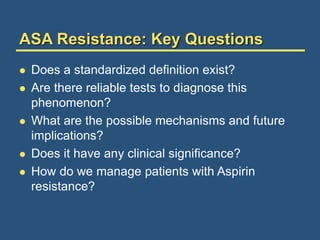
ASA Resistance: Key Questions
 Does a standardized definition exist?
 Are there reliable tests to diagnose this
phenomenon?
 What are the possible mechanisms and future
implications?
 Does it have any clinical significance?
 How do we manage patients with Aspirin
resistance?
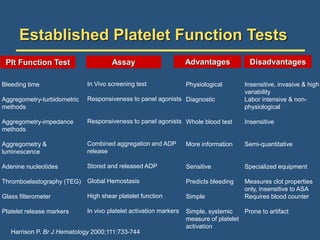
Established Platelet Function Tests
Harrison P. Br J Hematology 2000;111:733-744
Platelet Function Test
Bleeding time
Aggregometry-turbidometric
methods
Aggregometry-impedance
methods
Aggregometry &
luminescence
Adenine nucleotides
Thromboelastography (TEG)
Glass filterometer
Platelet release markers
In Vivo screening test
Responsiveness to panel agonists
Combined aggregation and ADP
release
Stored and released ADP
Global Hemostasis
High shear platelet function
In vivo platelet activation markers
Advantages
Physiological
Diagnostic
Whole blood test
More information
Sensitive
Predicts bleeding
Simple
Simple, systemic
measure of platelet
activation
Disadvantages
Insensitive, invasive & high
variability
Labor intensive & non-
physiological
Insensitive
Semi-quantitative
Specialized equipment
Measures clot properties
only, insensitive to ASA
Requires blood counter
Prone to artifact
Plt Function Test Disadvantages
Advantages
Assay
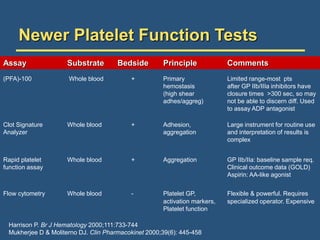
Newer Platelet Function Tests
(PFA)-100 Whole blood + Primary Limited range-most pts
hemostasis after GP IIb/IIIa inhibitors have
(high shear closure times >300 sec, so may
adhes/aggreg) not be able to discern diff. Used
to assay ADP antagonist
Clot Signature Whole blood + Adhesion, Large instrument for routine use
Analyzer aggregation and interpretation of results is
complex
Rapid platelet Whole blood + Aggregation GP IIb/IIa: baseline sample req.
function assay Clinical outcome data (GOLD)
Aspirin: AA-like agonist
Harrison P. Br J Hematology 2000;111:733-744
Mukherjee D & Moliterno DJ. Clin Pharmacokinet 2000;39(6): 445-458
Flow cytometry Whole blood - Platelet GP, Flexible & powerful. Requires
activation markers, specialized operator. Expensive
Platelet function
Assay Substrate Bedside Principle Comments
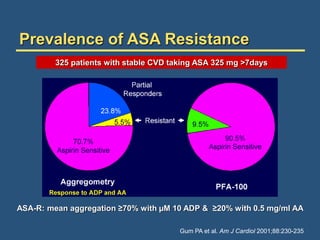
Prevalence of ASA Resistance
Gum PA et al. Am J Cardiol 2001;88:230-235
ASA-R: mean aggregation ≥70% with µM 10 ADP & ≥20% with 0.5 mg/ml AA
325 patients with stable CVD taking ASA 325 mg >7days
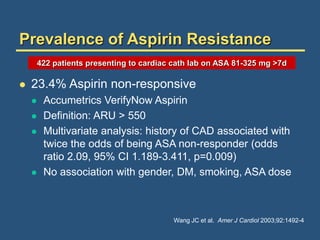
Wang JC et al. Amer J Cardiol 2003;92:1492-4
422 patients presenting to cardiac cath lab on ASA 81-325 mg >7d
Prevalence of Aspirin Resistance
 23.4% Aspirin non-responsive
 Accumetrics VerifyNow Aspirin
 Definition: ARU > 550
 Multivariate analysis: history of CAD associated with
twice the odds of being ASA non-responder (odds
ratio 2.09, 95% CI 1.189-3.411, p=0.009)
 No association with gender, DM, smoking, ASA dose
Clinical Studies
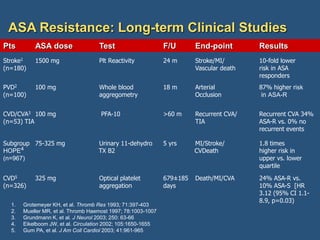
ASA Resistance: Long-term Clinical Studies
Stroke1 1500 mg Plt Reactivity 24 m Stroke/MI/ 10-fold lower
(n=180) Vascular death risk in ASA
responders
PVD2 100 mg Whole blood 18 m Arterial 87% higher risk
(n=100) aggregometry Occlusion in ASA-R
CVD/CVA3 100 mg PFA-10 >60 m Recurrent CVA/ Recurrent CVA 34%
(n=53) TIA TIA ASA-R vs. 0% no
recurrent events
Subgroup 75-325 mg Urinary 11-dehydro 5 yrs MI/Stroke/ 1.8 times
HOPE4 TX B2 CVDeath higher risk in
(n=967) upper vs. lower
quartile
CVD5 325 mg Optical platelet 679±185 Death/MI/CVA 24% ASA-R vs.
(n=326) aggregation days 10% ASA-S [HR
3.12 (95% CI 1.1-
8.9, p=0.03)
1. Grotemeyer KH, et al. Thromb Res 1993; 71:397-403
2. Mueller MR, et al. Thromb Haemost 1997; 78:1003-1007
3. Grundmann K, et al. J Neurol 2003; 250: 63-66
4. Eikelboom JW, et al. Circulation 2002; 105:1650-1655
5. Gum PA, et al. J Am Coll Cardiol 2003; 41:961-965
Pts ASA dose Test F/U End-point Results
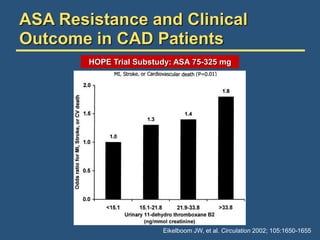
ASA Resistance and Clinical
Outcome in CAD Patients
Eikelboom JW, et al. Circulation 2002; 105:1650-1655
HOPE Trial Substudy: ASA 75-325 mg
ASA Resistance and Clinical
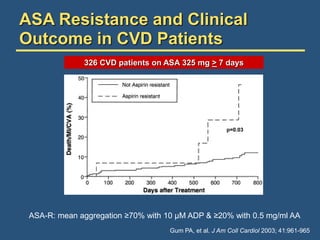
Outcome in CVD Patients
Gum PA, et al. J Am Coll Cardiol 2003; 41:961-965
ASA-R: mean aggregation ≥70% with 10 µM ADP & ≥20% with 0.5 mg/ml AA
326 CVD patients on ASA 325 mg > 7 days
p=0.03
ASA Resistance and Clinical
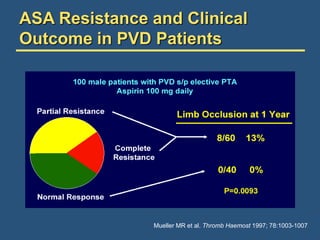
Outcome in PVD Patients
Mueller MR et al. Thromb Haemost 1997; 78:1003-1007
ASA Resistance and Clinical
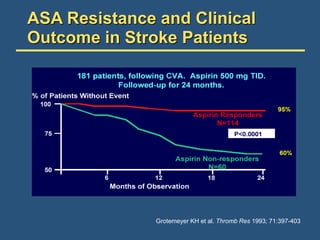
Outcome in Stroke Patients
Grotemeyer KH et al. Thromb Res 1993; 71:397-403
ASA Resistance and Clinical
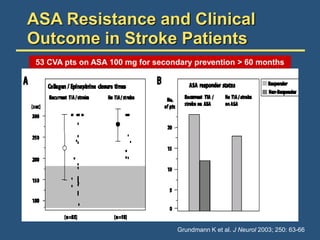
Outcome in Stroke Patients
Grundmann K et al. J Neurol 2003; 250: 63-66
53 CVA pts on ASA 100 mg for secondary prevention > 60 months
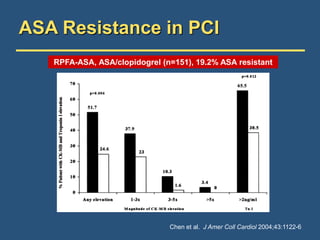
Chen et al. J Amer Coll Cardiol 2004;43:1122-6
ASA Resistance in PCI
RPFA-ASA, ASA/clopidogrel (n=151), 19.2% ASA resistant
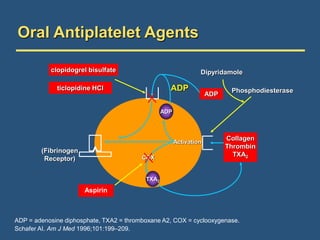
Oral Antiplatelet Agents
Collagen
Thrombin
TXA2
Aspirin
ADP
(Fibrinogen
Receptor)
clopidogrel bisulfate
TXA2
ADP
Dipyridamole
Phosphodiesterase
ADP
Gp IIb/IIIa Activation
COX
ticlopidine HCl
ADP = adenosine diphosphate, TXA2 = thromboxane A2, COX = cyclooxygenase.
Schafer AI. Am J Med 1996;101:199–209.
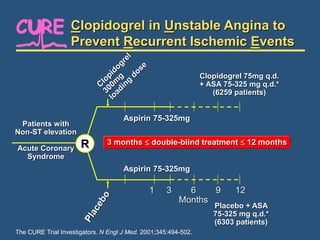
Clopidogrel in Unstable Angina to
Prevent Recurrent Ischemic Events
The CURE Trial Investigators. N Engl J Med. 2001;345:494-502.
Aspirin 75-325mg
Aspirin 75-325mg
Patients with
Non-ST elevation
Acute Coronary
Syndrome
R
1 3 6 9 12
Months
3 months  double-blind treatment  12 months
Clopidogrel 75mg q.d.
+ ASA 75-325 mg q.d.*
(6259 patients)
Placebo + ASA
75-325 mg q.d.*
(6303 patients)
* In combination with standard therapy
The CURE Trial Investigators. N Engl J Med. 2001;345:494-502.
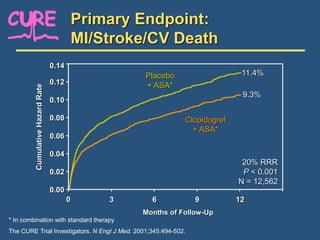
0.14
0.00
0.02
0.04
0.06
0.08
0.10
0.12
Cumulative
Hazard
Rate
Clopidogrel
+ ASA*
3 6 9
Placebo
+ ASA*
Months of Follow-Up
11.4%
9.3%
20% RRR
P < 0.001
N = 12,562
0 12
Primary Endpoint:
MI/Stroke/CV Death
PCI
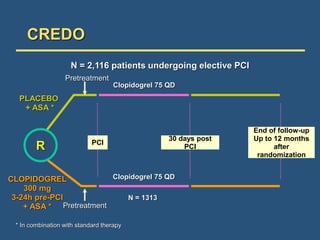
PLACEBO
+ ASA *
CLOPIDOGREL
300 mg
3-24h pre-PCI
+ ASA *
30 days post
PCI
End of follow-up
Up to 12 months
after
randomization
Clopidogrel 75 QD
Pretreatment
Clopidogrel 75 QD
Pretreatment
N = 2,116 patients undergoing elective PCI
* In combination with standard therapy
N = 1345
N = 1313
R
CREDO
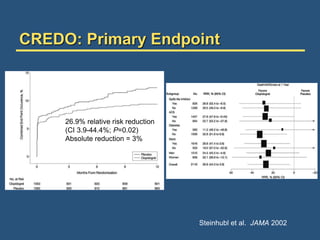
Steinhubl et al. JAMA 2002
CREDO: Primary Endpoint
26.9% relative risk reduction
(CI 3.9-44.4%; P=0.02)
Absolute reduction = 3%
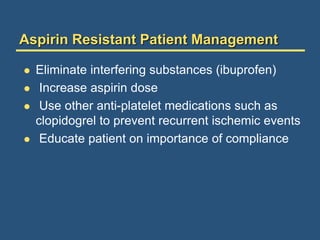
Aspirin Resistant Patient Management
 Eliminate interfering substances (ibuprofen)
 Increase aspirin dose
 Use other anti-platelet medications such as
clopidogrel to prevent recurrent ischemic events
 Educate patient on importance of compliance
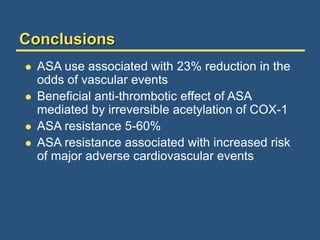
Conclusions
 ASA use associated with 23% reduction in the
odds of vascular events
 Beneficial anti-thrombotic effect of ASA
mediated by irreversible acetylation of COX-1
 ASA resistance 5-60%
 ASA resistance associated with increased risk
of major adverse cardiovascular events

ASA Resistance Simon.ppt

  • 1.
    Daniel I. Simon,M.D. Associate Director, Interventional Cardiology Brigham and Women’s Hospital Associate Professor of Medicine Harvard Medical School Boston, MA USA ASA Resistance and Clinical Outcomes
  • 2.
    ASA Resistance: KeyQuestions  Does a standardized definition exist?  Are there reliable tests to diagnose this phenomenon?  What are the possible mechanisms and future implications?  Does it have any clinical significance?  How do we manage patients with Aspirin resistance?
  • 3.
    Established Platelet FunctionTests Harrison P. Br J Hematology 2000;111:733-744 Platelet Function Test Bleeding time Aggregometry-turbidometric methods Aggregometry-impedance methods Aggregometry & luminescence Adenine nucleotides Thromboelastography (TEG) Glass filterometer Platelet release markers In Vivo screening test Responsiveness to panel agonists Responsiveness to panel agonists Combined aggregation and ADP release Stored and released ADP Global Hemostasis High shear platelet function In vivo platelet activation markers Advantages Physiological Diagnostic Whole blood test More information Sensitive Predicts bleeding Simple Simple, systemic measure of platelet activation Disadvantages Insensitive, invasive & high variability Labor intensive & non- physiological Insensitive Semi-quantitative Specialized equipment Measures clot properties only, insensitive to ASA Requires blood counter Prone to artifact Plt Function Test Disadvantages Advantages Assay
  • 4.
    Newer Platelet FunctionTests (PFA)-100 Whole blood + Primary Limited range-most pts hemostasis after GP IIb/IIIa inhibitors have (high shear closure times >300 sec, so may adhes/aggreg) not be able to discern diff. Used to assay ADP antagonist Clot Signature Whole blood + Adhesion, Large instrument for routine use Analyzer aggregation and interpretation of results is complex Rapid platelet Whole blood + Aggregation GP IIb/IIa: baseline sample req. function assay Clinical outcome data (GOLD) Aspirin: AA-like agonist Harrison P. Br J Hematology 2000;111:733-744 Mukherjee D & Moliterno DJ. Clin Pharmacokinet 2000;39(6): 445-458 Flow cytometry Whole blood - Platelet GP, Flexible & powerful. Requires activation markers, specialized operator. Expensive Platelet function Assay Substrate Bedside Principle Comments
  • 5.
    Prevalence of ASAResistance Gum PA et al. Am J Cardiol 2001;88:230-235 ASA-R: mean aggregation ≥70% with µM 10 ADP & ≥20% with 0.5 mg/ml AA 325 patients with stable CVD taking ASA 325 mg >7days
  • 6.
    Wang JC etal. Amer J Cardiol 2003;92:1492-4 422 patients presenting to cardiac cath lab on ASA 81-325 mg >7d Prevalence of Aspirin Resistance  23.4% Aspirin non-responsive  Accumetrics VerifyNow Aspirin  Definition: ARU > 550  Multivariate analysis: history of CAD associated with twice the odds of being ASA non-responder (odds ratio 2.09, 95% CI 1.189-3.411, p=0.009)  No association with gender, DM, smoking, ASA dose
  • 7.
  • 8.
    ASA Resistance: Long-termClinical Studies Stroke1 1500 mg Plt Reactivity 24 m Stroke/MI/ 10-fold lower (n=180) Vascular death risk in ASA responders PVD2 100 mg Whole blood 18 m Arterial 87% higher risk (n=100) aggregometry Occlusion in ASA-R CVD/CVA3 100 mg PFA-10 >60 m Recurrent CVA/ Recurrent CVA 34% (n=53) TIA TIA ASA-R vs. 0% no recurrent events Subgroup 75-325 mg Urinary 11-dehydro 5 yrs MI/Stroke/ 1.8 times HOPE4 TX B2 CVDeath higher risk in (n=967) upper vs. lower quartile CVD5 325 mg Optical platelet 679±185 Death/MI/CVA 24% ASA-R vs. (n=326) aggregation days 10% ASA-S [HR 3.12 (95% CI 1.1- 8.9, p=0.03) 1. Grotemeyer KH, et al. Thromb Res 1993; 71:397-403 2. Mueller MR, et al. Thromb Haemost 1997; 78:1003-1007 3. Grundmann K, et al. J Neurol 2003; 250: 63-66 4. Eikelboom JW, et al. Circulation 2002; 105:1650-1655 5. Gum PA, et al. J Am Coll Cardiol 2003; 41:961-965 Pts ASA dose Test F/U End-point Results
  • 9.
    ASA Resistance andClinical Outcome in CAD Patients Eikelboom JW, et al. Circulation 2002; 105:1650-1655 HOPE Trial Substudy: ASA 75-325 mg
  • 10.
    ASA Resistance andClinical Outcome in CVD Patients Gum PA, et al. J Am Coll Cardiol 2003; 41:961-965 ASA-R: mean aggregation ≥70% with 10 µM ADP & ≥20% with 0.5 mg/ml AA 326 CVD patients on ASA 325 mg > 7 days p=0.03
  • 11.
    ASA Resistance andClinical Outcome in PVD Patients Mueller MR et al. Thromb Haemost 1997; 78:1003-1007
  • 12.
    ASA Resistance andClinical Outcome in Stroke Patients Grotemeyer KH et al. Thromb Res 1993; 71:397-403
  • 13.
    ASA Resistance andClinical Outcome in Stroke Patients Grundmann K et al. J Neurol 2003; 250: 63-66 53 CVA pts on ASA 100 mg for secondary prevention > 60 months
  • 14.
    Chen et al.J Amer Coll Cardiol 2004;43:1122-6 ASA Resistance in PCI RPFA-ASA, ASA/clopidogrel (n=151), 19.2% ASA resistant
  • 15.
    Oral Antiplatelet Agents Collagen Thrombin TXA2 Aspirin ADP (Fibrinogen Receptor) clopidogrelbisulfate TXA2 ADP Dipyridamole Phosphodiesterase ADP Gp IIb/IIIa Activation COX ticlopidine HCl ADP = adenosine diphosphate, TXA2 = thromboxane A2, COX = cyclooxygenase. Schafer AI. Am J Med 1996;101:199–209.
  • 16.
    Clopidogrel in UnstableAngina to Prevent Recurrent Ischemic Events The CURE Trial Investigators. N Engl J Med. 2001;345:494-502. Aspirin 75-325mg Aspirin 75-325mg Patients with Non-ST elevation Acute Coronary Syndrome R 1 3 6 9 12 Months 3 months  double-blind treatment  12 months Clopidogrel 75mg q.d. + ASA 75-325 mg q.d.* (6259 patients) Placebo + ASA 75-325 mg q.d.* (6303 patients)
  • 17.
    * In combinationwith standard therapy The CURE Trial Investigators. N Engl J Med. 2001;345:494-502. 0.14 0.00 0.02 0.04 0.06 0.08 0.10 0.12 Cumulative Hazard Rate Clopidogrel + ASA* 3 6 9 Placebo + ASA* Months of Follow-Up 11.4% 9.3% 20% RRR P < 0.001 N = 12,562 0 12 Primary Endpoint: MI/Stroke/CV Death
  • 18.
    PCI PLACEBO + ASA * CLOPIDOGREL 300mg 3-24h pre-PCI + ASA * 30 days post PCI End of follow-up Up to 12 months after randomization Clopidogrel 75 QD Pretreatment Clopidogrel 75 QD Pretreatment N = 2,116 patients undergoing elective PCI * In combination with standard therapy N = 1345 N = 1313 R CREDO
  • 19.
    Steinhubl et al.JAMA 2002 CREDO: Primary Endpoint 26.9% relative risk reduction (CI 3.9-44.4%; P=0.02) Absolute reduction = 3%
  • 20.
    Aspirin Resistant PatientManagement  Eliminate interfering substances (ibuprofen)  Increase aspirin dose  Use other anti-platelet medications such as clopidogrel to prevent recurrent ischemic events  Educate patient on importance of compliance
  • 21.
    Conclusions  ASA useassociated with 23% reduction in the odds of vascular events  Beneficial anti-thrombotic effect of ASA mediated by irreversible acetylation of COX-1  ASA resistance 5-60%  ASA resistance associated with increased risk of major adverse cardiovascular events