1
INTRODUCTION
Copyright © 2004 South-Western/Thomson Learning
Course: MBA-1
Subject: ME
Unit:1
Copyright © 2004 South-Western/Thomson Learning
11Ten Principles of
Economics
Copyright © 2004 South-Western/Thomson Learning
Economy. . .
. . . The word economy comes from a Greek
word for “one who manages a household.”
Copyright © 2004 South-Western/Thomson Learning
TEN PRINCIPLES OF
ECONOMICS
• A household and an economy
face many decisions:
• Who will work?
• What goods and how many of them should be
produced?
• What resources should be used in production?
• At what price should the goods be sold?
Copyright © 2004 South-Western/Thomson Learning
TEN PRINCIPLES OF
ECONOMICS
Society and Scarce Resources:
• The management of society’s resources is
important because resources are scarce.
• Scarcity. . . means that society has limited resources
and therefore cannot produce all the goods and
services people wish to have.
Copyright © 2004 South-Western/Thomson Learning
TEN PRINCIPLES OF
ECONOMICS
Economics is the study of how society manages
its scarce resources.
Copyright © 2004 South-Western/Thomson Learning
TEN PRINCIPLES OF
ECONOMICS
• How people make decisions.
• People face tradeoffs.
• The cost of something is what you give up to get it.
• Rational people think at the margin.
• People respond to incentives.
Copyright © 2004 South-Western/Thomson Learning
TEN PRINCIPLES OF
ECONOMICS
• How people interact with each other.
• Trade can make everyone better off.
• Markets are usually a good way to organize
economic activity.
• Governments can sometimes improve economic
outcomes.
Copyright © 2004 South-Western/Thomson Learning
TEN PRINCIPLES OF
ECONOMICS
• The forces and trends that affect how the
economy as a whole works.
• The standard of living depends on a country’s
production.
• Prices rise when the government prints too much
money.
• Society faces a short-run tradeoff between inflation
and unemployment.
Copyright © 2004 South-Western/Thomson Learning
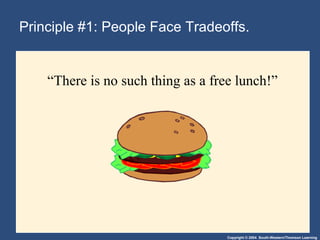
Principle #1: People Face Tradeoffs.
“There is no such thing as a free lunch!”
Copyright © 2004 South-Western/Thomson Learning
Making decisions requires trading
off one goal against another.
Principle #1: People Face Tradeoffs.
To get one thing, we usually have to give up
another thing.
• Guns v. butter
• Food v. clothing
• Leisure time v. work
• Efficiency v. equity
Copyright © 2004 South-Western/Thomson Learning
Principle #1: People Face Tradeoffs
• Efficiency v. Equity
• Efficiency means society gets the most that it can
from its scarce resources.
• Equity means the benefits of those resources are
distributed fairly among the members of society.
Copyright © 2004 South-Western/Thomson Learning
Principle #2: The Cost of Something Is What
You Give Up to Get It.
• Decisions require comparing costs and benefits
of alternatives.
• Whether to go to college or to work?
• Whether to study or go out on a date?
• Whether to go to class or sleep in?
• The opportunity cost of an item is what you
give up to obtain that item.
Copyright © 2004 South-Western/Thomson Learning
People make decisions by comparing
costs and benefits at the margin.
Principle #3: Rational People Think at the
Margin.
• Marginal changes are small, incremental
adjustments to an existing plan of action.
Copyright © 2004 South-Western/Thomson Learning
Principle #4: People Respond to Incentives.
• Marginal changes in costs or benefits motivate
people to respond.
• The decision to choose one alternative over
another occurs when that alternative’s marginal
benefits exceed its marginal costs!
Copyright © 2004 South-Western/Thomson Learning
Principle #5: Trade Can Make Everyone
Better Off.
• People gain from their ability to trade with one
another.
• Competition results in gains from trading.
• Trade allows people to specialize in what they
do best.
Copyright © 2004 South-Western/Thomson Learning
Principle #6: Markets Are Usually a Good
Way to Organize Economic Activity.
• A market economy is an economy that allocates
resources through the decentralized decisions of
many firms and households as they interact in
markets for goods and services.
• Households decide what to buy and who to work
for.
• Firms decide who to hire and what to produce.
Copyright © 2004 South-Western/Thomson Learning
Principle #6: Markets Are Usually a Good
Way to Organize Economic Activity.
• Adam Smith made the observation that
households and firms interacting in markets act
as if guided by an “invisible hand.”
• Because households and firms look at prices when
deciding what to buy and sell, they unknowingly
take into account the social costs of their actions.
• As a result, prices guide decision makers to reach
outcomes that tend to maximize the welfare of
society as a whole.
Copyright © 2004 South-Western/Thomson Learning
Principle #7: Governments Can Sometimes
Improve Market Outcomes.
• Market failure occurs when the market fails to
allocate resources efficiently.
• When the market fails (breaks down)
government can intervene to promote efficiency
and equity.
Copyright © 2004 South-Western/Thomson Learning
Principle #8: The Standard of Living
Depends on a Country’s Production.
• Standard of living may be measured in different
ways:
• By comparing personal incomes.
• By comparing the total market value of a nation’s
production.
Copyright © 2004 South-Western/Thomson Learning
Principle #8: The Standard of Living
Depends on a Country’s Production.
• Almost all variations in living standards are
explained by differences in countries’
productivities.
• Productivity is the amount of goods and
services produced from each hour of a worker’s
time.
Copyright © 2004 South-Western/Thomson Learning
Principle #8: The Standard of Living
Depends on a Country’s Production.
• Standard of living may be measured in different
ways:
• By comparing personal incomes.
• By comparing the total market value of a nation’s
production.
Copyright © 2004 South-Western/Thomson Learning
Principle #9: Prices Rise When the
Government Prints Too Much Money.
• Inflation is an increase in the overall level of
prices in the economy.
• One cause of inflation is the growth in the
quantity of money.
• When the government creates large quantities
of money, the value of the money falls.
Copyright © 2004 South-Western/Thomson Learning
Principle #10: Society Faces a Short-run
Tradeoff Between Inflation and
Unemployment.
• The Phillips Curve illustrates the tradeoff
between inflation and unemployment:
Inflation  Unemployment
It’s a short-run tradeoff!
Copyright © 2004 South-Western/Thomson Learning
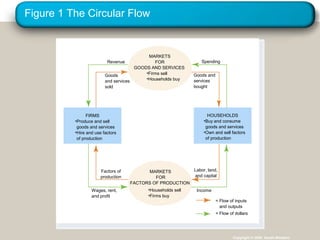
Figure 1 The Circular Flow
Copyright © 2004 South-Western
Spending
Goods and
services
bought
Revenue
Goods
and services
sold
Labor, land,
and capital
Income
= Flow of inputs
and outputs
= Flow of dollars
Factors of
production
Wages, rent,
and profit
FIRMS
•Produce and sell
goods and services
•Hire and use factors
of production
•Buy and consume
goods and services
•Own and sell factors
of production
HOUSEHOLDS
•Households sell
•Firms buy
MARKETS
FOR
FACTORS OF PRODUCTION
•Firms sell
•Households buy
MARKETS
FOR
GOODS AND SERVICES
Copyright © 2004 South-Western/Thomson Learning
Our First Model: The Circular-Flow Diagram
• Firms
• Produce and sell goods and services
• Hire and use factors of production
• Households
• Buy and consume goods and services
• Own and sell factors of production
Copyright © 2004 South-Western/Thomson Learning
Our First Model: The Circular-Flow Diagram
• Markets for Goods and Services
• Firms sell
• Households buy
• Markets for Factors of Production
• Households sell
• Firms buy
Copyright © 2004 South-Western/Thomson Learning
Our First Model: The Circular-Flow Diagram
• Factors of Production
• Inputs used to produce goods and services
• Land, labor, and capital
Copyright © 2004 South-Western/Thomson Learning
Elasticity . . .
• … allows us to analyze supply and demand
with greater precision.
• … is a measure of how much buyers and sellers
respond to changes in market conditions
Copyright © 2004 South-Western/Thomson Learning
THE ELASTICITY OF DEMAND
• Price elasticity of demand is a measure of how
much the quantity demanded of a good
responds to a change in the price of that good.
• Price elasticity of demand is the percentage
change in quantity demanded given a percent
change in the price.
Copyright © 2004 South-Western/Thomson Learning
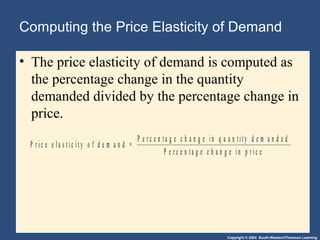
Computing the Price Elasticity of Demand
• The price elasticity of demand is computed as
the percentage change in the quantity
demanded divided by the percentage change in
price.
P r i c e e l a s t i c i t y o f d e m a n d =
P e r c e n t a g e c h a n g e i n q u a n t i t y d e m a n d e d
P e r c e n t a g e c h a n g e i n p r i c e
Copyright © 2004 South-Western/Thomson Learning
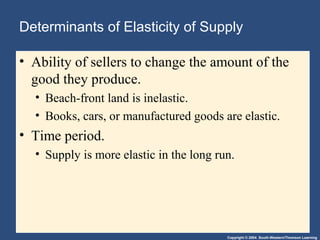
Determinants of Elasticity of Supply
• Ability of sellers to change the amount of the
good they produce.
• Beach-front land is inelastic.
• Books, cars, or manufactured goods are elastic.
• Time period.
• Supply is more elastic in the long run.
Copyright © 2004 South-Western/Thomson Learning
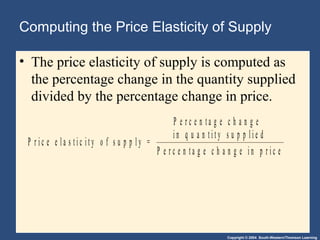
Computing the Price Elasticity of Supply
• The price elasticity of supply is computed as
the percentage change in the quantity supplied
divided by the percentage change in price.
P r i c e e l a s t i c i t y o f s u p p l y =
P e r c e n t a g e c h a n g e
i n q u a n t i t y s u p p l i e d
P e r c e n t a g e c h a n g e i n p r i c e
Copyright © 2004 South-Western/Thomson Learning
THREE APPLICATIONS OF SUPPLY,
DEMAND, AND ELASTICITY
• Can good news for farming be bad news for
farmers?
• What happens to wheat farmers and the market
for wheat when university agronomists discover
a new wheat hybrid that is more productive
than existing varieties?
Copyright © 2004 South-Western/Thomson Learning
THREE APPLICATIONS OF SUPPLY,
DEMAND, AND ELASTICITY
• Examine whether the supply or demand curve
shifts.
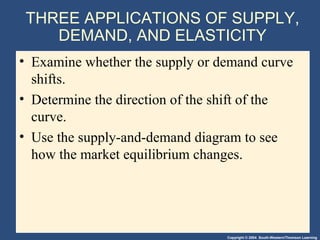
• Determine the direction of the shift of the
curve.
• Use the supply-and-demand diagram to see
how the market equilibrium changes.
Copyright © 2004 South-Western/Thomson Learning

Mba 1 me u 1.1 introduction

  • 1.
  • 2.
    Copyright © 2004South-Western/Thomson Learning Course: MBA-1 Subject: ME Unit:1
  • 3.
    Copyright © 2004South-Western/Thomson Learning 11Ten Principles of Economics
  • 4.
    Copyright © 2004South-Western/Thomson Learning Economy. . . . . . The word economy comes from a Greek word for “one who manages a household.”
  • 5.
    Copyright © 2004South-Western/Thomson Learning TEN PRINCIPLES OF ECONOMICS • A household and an economy face many decisions: • Who will work? • What goods and how many of them should be produced? • What resources should be used in production? • At what price should the goods be sold?
  • 6.
    Copyright © 2004South-Western/Thomson Learning TEN PRINCIPLES OF ECONOMICS Society and Scarce Resources: • The management of society’s resources is important because resources are scarce. • Scarcity. . . means that society has limited resources and therefore cannot produce all the goods and services people wish to have.
  • 7.
    Copyright © 2004South-Western/Thomson Learning TEN PRINCIPLES OF ECONOMICS Economics is the study of how society manages its scarce resources.
  • 8.
    Copyright © 2004South-Western/Thomson Learning TEN PRINCIPLES OF ECONOMICS • How people make decisions. • People face tradeoffs. • The cost of something is what you give up to get it. • Rational people think at the margin. • People respond to incentives.
  • 9.
    Copyright © 2004South-Western/Thomson Learning TEN PRINCIPLES OF ECONOMICS • How people interact with each other. • Trade can make everyone better off. • Markets are usually a good way to organize economic activity. • Governments can sometimes improve economic outcomes.
  • 10.
    Copyright © 2004South-Western/Thomson Learning TEN PRINCIPLES OF ECONOMICS • The forces and trends that affect how the economy as a whole works. • The standard of living depends on a country’s production. • Prices rise when the government prints too much money. • Society faces a short-run tradeoff between inflation and unemployment.
  • 11.
    Copyright © 2004South-Western/Thomson Learning Principle #1: People Face Tradeoffs. “There is no such thing as a free lunch!”
  • 12.
    Copyright © 2004South-Western/Thomson Learning Making decisions requires trading off one goal against another. Principle #1: People Face Tradeoffs. To get one thing, we usually have to give up another thing. • Guns v. butter • Food v. clothing • Leisure time v. work • Efficiency v. equity
  • 13.
    Copyright © 2004South-Western/Thomson Learning Principle #1: People Face Tradeoffs • Efficiency v. Equity • Efficiency means society gets the most that it can from its scarce resources. • Equity means the benefits of those resources are distributed fairly among the members of society.
  • 14.
    Copyright © 2004South-Western/Thomson Learning Principle #2: The Cost of Something Is What You Give Up to Get It. • Decisions require comparing costs and benefits of alternatives. • Whether to go to college or to work? • Whether to study or go out on a date? • Whether to go to class or sleep in? • The opportunity cost of an item is what you give up to obtain that item.
  • 15.
    Copyright © 2004South-Western/Thomson Learning People make decisions by comparing costs and benefits at the margin. Principle #3: Rational People Think at the Margin. • Marginal changes are small, incremental adjustments to an existing plan of action.
  • 16.
    Copyright © 2004South-Western/Thomson Learning Principle #4: People Respond to Incentives. • Marginal changes in costs or benefits motivate people to respond. • The decision to choose one alternative over another occurs when that alternative’s marginal benefits exceed its marginal costs!
  • 17.
    Copyright © 2004South-Western/Thomson Learning Principle #5: Trade Can Make Everyone Better Off. • People gain from their ability to trade with one another. • Competition results in gains from trading. • Trade allows people to specialize in what they do best.
  • 18.
    Copyright © 2004South-Western/Thomson Learning Principle #6: Markets Are Usually a Good Way to Organize Economic Activity. • A market economy is an economy that allocates resources through the decentralized decisions of many firms and households as they interact in markets for goods and services. • Households decide what to buy and who to work for. • Firms decide who to hire and what to produce.
  • 19.
    Copyright © 2004South-Western/Thomson Learning Principle #6: Markets Are Usually a Good Way to Organize Economic Activity. • Adam Smith made the observation that households and firms interacting in markets act as if guided by an “invisible hand.” • Because households and firms look at prices when deciding what to buy and sell, they unknowingly take into account the social costs of their actions. • As a result, prices guide decision makers to reach outcomes that tend to maximize the welfare of society as a whole.
  • 20.
    Copyright © 2004South-Western/Thomson Learning Principle #7: Governments Can Sometimes Improve Market Outcomes. • Market failure occurs when the market fails to allocate resources efficiently. • When the market fails (breaks down) government can intervene to promote efficiency and equity.
  • 21.
    Copyright © 2004South-Western/Thomson Learning Principle #8: The Standard of Living Depends on a Country’s Production. • Standard of living may be measured in different ways: • By comparing personal incomes. • By comparing the total market value of a nation’s production.
  • 22.
    Copyright © 2004South-Western/Thomson Learning Principle #8: The Standard of Living Depends on a Country’s Production. • Almost all variations in living standards are explained by differences in countries’ productivities. • Productivity is the amount of goods and services produced from each hour of a worker’s time.
  • 23.
    Copyright © 2004South-Western/Thomson Learning Principle #8: The Standard of Living Depends on a Country’s Production. • Standard of living may be measured in different ways: • By comparing personal incomes. • By comparing the total market value of a nation’s production.
  • 24.
    Copyright © 2004South-Western/Thomson Learning Principle #9: Prices Rise When the Government Prints Too Much Money. • Inflation is an increase in the overall level of prices in the economy. • One cause of inflation is the growth in the quantity of money. • When the government creates large quantities of money, the value of the money falls.
  • 25.
    Copyright © 2004South-Western/Thomson Learning Principle #10: Society Faces a Short-run Tradeoff Between Inflation and Unemployment. • The Phillips Curve illustrates the tradeoff between inflation and unemployment: Inflation  Unemployment It’s a short-run tradeoff!
  • 26.
    Copyright © 2004South-Western/Thomson Learning Figure 1 The Circular Flow Copyright © 2004 South-Western Spending Goods and services bought Revenue Goods and services sold Labor, land, and capital Income = Flow of inputs and outputs = Flow of dollars Factors of production Wages, rent, and profit FIRMS •Produce and sell goods and services •Hire and use factors of production •Buy and consume goods and services •Own and sell factors of production HOUSEHOLDS •Households sell •Firms buy MARKETS FOR FACTORS OF PRODUCTION •Firms sell •Households buy MARKETS FOR GOODS AND SERVICES
  • 27.
    Copyright © 2004South-Western/Thomson Learning Our First Model: The Circular-Flow Diagram • Firms • Produce and sell goods and services • Hire and use factors of production • Households • Buy and consume goods and services • Own and sell factors of production
  • 28.
    Copyright © 2004South-Western/Thomson Learning Our First Model: The Circular-Flow Diagram • Markets for Goods and Services • Firms sell • Households buy • Markets for Factors of Production • Households sell • Firms buy
  • 29.
    Copyright © 2004South-Western/Thomson Learning Our First Model: The Circular-Flow Diagram • Factors of Production • Inputs used to produce goods and services • Land, labor, and capital
  • 30.
    Copyright © 2004South-Western/Thomson Learning Elasticity . . . • … allows us to analyze supply and demand with greater precision. • … is a measure of how much buyers and sellers respond to changes in market conditions
  • 31.
    Copyright © 2004South-Western/Thomson Learning THE ELASTICITY OF DEMAND • Price elasticity of demand is a measure of how much the quantity demanded of a good responds to a change in the price of that good. • Price elasticity of demand is the percentage change in quantity demanded given a percent change in the price.
  • 32.
    Copyright © 2004South-Western/Thomson Learning Computing the Price Elasticity of Demand • The price elasticity of demand is computed as the percentage change in the quantity demanded divided by the percentage change in price. P r i c e e l a s t i c i t y o f d e m a n d = P e r c e n t a g e c h a n g e i n q u a n t i t y d e m a n d e d P e r c e n t a g e c h a n g e i n p r i c e
  • 33.
    Copyright © 2004South-Western/Thomson Learning Determinants of Elasticity of Supply • Ability of sellers to change the amount of the good they produce. • Beach-front land is inelastic. • Books, cars, or manufactured goods are elastic. • Time period. • Supply is more elastic in the long run.
  • 34.
    Copyright © 2004South-Western/Thomson Learning Computing the Price Elasticity of Supply • The price elasticity of supply is computed as the percentage change in the quantity supplied divided by the percentage change in price. P r i c e e l a s t i c i t y o f s u p p l y = P e r c e n t a g e c h a n g e i n q u a n t i t y s u p p l i e d P e r c e n t a g e c h a n g e i n p r i c e
  • 35.
    Copyright © 2004South-Western/Thomson Learning THREE APPLICATIONS OF SUPPLY, DEMAND, AND ELASTICITY • Can good news for farming be bad news for farmers? • What happens to wheat farmers and the market for wheat when university agronomists discover a new wheat hybrid that is more productive than existing varieties?
  • 36.
    Copyright © 2004South-Western/Thomson Learning THREE APPLICATIONS OF SUPPLY, DEMAND, AND ELASTICITY • Examine whether the supply or demand curve shifts. • Determine the direction of the shift of the curve. • Use the supply-and-demand diagram to see how the market equilibrium changes.
  • 37.
    Copyright © 2004South-Western/Thomson Learning