Article
Recommender
System Done by-
Lakshya Karwa
Tarun Kumar I. S.
Guided by-
Dr. J. Shana
On the Internet, where the number of options is
overwhelming, there is a need to filter prioritize
and efficiently deliver relevant information in
order to alleviate the problem of information
overload, which has created a potential problem
to many internet users.
Problem Description
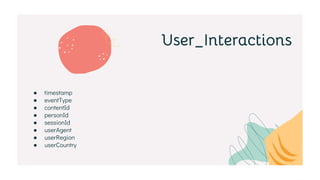
User_Interactions
The dataset which we are using was available on DeskDrop which is an
Internal Communications Platform developed by CI & T.
It has data from 2016 to 2017
There are 2 different Datasets namely :
Shared_Articles
DataSet Description
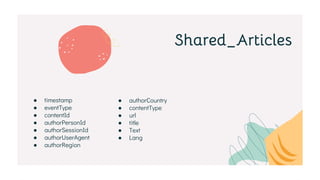
Shared_Articles
● timestamp
● eventType
● contentId
● authorPersonId
● authorSessionId
● authorUserAgent
● authorRegion
● authorCountry
● contentType
● url
● title
● Text
● Lang
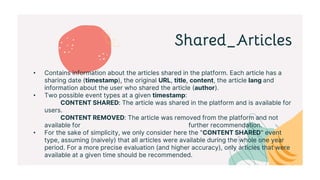
Shared_Articles
• Contains information about the articles shared in the platform. Each article has a
sharing date (timestamp), the original URL, title, content, the article lang and
information about the user who shared the article (author).
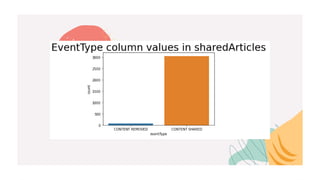
• Two possible event types at a given timestamp:
CONTENT SHARED: The article was shared in the platform and is available for
users.
CONTENT REMOVED: The article was removed from the platform and not
available for further recommendation.
• For the sake of simplicity, we only consider here the "CONTENT SHARED" event
type, assuming (naively) that all articles were available during the whole one year
period. For a more precise evaluation (and higher accuracy), only articles that were
available at a given time should be recommended.
User_Interactions
● timestamp
● eventType
● contentId
● personId
● sessionId
● userAgent
● userRegion
● userCountry
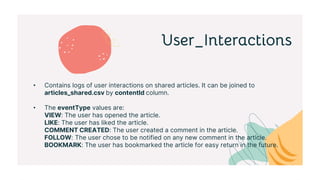
User_Interactions
• Contains logs of user interactions on shared articles. It can be joined to
articles_shared.csv by contentId column.
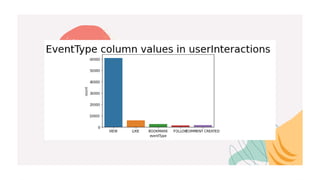
• The eventType values are:
VIEW: The user has opened the article.
LIKE: The user has liked the article.
COMMENT CREATED: The user created a comment in the article.
FOLLOW: The user chose to be notified on any new comment in the article.
BOOKMARK: The user has bookmarked the article for easy return in the future.
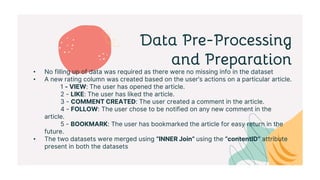
Data Pre-Processing
and Preparation
• No filling up of data was required as there were no missing info in the dataset
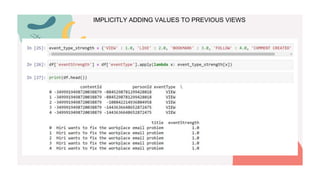
• A new rating column was created based on the user’s actions on a particular article.
1 - VIEW: The user has opened the article.
2 - LIKE: The user has liked the article.
3 - COMMENT CREATED: The user created a comment in the article.
4 - FOLLOW: The user chose to be notified on any new comment in the
article.
5 - BOOKMARK: The user has bookmarked the article for easy return in the
future.
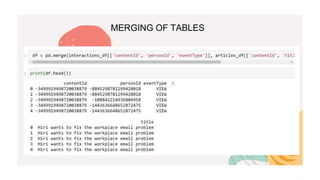
• The two datasets were merged using “INNER Join” using the “contentID” attribute
present in both the datasets
MERGING OF TABLES
IMPLICITLY ADDING VALUES TO PREVIOUS VIEWS
EXPLORATORY
DATA
ANALYSIS
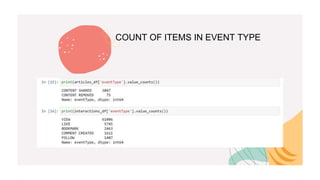
COUNT OF ITEMS IN EVENT TYPE
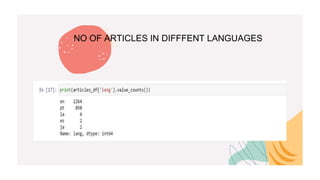
NO OF ARTICLES IN DIFFFENT LANGUAGES
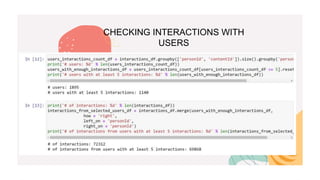
CHECKING INTERACTIONS WITH
USERS
MODEL SELECTION
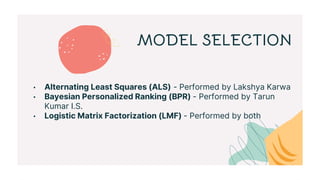
• Alternating Least Squares (ALS) - Performed by Lakshya Karwa
• Bayesian Personalized Ranking (BPR) - Performed by Tarun
Kumar I.S.
• Logistic Matrix Factorization (LMF) - Performed by both
MODEL BUILDING
PHASES
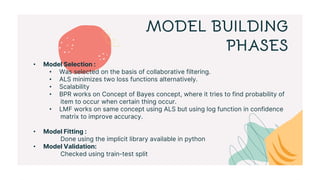
• Model Selection :
• Was selected on the basis of collaborative filtering.
• ALS minimizes two loss functions alternatively.
• Scalability
• BPR works on Concept of Bayes concept, where it tries to find probability of
item to occur when certain thing occur.
• LMF works on same concept using ALS but using log function in confidence
matrix to improve accuracy.
• Model Fitting :
Done using the implicit library available in python
• Model Validation:
Checked using train-test split
Performance
Analysis
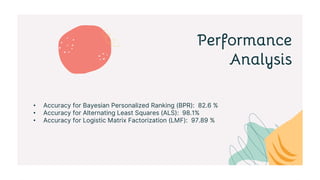
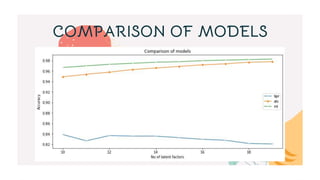
• Accuracy for Bayesian Personalized Ranking (BPR): 82.6 %
• Accuracy for Alternating Least Squares (ALS): 98.1%
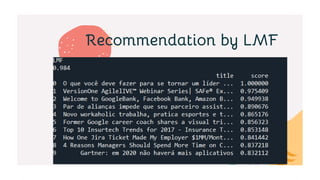
• Accuracy for Logistic Matrix Factorization (LMF): 97.89 %
COMPARISON OF MODELS
Inference For ALS
• Collaborative Filtering can be improved using Matrix Factorization
• The method is pretty robust.
• The time complexity is O(n).
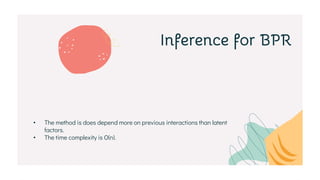
Inference for BPR
• The method is does depend more on previous interactions than latent
factors.
• The time complexity is O(n).
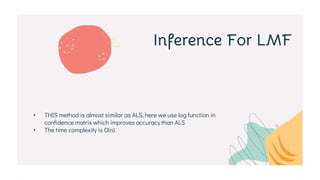
Inference For LMF
• THIS method is almost similar as ALS, here we use log function in
confidence matrix which improves accuracy than ALS
• The time complexity is O(n).
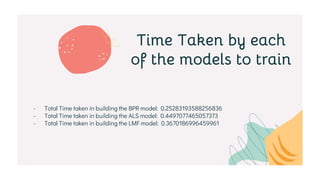
Time Taken by each
of the models to train
- Total Time taken in building the BPR model: 0.25283193588256836
- Total Time taken in building the ALS model: 0.4497077465057373
- Total Time taken in building the LMF model: 0.3670186996459961
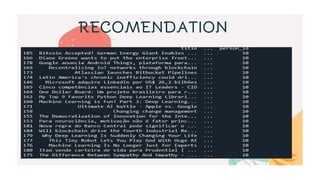
RECOMENDATION
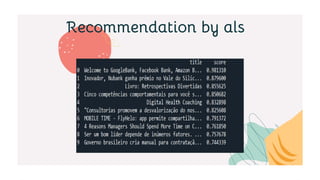
Recommendation by als
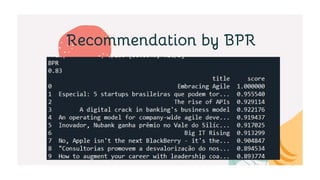
Recommendation by BPR
Recommendation by LMF
Challenges
• The implicit library available for implementation of the algorithms
wasn’t readily available for the Windows 10 Operating System. It had to
be run on Linux (ubuntu) and to run on Windows 10 it needed a C/C++
compiler.
• On Ubuntu, the system took a lot of time computing the results for ALS,
i.e., 17.xx seconds, every time the model was built.
Learning
• The usage of the implicit Library available in python.
• How different-different ‘Recommender Systems’ work.
• Implementation of ALS, BPR and LMF models using the implicit library
and how collaborative filtering can be improved.
• Matrix Factorization for sparse data problem.
References
• DataSet - https://www.kaggle.com/gspmoreira/articles-sharing-
reading-from-cit-deskdrop
• https://implicit.readthedocs.io/en/latest/quickstart.html
• https://implicit.readthedocs.io/en/latest/
• https://readthedocs.org/projects/implicit/downloads/pdf/latest/
THANK YOU

artrec.pptx

  • 1.
    Article Recommender System Done by- LakshyaKarwa Tarun Kumar I. S. Guided by- Dr. J. Shana
  • 2.
    On the Internet,where the number of options is overwhelming, there is a need to filter prioritize and efficiently deliver relevant information in order to alleviate the problem of information overload, which has created a potential problem to many internet users. Problem Description
  • 3.
    User_Interactions The dataset whichwe are using was available on DeskDrop which is an Internal Communications Platform developed by CI & T. It has data from 2016 to 2017 There are 2 different Datasets namely : Shared_Articles DataSet Description
  • 4.
    Shared_Articles ● timestamp ● eventType ●contentId ● authorPersonId ● authorSessionId ● authorUserAgent ● authorRegion ● authorCountry ● contentType ● url ● title ● Text ● Lang
  • 5.
    Shared_Articles • Contains informationabout the articles shared in the platform. Each article has a sharing date (timestamp), the original URL, title, content, the article lang and information about the user who shared the article (author). • Two possible event types at a given timestamp: CONTENT SHARED: The article was shared in the platform and is available for users. CONTENT REMOVED: The article was removed from the platform and not available for further recommendation. • For the sake of simplicity, we only consider here the "CONTENT SHARED" event type, assuming (naively) that all articles were available during the whole one year period. For a more precise evaluation (and higher accuracy), only articles that were available at a given time should be recommended.
  • 6.
    User_Interactions ● timestamp ● eventType ●contentId ● personId ● sessionId ● userAgent ● userRegion ● userCountry
  • 7.
    User_Interactions • Contains logsof user interactions on shared articles. It can be joined to articles_shared.csv by contentId column. • The eventType values are: VIEW: The user has opened the article. LIKE: The user has liked the article. COMMENT CREATED: The user created a comment in the article. FOLLOW: The user chose to be notified on any new comment in the article. BOOKMARK: The user has bookmarked the article for easy return in the future.
  • 8.
    Data Pre-Processing and Preparation •No filling up of data was required as there were no missing info in the dataset • A new rating column was created based on the user’s actions on a particular article. 1 - VIEW: The user has opened the article. 2 - LIKE: The user has liked the article. 3 - COMMENT CREATED: The user created a comment in the article. 4 - FOLLOW: The user chose to be notified on any new comment in the article. 5 - BOOKMARK: The user has bookmarked the article for easy return in the future. • The two datasets were merged using “INNER Join” using the “contentID” attribute present in both the datasets
  • 9.
  • 10.
    IMPLICITLY ADDING VALUESTO PREVIOUS VIEWS
  • 11.
  • 12.
    COUNT OF ITEMSIN EVENT TYPE
  • 13.
    NO OF ARTICLESIN DIFFFENT LANGUAGES
  • 14.
  • 17.
    MODEL SELECTION • AlternatingLeast Squares (ALS) - Performed by Lakshya Karwa • Bayesian Personalized Ranking (BPR) - Performed by Tarun Kumar I.S. • Logistic Matrix Factorization (LMF) - Performed by both
  • 18.
    MODEL BUILDING PHASES • ModelSelection : • Was selected on the basis of collaborative filtering. • ALS minimizes two loss functions alternatively. • Scalability • BPR works on Concept of Bayes concept, where it tries to find probability of item to occur when certain thing occur. • LMF works on same concept using ALS but using log function in confidence matrix to improve accuracy. • Model Fitting : Done using the implicit library available in python • Model Validation: Checked using train-test split
  • 19.
    Performance Analysis • Accuracy forBayesian Personalized Ranking (BPR): 82.6 % • Accuracy for Alternating Least Squares (ALS): 98.1% • Accuracy for Logistic Matrix Factorization (LMF): 97.89 %
  • 20.
  • 21.
    Inference For ALS •Collaborative Filtering can be improved using Matrix Factorization • The method is pretty robust. • The time complexity is O(n).
  • 22.
    Inference for BPR •The method is does depend more on previous interactions than latent factors. • The time complexity is O(n).
  • 23.
    Inference For LMF •THIS method is almost similar as ALS, here we use log function in confidence matrix which improves accuracy than ALS • The time complexity is O(n).
  • 24.
    Time Taken byeach of the models to train - Total Time taken in building the BPR model: 0.25283193588256836 - Total Time taken in building the ALS model: 0.4497077465057373 - Total Time taken in building the LMF model: 0.3670186996459961
  • 25.
  • 26.
  • 27.
  • 28.
  • 29.
    Challenges • The implicitlibrary available for implementation of the algorithms wasn’t readily available for the Windows 10 Operating System. It had to be run on Linux (ubuntu) and to run on Windows 10 it needed a C/C++ compiler. • On Ubuntu, the system took a lot of time computing the results for ALS, i.e., 17.xx seconds, every time the model was built.
  • 30.
    Learning • The usageof the implicit Library available in python. • How different-different ‘Recommender Systems’ work. • Implementation of ALS, BPR and LMF models using the implicit library and how collaborative filtering can be improved. • Matrix Factorization for sparse data problem.
  • 31.
    References • DataSet -https://www.kaggle.com/gspmoreira/articles-sharing- reading-from-cit-deskdrop • https://implicit.readthedocs.io/en/latest/quickstart.html • https://implicit.readthedocs.io/en/latest/ • https://readthedocs.org/projects/implicit/downloads/pdf/latest/
  • 32.