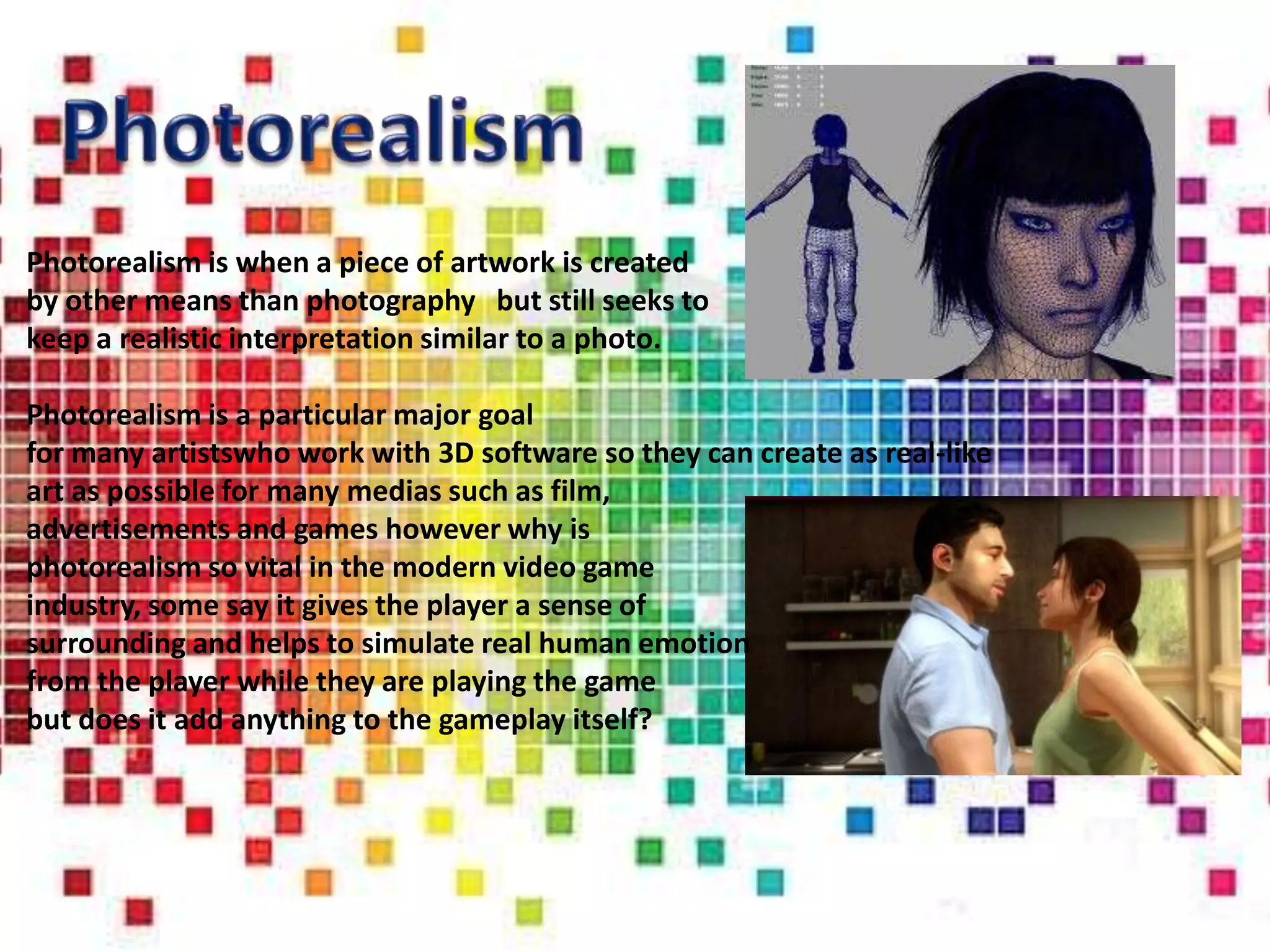
Photorealism is when a piece of artwork is created
by other means than photography but still seeks to
keep a realistic interpretation similar to a photo.

Photorealism is a particular major goal
for many artistswho work with 3D software so they can create as real-like
art as possible for many medias such as film,
advertisements and games however why is
photorealism so vital in the modern video game
industry, some say it gives the player a sense of
surrounding and helps to simulate real human emotion
from the player while they are playing the game
but does it add anything to the gameplay itself?
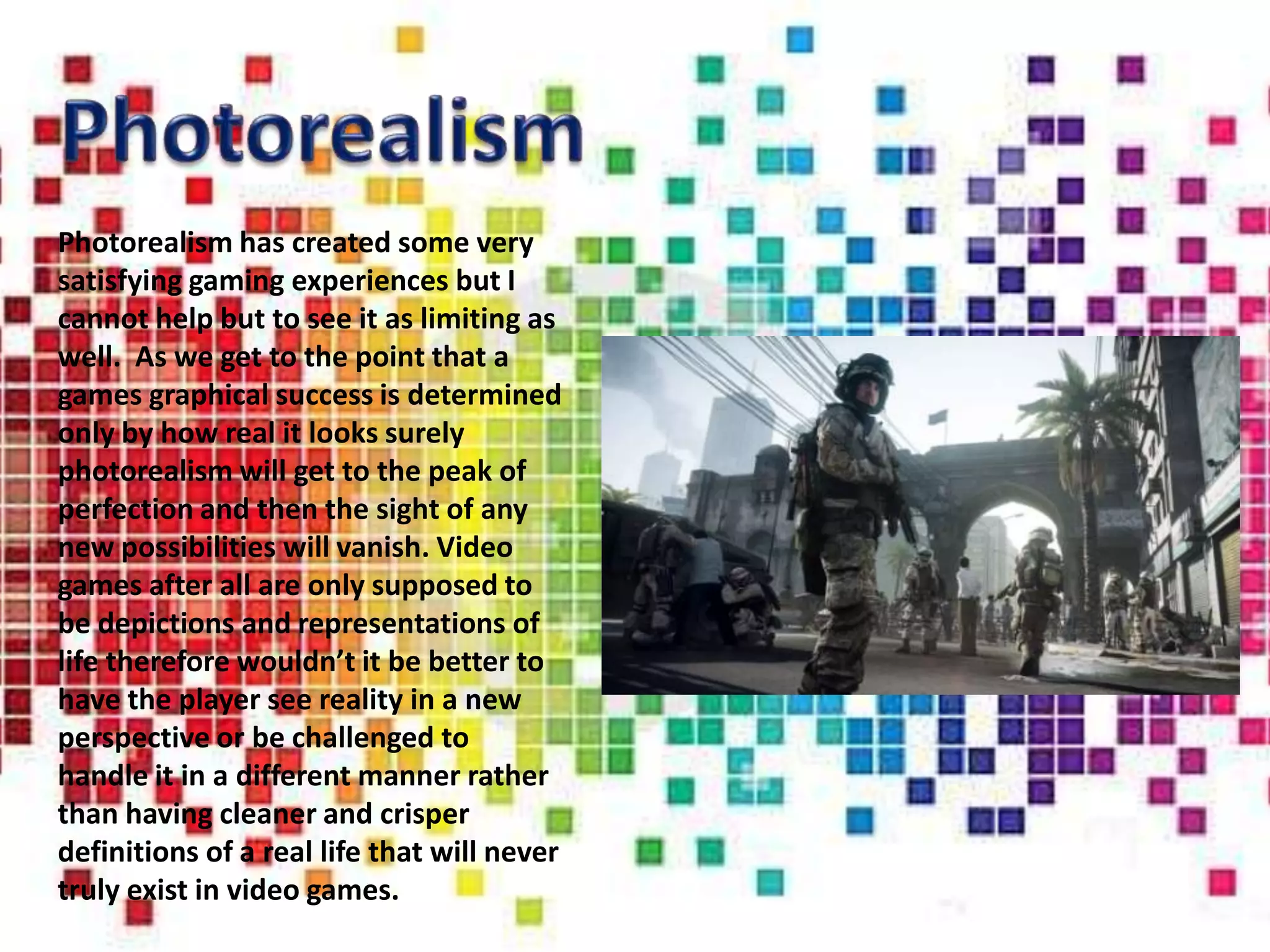
Photorealism has created some very
satisfying gaming experiences but I
cannot help but to see it as limiting as
well. As we get to the point that a
games graphical success is determined
only by how real it looks surely
photorealism will get to the peak of
perfection and then the sight of any
new possibilities will vanish. Video
games after all are only supposed to
be depictions and representations of
life therefore wouldn’t it be better to
have the player see reality in a new
perspective or be challenged to
handle it in a different manner rather
than having cleaner and crisper
definitions of a real life that will never
truly exist in video games.
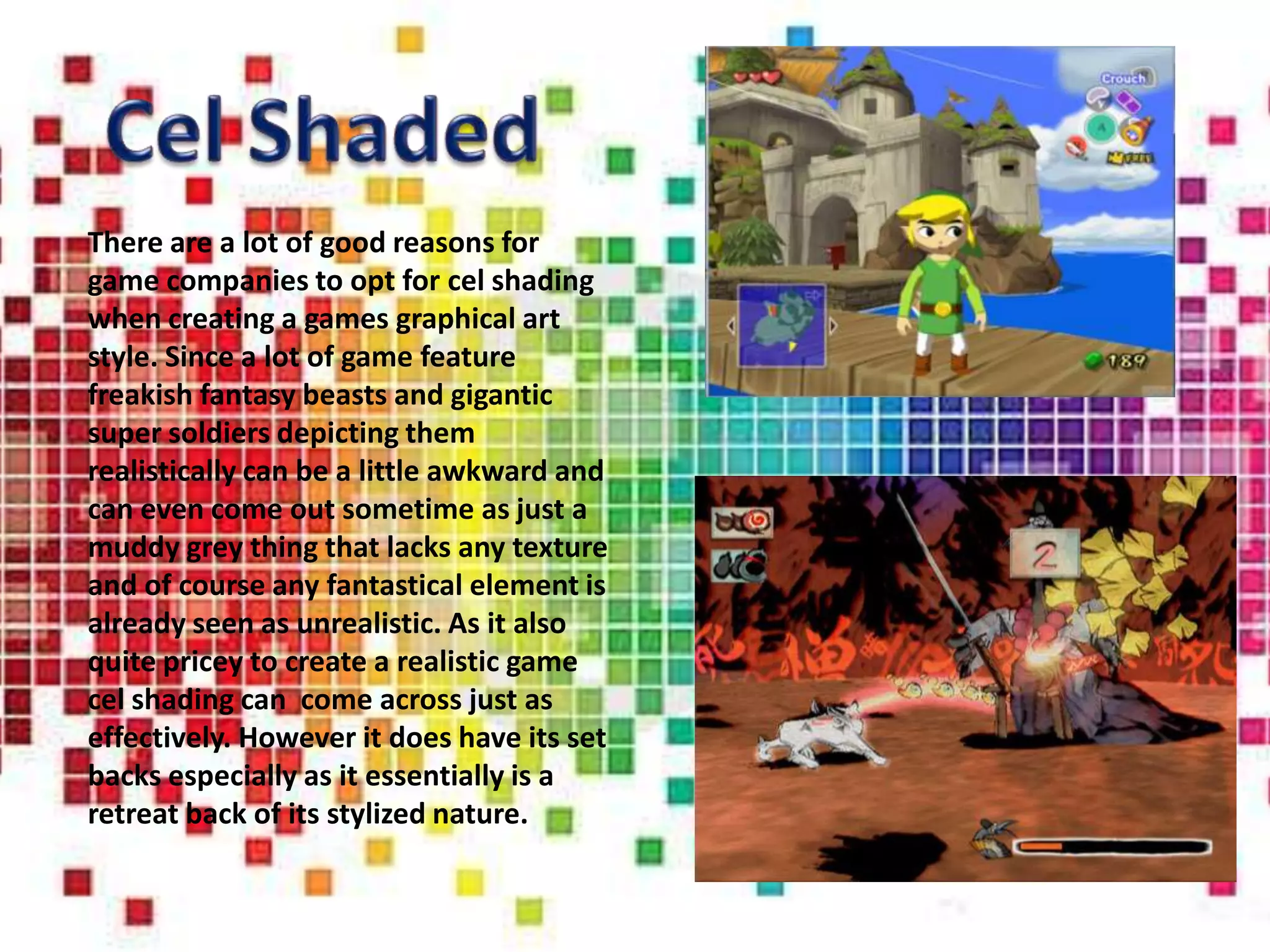
There are a lot of good reasons for
game companies to opt for cel shading
when creating a games graphical art
style. Since a lot of game feature
freakish fantasy beasts and gigantic
super soldiers depicting them
realistically can be a little awkward and
can even come out sometime as just a
muddy grey thing that lacks any texture
and of course any fantastical element is
already seen as unrealistic. As it also
quite pricey to create a realistic game
cel shading can come across just as
effectively. However it does have its set
backs especially as it essentially is a
retreat back of its stylized nature.
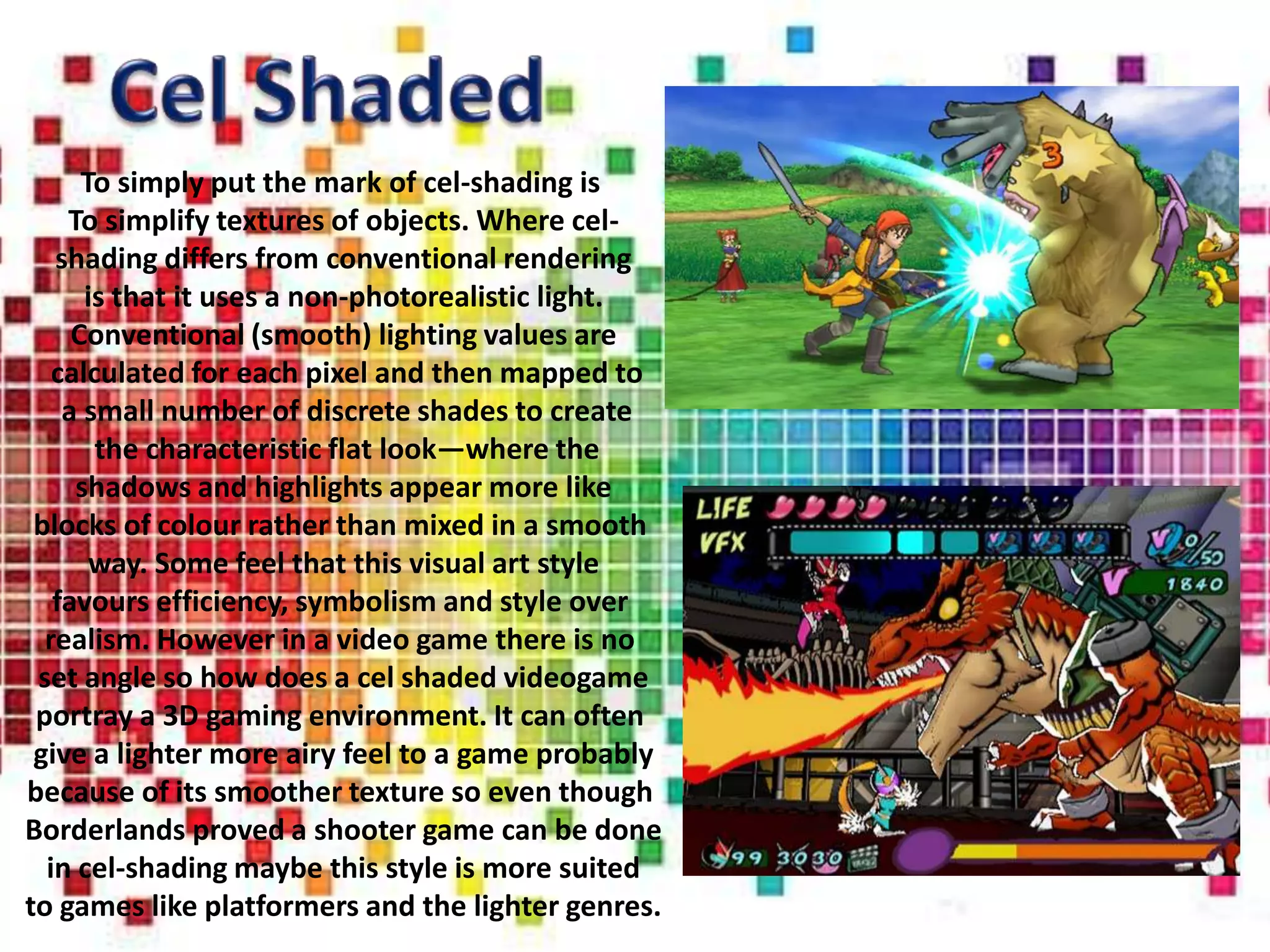
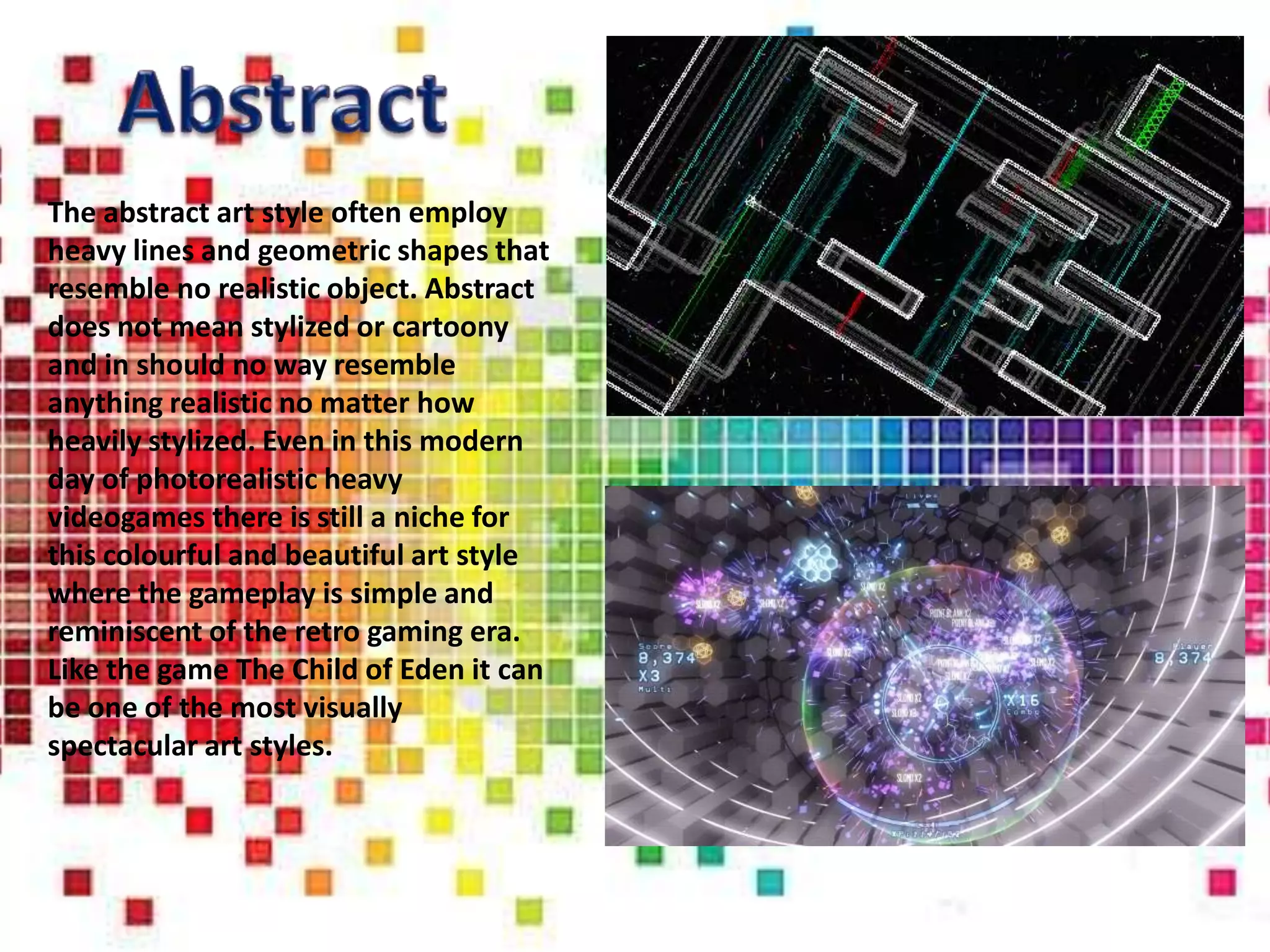
To simply put the mark of cel-shading is
    To simplify textures of objects. Where cel-
   shading differs from conventional rendering
      is that it uses a non-photorealistic light.
     Conventional (smooth) lighting values are
   calculated for each pixel and then mapped to
    a small number of discrete shades to create
       the characteristic flat look—where the
     shadows and highlights appear more like
 blocks of colour rather than mixed in a smooth
       way. Some feel that this visual art style
   favours efficiency, symbolism and style over
  realism. However in a video game there is no
 set angle so how does a cel shaded videogame
 portray a 3D gaming environment. It can often
 give a lighter more airy feel to a game probably
because of its smoother texture so even though
Borderlands proved a shooter game can be done
  in cel-shading maybe this style is more suited
to games like platformers and the lighter genres.
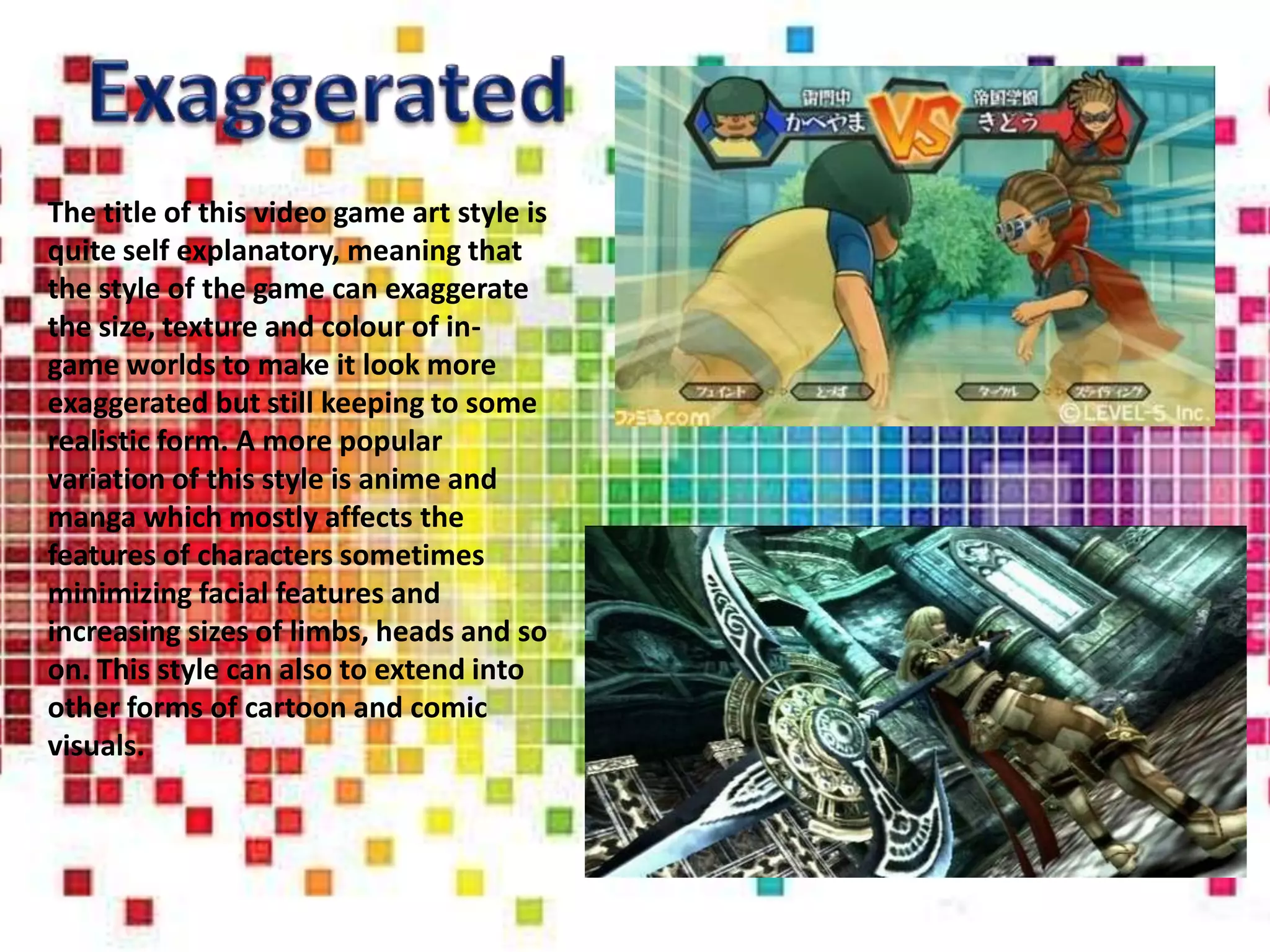
The abstract art style often employ
heavy lines and geometric shapes that
resemble no realistic object. Abstract
does not mean stylized or cartoony
and in should no way resemble
anything realistic no matter how
heavily stylized. Even in this modern
day of photorealistic heavy
videogames there is still a niche for
this colourful and beautiful art style
where the gameplay is simple and
reminiscent of the retro gaming era.
Like the game The Child of Eden it can
be one of the most visually
spectacular art styles.
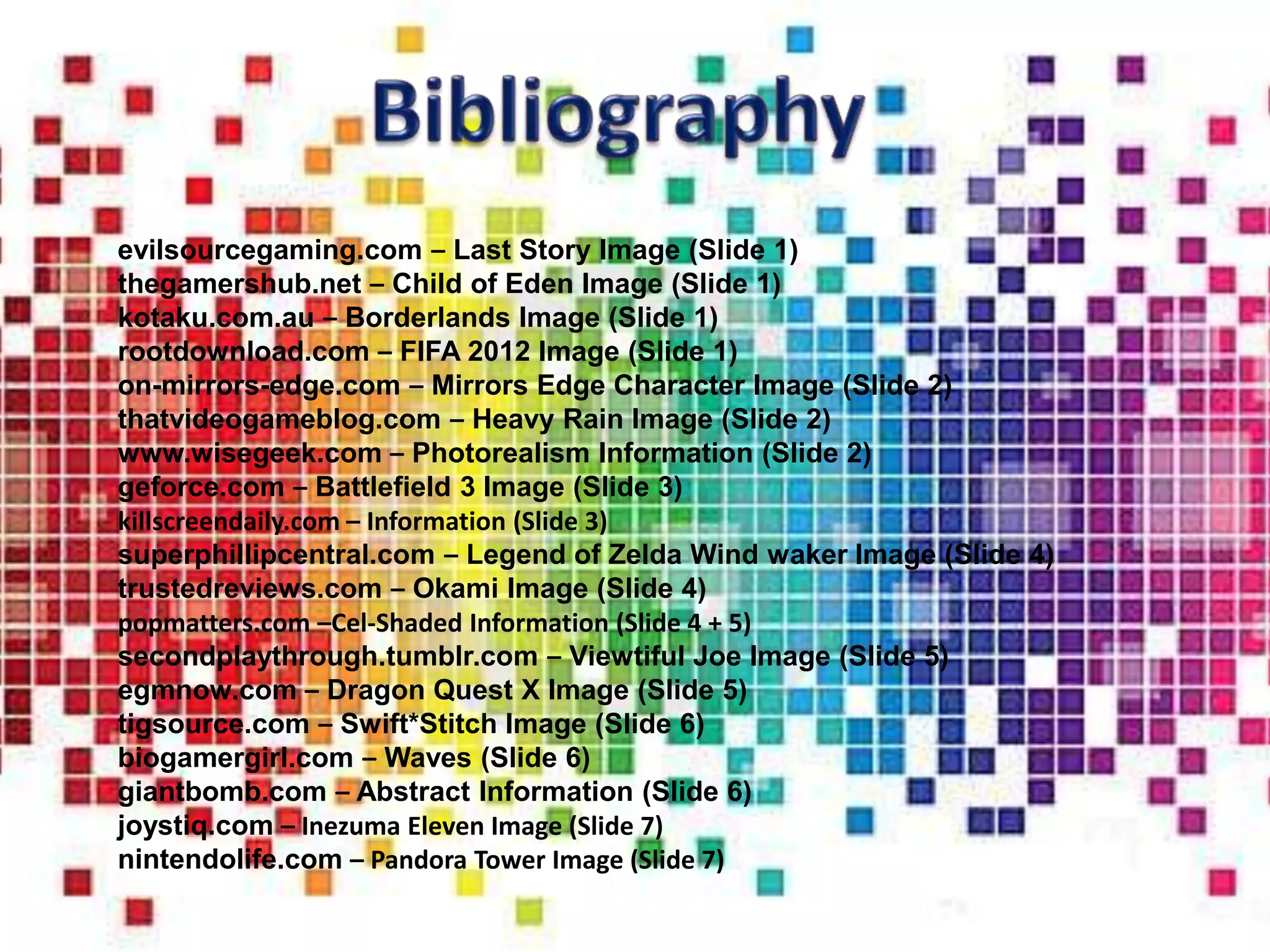
The title of this video game art style is
quite self explanatory, meaning that
the style of the game can exaggerate
the size, texture and colour of in-
game worlds to make it look more
exaggerated but still keeping to some
realistic form. A more popular
variation of this style is anime and
manga which mostly affects the
features of characters sometimes
minimizing facial features and
increasing sizes of limbs, heads and so
on. This style can also to extend into
other forms of cartoon and comic
visuals.
evilsourcegaming.com – Last Story Image (Slide 1)
thegamershub.net – Child of Eden Image (Slide 1)
kotaku.com.au – Borderlands Image (Slide 1)
rootdownload.com – FIFA 2012 Image (Slide 1)
on-mirrors-edge.com – Mirrors Edge Character Image (Slide 2)
thatvideogameblog.com – Heavy Rain Image (Slide 2)
www.wisegeek.com – Photorealism Information (Slide 2)
geforce.com – Battlefield 3 Image (Slide 3)
killscreendaily.com – Information (Slide 3)
superphillipcentral.com – Legend of Zelda Wind waker Image (Slide 4)
trustedreviews.com – Okami Image (Slide 4)
popmatters.com –Cel-Shaded Information (Slide 4 + 5)
secondplaythrough.tumblr.com – Viewtiful Joe Image (Slide 5)
egmnow.com – Dragon Quest X Image (Slide 5)
tigsource.com – Swift*Stitch Image (Slide 6)
biogamergirl.com – Waves (Slide 6)
giantbomb.com – Abstract Information (Slide 6)
joystiq.com – Inezuma Eleven Image (Slide 7)
nintendolife.com – Pandora Tower Image (Slide 7)

Artistic Styles used in Computer Games

  • 2.
    Photorealism is whena piece of artwork is created by other means than photography but still seeks to keep a realistic interpretation similar to a photo. Photorealism is a particular major goal for many artistswho work with 3D software so they can create as real-like art as possible for many medias such as film, advertisements and games however why is photorealism so vital in the modern video game industry, some say it gives the player a sense of surrounding and helps to simulate real human emotion from the player while they are playing the game but does it add anything to the gameplay itself?
  • 3.
    Photorealism has createdsome very satisfying gaming experiences but I cannot help but to see it as limiting as well. As we get to the point that a games graphical success is determined only by how real it looks surely photorealism will get to the peak of perfection and then the sight of any new possibilities will vanish. Video games after all are only supposed to be depictions and representations of life therefore wouldn’t it be better to have the player see reality in a new perspective or be challenged to handle it in a different manner rather than having cleaner and crisper definitions of a real life that will never truly exist in video games.
  • 4.
    There are alot of good reasons for game companies to opt for cel shading when creating a games graphical art style. Since a lot of game feature freakish fantasy beasts and gigantic super soldiers depicting them realistically can be a little awkward and can even come out sometime as just a muddy grey thing that lacks any texture and of course any fantastical element is already seen as unrealistic. As it also quite pricey to create a realistic game cel shading can come across just as effectively. However it does have its set backs especially as it essentially is a retreat back of its stylized nature.
  • 5.
    To simply putthe mark of cel-shading is To simplify textures of objects. Where cel- shading differs from conventional rendering is that it uses a non-photorealistic light. Conventional (smooth) lighting values are calculated for each pixel and then mapped to a small number of discrete shades to create the characteristic flat look—where the shadows and highlights appear more like blocks of colour rather than mixed in a smooth way. Some feel that this visual art style favours efficiency, symbolism and style over realism. However in a video game there is no set angle so how does a cel shaded videogame portray a 3D gaming environment. It can often give a lighter more airy feel to a game probably because of its smoother texture so even though Borderlands proved a shooter game can be done in cel-shading maybe this style is more suited to games like platformers and the lighter genres.
  • 6.
    The abstract artstyle often employ heavy lines and geometric shapes that resemble no realistic object. Abstract does not mean stylized or cartoony and in should no way resemble anything realistic no matter how heavily stylized. Even in this modern day of photorealistic heavy videogames there is still a niche for this colourful and beautiful art style where the gameplay is simple and reminiscent of the retro gaming era. Like the game The Child of Eden it can be one of the most visually spectacular art styles.
  • 7.
    The title ofthis video game art style is quite self explanatory, meaning that the style of the game can exaggerate the size, texture and colour of in- game worlds to make it look more exaggerated but still keeping to some realistic form. A more popular variation of this style is anime and manga which mostly affects the features of characters sometimes minimizing facial features and increasing sizes of limbs, heads and so on. This style can also to extend into other forms of cartoon and comic visuals.
  • 8.
    evilsourcegaming.com – LastStory Image (Slide 1) thegamershub.net – Child of Eden Image (Slide 1) kotaku.com.au – Borderlands Image (Slide 1) rootdownload.com – FIFA 2012 Image (Slide 1) on-mirrors-edge.com – Mirrors Edge Character Image (Slide 2) thatvideogameblog.com – Heavy Rain Image (Slide 2) www.wisegeek.com – Photorealism Information (Slide 2) geforce.com – Battlefield 3 Image (Slide 3) killscreendaily.com – Information (Slide 3) superphillipcentral.com – Legend of Zelda Wind waker Image (Slide 4) trustedreviews.com – Okami Image (Slide 4) popmatters.com –Cel-Shaded Information (Slide 4 + 5) secondplaythrough.tumblr.com – Viewtiful Joe Image (Slide 5) egmnow.com – Dragon Quest X Image (Slide 5) tigsource.com – Swift*Stitch Image (Slide 6) biogamergirl.com – Waves (Slide 6) giantbomb.com – Abstract Information (Slide 6) joystiq.com – Inezuma Eleven Image (Slide 7) nintendolife.com – Pandora Tower Image (Slide 7)