This document summarizes a research study on applying elements of digital game reward systems to computer-assisted learning models. The study analyzed the exponential reward systems of 4 popular digital games with over 10 million players. It found the reward systems function similarly to exponential learning models proposed by educators. Based on this, the study proposes a computer-assisted learning model designed like the digital game reward systems, allowing difficulty to scale appropriately to learner level. Normalized evaluation of game data supported the models' similarity to factors influencing learning efficacy like motivation. The study suggests digital game reward mechanisms could motivate learning when incorporated into educational algorithms and artificial intelligence systems.

![TOJET: The Turkish Online Journal of Educational Technology – January 2011, volume 10 Issue 1
environmental characteristics in teaching design. Furthermore, the model of school learning devised by Carroll
also provided the theoretical foundation for mastery learning presented by Bloom (1976).
Johnston and Aldridge suggested an effective teaching/learning design that considered learner characteristics
such as individual abilities and motivation through a functional formula in addition to learning effect (1985). In
their exponential learning model, efficacy is determined by considering learner level and the amount of time
spent problem solving. The formula for the exponential function learning model devised by Johnston and
Aldridge is:
L = 100[1 − e − k ( t + t0 ) ]
where L =learning effects, t = learning time, t0 = time spent on the subject before beginning to learn it, k =cm
where c = ability and m = motivation, and e =logarithm.
− k ( t +t )
0
In this functional formula, L is a constant which can be converted into a percentage and e
is a function
of the absolute effect on learning efficacy which increases as this value decreases. In other words, this formula
takes into account not only internal elements such as the attitude of the learner during the learning process but
also environmental elements such as the level of difficulty appropriate for the learner and the clarity of the
objective.
According to Johnston and Aldridge, this functional formula considers exponential growth. They emphasized the
fact that the learning effect can change based upon elements such as time, abilities of learner and teacher,
environment, and motivation. The exponential learning equation models proposed by Carroll (1963, 1989) and
Johnston and Aldridge (1985) were applied by Hwang who proposed a learning dynamic model based on the
Newton mechanism (Hwang et al., 2004).
Hwang et al. (2004) proposed methodology that could increase learning efficacy by adding learning dynamics
and learning energy. This exponential learning model referred to as a Learning Response Dynamic Model
applies the theory of Newtonian mechanics. In addition, learning dynamics, energy, speed, force, and
acceleration were considered as important elements to increase learning efficacy in digital-based network
learning circumstances.
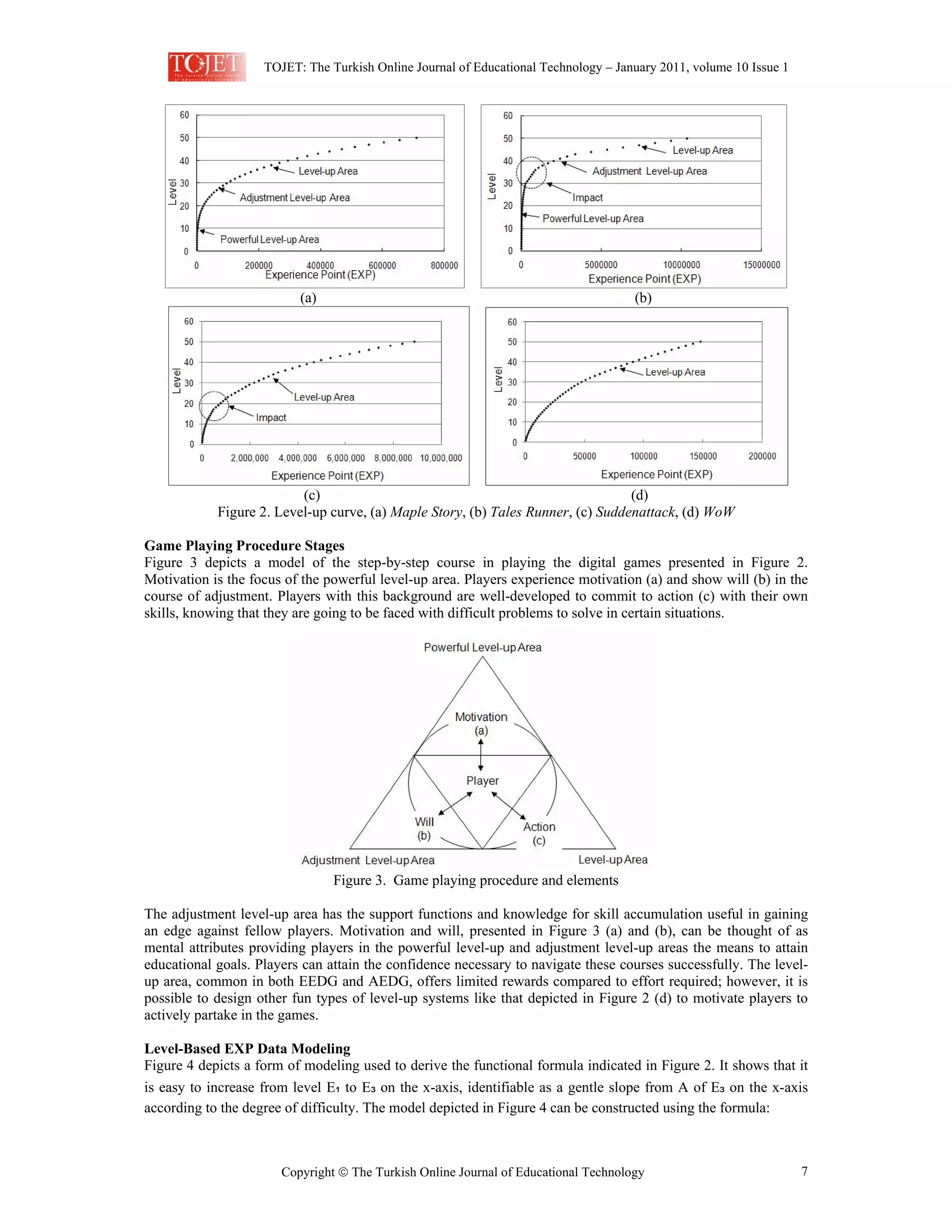
The majority of researchers emphasize the fact that a functional mechanism produces exponential growth which
is not linear in form (Hwang et al., 2004). Theoretically, this functional mechanism has a very similar structure
to the reward system of digital games. It is an established theory that most digital games have been designed
with a logarithm structure where attaining the next level is relatively easy during initial gameplay to increase
motivation but gradually becomes more and more difficult.
Accordingly, it is highly likely that the learning model presented in this study can also be applied to the digital
game-based learning model design since the digital environment is mostly exponential in function with a
nonlinear framework. In other words, setting the appropriate difficulty level according to learner level by
controlling the function and motivational elements is feasible.
We examined the reasons why a majority of student-age individuals are attracted to digital games and explored
the possibility of applying the game reward system which they are currently familiar with to learning model
applications.
The digital game reward system based on an exponential mechanism
Generally, the reward system in digital games is classified as one of the most important elements in game
structure responsible for stimulating active and sustained game playing. The reward system is designed to
function similar to the learning model and is adjusted according to players’ capabilities in diverse levels of
difficulty which are assessed with several open test processes.
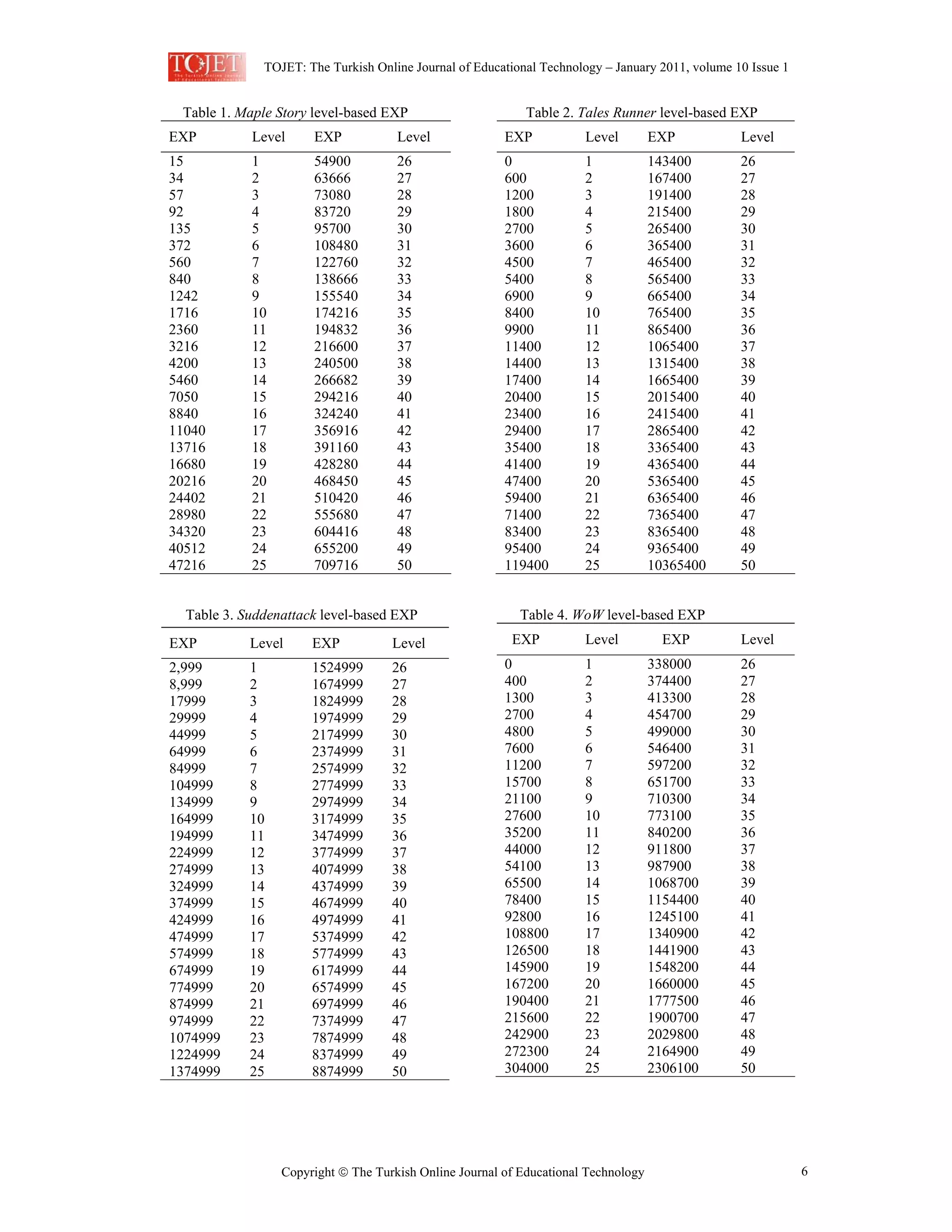
The reward system is divided into three types: ‘level-based progression’, ‘skill-based progression’ and ‘freeform
advancement’; however, gameplay is conducted based on experience points (EXPs) attained in all areas.
EXPs are a numerical display denoting the problem solving skills of game players (Koster, 2005) which can be
compared to learning environments where credit is awarded according to the efforts of students. The reward
system of digital games is assumed to have originated from the level up system of ‘Dungeon’ perceived as a
Copyright The Turkish Online Journal of Educational Technology
3](https://image.slidesharecdn.com/artikelit-131127081856-phpapp02/75/Artikel-it-3-2048.jpg)




![2.[8 12]developing teaching material for e-learning environment](https://cdn.slidesharecdn.com/ss_thumbnails/2-8-12developingteachingmaterialfore-learningenvironment-111118182158-phpapp02-thumbnail.jpg?width=640&height=640&fit=bounds)


