ARTIFICIAL INTELLIGENCE
PROFESSIONAL ELECTIVE-1
SUBJECT CODE- 19CSE303
9/8/2022
VIJAYALAKSHMI.N Asst. Professor/CSE 1
9/8/2022
VIJAYALAKSHMI.N Asst. Professor/CSE 2
UNIT-1
INTRODUCTION
What is Artificial Intelligence?
 One of the booming technologies of computer science is Artificial Intelligence.
 Simulation of human intelligence in m/c that are programmed to think like humans and
mimic their actions.
(OR)
 is the capability of a m/c to imitate intelligent human behaviour.
 currently working with a variety of subfields, ranging from general to specific,
 playing chess
 proving theorems
 playing music
 Painting
 Self driving cars
9/8/2022
VIJAYALAKSHMI.N Asst. Professor/CSE 3
Cont...
 Artificial Intelligence is composed of two words Artificial and Intelligence
 Artificial defines "man-made," and intelligence defines "thinking power",
hence AI means "a man-made thinking power.“
So, we can define AI ,
 "It is a branch of computer science by which we can create intelligent
machines which can behave like a human, think like humans, and able to
make decisions."
9/8/2022
VIJAYALAKSHMI.N Asst. Professor/CSE 4
Cont…
Why Artificial Intelligence?
 With the help of AI, one can create such software or devices which
can solve real-world problems very easily and with accuracy such as
health issues, marketing, traffic issues, etc.
 With the help of AI, you can create your personal virtual Assistant,
such as Cortana, Google Assistant, Siri, etc.
 With the help of AI, you can build such Robots which can work in an
environment where survival of humans can be at risk.
 Self driving cars need control signals as input . AI systems use
Vehicles radar, cameras, apps and cloud services.
9/8/2022
VIJAYALAKSHMI.N Asst. Professor/CSE 5
GOALS OF ARTIFICIAL INTELIGENCE
 To create an EXPERT SYSTEM
The system which exhibits intelligent behavior learn, demonstrate, explain, and
advice its user
9/8/2022
VIJAYALAKSHMI.N Asst. Professor/CSE 6
cont.
 To replicate human intelligence
 An intelligent connections of perceptions and actions
 Building a machine which can perform tasks that requires human intelligent
proving a theorem
playing chess
plan some surgical operations
driving a car in traffic
9/8/2022
VIJAYALAKSHMI.N Asst. Professor/CSE 7
WHAT IS INTELLIGENCE COMPOSED OF?
9/8/2022
VIJAYALAKSHMI.N Asst. Professor/CSE 8
Cont.
9/8/2022
VIJAYALAKSHMI.N Asst. Professor/CSE 9
 Linguistic Intelligence:
The ability to speak, recognize, and use mechanisms of phonology (speech
sounds), syntax (grammar), and semantics (meaning).
 Reasoning − It is the set of processes that enables us to provide basis for
judgement, making decisions, and prediction.
 Learning − It is the activity of gaining knowledge or skill by studying,
practising, being taught, or experiencing something. Learning enhances the
awareness of the subjects of the study.
Cont.
 Problem Solving − It is the process in which one perceives and tries to arrive
at a desired solution from a present situation by taking some path, which is
blocked by known or unknown hurdles.
 Perception − It is the process of acquiring, interpreting, selecting, and
organizing sensory information.
 Perception presumes sensing. In humans, perception is aided by sensory
organs. In the domain of AI, perception mechanism puts the data acquired by
the sensors together in a meaningful manner.
9/8/2022
VIJAYALAKSHMI.N Asst. Professor/CSE 10
AI – PROBLEM SOLVING
 Problem solving in games such as Sudoku.eg. It is done by building an AI system to
solve a particular problem.
 To do this one need to define the problem statement first, and then generating
the solution by keeping the condition in mind.
 Some of the most popularly used problem solving techniques with the help of AI
are:
Towers of Hanoi
playing chess
N-queen problem
water jug problem
Travelling salesman problem
9/8/2022
VIJAYALAKSHMI.N Asst. Professor/CSE 11
5 steps for problem solving
9/8/2022
VIJAYALAKSHMI.N Asst. Professor/CSE 12
9/8/2022
VIJAYALAKSHMI.N Asst. Professor/CSE 13
Is the problem decomposable?
9/8/2022
VIJAYALAKSHMI.N Asst. Professor/CSE 14
Can solution steps be ignored or undone?
 Ignorable: theorem proving
Solution steps can be ignored
 Recoverable: 8 puzzle problem
Solution steps may be undone ( backtracking)
 Irrecoverable: chess
 Solution steps cannot be undone.
9/8/2022
VIJAYALAKSHMI.N Asst. Professor/CSE 15
Cont..
9/8/2022
VIJAYALAKSHMI.N Asst. Professor/CSE 16
Cont…
9/8/2022
VIJAYALAKSHMI.N Asst. Professor/CSE 17
AGENT
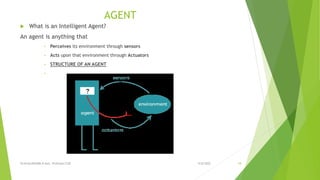
 What is an Intelligent Agent?
An agent is anything that
• Perceives its environment through sensors
• Acts upon that environment through Actuators
• STRUCTURE OF AN AGENT
•
9/8/2022
VIJAYALAKSHMI.N Asst. Professor/CSE 18
Examples of Agent
9/8/2022
VIJAYALAKSHMI.N Asst. Professor/CSE 19
Rational Agent
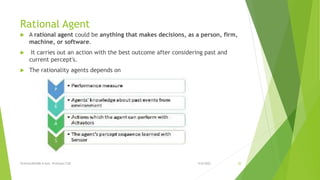
 A rational agent could be anything that makes decisions, as a person, firm,
machine, or software.
 It carries out an action with the best outcome after considering past and
current percept's.
 The rationality agents depends on
9/8/2022
VIJAYALAKSHMI.N Asst. Professor/CSE 20
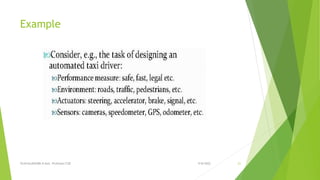
Example
9/8/2022
VIJAYALAKSHMI.N Asst. Professor/CSE 21
TYPES OF AGENT
9/8/2022
VIJAYALAKSHMI.N Asst. Professor/CSE 22
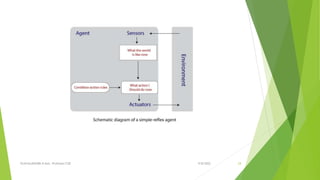
SIMPLE REFLEX AGENT
 They choose actions based on the current situation ignoring the history of
perception.
 They can perform action only on simple situation.
 The agent function is performed based on “condition- action rule” if condition
then action.
 They will work only if the environment is fully observable
9/8/2022
VIJAYALAKSHMI.N Asst. Professor/CSE 23
9/8/2022
VIJAYALAKSHMI.N Asst. Professor/CSE 24
MODEL BASED AGENT
 The Model-based agent can work in a partially observable environment, and
track the situation.
 A model-based agent has two important factors:
 Model: It is knowledge about "how things happen in the world," so it is called a
Model-based agent.
 Internal State: It is a representation of the current state based on percept history.
 These agents have the model, "which is knowledge of the world" and based on
the model they perform actions.
 Updating the agent state requires information about:
 How the world evolves
 How the agent's action affects the world.
9/8/2022
VIJAYALAKSHMI.N Asst. Professor/CSE 25
Diagram
9/8/2022
VIJAYALAKSHMI.N Asst. Professor/CSE 26
GOAL BASED AGENT
 The knowledge of the current state environment is not always sufficient to
decide for an agent to what to do.
 The agent needs to know its goal which describes desirable situations.
 Goal-based agents expand the capabilities of the model-based agent by
having the "goal" information.
 They choose an action, so that they can achieve the goal.
 These agents may have to consider a long sequence of possible actions before
deciding whether the goal is achieved or not. Such considerations of different
scenario are called searching and planning, which makes an agent proactive.
9/8/2022
VIJAYALAKSHMI.N Asst. Professor/CSE 27
Diagram
9/8/2022
VIJAYALAKSHMI.N Asst. Professor/CSE 28
UTILITY BASED AGENT
 These agents are similar to the goal-based agent but provide an extra
component of utility measurement which makes them different by providing a
measure of success at a given state.
 Utility-based agent act based not only goals but also the best way to achieve
the goal.
 The Utility-based agent is useful when there are multiple possible
alternatives, and an agent has to choose in order to perform the best action.
 The utility function maps each state to a real number to check how efficiently
each action achieves the goals.
9/8/2022
VIJAYALAKSHMI.N Asst. Professor/CSE 29
Diagram
9/8/2022
VIJAYALAKSHMI.N Asst. Professor/CSE 30
LEARNING BASED AGENT
 A learning agent in AI is the type of agent which can learn from its past
experiences, or it has learning capabilities.
 It starts to act with basic knowledge and then able to act and adapt
automatically through learning.
 A learning agent has mainly four conceptual components, which are:
 Learning element: It is responsible for making improvements by learning from
environment
 Critic: Learning element takes feedback from critic which describes that how well
the agent is doing with respect to a fixed performance standard.
 Performance element: It is responsible for selecting external action
 Problem generator: This component is responsible for suggesting actions that will
lead to new and informative experiences.
9/8/2022
VIJAYALAKSHMI.N Asst. Professor/CSE 31
Diagram
9/8/2022
VIJAYALAKSHMI.N Asst. Professor/CSE 32
TCS NQT LOGIC QUESTIONS
 What will be the output of the following Java code?
9/8/2022
VIJAYALAKSHMI.N Asst. Professor/CSE 33
OPTIONS
 [3, 5]
 [3, 2]
 [3, 2, 5]
 [3, 5, 2]
9/8/2022
VIJAYALAKSHMI.N Asst. Professor/CSE 34
CONT…
 What will be result if the given stack is popped?
 pat
 tap
 atp
 apt
9/8/2022
VIJAYALAKSHMI.N Asst. Professor/CSE 35
CONT…
INT MAIN()
{
INT A= 10,X;
X=A-- + ++A;
PRINTF(%D”, X);
}
OPTIONS
1. 19
2. 20
3. 21
4. 22
9/8/2022
VIJAYALAKSHMI.N Asst. Professor/CSE 36
TCS NQT Data Structure MCQS
1.Consider the following operation performed on the stack of size 5.
Push(1);
Pop();
Push(2); Answers: 1 ,2,3,4 ?
Push(3);
Pop();
Push(4);
Pop();
Pop();
Push(5);
After the completion of all operations , the number of elements present in the
stack is?
9/8/2022
VIJAYALAKSHMI.N Asst. Professor/CSE 37
Cont…
2. If the elements of A,B,C and D are placed in a stack and are deleted one at a
time, what is the order of deletion?
A. ABCD
B. DCBA Answer: ?
C. BCAD
D. CABD
3. Which of the real world scenario would u associate with a stack data
structure.
a. Piling of chairs one above the other
b. People standing in a line to be serviced at the counter
c. Offer services based on the priority of the customer
d. Tatkal ticket booking in IRCTC
9/8/2022
VIJAYALAKSHMI.N Asst. Professor/CSE 38
Problem formulation
 One of the core steps of problem-solving which decides what action should
be taken to achieve the formulated goal.
 In AI this core part is dependent upon software agent which consisted of the
following 5 components to formulate the associated problem.
 Problem Statement
Definition
Limitation or Constraints or Restrictions
 Problem Solution
 Solution Space
 Operators
9/8/2022
VIJAYALAKSHMI.N Asst. Professor/CSE 39
Cont…
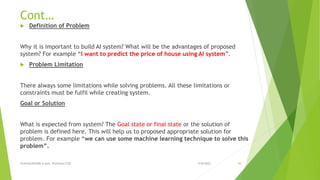
 Definition of Problem
Why it is important to build AI system? What will be the advantages of proposed
system? For example “I want to predict the price of house using AI system”.
 Problem Limitation
There always some limitations while solving problems. All these limitations or
constraints must be fulfil while creating system.
Goal or Solution
What is expected from system? The Goal state or final state or the solution of
problem is defined here. This will help us to proposed appropriate solution for
problem. For example “we can use some machine learning technique to solve this
problem”.
9/8/2022
VIJAYALAKSHMI.N Asst. Professor/CSE 40
Cont…
 Solution Space
Problem can be solve in many ways. Many possible ways with which we
can solve problem is known as Solution Space. For example “price of house can
be predict using many machine learning algorithms”.
 Operators
Operators are the actions taken during solving problem. Complete
problem is solved using tiny steps or actions and all these consecutive actions
leads to solution of problem.
 Examples of Problem Formulation
9/8/2022
VIJAYALAKSHMI.N Asst. Professor/CSE 41
Cont…
9/8/2022
VIJAYALAKSHMI.N Asst. Professor/CSE 42
Cont…
 Mouse Path Problem
 Problem Statement
 Problem Definition: Mouse is hungry, mouse is in a puzzle where there are some
cheese. Mouse will only be satisfied if mouse eat cheese
 Problem Limitation: Some paths are close i-e dead end, mouse can only travel
through open paths
 Problem Solution: Reach location where is cheese and eat minimum one
cheese. There are possible solutions (cheese pieces)
 Solution Space: To reach cheese there are multiple paths possible
 Operators: Mouse can move in four possible directions, these directions are
operators or actions which are UP, DOWN, LEFT and RIGHT
9/8/2022
VIJAYALAKSHMI.N Asst. Professor/CSE 43
Well-defined Problems and Solution
 Problem solving components discussed above are applicable to any problem.
For AI system implementation, problem must be well defined. A well-defined
problem must have five components:-
 Initial State: Start point of problem
 Final State: The finish point of problem. Goal or solution state
 States: Total states in problem
 Transition Model: How one can shift from one state to another
 Actions: Actions set, used to move from one state to another
 Path Cost: What is total effort (cost) from initial state to final state
9/8/2022
VIJAYALAKSHMI.N Asst. Professor/CSE 44
8 Puzzle or Slide Puzzle
 States: A state description specifies the location of each of the eight tiles and
the blank in one of the nine squares.
 Initial state: Any random shuffled state can be designated as initial state
 Actions:
 Slide Left
 or Slide Right
 or Slide Up
 And Slide Down
 Transition model: Given a state and action, this returns the resulting state
 Goal test: This checks whether the state matches the goal
 Path cost: Each step costs 1
9/8/2022
VIJAYALAKSHMI.N Asst. Professor/CSE 45
Cont…
9/8/2022
VIJAYALAKSHMI.N Asst. Professor/CSE 46
TCS NQT DATA STRUCTURE
1.While inserting the elements 71,65,84,69,67,83 in a empty binary search tree
(BST), in the sequence shown, find the lowest level.
2. The five items A,B,C,D,E are pushed on to the stack one after the other
starting from A. The stack is popped 4 items and each element is inserted into
queue. The 2 elements are deleted from the queue and pushed back on to the
stack. Now one item is popped from the stack. What is the popped item?
9/8/2022
VIJAYALAKSHMI.N Asst. Professor/CSE 47
Uninformed Search Algorithms in AI
 AI systems use various search algorithms for a particular goal state(if it
exists).
 As the name ‘Uninformed Search’ means the machine blindly follows the
algorithm regardless of whether right or wrong, efficient or in-efficient.
 These algorithms are brute force operations, and they don’t have extra
information about the search space;
 The only information they have is on how to traverse or visit the nodes in the
tree.
 Uninformed search algorithms are also called blind search algorithms.
9/8/2022
VIJAYALAKSHMI.N Asst. Professor/CSE 48
Cont…
The different types of search algorithms are as follows:
 1. Depth First Search (DFS)
 2. Breadth-First Search(BFS)
 3. Uniform Cost Search(UCS)
 4. Depth Limited Search(DLS)
 5. Iterative Deepening Depth First Search(IDDFS)
 6. Bidirectional Search(BS)
9/8/2022
VIJAYALAKSHMI.N Asst. Professor/CSE 49
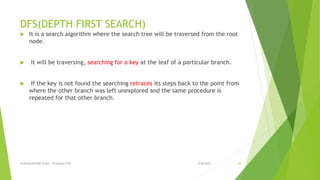
DFS(DEPTH FIRST SEARCH)
 It is a search algorithm where the search tree will be traversed from the root
node.
 It will be traversing, searching for a key at the leaf of a particular branch.
 If the key is not found the searching retraces its steps back to the point from
where the other branch was left unexplored and the same procedure is
repeated for that other branch.
9/8/2022
VIJAYALAKSHMI.N Asst. Professor/CSE 50
Cont…
9/8/2022
VIJAYALAKSHMI.N Asst. Professor/CSE 51
Cont…
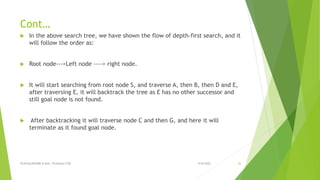
 In the above search tree, we have shown the flow of depth-first search, and it
will follow the order as:
 Root node--->Left node ----> right node.
 It will start searching from root node S, and traverse A, then B, then D and E,
after traversing E, it will backtrack the tree as E has no other successor and
still goal node is not found.
 After backtracking it will traverse node C and then G, and here it will
terminate as it found goal node.
9/8/2022
VIJAYALAKSHMI.N Asst. Professor/CSE 52
Cont…
 Completeness: DFS search algorithm is complete within finite state space as
it will expand every node within a limited search tree.
 Time Complexity: Time complexity of DFS will be equivalent to the node
traversed by the algorithm. It is given by:
T(n)= O(nm)
Advantage:
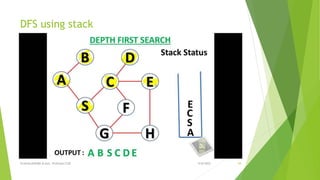
 DFS requires very less memory as it only needs to store a stack of the nodes
on the path from root node to the current node.
 It takes less time to reach to the goal node than BFS algorithm (if it traverses
in the right path).
9/8/2022
VIJAYALAKSHMI.N Asst. Professor/CSE 53
DFS using stack
9/8/2022
VIJAYALAKSHMI.N Asst. Professor/CSE 54
BFS ALGORITHM
 It is another search algorithm in AI which traverses breadthwise to search the
goal in a tree.
 It begins searching from the root node and expands the successor node before
going expanding it further expands along breadthwise and traverses those
nodes rather than searching depth-wise.
 BFS puts every vertex of the graph into two categories - visited and non-visited.
It selects a single node in a graph and, after that, visits all the nodes adjacent to
the selected node.
9/8/2022
VIJAYALAKSHMI.N Asst. Professor/CSE 55
CONT…
9/8/2022
VIJAYALAKSHMI.N Asst. Professor/CSE 56
CONT…
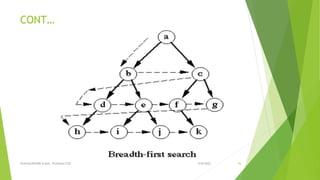
 The above figure is an example of a BFS Algorithm.
 It starts from the root node A and then traverses node B. Till this step it is the same as
DFS. But here instead of expanding the children of B as in the case of DFS we expand
the other child of A i.e. node C because of BFS and then move to the next level and
traverse from D to G and then from H to K in this typical example. To traverse here we
have only taken into consideration the lexicographical order. This is how the BFS
Algorithm is implemented.
9/8/2022
VIJAYALAKSHMI.N Asst. Professor/CSE 57
Applications of BFS algorithm
 The applications of breadth-first-algorithm are given as follows -
• BFS can be used to find the neighboring locations from a given source location.
• In a peer-to-peer network, BFS algorithm can be used as a traversal method to
find all the neighboring nodes. Most torrent clients, such as BitTorrent, uTorrent,
etc. employ this process to find "seeds" and "peers" in the network.
• BFS can be used in web crawlers to create web page indexes. It is one of the
main algorithms that can be used to index web pages. It starts traversing from
the source page and follows the links associated with the page. Here, every
web page is considered as a node in the graph.
• BFS is used to determine the shortest path and minimum spanning tree.
9/8/2022
VIJAYALAKSHMI.N Asst. Professor/CSE 58
Example of BFS algorithm
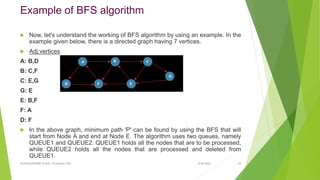
 Now, let's understand the working of BFS algorithm by using an example. In the
example given below, there is a directed graph having 7 vertices.
 Adj:vertices
A: B,D
B: C,F
C: E,G
G: E
E: B,F
F: A
D: F
 In the above graph, minimum path 'P' can be found by using the BFS that will
start from Node A and end at Node E. The algorithm uses two queues, namely
QUEUE1 and QUEUE2. QUEUE1 holds all the nodes that are to be processed,
while QUEUE2 holds all the nodes that are processed and deleted from
QUEUE1.
9/8/2022
VIJAYALAKSHMI.N Asst. Professor/CSE 59
Cont…
 Now, let's start examining the graph starting from Node A.
 Step 1 - First, add A to queue1 and NULL to queue2.
1. QUEUE1 = {A}
2. QUEUE2 = {NULL}
 Step 2 - Now, delete node A from queue1 and add it into queue2. Insert all neighbors of node
A to queue1.
1. QUEUE1 = {B, D}
2. QUEUE2 = {A}
 Step 3 - Now, delete node B from queue1 and add it into queue2. Insert all neighbors of node
B to queue1.
1. QUEUE1 = {D, C, F}
2. QUEUE2 = {A, B}
 Step 4 - Now, delete node D from queue1 and add it into queue2. Insert all neighbors of node D
to queue1. The only neighbor of Node D is F since it is already inserted, so it will not be
inserted again.
9/8/2022
VIJAYALAKSHMI.N Asst. Professor/CSE 60
Cont…
1. QUEUE1 = {C, F}
2. QUEUE2 = {A, B, D}
 Step 5 - Delete node C from queue1 and add it into queue2. Insert all neighbours of
node C to queue1.
1. QUEUE1 = {F, E, G}
2. QUEUE2 = {A, B, D, C}
 Step 5 - Delete node F from queue1 and add it into queue2. Insert all neighbours of
node F to queue1. Since all the neighbours of node F are already present, we will
not insert them again.
1. QUEUE1 = {E, G}
2. QUEUE2 = {A, B, D, C, F}
 Step 6 - Delete node E from queue1. Since all of its neighbours have already been
added, so we will not insert them again. Now, all the nodes are visited, and the
target node E is encountered into queue2.
1. QUEUE1 = {G}
2. QUEUE2 = {A, B, D, C, F, E}
9/8/2022
VIJAYALAKSHMI.N Asst. Professor/CSE 61
Cont…
 The time complexity of BFS algorithm is O(V+E)
 The space complexity of BFS can be expressed as O(V)
9/8/2022
VIJAYALAKSHMI.N Asst. Professor/CSE 62
9/8/2022
VIJAYALAKSHMI.N Asst. Professor/CSE 63

ARTIFICIAL INTELLIGENCE ppt.pptx

  • 1.
    ARTIFICIAL INTELLIGENCE PROFESSIONAL ELECTIVE-1 SUBJECTCODE- 19CSE303 9/8/2022 VIJAYALAKSHMI.N Asst. Professor/CSE 1
  • 2.
  • 3.
    UNIT-1 INTRODUCTION What is ArtificialIntelligence?  One of the booming technologies of computer science is Artificial Intelligence.  Simulation of human intelligence in m/c that are programmed to think like humans and mimic their actions. (OR)  is the capability of a m/c to imitate intelligent human behaviour.  currently working with a variety of subfields, ranging from general to specific,  playing chess  proving theorems  playing music  Painting  Self driving cars 9/8/2022 VIJAYALAKSHMI.N Asst. Professor/CSE 3
  • 4.
    Cont...  Artificial Intelligenceis composed of two words Artificial and Intelligence  Artificial defines "man-made," and intelligence defines "thinking power", hence AI means "a man-made thinking power.“ So, we can define AI ,  "It is a branch of computer science by which we can create intelligent machines which can behave like a human, think like humans, and able to make decisions." 9/8/2022 VIJAYALAKSHMI.N Asst. Professor/CSE 4
  • 5.
    Cont… Why Artificial Intelligence? With the help of AI, one can create such software or devices which can solve real-world problems very easily and with accuracy such as health issues, marketing, traffic issues, etc.  With the help of AI, you can create your personal virtual Assistant, such as Cortana, Google Assistant, Siri, etc.  With the help of AI, you can build such Robots which can work in an environment where survival of humans can be at risk.  Self driving cars need control signals as input . AI systems use Vehicles radar, cameras, apps and cloud services. 9/8/2022 VIJAYALAKSHMI.N Asst. Professor/CSE 5
  • 6.
    GOALS OF ARTIFICIALINTELIGENCE  To create an EXPERT SYSTEM The system which exhibits intelligent behavior learn, demonstrate, explain, and advice its user 9/8/2022 VIJAYALAKSHMI.N Asst. Professor/CSE 6
  • 7.
    cont.  To replicatehuman intelligence  An intelligent connections of perceptions and actions  Building a machine which can perform tasks that requires human intelligent proving a theorem playing chess plan some surgical operations driving a car in traffic 9/8/2022 VIJAYALAKSHMI.N Asst. Professor/CSE 7
  • 8.
    WHAT IS INTELLIGENCECOMPOSED OF? 9/8/2022 VIJAYALAKSHMI.N Asst. Professor/CSE 8
  • 9.
    Cont. 9/8/2022 VIJAYALAKSHMI.N Asst. Professor/CSE9  Linguistic Intelligence: The ability to speak, recognize, and use mechanisms of phonology (speech sounds), syntax (grammar), and semantics (meaning).  Reasoning − It is the set of processes that enables us to provide basis for judgement, making decisions, and prediction.  Learning − It is the activity of gaining knowledge or skill by studying, practising, being taught, or experiencing something. Learning enhances the awareness of the subjects of the study.
  • 10.
    Cont.  Problem Solving− It is the process in which one perceives and tries to arrive at a desired solution from a present situation by taking some path, which is blocked by known or unknown hurdles.  Perception − It is the process of acquiring, interpreting, selecting, and organizing sensory information.  Perception presumes sensing. In humans, perception is aided by sensory organs. In the domain of AI, perception mechanism puts the data acquired by the sensors together in a meaningful manner. 9/8/2022 VIJAYALAKSHMI.N Asst. Professor/CSE 10
  • 11.
    AI – PROBLEMSOLVING  Problem solving in games such as Sudoku.eg. It is done by building an AI system to solve a particular problem.  To do this one need to define the problem statement first, and then generating the solution by keeping the condition in mind.  Some of the most popularly used problem solving techniques with the help of AI are: Towers of Hanoi playing chess N-queen problem water jug problem Travelling salesman problem 9/8/2022 VIJAYALAKSHMI.N Asst. Professor/CSE 11
  • 12.
    5 steps forproblem solving 9/8/2022 VIJAYALAKSHMI.N Asst. Professor/CSE 12
  • 13.
  • 14.
    Is the problemdecomposable? 9/8/2022 VIJAYALAKSHMI.N Asst. Professor/CSE 14
  • 15.
    Can solution stepsbe ignored or undone?  Ignorable: theorem proving Solution steps can be ignored  Recoverable: 8 puzzle problem Solution steps may be undone ( backtracking)  Irrecoverable: chess  Solution steps cannot be undone. 9/8/2022 VIJAYALAKSHMI.N Asst. Professor/CSE 15
  • 16.
  • 17.
  • 18.
    AGENT  What isan Intelligent Agent? An agent is anything that • Perceives its environment through sensors • Acts upon that environment through Actuators • STRUCTURE OF AN AGENT • 9/8/2022 VIJAYALAKSHMI.N Asst. Professor/CSE 18
  • 19.
  • 20.
    Rational Agent  Arational agent could be anything that makes decisions, as a person, firm, machine, or software.  It carries out an action with the best outcome after considering past and current percept's.  The rationality agents depends on 9/8/2022 VIJAYALAKSHMI.N Asst. Professor/CSE 20
  • 21.
  • 22.
  • 23.
    SIMPLE REFLEX AGENT They choose actions based on the current situation ignoring the history of perception.  They can perform action only on simple situation.  The agent function is performed based on “condition- action rule” if condition then action.  They will work only if the environment is fully observable 9/8/2022 VIJAYALAKSHMI.N Asst. Professor/CSE 23
  • 24.
  • 25.
    MODEL BASED AGENT The Model-based agent can work in a partially observable environment, and track the situation.  A model-based agent has two important factors:  Model: It is knowledge about "how things happen in the world," so it is called a Model-based agent.  Internal State: It is a representation of the current state based on percept history.  These agents have the model, "which is knowledge of the world" and based on the model they perform actions.  Updating the agent state requires information about:  How the world evolves  How the agent's action affects the world. 9/8/2022 VIJAYALAKSHMI.N Asst. Professor/CSE 25
  • 26.
  • 27.
    GOAL BASED AGENT The knowledge of the current state environment is not always sufficient to decide for an agent to what to do.  The agent needs to know its goal which describes desirable situations.  Goal-based agents expand the capabilities of the model-based agent by having the "goal" information.  They choose an action, so that they can achieve the goal.  These agents may have to consider a long sequence of possible actions before deciding whether the goal is achieved or not. Such considerations of different scenario are called searching and planning, which makes an agent proactive. 9/8/2022 VIJAYALAKSHMI.N Asst. Professor/CSE 27
  • 28.
  • 29.
    UTILITY BASED AGENT These agents are similar to the goal-based agent but provide an extra component of utility measurement which makes them different by providing a measure of success at a given state.  Utility-based agent act based not only goals but also the best way to achieve the goal.  The Utility-based agent is useful when there are multiple possible alternatives, and an agent has to choose in order to perform the best action.  The utility function maps each state to a real number to check how efficiently each action achieves the goals. 9/8/2022 VIJAYALAKSHMI.N Asst. Professor/CSE 29
  • 30.
  • 31.
    LEARNING BASED AGENT A learning agent in AI is the type of agent which can learn from its past experiences, or it has learning capabilities.  It starts to act with basic knowledge and then able to act and adapt automatically through learning.  A learning agent has mainly four conceptual components, which are:  Learning element: It is responsible for making improvements by learning from environment  Critic: Learning element takes feedback from critic which describes that how well the agent is doing with respect to a fixed performance standard.  Performance element: It is responsible for selecting external action  Problem generator: This component is responsible for suggesting actions that will lead to new and informative experiences. 9/8/2022 VIJAYALAKSHMI.N Asst. Professor/CSE 31
  • 32.
  • 33.
    TCS NQT LOGICQUESTIONS  What will be the output of the following Java code? 9/8/2022 VIJAYALAKSHMI.N Asst. Professor/CSE 33
  • 34.
    OPTIONS  [3, 5] [3, 2]  [3, 2, 5]  [3, 5, 2] 9/8/2022 VIJAYALAKSHMI.N Asst. Professor/CSE 34
  • 35.
    CONT…  What willbe result if the given stack is popped?  pat  tap  atp  apt 9/8/2022 VIJAYALAKSHMI.N Asst. Professor/CSE 35
  • 36.
    CONT… INT MAIN() { INT A=10,X; X=A-- + ++A; PRINTF(%D”, X); } OPTIONS 1. 19 2. 20 3. 21 4. 22 9/8/2022 VIJAYALAKSHMI.N Asst. Professor/CSE 36
  • 37.
    TCS NQT DataStructure MCQS 1.Consider the following operation performed on the stack of size 5. Push(1); Pop(); Push(2); Answers: 1 ,2,3,4 ? Push(3); Pop(); Push(4); Pop(); Pop(); Push(5); After the completion of all operations , the number of elements present in the stack is? 9/8/2022 VIJAYALAKSHMI.N Asst. Professor/CSE 37
  • 38.
    Cont… 2. If theelements of A,B,C and D are placed in a stack and are deleted one at a time, what is the order of deletion? A. ABCD B. DCBA Answer: ? C. BCAD D. CABD 3. Which of the real world scenario would u associate with a stack data structure. a. Piling of chairs one above the other b. People standing in a line to be serviced at the counter c. Offer services based on the priority of the customer d. Tatkal ticket booking in IRCTC 9/8/2022 VIJAYALAKSHMI.N Asst. Professor/CSE 38
  • 39.
    Problem formulation  Oneof the core steps of problem-solving which decides what action should be taken to achieve the formulated goal.  In AI this core part is dependent upon software agent which consisted of the following 5 components to formulate the associated problem.  Problem Statement Definition Limitation or Constraints or Restrictions  Problem Solution  Solution Space  Operators 9/8/2022 VIJAYALAKSHMI.N Asst. Professor/CSE 39
  • 40.
    Cont…  Definition ofProblem Why it is important to build AI system? What will be the advantages of proposed system? For example “I want to predict the price of house using AI system”.  Problem Limitation There always some limitations while solving problems. All these limitations or constraints must be fulfil while creating system. Goal or Solution What is expected from system? The Goal state or final state or the solution of problem is defined here. This will help us to proposed appropriate solution for problem. For example “we can use some machine learning technique to solve this problem”. 9/8/2022 VIJAYALAKSHMI.N Asst. Professor/CSE 40
  • 41.
    Cont…  Solution Space Problemcan be solve in many ways. Many possible ways with which we can solve problem is known as Solution Space. For example “price of house can be predict using many machine learning algorithms”.  Operators Operators are the actions taken during solving problem. Complete problem is solved using tiny steps or actions and all these consecutive actions leads to solution of problem.  Examples of Problem Formulation 9/8/2022 VIJAYALAKSHMI.N Asst. Professor/CSE 41
  • 42.
  • 43.
    Cont…  Mouse PathProblem  Problem Statement  Problem Definition: Mouse is hungry, mouse is in a puzzle where there are some cheese. Mouse will only be satisfied if mouse eat cheese  Problem Limitation: Some paths are close i-e dead end, mouse can only travel through open paths  Problem Solution: Reach location where is cheese and eat minimum one cheese. There are possible solutions (cheese pieces)  Solution Space: To reach cheese there are multiple paths possible  Operators: Mouse can move in four possible directions, these directions are operators or actions which are UP, DOWN, LEFT and RIGHT 9/8/2022 VIJAYALAKSHMI.N Asst. Professor/CSE 43
  • 44.
    Well-defined Problems andSolution  Problem solving components discussed above are applicable to any problem. For AI system implementation, problem must be well defined. A well-defined problem must have five components:-  Initial State: Start point of problem  Final State: The finish point of problem. Goal or solution state  States: Total states in problem  Transition Model: How one can shift from one state to another  Actions: Actions set, used to move from one state to another  Path Cost: What is total effort (cost) from initial state to final state 9/8/2022 VIJAYALAKSHMI.N Asst. Professor/CSE 44
  • 45.
    8 Puzzle orSlide Puzzle  States: A state description specifies the location of each of the eight tiles and the blank in one of the nine squares.  Initial state: Any random shuffled state can be designated as initial state  Actions:  Slide Left  or Slide Right  or Slide Up  And Slide Down  Transition model: Given a state and action, this returns the resulting state  Goal test: This checks whether the state matches the goal  Path cost: Each step costs 1 9/8/2022 VIJAYALAKSHMI.N Asst. Professor/CSE 45
  • 46.
  • 47.
    TCS NQT DATASTRUCTURE 1.While inserting the elements 71,65,84,69,67,83 in a empty binary search tree (BST), in the sequence shown, find the lowest level. 2. The five items A,B,C,D,E are pushed on to the stack one after the other starting from A. The stack is popped 4 items and each element is inserted into queue. The 2 elements are deleted from the queue and pushed back on to the stack. Now one item is popped from the stack. What is the popped item? 9/8/2022 VIJAYALAKSHMI.N Asst. Professor/CSE 47
  • 48.
    Uninformed Search Algorithmsin AI  AI systems use various search algorithms for a particular goal state(if it exists).  As the name ‘Uninformed Search’ means the machine blindly follows the algorithm regardless of whether right or wrong, efficient or in-efficient.  These algorithms are brute force operations, and they don’t have extra information about the search space;  The only information they have is on how to traverse or visit the nodes in the tree.  Uninformed search algorithms are also called blind search algorithms. 9/8/2022 VIJAYALAKSHMI.N Asst. Professor/CSE 48
  • 49.
    Cont… The different typesof search algorithms are as follows:  1. Depth First Search (DFS)  2. Breadth-First Search(BFS)  3. Uniform Cost Search(UCS)  4. Depth Limited Search(DLS)  5. Iterative Deepening Depth First Search(IDDFS)  6. Bidirectional Search(BS) 9/8/2022 VIJAYALAKSHMI.N Asst. Professor/CSE 49
  • 50.
    DFS(DEPTH FIRST SEARCH) It is a search algorithm where the search tree will be traversed from the root node.  It will be traversing, searching for a key at the leaf of a particular branch.  If the key is not found the searching retraces its steps back to the point from where the other branch was left unexplored and the same procedure is repeated for that other branch. 9/8/2022 VIJAYALAKSHMI.N Asst. Professor/CSE 50
  • 51.
  • 52.
    Cont…  In theabove search tree, we have shown the flow of depth-first search, and it will follow the order as:  Root node--->Left node ----> right node.  It will start searching from root node S, and traverse A, then B, then D and E, after traversing E, it will backtrack the tree as E has no other successor and still goal node is not found.  After backtracking it will traverse node C and then G, and here it will terminate as it found goal node. 9/8/2022 VIJAYALAKSHMI.N Asst. Professor/CSE 52
  • 53.
    Cont…  Completeness: DFSsearch algorithm is complete within finite state space as it will expand every node within a limited search tree.  Time Complexity: Time complexity of DFS will be equivalent to the node traversed by the algorithm. It is given by: T(n)= O(nm) Advantage:  DFS requires very less memory as it only needs to store a stack of the nodes on the path from root node to the current node.  It takes less time to reach to the goal node than BFS algorithm (if it traverses in the right path). 9/8/2022 VIJAYALAKSHMI.N Asst. Professor/CSE 53
  • 54.
  • 55.
    BFS ALGORITHM  Itis another search algorithm in AI which traverses breadthwise to search the goal in a tree.  It begins searching from the root node and expands the successor node before going expanding it further expands along breadthwise and traverses those nodes rather than searching depth-wise.  BFS puts every vertex of the graph into two categories - visited and non-visited. It selects a single node in a graph and, after that, visits all the nodes adjacent to the selected node. 9/8/2022 VIJAYALAKSHMI.N Asst. Professor/CSE 55
  • 56.
  • 57.
    CONT…  The abovefigure is an example of a BFS Algorithm.  It starts from the root node A and then traverses node B. Till this step it is the same as DFS. But here instead of expanding the children of B as in the case of DFS we expand the other child of A i.e. node C because of BFS and then move to the next level and traverse from D to G and then from H to K in this typical example. To traverse here we have only taken into consideration the lexicographical order. This is how the BFS Algorithm is implemented. 9/8/2022 VIJAYALAKSHMI.N Asst. Professor/CSE 57
  • 58.
    Applications of BFSalgorithm  The applications of breadth-first-algorithm are given as follows - • BFS can be used to find the neighboring locations from a given source location. • In a peer-to-peer network, BFS algorithm can be used as a traversal method to find all the neighboring nodes. Most torrent clients, such as BitTorrent, uTorrent, etc. employ this process to find "seeds" and "peers" in the network. • BFS can be used in web crawlers to create web page indexes. It is one of the main algorithms that can be used to index web pages. It starts traversing from the source page and follows the links associated with the page. Here, every web page is considered as a node in the graph. • BFS is used to determine the shortest path and minimum spanning tree. 9/8/2022 VIJAYALAKSHMI.N Asst. Professor/CSE 58
  • 59.
    Example of BFSalgorithm  Now, let's understand the working of BFS algorithm by using an example. In the example given below, there is a directed graph having 7 vertices.  Adj:vertices A: B,D B: C,F C: E,G G: E E: B,F F: A D: F  In the above graph, minimum path 'P' can be found by using the BFS that will start from Node A and end at Node E. The algorithm uses two queues, namely QUEUE1 and QUEUE2. QUEUE1 holds all the nodes that are to be processed, while QUEUE2 holds all the nodes that are processed and deleted from QUEUE1. 9/8/2022 VIJAYALAKSHMI.N Asst. Professor/CSE 59
  • 60.
    Cont…  Now, let'sstart examining the graph starting from Node A.  Step 1 - First, add A to queue1 and NULL to queue2. 1. QUEUE1 = {A} 2. QUEUE2 = {NULL}  Step 2 - Now, delete node A from queue1 and add it into queue2. Insert all neighbors of node A to queue1. 1. QUEUE1 = {B, D} 2. QUEUE2 = {A}  Step 3 - Now, delete node B from queue1 and add it into queue2. Insert all neighbors of node B to queue1. 1. QUEUE1 = {D, C, F} 2. QUEUE2 = {A, B}  Step 4 - Now, delete node D from queue1 and add it into queue2. Insert all neighbors of node D to queue1. The only neighbor of Node D is F since it is already inserted, so it will not be inserted again. 9/8/2022 VIJAYALAKSHMI.N Asst. Professor/CSE 60
  • 61.
    Cont… 1. QUEUE1 ={C, F} 2. QUEUE2 = {A, B, D}  Step 5 - Delete node C from queue1 and add it into queue2. Insert all neighbours of node C to queue1. 1. QUEUE1 = {F, E, G} 2. QUEUE2 = {A, B, D, C}  Step 5 - Delete node F from queue1 and add it into queue2. Insert all neighbours of node F to queue1. Since all the neighbours of node F are already present, we will not insert them again. 1. QUEUE1 = {E, G} 2. QUEUE2 = {A, B, D, C, F}  Step 6 - Delete node E from queue1. Since all of its neighbours have already been added, so we will not insert them again. Now, all the nodes are visited, and the target node E is encountered into queue2. 1. QUEUE1 = {G} 2. QUEUE2 = {A, B, D, C, F, E} 9/8/2022 VIJAYALAKSHMI.N Asst. Professor/CSE 61
  • 62.
    Cont…  The timecomplexity of BFS algorithm is O(V+E)  The space complexity of BFS can be expressed as O(V) 9/8/2022 VIJAYALAKSHMI.N Asst. Professor/CSE 62
  • 63.