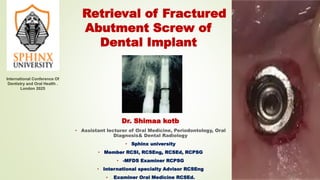
Retrieval of Fractured Abutment Screw of Dental Implant.
1.
Retrieval of Fractured
AbutmentScrew of
Dental Implant
Dr. Shimaa kotb
• Assistant lecturer of Oral Medicine, Periodontology, Oral
Diagnosis& Dental Radiology
• Sphinx university
• Member RCSI, RCSEng, RCSEd, RCPSG
• -MFDS Examiner RCPSG
• International specialty Advisor RCSEng
• Examiner Oral Medicine RCSEd.
International Conference Of
Dentistry and Oral Health .
London 2025
2.
Outlines
Objective / Aim
Dentalimplant
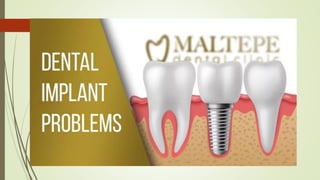
Dental implant problems
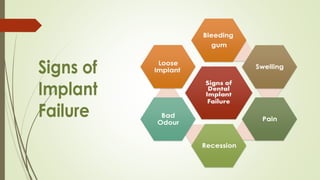
Signs of implant failure
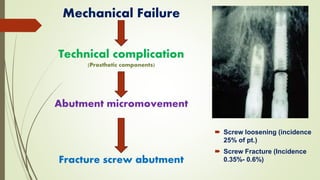
Mechanical Failure
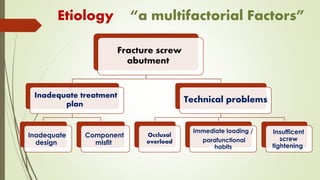
Etiology
Factor influencing abutment screw loosening
Decision making tree
Rational of treatment plan
Conclusion
References
3.
Retrieval of FracturedAbutment Screw of
Dental Implant
One of most tricky
task that requires
precise methods to
handle effectively.
4.
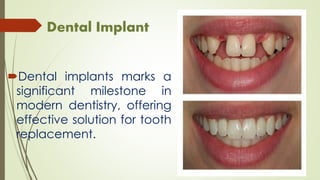
Dental Implant
Dental implantsmarks a
significant milestone in
modern dentistry, offering
effective solution for tooth
replacement.
7.
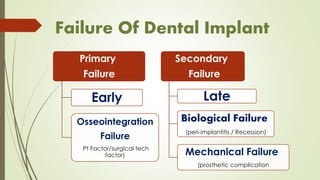
Failure Of DentalImplant
Primary
Failure
Early
Osseointegration
Failure
Pt Factor/surgical tech
factor)
Secondary
Failure
Late
Biological Failure
(peri-implantitis / Recession)
Mechanical Failure
(prosthetic complication
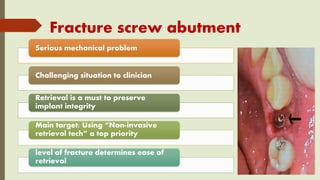
Fracture screw abutment
Seriousmechanical problem
Challenging situation to clinician
Retrieval is a must to preserve
implant integrity
Main target: Using “Non-invasive
retrieval tech” a top priority
level of fracture determines ease of
retrieval
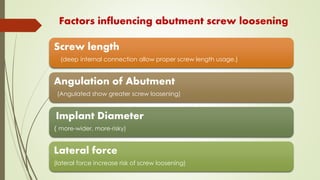
Factors influencing abutmentscrew loosening
Screw length
(deep internal connection allow proper screw length usage.)
Angulation of Abutment
(Angulated show greater screw loosening)
Implant Diameter
) more-wider, more-risky)
Lateral force
(lateral force increase risk of screw loosening)
13.
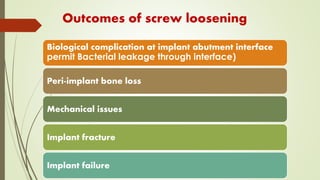
Outcomes of screwloosening
Biological complication at implant abutment interface
permit Bacterial leakage through interface)
Peri-implant bone loss
Mechanical issues
Implant fracture
Implant failure
14.
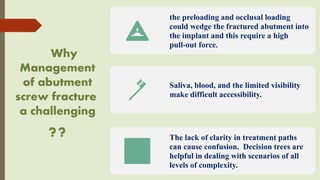
Why
Management
of abutment
screw fracture
achallenging
??
the preloading and occlusal loading
could wedge the fractured abutment into
the implant and this require a high
pull-out force.
Saliva, blood, and the limited visibility
make difficult accessibility.
The lack of clarity in treatment paths
can cause confusion. Decision trees are
helpful in dealing with scenarios of all
levels of complexity.
16.
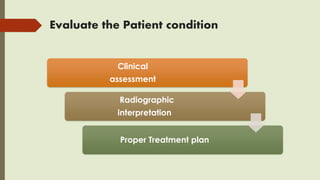
Evaluate the Patientcondition
Clinical
assessment
Radiographic
interpretation
Proper Treatment plan
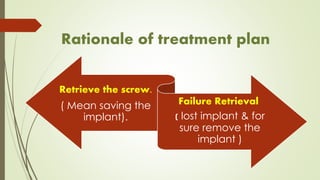
Rationale of treatmentplan
Retrieve the screw.
( Mean saving the
implant).
Failure Retrieval
( lost implant & for
sure remove the
implant )
19.
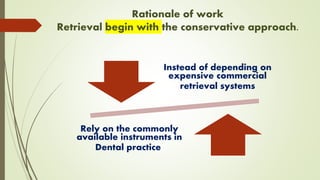
Rationale of work
beginwith the conservative approach.
Retrieval
Instead of depending on
expensive commercial
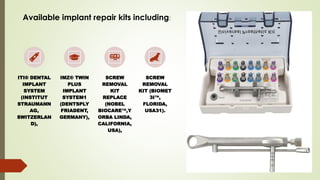
retrieval systems
Rely on the commonly
available instruments in
Dental practice
20.
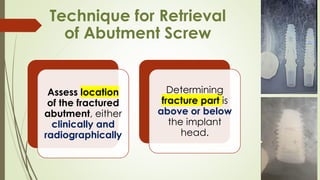
Technique for Retrieval
ofAbutment Screw
Assess location
of the fractured
abutment, either
clinically and
radiographically
Determining
fracture part is
above or below
the implant
head.
21.
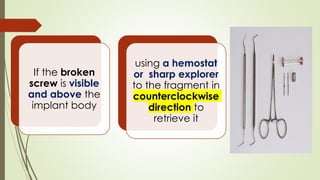
If the broken
screwis visible
and above the
implant body
using a hemostat
or sharp explorer
to the fragment in
counterclockwise
direction to
retrieve it
22.
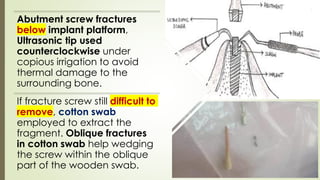
Abutment screw fractures
belowimplant platform,
Ultrasonic tip used
counterclockwise under
copious irrigation to avoid
thermal damage to the
surrounding bone.
If fracture screw still difficult to
remove, cotton swab
employed to extract the
fragment. Oblique fractures
in cotton swab help wedging
the screw within the oblique
part of the wooden swab.
23.
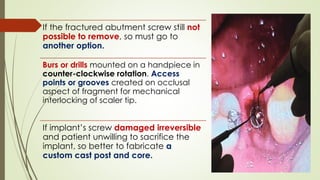
If the fracturedabutment screw still not
possible to remove, so must go to
another option.
Burs or drills mounted on a handpiece in
counter-clockwise rotation. Access
points or grooves created on occlusal
aspect of fragment for mechanical
interlocking of scaler tip.
If implant’s screw damaged irreversible
and patient unwilling to sacrifice the
implant, so better to fabricate a
custom cast post and core.
Conclusion
Implant fracturesis a serious
complication that contribute to implant
failure. Therefore, prevention is crucial
and relies on accurate diagnosis,
appropriate case selection, meticulous
treatment planning, and regular
maintenance.
The retrieval of a fractured screw is a
challenging scenarios.
A decision-making tree serves as a useful
tool that guide the clinicians in
managing different abutment screw
fractures scenarios.
28.
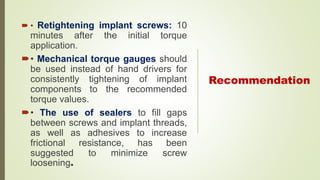
Recommendation
• Retighteningimplant screws: 10
minutes after the initial torque
application.
• Mechanical torque gauges should
be used instead of hand drivers for
consistently tightening of implant
components to the recommended
torque values.
• The use of sealers to fill gaps
between screws and implant threads,
as well as adhesives to increase
frictional resistance, has been
suggested to minimize screw
loosening.
29.
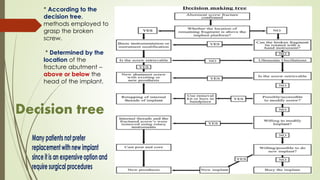
* According tothe
decision tree,
methods employed to
grasp the broken
screw.
* Determined by the
location of the
fracture abutment –
above or below the
head of the implant.
Decision tree
30.
References
▪ Peitsinis, PanagiotisRafail, et al. "Optimizing Implant Placement Timing and
Loading Protocols for Successful Functional and Esthetic Outcomes: A
Narrative Literature Review." Journal of Clinical Medicine 14.5 (2025): 1442.
▪ Pereira, Rafael & Sabri, Hamoun & Nava, Paolo & Alrmali, Abdusalam &
Wang, Hom-Lay. Treatment Strategies for Peri‐Implant Mucositis: The Final
Stop for Preventing Peri‐Implantitis. International Journal of Dentistry. 2025.
▪ Abdelfattah MY. Different mechanical complications of implant
prosthodontics. Int J Dent Res. 2014;2(6):190-6.
▪ Nayana P, Nayak SS, Chatterjee A, Sivaraman K, Srikanth G, Singh C.
Retrieval of fractured implant abutment screws: a narrative review. Journal
of International Society of Preventive and Community Dentistry. 2022
1;12(3):287-94.
▪ Kotb, S. Retrieval of Fractured Abutment Screw of Dental Implant. Case
Report. Preprints 2025, 2025050669.
 Most read