Web Forums
1
The less than dramatic History of the Web Forums.
Axel Huerta Morales.
Carlos Alejandro Sánchez González
Instituto Tecnologico de Tuxtepec.
February 2014.
Web Forums
2
Abstract.
In this document we are going to talk about the web forums. How many are? The
most important forums, the different types, etc. We’re not going to get complicated
with this. We are going to know their beginning as communication media between
people in the Net, some of their contributions to the current expansion of the Internet
and their current fight for existence against the monstrous social networks like
Facebook, Twitter and Tumblr. We’re not going to stop there, we also are going to
see more about this places of conflict, understanding, knowledge, drama, adventure
and laughs, all combined as only the Internet can do it. Which is the most popular?
Which is the oldest one? Which is the ugliest one? How is that they’re still there
despite Mark Zuckerberg’s (evil) Empire? All this questions and more are going to
be answered in the most understandable way possible, in order to assimilate all this
information in the most suitable way for the readers.
Web Forums
3
Introduction
Some of the first web forums were as old as the Internet itself (between eighties and
nineties). They are descendants of the BBS news systems and existed as
complements of bigger websites, supplying the function that they still are, being
discussion sites. The majority are supported in PHP, PERL, JAVA and HTML. Their
true boom came when systems and tools for forums began to appear. Anyone with
a little knowledge and people willing to help could get a free domain and host and
open a forum about whatever their minds wanted (even things outside of the Law).
It was all peace and harmony until Facebook and the Social Networks make their
appearance. But we’ll see that part later.
The main motivation when doing this document, aside of getting a good grading on
this subject, is that the people knows a little more about these places of the Net. That
they don’t stay with the bad things traditional media paints on them. That they’re not
places where people shares porn, scams others, uploads pictures of squashed
puppies and more horrid things. They are not like that, seriously (well, they sometime
are in part).
We are going to see the good side of this sites and a little bit of the bad side as much
as the rules of the institution where I study allows me. We’re going to learn what they
do in some of them and, as everything in existence, how to be safe and sound when
sailing on these turbulent waters of the big ocean of the Internet.
Web Forums
4
What’s a forum?
I can understand that you ask me what a forum is, even when the Internet almost
has 20 years existing. Nowadays the first thing that lots of the new web users do
when they open their browser is step on Facebook.
An Internet forum, as the FAQ’s of the vBulletin community refers (vBulletin
Community, 2013), is a website where people could hold discussions in the form of
posted messages.
Forums are not limited to just one topic, they can hold a lot of them and if the
webmaster make it so, different topics at the same time. The true limit of what can
be on a forum is the storage capacity and performance of the server it is hosted on.
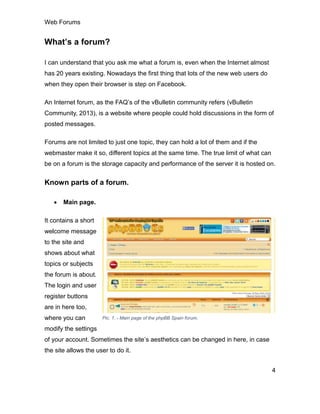
Known parts of a forum.
 Main page.
It contains a short
welcome message
to the site and
shows about what
topics or subjects
the forum is about.
The login and user
register buttons
are in here too,
where you can
modify the settings
of your account. Sometimes the site’s aesthetics can be changed in here, in case
the site allows the user to do it.
Pic. 1. - Main page of the phpBB Spain forum.
Web Forums
5
 Boards
All the message threads are inside the boards; ordered from the thread with more
replies or the most recent reply to the last. Generally the list of boards of the forum
is on the main page. If the boards attend distinct topics, the list could have a short
description for each one.
 Threads.
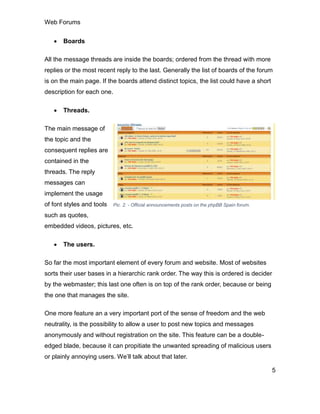
The main message of
the topic and the
consequent replies are
contained in the
threads. The reply
messages can
implement the usage
of font styles and tools
such as quotes,
embedded videos, pictures, etc.
 The users.
So far the most important element of every forum and website. Most of websites
sorts their user bases in a hierarchic rank order. The way this is ordered is decider
by the webmaster; this last one often is on top of the rank order, because or being
the one that manages the site.
One more feature an a very important port of the sense of freedom and the web
neutrality, is the possibility to allow a user to post new topics and messages
anonymously and without registration on the site. This feature can be a double-
edged blade, because it can propitiate the unwanted spreading of malicious users
or plainly annoying users. We’ll talk about that later.
Pic. 2. - Official announcements posts on the phpBB Spain forum.
Web Forums
6
 BBCodes.
BBCode or Bulletin Board Code
is a lightweight markup
language used to format posts
in many message boards. The
available tags are usually
indicated by square brackets
([ ]) surrounding a keyword.
Can be used to embed videos, post pictures, change fonts and place quotes.
BBCodes must be enabled by the administrators, but it can be disabled from the
message form too.
Pic. 3. - Example of the BBcode for quotes on the website
"Taringa!"
Web Forums
7
How they work?
Most of them just open their doors praying that the search engines bring someone
looking for something to do. If what is in the page is of the liking of the new guy,
he/she comes back with friends. The forums live from their users and need them,
since domain names and hostings aren’t cheap, and the free ones sometimes are
not good in performance.
But where the money comes? From the users.
Sometimes they don’t pay a cent for joining, but if the webmaster gets the hold on,
he can place ads so he can pay the bills. If the site gets full of people, he get paid
more. How you think that Google reached the place on where it is? With ads. Tons
of them.
When the resource is plentiful everything can be enhanced even more, hiring
personnel to help with the never-ending duty of keeping the site up, kicking out the
game the trolls and spambots and keep providing a nice environment for the users.
Web Forums
8
How can I make one? I want to make one!
Hold your horses. Creating a forum is easy but not as easy as it sounds.
If we want to have our first forum we need some things like:
- Web programming knowledge
- Data Bases knowledge
- How to create a server or buy a hosting and domain or get free ones.
- Time, patience, and dedication.
Although you can make one programming everything from scratch, there are tools
that shortens the task of the forum building.
Web Forums
9
vBulletin.
Pic. 4. - VBulletin’s logo
Is a software used to create web forums developed by vBulletin Solutions Inc. It’s
based in PHP and MYSQL. Has great compatibility with plenty of platforms, very
flexible for modifications and offers very simple management.
It was created by James & John Percival Limm in February 2000 as a rewriting of
UBB. It’s currently in the version 4.2.0 (released in May 25, 2012).
VBulletin is used by many companies such as Valve, Electronic Arts and Sony for
their support and customer’s services forums.
Sadly for the open source enthusiasts, vBulletin is a privative tool (costs
US249.00). Of course that there are free tools, we’re going to talk about that soon.
VBulletin comes with the next features:
- Edit and add custom BBCodes.
- Install modifications through uploading; just by adding files to the forum.
- Install languages and translations through uploading.
- Install templates/skins (the aesthetical aspects of the forum) through
uploading.
- Template modification through CSS style sheets.
- FAQ customization (Frequently Asked Questions).
- Creation of boards inside other boards.
Web Forums
10
phpBB.
Pic. 5. - PhpBB’s logo & slogan.
PhpBB is an Internet forum package written in the PHP scripting language.
Available under the GNU General Public License, phpBB is free and open source
software.
It was created by James Atkinson (no longer in the dev. team) as a simple forum
similar to UBB for his own personal site in 2000. Later joined Nathan Coding &
John Abela after the phpBB CVS repository was migrated to SourceForge.net, and
worked in the beginning of the version 1.0.0, which was released officially on
December 9th 2000 (phpBB Group, n.d.).
Currently it’s on the version 3.0.12, released on September 28th 2013.
As main features of phpBB we have:
- Totally free and Open Source.
- Unlimited forum and board creation.
- Improvement on the performance since its earlier version.
- User registration and field customization.
- Multi-user private messages and message folders.
- User and post search.
- Separated Admin and Mod panels.
- Poll creation with multi-answer support.
- Profile for each user with personal data.
- Apply ban for definite or indefinite time.
Web Forums
11
- Users can have friends or ignore them. Ignored people’s messages are
automatically hidden.
- BBCode customization.
- Creation of user groups, moderators and administrators.
- Warnings and reports from user to the mods for inappropriate content.
- Create new fields for user profile info.
- Edit from admin panel the files of the used post.
- Multi-fie adjunction.
- Free Mods (modifications, not the moderators) and styles created by the
community.
- Easy rank creation and assignation by post or user group.
- Action logs for the users, mods and admins.
- Database backup and restore from the admin panel.
As software requirements, phpBB needs PHP in its version 4.3.3 or later and any
of the following Data Base Management Systems.
 MySQL 3.23+/4.0+/4.1+/5.0+
 MySQLi (MySQL 4.1+/5.0+)
 PostgreSQL 7.3+
 SQLite
 Firebird 1.5+/Interbase 7.1+
 Oracle
 MSSQL 2000+
 MSSQL 2000+ (ODBC)
If you want to learn how to user this valuable tools, in our Annexes section you can
visit the vBulletin and phpBB websites.
Web Forums
12
Existing types of forums.
In practice there are many types. I’m not talking about all of them, but I’m going to
talk about 2 of them that I consider relevant.
Bulletin Boards.
They are built in a
hierarchical tree
structure; a forum
can have many
boards and the
boards can have a
lot of threads and in
the threads are
contained the
messages and
replies.
They keep the usual
hierarchy of these sites.
Administrator.
Also referred as “admins”, they are the ones that manage the technical features of
the website. As such, they are the ones that promote the common users to
moderators and, because it happens too, revoke their privileges when deserve it.
They also create and delete boards, manage the rules and handle the website’s
databases to do backups. Sometimes they work as moderators checking on the
topics and assign penalties to bad users.
Pic. 6. - View of a phpBB forum as a moderator.
Web Forums
13
Moderators.
Referred by everyone as “mods”, they are the ones that “moderate” the
discussions in the forum. They have access to every thread and board so they can
keep the topics in proper order, spam-free and Safe for Work.
The task of the mods (and the admins) is critical, since their efficiency shows how
the site and user base environment is. From their behaving it depends the users
satisfaction.
The final user.
By a great margin the MOST important. By default they have privileges to create,
edit and delete their own messages and posts. They have by only commitment
follow the site rules and report everything against them, either it be spam, Not Safe
for Work or illegal material or bad users.
Web Forums
14
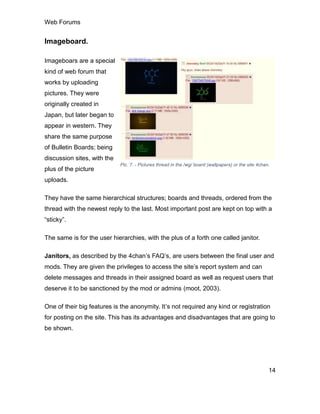
Imageboard.
Imageboars are a special
kind of web forum that
works by uploading
pictures. They were
originally created in
Japan, but later began to
appear in western. They
share the same purpose
of Bulletin Boards; being
discussion sites, with the
plus of the picture
uploads.
They have the same hierarchical structures; boards and threads, ordered from the
thread with the newest reply to the last. Most important post are kept on top with a
“sticky”.
The same is for the user hierarchies, with the plus of a forth one called janitor.
Janitors, as described by the 4chan’s FAQ’s, are users between the final user and
mods. They are given the privileges to access the site’s report system and can
delete messages and threads in their assigned board as well as request users that
deserve it to be sanctioned by the mod or admins (moot, 2003).
One of their big features is the anonymity. It’s not required any kind or registration
for posting on the site. This has its advantages and disadvantages that are going to
be shown.
Pic. 7. - Pictures thread in the /wg/ board (wallpapers) or the site 4chan.
Web Forums
15
Contributions of the forums to the Net.
Without doubt, the forums and discussion sites have played a starring role on the
evolution and expansion of the Internet, so much like in new websites as in the
web users themselves. There have been contributions for the good and for the
worse, and we’re going to see why.
The beginning of the social networks.
Social Networks are
communications media that
centers on finding people for
making a relationship online.
They are formed by people who
share a relation, mainly
friendship, keep interest, share
common activities or are
interested on knowing and
explore others likings.
Social network from their beginning have been taking features from forums, chat
rooms and more for integration of experiences and provide a better service.
An example of this is Facebook and one of its many implementations and
improvements, like allowing users to upload and post replies with pictures;
something taken from the Imageboards.
In the general thing the social networks owe other sites an even others take ideas
from social networks to improve and keep their own user base.
Pic. 8. - A message in Facebook with some replies.
Web Forums
16
Freedom of expression and anonymity: Double-edged blades.
Websites, call it forums,
blogs and social
networks have allowed
people to express their
ideas and opinions
without fear to
consequences (part of
the time).
The anonymity has granted people endangered by governments and criminal
organizations the way to make known their situation or the one of their
city/region/country/ to the world. On the Internet there are no government, nor
entity that can censor the words or the people and will never be, even with the
excuses of the governments for controlling the web like “the fight against terrorism”
and “watch for the security”.
Unfortunately, freedom of speech and anonymity can play on the dark side. Lots
have been the cases of cyberbullying, scams and the like in forums and social
networks. People take advantage of these gifts and play evilly.
Why?
Because anonymity and the media gives them security. It makes them believe that
there’re not going to be consequences for their actions, when the reality of
anonymity it’s made evident. Anonymity it’s not 100% anonymous.
There are well documented cases of people believing that being behind the PC
screen was giving them an “invisibility cloak” before their victims, and that simply
were followed the little crumbs of information left behind, until they were found in
real life, with IN REAL LIFE consequences.
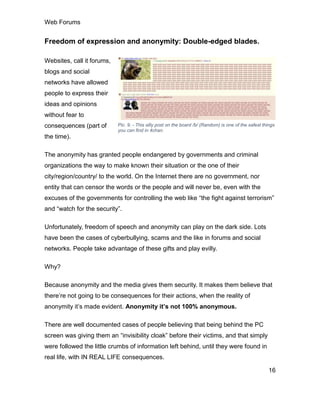
Pic. 9. - This silly post on the board /b/ (Random) is one of the safest things
you can find in 4chan.
Web Forums
17
Anonymity isn’t bad or evil, one just need to the responsibility its usage entails. And
from freedom of expression you don’t take advantage. As I heard once, “Your
freedom ends where the other’s begins”.
Knowledge is power.
Freedom of
speech and
though are the
main supports of
science and the
knowledge
development.
Without them
we’ll be still
burning witches and paying indulgences to the church every Sunday (somehow
we’re still doing that).
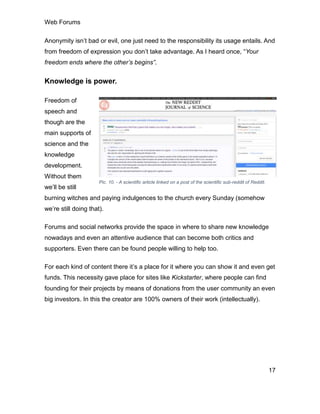
Forums and social networks provide the space in where to share new knowledge
nowadays and even an attentive audience that can become both critics and
supporters. Even there can be found people willing to help too.
For each kind of content there it’s a place for it where you can show it and even get
funds. This necessity gave place for sites like Kickstarter, where people can find
founding for their projects by means of donations from the user community an even
big investors. In this the creator are 100% owners of their work (intellectually).
Pic. 10. - A scientific article linked on a post of the scientific sub-reddit of Reddit.
Web Forums
18
The bad guys of the movie: Bad users and their mess.
There isn’t a place that lacks someone mean. It’s part of human nature after all.
There are evil or every kind, but nothing as bad as the next ones.
The trolls.
An Internet troll is a person who delights in sowing discord on the Internet. He (and
it is usually he) tries to start arguments and upset people (Campbell, 2001). The
consequences of their behavior vary depending on what they do or say on a post.
They just can derail the thread from the main topic, make users fight each other or
against him, or cause the whole post to be deleted for derailing the main topic and
make a complete disaster from which a lot of people could be banned temporally or
forever, troll included. Sometimes they find their way back, though.
The best way to handle this individuals is not paying attention. It’s their main
motivation after all. The mods and admins can just ban tem permanently, using the
IP address to prevent them from returning.
There are instances in where trolls cross the line of legality, incurring in acts like
cyberbullying, hacking, posting Not Safe For Work or illegal material to generate
reactions among people. They can be reported to the competing authority when
the case. This last one can be complicated if their real information is unknown.
Anonymity playing in the dark site like we mentioned before.
Flaming.
Generally caused by a troll or a polemic nature topic. It is the hostile and insulting
interaction between the users, even becoming profane too. This occurrences are of
special concern for the user’s coexistence.
The best way to handle this is to have an efficient moderation team, as well as a
Web Forums
19
good report system for the users.
The main consequence of Flaming, as with trolls, is post deletion and user ban.
Spam
It is not only a problem of emails.
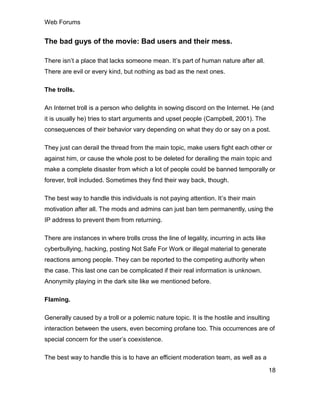
In a forum spam are post that
show content unrelated to the
post or advertisements of some
kind (like in Pic 11). It can be
links to malicious content too,
and it can affect the naive users.
Generally it’s posted by Spambots; automated programs that post this messages in
quantity. Often it’s a user doing it manually.
Meanwhile “manual” spam can be solved with the ban or the transgressor users,
Spambots are A LOT MORE faster and the mods might not be able to delete the
great amount of post or ban all the multiple “robotic users”. If the server in which
the forum is hosted is too small or slow the data could become corrupted rendering
useless the whole site.
A great solution for Spambots is the usage of CAPTCHAS.
Pic. 11. - User making Spam in a forum.
Web Forums
20
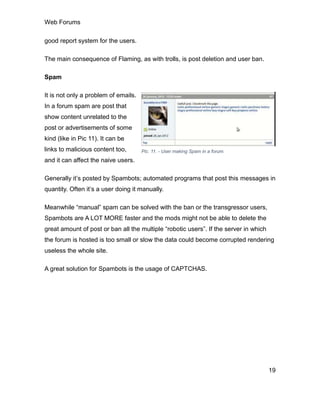
CAPTCHA is the acronym for
Completely Automated Public
Turing test to tell Computers and
Humans Apart. Is a type of
challenge-response test used in
computing to determine whether
or not the user is a human. The
term was coined in 2000 by Luis
von Ahn, Manuel Blum, Nicholas
J. Hopper of Carnegie Mellon
University and John Langford of
IBM (Engber, 2014).
It consist on a deformed text that the user must decipher and type correctly in order
to post his/her content or reply on a topic. It can be words or random letters,
numbers or symbols.
With time people has made algorithms to solve CAPTCHAs, and the same had
increased their difficulty to keep bots out the site.
Pic. 12. - Example of a hybrid CAPTCHA of text and image
recognition.
Web Forums
21
The good one, the bad one and the ugly one.
All good things have their bad side, and this couldn’t be more true for the Internet
and web forums.
Although we have seen the cases of trolls, flaming and spam, these are the some
of the smaller problems an even part of a daily basis of a few sites. The problem
comes when all this crosses the line of the legally, morally and ethically correct.
Freedom of expression plays for both sides.
A person can create a forum about cat pictures or advanced programming, but
someone else maybe thinks on one for porn, or about how to create drugs or
WORSE. Some of these sites, because of their own nature hides on the Deep
Web.
The Deep Web is just the region of the Internet that the search engines like Google
don’t index on their searches. Google don’t index them because they communicate
with different protocols and need special tools to access. If the Internet isn’t
managed by any government, the Deep Web is managed by no one.
Being cautious is important for every web user. There are LOTS of things out there
and we don’t know what can harm us, the PC or both. One must walk through
these alleyways with wide open eyes, to see what we found.
Even so, one can found new friends on there. It’s just matter of exploring without
fear the neighborhood.
Web Forums
22
What’s future holds for the forums?
Very likely the web forums are going to stay with us for much longer. Their
adaptability to changes makes them very lasting. Social Networks will come and
leave but the people will always like to argue.
That is what has keep them where they are. People always want to argue about
something, hold conversations and found people that think alike.
Whenever there are groups of people with something in common, they’ll want their
own place to coexist healthily, or maybe not.
Web Forums
23
Conclusion.
We conclude this writing with the same reiteration. The forums have been and will
still be important for the Internet. Their capacity for developing the critical thinking
has given to the people the power to understand a little more the way in both the
digital and real world work.
It has given them a place in where express their ideas, whether they are good or
bad, to all the people in the world.
It has created the community of Internet. The great village of the Web. The only
one and true democratic people.
The forums, alongside the Social Networks has given people something more than
only watch the news, now they can be part of the news. Now they can be part of
the action.
Now they are part of the Internet. So you are if you have opened the browser some
time.
Web Forums
24
References.
Campbell, T. (2001, Julio 13). Internet trolls. Retrieved from Internet Archive:
http://web.archive.org/web/20011026130853/http://members.aol.com/intwg/t
rolls.htm
Engber, D. (2014, Enero 17). Who made that Captcha? Retrieved from The New
York Times: http://www.nytimes.com/2014/01/19/magazine/who-made-that-
captcha.html?_r=0
moot. (2003). FAQ. Retrieved from 4chan: http://www.4chan.org/faq#whojan
phpBB Group. (n.d.). phpBB: A Brief History. Retrieved from phpBB: Free and
Open Source Forum Software:
https://www.phpbb.com/about/history/?sid=ee152fac1885983136e86eb8906
9507d
vBulletin Community. (2013, Abril 19). vBulletin Community Forum - FAQ: What is a
bulletin board? Retrieved from vBulletin.com:
http://www.vbulletin.com/forum/help?faq=vb3_board_usage#faq_vb3_forum
s_threads_posts
Web Forums
25
Annexes.
vBulletin website.
 http://www.vbulletin.com/en/
phpBB website (in English)
 https://www.phpbb.com/
phpBB website (in Spanish)
 http://www.phpbb-es.com/

Articulo sobre foros (completo ingles)

  • 1.
    Web Forums 1 The lessthan dramatic History of the Web Forums. Axel Huerta Morales. Carlos Alejandro Sánchez González Instituto Tecnologico de Tuxtepec. February 2014.
  • 2.
    Web Forums 2 Abstract. In thisdocument we are going to talk about the web forums. How many are? The most important forums, the different types, etc. We’re not going to get complicated with this. We are going to know their beginning as communication media between people in the Net, some of their contributions to the current expansion of the Internet and their current fight for existence against the monstrous social networks like Facebook, Twitter and Tumblr. We’re not going to stop there, we also are going to see more about this places of conflict, understanding, knowledge, drama, adventure and laughs, all combined as only the Internet can do it. Which is the most popular? Which is the oldest one? Which is the ugliest one? How is that they’re still there despite Mark Zuckerberg’s (evil) Empire? All this questions and more are going to be answered in the most understandable way possible, in order to assimilate all this information in the most suitable way for the readers.
  • 3.
    Web Forums 3 Introduction Some ofthe first web forums were as old as the Internet itself (between eighties and nineties). They are descendants of the BBS news systems and existed as complements of bigger websites, supplying the function that they still are, being discussion sites. The majority are supported in PHP, PERL, JAVA and HTML. Their true boom came when systems and tools for forums began to appear. Anyone with a little knowledge and people willing to help could get a free domain and host and open a forum about whatever their minds wanted (even things outside of the Law). It was all peace and harmony until Facebook and the Social Networks make their appearance. But we’ll see that part later. The main motivation when doing this document, aside of getting a good grading on this subject, is that the people knows a little more about these places of the Net. That they don’t stay with the bad things traditional media paints on them. That they’re not places where people shares porn, scams others, uploads pictures of squashed puppies and more horrid things. They are not like that, seriously (well, they sometime are in part). We are going to see the good side of this sites and a little bit of the bad side as much as the rules of the institution where I study allows me. We’re going to learn what they do in some of them and, as everything in existence, how to be safe and sound when sailing on these turbulent waters of the big ocean of the Internet.
  • 4.
    Web Forums 4 What’s aforum? I can understand that you ask me what a forum is, even when the Internet almost has 20 years existing. Nowadays the first thing that lots of the new web users do when they open their browser is step on Facebook. An Internet forum, as the FAQ’s of the vBulletin community refers (vBulletin Community, 2013), is a website where people could hold discussions in the form of posted messages. Forums are not limited to just one topic, they can hold a lot of them and if the webmaster make it so, different topics at the same time. The true limit of what can be on a forum is the storage capacity and performance of the server it is hosted on. Known parts of a forum.  Main page. It contains a short welcome message to the site and shows about what topics or subjects the forum is about. The login and user register buttons are in here too, where you can modify the settings of your account. Sometimes the site’s aesthetics can be changed in here, in case the site allows the user to do it. Pic. 1. - Main page of the phpBB Spain forum.
  • 5.
    Web Forums 5  Boards Allthe message threads are inside the boards; ordered from the thread with more replies or the most recent reply to the last. Generally the list of boards of the forum is on the main page. If the boards attend distinct topics, the list could have a short description for each one.  Threads. The main message of the topic and the consequent replies are contained in the threads. The reply messages can implement the usage of font styles and tools such as quotes, embedded videos, pictures, etc.  The users. So far the most important element of every forum and website. Most of websites sorts their user bases in a hierarchic rank order. The way this is ordered is decider by the webmaster; this last one often is on top of the rank order, because or being the one that manages the site. One more feature an a very important port of the sense of freedom and the web neutrality, is the possibility to allow a user to post new topics and messages anonymously and without registration on the site. This feature can be a double- edged blade, because it can propitiate the unwanted spreading of malicious users or plainly annoying users. We’ll talk about that later. Pic. 2. - Official announcements posts on the phpBB Spain forum.
  • 6.
    Web Forums 6  BBCodes. BBCodeor Bulletin Board Code is a lightweight markup language used to format posts in many message boards. The available tags are usually indicated by square brackets ([ ]) surrounding a keyword. Can be used to embed videos, post pictures, change fonts and place quotes. BBCodes must be enabled by the administrators, but it can be disabled from the message form too. Pic. 3. - Example of the BBcode for quotes on the website "Taringa!"
  • 7.
    Web Forums 7 How theywork? Most of them just open their doors praying that the search engines bring someone looking for something to do. If what is in the page is of the liking of the new guy, he/she comes back with friends. The forums live from their users and need them, since domain names and hostings aren’t cheap, and the free ones sometimes are not good in performance. But where the money comes? From the users. Sometimes they don’t pay a cent for joining, but if the webmaster gets the hold on, he can place ads so he can pay the bills. If the site gets full of people, he get paid more. How you think that Google reached the place on where it is? With ads. Tons of them. When the resource is plentiful everything can be enhanced even more, hiring personnel to help with the never-ending duty of keeping the site up, kicking out the game the trolls and spambots and keep providing a nice environment for the users.
  • 8.
    Web Forums 8 How canI make one? I want to make one! Hold your horses. Creating a forum is easy but not as easy as it sounds. If we want to have our first forum we need some things like: - Web programming knowledge - Data Bases knowledge - How to create a server or buy a hosting and domain or get free ones. - Time, patience, and dedication. Although you can make one programming everything from scratch, there are tools that shortens the task of the forum building.
  • 9.
    Web Forums 9 vBulletin. Pic. 4.- VBulletin’s logo Is a software used to create web forums developed by vBulletin Solutions Inc. It’s based in PHP and MYSQL. Has great compatibility with plenty of platforms, very flexible for modifications and offers very simple management. It was created by James & John Percival Limm in February 2000 as a rewriting of UBB. It’s currently in the version 4.2.0 (released in May 25, 2012). VBulletin is used by many companies such as Valve, Electronic Arts and Sony for their support and customer’s services forums. Sadly for the open source enthusiasts, vBulletin is a privative tool (costs US249.00). Of course that there are free tools, we’re going to talk about that soon. VBulletin comes with the next features: - Edit and add custom BBCodes. - Install modifications through uploading; just by adding files to the forum. - Install languages and translations through uploading. - Install templates/skins (the aesthetical aspects of the forum) through uploading. - Template modification through CSS style sheets. - FAQ customization (Frequently Asked Questions). - Creation of boards inside other boards.
  • 10.
    Web Forums 10 phpBB. Pic. 5.- PhpBB’s logo & slogan. PhpBB is an Internet forum package written in the PHP scripting language. Available under the GNU General Public License, phpBB is free and open source software. It was created by James Atkinson (no longer in the dev. team) as a simple forum similar to UBB for his own personal site in 2000. Later joined Nathan Coding & John Abela after the phpBB CVS repository was migrated to SourceForge.net, and worked in the beginning of the version 1.0.0, which was released officially on December 9th 2000 (phpBB Group, n.d.). Currently it’s on the version 3.0.12, released on September 28th 2013. As main features of phpBB we have: - Totally free and Open Source. - Unlimited forum and board creation. - Improvement on the performance since its earlier version. - User registration and field customization. - Multi-user private messages and message folders. - User and post search. - Separated Admin and Mod panels. - Poll creation with multi-answer support. - Profile for each user with personal data. - Apply ban for definite or indefinite time.
  • 11.
    Web Forums 11 - Userscan have friends or ignore them. Ignored people’s messages are automatically hidden. - BBCode customization. - Creation of user groups, moderators and administrators. - Warnings and reports from user to the mods for inappropriate content. - Create new fields for user profile info. - Edit from admin panel the files of the used post. - Multi-fie adjunction. - Free Mods (modifications, not the moderators) and styles created by the community. - Easy rank creation and assignation by post or user group. - Action logs for the users, mods and admins. - Database backup and restore from the admin panel. As software requirements, phpBB needs PHP in its version 4.3.3 or later and any of the following Data Base Management Systems.  MySQL 3.23+/4.0+/4.1+/5.0+  MySQLi (MySQL 4.1+/5.0+)  PostgreSQL 7.3+  SQLite  Firebird 1.5+/Interbase 7.1+  Oracle  MSSQL 2000+  MSSQL 2000+ (ODBC) If you want to learn how to user this valuable tools, in our Annexes section you can visit the vBulletin and phpBB websites.
  • 12.
    Web Forums 12 Existing typesof forums. In practice there are many types. I’m not talking about all of them, but I’m going to talk about 2 of them that I consider relevant. Bulletin Boards. They are built in a hierarchical tree structure; a forum can have many boards and the boards can have a lot of threads and in the threads are contained the messages and replies. They keep the usual hierarchy of these sites. Administrator. Also referred as “admins”, they are the ones that manage the technical features of the website. As such, they are the ones that promote the common users to moderators and, because it happens too, revoke their privileges when deserve it. They also create and delete boards, manage the rules and handle the website’s databases to do backups. Sometimes they work as moderators checking on the topics and assign penalties to bad users. Pic. 6. - View of a phpBB forum as a moderator.
  • 13.
    Web Forums 13 Moderators. Referred byeveryone as “mods”, they are the ones that “moderate” the discussions in the forum. They have access to every thread and board so they can keep the topics in proper order, spam-free and Safe for Work. The task of the mods (and the admins) is critical, since their efficiency shows how the site and user base environment is. From their behaving it depends the users satisfaction. The final user. By a great margin the MOST important. By default they have privileges to create, edit and delete their own messages and posts. They have by only commitment follow the site rules and report everything against them, either it be spam, Not Safe for Work or illegal material or bad users.
  • 14.
    Web Forums 14 Imageboard. Imageboars area special kind of web forum that works by uploading pictures. They were originally created in Japan, but later began to appear in western. They share the same purpose of Bulletin Boards; being discussion sites, with the plus of the picture uploads. They have the same hierarchical structures; boards and threads, ordered from the thread with the newest reply to the last. Most important post are kept on top with a “sticky”. The same is for the user hierarchies, with the plus of a forth one called janitor. Janitors, as described by the 4chan’s FAQ’s, are users between the final user and mods. They are given the privileges to access the site’s report system and can delete messages and threads in their assigned board as well as request users that deserve it to be sanctioned by the mod or admins (moot, 2003). One of their big features is the anonymity. It’s not required any kind or registration for posting on the site. This has its advantages and disadvantages that are going to be shown. Pic. 7. - Pictures thread in the /wg/ board (wallpapers) or the site 4chan.
  • 15.
    Web Forums 15 Contributions ofthe forums to the Net. Without doubt, the forums and discussion sites have played a starring role on the evolution and expansion of the Internet, so much like in new websites as in the web users themselves. There have been contributions for the good and for the worse, and we’re going to see why. The beginning of the social networks. Social Networks are communications media that centers on finding people for making a relationship online. They are formed by people who share a relation, mainly friendship, keep interest, share common activities or are interested on knowing and explore others likings. Social network from their beginning have been taking features from forums, chat rooms and more for integration of experiences and provide a better service. An example of this is Facebook and one of its many implementations and improvements, like allowing users to upload and post replies with pictures; something taken from the Imageboards. In the general thing the social networks owe other sites an even others take ideas from social networks to improve and keep their own user base. Pic. 8. - A message in Facebook with some replies.
  • 16.
    Web Forums 16 Freedom ofexpression and anonymity: Double-edged blades. Websites, call it forums, blogs and social networks have allowed people to express their ideas and opinions without fear to consequences (part of the time). The anonymity has granted people endangered by governments and criminal organizations the way to make known their situation or the one of their city/region/country/ to the world. On the Internet there are no government, nor entity that can censor the words or the people and will never be, even with the excuses of the governments for controlling the web like “the fight against terrorism” and “watch for the security”. Unfortunately, freedom of speech and anonymity can play on the dark side. Lots have been the cases of cyberbullying, scams and the like in forums and social networks. People take advantage of these gifts and play evilly. Why? Because anonymity and the media gives them security. It makes them believe that there’re not going to be consequences for their actions, when the reality of anonymity it’s made evident. Anonymity it’s not 100% anonymous. There are well documented cases of people believing that being behind the PC screen was giving them an “invisibility cloak” before their victims, and that simply were followed the little crumbs of information left behind, until they were found in real life, with IN REAL LIFE consequences. Pic. 9. - This silly post on the board /b/ (Random) is one of the safest things you can find in 4chan.
  • 17.
    Web Forums 17 Anonymity isn’tbad or evil, one just need to the responsibility its usage entails. And from freedom of expression you don’t take advantage. As I heard once, “Your freedom ends where the other’s begins”. Knowledge is power. Freedom of speech and though are the main supports of science and the knowledge development. Without them we’ll be still burning witches and paying indulgences to the church every Sunday (somehow we’re still doing that). Forums and social networks provide the space in where to share new knowledge nowadays and even an attentive audience that can become both critics and supporters. Even there can be found people willing to help too. For each kind of content there it’s a place for it where you can show it and even get funds. This necessity gave place for sites like Kickstarter, where people can find founding for their projects by means of donations from the user community an even big investors. In this the creator are 100% owners of their work (intellectually). Pic. 10. - A scientific article linked on a post of the scientific sub-reddit of Reddit.
  • 18.
    Web Forums 18 The badguys of the movie: Bad users and their mess. There isn’t a place that lacks someone mean. It’s part of human nature after all. There are evil or every kind, but nothing as bad as the next ones. The trolls. An Internet troll is a person who delights in sowing discord on the Internet. He (and it is usually he) tries to start arguments and upset people (Campbell, 2001). The consequences of their behavior vary depending on what they do or say on a post. They just can derail the thread from the main topic, make users fight each other or against him, or cause the whole post to be deleted for derailing the main topic and make a complete disaster from which a lot of people could be banned temporally or forever, troll included. Sometimes they find their way back, though. The best way to handle this individuals is not paying attention. It’s their main motivation after all. The mods and admins can just ban tem permanently, using the IP address to prevent them from returning. There are instances in where trolls cross the line of legality, incurring in acts like cyberbullying, hacking, posting Not Safe For Work or illegal material to generate reactions among people. They can be reported to the competing authority when the case. This last one can be complicated if their real information is unknown. Anonymity playing in the dark site like we mentioned before. Flaming. Generally caused by a troll or a polemic nature topic. It is the hostile and insulting interaction between the users, even becoming profane too. This occurrences are of special concern for the user’s coexistence. The best way to handle this is to have an efficient moderation team, as well as a
  • 19.
    Web Forums 19 good reportsystem for the users. The main consequence of Flaming, as with trolls, is post deletion and user ban. Spam It is not only a problem of emails. In a forum spam are post that show content unrelated to the post or advertisements of some kind (like in Pic 11). It can be links to malicious content too, and it can affect the naive users. Generally it’s posted by Spambots; automated programs that post this messages in quantity. Often it’s a user doing it manually. Meanwhile “manual” spam can be solved with the ban or the transgressor users, Spambots are A LOT MORE faster and the mods might not be able to delete the great amount of post or ban all the multiple “robotic users”. If the server in which the forum is hosted is too small or slow the data could become corrupted rendering useless the whole site. A great solution for Spambots is the usage of CAPTCHAS. Pic. 11. - User making Spam in a forum.
  • 20.
    Web Forums 20 CAPTCHA isthe acronym for Completely Automated Public Turing test to tell Computers and Humans Apart. Is a type of challenge-response test used in computing to determine whether or not the user is a human. The term was coined in 2000 by Luis von Ahn, Manuel Blum, Nicholas J. Hopper of Carnegie Mellon University and John Langford of IBM (Engber, 2014). It consist on a deformed text that the user must decipher and type correctly in order to post his/her content or reply on a topic. It can be words or random letters, numbers or symbols. With time people has made algorithms to solve CAPTCHAs, and the same had increased their difficulty to keep bots out the site. Pic. 12. - Example of a hybrid CAPTCHA of text and image recognition.
  • 21.
    Web Forums 21 The goodone, the bad one and the ugly one. All good things have their bad side, and this couldn’t be more true for the Internet and web forums. Although we have seen the cases of trolls, flaming and spam, these are the some of the smaller problems an even part of a daily basis of a few sites. The problem comes when all this crosses the line of the legally, morally and ethically correct. Freedom of expression plays for both sides. A person can create a forum about cat pictures or advanced programming, but someone else maybe thinks on one for porn, or about how to create drugs or WORSE. Some of these sites, because of their own nature hides on the Deep Web. The Deep Web is just the region of the Internet that the search engines like Google don’t index on their searches. Google don’t index them because they communicate with different protocols and need special tools to access. If the Internet isn’t managed by any government, the Deep Web is managed by no one. Being cautious is important for every web user. There are LOTS of things out there and we don’t know what can harm us, the PC or both. One must walk through these alleyways with wide open eyes, to see what we found. Even so, one can found new friends on there. It’s just matter of exploring without fear the neighborhood.
  • 22.
    Web Forums 22 What’s futureholds for the forums? Very likely the web forums are going to stay with us for much longer. Their adaptability to changes makes them very lasting. Social Networks will come and leave but the people will always like to argue. That is what has keep them where they are. People always want to argue about something, hold conversations and found people that think alike. Whenever there are groups of people with something in common, they’ll want their own place to coexist healthily, or maybe not.
  • 23.
    Web Forums 23 Conclusion. We concludethis writing with the same reiteration. The forums have been and will still be important for the Internet. Their capacity for developing the critical thinking has given to the people the power to understand a little more the way in both the digital and real world work. It has given them a place in where express their ideas, whether they are good or bad, to all the people in the world. It has created the community of Internet. The great village of the Web. The only one and true democratic people. The forums, alongside the Social Networks has given people something more than only watch the news, now they can be part of the news. Now they can be part of the action. Now they are part of the Internet. So you are if you have opened the browser some time.
  • 24.
    Web Forums 24 References. Campbell, T.(2001, Julio 13). Internet trolls. Retrieved from Internet Archive: http://web.archive.org/web/20011026130853/http://members.aol.com/intwg/t rolls.htm Engber, D. (2014, Enero 17). Who made that Captcha? Retrieved from The New York Times: http://www.nytimes.com/2014/01/19/magazine/who-made-that- captcha.html?_r=0 moot. (2003). FAQ. Retrieved from 4chan: http://www.4chan.org/faq#whojan phpBB Group. (n.d.). phpBB: A Brief History. Retrieved from phpBB: Free and Open Source Forum Software: https://www.phpbb.com/about/history/?sid=ee152fac1885983136e86eb8906 9507d vBulletin Community. (2013, Abril 19). vBulletin Community Forum - FAQ: What is a bulletin board? Retrieved from vBulletin.com: http://www.vbulletin.com/forum/help?faq=vb3_board_usage#faq_vb3_forum s_threads_posts
  • 25.
    Web Forums 25 Annexes. vBulletin website. http://www.vbulletin.com/en/ phpBB website (in English)  https://www.phpbb.com/ phpBB website (in Spanish)  http://www.phpbb-es.com/