Network
Server
Client
Client
Client
LAN (Local Area Network)
•LAN covers a small area, which is up to 2 to 5
Kilometers.
WAN (Wide Area Network)
•When a network is spread over wide areas,
such as across cities, states or countries, it is
called a Wide Area Network.
Internet
What is Internet?
• Internet is a Network of network.
• It is the name given to a world-wide
collection of local networks which are all
interconnected and which all follow the
same communication standard, The IP
protocol.
Some Services available on the
Internet.
• Electronic Mail (E- Mail)
• E-Learning
• Internet Relay Chat (IRC)
• E-Shopping
• E-Banking
• E-Medicine
What is a Protocol?
• A protocol is a formal set of rules or
standards that oversees the exchange of
data between computers on the Internet.
Some Protocol using with URL
• HTTP – Hyper Text Transfer Protocol
• FTP – Local File Access
• SMTP – Electronic Mail Form
• TELNET –Remote Login
HTTP
(Hyper Text Transfer Protocol)
• This is the protocol used by standard Web
Interfaces.
FTP (File Transfer Protocol)
• The File Transfer Protocol is intend to
allow the transfer of any type of file from
computer to computer.
• The files are copied through the Internet
from one hard disk to the other.
Electronic Mail (E - Mail)
• E – Mail is a means to send textual
messages from individuals.
Telnet (Remote Login)
• Telnet is a program that allows you to
connect to a remote computer.
• Your keyboard and screen connect
directly to the that computer.
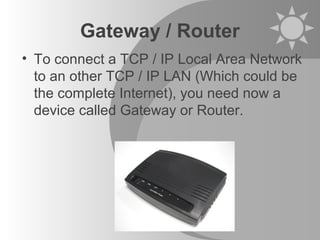
Gateway / Router
• To connect a TCP / IP Local Area Network
to an other TCP / IP LAN (Which could be
the complete Internet), you need now a
device called Gateway or Router.
Modem
• A modem is a device or program that
enables a computer to transmit data over,
telephone or cable lines.
• A modem converts information from digital
to analog or analog to digital.
• This device is used to access the Internet
from home computer.
ISP
(Internet Service Provider)
• ISP are Internet Service Providers. These consist
of local or international companies that provide
such services as web hosting, Internet
connections, and E-mail.
Eg.
– LEARN- Lanka Educational Academic & Research
Network (First registered IP network in Sri Lanka)
– Telecom
– Lanka Internet
Ect…
Web Browser or Internet
Navigator
• It is an application program which access
the various resources on the Internet.
• Normally web browser understands web
pages and languages written on it.
– Ex. Internet Explorer, Mozilla Firefox,
Netscape, Mosaic, Arena, Lynx
What is a search engine?
• A search engine is a program that allows
you to search for a particular set of words
specified by you, on the internet. Where a user
can enter the word or the phase that has to be
searched.
Some Popular Search
Engines
• www.google.com
• www.yahoo.com
• www.lycos.com
• www.msn.com
• www.hotbot.com
URL
(Uniform Resources Locator)
• URL lets you specify how to reach an Internet
resources. It consists of,
– Protocol
– Domain Name
– Directory / Filename
Protocol://domain name / directory / filename
Ex.
http://www.icta.lk/Sinhala/DefaultSinhala.asp
Domain Name
www.icta.lk
TOP
LEVEL
COM
EDU
GOV
ORG
SECOND
LEVEL
WWW
(World Wide Web)
• The World Wide Web is the name given to
the collection of machines which
exchange hypermedia information though
Internet.
• Hypermedia documents are electronics
documents including text, images, sound
and animated images.
Structure of a Web address
• http://www.niit.com
How do Viruses infect PCs
• Computer Viruses hide on a disk and
when you access the disk the virus
program will start to infect your computer.
• Computer viruses can spread from one
computer to another by infected floppy
disks or over a computer network.
What is firewall?
• A firewall consists of software and
hardware protection against invasion via
the Internet.
• When connect to the Internet
automatically goes through a firewall
What are anti-virus
programs?
• To protect against computer virus attack,
you should have a virus checker program
installed (Such as Norton Anti-Virus).
• You must update virus checker on a
regular basis so that you are protected
against new viruses as they come out.
Internet Explore
First Steps with the Web
Browser
• Open (and close) a Web browsing
application
– Double click on the Internet Explorer icon
displayed on your Desktop.
The Microsoft Internet Explorer
icons
• Will re-display the previous page which you visited.
• Will display the next page (assuming that you have
first moved back a page).
• Will halt the downloading of information. This button is
useful when you visit a slow loading site and you wish
to cancel the loading of that page.
• The refresh icon reloads the information from the Web
site which you are visiting.
• The home icon will take you to your default starting
page. This page can be set up to be any page on any
Web site. If your organisation has it's own Web site
then you may wish the Home Page to be the starting
page of your own Web site.
♦ The search icon allows you to search the Internet for
sites containing information which is of interest to you.
When you click on this icon you will have access to a
number of Internet Search programs, such as Lycos and
Google. When you enter a word or phrase into these
programs they will return a list of documents which
match your search criteria.
♦ The favourites list is basically a series of bookmarks
which allows you to store pointers to your favourite Web
sites, so that you can easily revisit a Web site of interest.
♦ Allows you to access the WindowsMedia.com for
music, radio and video
♦ Displays your URL history.
To close the Microsoft Internet
Explorer
• To close your web browser, click on the
application close icon (the x at the
• top-right of the application window).
What is a web site "Home
Page"?
• Most Internet sites have a starting
page, called the Home Page.
To set a home page
1. Tools  Internet Options
2. Click on the General tab
3. If you wish to use the currently displayed page
as your starting page,
4. click on the Use Current button.
5. If you wish to use the default Microsoft starting
page,
6. click on Use Default.
7. If you wish to start the program with a blank
page,
8. click on Use Blank.
9. If you wish to use another starting page,
10.Enter the full URL into the Address box.
11.Click on the OK button
To stop a page downloading (once
it has started downloading)
• A web page may start loading within your
web browser and take so long to display
anything that you may wish to stop the
download and look at something else. Click on
the Stop icon to stop the download.
Refresh a Web page.
• To refresh a page download Click on the
Refresh icon
Use available Help functions.
1. Help  Contents and Index. (Help dialog
box displayed)
2. You can browse through the contents pages
or click on the Search tab and type in a
questions.
What is a favourite
(bookmark)?
• You can use your browser to create favourites
(bookmarks) of interesting Web pages which you
have found. This is similar to the concept of placing
a bookmark in a real book. The big advantage is
that you can bookmark lots of interesting sites which
you have come across and easily visit them again in
the future. Also you can group similar sites together.
To add a Web page to your
favorites
1. Favorite  Add to favorite
2. OK
To delete or rename a
bookmark
1. Favorites  Organize Favorites (display
the Organize Favorites dialog box)
2. Select the items which you wish to delete
3. Click on the Delete button.
Web Searching
• Examples of Search Engines
• http://www.altavista.com
• http://www.hotbot.com
• http://www.google.com
• http://www.lycos.com
• http://www.msn.com
• http://www.yahoo.com
Combine selection criteria in a
search.
• Don't use a single search word
–For instance if you are searching for
information about computer training then
search for “computer
–training”, not just “training”, which would
include all sorts of training
Using + and " symbols to narrow
your search
•
• To get round this problem many search engines
allow you to insert a + symbol between your words,
this means that you only want to find pages
containing all your words.
• Computer + Training
• Sometimes you would be better enclosing your
search phrase with quotation (") symbols. This will
then mean that you want to find the exact phrase
which you have entered. Thus if you search for
• “Computer Training”
Duplicate text, image, URL from
a Web page to a document
1. Right click on the image within the web
page
2. Select the Copy command
3. The image can then be pasted into a
document using the normal Paste
command.
Download a picture
1. Right click on the Picture
2. Select the Save Picture As command
3. Select the location & Save the image
E-mail
E - Mail
• The advantages of using email
1. High speed: One of the great things about email is
that you can send messages and files to anyone in
the world, almost instantly.
2. Low cost: The cost of sending information by email
is a fraction of that involved when using the
traditional mail system, especially when emailing to
a different country.
E-mail
• www.gmail.com
• www.yahoo.com
• www.hotmail.com
• www.esrilanka.lk
• www.ematara.lk
How to make a E-Mail Address
DOMAIN ID
• Yahoo.com imuthumala@yahoo.com
• googal.com imuthumala@gmail.com
• Matara.lk imuthumala@matara.lk
• E srilanka.lk imuthumala@esrilanka.lk
User Name : imuthumala
Password : **********
E-Mail Address: imuthumala@gmail.com
Username @ Server name
<Firstname>_<Division><DS>
saman_buththalaDS@esrilanaka.lk
Username servername
To : sumith.niit@esrilanka.lk
CC : assignments.trg@gmail.com
Subject: ICTA Assessment
To : sumith.niit@esrilanka.lk
Cc : assignments.trg@gmail.com
Bcc : imuthumala@esrilanka.lk
Massage
Dear Mr.Sumith / Mr.Sameera,
Attached pls find the Annexure01.
Thaks & Regards,
Name
Designation
Brach
DS Office
Moneragala
Introduction Outlook
Express
To start Outlook using the Start
menu
• Start All Programs  Microsoft
Office
Microsoft Outlook
The Microsoft Outlook Screen
Internet & email

Internet & email

  • 2.
  • 3.
    LAN (Local AreaNetwork) •LAN covers a small area, which is up to 2 to 5 Kilometers. WAN (Wide Area Network) •When a network is spread over wide areas, such as across cities, states or countries, it is called a Wide Area Network.
  • 4.
  • 5.
    What is Internet? •Internet is a Network of network. • It is the name given to a world-wide collection of local networks which are all interconnected and which all follow the same communication standard, The IP protocol.
  • 6.
    Some Services availableon the Internet. • Electronic Mail (E- Mail) • E-Learning • Internet Relay Chat (IRC) • E-Shopping • E-Banking • E-Medicine
  • 7.
    What is aProtocol? • A protocol is a formal set of rules or standards that oversees the exchange of data between computers on the Internet.
  • 8.
    Some Protocol usingwith URL • HTTP – Hyper Text Transfer Protocol • FTP – Local File Access • SMTP – Electronic Mail Form • TELNET –Remote Login
  • 9.
    HTTP (Hyper Text TransferProtocol) • This is the protocol used by standard Web Interfaces.
  • 10.
    FTP (File TransferProtocol) • The File Transfer Protocol is intend to allow the transfer of any type of file from computer to computer. • The files are copied through the Internet from one hard disk to the other.
  • 11.
    Electronic Mail (E- Mail) • E – Mail is a means to send textual messages from individuals.
  • 12.
    Telnet (Remote Login) •Telnet is a program that allows you to connect to a remote computer. • Your keyboard and screen connect directly to the that computer.
  • 13.
    Gateway / Router •To connect a TCP / IP Local Area Network to an other TCP / IP LAN (Which could be the complete Internet), you need now a device called Gateway or Router.
  • 14.
    Modem • A modemis a device or program that enables a computer to transmit data over, telephone or cable lines. • A modem converts information from digital to analog or analog to digital. • This device is used to access the Internet from home computer.
  • 15.
    ISP (Internet Service Provider) •ISP are Internet Service Providers. These consist of local or international companies that provide such services as web hosting, Internet connections, and E-mail. Eg. – LEARN- Lanka Educational Academic & Research Network (First registered IP network in Sri Lanka) – Telecom – Lanka Internet Ect…
  • 16.
    Web Browser orInternet Navigator • It is an application program which access the various resources on the Internet. • Normally web browser understands web pages and languages written on it. – Ex. Internet Explorer, Mozilla Firefox, Netscape, Mosaic, Arena, Lynx
  • 17.
    What is asearch engine? • A search engine is a program that allows you to search for a particular set of words specified by you, on the internet. Where a user can enter the word or the phase that has to be searched.
  • 18.
    Some Popular Search Engines •www.google.com • www.yahoo.com • www.lycos.com • www.msn.com • www.hotbot.com
  • 19.
    URL (Uniform Resources Locator) •URL lets you specify how to reach an Internet resources. It consists of, – Protocol – Domain Name – Directory / Filename Protocol://domain name / directory / filename Ex. http://www.icta.lk/Sinhala/DefaultSinhala.asp
  • 20.
  • 21.
    WWW (World Wide Web) •The World Wide Web is the name given to the collection of machines which exchange hypermedia information though Internet. • Hypermedia documents are electronics documents including text, images, sound and animated images.
  • 22.
    Structure of aWeb address • http://www.niit.com
  • 23.
    How do Virusesinfect PCs • Computer Viruses hide on a disk and when you access the disk the virus program will start to infect your computer. • Computer viruses can spread from one computer to another by infected floppy disks or over a computer network.
  • 24.
    What is firewall? •A firewall consists of software and hardware protection against invasion via the Internet. • When connect to the Internet automatically goes through a firewall
  • 25.
    What are anti-virus programs? •To protect against computer virus attack, you should have a virus checker program installed (Such as Norton Anti-Virus). • You must update virus checker on a regular basis so that you are protected against new viruses as they come out.
  • 26.
  • 27.
    First Steps withthe Web Browser • Open (and close) a Web browsing application – Double click on the Internet Explorer icon displayed on your Desktop.
  • 28.
    The Microsoft InternetExplorer icons • Will re-display the previous page which you visited. • Will display the next page (assuming that you have first moved back a page). • Will halt the downloading of information. This button is useful when you visit a slow loading site and you wish to cancel the loading of that page. • The refresh icon reloads the information from the Web site which you are visiting. • The home icon will take you to your default starting page. This page can be set up to be any page on any Web site. If your organisation has it's own Web site then you may wish the Home Page to be the starting page of your own Web site.
  • 29.
    ♦ The searchicon allows you to search the Internet for sites containing information which is of interest to you. When you click on this icon you will have access to a number of Internet Search programs, such as Lycos and Google. When you enter a word or phrase into these programs they will return a list of documents which match your search criteria. ♦ The favourites list is basically a series of bookmarks which allows you to store pointers to your favourite Web sites, so that you can easily revisit a Web site of interest. ♦ Allows you to access the WindowsMedia.com for music, radio and video ♦ Displays your URL history.
  • 30.
    To close theMicrosoft Internet Explorer • To close your web browser, click on the application close icon (the x at the • top-right of the application window).
  • 31.
    What is aweb site "Home Page"? • Most Internet sites have a starting page, called the Home Page.
  • 32.
    To set ahome page 1. Tools  Internet Options 2. Click on the General tab 3. If you wish to use the currently displayed page as your starting page, 4. click on the Use Current button. 5. If you wish to use the default Microsoft starting page, 6. click on Use Default. 7. If you wish to start the program with a blank page, 8. click on Use Blank. 9. If you wish to use another starting page, 10.Enter the full URL into the Address box. 11.Click on the OK button
  • 33.
    To stop apage downloading (once it has started downloading) • A web page may start loading within your web browser and take so long to display anything that you may wish to stop the download and look at something else. Click on the Stop icon to stop the download.
  • 34.
    Refresh a Webpage. • To refresh a page download Click on the Refresh icon
  • 35.
    Use available Helpfunctions. 1. Help  Contents and Index. (Help dialog box displayed) 2. You can browse through the contents pages or click on the Search tab and type in a questions.
  • 36.
    What is afavourite (bookmark)? • You can use your browser to create favourites (bookmarks) of interesting Web pages which you have found. This is similar to the concept of placing a bookmark in a real book. The big advantage is that you can bookmark lots of interesting sites which you have come across and easily visit them again in the future. Also you can group similar sites together.
  • 37.
    To add aWeb page to your favorites 1. Favorite  Add to favorite 2. OK
  • 38.
    To delete orrename a bookmark 1. Favorites  Organize Favorites (display the Organize Favorites dialog box) 2. Select the items which you wish to delete 3. Click on the Delete button.
  • 39.
    Web Searching • Examplesof Search Engines • http://www.altavista.com • http://www.hotbot.com • http://www.google.com • http://www.lycos.com • http://www.msn.com • http://www.yahoo.com
  • 40.
    Combine selection criteriain a search. • Don't use a single search word –For instance if you are searching for information about computer training then search for “computer –training”, not just “training”, which would include all sorts of training
  • 41.
    Using + and" symbols to narrow your search • • To get round this problem many search engines allow you to insert a + symbol between your words, this means that you only want to find pages containing all your words. • Computer + Training • Sometimes you would be better enclosing your search phrase with quotation (") symbols. This will then mean that you want to find the exact phrase which you have entered. Thus if you search for • “Computer Training”
  • 42.
    Duplicate text, image,URL from a Web page to a document 1. Right click on the image within the web page 2. Select the Copy command 3. The image can then be pasted into a document using the normal Paste command.
  • 43.
    Download a picture 1.Right click on the Picture 2. Select the Save Picture As command 3. Select the location & Save the image
  • 44.
  • 45.
    E - Mail •The advantages of using email 1. High speed: One of the great things about email is that you can send messages and files to anyone in the world, almost instantly. 2. Low cost: The cost of sending information by email is a fraction of that involved when using the traditional mail system, especially when emailing to a different country.
  • 46.
    E-mail • www.gmail.com • www.yahoo.com •www.hotmail.com • www.esrilanka.lk • www.ematara.lk
  • 47.
    How to makea E-Mail Address DOMAIN ID • Yahoo.com imuthumala@yahoo.com • googal.com imuthumala@gmail.com • Matara.lk imuthumala@matara.lk • E srilanka.lk imuthumala@esrilanka.lk
  • 48.
    User Name :imuthumala Password : ********** E-Mail Address: imuthumala@gmail.com Username @ Server name
  • 49.
  • 50.
    To : sumith.niit@esrilanka.lk CC: assignments.trg@gmail.com
  • 51.
    Subject: ICTA Assessment To: sumith.niit@esrilanka.lk Cc : assignments.trg@gmail.com Bcc : imuthumala@esrilanka.lk
  • 52.
    Massage Dear Mr.Sumith /Mr.Sameera, Attached pls find the Annexure01. Thaks & Regards, Name Designation Brach DS Office Moneragala
  • 53.
  • 54.
    To start Outlookusing the Start menu • Start All Programs  Microsoft Office Microsoft Outlook
  • 55.