Update: Arrhythmias (II)
Mechanisms of Cardiac Arrhythmias
Larraitz Gaztan˜aga,a,b,
* Francis E. Marchlinski,a
and Brian P. Betenskya
a
Electrophysiology Program, Cardiovascular Division, Department of Medicine, Hospital of the University of Pennsylvania, Philadelphia, Pennsylvania, United States
b
Unidad de Electrofisiologı´a Cardiaca, Servicio de Cardiologı´a, Hospital de Basurto, Bilbao, Vizcaya, Spain
INTRODUCTION
Understanding the mechanisms of arrhythmias is helpful to the
appropriate management and treatment of all arrhythmia types.
Since the mechanisms that lead to clinical arrhythmias are
frequently due to abnormalities beyond the tissue level, it is also
essential to understand what occurs at the cellular level.
NORMAL CARDIAC CELLULAR ELECTROPHYSIOLOGY
Cardiac myocytes are highly specialized cells responsible for
both conduction of electrical impulses and mechanical contraction.
Some myocytes demonstrate automaticity, defined by the
capability of cardiac cells to undergo spontaneous diastolic
depolarization and to initiate an electrical impulse in the absence
of external electrical stimulation.1
Spontaneously originated action potentials (APs) are propa-
gated through cardiac myocytes, which are excitable, referring to
their ability to respond to a stimulus with a regenerative AP.2
Successful propagation of the cardiac impulse is enabled by gap
junctions, specialized membrane structures composed of multiple
intercellular ion channels that facilitate electrical and chemical
communication between cells. Cardiac APs are regionally distinct
(Fig. 1) due to each cell type expressing different numbers and
types of ion channels.3
Under normal conditions, the sinoatrial node is the primary
pacemaker of the heart, with a resting membrane potential of
approximately À60 mV. Prior research has demonstrated that the If
(‘‘funny’’) current plays a major role in the initiation of diastolic
depolarization.4
The aggregate activity of various currents results
in a net inward flow of sodium (Na+
) and thus an increase in the
membrane potential. When it reaches À40 mV, calcium (Ca2+
)
currents (T-type ICa,T- and L-type ICa,L) are activated, and serve as
the predominant ion carriers during the AP upstroke of pacemaker
cells4
(Ca2+
-dependent). Subsequently, outward potassium (K+
)
currents are activated and Ca2+
currents are inactivated. The
membrane potential decreases due to the outward flow of K+
,
the major repolarizing ion of the heart. Upon reaching the resting
membrane potential, the cycle is ready to repeat itself.
The resting membrane potential of muscle cells is À90 mV.
Inflow of positive charge (Ca2+
and Na+
) through the gap junction
increases the voltage towards threshold (approximately À65 mV)3
initiating an AP. At this point, Na+
channels are triggered to open,
resulting in a large but transient inward Na+
current (phase 0). The
Na+ current is quickly inactivated, followed by a subsequent
outward K+
current and thereby initiating repolarization (phase 1).
Rev Esp Cardiol. 2012;65(2):174–185
Article history:
Available online 21 December 2011
Keywords:
Automaticity
Triggered activity
Reentry
A B S T R A C T
Cardiac arrhythmias are prevalent among humans across all age ranges and may occur in the setting of
underlying heart disease as well as in structurally normal hearts. While arrhythmias are widely varied in
their clinical presentations, they possess shared electrophysiologic properties at the cellular level. The
3 main mechanisms responsible for cardiac arrhythmias are automaticity, triggered activity, and reentry.
Although identifying the specific mechanism may at times be challenging for the clinician and require
invasive electrophysiologic study, differentiating and understanding the underlying mechanism may be
critical to the development of an appropriate diagnosis and treatment strategy.
ß 2011 Sociedad Espan˜ola de Cardiologı´a. Published by Elsevier Espan˜a, S.L. All rights reserved.
Mecanismos de las arritmias cardiacas
Palabras clave:
Automatismo
Actividad desencadenada
Reentrada
R E S U M E N
En la especie humana, las arritmias cardiacas son muy prevalentes en todos los grupos de edad y pueden
darse tanto en el contexto de una cardiopatı´a subyacente como en corazones estructuralmente
normales. Aunque las formas de presentacio´ n clı´nica de las arritmias son muy diversas, en las ce´lulas
comparten propiedades electrofisiolo´gicas comunes. Los 3 mecanismos principales de las arritmias
cardiacas son las alteraciones en el automatismo, la actividad desencadenada y la reentrada. Aunque la
identificacio´n del mecanismo especı´fico a veces pueda resultar difı´cil para el clı´nico y requerir un estudio
electrofisiolo´gico invasivo, diferenciar y comprender el mecanismo subyacente puede ser crucial para
desarrollar una correcta estrategia diagno´stica y terape´utica.
ß 2011 Sociedad Espan˜ola de Cardiologı´a. Publicado por Elsevier Espan˜a, S.L. Todos los derechos reservados.
* Corresponding author: Hospital of the University of Pennsylvania, 9th Floor,
Founders Pavilion, 3400 Spruce Street, Philadelphia, Pennsylvania 19104, United
States.
E-mail address: Larraitz.gaztanaga@uphs.upenn.edu (L. Gaztan˜aga).
1885-5857/$ – see front matter ß 2011 Sociedad Espan˜ola de Cardiologı´a. Published by Elsevier Espan˜a, S.L. All rights reserved.
doi:10.1016/j.rec.2011.09.020
Document downloaded from http://www.revespcardiol.org, day 25/02/2019. This copy is for personal use. Any transmission of this document by any media or format is strictly prohibited.
The I Ca,L plays an important role during the AP plateau (phase 2),
opposing the K+
current. The I Ca,L is the main route for Ca2+
influx
and triggers Ca2+
release from the sarcoplasmic reticulum,
initiating contraction of the myocyte. Activation of delayed
rectifier K+
channels and inactivation of Ca2+
channels leads to
termination of the plateau and initiates late repolarization (phase
3). Finally, outward K+
channels mediate the final repolarization
(phase 4).
Following contraction, the cardiac myocytes must enter a
relaxation or refractory phase during which they cannot be
depolarized. The refractory period is defined by the time interval
following excitation during which the cell remains unexcitable.
This is due to the lack of availability of depolarizing current (which
is Na+
in muscle cells). It is classified as either absolute or relative
(Fig. 2), depending on whether it is completely unexcitable or
needs a greater stimulus than normal.
PRINCIPAL MECHANISMS OF CARDIAC ARRHYTHMIAS
The mechanisms responsible for cardiac arrhythmias may be
divided into disorders of impulse formation, disorders of impulse
conduction or a combination of both (Table 1).
Disorders of Impulse Formation
Automaticity
Altered Normal Automaticity
As described previously, some specialized heart cells, such as
sinoatrial nodal cells, the atrioventricular (AV) node, and the His-
Purkinje system, as well as some cells in both atria,5
possess the
property of pacemaker activity or automaticity. Suppression or
enhancement of this activity may lead to clinical arrhythmias.
Under normal conditions, the sinoatrial nodal cells have the
fastest rate of firing and the so-called ‘‘subsidiary’’ pacemaker cells
fire at slower rates, so the normal hierarchy is maintained.
The firing rate is determined by the interaction of 3 factors: the
maximum diastolic potential, the threshold potential at which
the AP is initiated, and the rate or slope of phase 4 depolarization.
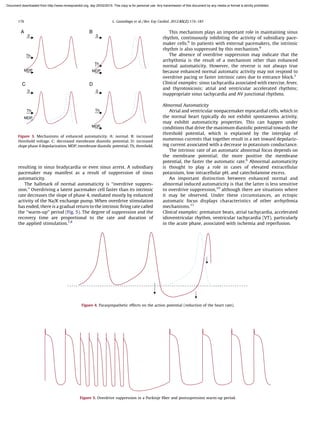
A change in any of these (Fig. 3) may alter the rate of impulse
initiation.6
Pacemaker activity is controlled by the autonomic nervous
system and can be modulated by a variety of systemic factors,
including metabolic abnormalities and endogenous or pharmaco-
logic substances.
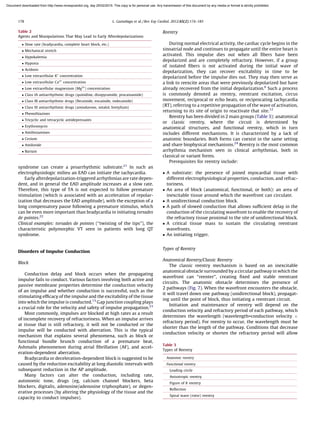
Parasympathetic activity reduces the discharge rate of the
pacemaker cells (Fig. 4) by releasing acetylcholine (Ach) and
hyperpolarizing the cells by increasing conductance of the K+
channels. It may also decrease ICa-L and If activity, which further
slows the rate.
The suppressive effect of Ach is frequently used in practice for
both diagnostic and therapeutic purposes. Tachycardias resulting
from enhanced normal automaticity are expected to respond to
vagal maneuvers (promoting Ach release) with a transient
decrease in frequency, and a progressive return towards baseline
after transiently accelerating to a faster rate upon cessation of the
maneuver (a phenomenon known as ‘‘post-vagal tachycardia’’).7
Conversely, sympathetic activity increases the sinus rate.
Catecholamines increase the permeability of Ica-L, increasing the
inward Ca2+
current. Sympathetic activity also results in enhance-
ment of the If current,8
thereby increasing the slope of phase
4 repolarization.
Metabolic abnormalities such as hypoxia and hypokalemia can
lead to enhanced normal automatic activity as a result of Na/K
pump inhibition, thereby reducing the background repolarizing
current and enhancing phase 4 diastolic repolarization.7
In degenerative conditions that affect the cardiac conduction
system, suppression of the sinus pacemaker cells can be seen,
Abbreviations
AP: action potential
AV: atrioventricular
DAD: delayed afterdepolarization
EAD: early afterdepolarization
TA: triggered activity
VT: ventricular tachycardia
0
−40
−80
mV
0
1 2
3
4
0
−40
−80
mV
A B
Figure 1. The cardiac action potential. A: sinus node action potential. B: muscle
cell action potential.
0
21
3
4
Absolute
refractoriness
Relative
refractoriness
Figure 2. Refractory periods, showing the absolute and relative refractory
periods during the action potential.
Table 1
Mechanisms of Cardiac Arrhythmias
Disorders of impulse formation Disorders of impulse
conduction
Automaticity Reentry
Altered normal automaticity Anatomic reentry
Abnormal automaticity Functional reentry
Triggered activity
Delayed afterdepolarization
Early afterdepolarization
L. Gaztan˜aga et al. / Rev Esp Cardiol. 2012;65(2):174–185 175
Document downloaded from http://www.revespcardiol.org, day 25/02/2019. This copy is for personal use. Any transmission of this document by any media or format is strictly prohibited.
resulting in sinus bradycardia or even sinus arrest. A subsidiary
pacemaker may manifest as a result of suppression of sinus
automaticity.
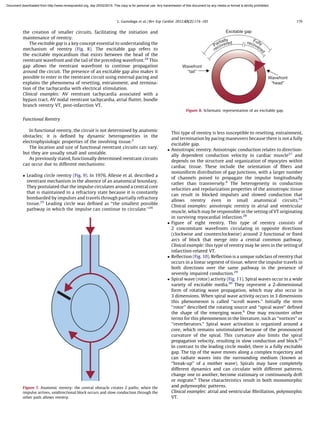
The hallmark of normal automaticity is ‘‘overdrive suppres-
sion.’’ Overdriving a latent pacemaker cell faster than its intrinsic
rate decreases the slope of phase 4, mediated mostly by enhanced
activity of the Na/K exchange pump. When overdrive stimulation
has ended, there is a gradual return to the intrinsic firing rate called
the ‘‘warm-up’’ period (Fig. 5). The degree of suppression and the
recovery time are proportional to the rate and duration of
the applied stimulation.7,8
This mechanism plays an important role in maintaining sinus
rhythm, continuously inhibiting the activity of subsidiary pace-
maker cells.6
In patients with external pacemakers, the intrinsic
rhythm is also suppressed by this mechanism.9
The absence of overdrive suppression may indicate that the
arrhythmia is the result of a mechanism other than enhanced
normal automaticity. However, the reverse is not always true
because enhanced normal automatic activity may not respond to
overdrive pacing or faster intrinsic rates due to entrance block.3
Clinical examples: sinus tachycardia associated with exercise, fever,
and thyrotoxicosis; atrial and ventricular accelerated rhythms;
inappropriate sinus tachycardia and AV junctional rhythms.
Abnormal Automaticity
Atrial and ventricular nonpacemaker myocardial cells, which in
the normal heart typically do not exhibit spontaneous activity,
may exhibit automaticity properties. This can happen under
conditions that drive the maximum diastolic potential towards the
threshold potential, which is explained by the interplay of
numerous currents that together result in a net inward depolariz-
ing current associated with a decrease in potassium conductance.
The intrinsic rate of an automatic abnormal focus depends on
the membrane potential; the more positive the membrane
potential, the faster the automatic rate.6
Abnormal automaticity
is thought to play a role in cases of elevated extracellular
potassium, low intracellular pH, and catecholamine excess.
An important distinction between enhanced normal and
abnormal induced automaticity is that the latter is less sensitive
to overdrive suppression,10
although there are situations where
it may be observed. Under these circumstances, an ectopic
automatic focus displays characteristics of other arrhythmia
mechanisms.11
Clinical examples: premature beats, atrial tachycardia, accelerated
idioventricular rhythm, ventricular tachycardia (VT), particularly
in the acute phase, associated with ischemia and reperfusion.
Figure 4. Parasympathetic effects on the action potential (reduction of the heart rate).
0
BA
DC
Th
MDP
0
00
Th
ThTh
MDP
MDP
MDP
Figure 3. Mechanisms of enhanced automaticity. A: normal. B: increased
threshold voltage. C: decreased membrane diastolic potential. D: increased
slope phase 4 depolarization. MDP, membrane diastolic potential; Th, threshold.
Figure 5. Overdrive suppression in a Purkinje fiber and postsupression warm-up period.
L. Gaztan˜aga et al. / Rev Esp Cardiol. 2012;65(2):174–185176
Document downloaded from http://www.revespcardiol.org, day 25/02/2019. This copy is for personal use. Any transmission of this document by any media or format is strictly prohibited.
Triggered Activity
Triggered activity (TA) is defined by impulse initiation caused
by afterdepolarizations (membrane potential oscillations that
occur during or immediately following a preceding AP).12
After-
depolarizations occur only in the presence of a previous AP (the
trigger), and when they reach the threshold potential, a new AP is
generated. This may be the source of a new triggered response,
leading to self-sustaining TA.
Based on their temporal relationship, 2 types of afterpolariza-
tions are described: early afterdepolarizations (EADs) occur during
phase 2 or 3 of the AP, and delayed afterdepolarizations (DADs)
occur after completion of the repolarization phase (Fig. 6).
Delayed Afterdepolarization-Induced Triggered Activity
A DAD is an oscillation in membrane voltage that occurs after
completion of repolarization of the AP (during phase 4). These
oscillations are caused by a variety of conditions that raise the
diastolic intracellular Ca2+
concentration, which cause Ca2+
mediated oscillations that can trigger a new AP if they reach the
stimulation threshold.13
As the cycle length decreases, the amplitude and rate of the
DADs increases, and therefore is expected to initiate arrhythmias
triggered when DADs increase the heart rate (either spontaneously
or during pacing). In fact, the amplitude and number of triggered
responses are direct functions of both the rate and duration of
overdrive pacing (easier to induce with continued stimulation).
When overdrive pacing is performed, the TA can slow until it stops,
or when it is not rapid enough to terminate the triggered rhythm it
can cause overdrive acceleration, in contrast to overdrive
suppression seen with automatic rhythms.6
Toxic concentration of digitalis was the first observed cause of
DAD.14
This occurs via inhibition of the Na/K pump, which
promotes the release of Ca2+
from the sarcoplasmic reticulum.
Clinically, digoxin toxic bidirectional fascicular tachycardia is felt
to be an example of TA.15
Catecholamines can cause DADs by causing intracellular Ca2+
overload via an increase in ICa-L and theNa+
-Ca2+
exchange current,
among other mechanisms. Ischemia-induced DADs are thought to
be mediated by the accumulation of lysophosphoglycerides in the
ischemic tissue,16
with subsequent elevation in Na+
and Ca2+
.
Abnormal sarcoplasmic reticulum function (e.g. mutations in
ryanodine receptor) can also lead to intracellular Ca2+
overload,
facilitating clinical arrhythmias, such as catecholaminergic poly-
morphic VT.17
A critical factor for the development of DADs is the duration of
the AP. Longer APs are associated with more Ca2+
overload and
facilitate DADs. Therefore, drugs that prolong AP (eg, Class IA
antiarrhythmic agents) can occasionally increase DAD amplitude.
Triggered arrhythmias induced by DADs may be terminated by
single stimuli; therefore, other electrophysologic features are
needed to distinguish them from the reentrant tachycardias. The
rate dependency of the coupling interval may be useful, because in
most cases of DAD-induced arrhythmias the shorter the cycle of
stimulation, the shorter the coupling interval to the induced
arrhythmia. This is in contrast to the inverse relationship seen in
reentrant arrhythmias, where the shorter the coupling intervals of
the initiating stimuli, the longer the coupling interval of the first
arrhythmia beat.3
Since this is not always the case, other
electrophysiologic properties must be taken into account.
Adenosine has been used as a test for the diagnosis of DADs.
Adenosine reduces the Ca2+
inward current indirectly by inhibiting
effects on adenylate cyclase and cyclic adenosine monophosphate.
Thus, it may abolish DADs induced by catecholamines, but does not
alter DADs induced by Na+
/K+
pump inhibition. The interruption of
VT by adenosine points toward catecholamine-induced DADs as
the underlying mechanism.18
Clinical examples: atrial tachycardia, digitalis toxicity-induced
tachycardia, accelerated ventricular rhythms in the setting of
acute myocardial infarction, some forms of repetitive mono-
morphic VT, reperfusion-induced arrhythmias, right ventricular
outflow tract VT, exercise-induced VT (e.g. catecholaminergic
polymorphic VT).
Early Afterdepolarization-Induced Triggered Activity
The EADs are oscillatory potentials that occur during the AP
plateau (phase 2 EADs) or during the late repolarization (phase 3
EADs). Both types may appear during similar experimental
conditions, but they differ morphologically as well as in the
underlying ionic mechanism. Phase 2 EADs appear to be related to
Ica-L current,19
while phase 3 EADs may be the result of electronic
current across repolarization or the result of low IK1.20
The plateau of the AP is a period of high membrane resistance3
and little current flow. Consequently, small changes in either
repolarizing or depolarizing currents can have profound
effects on the AP duration and profile. As a wide variety of
agents and conditions can result in a decreased outward current
or increased inward current (so shifting the normal outward
current), they can establish the conditions necessary for EADs
(Table 2).
A fundamental condition underlying the development of EADs
is AP prolongation, which manifests on the surface electrocardio-
gram (ECG) as QT prolongation. Some antiarrhythmic agents,
principally class IA and III drugs, may become proarrhythmic
because of their therapeutic effect of prolonging the AP. Many
other drugs (Table 2) can predispose to the formation of EADs,
particularly when associated with hypokalemia and/or bradycar-
dia, additional factors that result in prolongation of the AP.7
Catecholamines may enhance EADs by augmenting Ca2+
current,
however the resultant increase in heart rate along with the
increase in K+
current effectively reduces the APD and thus
abolishes EADs.7
An EAD-mediated TA appears to be the underlying cause of
arrhythmias that develop in the setting of long QT syndrome.
While the true mechanism of these arrhythmias is still debated, it
is accepted that enhanced repolarization dispersion seen in the
CBA
Figure 6. Representation of triggered activity. A: phase 2 early afterdepolarization. B: phase 3 early afterdepolarization. C: delayed afterdepolarization.
L. Gaztan˜aga et al. / Rev Esp Cardiol. 2012;65(2):174–185 177
Document downloaded from http://www.revespcardiol.org, day 25/02/2019. This copy is for personal use. Any transmission of this document by any media or format is strictly prohibited.
syndrome can create a proarrhythmic substrate.21
In such an
electrophysiologic milieu an EAD can initiate the tachycardia.
Early afterdepolarization-triggered arrhythmias are rate depen-
dent, and in general the EAD amplitude increases at a slow rate.
Therefore, this type of TA is not expected to follow premature
stimulation (which is associated with an acceleration of repolar-
ization that decreases the EAD amplitude), with the exception of a
long compensatory pause following a premature stimulus, which
can be even more important than bradycardia in initiating torsades
de pointes.22
Clinical examples: torsades de pointes (‘‘twisting of the tips’’), the
characteristic polymorphic VT seen in patients with long QT
syndrome.
Disorders of Impulse Conduction
Block
Conduction delay and block occurs when the propagating
impulse fails to conduct. Various factors involving both active and
passive membrane properties determine the conduction velocity
of an impulse and whether conduction is successful, such as the
stimulating efficacy of the impulse and the excitability of the tissue
into which the impulse is conducted.13
Gap junction coupling plays
a crucial role for the velocity and safety of impulse propagation.23
Most commonly, impulses are blocked at high rates as a result
of incomplete recovery of refractoriness. When an impulse arrives
at tissue that is still refractory, it will not be conducted or the
impulse will be conducted with aberration. This is the typical
mechanism that explains several phenomena, such as block or
functional bundle brunch conduction of a premature beat,
Ashman´ s phenomenon during atrial fibrillation (AF), and accel-
eration-dependent aberration.
Bradycardia or deceleration-dependent block is suggested to be
caused by the reduction excitability at long diastolic intervals with
subsequent reduction in the AP amplitude.
Many factors can alter the conduction, including rate,
autonomic tone, drugs (eg, calcium channel blockers, beta
blockers, digitalis, adenosine/adenosine triphosphate), or degen-
erative processes (by altering the physiology of the tissue and the
capacity to conduct impulses).
Reentry
During normal electrical activity, the cardiac cycle begins in the
sinoatrial node and continues to propagate until the entire heart is
activated. This impulse dies out when all fibers have been
depolarized and are completely refractory. However, if a group
of isolated fibers is not activated during the initial wave of
depolarization, they can recover excitability in time to be
depolarized before the impulse dies out. They may then serve as
a link to reexcite areas that were previously depolarized but have
already recovered from the initial depolarization.6
Such a process
is commonly denoted as reentry, reentrant excitation, circus
movement, reciprocal or echo beats, or reciprocating tachycardia
(RT), referring to a repetitive propagation of the wave of activation,
returning to its site of origin to reactivate that site.12
Reentry has been divided in 2 main groups (Table 3): anatomical
or classic reentry, where the circuit is determined by
anatomical structures, and functional reentry, which in turn
includes different mechanisms. It is characterized by a lack of
anatomic boundaries. Both forms can coexist in the same setting
and share biophysical mechanisms.24
Reentry is the most common
arrhythmia mechanism seen in clinical arrhythmias, both in
classical or variant forms.
Prerequisites for reentry include:
 A substrate: the presence of joined myocardial tissue with
different electrophysiological properties, conduction, and refrac-
toriness.
 An area of block (anatomical, functional, or both): an area of
inexcitable tissue around which the wavefront can circulate.
 A unidirectional conduction block.
 A path of slowed conduction that allows sufficient delay in the
conduction of the circulating wavefront to enable the recovery of
the refractory tissue proximal to the site of unidirectional block.
 A critical tissue mass to sustain the circulating reentrant
wavefronts.
 An initiating trigger.
Types of Reentry
Anatomical Reentry/Classic Reentry
The classic reentry mechanism is based on an inexcitable
anatomical obstacle surrounded by a circular pathway in which the
wavefront can ‘‘reenter’’, creating fixed and stable reentrant
circuits. The anatomic obstacle determines the presence of
2 pathways (Fig. 7). When the wavefront encounters the obstacle,
it will travel down one pathway (unidirectional block), propagat-
ing until the point of block, thus initiating a reentrant circuit.
Initiation and maintenance of reentry will depend on the
conduction velocity and refractory period of each pathway, which
determines the wavelength (wavelength=conduction velocity Â
refractory period). For reentry to occur, the wavelength must be
shorter than the length of the pathway. Conditions that decrease
conduction velocity or shorten the refractory period will allow
Table 3
Types of Reentry
Anatomic reentry
Functional reentry
Leading circle
Anisotropic reentry
Figure of 8 reentry
Reflection
Spiral wave (rotor) reentry
Table 2
Agents and Manipulations That May Lead to Early Afterdepolarizations
 Slow rate (bradycardia, complete heart block, etc.)
 Mechanical stretch
 Hypokalemia
 Hypoxia
 Acidosis
 Low extracellular K+
concentration
 Low extracellular Ca2+
concentration
 Low extracellular magnesium (Mg2+
) concentration
 Class IA antiarrhythmic drugs (quinidine, disopyramide, procainamide)
 Class IB antiarrhythmic drugs (flecainide, encainide, indecainide)
 Class III antiarrhythmic drugs (amiodarone, sotalol, bretylium)
 Phenothiazines
 Tricyclic and tetracyclic antidepressants
 Erythromycin
 Antihistamines
 Cesium
 Amiloride
 Barium
L. Gaztan˜aga et al. / Rev Esp Cardiol. 2012;65(2):174–185178
Document downloaded from http://www.revespcardiol.org, day 25/02/2019. This copy is for personal use. Any transmission of this document by any media or format is strictly prohibited.
the creation of smaller circuits, facilitating the initiation and
maintenance of reentry.
The excitable gap is a key concept essential to understanding the
mechanism of reentry (Fig. 8). The excitable gap refers to
the excitable myocardium that exists between the head of the
reentrant wavefront and the tail of the preceding wavefront.24
This
gap allows the reentrant wavefront to continue propagation
around the circuit. The presence of an excitable gap also makes it
possible to enter in the reentrant circuit using external pacing and
explains the phenomena of resetting, entrainment, and termina-
tion of the tachycardia with electrical stimulation.
Clinical examples: AV reentrant tachycardia associated with a
bypass tract, AV nodal reentrant tachycardia, atrial flutter, bundle
branch reentry VT, post-infarction VT.
Functional Reentry
In functional reentry, the circuit is not determined by anatomic
obstacles; it is defined by dynamic heterogeneities in the
electrophysiologic properties of the involving tissue.2
The location and size of functional reentrant circuits can vary,
but they are usually small and unstable.
As previously stated, functionally determined reentrant circuits
can occur due to different mechanisms:
 Leading circle reentry (Fig. 9). In 1976, Allesie et al. described a
reentrant mechanism in the absence of an anatomical boundary.
They postulated that the impulse circulates around a central core
that is maintained in a refractory state because it is constantly
bombarded by impulses and travels through partially refractory
tissue.25
Leading circle was defined as ‘‘the smallest possible
pathway in which the impulse can continue to circulate.’’26
This type of reentry is less susceptible to resetting, entrainment,
and termination by pacing maneuvers because there is not a fully
excitable gap.
 Anisotropic reentry. Anisotropic conduction relates to direction-
ally dependent conduction velocity in cardiac muscle27
and
depends on the structure and organization of myocytes within
cardiac tissue. These include the orientation of fibers and
nonuniform distribution of gap junctions, with a larger number
of channels poised to propagate the impulse longitudinally
rather than transversely.4
The heterogeneity in conduction
velocities and repolarization properties of the anisotropic tissue
can result in blocked impulses and slowed conduction that
allows reentry even in small anatomical circuits.24
Clinical examples: anisotropic reentry in atrial and ventricular
muscle, which may be responsible in the setting of VT originating
in surviving myocardial infarction.28
 Figure of eight reentry. This type of reentry consists of
2 concomitant wavefronts circulating in opposite directions
(clockwise and counterclockwise) around 2 functional or fixed
arcs of block that merge into a central common pathway.
Clinical example: this type of reentry may be seen in the setting of
infarction-related VT.
 Reflection (Fig. 10). Reflection is a unique subclass of reentry that
occurs in a linear segment of tissue, where the impulse travels in
both directions over the same pathway in the presence of
severely impaired conduction.29
 Spiral wave (rotor) activity (Fig. 11). Spiral waves occur in a wide
variety of excitable media.30
They represent a 2-dimensional
form of rotating wave propagation, which may also occur in
3 dimensions. When spiral wave activity occurs in 3 dimensions
this phenomenon is called ‘‘scroll waves.’’ Initially the term
‘‘rotor’’ described the rotating source and ‘‘spiral wave’’ defined
the shape of the emerging wave.6
One may encounter other
terms for this phenomenon in the literature, such as ‘‘vortices’’ or
‘‘reverberators.’’ Spiral wave activation is organized around a
core, which remains unstimulated because of the pronounced
curvature of the spiral. This curvature also limits the spiral
propagation velocity, resulting in slow conduction and block.25
In contrast to the leading circle model, there is a fully excitable
gap. The tip of the wave moves along a complex trajectory and
can radiate waves into the surrounding medium (known as
‘‘break-up’’ of a mother wave). Spirals may have completely
different dynamics and can circulate with different patterns,
change one to another, become stationary or continuously drift
or migrate.6
These characteristics result in both monomorphic
and polymorphic patterns.
Clinical examples: atrial and ventricular fibrillation, polymorphic
VT.
Figure 7. Anatomic reentry: the central obstacle creates 2 paths; when the
impulse arrives, unidirectional block occurs and slow conduction through the
other path allows reentry.
Partially
recovered
Fullyrecovere
d
Wavefront
“head”
Excitable gap
Wavefront
“tail”
Figure 8. Schematic representation of an excitable gap.
L. Gaztan˜aga et al. / Rev Esp Cardiol. 2012;65(2):174–185 179
Document downloaded from http://www.revespcardiol.org, day 25/02/2019. This copy is for personal use. Any transmission of this document by any media or format is strictly prohibited.
Resetting and Entrainment of Reentrant Arrhythmias
Resetting
Resetting is the act of advancing a tachycardia impulse by timed
premature electrical stimuli. The first tachycardia complex in
return should have the same morphological feature and cycle
length as before the extrastimulus, and the pause to this first
tachycardia complex should be ‘‘reset’’ and therefore less than
twice the tachycardia cycle length.6
To reset a tachycardia the stimulated wavefront must reach the
tachycardia circuit from the pacing site (the closer the pacing
the less prematurity is need) and enter the excitable gap. Once it
has entered the circuit, it will propagate in both directions,
colliding in the retrograde direction with the previous tachycardia
impulse (antidromically) while in the anterograde direction it will
propagate and occur earlier than expected in time.31
After that, the
tachycardia will continue unchanged.
The degree of advancement depends on the prematurity of the
extrastimulus and its conduction within the circuit (ie, the stimulus
will propagate slower if the gap is only partially excitable).
If the stimulus enters the circuit during the relative refractory
period, it can block in the anterograde direction (because it is
absolutely refractory) and collide antidromically with the previous
beat, thus terminating the tachycardia.32
Entrainment
Entrainment is the continuous resetting of a tachycardia circuit
(Fig. 12). During overdrive pacing all myocardial tissue will
maintain the pacing rate, with resumption of the intrinsic
morphology and rate upon either abrupt cessation of pacing or
slowing of the pacing rate below the intrinsic rate.33
Fusion
A fused beat possesses intermediate morphology between a fully
stimulated complex and the tachycardia complex. It can be observed
on the surface ECG (if a significant amount of myocardium is
depolarized34
) or intracardiac recordings. For fusion to occur, the
tachycardia wavefront must exit the circuit and collide with
the pacing stimulus before depolarization of the surrounding
myocardium (Fig. 13). This requires a circuit with distinct entry
and exit sites supporting a reentrant mechanism. Resetting and
entrainment with fusion are specific to reentrant arrhythmias, but
since they are sometimes challenging to identify, failure to detect
them does not invalidate reentry as the arrhythmia mechanism.
FEATURES OF ARRHYTHMIA MECHANISMS
We now present an approach to the differential diagnosis of
arrhythmia mechanisms. Table 4 is a schematic diagram of useful
maneuvers (explained above) for distinguishing between the
different arrhythmia mechanisms.
It is important to note that sometimes it may be very difficult to
identify the mechanism responsible for the arrhythmia, and even
more challenging if we take into account that an arrhythmia can be
initiated by one mechanism but perpetuated by others (e.g. AF).
As shown in Table 4, automatic arrhythmias cannot be
reproducibly initiated or terminated by programmed electric
stimulation. They can be reset, and rapid pacing can result in
overdrive suppression or produce no effect. The initiation may be
facilitated by isoproterenol, in which the arrhythmia will typically
start with a warm-up period with the first tachycardia beat being
identical to the next one. Adenosine can slow but usually does not
terminate the tachycardia.
Although TA can be initiated with pacing, initiation frequently
requires isoproterenol. Arrhythmias due to TA can be reset and
usually pacing can terminate a TA tachycardia. The first beat isFigure 10. Schematic representation of reflection mechanism.
Figure 11. Schematic representation of a spiral wave.Figure 9. Schematic representation of a leading circle.
L. Gaztan˜aga et al. / Rev Esp Cardiol. 2012;65(2):174–185180
Document downloaded from http://www.revespcardiol.org, day 25/02/2019. This copy is for personal use. Any transmission of this document by any media or format is strictly prohibited.
usually the extrastimulus or premature beat, and therefore
different from the subsequent one. These arrhythmias terminate
in response to adenosine.
Reentrant tachycardias respond to pacing and demonstrate the
hallmark features of resetting and entrainment with fusion.
Adenosine can terminate a reentrant tachycardia involving the
AV node, but will not affect sodium-dependent cells in the atria
and ventricles.
Furthermore, other noninvasive tools such as surface ECG
should always be considered. The surface ECG may not confirm a
particular mechanism, but it can provide important clues.35
The
sinus rhythm ECG may reveal disease processes known to
be associated with specific types of arrhythmias: a) Q waves
consistent with prior myocardial infarction suggest the substrate
for reentry; b) a long QT interval raises suspicion for after-
depolarizations; c) a ‘‘delta wave’’ makes reentry over an accessory
pathway a plausible mechanism, and d) epsilon waves or Brugada
pattern ECGs suggest reentrant mechanisms.
RELATIONSHIP TO CLINICAL ARRHYTHMIAS
In the following section, we will comment on the mechanisms
that sustain the most frequent arrhythmias seen in practice.
Bradyarrhythmias
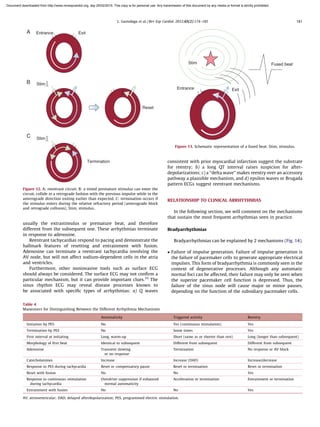
Bradyarrhythmias can be explained by 2 mechanisms (Fig. 14).
 Failure of impulse generation. Failure of impulse generation is
the failure of pacemaker cells to generate appropriate electrical
impulses. This form of bradyarrhythmia is commonly seen in the
context of degenerative processes. Although any automatic
normal foci can be affected, their failure may only be seen when
the superior pacemaker cell function is depressed. Thus, the
failure of the sinus node will cause major or minor pauses,
depending on the function of the subsidiary pacemaker cells.
Entrance Exit
Fused beatStim
Figure 13. Schematic representation of a fused beat. Stim, stimulus.
ExitEntranceA
B
C
Stim
Stim
Termination
Reset
Figure 12. A: reentrant circuit. B: a timed premature stimulus can enter the
circuit, collide in a retrograde fashion with the previous impulse while in the
anterograde direction exiting earlier than expected. C: termination occurs if
the stimulus enters during the relative refractory period (anterograde block
and retrograde collision). Stim, stimulus.
Table 4
Maneuvers for Distinguishing Between the Different Arrhythmia Mechanisms
Automaticity Triggered activity Reentry
Initiation by PES No Yes (continuous stimulation) Yes
Termination by PES No Some times Yes
First interval at initiating Long, warm-up Short (same as or shorter than rest) Long (longer than subsequent)
Morphology of first beat Identical to subsequent Different from subsequent Different from subsequent
Adenosine Transient slowing
or no response
Termination No response or AV block
Catecholamines Increase Increase (DAD) Increase/decrease
Response to PES during tachycardia Reset or compensatory pause Reset or termination Reset or termination
Reset with fusion No No Yes
Response to continuous stimulation
during tachycardia
Overdrive suppression if enhanced
normal automaticity
Acceleration or termination Entrainment or termination
Entrainment with fusion No No Yes
AV, atrioventricular; DAD, delayed afterdepolarization; PES, programmed electric stimulation.
L. Gaztan˜aga et al. / Rev Esp Cardiol. 2012;65(2):174–185 181
Document downloaded from http://www.revespcardiol.org, day 25/02/2019. This copy is for personal use. Any transmission of this document by any media or format is strictly prohibited.
Failure of impulse propagation. The failure of impulse propaga-
tion is the failure of electrical impulses generated by pacemaker
cells to conduct normally through the conduction system. This
mechanism implies an abnormality of conduction velocity
and/or refractoriness in the conducting system, causing heart
block at various levels.
Tachyarrhythmias
Sinus Tachycardia
 Physiologic sinus tachycardia represents an enhancement of the
sinus node in response to physiologic stress, and is characterized
by an increased slope of phase 4 depolarization in sinus node cells.
 Inappropriate sinus tachycardia refers to a condition in which
the sinus rate is increased continuously or out of proportion to
the degree of physiologic stress36
and is caused by enhanced
normal automaticity. An automatic tachycardia originating in
the region of the sinus node and sinoatrial reentrant circuit must
be ruled out.
Focal Atrial Tachycardia
Atrial tachycardias may be due to automaticity, TA, or reentrant
mechanisms, but most of them correspond to automaticity or
reentering mechanisms. They can be distinguished by their
behavior in relation to various maneuvers. Although fusion may
be more difficult to determine because of the P wave, intracardiac
recordings can help identify this phenomenon.
Recently lidocaine-sensitive atrial tachycardia has been
described, suggesting a less common underlying mechanism.37
Atrial Flutter
Atrial flutter may further be categorized into typical and
atypical atrial flutter.
Typical Atrial Flutter
The wavefront in typical flutter circulates in the right atrium
around the tricuspid valve annulus in a counterclockwise or
clockwise direction. Typical atrial flutter is the most common
example of a macroreentrant circuit, where anatomical and
functional barriers create the substrate.
Atypical Atrial Flutter
In this type of flutter, the obstacle is usually related to previously
performed procedures that create large anatomic barriers (atriot-
omy scar, suture line, or radiofrequency ablation) or facilitate a zone
of slow conduction such that reentry may occur (eg, left atrial flutter
related to previous AF ablation). In contrast to the typical form,
atypical atrial flutter occasionally exhibits features of a focal
mechanism and overlaps with atrial tachycardias.
Atrial Fibrillation
AF is the most common sustained arrhythmia. Even though its
underlying mechanism is still debated among electrophysiologists,
AF likely represents a complex interaction between drivers
responsible for initiation and the anatomic atrial substrate
required for perpetuation of the arrhythmia.38
The drivers are located predominantly in the pulmonary veins
and can represent variable forms of focal abnormal automaticity or
TA within the vein or microreentrant circuits around the vein
orifices with strong autonomic potentiation.39
Not only do they
contribute to the initiation of AF, but they also participate in the
maintenance of the arrhythmia.40
Other nonpulmonary triggering
foci have also been described, such as the coronary sinus, superior
vena cava,41
or ligament of Marshall.42
Maintenance of the arrhythmia lies in a combination of
electrophysiological and structural factors, which create the
substrate to perpetuate AF. Different mechanisms have been
postulated, including multiple wavelets of reentry or a mother
rotor circuit, as well as high frequency activity in the atria.42
Moreover, structural and electrical remodeling of the atria over
time contributes to the arrhythmogenic substrate.
Junctional Premature Complexes
Junctional premature complexes are very uncommon. They are
likely attributed to enhanced normal automaticity.
Atrioventricular Nodal Reentrant Tachycardia
This common paroxysmal supraventricular tachycardia is
caused by a classic reentrant mechanism. The presence within
the AV node of 2 pathways with distinct electrophysiological
properties makes this arrhythmia possible.
Under normal conditions, a sinus impulse will travel through
both pathways. In response to a premature stimulation, the
stimulus can block in the fast pathway due to a longer refractory
period and travel through the slow pathway. If conduction is slow
enough, the blocked fast pathway can have time to recover, thus
setting the stage for a reentrant circuit, translating into AV nodal
tachycardia when perpetuated (Fig. 15).
An atypical form of AV nodal tachycardia can occur when
activation of the circuit proceeds in the reverse direction.
Atrioventricular Junctional Tachycardia
Atrioventricular junctional tachycardias typically occur in the
setting of increased adrenergic tone or drug effect in patients with
sinus node dysfunction who have undergone a previous procedure
or digitalis toxicity. They can be related to enhanced normal
automaticity, abnormal automaticity or TA.43
Atrioventricular Reentrant Tachycardia Mediated by an Accessory
Pathway
The typical accessory pathway has rapid conduction and a
longer refractory period in comparison to the AV node, which
creates the substrate for reentry. The circuit that involves an
A B C
Figure 14. A: normal conduction. B: suppressed automaticity. C: conduction
block.
L. Gaztan˜aga et al. / Rev Esp Cardiol. 2012;65(2):174–185182
Document downloaded from http://www.revespcardiol.org, day 25/02/2019. This copy is for personal use. Any transmission of this document by any media or format is strictly prohibited.
accessory pathway is usually a large macroreentrant circuit
consisting of the native conduction system, the accessory pathway,
and the intervening atrial and ventricular tissue. In the ortho-
dromic type, the more common arrhythmia related to accessory
pathways, the AV node serves as the anterograde pathway and
the accessory pathway as the retrograde pathway. Antidromic
tachycardia occurs when activation proceeds in the reverse
direction (antegrade over the accessory pathway and retrograde
over the AV node), thus creating a wide QRS complex. Antidromic
AVRT occurs less frequently, and can be precipitated by conditions
that slow antegrade conduction over the AV node with rapid
conduction preserved over the AV node in a retrograde direction.
In patients with Wolff Parkinson White and AF, rapid
conduction over the accessory pathway with ventricular pre-
excitation may occur. Preexcitation may lead during AF to
ventricular fibrillation and cardiac arrest. The prevalence of AF
in patients with Wolff Parkinson White syndrome is unusually
high in the absence of organic heart disease. While the precise
mechanism remains unclear, the presence of the accessory
pathway itself and retrograde activation of the atria during
orthodromic supraventricular tachycardia has been postulated to
play an important role in the initiation of AF.44
Accelerated Idioventricular Rhythm
Accelerated idioventricular rhythm is thought to be due to
abnormal automaticity related to the acute phase of myocardial
infarction, aswellascocaine intoxication,acute myocarditis,digoxin
intoxication, and postoperative cardiac surgery conditions.45
Ventricular Tachycardia
This arrhythmia has a wealth of different characteristics and
behaviors. The predominant mechanisms underlying most VTs are
abnormal automaticity, TA, and reentry. The latter is the most
frequent mechanism causing VT.45
Monomorphic Ventricular Tachycardia
In the absence of structural heart disease, most VTs are thought
to correspond to TA or an automatic mechanism35
(distinguished
by previously explained maneuvers). However, most mono-
morphic VT occurs in the presence of structural heart disease,
with the predominant mechanism being reentry. The majority of
patients within this group demonstrate VT in relation to ischemic
cardiomyopathy. The post-infarction process results in a scar
associated with surviving islands of cardiac myocytes. This can
result in slow and discontinuous conduction and/or block in
conduction through the viable tissue, likely attributable to
disruption in gap junction distribution and function and poor
cell-to-cell coupling.46
These changes create the ideal electro-
physiologic and anatomic substrate for developing reentrant
arrhythmias (slow conduction and unidirectional block).
The second most common cause of VTs due to reentry is
nonischemic cardiomyopathy. In such patients the reentrant
circuit frequently involves a region of a scar near the valvular
orifices or in the subepicardium. Occasionally, VTs in this setting
appear to be mediated by an autonomic or triggered mechanism.35
Reentry is also the principal mechanism in VT due to
arrhythmogenic right ventricular dysplasia/cardiomyopathy. In
this condition, a reentrant circuit is formed around the character-
istic fibro-fatty tissue that has replaced the right ventricle. A
similar mechanism of VT occurs in the setting of hypertrophic
cardiomyopathy (especially in the presence of an apical aneur-
ysm), valvular heart disease, surgically repaired congenital heart
diseases (large resections are needed, creating large anatomical
barriers), infiltrative cardiomyopathy (eg, cardiac sarcoidosis) and
neuromuscular disorders.
Characteristics of some specific monomorphic VTs:
 Bundle branch reentrant VT. In presence of underlying His-
Purkinje disease (often seen in idiopathic nonischemic and
valvular cardiomyopathy) a large macroreentrant circuit can be
created involving the His-Purkinje network. Slow conduction
through a diseased His-Purkinje network allows the initiation of
the reentrant circuit,32
in which the right bundle typically
serves as the anterograde limb (explaining the left bundle
morphology of the tachycardia) and the left fascicle as the
retrograde limb. Frequently the circuit can be reversed by
stimulating in the left ventricle to create a right bundle branch
block VT pattern.
 Idiopathic VT. Idiopathic VT is found in structurally normal
hearts and can be divided into 2 main groups:
– Outflow tract tachycardia. Outflow tract tachycardias repre-
sent the most frequent idiopathic VTs. Although the pathogen-
esis is not fully understood, their behavior suggests that many
of them are due to TA as a result of afterdepolarizations.
– Fascicular ventricular tachycardia. Fascicular VT lies in the left
ventricular His-Purkinje system and although the mechanism
is accepted to be a macroreentry circuit involving calcium-
dependent slow response fibers of the ventricular Purkinje
network,47
typically terminated by verapamil, some automatic
forms of the tachycardia have also been described.
Atria
APC
AV
node
Figure 15. Initiation of atrioventricular nodal tachycardia with an atrium premature complex, which is blocked in the fast pathway and travels through the slow
pathway to establish reentry. APC, atrium premature complex; AV, atrioventricular.
L. Gaztan˜aga et al. / Rev Esp Cardiol. 2012;65(2):174–185 183
Document downloaded from http://www.revespcardiol.org, day 25/02/2019. This copy is for personal use. Any transmission of this document by any media or format is strictly prohibited.
Polymorphic Ventricular Tachycardia and Ventricular Fibrillation
The initiation and maintenance of these tachyarrhythmias
remain unknown; however, previous work supports a similar
mechanism as suspected in AF. The initiating trigger could be
mediated by TA, automaticity, or a reentrant mechanism, while
maintenance may be due to different forms of functional reentries,
including rotors, migrating scroll waves, or intramural or Purkinje
network reentry. Elucidation of the underlying mechanism is still
in its experimental phase. It is also possible that VF may be the final
common endpoint of a heterogeneous group of electrical
disturbances and it may not be possible to identify a single
mechanism that adequately accounts for all of them.48
Genetically determined abnormalities predisposing to poly-
morphic VT:
 Long QT syndrome. Both congenital and acquired (especially via
certain drugs49
) conditions lead to a long QT interval due to
lengthening of the AP plateau phase. The onset of the arrhythmia
occurs due to EADs potentiated by intracellular calcium
accumulation from a prolonged AP plateau.38
 Brugada syndrome. Genetic mutations resulting in diminished
inward sodium current in the epicardium of the right ventricular
outflow tract cause this syndrome. Because of the ionic
alteration, the outward potassium current is unopposed at some
epicardial sites, which gives rise to epicardial dispersion of
repolarization that creates a vulnerable window during which a
premature impulse can develop phase 2 reentrant arrhythmia.29
 Short QT syndrome. Genetic abnormalities that cause this
syndrome lead to decreased repolarization time and decrease
myocyte refractoriness, thus promoting reentrant arrhythmias.50
 Catecholaminergic polymorphic VT. Catecholaminergic poly-
morphic VT is due to genetic disorders of channels and proteins
(ryanodine and calquestrin) that regulate intracellular calcium.17
The defects cause an accumulation of intracellular calcium,
which can facilitate the TA mediated by DADs. Precipitants
include exercise or emotional stress as a result of increasing
intracellular calcium concentration.
CONFLICTS OF INTEREST
None declared.
REFERENCES
1. Peters N, Cabo C, Wit A. Arrhythmogenic mechanisms: automaticity, triggered
activity and reentry. In: Zipes DP, Jalife J, editors. Cardiac electrophysiology,
from cell to bedside. 3rd ed. Philadelphia: Saunders; 2003. p. 345–55.
2. Grant A, Durrani S. Mechanisms of cardiac arrhythmias. In: Topol. Textbook of
cardiovascular medicine. 3rd ed. Philadelphia: Lippicontt; 2007. p. 950–63.
3. Tomaselly G, Roden D. Molecular and cellular basis of cardiac electrophysiology.
In: Sanjeev S, editor. Electrophysiological disorders of the heart. New York:
Elsevier; 2005. p. 1–28.
4. Barbuti A, Baruscotti M, DiFrancesco D. The pacemaker current. J Cardiovasc
Electrophysiol. 2007;18:342–7.
5. Matteo E, Nargeot J. Genesis and regulation of the heart automaticity. Physiol
Rev. 2008;88:919–82.
6. Issa ZF, Miller JM, Zipes DP. Electrophysiological mechanisms of cardiac
arrhythmias: clinical arrhythmology and electrophysiology, a companion to
Brawnwald’s heart disease. Philadelphia: Saunders; 2009. p. 1–26.
7. Jalife J, Delmar M, Davidenko, Anumonwo J, Berenfeld O, Anumonwo KJ. Basic
cardiac electrophysiology for the clinician. 2nd ed. New Jersey: Wiley-Black-
well; 2009. p. 152–96.
8. DiFrancesco D. Funny channels in the control of cardiac rhythm and mode of
action of selective blockers. Pharmacol Res. 2006;53:399–406.
9. Almendral J, Gonza´lez-Torrecilla E. Mecanismos de las arritmias cardiacas.
Arritmologı´a clı´nica. Madrid: Sociedad Espan˜ola de Cardiologı´a; 2007. p. 81–
103.
10. Dangman KH, Hoffman BF. Studies on overdrive stimulation of canine cardiac
Purkinje fibers: Maximal diastolic potential as a determinant of the response.
J Am Coll Cardiol. 1983;2:1183–90.
11. Rosenthal J, Ferrier G. Contribution of variable entrance and exit block in
protected foci to arrhythmogenesis in isolated ventricular tissues. Circulation.
1983;67:1–8.
12. Zipes DP. Mechanisms of clinical arrhythmias. J Cardiovasc Electrophysiol.
2003;14:902–12.
13. Clusin WT. Calcium and cardiac arrhythmias: DADs, EADs, and alternans. Crit
Rev Clin Lab Sci. 2003;40:227–75.
14. Rosen MR, Gelband H, Merker C, Hoffman BF. Mechanisms of digitalis toxicity.
Effects of ouabain on phase four of canine Purkinje fiber transmembrane
potentials. Circulation. 1973;47:681–9.
15. Wieland JM, Marchlinski FE. Electrocardiographic response of digoxin-toxic
fascicular tachycardia to Fab fragments: implications for tachycardia mechan-
ism. Pacing Clin Electrophysiol. 1986;9:727–38.
16. Undrovinas Al, Fleidervish A, Makielski JC. Inward sodium current at resting
potentials in single cardiac myocytes induced by the ischemic metabolite
lysophosphatidylcholine. Circ Res. 1992;71:1231–41.
17. Paavola J, Vitaasalo M, Laitinen-Forsblom PJ, Pasternack M, Swan H, Tikkanen I,
et al. Mutant ryanodine receptors in catecholaminergic polymorphic ventri-
cular tachycardia generate delayed afterdepolarizations due to increased pro-
pensity to Ca2+ waves. Eur Heart J. 2007;28:1135–42.
18. Bruce B, Lerman MD. Adenosine sensitive ventricular tachycardia: evidence
suggesting cyclic AMP-mediated triggered activity. Circulation. 1986;74:
270–80.
19. Yamada M, Ohta K, Niwa A, Tsujino N, Nakada T, Hirose M. Contribution of L-
type Ca2+
channels to early depolarizations induced by IKr and IKs channel
suppression in guinea pig ventricular myocytes. J Membrane Biology.
2008;222:151–66.
20. Mitsunori M, Lin S, Xie Y, Chua SK, Joung B, Han S, et al. Genesis of phase 3 early
afterdepolarizations and triggered activity in acquired long-QT syndrome. Circ
Arrhythm Electrophysiol. 2011;4:103–11.
21. Hiroshu M, Jiashin W. The QT syndrome: long and short. Lancet. 2008;372:
750–63.
22. Prince K, Roden D. Darbar. Drug induced long QT syndrome. Pharmacol Rev.
2010;62:760–81.
23. Rohr S. Role of gap junctions in the propagation of the cardiac action potential.
Cardiovasc Res. 2004;62:309–22.
24. Kleber AG, Rudy Y. Basis mechanisms of cardiac impulse propagation and
associated arrhythmias. Physiol Rev. 2004;84:431–88.
25. Cabo C, Wit A. Cellular electrophysiologic mechanisms of arrhythmias. Cardiol
Clin. 1997;4:521–38.
26. Allesie MA, Bonke FJ, Schopman FJ. Circus movement in rabbit atrial muscle as a
mechanism of tachycardia. III. The ‘‘leading circle’’ concept. A new model of
circus movement in cardiac tissue without the involvement of an anatomical
obstacle. Cir Res. 1976;39:168–77.
27. Valderra´bano M. Influence of anisotropic conduction properties in the propa-
gation of the cardiac action potential. Prog Biophys Mol Biol. 2007;94:144–68.
28. Sapch MS, Josephson ME. Initiating reentry: the role of nonuniform anisotropy
in small circuits. J Cardiovasc Electrophysiol. 1994;5:182–209.
29. Antzelevirch C. Basis mechanisms of reentrant arrhythmias. Curr Opin Cardiol.
2001;16:1–7.
30. Davidenko J, Kent P, Jalife J. Spiral waves in normal isolated ventricular muscle.
Waves and patterns in biological systems. Physica D. 1991;49:182–97.
31. Stamato NJ, Rosenthal ME, Almendral JM, Josephson ME. The resetting response
of ventricular tachycardia to single and double extrastimuli. Implications for an
excitable gap. Am J Cardiol. 1987;60:5961.
32. Josephson ME. Recurrent ventricular tachycardia. In: Josephson M, editor.
Clinical cardiac electrophysiology. 3rd ed. Philadelphia: Lippincott-Williams 
Wilkins; 2002. p. 425–610.
33. Mac-Lean WAH, Plumb VJ, Waldo AL. Transient entrainment and interruption of
ventricular tachycardia. PACE. 1981;4:358.
34. Ormaetxe JM, Almendral J, Martı´nez-Alday JD, Villacastı´n JP, Arenal A, Pastor A,
et al. Analysis of the degree of QRS fusion necessary for its visual detection:
importance for the recognition of transient entrainment. Circulation.
1997;96:3509–16.
35. Riley M, Marchlinski F. ECG clues for diagnosis ventricular tachycardia mechan-
ism. J Cardiovasc Electrophysiol. 2008;19:224–9.
36. Morillo CA, Guzma´n JC. Taquicardia sinusal inapropiada: actualizacio´n. Rev Esp
Cardiol. 2007;60 (Supl 3):10–4.
37. Chiale P, Franco A, Selva HO, Millitello CA, Elizari MV. Lidocaine-sensitive, rate-
related, repetitive atrial tachycardia: a new arrhythmogenic syndrome. J Am
Coll Cardiol. 2000;36:1637–45.
38. Marchinski F. The tachycardias. Harrison’s Cardiovacular Medicine. New York:
McGraw-Hill; 2010. p. 147–77.
39. Arora R, Verheule S, Scott L, Navarrete A, Katari V, Wilson E, et al. Arrhythmo-
genic substrate of the pulmonary vein assessed by high resolution optical
mapping. Circulation. 2003;107:1816–21.
40. Sanders P, Nalliah CJ, Dubois R, Takahashi Y, Hocini M, Rotter M, et al. Frequency
mapping of the pulmonary veins in paroxysmal versus permanent atrial
fibrillation. J Cardiovasc Electrophysiol. 2006;17:965–72.
41. Tsai CF, Tai CT, Hsieh MH, Lin WS, Yu WC, Ueng KC, et al. Initiation of atrial
fibrillation by ectopic beats originating from the superior vena cava. Circula-
tion. 2000;102:67–74.
42. Okuyama Y, Miyauchi Y, Park AM, Hamabe A, Zhou S, Hayashi H, et al. High
resolution mapping of the pulmonary vein and the vein of Marsharll during
induce atrial fibrillation and atrial tachycardia in a canine model of pacing
induced congestive heart failure. J Am Coll Cardiol. 2003;42:348–60.
L. Gaztan˜aga et al. / Rev Esp Cardiol. 2012;65(2):174–185184
Document downloaded from http://www.revespcardiol.org, day 25/02/2019. This copy is for personal use. Any transmission of this document by any media or format is strictly prohibited.
43. Sanders P, Berenfeld O, Hocini M, Jaı¨s P, Vaidyanathan R, Hsu LF, et al. Spectral
analysis identifies sites of high frequency activity maintaining atrial fibrillation
in humans. Circulation. 2005;112:789–97.
44. Centurio OA, Shimizu A, Somoto S, Konoe A. Mechanisms for the genesis of
paroxysmal atrial fibrillation in the Wolff-Parkinson-White syndrome: intrinsic
atrial muscle vulnerability vs. electrophysiological properties of the accessory
pathway. Europace. 2008;10:294–302.
45. Rubar M, Zipes DP. Genesis of cardiac arrhythmias: electrophysiologic
considerations. In: Bonow RO, Mann DL, Zipes DP, Libby P, editors. Braunwald’s
heart disease. A textbook of cardiovascular medicine. 9th ed. Philadelphia:
Saunders Elsevier; 2011. p. 653–86.
46. Peters NS, Coromilas J, Severs NJ, Wit AL. Disturbed connexin 43 gap junction
distribution correlates with the location of reentrant circuits in the epicardial
border zone of healing canine infarcts that cause ventricular tachycardia.
Circulation. 1997;95:988–96.
47. Ouyang F, Cappato R, Ernst S, Goya M, Volkmer M, Habe J, et al. Electroana-
tomical substrate of idiopathic left ventricular tachycardia: unidirectional
block and macroreentry within the purkinje network. Circulation. 2002;
105:462–9.
48. Issa ZF, Miller JM, Zipes DP. Other ventricular tachycardias: Clinical arrhyth-
mology and electrophysiology. A companion to Brawnwald’s heart disease.
Philadelphia: Saunders; 2009. p. 482.
49. Roden DM. Drug induced prolongation of the QT interval. N Engl J Med.
2004;350:1013–22.
50. Cross B, Homoud M, Link M, Foote C, Carlitski AC, Weinstock J, et al. The short QT
syndrome. J Interv Card Electrophysiol. 2011;31:25–31.
L. Gaztan˜aga et al. / Rev Esp Cardiol. 2012;65(2):174–185 185
Document downloaded from http://www.revespcardiol.org, day 25/02/2019. This copy is for personal use. Any transmission of this document by any media or format is strictly prohibited.

Article about arrhythmias

  • 1.
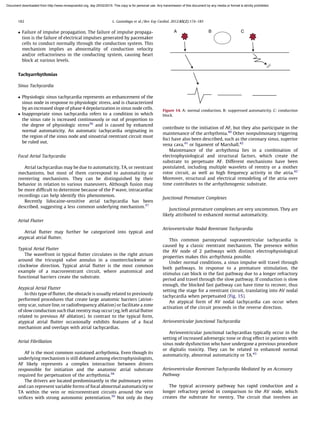
    Update: Arrhythmias (II) Mechanismsof Cardiac Arrhythmias Larraitz Gaztan˜aga,a,b, * Francis E. Marchlinski,a and Brian P. Betenskya a Electrophysiology Program, Cardiovascular Division, Department of Medicine, Hospital of the University of Pennsylvania, Philadelphia, Pennsylvania, United States b Unidad de Electrofisiologı´a Cardiaca, Servicio de Cardiologı´a, Hospital de Basurto, Bilbao, Vizcaya, Spain INTRODUCTION Understanding the mechanisms of arrhythmias is helpful to the appropriate management and treatment of all arrhythmia types. Since the mechanisms that lead to clinical arrhythmias are frequently due to abnormalities beyond the tissue level, it is also essential to understand what occurs at the cellular level. NORMAL CARDIAC CELLULAR ELECTROPHYSIOLOGY Cardiac myocytes are highly specialized cells responsible for both conduction of electrical impulses and mechanical contraction. Some myocytes demonstrate automaticity, defined by the capability of cardiac cells to undergo spontaneous diastolic depolarization and to initiate an electrical impulse in the absence of external electrical stimulation.1 Spontaneously originated action potentials (APs) are propa- gated through cardiac myocytes, which are excitable, referring to their ability to respond to a stimulus with a regenerative AP.2 Successful propagation of the cardiac impulse is enabled by gap junctions, specialized membrane structures composed of multiple intercellular ion channels that facilitate electrical and chemical communication between cells. Cardiac APs are regionally distinct (Fig. 1) due to each cell type expressing different numbers and types of ion channels.3 Under normal conditions, the sinoatrial node is the primary pacemaker of the heart, with a resting membrane potential of approximately À60 mV. Prior research has demonstrated that the If (‘‘funny’’) current plays a major role in the initiation of diastolic depolarization.4 The aggregate activity of various currents results in a net inward flow of sodium (Na+ ) and thus an increase in the membrane potential. When it reaches À40 mV, calcium (Ca2+ ) currents (T-type ICa,T- and L-type ICa,L) are activated, and serve as the predominant ion carriers during the AP upstroke of pacemaker cells4 (Ca2+ -dependent). Subsequently, outward potassium (K+ ) currents are activated and Ca2+ currents are inactivated. The membrane potential decreases due to the outward flow of K+ , the major repolarizing ion of the heart. Upon reaching the resting membrane potential, the cycle is ready to repeat itself. The resting membrane potential of muscle cells is À90 mV. Inflow of positive charge (Ca2+ and Na+ ) through the gap junction increases the voltage towards threshold (approximately À65 mV)3 initiating an AP. At this point, Na+ channels are triggered to open, resulting in a large but transient inward Na+ current (phase 0). The Na+ current is quickly inactivated, followed by a subsequent outward K+ current and thereby initiating repolarization (phase 1). Rev Esp Cardiol. 2012;65(2):174–185 Article history: Available online 21 December 2011 Keywords: Automaticity Triggered activity Reentry A B S T R A C T Cardiac arrhythmias are prevalent among humans across all age ranges and may occur in the setting of underlying heart disease as well as in structurally normal hearts. While arrhythmias are widely varied in their clinical presentations, they possess shared electrophysiologic properties at the cellular level. The 3 main mechanisms responsible for cardiac arrhythmias are automaticity, triggered activity, and reentry. Although identifying the specific mechanism may at times be challenging for the clinician and require invasive electrophysiologic study, differentiating and understanding the underlying mechanism may be critical to the development of an appropriate diagnosis and treatment strategy. ß 2011 Sociedad Espan˜ola de Cardiologı´a. Published by Elsevier Espan˜a, S.L. All rights reserved. Mecanismos de las arritmias cardiacas Palabras clave: Automatismo Actividad desencadenada Reentrada R E S U M E N En la especie humana, las arritmias cardiacas son muy prevalentes en todos los grupos de edad y pueden darse tanto en el contexto de una cardiopatı´a subyacente como en corazones estructuralmente normales. Aunque las formas de presentacio´ n clı´nica de las arritmias son muy diversas, en las ce´lulas comparten propiedades electrofisiolo´gicas comunes. Los 3 mecanismos principales de las arritmias cardiacas son las alteraciones en el automatismo, la actividad desencadenada y la reentrada. Aunque la identificacio´n del mecanismo especı´fico a veces pueda resultar difı´cil para el clı´nico y requerir un estudio electrofisiolo´gico invasivo, diferenciar y comprender el mecanismo subyacente puede ser crucial para desarrollar una correcta estrategia diagno´stica y terape´utica. ß 2011 Sociedad Espan˜ola de Cardiologı´a. Publicado por Elsevier Espan˜a, S.L. Todos los derechos reservados. * Corresponding author: Hospital of the University of Pennsylvania, 9th Floor, Founders Pavilion, 3400 Spruce Street, Philadelphia, Pennsylvania 19104, United States. E-mail address: Larraitz.gaztanaga@uphs.upenn.edu (L. Gaztan˜aga). 1885-5857/$ – see front matter ß 2011 Sociedad Espan˜ola de Cardiologı´a. Published by Elsevier Espan˜a, S.L. All rights reserved. doi:10.1016/j.rec.2011.09.020 Document downloaded from http://www.revespcardiol.org, day 25/02/2019. This copy is for personal use. Any transmission of this document by any media or format is strictly prohibited.
  • 2.
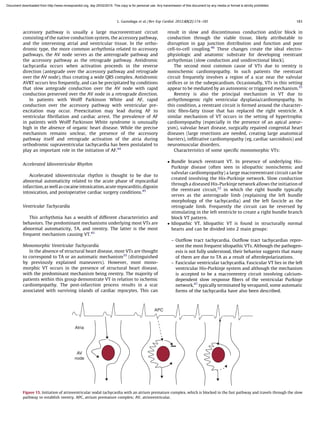
    The I Ca,Lplays an important role during the AP plateau (phase 2), opposing the K+ current. The I Ca,L is the main route for Ca2+ influx and triggers Ca2+ release from the sarcoplasmic reticulum, initiating contraction of the myocyte. Activation of delayed rectifier K+ channels and inactivation of Ca2+ channels leads to termination of the plateau and initiates late repolarization (phase 3). Finally, outward K+ channels mediate the final repolarization (phase 4). Following contraction, the cardiac myocytes must enter a relaxation or refractory phase during which they cannot be depolarized. The refractory period is defined by the time interval following excitation during which the cell remains unexcitable. This is due to the lack of availability of depolarizing current (which is Na+ in muscle cells). It is classified as either absolute or relative (Fig. 2), depending on whether it is completely unexcitable or needs a greater stimulus than normal. PRINCIPAL MECHANISMS OF CARDIAC ARRHYTHMIAS The mechanisms responsible for cardiac arrhythmias may be divided into disorders of impulse formation, disorders of impulse conduction or a combination of both (Table 1). Disorders of Impulse Formation Automaticity Altered Normal Automaticity As described previously, some specialized heart cells, such as sinoatrial nodal cells, the atrioventricular (AV) node, and the His- Purkinje system, as well as some cells in both atria,5 possess the property of pacemaker activity or automaticity. Suppression or enhancement of this activity may lead to clinical arrhythmias. Under normal conditions, the sinoatrial nodal cells have the fastest rate of firing and the so-called ‘‘subsidiary’’ pacemaker cells fire at slower rates, so the normal hierarchy is maintained. The firing rate is determined by the interaction of 3 factors: the maximum diastolic potential, the threshold potential at which the AP is initiated, and the rate or slope of phase 4 depolarization. A change in any of these (Fig. 3) may alter the rate of impulse initiation.6 Pacemaker activity is controlled by the autonomic nervous system and can be modulated by a variety of systemic factors, including metabolic abnormalities and endogenous or pharmaco- logic substances. Parasympathetic activity reduces the discharge rate of the pacemaker cells (Fig. 4) by releasing acetylcholine (Ach) and hyperpolarizing the cells by increasing conductance of the K+ channels. It may also decrease ICa-L and If activity, which further slows the rate. The suppressive effect of Ach is frequently used in practice for both diagnostic and therapeutic purposes. Tachycardias resulting from enhanced normal automaticity are expected to respond to vagal maneuvers (promoting Ach release) with a transient decrease in frequency, and a progressive return towards baseline after transiently accelerating to a faster rate upon cessation of the maneuver (a phenomenon known as ‘‘post-vagal tachycardia’’).7 Conversely, sympathetic activity increases the sinus rate. Catecholamines increase the permeability of Ica-L, increasing the inward Ca2+ current. Sympathetic activity also results in enhance- ment of the If current,8 thereby increasing the slope of phase 4 repolarization. Metabolic abnormalities such as hypoxia and hypokalemia can lead to enhanced normal automatic activity as a result of Na/K pump inhibition, thereby reducing the background repolarizing current and enhancing phase 4 diastolic repolarization.7 In degenerative conditions that affect the cardiac conduction system, suppression of the sinus pacemaker cells can be seen, Abbreviations AP: action potential AV: atrioventricular DAD: delayed afterdepolarization EAD: early afterdepolarization TA: triggered activity VT: ventricular tachycardia 0 −40 −80 mV 0 1 2 3 4 0 −40 −80 mV A B Figure 1. The cardiac action potential. A: sinus node action potential. B: muscle cell action potential. 0 21 3 4 Absolute refractoriness Relative refractoriness Figure 2. Refractory periods, showing the absolute and relative refractory periods during the action potential. Table 1 Mechanisms of Cardiac Arrhythmias Disorders of impulse formation Disorders of impulse conduction Automaticity Reentry Altered normal automaticity Anatomic reentry Abnormal automaticity Functional reentry Triggered activity Delayed afterdepolarization Early afterdepolarization L. Gaztan˜aga et al. / Rev Esp Cardiol. 2012;65(2):174–185 175 Document downloaded from http://www.revespcardiol.org, day 25/02/2019. This copy is for personal use. Any transmission of this document by any media or format is strictly prohibited.
  • 3.
    resulting in sinusbradycardia or even sinus arrest. A subsidiary pacemaker may manifest as a result of suppression of sinus automaticity. The hallmark of normal automaticity is ‘‘overdrive suppres- sion.’’ Overdriving a latent pacemaker cell faster than its intrinsic rate decreases the slope of phase 4, mediated mostly by enhanced activity of the Na/K exchange pump. When overdrive stimulation has ended, there is a gradual return to the intrinsic firing rate called the ‘‘warm-up’’ period (Fig. 5). The degree of suppression and the recovery time are proportional to the rate and duration of the applied stimulation.7,8 This mechanism plays an important role in maintaining sinus rhythm, continuously inhibiting the activity of subsidiary pace- maker cells.6 In patients with external pacemakers, the intrinsic rhythm is also suppressed by this mechanism.9 The absence of overdrive suppression may indicate that the arrhythmia is the result of a mechanism other than enhanced normal automaticity. However, the reverse is not always true because enhanced normal automatic activity may not respond to overdrive pacing or faster intrinsic rates due to entrance block.3 Clinical examples: sinus tachycardia associated with exercise, fever, and thyrotoxicosis; atrial and ventricular accelerated rhythms; inappropriate sinus tachycardia and AV junctional rhythms. Abnormal Automaticity Atrial and ventricular nonpacemaker myocardial cells, which in the normal heart typically do not exhibit spontaneous activity, may exhibit automaticity properties. This can happen under conditions that drive the maximum diastolic potential towards the threshold potential, which is explained by the interplay of numerous currents that together result in a net inward depolariz- ing current associated with a decrease in potassium conductance. The intrinsic rate of an automatic abnormal focus depends on the membrane potential; the more positive the membrane potential, the faster the automatic rate.6 Abnormal automaticity is thought to play a role in cases of elevated extracellular potassium, low intracellular pH, and catecholamine excess. An important distinction between enhanced normal and abnormal induced automaticity is that the latter is less sensitive to overdrive suppression,10 although there are situations where it may be observed. Under these circumstances, an ectopic automatic focus displays characteristics of other arrhythmia mechanisms.11 Clinical examples: premature beats, atrial tachycardia, accelerated idioventricular rhythm, ventricular tachycardia (VT), particularly in the acute phase, associated with ischemia and reperfusion. Figure 4. Parasympathetic effects on the action potential (reduction of the heart rate). 0 BA DC Th MDP 0 00 Th ThTh MDP MDP MDP Figure 3. Mechanisms of enhanced automaticity. A: normal. B: increased threshold voltage. C: decreased membrane diastolic potential. D: increased slope phase 4 depolarization. MDP, membrane diastolic potential; Th, threshold. Figure 5. Overdrive suppression in a Purkinje fiber and postsupression warm-up period. L. Gaztan˜aga et al. / Rev Esp Cardiol. 2012;65(2):174–185176 Document downloaded from http://www.revespcardiol.org, day 25/02/2019. This copy is for personal use. Any transmission of this document by any media or format is strictly prohibited.
  • 4.
    Triggered Activity Triggered activity(TA) is defined by impulse initiation caused by afterdepolarizations (membrane potential oscillations that occur during or immediately following a preceding AP).12 After- depolarizations occur only in the presence of a previous AP (the trigger), and when they reach the threshold potential, a new AP is generated. This may be the source of a new triggered response, leading to self-sustaining TA. Based on their temporal relationship, 2 types of afterpolariza- tions are described: early afterdepolarizations (EADs) occur during phase 2 or 3 of the AP, and delayed afterdepolarizations (DADs) occur after completion of the repolarization phase (Fig. 6). Delayed Afterdepolarization-Induced Triggered Activity A DAD is an oscillation in membrane voltage that occurs after completion of repolarization of the AP (during phase 4). These oscillations are caused by a variety of conditions that raise the diastolic intracellular Ca2+ concentration, which cause Ca2+ mediated oscillations that can trigger a new AP if they reach the stimulation threshold.13 As the cycle length decreases, the amplitude and rate of the DADs increases, and therefore is expected to initiate arrhythmias triggered when DADs increase the heart rate (either spontaneously or during pacing). In fact, the amplitude and number of triggered responses are direct functions of both the rate and duration of overdrive pacing (easier to induce with continued stimulation). When overdrive pacing is performed, the TA can slow until it stops, or when it is not rapid enough to terminate the triggered rhythm it can cause overdrive acceleration, in contrast to overdrive suppression seen with automatic rhythms.6 Toxic concentration of digitalis was the first observed cause of DAD.14 This occurs via inhibition of the Na/K pump, which promotes the release of Ca2+ from the sarcoplasmic reticulum. Clinically, digoxin toxic bidirectional fascicular tachycardia is felt to be an example of TA.15 Catecholamines can cause DADs by causing intracellular Ca2+ overload via an increase in ICa-L and theNa+ -Ca2+ exchange current, among other mechanisms. Ischemia-induced DADs are thought to be mediated by the accumulation of lysophosphoglycerides in the ischemic tissue,16 with subsequent elevation in Na+ and Ca2+ . Abnormal sarcoplasmic reticulum function (e.g. mutations in ryanodine receptor) can also lead to intracellular Ca2+ overload, facilitating clinical arrhythmias, such as catecholaminergic poly- morphic VT.17 A critical factor for the development of DADs is the duration of the AP. Longer APs are associated with more Ca2+ overload and facilitate DADs. Therefore, drugs that prolong AP (eg, Class IA antiarrhythmic agents) can occasionally increase DAD amplitude. Triggered arrhythmias induced by DADs may be terminated by single stimuli; therefore, other electrophysologic features are needed to distinguish them from the reentrant tachycardias. The rate dependency of the coupling interval may be useful, because in most cases of DAD-induced arrhythmias the shorter the cycle of stimulation, the shorter the coupling interval to the induced arrhythmia. This is in contrast to the inverse relationship seen in reentrant arrhythmias, where the shorter the coupling intervals of the initiating stimuli, the longer the coupling interval of the first arrhythmia beat.3 Since this is not always the case, other electrophysiologic properties must be taken into account. Adenosine has been used as a test for the diagnosis of DADs. Adenosine reduces the Ca2+ inward current indirectly by inhibiting effects on adenylate cyclase and cyclic adenosine monophosphate. Thus, it may abolish DADs induced by catecholamines, but does not alter DADs induced by Na+ /K+ pump inhibition. The interruption of VT by adenosine points toward catecholamine-induced DADs as the underlying mechanism.18 Clinical examples: atrial tachycardia, digitalis toxicity-induced tachycardia, accelerated ventricular rhythms in the setting of acute myocardial infarction, some forms of repetitive mono- morphic VT, reperfusion-induced arrhythmias, right ventricular outflow tract VT, exercise-induced VT (e.g. catecholaminergic polymorphic VT). Early Afterdepolarization-Induced Triggered Activity The EADs are oscillatory potentials that occur during the AP plateau (phase 2 EADs) or during the late repolarization (phase 3 EADs). Both types may appear during similar experimental conditions, but they differ morphologically as well as in the underlying ionic mechanism. Phase 2 EADs appear to be related to Ica-L current,19 while phase 3 EADs may be the result of electronic current across repolarization or the result of low IK1.20 The plateau of the AP is a period of high membrane resistance3 and little current flow. Consequently, small changes in either repolarizing or depolarizing currents can have profound effects on the AP duration and profile. As a wide variety of agents and conditions can result in a decreased outward current or increased inward current (so shifting the normal outward current), they can establish the conditions necessary for EADs (Table 2). A fundamental condition underlying the development of EADs is AP prolongation, which manifests on the surface electrocardio- gram (ECG) as QT prolongation. Some antiarrhythmic agents, principally class IA and III drugs, may become proarrhythmic because of their therapeutic effect of prolonging the AP. Many other drugs (Table 2) can predispose to the formation of EADs, particularly when associated with hypokalemia and/or bradycar- dia, additional factors that result in prolongation of the AP.7 Catecholamines may enhance EADs by augmenting Ca2+ current, however the resultant increase in heart rate along with the increase in K+ current effectively reduces the APD and thus abolishes EADs.7 An EAD-mediated TA appears to be the underlying cause of arrhythmias that develop in the setting of long QT syndrome. While the true mechanism of these arrhythmias is still debated, it is accepted that enhanced repolarization dispersion seen in the CBA Figure 6. Representation of triggered activity. A: phase 2 early afterdepolarization. B: phase 3 early afterdepolarization. C: delayed afterdepolarization. L. Gaztan˜aga et al. / Rev Esp Cardiol. 2012;65(2):174–185 177 Document downloaded from http://www.revespcardiol.org, day 25/02/2019. This copy is for personal use. Any transmission of this document by any media or format is strictly prohibited.
  • 5.
    syndrome can createa proarrhythmic substrate.21 In such an electrophysiologic milieu an EAD can initiate the tachycardia. Early afterdepolarization-triggered arrhythmias are rate depen- dent, and in general the EAD amplitude increases at a slow rate. Therefore, this type of TA is not expected to follow premature stimulation (which is associated with an acceleration of repolar- ization that decreases the EAD amplitude), with the exception of a long compensatory pause following a premature stimulus, which can be even more important than bradycardia in initiating torsades de pointes.22 Clinical examples: torsades de pointes (‘‘twisting of the tips’’), the characteristic polymorphic VT seen in patients with long QT syndrome. Disorders of Impulse Conduction Block Conduction delay and block occurs when the propagating impulse fails to conduct. Various factors involving both active and passive membrane properties determine the conduction velocity of an impulse and whether conduction is successful, such as the stimulating efficacy of the impulse and the excitability of the tissue into which the impulse is conducted.13 Gap junction coupling plays a crucial role for the velocity and safety of impulse propagation.23 Most commonly, impulses are blocked at high rates as a result of incomplete recovery of refractoriness. When an impulse arrives at tissue that is still refractory, it will not be conducted or the impulse will be conducted with aberration. This is the typical mechanism that explains several phenomena, such as block or functional bundle brunch conduction of a premature beat, Ashman´ s phenomenon during atrial fibrillation (AF), and accel- eration-dependent aberration. Bradycardia or deceleration-dependent block is suggested to be caused by the reduction excitability at long diastolic intervals with subsequent reduction in the AP amplitude. Many factors can alter the conduction, including rate, autonomic tone, drugs (eg, calcium channel blockers, beta blockers, digitalis, adenosine/adenosine triphosphate), or degen- erative processes (by altering the physiology of the tissue and the capacity to conduct impulses). Reentry During normal electrical activity, the cardiac cycle begins in the sinoatrial node and continues to propagate until the entire heart is activated. This impulse dies out when all fibers have been depolarized and are completely refractory. However, if a group of isolated fibers is not activated during the initial wave of depolarization, they can recover excitability in time to be depolarized before the impulse dies out. They may then serve as a link to reexcite areas that were previously depolarized but have already recovered from the initial depolarization.6 Such a process is commonly denoted as reentry, reentrant excitation, circus movement, reciprocal or echo beats, or reciprocating tachycardia (RT), referring to a repetitive propagation of the wave of activation, returning to its site of origin to reactivate that site.12 Reentry has been divided in 2 main groups (Table 3): anatomical or classic reentry, where the circuit is determined by anatomical structures, and functional reentry, which in turn includes different mechanisms. It is characterized by a lack of anatomic boundaries. Both forms can coexist in the same setting and share biophysical mechanisms.24 Reentry is the most common arrhythmia mechanism seen in clinical arrhythmias, both in classical or variant forms. Prerequisites for reentry include: A substrate: the presence of joined myocardial tissue with different electrophysiological properties, conduction, and refrac- toriness. An area of block (anatomical, functional, or both): an area of inexcitable tissue around which the wavefront can circulate. A unidirectional conduction block. A path of slowed conduction that allows sufficient delay in the conduction of the circulating wavefront to enable the recovery of the refractory tissue proximal to the site of unidirectional block. A critical tissue mass to sustain the circulating reentrant wavefronts. An initiating trigger. Types of Reentry Anatomical Reentry/Classic Reentry The classic reentry mechanism is based on an inexcitable anatomical obstacle surrounded by a circular pathway in which the wavefront can ‘‘reenter’’, creating fixed and stable reentrant circuits. The anatomic obstacle determines the presence of 2 pathways (Fig. 7). When the wavefront encounters the obstacle, it will travel down one pathway (unidirectional block), propagat- ing until the point of block, thus initiating a reentrant circuit. Initiation and maintenance of reentry will depend on the conduction velocity and refractory period of each pathway, which determines the wavelength (wavelength=conduction velocity  refractory period). For reentry to occur, the wavelength must be shorter than the length of the pathway. Conditions that decrease conduction velocity or shorten the refractory period will allow Table 3 Types of Reentry Anatomic reentry Functional reentry Leading circle Anisotropic reentry Figure of 8 reentry Reflection Spiral wave (rotor) reentry Table 2 Agents and Manipulations That May Lead to Early Afterdepolarizations Slow rate (bradycardia, complete heart block, etc.) Mechanical stretch Hypokalemia Hypoxia Acidosis Low extracellular K+ concentration Low extracellular Ca2+ concentration Low extracellular magnesium (Mg2+ ) concentration Class IA antiarrhythmic drugs (quinidine, disopyramide, procainamide) Class IB antiarrhythmic drugs (flecainide, encainide, indecainide) Class III antiarrhythmic drugs (amiodarone, sotalol, bretylium) Phenothiazines Tricyclic and tetracyclic antidepressants Erythromycin Antihistamines Cesium Amiloride Barium L. Gaztan˜aga et al. / Rev Esp Cardiol. 2012;65(2):174–185178 Document downloaded from http://www.revespcardiol.org, day 25/02/2019. This copy is for personal use. Any transmission of this document by any media or format is strictly prohibited.
  • 6.
    the creation ofsmaller circuits, facilitating the initiation and maintenance of reentry. The excitable gap is a key concept essential to understanding the mechanism of reentry (Fig. 8). The excitable gap refers to the excitable myocardium that exists between the head of the reentrant wavefront and the tail of the preceding wavefront.24 This gap allows the reentrant wavefront to continue propagation around the circuit. The presence of an excitable gap also makes it possible to enter in the reentrant circuit using external pacing and explains the phenomena of resetting, entrainment, and termina- tion of the tachycardia with electrical stimulation. Clinical examples: AV reentrant tachycardia associated with a bypass tract, AV nodal reentrant tachycardia, atrial flutter, bundle branch reentry VT, post-infarction VT. Functional Reentry In functional reentry, the circuit is not determined by anatomic obstacles; it is defined by dynamic heterogeneities in the electrophysiologic properties of the involving tissue.2 The location and size of functional reentrant circuits can vary, but they are usually small and unstable. As previously stated, functionally determined reentrant circuits can occur due to different mechanisms: Leading circle reentry (Fig. 9). In 1976, Allesie et al. described a reentrant mechanism in the absence of an anatomical boundary. They postulated that the impulse circulates around a central core that is maintained in a refractory state because it is constantly bombarded by impulses and travels through partially refractory tissue.25 Leading circle was defined as ‘‘the smallest possible pathway in which the impulse can continue to circulate.’’26 This type of reentry is less susceptible to resetting, entrainment, and termination by pacing maneuvers because there is not a fully excitable gap. Anisotropic reentry. Anisotropic conduction relates to direction- ally dependent conduction velocity in cardiac muscle27 and depends on the structure and organization of myocytes within cardiac tissue. These include the orientation of fibers and nonuniform distribution of gap junctions, with a larger number of channels poised to propagate the impulse longitudinally rather than transversely.4 The heterogeneity in conduction velocities and repolarization properties of the anisotropic tissue can result in blocked impulses and slowed conduction that allows reentry even in small anatomical circuits.24 Clinical examples: anisotropic reentry in atrial and ventricular muscle, which may be responsible in the setting of VT originating in surviving myocardial infarction.28 Figure of eight reentry. This type of reentry consists of 2 concomitant wavefronts circulating in opposite directions (clockwise and counterclockwise) around 2 functional or fixed arcs of block that merge into a central common pathway. Clinical example: this type of reentry may be seen in the setting of infarction-related VT. Reflection (Fig. 10). Reflection is a unique subclass of reentry that occurs in a linear segment of tissue, where the impulse travels in both directions over the same pathway in the presence of severely impaired conduction.29 Spiral wave (rotor) activity (Fig. 11). Spiral waves occur in a wide variety of excitable media.30 They represent a 2-dimensional form of rotating wave propagation, which may also occur in 3 dimensions. When spiral wave activity occurs in 3 dimensions this phenomenon is called ‘‘scroll waves.’’ Initially the term ‘‘rotor’’ described the rotating source and ‘‘spiral wave’’ defined the shape of the emerging wave.6 One may encounter other terms for this phenomenon in the literature, such as ‘‘vortices’’ or ‘‘reverberators.’’ Spiral wave activation is organized around a core, which remains unstimulated because of the pronounced curvature of the spiral. This curvature also limits the spiral propagation velocity, resulting in slow conduction and block.25 In contrast to the leading circle model, there is a fully excitable gap. The tip of the wave moves along a complex trajectory and can radiate waves into the surrounding medium (known as ‘‘break-up’’ of a mother wave). Spirals may have completely different dynamics and can circulate with different patterns, change one to another, become stationary or continuously drift or migrate.6 These characteristics result in both monomorphic and polymorphic patterns. Clinical examples: atrial and ventricular fibrillation, polymorphic VT. Figure 7. Anatomic reentry: the central obstacle creates 2 paths; when the impulse arrives, unidirectional block occurs and slow conduction through the other path allows reentry. Partially recovered Fullyrecovere d Wavefront “head” Excitable gap Wavefront “tail” Figure 8. Schematic representation of an excitable gap. L. Gaztan˜aga et al. / Rev Esp Cardiol. 2012;65(2):174–185 179 Document downloaded from http://www.revespcardiol.org, day 25/02/2019. This copy is for personal use. Any transmission of this document by any media or format is strictly prohibited.
  • 7.
    Resetting and Entrainmentof Reentrant Arrhythmias Resetting Resetting is the act of advancing a tachycardia impulse by timed premature electrical stimuli. The first tachycardia complex in return should have the same morphological feature and cycle length as before the extrastimulus, and the pause to this first tachycardia complex should be ‘‘reset’’ and therefore less than twice the tachycardia cycle length.6 To reset a tachycardia the stimulated wavefront must reach the tachycardia circuit from the pacing site (the closer the pacing the less prematurity is need) and enter the excitable gap. Once it has entered the circuit, it will propagate in both directions, colliding in the retrograde direction with the previous tachycardia impulse (antidromically) while in the anterograde direction it will propagate and occur earlier than expected in time.31 After that, the tachycardia will continue unchanged. The degree of advancement depends on the prematurity of the extrastimulus and its conduction within the circuit (ie, the stimulus will propagate slower if the gap is only partially excitable). If the stimulus enters the circuit during the relative refractory period, it can block in the anterograde direction (because it is absolutely refractory) and collide antidromically with the previous beat, thus terminating the tachycardia.32 Entrainment Entrainment is the continuous resetting of a tachycardia circuit (Fig. 12). During overdrive pacing all myocardial tissue will maintain the pacing rate, with resumption of the intrinsic morphology and rate upon either abrupt cessation of pacing or slowing of the pacing rate below the intrinsic rate.33 Fusion A fused beat possesses intermediate morphology between a fully stimulated complex and the tachycardia complex. It can be observed on the surface ECG (if a significant amount of myocardium is depolarized34 ) or intracardiac recordings. For fusion to occur, the tachycardia wavefront must exit the circuit and collide with the pacing stimulus before depolarization of the surrounding myocardium (Fig. 13). This requires a circuit with distinct entry and exit sites supporting a reentrant mechanism. Resetting and entrainment with fusion are specific to reentrant arrhythmias, but since they are sometimes challenging to identify, failure to detect them does not invalidate reentry as the arrhythmia mechanism. FEATURES OF ARRHYTHMIA MECHANISMS We now present an approach to the differential diagnosis of arrhythmia mechanisms. Table 4 is a schematic diagram of useful maneuvers (explained above) for distinguishing between the different arrhythmia mechanisms. It is important to note that sometimes it may be very difficult to identify the mechanism responsible for the arrhythmia, and even more challenging if we take into account that an arrhythmia can be initiated by one mechanism but perpetuated by others (e.g. AF). As shown in Table 4, automatic arrhythmias cannot be reproducibly initiated or terminated by programmed electric stimulation. They can be reset, and rapid pacing can result in overdrive suppression or produce no effect. The initiation may be facilitated by isoproterenol, in which the arrhythmia will typically start with a warm-up period with the first tachycardia beat being identical to the next one. Adenosine can slow but usually does not terminate the tachycardia. Although TA can be initiated with pacing, initiation frequently requires isoproterenol. Arrhythmias due to TA can be reset and usually pacing can terminate a TA tachycardia. The first beat isFigure 10. Schematic representation of reflection mechanism. Figure 11. Schematic representation of a spiral wave.Figure 9. Schematic representation of a leading circle. L. Gaztan˜aga et al. / Rev Esp Cardiol. 2012;65(2):174–185180 Document downloaded from http://www.revespcardiol.org, day 25/02/2019. This copy is for personal use. Any transmission of this document by any media or format is strictly prohibited.
  • 8.
    usually the extrastimulusor premature beat, and therefore different from the subsequent one. These arrhythmias terminate in response to adenosine. Reentrant tachycardias respond to pacing and demonstrate the hallmark features of resetting and entrainment with fusion. Adenosine can terminate a reentrant tachycardia involving the AV node, but will not affect sodium-dependent cells in the atria and ventricles. Furthermore, other noninvasive tools such as surface ECG should always be considered. The surface ECG may not confirm a particular mechanism, but it can provide important clues.35 The sinus rhythm ECG may reveal disease processes known to be associated with specific types of arrhythmias: a) Q waves consistent with prior myocardial infarction suggest the substrate for reentry; b) a long QT interval raises suspicion for after- depolarizations; c) a ‘‘delta wave’’ makes reentry over an accessory pathway a plausible mechanism, and d) epsilon waves or Brugada pattern ECGs suggest reentrant mechanisms. RELATIONSHIP TO CLINICAL ARRHYTHMIAS In the following section, we will comment on the mechanisms that sustain the most frequent arrhythmias seen in practice. Bradyarrhythmias Bradyarrhythmias can be explained by 2 mechanisms (Fig. 14). Failure of impulse generation. Failure of impulse generation is the failure of pacemaker cells to generate appropriate electrical impulses. This form of bradyarrhythmia is commonly seen in the context of degenerative processes. Although any automatic normal foci can be affected, their failure may only be seen when the superior pacemaker cell function is depressed. Thus, the failure of the sinus node will cause major or minor pauses, depending on the function of the subsidiary pacemaker cells. Entrance Exit Fused beatStim Figure 13. Schematic representation of a fused beat. Stim, stimulus. ExitEntranceA B C Stim Stim Termination Reset Figure 12. A: reentrant circuit. B: a timed premature stimulus can enter the circuit, collide in a retrograde fashion with the previous impulse while in the anterograde direction exiting earlier than expected. C: termination occurs if the stimulus enters during the relative refractory period (anterograde block and retrograde collision). Stim, stimulus. Table 4 Maneuvers for Distinguishing Between the Different Arrhythmia Mechanisms Automaticity Triggered activity Reentry Initiation by PES No Yes (continuous stimulation) Yes Termination by PES No Some times Yes First interval at initiating Long, warm-up Short (same as or shorter than rest) Long (longer than subsequent) Morphology of first beat Identical to subsequent Different from subsequent Different from subsequent Adenosine Transient slowing or no response Termination No response or AV block Catecholamines Increase Increase (DAD) Increase/decrease Response to PES during tachycardia Reset or compensatory pause Reset or termination Reset or termination Reset with fusion No No Yes Response to continuous stimulation during tachycardia Overdrive suppression if enhanced normal automaticity Acceleration or termination Entrainment or termination Entrainment with fusion No No Yes AV, atrioventricular; DAD, delayed afterdepolarization; PES, programmed electric stimulation. L. Gaztan˜aga et al. / Rev Esp Cardiol. 2012;65(2):174–185 181 Document downloaded from http://www.revespcardiol.org, day 25/02/2019. This copy is for personal use. Any transmission of this document by any media or format is strictly prohibited.
  • 9.
    Failure of impulsepropagation. The failure of impulse propaga- tion is the failure of electrical impulses generated by pacemaker cells to conduct normally through the conduction system. This mechanism implies an abnormality of conduction velocity and/or refractoriness in the conducting system, causing heart block at various levels. Tachyarrhythmias Sinus Tachycardia Physiologic sinus tachycardia represents an enhancement of the sinus node in response to physiologic stress, and is characterized by an increased slope of phase 4 depolarization in sinus node cells. Inappropriate sinus tachycardia refers to a condition in which the sinus rate is increased continuously or out of proportion to the degree of physiologic stress36 and is caused by enhanced normal automaticity. An automatic tachycardia originating in the region of the sinus node and sinoatrial reentrant circuit must be ruled out. Focal Atrial Tachycardia Atrial tachycardias may be due to automaticity, TA, or reentrant mechanisms, but most of them correspond to automaticity or reentering mechanisms. They can be distinguished by their behavior in relation to various maneuvers. Although fusion may be more difficult to determine because of the P wave, intracardiac recordings can help identify this phenomenon. Recently lidocaine-sensitive atrial tachycardia has been described, suggesting a less common underlying mechanism.37 Atrial Flutter Atrial flutter may further be categorized into typical and atypical atrial flutter. Typical Atrial Flutter The wavefront in typical flutter circulates in the right atrium around the tricuspid valve annulus in a counterclockwise or clockwise direction. Typical atrial flutter is the most common example of a macroreentrant circuit, where anatomical and functional barriers create the substrate. Atypical Atrial Flutter In this type of flutter, the obstacle is usually related to previously performed procedures that create large anatomic barriers (atriot- omy scar, suture line, or radiofrequency ablation) or facilitate a zone of slow conduction such that reentry may occur (eg, left atrial flutter related to previous AF ablation). In contrast to the typical form, atypical atrial flutter occasionally exhibits features of a focal mechanism and overlaps with atrial tachycardias. Atrial Fibrillation AF is the most common sustained arrhythmia. Even though its underlying mechanism is still debated among electrophysiologists, AF likely represents a complex interaction between drivers responsible for initiation and the anatomic atrial substrate required for perpetuation of the arrhythmia.38 The drivers are located predominantly in the pulmonary veins and can represent variable forms of focal abnormal automaticity or TA within the vein or microreentrant circuits around the vein orifices with strong autonomic potentiation.39 Not only do they contribute to the initiation of AF, but they also participate in the maintenance of the arrhythmia.40 Other nonpulmonary triggering foci have also been described, such as the coronary sinus, superior vena cava,41 or ligament of Marshall.42 Maintenance of the arrhythmia lies in a combination of electrophysiological and structural factors, which create the substrate to perpetuate AF. Different mechanisms have been postulated, including multiple wavelets of reentry or a mother rotor circuit, as well as high frequency activity in the atria.42 Moreover, structural and electrical remodeling of the atria over time contributes to the arrhythmogenic substrate. Junctional Premature Complexes Junctional premature complexes are very uncommon. They are likely attributed to enhanced normal automaticity. Atrioventricular Nodal Reentrant Tachycardia This common paroxysmal supraventricular tachycardia is caused by a classic reentrant mechanism. The presence within the AV node of 2 pathways with distinct electrophysiological properties makes this arrhythmia possible. Under normal conditions, a sinus impulse will travel through both pathways. In response to a premature stimulation, the stimulus can block in the fast pathway due to a longer refractory period and travel through the slow pathway. If conduction is slow enough, the blocked fast pathway can have time to recover, thus setting the stage for a reentrant circuit, translating into AV nodal tachycardia when perpetuated (Fig. 15). An atypical form of AV nodal tachycardia can occur when activation of the circuit proceeds in the reverse direction. Atrioventricular Junctional Tachycardia Atrioventricular junctional tachycardias typically occur in the setting of increased adrenergic tone or drug effect in patients with sinus node dysfunction who have undergone a previous procedure or digitalis toxicity. They can be related to enhanced normal automaticity, abnormal automaticity or TA.43 Atrioventricular Reentrant Tachycardia Mediated by an Accessory Pathway The typical accessory pathway has rapid conduction and a longer refractory period in comparison to the AV node, which creates the substrate for reentry. The circuit that involves an A B C Figure 14. A: normal conduction. B: suppressed automaticity. C: conduction block. L. Gaztan˜aga et al. / Rev Esp Cardiol. 2012;65(2):174–185182 Document downloaded from http://www.revespcardiol.org, day 25/02/2019. This copy is for personal use. Any transmission of this document by any media or format is strictly prohibited.
  • 10.
    accessory pathway isusually a large macroreentrant circuit consisting of the native conduction system, the accessory pathway, and the intervening atrial and ventricular tissue. In the ortho- dromic type, the more common arrhythmia related to accessory pathways, the AV node serves as the anterograde pathway and the accessory pathway as the retrograde pathway. Antidromic tachycardia occurs when activation proceeds in the reverse direction (antegrade over the accessory pathway and retrograde over the AV node), thus creating a wide QRS complex. Antidromic AVRT occurs less frequently, and can be precipitated by conditions that slow antegrade conduction over the AV node with rapid conduction preserved over the AV node in a retrograde direction. In patients with Wolff Parkinson White and AF, rapid conduction over the accessory pathway with ventricular pre- excitation may occur. Preexcitation may lead during AF to ventricular fibrillation and cardiac arrest. The prevalence of AF in patients with Wolff Parkinson White syndrome is unusually high in the absence of organic heart disease. While the precise mechanism remains unclear, the presence of the accessory pathway itself and retrograde activation of the atria during orthodromic supraventricular tachycardia has been postulated to play an important role in the initiation of AF.44 Accelerated Idioventricular Rhythm Accelerated idioventricular rhythm is thought to be due to abnormal automaticity related to the acute phase of myocardial infarction, aswellascocaine intoxication,acute myocarditis,digoxin intoxication, and postoperative cardiac surgery conditions.45 Ventricular Tachycardia This arrhythmia has a wealth of different characteristics and behaviors. The predominant mechanisms underlying most VTs are abnormal automaticity, TA, and reentry. The latter is the most frequent mechanism causing VT.45 Monomorphic Ventricular Tachycardia In the absence of structural heart disease, most VTs are thought to correspond to TA or an automatic mechanism35 (distinguished by previously explained maneuvers). However, most mono- morphic VT occurs in the presence of structural heart disease, with the predominant mechanism being reentry. The majority of patients within this group demonstrate VT in relation to ischemic cardiomyopathy. The post-infarction process results in a scar associated with surviving islands of cardiac myocytes. This can result in slow and discontinuous conduction and/or block in conduction through the viable tissue, likely attributable to disruption in gap junction distribution and function and poor cell-to-cell coupling.46 These changes create the ideal electro- physiologic and anatomic substrate for developing reentrant arrhythmias (slow conduction and unidirectional block). The second most common cause of VTs due to reentry is nonischemic cardiomyopathy. In such patients the reentrant circuit frequently involves a region of a scar near the valvular orifices or in the subepicardium. Occasionally, VTs in this setting appear to be mediated by an autonomic or triggered mechanism.35 Reentry is also the principal mechanism in VT due to arrhythmogenic right ventricular dysplasia/cardiomyopathy. In this condition, a reentrant circuit is formed around the character- istic fibro-fatty tissue that has replaced the right ventricle. A similar mechanism of VT occurs in the setting of hypertrophic cardiomyopathy (especially in the presence of an apical aneur- ysm), valvular heart disease, surgically repaired congenital heart diseases (large resections are needed, creating large anatomical barriers), infiltrative cardiomyopathy (eg, cardiac sarcoidosis) and neuromuscular disorders. Characteristics of some specific monomorphic VTs: Bundle branch reentrant VT. In presence of underlying His- Purkinje disease (often seen in idiopathic nonischemic and valvular cardiomyopathy) a large macroreentrant circuit can be created involving the His-Purkinje network. Slow conduction through a diseased His-Purkinje network allows the initiation of the reentrant circuit,32 in which the right bundle typically serves as the anterograde limb (explaining the left bundle morphology of the tachycardia) and the left fascicle as the retrograde limb. Frequently the circuit can be reversed by stimulating in the left ventricle to create a right bundle branch block VT pattern. Idiopathic VT. Idiopathic VT is found in structurally normal hearts and can be divided into 2 main groups: – Outflow tract tachycardia. Outflow tract tachycardias repre- sent the most frequent idiopathic VTs. Although the pathogen- esis is not fully understood, their behavior suggests that many of them are due to TA as a result of afterdepolarizations. – Fascicular ventricular tachycardia. Fascicular VT lies in the left ventricular His-Purkinje system and although the mechanism is accepted to be a macroreentry circuit involving calcium- dependent slow response fibers of the ventricular Purkinje network,47 typically terminated by verapamil, some automatic forms of the tachycardia have also been described. Atria APC AV node Figure 15. Initiation of atrioventricular nodal tachycardia with an atrium premature complex, which is blocked in the fast pathway and travels through the slow pathway to establish reentry. APC, atrium premature complex; AV, atrioventricular. L. Gaztan˜aga et al. / Rev Esp Cardiol. 2012;65(2):174–185 183 Document downloaded from http://www.revespcardiol.org, day 25/02/2019. This copy is for personal use. Any transmission of this document by any media or format is strictly prohibited.
  • 11.
    Polymorphic Ventricular Tachycardiaand Ventricular Fibrillation The initiation and maintenance of these tachyarrhythmias remain unknown; however, previous work supports a similar mechanism as suspected in AF. The initiating trigger could be mediated by TA, automaticity, or a reentrant mechanism, while maintenance may be due to different forms of functional reentries, including rotors, migrating scroll waves, or intramural or Purkinje network reentry. Elucidation of the underlying mechanism is still in its experimental phase. It is also possible that VF may be the final common endpoint of a heterogeneous group of electrical disturbances and it may not be possible to identify a single mechanism that adequately accounts for all of them.48 Genetically determined abnormalities predisposing to poly- morphic VT: Long QT syndrome. Both congenital and acquired (especially via certain drugs49 ) conditions lead to a long QT interval due to lengthening of the AP plateau phase. The onset of the arrhythmia occurs due to EADs potentiated by intracellular calcium accumulation from a prolonged AP plateau.38 Brugada syndrome. Genetic mutations resulting in diminished inward sodium current in the epicardium of the right ventricular outflow tract cause this syndrome. Because of the ionic alteration, the outward potassium current is unopposed at some epicardial sites, which gives rise to epicardial dispersion of repolarization that creates a vulnerable window during which a premature impulse can develop phase 2 reentrant arrhythmia.29 Short QT syndrome. Genetic abnormalities that cause this syndrome lead to decreased repolarization time and decrease myocyte refractoriness, thus promoting reentrant arrhythmias.50 Catecholaminergic polymorphic VT. Catecholaminergic poly- morphic VT is due to genetic disorders of channels and proteins (ryanodine and calquestrin) that regulate intracellular calcium.17 The defects cause an accumulation of intracellular calcium, which can facilitate the TA mediated by DADs. Precipitants include exercise or emotional stress as a result of increasing intracellular calcium concentration. CONFLICTS OF INTEREST None declared. REFERENCES 1. Peters N, Cabo C, Wit A. Arrhythmogenic mechanisms: automaticity, triggered activity and reentry. In: Zipes DP, Jalife J, editors. Cardiac electrophysiology, from cell to bedside. 3rd ed. Philadelphia: Saunders; 2003. p. 345–55. 2. Grant A, Durrani S. Mechanisms of cardiac arrhythmias. In: Topol. Textbook of cardiovascular medicine. 3rd ed. Philadelphia: Lippicontt; 2007. p. 950–63. 3. Tomaselly G, Roden D. Molecular and cellular basis of cardiac electrophysiology. In: Sanjeev S, editor. Electrophysiological disorders of the heart. New York: Elsevier; 2005. p. 1–28. 4. Barbuti A, Baruscotti M, DiFrancesco D. The pacemaker current. J Cardiovasc Electrophysiol. 2007;18:342–7. 5. Matteo E, Nargeot J. Genesis and regulation of the heart automaticity. Physiol Rev. 2008;88:919–82. 6. Issa ZF, Miller JM, Zipes DP. Electrophysiological mechanisms of cardiac arrhythmias: clinical arrhythmology and electrophysiology, a companion to Brawnwald’s heart disease. Philadelphia: Saunders; 2009. p. 1–26. 7. Jalife J, Delmar M, Davidenko, Anumonwo J, Berenfeld O, Anumonwo KJ. Basic cardiac electrophysiology for the clinician. 2nd ed. New Jersey: Wiley-Black- well; 2009. p. 152–96. 8. DiFrancesco D. Funny channels in the control of cardiac rhythm and mode of action of selective blockers. Pharmacol Res. 2006;53:399–406. 9. Almendral J, Gonza´lez-Torrecilla E. Mecanismos de las arritmias cardiacas. Arritmologı´a clı´nica. Madrid: Sociedad Espan˜ola de Cardiologı´a; 2007. p. 81– 103. 10. Dangman KH, Hoffman BF. Studies on overdrive stimulation of canine cardiac Purkinje fibers: Maximal diastolic potential as a determinant of the response. J Am Coll Cardiol. 1983;2:1183–90. 11. Rosenthal J, Ferrier G. Contribution of variable entrance and exit block in protected foci to arrhythmogenesis in isolated ventricular tissues. Circulation. 1983;67:1–8. 12. Zipes DP. Mechanisms of clinical arrhythmias. J Cardiovasc Electrophysiol. 2003;14:902–12. 13. Clusin WT. Calcium and cardiac arrhythmias: DADs, EADs, and alternans. Crit Rev Clin Lab Sci. 2003;40:227–75. 14. Rosen MR, Gelband H, Merker C, Hoffman BF. Mechanisms of digitalis toxicity. Effects of ouabain on phase four of canine Purkinje fiber transmembrane potentials. Circulation. 1973;47:681–9. 15. Wieland JM, Marchlinski FE. Electrocardiographic response of digoxin-toxic fascicular tachycardia to Fab fragments: implications for tachycardia mechan- ism. Pacing Clin Electrophysiol. 1986;9:727–38. 16. Undrovinas Al, Fleidervish A, Makielski JC. Inward sodium current at resting potentials in single cardiac myocytes induced by the ischemic metabolite lysophosphatidylcholine. Circ Res. 1992;71:1231–41. 17. Paavola J, Vitaasalo M, Laitinen-Forsblom PJ, Pasternack M, Swan H, Tikkanen I, et al. Mutant ryanodine receptors in catecholaminergic polymorphic ventri- cular tachycardia generate delayed afterdepolarizations due to increased pro- pensity to Ca2+ waves. Eur Heart J. 2007;28:1135–42. 18. Bruce B, Lerman MD. Adenosine sensitive ventricular tachycardia: evidence suggesting cyclic AMP-mediated triggered activity. Circulation. 1986;74: 270–80. 19. Yamada M, Ohta K, Niwa A, Tsujino N, Nakada T, Hirose M. Contribution of L- type Ca2+ channels to early depolarizations induced by IKr and IKs channel suppression in guinea pig ventricular myocytes. J Membrane Biology. 2008;222:151–66. 20. Mitsunori M, Lin S, Xie Y, Chua SK, Joung B, Han S, et al. Genesis of phase 3 early afterdepolarizations and triggered activity in acquired long-QT syndrome. Circ Arrhythm Electrophysiol. 2011;4:103–11. 21. Hiroshu M, Jiashin W. The QT syndrome: long and short. Lancet. 2008;372: 750–63. 22. Prince K, Roden D. Darbar. Drug induced long QT syndrome. Pharmacol Rev. 2010;62:760–81. 23. Rohr S. Role of gap junctions in the propagation of the cardiac action potential. Cardiovasc Res. 2004;62:309–22. 24. Kleber AG, Rudy Y. Basis mechanisms of cardiac impulse propagation and associated arrhythmias. Physiol Rev. 2004;84:431–88. 25. Cabo C, Wit A. Cellular electrophysiologic mechanisms of arrhythmias. Cardiol Clin. 1997;4:521–38. 26. Allesie MA, Bonke FJ, Schopman FJ. Circus movement in rabbit atrial muscle as a mechanism of tachycardia. III. The ‘‘leading circle’’ concept. A new model of circus movement in cardiac tissue without the involvement of an anatomical obstacle. Cir Res. 1976;39:168–77. 27. Valderra´bano M. Influence of anisotropic conduction properties in the propa- gation of the cardiac action potential. Prog Biophys Mol Biol. 2007;94:144–68. 28. Sapch MS, Josephson ME. Initiating reentry: the role of nonuniform anisotropy in small circuits. J Cardiovasc Electrophysiol. 1994;5:182–209. 29. Antzelevirch C. Basis mechanisms of reentrant arrhythmias. Curr Opin Cardiol. 2001;16:1–7. 30. Davidenko J, Kent P, Jalife J. Spiral waves in normal isolated ventricular muscle. Waves and patterns in biological systems. Physica D. 1991;49:182–97. 31. Stamato NJ, Rosenthal ME, Almendral JM, Josephson ME. The resetting response of ventricular tachycardia to single and double extrastimuli. Implications for an excitable gap. Am J Cardiol. 1987;60:5961. 32. Josephson ME. Recurrent ventricular tachycardia. In: Josephson M, editor. Clinical cardiac electrophysiology. 3rd ed. Philadelphia: Lippincott-Williams Wilkins; 2002. p. 425–610. 33. Mac-Lean WAH, Plumb VJ, Waldo AL. Transient entrainment and interruption of ventricular tachycardia. PACE. 1981;4:358. 34. Ormaetxe JM, Almendral J, Martı´nez-Alday JD, Villacastı´n JP, Arenal A, Pastor A, et al. Analysis of the degree of QRS fusion necessary for its visual detection: importance for the recognition of transient entrainment. Circulation. 1997;96:3509–16. 35. Riley M, Marchlinski F. ECG clues for diagnosis ventricular tachycardia mechan- ism. J Cardiovasc Electrophysiol. 2008;19:224–9. 36. Morillo CA, Guzma´n JC. Taquicardia sinusal inapropiada: actualizacio´n. Rev Esp Cardiol. 2007;60 (Supl 3):10–4. 37. Chiale P, Franco A, Selva HO, Millitello CA, Elizari MV. Lidocaine-sensitive, rate- related, repetitive atrial tachycardia: a new arrhythmogenic syndrome. J Am Coll Cardiol. 2000;36:1637–45. 38. Marchinski F. The tachycardias. Harrison’s Cardiovacular Medicine. New York: McGraw-Hill; 2010. p. 147–77. 39. Arora R, Verheule S, Scott L, Navarrete A, Katari V, Wilson E, et al. Arrhythmo- genic substrate of the pulmonary vein assessed by high resolution optical mapping. Circulation. 2003;107:1816–21. 40. Sanders P, Nalliah CJ, Dubois R, Takahashi Y, Hocini M, Rotter M, et al. Frequency mapping of the pulmonary veins in paroxysmal versus permanent atrial fibrillation. J Cardiovasc Electrophysiol. 2006;17:965–72. 41. Tsai CF, Tai CT, Hsieh MH, Lin WS, Yu WC, Ueng KC, et al. Initiation of atrial fibrillation by ectopic beats originating from the superior vena cava. Circula- tion. 2000;102:67–74. 42. Okuyama Y, Miyauchi Y, Park AM, Hamabe A, Zhou S, Hayashi H, et al. High resolution mapping of the pulmonary vein and the vein of Marsharll during induce atrial fibrillation and atrial tachycardia in a canine model of pacing induced congestive heart failure. J Am Coll Cardiol. 2003;42:348–60. L. Gaztan˜aga et al. / Rev Esp Cardiol. 2012;65(2):174–185184 Document downloaded from http://www.revespcardiol.org, day 25/02/2019. This copy is for personal use. Any transmission of this document by any media or format is strictly prohibited.
  • 12.
    43. Sanders P,Berenfeld O, Hocini M, Jaı¨s P, Vaidyanathan R, Hsu LF, et al. Spectral analysis identifies sites of high frequency activity maintaining atrial fibrillation in humans. Circulation. 2005;112:789–97. 44. Centurio OA, Shimizu A, Somoto S, Konoe A. Mechanisms for the genesis of paroxysmal atrial fibrillation in the Wolff-Parkinson-White syndrome: intrinsic atrial muscle vulnerability vs. electrophysiological properties of the accessory pathway. Europace. 2008;10:294–302. 45. Rubar M, Zipes DP. Genesis of cardiac arrhythmias: electrophysiologic considerations. In: Bonow RO, Mann DL, Zipes DP, Libby P, editors. Braunwald’s heart disease. A textbook of cardiovascular medicine. 9th ed. Philadelphia: Saunders Elsevier; 2011. p. 653–86. 46. Peters NS, Coromilas J, Severs NJ, Wit AL. Disturbed connexin 43 gap junction distribution correlates with the location of reentrant circuits in the epicardial border zone of healing canine infarcts that cause ventricular tachycardia. Circulation. 1997;95:988–96. 47. Ouyang F, Cappato R, Ernst S, Goya M, Volkmer M, Habe J, et al. Electroana- tomical substrate of idiopathic left ventricular tachycardia: unidirectional block and macroreentry within the purkinje network. Circulation. 2002; 105:462–9. 48. Issa ZF, Miller JM, Zipes DP. Other ventricular tachycardias: Clinical arrhyth- mology and electrophysiology. A companion to Brawnwald’s heart disease. Philadelphia: Saunders; 2009. p. 482. 49. Roden DM. Drug induced prolongation of the QT interval. N Engl J Med. 2004;350:1013–22. 50. Cross B, Homoud M, Link M, Foote C, Carlitski AC, Weinstock J, et al. The short QT syndrome. J Interv Card Electrophysiol. 2011;31:25–31. L. Gaztan˜aga et al. / Rev Esp Cardiol. 2012;65(2):174–185 185 Document downloaded from http://www.revespcardiol.org, day 25/02/2019. This copy is for personal use. Any transmission of this document by any media or format is strictly prohibited.