00
Curs 2017-18
www.cinemaperaestudiants.cat
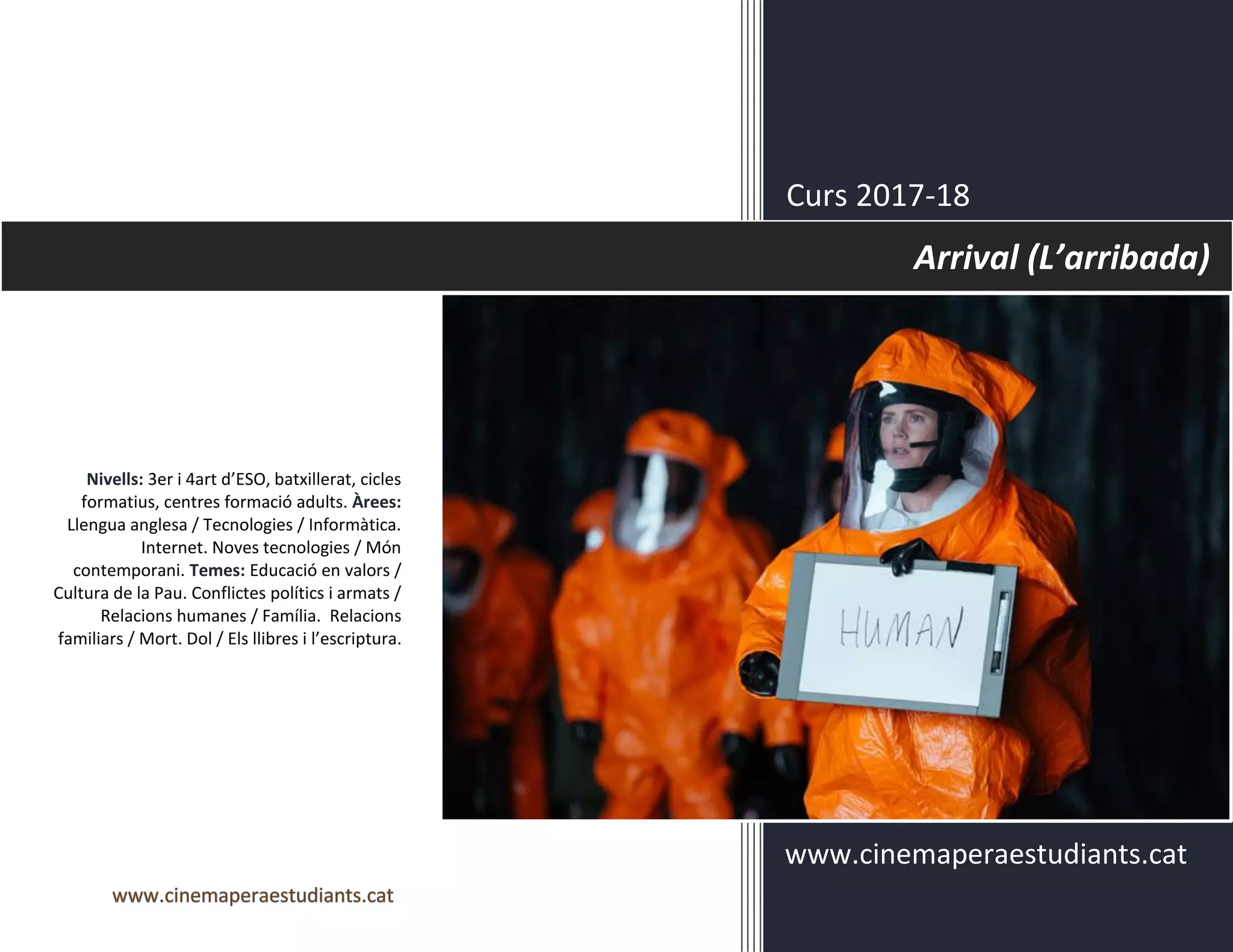
Arrival (L’arribada)
Nivells: 3er i 4art d’ESO, batxillerat, cicles
formatius, centres formació adults. Àrees:
Llengua anglesa / Tecnologies / Informàtica.
Internet. Noves tecnologies / Món
contemporani. Temes: Educació en valors /
Cultura de la Pau. Conflictes polítics i armats /
Relacions humanes / Família. Relacions
familiars / Mort. Dol / Els llibres i l’escriptura.
.
11
Suggeriments per al professorat
El dossier que us fem arribar conté un
seguit d’activitats per treballar amb
l’alumnat dins l’aula abans o després
de la projecció. Aquestes activitats són
opcionals, deixant al vostre criteri, a
partir del coneixement real que teniu
del vostre alumnat, la manera de
treballar el film.
Direcció i concepció gràfica
Cinema per a estudiants
Activitats i adaptació de textos
Abel Gálvez i José Pica
ÍNDEX PÀGINES
Fitxa tècnica i artística. Sinopsi ….............................................….... 2
ACTIVITIES IN ENGLISH
The plot of the film. Reading Comprehension …………………………….…...……………………… 3
Who is who in the film? ………………………………….…...…………………….…...……………………… 4
The purpose of the aliens. Why are they here? ………….………….……………………………….. 5
Indirect questions. Reported speech ………..……..………………….…………….....……………….. 6
Arrive in / Arrive at ….……………………………..……………………………………………..……………….. 7
Phrasal verbs in journeys ….……………………………..….…………………...……………..…………….. 8
The creation of Esperanto. Reading Comprehension ……..…………….……….……………….. 9 - 10
A short history of languages ……….………………….……………………………...……..……………….. 11
A history of writing instruments ………..……..………..…..……….……….……………..…………….. 12
22
FITXA TÈCNICA I ARTÍSTICA
Direcció: Denis Villeneuve. Interpretació: Amy Adams, Jeremy Renner,
Forest Whitaker, Michael Stuhlbarg. Guió: Eric Heisserer, basat en el relat
curt The Story of Your Life, de Ted Chiang. Gènere: ciència-ficció. País:
EUA. Any: 2016. Durada: 116 min.
SINOPSI
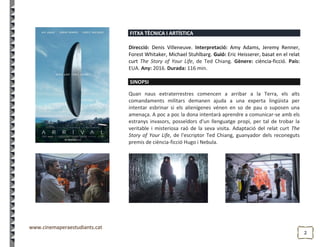
Quan naus extraterrestres comencen a arribar a la Terra, els alts
comandaments militars demanen ajuda a una experta lingüista per
intentar esbrinar si els alienígenes vénen en so de pau o suposen una
amenaça. A poc a poc la dona intentarà aprendre a comunicar-se amb els
estranys invasors, posseïdors d'un llenguatge propi, per tal de trobar la
veritable i misteriosa raó de la seva visita. Adaptació del relat curt The
Story of Your Life, de l'escriptor Ted Chiang, guanyador dels reconeguts
premis de ciència-ficció Hugo i Nebula.
33
ACTIVITY ONE - THE PLOT OF THE FILM
Read the plot of Arrival and then choose the correct
true answer for each question.
1- Louise Banks teaches… a) literature in Montana b)
linguistics at University c) physics in Massachusetts.
2- Hannah, Louise’s daughter… a) dies at a very young age
b) gets an incurable disease from the aliens c) loves
singing and dancing.
3- One day, twelve alien spacecraft … a) arrive in different
American cities. b) surround the state of Massachusetts
c) appear in several places on our planet.
4- Ian Donelly is a … a) doctor who tries to heal Hannah b) a
soldier working at the military camp of Montana c) a
physicist who will help Louise in her quest.
5- Ian and Louise … a) are abducted by the aliens b) are
taken to China to speak with the aliens c) are recruited by
General Weber.
6- The soldiers call the aliens heptapods… a) because they
have seven limbs b) because there are seven specimens
in the spaceship. c) because they only have seven words
in their language.
7- The symbols of the alien language… a) show different
images of their planet b) are similar to our letters of the
alphabet c) are circular and written with a strange ink.
8- As Louise is deciphering the new language … a) she starts
to realize that humanity is in danger b) she starts having
visions of her daughter c) she misses her dead father a
lot.
9- Louise’s translation of an alien symbol … a) is entirely
different from a translation offered at another site b)
starts a heated discussion among the soldiers c) makes
Colonel Weber angry about the discovery.
10- After this discovery… a) the Chinese decide to
collaborate with the Americans b) the Chinese choose to
attack the aliens c) the Americans decide to kill the aliens
in the spaceship.
The film opens with a sequence of scenes showing a woman, Louise Banks and her
relationship with her daughter Hannah, from her birth, through childhood and to her
premature death as a young girl from an incurable disease. Louise Banks is a linguist
who lectures at a Massachusetts university. One day everything changes forever when
twelve extraterrestrial spacecraft appear at twelve different locations across Earth.
U.S. Army Colonel G.T. Weber comes to her university to ask Louise to join physicist
Ian Donnelly and find out why the aliens have come to our planet. She is brought to an
army camp in Montana near one of the spacecraft. They make contact with two
strange seven-limbed aliens, whom they call "heptapods" and Ian nicknames them
Abbott and Costello.
Louise discovers that they have a written language of complicated circular symbols,
written in a substance analogous to ink, or dark smoke, and she begins to learn a basic
vocabulary. As she becomes more proficient, she starts to have visions of herself with
her daughter and of their relationship with the absent father. After several meetings
with the aliens, Louise and Ian manage to translate their language and somehow
manage to communicate with them.
When Louise finally asks why the aliens have come to Earth, they answer “offer
weapon”. An alternate translation of "use weapon" is made at another site. This leads
China to break off communications with the rest of the world and other nations also
stop exchanging information. Chinese General Chang is the leader of the Chinese army,
and as they grow impatient, they plan to start the attack on the spaceships.
However, Louise argues that the symbol interpreted as "weapon" might mean
"tool", providing an entirely different approach which could not involve any violence at
all. In a desperate countdown, Louise and Ian will discover how important
communication is and how flexible the borders of space and time are when your mind
is open to a new perspective of understanding the world around you.
44
ACTIVITY TWO - WHO IS WHO IN THE FILM?
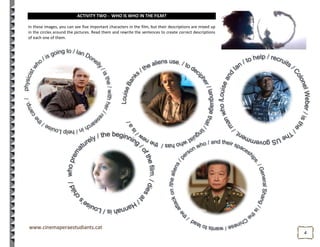
In these images, you can see five important characters in the film, but their descriptions are mixed up
in the circles around the pictures. Read them and rewrite the sentences to create correct descriptions
of each one of them.
55
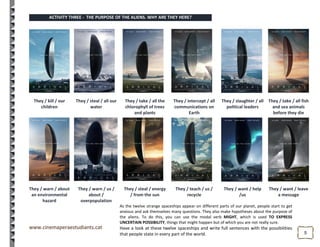
They / kill / our
children
They / steal / all our
water
They / take / all the
chlorophyll of trees
and plants
They / intercept / all
communications on
Earth
They / slaughter / all
political leaders
They / take / all fish
and sea animals
before they die
They / warn / about
an environmental
hazard
They / warn / us /
about /
overpopulation
They / steal / energy
/ from the sun
They / teach / us /
recycle
They / want / help
/us
They / want / leave
a message
As the twelve strange spaceships appear on different parts of our planet, people start to get
anxious and ask themselves many questions. They also make hypotheses about the purpose of
the aliens. To do this, you can use the modal verb MIGHT, which is used TO EXPRESS
UNCERTAIN POSSIBILITY, things that might happen but of which you are not really sure.
Have a look at these twelve spaceships and write full sentences with the possibilities
that people state in every part of the world.
ACTIVITY THREE - THE PURPOSE OF THE ALIENS. WHY ARE THEY HERE?
66
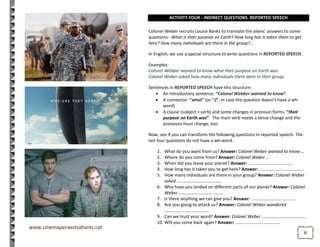
ACTIVITY FOUR - INDIRECT QUESTIONS. REPORTED SPEECH
Colonel Weber recruits Louise Banks to translate the aliens’ answers to some
questions: What is their purpose on Earth? How long has it taken them to get
here? How many individuals are there in the group?...
In English, we use a special structure to write questions in REPORTED SPEECH.
Examples:
Colonel Webber wanted to know what their purpose on Earth was.
Colonel Weber asked how many individuals there were in their group.
Sentences in REPORTED SPEECH have this structure:
 An introductory sentence: “Colonel Webber wanted to know”
 A connector: “what” (or “if”, in case the question doesn’t have a wh-
word)
 A clause (subject + verb) and some changes in pronoun forms: “their
purpose on Earth was”. The main verb needs a tense change and the
pronouns must change, too.
Now, see if you can transform the following questions in reported speech. The
last four questions do not have a wh-word.
1. What do you want from us? Answer: Colonel Weber wanted to know …
2. Where do you come from? Answer: Colonel Weber …
3. When did you leave your planet? Answer: ………………………………….
4. How long has it taken you to get here? Answer: ………………………………….
5. How many individuals are there in your group? Answer: Colonel Weber
asked ………………………………….
6. Why have you landed on different parts of our planet? Answer: Colonel
Weber ………………………………….
7. Is there anything we can give you? Answer: ………………………………….
8. Are you going to attack us? Answer: Colonel Weber wondered
………………………………….
9. Can we trust your word? Answer: Colonel Weber ………………………………….
10. Will you come back again? Answer: ………………………………….
77
ACTIVITY FIVE – ARRIVE IN / ARRIVE AT
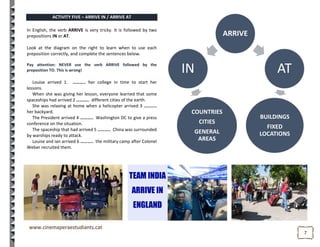
In English, the verb ARRIVE is very tricky. It is followed by two
prepositions IN or AT.
Look at the diagram on the right to learn when to use each
preposition correctly, and complete the sentences below.
Pay attention: NEVER use the verb ARRIVE followed by the
preposition TO. This is wrong!
Louise arrived 1. ……….. her college in time to start her
lessons.
When she was giving her lesson, everyone learned that some
spaceships had arrived 2 ……….. different cities of the earth.
She was relaxing at home when a helicopter arrived 3 ………..
her backyard.
The President arrived 4 ……….. Washington DC to give a press
conference on the situation.
The spaceship that had arrived 5 ……….. China was surrounded
by warships ready to attack.
Louise and Ian arrived 6 ……….. the military camp after Colonel
Weber recruited them.
ARRIVE
AT
BUILDINGS
FIXED
LOCATIONS
COUNTRIES
CITIES
GENERAL
AREAS
IN
88
ACTIVITY SIX - PHRASAL VERBS IN JOURNEYS
All the sentences below are related to journeys
and travelling. Read them and choose the right
preposition that completes the phrasal verb or
choose the correct phrasal verb out of the
three options.
1- Before you go to passport control, you need
to check away/off/in your bags.
2- Drivers have to slow down/up/under when
they are travelling through towns.
3- If you want to get off/away/out the bus
now, press the bell.
4- The Olympic team will fly out/away/on
from Heathrow Airport today.
5- We need to get on/back/up to the hotel
before dinnertime.
6- The plane touched down/on/up safely and
the passengers got out.
7- We got away/continued out/set off on our
trek at dawn.
8- Hurry! The plane will touch up/take off/get
away in twenty minutes!
9- We came across/went into/ met round
some amazing people while we were
travelling.
10- We were late home because our car broke
down/crashed up/ fell out on the way.
11- I’m so bored at work. I need to go out/get
away/travel apart from it all for a while.
12- Even though we were lost, we still carried
on/kept under/moved further walking.
99
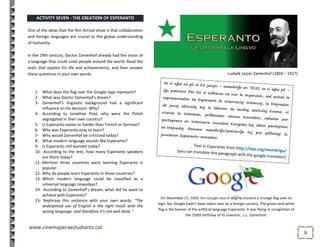
Ludwik Lejzer Zamenhof (1859 – 1917)
On December 15, 2009, the Google search engine showed a strange flag over its
logo. No, Google hadn't been taken over by a foreign country. The green-and-white
flag is the banner of the artificial language Esperanto. It was flying in recognition of
the 150th birthday of its inventor, L.L. Zamenhof.
ACTIVITY SEVEN - THE CREATION OF ESPERANTO
One of the ideas that the film Arrival show is that collaboration
and foreign languages are crucial to the global understanding
of humanity.
In the 19th century, Doctor Zamenhof already had the vision of
a language that could unite people around the world. Read the
texts that explain his life and achievements, and then answer
these questions in your own words.
1- What does the flag over the Google logo represent?
2- What was Doctor Zamenhof’s dream?
3- Zamenhof’s linguistic background had a significant
influence on his decision. Why?
4- According to Jonathan Pool, why were the Polish
segregated in their own country?
5- Is Esperanto easier or harder than French or German?
6- Why was Esperanto easy to learn?
7- Why would Zamenhof be criticized today?
8- What modern language sounds like Esperanto?
9- Is Esperanto still learned today?
10- According to the text, how many Esperanto speakers
are there today?
11- Mention three countries were learning Esperanto is
popular.
12- Why do people learn Esperanto in these countries?
13- Which modern language could be classified as a
universal language nowadays?
14- According to Zamenhof’s dream, what did he want to
achieve with Esperanto?
15- Rephrase this sentence with your own words: “The
widespread use of English is the right result with the
wrong language, and therefore it’s not well done.”
1010
L.L. ZAMENHOF: WHO HE WAS
Born on December 15, 1859, in Bialystok, Poland, Ludwik Lejzer
Zamenhof was a doctor and linguist who dreamed of a universal
second language that could unite people around the world.
L.L. Zamenhof wrote under the pseudonym Doktoro Esperanto
(Doctor Hopeful). "He grew up in a very contentious, divisive
location in Poland, where there were speakers of at least four
different languages near each other. This led to a lot of ethnic
animosities" says Jonathan Pool, the founder of
the Utilika Foundation, a nonprofit organization
devoted to universal communication. This
foundation is based in Seattle, Washington.
Zamenhof's "analysis was that they could not
understand each other because of their
languages" says Pool, who is a fluent Esperanto
speaker.
L.L. ZAMENHOF AND THE BIRTH OF ESPERANTO
L.L. Zamenhof decided to create an easy second
language that people could use to transcend
barriers. According to some experiments,
Esperanto is about five times easier to learn than
"natural" languages such as French or German, Pool says.
Drawing on a variety of Indo-European languages, including
English, Spanish, German, and French, Zamenhof created a language
with a simple syntax and morphology, which he eventually called
Esperanto.
Zamenhof "didn't know Chinese or Japanese or any of the African
languages," Pool says. "By today's standard, he was very
Eurocentric, but he was as international as he could."A few years
after he had fine-tuned his language, Zamenhof gave up control of it
to its users”.
"Zamenhof looked up recent cases of attempts at creating
artificial languages, and he saw that in these projects their inventors
kept grasping their languages and trying to control and modify
them. It created much animosity among its speakers," Pool says.
ENGLISH'S RISE WOULD TROUBLE L.L. ZAMENHOF?
Esperanto, which sounds like Italian to many non-speakers, is still
learned and used by people around the world,
but it is not a widely spoken language.
"There's no place in the world where you can
walk down the street and ask a question in
Esperanto and think there's more than a 50
percent chance that anyone is going to be able
to answer you," Pool says.
Nowadays the number of Esperanto
speakers worldwide is between half a million
and a few million. Many of them are in Japan,
Korea, Brazil, Bulgaria, and Poland.
"There's a tendency for people in countries
whose languages are rarely learned
internationally to learn Esperanto," Pool said.
The closest thing to a universal human
language today is English, he added, but English in many ways fails
to live up to Zamenhof's dream, which was to help create a more
egalitarian world.
Unlike with Esperanto, with English, "you can always tell a non-
native speaker by the accent and the little mistakes that a native
speaker never makes," Pool said.
"Zamenhof would say that the widespread use of English is the
right result with the wrong language, and therefore it is not well
done. It is going to classify most of the world as second-class citizens
permanently.
1111
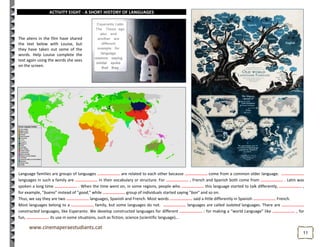
ACTIVITY EIGHT - A SHORT HISTORY OF LANGUAGES
Language families are groups of languages ................... are related to each other because ................... come from a common older language. ...................
languages in such a family are ................... in their vocabulary or structure. For ................... , French and Spanish both come from ................... . Latin was
spoken a long time ................... . When the time went on, in some regions, people who ................... this language started to talk differently, ................... ,
for example, "bueno" instead of “good,” while ................... group of individuals started saying "bon" and so on.
Thus, we say they are two ................... languages, Spanish and French. Most words ................... said a little differently in Spanish ................... French.
Most languages belong to a ................... family, but some languages do not. ................... languages are called isolated languages. There are ...................
constructed languages, like Esperanto. We develop constructed languages for different ................... : for making a “world Language” like ................... , for
fun, ................... its use in some situations, such as fiction, science (scientific language)...
The aliens in the film have shared
the text below with Louise, but
they have taken out some of the
words. Help Louise complete the
text again using the words she sees
on the screen.
1212
a-
b-
c-
d- e- f-
g- h- i-
The problem with the infographic is that the
designer accidentally dropped nine ink blots on
top of the images of the writing instruments, so it
is your turn to read the descriptions and match
them to the corresponding images from the box
below.
ACTIVITY NINE - THE HISTORY OF WRITING INSTRUMENTS
The aliens in Arrival communicate with Louise and Ian via a strange written
language made with a mix of ink and smoke circle sentences.
Writing has been a great invention in the history of humanity and so have been
their writing instruments. In this infographic, you can read about nine different
writing instruments, from prehistoric times till the present day.
1313
info@cinemaperaestudiants.cat

ARRIVAL- ACTIVITY PACK

  • 1.
    00 Curs 2017-18 www.cinemaperaestudiants.cat Arrival (L’arribada) Nivells:3er i 4art d’ESO, batxillerat, cicles formatius, centres formació adults. Àrees: Llengua anglesa / Tecnologies / Informàtica. Internet. Noves tecnologies / Món contemporani. Temes: Educació en valors / Cultura de la Pau. Conflictes polítics i armats / Relacions humanes / Família. Relacions familiars / Mort. Dol / Els llibres i l’escriptura. .
  • 2.
    11 Suggeriments per alprofessorat El dossier que us fem arribar conté un seguit d’activitats per treballar amb l’alumnat dins l’aula abans o després de la projecció. Aquestes activitats són opcionals, deixant al vostre criteri, a partir del coneixement real que teniu del vostre alumnat, la manera de treballar el film. Direcció i concepció gràfica Cinema per a estudiants Activitats i adaptació de textos Abel Gálvez i José Pica ÍNDEX PÀGINES Fitxa tècnica i artística. Sinopsi ….............................................….... 2 ACTIVITIES IN ENGLISH The plot of the film. Reading Comprehension …………………………….…...……………………… 3 Who is who in the film? ………………………………….…...…………………….…...……………………… 4 The purpose of the aliens. Why are they here? ………….………….……………………………….. 5 Indirect questions. Reported speech ………..……..………………….…………….....……………….. 6 Arrive in / Arrive at ….……………………………..……………………………………………..……………….. 7 Phrasal verbs in journeys ….……………………………..….…………………...……………..…………….. 8 The creation of Esperanto. Reading Comprehension ……..…………….……….……………….. 9 - 10 A short history of languages ……….………………….……………………………...……..……………….. 11 A history of writing instruments ………..……..………..…..……….……….……………..…………….. 12
  • 3.
    22 FITXA TÈCNICA IARTÍSTICA Direcció: Denis Villeneuve. Interpretació: Amy Adams, Jeremy Renner, Forest Whitaker, Michael Stuhlbarg. Guió: Eric Heisserer, basat en el relat curt The Story of Your Life, de Ted Chiang. Gènere: ciència-ficció. País: EUA. Any: 2016. Durada: 116 min. SINOPSI Quan naus extraterrestres comencen a arribar a la Terra, els alts comandaments militars demanen ajuda a una experta lingüista per intentar esbrinar si els alienígenes vénen en so de pau o suposen una amenaça. A poc a poc la dona intentarà aprendre a comunicar-se amb els estranys invasors, posseïdors d'un llenguatge propi, per tal de trobar la veritable i misteriosa raó de la seva visita. Adaptació del relat curt The Story of Your Life, de l'escriptor Ted Chiang, guanyador dels reconeguts premis de ciència-ficció Hugo i Nebula.
  • 4.
    33 ACTIVITY ONE -THE PLOT OF THE FILM Read the plot of Arrival and then choose the correct true answer for each question. 1- Louise Banks teaches… a) literature in Montana b) linguistics at University c) physics in Massachusetts. 2- Hannah, Louise’s daughter… a) dies at a very young age b) gets an incurable disease from the aliens c) loves singing and dancing. 3- One day, twelve alien spacecraft … a) arrive in different American cities. b) surround the state of Massachusetts c) appear in several places on our planet. 4- Ian Donelly is a … a) doctor who tries to heal Hannah b) a soldier working at the military camp of Montana c) a physicist who will help Louise in her quest. 5- Ian and Louise … a) are abducted by the aliens b) are taken to China to speak with the aliens c) are recruited by General Weber. 6- The soldiers call the aliens heptapods… a) because they have seven limbs b) because there are seven specimens in the spaceship. c) because they only have seven words in their language. 7- The symbols of the alien language… a) show different images of their planet b) are similar to our letters of the alphabet c) are circular and written with a strange ink. 8- As Louise is deciphering the new language … a) she starts to realize that humanity is in danger b) she starts having visions of her daughter c) she misses her dead father a lot. 9- Louise’s translation of an alien symbol … a) is entirely different from a translation offered at another site b) starts a heated discussion among the soldiers c) makes Colonel Weber angry about the discovery. 10- After this discovery… a) the Chinese decide to collaborate with the Americans b) the Chinese choose to attack the aliens c) the Americans decide to kill the aliens in the spaceship. The film opens with a sequence of scenes showing a woman, Louise Banks and her relationship with her daughter Hannah, from her birth, through childhood and to her premature death as a young girl from an incurable disease. Louise Banks is a linguist who lectures at a Massachusetts university. One day everything changes forever when twelve extraterrestrial spacecraft appear at twelve different locations across Earth. U.S. Army Colonel G.T. Weber comes to her university to ask Louise to join physicist Ian Donnelly and find out why the aliens have come to our planet. She is brought to an army camp in Montana near one of the spacecraft. They make contact with two strange seven-limbed aliens, whom they call "heptapods" and Ian nicknames them Abbott and Costello. Louise discovers that they have a written language of complicated circular symbols, written in a substance analogous to ink, or dark smoke, and she begins to learn a basic vocabulary. As she becomes more proficient, she starts to have visions of herself with her daughter and of their relationship with the absent father. After several meetings with the aliens, Louise and Ian manage to translate their language and somehow manage to communicate with them. When Louise finally asks why the aliens have come to Earth, they answer “offer weapon”. An alternate translation of "use weapon" is made at another site. This leads China to break off communications with the rest of the world and other nations also stop exchanging information. Chinese General Chang is the leader of the Chinese army, and as they grow impatient, they plan to start the attack on the spaceships. However, Louise argues that the symbol interpreted as "weapon" might mean "tool", providing an entirely different approach which could not involve any violence at all. In a desperate countdown, Louise and Ian will discover how important communication is and how flexible the borders of space and time are when your mind is open to a new perspective of understanding the world around you.
  • 5.
    44 ACTIVITY TWO -WHO IS WHO IN THE FILM? In these images, you can see five important characters in the film, but their descriptions are mixed up in the circles around the pictures. Read them and rewrite the sentences to create correct descriptions of each one of them.
  • 6.
    55 They / kill/ our children They / steal / all our water They / take / all the chlorophyll of trees and plants They / intercept / all communications on Earth They / slaughter / all political leaders They / take / all fish and sea animals before they die They / warn / about an environmental hazard They / warn / us / about / overpopulation They / steal / energy / from the sun They / teach / us / recycle They / want / help /us They / want / leave a message As the twelve strange spaceships appear on different parts of our planet, people start to get anxious and ask themselves many questions. They also make hypotheses about the purpose of the aliens. To do this, you can use the modal verb MIGHT, which is used TO EXPRESS UNCERTAIN POSSIBILITY, things that might happen but of which you are not really sure. Have a look at these twelve spaceships and write full sentences with the possibilities that people state in every part of the world. ACTIVITY THREE - THE PURPOSE OF THE ALIENS. WHY ARE THEY HERE?
  • 7.
    66 ACTIVITY FOUR -INDIRECT QUESTIONS. REPORTED SPEECH Colonel Weber recruits Louise Banks to translate the aliens’ answers to some questions: What is their purpose on Earth? How long has it taken them to get here? How many individuals are there in the group?... In English, we use a special structure to write questions in REPORTED SPEECH. Examples: Colonel Webber wanted to know what their purpose on Earth was. Colonel Weber asked how many individuals there were in their group. Sentences in REPORTED SPEECH have this structure:  An introductory sentence: “Colonel Webber wanted to know”  A connector: “what” (or “if”, in case the question doesn’t have a wh- word)  A clause (subject + verb) and some changes in pronoun forms: “their purpose on Earth was”. The main verb needs a tense change and the pronouns must change, too. Now, see if you can transform the following questions in reported speech. The last four questions do not have a wh-word. 1. What do you want from us? Answer: Colonel Weber wanted to know … 2. Where do you come from? Answer: Colonel Weber … 3. When did you leave your planet? Answer: …………………………………. 4. How long has it taken you to get here? Answer: …………………………………. 5. How many individuals are there in your group? Answer: Colonel Weber asked …………………………………. 6. Why have you landed on different parts of our planet? Answer: Colonel Weber …………………………………. 7. Is there anything we can give you? Answer: …………………………………. 8. Are you going to attack us? Answer: Colonel Weber wondered …………………………………. 9. Can we trust your word? Answer: Colonel Weber …………………………………. 10. Will you come back again? Answer: ………………………………….
  • 8.
    77 ACTIVITY FIVE –ARRIVE IN / ARRIVE AT In English, the verb ARRIVE is very tricky. It is followed by two prepositions IN or AT. Look at the diagram on the right to learn when to use each preposition correctly, and complete the sentences below. Pay attention: NEVER use the verb ARRIVE followed by the preposition TO. This is wrong! Louise arrived 1. ……….. her college in time to start her lessons. When she was giving her lesson, everyone learned that some spaceships had arrived 2 ……….. different cities of the earth. She was relaxing at home when a helicopter arrived 3 ……….. her backyard. The President arrived 4 ……….. Washington DC to give a press conference on the situation. The spaceship that had arrived 5 ……….. China was surrounded by warships ready to attack. Louise and Ian arrived 6 ……….. the military camp after Colonel Weber recruited them. ARRIVE AT BUILDINGS FIXED LOCATIONS COUNTRIES CITIES GENERAL AREAS IN
  • 9.
    88 ACTIVITY SIX -PHRASAL VERBS IN JOURNEYS All the sentences below are related to journeys and travelling. Read them and choose the right preposition that completes the phrasal verb or choose the correct phrasal verb out of the three options. 1- Before you go to passport control, you need to check away/off/in your bags. 2- Drivers have to slow down/up/under when they are travelling through towns. 3- If you want to get off/away/out the bus now, press the bell. 4- The Olympic team will fly out/away/on from Heathrow Airport today. 5- We need to get on/back/up to the hotel before dinnertime. 6- The plane touched down/on/up safely and the passengers got out. 7- We got away/continued out/set off on our trek at dawn. 8- Hurry! The plane will touch up/take off/get away in twenty minutes! 9- We came across/went into/ met round some amazing people while we were travelling. 10- We were late home because our car broke down/crashed up/ fell out on the way. 11- I’m so bored at work. I need to go out/get away/travel apart from it all for a while. 12- Even though we were lost, we still carried on/kept under/moved further walking.
  • 10.
    99 Ludwik Lejzer Zamenhof(1859 – 1917) On December 15, 2009, the Google search engine showed a strange flag over its logo. No, Google hadn't been taken over by a foreign country. The green-and-white flag is the banner of the artificial language Esperanto. It was flying in recognition of the 150th birthday of its inventor, L.L. Zamenhof. ACTIVITY SEVEN - THE CREATION OF ESPERANTO One of the ideas that the film Arrival show is that collaboration and foreign languages are crucial to the global understanding of humanity. In the 19th century, Doctor Zamenhof already had the vision of a language that could unite people around the world. Read the texts that explain his life and achievements, and then answer these questions in your own words. 1- What does the flag over the Google logo represent? 2- What was Doctor Zamenhof’s dream? 3- Zamenhof’s linguistic background had a significant influence on his decision. Why? 4- According to Jonathan Pool, why were the Polish segregated in their own country? 5- Is Esperanto easier or harder than French or German? 6- Why was Esperanto easy to learn? 7- Why would Zamenhof be criticized today? 8- What modern language sounds like Esperanto? 9- Is Esperanto still learned today? 10- According to the text, how many Esperanto speakers are there today? 11- Mention three countries were learning Esperanto is popular. 12- Why do people learn Esperanto in these countries? 13- Which modern language could be classified as a universal language nowadays? 14- According to Zamenhof’s dream, what did he want to achieve with Esperanto? 15- Rephrase this sentence with your own words: “The widespread use of English is the right result with the wrong language, and therefore it’s not well done.”
  • 11.
    1010 L.L. ZAMENHOF: WHOHE WAS Born on December 15, 1859, in Bialystok, Poland, Ludwik Lejzer Zamenhof was a doctor and linguist who dreamed of a universal second language that could unite people around the world. L.L. Zamenhof wrote under the pseudonym Doktoro Esperanto (Doctor Hopeful). "He grew up in a very contentious, divisive location in Poland, where there were speakers of at least four different languages near each other. This led to a lot of ethnic animosities" says Jonathan Pool, the founder of the Utilika Foundation, a nonprofit organization devoted to universal communication. This foundation is based in Seattle, Washington. Zamenhof's "analysis was that they could not understand each other because of their languages" says Pool, who is a fluent Esperanto speaker. L.L. ZAMENHOF AND THE BIRTH OF ESPERANTO L.L. Zamenhof decided to create an easy second language that people could use to transcend barriers. According to some experiments, Esperanto is about five times easier to learn than "natural" languages such as French or German, Pool says. Drawing on a variety of Indo-European languages, including English, Spanish, German, and French, Zamenhof created a language with a simple syntax and morphology, which he eventually called Esperanto. Zamenhof "didn't know Chinese or Japanese or any of the African languages," Pool says. "By today's standard, he was very Eurocentric, but he was as international as he could."A few years after he had fine-tuned his language, Zamenhof gave up control of it to its users”. "Zamenhof looked up recent cases of attempts at creating artificial languages, and he saw that in these projects their inventors kept grasping their languages and trying to control and modify them. It created much animosity among its speakers," Pool says. ENGLISH'S RISE WOULD TROUBLE L.L. ZAMENHOF? Esperanto, which sounds like Italian to many non-speakers, is still learned and used by people around the world, but it is not a widely spoken language. "There's no place in the world where you can walk down the street and ask a question in Esperanto and think there's more than a 50 percent chance that anyone is going to be able to answer you," Pool says. Nowadays the number of Esperanto speakers worldwide is between half a million and a few million. Many of them are in Japan, Korea, Brazil, Bulgaria, and Poland. "There's a tendency for people in countries whose languages are rarely learned internationally to learn Esperanto," Pool said. The closest thing to a universal human language today is English, he added, but English in many ways fails to live up to Zamenhof's dream, which was to help create a more egalitarian world. Unlike with Esperanto, with English, "you can always tell a non- native speaker by the accent and the little mistakes that a native speaker never makes," Pool said. "Zamenhof would say that the widespread use of English is the right result with the wrong language, and therefore it is not well done. It is going to classify most of the world as second-class citizens permanently.
  • 12.
    1111 ACTIVITY EIGHT -A SHORT HISTORY OF LANGUAGES Language families are groups of languages ................... are related to each other because ................... come from a common older language. ................... languages in such a family are ................... in their vocabulary or structure. For ................... , French and Spanish both come from ................... . Latin was spoken a long time ................... . When the time went on, in some regions, people who ................... this language started to talk differently, ................... , for example, "bueno" instead of “good,” while ................... group of individuals started saying "bon" and so on. Thus, we say they are two ................... languages, Spanish and French. Most words ................... said a little differently in Spanish ................... French. Most languages belong to a ................... family, but some languages do not. ................... languages are called isolated languages. There are ................... constructed languages, like Esperanto. We develop constructed languages for different ................... : for making a “world Language” like ................... , for fun, ................... its use in some situations, such as fiction, science (scientific language)... The aliens in the film have shared the text below with Louise, but they have taken out some of the words. Help Louise complete the text again using the words she sees on the screen.
  • 13.
    1212 a- b- c- d- e- f- g-h- i- The problem with the infographic is that the designer accidentally dropped nine ink blots on top of the images of the writing instruments, so it is your turn to read the descriptions and match them to the corresponding images from the box below. ACTIVITY NINE - THE HISTORY OF WRITING INSTRUMENTS The aliens in Arrival communicate with Louise and Ian via a strange written language made with a mix of ink and smoke circle sentences. Writing has been a great invention in the history of humanity and so have been their writing instruments. In this infographic, you can read about nine different writing instruments, from prehistoric times till the present day.
  • 14.