Affymetrix CytoScan HD array
CytoScan HD vs current array
• Current array (CGH based)
– patient + reference DNA required (two color)
– utilizes Cy dyes – ozone sensitive
– copy number probes only (135 K)
• CytoScan HD array (not CGH based)
– patient DNA only (single color)
– in silico reference based on >300 normal
individuals and cell lines
– utilizes phycoerythrin – not ozone sensitive
– copy number probes (1.9 million) + SNP (750 K)
Coverage
• Average marker spacing:
– ISCA genes – 384 bp
– OMIM genes – 659 bp
– X chromosome OMIM genes – 486 bp
– RefSeq genes – 880 bp
– Intergenic backbone – 1737 bp
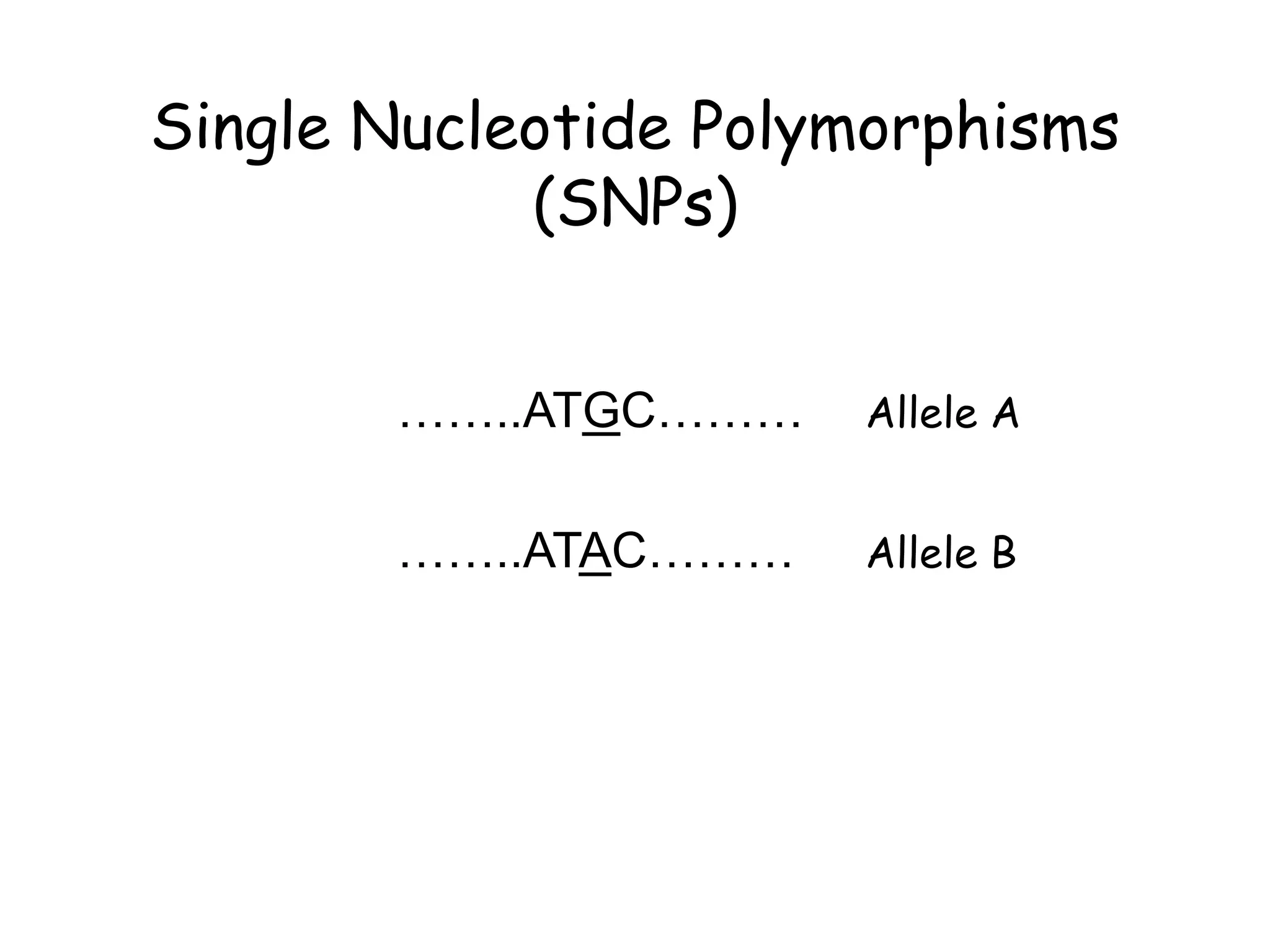
Single Nucleotide Polymorphisms
(SNPs)
……..ATGC………
……..ATAC………
Allele A
Allele B
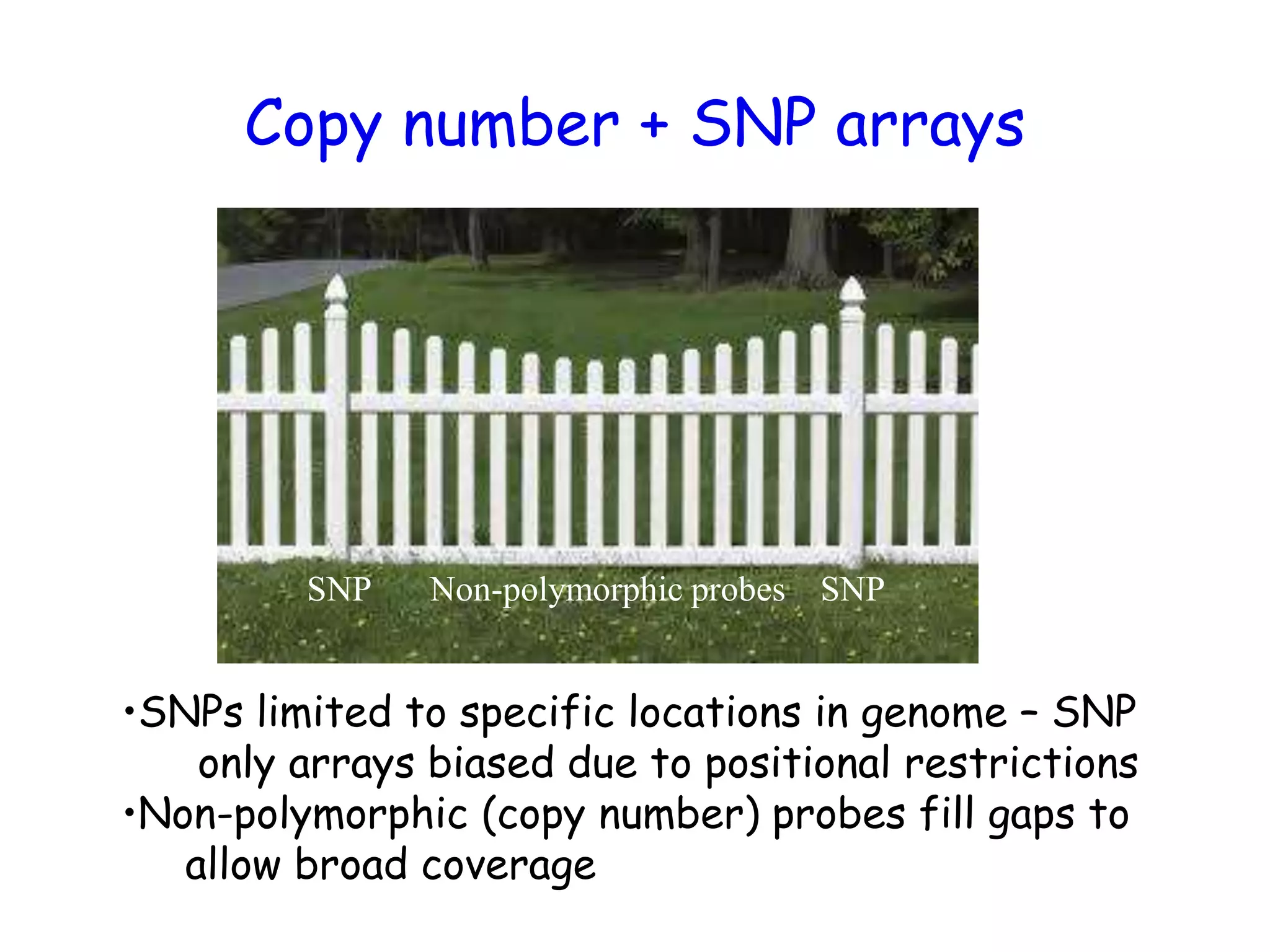
Copy number + SNP arrays
Non-polymorphic probes
SNP SNP
•SNPs limited to specific locations in genome – SNP
only arrays biased due to positional restrictions
•Non-polymorphic (copy number) probes fill gaps to
allow broad coverage
Improvements of CytoScan HD over
Affy SNP 6.0
• Improved software
• Much less noise
– Probes empirically chosen based on
performance
• 20 million probes screened
– All reagents centrally manufactured and
provided as kits
– Streamlined procedure – only one
restriction digest, ~half the steps, less
hands-on time
Other potential benefits of CytoScan
• Affy filing for FDA clearance
• CytoScan currently has best coverage
on single array for both constitutional
and neoplastic cases
• Other large clinical labs switching to
CytoScan (LabCorp, ARUP)
• Copy number + SNP arrays -
detect copy number changes and
allele frequencies
– SNPs can detect uniparental isodisomy,
consanguinity
– more sensitive for detection of
mosaicism
– independent confirmation of copy
number findings and better breakpoint
determination
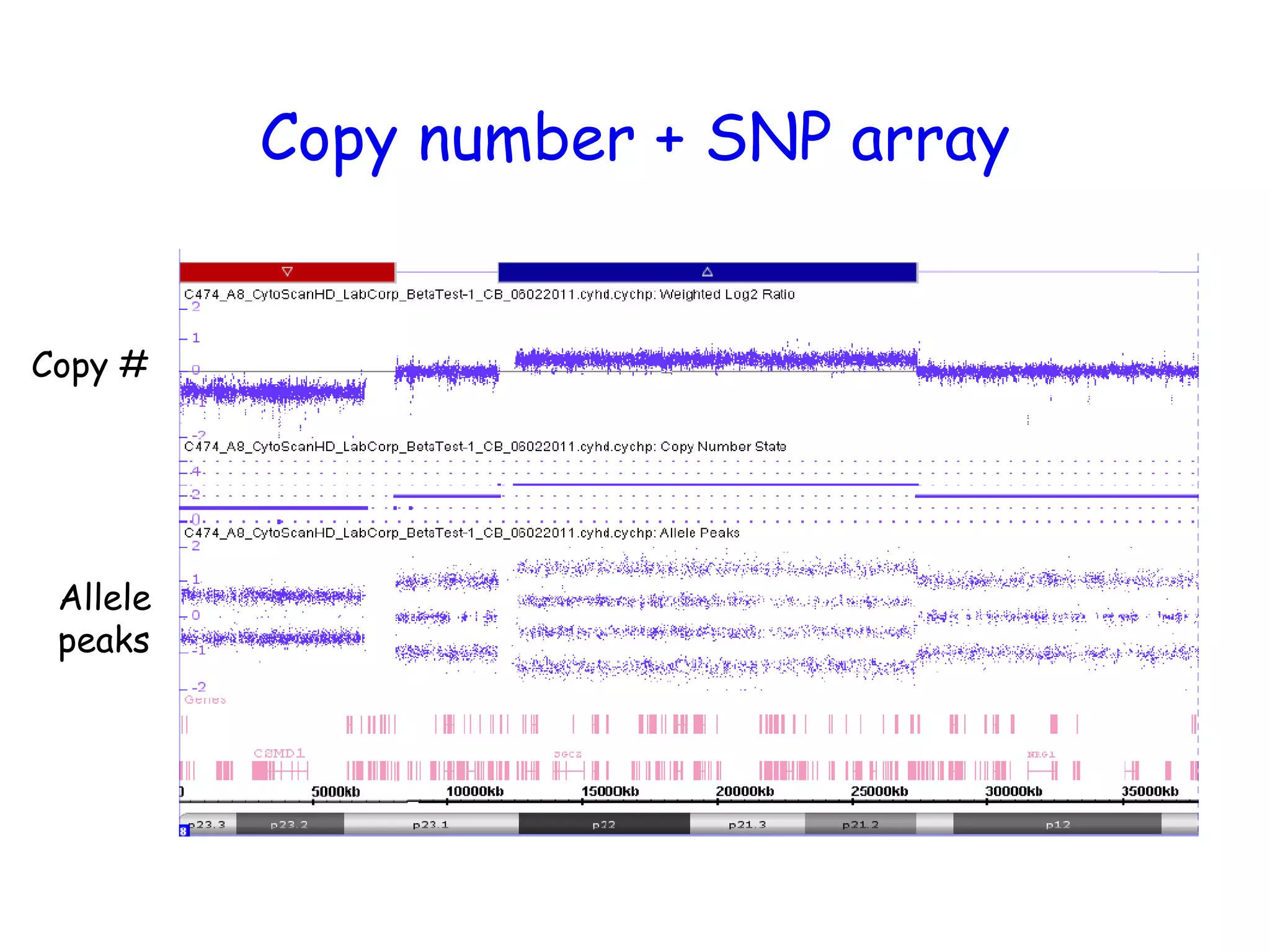
Copy number + SNP array
Copy #
Allele
peaks
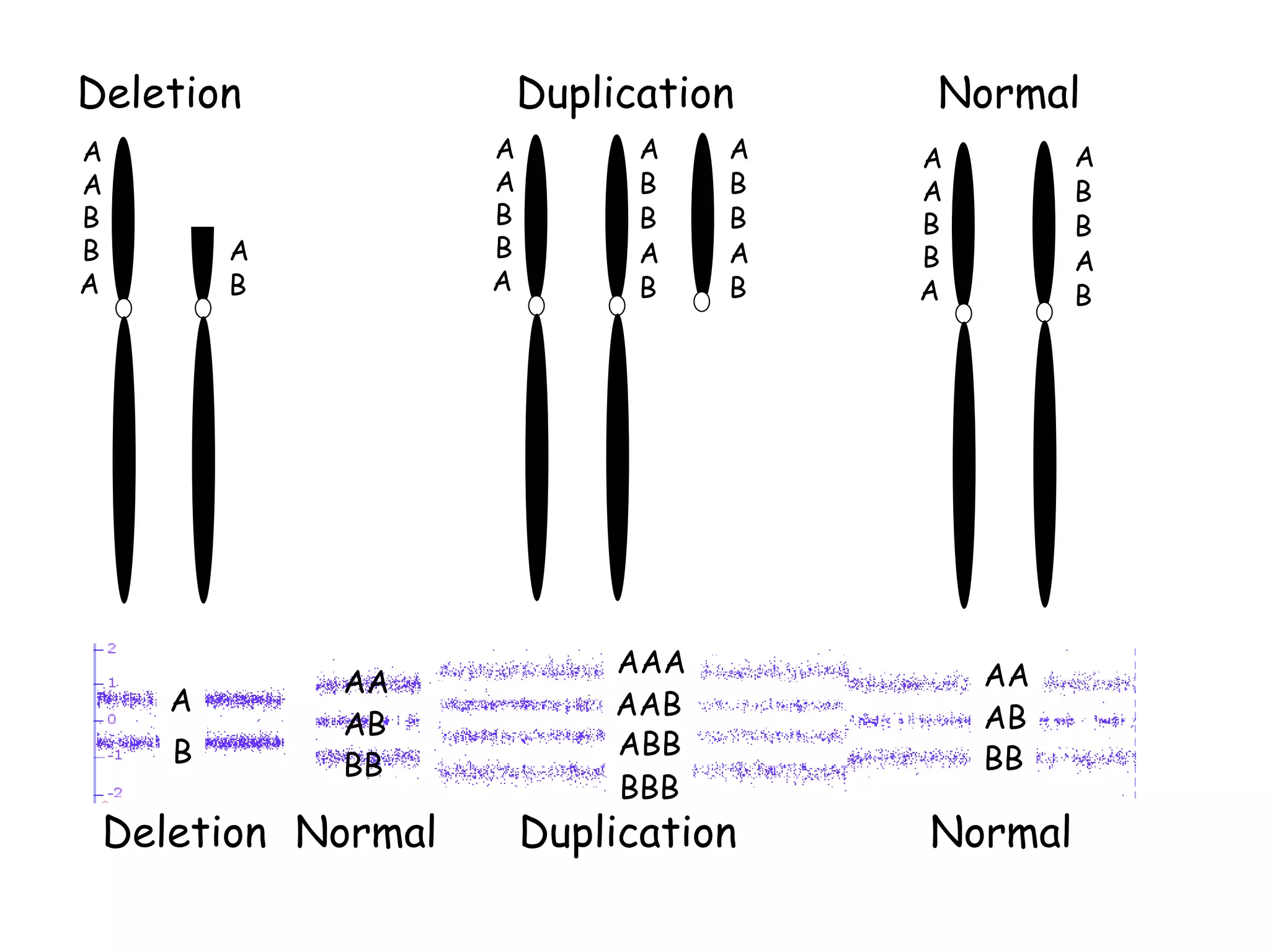
AA
AB
BB
Deletion Normal Duplication Normal
AA
AB
BB
A
AAA
BBB
B
AAB
ABB
B
B
A
A
A
A
B
B
A
B
Normal
Deletion
B
B
A
A
A
A
B
B
B
A
A
A
Duplication
A
B
B
A
B
A
B
B
A
B
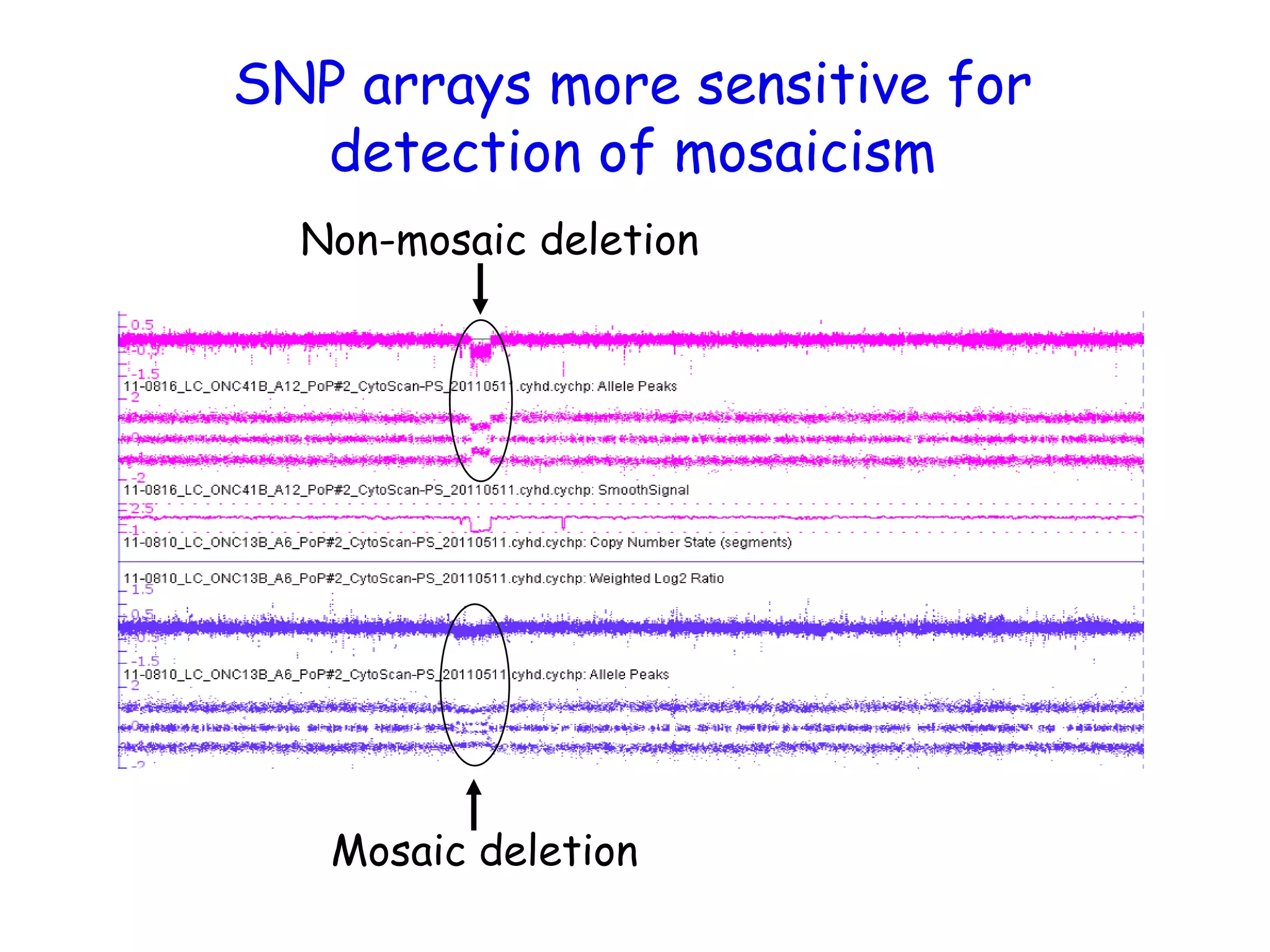
SNP arrays more sensitive for
detection of mosaicism
Non-mosaic deletion
Mosaic deletion
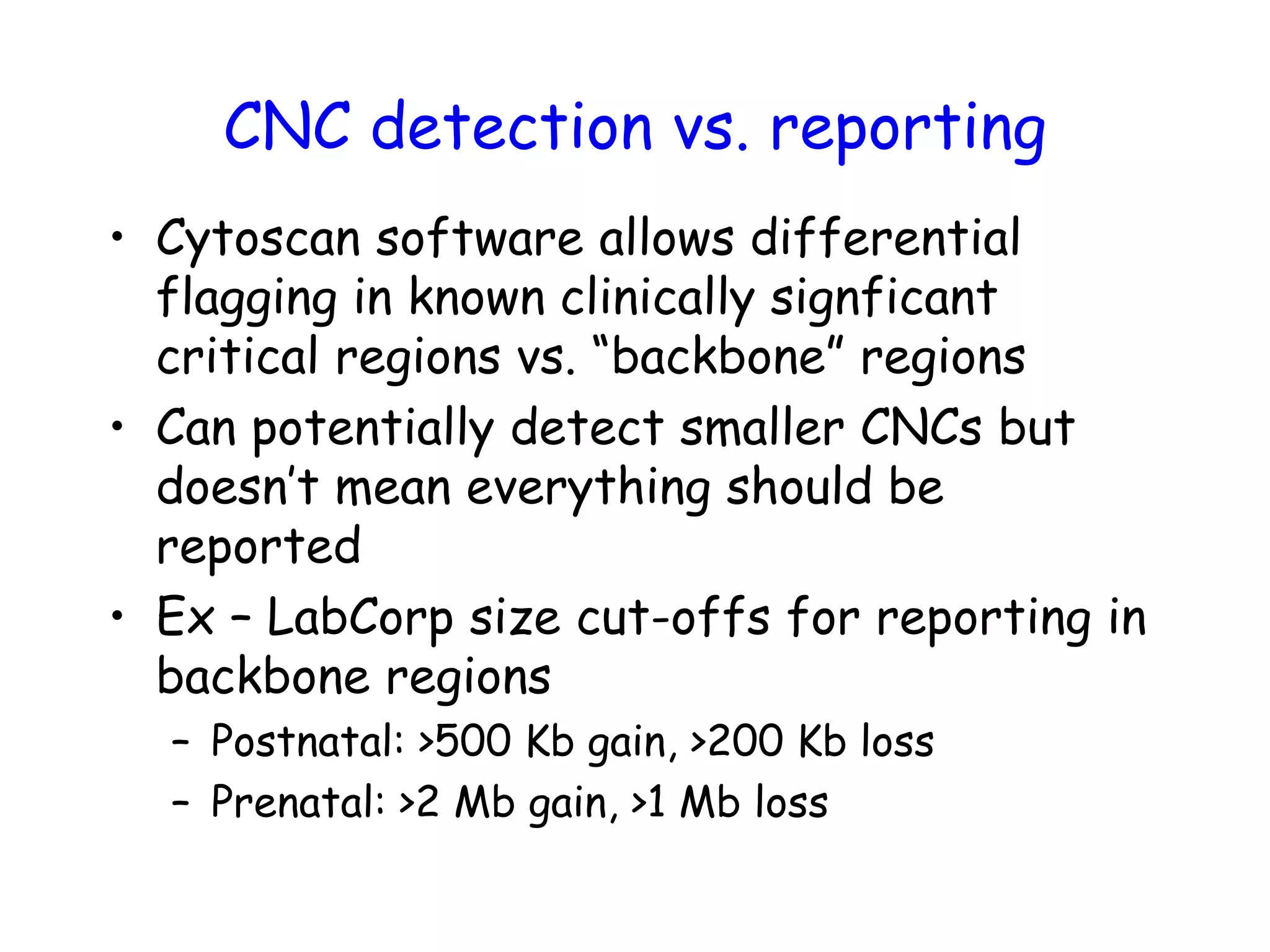
CNC detection vs. reporting
• Cytoscan software allows differential
flagging in known clinically signficant
critical regions vs. “backbone” regions
• Can potentially detect smaller CNCs but
doesn’t mean everything should be
reported
• Ex – LabCorp size cut-offs for reporting in
backbone regions
– Postnatal: >500 Kb gain, >200 Kb loss
– Prenatal: >2 Mb gain, >1 Mb loss
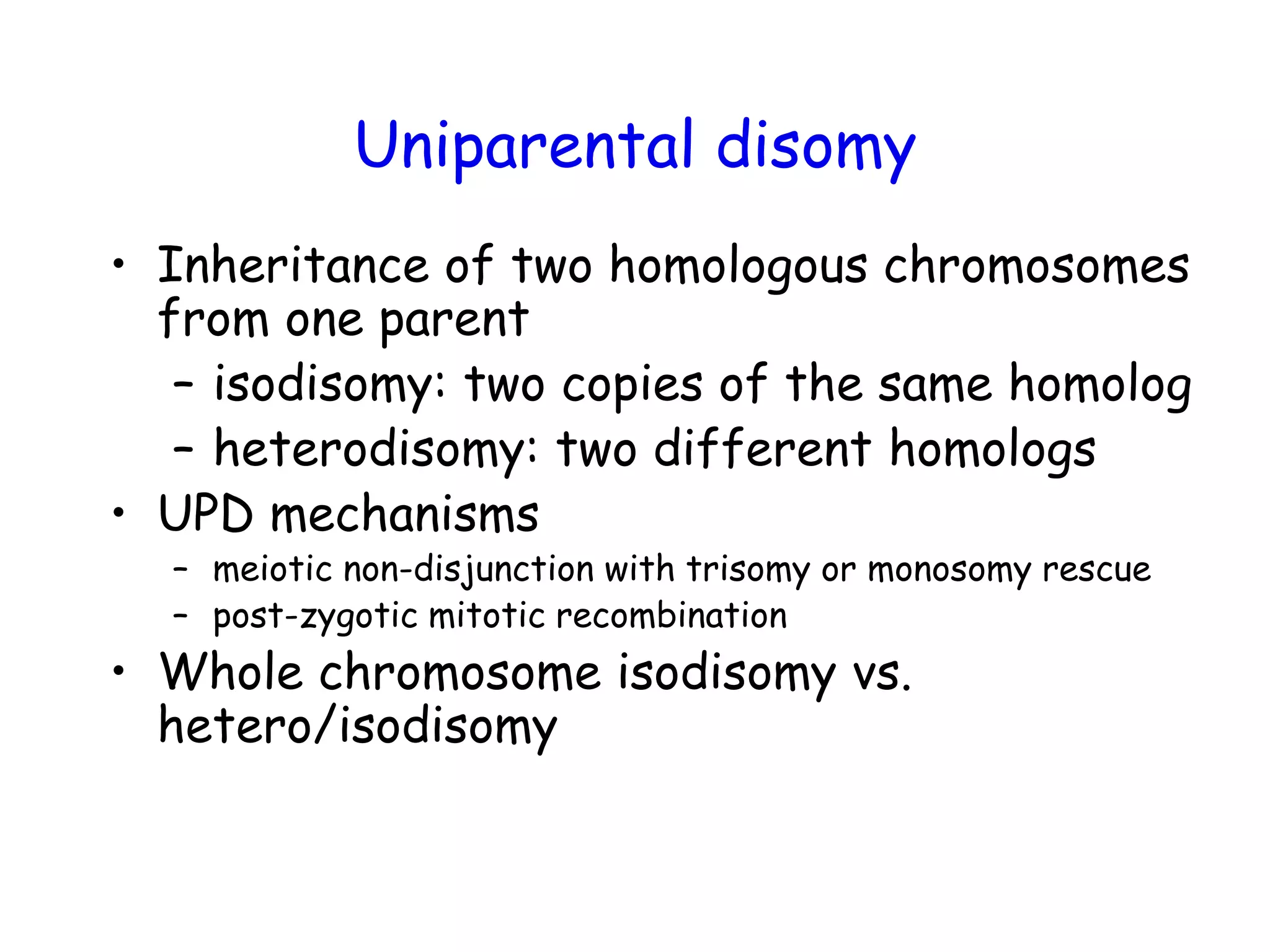
Uniparental disomy
• Inheritance of two homologous chromosomes
from one parent
– isodisomy: two copies of the same homolog
– heterodisomy: two different homologs
• UPD mechanisms
– meiotic non-disjunction with trisomy or monosomy rescue
– post-zygotic mitotic recombination
• Whole chromosome isodisomy vs.
hetero/isodisomy
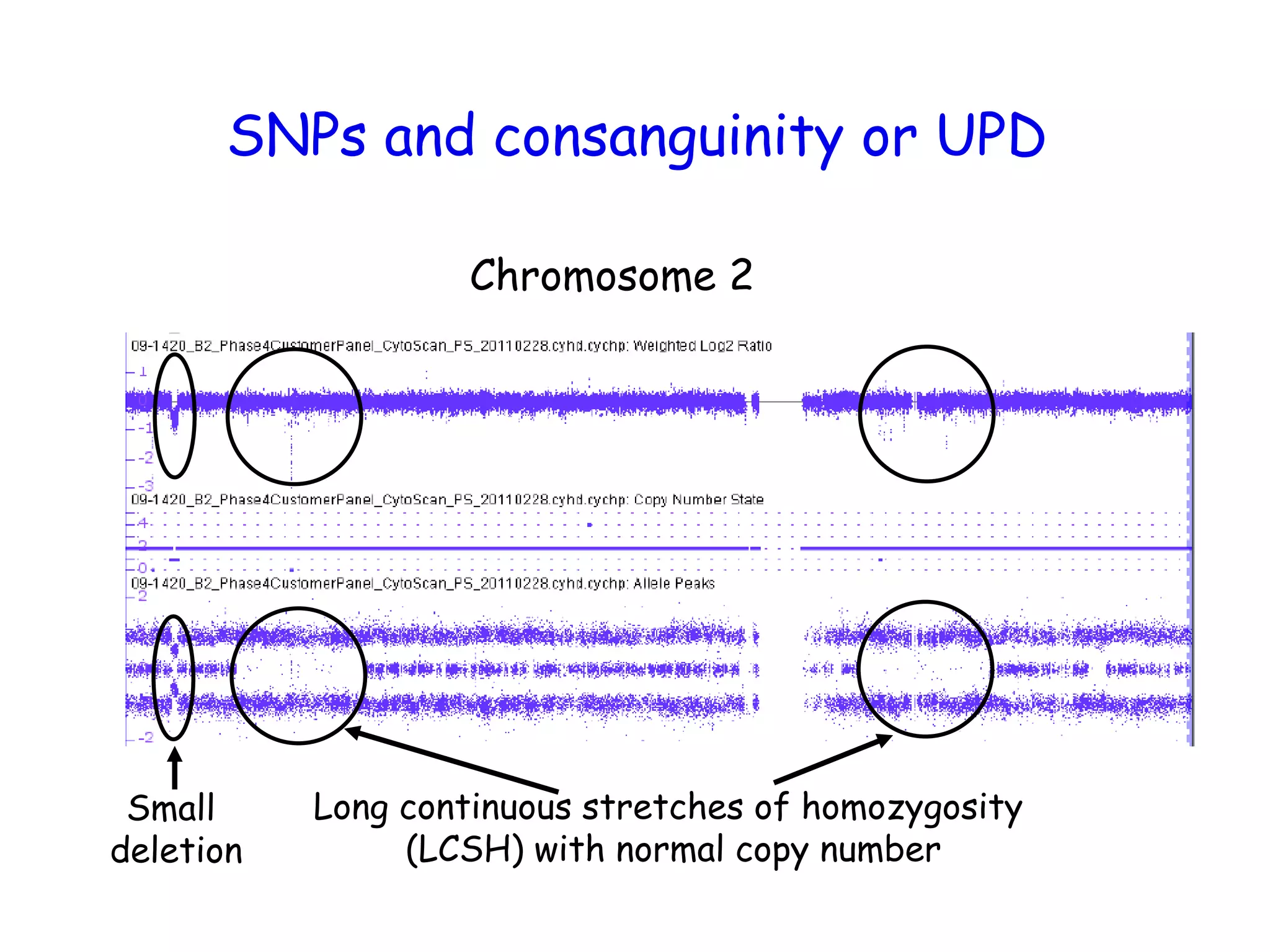
Chromosome 2
Small
deletion
Long continuous stretches of homozygosity
(LCSH) with normal copy number
SNPs and consanguinity or UPD
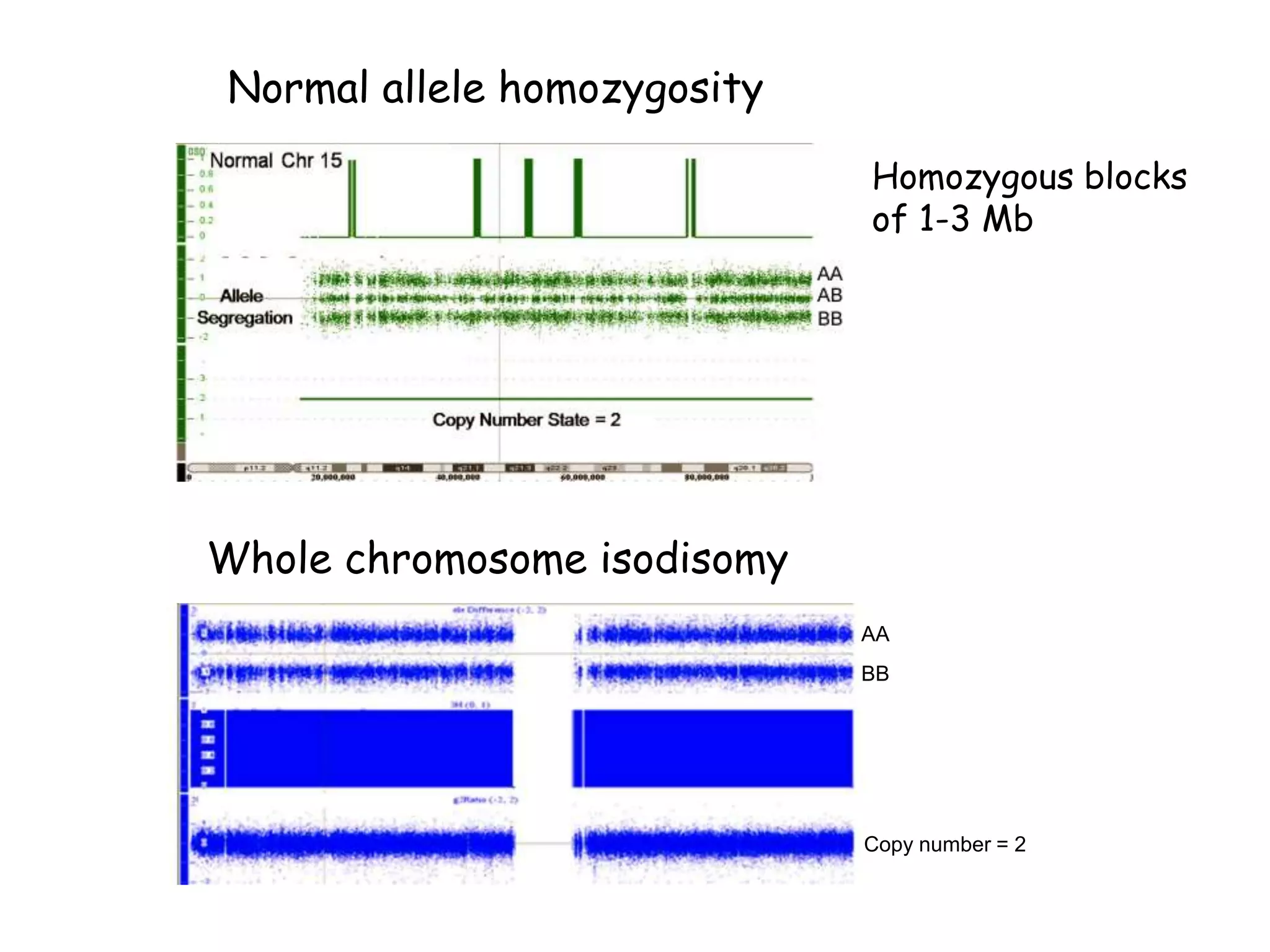
Normal allele homozygosity
Whole chromosome isodisomy
Homozygous blocks
of 1-3 Mb
AA
BB
Copy number = 2
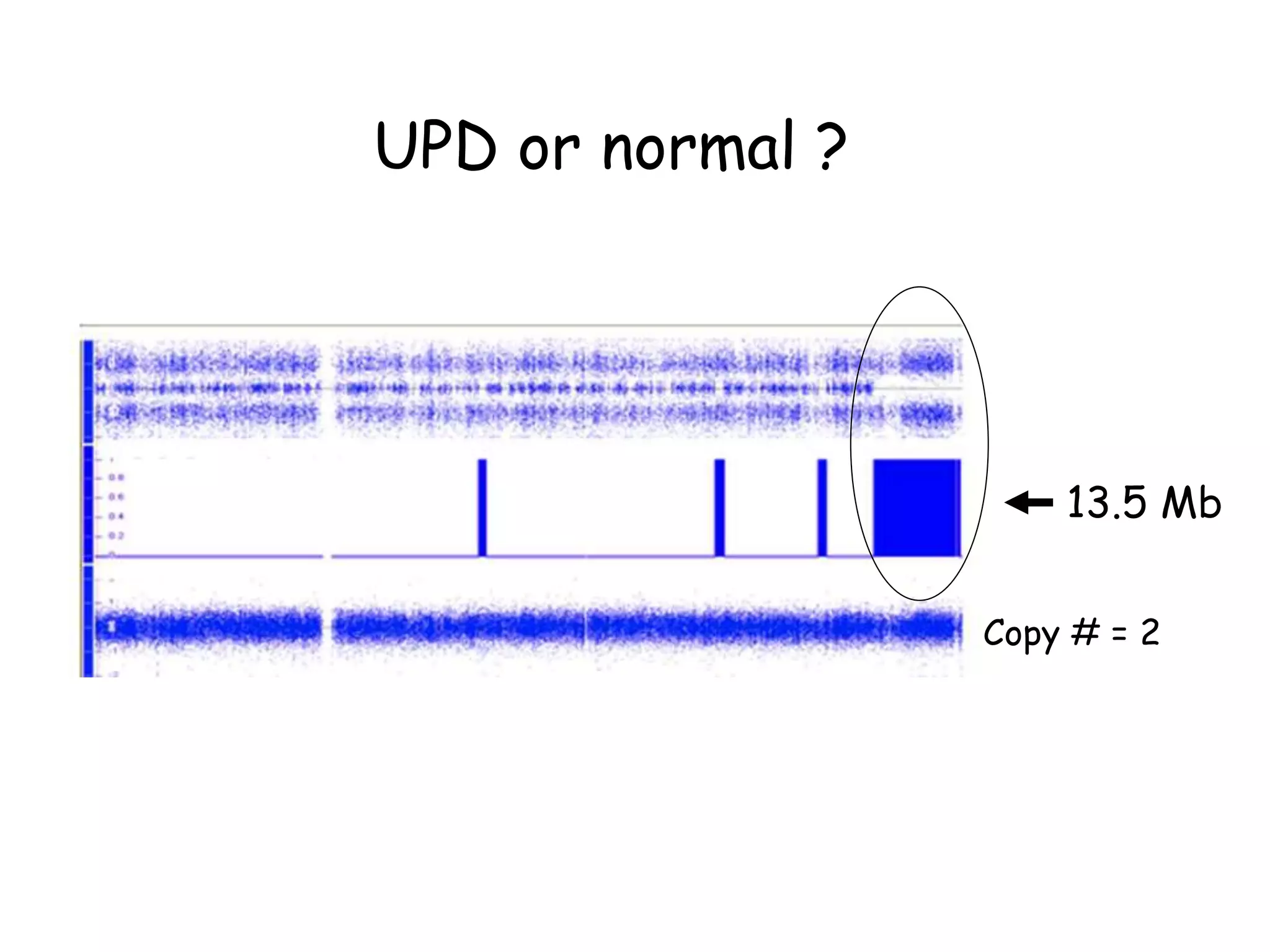
Copy # = 2
13.5 Mb
UPD or normal ?
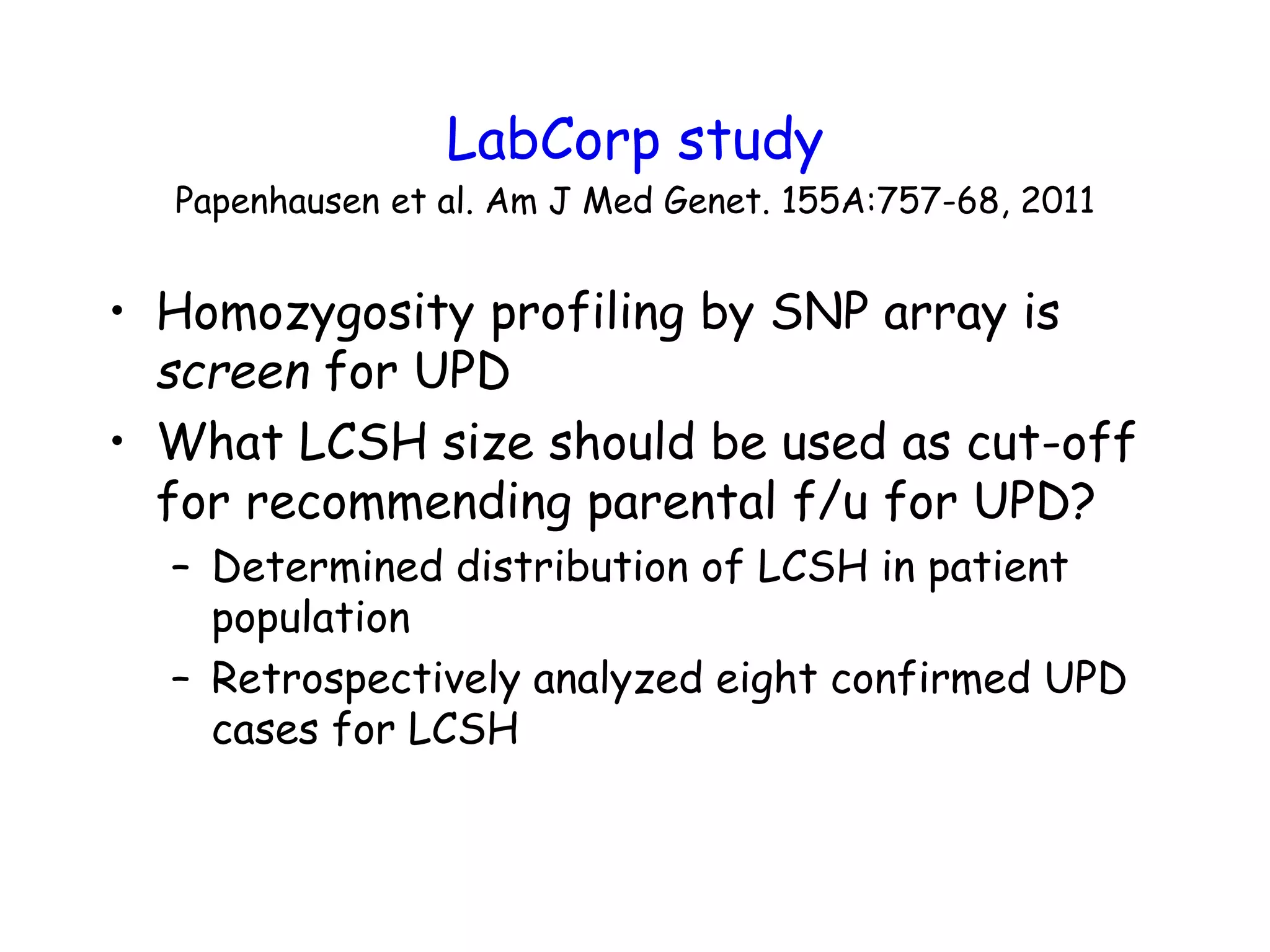
LabCorp study
Papenhausen et al. Am J Med Genet. 155A:757-68, 2011
• Homozygosity profiling by SNP array is
screen for UPD
• What LCSH size should be used as cut-off
for recommending parental f/u for UPD?
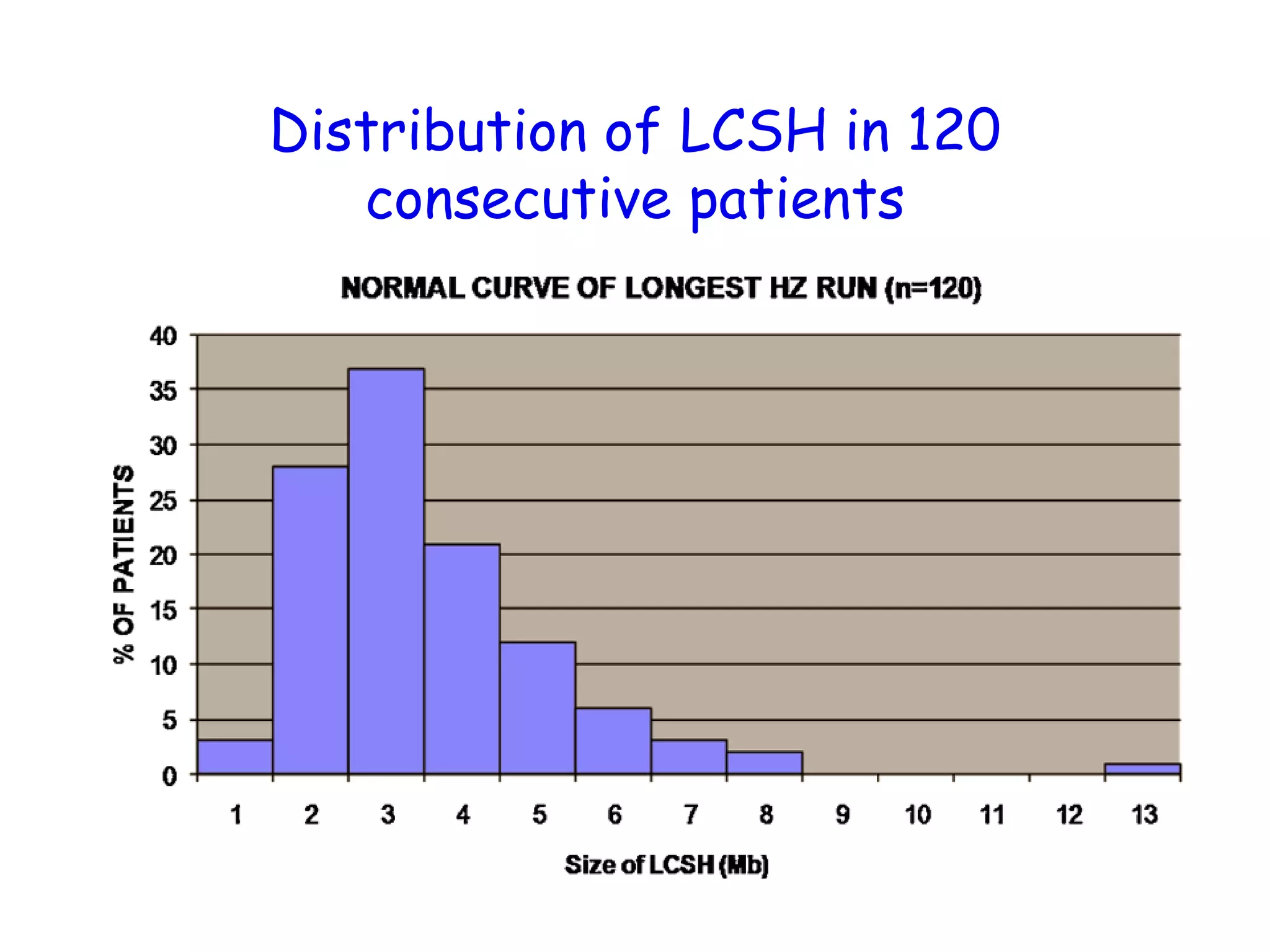
– Determined distribution of LCSH in patient
population
– Retrospectively analyzed eight confirmed UPD
cases for LCSH
Distribution of LCSH in 120
consecutive patients
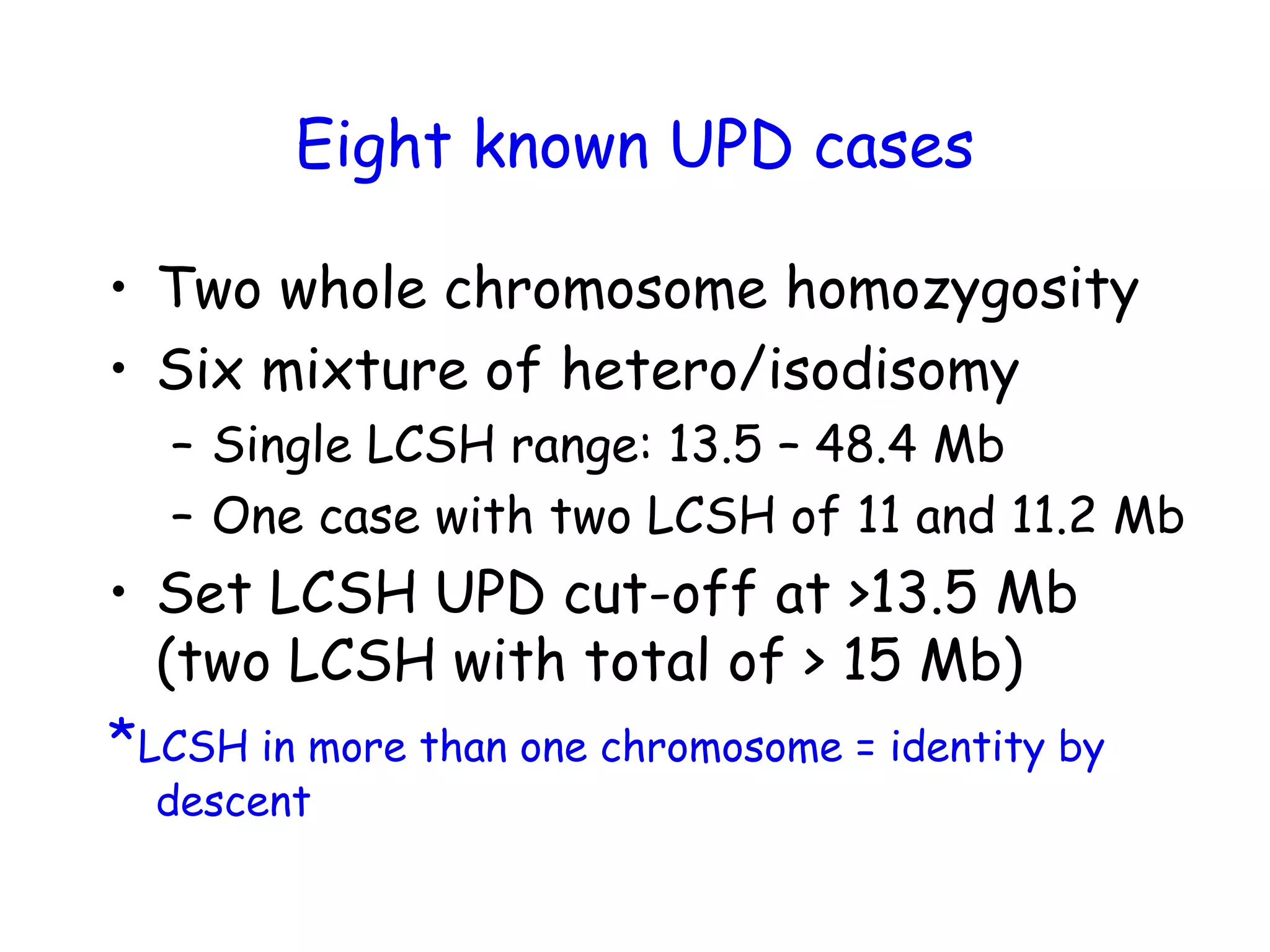
Eight known UPD cases
• Two whole chromosome homozygosity
• Six mixture of hetero/isodisomy
– Single LCSH range: 13.5 – 48.4 Mb
– One case with two LCSH of 11 and 11.2 Mb
• Set LCSH UPD cut-off at >13.5 Mb
(two LCSH with total of > 15 Mb)
*LCSH in more than one chromosome = identity by
descent
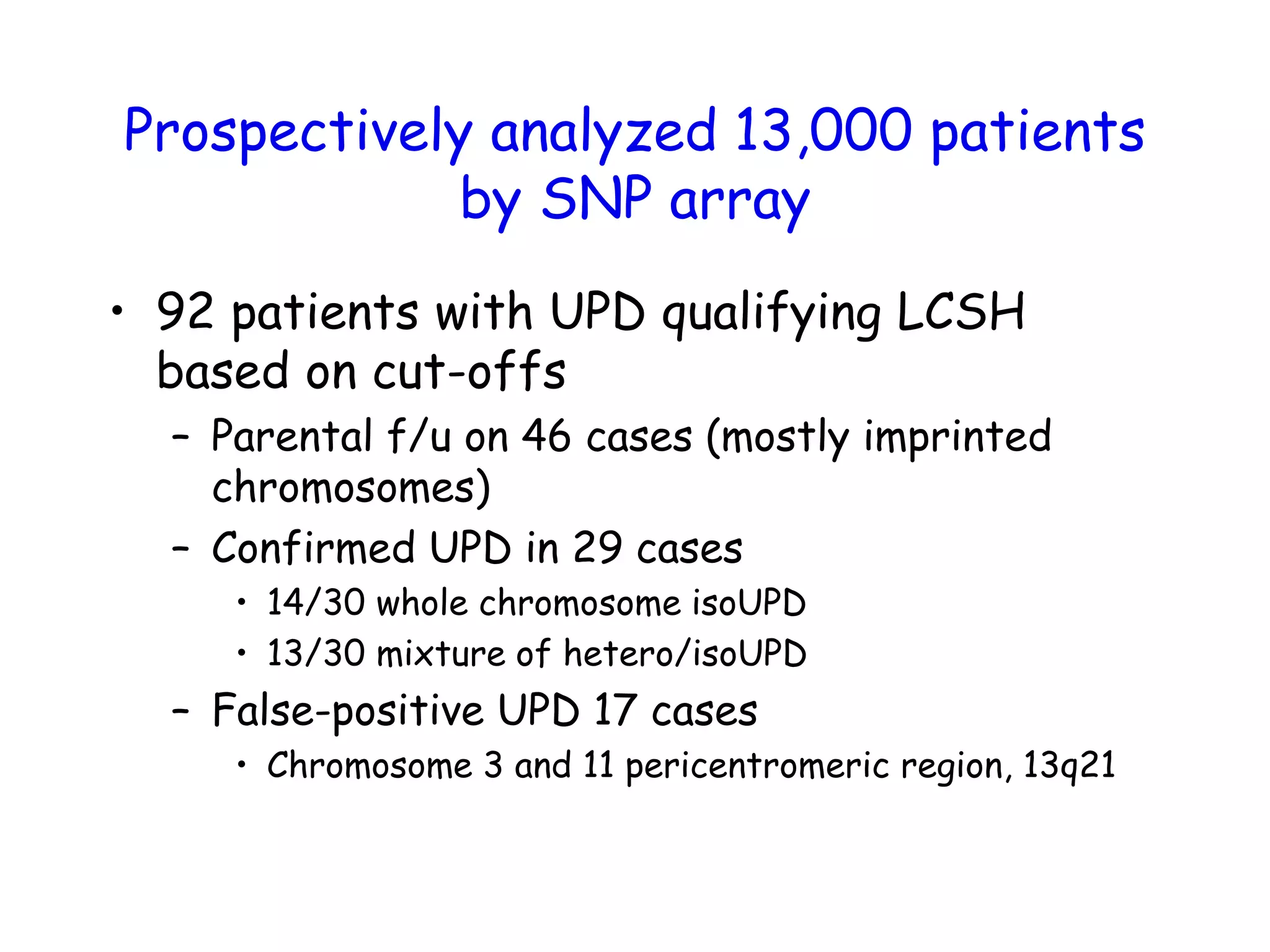
Prospectively analyzed 13,000 patients
by SNP array
• 92 patients with UPD qualifying LCSH
based on cut-offs
– Parental f/u on 46 cases (mostly imprinted
chromosomes)
– Confirmed UPD in 29 cases
• 14/30 whole chromosome isoUPD
• 13/30 mixture of hetero/isoUPD
– False-positive UPD 17 cases
• Chromosome 3 and 11 pericentromeric region, 13q21
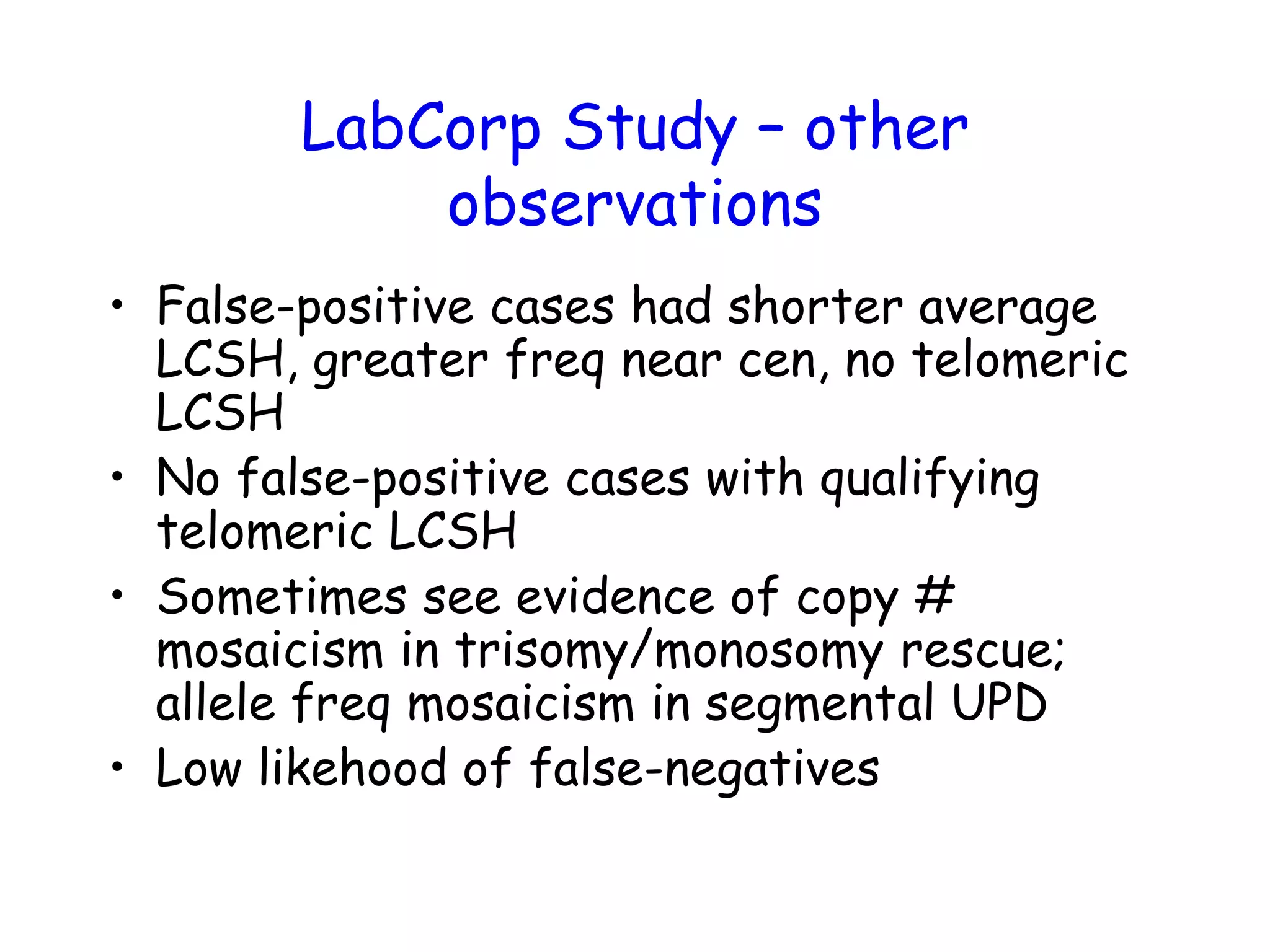
LabCorp Study – other
observations
• False-positive cases had shorter average
LCSH, greater freq near cen, no telomeric
LCSH
• No false-positive cases with qualifying
telomeric LCSH
• Sometimes see evidence of copy #
mosaicism in trisomy/monosomy rescue;
allele freq mosaicism in segmental UPD
• Low likehood of false-negatives
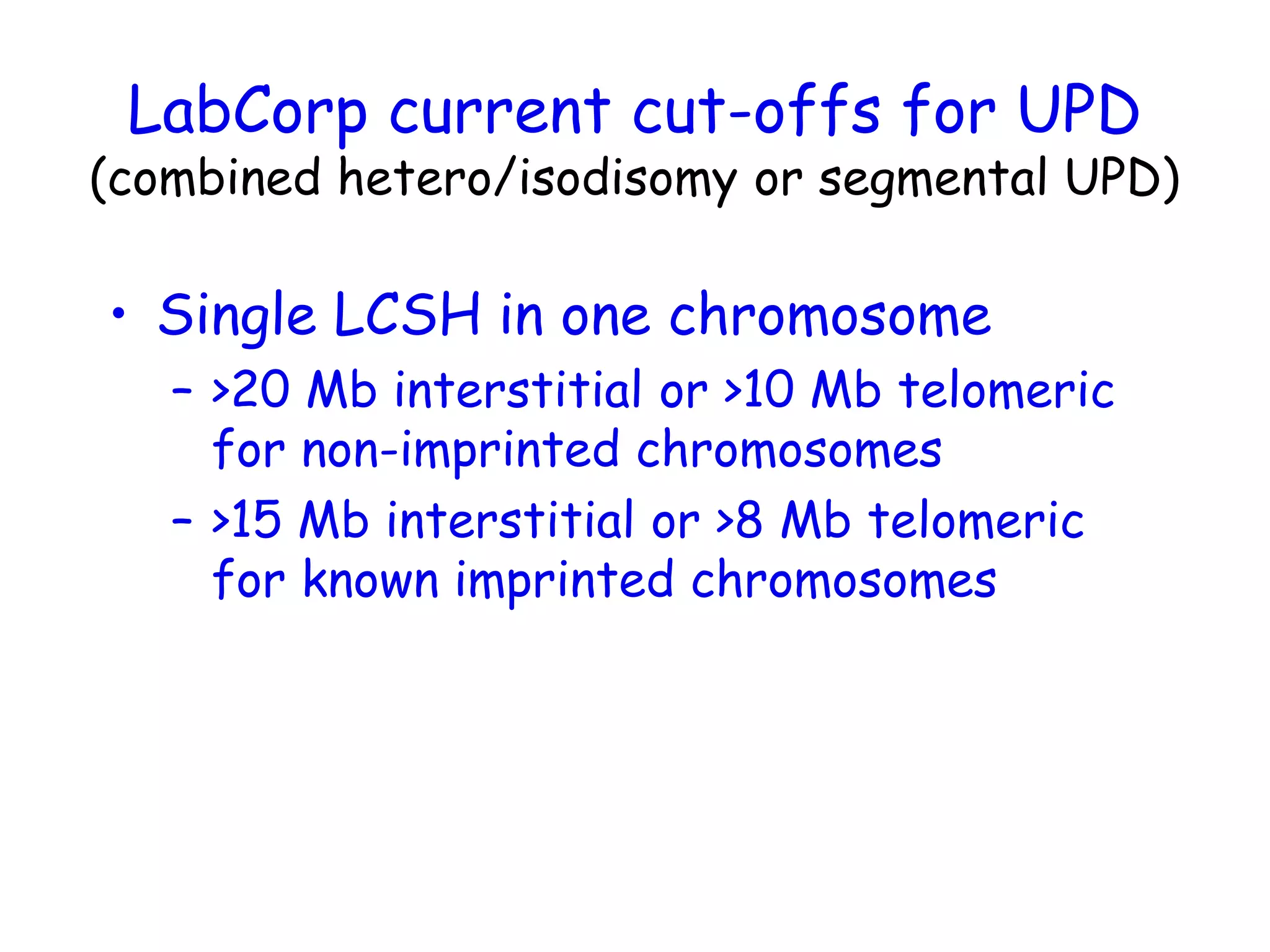
LabCorp current cut-offs for UPD
(combined hetero/isodisomy or segmental UPD)
• Single LCSH in one chromosome
– >20 Mb interstitial or >10 Mb telomeric
for non-imprinted chromosomes
– >15 Mb interstitial or >8 Mb telomeric
for known imprinted chromosomes
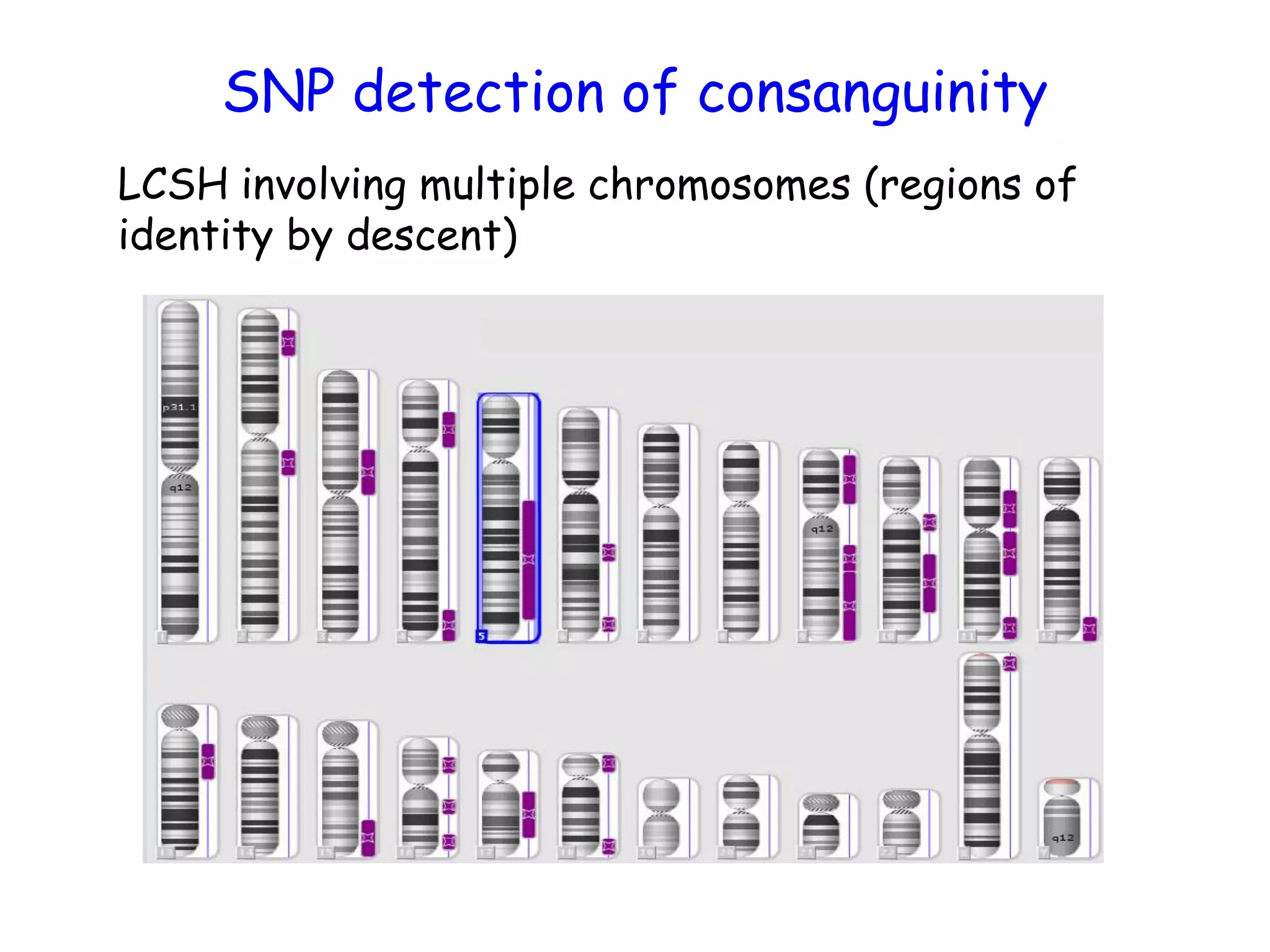
SNP detection of consanguinity
LCSH involving multiple chromosomes (regions of
identity by descent)
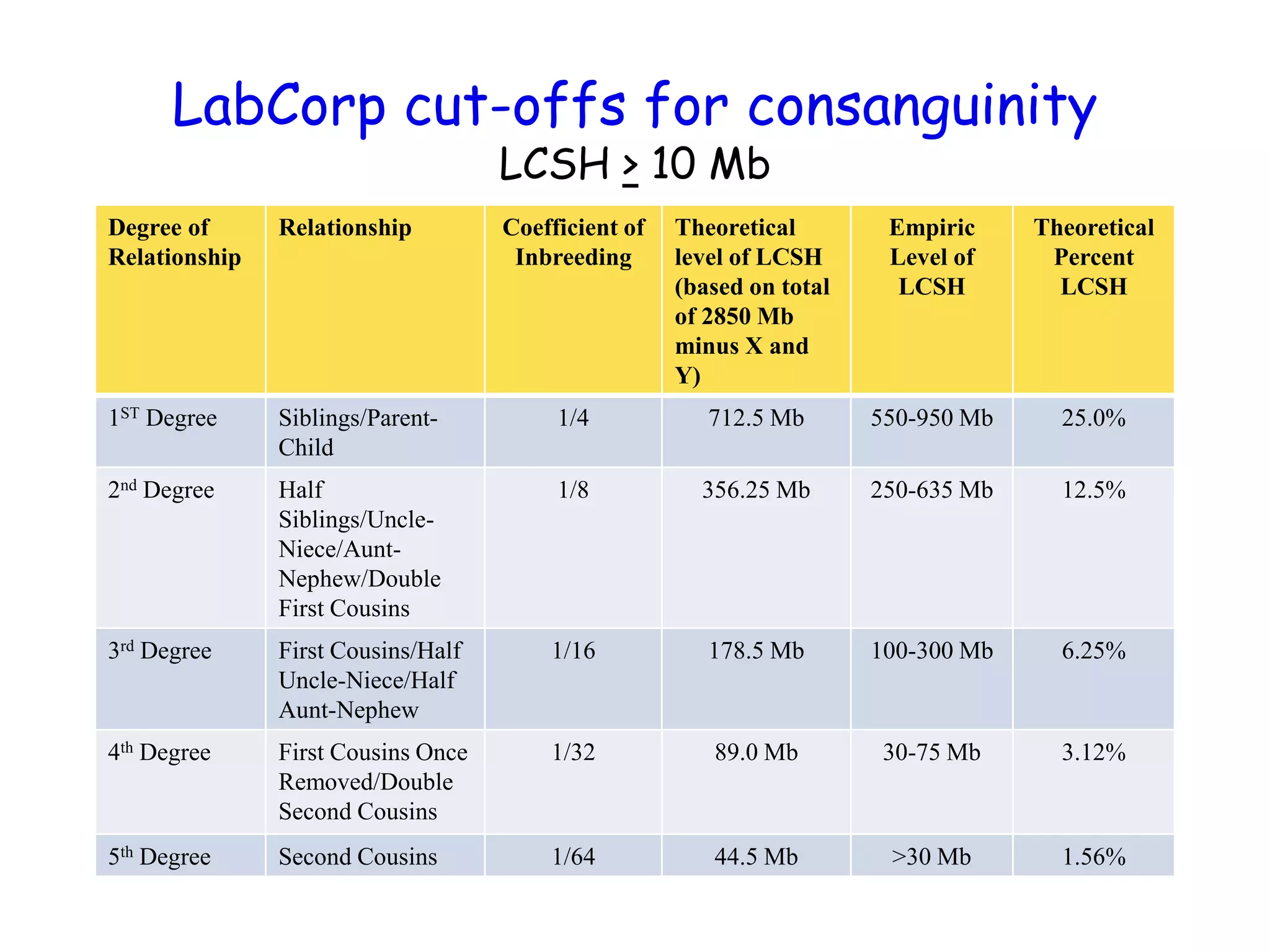
LabCorp cut-offs for consanguinity
LCSH > 10 Mb
Degree of
Relationship
Relationship Coefficient of
Inbreeding
Theoretical
level of LCSH
(based on total
of 2850 Mb
minus X and
Y)
Empiric
Level of
LCSH
Theoretical
Percent
LCSH
1ST Degree Siblings/Parent-
Child
1/4 712.5 Mb 550-950 Mb 25.0%
2nd Degree Half
Siblings/Uncle-
Niece/Aunt-
Nephew/Double
First Cousins
1/8 356.25 Mb 250-635 Mb 12.5%
3rd Degree First Cousins/Half
Uncle-Niece/Half
Aunt-Nephew
1/16 178.5 Mb 100-300 Mb 6.25%
4th Degree First Cousins Once
Removed/Double
Second Cousins
1/32 89.0 Mb 30-75 Mb 3.12%
5th Degree Second Cousins 1/64 44.5 Mb >30 Mb 1.56%

ArraySNP(Tsuchiya2012).ppt

  • 1.
  • 2.
    CytoScan HD vscurrent array • Current array (CGH based) – patient + reference DNA required (two color) – utilizes Cy dyes – ozone sensitive – copy number probes only (135 K) • CytoScan HD array (not CGH based) – patient DNA only (single color) – in silico reference based on >300 normal individuals and cell lines – utilizes phycoerythrin – not ozone sensitive – copy number probes (1.9 million) + SNP (750 K)
  • 3.
    Coverage • Average markerspacing: – ISCA genes – 384 bp – OMIM genes – 659 bp – X chromosome OMIM genes – 486 bp – RefSeq genes – 880 bp – Intergenic backbone – 1737 bp
  • 4.
  • 5.
    Copy number +SNP arrays Non-polymorphic probes SNP SNP •SNPs limited to specific locations in genome – SNP only arrays biased due to positional restrictions •Non-polymorphic (copy number) probes fill gaps to allow broad coverage
  • 6.
    Improvements of CytoScanHD over Affy SNP 6.0 • Improved software • Much less noise – Probes empirically chosen based on performance • 20 million probes screened – All reagents centrally manufactured and provided as kits – Streamlined procedure – only one restriction digest, ~half the steps, less hands-on time
  • 7.
    Other potential benefitsof CytoScan • Affy filing for FDA clearance • CytoScan currently has best coverage on single array for both constitutional and neoplastic cases • Other large clinical labs switching to CytoScan (LabCorp, ARUP)
  • 8.
    • Copy number+ SNP arrays - detect copy number changes and allele frequencies – SNPs can detect uniparental isodisomy, consanguinity – more sensitive for detection of mosaicism – independent confirmation of copy number findings and better breakpoint determination
  • 9.
    Copy number +SNP array Copy # Allele peaks
  • 10.
    AA AB BB Deletion Normal DuplicationNormal AA AB BB A AAA BBB B AAB ABB B B A A A A B B A B Normal Deletion B B A A A A B B B A A A Duplication A B B A B A B B A B
  • 11.
    SNP arrays moresensitive for detection of mosaicism Non-mosaic deletion Mosaic deletion
  • 12.
    CNC detection vs.reporting • Cytoscan software allows differential flagging in known clinically signficant critical regions vs. “backbone” regions • Can potentially detect smaller CNCs but doesn’t mean everything should be reported • Ex – LabCorp size cut-offs for reporting in backbone regions – Postnatal: >500 Kb gain, >200 Kb loss – Prenatal: >2 Mb gain, >1 Mb loss
  • 13.
    Uniparental disomy • Inheritanceof two homologous chromosomes from one parent – isodisomy: two copies of the same homolog – heterodisomy: two different homologs • UPD mechanisms – meiotic non-disjunction with trisomy or monosomy rescue – post-zygotic mitotic recombination • Whole chromosome isodisomy vs. hetero/isodisomy
  • 14.
    Chromosome 2 Small deletion Long continuousstretches of homozygosity (LCSH) with normal copy number SNPs and consanguinity or UPD
  • 15.
    Normal allele homozygosity Wholechromosome isodisomy Homozygous blocks of 1-3 Mb AA BB Copy number = 2
  • 16.
    Copy # =2 13.5 Mb UPD or normal ?
  • 17.
    LabCorp study Papenhausen etal. Am J Med Genet. 155A:757-68, 2011 • Homozygosity profiling by SNP array is screen for UPD • What LCSH size should be used as cut-off for recommending parental f/u for UPD? – Determined distribution of LCSH in patient population – Retrospectively analyzed eight confirmed UPD cases for LCSH
  • 18.
    Distribution of LCSHin 120 consecutive patients
  • 19.
    Eight known UPDcases • Two whole chromosome homozygosity • Six mixture of hetero/isodisomy – Single LCSH range: 13.5 – 48.4 Mb – One case with two LCSH of 11 and 11.2 Mb • Set LCSH UPD cut-off at >13.5 Mb (two LCSH with total of > 15 Mb) *LCSH in more than one chromosome = identity by descent
  • 20.
    Prospectively analyzed 13,000patients by SNP array • 92 patients with UPD qualifying LCSH based on cut-offs – Parental f/u on 46 cases (mostly imprinted chromosomes) – Confirmed UPD in 29 cases • 14/30 whole chromosome isoUPD • 13/30 mixture of hetero/isoUPD – False-positive UPD 17 cases • Chromosome 3 and 11 pericentromeric region, 13q21
  • 21.
    LabCorp Study –other observations • False-positive cases had shorter average LCSH, greater freq near cen, no telomeric LCSH • No false-positive cases with qualifying telomeric LCSH • Sometimes see evidence of copy # mosaicism in trisomy/monosomy rescue; allele freq mosaicism in segmental UPD • Low likehood of false-negatives
  • 22.
    LabCorp current cut-offsfor UPD (combined hetero/isodisomy or segmental UPD) • Single LCSH in one chromosome – >20 Mb interstitial or >10 Mb telomeric for non-imprinted chromosomes – >15 Mb interstitial or >8 Mb telomeric for known imprinted chromosomes
  • 23.
    SNP detection ofconsanguinity LCSH involving multiple chromosomes (regions of identity by descent)
  • 24.
    LabCorp cut-offs forconsanguinity LCSH > 10 Mb Degree of Relationship Relationship Coefficient of Inbreeding Theoretical level of LCSH (based on total of 2850 Mb minus X and Y) Empiric Level of LCSH Theoretical Percent LCSH 1ST Degree Siblings/Parent- Child 1/4 712.5 Mb 550-950 Mb 25.0% 2nd Degree Half Siblings/Uncle- Niece/Aunt- Nephew/Double First Cousins 1/8 356.25 Mb 250-635 Mb 12.5% 3rd Degree First Cousins/Half Uncle-Niece/Half Aunt-Nephew 1/16 178.5 Mb 100-300 Mb 6.25% 4th Degree First Cousins Once Removed/Double Second Cousins 1/32 89.0 Mb 30-75 Mb 3.12% 5th Degree Second Cousins 1/64 44.5 Mb >30 Mb 1.56%