Arrays and Stringsin C
Programming
Welcome to this presentation on arrays and strings in C programming.
These fundamental data structures are essential for efficient storage and
manipulation of data. You'll learn how they work, how to use them
effectively, and how to put them into practice.
by Tech Bar
2.
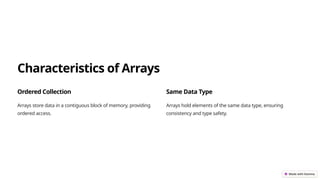
Characteristics of Arrays
OrderedCollection
Arrays store data in a contiguous block of memory, providing
ordered access.
Same Data Type
Arrays hold elements of the same data type, ensuring
consistency and type safety.
Working with Arrays
AccessElements
Use index notation: numbers[0] accesses the first element.
Iterate Through Arrays
Use loops for processing each element systematically.
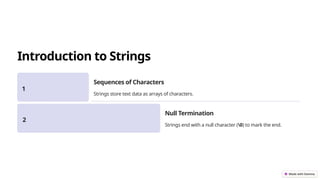
Introduction to Strings
1
Sequencesof Characters
Strings store text data as arrays of characters.
2
Null Termination
Strings end with a null character (0) to mark the end.
String Operations
1 Copying
Usestrcpy() to copy one
string to another.
2 Concatenating
Use strcat() to combine two
strings.
3 Comparing
Use strcmp() to compare two strings lexicographically.
9.
Common String Functions
1strlen() - get the length of a string.
2 strchr() - find the first occurrence of a character.
3 strstr() - find the first occurrence of a substring.
10.
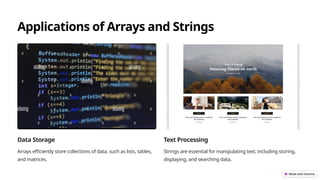
Applications of Arraysand Strings
Data Storage
Arrays efficiently store collections of data, such as lists, tables,
and matrices.
Text Processing
Strings are essential for manipulating text, including storing,
displaying, and searching data.
![Declaring and Initializing
Arrays
Declaration
Declare an array with the data
type, name, and size: int
numbers[5];
Initialization
Assign values during
declaration: int numbers[5] =
{1, 2, 3, 4, 5};](https://image.slidesharecdn.com/arrays-and-strings-in-c-programming-250315182240-8275b16c/85/Arrays-and-Strings-in-C-Programming-PPT-by-AI-3-320.jpg)
![Working with Arrays
Access Elements
Use index notation: numbers[0] accesses the first element.
Iterate Through Arrays
Use loops for processing each element systematically.](https://image.slidesharecdn.com/arrays-and-strings-in-c-programming-250315182240-8275b16c/85/Arrays-and-Strings-in-C-Programming-PPT-by-AI-4-320.jpg)
![Declaring and Initializing
Strings
1
Declaration
Declare a character array: char
str[10];
2
Initialization
Assign a string literal: char str[10] =
"Hello";](https://image.slidesharecdn.com/arrays-and-strings-in-c-programming-250315182240-8275b16c/85/Arrays-and-Strings-in-C-Programming-PPT-by-AI-7-320.jpg)