Download to read offline
![© 2015UPESJuly 2015 Department. Of Civil Engineering
INTRODUCTION
An array is a collection of similar data elements.
These data elements have the same data type.
The elements of the array are stored in consecutive memory locations and are referenced by an
index (also known as the subscript).
Declaring an array means specifying three things:
The data type- what kind of values it can store as int, char, float.
Name- to identify the array
The size- the maximum number of values that the array can hold
Arrays are declared using the following syntax.
type name[size];
1st
element
2nd
element
3rd
element
4th
element
5th
element
6th
element
7th
element
8th
element
9th
element
10th
element
marks[0] marks[1] marks[2] marks[3] marks[4] marks[5] marks[6] marks[7] marks[8] marks[9]](https://image.slidesharecdn.com/arrays-180327085501/75/Arrays-2-2048.jpg)
![© 2015UPESJuly 2015 Department. Of Civil Engineering
ACCESSING ELEMENTS OF THE ARRAY
To access all the elements of the array, you must use a loop. That is, we can access all the
elements of the array by varying the value of the subscript into the array. But note that the
subscript must be an integral value or an expression that evaluates to an integral value.
int i, marks[10];
for(i=0;i<10;i++)
marks[i] = -1;
CALCULATING THE ADDRESS OF ARRAY
ELEMENTS
Address of data element, A[k] = BA(A) + w( k – lower_bound)
Here, A is the array
k is the index of the element of which we have to calculate the address
BA is the base address of the array A.
w is the word size of one element in memory, for example, size of int is 2.
99 67 78 56 88 90 34 85
Marks[0] marks[1] marks[2] marks[3] marks[4] marks[5] marks[6] marks[7]
1000 1002 1004 1006 1008 1010 1012 1014
Marks[4] = 1000 + 2(4 – 0)
= 1000 + 2(4) = 1008](https://image.slidesharecdn.com/arrays-180327085501/75/Arrays-3-2048.jpg)
![© 2015UPESJuly 2015 Department. Of Civil Engineering
STORING VALES IN ARRAYS
Store values in the array
Initialize the elements
Input values for the elements
Assign values to the elements
Initialization of Arrays
Arrays are initialized by writing,
type array_name[size]={list of values};
int marks[5]={90, 82, 78, 95, 88};
int i, marks[10];
for(i=0;i<10;i++)
scanf(“%d”, &marks[i]);
Assigning Values
int i, arr1[10], arr2[10];
for(i=0;i<10;i++)
arr2[i] = arr1[i];
Inputting Values
CALCULATING THE LENGTH OF THE ARRAY
Length = upper_bound – lower_bound + 1
Where, upper_bound is the index of the last element
and lower_bound is the index of the first element in the array
99 67 78 56 88 90 34 85
Marks[0] marks[1] marks[2] marks[3] marks[4] marks[5] marks[6 marks[7]]
Here, lower_bound = 0, upper_bound = 7
Therefore, length = 7 – 0 + 1 = 8](https://image.slidesharecdn.com/arrays-180327085501/75/Arrays-4-2048.jpg)
![© 2015UPESJuly 2015 Department. Of Civil Engineering
WRITE A PROGRAM TO READ AND DISPLAY N
NUMBERS USING AN ARRAY
#include<stdio.h>
int main()
{ int i=0, n, arr[20];
printf(“n Enter the number of elements : “);
scanf(“%d”, &n);
for(i=0;i<n;i++)
{ printf(“n Arr[%d] = “, i);
scanf(“%d”,&arr[i]);
}
printf(“n The array elements are “);
for(i=0;i<n;i++)
printf(“Arr[%d] = %dt”, i, arr[i]);
return 0;
}](https://image.slidesharecdn.com/arrays-180327085501/75/Arrays-5-2048.jpg)
![© 2015UPESJuly 2015 Department. Of Civil Engineering
INSERTING AN ELEMENT IN THE ARRAY
Algorithm to insert a new element to the end of the array.
Step 1: Set upper_bound = upper_bound + 1
Step 2: Set A[upper_bound] = VAL
Step 3; EXIT
The algorithm INSERT will be declared as INSERT( A, N, POS, VAL).
Calling INSERT (Data, 6, 3, 100) will lead to the following processing in the array
45 23 34 12 56 20 20
Data[0] Data[1] Data[2] Data[3] Data[4] Data[5] Data[6]
45 23 34 12 56 56 20
Data[0] Data[1] Data[2] Data[3] Data[4] Data[5] Data[6]
45 23 34 12 12 56 20
Data[0] Data[1] Data[2] Data[3] Data[4] Data[5] Data[6]
45 23 34 100 12 56 20
Data[0] Data[1] Data[2] Data[3] Data[4] Data[5] Data[6]](https://image.slidesharecdn.com/arrays-180327085501/75/Arrays-6-2048.jpg)
![© 2015UPESJuly 2015 Department. Of Civil Engineering
Step 1: [INITIALIZATION] SET I = N
Step 2: Repeat Steps 3 and 4 while I >= POS
Step 3: SET A[I + 1] = A[I]
Step 4: SET I = I – 1
[End of Loop]
Step 5: SET N = N + 1
Step 6: SET A[POS] = VAL
Step 7: EXIT](https://image.slidesharecdn.com/arrays-180327085501/75/Arrays-7-2048.jpg)
![© 2015UPESJuly 2015 Department. Of Civil Engineering
#include <stdio.h>
int main()
{
int array[100], position, c, n, value;
printf("Enter number of elements in arrayn");
scanf("%d", &n);
printf("Enter %d elementsn", n);
for (c = 0; c < n; c++)
scanf("%d", &array[c]);
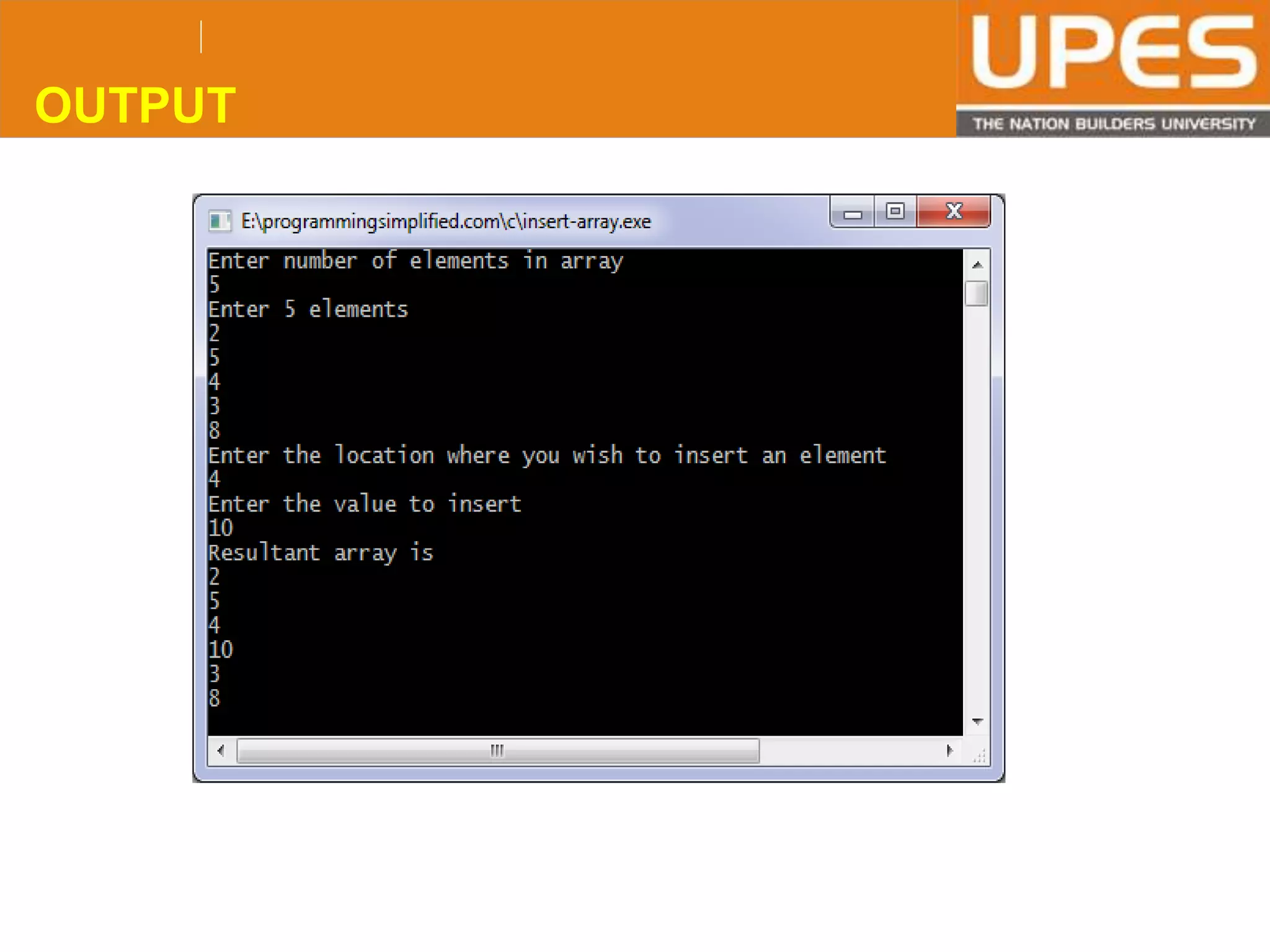
printf("Enter the location where you wish to insert an elementn");
scanf("%d", &position);
printf("Enter the value to insertn");
scanf("%d", &value);
Inserting element in an array](https://image.slidesharecdn.com/arrays-180327085501/75/Arrays-8-2048.jpg)
![© 2015UPESJuly 2015 Department. Of Civil Engineering
Inserting element in an array (Contd.)
for (c = n - 1; c >= position - 1; c--)
{ array[c+1] = array[c];
}
array[position-1] = value;
printf("Resultant array isn");
for (c = 0; c <= n; c++)
{
printf("%dn", array[c]);}
return 0;
}](https://image.slidesharecdn.com/arrays-180327085501/75/Arrays-9-2048.jpg)
![© 2015UPESJuly 2015 Department. Of Civil Engineering
DELETING AN ELEMENT FROM THE ARRAY
Algorithm to delete an element from the end of the array
45 23 34 12 56 20
Step 1: Set upper_bound = upper_bound - 1
Step 2: EXIT
Step 1: [INITIALIZATION] SET I = POS
Step 2: Repeat Steps 3 and 4 while I <= N - 1
Step 3: SET A[I] = A[I + 1]
Step 4: SET I = I + 1
[End of Loop]
Step 5: SET N = N - 1
Step 6: EXIT
The algorithm DELETE will be declared as DELETE( A, N, POS).
Calling DELETE (Data, 6, 2) will lead to the following processing in the array
45
23 12 12 56
20
Data[0] Data[1] Data[2] Data[3] Data[4] Data[5]
Data[0] Data[1] Data[2] Data[3] Data[4] Data[5]
45
23 12 56 56
20
Data[0] Data[1] Data[2] Data[3] Data[4] Data[5]
45
23 12 56 20
20
Data[0] Data[1] Data[2] Data[3] Data[4] Data[5]
45
23 12 56 20
Data[0] Data[1] Data[2] Data[3] Data[4]](https://image.slidesharecdn.com/arrays-180327085501/75/Arrays-11-2048.jpg)
![© 2015UPESJuly 2015 Department. Of Civil Engineering
Deleting an Element from an array
#include <stdio.h>
int main()
{
int array[100], position, c, n;
printf("Enter number of elements in arrayn");
scanf("%d", &n);
printf("Enter %d elementsn", n);
for ( c = 0 ; c < n ; c++ )
scanf("%d", &array[c]);](https://image.slidesharecdn.com/arrays-180327085501/75/Arrays-12-2048.jpg)
![© 2015UPESJuly 2015 Department. Of Civil Engineering
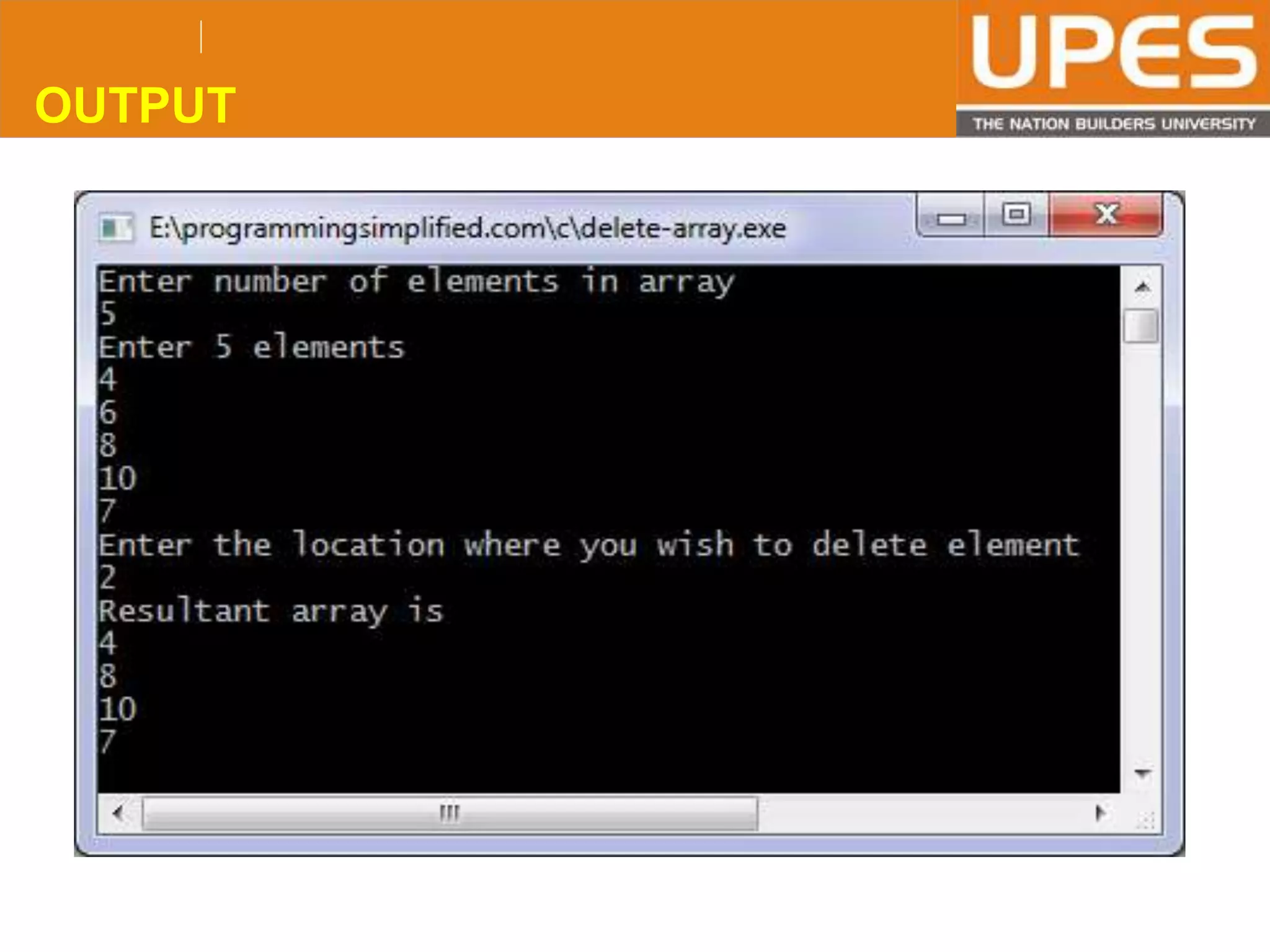
printf("Enter the location where you wish to delete elementn");
scanf("%d", &position);
if ( position >= n+1 )
printf("Deletion not possible.n");
else
{
for ( c = position - 1 ; c < n - 1 ; c++ )
array[c] = array[c+1];
printf("Resultant array isn");
for( c = 0 ; c < n - 1 ; c++ )
printf("%dn", array[c]);
} return 0;
}
Deleting an Element from an array](https://image.slidesharecdn.com/arrays-180327085501/75/Arrays-13-2048.jpg)
![© 2015UPESJuly 2015 Department. Of Civil Engineering
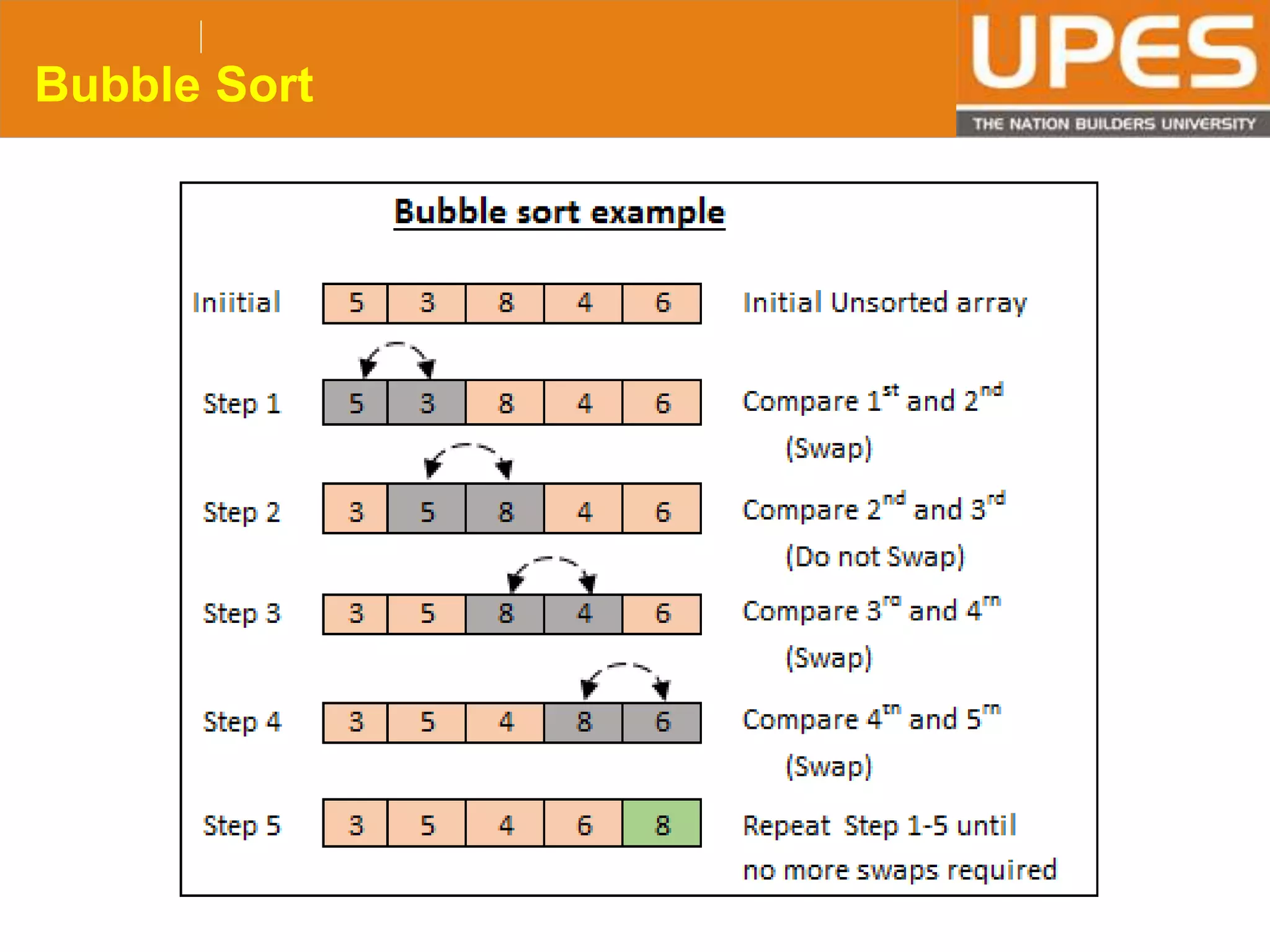
Program for Bubble Sort
#include <stdio.h>
int main()
{
int myarray[50];
int i, n, temp, swapflag;
/* Get the number of items in array */
printf("How many items are in the array? n");
scanf("%d", &n);
/* Read array items*/
printf("Enter the array items n");
for (i = 0; i < n; i++)
scanf("%d", &myarray[i]);
/* Sort array using bubble sort method */
do {
swapflag = 0;](https://image.slidesharecdn.com/arrays-180327085501/75/Arrays-17-2048.jpg)
![© 2015UPESJuly 2015 Department. Of Civil Engineering
for (i = 0; i < n-1; i++) {
if (myarray[i] > myarray[i+1])
{
temp = myarray[i+1]
myarray[i+1] = myarray[i];
myarray[i] = temp;
swapflag = 1;
}
}
} while (swapflag == 1);
/* Print the sorted array */
printf("Array items sorted in ascending order n");
for (i = 0; i < n; i++){
printf("%d n", myarray[i]);}
return 0; }](https://image.slidesharecdn.com/arrays-180327085501/75/Arrays-18-2048.jpg)
![© 2015UPESJuly 2015 Department. Of Civil Engineering
#include <stdio.h>
int main()
{
int array[100], n, c, d, position, swap;
printf("Enter number of elementsn");
scanf("%d", &n);
printf("Enter %d integersn", n);
for ( c = 0 ; c < n ; c++ )
{
scanf("%d", &array[c]);
}](https://image.slidesharecdn.com/arrays-180327085501/75/Arrays-21-2048.jpg)
![© 2015UPESJuly 2015 Department. Of Civil Engineering
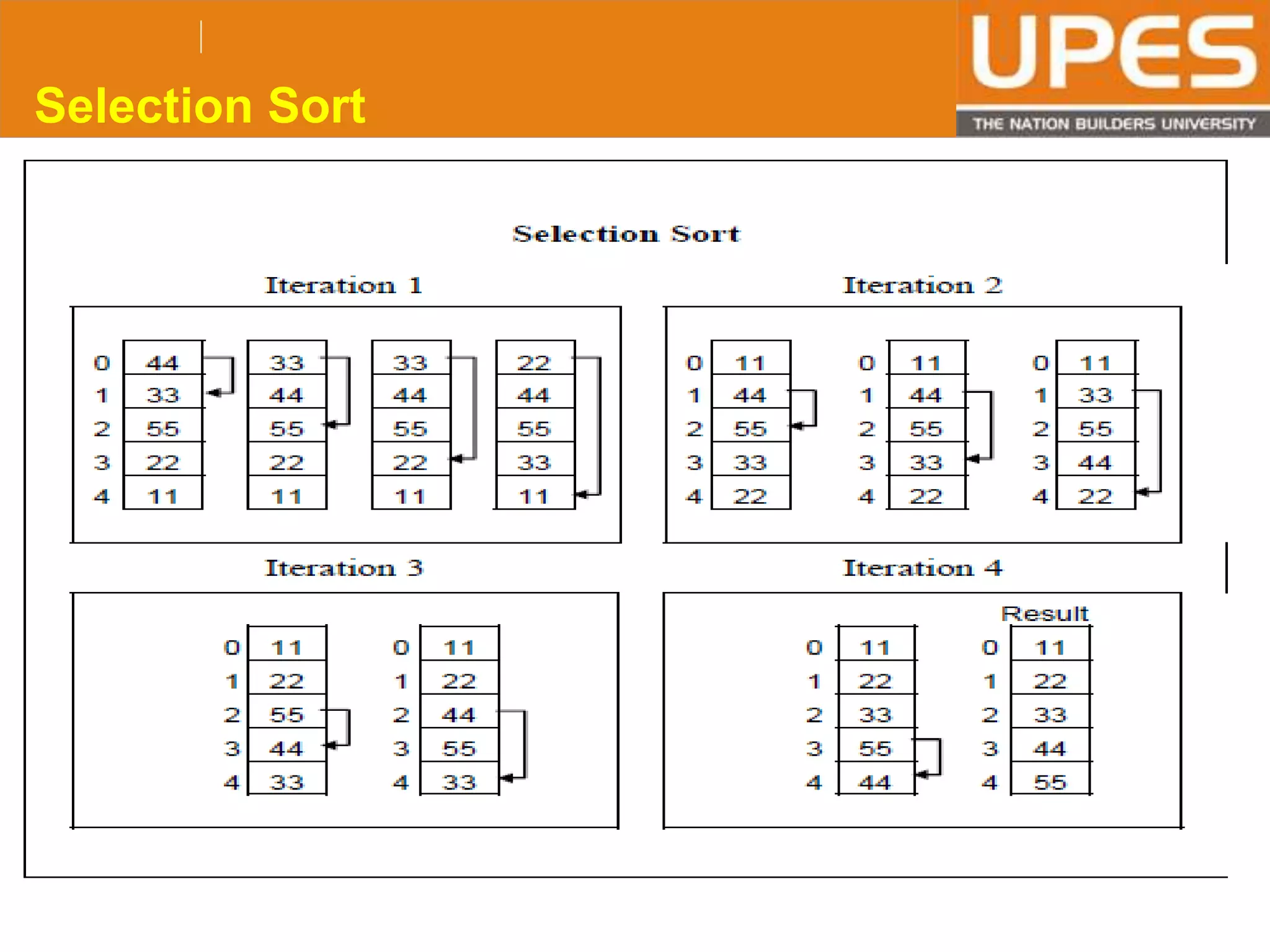
for ( c = 0 ; c < ( n - 1 ) ; c++ )
{ position = c;
for ( d = c + 1 ; d < n ; d++ )
{ if ( array[position] > array[d] )
position = d;
}
if ( position != c )
{ swap = array[c];
array[c] = array[position];
array[position] = swap;
}
}](https://image.slidesharecdn.com/arrays-180327085501/75/Arrays-22-2048.jpg)
![© 2015UPESJuly 2015 Department. Of Civil Engineering
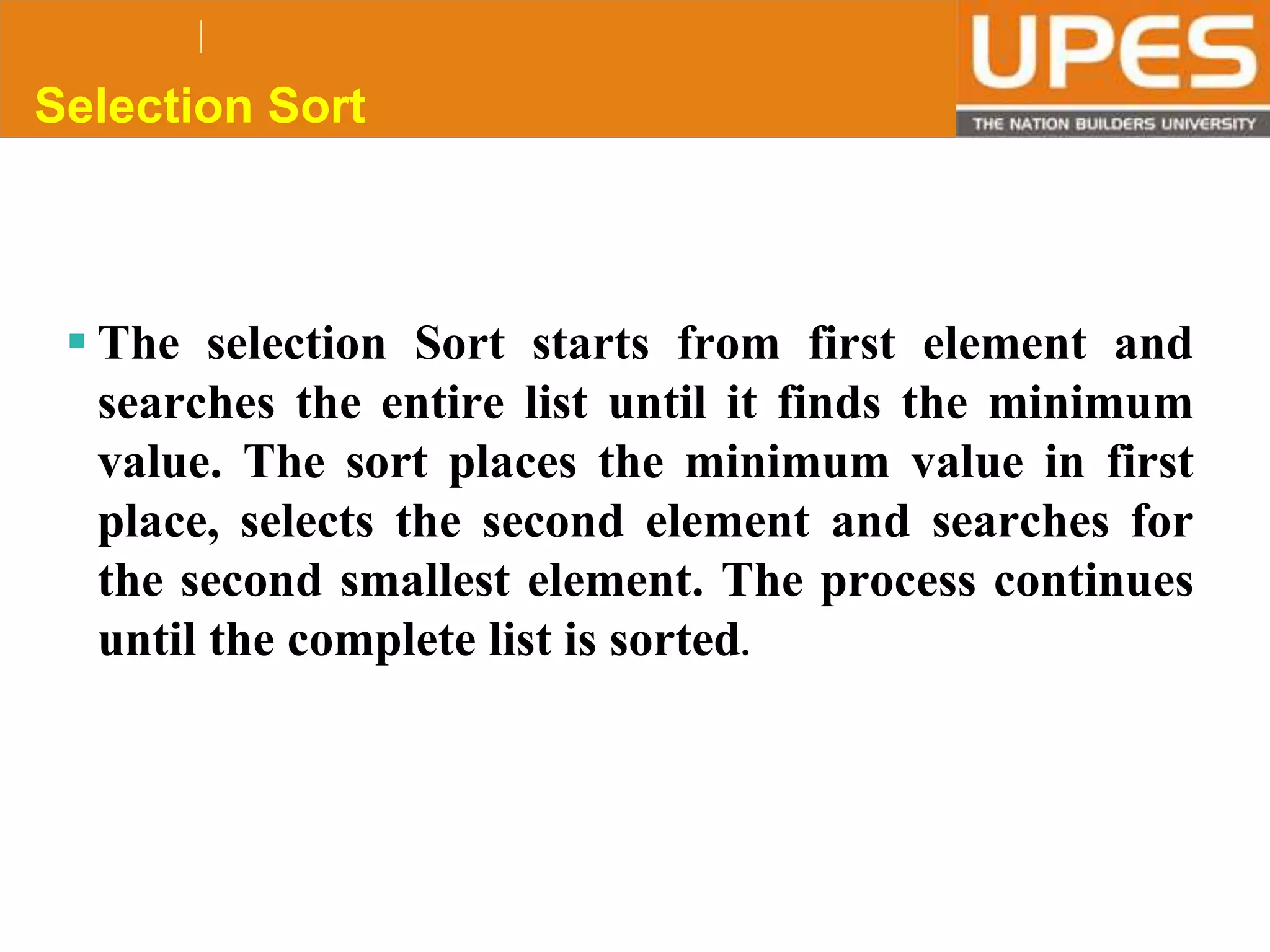
printf("Sorted list in ascending order:n");
for ( c = 0 ; c < n ; c++ )
{
printf("%dn", array[c]);
}
return 0;
}](https://image.slidesharecdn.com/arrays-180327085501/75/Arrays-23-2048.jpg)
![© 2015UPESJuly 2015 Department. Of Civil Engineering
/* insertion sort ascending order */
#include <stdio.h>
int main()
{
int n, array[1000], c, d, t;
printf("Enter number of elementsn");
scanf("%d", &n);
printf("Enter %d integersn", n);
for (c = 0; c < n; c++) {
scanf("%d", &array[c]);
}](https://image.slidesharecdn.com/arrays-180327085501/75/Arrays-25-2048.jpg)
![© 2015UPESJuly 2015 Department. Of Civil Engineering
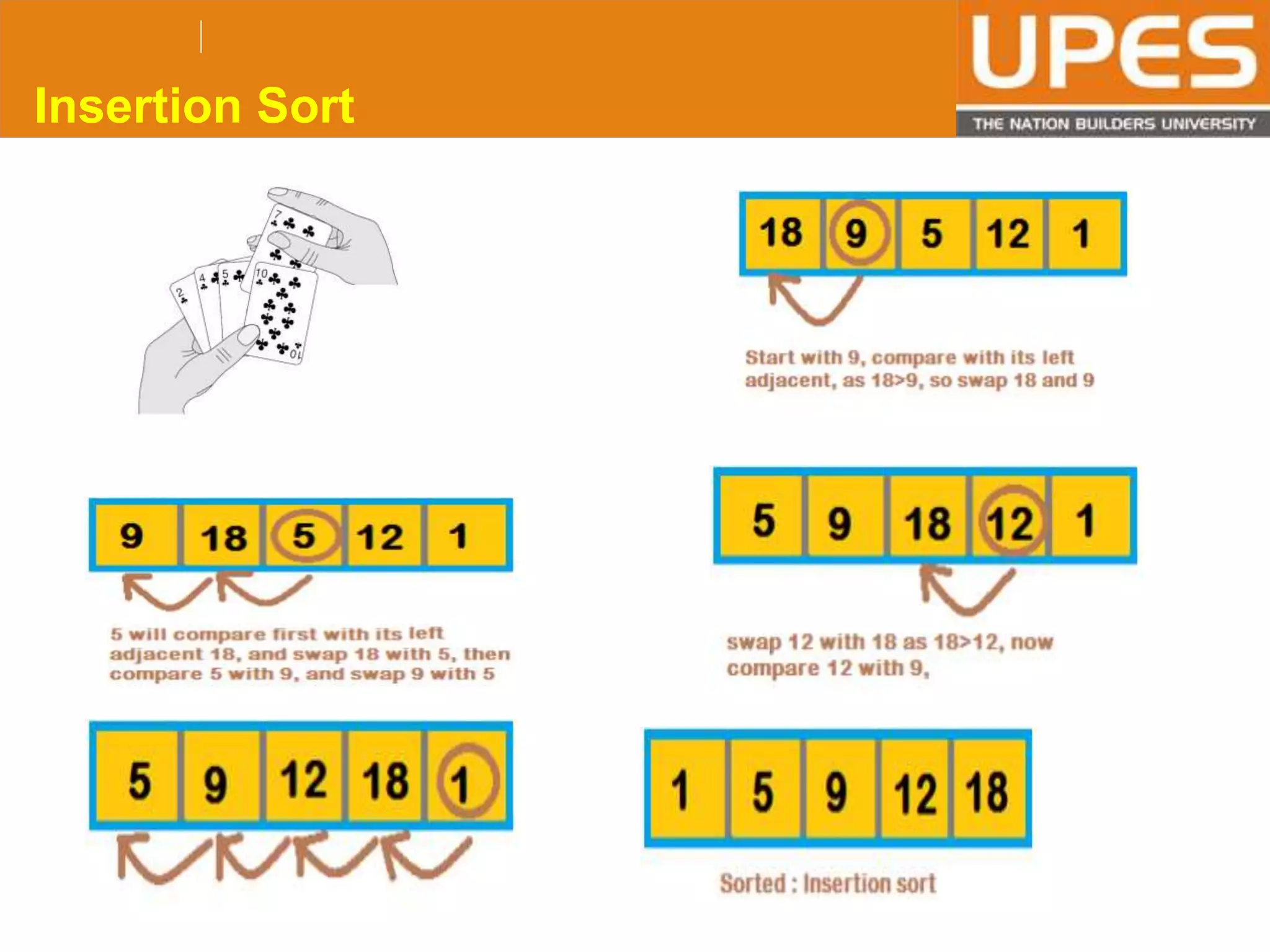
for (c = 1 ; c <= n - 1; c++)
{
d = c;
while ( d > 0 && array[d] < array[d-1]) {
t = array[d];
array[d] = array[d-1];
array[d-1] = t;
d--;
}
}
printf("Sorted list in ascending order:n");
for (c = 0; c <= n - 1; c++) {
printf("%dn", array[c]); }](https://image.slidesharecdn.com/arrays-180327085501/75/Arrays-26-2048.jpg)
![© 2015UPESJuly 2015 Department. Of Civil Engineering
LINEAR SEARCH
LINEAR_SEARCH(A, N, VAL, POS)
Step 1: [INITIALIZE] SET POS = -1
Step 2: [INITIALIZE] SET I = 0
Step 3: Repeat Step 4 while I<N
Step 4: IF A[I] = VAL, then
SET POS = I
PRINT POS
Go to Step 6
[END OF IF]
[END OF LOOP]
Step 5: PRINT “Value Not Present In The Array”
Step 6: EXIT
BINARY SEARCH
BEG = lower_bound and END = upper_bound
MID = (BEG + END) / 2
If VAL < A[MID], then VAL will be present in the left segment of the array. So,
the value of END will be changed as, END = MID – 1
If VAL > A[MID], then VAL will be present in the right segment of the array. So,
the value of BEG will be changed as, BEG = MID + 1](https://image.slidesharecdn.com/arrays-180327085501/75/Arrays-27-2048.jpg)
![© 2015UPESJuly 2015 Department. Of Civil Engineering
Program (Linear Search)
#include <stdio.h>
int main()
{
int array[100], search, c, n;
printf("Enter the number of elements in arrayn");
scanf("%d",&n);
printf("Enter %d integer(s)n", n);
for (c = 0; c < n; c++)
scanf("%d", &array[c]);
printf("Enter the number to searchn");
scanf("%d", &search);](https://image.slidesharecdn.com/arrays-180327085501/75/Arrays-28-2048.jpg)
![© 2015UPESJuly 2015 Department. Of Civil Engineering
for (c = 0; c < n; c++)
{ if (array[c] == search) /* if required element found */
{ printf("%d is present at location %d.n", search, c+1);
break;
}
} if (c == n)
printf("%d is not present in array.n", search);
return 0; }](https://image.slidesharecdn.com/arrays-180327085501/75/Arrays-29-2048.jpg)
![© 2015UPESJuly 2015 Department. Of Civil Engineering
#include <stdio.h>
int main()
{
int c, first, last, middle, n, search, array[100];
printf("Enter number of elementsn");
scanf("%d",&n);
printf("Enter %d integersn", n);
for (c = 0; c < n; c++)
scanf("%d",&array[c]);
printf("Enter value to findn");
scanf("%d", &search);
first = 0;
last = n - 1;
middle = (first+last)/2;
Program (Binary Search)](https://image.slidesharecdn.com/arrays-180327085501/75/Arrays-30-2048.jpg)
![© 2015UPESJuly 2015 Department. Of Civil Engineering
while (first <= last) {
if (array[middle] < search)
first = middle + 1;
else if (array[middle] == search) {
printf("%d found at location %d.n", search, middle+1);
break;
}
else
last = middle - 1;
middle = (first + last)/2;
}
if (first > last)
printf("Not found! %d is not present in the list.n", search);
return 0;
}
Program (Binary Search)](https://image.slidesharecdn.com/arrays-180327085501/75/Arrays-31-2048.jpg)
![© 2015UPESJuly 2015 Department. Of Civil Engineering
TWO DIMENSIONAL ARRAYS
A two dimensional array is specified using two subscripts where one subscript denotes row
and the other denotes column.
C looks a two dimensional array as an array of a one dimensional array.
Second Dimension
A two dimensional array is declared as:
data_type array_name[row_size][column_size];
Therefore, a two dimensional mXn array is an
array that contains m*n data elements and each
element is accessed using two subscripts, i and j
where i<=m and j<=n
int marks[3][5]
Rows/Columns
Col 0 Col 1 Col2 Col 3 Col 4
Row 0 Marks[0][0] Marks[0][1] Marks[0][2] Marks[0][3] Marks[0][4]
Row 1 Marks[1][0] Marks[1][1] Marks[1][2] Marks[1][3] Marks[1][4]
Row 2 Marks[2][0] Marks[2][1] Marks[2][2] Marks[2][3] Marks[2][4]
Two Dimensional Array](https://image.slidesharecdn.com/arrays-180327085501/75/Arrays-32-2048.jpg)
![© 2015UPESJuly 2015 Department. Of Civil Engineering
MEMORY REPRESENTATION OF A TWO
DIMENSIONAL ARRAY
There are two ways of storing a 2-D array can be stored in memory. The first way is row major
order and the second is column major order.
In the row major order the elements of the first row are stored before the elements of the second
and third row. That is, the elements of the array are stored row by row where n elements of the
first row will occupy the first nth locations.
(0,0) (0, 1) (0,2) (0,3) (1,0) (1,1) (1,2) (1,3) (2,0) (2,1) (2,2) (2,3)
However, when we store the elements in a column major order, the elements of the first column
are stored before the elements of the second and third column. That is, the elements of the
array are stored column by column where n elements of the first column will occupy the first nth
locations.
(0,0) (1,0) (2,0) (3,0) (0,1) (1,1) (2,1 (3,1) (0,2) (1,2) (2,2) (3,2)
Address(A[I][J] = Base_Address + w{M ( J - 1) + (I - 1)}, if the array elements are stored in column
major order.
And, Address(A[I][J] = Base_Address + w{N ( I - 1) + (J - 1)}, if the array elements are stored in row
major order.
Where, w is the number of words stored per memory location
m, is the number of columns
n, is the number of rows
I and J are the subscripts of the array element](https://image.slidesharecdn.com/arrays-180327085501/75/Arrays-33-2048.jpg)
![© 2015UPESJuly 2015 Department. Of Civil Engineering
TWO DIMENSIONAL ARRAYS CONTD..
A two dimensional array is initialized in the same was as a single dimensional array is initialized. For example,
int marks[2][3]={90, 87, 78, 68, 62, 71};
int marks[2][3]={{90,87,78},{68, 62, 71}};
Write a program to print the elements of a 2D array
#include<stdio.h>
#include<conio.h>
int main()
{ int arr[2][2] = {12, 34, 56,32};
int i, j;
for(i=0;i<2;i++)
{ printf("n");
for(j=0;j<2;j++)
printf("%dt", arr[i][j]);
} return 0;
}](https://image.slidesharecdn.com/arrays-180327085501/75/Arrays-34-2048.jpg)
![© 2015UPESJuly 2015 Department. Of Civil Engineering
MULTI DIMENSIONAL ARRAYS
A multi dimensional array is an array of arrays.
Like we have one index in a single dimensional array, two indices in a two dimensional array, in
the same way we have n indices in a n-dimensional array or multi dimensional array.
Conversely, an n dimensional array is specified using n indices.
An n dimensional m1 x m2 x m3 x ….. mn array is a collection m1*m2*m3* ….. *mn elements.
In a multi dimensional array, a particular element is specified by using n subscripts as
A[I1][I2][I3]…[In], where,
I1<=M1 I2<=M2 I3 <= M3 ……… In <= Mn](https://image.slidesharecdn.com/arrays-180327085501/75/Arrays-35-2048.jpg)
![© 2015UPESJuly 2015 Department. Of Civil Engineering
PROGRAM TO READ AND DISPLAY A 2X2X2
ARRAY
#include<stdio.h>
int main()
{ int array1[3][3][3], i, j, k;
printf(“n Enter the elements of the matrix”);
printf(“n ******************************”);
for(i=0;i<2;i++)
{ for(j=0;j<2;j++)
{
for(k=0;k<2;k++)
{
printf(“n array[%d][ %d][ %d] = ”, i, j, k);
scanf(“%d”, &array1[i][j][k]);
}
}
}
printf(“n The matrix is : “);
printf(“n *********************************”)l
for(i=0;i<2;i++)
{ printf(“nn”);
for(j=0;j<2;j++)
{
printf(“n”);
for(k=0;k<2;k++)
printf(“t array[%d][ %d][ %d] = %d”, i, j, k, array1[i][j][k]); } }](https://image.slidesharecdn.com/arrays-180327085501/75/Arrays-36-2048.jpg)
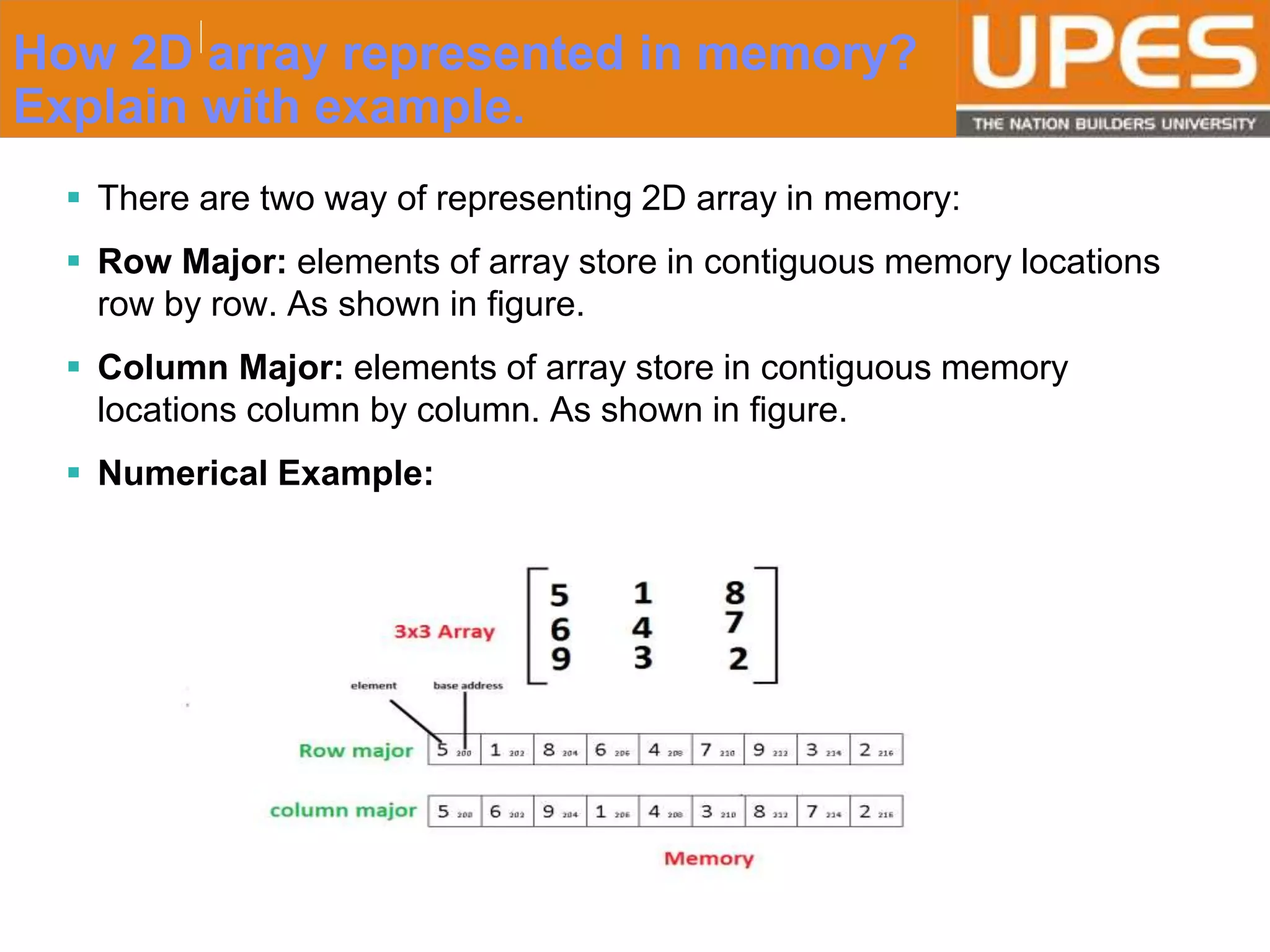
![© 2015UPESJuly 2015 Department. Of Civil Engineering
In figure there is 3x3 array and memory location start from 200 and each
element take 2 address. Calculate element at Array [3][1] for both row
and column major?
Ans. here m=n=3
I =3, j=1, w=2, base address=200
Formula for row major
Array[i][j] = Base+w( n(i-1)+(j-1) )
= 200+2(3(3-1)+(1-1))
= 212
Formula for column major
Array[i][j] = Base+w( m(j-1)+(i-1) )
= 200+2(3(1-1)+(3-1))
= 204](https://image.slidesharecdn.com/arrays-180327085501/75/Arrays-38-2048.jpg)

The document discusses various topics related to arrays including: - Defining an array as a collection of similar data elements of the same type stored in consecutive memory locations referenced by an index. - Syntax for declaring arrays and accessing elements using a loop and subscript. - Calculating addresses of array elements. - Storing, initializing, inputting, and assigning values to array elements. - Calculating the length of an array. - Algorithms for inserting and deleting elements from an array. - Sorting algorithms like bubble, selection, and insertion sort. - Searching techniques like linear and binary search.


