KLE SOCIETY’S COLLEGE OFEDUCATION
VIDYANAGAR HUBBALLI
SUBJECT : EDUCATIONAL TECHNOLOGY
SEMINAR ON :
EDUCATIONAL SYSTEMS
PRESENTED BY : SUBMITTED TO:
ARPITA.S.KUNNAL DR. LAKSHMIBAI B
B. Ed. 1st SEM JADHAV MAM
CONTENT
 WEB SERVICE
 WIKIPEDIA
 EDU BLOG
 BLOG
 E-MAIL
 DIGITAL LIBRARY / E-LIBRARY
 CHAT
 INTERNET FOURM / ONLINE FORUM
 CONCLUSION
WEB SERVICES
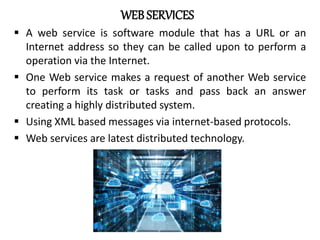
 A web service is software module that has a URL or an
Internet address so they can be called upon to perform a
operation via the Internet.
 One Web service makes a request of another Web service
to perform its task or tasks and pass back an answer
creating a highly distributed system.
 Using XML based messages via internet-based protocols.
 Web services are latest distributed technology.
WIKIPEDIA:
• Wikipedia is a free online encyclopedia, created and
maintained as an open collaboration project.
• Wikipedia was launched on January 15,2001 by JIMMY WALES
and LARRY SANGER.
• Wiki comes from Hawaiian word which means ”QUICK” and
pedia from encyclopedia.
• A wiki is a Web site that allows users to
add and update content on the site using
their on Web browser. This is made
possible by wiki software that runs on the
web server.
ADVANTAGES:
• A wiki can be thought of as a combination
of a website and a word document.
• The important element of a wiki is its ability
to keep track of the history of a document as it is revised.
• A wiki makes it easy for the students to write, revise and
submit a assignment, since students can develop, write and
revise.
DISAVANTAGES:
• Anyone can create, edit, or delete Wikipedia articles.
• Wikipedia articles cannot be considered scholarly, because
we know nothing about the contributors.
• Articles are works-in-progress, meaning changes are
constantly occurring to the information.
EDU BLOGS
• An education blog or edu blog is a blog ( weblog ) created for
educational purposes.
• A blog is a type of website or a
part of a website.
• A blog is similar to an empty book.
• The commenting feature of blogs
allows for immediate feedback on
a posting and active participation.
ADVANTAGES OF EDUBLOGS FORTEACHERS:
• It is easy and quick way to create a class website.
• Makes it easy for the teacher to find out what students think
and feel about the class and the lesson content.
• Is flexible and has lots of uses.
ADVANTAGES OF EDUBLOGS FORSTUDENTS:
• Provides a place for students to
express themselves and share
information with others.
• Encourages students who are
shy about talking in classroom
to share their ideas.
• Helps students to develop their ICT skills.
DISADVANTAGES:
• Students may not blog if they are not required to because it
takes time.
• It may be difficult for some people who have lower digital
skills to blog .
BLOG
• A website where entries ( or posts) are written in
chronological order and commonly displayed in reverse
chronological order
• Accessible to any internet user
• Blogs are all about opening up
your knowledge, experience,
processes and goals to customers
• Blogs are online chronicles that are
updated frequently, even daily. An update, ( also called an
entry or a post) is usually quite short, perhaps just a few
sentences, and readers can respond with comments. People
who write blogs are called bloggers.
ADVANTAGES :
• Become your own boss
• More energy
• Better work output
• Easily find clients
• More money for you( secure
your future)
DISADVANTAGES :
• You feel lonely
• Economy condition
• No work while you are ill
• Discipline
• Attitude and learning
E-MAIL
• Electronic mail, most commonly called e-mail since around
1993,is a method of exchanging digital messages from an
author to one or more recipients.
• E-mail operates across the Internet or other computer
networks via an e-mail providers server facility.
• Some early e-mail system required the author an the
recipients to both be online at the same time, in common
with instant messaging.
• Today’s e-mail systems are
based on a store-and-forward
Model.
AVANTAGES :
• Easy to reference
• Easy to use
• Speed
• Info at your fingertips
• Leverage
DISADVANTAGES :
• Emotional responses
• Lacking the personal touch
• Misunderstandings
• No respite
• Pressure to reply
DIGITAL LIBRARY OR E-LIBRARY
• A digital library or E-library is a collection of documents in a
organized electronic form, available on internet or on
CDROM ( compact-disk read-only memory ).
• Depending on the specific library, a user may be able to
access magazine articles, books, papers, images, sound files,
and videos.
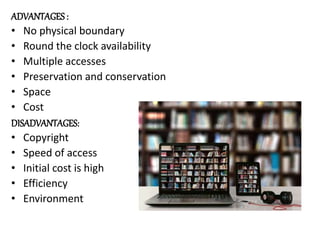
• The electronic content may be
stored locally, or accessed
remotely via computer
networks. It is a type of
information retrieval system.
ADVANTAGES :
• No physical boundary
• Round the clock availability
• Multiple accesses
• Preservation and conservation
• Space
• Cost
DISADVANTAGES:
• Copyright
• Speed of access
• Initial cost is high
• Efficiency
• Environment
CHAT
• Chat refers to the process of communicating, interacting
and or exchanging messages over the internet.
• It involves two or more individuals that communicate
through a chat-enabled service or software.
• Chat is also known as chatting, online chat or Internet
chat.
ADVANTAGES :
• It develops the communication skills.
• Chat may be delivered through text, verbal, audio, visual or
audio-visual communication via internet.
• It encourages E-Learning, team work.
• It promotes interaction between student-student, teacher-
student, student-teacher, teacher –teacher etc.
DISADVANTAGES :
• There are millions of teens who spend their precious time in
front of the computer.
• No time management.
• They are always busy in chatting.
• Addiction.
• Hacking and cheating.
AN INTERNET FORUM/ ONLINE FORUM
• An internet forum, or message board, is an online
discussion site where people can hold conversations in the
form of posted messages.
• A discussion forum is hierarchical or tree like in structure.
• It can contain a number of sub forums, each of which may
have several topics.
• Within a forums topic, each new discussion started is called
a thread, and can be replied to by as many people as so
wish.
ADVANTAGES :
• Students can learn to communicate collaboratively and form
relationships around academic goals.
• Active forum participation can improve students writing and
communication skills.
• Develops ability to express and see the views and opinions in
different topics.
• Develops high quality of discussion, comments, expression
skills.
• Due to continuous participation student increase their
writing, reading, replying, addressing, acknowledging
qualities.
CONCLUSION :
Arpita kunnal

Arpita kunnal

  • 1.
    KLE SOCIETY’S COLLEGEOFEDUCATION VIDYANAGAR HUBBALLI SUBJECT : EDUCATIONAL TECHNOLOGY SEMINAR ON : EDUCATIONAL SYSTEMS PRESENTED BY : SUBMITTED TO: ARPITA.S.KUNNAL DR. LAKSHMIBAI B B. Ed. 1st SEM JADHAV MAM
  • 2.
    CONTENT  WEB SERVICE WIKIPEDIA  EDU BLOG  BLOG  E-MAIL  DIGITAL LIBRARY / E-LIBRARY  CHAT  INTERNET FOURM / ONLINE FORUM  CONCLUSION
  • 3.
    WEB SERVICES  Aweb service is software module that has a URL or an Internet address so they can be called upon to perform a operation via the Internet.  One Web service makes a request of another Web service to perform its task or tasks and pass back an answer creating a highly distributed system.  Using XML based messages via internet-based protocols.  Web services are latest distributed technology.
  • 4.
    WIKIPEDIA: • Wikipedia isa free online encyclopedia, created and maintained as an open collaboration project. • Wikipedia was launched on January 15,2001 by JIMMY WALES and LARRY SANGER. • Wiki comes from Hawaiian word which means ”QUICK” and pedia from encyclopedia. • A wiki is a Web site that allows users to add and update content on the site using their on Web browser. This is made possible by wiki software that runs on the web server.
  • 5.
    ADVANTAGES: • A wikican be thought of as a combination of a website and a word document. • The important element of a wiki is its ability to keep track of the history of a document as it is revised. • A wiki makes it easy for the students to write, revise and submit a assignment, since students can develop, write and revise. DISAVANTAGES: • Anyone can create, edit, or delete Wikipedia articles. • Wikipedia articles cannot be considered scholarly, because we know nothing about the contributors. • Articles are works-in-progress, meaning changes are constantly occurring to the information.
  • 6.
    EDU BLOGS • Aneducation blog or edu blog is a blog ( weblog ) created for educational purposes. • A blog is a type of website or a part of a website. • A blog is similar to an empty book. • The commenting feature of blogs allows for immediate feedback on a posting and active participation. ADVANTAGES OF EDUBLOGS FORTEACHERS: • It is easy and quick way to create a class website. • Makes it easy for the teacher to find out what students think and feel about the class and the lesson content. • Is flexible and has lots of uses.
  • 7.
    ADVANTAGES OF EDUBLOGSFORSTUDENTS: • Provides a place for students to express themselves and share information with others. • Encourages students who are shy about talking in classroom to share their ideas. • Helps students to develop their ICT skills. DISADVANTAGES: • Students may not blog if they are not required to because it takes time. • It may be difficult for some people who have lower digital skills to blog .
  • 8.
    BLOG • A websitewhere entries ( or posts) are written in chronological order and commonly displayed in reverse chronological order • Accessible to any internet user • Blogs are all about opening up your knowledge, experience, processes and goals to customers • Blogs are online chronicles that are updated frequently, even daily. An update, ( also called an entry or a post) is usually quite short, perhaps just a few sentences, and readers can respond with comments. People who write blogs are called bloggers.
  • 9.
    ADVANTAGES : • Becomeyour own boss • More energy • Better work output • Easily find clients • More money for you( secure your future) DISADVANTAGES : • You feel lonely • Economy condition • No work while you are ill • Discipline • Attitude and learning
  • 10.
    E-MAIL • Electronic mail,most commonly called e-mail since around 1993,is a method of exchanging digital messages from an author to one or more recipients. • E-mail operates across the Internet or other computer networks via an e-mail providers server facility. • Some early e-mail system required the author an the recipients to both be online at the same time, in common with instant messaging. • Today’s e-mail systems are based on a store-and-forward Model.
  • 11.
    AVANTAGES : • Easyto reference • Easy to use • Speed • Info at your fingertips • Leverage DISADVANTAGES : • Emotional responses • Lacking the personal touch • Misunderstandings • No respite • Pressure to reply
  • 12.
    DIGITAL LIBRARY ORE-LIBRARY • A digital library or E-library is a collection of documents in a organized electronic form, available on internet or on CDROM ( compact-disk read-only memory ). • Depending on the specific library, a user may be able to access magazine articles, books, papers, images, sound files, and videos. • The electronic content may be stored locally, or accessed remotely via computer networks. It is a type of information retrieval system.
  • 13.
    ADVANTAGES : • Nophysical boundary • Round the clock availability • Multiple accesses • Preservation and conservation • Space • Cost DISADVANTAGES: • Copyright • Speed of access • Initial cost is high • Efficiency • Environment
  • 14.
    CHAT • Chat refersto the process of communicating, interacting and or exchanging messages over the internet. • It involves two or more individuals that communicate through a chat-enabled service or software. • Chat is also known as chatting, online chat or Internet chat.
  • 15.
    ADVANTAGES : • Itdevelops the communication skills. • Chat may be delivered through text, verbal, audio, visual or audio-visual communication via internet. • It encourages E-Learning, team work. • It promotes interaction between student-student, teacher- student, student-teacher, teacher –teacher etc. DISADVANTAGES : • There are millions of teens who spend their precious time in front of the computer. • No time management. • They are always busy in chatting. • Addiction. • Hacking and cheating.
  • 16.
    AN INTERNET FORUM/ONLINE FORUM • An internet forum, or message board, is an online discussion site where people can hold conversations in the form of posted messages. • A discussion forum is hierarchical or tree like in structure. • It can contain a number of sub forums, each of which may have several topics. • Within a forums topic, each new discussion started is called a thread, and can be replied to by as many people as so wish.
  • 17.
    ADVANTAGES : • Studentscan learn to communicate collaboratively and form relationships around academic goals. • Active forum participation can improve students writing and communication skills. • Develops ability to express and see the views and opinions in different topics. • Develops high quality of discussion, comments, expression skills. • Due to continuous participation student increase their writing, reading, replying, addressing, acknowledging qualities.
  • 18.