Are Health Sciences Librarians Taking the Evidence-Based Medicine Challenge? Ping Li, PhD GSLIS, Queens College, City University of New York   Lin Wu, MLIS, AHIP  Health Sciences Library and Biocommunications Center  University of Tennessee Health Science Center Canadian Association for Information Science (CAIS)  Annual Conference, Vancouver, BC, June 5–7, 2008
Introduction Evidence-Based Medicine (EBM) What is EBM? “ The integration of best research evidence with clinical expertise and patient values” (Sackett et al. 2000).
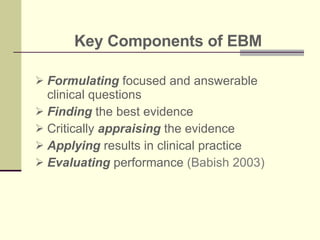
Key Components of EBM Formulating  focused and answerable clinical questions Finding  the best evidence Critically  appraising  the evidence  Applying  results in clinical practice Evaluating  performance  (Babish 2003)
Challenges Health care professionals Health sciences librarians
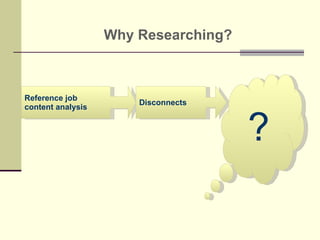
Why Researching? Reference job content analysis Disconnects ?
Research Objective To investigate whether and how health sciences librarians have been taking the evidence-based medicine (EBM) challenge.
Methodology Content analysis Job postings from January 2000 through  December 2007 Literature review Librarians' EBM-related duties, responsibilities, and activities
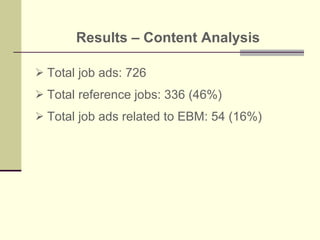
Results – Content Analysis Total job ads: 726 Total reference jobs: 336 (46%) Total job ads related to EBM: 54 (16%)
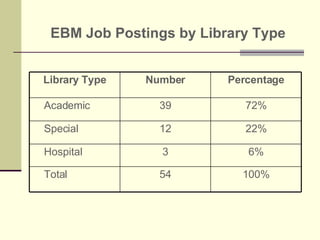
EBM Job Postings by Library Type Library Type Number Percentage Academic  39 72% Special 12 22% Hospital 3 6% Total 54 100%
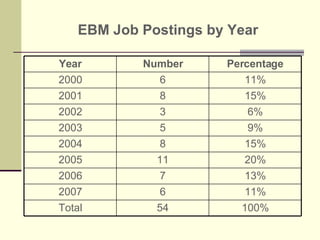
EBM Job Postings by Year Year Number Percentage 2000 6 11% 2001 8 15% 2002 3 6% 2003 5 9% 2004 8 15% 2005 11 20% 2006 7 13% 2007 6 11% Total 54 100%
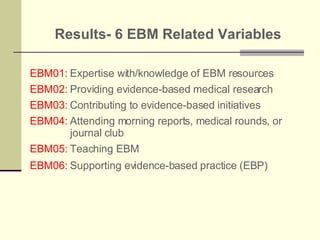
Results- 6 EBM Related Variables EBM01:  Expertise with/knowledge of EBM resources EBM02:  Providing evidence-based medical research EBM03:  Contributing to evidence-based initiatives EBM04:  Attending morning reports, medical rounds, or  journal club EBM05:  Teaching EBM EBM06:  Supporting evidence-based practice (EBP)
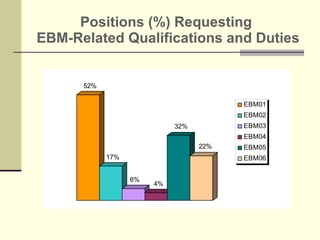
Positions (%) Requesting  EBM-Related Qualifications and Duties
Results – Literature Review Sources of Literature PubMed/Medline CINAHL LISTA Academic Search Premier
Results – Literature Review (Cont’d)   41 Articles Identified Opinion articles Articles reporting on librarians’ EBM-related  activities Most are of project nature  Only 4 articles reported on librarians’ routine involvement in EBM-related activities
Results – Literature Review (Cont’d)   Librarians’ Project-Related EBM Roles: Team members Partners Played a leading role in 3 projects
Results – Literature Review (Cont’d)   Librarians’ Routine EBM-Related Activities Participating in the curriculum integration to  support EBM Participating in morning reports to improve residents’ information searching skills Identifying, supplying, and providing training in EBP resources for educational  programs Participating in graduate medical education, finding and relating the best evidence to  clinical problems
Discussion Health sciences librarians Library administrators EBM practice in health care settings
Conclusions Potential existence of disconnects Significances Guidance for both employers and employees Insight into the training of future librarians
What to Be Done Next? More rigid data to validate the findings A survey to investigate health sciences librarians’ actual involvements related to EBM
Reference Sackett, David L., Sharon E. Straus, W. Scott Richardson,  William Rosenberg, and R. Brian Haynes. 2000.  Evidence based medicine: how to practice and  teach EBM.  2nd ed. Edinburgh: Churchill Livingstone. Babish, JoAnn. 2003. Evidence-based medicine morning  report: overview and role of the librarian.  Journal of Hospital Librarianship  3, no. 4: 35-45.  
Thank you! Full paper is available at http://www.cais-acsi.ca/2008proceedings.htm Ping Li: pli@qc.cuny.edu Lin Wu: lwu5@utmem.edu

Are Health Sciences Librarians Taking the EBM Challenge?

  • 1.
    Are Health SciencesLibrarians Taking the Evidence-Based Medicine Challenge? Ping Li, PhD GSLIS, Queens College, City University of New York Lin Wu, MLIS, AHIP Health Sciences Library and Biocommunications Center University of Tennessee Health Science Center Canadian Association for Information Science (CAIS) Annual Conference, Vancouver, BC, June 5–7, 2008
  • 2.
    Introduction Evidence-Based Medicine(EBM) What is EBM? “ The integration of best research evidence with clinical expertise and patient values” (Sackett et al. 2000).
  • 3.
    Key Components ofEBM Formulating focused and answerable clinical questions Finding the best evidence Critically appraising the evidence Applying results in clinical practice Evaluating performance (Babish 2003)
  • 4.
    Challenges Health careprofessionals Health sciences librarians
  • 5.
    Why Researching? Referencejob content analysis Disconnects ?
  • 6.
    Research Objective Toinvestigate whether and how health sciences librarians have been taking the evidence-based medicine (EBM) challenge.
  • 7.
    Methodology Content analysisJob postings from January 2000 through December 2007 Literature review Librarians' EBM-related duties, responsibilities, and activities
  • 8.
    Results – ContentAnalysis Total job ads: 726 Total reference jobs: 336 (46%) Total job ads related to EBM: 54 (16%)
  • 9.
    EBM Job Postingsby Library Type Library Type Number Percentage Academic 39 72% Special 12 22% Hospital 3 6% Total 54 100%
  • 10.
    EBM Job Postingsby Year Year Number Percentage 2000 6 11% 2001 8 15% 2002 3 6% 2003 5 9% 2004 8 15% 2005 11 20% 2006 7 13% 2007 6 11% Total 54 100%
  • 11.
    Results- 6 EBMRelated Variables EBM01: Expertise with/knowledge of EBM resources EBM02: Providing evidence-based medical research EBM03: Contributing to evidence-based initiatives EBM04: Attending morning reports, medical rounds, or journal club EBM05: Teaching EBM EBM06: Supporting evidence-based practice (EBP)
  • 12.
    Positions (%) Requesting EBM-Related Qualifications and Duties
  • 13.
    Results – LiteratureReview Sources of Literature PubMed/Medline CINAHL LISTA Academic Search Premier
  • 14.
    Results – LiteratureReview (Cont’d) 41 Articles Identified Opinion articles Articles reporting on librarians’ EBM-related activities Most are of project nature Only 4 articles reported on librarians’ routine involvement in EBM-related activities
  • 15.
    Results – LiteratureReview (Cont’d) Librarians’ Project-Related EBM Roles: Team members Partners Played a leading role in 3 projects
  • 16.
    Results – LiteratureReview (Cont’d) Librarians’ Routine EBM-Related Activities Participating in the curriculum integration to support EBM Participating in morning reports to improve residents’ information searching skills Identifying, supplying, and providing training in EBP resources for educational programs Participating in graduate medical education, finding and relating the best evidence to clinical problems
  • 17.
    Discussion Health scienceslibrarians Library administrators EBM practice in health care settings
  • 18.
    Conclusions Potential existenceof disconnects Significances Guidance for both employers and employees Insight into the training of future librarians
  • 19.
    What to BeDone Next? More rigid data to validate the findings A survey to investigate health sciences librarians’ actual involvements related to EBM
  • 20.
    Reference Sackett, DavidL., Sharon E. Straus, W. Scott Richardson, William Rosenberg, and R. Brian Haynes. 2000. Evidence based medicine: how to practice and teach EBM. 2nd ed. Edinburgh: Churchill Livingstone. Babish, JoAnn. 2003. Evidence-based medicine morning report: overview and role of the librarian. Journal of Hospital Librarianship 3, no. 4: 35-45.  
  • 21.
    Thank you! Fullpaper is available at http://www.cais-acsi.ca/2008proceedings.htm Ping Li: pli@qc.cuny.edu Lin Wu: lwu5@utmem.edu