DEVELOPMENT ALTERNATIVE WORLD
HEADQUARTERS
NAME:GAYATHRI,MISHAB,AKSHAYA,VAISHNAVI,DEEKSHITHA,
SAISHREE
SECTION: A
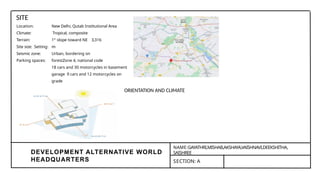
Location:
Climate:
Terrain:
Site size: Setting:
Seismic zone:
Parking spaces:
New Delhi, Qutab Institutional Area
Tropical, composite
1° slope toward NE 3,316
m2
Urban, bordering on
forestZone 4, national code
18 cars and 30 motorcycles in basement
garage 9 cars and 12 motorcycles on
grade
SITE
ORIENTATION AND CLIMATE
DEVELOPMENT ALTERNATIVE WORLD
HEADQUARTERS
NAME:GAYATHRI,MISHAB,AKSHAYA,VAISHNAVI,DEEKSHITHA,
SAISHREE
SECTION: A
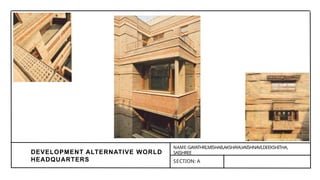
The ecologically-friendly and culturally nuanced building of
Development Alternative in New Delhi includes molded
terracotta tiles that form a jali (patterned screen) feature
common to traditional buildings in northern India. The tiles
are filled with insulating vermiculite plaster and some host
recycled mirror fragments that glint sunlight and enhance the
dimensional effect.
DEVELOPMENT ALTERNATIVE WORLD
HEADQUARTERS
NAME:GAYATHRI,MISHAB,AKSHAYA,VAISHNAVI,DEEKSHITHA,
SAISHREE
SECTION: A
The design, materials, and techniques of Development Alternatives world
headquarters demonstrate a fundamental alternative for the construction of
comfortable, green, and affordable buildings of many types.
The project tests innovative, specially designed elements and components such as
a hybrid air-handling unit that incorporates available components in a new way to
achieve great energy savings.
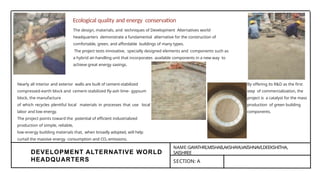
Nearly all interior and exterior walls are built of cement-stabilized
compressed-earth block and cement-stabilized fly-ash lime- gypsum
block, the manufacture
of which recycles plentiful local materials in processes that use local
labor and low energy.
The project points toward the potential of efficient industrialized
production of simple, reliable,
low-energy building materials that, when broadly adopted, will help
curtail the massive energy consumption and CO2 emissions.
By offering its R&D as the first
step of commercialization, the
project is a catalyst for the mass
production of green building
components.
Ecological quality and energy conservation
DEVELOPMENT ALTERNATIVE WORLD
HEADQUARTERS
NAME:GAYATHRI,MISHAB,AKSHAYA,VAISHNAVI,DEEKSHITHA,
SAISHREE
SECTION: A
Ethical standards and social equity
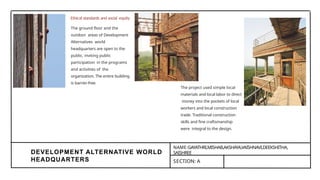
The ground floor and the
outdoor areas of Development
Alternatives world
headquarters are open to the
public, inviting public
participation in the programs
and activities of the
organization. The entire building
is barrier-free.
The project used simple local
materials and local labor to direct
money into the pockets of local
workers and local construction
trade. Traditional construction
skills and fine craftsmanship
were integral to the design.
DEVELOPMENT ALTERNATIVE WORLD
HEADQUARTERS
NAME:GAYATHRI,MISHAB,AKSHAYA,VAISHNAVI,DEEKSHITHA,
SAISHREE
SECTION: A
Economic performance and compatibility
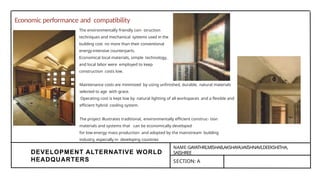
The environmentally friendly con- struction
techniques and mechanical systems used in the
building cost no more than their conventional
energy-intensive counterparts.
Economical local materials, simple technology,
and local labor were employed to keep
construction costs low.
Maintenance costs are minimized by using unfinished, durable, natural materials
selected to age with grace.
Operating cost is kept low by natural lighting of all workspaces and a flexible and
efficient hybrid cooling system.
The project illustrates traditional, environmentally efficient construc- tion
materials and systems that can be economically developed
for low-energy mass production and adopted by the mainstream building
industry, especially in developing countries
DEVELOPMENT ALTERNATIVE WORLD
HEADQUARTERS
NAME:GAYATHRI,MISHAB,AKSHAYA,VAISHNAVI,DEEKSHITHA,
SAISHREE
SECTION: A
Contextual and aesthetic impact Responding to its physical setting,
Development Alternatives world
headquarters forms a visual anchor
at the end of the city street on one
side and shows reverence to the
calm forest on the other. The
significance of the historic city forest
as an ecological asset is
heightened by how the building
embraces the forest.
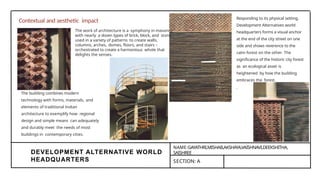
The work of architecture is a symphony in masonry,
with nearly a dozen types of brick, block, and stone
used in a variety of patterns to create walls,
columns, arches, domes, floors, and stairs –
orchestrated to create a harmonious whole that
delights the senses.
The building combines modern
technology with forms, materials, and
elements of traditional Indian
architecture to exemplify how regional
design and simple means can adequately
and durably meet the needs of most
buildings in contemporary cities.
DEVELOPMENT ALTERNATIVE WORLD
HEADQUARTERS
NAME:GAYATHRI,MISHAB,AKSHAYA,VAISHNAVI,DEEKSHITHA,
SAISHREE
SECTION: A
DEVELOPMENT ALTERNATIVE WORLD
HEADQUARTERS
NAME:GAYATHRI,MISHAB,AKSHAYA,VAISHNAVI,DEEKSHITHA,
SAISHREE
SECTION: A
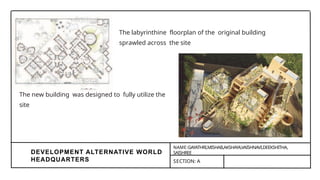
The labyrinthine floorplan of the original building
sprawled across the site.
The new building was designed to fully utilize the
site.
DEVELOPMENT ALTERNATIVE WORLD
HEADQUARTERS
NAME:GAYATHRI,MISHAB,AKSHAYA,VAISHNAVI,DEEKSHITHA,
SAISHREE
SECTION: A
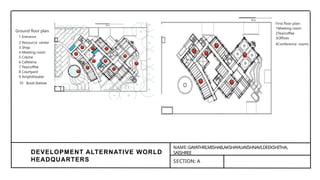
1 Entrance
2 Resource center
3 Shop
4 Meeting room
5 Crèche
6 Cafeteria
7 Tea/coffee
8 Courtyard
9 Amphitheater
Ground floor plan:
10 Bouli (below
First floor plan:
1Meeting room
2Tea/coffee
3Offices
4Conference rooms
DEVELOPMENT ALTERNATIVE WORLD
HEADQUARTERS
NAME:GAYATHRI,MISHAB,AKSHAYA,VAISHNAVI,DEEKSHITHA,
SAISHREE
SECTION: A
DEVELOPMENT ALTERNATIVE WORLD
HEADQUARTERS
NAME:GAYATHRI,MISHAB,AKSHAYA,VAISHNAVI,DEEKSHITHA,
SAISHREE
SECTION: A
DEVELOPMENT ALTERNATIVE WORLD
HEADQUARTERS
NAME:GAYATHRI,MISHAB,AKSHAYA,VAISHNAVI,DEEKSHITHA,
SAISHREE
SECTION: A
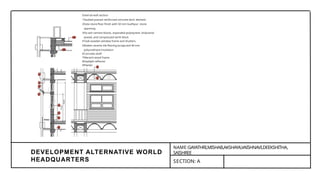
External wall section:
1Vaulted precast reinforced-concrete deck element
2Kota stone floor finish with 50 mm budhpur stone
spanning
3Fly-ash cement blocks, expanded polystyrene (industrial
waste), and compressed earth block
4Teak wooden window frame and shutters.
5Broken ceramic tile flooring (scrap) and 40 mm
polyurethane insulation
6Concrete shelf
7Meranti wood frame
8Daylight reflector
9Planter
DEVELOPMENT ALTERNATIVE WORLD
HEADQUARTERS
NAME:GAYATHRI,MISHAB,AKSHAYA,VAISHNAVI,DEEKSHITHA,
SAISHREE
SECTION: A
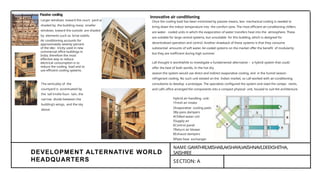
Passive cooling
Larger windows toward the court- yard are
shaded by the building mass; smaller
windows toward the outside are shaded
by elements such as brise soleils.
Air conditioning accounts for
approximately seventy percent
of the elec- tricity used in new
commercial office buildings in
India; therefore the most
effective way to reduce
electrical consumption is to
reduce the cooling load and to
use efficient cooling systems.
The verticality of the
courtyard is accentuated by
the tall trickle foun- tain, the
narrow divide between the
building’s wings, and the sky
above.
Innovative air conditioning
Hybrid air-handling unit:
1Fresh air intake
2Evaporative cooling pads
3By-pass dampers
4Chilled water coil
5Supply air
6Control panel
7Return air blower
8Exhaust dampers
9Plate heat exchanger
Once the cooling load has been minimized by passive means, less mechanical cooling is needed to
bring down the indoor temperature into the comfort zone. The most efficient air-conditioning chillers
are water- cooled units in which the evaporation of water transfers heat into the atmosphere. These
are suitable for large central systems, but unsuitable for this building, which is designed for
decentralized operation and control. Another drawback of these systems is that they consume
substantial amounts of soft water. Air-cooled systems on the market offer the benefit of modularity
but they are inefficient during high summer.
Lall thought it worthwhile to investigate a fundamental alternative – a hybrid system that could
offer the best of both worlds. In the hot dry
season the system would use direct and indirect evaporative cooling, and in the humid season
refrigerant cooling. No such unit existed on the Indian market, so Lall worked with air-conditioning
consultants to develop a prototype. The specialists configured the system and sized the compo- nents,
and Lall’s office arranged the components into a compact physical unit, housed to suit the architecture.
DEVELOPMENT ALTERNATIVE WORLD
HEADQUARTERS
NAME:GAYATHRI,MISHAB,AKSHAYA,VAISHNAVI,DEEKSHITHA,
SAISHREE
SECTION: A
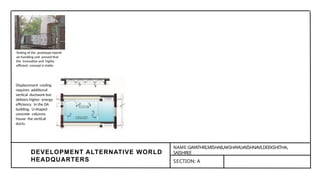
Testing of the prototype hybrid
air-handling unit proved that
the innovative and highly-
efficient concept is viable
Displacement cooling
requires additional
vertical ductwork but
delivers higher energy
efficiency. In the DA
building, U-shaped
concrete columns
house the vertical
ducts.
DEVELOPMENT ALTERNATIVE WORLD
HEADQUARTERS
NAME:GAYATHRI,MISHAB,AKSHAYA,VAISHNAVI,DEEKSHITHA,
SAISHREE
SECTION: A
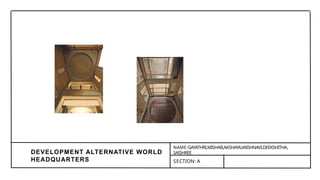
TRADITIONAL & ENVIRONMENTALLY EFFICIENT
CONSTRUCTION MATERIALS AND SYSTEMS THAT CAN BE
ECONOMICALLY DEVELOPED FOR LOW-ENERGY MASS
PRODUCTION WALLS ARE BUILT OF CEMENT-
STABILIZED COMPRESSED-EARTH BLOCK & CEMENT-
STABILIZED FLY-ASH LIME-GYPSUM BLOCKUSES LESS THAN
HALF THE REINFORCING STEEL USED IN COMPARABLE
STRUCTURES OF CONVENTIONAL DESIGN HIGHLY
ENERGY INTENSIVE MATERIALSARE LEAST USED
EXTENSIVE USE OF COMMERCIAL TIMBER AT DOORS AND
WINDOWS TERRACOTTA TILES AT SLOOP ROOFING
VAULTED PRECAST CC DECK AT ROOFING
CONSTRUCTION MATERIALS
DEVELOPMENT ALTERNATIVE WORLD
HEADQUARTERS
NAME:GAYATHRI,MISHAB,AKSHAYA,VAISHNAVI,DEEKSHITHA,
SAISHREE
SECTION: A
DEVELOPMENT ALTERNATIVE WORLD
HEADQUARTERS
NAME:GAYATHRI,MISHAB,AKSHAYA,VAISHNAVI,DEEKSHITHA,
SAISHREE
SECTION: A

architecture sheet for design refrence and design approach

  • 1.
    DEVELOPMENT ALTERNATIVE WORLD HEADQUARTERS NAME:GAYATHRI,MISHAB,AKSHAYA,VAISHNAVI,DEEKSHITHA, SAISHREE SECTION:A Location: Climate: Terrain: Site size: Setting: Seismic zone: Parking spaces: New Delhi, Qutab Institutional Area Tropical, composite 1° slope toward NE 3,316 m2 Urban, bordering on forestZone 4, national code 18 cars and 30 motorcycles in basement garage 9 cars and 12 motorcycles on grade SITE ORIENTATION AND CLIMATE
  • 2.
    DEVELOPMENT ALTERNATIVE WORLD HEADQUARTERS NAME:GAYATHRI,MISHAB,AKSHAYA,VAISHNAVI,DEEKSHITHA, SAISHREE SECTION:A The ecologically-friendly and culturally nuanced building of Development Alternative in New Delhi includes molded terracotta tiles that form a jali (patterned screen) feature common to traditional buildings in northern India. The tiles are filled with insulating vermiculite plaster and some host recycled mirror fragments that glint sunlight and enhance the dimensional effect.
  • 3.
    DEVELOPMENT ALTERNATIVE WORLD HEADQUARTERS NAME:GAYATHRI,MISHAB,AKSHAYA,VAISHNAVI,DEEKSHITHA, SAISHREE SECTION:A The design, materials, and techniques of Development Alternatives world headquarters demonstrate a fundamental alternative for the construction of comfortable, green, and affordable buildings of many types. The project tests innovative, specially designed elements and components such as a hybrid air-handling unit that incorporates available components in a new way to achieve great energy savings. Nearly all interior and exterior walls are built of cement-stabilized compressed-earth block and cement-stabilized fly-ash lime- gypsum block, the manufacture of which recycles plentiful local materials in processes that use local labor and low energy. The project points toward the potential of efficient industrialized production of simple, reliable, low-energy building materials that, when broadly adopted, will help curtail the massive energy consumption and CO2 emissions. By offering its R&D as the first step of commercialization, the project is a catalyst for the mass production of green building components. Ecological quality and energy conservation
  • 4.
    DEVELOPMENT ALTERNATIVE WORLD HEADQUARTERS NAME:GAYATHRI,MISHAB,AKSHAYA,VAISHNAVI,DEEKSHITHA, SAISHREE SECTION:A Ethical standards and social equity The ground floor and the outdoor areas of Development Alternatives world headquarters are open to the public, inviting public participation in the programs and activities of the organization. The entire building is barrier-free. The project used simple local materials and local labor to direct money into the pockets of local workers and local construction trade. Traditional construction skills and fine craftsmanship were integral to the design.
  • 5.
    DEVELOPMENT ALTERNATIVE WORLD HEADQUARTERS NAME:GAYATHRI,MISHAB,AKSHAYA,VAISHNAVI,DEEKSHITHA, SAISHREE SECTION:A Economic performance and compatibility The environmentally friendly con- struction techniques and mechanical systems used in the building cost no more than their conventional energy-intensive counterparts. Economical local materials, simple technology, and local labor were employed to keep construction costs low. Maintenance costs are minimized by using unfinished, durable, natural materials selected to age with grace. Operating cost is kept low by natural lighting of all workspaces and a flexible and efficient hybrid cooling system. The project illustrates traditional, environmentally efficient construc- tion materials and systems that can be economically developed for low-energy mass production and adopted by the mainstream building industry, especially in developing countries
  • 6.
    DEVELOPMENT ALTERNATIVE WORLD HEADQUARTERS NAME:GAYATHRI,MISHAB,AKSHAYA,VAISHNAVI,DEEKSHITHA, SAISHREE SECTION:A Contextual and aesthetic impact Responding to its physical setting, Development Alternatives world headquarters forms a visual anchor at the end of the city street on one side and shows reverence to the calm forest on the other. The significance of the historic city forest as an ecological asset is heightened by how the building embraces the forest. The work of architecture is a symphony in masonry, with nearly a dozen types of brick, block, and stone used in a variety of patterns to create walls, columns, arches, domes, floors, and stairs – orchestrated to create a harmonious whole that delights the senses. The building combines modern technology with forms, materials, and elements of traditional Indian architecture to exemplify how regional design and simple means can adequately and durably meet the needs of most buildings in contemporary cities.
  • 7.
  • 8.
    DEVELOPMENT ALTERNATIVE WORLD HEADQUARTERS NAME:GAYATHRI,MISHAB,AKSHAYA,VAISHNAVI,DEEKSHITHA, SAISHREE SECTION:A The labyrinthine floorplan of the original building sprawled across the site. The new building was designed to fully utilize the site.
  • 9.
    DEVELOPMENT ALTERNATIVE WORLD HEADQUARTERS NAME:GAYATHRI,MISHAB,AKSHAYA,VAISHNAVI,DEEKSHITHA, SAISHREE SECTION:A 1 Entrance 2 Resource center 3 Shop 4 Meeting room 5 Crèche 6 Cafeteria 7 Tea/coffee 8 Courtyard 9 Amphitheater Ground floor plan: 10 Bouli (below First floor plan: 1Meeting room 2Tea/coffee 3Offices 4Conference rooms
  • 10.
  • 11.
  • 12.
    DEVELOPMENT ALTERNATIVE WORLD HEADQUARTERS NAME:GAYATHRI,MISHAB,AKSHAYA,VAISHNAVI,DEEKSHITHA, SAISHREE SECTION:A External wall section: 1Vaulted precast reinforced-concrete deck element 2Kota stone floor finish with 50 mm budhpur stone spanning 3Fly-ash cement blocks, expanded polystyrene (industrial waste), and compressed earth block 4Teak wooden window frame and shutters. 5Broken ceramic tile flooring (scrap) and 40 mm polyurethane insulation 6Concrete shelf 7Meranti wood frame 8Daylight reflector 9Planter
  • 13.
    DEVELOPMENT ALTERNATIVE WORLD HEADQUARTERS NAME:GAYATHRI,MISHAB,AKSHAYA,VAISHNAVI,DEEKSHITHA, SAISHREE SECTION:A Passive cooling Larger windows toward the court- yard are shaded by the building mass; smaller windows toward the outside are shaded by elements such as brise soleils. Air conditioning accounts for approximately seventy percent of the elec- tricity used in new commercial office buildings in India; therefore the most effective way to reduce electrical consumption is to reduce the cooling load and to use efficient cooling systems. The verticality of the courtyard is accentuated by the tall trickle foun- tain, the narrow divide between the building’s wings, and the sky above. Innovative air conditioning Hybrid air-handling unit: 1Fresh air intake 2Evaporative cooling pads 3By-pass dampers 4Chilled water coil 5Supply air 6Control panel 7Return air blower 8Exhaust dampers 9Plate heat exchanger Once the cooling load has been minimized by passive means, less mechanical cooling is needed to bring down the indoor temperature into the comfort zone. The most efficient air-conditioning chillers are water- cooled units in which the evaporation of water transfers heat into the atmosphere. These are suitable for large central systems, but unsuitable for this building, which is designed for decentralized operation and control. Another drawback of these systems is that they consume substantial amounts of soft water. Air-cooled systems on the market offer the benefit of modularity but they are inefficient during high summer. Lall thought it worthwhile to investigate a fundamental alternative – a hybrid system that could offer the best of both worlds. In the hot dry season the system would use direct and indirect evaporative cooling, and in the humid season refrigerant cooling. No such unit existed on the Indian market, so Lall worked with air-conditioning consultants to develop a prototype. The specialists configured the system and sized the compo- nents, and Lall’s office arranged the components into a compact physical unit, housed to suit the architecture.
  • 14.
    DEVELOPMENT ALTERNATIVE WORLD HEADQUARTERS NAME:GAYATHRI,MISHAB,AKSHAYA,VAISHNAVI,DEEKSHITHA, SAISHREE SECTION:A Testing of the prototype hybrid air-handling unit proved that the innovative and highly- efficient concept is viable Displacement cooling requires additional vertical ductwork but delivers higher energy efficiency. In the DA building, U-shaped concrete columns house the vertical ducts.
  • 15.
    DEVELOPMENT ALTERNATIVE WORLD HEADQUARTERS NAME:GAYATHRI,MISHAB,AKSHAYA,VAISHNAVI,DEEKSHITHA, SAISHREE SECTION:A TRADITIONAL & ENVIRONMENTALLY EFFICIENT CONSTRUCTION MATERIALS AND SYSTEMS THAT CAN BE ECONOMICALLY DEVELOPED FOR LOW-ENERGY MASS PRODUCTION WALLS ARE BUILT OF CEMENT- STABILIZED COMPRESSED-EARTH BLOCK & CEMENT- STABILIZED FLY-ASH LIME-GYPSUM BLOCKUSES LESS THAN HALF THE REINFORCING STEEL USED IN COMPARABLE STRUCTURES OF CONVENTIONAL DESIGN HIGHLY ENERGY INTENSIVE MATERIALSARE LEAST USED EXTENSIVE USE OF COMMERCIAL TIMBER AT DOORS AND WINDOWS TERRACOTTA TILES AT SLOOP ROOFING VAULTED PRECAST CC DECK AT ROOFING CONSTRUCTION MATERIALS
  • 16.
  • 17.