Welcome
Name: Panchal Dhrumil Indravadan
Subject: Database Management Systems
Branch: Computer Engineering (B.E.)
Semester: Third Sem
Year: 2018-19
Topic
DBA
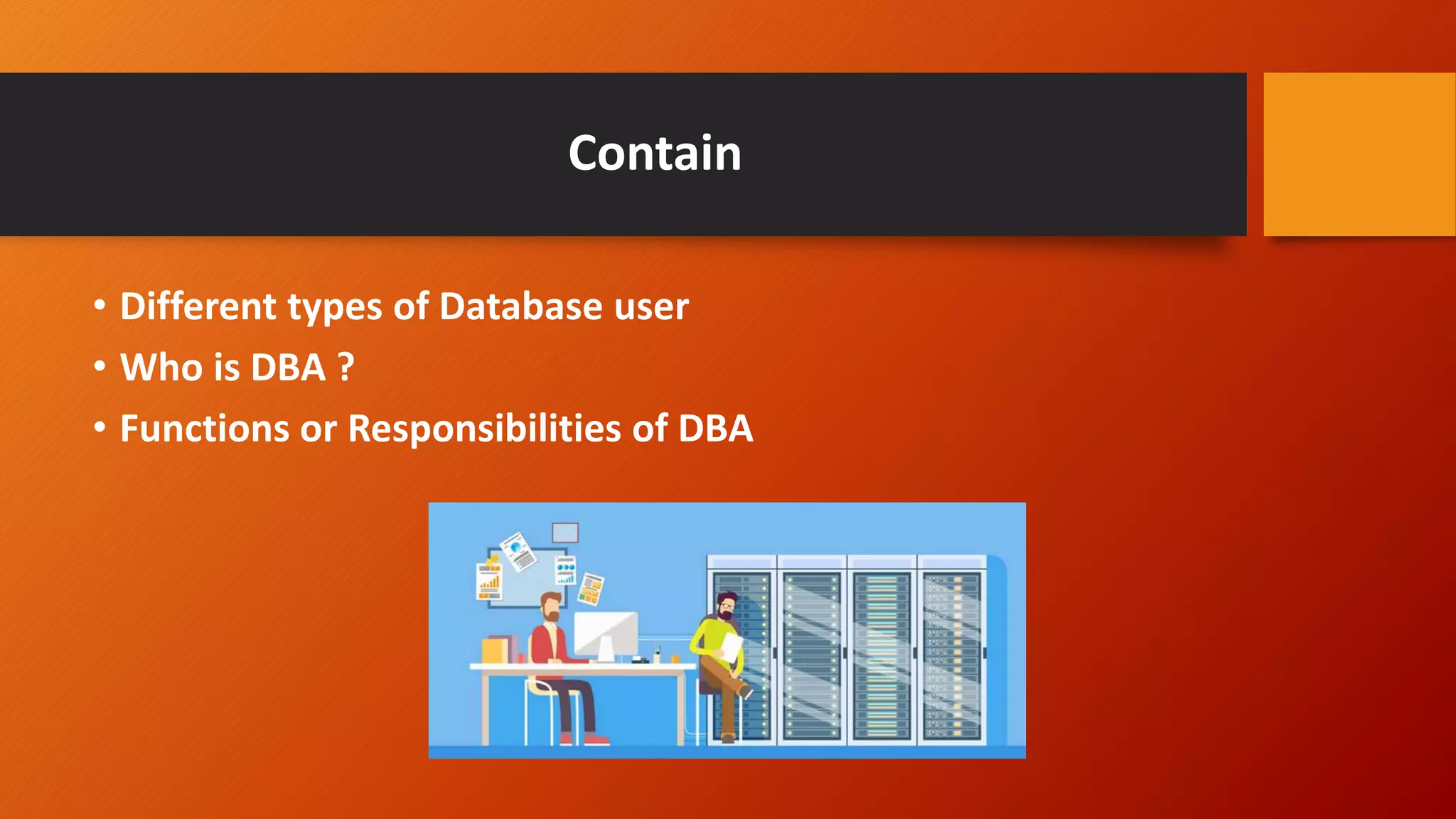
Contain
• Different types of Database user
• Who is DBA ?
• Functions or Responsibilities of DBA
Different types of Database users
• There are mainly four types of Database user which are:
1. Naive users
2. Application Programmers
3. Sophisticated user
4. Specialized user (DBA)
Who is DBA ?
• The full name of DBA is Database Administrator.
• Database Administrator is a person in the organization who
controls the design and the use of database.
Functions/Responsibilities of DBA
• Schema Definition:
• DBA defines the logical schema of the database.
• A schema refers to the overall logical structure of the
database.
• According to this schema, database will be designed to store
required data for an organization.
Functions/Responsibilities of DBA
• Storage Structure and Access Method Definition:
• DBA decides how the data is to be represented in the
database.
• Based on this, storage structure of the database and access
methods of data is defined.
Functions/Responsibilities of DBA
• Defining Security and Integrity Constraints:
• DBA decides various security and integrity constraints.
• DDL provides facilities to specifying such constraints.
Functions/Responsibilities of DBA
• Granting of Authorization for Data Access:
• The DBA determines which user needs access to which part of
the database.
• According to this, various types of authorizations
(permissions) are granted to different users.
• This is required to prevent unauthorized access of a database.
Functions/Responsibilities of DBA
• Liaison with Users:
• DBA is responsible to provide necessary data to user.
• User should be able to write the external schema, using DDL.
Functions/Responsibilities of DBA
• Assisting Application Programmers:
• DBA provides assistance to application programmers to
develop application programs.
Functions/Responsibilities of DBA
• Monitoring Performance:
• The DBA monitors performance of the system.
• The DBA ensures that better performance is maintained by
making change in physical or logical schema if required.
Functions/Responsibilities of DBA
• Backup and Recovery:
• Database should not be lost or damaged.
• The task of DBA is to backing up the database on some
storage devices such as DVD, CD or Magnetic Tape or remote
servers.
• In case of failures, such as flood or virus attack, Database is
recovered from this backup.
In sort DBA
• The database administrator is a person in the organization
who controls the design and the use of the database.
• DBA provides necessary technical support for implementing a
database.
• DBA is involved more in the design, development, testing and
operational phases.
In sort DBA
• DBA is a technical person having knowledge of database
technology.
• DBA does not need to be a business person, but any kind of
knowledge about a functionality of an organization can be
more beneficiary.
• DBA is a technically focused person, but, he/she should
understand more about the business to administer the
databases effectively.
References
• Inspiration from Dr. Neha Soni, Prof. Keyur Upadhyay and
Prof. Uma Dave
• Notes of DBMS
• Text book of DBMS
• Images from Google images
• Some my own knowledge
Thank You

Database Administrator

  • 1.
    Welcome Name: Panchal DhrumilIndravadan Subject: Database Management Systems Branch: Computer Engineering (B.E.) Semester: Third Sem Year: 2018-19
  • 2.
  • 3.
    Contain • Different typesof Database user • Who is DBA ? • Functions or Responsibilities of DBA
  • 4.
    Different types ofDatabase users • There are mainly four types of Database user which are: 1. Naive users 2. Application Programmers 3. Sophisticated user 4. Specialized user (DBA)
  • 5.
    Who is DBA? • The full name of DBA is Database Administrator. • Database Administrator is a person in the organization who controls the design and the use of database.
  • 6.
  • 7.
    Functions/Responsibilities of DBA •Schema Definition: • DBA defines the logical schema of the database. • A schema refers to the overall logical structure of the database. • According to this schema, database will be designed to store required data for an organization.
  • 8.
    Functions/Responsibilities of DBA •Storage Structure and Access Method Definition: • DBA decides how the data is to be represented in the database. • Based on this, storage structure of the database and access methods of data is defined.
  • 9.
    Functions/Responsibilities of DBA •Defining Security and Integrity Constraints: • DBA decides various security and integrity constraints. • DDL provides facilities to specifying such constraints.
  • 10.
    Functions/Responsibilities of DBA •Granting of Authorization for Data Access: • The DBA determines which user needs access to which part of the database. • According to this, various types of authorizations (permissions) are granted to different users. • This is required to prevent unauthorized access of a database.
  • 11.
    Functions/Responsibilities of DBA •Liaison with Users: • DBA is responsible to provide necessary data to user. • User should be able to write the external schema, using DDL.
  • 12.
    Functions/Responsibilities of DBA •Assisting Application Programmers: • DBA provides assistance to application programmers to develop application programs.
  • 13.
    Functions/Responsibilities of DBA •Monitoring Performance: • The DBA monitors performance of the system. • The DBA ensures that better performance is maintained by making change in physical or logical schema if required.
  • 14.
    Functions/Responsibilities of DBA •Backup and Recovery: • Database should not be lost or damaged. • The task of DBA is to backing up the database on some storage devices such as DVD, CD or Magnetic Tape or remote servers. • In case of failures, such as flood or virus attack, Database is recovered from this backup.
  • 15.
    In sort DBA •The database administrator is a person in the organization who controls the design and the use of the database. • DBA provides necessary technical support for implementing a database. • DBA is involved more in the design, development, testing and operational phases.
  • 16.
    In sort DBA •DBA is a technical person having knowledge of database technology. • DBA does not need to be a business person, but any kind of knowledge about a functionality of an organization can be more beneficiary. • DBA is a technically focused person, but, he/she should understand more about the business to administer the databases effectively.
  • 17.
    References • Inspiration fromDr. Neha Soni, Prof. Keyur Upadhyay and Prof. Uma Dave • Notes of DBMS • Text book of DBMS • Images from Google images • Some my own knowledge
  • 18.