KATSIGIANNIS LAYOUT                         10/9/06      1:11 PM       Page 90


                                                         M U LT I M E D I A I N W I R E L E S S /M O B I L E A D H O C N E T W O R K S


             ARCHITECTURE FOR RELIABLE SERVICE DISCOVERY
              AND DELIVERY IN MANETS BASED ON POWER
               MANAGEMENT EMPLOYING SLP EXTENSIONS
             CHRISTOS I. KATSIGIANNIS, DIMITRIOS A. KATEROS, ELEFTHERIOS A. KOUTSOLOUKAS, NIKO-
             LAOS D. TSELIKAS, AND IAKOVOS S. VENIERIS, NATIONAL TECHNICAL UNIVERSITY OF ATHENS


                                                                                 ABSTRACT                                          tion. The first one arises from the nature of the
                            UA 3    2                                                                                              mobile devices that form the network, since the
                             lg  srvR b:
                              3      qst(
                                          )                 Limited energy resources and mobility issues                           main energy supply is batteries, which have lim-
                                 srvRq


              : )
                              2b: ()


         2b qst(                                         affect the topology of ad hoc networks and intro-                         ited power resources. As for the dynamic topolo-
                                  st
                                   2b: ()


             R
                            srvRq


        s rv                                     : ()    duce difficulties in service discovery. The high                          gy problem, it derives from the mobility of the
                                       st


                                             2b qst      possibility of a link breakdown due to low energy                         devices and causes extra problems in the net-
                                    lg         v R
               2b:                   3      sr           supplies in a ubiquitous computing environment,                           work’s connectivity. Consequently, these two
                                  UA 2             2b
            srvRqst()                       srvRq :      such as a mobile ad hoc network (MANET),                                  problems affect service-discovery and delivery
                                                     s
       2a                                                raises service-provider selection issues with                             processes within MANETs.
                                srvRqst()


         :s
             rvR
                                                         regard to achieving the best possible service reli-                          In this article a few well-known protocols and
                                   2b:


                   ply
                       ()
                                                         ability. Every node requiring a specific service                          technologies of service discovery and delivery
                                lg                       must choose a provider under certain criteria.                            are described. Energy constraints affecting
                                 2
                               SA 1                      This article provides an overview of standardized                         MANET are cited, while a novel architecture of
                                                         service-discovery and delivery solutions. In addi-                        reliable service discovery and delivery based on
                                                         tion, a novel architecture is proposed which pro-                         energy metrics is presented. The foundation of
       The authors provide                               vides the ability to select a service provider by                         the proposed architecture is an application layer
                                                         taking into account metrics such as the power                             algorithm, which is based on a decentralized
       an overview of                                    supplies of the service provider and concomitant                          approach of Service Location Protocol (SLP)
       standardized service-                             path towards the destination. The proposed
                                                         algorithm is decentralized and based on Service
                                                                                                                                   extensions. Finally, conclusions of the work and
                                                                                                                                   possible future extensions are presented.
       discovery and                                     Location Protocol version 2 (SLPv2) extensions.
                                                                                                                                                      SERVICE DISCOVERY
       delivery solutions.                                                    INTRODUCTION
       An architecture is                                                                                                                   STATE OF THE ART TECHNOLOGIES FOR
                                                         Advances arising from wireless connectivity
                                                         and portable computing along with the demand                                               SERVICE DISCOVERY
       proposed that                                     for greater mobility and user independence                                Viewing services as either hardware or soft-
       provides the ability                              have boosted the rapid deployment towards
                                                         mobile ad hoc networks (MANETs). These are
                                                                                                                                   ware resources, accessible through the network
                                                                                                                                   and capable of interacting with each other by
       to select a service                               networks that do not require a fixed infra-                               sending and receiving information and data,
                                                         structure and consist of wireless autonomous                              service discovery could be defined as the pro-
       provider by taking                                systems and devices, called nodes. Ad hoc net-                            cess of mapping a service description to a so-
                                                         works are self-organized and self-managed.                                called service location. The service location
       into account metrics                              They are mostly applied either in personal area                           characterizes a network location, consisting, for
                                                         networks (PANs) or in military and emergency                              example, of a server address and a port num-
       such as the power                                 situations. Because of the flexible infrastruc-                           ber on which the service is able to listen to the
       supplies of the                                   tureless nature of MANETs, even in the event
                                                         of sudden damage of some nodes caused by
                                                                                                                                   incoming requests and answer back with corre-
                                                                                                                                   sponding responses.
       service provider and                              possible physical disaster (e.g., an earthquake),                            In order to make the service-discovery con-
                                                         the nodes can be easily reorganized to provide                            cept more concrete, an everyday example is
       concomitant path                                  connectivity to emergency services like police                            given. Assuming that we want to find the tele-
                                                         or fire brigade teams.                                                    phone number of a person (this is the requested
       towards the                                          One of the major problems in mobile ad hoc                             service), we can look it up in our phone book
                                                         environments is associated with energy con-                               (this is the service location) and, if it does exist,
       destination.                                      straints and with dynamic topology configura-                             we can call him/her (this is the service usage). In


        90                                                          1536-1284/06/$20.00 © 2006 IEEE                                         IEEE Wireless Communications • October 2006
                             Authorized licensed use limited to: Annamalai University. Downloaded on August 8, 2009 at 02:30 from IEEE Xplore. Restrictions apply.
KATSIGIANNIS LAYOUT       10/9/06         1:11 PM         Page 91


       case the requested telephone number does not
       exist in our phone book, we can alternatively
                                                                                (XML) is used in control messages that describe
                                                                                device features and capabilities. The XML
                                                                                                                                                                       The Jini
       search for it in the white pages, search in a relat-                     description allows complex, powerful descrip-                                 communication
       ed site on the Internet, call the telephone direc-                       tions of device capabilities — and, most impor-
       tory service, or even ask friends or family. This is                     tantly — in a standardized manner. SOAP over                            mechanism is based
       the case when the same service can be provided                           HTTP can be used for the transportation of the
       by several actors (i.e., several service locations).                     XML control messages, which is also a                                   on the Java Remote
       Telecommunication applications, however, gen-                            lightweight and standard communication mecha-
       erally do not have the luxury of the richness and                        nism.                                                                    Method Invocation,
       stability of human communications available to
       them [1]. Harking back to the previous example,
                                                                                    The Jini architecture is an extension of the
                                                                                Java programming language, where each device
                                                                                                                                                            which allows the
       even in our everyday life, we would be happy if                          is assumed to run a Java virtual machine (JVM).                              code movement
       we could a priori know that the desired tele-                            Devices and applications are registered with a
       phone number does not exist in our phone book,                           Jini network using processes like Discovery and                         around the network.
       while, for example, searching in the white pages                         Join. To join a Jini network, devices or applica-
       will be much more efficient and faster than ask-                         tions register themselves in a Lookup Table, a                           Thus, the benefit of
       ing our friends for it. The above paradigm is                            database placed on a lookup server, which keeps
       depicted in the case of telecommunication ser-                           track of all services in the network. This kind of                              code mobility
       vices, when multiple mappings of the same ser-
       vice are offered by different servers (i.e., service
                                                                                registration follows the concept of leasing. In
                                                                                other words, the device is registering itself and
                                                                                                                                                                 replaces the
       locations). The client has to choose a specific                          exposes its services only for a certain time period                               necessity of
       server providing the desired service, based on                           — called a lease — which is very useful, espe-
       multiple criteria. Those factors can be network                          cially for dynamic ad hoc networks. Inside the                            preinstalling drivers
       layer parameters, the hop-count number, or even                          Lookup Table, apart from the pointers associat-
       the actual distance between client and server.                           ing a service provider with a requested service,                                on the client.
       The last parameter could be very useful in                               the Java code for these services can also be
       mobile environments, since routing is based not                          stored, while device drivers, interfaces, and other
       only on the number of hops a message will roam                           auxiliary programs helping the clients access a
       from the source to the destination, but also on                          service can be uploaded to the Lookup Table
       the distance or the traffic load between the                             too. When a client wants to utilize a service, the
       nodes.                                                                   object code is downloaded to the client’s JVM.
           Moreover, the selection of the service descrip-                      The Jini communication mechanism is based on
       tion language is very proprietary in service dis-                        the Java Remote Method Invocation (RMI),
       covery. A client requiring a service and a server                        which allows the code movement around the
       offering this service must use a common descrip-                         network. Thus, the benefit of code mobility
       tion language in order to efficiently map the ser-                       replaces the necessity of preinstalling drivers on
       vice description with the location. In a                                 the client.
       service-discovery mechanism, services advertise                              SLP is an IETF standard for service discovery
       themselves, thus providing information and                               [3]. There are three types of agents that operate
       details about their capabilities and access (e.g.                        on behalf of network-based software:
       IP address).                                                             • The user sgent (UA), which performs service
           Several protocols and technologies support                              discovery on behalf of the client software
       service-discovery and delivery mechanisms. The                           • The service agent (SA), which advertises the
       most commonly known and used ones are briefly                               location and attributes on behalf of the ser-
       described below and are mentioned in [2].                                   vices
           Universal plug and play (UPnP), an extension                         • The directory agent (DA), which aggregates
       of Microsoft’s plug and play technology, is appli-                          service information registered or advertised by
       cable in the case where devices, either wireless                            the SAs
       or wired, are reachable via TCP/IP. It is pro-                               SLP can operate in both centralized and
       posed for small office or home networks to                               decentralized modes. In the centralized mode
       enable peer-to-peer mechanisms for auto-config-                          one or more DAs are present in the network
       uration of devices, service discovery, and control                       registering information about a service.
       of services. In UPnP architecture there are two                          Through either the service agent’s advertise-
       main classifications of devices: controlled devices                      ment (SAAdvert) messages or the service regis-
       and control points. Controlled devices are the                           ter (SrvReg) messages, sent by an SA, the DA
       devices that form the network and respond to                             registers in its cache information about the
       requests coming from the control points. When                            location (URL of the node) and the type
       a new device joins the network, it can dynamical-                        (attributes) of a service. When a UA requests a
       ly obtain an IP address. If this node functions as                       service, it sends a service request (SrvRqst)
       a controlled device, it has to convey its services                       message to the DA. Then the DA replies with a
       and capabilities to the control points upon                              service reply (SrvRply) message. With this mes-
       request. This action is accomplished by using the                        sage, the DA informs the client about the loca-
       Simple Service Discovery Protocol (SSDP). In                             tion of the service. Then the UA requests
       the case of a newcomer control point, the device                         directly the service from the SA, by establishing
       has to exchange discovery messages with the                              a direct TCP connection.
       other nodes of the network, in order to gather                               The decentralized approach is associated with
       information about the available services and                             the absence of DAs in the network. In that case,
       devices of the network. UPnP architecture is                             UAs repeatedly multicast requests (SrvRqst) to
       applied over standard TCP/IP and web-based                               the SAs. The SA that can offer the requested
       networks, while eXtensible Markup Language                               service unicasts a reply message.


       IEEE Wireless Communications • October 2006                                                                                                                          91
                Authorized licensed use limited to: Annamalai University. Downloaded on August 8, 2009 at 02:30 from IEEE Xplore. Restrictions apply.
KATSIGIANNIS LAYOUT      10/9/06         1:11 PM         Page 92


       If a node is off                                                                                              need to register services to a registry server. The
                                                                                                                     description of services is made through the
       because of low                           Node 0                                                               DARPA         Agent       Markup        Language
                                                                                                                     (DAML+OIL).
       power or processing                                                Node 1                                        In-advance cross-layer architectures have
                                                                                                                     been proposed in order to reduce the number of
       resources, the whole                                                                                          message exchanges in a mobile ad hoc network.
                                                                                                                     However, the cross-layer approach simplifies the
       path from the source                                                                                          procedure of service request and reply, since all
       to the destination                                                                                            these messages are included in the network layer
                                                                                                                     and the application layer is lightweight. A cross-
                                                                                              Node 3
                                                                  Node 2
       will probably change,                                                                                         layer architecture is proposed in [7], where the
                                                                                                                     service-discovery and delivery messages are
       thus causing                                                                                                  included in the Dynamic Source Routing (DSR)
                                         I Figure 1. A simple mobile ad hoc network.                                 protocol and the Destination Sequenced Dis-
       difficulties in the                                                                                           tance Vector (DSDV) algorithm, representatives
                                                                                                                     of reactive (on-demand) routing and proactive
       discovery of services                         SERVICE DISCOVERY IN MANET                                      (table-driven) routing, respectively.
       as well as in the                Architectures for service discovery like SLP and
                                                                                                                        Another cross-layer architecture is proposed
                                                                                                                     in [3] with the On-Demand Multicast Routing
       establishment of a               Jini do not offer efficiency in a mobile ad hoc                              Protocol (ODMRP), where the service advertise-
                                        network, due to energy and mobility constraints.                             ment and discovery messages are included in the
       connection between               Specifically, the centralized mechanisms of these                            network layer.
                                        protocols act as a contrary wind against
       the service provider             MANET, since the DA’s presence and the
                                        Lookup Server impose difficulties, and both can                                          POWER CONSTRAINTS AND
       and the client r                 be often assumed as a bottleneck for the net-                                         SERVICE DISCOVERY IN MANETS
       equiring the                     work. Sending periodically updated SrvReg mes-
                                        sages to the DA or the Lookup Table and the                                  The most intense problem in mobile networks,
       specific service.                concomitant SrvRqst and SrvRply messages can                                 especially in mobile ad hoc networks, is network
                                        cause extra traffic to the network.                                          connectivity, which can change due to power
                                            Moreover, all those extra messages sent to                               consumption as analyzed in [8]. If a node is off
                                        the DA or to the Lookup Server will lead to                                  because of low power or processing resources,
                                        additional energy consumption from the nodes’                                the whole path from the source to the destina-
                                        point of view, causing rapid “death” of nodes. A                             tion will probably change, thus causing difficul-
                                        better solution in the implementation of the SLP                             ties in the discovery of services as well as in the
                                        in a MANET could be a decentralized approach                                 establishment of a connection between the ser-
                                        without the presence of the DA. Both central-                                vice provider and the client requiring the specific
                                        ized and decentralized SLP approaches have                                   service.
                                        already been developed in CSLP and DSLP                                          An example depicting the abovementioned
                                        architectures for service discovery in MANETs                                difficulties in a mobile ad hoc network is shown
                                        [4].                                                                         in Fig. 1.
                                            Because of the infrastructureless nature of                                  The mobile ad hoc network is comprised by
                                        this kind of networks and their dynamic topolo-                              four nodes and we assume that node 0 is request-
                                        gy, service discovery is becoming a crucial issue.                           ing a service that only node 3 can provide to
                                        Bandwidth and energy constraints reduce the                                  him. If the requested service is energy and time
                                        efficiency of the well-known application-layer                               demanding, such as, for example, a video, music,
                                        service-discovery protocols. Previous attempts                               or other multimedia service, power management
                                        made to implement an application-layer service-                              is very important in order to increase network’s
                                        discovery technique are briefly described below.                             lifetime. Therefore node 0, which requests the
                                            Konark is a service-discovery and delivery                               service from node 3, has to know the remaining
                                        protocol implemented for mobile ad hoc net-                                  power not only of the service provider, but also
                                        works. Concerning discovery, Konark proposes a                               of the intermediate nodes in order to select the
                                        completely distributed, peer-to-peer mechanism                               proper route to the destination for both the
                                        giving each device the ability to advertise and                              request and reply messages.
                                        discover services in the network. The service
                                        description is based on XML messages, and the
                                        services are described in a way that is under-                                THE PROPOSED ARCHITECTURE FOR POWER
                                        standable by humans and machines alike. Each                                  MANAGEMENT BASED ON SLP EXTENSIONS
                                        participating node can cache its services in a
                                        local registry and deliver them to the requested                             The basic challenge of mobile ad hoc networks is
                                        client using a micro-HTTP server. The service                                to develop algorithms that take into account the
                                        delivery mechanism is based on the exchange of                               resources’ constraints. All devices participating
                                        SOAP-based messages [5].                                                     in a MANET have restricted power resources
                                            Group-based Service Discovery (GSD) is a                                 such as batteries. It is probable that a mobile
                                        novel distributed service-discovery architecture                             node may fail because of lack of resources,
                                        based on the concept of peer-to-peer caching of                              destroying (in this case) a link or a route and
                                        service advertisement and group-based intelli-                               changing the network’s topology. This dynamic
                                        gent forwarding of service requests [5]. Contrary                            configuration of network topology causes serious
                                        to the abovementioned techniques, there is no                                problems in service discovery and delivery. This


       92                                                                                                                     IEEE Wireless Communications • October 2006
               Authorized licensed use limited to: Annamalai University. Downloaded on August 8, 2009 at 02:30 from IEEE Xplore. Restrictions apply.
KATSIGIANNIS LAYOUT       10/9/06         1:11 PM         Page 93


                                                                                                                                                           A better solution in
            0 1 2 3 4 5 6 7 8 9 0 1 2 3 4 5 6 7 8 9 0 1 2 3 4 5 6 7 8 9 0 1
                  Version                Function-ID                     Length                                                                           the implementation
                Length cont.       O F D
                     Next extension offset cont.
                                                             Reserved
                                                                           XID
                                                                                Next extension offset
                                                                                                                                                               of the SLP in a
                        Language tag length                           Language tag                                                                          MANET could be a
                                                     Protocol data
                                                                                                                                                                 decentralized
                                                                    Protocol data                                                                       approach without the
                            Extension ID (0x8001)                                             Next extension offset
                Next extension                                                      Extension data                                                        presence of the DA.
                 offset cont.                      Request/reply                         Byte 1                   Byte 2
                                                                                                                                                         Both centralized and
        I Figure 2. SLP message structure.                                                                                                                  decentralized SLP
                                                                                                                                                          approaches of have
       problem can be overcome by introducing a new
       service-discovery and delivery architecture, in
                                                                                remaining power resources. It is an implementa-
                                                                                tion requirement that every node engaging in
                                                                                                                                                                 already been
       which critical information, such as the remaining                        the proposed power-management scheme will be                               developed in CSLP
       energy resources of the service provider and the                         able to report their lifetime in minutes, from
       remaining power of the intermediate nodes, is                            their available power resources. Routing based                                       and DSLP
       known to the client.                                                     on this metric, called Minimum Battery Cost
           Our proposed scheme is based on a decen-                             Routing (MBCR), has been suggested in [10],                                   architectures for
       tralized extended approach of the Service Loca-                          where it was compared with regard to perfor-
       tion Protocol version 2 (SLPv2). SLPv2 is                                mance to other power-based routing schemes                                   service discovery
       documented in [9], where the protocol life cycle,
       message structuring, and scope are described.
                                                                                such as Minimum Total Transmission Power
                                                                                Routing (MTTPR) and Min–Max Battery Cost
                                                                                                                                                                    in MANETs
       SLPv2 is flexible enough to provide an extension                         Routing (MMBCR).
       mechanism through which the protocol adapts to                               The Next Extension Offset field has two pos-
       specific service-discovery requirements. Guide-                          sible values
       lines for extending the protocol are also docu-                          • Zero, when this is the last extension section in
       mented in RFC 3224.                                                         the message
           The extension mechanism in SLPv2 is provid-                          • The value of the “Extension Offset” field in
       ed by dedicated sections located at the end of                              the message header plus eight for the 8 bytes
       SLP messages. The exact position of the first                               of the proposed extension section, when there
       extension in an SLP message is defined by a                                 are subsequent extension sections in the SLP
       dedicated field in the SLP message header, as an                            message.
       offset in bytes from the message beginning. This                             Accordingly, the Rqst/Rply field has a value
       is the “Next Extension Offset” field, which takes                        of
       2 bytes and contains an integer number in net-                           • 0 × 00 when the extension section resides in an
       work byte order. Each extension section at the                              SLP SrvRqst message
       end of the message defines the exact position of                         • 0 × F0 when the extension section resides in
       the following extension section as an offset (in                            an SLP SrvRply message.
       number of bytes) from the message beginning.                                 The proposed incorporation of the concepts
       Again, the field’s name is “Next Extension Off-                          of MBCR in SLP-based discovery is described in
       set,” its length is two bytes, and it contains an                        the algorithm below. For the sake of clarity, the
       integer number in network byte order. If no fur-                         algorithm’s functionality concerning the pro-
       ther extension section is present, the immediate                         posed extended-SLP architecture is described
       preceding “Next Extension Offset” field should                           using an example and is depicted in Fig. 3. The
       have the value zero. Figure 2 describes this                             assumptions regarding the following description
       arrangement. It shows the general structure of                           are that UA1 enters into the MANET and
       an SLP message and the location and length of                            requests a service that both SA1 and SA2 can
       the different fields. The SLP message header                             provide, while UA2, UA3, and UA4 cannot offer
       takes up the first four lines of the matrix, fol-                        the requested service. The latter can act only as
       lowed by the SLP message protocol data and the                           intermediate routing nodes during the service
       extension field which takes up the last two lines.                       provision phase. We also assume that each SA
           The proposed power-management extension                              that receives a SrvRqst message replies with the
       for SLP is assigned the Extension ID 0x8001, as                          corresponding SrvRply one by extending it and
       described in RFC 3224 for experimental exten-                            adding in the above-described field its remaining
       sions. The “Extension Data” field of the pro-                            power resource value. Furthermore, we assume
       posed extension section has a length of three                            that each node manipulates the received extend-
       bytes and it contains a one byte field defining                          ed SrvRply call-back SLP message, as described
       whether this is a power state request or response,                       below: it first checks this new field in the SrvR-
       and two bytes containing an integer number in                            ply message regarding the remaining power
       network byte order, representing the minutes that                        resources of the previous node and, if its own
       the corresponding route to a service provider will                       resources are lower than the previous one, it
       be available, expressed as the remaining lifetime of                     substitutes this field with the lower value (its
       the intermediate hop in the route with the least                         own value); otherwise, it dispatches the message


       IEEE Wireless Communications • October 2006                                                                                                                          93
                Authorized licensed use limited to: Annamalai University. Downloaded on August 8, 2009 at 02:30 from IEEE Xplore. Restrictions apply.
KATSIGIANNIS LAYOUT                       10/9/06         1:11 PM                      Page 94


                   Caches the
                              UA 3                                                                                                                                                                  UA 3
                    SrvRqst                                                                                                    UA 3    2                                                                   srv 3a:
                                                                                                                                lg  srvR b:                                                                   Rp
                                                                   SA 2                                                          3      qst(                                                                     ly(        SA 2
                                 t()                                                                                                         )          SA 2                                                         )


                                                                                                                                    srvRq
                               qs                                                                                : )


                                                                                                                                 2b: ()
                          R                                                                                 2b qst(


                                                                                                                                    st
                                                                                                                                      2b: ()
                       rv
                     :s


                                                                                                                                                                                                                               srvR
                                                                                                                R                                                                                                    :


                                                                                                                               srvRq
                    1                                                                                        rv                                     : ()                                                          3a ly()


                                                                                                                                                                                                                                 3b: t()
                                                                                                           s


                                                                                                                                          st
                                                                                                                                                 2b qst                                                               p
                                                                                                   lg                                                                                                             rvR


                                                                                                                                                                                                                                    qs
                          Caches the                                                                                                                                                                            s
                                                                                                    1                                  lg          vR
            UA 1        1: SrvRqst
                              srvRq                                                             UA 1 lg           2b:                   3       sr                             UA 1
                                                                                                                                                                                                       UA 2
                                   st()       UA 2                                                                                   UA 2             2b
                                                                                                      1
                                                                                      UA 4                     srvRqst()                        srvRq :           UA 4                                                             UA 3
                                                                                                                                                        st()
                        1:                                                                                2a                                                                               Path 1


                                                                                                                                   srvRqst()
                             srv                                                                            :s
                                   Rq                                                                           rvR


                                                                                                                                      2b:
                                      st()
                                                                                                                      ply
                                                                                                                          ()
                                                                                                                                   lg
                                             SA 1                                                                                   2                                                                 SA 1
                                                                                                                                  SA 1
            (a)                                                                                     (b)                                                                        (c)


                                                                                        UA 3                                                                        UA 3
                                                                                  )
                                                                           l   y(                          SA 2                                                                         SA 2
                                                                         Rp                                                                              Path 3
                                                                  s rv
                                                              4a:


                                                                                                               sr
                                                                                                               4b ply
                                                                                                                 vR
                                                                                                                  : ()
                                                    UA 1                                                                                  UA 1                 Path 2         lg
                                                                  4a: srvRply()               UA 2                                                                       UA 2 4      5:
                                                                                                                        UA 4                                                     srvRp         UA 4
                                                                                                                                                                                        ly()
                                                                         Path 1                                                                           Path 1


                                                                                             SA 1                                                                       SA 1
                                                    (d)                                                                                   (e)


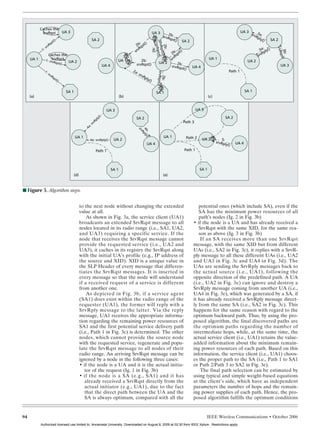
        I Figure 3. Algorithm steps.


                                                          to the next node without changing the extended                                                              potential ones (which include SA), even if the
                                                          value at all.                                                                                               SA has the minimum power resources of all
                                                              As shown in Fig. 3a, the service client (UA1)                                                           path’s nodes (Ig. 2 in Fig. 3b)
                                                          broadcasts an extended SrvRqst message to all                                                            • if the node is a UA and has already received a
                                                          nodes located in its radio range (i.e., SA1, UA2,                                                           SrvRqst with the same XID, for the same rea-
                                                          and UA3) requiring a specific service. If the                                                               son as above (Ig. 3 in Fig. 3b)
                                                          node that receives the SrvRqst message cannot                                                                If an SA receives more than one SrvRqst
                                                          provide the requested service (i.e., UA2 and                                                             message, with the same XID but from different
                                                          UA3), it caches in its registry the SrvRqst along                                                        UAs (i.e., SA2 in Fig. 3c), it replies with a SrvR-
                                                          with the initial UA’s profile (e.g., IP address of                                                       ply message to all these different UAs (i.e., UA2
                                                          the source and XID). XID is a unique value in                                                            and UA3 in Fig. 3c and UA4 in Fig. 3d). The
                                                          the SLP Header of every message that differen-                                                           UAs are sending the SrvRply messages back to
                                                          tiates the SrvRqst messages. It is inserted in                                                           the actual source (i.e., UA1), following the
                                                          every message so that the node will understand                                                           opposite direction of the predefined path. A UA
                                                          if a received request of a service is different                                                          (i.e., UA2 in Fig. 3e) can ignore and destroy a
                                                          from another one.                                                                                        SrvRply message coming from another UA (i.e.,
                                                              As depicted in Fig. 3b, if a service agent                                                           UA4 in Fig. 3e), which was generated by a SA, if
                                                          (SA1) does exist within the radio range of the                                                           it has already received a SrvRply message direct-
                                                          requester (UA1), the former will reply with a                                                            ly from the same SA (i.e., SA2 in Fig. 3c). This
                                                          SrvRply message to the latter. Via the reply                                                             happens for the same reason with regard to the
                                                          message, UA1 receives the appropriate informa-                                                           optimum backward path. Thus, by using the pro-
                                                          tion regarding the remaining power resources of                                                          posed algorithm, the final discovered paths are
                                                          SA1 and the first potential service delivery path                                                        the optimum paths regarding the number of
                                                          (i.e., Path 1 in Fig. 3c) is determined. The other                                                       intermediate hops, while, at the same time, the
                                                          nodes, which cannot provide the source node                                                              actual service client (i.e., UA1) retains the value-
                                                          with the requested service, regenerate and popu-                                                         added information about the minimum remain-
                                                          late the SrvRqst message to all nodes of their                                                           ing power resources of each path. Based on this
                                                          radio range. An arriving SrvRqst message can be                                                          information, the service client (i.e., UA1) choos-
                                                          ignored by a node in the following three cases:                                                          es the proper path to the SA (i.e., Path 1 to SA1
                                                          • if the node is a UA and it is the actual initia-                                                       or Path 2/Path 3 to SA2 in Fig. 3e).
                                                             tor of the request (Ig. 1 in Fig. 3b)                                                                     The final path selection can be estimated by
                                                          • if the node is a SA (e.g., SA1) and it has                                                             using typical and simple weight-based equations
                                                             already received a SrvRqst directly from the                                                          at the client’s side, which have as independent
                                                             actual initiator (e.g., UA1), due to the fact                                                         parameters the number of hops and the remain-
                                                             that the direct path between the UA and the                                                           ing power supplies of each path. Hence, the pro-
                                                             SA is always optimum, compared with all the                                                           posed algorithm fulfills the optimum conditions


       94                                                                                                                                                                   IEEE Wireless Communications • October 2006
                   Authorized licensed use limited to: Annamalai University. Downloaded on August 8, 2009 at 02:30 from IEEE Xplore. Restrictions apply.
KATSIGIANNIS LAYOUT        10/9/06         1:11 PM         Page 95


                                                                                 [9] E. Guttman et al., “Service Location Protocol (SLP) Ver-
       regarding service provision, while in parallel it
       has the intention to conserve the MANET’s cur-                                sion 2,” IETF RFC 2608, June 1999.                                   Further cross-layer
                                                                                 [10] C.-K. Toh, “Maximum Battery Life Routing to Support
       rent configuration and network topology.                                      Ubiquitous Mobile Computing in Wireless Ad Hoc Net-                     implementation,
                                                                                     works,” IEEE Commun. Mag., June 2001, pp. 138–47.
             CONCLUSIONS AND FUTURE WORK                                                                                                                    incorporating the
                                                                                                           BIOGRAPHIES
       In this article a new architecture concerning ser-                        CHRISTOS I. KATSIGIANNIS (chkatsig@telecom.ntua.gr) received              useful power and
                                                                                 a Dipl-Ing. degree from the Computer Engineering and
       vice-discovery procedures in a mobile ad hoc
       network (MANET) has been proposed. This
                                                                                 Informatics Department of Patras (CEID) in 2004. Since
                                                                                 then he has been a research associate and a Ph.D. candi-
                                                                                                                                                         hop-number metrics
       architecture is implemented in the application
       layer, without taking into account procedures in
                                                                                 date in the Intelligent Communications and Broadband
                                                                                 Networks Laboratory of National Technical University of
                                                                                                                                                                     with the
       the network layer. The main concept of the pro-                           Athens (NTUA). His current research interests are in the
                                                                                 fields of mobile networks, and mobile ad hoc and sensor                       corresponding
       posed architecture is based on SLP extensions in                          networks. He is a member of the Technical Chamber of
       conjunction with an algorithm, taking into                                Greece.                                                                   distance and load
       account the remaining energy supplies and the
       minimum number of hops in each potential ser-                             DIMITRIOS A. KATEROS (dkateros@telecom.ntua.gr) received a
                                                                                 Dipl-Ing.degree from the School of Electrical and Computer
                                                                                                                                                          ones, arising from
       vice-provisioning path within a MANET. The
       new metrics are passed through an “application-
                                                                                 Engineering of NTUA in 2004. Since then he has been a
                                                                                 research associate and a Ph.D. candidate in the Intelligent
                                                                                                                                                          the network layer,
       layer signaling” procedure. The slight load over-
       head caused by adding this kind of “signaling”
                                                                                 Communications and Broadband Networks Laboratory of
                                                                                 NTUA. His primary research interests are mobile computing                can be applied for
                                                                                 and software development in the area of mobile Internet.
       can be easily condoned, if its vital advantages —                         He is a member of the Technical Chamber of Greece.                        advanced routing
       the ad hoc environment’s lifetime maintenance
       and all nodes’ connectivity retention — are real-                         N IKOLAOS D. T SELIKAS (ntsel@telecom.ntua.gr) received
                                                                                 Dipl.-Ing. and Ph.D. degrees from the School of Electrical
                                                                                                                                                                algorithms in
       ized.
          Further cross-layer implementation, incorpo-
                                                                                 and Computer Engineering of NTUA in 1999 and 2004,
                                                                                 respectively. He is currently working in NTUA as a research
                                                                                                                                                                    MANETs.
       rating the useful power and hop-number metrics                            associate. He is interested in broadband intelligent net-
       with the corresponding distance and load ones,                            works, network convergence, service control, distributed
                                                                                 and middleware architectures, and telecommunications ser-
       arising from the network layer, can be applied                            vice engineering. He has participated in several European
       for advanced routing algorithms in MANETs. A                              Union and national research projects. He is a member of
       possible comparison of the proposed architec-                             the Technical Chamber of Greece.
       ture in this article with a cross-layer one could
                                                                                 E LEFTHERIOS A. K OUTSOLOUKAS (lefterisk@telecom.ntua.gr)
       offer very useful results for considering the best                        received a Dipl-Ing. degree from the School of Electrical
       solution in the development of a service-discov-                          and Computer Engineering of NTUA in 2002. Since then he
       ery and delivery framework.                                               has been a research associate and a Ph.D. candidate in the
                                                                                 Intelligent Communications and Broadband Networks Lab-
                                                                                 oratory of NTUA. His primary research interests are mobile
                               REFERENCES                                        computing, and software development in the area of
       [1] S. Vinoski, “Service Discovery 101,” IEEE Internet                    mobile Internet, middleware applications, and distributed
           Comp., vol. 7, no. 1, Jan. 2003, pp. 69–71.                           technologies. He has participated in European Union and
       [2] C. Bettstetter and C. Renner, “A Comparison of Service                national research projects and he is a member of the Tech-
           Discovery Protocols and Implementation of the Service                 nical Chamber of Greece.
           Location Protocol,” Proc. 6th EUNICE Open Euro. Sum-
           mer School: Innovative Internet Apps., Twente, The                    I AKOVOS S. V ENIERIS [M] (venieris@cs.ntua.gr) received a
           Netherlands, Sept. 2000, pp. 13–15.                                   Dipl.-Ing. degree from the University of Patras, Patras,
       [3] W. Ma et al., “Implementation of a Lightweight Service                Greece in 1988, and a Ph.D. degree from NTUA in 1990, all
           Advertisement and Discovery Protocol for Mobile Ad                    in electrical and computer engineering. In 1994 he became
           Hoc Networks,” IEEE GLOBECOM ’03, vol. 2, nos. 1–5,                   an Assistant Professor in the School of Electrical and Com-
           Dec. 2003, pp. 1023–27.                                               puter Engineering of NTUA, where he is now a full profes-
       [4] H. Seo et al., “Performance of Service Location Proto-                sor. His research interests are in the fields of broadband
           cols in MANET Based on Reactive Routing Protocols”                    communications, Internet, mobile networks, intelligent net-
           ICN 2005, 2005.                                                       works, internetworking, signaling, service creation and con-
       [5] S. Helal et al., “Konark:A Service Discovery and Delivery             trol, distributed processing, agents technology, and
           Protocol for Ad Hoc Networks,” Proc. WCNC 2003,                       performance evaluation. He has more than 150 publica-
           2003.                                                                 tions in the above areas. He leads NTUA participation in
       [6] D. Chakraborty, A. Joshi, and T. Finin, “GSD: A Novel                 several European Union and national projects. He is a
           Group-Based Service Discovery Protocol for MANETS,”                   reviewer for several IEEE, ACM, Elsevier, and Wiley journals;
           Proc. IEEE MWCN, 2002.                                                Associate Editor for IEEE Communications Letters; a mem-
       [7] A. Varshavsky, B. Reid, and E. de Lara, “The Need for                 ber of the editorial staff of Computer Communications
           Cross-Layer Service Discovery in MANETs,” Tech. Rep.                  (Elsevier); and has been a guest editor for IEEE Communi-
           CSRG-492, UofT Comp. Sci., 2004                                       cations Magazine. He is a co-editor of the books Intelligent
       [8] A.Ephremides, “Energy Concerns in Wireless Networks.”                 Broadband Networks (Wiley, 1998) and Object Oriented
           IEEE Wireless Commun., vol. 9, no. 4, Aug. 2002, pp.                  Software Technologies in Telecommunications (Wiley,
           48–59.                                                                2000). He is a member of the Technical Chamber of Greece.


       IEEE Wireless Communications • October 2006                                                                                                                        95
                 Authorized licensed use limited to: Annamalai University. Downloaded on August 8, 2009 at 02:30 from IEEE Xplore. Restrictions apply.

Architecture for reliable service discovery

  • 1.
    KATSIGIANNIS LAYOUT 10/9/06 1:11 PM Page 90 M U LT I M E D I A I N W I R E L E S S /M O B I L E A D H O C N E T W O R K S ARCHITECTURE FOR RELIABLE SERVICE DISCOVERY AND DELIVERY IN MANETS BASED ON POWER MANAGEMENT EMPLOYING SLP EXTENSIONS CHRISTOS I. KATSIGIANNIS, DIMITRIOS A. KATEROS, ELEFTHERIOS A. KOUTSOLOUKAS, NIKO- LAOS D. TSELIKAS, AND IAKOVOS S. VENIERIS, NATIONAL TECHNICAL UNIVERSITY OF ATHENS ABSTRACT tion. The first one arises from the nature of the UA 3 2 mobile devices that form the network, since the lg srvR b: 3 qst( ) Limited energy resources and mobility issues main energy supply is batteries, which have lim- srvRq : ) 2b: () 2b qst( affect the topology of ad hoc networks and intro- ited power resources. As for the dynamic topolo- st 2b: () R srvRq s rv : () duce difficulties in service discovery. The high gy problem, it derives from the mobility of the st 2b qst possibility of a link breakdown due to low energy devices and causes extra problems in the net- lg v R 2b: 3 sr supplies in a ubiquitous computing environment, work’s connectivity. Consequently, these two UA 2 2b srvRqst() srvRq : such as a mobile ad hoc network (MANET), problems affect service-discovery and delivery s 2a raises service-provider selection issues with processes within MANETs. srvRqst() :s rvR regard to achieving the best possible service reli- In this article a few well-known protocols and 2b: ply () ability. Every node requiring a specific service technologies of service discovery and delivery lg must choose a provider under certain criteria. are described. Energy constraints affecting 2 SA 1 This article provides an overview of standardized MANET are cited, while a novel architecture of service-discovery and delivery solutions. In addi- reliable service discovery and delivery based on tion, a novel architecture is proposed which pro- energy metrics is presented. The foundation of The authors provide vides the ability to select a service provider by the proposed architecture is an application layer taking into account metrics such as the power algorithm, which is based on a decentralized an overview of supplies of the service provider and concomitant approach of Service Location Protocol (SLP) standardized service- path towards the destination. The proposed algorithm is decentralized and based on Service extensions. Finally, conclusions of the work and possible future extensions are presented. discovery and Location Protocol version 2 (SLPv2) extensions. SERVICE DISCOVERY delivery solutions. INTRODUCTION An architecture is STATE OF THE ART TECHNOLOGIES FOR Advances arising from wireless connectivity and portable computing along with the demand SERVICE DISCOVERY proposed that for greater mobility and user independence Viewing services as either hardware or soft- provides the ability have boosted the rapid deployment towards mobile ad hoc networks (MANETs). These are ware resources, accessible through the network and capable of interacting with each other by to select a service networks that do not require a fixed infra- sending and receiving information and data, structure and consist of wireless autonomous service discovery could be defined as the pro- provider by taking systems and devices, called nodes. Ad hoc net- cess of mapping a service description to a so- works are self-organized and self-managed. called service location. The service location into account metrics They are mostly applied either in personal area characterizes a network location, consisting, for networks (PANs) or in military and emergency example, of a server address and a port num- such as the power situations. Because of the flexible infrastruc- ber on which the service is able to listen to the supplies of the tureless nature of MANETs, even in the event of sudden damage of some nodes caused by incoming requests and answer back with corre- sponding responses. service provider and possible physical disaster (e.g., an earthquake), In order to make the service-discovery con- the nodes can be easily reorganized to provide cept more concrete, an everyday example is concomitant path connectivity to emergency services like police given. Assuming that we want to find the tele- or fire brigade teams. phone number of a person (this is the requested towards the One of the major problems in mobile ad hoc service), we can look it up in our phone book environments is associated with energy con- (this is the service location) and, if it does exist, destination. straints and with dynamic topology configura- we can call him/her (this is the service usage). In 90 1536-1284/06/$20.00 © 2006 IEEE IEEE Wireless Communications • October 2006 Authorized licensed use limited to: Annamalai University. Downloaded on August 8, 2009 at 02:30 from IEEE Xplore. Restrictions apply.
  • 2.
    KATSIGIANNIS LAYOUT 10/9/06 1:11 PM Page 91 case the requested telephone number does not exist in our phone book, we can alternatively (XML) is used in control messages that describe device features and capabilities. The XML The Jini search for it in the white pages, search in a relat- description allows complex, powerful descrip- communication ed site on the Internet, call the telephone direc- tions of device capabilities — and, most impor- tory service, or even ask friends or family. This is tantly — in a standardized manner. SOAP over mechanism is based the case when the same service can be provided HTTP can be used for the transportation of the by several actors (i.e., several service locations). XML control messages, which is also a on the Java Remote Telecommunication applications, however, gen- lightweight and standard communication mecha- erally do not have the luxury of the richness and nism. Method Invocation, stability of human communications available to them [1]. Harking back to the previous example, The Jini architecture is an extension of the Java programming language, where each device which allows the even in our everyday life, we would be happy if is assumed to run a Java virtual machine (JVM). code movement we could a priori know that the desired tele- Devices and applications are registered with a phone number does not exist in our phone book, Jini network using processes like Discovery and around the network. while, for example, searching in the white pages Join. To join a Jini network, devices or applica- will be much more efficient and faster than ask- tions register themselves in a Lookup Table, a Thus, the benefit of ing our friends for it. The above paradigm is database placed on a lookup server, which keeps depicted in the case of telecommunication ser- track of all services in the network. This kind of code mobility vices, when multiple mappings of the same ser- vice are offered by different servers (i.e., service registration follows the concept of leasing. In other words, the device is registering itself and replaces the locations). The client has to choose a specific exposes its services only for a certain time period necessity of server providing the desired service, based on — called a lease — which is very useful, espe- multiple criteria. Those factors can be network cially for dynamic ad hoc networks. Inside the preinstalling drivers layer parameters, the hop-count number, or even Lookup Table, apart from the pointers associat- the actual distance between client and server. ing a service provider with a requested service, on the client. The last parameter could be very useful in the Java code for these services can also be mobile environments, since routing is based not stored, while device drivers, interfaces, and other only on the number of hops a message will roam auxiliary programs helping the clients access a from the source to the destination, but also on service can be uploaded to the Lookup Table the distance or the traffic load between the too. When a client wants to utilize a service, the nodes. object code is downloaded to the client’s JVM. Moreover, the selection of the service descrip- The Jini communication mechanism is based on tion language is very proprietary in service dis- the Java Remote Method Invocation (RMI), covery. A client requiring a service and a server which allows the code movement around the offering this service must use a common descrip- network. Thus, the benefit of code mobility tion language in order to efficiently map the ser- replaces the necessity of preinstalling drivers on vice description with the location. In a the client. service-discovery mechanism, services advertise SLP is an IETF standard for service discovery themselves, thus providing information and [3]. There are three types of agents that operate details about their capabilities and access (e.g. on behalf of network-based software: IP address). • The user sgent (UA), which performs service Several protocols and technologies support discovery on behalf of the client software service-discovery and delivery mechanisms. The • The service agent (SA), which advertises the most commonly known and used ones are briefly location and attributes on behalf of the ser- described below and are mentioned in [2]. vices Universal plug and play (UPnP), an extension • The directory agent (DA), which aggregates of Microsoft’s plug and play technology, is appli- service information registered or advertised by cable in the case where devices, either wireless the SAs or wired, are reachable via TCP/IP. It is pro- SLP can operate in both centralized and posed for small office or home networks to decentralized modes. In the centralized mode enable peer-to-peer mechanisms for auto-config- one or more DAs are present in the network uration of devices, service discovery, and control registering information about a service. of services. In UPnP architecture there are two Through either the service agent’s advertise- main classifications of devices: controlled devices ment (SAAdvert) messages or the service regis- and control points. Controlled devices are the ter (SrvReg) messages, sent by an SA, the DA devices that form the network and respond to registers in its cache information about the requests coming from the control points. When location (URL of the node) and the type a new device joins the network, it can dynamical- (attributes) of a service. When a UA requests a ly obtain an IP address. If this node functions as service, it sends a service request (SrvRqst) a controlled device, it has to convey its services message to the DA. Then the DA replies with a and capabilities to the control points upon service reply (SrvRply) message. With this mes- request. This action is accomplished by using the sage, the DA informs the client about the loca- Simple Service Discovery Protocol (SSDP). In tion of the service. Then the UA requests the case of a newcomer control point, the device directly the service from the SA, by establishing has to exchange discovery messages with the a direct TCP connection. other nodes of the network, in order to gather The decentralized approach is associated with information about the available services and the absence of DAs in the network. In that case, devices of the network. UPnP architecture is UAs repeatedly multicast requests (SrvRqst) to applied over standard TCP/IP and web-based the SAs. The SA that can offer the requested networks, while eXtensible Markup Language service unicasts a reply message. IEEE Wireless Communications • October 2006 91 Authorized licensed use limited to: Annamalai University. Downloaded on August 8, 2009 at 02:30 from IEEE Xplore. Restrictions apply.
  • 3.
    KATSIGIANNIS LAYOUT 10/9/06 1:11 PM Page 92 If a node is off need to register services to a registry server. The description of services is made through the because of low Node 0 DARPA Agent Markup Language (DAML+OIL). power or processing Node 1 In-advance cross-layer architectures have been proposed in order to reduce the number of resources, the whole message exchanges in a mobile ad hoc network. However, the cross-layer approach simplifies the path from the source procedure of service request and reply, since all to the destination these messages are included in the network layer and the application layer is lightweight. A cross- Node 3 Node 2 will probably change, layer architecture is proposed in [7], where the service-discovery and delivery messages are thus causing included in the Dynamic Source Routing (DSR) I Figure 1. A simple mobile ad hoc network. protocol and the Destination Sequenced Dis- difficulties in the tance Vector (DSDV) algorithm, representatives of reactive (on-demand) routing and proactive discovery of services SERVICE DISCOVERY IN MANET (table-driven) routing, respectively. as well as in the Architectures for service discovery like SLP and Another cross-layer architecture is proposed in [3] with the On-Demand Multicast Routing establishment of a Jini do not offer efficiency in a mobile ad hoc Protocol (ODMRP), where the service advertise- network, due to energy and mobility constraints. ment and discovery messages are included in the connection between Specifically, the centralized mechanisms of these network layer. protocols act as a contrary wind against the service provider MANET, since the DA’s presence and the Lookup Server impose difficulties, and both can POWER CONSTRAINTS AND and the client r be often assumed as a bottleneck for the net- SERVICE DISCOVERY IN MANETS equiring the work. Sending periodically updated SrvReg mes- sages to the DA or the Lookup Table and the The most intense problem in mobile networks, specific service. concomitant SrvRqst and SrvRply messages can especially in mobile ad hoc networks, is network cause extra traffic to the network. connectivity, which can change due to power Moreover, all those extra messages sent to consumption as analyzed in [8]. If a node is off the DA or to the Lookup Server will lead to because of low power or processing resources, additional energy consumption from the nodes’ the whole path from the source to the destina- point of view, causing rapid “death” of nodes. A tion will probably change, thus causing difficul- better solution in the implementation of the SLP ties in the discovery of services as well as in the in a MANET could be a decentralized approach establishment of a connection between the ser- without the presence of the DA. Both central- vice provider and the client requiring the specific ized and decentralized SLP approaches have service. already been developed in CSLP and DSLP An example depicting the abovementioned architectures for service discovery in MANETs difficulties in a mobile ad hoc network is shown [4]. in Fig. 1. Because of the infrastructureless nature of The mobile ad hoc network is comprised by this kind of networks and their dynamic topolo- four nodes and we assume that node 0 is request- gy, service discovery is becoming a crucial issue. ing a service that only node 3 can provide to Bandwidth and energy constraints reduce the him. If the requested service is energy and time efficiency of the well-known application-layer demanding, such as, for example, a video, music, service-discovery protocols. Previous attempts or other multimedia service, power management made to implement an application-layer service- is very important in order to increase network’s discovery technique are briefly described below. lifetime. Therefore node 0, which requests the Konark is a service-discovery and delivery service from node 3, has to know the remaining protocol implemented for mobile ad hoc net- power not only of the service provider, but also works. Concerning discovery, Konark proposes a of the intermediate nodes in order to select the completely distributed, peer-to-peer mechanism proper route to the destination for both the giving each device the ability to advertise and request and reply messages. discover services in the network. The service description is based on XML messages, and the services are described in a way that is under- THE PROPOSED ARCHITECTURE FOR POWER standable by humans and machines alike. Each MANAGEMENT BASED ON SLP EXTENSIONS participating node can cache its services in a local registry and deliver them to the requested The basic challenge of mobile ad hoc networks is client using a micro-HTTP server. The service to develop algorithms that take into account the delivery mechanism is based on the exchange of resources’ constraints. All devices participating SOAP-based messages [5]. in a MANET have restricted power resources Group-based Service Discovery (GSD) is a such as batteries. It is probable that a mobile novel distributed service-discovery architecture node may fail because of lack of resources, based on the concept of peer-to-peer caching of destroying (in this case) a link or a route and service advertisement and group-based intelli- changing the network’s topology. This dynamic gent forwarding of service requests [5]. Contrary configuration of network topology causes serious to the abovementioned techniques, there is no problems in service discovery and delivery. This 92 IEEE Wireless Communications • October 2006 Authorized licensed use limited to: Annamalai University. Downloaded on August 8, 2009 at 02:30 from IEEE Xplore. Restrictions apply.
  • 4.
    KATSIGIANNIS LAYOUT 10/9/06 1:11 PM Page 93 A better solution in 0 1 2 3 4 5 6 7 8 9 0 1 2 3 4 5 6 7 8 9 0 1 2 3 4 5 6 7 8 9 0 1 Version Function-ID Length the implementation Length cont. O F D Next extension offset cont. Reserved XID Next extension offset of the SLP in a Language tag length Language tag MANET could be a Protocol data decentralized Protocol data approach without the Extension ID (0x8001) Next extension offset Next extension Extension data presence of the DA. offset cont. Request/reply Byte 1 Byte 2 Both centralized and I Figure 2. SLP message structure. decentralized SLP approaches of have problem can be overcome by introducing a new service-discovery and delivery architecture, in remaining power resources. It is an implementa- tion requirement that every node engaging in already been which critical information, such as the remaining the proposed power-management scheme will be developed in CSLP energy resources of the service provider and the able to report their lifetime in minutes, from remaining power of the intermediate nodes, is their available power resources. Routing based and DSLP known to the client. on this metric, called Minimum Battery Cost Our proposed scheme is based on a decen- Routing (MBCR), has been suggested in [10], architectures for tralized extended approach of the Service Loca- where it was compared with regard to perfor- tion Protocol version 2 (SLPv2). SLPv2 is mance to other power-based routing schemes service discovery documented in [9], where the protocol life cycle, message structuring, and scope are described. such as Minimum Total Transmission Power Routing (MTTPR) and Min–Max Battery Cost in MANETs SLPv2 is flexible enough to provide an extension Routing (MMBCR). mechanism through which the protocol adapts to The Next Extension Offset field has two pos- specific service-discovery requirements. Guide- sible values lines for extending the protocol are also docu- • Zero, when this is the last extension section in mented in RFC 3224. the message The extension mechanism in SLPv2 is provid- • The value of the “Extension Offset” field in ed by dedicated sections located at the end of the message header plus eight for the 8 bytes SLP messages. The exact position of the first of the proposed extension section, when there extension in an SLP message is defined by a are subsequent extension sections in the SLP dedicated field in the SLP message header, as an message. offset in bytes from the message beginning. This Accordingly, the Rqst/Rply field has a value is the “Next Extension Offset” field, which takes of 2 bytes and contains an integer number in net- • 0 × 00 when the extension section resides in an work byte order. Each extension section at the SLP SrvRqst message end of the message defines the exact position of • 0 × F0 when the extension section resides in the following extension section as an offset (in an SLP SrvRply message. number of bytes) from the message beginning. The proposed incorporation of the concepts Again, the field’s name is “Next Extension Off- of MBCR in SLP-based discovery is described in set,” its length is two bytes, and it contains an the algorithm below. For the sake of clarity, the integer number in network byte order. If no fur- algorithm’s functionality concerning the pro- ther extension section is present, the immediate posed extended-SLP architecture is described preceding “Next Extension Offset” field should using an example and is depicted in Fig. 3. The have the value zero. Figure 2 describes this assumptions regarding the following description arrangement. It shows the general structure of are that UA1 enters into the MANET and an SLP message and the location and length of requests a service that both SA1 and SA2 can the different fields. The SLP message header provide, while UA2, UA3, and UA4 cannot offer takes up the first four lines of the matrix, fol- the requested service. The latter can act only as lowed by the SLP message protocol data and the intermediate routing nodes during the service extension field which takes up the last two lines. provision phase. We also assume that each SA The proposed power-management extension that receives a SrvRqst message replies with the for SLP is assigned the Extension ID 0x8001, as corresponding SrvRply one by extending it and described in RFC 3224 for experimental exten- adding in the above-described field its remaining sions. The “Extension Data” field of the pro- power resource value. Furthermore, we assume posed extension section has a length of three that each node manipulates the received extend- bytes and it contains a one byte field defining ed SrvRply call-back SLP message, as described whether this is a power state request or response, below: it first checks this new field in the SrvR- and two bytes containing an integer number in ply message regarding the remaining power network byte order, representing the minutes that resources of the previous node and, if its own the corresponding route to a service provider will resources are lower than the previous one, it be available, expressed as the remaining lifetime of substitutes this field with the lower value (its the intermediate hop in the route with the least own value); otherwise, it dispatches the message IEEE Wireless Communications • October 2006 93 Authorized licensed use limited to: Annamalai University. Downloaded on August 8, 2009 at 02:30 from IEEE Xplore. Restrictions apply.
  • 5.
    KATSIGIANNIS LAYOUT 10/9/06 1:11 PM Page 94 Caches the UA 3 UA 3 SrvRqst UA 3 2 srv 3a: lg srvR b: Rp SA 2 3 qst( ly( SA 2 t() ) SA 2 ) srvRq qs : ) 2b: () R 2b qst( st 2b: () rv :s srvR R : srvRq 1 rv : () 3a ly() 3b: t() s st 2b qst p lg rvR qs Caches the s 1 lg vR UA 1 1: SrvRqst srvRq UA 1 lg 2b: 3 sr UA 1 UA 2 st() UA 2 UA 2 2b 1 UA 4 srvRqst() srvRq : UA 4 UA 3 st() 1: 2a Path 1 srvRqst() srv :s Rq rvR 2b: st() ply () lg SA 1 2 SA 1 SA 1 (a) (b) (c) UA 3 UA 3 ) l y( SA 2 SA 2 Rp Path 3 s rv 4a: sr 4b ply vR : () UA 1 UA 1 Path 2 lg 4a: srvRply() UA 2 UA 2 4 5: UA 4 srvRp UA 4 ly() Path 1 Path 1 SA 1 SA 1 (d) (e) I Figure 3. Algorithm steps. to the next node without changing the extended potential ones (which include SA), even if the value at all. SA has the minimum power resources of all As shown in Fig. 3a, the service client (UA1) path’s nodes (Ig. 2 in Fig. 3b) broadcasts an extended SrvRqst message to all • if the node is a UA and has already received a nodes located in its radio range (i.e., SA1, UA2, SrvRqst with the same XID, for the same rea- and UA3) requiring a specific service. If the son as above (Ig. 3 in Fig. 3b) node that receives the SrvRqst message cannot If an SA receives more than one SrvRqst provide the requested service (i.e., UA2 and message, with the same XID but from different UA3), it caches in its registry the SrvRqst along UAs (i.e., SA2 in Fig. 3c), it replies with a SrvR- with the initial UA’s profile (e.g., IP address of ply message to all these different UAs (i.e., UA2 the source and XID). XID is a unique value in and UA3 in Fig. 3c and UA4 in Fig. 3d). The the SLP Header of every message that differen- UAs are sending the SrvRply messages back to tiates the SrvRqst messages. It is inserted in the actual source (i.e., UA1), following the every message so that the node will understand opposite direction of the predefined path. A UA if a received request of a service is different (i.e., UA2 in Fig. 3e) can ignore and destroy a from another one. SrvRply message coming from another UA (i.e., As depicted in Fig. 3b, if a service agent UA4 in Fig. 3e), which was generated by a SA, if (SA1) does exist within the radio range of the it has already received a SrvRply message direct- requester (UA1), the former will reply with a ly from the same SA (i.e., SA2 in Fig. 3c). This SrvRply message to the latter. Via the reply happens for the same reason with regard to the message, UA1 receives the appropriate informa- optimum backward path. Thus, by using the pro- tion regarding the remaining power resources of posed algorithm, the final discovered paths are SA1 and the first potential service delivery path the optimum paths regarding the number of (i.e., Path 1 in Fig. 3c) is determined. The other intermediate hops, while, at the same time, the nodes, which cannot provide the source node actual service client (i.e., UA1) retains the value- with the requested service, regenerate and popu- added information about the minimum remain- late the SrvRqst message to all nodes of their ing power resources of each path. Based on this radio range. An arriving SrvRqst message can be information, the service client (i.e., UA1) choos- ignored by a node in the following three cases: es the proper path to the SA (i.e., Path 1 to SA1 • if the node is a UA and it is the actual initia- or Path 2/Path 3 to SA2 in Fig. 3e). tor of the request (Ig. 1 in Fig. 3b) The final path selection can be estimated by • if the node is a SA (e.g., SA1) and it has using typical and simple weight-based equations already received a SrvRqst directly from the at the client’s side, which have as independent actual initiator (e.g., UA1), due to the fact parameters the number of hops and the remain- that the direct path between the UA and the ing power supplies of each path. Hence, the pro- SA is always optimum, compared with all the posed algorithm fulfills the optimum conditions 94 IEEE Wireless Communications • October 2006 Authorized licensed use limited to: Annamalai University. Downloaded on August 8, 2009 at 02:30 from IEEE Xplore. Restrictions apply.
  • 6.
    KATSIGIANNIS LAYOUT 10/9/06 1:11 PM Page 95 [9] E. Guttman et al., “Service Location Protocol (SLP) Ver- regarding service provision, while in parallel it has the intention to conserve the MANET’s cur- sion 2,” IETF RFC 2608, June 1999. Further cross-layer [10] C.-K. Toh, “Maximum Battery Life Routing to Support rent configuration and network topology. Ubiquitous Mobile Computing in Wireless Ad Hoc Net- implementation, works,” IEEE Commun. Mag., June 2001, pp. 138–47. CONCLUSIONS AND FUTURE WORK incorporating the BIOGRAPHIES In this article a new architecture concerning ser- CHRISTOS I. KATSIGIANNIS (chkatsig@telecom.ntua.gr) received useful power and a Dipl-Ing. degree from the Computer Engineering and vice-discovery procedures in a mobile ad hoc network (MANET) has been proposed. This Informatics Department of Patras (CEID) in 2004. Since then he has been a research associate and a Ph.D. candi- hop-number metrics architecture is implemented in the application layer, without taking into account procedures in date in the Intelligent Communications and Broadband Networks Laboratory of National Technical University of with the the network layer. The main concept of the pro- Athens (NTUA). His current research interests are in the fields of mobile networks, and mobile ad hoc and sensor corresponding posed architecture is based on SLP extensions in networks. He is a member of the Technical Chamber of conjunction with an algorithm, taking into Greece. distance and load account the remaining energy supplies and the minimum number of hops in each potential ser- DIMITRIOS A. KATEROS (dkateros@telecom.ntua.gr) received a Dipl-Ing.degree from the School of Electrical and Computer ones, arising from vice-provisioning path within a MANET. The new metrics are passed through an “application- Engineering of NTUA in 2004. Since then he has been a research associate and a Ph.D. candidate in the Intelligent the network layer, layer signaling” procedure. The slight load over- head caused by adding this kind of “signaling” Communications and Broadband Networks Laboratory of NTUA. His primary research interests are mobile computing can be applied for and software development in the area of mobile Internet. can be easily condoned, if its vital advantages — He is a member of the Technical Chamber of Greece. advanced routing the ad hoc environment’s lifetime maintenance and all nodes’ connectivity retention — are real- N IKOLAOS D. T SELIKAS (ntsel@telecom.ntua.gr) received Dipl.-Ing. and Ph.D. degrees from the School of Electrical algorithms in ized. Further cross-layer implementation, incorpo- and Computer Engineering of NTUA in 1999 and 2004, respectively. He is currently working in NTUA as a research MANETs. rating the useful power and hop-number metrics associate. He is interested in broadband intelligent net- with the corresponding distance and load ones, works, network convergence, service control, distributed and middleware architectures, and telecommunications ser- arising from the network layer, can be applied vice engineering. He has participated in several European for advanced routing algorithms in MANETs. A Union and national research projects. He is a member of possible comparison of the proposed architec- the Technical Chamber of Greece. ture in this article with a cross-layer one could E LEFTHERIOS A. K OUTSOLOUKAS (lefterisk@telecom.ntua.gr) offer very useful results for considering the best received a Dipl-Ing. degree from the School of Electrical solution in the development of a service-discov- and Computer Engineering of NTUA in 2002. Since then he ery and delivery framework. has been a research associate and a Ph.D. candidate in the Intelligent Communications and Broadband Networks Lab- oratory of NTUA. His primary research interests are mobile REFERENCES computing, and software development in the area of [1] S. Vinoski, “Service Discovery 101,” IEEE Internet mobile Internet, middleware applications, and distributed Comp., vol. 7, no. 1, Jan. 2003, pp. 69–71. technologies. He has participated in European Union and [2] C. Bettstetter and C. Renner, “A Comparison of Service national research projects and he is a member of the Tech- Discovery Protocols and Implementation of the Service nical Chamber of Greece. Location Protocol,” Proc. 6th EUNICE Open Euro. Sum- mer School: Innovative Internet Apps., Twente, The I AKOVOS S. V ENIERIS [M] (venieris@cs.ntua.gr) received a Netherlands, Sept. 2000, pp. 13–15. Dipl.-Ing. degree from the University of Patras, Patras, [3] W. Ma et al., “Implementation of a Lightweight Service Greece in 1988, and a Ph.D. degree from NTUA in 1990, all Advertisement and Discovery Protocol for Mobile Ad in electrical and computer engineering. In 1994 he became Hoc Networks,” IEEE GLOBECOM ’03, vol. 2, nos. 1–5, an Assistant Professor in the School of Electrical and Com- Dec. 2003, pp. 1023–27. puter Engineering of NTUA, where he is now a full profes- [4] H. Seo et al., “Performance of Service Location Proto- sor. His research interests are in the fields of broadband cols in MANET Based on Reactive Routing Protocols” communications, Internet, mobile networks, intelligent net- ICN 2005, 2005. works, internetworking, signaling, service creation and con- [5] S. Helal et al., “Konark:A Service Discovery and Delivery trol, distributed processing, agents technology, and Protocol for Ad Hoc Networks,” Proc. WCNC 2003, performance evaluation. He has more than 150 publica- 2003. tions in the above areas. He leads NTUA participation in [6] D. Chakraborty, A. Joshi, and T. Finin, “GSD: A Novel several European Union and national projects. He is a Group-Based Service Discovery Protocol for MANETS,” reviewer for several IEEE, ACM, Elsevier, and Wiley journals; Proc. IEEE MWCN, 2002. Associate Editor for IEEE Communications Letters; a mem- [7] A. Varshavsky, B. Reid, and E. de Lara, “The Need for ber of the editorial staff of Computer Communications Cross-Layer Service Discovery in MANETs,” Tech. Rep. (Elsevier); and has been a guest editor for IEEE Communi- CSRG-492, UofT Comp. Sci., 2004 cations Magazine. He is a co-editor of the books Intelligent [8] A.Ephremides, “Energy Concerns in Wireless Networks.” Broadband Networks (Wiley, 1998) and Object Oriented IEEE Wireless Commun., vol. 9, no. 4, Aug. 2002, pp. Software Technologies in Telecommunications (Wiley, 48–59. 2000). He is a member of the Technical Chamber of Greece. IEEE Wireless Communications • October 2006 95 Authorized licensed use limited to: Annamalai University. Downloaded on August 8, 2009 at 02:30 from IEEE Xplore. Restrictions apply.