ARCHITECTURE & DEVELOPMENT OF NFC APPLICATIONS  MOBILE JAVA DEVELOPMENT, JAVA CARD, USIM AND TOUCH-BASED SERVICES Thomas de Lazzari Smart-University 2009
Presentation Project Manager at the University of Nice with Serge Miranda Ticket TAP Campus Nova NFC Container NFC Forum competition (WIMA, Monaco) R&D Team in Morocco (mobile money transfer) Blog:  http://tdelazzari.blogspot.com
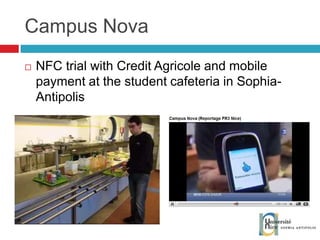
Campus Nova NFC trial with Credit Agricole and mobile payment at the student cafeteria in Sophia-Antipolis
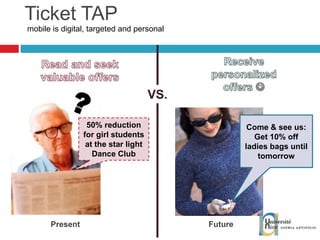
Ticket TAP mobile is digital, targeted and personal Present Future Come & see us: Get 10% off ladies bags until  tomorrow 50% reduction for girl students at the star light Dance Club  ? VS.
Partners
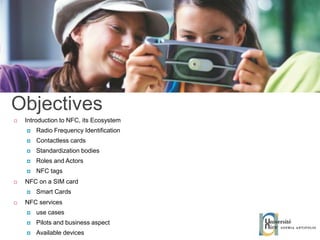
Introduction to NFC, its Ecosystem Radio Frequency Identification Contactless cards Standardization bodies Roles and Actors NFC tags NFC on a SIM card Smart Cards NFC services use cases Pilots and business aspect Available devices Objectives
Objectives (2) NFC for developers Dev kits Reading/Writing tags APDU JSR 257 & 177 Java Card PC/SC readers JSR-268 Midlet SCWS Demo and Examples Conclusion
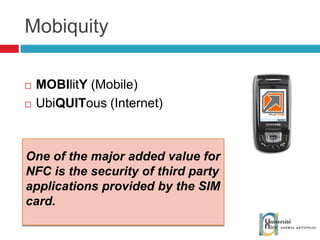
Mobiquity MOBI lit Y  (Mobile) Ubi QUIT ous (Internet) One of the major added value for NFC is the security of third party applications provided by the SIM card.
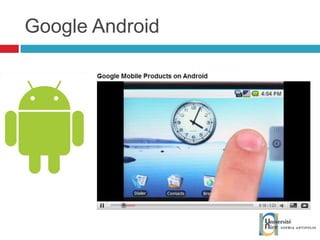
Google Android
ATAWAD Google is going from web to mobile. This means you can now create a contact or an entry in your calendar from your mobile and data is automatically replicated not on the SIM but on Google servers (trust and private life is another debate).  ATAWAD = Any Time, Any Where, Any Device They start from the needs without necessarily innovate. They did not create the search engine, they just improved it. In 5 years we’ll probably say: "they didn’t create the mobile, they’ve just improved it."
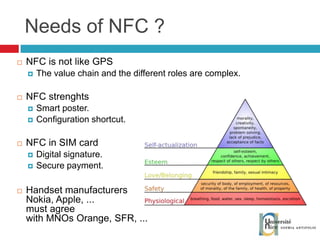
Needs of NFC ? NFC is not like GPS The value chain and the different roles are complex. NFC strenghts Smart poster. Configuration shortcut. NFC in SIM card Digital signature. Secure payment. Handset manufacturers Nokia, Apple, ... must agree with MNOs Orange, SFR, ...
PART 1 Introduction to NFC,  its Ecosystem
RFID RFID : Radio Frequency Identification RFID Tags: Store and retrieve data (with a distant reader) History : radar technology, cow identification (year 1970). Use case examples: road taxes, trace books in libraires, access card, shops (Wall-Mart). RFID tags types Active Passive (without battery)
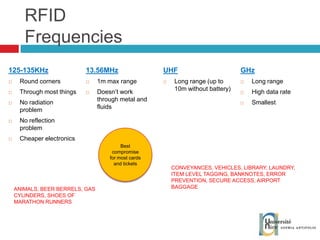
RFID Frequencies 125-135KHz Round corners Through most things No radiation problem No reflection problem Cheaper electronics 13.56MHz 1m max range Doesn’t work through metal and fluids UHF Long range (up to 10m without battery) GHz Long range High data rate Smallest Best compromise for most cards and tickets ANIMALS, BEER BERRELS, GAS CYLINDERS, SHOES OF MARATHON RUNNERS CONVEYANCES, VEHICLES, LIBRARY, LAUNDRY, ITEM LEVEL TAGGING, BANKNOTES, ERROR PREVENTION, SECURE ACCESS, AIRPORT BAGGAGE
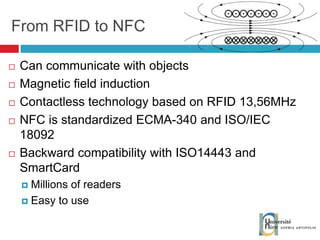
From RFID to NFC Can communicate with objects Magnetic field induction Contactless technology based on RFID 13,56MHz NFC is standardized ECMA-340 and ISO/IEC 18092 Backward compatibility with ISO14443 and SmartCard Millions of readers Easy to use
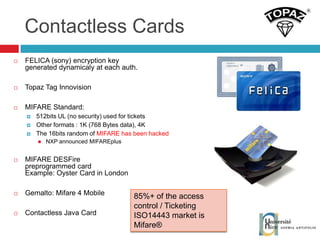
Contactless Cards FELICA (sony) encryption key generated dynamicaly at each auth. Topaz Tag Innovision MIFARE Standard:  512bits UL (no security) used for tickets Other formats : 1K (768 Bytes data), 4K The 16bits random of  MIFARE has been hacked NXP announced MIFAREplus MIFARE DESFire preprogrammed card Example: Oyster Card in London Gemalto: Mifare 4 Mobile Contactless Java Card 85%+ of the access control / Ticketing ISO14443 market is Mifare®
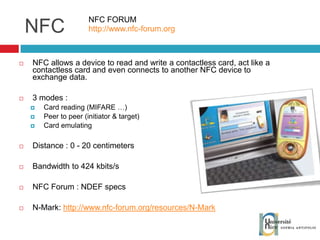
NFC NFC allows a device to read and write a contactless card, act like a contactless card and even connects to another NFC device to exchange data. 3 modes : Card reading (MIFARE …) Peer to peer (initiator & target) Card emulating Distance : 0 - 20 centimeters Bandwidth to 424 kbits/s NFC Forum : NDEF specs N-Mark:  http://www.nfc-forum.org/resources/N-Mark NFC FORUM http://www.nfc-forum.org
Standardization bodies ETSI / SCP  (Smart Card Platform) to specify the interface between the SIM card and the NFC chipset. EMVCo  for the impacts on the EMV payment applications. GSM Association Mobey Forum  for mobile financial services AFSCM  is French association for mobile contactless Download specifications here:  http://afscm.org Global Platform  to specify a multi-application architecture of the secure element. Etc.
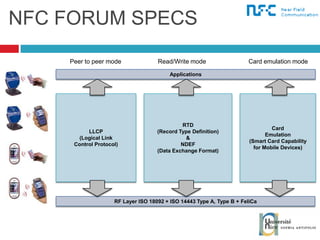
NFC FORUM SPECS Applications LLCP (Logical Link Control Protocol) RTD (Record Type Definition) & NDEF (Data Exchange Format) Card  Emulation (Smart Card Capability  for Mobile Devices) RF Layer ISO 18092 + ISO 14443 Type A, Type B + FeliCa Peer to peer mode Read/Write mode Card emulation mode
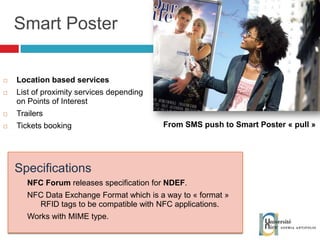
Smart Poster Location based services List of proximity services depending on Points of Interest Trailers Tickets booking Specifications NFC Forum  releases specification for  NDEF . NFC Data Exchange Format which is a way to « format » RFID tags to be compatible with NFC applications. Works with MIME type. From SMS push to Smart Poster « pull »
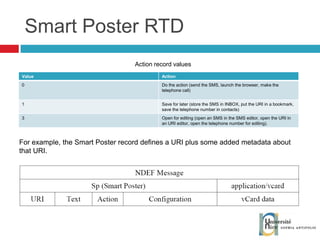
Smart Poster RTD MAY SHALL For example, the Smart Poster record defines a URI plus some added metadata about that URI. Action record values Value Action 0 Do the action (send the SMS, launch the browser, make the telephone call)  1 Save for later (store the SMS in INBOX, put the URI in a bookmark, save the telephone number in contacts)  3 Open for editing (open an SMS in the SMS editor, open the URI in an URI editor, open the telephone number for editing).
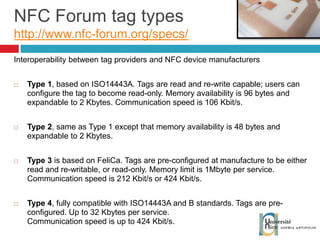
NFC Forum tag types http://www.nfc-forum.org/specs/   Interoperability between tag providers and NFC device manufacturers Type 1 , based on ISO14443A. Tags are read and re-write capable; users can configure the tag to become read-only. Memory availability is 96 bytes and expandable to 2 Kbytes. Communication speed is 106 Kbit/s. Type 2 , same as Type 1 except that memory availability is 48 bytes and expandable to 2 Kbytes. Type 3  is based on FeliCa. Tags are pre-configured at manufacture to be either read and re-writable, or read-only. Memory limit is 1Mbyte per service. Communication speed is 212 Kbit/s or 424 Kbit/s. Type 4 , fully compatible with ISO14443A and B standards. Tags are pre-configured. Up to 32 Kbytes per service. Communication speed is up to 424 Kbit/s.
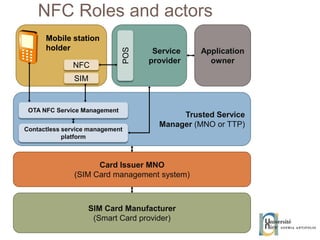
NFC Roles and actors Service provider Trusted Service Manager  (MNO or TTP) Application owner SIM Card Manufacturer (Smart Card provider) Card Issuer MNO (SIM Card management system) Contactless service management platform OTA NFC Service Management POS SIM NFC Mobile station holder
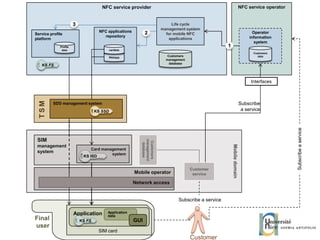
NFC service provider Mobile domain Mobile operator NFC applications repository Webapp NFC service operator SIM management system SIM card Application Customers management database cardlets Service profile platform Profile data KS  FS Final user Customers management database Life cycle management system for mobile NFC applications KS  FS Application data GUI SDD management system KS  SSD Card management system KS ISD Network access Customer service Subscribe a service Subscribe a service Subscribe a service Interfaces 3 1 Customer Operator information system Customers data 2
Use case: phone is lost Service provider TSM Mobile operator Customer Ask for token (delegated management) Ask applet installation via ISD (MNO centric model) Tells phone has been lost Tells customer has new SIM card Service installation request after customer registration Tells phone has been lost Tells customer has new SIM card Services management & referral for SP Install NFC services
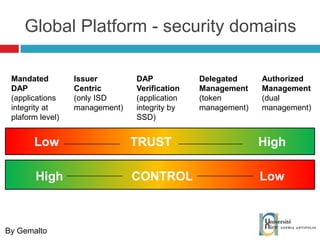
Global Platform - security domains By Gemalto Low TRUST High Mandated DAP (applications integrity at plaform level) DAP Verification (application integrity by SSD) Issuer Centric (only ISD management) Delegated Management (token management) Authorized Management (dual management) High CONTROL Low
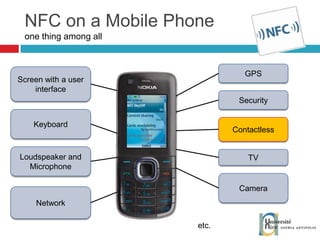
NFC on a Mobile Phone one thing among all Contactless Screen with a user interface Security GPS Loudspeaker and Microphone Keyboard Camera Network TV etc.
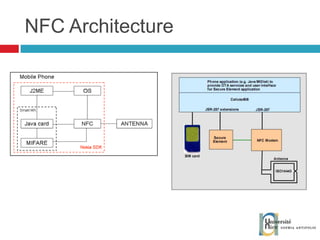
NFC Architecture
PART 2 NFC in a SIM Card
Smart Card Piece of plastic the size of a credit card hosting an electronic circuit that can  store  and  process  information. The integrated circuit (chip) may contain a microprocessor capable of processing this information, or it can only contain non-volatile memory with a security component (memory card). Smart cards are mainly used as means of personal identification (identity card, access badge to buildings, health insurance card, SIM card) or payment (credit card, electronic purse) or proof of subscription to prepaid services (calling card, ticket). Contact or Contactless smart card readers are used as a communications medium between the smart card and a host (point of sale).
Smart Card used in France for healthcare refunds (Carte Vitale)
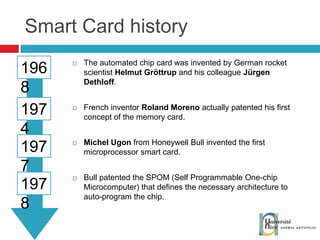
Smart Card history The automated chip card was invented by German rocket scientist  Helmut Gröttrup  and his colleague  Jürgen Dethloff . French inventor  Roland Moreno  actually patented his first concept of the memory card. Michel Ugon  from Honeywell Bull invented the first microprocessor smart card. Bull patented the SPOM (Self Programmable One-chip Microcomputer) that defines the necessary architecture to auto-program the chip. 1968 1974 1977 1978
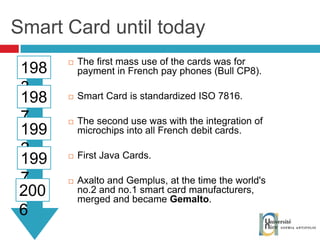
Smart Card until today The first mass use of the cards was for payment in French pay phones (Bull CP8). Smart Card is standardized ISO 7816. The second use was with the integration of microchips into all French debit cards. First Java Cards. Axalto and Gemplus, at the time the world's no.2 and no.1 smart card manufacturers, merged and became  Gemalto . 1983 1987 1992 1997 2006
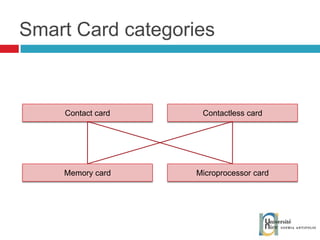
Smart Card categories Microprocessor card Memory card Contact card Contactless card
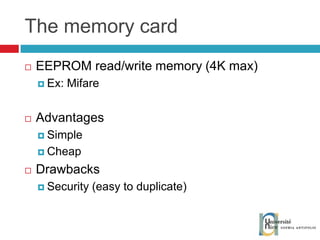
The memory card EEPROM read/write memory (4K max) Ex: Mifare Advantages Simple Cheap Drawbacks Security (easy to duplicate)
Microprocessor card Microprocessor used by the application running on card to calculate operations. Each card can be personalized and updated after manufacture (for banks with more than 500 000 customers).  Credentials can be updated while the card is inserted in a bank automat for example. Very secure for a reasonable cost
Smart Card security Information stored can be protected by a PIN code Cryptographic operations Circuit is shielded Unique serial number Software security Access control to data Data integrity IN/OUT firewall
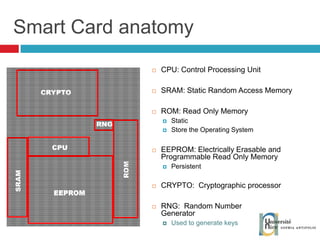
Smart Card anatomy CPU: Control Processing Unit SRAM: Static Random Access Memory ROM: Read Only Memory Static Store the Operating System EEPROM: Electrically Erasable and Programmable Read Only Memory Persistent CRYPTO:  Cryptographic processor RNG:  Random Number Generator Used to generate keys
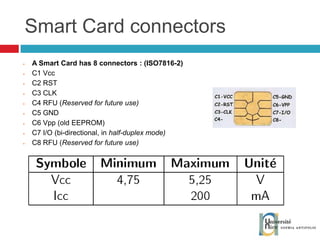
Smart Card connectors A Smart Card has 8 connectors : (ISO7816-2) C1 Vcc C2 RST C3 CLK C4 RFU ( Reserved for future use) C5 GND C6 Vpp (old EEPROM) C7 I/O (bi-directional, in  half-duplex mode) C8 RFU ( Reserved for future use)
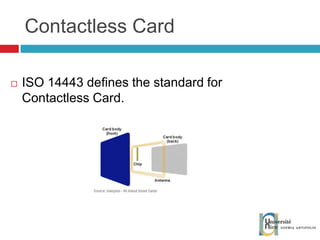
Contactless Card ISO 14443 defines the standard for Contactless Card.
Smart Card applications Secure a computer Store internet security certificate Hard drives can be encrypted using and attached Smart Card Used to authenticate a user on the computer (at login screen)
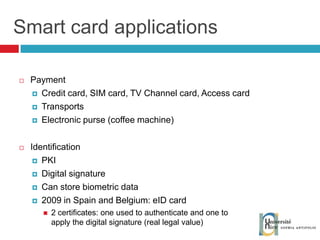
Smart card applications Payment Credit card, SIM card, TV Channel card, Access card Transports Electronic purse (coffee machine) Identification PKI Digital signature Can store biometric data 2009 in Spain and Belgium: eID card 2 certificates: one used to authenticate and one to apply the digital signature (real legal value)
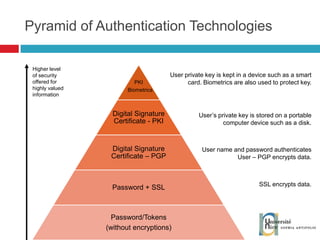
Pyramid of Authentication Technologies Higher level of security offered for highly valued information User private key is kept in a device such as a smart card. Biometrics are also used to protect key. User’s private key is stored on a portable computer device such as a disk. User name and password authenticates User – PGP encrypts data. SSL encrypts data.
Part 3 NFC potential, services and devices
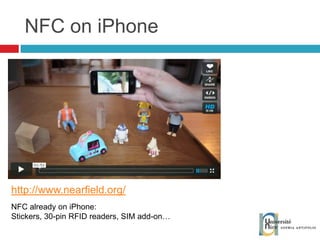
NFC on iPhone http://www.nearfield.org/ NFC already on iPhone: Stickers, 30-pin RFID readers, SIM add-on…
Exchange data, P2P Configuration (bluetooth pairing) Vending machines, service maintenance Loyalty, couponing NFC poster, get information Ticketing Medical, home care Web applications Payment solution Access control Mobile signature Etc. Added value services
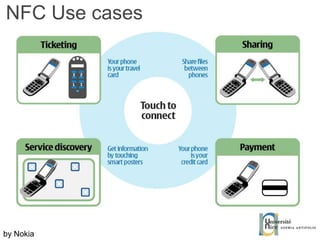
NFC Use cases by Nokia
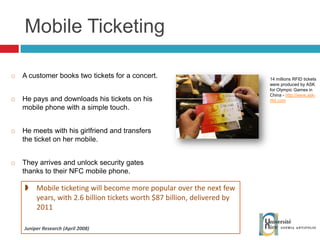
Mobile Ticketing A customer books two tickets for a concert. He pays and downloads his tickets on his mobile phone with a simple touch. He meets with his girlfriend and transfers the ticket on her mobile. They arrives and unlock security gates thanks to their NFC mobile phone. 14 millions RFID tickets were produced by ASK for Olympic Games in China -  http://www.ask-rfid.com Mo bile ticketing will become more popular over the next few years, with 2.6 billion tickets worth $87 billion, delivered by 2011 Juniper Research (April 2008)
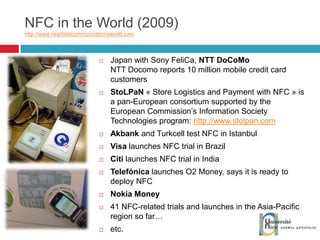
NFC in the World (2009) http://www.nearfieldcommunicationsworld.com   Japan with Sony FeliCa,  NTT DoCoMo NTT Docomo reports 10 million mobile credit card customers StoLPaN  « Store Logistics and Payment with NFC » is a pan-European consortium supported by the European Commission’s Information Society Technologies program:  http://www.stolpan.com Akbank  and Turkcell test NFC in Istanbul Visa  launches NFC trial in Brazil Citi  launches NFC trial in India Telefónica  launches O2 Money, says it is ready to deploy NFC Nokia Money 41 NFC-related trials and launches in the Asia-Pacific region so far… etc.
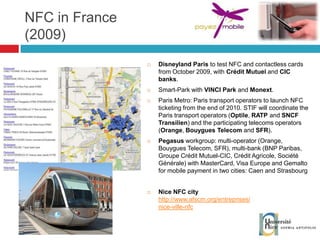
NFC in France (2009) Disneyland Paris  to test NFC and contactless cards from October 2009, with  Crédit Mutuel  and  CIC banks . Smart-Park with  VINCI Park  and  Monext . Paris Metro: Paris transport operators to launch NFC ticketing from the end of 2010. STIF will coordinate the Paris transport operators ( Optile ,  RATP  and  SNCF Transilien ) and the participating telecoms operators ( Orange ,  Bouygues Telecom  and  SFR ). Pegasus  workgroup: multi-operator (Orange, Bouygues Telecom, SFR), multi-bank (BNP Paribas, Groupe Crédit Mutuel-CIC, Crédit Agricole, Société Générale) with MasterCard, Visa Europe and Gemalto for mobile payment in two cities: Caen and Strasbourg Nice NFC city http://www.afscm.org/entreprises/nice-ville-nfc
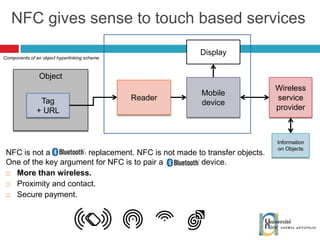
NFC gives sense to touch based services Object Tag + URL Mobile device Reader Display Wireless service provider Information on Objects Components of an object hyperlinking scheme NFC is not a Bluetooth replacement. NFC is not made to transfer objects. One of the key argument for NFC is to pair a Bluetooth device. More than wireless. Proximity and contact. Secure payment.
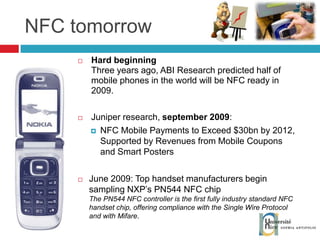
NFC tomorrow Hard beginning Three years ago, ABI Research predicted half of mobile phones in the world will be NFC ready in 2009. Juniper research,  september 2009 : NFC Mobile Payments to Exceed $30bn by 2012, Supported by Revenues from Mobile Coupons and Smart Posters June 2009: Top handset manufacturers begin sampling NXP’s PN544 NFC chip The PN544 NFC controller is the first fully industry standard NFC handset chip, offering compliance with the Single Wire Protocol and with Mifare .
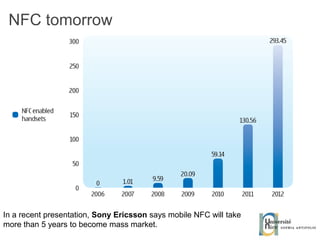
In a recent presentation,  Sony Ericsson  says mobile NFC will take more than 5 years to become mass market. NFC tomorrow
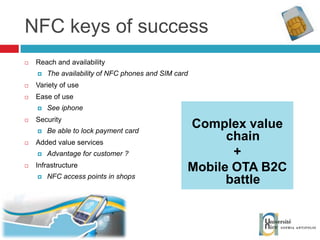
NFC keys of success Reach and availability The availability of NFC phones and SIM card Variety of use Ease of use See iphone Security Be able to lock payment card Added value services Advantage for customer ? Infrastructure NFC access points in shops Complex value chain  +  Mobile OTA B2C battle
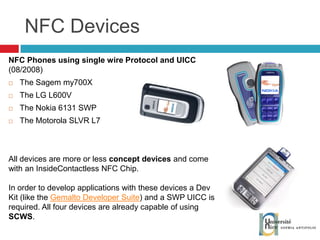
NFC Devices NFC Phones using single wire Protocol and UICC  (08/2008) The Sagem my700X The LG L600V The Nokia 6131 SWP The Motorola SLVR L7 All devices are more or less  concept devices  and come with an InsideContactless NFC Chip. In order to develop applications with these devices a Dev Kit (like the  Gemalto Developer Suite ) and a SWP UICC is required. All four devices are already capable of using  SCWS .
NOKIA 6212 Java MIDP 2.0 Bluetooth 2.0 2 megapixel camera 3G connection Share business cards, bookmarks, calendar notes, images, profiles, and more. Contactless payment and ticketing capabilities. Access to mobile services and information with a simple touch. Uses Java specification requirement 257 (JSR 257) for third-party NFC applications. http://europe.nokia.com/A4991363 Jeremy Belostock on the future of NFC http://fr.youtube.com/watch?v=BoOH7AtCT_E
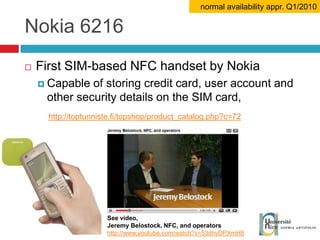
Nokia 6216 First SIM-based NFC handset by Nokia Capable of storing credit card, user account and other security details on the SIM card, http://toptunniste.fi/topshop/product_catalog.php?c=72 normal availability appr. Q1/2010 See video, Jeremy Belostock, NFC, and operators http://www.youtube.com/watch?v=53dhyDPXmH8
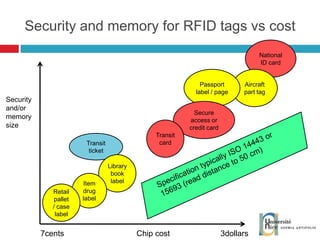
Security and memory for RFID tags vs cost National ID card Aircraft part tag Passport label / page Secure access or credit card Transit card Transit ticket Library book label Item drug label Retail pallet / case label Specification typically ISO 14443 or 15693 (r ead distance to 50 cm) 7cents Chip cost   3dollars Security and/or memory size
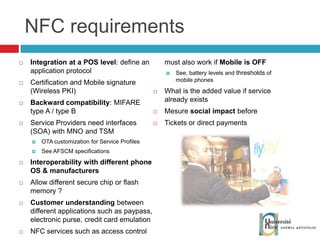
NFC requirements
Part 4 NFC for developers
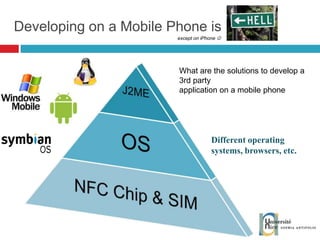
Developing on a Mobile Phone is  Different operating systems, browsers, etc. What are the solutions to develop a 3rd party application on a mobile phone except on iPhone  
UICC SIM NFC antenna External env. Applications CPU OS J2ME NFC Chip OTA OS Apps NFC Phone Architecture Single Wire Protocol (SWP) architecture: SIM & SE is same Java Card. MIFARE is a storage which enables the phone to act like a MIFARE card. F rom a developer's point of view it does not matter at all where the SE is located. You will still code against the GlobalPlatform specs. The only difference comes with the distribution/lifecycle model; and since in most cases, the operators control both the SIM card and the phone, the difference is largely academical anyway. Of course, business people may think differently, but that's their problem. Jalkanen, Nokia discussion boards
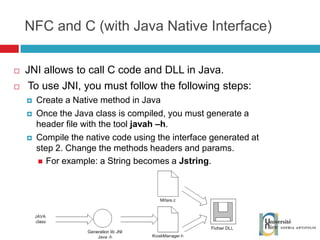
NFC and C (with Java Native Interface) JNI allows to call C code and DLL in Java.   To use JNI, you must follow the following steps: Create a Native method in Java Once the Java class is compiled, you must generate a header file with the tool  javah –h . Compile the native code using the interface generated at step 2. Change the methods headers and params. For example: a String becomes a  Jstring .
NFC and Java Java / NFC Java is the key. It allows technologies to  work together : Bluetooth, Video, Music, GPRS, … Problems of JSR not implemented on a mobile phone Graphical user Interface are not always compatible : screen size, different JVM. Solution: Mobile Distillery ? SVG ? Flash lite ? SIM Toolkit ? SCWS ?  HTML5 ? Native application : security problem, no API, manufacturer lock… Symbian development is heavy.
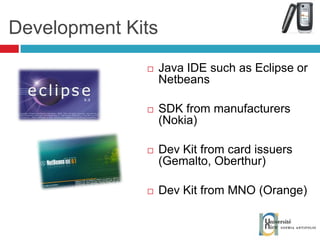
Java IDE such as Eclipse or Netbeans SDK from manufacturers (Nokia) Dev Kit from card issuers (Gemalto, Oberthur) Dev Kit from MNO (Orange) Development Kits
JCOP Tools String uri = System.getProperty("internal.se.url"); ISO14443Connection iseConn =  (ISO14443Connection) Connector.open(uri); Applet  extends javacard.framework.Applet MIDlet JCOP tools need activation key:  [email_address] compatible PC/SC reader Configure SE keyset to 42 ENC, MAC and KEY are all "404142434445464748494A4B4C4D4E4F” public void process(APDU apdu){ byte[] buf = apdu.getBuffer();  // Ignore Select instruction. if (buf[ISO7816.OFFSET_CLA] == 0x00 &&  buf[ISO7816.OFFSET_INS] == (byte)0xA4) { return; }
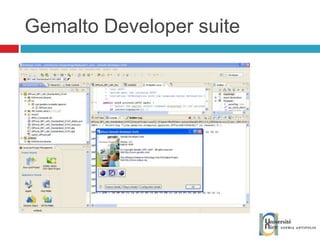
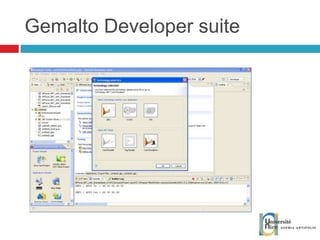
Gemalto Developer suite
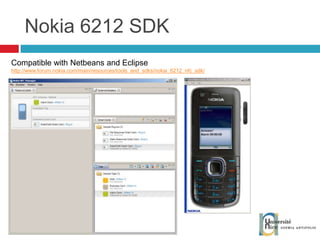
Nokia 6212 SDK Compatible with Netbeans and Eclipse http://www.forum.nokia.com/main/resources/tools_and_sdks/nokia_6212_nfc_sdk/
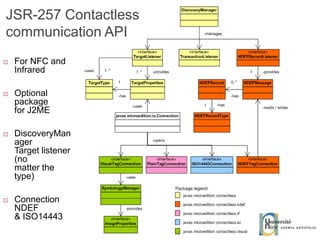
JSR-257 Contactless communication API For NFC and Infrared Optional package for J2ME DiscoveryManager Target listener (no matter the type) Connection NDEF & ISO14443
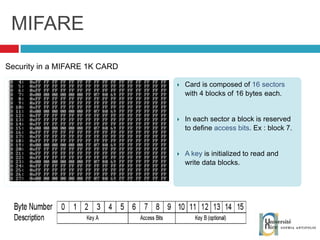
MIFARE Card is composed of  16 sectors  with 4 blocks of 16 bytes each. In each sector a block is reserved to define  access bits . Ex : block 7. A key  is initialized to read and write data blocks. Security in a MIFARE 1K CARD
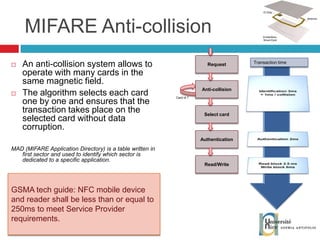
MIFARE Anti-collision An anti-collision system allows to operate with many cards in the same magnetic field. The algorithm selects each card one by one and  ensures that the transaction takes place on the selected card without data corruption. MAD (MIFARE Application Directory) is a table written in first sector and used to identify which sector is dedicated to a specific application. Request Anti-collision Read/Write Authentication Select card Card id ? Transaction time GSMA tech guide: NFC mobile device and reader shall be less than or equal to 250ms to meet Service Provider  requirements.
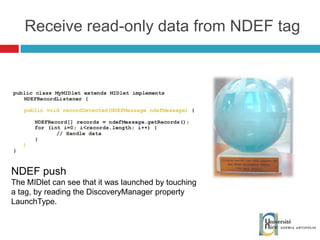
Receive read-only data from NDEF tag NDEF push The MIDlet can see that it was launched by touching a tag, by reading the DiscoveryManager property LaunchType.
Java Card Java Card  MIFARE ProX & SmartMX are cards with microprocessor and OS (for example JCOP). An Applet is a JAVA CARD application stored inside the Secure Element. APDU COMMANDS is a way to communicate with Applet ISO14443Connection and 7816-4 APDUS Security : Crypto Processor
Java Card description At the beginning, applications on Smart Card were all developed  proprietary and native . There was a need to find a  generic  way to develop an application that could run on 2 Smart Cards issued by different companies. The Java Card technology allows developers to gather around one way of programming using Java.  And it openned the path to third party applications. This technology can also be used to develop on a SIM card. A SIM card has more memory than other types of Smart Cards like Credit Card. Java Card includes: An API (application programming interface) to define Java libraries that can be used A virtual machine Runtime (JCRE) : memory and security management Java Card 2.1.1 SDK provides an environment to test applets, a tool to upload applets into the Java Card, and  code examples.
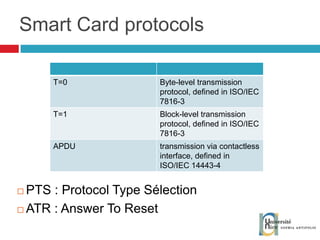
Smart Card protocols PTS : Protocol Type Sélection ATR : Answer To Reset T=0 Byte-level transmission protocol, defined in ISO/IEC 7816-3 T=1 Block-level transmission protocol, defined in ISO/IEC 7816-3 APDU  transmission via contactless interface, defined in ISO/IEC 14443-4
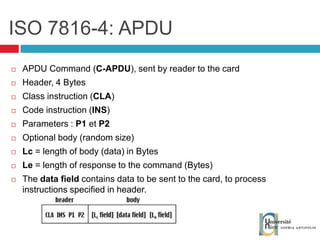
ISO 7816-4: APDU APDU Command ( C-APDU ), sent by reader to the card Header, 4 Bytes Class instruction ( CLA ) Code instruction ( INS ) Parameters :  P1  et  P2 Optional body (random size) Lc  = length of body (data) in Bytes Le  = length of response to the command (Bytes) The  data field  contains data to be sent to the card, to process instructions specified in header.
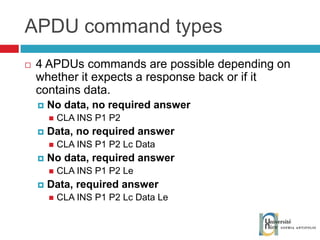
APDU command types 4 APDUs commands are possible depending on whether it expects a response back or if it contains data. No data, no required answer CLA INS P1 P2 Data, no required answer CLA INS P1 P2 Lc Data No data, required answer CLA INS P1 P2 Le Data, required answer CLA INS P1 P2 Lc Data Le
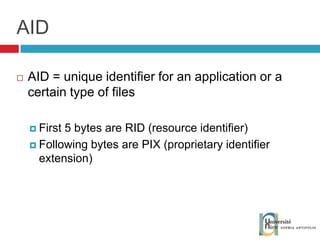
AID AID = unique identifier for an application or a certain type of files First 5 bytes are RID (resource identifier) Following bytes are PIX (proprietary identifier extension)
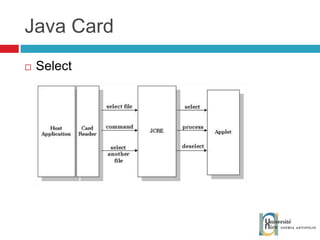
Java Card Select
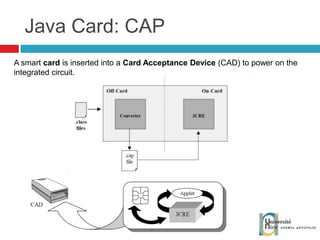
Java Card: CAP A smart  card  is inserted into a  Card Acceptance Device  (CAD) to power on the integrated circuit.
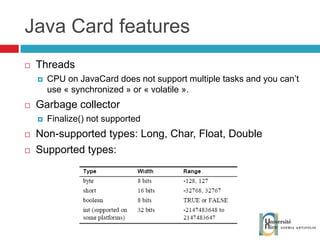
Java Card features Threads CPU on JavaCard does not support multiple tasks and you can’t use « synchronized » or « volatile ».  Garbage collector Finalize() not supported Non-supported types: Long, Char, Float, Double Supported types:
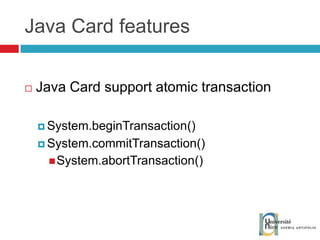
Java Card features Java Card support atomic transaction System.beginTransaction() System.commitTransaction() System.abortTransaction()
Java Card security « Sandbox »:  In Java, code and application data (resources) are protected by a sandbox and can’t interfere with other applications.
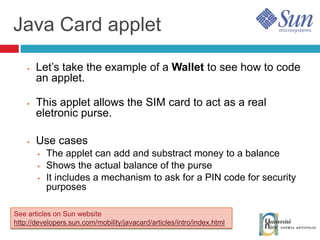
Java Card applet Let’s take the example of a  Wallet  to see how to code an applet. This applet allows the SIM card to act as a real eletronic purse. Use cases The applet can add and substract money to a balance Shows the actual balance of the purse It includes a mechanism to ask for a PIN code for security purposes See articles on Sun website http://developers.sun.com/mobility/javacard/articles/intro/index.html
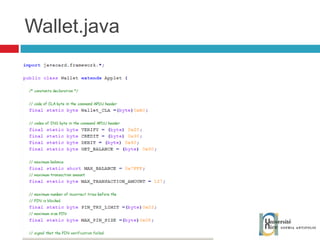
Wallet.java
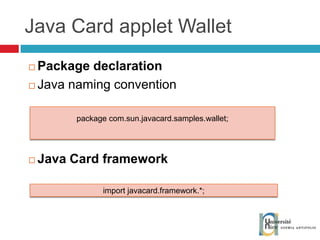
Java Card applet Wallet Package declaration Java naming convention Java Card framework package com.sun.javacard.samples.wallet;  import javacard.framework.*;
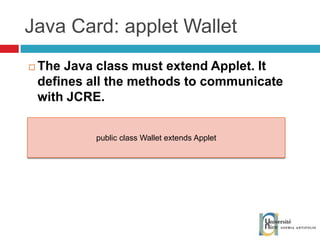
Java Card: applet Wallet The Java class must extend Applet. It defines all the methods to communicate with JCRE. public class Wallet extends Applet
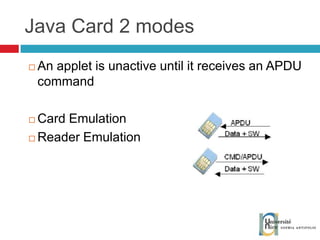
Java Card 2 modes An applet is unactive until it receives an APDU command Card Emulation Reader Emulation
Applet PIN code In the Wallet source code, the VERIFY method checks the PIN code. The APDU command contains the parameter PIN (stored inside the data field). If PIN code is the same than the one defined during the installation process, the method returns true. PIN_TRY_LIMIT = 3
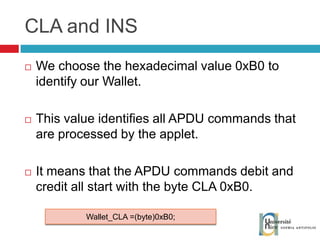
CLA and INS We choose the hexadecimal value 0xB0 to identify our Wallet. This value identifies all APDU commands that are processed by the applet. It means that the APDU commands debit and credit all start with the byte CLA 0xB0. Wallet_CLA =(byte)0xB0;
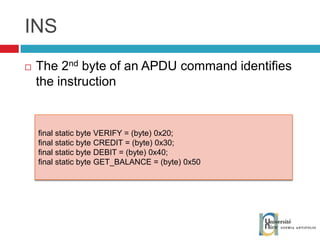
INS The 2 nd  byte of an APDU command identifies the instruction final static byte VERIFY = (byte) 0x20; final static byte CREDIT = (byte) 0x30; final static byte DEBIT = (byte) 0x40; final static byte GET_BALANCE = (byte) 0x50
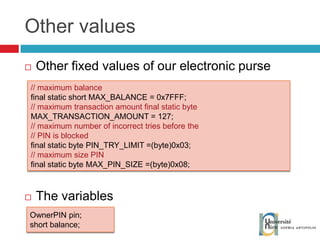
Other values Other fixed values of our electronic purse The variables // maximum balance final static short MAX_BALANCE = 0x7FFF; // maximum transaction amount final static byte  MAX_TRANSACTION_AMOUNT = 127; // maximum number of incorrect tries before the // PIN is blocked final static byte PIN_TRY_LIMIT =(byte)0x03; // maximum size PIN final static byte MAX_PIN_SIZE =(byte)0x08;  OwnerPIN pin; short balance;
Applet structure Constructor Install Select Process Header analysis (CLA and INS) public void process(APDU apdu) {
Send and receive APDUs setIncomingAndReceive(); setOutgoingAndSend() Transfer mode Expected length for the answer Send bytes in response byte[] apduBuffer = apdu.getBuffer(); apduBuffer[0] = byte1; apduBuffer[1] = byte2; apduBuffer[2] = byte3; //0-offset, 3-number of bytes to send apdu.setOutgoingAndSend(0, 3);  byte[] buffer = apdu.getBuffer(); short bytes_left = (short) buffer[ISO.OFFSET_LC]; short readCount = apdu.setIncomingAndReceive(); while (bytes_left > 0) { //{process received data in buffer} … bytes_left -= readCount; //get more data readCount = apdu.receiveBytes (ISO.OFFSET_CDDATA); }
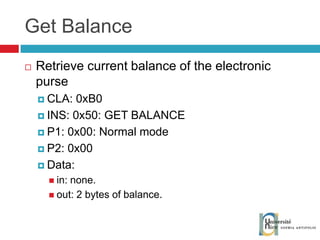
Get Balance Retrieve current balance of the electronic purse CLA: 0xB0 INS: 0x50: GET BALANCE P1: 0x00: Normal mode P2: 0x00 Data: in: none. out: 2 bytes of balance.
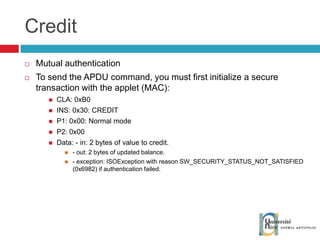
Credit Mutual authentication To send the APDU command, you must first initialize a secure transaction with the applet (MAC): CLA: 0xB0 INS: 0x30: CREDIT P1: 0x00: Normal mode P2: 0x00 Data: - in: 2 bytes of value to credit. - out: 2 bytes of updated balance. - exception: ISOException with reason SW_SECURITY_STATUS_NOT_SATISFIED (0x6982) if authentication failed.
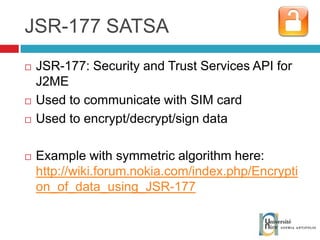
JSR-177 SATSA JSR-177: Security and Trust Services API for J2ME Used to communicate with SIM card Used to encrypt/decrypt/sign data Example with symmetric algorithm here: http://wiki.forum.nokia.com/index.php/Encryption_of_data_using_JSR-177
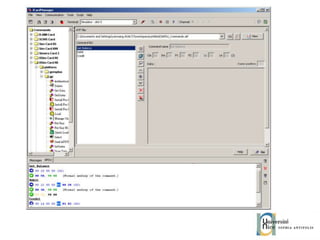
Gemalto examples APDU commands of GPPurse applet are stored in the file  APDU_Commands.atf  that comes with the project. You can open this file with the Jcard Manager and execute each command at a time. Or manually thanks to the option  Send APDU  in the menu bar.
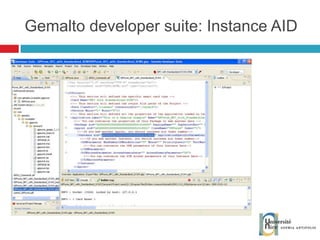
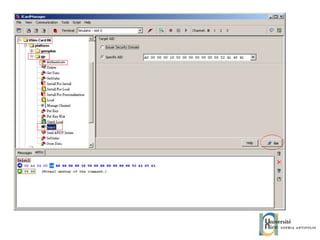
Gemalto developer suite: Instance AID
 
 
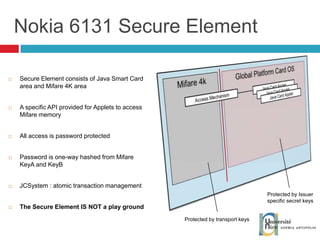
Nokia 6131 Secure Element Secure Element consists of Java Smart Card area and Mifare 4K area A specific API provided for Applets to access Mifare memory All access is password protected Password is one-way hashed from Mifare KeyA and KeyB JCSystem : atomic transaction management The Secure Element IS NOT a play ground Protected by Issuer specific secret keys Protected by transport keys
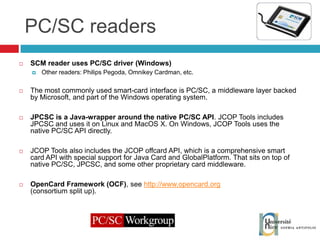
PC/SC readers SCM reader uses PC/SC driver (Windows) Other readers: Philips Pegoda,  Omnikey Cardman, etc. The most commonly used smart-card interface is PC/SC, a middleware layer backed by Microsoft, and part of the Windows operating system. JPCSC is a Java-wrapper around the native PC/SC API . JCOP Tools includes JPCSC and uses it on Linux and MacOS X. On Windows, JCOP Tools uses the native PC/SC API directly. JCOP Tools also includes the JCOP offcard API, which is a comprehensive smart card API with special support for Java Card and GlobalPlatform. That sits on top of native PC/SC, JPCSC, and some other proprietary card middleware. OpenCard Framework (OCF) , s ee  http://www.opencard.org (consortium split up).
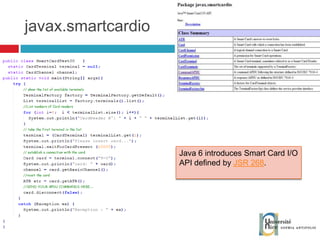
javax.smartcardio Java 6 introduces  Smart Card I/O API defined by  JSR 268 .
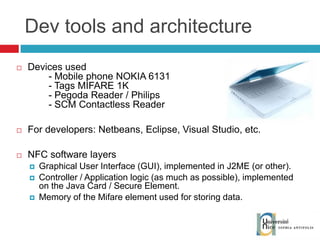
Dev tools and architecture Devices used - Mobile phone NOKIA 6131 - Tags MIFARE 1K - Pegoda Reader / Philips - SCM Contactless Reader For developers: Netbeans, Eclipse, Visual Studio, etc. NFC software layers Graphical User Interface (GUI), implemented in J2ME (or other). Controller / Application logic (as much as possible), implemented on the Java Card / Secure Element. Memory of the Mifare element used for storing data.
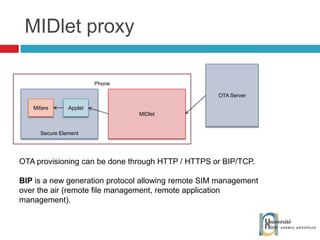
MIDlet proxy Phone OTA Server Secure Element Mifare Applet MIDlet OTA provisioning can be done through HTTP / HTTPS or BIP/TCP. BIP  is a new generation protocol allowing remote SIM management over the air (remote file management, remote application management).
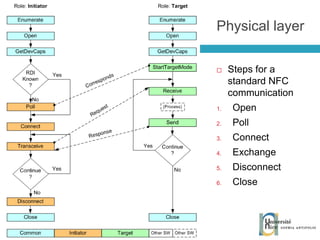
Physical layer Steps for a standard NFC communication Open Poll Connect Exchange Disconnect Close
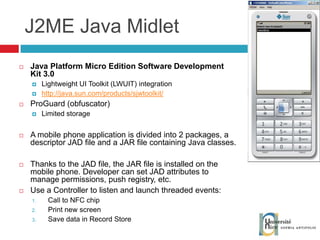
J2ME Java Midlet Java Platform Micro Edition Software Development Kit 3.0 Lightweight UI Toolkit (LWUIT) integration http://java.sun.com/products/sjwtoolkit/ ProGuard (obfuscator) Limited storage A mobile phone application is divided into 2 packages, a descriptor JAD file and a JAR file containing Java classes. Thanks to the JAD file, the JAR file is installed on the mobile phone. Developer can set JAD attributes to manage permissions, push registry, etc. Use a Controller to listen and launch threaded events: Call to NFC chip Print new screen Save data in Record Store
J2ME Signature and certificate Security exception MIDP permissions javax.microedition.io.file.FileConnection javax.microedition.io.Connector
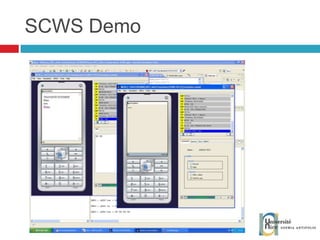
SmartCard Web Server SIM Toolkit successor. SCWS technology can be installed on new generation SIM card and allows GUI management thanks to mobile web browser. The SIM card is the authorization module for secure electronic transactions but it’s the mobile phone that controls and generates graphical interfaces. With SCWS, a developer can implement the full application in one package and deploy it directly on the SIM card. MMI and Applets are on the same media. Deployment and administration of applications are simplified. For example: if the user changes his mobile phone. Moreover, generated interfaces are compatible with most phones but the rendering and user interaction is not necessarily better.
SCWS Demo
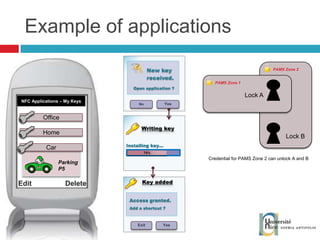
Example of applications NFC Applications – My Keys Office Home Car Edit Delete Parking P5 New key received. Open application ? Yes No Writing key 75% Installing key… Key added Exit Yes Access granted. Add a shortcut ? Lock A PAMS Zone 1 PAMS Zone 2 Credential for PAMS Zone 2 can unlock A and B Lock B
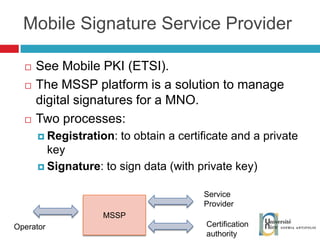
See Mobile PKI (ETSI). The MSSP platform is a solution to manage digital signatures for a MNO. Two processes: Registration : to obtain a certificate and a private key Signature : to sign data (with private key) Mobile Signature Service Provider MSSP Operator Service Provider Certification authority
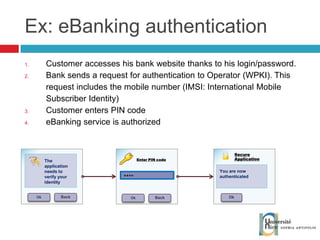
Ex: eBanking authentication Customer accesses his bank website thanks to his login/password. Bank sends a request for authentication to Operator (WPKI). This request includes the mobile number (IMSI: International Mobile Subscriber Identity) Customer enters PIN code eBanking service is authorized Enter PIN code Back Ok The application needs to verify your identity Back Ok Secure Application Ok You are now authenticated
DEMO
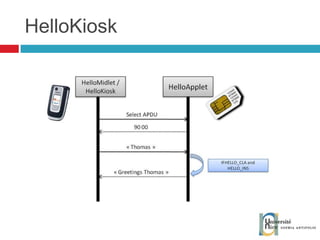
HelloKiosk
Conclusion NFC in handsets without knowing it really soon Industry is now convinced SDK standardization Easy to use ! Remember iPhone
Conclusion Use J2ME 3.0 Use JSR 257 or SCWS Optimize your code Store your data online Never trust a MIDlet Sign your application Use J2ME Polish or LWUIT  to adapt your application to your target platforms (screen size) Use web app for cross-platform development Use AFSCM specifications for OTA NFC is not an exchange protocol but identification For developers
Resources http://discussion.forum.nokia.com/forum/forumdisplay.php?f=144   http://wiki.forum.nokia.com/index.php/NFC http://forum.java.sun.com/forum.jspa?forumID=23 http://www.nearfieldcommunicationsworld.com   http://www.talknfc.com http://www.blognfc.com  http://www.nfcnews.com   Writing a Java Card Applet http://developers.sun.com/mobility/javacard/articles/intro/index.html
Resources Contactless Smart Cards and NFC Peter Harrop, Ning Xiao & Raghu Das http://www.nxp.com , thanks for pictures http://www.nearfield.org http://www.nfc-forum.org   http://www.gsmworld.com/documents/   http://www.rfidjournal.com   RFID Information http://mobilepayment.typepad.com   Mobile payment blog http://0x9000.blogspot.com   Great blog on Java Card development Special thanks to  Nicolas Pastorelly w ho helped me on some slides
Contact me Master MBDS , University of Nice Sophia-Antipolis [email_address] http://www.mbds-fr.org http://tdelazzari.blogspot.com http://twitter.com/tdelazzari

Architecture and Development of NFC Applications

  • 1.
    ARCHITECTURE & DEVELOPMENTOF NFC APPLICATIONS MOBILE JAVA DEVELOPMENT, JAVA CARD, USIM AND TOUCH-BASED SERVICES Thomas de Lazzari Smart-University 2009
  • 2.
    Presentation Project Managerat the University of Nice with Serge Miranda Ticket TAP Campus Nova NFC Container NFC Forum competition (WIMA, Monaco) R&D Team in Morocco (mobile money transfer) Blog: http://tdelazzari.blogspot.com
  • 3.
    Campus Nova NFCtrial with Credit Agricole and mobile payment at the student cafeteria in Sophia-Antipolis
  • 4.
    Ticket TAP mobileis digital, targeted and personal Present Future Come & see us: Get 10% off ladies bags until tomorrow 50% reduction for girl students at the star light Dance Club ? VS.
  • 5.
  • 6.
    Introduction to NFC,its Ecosystem Radio Frequency Identification Contactless cards Standardization bodies Roles and Actors NFC tags NFC on a SIM card Smart Cards NFC services use cases Pilots and business aspect Available devices Objectives
  • 7.
    Objectives (2) NFCfor developers Dev kits Reading/Writing tags APDU JSR 257 & 177 Java Card PC/SC readers JSR-268 Midlet SCWS Demo and Examples Conclusion
  • 8.
    Mobiquity MOBI litY (Mobile) Ubi QUIT ous (Internet) One of the major added value for NFC is the security of third party applications provided by the SIM card.
  • 9.
  • 10.
    ATAWAD Google isgoing from web to mobile. This means you can now create a contact or an entry in your calendar from your mobile and data is automatically replicated not on the SIM but on Google servers (trust and private life is another debate).  ATAWAD = Any Time, Any Where, Any Device They start from the needs without necessarily innovate. They did not create the search engine, they just improved it. In 5 years we’ll probably say: "they didn’t create the mobile, they’ve just improved it."
  • 11.
    Needs of NFC? NFC is not like GPS The value chain and the different roles are complex. NFC strenghts Smart poster. Configuration shortcut. NFC in SIM card Digital signature. Secure payment. Handset manufacturers Nokia, Apple, ... must agree with MNOs Orange, SFR, ...
  • 12.
    PART 1 Introductionto NFC, its Ecosystem
  • 13.
    RFID RFID :Radio Frequency Identification RFID Tags: Store and retrieve data (with a distant reader) History : radar technology, cow identification (year 1970). Use case examples: road taxes, trace books in libraires, access card, shops (Wall-Mart). RFID tags types Active Passive (without battery)
  • 14.
    RFID Frequencies 125-135KHzRound corners Through most things No radiation problem No reflection problem Cheaper electronics 13.56MHz 1m max range Doesn’t work through metal and fluids UHF Long range (up to 10m without battery) GHz Long range High data rate Smallest Best compromise for most cards and tickets ANIMALS, BEER BERRELS, GAS CYLINDERS, SHOES OF MARATHON RUNNERS CONVEYANCES, VEHICLES, LIBRARY, LAUNDRY, ITEM LEVEL TAGGING, BANKNOTES, ERROR PREVENTION, SECURE ACCESS, AIRPORT BAGGAGE
  • 15.
    From RFID toNFC Can communicate with objects Magnetic field induction Contactless technology based on RFID 13,56MHz NFC is standardized ECMA-340 and ISO/IEC 18092 Backward compatibility with ISO14443 and SmartCard Millions of readers Easy to use
  • 16.
    Contactless Cards FELICA(sony) encryption key generated dynamicaly at each auth. Topaz Tag Innovision MIFARE Standard: 512bits UL (no security) used for tickets Other formats : 1K (768 Bytes data), 4K The 16bits random of MIFARE has been hacked NXP announced MIFAREplus MIFARE DESFire preprogrammed card Example: Oyster Card in London Gemalto: Mifare 4 Mobile Contactless Java Card 85%+ of the access control / Ticketing ISO14443 market is Mifare®
  • 17.
    NFC NFC allowsa device to read and write a contactless card, act like a contactless card and even connects to another NFC device to exchange data. 3 modes : Card reading (MIFARE …) Peer to peer (initiator & target) Card emulating Distance : 0 - 20 centimeters Bandwidth to 424 kbits/s NFC Forum : NDEF specs N-Mark: http://www.nfc-forum.org/resources/N-Mark NFC FORUM http://www.nfc-forum.org
  • 18.
    Standardization bodies ETSI/ SCP (Smart Card Platform) to specify the interface between the SIM card and the NFC chipset. EMVCo for the impacts on the EMV payment applications. GSM Association Mobey Forum for mobile financial services AFSCM is French association for mobile contactless Download specifications here: http://afscm.org Global Platform to specify a multi-application architecture of the secure element. Etc.
  • 19.
    NFC FORUM SPECSApplications LLCP (Logical Link Control Protocol) RTD (Record Type Definition) & NDEF (Data Exchange Format) Card Emulation (Smart Card Capability for Mobile Devices) RF Layer ISO 18092 + ISO 14443 Type A, Type B + FeliCa Peer to peer mode Read/Write mode Card emulation mode
  • 20.
    Smart Poster Locationbased services List of proximity services depending on Points of Interest Trailers Tickets booking Specifications NFC Forum releases specification for NDEF . NFC Data Exchange Format which is a way to « format » RFID tags to be compatible with NFC applications. Works with MIME type. From SMS push to Smart Poster « pull »
  • 21.
    Smart Poster RTDMAY SHALL For example, the Smart Poster record defines a URI plus some added metadata about that URI. Action record values Value Action 0 Do the action (send the SMS, launch the browser, make the telephone call) 1 Save for later (store the SMS in INBOX, put the URI in a bookmark, save the telephone number in contacts) 3 Open for editing (open an SMS in the SMS editor, open the URI in an URI editor, open the telephone number for editing).
  • 22.
    NFC Forum tagtypes http://www.nfc-forum.org/specs/ Interoperability between tag providers and NFC device manufacturers Type 1 , based on ISO14443A. Tags are read and re-write capable; users can configure the tag to become read-only. Memory availability is 96 bytes and expandable to 2 Kbytes. Communication speed is 106 Kbit/s. Type 2 , same as Type 1 except that memory availability is 48 bytes and expandable to 2 Kbytes. Type 3 is based on FeliCa. Tags are pre-configured at manufacture to be either read and re-writable, or read-only. Memory limit is 1Mbyte per service. Communication speed is 212 Kbit/s or 424 Kbit/s. Type 4 , fully compatible with ISO14443A and B standards. Tags are pre-configured. Up to 32 Kbytes per service. Communication speed is up to 424 Kbit/s.
  • 23.
    NFC Roles andactors Service provider Trusted Service Manager (MNO or TTP) Application owner SIM Card Manufacturer (Smart Card provider) Card Issuer MNO (SIM Card management system) Contactless service management platform OTA NFC Service Management POS SIM NFC Mobile station holder
  • 24.
    NFC service providerMobile domain Mobile operator NFC applications repository Webapp NFC service operator SIM management system SIM card Application Customers management database cardlets Service profile platform Profile data KS FS Final user Customers management database Life cycle management system for mobile NFC applications KS FS Application data GUI SDD management system KS SSD Card management system KS ISD Network access Customer service Subscribe a service Subscribe a service Subscribe a service Interfaces 3 1 Customer Operator information system Customers data 2
  • 25.
    Use case: phoneis lost Service provider TSM Mobile operator Customer Ask for token (delegated management) Ask applet installation via ISD (MNO centric model) Tells phone has been lost Tells customer has new SIM card Service installation request after customer registration Tells phone has been lost Tells customer has new SIM card Services management & referral for SP Install NFC services
  • 26.
    Global Platform -security domains By Gemalto Low TRUST High Mandated DAP (applications integrity at plaform level) DAP Verification (application integrity by SSD) Issuer Centric (only ISD management) Delegated Management (token management) Authorized Management (dual management) High CONTROL Low
  • 27.
    NFC on aMobile Phone one thing among all Contactless Screen with a user interface Security GPS Loudspeaker and Microphone Keyboard Camera Network TV etc.
  • 28.
  • 29.
    PART 2 NFCin a SIM Card
  • 30.
    Smart Card Pieceof plastic the size of a credit card hosting an electronic circuit that can store and process information. The integrated circuit (chip) may contain a microprocessor capable of processing this information, or it can only contain non-volatile memory with a security component (memory card). Smart cards are mainly used as means of personal identification (identity card, access badge to buildings, health insurance card, SIM card) or payment (credit card, electronic purse) or proof of subscription to prepaid services (calling card, ticket). Contact or Contactless smart card readers are used as a communications medium between the smart card and a host (point of sale).
  • 31.
    Smart Card usedin France for healthcare refunds (Carte Vitale)
  • 32.
    Smart Card historyThe automated chip card was invented by German rocket scientist  Helmut Gröttrup  and his colleague Jürgen Dethloff . French inventor  Roland Moreno  actually patented his first concept of the memory card. Michel Ugon  from Honeywell Bull invented the first microprocessor smart card. Bull patented the SPOM (Self Programmable One-chip Microcomputer) that defines the necessary architecture to auto-program the chip. 1968 1974 1977 1978
  • 33.
    Smart Card untiltoday The first mass use of the cards was for payment in French pay phones (Bull CP8). Smart Card is standardized ISO 7816. The second use was with the integration of microchips into all French debit cards. First Java Cards. Axalto and Gemplus, at the time the world's no.2 and no.1 smart card manufacturers, merged and became Gemalto . 1983 1987 1992 1997 2006
  • 34.
    Smart Card categoriesMicroprocessor card Memory card Contact card Contactless card
  • 35.
    The memory cardEEPROM read/write memory (4K max) Ex: Mifare Advantages Simple Cheap Drawbacks Security (easy to duplicate)
  • 36.
    Microprocessor card Microprocessorused by the application running on card to calculate operations. Each card can be personalized and updated after manufacture (for banks with more than 500 000 customers).  Credentials can be updated while the card is inserted in a bank automat for example. Very secure for a reasonable cost
  • 37.
    Smart Card securityInformation stored can be protected by a PIN code Cryptographic operations Circuit is shielded Unique serial number Software security Access control to data Data integrity IN/OUT firewall
  • 38.
    Smart Card anatomyCPU: Control Processing Unit SRAM: Static Random Access Memory ROM: Read Only Memory Static Store the Operating System EEPROM: Electrically Erasable and Programmable Read Only Memory Persistent CRYPTO:  Cryptographic processor RNG:  Random Number Generator Used to generate keys
  • 39.
    Smart Card connectorsA Smart Card has 8 connectors : (ISO7816-2) C1 Vcc C2 RST C3 CLK C4 RFU ( Reserved for future use) C5 GND C6 Vpp (old EEPROM) C7 I/O (bi-directional, in half-duplex mode) C8 RFU ( Reserved for future use)
  • 40.
    Contactless Card ISO14443 defines the standard for Contactless Card.
  • 41.
    Smart Card applicationsSecure a computer Store internet security certificate Hard drives can be encrypted using and attached Smart Card Used to authenticate a user on the computer (at login screen)
  • 42.
    Smart card applicationsPayment Credit card, SIM card, TV Channel card, Access card Transports Electronic purse (coffee machine) Identification PKI Digital signature Can store biometric data 2009 in Spain and Belgium: eID card 2 certificates: one used to authenticate and one to apply the digital signature (real legal value)
  • 43.
    Pyramid of AuthenticationTechnologies Higher level of security offered for highly valued information User private key is kept in a device such as a smart card. Biometrics are also used to protect key. User’s private key is stored on a portable computer device such as a disk. User name and password authenticates User – PGP encrypts data. SSL encrypts data.
  • 44.
    Part 3 NFCpotential, services and devices
  • 45.
    NFC on iPhonehttp://www.nearfield.org/ NFC already on iPhone: Stickers, 30-pin RFID readers, SIM add-on…
  • 46.
    Exchange data, P2PConfiguration (bluetooth pairing) Vending machines, service maintenance Loyalty, couponing NFC poster, get information Ticketing Medical, home care Web applications Payment solution Access control Mobile signature Etc. Added value services
  • 47.
    NFC Use casesby Nokia
  • 48.
    Mobile Ticketing Acustomer books two tickets for a concert. He pays and downloads his tickets on his mobile phone with a simple touch. He meets with his girlfriend and transfers the ticket on her mobile. They arrives and unlock security gates thanks to their NFC mobile phone. 14 millions RFID tickets were produced by ASK for Olympic Games in China -  http://www.ask-rfid.com Mo bile ticketing will become more popular over the next few years, with 2.6 billion tickets worth $87 billion, delivered by 2011 Juniper Research (April 2008)
  • 49.
    NFC in theWorld (2009) http://www.nearfieldcommunicationsworld.com Japan with Sony FeliCa, NTT DoCoMo NTT Docomo reports 10 million mobile credit card customers StoLPaN « Store Logistics and Payment with NFC » is a pan-European consortium supported by the European Commission’s Information Society Technologies program: http://www.stolpan.com Akbank and Turkcell test NFC in Istanbul Visa launches NFC trial in Brazil Citi launches NFC trial in India Telefónica launches O2 Money, says it is ready to deploy NFC Nokia Money 41 NFC-related trials and launches in the Asia-Pacific region so far… etc.
  • 50.
    NFC in France(2009) Disneyland Paris to test NFC and contactless cards from October 2009, with Crédit Mutuel and CIC banks . Smart-Park with VINCI Park and Monext . Paris Metro: Paris transport operators to launch NFC ticketing from the end of 2010. STIF will coordinate the Paris transport operators ( Optile , RATP and SNCF Transilien ) and the participating telecoms operators ( Orange , Bouygues Telecom and SFR ). Pegasus workgroup: multi-operator (Orange, Bouygues Telecom, SFR), multi-bank (BNP Paribas, Groupe Crédit Mutuel-CIC, Crédit Agricole, Société Générale) with MasterCard, Visa Europe and Gemalto for mobile payment in two cities: Caen and Strasbourg Nice NFC city http://www.afscm.org/entreprises/nice-ville-nfc
  • 51.
    NFC gives senseto touch based services Object Tag + URL Mobile device Reader Display Wireless service provider Information on Objects Components of an object hyperlinking scheme NFC is not a Bluetooth replacement. NFC is not made to transfer objects. One of the key argument for NFC is to pair a Bluetooth device. More than wireless. Proximity and contact. Secure payment.
  • 52.
    NFC tomorrow Hardbeginning Three years ago, ABI Research predicted half of mobile phones in the world will be NFC ready in 2009. Juniper research, september 2009 : NFC Mobile Payments to Exceed $30bn by 2012, Supported by Revenues from Mobile Coupons and Smart Posters June 2009: Top handset manufacturers begin sampling NXP’s PN544 NFC chip The PN544 NFC controller is the first fully industry standard NFC handset chip, offering compliance with the Single Wire Protocol and with Mifare .
  • 53.
    In a recentpresentation, Sony Ericsson says mobile NFC will take more than 5 years to become mass market. NFC tomorrow
  • 54.
    NFC keys ofsuccess Reach and availability The availability of NFC phones and SIM card Variety of use Ease of use See iphone Security Be able to lock payment card Added value services Advantage for customer ? Infrastructure NFC access points in shops Complex value chain + Mobile OTA B2C battle
  • 55.
    NFC Devices NFCPhones using single wire Protocol and UICC (08/2008) The Sagem my700X The LG L600V The Nokia 6131 SWP The Motorola SLVR L7 All devices are more or less concept devices and come with an InsideContactless NFC Chip. In order to develop applications with these devices a Dev Kit (like the Gemalto Developer Suite ) and a SWP UICC is required. All four devices are already capable of using SCWS .
  • 56.
    NOKIA 6212 JavaMIDP 2.0 Bluetooth 2.0 2 megapixel camera 3G connection Share business cards, bookmarks, calendar notes, images, profiles, and more. Contactless payment and ticketing capabilities. Access to mobile services and information with a simple touch. Uses Java specification requirement 257 (JSR 257) for third-party NFC applications. http://europe.nokia.com/A4991363 Jeremy Belostock on the future of NFC http://fr.youtube.com/watch?v=BoOH7AtCT_E
  • 57.
    Nokia 6216 FirstSIM-based NFC handset by Nokia Capable of storing credit card, user account and other security details on the SIM card, http://toptunniste.fi/topshop/product_catalog.php?c=72 normal availability appr. Q1/2010 See video, Jeremy Belostock, NFC, and operators http://www.youtube.com/watch?v=53dhyDPXmH8
  • 58.
    Security and memoryfor RFID tags vs cost National ID card Aircraft part tag Passport label / page Secure access or credit card Transit card Transit ticket Library book label Item drug label Retail pallet / case label Specification typically ISO 14443 or 15693 (r ead distance to 50 cm) 7cents Chip cost 3dollars Security and/or memory size
  • 59.
  • 60.
    Part 4 NFCfor developers
  • 61.
    Developing on aMobile Phone is Different operating systems, browsers, etc. What are the solutions to develop a 3rd party application on a mobile phone except on iPhone 
  • 62.
    UICC SIM NFCantenna External env. Applications CPU OS J2ME NFC Chip OTA OS Apps NFC Phone Architecture Single Wire Protocol (SWP) architecture: SIM & SE is same Java Card. MIFARE is a storage which enables the phone to act like a MIFARE card. F rom a developer's point of view it does not matter at all where the SE is located. You will still code against the GlobalPlatform specs. The only difference comes with the distribution/lifecycle model; and since in most cases, the operators control both the SIM card and the phone, the difference is largely academical anyway. Of course, business people may think differently, but that's their problem. Jalkanen, Nokia discussion boards
  • 63.
    NFC and C(with Java Native Interface) JNI allows to call C code and DLL in Java.   To use JNI, you must follow the following steps: Create a Native method in Java Once the Java class is compiled, you must generate a header file with the tool javah –h . Compile the native code using the interface generated at step 2. Change the methods headers and params. For example: a String becomes a Jstring .
  • 64.
    NFC and JavaJava / NFC Java is the key. It allows technologies to work together : Bluetooth, Video, Music, GPRS, … Problems of JSR not implemented on a mobile phone Graphical user Interface are not always compatible : screen size, different JVM. Solution: Mobile Distillery ? SVG ? Flash lite ? SIM Toolkit ? SCWS ? HTML5 ? Native application : security problem, no API, manufacturer lock… Symbian development is heavy.
  • 65.
    Java IDE suchas Eclipse or Netbeans SDK from manufacturers (Nokia) Dev Kit from card issuers (Gemalto, Oberthur) Dev Kit from MNO (Orange) Development Kits
  • 66.
    JCOP Tools Stringuri = System.getProperty("internal.se.url"); ISO14443Connection iseConn = (ISO14443Connection) Connector.open(uri); Applet extends javacard.framework.Applet MIDlet JCOP tools need activation key: [email_address] compatible PC/SC reader Configure SE keyset to 42 ENC, MAC and KEY are all "404142434445464748494A4B4C4D4E4F” public void process(APDU apdu){ byte[] buf = apdu.getBuffer(); // Ignore Select instruction. if (buf[ISO7816.OFFSET_CLA] == 0x00 && buf[ISO7816.OFFSET_INS] == (byte)0xA4) { return; }
  • 67.
  • 68.
  • 69.
    Nokia 6212 SDKCompatible with Netbeans and Eclipse http://www.forum.nokia.com/main/resources/tools_and_sdks/nokia_6212_nfc_sdk/
  • 70.
    JSR-257 Contactless communicationAPI For NFC and Infrared Optional package for J2ME DiscoveryManager Target listener (no matter the type) Connection NDEF & ISO14443
  • 71.
    MIFARE Card iscomposed of 16 sectors with 4 blocks of 16 bytes each. In each sector a block is reserved to define access bits . Ex : block 7. A key is initialized to read and write data blocks. Security in a MIFARE 1K CARD
  • 72.
    MIFARE Anti-collision Ananti-collision system allows to operate with many cards in the same magnetic field. The algorithm selects each card one by one and ensures that the transaction takes place on the selected card without data corruption. MAD (MIFARE Application Directory) is a table written in first sector and used to identify which sector is dedicated to a specific application. Request Anti-collision Read/Write Authentication Select card Card id ? Transaction time GSMA tech guide: NFC mobile device and reader shall be less than or equal to 250ms to meet Service Provider requirements.
  • 73.
    Receive read-only datafrom NDEF tag NDEF push The MIDlet can see that it was launched by touching a tag, by reading the DiscoveryManager property LaunchType.
  • 74.
    Java Card JavaCard MIFARE ProX & SmartMX are cards with microprocessor and OS (for example JCOP). An Applet is a JAVA CARD application stored inside the Secure Element. APDU COMMANDS is a way to communicate with Applet ISO14443Connection and 7816-4 APDUS Security : Crypto Processor
  • 75.
    Java Card descriptionAt the beginning, applications on Smart Card were all developed proprietary and native . There was a need to find a generic way to develop an application that could run on 2 Smart Cards issued by different companies. The Java Card technology allows developers to gather around one way of programming using Java. And it openned the path to third party applications. This technology can also be used to develop on a SIM card. A SIM card has more memory than other types of Smart Cards like Credit Card. Java Card includes: An API (application programming interface) to define Java libraries that can be used A virtual machine Runtime (JCRE) : memory and security management Java Card 2.1.1 SDK provides an environment to test applets, a tool to upload applets into the Java Card, and code examples.
  • 76.
    Smart Card protocolsPTS : Protocol Type Sélection ATR : Answer To Reset T=0 Byte-level transmission protocol, defined in ISO/IEC 7816-3 T=1 Block-level transmission protocol, defined in ISO/IEC 7816-3 APDU transmission via contactless interface, defined in ISO/IEC 14443-4
  • 77.
    ISO 7816-4: APDUAPDU Command ( C-APDU ), sent by reader to the card Header, 4 Bytes Class instruction ( CLA ) Code instruction ( INS ) Parameters : P1 et P2 Optional body (random size) Lc = length of body (data) in Bytes Le = length of response to the command (Bytes) The data field contains data to be sent to the card, to process instructions specified in header.
  • 78.
    APDU command types4 APDUs commands are possible depending on whether it expects a response back or if it contains data. No data, no required answer CLA INS P1 P2 Data, no required answer CLA INS P1 P2 Lc Data No data, required answer CLA INS P1 P2 Le Data, required answer CLA INS P1 P2 Lc Data Le
  • 79.
    AID AID =unique identifier for an application or a certain type of files First 5 bytes are RID (resource identifier) Following bytes are PIX (proprietary identifier extension)
  • 80.
  • 81.
    Java Card: CAPA smart  card  is inserted into a  Card Acceptance Device  (CAD) to power on the integrated circuit.
  • 82.
    Java Card featuresThreads CPU on JavaCard does not support multiple tasks and you can’t use « synchronized » or « volatile ». Garbage collector Finalize() not supported Non-supported types: Long, Char, Float, Double Supported types:
  • 83.
    Java Card featuresJava Card support atomic transaction System.beginTransaction() System.commitTransaction() System.abortTransaction()
  • 84.
    Java Card security« Sandbox »: In Java, code and application data (resources) are protected by a sandbox and can’t interfere with other applications.
  • 85.
    Java Card appletLet’s take the example of a Wallet to see how to code an applet. This applet allows the SIM card to act as a real eletronic purse. Use cases The applet can add and substract money to a balance Shows the actual balance of the purse It includes a mechanism to ask for a PIN code for security purposes See articles on Sun website http://developers.sun.com/mobility/javacard/articles/intro/index.html
  • 86.
  • 87.
    Java Card appletWallet Package declaration Java naming convention Java Card framework package com.sun.javacard.samples.wallet; import javacard.framework.*;
  • 88.
    Java Card: appletWallet The Java class must extend Applet. It defines all the methods to communicate with JCRE. public class Wallet extends Applet
  • 89.
    Java Card 2modes An applet is unactive until it receives an APDU command Card Emulation Reader Emulation
  • 90.
    Applet PIN codeIn the Wallet source code, the VERIFY method checks the PIN code. The APDU command contains the parameter PIN (stored inside the data field). If PIN code is the same than the one defined during the installation process, the method returns true. PIN_TRY_LIMIT = 3
  • 91.
    CLA and INSWe choose the hexadecimal value 0xB0 to identify our Wallet. This value identifies all APDU commands that are processed by the applet. It means that the APDU commands debit and credit all start with the byte CLA 0xB0. Wallet_CLA =(byte)0xB0;
  • 92.
    INS The 2nd byte of an APDU command identifies the instruction final static byte VERIFY = (byte) 0x20; final static byte CREDIT = (byte) 0x30; final static byte DEBIT = (byte) 0x40; final static byte GET_BALANCE = (byte) 0x50
  • 93.
    Other values Otherfixed values of our electronic purse The variables // maximum balance final static short MAX_BALANCE = 0x7FFF; // maximum transaction amount final static byte MAX_TRANSACTION_AMOUNT = 127; // maximum number of incorrect tries before the // PIN is blocked final static byte PIN_TRY_LIMIT =(byte)0x03; // maximum size PIN final static byte MAX_PIN_SIZE =(byte)0x08; OwnerPIN pin; short balance;
  • 94.
    Applet structure ConstructorInstall Select Process Header analysis (CLA and INS) public void process(APDU apdu) {
  • 95.
    Send and receiveAPDUs setIncomingAndReceive(); setOutgoingAndSend() Transfer mode Expected length for the answer Send bytes in response byte[] apduBuffer = apdu.getBuffer(); apduBuffer[0] = byte1; apduBuffer[1] = byte2; apduBuffer[2] = byte3; //0-offset, 3-number of bytes to send apdu.setOutgoingAndSend(0, 3); byte[] buffer = apdu.getBuffer(); short bytes_left = (short) buffer[ISO.OFFSET_LC]; short readCount = apdu.setIncomingAndReceive(); while (bytes_left > 0) { //{process received data in buffer} … bytes_left -= readCount; //get more data readCount = apdu.receiveBytes (ISO.OFFSET_CDDATA); }
  • 96.
    Get Balance Retrievecurrent balance of the electronic purse CLA: 0xB0 INS: 0x50: GET BALANCE P1: 0x00: Normal mode P2: 0x00 Data: in: none. out: 2 bytes of balance.
  • 97.
    Credit Mutual authenticationTo send the APDU command, you must first initialize a secure transaction with the applet (MAC): CLA: 0xB0 INS: 0x30: CREDIT P1: 0x00: Normal mode P2: 0x00 Data: - in: 2 bytes of value to credit. - out: 2 bytes of updated balance. - exception: ISOException with reason SW_SECURITY_STATUS_NOT_SATISFIED (0x6982) if authentication failed.
  • 98.
    JSR-177 SATSA JSR-177:Security and Trust Services API for J2ME Used to communicate with SIM card Used to encrypt/decrypt/sign data Example with symmetric algorithm here: http://wiki.forum.nokia.com/index.php/Encryption_of_data_using_JSR-177
  • 99.
    Gemalto examples APDUcommands of GPPurse applet are stored in the file APDU_Commands.atf that comes with the project. You can open this file with the Jcard Manager and execute each command at a time. Or manually thanks to the option Send APDU in the menu bar.
  • 100.
  • 101.
  • 102.
  • 103.
    Nokia 6131 SecureElement Secure Element consists of Java Smart Card area and Mifare 4K area A specific API provided for Applets to access Mifare memory All access is password protected Password is one-way hashed from Mifare KeyA and KeyB JCSystem : atomic transaction management The Secure Element IS NOT a play ground Protected by Issuer specific secret keys Protected by transport keys
  • 104.
    PC/SC readers SCMreader uses PC/SC driver (Windows) Other readers: Philips Pegoda, Omnikey Cardman, etc. The most commonly used smart-card interface is PC/SC, a middleware layer backed by Microsoft, and part of the Windows operating system. JPCSC is a Java-wrapper around the native PC/SC API . JCOP Tools includes JPCSC and uses it on Linux and MacOS X. On Windows, JCOP Tools uses the native PC/SC API directly. JCOP Tools also includes the JCOP offcard API, which is a comprehensive smart card API with special support for Java Card and GlobalPlatform. That sits on top of native PC/SC, JPCSC, and some other proprietary card middleware. OpenCard Framework (OCF) , s ee http://www.opencard.org (consortium split up).
  • 105.
    javax.smartcardio Java 6introduces Smart Card I/O API defined by JSR 268 .
  • 106.
    Dev tools andarchitecture Devices used - Mobile phone NOKIA 6131 - Tags MIFARE 1K - Pegoda Reader / Philips - SCM Contactless Reader For developers: Netbeans, Eclipse, Visual Studio, etc. NFC software layers Graphical User Interface (GUI), implemented in J2ME (or other). Controller / Application logic (as much as possible), implemented on the Java Card / Secure Element. Memory of the Mifare element used for storing data.
  • 107.
    MIDlet proxy PhoneOTA Server Secure Element Mifare Applet MIDlet OTA provisioning can be done through HTTP / HTTPS or BIP/TCP. BIP is a new generation protocol allowing remote SIM management over the air (remote file management, remote application management).
  • 108.
    Physical layer Stepsfor a standard NFC communication Open Poll Connect Exchange Disconnect Close
  • 109.
    J2ME Java MidletJava Platform Micro Edition Software Development Kit 3.0 Lightweight UI Toolkit (LWUIT) integration http://java.sun.com/products/sjwtoolkit/ ProGuard (obfuscator) Limited storage A mobile phone application is divided into 2 packages, a descriptor JAD file and a JAR file containing Java classes. Thanks to the JAD file, the JAR file is installed on the mobile phone. Developer can set JAD attributes to manage permissions, push registry, etc. Use a Controller to listen and launch threaded events: Call to NFC chip Print new screen Save data in Record Store
  • 110.
    J2ME Signature andcertificate Security exception MIDP permissions javax.microedition.io.file.FileConnection javax.microedition.io.Connector
  • 111.
    SmartCard Web ServerSIM Toolkit successor. SCWS technology can be installed on new generation SIM card and allows GUI management thanks to mobile web browser. The SIM card is the authorization module for secure electronic transactions but it’s the mobile phone that controls and generates graphical interfaces. With SCWS, a developer can implement the full application in one package and deploy it directly on the SIM card. MMI and Applets are on the same media. Deployment and administration of applications are simplified. For example: if the user changes his mobile phone. Moreover, generated interfaces are compatible with most phones but the rendering and user interaction is not necessarily better.
  • 112.
  • 113.
    Example of applicationsNFC Applications – My Keys Office Home Car Edit Delete Parking P5 New key received. Open application ? Yes No Writing key 75% Installing key… Key added Exit Yes Access granted. Add a shortcut ? Lock A PAMS Zone 1 PAMS Zone 2 Credential for PAMS Zone 2 can unlock A and B Lock B
  • 114.
    See Mobile PKI(ETSI). The MSSP platform is a solution to manage digital signatures for a MNO. Two processes: Registration : to obtain a certificate and a private key Signature : to sign data (with private key) Mobile Signature Service Provider MSSP Operator Service Provider Certification authority
  • 115.
    Ex: eBanking authenticationCustomer accesses his bank website thanks to his login/password. Bank sends a request for authentication to Operator (WPKI). This request includes the mobile number (IMSI: International Mobile Subscriber Identity) Customer enters PIN code eBanking service is authorized Enter PIN code Back Ok The application needs to verify your identity Back Ok Secure Application Ok You are now authenticated
  • 116.
  • 117.
  • 118.
    Conclusion NFC inhandsets without knowing it really soon Industry is now convinced SDK standardization Easy to use ! Remember iPhone
  • 119.
    Conclusion Use J2ME3.0 Use JSR 257 or SCWS Optimize your code Store your data online Never trust a MIDlet Sign your application Use J2ME Polish or LWUIT to adapt your application to your target platforms (screen size) Use web app for cross-platform development Use AFSCM specifications for OTA NFC is not an exchange protocol but identification For developers
  • 120.
    Resources http://discussion.forum.nokia.com/forum/forumdisplay.php?f=144 http://wiki.forum.nokia.com/index.php/NFC http://forum.java.sun.com/forum.jspa?forumID=23 http://www.nearfieldcommunicationsworld.com http://www.talknfc.com http://www.blognfc.com http://www.nfcnews.com Writing a Java Card Applet http://developers.sun.com/mobility/javacard/articles/intro/index.html
  • 121.
    Resources Contactless SmartCards and NFC Peter Harrop, Ning Xiao & Raghu Das http://www.nxp.com , thanks for pictures http://www.nearfield.org http://www.nfc-forum.org http://www.gsmworld.com/documents/ http://www.rfidjournal.com RFID Information http://mobilepayment.typepad.com Mobile payment blog http://0x9000.blogspot.com Great blog on Java Card development Special thanks to Nicolas Pastorelly w ho helped me on some slides
  • 122.
    Contact me MasterMBDS , University of Nice Sophia-Antipolis [email_address] http://www.mbds-fr.org http://tdelazzari.blogspot.com http://twitter.com/tdelazzari