The Essential AQUIS Stock Exchange Guide
The essential
AQUIS Stock
Exchange Guide
W
I
SE GUID
E
S
·
W
I
S
E
G
U
I
D
E
S
·
The Essential AQUIS Stock Exchange Guide
Contents
Foreword
SECTION A
Listing a company on the UK stock markets
SECTION B
The AQSE Growth Market
The AQSE Growth Market - Access Segment (AXS)
The AQSE Growth Market - Apex Segment (APX)
The AQSE Growth Market - Listing process
The AQSE Growth Market - Corporate governance
The AQSE Growth Market – Costs of joining
SECTION C
The AQSE Main Market
SECTION D
Frequently asked questions
SECTION E
Glossary of stock market terms
SECTION F
Contact details
3
4
5
7
8
10
12
13
14
15
16
18
The Essential AQUIS Stock Exchange Guide
Foreword
The AQSE Growth Market
The AQSE Growth Market is designed to meet the needs
of SME’s. The straightforward admission process and
rule book are designed to reduce the red tape and
cost involved for smaller companies seeking a public
market listing. The criteria for joining the market and
the ongoing obligations of those companies joining the
market are flexible and straightforward. In addition,
companies that are admitted to the AQSE Growth Market
may be eligible for a broad range of company tax reliefs
which are associated with ‘unquoted companies’. These
may include capital gains and inheritance tax, and
investments for EIS and ISA’s.
The AQSE Main Market
The AQSE Main Board is a stock market designed for
larger companies with an established track record.
Companies listed on the market are expected to
meet more demanding UK Corporate Governance
standards. By joining the AQSE Main Board
companies benefit from access to a broad range of
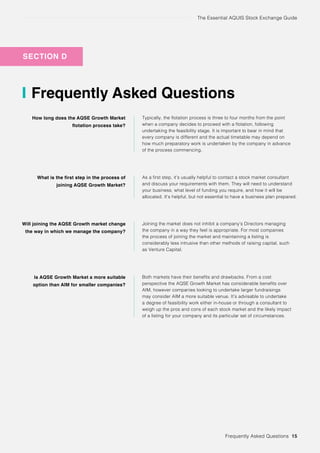
retail and institutional investors.
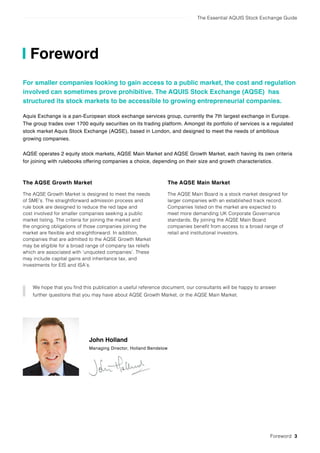
John Holland
Managing Director, Holland Bendelow
We hope that you find this publication a useful reference document, our consultants will be happy to answer
further questions that you may have about AQSE Growth Market, or the AQSE Main Market.
Foreword 3
For smaller companies looking to gain access to a public market, the cost and regulation
involved can sometimes prove prohibitive. The AQUIS Stock Exchange (AQSE) has
structured its stock markets to be accessible to growing entrepreneurial companies.
Aquis Exchange is a pan-European stock exchange services group, currently the 7th largest exchange in Europe.
The group trades over 1700 equity securities on its trading platform. Amongst its portfolio of services is a regulated
stock market Aquis Stock Exchange (AQSE), based in London, and designed to meet the needs of ambitious
growing companies.
AQSE operates 2 equity stock markets, AQSE Main Market and AQSE Growth Market, each having its own criteria
for joining with rulebooks offering companies a choice, depending on their size and growth characteristics.
The Essential AQUIS Stock Exchange Guide
4 Listing a Company on the UK Stock Markets
Listing a Company on the UK
Stock Markets
For companies looking to join any stock market there will undoubtedly be some challenges along the way.
However, with the right level of preparation and support, companies that are admitted to any UK stock market will
gain from considerable benefits. For many companies the opportunity to have an ongoing source of equity capital
to fuel growth will be the major benefit. For others, the added profile and credibility that a stock market listing
provides will enhance marketing and sales initiatives, helping to open doors to new customers. For companies that
are looking to grow via acquisition, the UK stock markets provide a valuable source of capital to undertake multiple
acquisitions over a period, thus accelerating a company’s growth.
Transparency
Companies listed on a stock market are likely to face
more public and media scrutiny than private companies.
However, most companies outside the FTSE 100 or FTSE
250 are unlikely to find such scrutiny intrusive or detrimental
to their business operations.
Regulation
Whilst listed companies face some additional regulatory
responsibilities over and above those of running a privately
owned company, the rules are generally designed so as
not to over burden companies or prevent entrepreneurial
companies from growing.
Your company’s reasons for seeking a stock
market listing
Whilst some companies use a listing to add credibility to
their business, the majority of companies choose to float on
a stock market to raise funding to;
• Reduce the dependency on bank finance
• Grow the business organically
• Pay down significant creditors
• Buy out founder shareholders
• Fund strategic acquisitions
Company valuation
One of the major considerations for companies looking to
join public markets is the potential valuation that can be
commanded. This information is not readily available and
therefore it is prudent to seek advice from a specialist at the
outset, and prior to commencing the flotation process.
Consultants will undertake initial research into the valuation
ranges that may be achievable. In addition, they will be
able to assess your company’s ability to raise funding on
the market. This information is key before embarking on the
flotation process and incurring costs associated with joining
a stock market.
A company’s share price
Once a company joins a public market, the pricing of the
company’s stock will be a continuous and ongoing process.
As a company grows and becomes more profitable, it will
generate positive news flow. This will help to stimulate
the share price and the value of the company increases.
Negative price movements can be triggered by macro-
economic or business sector trends or events. However, it is
more likely that they are a response to announcements made
by a company to the market that trading results will not meet
the targets previously forecast.
SECTION A
The Essential AQUIS Stock Exchange Guide
The AQSE Growth Market 5
SECTION B
The AQSE Growth Market
The AQSE Growth Market offers the quickest,
easiest and therefore the least expensive route to
a UK public market listing for companies.
The Market has a streamlined process of admission,
and the rules governing AQSE Growth Market
companies are less onerous than those for stock
markets operated by The London Stock Exchange.
The AQSE Growth Market offers companies several benefits
which would not be available if they remain in private
ownership. These include:
• Access to equity growth capital
• A mechanism to raise additional capital on an ongoing
basis through the further issue of shares
• A platform from which a company is able to broaden
their shareholder base
• The ability to introduce share based incentive
schemes which can be important in motivating,
retaining and recruiting key employees
• An objective valuation
• The potential to use the company’s shares as
acquisition currency
• A route for existing shareholders to partially or fully
exit at a time of their choosing
Once admitted to the market, the on-going regulatory
responsibilities for a company remain straightforward and
are designed to remove over regulation, whilst offering
investor protection.
The Essential AQUIS Stock Exchange Guide
6 Standard Listing Overview
Access segment (AXS)
AQSE have created a segment of the AQSE Growth Market
called Access.This is specifically designed for younger
and growing businesses. The Access segment has a more
simplified admission process and ongoing rules designed
to enable companies to focus on growing their businesses
rather than being distracted by too much red tape.
6 The NEX Exchange Growth Market
Apex segment (APX)
The Apex segment has been designed for more established
companies with a trading history. Whilst there are additional
eligibility requirements for joining this sector, there still
remains considerable flexibility, enabling SME’s to access
the market without unnecessary levels of regulation.
Generally Apex is aimed at companies with a market
capitalisation of over £10m.
Within the AQSE growth market two segments have
been created. Each segment is tailored to meet the
needs of companies at a particular stage in their
development.
The Essential AQUIS Stock Exchange Guide
The AQSE Growth Market - Access segment (AXS) 7
The AQSE Growth Market -
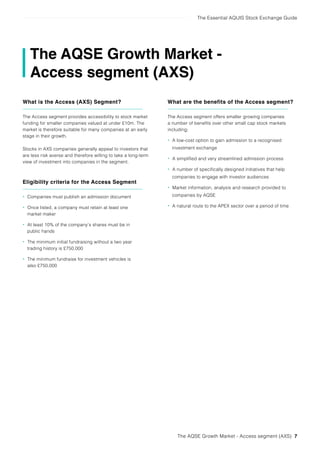
Access segment (AXS)
What is the Access (AXS) Segment?
The Access segment provides accessibility to stock market
funding for smaller companies valued at under £10m. The
market is therefore suitable for many companies at an early
stage in their growth.
Stocks in AXS companies generally appeal to investors that
are less risk averse and therefore willing to take a long-term
view of investment into companies in the segment.
Eligibility criteria for the Access Segment
• Companies must publish an admission document
• Once listed, a company must retain at least one
market maker
• At least 10% of the company’s shares must be in
public hands
• The minimum initial fundraising without a two year
trading history is £750,000
• The minimum fundraise for investment vehicles is
also £750,000
What are the benefits of the Access segment?
The Access segment offers smaller growing companies
a number of benefits over other small cap stock markets
including;
• A low-cost option to gain admission to a recognised
investment exchange
• A simplified and very streamlined admission process
• A number of specifically designed initiatives that help
companies to engage with investor audiences
• Market information, analysis and research provided to
companies by AQSE
• A natural route to the APEX sector over a period of time
The Essential AQUIS Stock Exchange Guide
8 The AQSE Growth Market - Apex segment (APX)
The AQSE Growth Market -
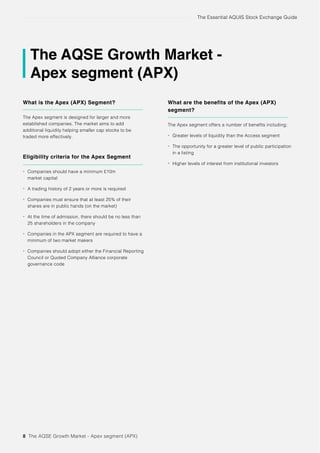
Apex segment (APX)
What is the Apex (APX) Segment?
The Apex segment is designed for larger and more
established companies. The market aims to add
additional liquidity helping smaller cap stocks to be
traded more effectively.
Eligibility criteria for the Apex Segment
• Companies should have a minimum £10m
market capital
• A trading history of 2 years or more is required
• Companies must ensure that at least 25% of their
shares are in public hands (on the market)
• At the time of admission, there should be no less than
25 shareholders in the company
• Companies in the APX segment are required to have a
minimum of two market makers
• Companies should adopt either the Financial Reporting
Council or Quoted Company Alliance corporate
governance code
What are the benefits of the Apex (APX)
segment?
The Apex segment offers a number of benefits including;
• Greater levels of liquidity than the Access segment
• The opportunity for a greater level of public participation
in a listing
• Higher levels of interest from institutional investors
The Essential AQUIS Stock Exchange Guide
Joining the Standard Segment of the Main Market 11
The Essential AQUIS Stock Exchange Guide
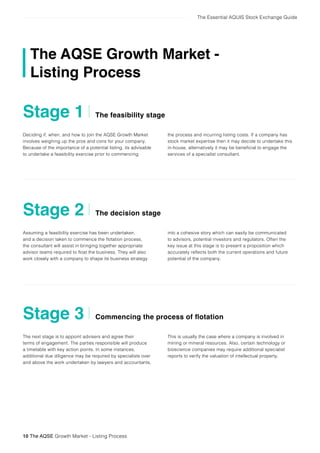
Deciding if, when, and how to join the AQSE Growth Market
involves weighing up the pros and cons for your company.
Because of the importance of a potential listing, its advisable
to undertake a feasibility exercise prior to commencing
Assuming a feasibility exercise has been undertaken,
and a decision taken to commence the flotation process,
the consultant will assist in bringing together appropriate
advisor teams required to float the business. They will also
work closely with a company to shape its business strategy
The next stage is to appoint advisers and agree their
terms of engagement. The parties responsible will produce
a timetable with key action points. In some instances,
additional due diligence may be required by specialists over
and above the work undertaken by lawyers and accountants.
The feasibility stage
The decision stage
Commencing the process of flotation
Stage 1
Stage 2
Stage 3
10 The AQSE Growth Market - Listing Process
The AQSE Growth Market -
Listing Process
the process and incurring listing costs. If a company has
stock market expertise then it may decide to undertake this
in-house, alternatively it may be beneficial to engage the
services of a specialist consultant.
into a cohesive story which can easily be communicated
to advisors, potential investors and regulators. Often the
key issue at this stage is to present a proposition which
accurately reflects both the current operations and future
potential of the company.
This is usually the case where a company is involved in
mining or mineral resources. Also, certain technology or
bioscience companies may require additional specialist
reports to verify the valuation of intellectual property.
The Essential AQUIS Stock Exchange Guide
An important part of the process of joining AQSE Growth
Market is the due diligence exercise. The scope of this may
differ from company to company depending upon the size,
structure and nature of a business. Often the focus of due
diligence concerns the individuals involved in the business
which may include the directors of the company and existing
substantial shareholders.
Aquis Stock Exchange expects that a company’s advisers
have visited the company’s main site of operation and have
met senior members of the management team. In some
Once the admission document for AQSE Growth Market is
completed, it will be submitted to the Aquis Stock Exchange
regulatory team for approval.
It’s most likely that representatives from the company
will be invited to the AQSE headquarters in London to
celebrate the company’s first day on the market.
The due diligence process
Admission document approval Admission day
Stage 4
Stage 5 Stage 6
The AQSE Growth Market - Listing Process 11
circumstances this may also include major shareholders or
those that have significant influence over the business or its
operations.
Aquis Stock Exchange’s regulatory department will need
to be satisfied that advisors have ensured statements and
material included in the company’s admission document
have been legally verified. In addition, financial due diligence
which is appropriate to the company should have been
undertaken covering key areas such as working capital and
financial reporting controls.
The Essential AQUIS Stock Exchange Guide
The AQSE Growth Market
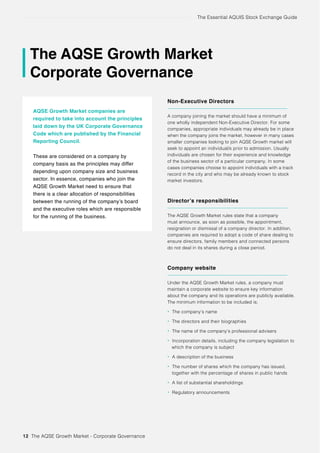
Corporate Governance
AQSE Growth Market companies are
required to take into account the principles
laid down by the UK Corporate Governance
Code which are published by the Financial
Reporting Council.
These are considered on a company by
company basis as the principles may differ
depending upon company size and business
sector. In essence, companies who join the
AQSE Growth Market need to ensure that
there is a clear allocation of responsibilities
between the running of the company’s board
and the executive roles which are responsible
for the running of the business.
Non-Executive Directors
A company joining the market should have a minimum of
one wholly independent Non-Executive Director. For some
companies, appropriate individuals may already be in place
when the company joins the market, however in many cases
smaller companies looking to join AQSE Growth market will
seek to appoint an individual/s prior to admission. Usually
individuals are chosen for their experience and knowledge
of the business sector of a particular company. In some
cases companies choose to appoint individuals with a track
record in the city and who may be already known to stock
market investors.
Director’s responsibilities
The AQSE Growth Market rules state that a company
must announce, as soon as possible, the appointment,
resignation or dismissal of a company director. In addition,
companies are required to adopt a code of share dealing to
ensure directors, family members and connected persons
do not deal in its shares during a close period.
Company website
Under the AQSE Growth Market rules, a company must
maintain a corporate website to ensure key information
about the company and its operations are publicly available.
The minimum information to be included is;
• The company’s name
• The directors and their biographies
• The name of the company’s professional advisers
• Incorporation details, including the company legislation to
which the company is subject
• A description of the business
• The number of shares which the company has issued,
together with the percentage of shares in public hands
• A list of substantial shareholdings
• Regulatory announcements
12 The AQSE Growth Market - Corporate Governance
The Essential AQUIS Stock Exchange Guide
The AQSE Growth Market -
Costs of joining
Pre float funding –
For some companies a pre-float funding round or even a
reverse transaction into an existing cash shell may be an
alternative to a traditional flotation. These options should be
discussed with your consultant.
Factors that impact on the costs of joining –
• A company’s preferred route to market (introduction,
placement, or reverse into an existing cash shell)
• The amount of funding raised at admission
• How prepared the management team and company are to
commence the flotation process
The Cost of joining the AQSE Growth Market –
In many cases smaller growing companies raise additional
funding over and above that required for their business
growth to pay some or all of the costs of a flotation. In
addition, many companies agree with their adviser teams
to ‘back end load’ fees until the fundraising is completed.
In some cases companies appoint certain advisers on a
contingency basis whereby a proportion of fees become due
only when the company has successfully listed on AQSE
Growth Market.
In most cases a listing on AQSE Growth
Market will be quicker, easier and
therefore less costly than a listing on
other UK stock markets. Because costs
can vary, it’s important to commence
the process having already established
the likely cost for your company. If a
fundraising is to be part of the listing
strategy, commissions on fundraising
should be taken into account.
AQSE Growth Market - fee table
Application and Admission
By market capitalisation for equities and notional value for bonds
Under £10m
£10m - £25m
£25m - £50m
An additional £100 per £10m will be charged up to a maximum fee of £50,000
Further issues of shares
Securities to be admitted between £25,000 to £100,000 further issue fee
Fees for companies transferring from other markets
Transfer from another UK SME Growth Market
Transfer from a qualifying market
Annual fees
For each issuer
Application fee
£2,500
£5,000
£5,000
Admission fee
£5,000
£8,000
£16,000
£5,000
£500
£5,000
£6,800
The Essential AQUIS Stock Exchange Guide
16 The NEX Main Board
The AQSE Main Market
SECTION C
The Aquis Main Market is designed to meet the needs
of larger or more mature businesses. Companies
looking to join are required to have a minimum track
record of three years. The AQSE Main Market is
regulated by the Financial Conduct Authority (FCA).
Admission to the AQSE Main Market provides companies
with access to a broad range of investors, both retail and
institutional, which helps to provide liquidity.
AQSE have introduced an impact segment of the market
which is dedicated specifically to companies that have a
positive social or environmental impact. For Companies that
qualify for this accreditation, there are opportunities to attract
investment from investors seeking investment into companies
that demonstrate sound credentials in these areas.
The Essential AQUIS Stock Exchange Guide
SECTION D
Frequently Asked Questions
How long does the AQSE Growth Market
flotation process take?
What is the first step in the process of
joining AQSE Growth Market?
Will joining the AQSE Growth market change
the way in which we manage the company?
Is AQSE Growth Market a more suitable
option than AIM for smaller companies?
Typically, the flotation process is three to four months from the point
when a company decides to proceed with a flotation, following
undertaking the feasibility stage. It is important to bear in mind that
every company is different and the actual timetable may depend on
how much preparatory work is undertaken by the company in advance
of the process commencing.
As a first step, it’s usually helpful to contact a stock market consultant
and discuss your requirements with them. They will need to understand
your business, what level of funding you require, and how it will be
allocated. It’s helpful, but not essential to have a business plan prepared.
Joining the market does not inhibit a company’s Directors managing
the company in a way they feel is appropriate. For most companies
the process of joining the market and maintaining a listing is
considerably less intrusive than other methods of raising capital, such
as Venture Capital.
Both markets have their benefits and drawbacks. From a cost
perspective the AQSE Growth Market has considerable benefits over
AIM, however companies looking to undertake larger fundraisings
may consider AIM a more suitable venue. It’s advisable to undertake
a degree of feasibility work either in-house or through a consultant to
weigh up the pros and cons of each stock market and the likely impact
of a listing for your company and its particular set of circumstances.
Frequently Asked Questions 15
The Essential AQUIS Stock Exchange Guide
Admission - The admission of securities to trading on a stock market.
Admission agreement - A document detailing contractual responsibilities of a company.
Admission Document - The disclosure document which a company applying for admission to AQSE is required to produce.
AIM - Originally called the Alternative Investment Market. The London Stock Exchanges market for smaller growing companies.
Approved prospectus - The document produced by the company and its advisors to be approved by the Competent Authority of the
company’s home country, and published in relation to the admission of securities to a regulated stock market, or an offer of securities
to the public.
Close Period - A period of time in which a company must ensure that its directors and applicable employees do not deal in any of its
own shares.
Connected person - A trust of which a director of a company is a trustee or beneficiary.
Corporate Governance - Used to describe the systems used to control corporations. There are corporate governance codes and
recommendations that are not compulsory.
Depositary receipt (DR) - A transferable certificate that represents shares in a company and confers certain rights in respect of
those shares, issued by a depository bank for the purposes of admission to trading.
Dividend - The part of a company’s profits after tax which is distributed to shareholders, usually expressed in pence per share.
Due diligence - The process of obtaining all information about a company to ensure that the company is appropriate to be admitted
to a stock market.
Equity - The stake its owners have in the company. This is the risk sharing part of a company’s capital, usually made up of ordinary
shares.
FCA - The Financial Conduct Authority
Flotation - When a company’s shares are admitted to trading on a Stock Exchange.
Free float - The amount of shares in a company which are in ‘public hands’ i.e. not owned by a director of the company or its
subsidiaries, or individuals connected with the company and any person holding five per cent or more of the shares.
FSA - The Financial Services Authority, who act as the competent authority in the UK.
Introduction - A method of obtaining admission to a stock market without an offering of shares.
Issuer - An issuer or company whose shares have been admitted to trading.
Market capitalisation (Market Cap) - The total value of the shares of a company, sector or market.
Market Maker - A securities firm which is obliged to offer to buy and sell securities in which it is registered to the market for the first
time or issues of extra shares.
Official List - The list maintained by the FSA of those securities which have been admitted to listing.
16 Glossary of Stock Market Terms
Glossary of Stock Market Terms
SECTION D
SECTION E
The Essential AQUIS Stock Exchange Guide
Glossary of Stock Market Terms 17
Ordinary Shares - The most common form of share. Holders may receive dividends in line with the company’s profitability and on
the recommendation of its directors.
Primary market - The function of a stock exchange in bringing securities to the market for the first time. Money is raised either for
the company at admission or through further issues to fund future growth.
Primary company - A company which is not a public company and which is not allowed to offer its shares to the general public.
Prospectus - When a company applies for a listing of its securities which are to be offered to the public in the UK.
Related Party - Any director of the company or any other group company, any substantial shareholder who holds 10% or more of the
company’s shares or any associate of any director or any substantial shareholder.
Shell Company - A shell company is a company that exists but does not actually do any business or have any assets. A listed shell
has significant value even if does not have any assets. Listed shells are therefore often targets for reverse takeovers.
The Essential AQUIS Stock Exchange Guide
Contact details
Holland Bendelow are the UK’s
longest established stock market
flotation consultancy, with a
successful track record of advising
UK and International companies.
We specialise in advising the directors and owners on privately
owned pre-float companies considering floating their companies
on any of the UK stock markets, including Aquis Stock Exchange,
AIM Stock Market and The Main Market. For further information
about joining Aquis Stock Exchange or to arrange a confidential
consultation please contact Holland Bendelow.
Call +44 (0)845 1223415
Visit www.hbcg.co.uk
Holland Bendelow
12th Floor
6 New Street Square
London, EC4A 3BF
Holland Bendelow
Princess Square
Leeds, LS1 4HY
Also satellites in Bristol and Cambridge.
SECTION D
SECTION F
The Essential AQUIS Stock Exchange Guide
LEGAL DISCLAIMER
This document has been compiled by Holland Bendelow who have attempted to ensure that the information in this document is accurate,
however the information is provided “AS IS” and on an “AS AVAILABLE” basis and may not be accurate or up to date. Holland Bendelow does
not guarantee the accuracy, timeliness, completeness, performance or fitness for a particular purpose of the document or any of the information
in it. Holland Bendelow is not responsible for any third-party content which is set out in this document. No responsibility is accepted by or on
behalf of Holland Bendelow for any errors, omissions, or inaccurate information in the document. No action should be taken or omitted to be
taken in reliance upon information in this document. Holland Bendelow accepts no liability for the results of any action taken on the basis of the
information in this document.
All implied warranties, including but not limited to the implied warranties of satisfactory quality, fitness for a particular purpose, non-infringement,
compatibility, security and accuracy are excluded by Holland Bendelow to the extent that they may be excluded as a matter of law. Holland
Bendelow does not warrant that the document is error free or that any defects will be corrected. Holland Bendelow expressly disclaims all liability
howsoever arising whether in contract, tort (or deceit) or otherwise (including, but not limited to, liability for any negligent act or omissions) to
any person in respect of any claims or losses of any nature, arising directly or indirectly from: (i) anything done or the consequences of anything
done or omitted to be done wholly or partly in reliance upon the whole or any part of the contents of this document, and (ii) the use of any data or
materials in this document. Information in this document is not offered as advice on any particular matter and must not be treated as a substitute
for specific advice. In particular information in the document does not constitute professional, financial or investment advice and must not be
used as a basis for making investment decisions and is in no way intended, directly or indirectly, as an attempt to market or sell any type of
financial instrument. Advice from a suitably qualified professional should always be sought in relation to any particular matter or circumstances.
Electronic mail copies of this document are not official unless authenticated by Holland Bendelow Limited and are not to be modified in any
manner without Holland Bendelow Limited’s expressed written consent.
Holland Bendelow’s logo is a registered trade mark.
@2021
The Essential AQUIS Stock Exchange Guide

Aquis stock exchange guide

  • 1.
    The Essential AQUISStock Exchange Guide The essential AQUIS Stock Exchange Guide W I SE GUID E S · W I S E G U I D E S ·
  • 2.
    The Essential AQUISStock Exchange Guide Contents Foreword SECTION A Listing a company on the UK stock markets SECTION B The AQSE Growth Market The AQSE Growth Market - Access Segment (AXS) The AQSE Growth Market - Apex Segment (APX) The AQSE Growth Market - Listing process The AQSE Growth Market - Corporate governance The AQSE Growth Market – Costs of joining SECTION C The AQSE Main Market SECTION D Frequently asked questions SECTION E Glossary of stock market terms SECTION F Contact details 3 4 5 7 8 10 12 13 14 15 16 18
  • 3.
    The Essential AQUISStock Exchange Guide Foreword The AQSE Growth Market The AQSE Growth Market is designed to meet the needs of SME’s. The straightforward admission process and rule book are designed to reduce the red tape and cost involved for smaller companies seeking a public market listing. The criteria for joining the market and the ongoing obligations of those companies joining the market are flexible and straightforward. In addition, companies that are admitted to the AQSE Growth Market may be eligible for a broad range of company tax reliefs which are associated with ‘unquoted companies’. These may include capital gains and inheritance tax, and investments for EIS and ISA’s. The AQSE Main Market The AQSE Main Board is a stock market designed for larger companies with an established track record. Companies listed on the market are expected to meet more demanding UK Corporate Governance standards. By joining the AQSE Main Board companies benefit from access to a broad range of retail and institutional investors. John Holland Managing Director, Holland Bendelow We hope that you find this publication a useful reference document, our consultants will be happy to answer further questions that you may have about AQSE Growth Market, or the AQSE Main Market. Foreword 3 For smaller companies looking to gain access to a public market, the cost and regulation involved can sometimes prove prohibitive. The AQUIS Stock Exchange (AQSE) has structured its stock markets to be accessible to growing entrepreneurial companies. Aquis Exchange is a pan-European stock exchange services group, currently the 7th largest exchange in Europe. The group trades over 1700 equity securities on its trading platform. Amongst its portfolio of services is a regulated stock market Aquis Stock Exchange (AQSE), based in London, and designed to meet the needs of ambitious growing companies. AQSE operates 2 equity stock markets, AQSE Main Market and AQSE Growth Market, each having its own criteria for joining with rulebooks offering companies a choice, depending on their size and growth characteristics.
  • 4.
    The Essential AQUISStock Exchange Guide 4 Listing a Company on the UK Stock Markets Listing a Company on the UK Stock Markets For companies looking to join any stock market there will undoubtedly be some challenges along the way. However, with the right level of preparation and support, companies that are admitted to any UK stock market will gain from considerable benefits. For many companies the opportunity to have an ongoing source of equity capital to fuel growth will be the major benefit. For others, the added profile and credibility that a stock market listing provides will enhance marketing and sales initiatives, helping to open doors to new customers. For companies that are looking to grow via acquisition, the UK stock markets provide a valuable source of capital to undertake multiple acquisitions over a period, thus accelerating a company’s growth. Transparency Companies listed on a stock market are likely to face more public and media scrutiny than private companies. However, most companies outside the FTSE 100 or FTSE 250 are unlikely to find such scrutiny intrusive or detrimental to their business operations. Regulation Whilst listed companies face some additional regulatory responsibilities over and above those of running a privately owned company, the rules are generally designed so as not to over burden companies or prevent entrepreneurial companies from growing. Your company’s reasons for seeking a stock market listing Whilst some companies use a listing to add credibility to their business, the majority of companies choose to float on a stock market to raise funding to; • Reduce the dependency on bank finance • Grow the business organically • Pay down significant creditors • Buy out founder shareholders • Fund strategic acquisitions Company valuation One of the major considerations for companies looking to join public markets is the potential valuation that can be commanded. This information is not readily available and therefore it is prudent to seek advice from a specialist at the outset, and prior to commencing the flotation process. Consultants will undertake initial research into the valuation ranges that may be achievable. In addition, they will be able to assess your company’s ability to raise funding on the market. This information is key before embarking on the flotation process and incurring costs associated with joining a stock market. A company’s share price Once a company joins a public market, the pricing of the company’s stock will be a continuous and ongoing process. As a company grows and becomes more profitable, it will generate positive news flow. This will help to stimulate the share price and the value of the company increases. Negative price movements can be triggered by macro- economic or business sector trends or events. However, it is more likely that they are a response to announcements made by a company to the market that trading results will not meet the targets previously forecast. SECTION A
  • 5.
    The Essential AQUISStock Exchange Guide The AQSE Growth Market 5 SECTION B The AQSE Growth Market The AQSE Growth Market offers the quickest, easiest and therefore the least expensive route to a UK public market listing for companies. The Market has a streamlined process of admission, and the rules governing AQSE Growth Market companies are less onerous than those for stock markets operated by The London Stock Exchange. The AQSE Growth Market offers companies several benefits which would not be available if they remain in private ownership. These include: • Access to equity growth capital • A mechanism to raise additional capital on an ongoing basis through the further issue of shares • A platform from which a company is able to broaden their shareholder base • The ability to introduce share based incentive schemes which can be important in motivating, retaining and recruiting key employees • An objective valuation • The potential to use the company’s shares as acquisition currency • A route for existing shareholders to partially or fully exit at a time of their choosing Once admitted to the market, the on-going regulatory responsibilities for a company remain straightforward and are designed to remove over regulation, whilst offering investor protection.
  • 6.
    The Essential AQUISStock Exchange Guide 6 Standard Listing Overview Access segment (AXS) AQSE have created a segment of the AQSE Growth Market called Access.This is specifically designed for younger and growing businesses. The Access segment has a more simplified admission process and ongoing rules designed to enable companies to focus on growing their businesses rather than being distracted by too much red tape. 6 The NEX Exchange Growth Market Apex segment (APX) The Apex segment has been designed for more established companies with a trading history. Whilst there are additional eligibility requirements for joining this sector, there still remains considerable flexibility, enabling SME’s to access the market without unnecessary levels of regulation. Generally Apex is aimed at companies with a market capitalisation of over £10m. Within the AQSE growth market two segments have been created. Each segment is tailored to meet the needs of companies at a particular stage in their development.
  • 7.
    The Essential AQUISStock Exchange Guide The AQSE Growth Market - Access segment (AXS) 7 The AQSE Growth Market - Access segment (AXS) What is the Access (AXS) Segment? The Access segment provides accessibility to stock market funding for smaller companies valued at under £10m. The market is therefore suitable for many companies at an early stage in their growth. Stocks in AXS companies generally appeal to investors that are less risk averse and therefore willing to take a long-term view of investment into companies in the segment. Eligibility criteria for the Access Segment • Companies must publish an admission document • Once listed, a company must retain at least one market maker • At least 10% of the company’s shares must be in public hands • The minimum initial fundraising without a two year trading history is £750,000 • The minimum fundraise for investment vehicles is also £750,000 What are the benefits of the Access segment? The Access segment offers smaller growing companies a number of benefits over other small cap stock markets including; • A low-cost option to gain admission to a recognised investment exchange • A simplified and very streamlined admission process • A number of specifically designed initiatives that help companies to engage with investor audiences • Market information, analysis and research provided to companies by AQSE • A natural route to the APEX sector over a period of time
  • 8.
    The Essential AQUISStock Exchange Guide 8 The AQSE Growth Market - Apex segment (APX) The AQSE Growth Market - Apex segment (APX) What is the Apex (APX) Segment? The Apex segment is designed for larger and more established companies. The market aims to add additional liquidity helping smaller cap stocks to be traded more effectively. Eligibility criteria for the Apex Segment • Companies should have a minimum £10m market capital • A trading history of 2 years or more is required • Companies must ensure that at least 25% of their shares are in public hands (on the market) • At the time of admission, there should be no less than 25 shareholders in the company • Companies in the APX segment are required to have a minimum of two market makers • Companies should adopt either the Financial Reporting Council or Quoted Company Alliance corporate governance code What are the benefits of the Apex (APX) segment? The Apex segment offers a number of benefits including; • Greater levels of liquidity than the Access segment • The opportunity for a greater level of public participation in a listing • Higher levels of interest from institutional investors
  • 9.
    The Essential AQUISStock Exchange Guide Joining the Standard Segment of the Main Market 11
  • 10.
    The Essential AQUISStock Exchange Guide Deciding if, when, and how to join the AQSE Growth Market involves weighing up the pros and cons for your company. Because of the importance of a potential listing, its advisable to undertake a feasibility exercise prior to commencing Assuming a feasibility exercise has been undertaken, and a decision taken to commence the flotation process, the consultant will assist in bringing together appropriate advisor teams required to float the business. They will also work closely with a company to shape its business strategy The next stage is to appoint advisers and agree their terms of engagement. The parties responsible will produce a timetable with key action points. In some instances, additional due diligence may be required by specialists over and above the work undertaken by lawyers and accountants. The feasibility stage The decision stage Commencing the process of flotation Stage 1 Stage 2 Stage 3 10 The AQSE Growth Market - Listing Process The AQSE Growth Market - Listing Process the process and incurring listing costs. If a company has stock market expertise then it may decide to undertake this in-house, alternatively it may be beneficial to engage the services of a specialist consultant. into a cohesive story which can easily be communicated to advisors, potential investors and regulators. Often the key issue at this stage is to present a proposition which accurately reflects both the current operations and future potential of the company. This is usually the case where a company is involved in mining or mineral resources. Also, certain technology or bioscience companies may require additional specialist reports to verify the valuation of intellectual property.
  • 11.
    The Essential AQUISStock Exchange Guide An important part of the process of joining AQSE Growth Market is the due diligence exercise. The scope of this may differ from company to company depending upon the size, structure and nature of a business. Often the focus of due diligence concerns the individuals involved in the business which may include the directors of the company and existing substantial shareholders. Aquis Stock Exchange expects that a company’s advisers have visited the company’s main site of operation and have met senior members of the management team. In some Once the admission document for AQSE Growth Market is completed, it will be submitted to the Aquis Stock Exchange regulatory team for approval. It’s most likely that representatives from the company will be invited to the AQSE headquarters in London to celebrate the company’s first day on the market. The due diligence process Admission document approval Admission day Stage 4 Stage 5 Stage 6 The AQSE Growth Market - Listing Process 11 circumstances this may also include major shareholders or those that have significant influence over the business or its operations. Aquis Stock Exchange’s regulatory department will need to be satisfied that advisors have ensured statements and material included in the company’s admission document have been legally verified. In addition, financial due diligence which is appropriate to the company should have been undertaken covering key areas such as working capital and financial reporting controls.
  • 12.
    The Essential AQUISStock Exchange Guide The AQSE Growth Market Corporate Governance AQSE Growth Market companies are required to take into account the principles laid down by the UK Corporate Governance Code which are published by the Financial Reporting Council. These are considered on a company by company basis as the principles may differ depending upon company size and business sector. In essence, companies who join the AQSE Growth Market need to ensure that there is a clear allocation of responsibilities between the running of the company’s board and the executive roles which are responsible for the running of the business. Non-Executive Directors A company joining the market should have a minimum of one wholly independent Non-Executive Director. For some companies, appropriate individuals may already be in place when the company joins the market, however in many cases smaller companies looking to join AQSE Growth market will seek to appoint an individual/s prior to admission. Usually individuals are chosen for their experience and knowledge of the business sector of a particular company. In some cases companies choose to appoint individuals with a track record in the city and who may be already known to stock market investors. Director’s responsibilities The AQSE Growth Market rules state that a company must announce, as soon as possible, the appointment, resignation or dismissal of a company director. In addition, companies are required to adopt a code of share dealing to ensure directors, family members and connected persons do not deal in its shares during a close period. Company website Under the AQSE Growth Market rules, a company must maintain a corporate website to ensure key information about the company and its operations are publicly available. The minimum information to be included is; • The company’s name • The directors and their biographies • The name of the company’s professional advisers • Incorporation details, including the company legislation to which the company is subject • A description of the business • The number of shares which the company has issued, together with the percentage of shares in public hands • A list of substantial shareholdings • Regulatory announcements 12 The AQSE Growth Market - Corporate Governance
  • 13.
    The Essential AQUISStock Exchange Guide The AQSE Growth Market - Costs of joining Pre float funding – For some companies a pre-float funding round or even a reverse transaction into an existing cash shell may be an alternative to a traditional flotation. These options should be discussed with your consultant. Factors that impact on the costs of joining – • A company’s preferred route to market (introduction, placement, or reverse into an existing cash shell) • The amount of funding raised at admission • How prepared the management team and company are to commence the flotation process The Cost of joining the AQSE Growth Market – In many cases smaller growing companies raise additional funding over and above that required for their business growth to pay some or all of the costs of a flotation. In addition, many companies agree with their adviser teams to ‘back end load’ fees until the fundraising is completed. In some cases companies appoint certain advisers on a contingency basis whereby a proportion of fees become due only when the company has successfully listed on AQSE Growth Market. In most cases a listing on AQSE Growth Market will be quicker, easier and therefore less costly than a listing on other UK stock markets. Because costs can vary, it’s important to commence the process having already established the likely cost for your company. If a fundraising is to be part of the listing strategy, commissions on fundraising should be taken into account. AQSE Growth Market - fee table Application and Admission By market capitalisation for equities and notional value for bonds Under £10m £10m - £25m £25m - £50m An additional £100 per £10m will be charged up to a maximum fee of £50,000 Further issues of shares Securities to be admitted between £25,000 to £100,000 further issue fee Fees for companies transferring from other markets Transfer from another UK SME Growth Market Transfer from a qualifying market Annual fees For each issuer Application fee £2,500 £5,000 £5,000 Admission fee £5,000 £8,000 £16,000 £5,000 £500 £5,000 £6,800
  • 14.
    The Essential AQUISStock Exchange Guide 16 The NEX Main Board The AQSE Main Market SECTION C The Aquis Main Market is designed to meet the needs of larger or more mature businesses. Companies looking to join are required to have a minimum track record of three years. The AQSE Main Market is regulated by the Financial Conduct Authority (FCA). Admission to the AQSE Main Market provides companies with access to a broad range of investors, both retail and institutional, which helps to provide liquidity. AQSE have introduced an impact segment of the market which is dedicated specifically to companies that have a positive social or environmental impact. For Companies that qualify for this accreditation, there are opportunities to attract investment from investors seeking investment into companies that demonstrate sound credentials in these areas.
  • 15.
    The Essential AQUISStock Exchange Guide SECTION D Frequently Asked Questions How long does the AQSE Growth Market flotation process take? What is the first step in the process of joining AQSE Growth Market? Will joining the AQSE Growth market change the way in which we manage the company? Is AQSE Growth Market a more suitable option than AIM for smaller companies? Typically, the flotation process is three to four months from the point when a company decides to proceed with a flotation, following undertaking the feasibility stage. It is important to bear in mind that every company is different and the actual timetable may depend on how much preparatory work is undertaken by the company in advance of the process commencing. As a first step, it’s usually helpful to contact a stock market consultant and discuss your requirements with them. They will need to understand your business, what level of funding you require, and how it will be allocated. It’s helpful, but not essential to have a business plan prepared. Joining the market does not inhibit a company’s Directors managing the company in a way they feel is appropriate. For most companies the process of joining the market and maintaining a listing is considerably less intrusive than other methods of raising capital, such as Venture Capital. Both markets have their benefits and drawbacks. From a cost perspective the AQSE Growth Market has considerable benefits over AIM, however companies looking to undertake larger fundraisings may consider AIM a more suitable venue. It’s advisable to undertake a degree of feasibility work either in-house or through a consultant to weigh up the pros and cons of each stock market and the likely impact of a listing for your company and its particular set of circumstances. Frequently Asked Questions 15
  • 16.
    The Essential AQUISStock Exchange Guide Admission - The admission of securities to trading on a stock market. Admission agreement - A document detailing contractual responsibilities of a company. Admission Document - The disclosure document which a company applying for admission to AQSE is required to produce. AIM - Originally called the Alternative Investment Market. The London Stock Exchanges market for smaller growing companies. Approved prospectus - The document produced by the company and its advisors to be approved by the Competent Authority of the company’s home country, and published in relation to the admission of securities to a regulated stock market, or an offer of securities to the public. Close Period - A period of time in which a company must ensure that its directors and applicable employees do not deal in any of its own shares. Connected person - A trust of which a director of a company is a trustee or beneficiary. Corporate Governance - Used to describe the systems used to control corporations. There are corporate governance codes and recommendations that are not compulsory. Depositary receipt (DR) - A transferable certificate that represents shares in a company and confers certain rights in respect of those shares, issued by a depository bank for the purposes of admission to trading. Dividend - The part of a company’s profits after tax which is distributed to shareholders, usually expressed in pence per share. Due diligence - The process of obtaining all information about a company to ensure that the company is appropriate to be admitted to a stock market. Equity - The stake its owners have in the company. This is the risk sharing part of a company’s capital, usually made up of ordinary shares. FCA - The Financial Conduct Authority Flotation - When a company’s shares are admitted to trading on a Stock Exchange. Free float - The amount of shares in a company which are in ‘public hands’ i.e. not owned by a director of the company or its subsidiaries, or individuals connected with the company and any person holding five per cent or more of the shares. FSA - The Financial Services Authority, who act as the competent authority in the UK. Introduction - A method of obtaining admission to a stock market without an offering of shares. Issuer - An issuer or company whose shares have been admitted to trading. Market capitalisation (Market Cap) - The total value of the shares of a company, sector or market. Market Maker - A securities firm which is obliged to offer to buy and sell securities in which it is registered to the market for the first time or issues of extra shares. Official List - The list maintained by the FSA of those securities which have been admitted to listing. 16 Glossary of Stock Market Terms Glossary of Stock Market Terms SECTION D SECTION E
  • 17.
    The Essential AQUISStock Exchange Guide Glossary of Stock Market Terms 17 Ordinary Shares - The most common form of share. Holders may receive dividends in line with the company’s profitability and on the recommendation of its directors. Primary market - The function of a stock exchange in bringing securities to the market for the first time. Money is raised either for the company at admission or through further issues to fund future growth. Primary company - A company which is not a public company and which is not allowed to offer its shares to the general public. Prospectus - When a company applies for a listing of its securities which are to be offered to the public in the UK. Related Party - Any director of the company or any other group company, any substantial shareholder who holds 10% or more of the company’s shares or any associate of any director or any substantial shareholder. Shell Company - A shell company is a company that exists but does not actually do any business or have any assets. A listed shell has significant value even if does not have any assets. Listed shells are therefore often targets for reverse takeovers.
  • 18.
    The Essential AQUISStock Exchange Guide Contact details Holland Bendelow are the UK’s longest established stock market flotation consultancy, with a successful track record of advising UK and International companies. We specialise in advising the directors and owners on privately owned pre-float companies considering floating their companies on any of the UK stock markets, including Aquis Stock Exchange, AIM Stock Market and The Main Market. For further information about joining Aquis Stock Exchange or to arrange a confidential consultation please contact Holland Bendelow. Call +44 (0)845 1223415 Visit www.hbcg.co.uk Holland Bendelow 12th Floor 6 New Street Square London, EC4A 3BF Holland Bendelow Princess Square Leeds, LS1 4HY Also satellites in Bristol and Cambridge. SECTION D SECTION F
  • 19.
    The Essential AQUISStock Exchange Guide LEGAL DISCLAIMER This document has been compiled by Holland Bendelow who have attempted to ensure that the information in this document is accurate, however the information is provided “AS IS” and on an “AS AVAILABLE” basis and may not be accurate or up to date. Holland Bendelow does not guarantee the accuracy, timeliness, completeness, performance or fitness for a particular purpose of the document or any of the information in it. Holland Bendelow is not responsible for any third-party content which is set out in this document. No responsibility is accepted by or on behalf of Holland Bendelow for any errors, omissions, or inaccurate information in the document. No action should be taken or omitted to be taken in reliance upon information in this document. Holland Bendelow accepts no liability for the results of any action taken on the basis of the information in this document. All implied warranties, including but not limited to the implied warranties of satisfactory quality, fitness for a particular purpose, non-infringement, compatibility, security and accuracy are excluded by Holland Bendelow to the extent that they may be excluded as a matter of law. Holland Bendelow does not warrant that the document is error free or that any defects will be corrected. Holland Bendelow expressly disclaims all liability howsoever arising whether in contract, tort (or deceit) or otherwise (including, but not limited to, liability for any negligent act or omissions) to any person in respect of any claims or losses of any nature, arising directly or indirectly from: (i) anything done or the consequences of anything done or omitted to be done wholly or partly in reliance upon the whole or any part of the contents of this document, and (ii) the use of any data or materials in this document. Information in this document is not offered as advice on any particular matter and must not be treated as a substitute for specific advice. In particular information in the document does not constitute professional, financial or investment advice and must not be used as a basis for making investment decisions and is in no way intended, directly or indirectly, as an attempt to market or sell any type of financial instrument. Advice from a suitably qualified professional should always be sought in relation to any particular matter or circumstances. Electronic mail copies of this document are not official unless authenticated by Holland Bendelow Limited and are not to be modified in any manner without Holland Bendelow Limited’s expressed written consent. Holland Bendelow’s logo is a registered trade mark. @2021
  • 20.
    The Essential AQUISStock Exchange Guide