Stock Market
Business communication
assignment
Stock Exchanges
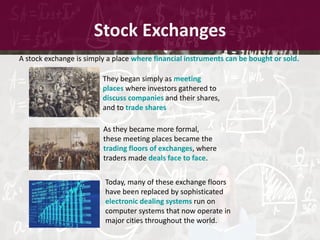
They began simply as meeting
places where investors gathered to
discuss companies and their shares,
and to trade shares
As they became more formal,
these meeting places became the
trading floors of exchanges, where
traders made deals face to face.
Today, many of these exchange floors
have been replaced by sophisticated
electronic dealing systems run on
computer systems that now operate in
major cities throughout the world.
A stock exchange is simply a place where financial instruments can be bought or sold.
Stock Exchanges
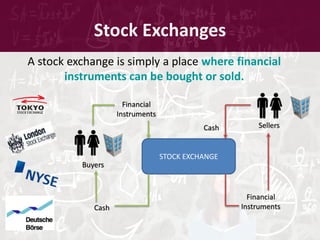
A stock exchange is simply a place where financial
instruments can be bought or sold.
STOCK EXCHANGE
Financial
Instruments
Sellers
Cash
Cash
Financial
Instruments
Buyers
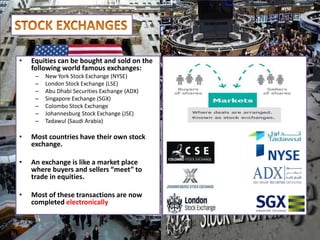
• Equities can be bought and sold on the
following world famous exchanges:
– New York Stock Exchange (NYSE)
– London Stock Exchange (LSE)
– Abu Dhabi Securities Exchange (ADX)
– Singapore Exchange (SGX)
– Colombo Stock Exchange
– Johannesburg Stock Exchange (JSE)
– Tadawul (Saudi Arabia)
• Most countries have their own stock
exchange.
• An exchange is like a market place
where buyers and sellers “meet” to
trade in equities.
• Most of these transactions are now
completed electronically
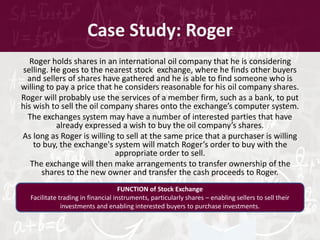
Case Study: Roger
Roger holds shares in an international oil company that he is considering
selling. He goes to the nearest stock exchange, where he finds other buyers
and sellers of shares have gathered and he is able to find someone who is
willing to pay a price that he considers reasonable for his oil company shares.
Roger will probably use the services of a member firm, such as a bank, to put
his wish to sell the oil company shares onto the exchange’s computer system.
The exchanges system may have a number of interested parties that have
already expressed a wish to buy the oil company’s shares.
As long as Roger is willing to sell at the same price that a purchaser is willing
to buy, the exchange's system will match Roger’s order to buy with the
appropriate order to sell.
The exchange will then make arrangements to transfer ownership of the
shares to the new owner and transfer the cash proceeds to Roger.
FUNCTION of Stock Exchange
Facilitate trading in financial instruments, particularly shares – enabling sellers to sell their
investments and enabling interested buyers to purchase investments.
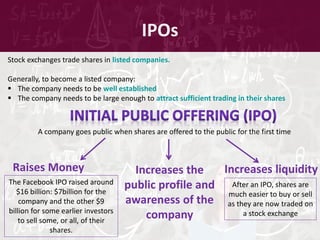
IPOs
Stock exchanges trade shares in listed companies.
Generally, to become a listed company:
 The company needs to be well established
 The company needs to be large enough to attract sufficient trading in their shares
A company goes public when shares are offered to the public for the first time
Raises Money
The Facebook IPO raised around
$16 billion: $7billion for the
company and the other $9
billion for some earlier investors
to sell some, or all, of their
shares.
Increases the
public profile and
awareness of the
company
Increases liquidity
After an IPO, shares are
much easier to buy or sell
as they are now traded on
a stock exchange
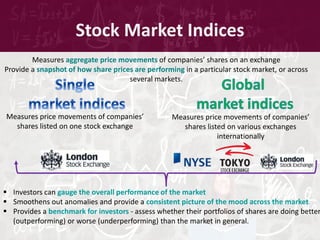
Stock Market Indices
Measures aggregate price movements of companies’ shares on an exchange
Provide a snapshot of how share prices are performing in a particular stock market, or across
several markets.
Measures price movements of companies’
shares listed on one stock exchange
Measures price movements of companies’
shares listed on various exchanges
internationally
 Investors can gauge the overall performance of the market
 Smoothens out anomalies and provide a consistent picture of the mood across the market.
 Provides a benchmark for investors - assess whether their portfolios of shares are doing better
(outperforming) or worse (underperforming) than the market in general.
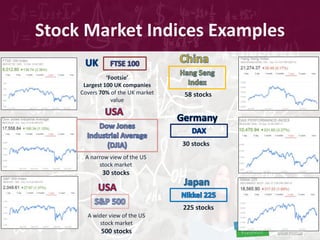
Stock Market Indices Examples
‘Footsie’
Largest 100 UK companies
Covers 70% of the UK market
value
A narrow view of the US
stock market
30 stocks
A wider view of the US
stock market
500 stocks
58 stocks
30 stocks
225 stocks
PRESENTED BY: KRITIK SINGH, SHUBH GUPTA

bc.pptx

  • 1.
  • 2.
    Stock Exchanges They begansimply as meeting places where investors gathered to discuss companies and their shares, and to trade shares As they became more formal, these meeting places became the trading floors of exchanges, where traders made deals face to face. Today, many of these exchange floors have been replaced by sophisticated electronic dealing systems run on computer systems that now operate in major cities throughout the world. A stock exchange is simply a place where financial instruments can be bought or sold.
  • 3.
    Stock Exchanges A stockexchange is simply a place where financial instruments can be bought or sold. STOCK EXCHANGE Financial Instruments Sellers Cash Cash Financial Instruments Buyers
  • 4.
    • Equities canbe bought and sold on the following world famous exchanges: – New York Stock Exchange (NYSE) – London Stock Exchange (LSE) – Abu Dhabi Securities Exchange (ADX) – Singapore Exchange (SGX) – Colombo Stock Exchange – Johannesburg Stock Exchange (JSE) – Tadawul (Saudi Arabia) • Most countries have their own stock exchange. • An exchange is like a market place where buyers and sellers “meet” to trade in equities. • Most of these transactions are now completed electronically
  • 5.
    Case Study: Roger Rogerholds shares in an international oil company that he is considering selling. He goes to the nearest stock exchange, where he finds other buyers and sellers of shares have gathered and he is able to find someone who is willing to pay a price that he considers reasonable for his oil company shares. Roger will probably use the services of a member firm, such as a bank, to put his wish to sell the oil company shares onto the exchange’s computer system. The exchanges system may have a number of interested parties that have already expressed a wish to buy the oil company’s shares. As long as Roger is willing to sell at the same price that a purchaser is willing to buy, the exchange's system will match Roger’s order to buy with the appropriate order to sell. The exchange will then make arrangements to transfer ownership of the shares to the new owner and transfer the cash proceeds to Roger. FUNCTION of Stock Exchange Facilitate trading in financial instruments, particularly shares – enabling sellers to sell their investments and enabling interested buyers to purchase investments.
  • 6.
    IPOs Stock exchanges tradeshares in listed companies. Generally, to become a listed company:  The company needs to be well established  The company needs to be large enough to attract sufficient trading in their shares A company goes public when shares are offered to the public for the first time Raises Money The Facebook IPO raised around $16 billion: $7billion for the company and the other $9 billion for some earlier investors to sell some, or all, of their shares. Increases the public profile and awareness of the company Increases liquidity After an IPO, shares are much easier to buy or sell as they are now traded on a stock exchange
  • 7.
    Stock Market Indices Measuresaggregate price movements of companies’ shares on an exchange Provide a snapshot of how share prices are performing in a particular stock market, or across several markets. Measures price movements of companies’ shares listed on one stock exchange Measures price movements of companies’ shares listed on various exchanges internationally  Investors can gauge the overall performance of the market  Smoothens out anomalies and provide a consistent picture of the mood across the market.  Provides a benchmark for investors - assess whether their portfolios of shares are doing better (outperforming) or worse (underperforming) than the market in general.
  • 8.
    Stock Market IndicesExamples ‘Footsie’ Largest 100 UK companies Covers 70% of the UK market value A narrow view of the US stock market 30 stocks A wider view of the US stock market 500 stocks 58 stocks 30 stocks 225 stocks
  • 9.
    PRESENTED BY: KRITIKSINGH, SHUBH GUPTA

Editor's Notes

  • #3 Only members of the exchange can access the electronic market (Member firms such as banks) Electronic systems such as SETS is used on the London Stock Exchange. SETS (Stock Exchange Trading System) matches buyers and sellers and executes a trade. The exchange makes arrangements to transfer share ownership and the cash.
  • #4 Only members of the exchange can access the electronic market (Member firms such as banks) Electronic systems such as SETS is used on the London Stock Exchange. SETS (Stock Exchange Trading System) matches buyers and sellers and executes a trade. The exchange makes arrangements to transfer share ownership and the cash.
  • #5 These exchanges trade millions of shares every day and began as meeting places where buyers (or people representing them) would meet sellers (or people representing them) to agree purchases and sales. Now the majority of deals are made electronically, with most exchanges essentially operating as electronic auction facilities similar to eBay
  • #6 Roger would probably have to use the services of a member firm e.g. bank to put his wish to sell the oil company shares onto the exchanges’ computer system.
  • #7 See Chapter 4: Equities for more info on IPOs Advantages Providing access to capital for growth. Enabling companies to raise finance for further development, both at the time of admission and through further capital raisings. Creating a market for a company’s shares or broadening the shareholder base. Placing an objective market value on the company’s business. Encouraging employees’ commitment and incentivising their long-term motivation and performance, by making share schemes more attractive. Increasing the company’s ability to make acquisitions by using their own quoted shares as payment Drawbacks The costs involved in listing and the management time needed for it to be successful. Once listed, the price and liquidity of the company’s shares are affected by market conditions. A potential loss of control due to widening the shareholder base. The need for increased disclosure requirements about the company and its plans. Ongoing reporting to shareholders, exchanges and regulators.
  • #8 A stock market index is simply a number that amalgamates a group of share prices weighted by the size of the firm – so, the price movements of larger firms have a bigger effect on the… The significance of the index is how much it has moved, and that move could be largely attributable to particular shares that are included in the index overall. The index value is termed points – as in ‘the DJIA increased by 50 points today’ The points have no specific value in themselves – the way to look at an index number is to compare it with a previous value, such as the previous day’s number or the previous high. Many stock market indices relate to particular markets, or geographies.