Understanding the Stock
Exchange
Welcometo this presentation about the stock exchange. We'll delve
into the core functions, major players, and key processes that make
this essential market work. Learn about the benefits and risks of
investing, and discover how technology is shaping the future of
trading. By the end, you'll have a better understanding of how
stock markets operate and how you can navigate them responsibly.
2.
What is aStock Exchange?
Definition
A stock exchange is a marketplace where buyers and
sellers meet to trade shares of publicly listed
companies. These shares represent ownership in the
company, giving investors a stake in its potential profits
and losses.
Brief History
The first organized stock exchange, the Amsterdam
Stock Exchange, was founded in 1602. Today, thousands
of stock exchanges operate globally, connecting
investors and facilitating the flow of capital for
businesses.
3.
Functions of aStock Exchange
1 Platform for Buying/Selling
Securities
Stock exchanges provide a
centralized platform for buying
and selling shares, bonds, and
other financial instruments,
offering transparency and
efficiency.
2 Ensures Fair Trading
Practices
Exchanges implement rules and
regulations to ensure fair and
transparent trading practices,
protecting investors from
manipulation and fraud.
3 Facilitates Price Discovery
The constant interplay of buyers
and sellers on an exchange
determines the prices of
securities, reflecting their
current market value.
4 Enables Capital Raising for Companies
Companies can access capital by issuing shares
through Initial Public Offerings (IPOs), fueling growth
and expansion.
5 Offers Liquidity for Investors
Investors can easily buy or sell their shares on an
exchange, ensuring access to their investment capital
when needed.
4.
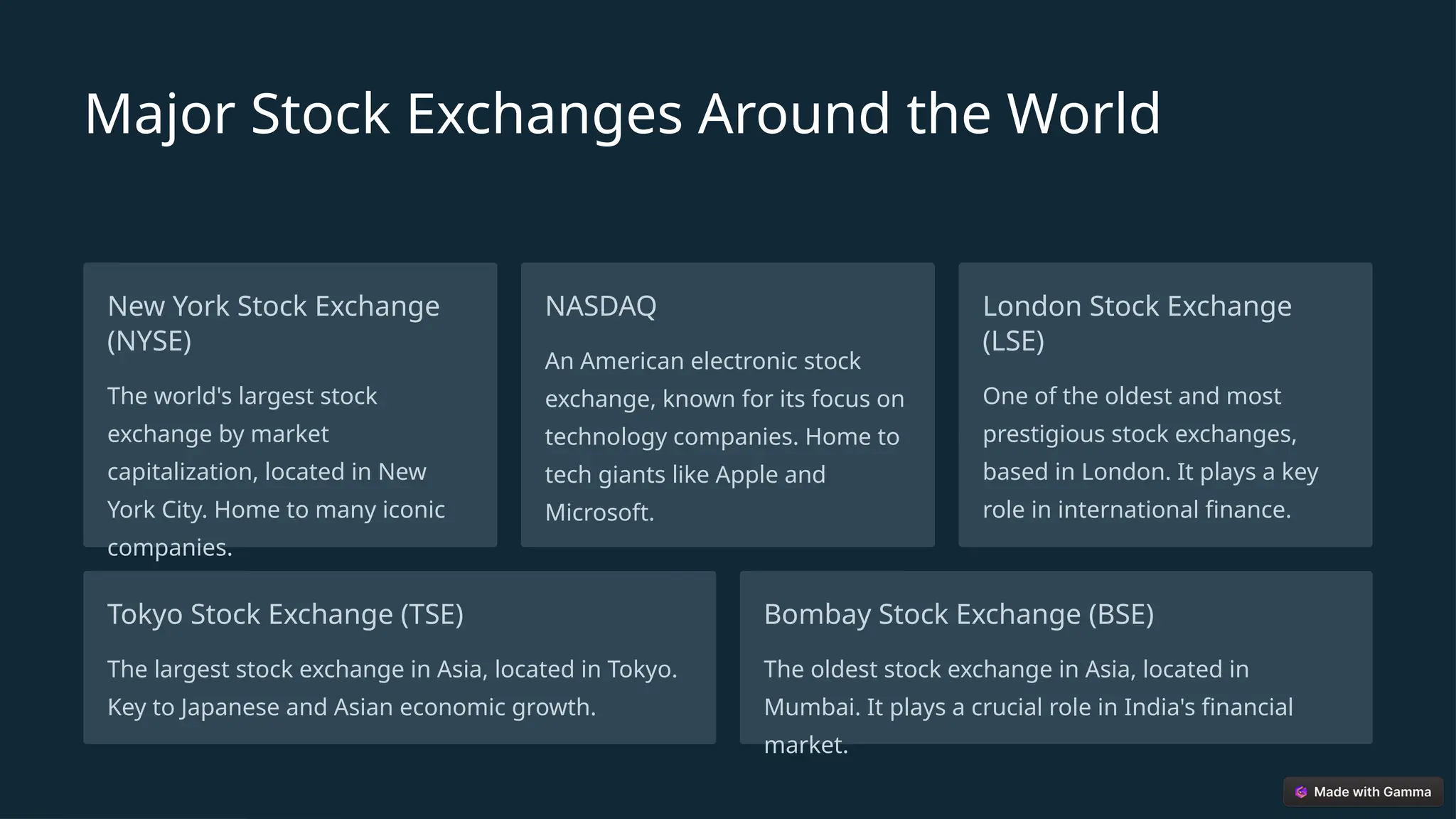
Major Stock ExchangesAround the World
New York Stock Exchange
(NYSE)
The world's largest stock
exchange by market
capitalization, located in New
York City. Home to many iconic
companies.
NASDAQ
An American electronic stock
exchange, known for its focus on
technology companies. Home to
tech giants like Apple and
Microsoft.
London Stock Exchange
(LSE)
One of the oldest and most
prestigious stock exchanges,
based in London. It plays a key
role in international finance.
Tokyo Stock Exchange (TSE)
The largest stock exchange in Asia, located in Tokyo.
Key to Japanese and Asian economic growth.
Bombay Stock Exchange (BSE)
The oldest stock exchange in Asia, located in
Mumbai. It plays a crucial role in India's financial
market.
5.
How the StockExchange Works
1
Listing of Companies
Companies seeking to raise capital or become publicly
traded undergo a listing process, meeting exchange
requirements and disclosing financial information. 2 Role of Brokers and Investors
Investors engage brokers, who act as intermediaries,
placing orders to buy or sell shares on their behalf.
3
Placing Orders (Buy/Sell)
Investors provide instructions to their brokers regarding
the number of shares they want to buy or sell and the
desired price.
4 Matching Orders and Price Determination
The exchange's matching system connects buy and sell
orders, determining the final price based on supply and
demand.
5
Trading Mechanisms
Orders can be executed through online trading platforms
or physically on the exchange floor, depending on the
mechanism employed.
6.
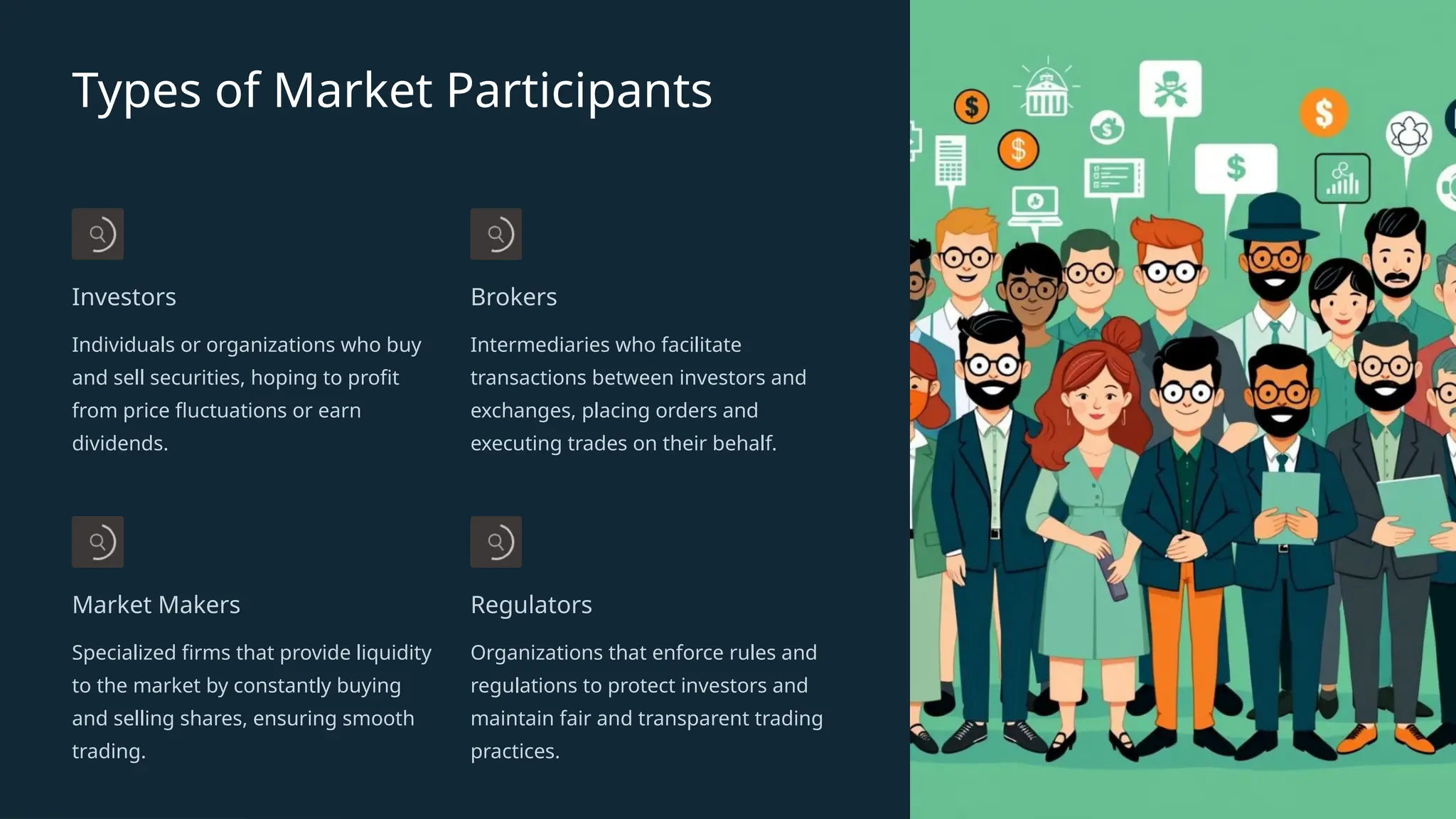
Types of MarketParticipants
Investors
Individuals or organizations who buy
and sell securities, hoping to profit
from price fluctuations or earn
dividends.
Brokers
Intermediaries who facilitate
transactions between investors and
exchanges, placing orders and
executing trades on their behalf.
Market Makers
Specialized firms that provide liquidity
to the market by constantly buying
and selling shares, ensuring smooth
trading.
Regulators
Organizations that enforce rules and
regulations to protect investors and
maintain fair and transparent trading
practices.
7.
Key Terms toKnow
1
Stock
A share of ownership in a publicly listed company, giving investors a stake in its profits and losses.
2
Index
A statistical measure that tracks the performance of a group of stocks, representing a particular market or sector.
3
IPO
Initial Public Offering, a process by which a private company becomes publicly traded, offering
shares to investors.
4
Market Capitalization
The total value of a company's outstanding shares, calculated by multiplying the share
price by the number of shares.
5
Bull Market vs. Bear Market
A bull market is characterized by rising prices, while a bear market is
characterized by falling prices.
8.
Benefits and Risks
1
WealthCreation
Investing in stocks can lead to wealth creation through capital appreciation and dividend income, potentially exceeding traditional savings.
2
Dividend Income
Some companies distribute a portion of their profits to shareholders in the form of dividends, providing a regular stream of income.
3
Capital Appreciation
The value of shares can increase over time, leading to capital appreciation and potentially higher returns than other investments.
4
Market Volatility
Stock prices can fluctuate significantly due to various factors, including economic conditions, company performance,
and market sentiment.
5
Uncertainty
Investing in the stock market involves inherent uncertainty and risk, as there is no guarantee of future returns.
6
Potential Losses
Investors can experience losses if the value of their shares falls, potentially losing a
portion or even all of their investment.
9.
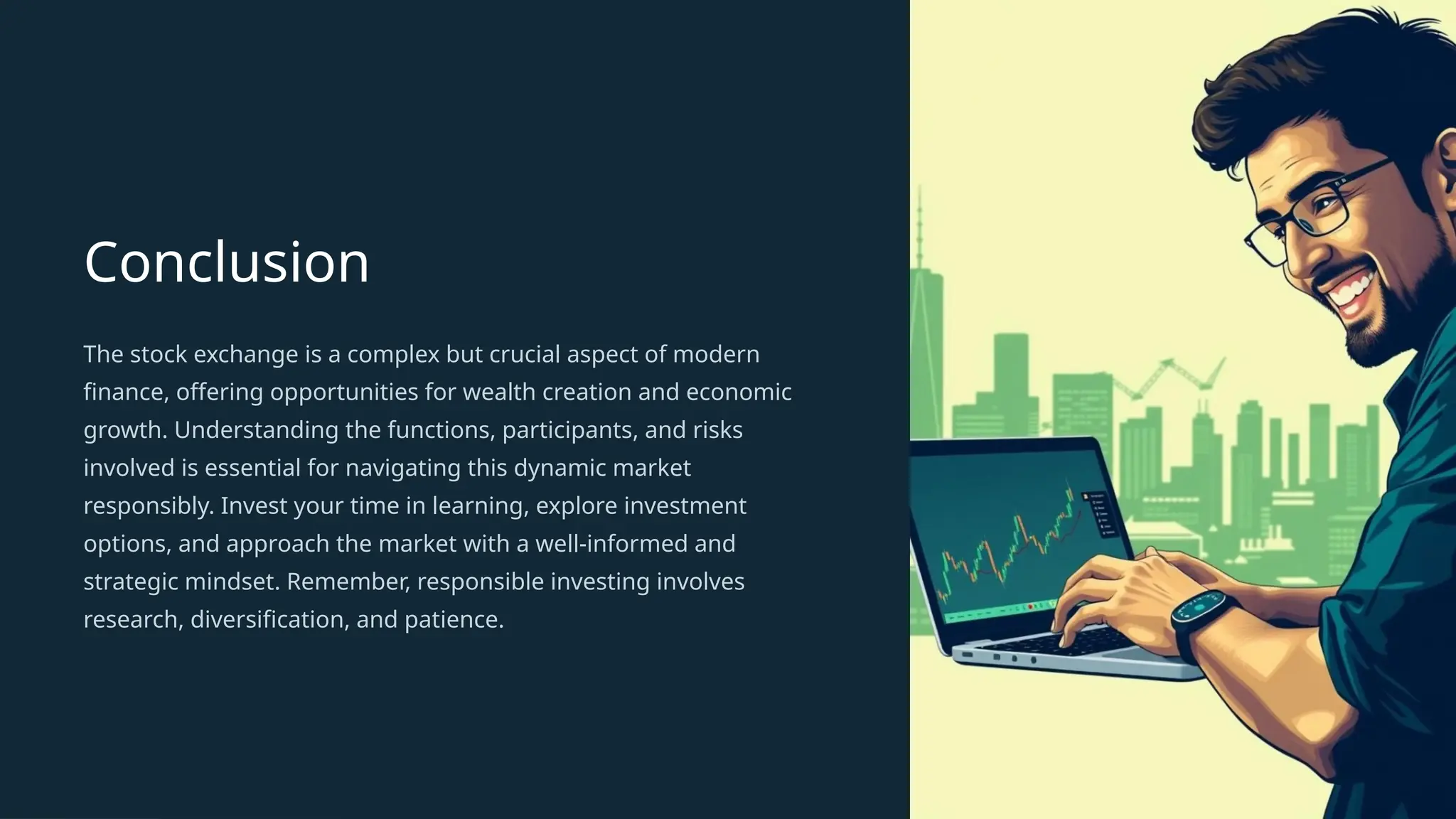
Conclusion
The stock exchangeis a complex but crucial aspect of modern
finance, offering opportunities for wealth creation and economic
growth. Understanding the functions, participants, and risks
involved is essential for navigating this dynamic market
responsibly. Invest your time in learning, explore investment
options, and approach the market with a well-informed and
strategic mindset. Remember, responsible investing involves
research, diversification, and patience.