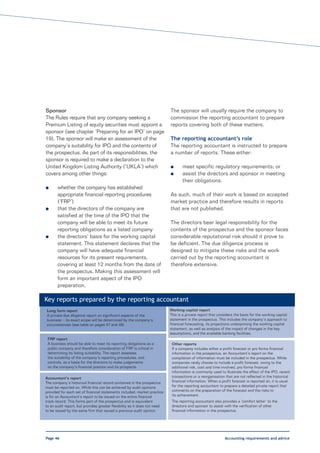
A guide to listing on the
                                                                          London Stock Exchange


Published by White Page Ltd in association with the London Stock Exchange, with contributions from:
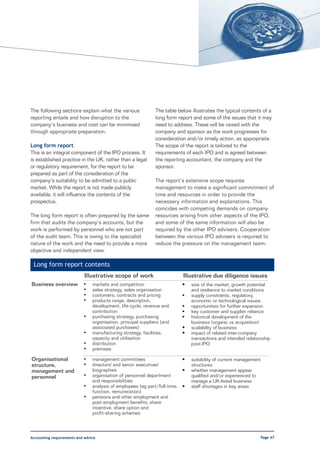
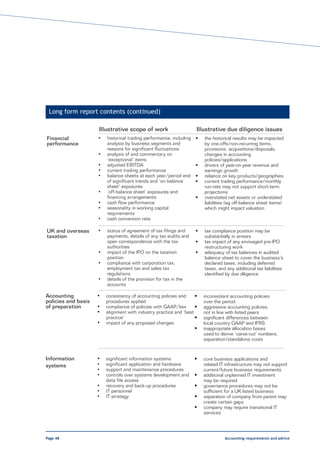
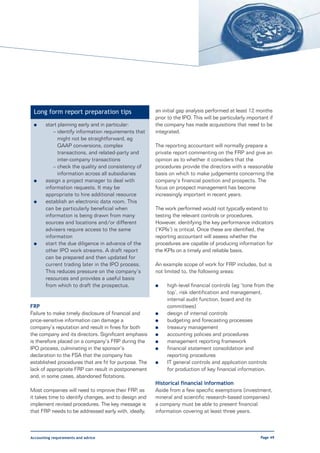
Publishing editor: Nigel Page            A guide to listing on the          A guide to listing on the
                                         London Stock Exchange              London Stock Exchange
Publisher: Tim Dempsey                   is published by:                   © 2010 London Stock Exchange plc
                                                                            and White Page Ltd
Design: London Stock Exchange plc        White Page Ltd, 17 Bolton Street
                                         London W1J 8BH                     Copyright in individual chapters rests with the
Printing and binding: Argent Litho Ltd   United Kingdom                     authors. No photocopying: copyright licences
                                         Phone: + 44 20 7408 0268           do not apply.
                                         Fax: + 44 20 7408 0168
                                         Email: mail@whitepage.co.uk        This guide is written as a general guide only. It
                                         Web: www.whitepage.co.uk           should not be relied upon as a substitute for
                                                                            specific legal or financial advice. Professional
                                                                            advice should always be sought before taking
                                           white page                       any action based on the information provided.
                                                                            Every effort has been made to ensure that the
                                         First published: November 2010     information in this guide is correct at the time of
                                         ISBN: 978-0-9565842-1-2            publication. The views expressed in the articles
                                                                            contained in this guide are those of the authors.

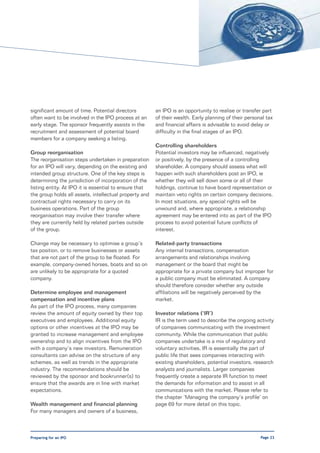
                                                                            London Stock Exchange, AIM and the coat of
                                                                            arms device are registered trademarks of
                                                                            London Stock Exchange plc. The publishers
                                                                            and authors stress that this publication does
                                                                            not purport to provide investment advice, nor
                                                                            do they bear the responsibility for any errors or
                                                                            omissions contained herein.
A guide to listing on the
London Stock Exchange
Contents

3     Foreword
      London Stock Exchange

5     The Main Market – the standard for excellence
      London Stock Exchange

13    The role of the UKLA
      The United Kingdom Listing Authority

19    Preparing for an IPO
      UBS Investment Bank

31    The legal framework for an IPO
      Freshfields Bruckhaus Deringer LLP

43    Accounting requirements and advice
      through the IPO process
      Ernst & Young LLP

57    Generating and capturing investor
      demand during an IPO
      UBS Investment Bank

69    Managing the company’s profile
      Fishburn Hedges

81    The role of the registrar in an IPO
      Capita Registrars

87    London: a unique investment opportunity
      FTSE Group

91    Preparing to list depositary receipts
      Cleary Gottlieb Steen & Hamilton LLP

105   Establishing a depositary receipt programme
      J.P. Morgan

116   Useful contacts
A guide to listing on the London Stock Exchange
        Foreword
        By Tracey Pierce, Director of Equity Primary Markets, London Stock Exchange


        With roots stretching back to the coffee houses of 17th century London, the London Stock Exchange is
        built on a long history of integrity, expertise and market knowledge.

        It has become one of the world’s largest and most international stock exchanges, playing a pivotal role in
        the development of global capital markets. We offer the widest choice of routes to market, which are
        available to both UK and international companies, and today we have close to 3,000 companies from
        over 70 countries listed and trading on our markets.

        In challenging market conditions, the London markets have proved their value by providing companies
        with access to capital when other funding channels have not been available. At the Exchange, we strive
        to build on this success by working with market regulators and the wider financial community to ensure
        that our markets are well-regulated, transparent, liquid and neutral. This success is underpinned by the
        dedicated community of advisers and investors that continues to support the companies on our markets.

        We understand that joining a public market is one of the most significant decisions a business will ever
        take; the sheer range of topics that need to be considered building up to IPO can seem like a daunting
        task. With this in mind, this guide has been developed with input from some of the key advisers
        experienced in bringing companies to our Main Market and our Professional Securities Market, providing
        you with a practical outline of the listing process, as well as an insight into life as a public company.

        I hope you find this publication useful and wish you every success, both in bringing your company to
        market and as a publicly-traded company.


A guide to listing on the London Stock Exchange                                                       Page 3
The Main Market –
the standard for excellence
        London Stock Exchange
QUOTED


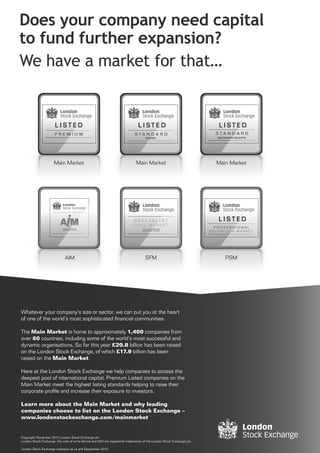
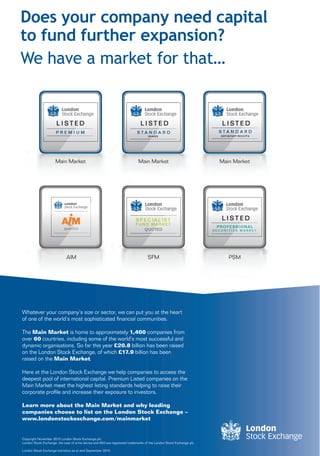
Whatever your company’s size or sector, we can put you at the heart
of one of the world’s most sophisticated financial communities.

The Main Market is home to approximately 1,400 companies from
over 60 countries, including some of the world’s most successful and
dynamic organisations. So far this year £20.8 billion has been raised
on the London Stock Exchange, of which £17.9 billion has been
raised on the Main Market.
Here at the London Stock Exchange we help companies to access the
deepest pool of international capital. Premium Listed companies on the
Main Market meet the highest listing standards helping to raise their
corporate profile and increase their exposure to investors.

Learn more about the Main Market and why leading
companies choose to list on the London Stock Exchange –
www.londonstockexchange.com/mainmarket


Copyright November 2010 London Stock Exchange plc
London Stock Exchange, the coat of arms device and AIM are registered trademarks of the London Stock Exchange plc.

London Stock Exchange statistics as at end September 2010
The Main Market – the
standard for excellence
Established in 1698, the London Stock Exchange’s         Why join a public market…?
(the ‘Exchange’) Main Market has long been home          Joining a public market – the Main Market or AIM
to some of the UK’s, and indeed the world’s,             (our market for smaller, growing companies) – is a
largest and best-known companies. There are over         way to grow and enhance your business. When
1,400 companies on the Main Market with a                considering the available financing options, the
combined market capitalisation of £3.7 trillion.         following factors are frequently cited as the key
Companies of all types, nationalities and sizes          benefits of admission to a public market:
together represent some 40 sectors.
                                                         l    providing access to capital for growth,
As well as sectoral and geographical diversity, the           enabling companies to raise finance for
Main Market accommodates the admission to                     further development, both at the time of
trading of companies with a Premium Listing or a              admission and through further capital
Standard Listing. The FSA’s listing categories are            raisings
described in detail in the chapter ‘The role of the      l    creating a market for the company’s shares,
UK Listing Authority’ on page 13.                             broadening the shareholder base
                                                         l    placing an objective market value on the
A listing on the Main Market demonstrates a                   company’s business
commitment to high standards and provides                l    encouraging employees’ commitment and
companies with the means to access capital from               incentivising their long-term motivation and
the widest set of investors. Over the last 10 years,          performance, by making share schemes
£366 billion has been raised through new and                  more attractive
further issues by Main Market companies – capital        l    increasing the company’s ability to make
that has seen companies through the good times                acquisitions, using quoted shares as
and the bad.                                                  currency


Joining the Main Market
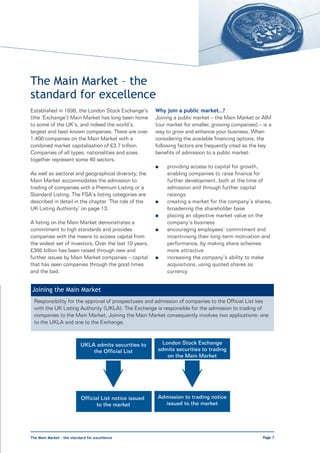
  Responsibility for the approval of prospectuses and admission of companies to the Official List lies
  with the UK Listing Authority (UKLA). The Exchange is responsible for the admission to trading of
  companies to the Main Market. Joining the Main Market consequently involves two applications: one
  to the UKLA and one to the Exchange.


                           UKLA admits securities to       London Stock Exchange
                               the Official List          admits securities to trading
                                                             on the Main Market


                           Official List notice issued    Admission to trading notice
                                  to the market             issued to the market


The Main Market – the standard for excellence                                                          Page 7
l        creating a heightened public profile –       A respected and balanced regulatory
         stemming from increased press coverage and   environment
         analysts’ reports – helping to maintain      The UKLA’s listing framework underpins London’s
         liquidity in the company’s shares            reputation for balanced and globally-respected
l        enhancing the company’s status with          standards of regulation and corporate governance.
         customers and suppliers.                     Regulatory requirements in London are principles-
                                                      based and provide an appropriate balance of
Companies that choose to seek admission to a          investor protection, practitioner certainty and
public market in London have a range of options       flexibility. The Exchange aims to be involved in all
depending on their size, stage of development and     relevant processes where amendments or
capital-raising requirements. The options open to     additions to the regulatory framework are
companies should be discussed in detail with their    considered. This is to ensure that London’s
team of advisers.                                     competitive advantage remains undiminished; that
                                                      listings and subsequent capital raisings are cost-
Companies which are successful on AIM and reach       effective and efficient for our companies; and that
a certain size and stage of development, may seek     investors have the appropriate amount of
to transfer their securities from AIM to the Main     information to make informed investment
Market, provided that they meet the eligibility       decisions.
criteria. While a move to the Main Market may
subject the company to increased regulatory           Choice
requirements, it can bring benefits in terms of a     Companies with either a Premium or a Standard
heightened profile and attracting different           Listing can choose to admit to trading on the Main
investors.                                            Market.

…and why the Main Market?                             A Premium Listing means that a company must
                                                      meet standards that are over and above (often
The success of the Main Market is built on a wide     described as ‘super-equivalent’) those set forth in
range of factors:                                     the EU legislation, including the UK’s corporate
                                                      governance code. Investors trust the super-
l        a respected and balanced regulatory          equivalent standards as they provide them with
         environment                                  additional protections. By virtue of these higher
l        choice                                       standards, companies may have access to a
l        access to capital from a broad and           broader range of investors and may enjoy a lower
         knowledgeable investor base                  cost of capital owing to heightened shareholder
l        expert advisory community                    confidence. A Premium Listing is only available to
l        enhanced profile and status.                 equity shares issued by commercial trading
                                                      companies.
The Main Market has attracted companies of all
sizes and from all sectors over many years.           With a Standard Listing, a company has to meet
Irrespective of their sector, origin or strategic     the requirements laid down by EU legislation. This
direction, they have all sought to take advantage     means that their overall compliance burden will be
of the range of benefits a listing on the Main        lighter, both in terms of preparing for listing and
Market affords. Those benefits include:               on an ongoing basis. Standard Listings cover the
                                                      issuance of shares and Depositary Receipts


Page 8                                                                The Main Market – the standard for excellence
(‘DRs’) as well as a range of other securities,       Underpinning the Main Market is a network of
including fixed-income. Large companies from          experienced advisers who will guide you on the
emerging markets may wish to list their DRs, thus     journey to an initial public offering (‘IPO’) and
attracting investment from the significant            provide ongoing advice once your company is
international pool of capital available in London.    listed.
(A table showing the key differences between a
Premium Listing and a Standard Listing can be         Selecting the right advisers for you and your
found in the chapter ‘The role of the UK Listing      company is vital. Getting it right early on will help
Authority’ on page 18).                               ensure that disruptions to the process are
                                                      minimised and you are able to get on with the task
In this guide, the chapters ‘Preparing to list        at hand. Factors to consider when appointing
depositary receipts’ and ‘Establishing a depositary   advisers include the firm’s relevant and recent
receipt programme’ are dedicated to the listing       experience in relation to your business and the
and admission to trading of DRs on both the Main      sector you operate in, as well as the personal
Market and the Professional Securities Market         rapport you develop with the individuals with whom
(‘PSM’). The PSM provides an alternative route to     you will be working.
a listing on the Exchange for issuers of DRs.
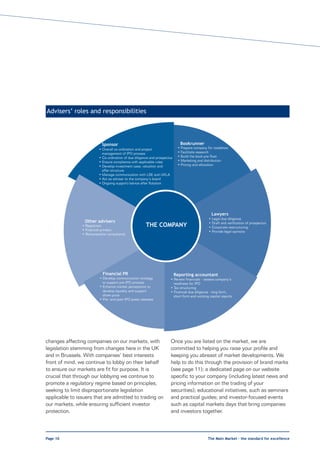
                                                      The diagram on page 10 below shows the different
Access to capital                                     advisers typically involved in a flotation on the
We provide access to the largest pool of              Main Market and briefly highlights their varying
international equity assets in the world. This        roles and responsibilities.
culture is embedded in London’s investment
management community, which understands               Profile
companies from home and abroad and wants to           Floating a company on the Main Market raises
invest in the global economy.                         your company’s profile and helps you to meet your
                                                      strategic objectives. You will have the opportunity
Once they are listed and admitted to trading on       to project your company onto a global stage with
the Main Market, companies should not                 increased media coverage, investor interest and
underestimate the value of being able to return to    broad analyst coverage.
the market to raise funds through further issues.
Even during the recent difficult market conditions,   With a Premium Listing comes the potential for
the Exchange successfully facilitated significant     inclusion in the FTSE UK series of indices which
levels of capital raising. Further issues by Main     includes the FTSE 100, FTSE 250 and FTSE
Market companies provided capital injections that     Small Cap indices. Access to these indices is
were used to pay off debt, rebuild balance sheets     often seen as one of the key benefits of achieving
and fund further growth.                              a Premium Listing since so many investment
                                                      mandates – particularly in respect of the vast
Expert advisory community                             amount of capital represented by tracker funds –
The decision to join the Main Market is a pivotal     are driven by FTSE indexation. For more
one. To achieve a successful listing and admission    information see chapter ‘London: a unique
to trading, companies must deliberate over many       investment opportunity’ on page 87.
considerations.
                                                      Our commitment to the primary markets
                                                      There is a continuous stream of proposed regulatory


The Main Market – the standard for excellence                                                         Page 9
Advisers’ roles and responsibilities


                           Sponsor                                             Bookrunner
                          • Overall co-ordination and project                • Prepare company for roadshow
                            management of IPO process                        • Facilitate research
                          • Co-ordination of due diligence and prospectus    • Build the book pre-float
                          • Ensure compliance with applicable rules          • Marketing and distribution
                          • Develop investment case, valuation and           • Pricing and allocation
                            offer structure
                          • Manage communication with LSE and UKLA
                          • Act as adviser to the company’s board
                          • Ongoing support/advice after flotation


                                                                                                 Lawyers
                                                                                               • Legal due diligence
                 Other advisers
                • Registrars                            THE COMPANY                            • Draft and verification of prospectus
                                                                                               • Corporate restructuring
                • Financial printers                                                           • Provide legal opinions
                • Remuneration consultants


                            Financial PR                                    Reporting accountant
                          • Develop communication strategy             • Review financials – assess company’s
                            to support pre-IPO process                   readiness for IPO
                          • Enhance market perceptions to              • Tax structuring
                            develop liquidity and support              • Financial due diligence - long form,
                            share price                                  short form and working capital reports
                          • Pre- and post-IPO press releases


changes affecting companies on our markets, with                        Once you are listed on the market, we are
legislation stemming from changes here in the UK                        committed to helping you raise your profile and
and in Brussels. With companies’ best interests                         keeping you abreast of market developments. We
front of mind, we continue to lobby on their behalf                     help to do this through the provision of brand marks
to ensure our markets are fit for purpose. It is                        (see page 11); a dedicated page on our website
crucial that through our lobbying we continue to                        specific to your company (including latest news and
promote a regulatory regime based on principles,                        pricing information on the trading of your
seeking to limit disproportionate legislation                           securities); educational initiatives, such as seminars
applicable to issuers that are admitted to trading on                   and practical guides; and investor-focused events
our markets, while ensuring sufficient investor                         such as capital markets days that bring companies
protection.                                                             and investors together.


Page 10                                                                                        The Main Market – the standard for excellence
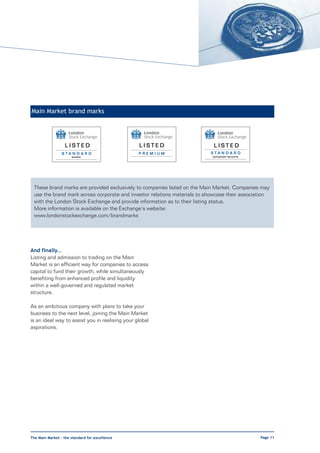
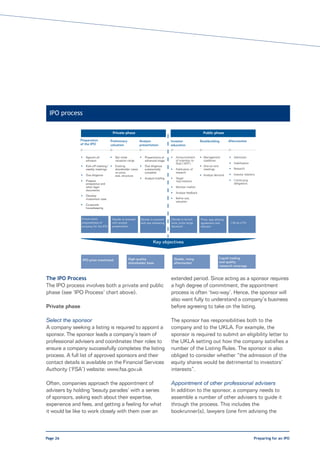
Main Market brand marks


                  LISTED                         LISTED                    LISTED
                 STANDARD                        PREMIUM                  STANDARD
                      SHARES                                               DEPOSITARY RECEIPTS


 These brand marks are provided exclusively to companies listed on the Main Market. Companies may
 use the brand mark across corporate and investor relations materials to showcase their association
 with the London Stock Exchange and provide information as to their listing status.
 More information is available on the Exchange’s website:
 www.londonstockexchange.com/brandmarks


And finally…
Listing and admission to trading on the Main
Market is an efficient way for companies to access
capital to fund their growth, while simultaneously
benefiting from enhanced profile and liquidity
within a well-governed and regulated market
structure.

As an ambitious company with plans to take your
business to the next level, joining the Main Market
is an ideal way to assist you in realising your global
aspirations.


The Main Market – the standard for excellence                                                    Page 11
The role of the UK Listing Authority
                                UKLA
The role of the UK Listing Authority
The UK Listing Authority (‘UKLA’) is the name           As a consequence, when a company wishes to
used by the Financial Services Authority (‘FSA’)        make an initial public offering (‘IPO’) of its
when it acts as competent authority for listing, as     securities onto a regulated market such as the
competent authority for the purposes of the             Main Market of the London Stock Exchange, the
European Prospectus and Transparency Directives,        UKLA has two principal roles to perform: to review
and as competent authority for certain aspects of       and approve the issuer’s prospectus, and to admit
the Market Abuse Directive. These roles have a          those securities to listing once it is happy that the
statutory basis in Part VI of the Financial Services    issuer complies with all relevant eligibility criteria.
and Markets Act 2000 (‘FSMA’). Three
sourcebooks in the FSA Handbook implement the           Listing categories
relevant rules. These are:                              The term ‘listed’ is used in a number of different
                                                        contexts, but in the UK this technically means
l     Listing Rules – these rules include the           admitted to the Official List of the UKLA. The
      eligibility requirements for admission to the     UKLA has created a number of different listing
      Official List (or ‘listing’) and the continuing   categories which determine the eligibility criteria
      obligations that apply thereafter. They come      and continuing obligations that apply to the issuer
      partly from the European Consolidated             and its securities.
      Admissions and Reporting Directive, but also
      include a significant body of rules that are      The UKLA introduced the listing categories to help
      ‘super-equivalent’ or additional to the           clarify that listing refers to admission to the
      European minimum requirements. These              Official List of the UKLA, and does not relate to
      additional requirements include substantive       the market to which a security is admitted to
      eligibility requirements such as the need for a   trading. Listing categories are also intended to
      three-year track record, the class test and       clarify the regulatory standards that apply to
      related party regimes, and the requirement        different types of listing. A Standard Listing
      for a sponsor in relation to a Premium Listing.   requires compliance only with EU minimum
l     Prospectus Rules – these rules stem               standards, whilst a Premium Listing also requires
      primarily from the enactment of the European      compliance with the more stringent super-
      Prospectus Directive and detail the               equivalent standards. Note that only equity shares
      circumstances when a prospectus is required       may be admitted to a Premium Listing; issuers of
      and the disclosures a prospectus should           other securities may only seek a Standard Listing
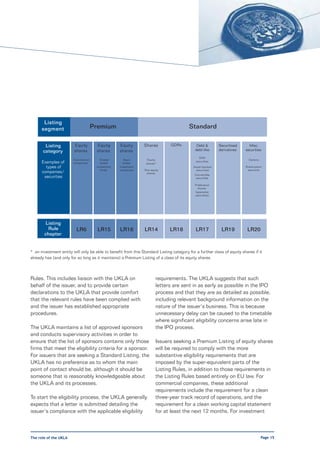
      include.                                          for their securities. A table showing the key
l     Disclosure and Transparency Rules (‘DTRs’)        differences between Premium and Standard
      – these rules govern the periodic and ad hoc      Listings can be found on page 18.
      disclosure of information by listed companies.
      Periodic information includes interim and         Eligibility
      annual accounts, and ad hoc disclosures,          An issuer will generally select its preferred market
      including major shareholding notifications and    and listing category in consultation with its
      details of significant developments that might    advisers prior to engagement with the UKLA. For
      affect the price of the securities. These rules   issuers requesting a Premium Listing of their
      originate from the Transparency Directive and     equity shares, contact with the UKLA will be
      part of the Market Abuse Directive, and also      undertaken by the issuer’s appointed sponsor firm.
      from the 4th/7th Company Law Directives.          The role of a sponsor is to guide the issuer on the
                                                        application of the Listing Rules and the Prospectus


Page 14                                                                                       The role of the UKLA
Listing
      segment                        Premium                                             Standard

        Listing         Equity        Equity       Equity       Shares        GDRs           Debt &       Securitised     Misc.
       category         shares        shares       shares                                   debt-like     derivatives   securities

                                                                                              Debt
                        Commercial      Closed-       Open-       Equity                                                  Options
      Examples of       companies        ended        ended      shares*
                                                                                            securities

        types of                      investment   investment                              Asset-backed                 Subscription
                                         funds     companies    Non-equity                  securities                   warrants
      companies/                                                 shares
                                                                                            Convertible
       securities                                                                            securities

                                                                   -                        Preference
                                                                                              shares
                                                                                            (specialist
                                                                                            securities)


       Listing
         Rule            LR6           LR15        LR16         LR14          LR18          LR17           LR19          LR20
       chapter


* an investment entity will only be able to benefit from this Standard Listing category for a further class of equity shares if it
already has (and only for so long as it maintains) a Premium Listing of a class of its equity shares


Rules. This includes liaison with the UKLA on                          requirements. The UKLA suggests that such
behalf of the issuer, and to provide certain                           letters are sent in as early as possible in the IPO
declarations to the UKLA that provide comfort                          process and that they are as detailed as possible,
that the relevant rules have been complied with                        including relevant background information on the
and the issuer has established appropriate                             nature of the issuer’s business. This is because
procedures.                                                            unnecessary delay can be caused to the timetable
                                                                       where significant eligibility concerns arise late in
The UKLA maintains a list of approved sponsors                         the IPO process.
and conducts supervisory activities in order to
ensure that the list of sponsors contains only those                   Issuers seeking a Premium Listing of equity shares
firms that meet the eligibility criteria for a sponsor.                will be required to comply with the more
For issuers that are seeking a Standard Listing, the                   substantive eligibility requirements that are
UKLA has no preference as to whom the main                             imposed by the super-equivalent parts of the
point of contact should be, although it should be                      Listing Rules, in addition to those requirements in
someone that is reasonably knowledgeable about                         the Listing Rules based entirely on EU law. For
the UKLA and its processes.                                            commercial companies, these additional
                                                                       requirements include the requirement for a clean
To start the eligibility process, the UKLA generally                   three-year track record of operations, and the
expects that a letter is submitted detailing the                       requirement for a clean working capital statement
issuer’s compliance with the applicable eligibility                    for at least the next 12 months. For investment


The role of the UKLA                                                                                                                Page 15
entities, these requirements include an additional       The prospectus can be published once it has been
degree of regulation in relation to the corporate        formally approved by the UKLA. The actual timing
governance of the issuer. Overseas issuers wishing       of that approval will depend on the issuer’s choice
to comply only with the minimum standards applied        of issuance method – for example, if the issuance
by the EU Directives can apply for a Standard            involves a retail offering then approval and
Listing of either equity shares or GDRs. The UKLA        publication must occur sufficiently in advance of
has recently also extended the Standard Listing          the beginning of the offer. A prospectus relating
category to UK issuers of equity shares which            only to an introduction where no offer to the public
could previously only have had a Premium                 is made may be approved as little as 48 hours prior
(formerly ‘Primary’) Listing.                            to admission to listing.

Prospectus review and approval                           Listing Particulars
An admission of securities onto the Official List        Although no prospectus is required for the
and the Main Market of the London Stock                  admission of securities to unregulated markets
Exchange requires the production of an approved          such as the Professional Securities Market (the
prospectus. As the UKLA is the UK’s competent            ‘PSM’), the UKLA does require Listing Particulars
authority for the purposes of the Prospectus             for the admission of those securities to listing on
Directive, it typically approves prospectuses            the Official List. In these cases, the process for
produced during an IPO.                                  reviewing the document, and the content
                                                         requirements, are very similar to the requirements
Although final confirmation of an issuer’s eligibility   for a prospectus. The principal difference is that
can only be given once its prospectus has been           the financial information in a prospectus must be
approved, the UKLA will generally try to resolve         prepared in accordance with IFRS or an
any major eligibility issues prior to starting its       equivalent GAAP. In the case of Listing
review of an issuer’s prospectus. This review            Particulars where securities are to be admitted to
involves an iterative process of reviewing and           the PSM, the financial information can be
commenting on drafts of the prospectus until the         prepared in accordance with local standards.
UKLA is satisfied that all applicable rules have
been complied with. The number of drafts                 Passporting
necessary to reach this point will depend on the         An overseas issuer may also seek to passport onto
complexity of the issues and the quality of the          a UK-regulated market, using a prospectus that
submissions. By way of example, many large IPOs          has been approved by another competent
can involve the review of five or more substantive       authority. Although in these circumstances the
drafts for one reason or another.                        UKLA will rely upon the passport to satisfy the
                                                         requirement for an approved prospectus, it will still
The UKLA seeks to comply with its published              separately assess the issuer against the relevant
service standards for the document review and            eligibility requirements. As part of this process, the
approval process, and aims to provide comments           UKLA reviews the issuer’s proposed prospectus to
on an initial draft of a new applicant prospectus        help in its assessment of eligibility, so again the
within 10 working days, and comments on each             UKLA recommends that an issuer makes contact
subsequent draft within five working days. On            sufficiently early in the process, and certainly
average, the review and approval of a prospectus         before the prospectus has been approved by the
takes around 6-8 weeks for an IPO.                       home competent authority.


Page 16                                                                                       The role of the UKLA
Post-IPO interaction with the UKLA                      l   Timetables – the UKLA staff (or ‘readers’)
l    DTRs – a listed issuer must comply with the            allocated to a particular case will typically be
     DTRs on an ongoing basis, as failure to                working on a large number of transactions at
     comply with these rules may result in the              any one time. Whilst the UKLA makes every
     suspension of the listing of its securities. The       effort to accommodate tight timetables it
     UKLA has a team dedicated to monitoring                cannot deal with every issue immediately or
     issuers’ compliance with the DTRs, and to              meet unrealistic timetables. Complex issues
     providing guidance on these rules on a real-           will need time for proper consideration prior
     time basis.                                            to resolution and therefore the UKLA always
l    Prospectus requirements – if the issuer                advises that such issues should be brought to
     seeks admission of further securities of the           its attention as early as possible.
     same class it will be required to produce a        l   Helpdesks – the UKLA offers several
     prospectus, unless an exemption applies.               different helpdesks to provide guidance on
     Exemptions include, among other things, the            the Listing Rules, Prospectus Rules, and the
     issue of shares under employee share                   DTRs. This enables complex issues to be
     schemes and bonus issues. The UKLA would               discussed and agreed prior to the submission
     typically be required to approve any future            of documents, or in relation to significant
     prospectus.                                            transactions (Tel: +44 (0)20 7066 8333).
l    Significant transactions – if the issuer has a
     Premium Listing of its equity shares, it will be
     required to consider whether any significant
     transaction that it undertakes will need
     announcement or, if it is of sufficient size,
     shareholder approval. Lower size thresholds
     are applied if the transaction is being
     undertaken with a related party such as a
     director or substantial shareholder. The
     Listing Rules include rules governing the
     disclosure requirements in circulars where
     shareholder approval is sought, and also
     clarify which circulars require UKLA approval.


The role of the UKLA                                                                                  Page 17
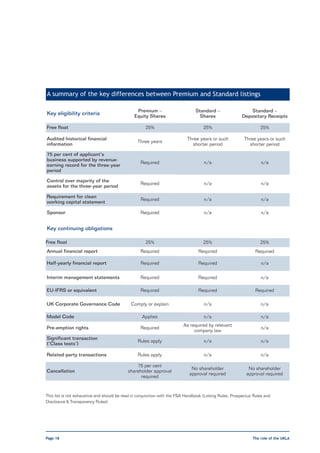
A summary of the key differences between Premium and Standard listings

                                                Premium –                       Standard –                 Standard –
Key eligibility criteria                       Equity Shares                      Shares                Depositary Receipts

Free float                                           25%                            25%                           25%

Audited historical financial                                               Three years or such            Three years or such
                                                 Three years
information                                                                  shorter period                 shorter period

75 per cent of applicant’s
business supported by revenue-
                                                  Required                          n/a                            n/a
earning record for the three-year
period

Control over majority of the
                                                  Required                          n/a                            n/a
assets for the three-year period

Requirement for clean
                                                  Required                          n/a                            n/a
working capital statement

Sponsor                                           Required                          n/a                            n/a


Key continuing obligations

Free float                                           25%                            25%                           25%
Annual financial report                           Required                       Required                       Required

Half-yearly financial report                      Required                       Required                          n/a

Interim management statements                     Required                       Required                          n/a

EU-IFRS or equivalent                             Required                       Required                       Required

UK Corporate Governance Code                 Comply or explain                      n/a                           n/a

Model Code                                         Applies                          n/a                           n/a
                                                                         As required by relevant
Pre-emption rights                                Required                                                        n/a
                                                                              company law
Significant transaction
                                                 Rules apply                        n/a                           n/a
(‘Class tests’)

Related-party transactions                       Rules apply                        n/a                           n/a

                                               75 per cent
                                                                             No shareholder                 No shareholder
Cancellation                               shareholder approval
                                                                            approval required              approval required
                                                 required


This list is not exhaustive and should be read in conjunction with the FSA Handbook (Listing Rules, Prospectus Rules and
Disclosure & Transparency Rules).


Page 18                                                                                                       The role of the UKLA
Preparing for an IPO
John Woolland and David Seal
       UBS Investment Bank
Advertisement


Personal
wealth
management
At UBS Wealth Management we                Drawing on the expertise of the UBS


                                           opportunities, blending traditional asset
                                           classes with private equity, hedge funds,
                                           commodities and real estate (where
                                           suitable to the client).

                                           UBS provides brokerage services, foreign
                                           exchange execution and strategy,
                                           collateral backed lending and whole-of-
                                           market advice. Where there is a need for

                                           provides advice on structuring personal
Most people who IPO a business want        and corporate assets, pensions options
to realise part of the value in cash. A    and succession planning, with full back-
higher proportion of their assets may      up at every stage of life.
now be in stocks or shares. Early wealth
management advice can help the owners      For more information about UBS Wealth
extract and maximise the value of the      Management please contact Michael
investments they have built up.            Bishop on +44-20-7568 9587.

                                           www.ubs.com/uk
Preparing for an IPO
Initial public offerings (‘IPOs’) are among the most   allowed to list on a market. Unsurprisingly, a
challenging transactions that a business can           number of the UKLA’s requirements coincide with
undertake. The decision on whether to list a           the attributes which investors are looking for in a
company’s shares on a public market is a               company. The precise regulatory requirements are
significant one; obtaining a public quote is a major   covered in the chapter ‘The legal framework for an
milestone in any company’s life. The process of        IPO’ on page 31. Areas such as a demonstrable
going public is time-consuming, but it is an           trading record and appropriately experienced
opportunity for a company to critically examine        directors clearly help to satisfy both the regulators
itself. A company, its management and its owners       and the potential shareholders. Ultimately, the
are likely to be in the public eye to a much greater   ability to meet the market’s commercial
extent than before.                                    expectations is crucial.

A company’s decision to launch an IPO must be          For management and owners, an IPO may also
based on a realistic assessment of its business, its   crystallise the need to examine their tax planning
management resources, its stage of development         and personal wealth management. This should be
and its prospects. Public ownership offers             addressed early to avoid distraction during the
significant advantages, such as access to the          final, and often hectic, few weeks of the IPO
public equity and debt markets to finance growth       process.
and strengthen a company’s financial position, as
well as the creation of an open market for a           Pre-IPO preparation
company’s shares. However, a company will face         Businesses often begin their preparations for
heightened scrutiny and greater demands on its         becoming public companies well before they launch
management.                                            the IPO process. Typically, pre-IPO preparations
                                                       take four to six months, but they can take
Planning is a key element in any IPO. In order to      considerably longer. Advance preparation is a key
avoid unnecessary delays and distraction, which        success factor that allows for a smooth and
could be costly, management should evaluate in         efficient execution process and the ability to take
detail how it will commit adequate resources to        advantage of market windows.
meet the pressing deadlines of an IPO process.
                                                       Management team
The run-up to a company seeking a listing on the       A company’s management team will need to
Main Market can be broadly divided into two            explain the business, its strategy and prospects to
phases – pre-IPO preparation and the IPO process       investors, and demonstrate knowledge of the
itself. Pre-IPO preparation includes the critical      sector, as well as its challenges, in order to gain
review of a company’s business plan and growth         the support and confidence of the market. The
prospects, assessing the management team,              directors of a company will be accountable to its
appointing an appropriate board, tightening            new and existing shareholders for the performance
internal controls, improving operational efficiency    of the business when it is a public company.
and resolving issues that may adversely affect the     Therefore, as a company prepares for its IPO it
listing early on.                                      may need to ensure that its management has
                                                       sufficient depth and breadth.
The United Kingdom Listing Authority’s (‘UKLA’)
Listing Rules set the specific regulatory              Business plan
requirements that a company has to meet to be          For the purposes of an IPO, a company needs a


Preparing for an IPO                                                                                  Page 21
comprehensive business plan that sets out its               existing shareholders (a primary offering)
products, markets, competitive environment,            l    existing shareholders selling their shares to
strategy, capabilities and growth objectives.               new or other existing shareholders, ie no
Companies engaging in successful IPOs tend to               additional capital is raised for the business (a
have a clearly defined vision for the future                secondary offering); or
performance of the business that can be                l    a combination of both.
articulated credibly, clearly and quantifiably.
                                                       If existing shareholders intend to sell in the IPO, it
Companies that are in mature or shrinking              is helpful to know the likely quantum early so that
industries, operate within small markets, or           the IPO can be planned accordingly.
provide a narrow range of products to a small and
highly specialised customer base may be                Use of proceeds
unsuitable for an IPO.                                 If a company is raising new capital, the use of
                                                       proceeds should be clearly articulated and in line
Financial performance                                  with its strategy. In many cases, the proceeds will
A company should expect to show investors a            be used to either pay down debt, fund capital
consistent pattern of top- and bottom-line growth      investment or to provide working capital for
and a sound balance sheet post-IPO. For a company      expansion.
seeking a Premium Listing, its financial statements
need to adhere to International Financial Reporting    In determining the quantum of new capital, a
Standards (‘IFRS’). Further technical requirements     company needs to consider its future capital
of the financial information required to be included   structure and its ability to pay dividends at an
in a prospectus are covered in the chapter             appropriate level.
‘Accounting requirements and advice through the
IPO process’ on page 43.                               Financial controls
                                                       The market expects companies to have proper
Growth prospects                                       financial controls in place. In addition, the UKLA
Before investing in a company, most investors          requires the sponsor to provide written
want to feel confident about its future growth         confirmation of the adequacy of a company’s
prospects. A company should develop a financial        financial controls. Companies contemplating a
model that quantifies its business plan and            listing will therefore need to ensure that they have
expected growth. The sponsor (see page 26) may         systems in place to ensure a flow of accurate,
work closely with management and external              timely information.
consultants/experts to develop this model and will
conduct due diligence on the assumptions behind        Board
the model and stress-test the projections.             A public company needs to satisfy corporate
                                                       governance requirements. The principles are set
Raising funds?                                         out in the UK Corporate Governance Code (the
The majority of listings take place with a             ’Code’) and a company is required to comply with
simultaneous share offering to investors. This can     the Code, or explain why it has not, in its
take the form of:                                      prospectus. It is typically necessary to appoint new
                                                       members to the board who are independent and to
l     raising additional capital for the business by   form new committees (eg audit and remuneration).
      issuing new shares in a company to new and       Identifying suitable candidates can take a


Page 22                                                                                      Preparing for an IPO
significant amount of time. Potential directors         an IPO is an opportunity to realise or transfer part
often want to be involved in the IPO process at an      of their wealth. Early planning of their personal tax
early stage. The sponsor frequently assists in the      and financial affairs is advisable to avoid delay or
recruitment and assessment of potential board           difficulty in the final stages of an IPO.
members for a company seeking a listing.
                                                        Controlling shareholders
Group reorganisation                                    Potential investors may be influenced, negatively
The reorganisation steps undertaken in preparation      or positively, by the presence of a controlling
for an IPO will vary, depending on the existing and     shareholder. A company should assess what will
intended group structure. One of the key steps is       happen with such shareholders post an IPO, ie
determining the jurisdiction of incorporation of the    whether they will sell down some or all of their
listing entity. At IPO it is essential to ensure that   holdings, continue to have board representation or
the group holds all assets, intellectual property and   maintain veto rights on certain company decisions.
contractual rights necessary to carry on its            In most situations, any special rights will be
business operations. Part of the group                  unwound and, where appropriate, a relationship
reorganisation may involve their transfer where         agreement may be entered into as part of the IPO
they are currently held by related parties outside      process to avoid potential future conflicts of
of the group.                                           interest.

Change may be necessary to optimise a group’s           Related-party transactions
tax position, or to remove businesses or assets         Any internal transactions, compensation
that are not part of the group to be floated. For       arrangements and relationships involving
example, company-owned horses, boats and so on          management or the board that might be
are unlikely to be appropriate for a quoted             appropriate for a private company but improper for
company.                                                a public company must be eliminated. A company
                                                        should therefore consider whether any outside
Determine employee and management                       affiliations will be negatively perceived by the
compensation and incentive plans                        market.
As part of the IPO process, many companies
review the amount of equity owned by their top          Investor relations (‘IR’)
executives and employees. Additional equity             IR is the term used to describe the ongoing activity
options or other incentives at the IPO may be           of companies communicating with the investment
granted to increase management and employee             community. While the communication that public
ownership and to align incentives from the IPO          companies undertake is a mix of regulatory and
with a company’s new investors. Remuneration            voluntary activities, IR is essentially the part of
consultants can advise on the structure of any          public life that sees companies interacting with
schemes, as well as trends in the appropriate           existing shareholders, potential investors, research
industry. The recommendations should be                 analysts and journalists. Larger companies
reviewed by the sponsor and bookrunner(s) to            frequently create a separate IR function to meet
ensure that the awards are in line with market          the demands for information and to assist in all
expectations.                                           communications with the market. Please refer to
                                                        the chapter ‘Managing the company’s profile’ on
Wealth management and financial planning                page 69 for more detail on this topic.
For many managers and owners of a business,


Preparing for an IPO                                                                                   Page 23
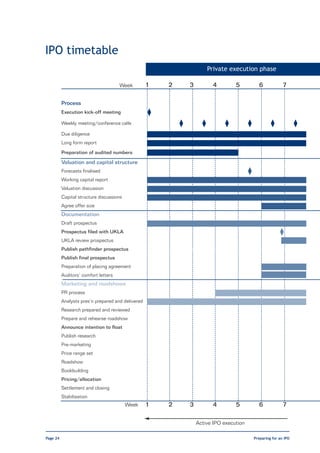
IPO timetable
                                                                         Private execution phase

                                      Week         1   2       3          4        5            6             7

          Process
          Execution kick-off meeting               ⧫
          Weekly meeting/conference calls                  ⧫         ⧫        ⧫           ⧫            ⧫             ⧫
          Due diligence
          Long form report

          Preparation of audited numbers

          Valuation and capital structure
          Forecasts finalised                                                             ⧫
          Working capital report
          Valuation discussion
          Capital structure discussions
          Agree offer size
          Documentation
          Draft prospectus
          Prospectus filed with UKLA                                                                        ⧫
          UKLA review prospectus
          Publish pathfinder prospectus
          Publish final prospectus
          Preparation of placing agreement
          Auditors’ comfort letters
          Marketing and roadshows
          PR process
          Analysts pres’n prepared and delivered
          Research prepared and reviewed
          Prepare and rehearse roadshow
          Announce intention to float
          Publish research
          Pre-marketing
          Price range set
          Roadshow
          Bookbuilding
          Pricing/allocation
          Settlement and closing
          Stabilisation
                                          Week     1   2       3          4        5            6             7

                                                                   Active IPO execution

Page 24                                                                                       Preparing for an IPO
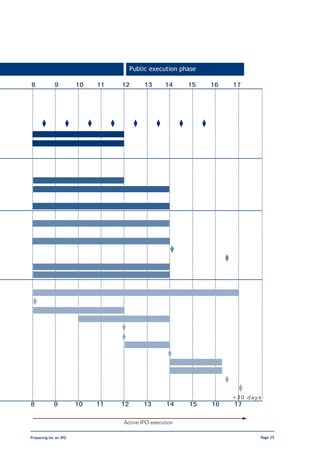
Public execution phase

8            9         10       11       12        13       14       15       16       17


      ⧫            ⧫        ⧫        ⧫         ⧫        ⧫        ⧫        ⧫


                                                             ⧫
                                                                                   ⧫


 ⧫


                                         ⧫
                                         ⧫

                                                            ⧫


                                                                                   ⧫
                                                                                        ⧫
                                                                                       +30 days
8            9         10       11       12        13       14       15       16       17

                                         Active IPO execution

Preparing for an IPO                                                                          Page 25
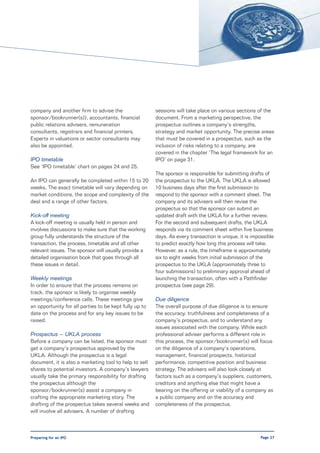
IPO process

                                           Private phase                                                        Public phase

                Preparation            Preliminary             Analyst                Investor                Bookbuilding          Aftermarket
                of the IPO             valuation               presentation           education


                •    Appoint all       •     Set initial       •   Preparations at    •    Announcement       • Management          •     Admission
                     advisers                valuation range       advanced stage          of intention to      roadshow
                                                                                           float (’AITF’)                           •     Stabilisation
                •    Kick-off meeting/ •     Existing          •   Due diligence                              • One-on-one
                     weekly meetings         shareholder views     substantially      •    Publication of       meetings            •     Research
                                             on price,             complete                research
                •    Due diligence           size, structure                                                  • Analyse demand      •     Investor relations
                                                               •   Analyst briefing   •    Target
                •    Prepare                                                                key investors                           •     Continuing
                     prospectus and                                                                                                       obligations
                     other legal                                                      •    Monitor market
                     documents
                                                                                      •    Analyse feedback
                •    Develop
                     investment case                                                  •    Refine size,
                                                                                           valuation
                •    Corporate
                     housekeeping


                Ensure basic               Decide to proceed   Decide to proceed      Decide to launch        Price, sign placing
                preparedness of            with analyst        with pre-marketing     (size, price range      agreement and             Life as a Plc
                company for the IPO        presentation                               decision)               allocate


                                                                         Key objectives


                                                       High-quality                       Stable, rising                     Liquid trading
                    IPO price maximised
                                                       shareholder base                   aftermarket                        and quality
                                                                                                                             research coverage


The IPO Process                                                                       extended period. Since acting as a sponsor requires
The IPO process involves both a private and public                                    a high degree of commitment, the appointment
phase (see ‘IPO Process’ chart above).                                                process is often ‘two-way’. Hence, the sponsor will
                                                                                      also want fully to understand a company’s business
Private phase                                                                         before agreeing to take on the listing.

Select the sponsor                                                                    The sponsor has responsibilities both to the
A company seeking a listing is required to appoint a                                  company and to the UKLA. For example, the
sponsor. The sponsor leads a company’s team of                                        sponsor is required to submit an eligibility letter to
professional advisers and coordinates their roles to                                  the UKLA setting out how the company satisfies a
ensure a company successfully completes the listing                                   number of the Listing Rules. The sponsor is also
process. A full list of approved sponsors and their                                   obliged to consider whether “the admission of the
contact details is available on the Financial Services                                equity shares would be detrimental to investors’
Authority (‘FSA’) website: www.fsa.gov.uk                                             interests”.

Often, companies approach the appointment of                                          Appointment of other professional advisers
advisers by holding ‘beauty parades’ with a series                                    In addition to the sponsor, a company needs to
of sponsors, asking each about their expertise,                                       assemble a number of other advisers to guide it
experience and fees, and getting a feeling for what                                   through the process. This includes the
it would be like to work closely with them over an                                    bookrunner(s), lawyers (one firm advising the


Page 26                                                                                                                                                    Preparing for an IPO
company and another firm to advise the                  sessions will take place on various sections of the
sponsor/bookrunner(s)), accountants, financial          document. From a marketing perspective, the
public relations advisers, remuneration                 prospectus outlines a company’s strengths,
consultants, registrars and financial printers.         strategy and market opportunity. The precise areas
Experts in valuations or sector consultants may         that must be covered in a prospectus, such as the
also be appointed.                                      inclusion of risks relating to a company, are
                                                        covered in the chapter ‘The legal framework for an
IPO timetable                                           IPO’ on page 31.
See ‘IPO timetable’ chart on pages 24 and 25.
                                                        The sponsor is responsible for submitting drafts of
An IPO can generally be completed within 15 to 20       the prospectus to the UKLA. The UKLA is allowed
weeks. The exact timetable will vary depending on       10 business days after the first submission to
market conditions, the scope and complexity of the      respond to the sponsor with a comment sheet. The
deal and a range of other factors.                      company and its advisers will then revise the
                                                        prospectus so that the sponsor can submit an
Kick-off meeting                                        updated draft with the UKLA for a further review.
A kick-off meeting is usually held in person and        For the second and subsequent drafts, the UKLA
involves discussions to make sure that the working      responds via its comment sheet within five business
group fully understands the structure of the            days. As every transaction is unique, it is impossible
transaction, the process, timetable and all other       to predict exactly how long this process will take.
relevant issues. The sponsor will usually provide a     However, as a rule, the timeframe is approximately
detailed organisation book that goes through all        six to eight weeks from initial submission of the
these issues in detail.                                 prospectus to the UKLA (approximately three to
                                                        four submissions) to preliminary approval ahead of
Weekly meetings                                         launching the transaction, often with a Pathfinder
In order to ensure that the process remains on          prospectus (see page 29).
track, the sponsor is likely to organise weekly
meetings/conference calls. These meetings give          Due diligence
an opportunity for all parties to be kept fully up to   The overall purpose of due diligence is to ensure
date on the process and for any key issues to be        the accuracy, truthfulness and completeness of a
raised.                                                 company’s prospectus, and to understand any
                                                        issues associated with the company. While each
Prospectus – UKLA process                               professional adviser performs a different role in
Before a company can be listed, the sponsor must        this process, the sponsor/bookrunner(s) will focus
get a company’s prospectus approved by the              on the diligence of a company’s operations,
UKLA. Although the prospectus is a legal                management, financial prospects, historical
document, it is also a marketing tool to help to sell   performance, competitive position and business
shares to potential investors. A company’s lawyers      strategy. The advisers will also look closely at
usually take the primary responsibility for drafting    factors such as a company’s suppliers, customers,
the prospectus although the                             creditors and anything else that might have a
sponsor/bookrunner(s) assist a company in               bearing on the offering or viability of a company as
crafting the appropriate marketing story. The           a public company and on the accuracy and
drafting of the prospectus takes several weeks and      completeness of the prospectus.
will involve all advisers. A number of drafting


Preparing for an IPO                                                                                    Page 27
Due diligence comprises many interrelated              l    litigation
processes. Business due diligence is conducted         l    compliance with laws and regulations
mainly by the sponsor and bookrunner(s) and is         l    title to principal assets
designed to verify a company’s business strategy       l    corporate structure
and potential for future growth. As part of the        l    debt covenants
information and fact-gathering process, the            l    environmental issues
sponsor/bookrunner(s) may conduct onsite               l    intellectual property.
inspections, particularly for manufacturing and
property-intensive businesses. They may also           Legal restructuring, documentation and
interview company officials, suppliers and             agreements
customers to understand fully every aspect of a        During this stage, a company’s management,
company’s business and its financial statements.       sponsor and lawyers work together to draft the
The knowledge obtained will later help the             necessary legal documentation and implement any
sponsor/bookrunner(s) and management to craft a        required corporate restructuring. The collective
strong, consistent message that can be used            purpose of these documents is to assure investors
during the marketing process.                          and regulators that the IPO has been objectively
                                                       vetted for gaps, irregularities, misleading
Financial due diligence is geared toward confirming    statements and other potential problems. The
a company’s historical financial results and           documents include:
understanding its operational and financial
prospects. Key areas of focus include:                 l    the placing agreement (if funds are being
                                                            raised)
l     audited and interim financial statements         l    comfort letters
l     capital structure                                l    legal opinions
l     breakdown of historical financials by business   l    lock-up agreements.
l     detailed review of budgets
l     meetings with auditors                           Continue to prepare a company to become a
l     budget versus actual financial statements        public company
l     accounting policies and auditor management       The sponsor/bookrunner(s) will assist a company
      letters                                          on a number of matters critical to its
l     use of proceeds                                  transformation into a public entity. These include:
l     financial control systems
l     working capital requirements                     l    discussion of valuation
l     debt covenants.                                  l    development of investment case
                                                       l    the composition of the board and its
The financial due diligence workstreams are                 committees
covered in more detail in the chapter: ‘Accounting     l    internal controls
requirements and advice through the IPO process’       l    prevailing market conditions.
on page 43.
                                                       Marketing strategy
Legal due diligence is conducted by the solicitors     The bookrunner(s) and sponsor will set up a
and is the process of verifying a company’s legal      comprehensive marketing plan to target specific
records, material contracts and litigation. Key        investors.
areas of focus include:


Page 28                                                                                     Preparing for an IPO
Analyst presentation
It is common practice for senior management to          Considerations for overseas companies
meet with the research analysts employed by the         For inclusion in the FTSE UK Index Series, it is
bookrunner(s) before the IPO and for such               important for overseas companies to note that:
analysts to publish pre-deal research on a
company before the start of the roadshow. To            l    a company not incorporated in the UK will be
prepare fully for the presentation, several                  required to publicly acknowledge adherence
meetings and rehearsals with senior management               to the principles of the UK Corporate
are usually required. Material information must be           Governance Code, pre-emption rights and the
included in the prospectus, but considerable                 UK Takeover Code, as far as is practical; and
additional information will be provided to the          l    a company not incorporated in the UK must
analysts to ensure a full understanding of a                 have a free float of not less than 50 per cent.
company’s business and sector.
                                                        Details in relation to the FTSE UK Index Series
Public phase                                            are covered in the chapter: ’London: a unique
The main components of the marketing process            investment opportunity’ on page 87.
are outlined below and explained at greater length
in the chapter: ‘Generating and capturing investor      investors using the research they have written.
demand during an IPO’ on page 57.                       This takes place on larger IPOs and is in advance
                                                        of the management roadshow.
Announcement of Intention to Float (‘AITF’)
The first time that a company provides specific         Management roadshow presentation
confirmation of its IPO plans is in a public            The management roadshow is a series of
announcement known as the AITF. At this stage           meetings with potential investors. It typically
the marketing process begins in earnest, often          includes a formal presentation by the CEO and
with publication of research by analysts connected      CFO outlining the company’s business
to the bookrunner(s). Larger companies are likely       operations, financial results, performance,
to have a carefully developed media PR campaign         markets, products and services. As with the
to promote knowledge of the business and                analyst presentation, the role of the
management to the media.                                sponsor/bookrunner(s) in this workstream
                                                        includes assisting a company in the preparation
Pathfinder prospectus                                   of the presentation and organising rehearsals.
At this stage in the process, a draft prospectus
(also referred to as a Pathfinder prospectus) is        Completion and pricing meeting
often made available to prospective investors. This     Following the management roadshow and the
document is an almost final version of the              pricing of the IPO, a completion meeting takes
prospectus. Apart from details of the precise size      place where all relevant documents and paperwork
of the IPO and the subscription price of the new        are reviewed in their final form by both the
shares to be offered (which are unlikely to be          directors and their advisers. The exchange of new
finalised at this stage), it should include all other   shares for funds typically occurs three business
relevant details.                                       days after pricing. During this three-day period,
                                                        the shares may trade on a ‘when issued’ basis,
Investor education                                      meaning that the bargains are not settled until the
Investor education is the process whereby the           listing becomes effective.
analyst(s) referred to above market the story to


Preparing for an IPO                                                                                  Page 29
Impact Day                                               companies and certain financial companies. In
This is typically the day after the completion           some cases, expert reports will be required (eg to
meeting and is the day on which the availability of      report on oil and gas reserves).
the prospectus is advertised and the listing is
officially announced to the market.                      Occasionally, companies may be able to IPO
                                                         when they do not meet the three-year rule on
UKLA final approval                                      financial statements, such as when they are
The prospectus must be submitted in final form,          seeking a Standard Listing. The requirements for
which will include the relevant pricing and size         listing should be discussed in advance with both
information, to the UKLA for final approval.             the sponsor and the London Stock Exchange or
                                                         the UKLA.
The UKLA also requires any supporting
documents, including directors’ service contracts,       Summary
audited accounts and all reports referred to in the      When contemplating an IPO, a company’s
prospectus, to be delivered on the date of               management and its owners should not
approval. The UKLA only approves the prospectus          underestimate the significant time, resources and
on the day it is dated and published.                    planning required in listing a company on the Main
                                                         Market.
Applications for listing and trading
At least 48 hours before admission, the formal           There are two distinct stages: pre-IPO preparation
application for a listing is submitted to the UKLA.      and the IPO process itself. It is imperative for the
At the same time, a formal application for               success of an IPO that a company undertakes
admission to trading is submitted to the Exchange.       sufficient pre-IPO preparation to ensure it is
                                                         suitable to become a public company.
Admission
This is the point at which a company’s shares are        To assist in the planning process, a sponsor, which
‘admitted’ to listing and the shares are traded          is usually an investment bank, should be
publicly on the Main Market. The listing is officially   appointed. A sponsor is able to advise a company
granted by the UKLA in conjunction with                  through its pre-IPO preparation and will, during
admission to trading being granted by the London         the IPO process, lead a company’s team of
Stock Exchange.                                          professional advisers and coordinate their roles to
                                                         ensure a smooth listing process.
Specialist companies
Specific rules apply to a variety of businesses
including investment companies and resource


Page 30                                                                                      Preparing for an IPO
The legal framework for antitle
                 Section IPO
          Simon Witty and David Cotton
     Freshfields Bruckhaus Deringer LLP
An IPO is just the beginning.


In 2009, we helped our clients complete 14 initial public offerings
(IPOs) globally, raising in excess of $15bn. We also completed
58 further issues, raising in excess of $62bn.

We’re proud of those statistics, but they’re only a part of the story.
We cover every kind of mandate and, because we work
hard to maintain long-standing client relationships, we get to
work with clients through the good times and the challenging.
Freshfields Bruckhaus Deringer currently acts for over a third of the
FTSE 100 and those clients know that, when the going gets really
tough, we are the law firm they can turn to for business-focused
advice on the most complex challenges.

With over 2,500 lawyers in 27 offices, we are able to offer our clients
the best legal advice for their business – wherever they need it,
whatever the jurisdiction and through every stage of development.


If you would like more information please contact any of
sarah.murphy@freshfields.com, stephen.revell@freshfields.com or
simon.witty@freshfields.com.


                    www.freshfields.com


           Freshfields Bruckhaus Deringer LLP is proud to be the official legal services
           provider to the London 2012 Olympic and Paralympic Games.
The legal framework for an IPO

This chapter provides an insight into the following    (the ‘Official List’), and then for the Exchange to
areas:                                                 admit those shares to trading on the Main Market.

l     regulations governing the Main Market and        In order to obtain admission to the Official List, a
      an overview of the relevant rulebooks            company must meet the requirements of the
l     eligibility criteria for companies seeking       Listing Rules and have published, or passported
      Premium and Standard Listings                    into the UK, an approved prospectus. The
l     contents requirements for the prospectus         requirements of the Listing Rules will vary
l     considerations for companies located outside     according to the type of listing being sought – a
      the UK                                           Premium Listing or a Standard Listing. In order to
l     continuing obligations.                          be admitted to trading on the Main Market, in
                                                       addition to obtaining admission to the Official List,
The legal and regulatory basis of                      a company must comply with the Exchange’s own
the Main Market                                        regulations as laid out in its Admission and
The Main Market of the London Stock Exchange           Disclosure Standards (‘A&DS’).
(the ‘Exchange’) is governed by EU law, UK Acts
of Parliament, regulations drawn up by the             Eligibility for joining the
Financial Services Authority (‘FSA’) and the           Official List/Main Market
Exchange’s rules.                                      For shares to be admitted to the Official List and
                                                       to trading on the Main Market, a company and the
EU law, through various directives and regulations,    shares it issues must satisfy the relevant Official
provides the minimum standards (applicable EU-         List and the Exchange’s eligibility requirements. A
wide) that apply to the Main Market. The UK has,       company also needs to bear in mind, and ensure

where necessary, implemented these directives          that it is able to comply with, the continuing
and regulations through the Financial Services and     obligations to which it will be subject following
Markets Act 2000 (‘FSMA’) and through the              listing and admission. These are described on
Listing Rules, the Prospectus Rules and the            page 39 and following.
Disclosure and Transparency Rules. Among other
things, FSMA gives statutory powers in relation to     UKLA eligibility requirements
listings and listed companies to the FSA, which        The UKLA eligibility requirements are found in the
also acts as the UK Listing Authority (‘UKLA’).        Listing Rules. There are requirements that apply to
The UKLA is also the UK’s ‘competent authority’        all listings, as well as additional requirements that
for the purposes of EU legislation. Also relevant to   apply only to Premium Listings. One such
interpreting and applying the relevant EU and UK       requirement that applies to companies seeking a
legislation are guidance published by the              Premium Listing is that they must appoint a
Committee of European Securities Regulators            ‘sponsor’, which will generally be an investment
(‘CESR’), materials published by the FSA/UKLA          bank, to advise them on the Listing Rules and
(eg LIST!) and the UK Corporate Governance             Prospectus Rules and to give confirmations as to
Code (formerly the ‘Combined Code’), which is          their compliance with those rules and certain other
published by the Financial Reporting Council.          matters to the UKLA. Although a sponsor is
                                                       required to provide advice to the company, its
Access to the Main Market is a two-stage process:      primary responsibilities and obligations are owed
first it is necessary for the UKLA to admit a          to the UKLA. The Listing Rules contain provisions
company’s shares to the official list of the FSA       as to the independence of the sponsor and


The legal framework for an IPO                                                                        Page 33
identifying and managing conflicts of interest            ‘Free-float’ requirement
between its relationship with the company and its         In order to obtain a Premium or Standard Listing,
role as sponsor (it is, for example, customary for a      at least 25 per cent of the entire class of shares
sponsor also to be a bookrunner or underwriter in         must, by the time of their admission to listing, be
an offering). See the chapter ‘Preparing for an           held by ‘the public’ in one or more EEA states. The
IPO’ on page 19 for more detail on the role of the        amount of share capital held by the public is also
sponsor and the chapter ‘Generating and capturing         known as the ‘free-float’. Generally speaking,
investor demand during an IPO’on page 57 for              shares are deemed held by the public unless they
more information on the role of the bookrunner(s).        are held by one or more of the following:
                                                          (i) directors of the company or group members;
Eligibility requirements that apply to both               (ii) persons connected with directors of the
Standard and Premium Listings                             company or group members; (iii) trustees of any
                                                          group employee share scheme or pension fund; (iv)
Chapter 2 Listing Rules requirements                      a person who has the right to nominate a director;
Chapter 2 of the Listing Rules contains basic             and/or (v) persons who individually or acting in
requirements that, subject to some modifications,         concert have a 5 per cent or greater interest in the
apply to listings of all types of securities.             share capital.

The first set of requirements relates to legal matters    This rule is to ensure that there are sufficient
and these require that the company is duly                smaller and non company-related shareholders for
incorporated, validly existing and operating in           the market in the shares to operate properly – that
conformity with its constitution and that its shares      is, for there to be sufficient liquidity in the shares.
comply with the laws of the company’s place of            Given this, the UKLA does sometimes allow a
incorporation, are duly authorised and have all           smaller free-float than 25 per cent – for instance,
necessary statutory and other consents. The shares        where there are shares held outside the EEA that
must also be admitted to trading on a recognised          would be capable of being traded, or where the
investment exchange, such as the London Stock             company’s market capitalisation is so large that a
Exchange (in practice, the listing and admission to       smaller percentage might still allow for a
trading will take place simultaneously), be freely        sufficiently liquid market in the stock.
transferable, fully paid and free from any liens or
restrictions on the right of transfer (save for failure   This rule is of particular interest in an IPO where
to comply with a statutory notice requiring               the existing owners intend to maintain a
information about interests in shares). Neither usual     substantial majority stake following the listing, as
selling restrictions imposed as part of an offering       it will limit the number of shares they can retain
nor a contractual lock-up arrangement would be            post-IPO, especially if there is also a ‘strategic’
considered a bar on transferability for these             investor with more than 5 per cent.
purposes. In addition, all the shares of the same
class as the listed shares must be listed and the         Eligibility requirements for a Premium Listing
shares must have a minimum market capitalisation          The eligibility requirements for a Premium Listing
of £700,000. Finally, a prospectus relating to the        are found in Chapter 6 of the Listing Rules (‘LR6’).
shares must be approved by the FSA (or by another         As indicated above, these go beyond the basic
EEA state competent authority and passported into         requirements of the EU legislation.
the UK) and published.


Page 34                                                                                The legal framework for an IPO
Audited historical financial information                after IPO, it is customary to put in place a
A company seeking a Premium Listing must                relationship agreement between those
generally have published or filed accounts for at       shareholders and the company to assist in
least the last three financial years, audited without   demonstrating its operational independence.
modification (which will generally mean without
qualification), and the most recent must be for a       The requirements relating to the nature and
period ended not more than six months prior to the      duration of the company’s business activities are
date of the prospectus. This requirement will often     intended to enable investors to make a reasonable
drive the IPO timetable and will necessitate the        assessment of the future prospects of the
preparation of interim audited accounts where the       company’s business. Accordingly, an issuer may
existing annual accounts are not sufficiently recent.   not satisfy these provisions if its strategy, business
                                                        or financial performance in the future is expected
In addition to the above requirements, the auditors     to be significantly different from that in its three-
must be independent of the company and the              year track record.
company must obtain written confirmation from
them that they comply with the relevant                 Working capital
accounting and auditing independence guidelines.        A company seeking a Premium Listing is required to
                                                        satisfy the FSA that it has sufficient working capital
75 per cent of the business being supported by          for at least the next 12 months. On a practical level,
revenue-earning record, control of assets and           this is generally satisfied by the working capital
independence                                            statement to this effect included in the prospectus
At least 75 per cent of the business of a company       and the sponsor’s declaration to the FSA. By
seeking a Premium Listing must generally be             contrast, an issuer seeking a Standard Listing need
supported by a revenue-earning record covering the      not have sufficient working capital for the next 12
period for which accounts are required under LR6        months, although if not it would need to explain in
– namely, at least three years. In practical terms,     its prospectus how it intends to procure such
this means that a company that has made major           capital. To support the working capital statement
acquisitions (amounting to 25 per cent or more of       and, where applicable, the related declaration, the
its business) over the financial track record period    company and its accountants will prepare a working
must include financial information for these            capital report. The sponsor will review this report
businesses both before and after their acquisition.     and conduct other related due diligence.

The form this information will take will be             Warrants or options to subscribe
determined in accordance with the rules relating to     The total of all issued warrants and options to
‘complex financial histories’ (rules contained,         subscribe for equity share capital of the company
amongst other places, in Regulation 211/2007,           must not exceed 20 per cent of its issued share
which amended the Prospectus Regulation                 capital.
809/2004 EC (the ‘EU PD Regulation’)).
                                                        Mineral companies and scientific
A company must also have controlled the majority        research companies
of its assets for at least the three-year period for    Mineral companies and scientific research
which accounts are required and be carrying on an       companies are subject to additional eligibility
independent business as its main activity. Where        requirements, although they are not required to have
shareholders continue to own a substantial stake        a three-year, revenue-earning, audited track record.


The legal framework for an IPO                                                                          Page 35
London Stock Exchange eligibility requirements        final draft of the prospectus that, in the context of
The London Stock Exchange eligibility                 offers to institutional investors only, will be used as
requirements are found in the A&DS. The essential     part of the book-building and marketing process of
requirement of the company is that it complies        the IPO. A few days before the day of admission to
with the requirements of the securities regulators    both the Official List and trading on the Main
by which it is regulated (ie the FSA and any other    Market, a final, complete and UKLA-approved
home state regulator) and any other stock             prospectus will be published containing the price at
exchange on which it has securities admitted to       which the securities are offered for sale. If the
trading. The A&DS also impose requirements            offer is also being made to non-institutional
relating to the trading and settlement of the         investors, a pathfinder prospectus is not normally
shares: the shares must be capable of being           published, and instead a UKLA-approved ‘price
traded in a fair, orderly and efficient manner and    range’ prospectus is used, offering shares to
they must be eligible for electronic settlement.      investors within a specified indicative offer price
                                                      range. A pricing statement would subsequently be
The prospectus                                        issued once the offer price is fixed at the end of
A prospectus must be published by a company           the book-building and marketing period.
before its securities can be listed and admitted to
trading on the Main Market. A prospectus sets out     What must the prospectus contain?
detailed information about a company’s business,      The prospectus must contain the information
management and financial information, and there are   necessary for investors to make an informed
detailed provisions in the FSA’s Prospectus Rules     assessment of the assets and liabilities, financial
and the EU PD Regulation regarding its content. The   position, profits and losses and prospects of the
prospectus and its contents also form the base for    company, as well as the rights attaching to the
marketing any offering to potential investors.        securities being offered. This information must be
                                                      presented in a way that is comprehensible and
Passporting                                           easy to analyse.
The EU Prospectus Directive introduced the
possibility of using a single prospectus approved     These are the overarching requirements of FSMA,
within one EU jurisdiction to enable companies to     but there are also more detailed content
offer or list securities throughout the EU. The       requirements contained in the Prospectus Rules,
requirements to effect the passporting into the UK    which along with FSMA implement the Prospectus
of a prospectus approved elsewhere in the EU are      Directive and the EU PD Regulation (which will be
minimal: the relevant regulator must provide the      shortly amended, although mainly in the context of
FSA with a copy of the prospectus and                 secondary offerings rather than IPOs). Additionally,
confirmation of its approval and the summary          certain of these detailed requirements are further
section of the prospectus (expected to be no more     described in guidelines and questions and answers
than 2,500 words) must be available in English.       published by CESR, which will be taken into
                                                      account by the FSA when it is determining whether
‘Pathfinder’ or ‘Price Range’ prospectus              the company has complied with its obligations
By the time a company has completed its IPO it is     regarding the prospectus. Further guidance on the
likely that it will have produced a ‘pathfinder’      application and interpretation of the EU PD
prospectus (strictly an advertisement rather than a   Regulation and Prospectus Rules can be found in
prospectus) as well as the UKLA-approved              the LIST! newsletters published by the UKLA from
prospectus. The pathfinder prospectus is a near-      time to time.


Page 36                                                                            The legal framework for an IPO
Summary of prospectus contents
Summary                          This section must briefly (in no more than 2,500 words) convey in non-technical language the
                                 essential characteristics of, and the risks associated with, the company and its securities. This will
                                 usually include a summary of the company, its business, strategy and prospects along with a
                                 summary of its financial information and the risk factors.


Risk factors                     This section must describe the principal risks of relevance to the company and an acquisition of its
                                 shares. The former should be specific to the company and its industry – often a prospectus will
                                 divide the risk factors so as to address these separately. It will generally take a considerable time to
                                 draft the risk factors. As part of the approval process, the FSA will check to ensure that the risk
                                 factors do not undermine any of the statements made in the rest of the prospectus, especially the
                                 working capital statement.

Business description             This section describes and discusses the company’s business and operations. It will generally start
                                 with an overview section, followed by a summary of the group’s strengths and strategies. Following
                                 this, there will be a description of the principal products or services sold by the group, together with
                                 details of where and how these are produced and sold, including information on the group’s
                                 customers and suppliers. An overview of the industry in which the group operates will also be
                                 included in this section, or included as a standalone section. The business description section will
                                 also typically include information on the group’s employees, research and development, the group’s
                                 competitors and the legal and regulatory framework in which the group operates.

 Operating and                   This section is intended to provide investors with the information necessary to enable them to
 financial review                assess the key drivers of the group’s business, of relevance to both past and future performance,
                                 and to understand management’s perception of these matters. The operating and financial review
                                 will also include a description and explanation of the trends in the financial information included in
                                 the prospectus (including by business segment where appropriate) and a description of the group’s
                                 sources and uses of liquidity and capital resources.

Financial information            This section must include information about the company’s assets and liabilities, financial position
                                 and profits and losses for the three most recent financial years (or, unless a Premium Listing, such
                                 shorter period as the company has been in operation) as well as any interim results published. The
                                 financial information needs to be audited (subject to certain exceptions) and prepared in
                                 accordance with IFRS or an ‘equivalent’ GAAP (eg US GAAP). As well as the historical financial
                                 information, the prospectus must include a ‘pro forma’ table, illustrating the effect of the IPO (and
                                 any significant transactions that are not consolidated into the financial statements) on the balance
                                 sheet and income statement. If the company wishes (for marketing reasons) or is obliged (because
                                 it has previously published one that remains current) to include a profit forecast or estimate in its
                                 prospectus, that forecast or estimate must be reported on by an auditor and that report must be
                                 included in the prospectus.

 Working capital and             The directors must make a working capital statement stating that the company has sufficient
 no significant change           working capital for the requirements of its group for the 12 months following publication of the
                                 prospectus (or, in the case of a Standard Listing, if not, how it intends to procure sufficient working
                                 capital). In addition, the prospectus must include a statement confirming that there has been no
                                 significant change in the financial or trading position of the group since the end of the last annual or
                                 interim financial period (or, if there have been changes, include details).

 Other information               l   dividend policy
 about the company               l   material litigation
                                 l   directors and senior management
                                 l   related-party transactions
                                 l   major shareholders, and
                                 l   terms of the share offering and share capital.


The legal framework for an IPO                                                                                                   Page 37
Who is responsible for the prospectus?                      state this will normally be the competent authority
The company directors are obliged in the                    in its state of incorporation.
prospectus to state that they accept responsibility
for the information in it and that it is true to the best   Eligibility requirements
of their knowledge, having taken reasonable care to         Subject to the additional eligibility requirement in
make sure that this is the case. The issuer will also       respect of non-EEA companies without a home
be responsible for the prospectus, as potentially are       listing (see below), the Official List and London
certain others (for example, providers of any expert        Stock Exchange eligibility requirements are the
reports included in the prospectus).                        same for both UK and non-UK entities. However,
                                                            non-UK companies may find it more difficult to
Responsibility for the prospectus carries with it the       comply with some of the Official List eligibility
possibility of liability for the company, its directors     requirements.
and others. Quite apart from these considerations,
the accuracy and completeness of the prospectus             Absence of a home listing
are of the utmost importance for commercial and             Where the shares of a non-EEA company are not
reputational reasons. As a consequence,                     also listed in that company’s country of
procedures have developed around the preparation            incorporation or the country in which the majority
of any prospectus, collectively referred to as ‘due         of its shares are held, the FSA must be satisfied
diligence’, with this aim in mind. The process              that the absence of a listing is not due to the need
depends on the collective efforts of management             to protect investors. For instance, the company
as well as the banking, legal, accounting and other         has not been delisted or refused a listing in its
advisers. The due diligence exercise may also               home country due to breaches of law or regulation.
include a specific ‘verification’ exercise in which
the steps taken to check material factual                   Financial information
statements in the prospectus are recorded.                  A non-UK company that has not historically
                                                            prepared its financial information to IFRS or an
Timetable                                                   equivalent set of standards (eg US GAAP) will
The process, from the start of due diligence to the         need to restate its historical financial information
final printing of the prospectus prior to UKLA              to IFRS or an equivalent set of standards, which
approval, is accordingly a complex one and can              can be a lengthy and costly process. This would
take four months or more to complete (see IPO               apply to a listing anywhere in the EEA.
timetable on pages 24 and 25 in the chapter
‘Preparing for an IPO’).                                    Settlement
                                                            To be eligible for admission, a company’s shares
Considerations for overseas companies                       must be capable of being traded electronically. For
There are a number of additional factors that a             admission to the Exchange’s Main Market, this
non-UK company needs to take into account. For              means that the shares must be capable of being
example, although non-UK companies can obtain a             admitted to CREST, a system operated by
Premium Listing, FTSE index inclusion (one of the           Euroclear UK & Ireland Limited (‘Euroclear’) to
main motivations for a Premium Listing) will not            hold and transfer uncertificated securities. Only
always be possible. A non-UK company also needs             shares of a UK or Irish company can be admitted
to consider which competent authority will be               directly to CREST. For other issuers, depositary
responsible for approving its prospectus. In the            interests in respect of the underlying shares will
case of companies incorporated in another EEA               need to be created and admitted to CREST.


Page 38                                                                                  The legal framework for an IPO
As well as giving rise to an additional workstream       facing this issue should consider the ramifications
and extra costs, Euroclear imposes certain               of being subject to two sets of rules and two
eligibility requirements as to the laws of the           regulators (including having a regulator other than
country of incorporation before it will admit            the FSA approve prospectuses).
depositary interests in respect of shares. Not all
countries have historically been able to meet these      FTSE inclusion, Takeover Code, UK Corporate
requirements (for example, Russia). A depositary         Governance Code and pre-emption rights
interest is similar to a global depositary receipt,      Only securities with a Premium Listing are
but it has the advantage that the shares                 potentially eligible for inclusion in the FTSE UK
themselves are listed rather than receipts, which,       indices series (see FTSE’s chapter, ‘London: a
among other things, can increase the range of            unique investment opportunity’ on page 87, for
potential investors and permits a Premium Listing.       more information on non-UK companies accessing
                                                         the FTSE UK series of indices).
Home member state
In addition to the various obligations that will apply   Ongoing obligations
by virtue of being admitted to trading on a UK-          A non-UK company should also consider the
regulated market, a company will be subject to           continuing obligations to which it will be subject
certain ongoing obligations as to periodic               following listing and admission to trading. Although
disclosure of financial and other information,           these continuing obligations do not generally differ
disclosure of major shareholdings and treatment of       between UK and non-UK entities, companies
shareholders under the law of its ‘home member           without prior experience of being subject to such
state’ (see ‘Continuing obligations’ below). The         obligations will need to ensure that the necessary
securities regulator in a company’s home member          systems and controls are in place and that their
state will also be the regulator responsible for         employees have been adequately trained to
approval of prospectuses prepared by that issuer.        comply with them following listing. In addition,
The identity of a company’s home member state is         some of those obligations may require changes to
therefore important as it will affect both an IPO        the company’s constitution to give shareholders
process (and any future prospectuses) and                pre-emption rights and impose a regime consistent
ongoing obligations.                                     with the UK Takeover Code.

If a company is incorporated in the EEA, its home        Continuing obligations
member state will be its state of incorporation. If it   A company will become subject to a number of
is not incorporated in the EEA, the home member          continuing obligations once its shares have been
state may be chosen from the state(s) in which the       listed on the Official List and admitted to trading
issuer first makes an application to admit its           on the Main Market. Certain obligations apply to
shares to trading or makes an offer of those             all listed companies, whether they have a Standard
shares. For non-EEA entities seeking a listing in        or Premium Listing, and there are additional
London, the home member state will generally be          obligations that apply only to Premium Listed
the UK. However, it is not uncommon for non-EEA          companies. The main obligations are set out below.
groups to establish a non-UK EEA-incorporated            Of particular note are the significant transaction
holding company (for example, in Cyprus,                 and related-party transaction rules that apply to
Luxembourg or the Netherlands), in which case the        issuers with a Premium Listing. These restrict the
issuer’s home member state will be the state of          company’s ability to complete major transactions,
incorporation of that holding company. An issuer         or transactions outside the ordinary course of


The legal framework for an IPO                                                                         Page 39
business with related parties, without first              to shareholders and shareholder approval (with a
publishing a detailed circular and obtaining              simple majority). A Class 1 Circular needs to be
shareholder approval.                                     approved by the UKLA and will contain certain
                                                          information in relation to the proposed transaction
This section assumes that the company’s home              and its expected effect on the listed company.
member state is the UK, which will generally be           Among other things, a Class 1 Circular is also
the case for a London-listed company. If, however,        required to include a working capital statement on
its home member state is another EEA state, not           the basis that the transaction has gone ahead, a
all of these requirements will apply or apply in full     no significant change statement and, if the Class 1
(for example, DTRs 3, 4 and 5). That said, similar        Circular relates to an acquisition, financial
requirements may well be imposed by that other            information on the target.
member state as many of these rules are taken
from EU legislation.                                      A reverse takeover is subject to the same
                                                          requirements as a Class 1 transaction and, in
Continuing obligations that apply only to                 addition, the UKLA will generally cancel the listing
Premium Listed companies                                  of the issuer and require the combined entity to
                                                          reapply for listing (which will, among other things,
Significant transactions                                  require the combined group to comply with many
A Premium Listed company is required to classify          of the eligibility requirements of Chapter 6 of the
certain transactions on the basis of the ‘class           Listing Rules as if it were a new applicant).
tests’, which produce a ratio of the transaction size
to certain company indicators (eg market                  Related-party transactions
capitalisation) set out in the Listing Rules. Not all     Certain transactions entered into between
transactions need to be classified, including             Premium Listed companies and ‘related parties’, or
transactions of a revenue nature in the ordinary          which benefit a ‘related party’, require publication
course of business and issues of securities or            of a shareholder circular and shareholder approval
transactions to raise finance that do not involve         by a simple majority, with the related party not
the acquisition or disposal of assets. An eligible        voting. The shareholder circular must be approved
transaction will be classified as ‘Class 3’ (ratios all   by the UKLA and include a recommendation from
less than 5 per cent), ‘Class 2’ (any ratio at least 5    an independent adviser (generally an investment
per cent, but all less than 25 per cent), ‘Class 1’       bank) that the terms of the transaction are fair and
(any ratio at least 25 per cent) or as a reverse          reasonable as far as shareholders are concerned.
takeover (an acquisition where any ratio is at least
100 per cent or that would result in a fundamental        A ‘related party’ is a person who is or was within
change in the board or voting control). Related           the previous 12 months a substantial shareholder
transactions within a 12-month period are                 (broadly speaking, a shareholder holding at least
aggregated.                                               10 per cent), a director of the company or another
                                                          group member, a person exercising significant
Entry into a Class 3 or Class 2 transaction               influence over the company, or an associate of any
requires the notification of certain information on       of these persons.
the transaction to the market via a ‘Regulatory
Information Service’ (‘RIS’) (see below). The entry       Certain related transactions are exempt from the
into a Class 1 transaction is a more significant          requirement to publish a circular and obtain
matter, requiring publication of a ‘Class 1 Circular’     shareholder approval. These include transactions


Page 40                                                                               The legal framework for an IPO
of a revenue nature in the ordinary course of            next annual report and accounts and, if the actual
business, very small transactions (below 0.25 per        figures differ from them by 10 per cent or more,
cent based on the class tests) and certain               provide an explanation of the differences.
transactions in relation to an issue of securities. In
addition, for related-party transactions where the       UK Corporate Governance (the ‘Code’)
class test ratios are all below 5 per cent, a circular   A Premium Listed company is required to comply
and shareholder approval are not required, but an        with the Code, or explain the reasons for non-
independent adviser is required to confirm in            compliance in its annual report. The Code is
writing to the FSA that the terms of the                 published by the Financial Reporting Council and
transaction are fair and reasonable as far as            contains a number of rules governing the
shareholders are concerned.                              composition and operation of the board of
                                                         directors and board committees of a listed
Sponsor                                                  company. Among other things, the Code requires
A Premium Listed company is required to appoint a        that (except for smaller companies outside the
sponsor to advise it and, if applicable, to give         FTSE 350) at least half the board (excluding the
certain confirmations to the FSA – for example,          Chairman) is comprised of independent non-
where the company is to publish a Class 1 or             executive directors.
related-party circular or prospectus.
                                                         Pre-emption rights and further issues
Model Code                                               A Premium Listed company is generally required to
 A Premium Listed company must require each of its       make issues of new shares on a pre-emptive basis,
‘persons discharging managerial responsibilities’        except where pre-emption rights have been
(PDMRs) to comply with a securities dealing code         disapplied in accordance with the UK Companies
at least as rigorous as the Model Code annexed to        Act or equivalent national legislation. For non-UK
the Listing Rules. The Model Code governs when           entities where pre-emption rights do not exist as a
and in what circumstances a PDMR is able to deal         matter of law, this requirement will need to be
in the company’s securities and imposes certain          addressed in the articles of association or
obligations on a PDMR in respect of his or her           equivalent constitutional document.
connected persons.
                                                         When offering new shares to investors, a Premium
In particular, the Model Code restricts PDMRs from       Listed company is, in broad terms, required to
trading during ‘close periods’ (that is to say, in the   ensure that the offer price is at a discount of not
weeks before publication of annual, semi-annual and      more than 10 per cent to the existing market price
quarterly reports) and during any other periods          of those shares, unless a larger discount has been
when the company is in possession of inside              approved by shareholders, shareholder pre-
information. There are some exceptions to these          emption rights have been disapplied or the offering
restrictions, but they are very limited. A similar       takes the form of a rights issue.
restriction applies to the company and members of
its group dealing in the company’s securities.           Repurchase of securities
                                                         Various rules regarding the repurchase of
Unaudited financial information and profit forecasts     securities apply to Premium Listed companies.
If a Premium Listed company has published                These include a prohibition on repurchasing shares
unaudited financial information or a profit forecast     during a period in which PDMRs would be
or estimate, it must reproduce the figures in its        prohibited from dealing under the Model Code,


The legal framework for an IPO                                                                        Page 41
limits on the price at which shares can be                company is in turn required to notify a RIS of any
repurchased and a requirement for a tender offer          notifications made to it under these rules.
in relation to purchases in excess of 15 per cent of
the company’s share capital.                              Periodic reporting
                                                          A company will be required to publish annual and
Continuing obligations that apply to all listed           semi-annual reports including consolidated
companies                                                 financial information for the relevant period,
                                                          together with an accompanying review of the
Disclosure of inside information                          company’s business for that period, within four
A company is required to publish any ‘inside              months and two months respectively of the end of
information’ that directly concerns it on a RIS as        the relevant financial period. The annual financial
soon as possible. ‘Inside information’ is information     information must be audited. The semi-annual
that, if made public, would be likely to have a           financial information need not be audited. As well
significant effect on the price of the shares or          as a report on the company’s business for the
related financial instruments. There is limited ability   period, certain other information is required,
to delay disclosure of inside information – in            including information on the risks and uncertainties
practice this is normally limited to transactions         facing the business. The reports are also required
subject to ongoing negotiation, the disclosure of         to include responsibility statements from the
which could prejudice the outcome of those                relevant directors of the issuer, for example the
negotiations.                                             Chief Financial Officer (‘CFO’).

A company will also be subject to various other           A company is also required to publish an interim
rules on the control and management of inside             management statement twice a year, between its
information, including a requirement to maintain lists    annual and semi-annual reports. This is not
of persons who have access to inside information          required to include any financial information but
and to provide such lists to the FSA on request.          should include an update on the group’s business
                                                          and financial position in the period.
A RIS is a service that disseminates regulatory
information, such as company announcements, and           Free float
must be approved by the FSA. The Exchange                 An issuer is required to ensure that at least 25 per
operates the Regulatory News Service (RNS),               cent of its shares are at all times in ‘public hands’
which is a RIS.                                           (see ‘Free float requirement’ on page 34 for a
                                                          description of how this is calculated).
Disclosure of dealings and shareholdings
PDMRs and their connected persons are required to         Further issues
notify the company of all transactions in its shares      Further issues of shares of 10 per cent or more of
(including instruments relating to those shares). In      the company’s share capital (aggregated on a 12-
addition, persons who hold voting rights (or rights to    month rolling basis) will generally require the
voting rights – such as convertibles) must notify the     publication of an approved prospectus.
company if they reach, exceed or fall below 3 per
cent, or any 1 per cent threshold in excess of 3 per
cent, of the company’s total voting rights (for
instance, if a shareholder moved from a 4 per cent
holding to a 5 per cent holding or vice versa). The


Page 42                                                                               The legal framework for an IPO
Accounting requirements and advice
                       Section title
            through the IPO process
                         David Wilkinson
                       Ernst & Young LLP
© 2010 EYGM Limited. All Rights Reserved.


The IPO journey can be a rewarding yet complex one: with

obligations and tax structuring as just some of the topics you
will need to get to grips with. At Ernst and Young, we are
committed to helping you every step of the way. Our
multidisciplinary, cross-border teams provide a comprehensive

life in the public spotlight and help you realise your full
potential with investors post-IPO.

Think IPO. Think Ernst & Young.

ey.com/uk/ipo
Accounting requirements and advice
through the IPO process
Although the initial public offering (‘IPO’) event       The equity growth story for the business to attract
itself generally lasts for between four and six          investors must be presented, however, other key
months, the process of transforming a business           information required includes:
into a public company begins at least a year or two
before the IPO, and continues well beyond it.            l     operating and financial review
                                                         l     current trading and significant changes in the
An IPO is a key turning point in the life of a                 business
company. As such, it should be seen as a business        l     key investment risks
transformation process rather than simply a one-         l     audited financial record
off financial transaction. The IPO is also an            l     unaudited interim financial information*
opportunity for a business to simplify its               l     indebtedness, funding requirements and
structures, formalise business practices and make              capital structure
improvements that will prepare it to face the            l     statement on the adequacy of working capital
challenges of operating in the public spotlight.         l     pro forma financial information*
                                                         l     profit forecast.*
This chapter summarises the principal financial          * only required in certain circumstances
information requirements for a company seeking a
Premium Listing and admission to trading on the          While some of these requirements must have an
London Stock Exchange’s (the ‘Exchange’) market          opinion from a reporting accountant/auditor, not all
for listed securities. The prospectus requirements       will lead to disclosure of financial information in the
set out below apply equally to Standard and              prospectus. They will, however, all need to be
Premium Listings, but those eligibility requirements     based upon financial information.
under the Listing Rules, and the requirement to
appoint a sponsor, only apply to a Premium Listing.      Listing Rules
                                                         These require a company (subject to certain
Regulatory background                                    industry-specific exemptions) to have accounts
The Financial Service Authority’s (‘FSA’)                that have been audited without qualification and:
Prospectus Rules, Listing Rules and Transparency
and Disclosure Rules (collectively, the ‘Rules’)         l     cover at least three years
establish a regulatory framework that determines         l     have a final balance sheet that is not more
the financial reporting requirements for a listing. In         than six months before the date of the
applying the Prospectus Rules, the FSA will take               prospectus
account of guidance issued by the Committee of           l     show a revenue-earning record that supports
European Securities Regulators (‘CESR guidance’).              at least 75 per cent of the company’s
                                                               business.
Financial information requirements
The most significant requirements arise from:            The financial information implications of these
                                                         requirements should be carefully considered and,
Prospectus requirements                                  where necessary, they should be agreed with the
A company seeking to list on the Main Market             FSA at an early stage in the IPO process. It is
must prepare a prospectus presenting detailed            particularly important if major acquisitions have
information on management and the underlying             occurred during the period covered, as they can
business.                                                significantly impact the work required by both the
                                                         company and the reporting accountants.


Accounting requirements and advice                                                                       Page 45
Sponsor                                                                    The sponsor will usually require the company to
The Rules require that any company seeking a                               commission the reporting accountant to prepare
Premium Listing of equity securities must appoint a                        reports covering both of these matters.
sponsor (see chapter ‘Preparing for an IPO’ on page
19). The sponsor will make an assessment of the                            The reporting accountant’s role
company’s suitability for IPO and the contents of                          The reporting accountant is instructed to prepare
the prospectus. As part of its responsibilities, the                       a number of reports. These either:
sponsor is required to make a declaration to the
United Kingdom Listing Authority (‘UKLA’) which                            l      meet specific regulatory requirements; or
covers among other things:                                                 l      assist the directors and sponsor in meeting
                                                                                  their obligations.
l      whether the company has established
       appropriate financial reporting procedures                          As such, much of their work is based on accepted
       (‘FRP’)                                                             market practice and therefore results in reports
l      that the directors of the company are                               that are not published.
       satisfied at the time of the IPO that the
       company will be able to meet its future                             The directors bear legal responsibility for the
       reporting obligations as a listed company                           contents of the prospectus and the sponsor faces
l      the directors’ basis for the working capital                        considerable reputational risk should it prove to
       statement. This statement declares that the                         be deficient. The due diligence process is
       company will have adequate financial                                designed to mitigate these risks and the work
       resources for its present requirements,                             carried out by the reporting accountant is
       covering at least 12 months from the date of                        therefore extensive.
       the prospectus. Making this assessment will
       form an important aspect of the IPO
       preparation.

Key reports prepared by the reporting accountant
Long form report                                                           Working capital report
A private due diligence report on significant aspects of the               This is a private report that considers the basis for the working capital
business – its exact scope will be determined by the company’s             statement in the prospectus. This includes the company’s approach to
circumstances (see table on pages 47 and 48).                              financial forecasting, its projections underpinning the working capital
                                                                           statement, as well as analysis of the impact of changes in the key
                                                                           assumptions, and the available banking facilities.
 FRP report
 A business should be able to meet its reporting obligations as a           Other reports
 public company and therefore consideration of FRP is critical in           If a company includes either a profit forecast or pro forma financial
 determining its listing suitability. The report assesses                   information in the prospectus, an Accountant’s report on the
 the suitability of the company’s reporting procedures, and                 compilation of information must be included in the prospectus. While
 controls, as a basis for the directors to make judgements                  companies rarely choose to include a profit forecast, owing to the
 on the company’s financial position and its prospects.                     additional risk, cost and time involved, pro forma financial
                                                                            information is commonly used to illustrate the effect of the IPO, recent
Accountant’s report                                                         transactions or a reorganisation that are not reflected in the historical
The company’s historical financial record contained in the prospectus       financial information. When a profit forecast is reported on, it is usual
must be reported on. While this can be achieved by audit opinions           for the reporting accountant to prepare a detailed private report that
provided for each set of financial statements included, market practice     comments on the preparation of the forecast and the risks to
is for an Accountant’s report to be issued on the entire financial          its achievement.
track record. This forms part of the prospectus and is equivalent           The reporting accountant also provides a ‘comfort letter’ to the
to an audit report, but provides greater flexibility as it does not need    directors and sponsor to assist with the verification of other
to be issued by the same firm that issued a previous audit opinion.         financial information in the prospectus.


Page 46                                                                                                      Accounting requirements and advice
The following sections explain what the various                The table below illustrates the typical contents of a
reporting entails and how disruption to the                    long form report and some of the issues that it may
company’s business and cost can be minimised                   need to address. These will be raised with the
through appropriate preparation.                               company and sponsor as the work progresses for
                                                               consideration and/or timely action, as appropriate.
Long form report                                               The scope of the report is tailored to the
This is an integral component of the IPO process. It           requirements of each IPO and is agreed between
is established practice in the UK, rather than a legal         the reporting accountant, the company and the
or regulatory requirement, for the report to be                sponsor.
prepared as part of the consideration of the
company’s suitability to be admitted to a public               The report’s extensive scope requires
market. While the report is not made publicly                  management to make a significant commitment of
available, it will influence the contents of the               time and resources in order to provide the
prospectus.                                                    necessary information and explanations. This
                                                               coincides with competing demands on company
The long form report is often prepared by the same             resources arising from other aspects of the IPO,
firm that audits the company’s accounts, but the               and some of the same information will also be
work is performed by personnel who are not part                required by the other IPO advisers. Cooperation
of the audit team. This is owing to the specialist             between the various IPO advisers is required to
nature of the work and the need to provide a more              reduce the pressure on the management team.
objective and independent view.

 Long form report contents
                            Illustrative scope of work                     Illustrative due diligence issues
Business overview          •    markets and competition                    •   size of the market, growth potential
                           •    sales strategy, sales organisation             and resilience to market conditions
                           •    customers, contracts and pricing           •   supply constraints, regulatory,
                           •    products range, description,                   economic or technological issues
                                development, life-cycle, revenue and       •   opportunities for further expansion
                                contribution                               •   key customer and supplier reliance
                           •    purchasing strategy, purchasing            •   historical development of the
                                organisation, principal suppliers (and         business (organic vs acquisition)
                                associated purchases)                      •   scalability of business
                           •    manufacturing strategy, facilities,        •   impact of related inter-company
                                capacity and utilisation                       transactions and intended relationship
                           •    distribution                                   post-IPO
                           •    premises

Organisational             •    management committees                     •    suitability of current management
structure,                 •    directors' and senior executives'              structures
management and                  biographies                               •    whether management appear
personnel                  •    organisation of personnel department           qualified and/or experienced to
                                and responsibilities                           manage a UK-listed business
                           •    analysis of employees (eg part/full-time, •    staff shortages in key areas
                                function, remuneration)
                           •    pensions and other employment and
                                post-employment benefits, share
                                incentive, share option and
                                profit-sharing schemes


Accounting requirements and advice                                                                                 Page 47
Long form report contents (continued)

                     Illustrative scope of work                      Illustrative due diligence issues
Financial            •   historical trading performance, including   •   the historical results may be impacted
performance              analysis by business segments and               by one-offs/non-recurring items,
                         reasons for significant fluctuations            provisions, acquisitions/disposals,
                     •   analysis of and commentary on                   changes in accounting
                         ‘exceptional’ items                             policies/applications
                     •   adjusted EBITDA                             •   drivers of year-on-year revenue and
                     •   current trading performance                     earnings growth
                     •   balance sheets at each year/period end      •   reliance on key products/geographies
                         of significant trends and ‘on-balance       •   current trading performance/monthly
                         sheet’ exposures                                run-rate may not support short-term
                     •   ‘off-balance sheet’ exposures and               projections
                         financing arrangements                      •   overstated net assets or understated
                     •   cash flow performance                           liabilities (eg off-balance sheet items)
                     •   seasonality in working capital                  which might impact valuation
                         requirements
                     •   cash conversion rate

UK and overseas      •   status of agreement of tax filings and      •   tax compliance position may be
taxation                 payments, details of any tax audits and         substantially in arrears
                         open correspondence with the tax            •   tax impact of any envisaged pre-IPO
                         authorities                                     restructuring work
                     •   impact of the IPO on the taxation           •   adequacy of tax balances in audited
                         position                                        balance sheet to cover the business’s
                     •   compliance with corporation tax,                declared taxes, including deferred
                         employment tax and sales tax                    taxes, and any additional tax liabilities
                         regulations                                     identified by due diligence
                     •   details of the provision for tax in the
                         accounts

Accounting           •   consistency of accounting policies and     •    inconsistent accounting policies
policies and basis       procedures applied                              over the period
of preparation       •   compliance of policies with GAAP/law       •    aggressive accounting policies,
                     •   alignment with industry practice and ‘best      not in line with listed peers
                         practice’                                  •    significant differences between
                     •   impact of any proposed changes                  local country GAAP and IFRS
                                                                     •   inappropriate allocation bases
                                                                         used to derive ‘carve-out’ numbers,
                                                                         separation/standalone costs


Information          •   significant information systems             •   core business applications and
systems              •   significant application and hardware            related IT infrastructure may not support
                     •   support and maintenance procedures              current/future business requirements
                     •   controls over systems development and       •   additional unplanned IT investment
                         data file access                                may be required
                     •   recovery and back-up procedures             •   governance procedures may not be
                     •   IT personnel                                    sufficient for a UK-listed business
                     •   IT strategy                                 •   separation of company from parent may
                                                                         create certain gaps
                                                                     •   company may require transitional IT
                                                                         services


Page 48                                                                            Accounting requirements and advice
Long form report preparation tips                     an initial gap analysis performed at least 12 months
                                                       prior to the IPO. This will be particularly important if
 l     start planning early and in particular:         the company has made acquisitions that need to be
           – identify information requirements that    integrated.
             might not be straightforward, eg
             GAAP conversions, complex                 The reporting accountant will normally prepare a
             transactions, and related-party and       private report commenting on the FRP and give an
             inter-company transactions                opinion as to whether it considers that the
           – check the quality and consistency of      procedures provide the directors with a reasonable
             information across all subsidiaries       basis on which to make judgements concerning the
 l     assign a project manager to deal with           company’s financial position and prospects. The
       information requests. It may be                 focus on prospect management has become
       appropriate to hire additional resource         increasingly important in recent years.
 l     establish an electronic data room. This
       can be particularly beneficial when             The work performed would not typically extend to
       information is being drawn from many            testing the relevant controls or procedures.
       sources and locations and/or different          However, identifying the key performance indicators
       advisers require access to the same             (‘KPIs’) is critical. Once these are identified, the
       information                                     reporting accountant will assess whether the
 l     start the due diligence in advance of the       procedures are capable of producing information for
       other IPO work streams. A draft report          the KPIs on a timely and reliable basis.
       can be prepared and then updated for
       current trading later in the IPO process.       An example scope of work for FRP includes, but is
       This reduces pressure on the company’s          not limited to, the following areas:
       resources and provides a useful basis
       from which to draft the prospectus.             l    high-level financial controls (eg ‘tone from the
                                                            top’, risk identification and management,
                                                            internal audit function, board and its
FRP                                                         committees)
Failure to make timely disclosure of financial and     l    design of internal controls
price-sensitive information can damage a               l    budgeting and forecasting processes
company’s reputation and result in fines for both      l    treasury management
the company and its directors. Significant emphasis    l    accounting policies and procedures
is therefore placed on a company’s FRP during the      l    management reporting framework
IPO process, culminating in the sponsor’s              l    financial statement consolidation and
declaration to the FSA that the company has                 reporting procedures
established procedures that are fit for purpose. The   l    IT general controls and application controls
lack of appropriate FRP can result in postponement          for production of key financial information.
and, in some cases, abandoned flotations.
                                                       Historical financial information
Most companies will need to improve their FRP, as      Aside from a few specific exemptions (investment,
it takes time to identify changes, and to design and   mineral and scientific research-based companies)
implement revised procedures. The key message is       a company must be able to present financial
that FRP needs to be addressed early with, ideally,    information covering at least three years.


Accounting requirements and advice                                                                       Page 49
FRP – a separation case study
 The separation of a large energy business from its parent, and subsequent IPO onto the Main Market,
 involved the complex detachment of legal entities, assets, people, systems and shared/centrally-
 provided services. As the new entity had not previously operated as a standalone business, the design
 and implementation of new FRP was a priority.

 Ernst & Young identified the FRP gaps through an early readiness assessment and the following
 actions were undertaken:

 l        A comprehensive separation plan was developed, which was led by a dedicated separation
          manager. The key areas covered were:
              – management and people
              – the scope of central services to be provided by the parent
              – shared and separated IT systems
              – contractual agreements
              – confidentiality considerations
 l        An action plan was then developed to address the implementation required for new FRP relating
          to corporate governance, management and statutory reporting, preparation of IFRS management
          accounts, budgeting and forecasting.

 Ernst & Young’s readiness assessment and the resulting remediation plan enabled the company to
 avoid delays and unnecessary cost by ensuring its FRP were appropriate in advance of the IPO.

 The action plan also highlighted the additional expertise that the company would need to hire in order
 to implement the new FRP procedures successfully, particularly with regard to International Financial
 Reporting Standards (‘IFRS’).

However, there are some additional, potentially        Age of historical financial information
onerous, requirements that are considered below.       The financial information for Premium Listings
                                                       must be drawn up to date no more than six months
Reporting                                              before the prospectus date. This could mean that
The financial information must be reported on,         full, audited financial statements are required to an
either by means of an audit report or, more            interim date, with comparative information,
typically, an Accountant’s report. The opinion in      although the latter can be unaudited.
each of these reports is essentially the same, but
an Accountant’s report may require additional          Interim information should be prepared and audited
work. Whichever form of report is used, it should      early in the IPO planning process, as failure to do so
be unqualified. Any audits must have been              can cause a delay and incur additional costs.
performed in accordance with auditing standards
accepted in an EU member state or equivalent.          If a company wishes to offer shares in the US to
                                                       qualified investors under Rule 144A of the US
                                                       Securities Act and the latest audited financial
                                                       information is more than 135 days old, the auditors


Page 50                                                                        Accounting requirements and advice
Achieving successful financial                           mean that its existing financial information does
 reporting                                                not reach the 75 per cent threshold. To reach this
                                                          threshold, additional pre-acquisition financial
 The regulators do not want any surprises and             information for acquired companies will have to be
 want to know that companies can meet their               presented separately.
 reporting requirements in a timely fashion.
 Listed companies must be able to respond                 This inevitably adds to the work of the finance
 quickly and effectively to the rigorous                  team and the reporting accountants, particularly
 information demands of a listing on the Main             when the financial information in question has not
 Market.                                                  previously been audited or was prepared using
                                                          different accounting policies from those of the
 Companies should:                                        company.
 l  conduct an early gap analysis of FRP
 l  allow time to resolve gaps in key controls            Accounting policies
    and financial information gathering                   At least the last two years of the financial
 l  embed policies and procedures into the                information must be prepared using the accounting
    business, including the effect of IFRS                policies that will be used in the first set of audited
 l  ensure that FRP are scalable, to support              accounts post-listing. For EU-registered
    both existing processes and future growth             companies preparing consolidated accounts, this
    plans.                                                will mean accounts prepared under IFRS as
                                                          adopted by the EU. Non-EU registered companies
                                                          have greater flexibility, as they can also use certain
                                                          other approved GAAPs.
may need to review more recent, unpublished
financial information so that they can issue the          Companies that do not already prepare accounts
auditor’s comfort letter, required by the                 under IFRS should give advance consideration to
underwriters to the offering.                             the conversion. This can be very time-consuming
                                                          and could impact the IPO story if the trading track
Financial track record and transactions                   record changes significantly when looked at
A minimum of 75 per cent of the company’s                 through a different accounting lens.
business must be supported by a revenue-earning
track record for the three-year period.                   Adopting IFRS will necessitate a change in internal
                                                          reporting and may require new or different internal
The implications are that, even with this track           controls that will also impact the FRP workstream.
record, a company may still not be eligible for
listing, if, for example, its core activity has changed   Working capital statement
fundamentally during the three-year period or the         The prospectus will include a working capital
level of operations has increased exponentially. In       statement that considers both internal and external
such cases, management should discuss the matter          financial resources available to the issuer in order to
with the FSA to determine whether the company             meet its liabilities as they fall due. This statement
will be eligible for listing at the present time.         cannot be qualified, or stated to be subject to
                                                          assumptions, although the Listing Rules provide
If the company has made a significant acquisition         potential concessions for certain regulated
in the three years leading up to the IPO, it may          companies.


Accounting requirements and advice                                                                         Page 51
The directors therefore need to be satisfied that        To prepare the projections, the company needs to:
the company has sufficient working capital to
finance its business plan and also sufficient margin     l     perform an analysis of its existing business
or headroom to cover a reasonable worst-case             l     consider the strategy and plans of the
scenario.                                                      business, the related implementation risks
                                                               and resultant uncertainties
Projections                                              l     identify assumptions that address the
To prepare a working capital statement, the                    uncertainties, checking against external
company will make unpublished financial                        evidence
projections and identify the key assumptions. The        l     include capital expenditure and other
projections take the form of an internally                     resource requirements of the business
consistent cash flow, profit and loss and balance        l     identify the financing facilities available and
sheet, on a monthly basis. While the statement                 required
only covers 12 months after the proposed date of         l     perform sensitivity analysis to identify the
listing, the projections typically extend to at                impact of changes in key assumptions.
least 18 months.


 IFRS conversion – a case study

 The complexities of a pre-IPO IFRS conversion were heightened for a private equity-backed consumer
 product business by a significant overseas acquisition made 18 months prior to the float. When asked
 after the successful IPO what he would have done differently, the company’s CFO stated that he
 would have started much earlier on the preparation of the IFRS historical financial information.

 His first challenge related to IFRS conversion. Issues arising included:

 l        accounting for hedges and other financial instruments and, in particular, issues around
          demonstrating the effectiveness of hedge instruments for accounting purposes and valuations
 l        fair value accounting and valuations for the intangible assets arising on the acquisitions made
          during the three years included in the track record
 l        segmental reporting requirements
 l        deferred taxation changes.

 The second challenge related to the overseas acquisition. The requirement in the Listing Rules for 75
 per cent of the business to be supported by a historic revenue-earning record, meant that separate
 historic financial information had to be included for the overseas acquisition. At the IPO date, this
 made up more than one-third of the group’s business. The acquisition had not previously been subject
 to a full audit and its accounts were not prepared under IFRS. As a result, significant lead time was
 required by Ernst & Young to complete this process for the pre-acquisition period.

 In addition to preparing the historical financial information under IFRS, the team had to build the new
 accounting policies into the ongoing management reporting and forecasting processes. This also took
 significant time and effort to complete, but was essential for the company to operate on the same
 metrics used by market participants.


Page 52                                                                           Accounting requirements and advice
Finance facilities                                        Working capital report
In making a working capital statement, the company        The reporting accountant will then prepare a
may only include facilities to which it has secured       private report* commenting on the:
access at the time of making the statement. This
means that committed bank facilities (for the             l    preparation of the projections
period they are committed) and the proceeds of an         l    assumptions
offering (if they are either fully underwritten, or, in   l    accuracy of the previous forecasting
the case of a placing, firmly placed) can be taken        l    availability of financing
into account when making the statement.                   l    restrictions on cash movements
                                                               within the group
The company should also consider projected                l    sensitivity analysis
compliance with any loan covenants (including             l    the directors’ basis for making the working
under the sensitivity analysis, unless there are               capital statement.
mitigating actions) and the borrowing limits in its            * There are additional requirements in place for
                                                                 mineral companies that have not been producing
Articles of Association.                                         on a commercial scale for the previous three years.


 Tax considerations

 Structure                                                Float process
 l  holding company location                              l   availability of tax information and in-house
 l  personal holding structure – 50 per cent tax              tax resources
    rate, capital vs income                               l   project management and coordination of tax
 l  rollover/cash out of existing debt and equity             structure, tax disclosure for long form, short
    structure, including share options                        form, working capital report, funds flows etc
 l  tax clearances and transaction taxes (eg              l   likely UK GAAP to IFRS adjustments
    stamp duty)


 Tax status                                               Post-float

 l    ensure all tax filings and payments are up to       l   tax resource requirements
      date                                                l   post-close tax filings and payments
 l    look to resolve any open items with the             l   ongoing tax compliance, planning and
      relevant tax authorities                                reporting
 l    review the approach taken to any other areas        l   securing tax upsides
      of tax uncertainty                                  l   securing tax assets
 l    tax assets (eg unprovided deferred tax              l   management of structure and optimising tax
      assets)                                                 profile


Accounting requirements and advice                                                                            Page 53
Tax structuring – a case study                       Tax structuring
                                                      Companies seeking admission to the Main Market
 Ernst & Young carried out a tax readiness review     should consider their tax structure prior to listing,
 for a large private mining group in order to         and in particular the location of key management.
 identify potential tax issues (and opportunities)    A structure should be implemented that closely
 in preparation for its listing on the Main Market.   aligns with the commercial and operational
 The determination of the tax residence of the        management structure of the group to be listed, so
 parent company was identified as a key issue.        it can be effectively managed in the future.

 Key management individuals were personally tax       It is essential that management understands the
 resident in a number of jurisdictions, so the        effect of the decisions taken about the IPO on
 structure was assessed in detail to ascertain        future tax rates and the tax position of existing
 what was practical for the group, recognising        investors. Failure to prepare early may constrain
 implementation issues. The most practicable          the flexibility of management’s decision-making
 solution was a bespoke tax structure that aligned    closer to the IPO event and may also create
 with the company’s commercial strategy.              additional burdens on management’s time during
                                                      the challenging later phases of preparation.
 If this issue had not been identified well in
 advance of the planned IPO, the potential and        A range of potential tax implications should be
 significant tax consequences would have, at          considered in order to determine the future optimal
 best, resulted in an additional tax charge; at       structure. These are highlighted in the table on
 worst, a delay to the IPO process.                   page 53.

 In order to ensure that the structure was            Overseas companies
 managed in a way expected of a company with          Overseas companies thinking of listing in London
 a Premium Listing on the Exchange, new               will need to be aware of the implications of
 procedures were needed for corporate                 becoming UK tax-resident and how appropriate
 governance, the physical location of key             structuring and good governance can preserve
 management activities and the commercial             non-resident status.
 structure of the entity to be listed.
                                                      A UK listing does not automatically place the
 As the design, implementation and management         business within the UK tax net if it comes through
 of tax residence were demanding matters, there       an overseas holding company.
 was a risk that they would occupy significant
 management time. However, the process went           Overseas companies with a free float of less than 50
 smoothly because the issues had been                 per cent are not eligible for inclusion in the FTSE UK
 identified and acted upon early. Consequently,       index series (see chapter ‘London: a unique
 much of the implementation of the tax                investment opportunity’). Companies in this position
 structuring work had been completed in               therefore tend to use a UK-incorporated company as
 advance of the IPO and management were not           the listing vehicle.
 tied up in dealing with these matters during the
 key IPO execution phase.                             However, a successful challenge by the UK tax
                                                      authorities on the parent company’s tax residence
                                                      can result in profits of overseas subsidiaries being


Page 54                                                                       Accounting requirements and advice
brought into the UK tax net under existing or
future controlled foreign company rules. The UK       Implications of an IPO on employee
tax authorities increasingly look at a group’s        remuneration and incentives
transfer pricing policies as a further way of
bringing additional tax income into the UK.           Pay structures in public companies differ
                                                      significantly to those in private companies and
Personal tax factors and employee incentives          come under a great deal more scrutiny from
UK tax rates are, at the time of writing, high and    non-executive directors, external regulators and
careful structuring of remuneration and               investor bodies.
shareholdings is crucial to protect employees’ tax
position and avoid incurring higher company costs     Companies planning for an IPO should consider:
(eg tax and social security). Appropriate tax
structuring though can result in a more effective     l    the quantum of pay, bonuses and structure
and motivational reward package.                           of any share incentive schemes. Salary
                                                           benchmarking is required to ensure these
Becoming a listed company also provides                    are in line with comparable listed
opportunities, through shares, to incentivise a            businesses and market practice
much wider group of employees. A range of             l    ensure institutions are comfortable with
possible plans are available for executives and all        level of dilution of pre- and post-IPO equity
employees, some with specific tax breaks                   incentives, usually requiring shareholder
approved by HM Revenue & Customs.                          approval on admission
                                                      l    early indication and communication to
The implications of an IPO on employee                     investors of any likely charge going
remuneration and incentives are summarised in the          through the income statement
table opposite.                                       l    appropriate performance targets post-IPO
                                                      l    ensure as far as possible that
Ongoing obligations post-IPO                               remuneration and incentives are delivered
Once the IPO has been completed and the                    in the most tax-efficient manner whilst
company has been admitted to the Main Market, a            being aware of the attitudes of investors in
listed company will be subject to a number of              this regard
reporting obligations. These include:                 l    ‘lock-in’ arrangements are likely to apply to
                                                           management shareholders, in order to help
Report and accounts                                        retain key management, which is key to
l   audited annual report and accounts must be             the value of the business from an investor
    published within four months of the year-end           perspective
    and include corporate governance disclosures      l    the remuneration committee will set pay
l   unaudited figures must be prepared for the             design and levels for executives
    half-year within two months of the half-year      l    current management shareholdings
    end                                                    investments and options will be impacted
l   interim management statements during each              by any restructuring of the group
    of the first and second halves of the year.            pre-listing and tax advice should be
                                                           revisited as part of the listing process.


Accounting requirements and advice                                                                 Page 55
Disclosure of price-sensitive information               A shareholder circular, and approval, is also
l    the company must make a prompt                     required for transactions with ‘related parties’ that
     announcement in connection with any                exceed 5 per cent of any of the class tests.
     price-sensitive information.
Transaction and document disclosure                     A business transformation process
l    many types of transactions have to be              As this chapter shows, the work of the reporting
     disclosed to the market and some require           accountant is extensive. It has to be performed at a
     shareholder approval.                              detailed level to satisfy the regulatory requirements
                                                        and to provide the directors of the company and the
Acquisitions and disposals post-IPO                     sponsor with the comfort they need. Providing all
Transactions by Premium Listed companies are            the information mandated by reporting
subject to ‘class tests’ that compare the size of       requirements presents an onerous task to
the potential target to the listed company’s            management. The burden will be particularly heavy
existing business, based on a number of financial       on the finance team, who will already be subject to
measures. A proposed transaction that exceeds           competing demands from other parties involved in
the 25 per cent class test would be conditional         the listing process. The reporting accountant can
upon shareholder approval. Additionally, if the         assist with many aspects where help is required, but
100 per cent threshold is breached, the company         are precluded from some for independence reasons,
enlarged by the acquired entity would need to           so management should consider employing
reapply for listing. The class tests are based on:      additional temporary resources.

l     gross assets                                      The key message that should come through from
l     profit before tax                                 this chapter is the need to start this process early.
l     gross capital                                     The earlier that management starts to identify the
l     consideration: market capitalisation.             gaps in their company’s IPO readiness, the sooner
                                                        they can address the tasks required to fill them.
These requirements could introduce an element of        Those companies that start to behave like a public
uncertainty into a transaction, potentially affecting   company before they list, will find their new
the company’s competitiveness in an auction             environment post-IPO very much easier to
process. Additional costs are added with these          navigate. For these reasons, it is essential to view
requirements, including the need to provide a           an IPO as part of a business transformation
circular to shareholders to enable them to reach a      process, rather than seeing it as a standalone
decision. The company would need to appoint a           transaction.
sponsor to provide declarations to the FSA
concerning the transaction and reports will also be
required from a reporting accountant.


Think and operate like a listed company pre-IPO. Early preparation is everything.


Page 56                                                                         Accounting requirements and advice
Generating and capturing investor
           demand during an IPO
         Christopher Smith and Alex Bloch
                     UBS Investment Bank
Market-leading
         capabilities and
         the extra mile.
                                   Your IPO marks the beginning of a new chapter for your business. With UBS,
                                   you’ll have one of the most experienced, highly-regarded teams in Europe
                                   working with you every step of the way, providing detailed analysis, sound
                                   judgement and guidance to ensure that the process meets your objectives
                                   and is smooth and successful. We are chosen as trusted advisers by hundreds
                                   of companies from around the world and our market-leading equities
                                   franchise delivers exceptional access to high quality investors. You can be
                                   confident that we’ll put the full strength and depth of our resources to
                                   work for you.


                                   Start your journey with us. Visit ubs.com/investmentbank


                                   Best Pan-European Equity House
                                   Thomson Reuters Extel 2001-2010


                                   Contact us
                                   John Woolland
                                   +44-20-7568 2336
                                   john.woolland@ubs.com


                                   Christopher Smith
                                   +44-20-7568 4389
                                   christopher-mp.smith@ubs.com


www.ubs.com


© UBS 2010. All rights reserved.
Generating and capturing investor demand
during an IPO
From a capital markets perspective, there are three           investment horizon will be less influenced by
main objectives of an initial public offering (‘IPO’):        short-term trading considerations and are
                                                              more likely to help the company achieve its
l     to raise sufficient proceeds for the company            future ambitions
      and/or for the selling shareholders                l    the ability to invest further in the after-
l     to optimise the price at which shares are sold          market – the IPO should not be seen as the
      (this is important both for selling shareholders        end of the investment process and certain
      and to minimise the dilution impact of new              shareholders will look to increase their
      money being raised for the company)                     holdings in the company after the IPO. Such
l     to provide the company with a strong                    investors lend important support to the stock
      shareholder base for its future development.            in the after-market
                                                         l    the ability to act quickly and participate in
The objectives of the IPO                                     future equity raisings and/or sell-downs –
In this chapter, we explore the process used to               the company may have requirements to raise
maximise investor interest and demand for an IPO              additional equity at some point after the IPO
on the Main Market, as this is critical in raising            (eg in connection with an acquisition) or there
adequate funds for the company and the overall                may be further sell-downs by existing
success of the transaction. There can sometimes               shareholders. These transactions are likely to
be a conflict between maximising the price at                 be best facilitated if the company’s largest
which the shares are offered and optimising the               shareholders are able to react quickly and are
shareholder base for the company’s future. Whilst             likely to be supportive.
the ideal result would be an IPO which is priced
highly with a very strong, long-term investor base,      The overall goal of the IPO should therefore be to
there is sometimes a degree of trade-off. To inform      achieve transaction success whilst maximising the
that debate, companies should build-up an                quality of the share register with which the
understanding of the characteristics of different        company begins life as a public company on the
potential shareholders as the make-up of the             Main Market.
register post-IPO is critical to the after-market and
the company’s ability to access the equity market        Appointing a syndicate to manage the offering
in the future. Below is a list of some of the key        In addition to the sponsor, who is responsible for
investor qualities one should look for when              advising the issuer on all market and regulatory
establishing a strong shareholder base                   issues and for representing to the FSA that the
through an IPO:                                          issuer has met its responsibilities, a bank/broker or
                                                         number of such institutions will be appointed to
l     a strong understanding of the company’s            market the offering to investors. It is typical for the
      equity story and its positioning – it is           sponsor to have a dual-role and also perform this
      important that a company’s shareholders            function, but this need not necessarily be the case.
      should thoroughly grasp its investment case.       For certain IPOs, it may be appropriate to have a
      Focusing the marketing process on investors        single bank or broker performing the marketing role,
      who are thought leaders and highly                 but for larger transactions it is common to see a
      experienced will make this a more likely           number of banks or brokers appointed. Such banks
      outcome                                            or brokers are often called ‘bookrunners’ because
l     the ability to maintain a shareholding over        they are responsible for running the order book of
      the long term – investors with a long-term         demand which is built during the marketing process.


Generating and capturing investor demand                                                                 Page 59
Average number of bookrunners in a syndicate
(IPOs on the London Stock Exchange since 2000)

                                               3.0


                                               2.5
               Average number of bookrunners


                                               2.0


                                               1.5


                                               1.0


                                               0.5


                                               0.0   < £50m   £50m - £100m   £100m - £300m    £300m - £500m £500m - £1,000m   > £1,000m
                                                                                    Size of IPO


The two important questions relating to this topic                                           ‘Exchange’) of different sizes since 2000). It may
which face any company considering an IPO are:                                               help companies to decide on the optimum number
                                                                                             of bookrunners required.
(i)    how many bookrunners should be appointed
       to handle the offering, and                                                           In order to select the right bookrunners for the
(ii)   which are the right bookrunners                                                       IPO, many companies and their shareholders will
       for the IPO?                                                                          invite a number of potential candidates to a formal
                                                                                             ‘beauty parade’ (so that they can hear the views of
Whilst increasing the number of bookrunners                                                  each and make an informed decision on the back
involved in the IPO will increase the syndicate’s                                            of that information). This process has become
potential marketing ‘reach’ with investors, there is                                         more common in recent years and is well advised
likely to be an optimal syndicate size for a given                                           for any company considering an IPO. In certain
deal. Beyond this, the additional marketing ‘reach’                                          circumstances, an independent adviser may be
of an extra bookrunner will be outweighed by the                                             hired to assist in the process of selecting
additional complexities of involving another bank or                                         bookrunners for the offering.
broker in the process. The chart above illustrates
the average number of bookrunners in a syndicate                                             Some of the criteria that can be used to assess
(for IPOs on the London Stock Exchange (the                                                  the candidates are listed below, but this should not


Page 60                                                                                                             Generating and capturing investor demand
be considered prescriptive and each company will        assets using long-only strategies on behalf of both
look for different qualities in its IPO bookrunners:    institutional and retail clients.

l     quality of project team and commitment            UK long-only investors manage equity assets
l     relevant credentials and distribution             representing approximately 45-50 per cent of the
      capabilities                                      total UK market and are therefore of paramount
l     quality of research analyst and market            importance to any company seeking to raise equity
      credibility                                       capital in the UK. Many of these investors will only
l     industry knowledge, understanding of the          have a mandate to invest in UK equities. In most
      issuer and its equity story                       IPOs on the Exchange, UK long-only investors are
l     ability to support the issuer in the after-       the single biggest provider of demand.
      market
l     views on valuation and positioning                International investors
l     proposed level of fees                            There is often a grey area between what might be
l     company’s relationship/rapport with the           considered a UK investor and an international
      adviser.                                          investor. A number of global investment
                                                        institutions will have offices in London, some of
The investor universe for a UK IPO                      which may only invest in the UK, making the
The bookrunners will be able to advise the issuer       distinction even less clear. However one treats
on the specific characteristics of individual           international investors with offices in London,
investors but an understanding of the target            there is also a separate class of investors that only
investor community and its different constituents       operate out of offices overseas. The most
will assist the management team to prepare itself       important regions for UK IPOs have tended to be
properly for the marketing process. We set out          the US and Europe and it is common for
below general comments on the main investor             companies to market their offerings in both regions
groups for a UK IPO although in practice the lines      (this is something that needs to be reviewed by
between the long-only and hedge fund investors is       the legal advisers as it impacts the due diligence
blurred. Many long-only investors have in-house         exercise and the offering documentation).
hedge funds and many hedge funds run long-only
funds and have long investment horizons and             Many of those non-UK investors that are
rigorous, research-based investment processes.          interested in UK equities have a mandate to invest
                                                        only outside of their domestic region and, in
UK ‘long-only’ institutions                             certain cases, they may be running funds that
The term ‘long-only’ is used to refer to investors      solely invest in the UK or Europe. These types of
that only take long positions in securities. A long     fund managers are often as well-versed in UK
position is one which generates a return to the         equities as domestic, long-only institutions and
investor if the share price increases. Long-only        they form an important pool of additional demand
investors are typically traditional institutions that   for IPOs on the London Stock Exchange.
are seeking to generate a return on their
investments over a relatively longer time horizon       Sector specialists
than certain other market participants. Such            While most investors will be interested in
investors include pension funds, insurance              companies in a variety of industries, some
companies, investment trusts and mutual funds.          investors are sector specialists that will only invest
They include investment advisers who manage             in certain sectors. This specialism can sometimes


Generating and capturing investor demand                                                                Page 61
be at an institutional level, but is more common at   The marketing process
a fund level. So, for example, within some of the     The marketing of an IPO can be divided into a
largest asset managers, there may be certain          number of stages, not all of which are equally
funds dedicated explicitly to investing in mining     public in their nature. The process described in
companies. Other sectors which lend themselves        this section is a common one, but slight
to specialist funds include real estate, financials   modifications to it will be made in some
and technology. For companies in these sectors        instances.
considering an IPO, it is critical to tap into this
additional pool of demand and in-depth                Syndicate analyst research and the
understanding during the marketing process.           process to publication
                                                      Outside of the IPO process, investment banks
Hedge funds                                           employ research analysts to monitor the
Hedge funds are investment vehicles which             performance of different companies that they
explicitly pursue absolute returns on their           ‘cover’ in a certain sector and to make investment
investments. While long-only investors target         recommendations to their investor clients on those
outperformance relative to their benchmark            stocks. In most IPOs, the bookrunners’ research
indices, hedge funds target positive returns to       analysts will write detailed research notes on the
their investors, irrespective of the wider market     company in order to educate investors before the
backdrop. Such funds are able to employ               company’s management markets the transaction.
strategies that allow them to generate positive       The company’s management team typically
returns when security prices are falling. The term    presents to the syndicate analysts early on in the
‘hedge fund’ has come to incorporate any absolute     preparatory process. This ensures that they have
return fund applying non-traditional portfolio        sufficient background information and
management techniques (including shorting,            understanding of the company and its prospects to
leveraging, arbitrage, the use of derivatives         write a research note.
and so on).
                                                      This is an important part of the preparatory
These funds have become increasingly significant      process for the IPO. Ensuring that the analysts
in the market place. Whilst historically there has    properly understand the company’s business
been scepticism about their motivations among         model and prospects is critical to ensuring that the
some corporates, it is important to note that a       investors have a good grasp of this before meeting
number of these funds are extremely long-term in      management. Whilst investors carry out their own
their focus. Indeed, many of the most                 detailed analysis ahead of making an investment
sophisticated asset managers in the investor          decision, the work, forecasts and views of the
community are now employed in such institutions.      syndicate analysts will be important in informing
Furthermore, the distinction between long-only        investors’ opinions. As such, it is essential for the
institutions and hedge funds is getting               company’s equity story to be effectively conveyed
increasingly less clear, as many investment           to the syndicate analysts in this presentation.
advisers now manage funds which employ both
types of strategy. Lastly, these types of investors   The analysts will have a period of one to two
can provide a significant amount of demand and        months to write their research note. During that
liquidity in an IPO and will always form some         time, they will be in regular dialogue with
component of the final                                representatives of the company (including the
book of demand.                                       CFO) to have their questions on the business


Page 62                                                                  Generating and capturing investor demand
addressed. Draft research notes will be submitted         This day marks the beginning of what is usually a
to the company and the lawyers for a review of            two-week process of investor education.
their factual accuracy. The research note will need
to be completed by the time the company issues            Investor education
its ‘Announcement of Intention to Float’ as at that       Investor education is the process through which
stage the analysts will begin a process of investor       the market is educated about the company and its
education, which is described further below.              investment case. This is carried out by the
                                                          research analysts of the various syndicate banks,
Initial meetings with potential investors                 together with their equity sales forces. Equity
(‘pilot fishing’)                                         salespeople are individuals at an investment bank
This exercise is one part of the marketing process        who are responsible for discussing investment
which certainly does vary from deal to deal. The          ideas with the bank’s investor clients. They
purpose of carrying out ‘pilot fishing’ meetings          leverage the work of the research department in
with investors is to introduce the company to them        these client conversations.
before the transaction is publicly launched so as to
obtain feedback on how the market will assess and         In the IPO process, it will be common for the
value the company. Such meetings also help to             equity salespeople to book a series of investor
build relations with potential key investors early        meetings in different regions.These provide the
on. However, they are not always carried out and          research analysts with an opportunity to educate
may not be required if the company has a simple           their institutional clients about the company.
business model with known, listed peers and               Feedback from the meetings will be collated by the
limited valuation outturns. To the extent that such       analyst, the salesperson responsible for that client
meetings are held, they would be organised by the         and by the equity capital markets teams. The
bookrunners and limited to a very small number of         feedback is used to refine the company’s thinking
investors so as to maintain the transaction’s             on and presentation of the investment case in its
confidentiality.                                          subsequent meetings. This is also the point in the
                                                          marketing process when meaningful conversations
Announcing the intention to float                         about valuation begin to be held with investors.
The announcement of the intention to float is the         Ultimately, the feedback from this exercise needs
formal start of the public marketing exercise. The        to be used to set a price range for the shares that
content of this announcement should be carefully          will be offered in the IPO.
considered because it is likely to include a summary
of the company’s investment case and information          Management roadshow
on the offering, potentially including its size (though   The final stage in the marketing process is also the
that may still be undetermined at this stage).            most important. During this stage the management
                                                          team (typically the CEO and CFO) will meet with a
It is usual for a number of meetings to be held with      significant number of investors (usually over a two-
the media on the day the announcement is                  week period) to explain the business, the
released. This ensures the most positive media            investment case and the rationale for the IPO.
reaction to the company and the IPO.                      Depending on the size of the transaction and the
                                                          legal restrictions around the offering, this roadshow
On the same day, the bookrunners (and any other           will take place in a number of regions. For larger
banks in the syndicate which have written                 IPOs, it is common for the management team to
research) will publish their notes on the company.        hold meetings in the UK, Europe and the US. In


Generating and capturing investor demand                                                                 Page 63
certain instances there will be more than one team       and even analysts, but there are a number of
of presenters attending these investor meetings.         common methodologies which are often applied. In
                                                         many cases, these methodologies will be similar to
Almost all investors will want to have spent some        those used by the analysts to value the company’s
time with management before committing any               listed peers. Examples of the techniques used
meaningful amount of capital. These meetings are         include applying the multiples at which the listed
therefore fundamental to the entire process. The         peers trade (or potentially a premium or discount
analysts will have educated the market on the            to those multiples depending on the company’s
company and the investment case, but it will             investment case); using a discounted cash flow
ultimately be the management of the company that         analysis, or using a valuation of the group’s
must ‘sell’ its equity story to the investors. This is   individual businesses to arrive at a combined ‘sum-
crucial for encouraging them to participate in the       of-the-parts’ valuation.
offering at an attractive valuation for the company.
                                                         Throughout the process of investor education,
Pricing the offer                                        the bookrunners’ analysts and salespeople will
Participating in an IPO is an investment decision.       discuss the valuation range contained in the
Investors first need to establish whether they           research note with investors and this will allow
‘believe’ in the investment case before deciding         the bookrunners to assess the market’s reaction
how much they are prepared to pay to buy the             to that valuation. Investors, at this stage, will still
shares being offered. Since there will be no public      not have met management and some may still be
market value for the business to inform them of          familiarising themselves with the business model,
the ‘right price’, their challenge is to establish       so these initial discussions should be interpreted
what that public market value should be. The             accordingly. In many cases, there will be scope
existing shareholders will be looking to maximise        for the investor’s valuation to increase from
the valuation of the business, either to minimise        this point.
their dilution or to maximise the proceeds of any
shares they sell (or both). Having said that,            Setting the price range
existing shareholders and the company itself will        At the end of the investor education exercise, the
know that it is also important to establish a strong     bookrunners, the company and its existing
(but not excessive) share price performance in the       shareholders will discuss the feedback from the
after-market. There are therefore a number of            investors meetings and agree a price range within
dynamics which impact the pricing process and            which the offering will be marketed. In certain
managing these is one of the key roles of the            cases (especially fund offerings), the IPO will be at
bookrunners on the IPO. The process of pricing an        a fixed price, but for most corporates a price range
IPO involves a number of stages – discussed in           will be used.
detail below.
                                                         The price range is used to generate a competitive
Syndicate analyst research valuation range               auction for the shares to ensure that pricing is
The research reports written by the syndicate            maximised, subject to having a stable after-
analysts will typically each include a valuation         market. There are different strategies for setting a
range. These ranges will be the market’s first           price range, but the ‘textbook’ approach is to set
public attempt at putting a value on the company’s       the bottom of the range where there is broad ‘buy-
equity. The methodology used to value the                in’ from the investor community. This allows the
company will vary between companies, sectors             bookrunners to generate sufficient demand to ‘get


Page 64                                                                      Generating and capturing investor demand
the book covered’ (ie have demand for all the           short discussion – in the ideal scenario, the book
shares being offered) quickly. From this point on,      will be many times covered by high-quality
competitive tension between buyers can be               investors at the top of the range. However, there is
established to increase the price. If there is no       often a balance to be sought between price and
‘hook’ at the bottom of the range, there is a risk of   quality of investors. The debate will be about
insufficient momentum, which potentially means          where to set the IPO price so that proceeds to
that the book might not be covered.                     sellers are maximised and/or dilution minimised,
                                                        consistent with providing the company with a
Typically, the price range is set before the            strong shareholder register and stable after-
management begin their roadshow, but in certain         market performance. Having agreed on the price,
circumstances it may be appropriate to delay the        the bookrunners and the company will then agree
setting of the range by a few days. This both           on the allocation of the shares and these
reduces the period of ‘market risk’ and can allow       allocations will be confirmed to the investors the
for a higher and tighter price range, if early          following morning, before the shares begin trading.
feedback from the management meetings
is highly positive.                                     The after-market

Building the book of demand                             Typical trading patterns post IPO
Once the price range has been set, the                  It is common after an IPO to see some turnover in
bookrunners begin taking orders from investors.         the shares in the first few days. Certain investors
This process allows the bookrunners to build a book     may be looking to buy more stock whilst others
of demand, showing how much demand there is for         who have participated may trim their exposure.
the shares being offered at different prices. The       The average volume of shares traded in the first
system is electronic and pooled between the             day post the IPO is 23 per cent of the shares
bookrunners to give the company and each                offered in the transaction (based on IPOs on the
bookrunner a view of the combined demand                London Stock Exchange over the last five years).
generated. This process of bookbuilding lasts for       This number increases to 34 per cent for the first
the full duration of the management roadshow.           week post-IPO. Over time, trading will settle down
Orders can come in various styles – some investors      and come more into line with the typical levels
may put a price limit on their order (ie a cap on the   seen elsewhere in the secondary market.
amount they are willing to pay such that they have
no demand above that price), others may give an         Stabilisation
unlimited order and some will give stepped orders       Because there is a heightened sensitivity to the
throughout the price range (ie giving precise           share price performance immediately post-IPO,
amounts of demand at different prices).                 regulators internationally permit one of the
                                                        bookrunners to support the share price in the
Setting the offer price and                             after-market (‘stabilisation’) through buying shares
allocating the shares                                   in the open market. In the UK, such stabilisation is
At the end of the bookbuilding process and              only permitted for a period of 30 days and the
management roadshow, the time will come to set          bookrunner selected to carry out this activity is
the price of the shares in the offering. A meeting      only allowed to buy stock in the market if the
to agree that price will be held with the               shares are trading below the issue price in the IPO,
bookrunners, the company and certain of the             and only for the express purpose of supporting the
existing shareholders. Sometimes this will be a         share price.


Generating and capturing investor demand                                                              Page 65
To allow the stabilisation process to occur, the        the development of key messages and how they
bookrunners initially over-allot shares in the IPO      are best communicated to the market. Their role
(up to a maximum of 15 per cent of the total            includes capital markets and corporate
number of ordinary shares which comprise the            transactions advice and strategic non-transaction
base offer in the UK). The proceeds from this over-     advice such as dialogue on the company’s
allotment may then be used to buy back up to that       investment case, being a sounding board on key
number of over-allotted shares if stabilisation is      strategic issues (strategy, capital structure and
required. By way of example, if the offer has been      dividend policy) and providing support around key
set at 100 shares, the bookrunners may actually         investor events. The corporate broker will also
sell, say, 115 shares to investors. They would          provide its clients with relevant market intelligence
borrow 15 shares from an existing shareholder to        such as share price movements, trading strategies,
deliver to new investors at the time of the IPO. If     key market themes and macroeconomic events. In
the share price drops below the IPO issue price,        addition, a corporate broker will carry out investor
the stabilisation bookrunner may elect to buy up to     targeting exercises, organise investor meetings
15 shares and return these shares to the original       and collate feedback from investors.
owner. If the shares trade above the IPO issue
price, no stabilisation will be carried out and the     It is usual that the banks or brokers selected for
proceeds of the sale of the over-allotted shares will   this role will be some or all of those that acted as
be paid to the original owner.                          bookrunners in the IPO. In many ways, they
                                                        should be the firms that best understand the
The ongoing role of the corporate broker                company’s investment case and are therefore
The IPO is the beginning of the company’s life as a     best-placed to present that to the rest of the
listed entity. A critical component of that life is     market on an ongoing basis. In order to perform
managing the company’s relations with the market        the role well, the corporate broker must be
– with research analysts, investors, the London         thought of as a ‘trusted adviser’ by the company
Stock Exchange, the regulators, the media and so        and this is the relationship that is best forged
on. Whilst the company’s corporate broker will be       from the outset of the IPO process.
responsible for advising the company on regulatory
aspects, the broker will also be an important           Other IPO considerations
‘voice’ for the company and will act as the
company’s eyes and ears in the market.                  Retail offerings
                                                        In some instances, the company or its existing
The corporate broker’s research analyst will            shareholders may wish to make the offering
disseminate the company’s equity story widely to        available to the general public, or to a subset of
maximise the investor following and understanding       it – the company’s customers, for instance. These
of the story in the market. The salespeople will        offers were a common feature of government
ensure the message is disseminated to a                 privatisations. In most cases, the public will
generalist audience as well as to the sector            participate on the same terms as the institutional
specialists who will also be the focus of the           investors. Sometimes a discount or other reward
research analyst.                                       is given to encourage public participation. Retail
                                                        demand can be meaningful in IPOs of certain
The corporate broking professionals at the firm will    types of companies. It is most applicable where
advise the company on all aspects of the                the company has a strong brand presence and
company’s interaction with the market, including        level of customer loyalty. A retail offer can be


Page 66                                                                    Generating and capturing investor demand
made as an offering to the public, through public       Summary
application forms (which has certain technical          The Exchange provides an excellent platform for
implications on the timetable and documentation),       marketing any IPO. Optimising the marketing
or as an intermediaries’ offering which is made         exercise is critical to the IPO's success and will
available to clients of private client brokers only.    ultimately impact the valuation achieved for the
                                                        company and its shareholders. This exercise
Employee offerings                                      needs to be carefully designed by the
These are similar to the above, but are only made       bookrunners to achieve the objectives of raising
available to the company’s employees. They are          sufficient proceeds for the company or its
relatively simple to execute and facilitate increased   shareholders, optimising the price at which shares
employee ownership of the business – often a            are issued and establishing a strong share
positive for the company and its staff. If this is      register for the company's future.
being considered, it is important to ensure that the
appropriate legal steps have been taken where the       The key areas to focus on, as discussed in detail
employee base is international as this can              in this chapter, are as follows:
constitute an offering into other jurisdictions
(giving rise to regulatory implications).               l    ensuring the right bookrunners are appointed
                                                             to market the offering
Additional considerations for                           l    positioning the investment case in a way
international issuers                                        which effectively demonstrates the
The Exchange is a popular listing venue amongst              attractions to equity investors
international issuers. Being incorporated outside       l    meeting enough and the right type of
the UK is typically not an issue from a marketing            investors on the management roadshow; and
perspective. It may, however, encourage the             l    setting the price range to generate
bookrunners to adjust the regions in which the               momentum and a successful bookbuilding
investor education and management roadshow are               exercise.
carried out to reflect potential investment interest
from the company’s home country. Aside from this,       Getting these critical points right is the key to
and certain technical considerations around             achieving a successful listing on the Main Market
ensuring that the company is eligible for FTSE          of the Exchange.
index inclusion, there are limited differences to
the marketing process on an IPO of a UK
incorporated company and an international issuer
on the Exchange.


Generating and capturing investor demand                                                             Page 67
Managing the company’s profile
                       Andy Berry
                  Fishburn Hedges
!
    !


!


        !
            !
Managing the company’s profile

For companies looking to join the Main Market and       In this chapter we explain why good
begin the flotation process, corporate                  communications are instrumental in achieving a
communications can be an important and valuable         successful IPO and how a well-constructed PR
tool. An ongoing PR programme is fundamental to         campaign can add value to your proposition
establishing and maintaining a company’s profile        through building and maintaining reputation. This
and is a key component to ensuring a successful         runs from the preparation stages of defining your
flotation.                                              objectives and understanding your audiences,
                                                        through to executing an effective strategy within
Joining the Main Market offers considerable             the confines of the IPO timetable. We also look at
benefits to companies. Gaining access to capital to     life beyond the IPO and how communications,
fund business growth and an enhanced international      done well, can help you maintain the valuation your
profile are key advantages. So, too, are offering a     company deserves.
new currency for acquisitions and the staff
motivation that a listing encourages. But in order to   Your communications objectives
realise the full potential of these benefits, the
positioning of your business is important. Investors    Set your objectives early on
are selective and will look to invest in those          It is critical that communications objectives are set
companies with a strong and well-established            from the start of the IPO process. Of course, it is
corporate reputation. As a company you will need to     important to be flexible, but you will need a clear
be transparent, committed to building long-term         plan to follow, and it is vital that your
value for both customers and shareholders and           communications objectives dovetail with your
become an active member of and contributor to the       overall strategy. At the core of this is the need to:
communities to which you belong.
                                                        l     build a strong, credible story – introduce
Reputation adds value                                         management to stakeholders and explain why
So, does reputation have value for a company?                 the company is a ‘must have’ investment
Absolutely. Reputation is intrinsically valuable and          opportunity
can set companies apart from their competitors.
That might mean the difference between a high and           Checklist for a successful IPO
modest valuation, or – in tougher times – between a
successful market debut and a failed issue.             l     define key overall objectives – maximise
                                                              advantages and minimise risks
It should also be recognised that, following the        l     preparation is paramount – build value in
global financial crisis, the world is markedly                advance to attract the investors you want
different. In the UK, for example, an already cynical   l     set long-term expectations – a successful IPO
media industry is now only too ready to voice strong          is the starting point, not the finishing line
opinions about companies that stand out for the         l     be ready to communicate in a clear, effective
wrong reasons. There is also a growing view in many           and transparent manner.
quarters that companies do not just exist to create
value for shareholders: they must also demonstrate      And don’t forget…
that they serve the interests of a wider group of
stakeholders, which includes employees, analysts,       l     work towards the good times, but prepare
potential investors, the media and the community in           for the worst – you must have a crisis
which the company operates.                                   communications plan.


Managing the company’s profile                                                                         Page 71
l     build the relationships that matter – ensure     interests of each group will allow you to run your
      you have a ‘fan-club’ ready to support you       communications strategy smoothly.
l     position the IPO as a stage in the company’s
      development, not as an end in itself.            A strong public relations campaign is central to any
                                                       flotation, particularly in an environment where many
Be prepared                                            established norms are changing. It is important to
As part of ensuring that the IPO runs smoothly, it     understand the evolving media landscape and
is necessary to prepare for unexpected events that     consider how different forms of media can help you
have the potential to impact negatively on the         communicate with your stakeholders. Traditional
process. You should have a crisis plan in place to     print media has gone digital with specific online
deal with any issues that arise, whether concerning    coverage, podcasts and vodcasts; digital-only
the IPO itself or from an operational perspective.     publications have sprung up; and social media and
                                                       user-generated content have exploded. In addition,
Audiences and stakeholders: who are you                we now have citizen journalism, where anyone with
talking to?                                            a mobile phone can report on a story and share their
                                                       views with a wide audience. (see ‘Identifying your
Understand your audiences                              audience’ chart on the next page).
In order to achieve your objectives, it is important
to identify who your different audiences are, as       Coordinating the communications strategy
well as understanding their needs, objectives and –    In the past, PR was often seen as an added extra,
crucially – how they interact with each other.         bolted on towards the end of the IPO process
                                                       shortly before the official ‘go live’ date. This
The IPO will be one of your company’s most             inevitably meant that external communications
newsworthy events, and this news will be of interest   were secondary to the rest of the IPO activity. But
to a wide range of stakeholders including media,       the increased scrutiny of quoted companies
investors, analysts, employees, trade unions, trade    brought about by the financial crisis means that
associations, customers, partners, regulators,         this is at best ill advised, and at worst potentially
government and a variety of opinion formers. These     damaging to the entire IPO process.
stakeholders form a complex matrix, informing each
other and shaping the response to your IPO. The        Start your PR early
structure of this network means that public market     For this reason, PR considerations should be
transactions can face a much higher level of           worked into the overall strategic plan right from
scrutiny now than in the past few years, and you       the beginning of the IPO process. Indeed, it is
need to be prepared for this.                          better to think of PR around the IPO as part of
                                                       your overall communications strategy and not as a
While communication across all stakeholder             one-off project – just as the IPO itself should be
groups must be consistent, it is also important to     seen as an integral part of your company’s long-
address the interests of individual audiences. For     term business strategy. This holistic view will best
example, all stakeholders will want assurance of       be able to address the different but
the company’s long-term growth potential, but          interconnecting interests of your various
potential investors will need convincing that they     audiences, so achieving the overall aim of building
can make a return on their money, and employees        long-term value by establishing your company as a
will want to know that their jobs are secure.          superior investment opportunity.
Anticipating and appreciating the needs and


Page 72                                                                            Managing the company’s profile
Identifying your audience
                                                                                                Financial
                                                                                               Stakeholders
                                                            UK and
                                                         international
                                                           business          Analysts        Potential
                                            Financial
                                                        correspondents                       investors
                                          trade media
Media                   City editors
                                                                                          (institutional,
                                                                                            retail, high
                            and
                                                                                             net worth)
                       commentators

                                                                                                              Industry
          Sector                                                                                               bodies
      correspondents


                                                                                                                         Regulators
 Newswire
 journalists
                                       Communications no longer operates in silos:
                                       expect your story to be part of a discussion

                                                                                                                     Government
   Regional news
    and business
       writers


                       Trade
                                                                                                            Unions
                                                                                                                            External
                       media
                                                                                                                           Influencers
                                                                                        Business
                                            Staff                                       partners
                                                                         Customers
                                                         Competitors


                                                          Corporate
                                                         Influencers

Identify your story                                                      Typically, this falls into three phases:
To this end, your PR agency should work closely
with you and your other advisers from early on in                        l     the corporate or pre-offer phase – where the
the process to identify and develop your corporate                             objective is to raise awareness and
story. This will ensure that all regulatory guidelines                         understanding of the company as a potential
are followed and, if you are working on a dual                                 investment opportunity
listing, that the needs of each regime are identified                    l     the offer phase – where the emphasis is on
and respected. Once the right story has been                                   the details of the offer, the timetable and the
developed, it will be included in IPO marketing                                subscription period
materials, regulatory documents and                                      l     the post-offer phase – capitalising on the
press releases.                                                                success of the flotation and building on the
                                                                               long-term, strategic goals of the company.
Make the most of it
Having the right communications story in place as                        Preparation, preparation, preparation
early as possible will allow you to make the most                        Your communications strategy should be
of the opportunities thrown up by the IPO process.                       coordinated around these phases. Focusing on PR


Managing the company’s profile                                                                                                        Page 73
during the pre-offer phase means that you can             Getting the story right
start to raise the profile of the business prior to
the live IPO work. The aim of this is to begin the
value-building process early, raising awareness of        This is crucial as it will run through the entire
your company and thus laying a good foundation            IPO process, linking up the work you do with
for the later fundraising activities.                     potential investors, press, analysts and your
                                                          own employees. The ‘story’ will need to answer
Once you enter the offer phase, communications            these questions, and potentially others:
activity will take place around the most important
events typically occurring in the IPO timetable:          l    What aspects make your company stand
                                                               out?
l     announcement of the intention to float              l    Why is your company the best recipient of
l     announcement of the pricing range                        investors’ money?
l     announcement of the final pricing                   l    Why are you right to come to a public
l     announcement of first-day dealings.                      market?
                                                          l    How will you use the money you raise?
A regular stream of positive announcements and            l    How you will ensure long-term success?
updates will help maintain momentum and keep the
investment opportunity in front of your audience.
                                                          You will need to be able to answer all these
Announcement of intention to float                        questions and deliver your messages in a short,
This will be the first time that you will be declaring    succinct and memorable way.
your plans publicly. Typically, your financial PR
agency will work with you and your other advisers
to choose the best time to ‘go live’ with the story      Pricing range
and decide which tactics to use in order to achieve      With the issue of the pathfinder prospectus, a
maximum profile. The press release that is issued        further press release can be used to announce
at this time will reflect the corporate story already    the pricing range of the IPO. Media expectations
identified, and will describe the company and its        here need to be handled carefully to ensure that
main attributes, set out the anticipated timetable       the IPO will be perceived as a success. This is
for the IPO and include quotations from the              particularly important in the UK, as the media
company’s management.                                    will often look for bad news and want to highlight
                                                         IPOs being priced towards the bottom
If other supporting material (such as an analyst’s       of their range.
note) is also available, this can be packaged up
with the press release to provide positive               Announcement of final price
accompanying commentary. Photography can also            Once the marketing period is completed, the final
be used – a good picture can enhance the                 IPO price can be announced. Again, care needs to
attraction of the story. All in all, the intention to    be taken here to ensure that this is positioned
float announcement is a chance to start the              appropriately.
fundraising process in a positive, high-profile
fashion – crucial when trying to compete for             First-day dealings
investment.                                              An announcement can also be issued to mark the
                                                         first day of dealings on the stock market. This is a


Page 74                                                                              Managing the company’s profile
The communications timetable

                    Value
                            Pre-offer                              Offer                                     Post-offer

                                                             Intention                                 First-day
                                                               to float                                dealings


                             Corporate profile building             Connected analyst research                Over-subscription

                             Preparation                            Pathfinder                                High-quality investor base

                                                                    Institutional roadshow                    Optimum valuation

                                                                    Pricing range                             Healthy after-market

                                                                    Pricing                                   Strong investor rating

                                                                                                              Perception of success

                                                                                                              Raised corporate profile


                                                                                                                                                     Time
                                           Awareness                          Understanding                              Endorsement
                                    of the company and IPO                       and high regard                   of equity story and offer terms


good opportunity for management to brief external                                            often, communication with staff is something of an
research analysts on the story, as well as alerting                                          afterthought, coming late in the process and, as a
market commentators to the stock on its market                                               consequence, failing either to counter the fears
debut.                                                                                       staff may have or to help obtain maximum value
                                                                                             from the flotation.
While these are typically the fundamental stages in
the IPO timetable, your PR agency and advisers will                                          Keep your staff informed
work to identify any other suitable opportunities to                                         When considering a flotation, one of the first
support the marketing process, if appropriate.                                               internal communications steps is to decide when
These could include profiles of senior management                                            and how to advise staff of the decision to list. This
and news of appointments or contract wins.                                                   will always be something of a balancing act:
                                                                                             weighing up the desire for confidentiality with the
Internal communications: don’t forget your staff                                             need to ensure that staff are appropriately
In their annual reports and accounts statement, it                                           informed, and see the listing as a welcome and
has become commonplace for chairmen of listed                                                exciting event for themselves and for their
companies to acknowledge that the company’s                                                  company.
most valuable assets are its staff and to thank
them for their efforts over the year.                                                        It is important to recognise that, in most industries,
                                                                                             few members of staff will be familiar with the
However, it is less common for companies to                                                  process of a company joining the market. They
remember this when planning their IPO. All too                                               may also harbour fears that the listing will prove to


Managing the company’s profile                                                                                                                              Page 75
Create momentum – make the most                       best practice, with meaningful dialogue with staff
 of set-piece moments                                  established as the norm rather than the
                                                       exception. If that is not the case, plan well in
The communications strategy should flow from           advance and work with your PR advisers to audit
the objectives which have been set out at the          and upgrade your internal communications as
start. They should dovetail together in order to       soon as possible.
make a robust, distinctive, credible case about
your company’s qualities and ensure a successful       Make sure they understand the process
flotation.                                             You can probably afford to tell staff about the
                                                       potential listing rather earlier than you might
Effective co-ordination of communications              imagine. Tell them what it means for the company
enables the release of information to take place in    and – vitally – what it means for them. If you plan to
a controlled and strategic manner. This will           introduce incentive programmes for staff at, or prior
reinforce the perception that the flotation is being   to the IPO, inform them, but make sure that you
professionally managed by the company and its          communicate clearly, avoiding financial jargon. Staff
advisers.                                              also need to understand what they can and cannot
                                                       say to their contacts – most likely your customers.
It is essential that the flow of communications        There is little point in setting out on a campaign of
should build momentum and keep the story intact,       customer communications if the customers’ day-to-
maintaining the focus on the business and the          day contact points – your staff – are uninformed and
investment case. Clear, consistent communication       uncertain of what the listing means.
with all stakeholders will not only help your
company navigate through potential pitfalls, but       None of this is to suggest that your staff should or
will build and protect its reputation and brand in     could become official spokespeople for your
subsequent years.                                      company at this important time. Rather it is to
                                                       recognise that they need, at the very least, to be
Throughout the duration of the campaign, it is         aware of the issue and to whom any questions
essential that the timing and sequence of              should be referred.
messages are carefully managed and the
momentum of the campaign maintained. Without           Engage and communicate
careful preparation and guidance, it is all too easy   The increasing use of social media will have a
to create misleading perceptions or expectations,      significant influence on the way that you should
which will adversely affect the outcome of the         communicate with your staff. You can be sure that
flotation. Communication of key information must       once informed of the listing, staff will discuss this
be clear, comprehensively prepared and                 among themselves online, and equally sure that, as
consistent with the agreed timetable.                  a result, this debate will be visible to the outside
                                                       world. So any evidence of disquiet among staff will
                                                       be only too clear to potential investors and others.
be a catalyst for additional change within the         Engage and communicate with staff, understand
business – something that may threaten their job       their concerns, address their questions and ensure
security.                                              that achieving the listing becomes a joint
                                                       objective – something to which they can all
Hopefully, internal communications procedures          contribute.
within the company are already compliant with


Page 76                                                                            Managing the company’s profile
When the IPO has happened and you are quoted            communicating with the market. Any sense that
on the Main Market, you must continue to                the market is being informed of anything less than
communicate openly. Make sure your members of           the full story will be punished by a lower valuation
staff are all aware of their responsibilities in        than might otherwise be achievable.
connection with the handling of material or price-
sensitive information. Remember them when you           There is, of course, a balance to be struck here.
are communicating company results or corporate          Investor and analyst appetite for information on
developments, such as major contracts or joint          listed companies is potentially limitless. You must
ventures. There can be few things more                  decide what information is most relevant, most
demotivating for staff than finding out about news      helpful and which – vitally – will not be damaging to
affecting their company and their working lives         your business if it were in the hands of competitors.
from the newspapers or social media outlets.
                                                        There is an increasing and welcome trend for
Internal communications – done well – will add          information given to investors in corporate
significant value to your IPO and your                  presentations to be made available more widely,
communications with staff could, over time, prove       often via a dedicated Investor Relations section on
to be the most valuable of all.                         the company’s website. Making information
                                                        available in this way limits the scope for
Post-flotation: ongoing financial PR strategy           accusations of selective briefing of institutional
After many months of preparation and much               investors in advance of the dissemination of
anticipation of a successful outcome, you have          information to the wider market.
finally made it – trading in your company’s shares
has started, hopefully at a premium to the offer        Make disclosure work for you
price. You have become a member of one of the           In the early meetings with your new investors, and
world’s most exclusive clubs. It is unlikely to mean,   in the information that is released more widely at
however, that now is the time to relax.                 the same time, you will set the benchmark for what
                                                        investors can expect from you on an ongoing basis.
Keep up the good work                                   Bare compliance with the rules will be noticed and
The regulatory rules are clear on what is required      may well be marked down. In contrast, fulsome
from listed companies in terms of disclosure and        disclosure in a style that indicates the value you
communications – and the mindset which should be        place on stakeholders’ understanding of your
adopted throughout the IPO marketing process is         business and the role it plays in its various
no less meaningful once a company is on market.         communities, will stand you in good stead.
                                                        Remember, too, that the market may well be
In order to achieve and retain an optimum               suspicious of those companies that start with
valuation for your shares, only those companies         admirably high levels of disclosure but backtrack
with the highest reputation for transparency will       over time.
succeed. Put simply, increasing cynicism from
media and investors alike means that merely             Take advantage of the communications
complying with the minimum levels of disclosure         opportunities
required is not likely to be enough. Investors and      Having set the tone and content for early
the media are only too ready to judge companies,        communications, what are the opportunities for
not just on the accuracy and completeness of            telling your story? Well, the good news is that the
disclosure, but on their whole approach to              financial calendar offers plenty of chances to


Managing the company’s profile                                                                         Page 77
Typical financial calendar


               JAN            FEB          MAR          APR         MAY        JUN           JUL          AUG     SEP            OCT            NOV               DEC
                                                                                                                Trading
                                                                                              AGM               update                                         Comms
                                        (31 March                             Full-year                                                                     review of the
                Interim                                                                                                                        Half-year
                                                         Trading                                                                                                 year
  Key dates   Management                 full-year       update
                                                                               results       Interim            (30 Sept
                                                                                                                                                results
                                                                                                                                                              and look
               Statement                   end)                              announced     Management                                         announced
                                                                                                                half-year                                     ahead to
                                                                                            Statement                                                         next year
                                                                                                                  end)

                                                                    Developing messaging                                          Developing messaging
                                                                     Drafting statements                                           Drafting statements
                                                                       Agreeing media                                                Agreeing media
                                                                           strategy                                                      strategy
                                                        Pre-close                                               Pre-close
                                                                       Drafting Q&As                                                 Drafting Q&As
                                                        meetings                                                meetings
   Results                                                with           Rehearsals                               with                 Rehearsals
                                                        analysts      Analyst feedback                          analysts            Analyst feedback
                                                                      Organising media                                              Organising media
                                                                          interviews                                                    interview s
                                                                         Organising                                                    Organising
                                                                       analyst briefing                                               analyst brie fi ng


                    Monthly meetings with key media                       Positive share price movement                           Feature opportunities
    Media
                           Corporate and personal                           Promoting analyst research                       Proactive/reactive commentary
 engagement                 profi le opportunities                                Bylined articles                                        Site visits


   Analyst            Introduction to new analysts                                                                          Individual visits to broking houses
                                                                               One-to-one briefings
 engagement                      Site visits                                                                                       to addr ess sales teams


                                               Conferences                                                         Annual drinks event
    Events
                                         Roundtables/seminars                                                     Corporate hospitality


               JAN           FEB           MAR          APR         MAY
                                                                    MAY        JUN           JUL          AUG    SEP             OCT            NOV               DEC


update the market throughout the year (see chart                                 company, expanding on the information in the press
above).                                                                          release and offering an opportunity for questions
                                                                                 around your strategy and details of delivery. These
There are of course the annual and six-month                                     presentations – and the dialogue that they generate
results announcements, when full disclosure is                                   – are pivotal in developing relationships with the
made of the financial results for the period. These                              analyst community and ensuring that those analysts
also offer the opportunity to provide an update on                               understand your company and the markets in which
current trading and the outlook for your business.                               you operate sufficiently well to provide realistic
                                                                                 estimates of your expected financial performance.
In addition, you can update the market in Interim
Management Statements twice a year and again                                     But while investors, analysts and the media will
at your Annual General Meeting.                                                  want regular communication, beware of issuing too
                                                                                 many press releases. You will want the market to
Keep up the dialogue                                                             listen closely to what you have to say; that is far
Following the formal announcement of your results,                               more difficult if they become used to a frequent
analysts will expect a presentation from the                                     stream of largely inconsequential announcements


Page 78                                                                                                                       Managing the company’s profile
about your latest customer win. Consult closely
with both brokers and financial PR advisers on this
to ensure you get the balance right.

You should also think carefully about your
approach to social media and how to manage
messaging in the digital age. News travels fast and
can cross from customers to investors, and from
analysts to financial journalists, in seconds. The
power of the internet means that these
conversations are increasingly conducted in public,
via social media channels.

Invest in PR and reap the rewards
Most of all, the media demands transparency and
ready access to the senior management of your
company. You should expect to commit your own
time to building relationships with important
journalists and analysts. By helping them to
understand your business and the challenges it
faces, you are far more likely to get a fair hearing
when things are tough – or to get the coverage
that you want on a busy news day.

Taking communications seriously from the
beginning of the IPO process, right through to your
life as a listed company, will add value to your
business and pay dividends. Done correctly, it will
allow you to take advantage of all the benefits of
the raised profile that a listing on the Main Market
can bring.


Managing the company’s profile                         Page 79
The role of the registrar in antitle
                      Section IPO
           Paul Etheridge and Phil Roberts
                         Capita Registrars
Shaped to fit your business
                                                                                                                                           your


Make the right choice
Make the r                                                                                                                  To find out why so many companies
                                                                                                                            T             y so many companies
for your IPO and share
for your IPO and share                                                                                                      choose Capita Registrars to handle their
                                                                                                                            c             Registrars to handle their
                                                                                                                            IPO, please contact Paul Etheridge
                                                                                                                            IPO, please contact Paul Etheridge

registration services
registration services                                                                                                       on +44 (0)20 7954 9706 or email
                                                                                                                            on +44 (0)20 7954 9706 or email
                                                                                                                            petheridge@capitaregistrars.com
                                                                                                                            petheridge@capitaregistrars.com


More companies choose Capita than any other
More                                    any
registrar. So far in 2010 we have managed more IPOs*
registrar.                   have            more
than any of our competitors. No one offers a better
      any
combination of value, service and reliability.
                                   reliability.


We work in partnership with our clients to ensure they are totally satisfied
  e work in partnership with our clients to ensure they are totally satisfied
throughout the project and beyond, delivering innovation, flexibility and a
throughout the project and beyond, delivering innovation, flexibility and
wide range of services.
                rv
–      Full range of receiving agent and corporate action services
       Full range of receiving agent and corporate action services
–      Specialist support from an experienced team of company secretaries
       Specialist support from an experienced team of company secretaries
–      Extensive investor relations capability
       Extensive investor relations capability
–      Market leading employee share plan expertise
       Market leading employee share plan expertise
–      And the strength and reliability of a FTSE 100 parent company
       And the strength and reliability of FTSE 100 parent company

Fifty six appointments in the first nine months of 2010, are proof that we offer
the IPO service that issuers are looking for.
            rv


www
www.capitaregistrars.com
 w
*In the UK, Ireland and Channel Islands. Source: Euroclear UK and Ireland. Figures correct as at 09 Sept 2010.
Capita Registrars Limited, Registered office: The Registry, 34 Beckenham Road, BR3 4TU. Registered in England No. 2605568.
The role of the registrar in an IPO

For companies considering an IPO, what a share         Engagement period
registrar actually does might be something of a        As soon as it is brought into the IPO process, the
mystery. Simply put, the role of the registrar is to   registrar should begin by finding out as much
update and maintain the official register of           about your company as it can so that it can best
members (or shareholders) of the company whilst        advise you on the correct course of action. The
reconciling the total number of shares authorised      first – and initially most important – question is to
and issued by the company on a daily basis. But        evaluate the structure of the company coming to
putting this apparently simple objective into          market. From a registrar’s point of view these can
practice requires a great deal of careful planning     typically be divided into three categories:
and specialised work – and this is where a good
registrar will prove its worth many times over.        l    UK-incorporated entities,
                                                       l    offshore companies, usually established in
Early involvement                                           the Channel Islands, Isle of Man or Ireland;
The complex and painstaking work that registrars            or
need to complete ahead of an IPO cannot be             l    international companies, incorporated
carried out overnight, or as part of a last-minute          overseas.
rush. So whether you approach the registrar
directly or through your advisers – be they a law      As we will discuss later, the third of these options
firm, investment bank or another adviser – you         requires a very different approach to the first two
should leave a minimum of four weeks between           and, as a result, a longer lead time should be
involving the registrar and the proposed date of       taken into account.
the flotation. Be aware that more complicated
cases may require an additional four to six weeks      But the engagement period does not begin and
on top of that. For this reason, it is always          end with your choice of location. The type of offer
advisable to get your registrar involved as early      you are wanting to bring to the market is also
as possible in the IPO process.                        crucial. You may opt for an IPO targeting
                                                       institutional investors, but it is possible to launch
Because the relationship with your registrar is a      to a mix of institutional and retail investors.
long-term one and does not end with the                Alternatively, you may only be interested in an
successful flotation of your company, you should       introduction to the market that does not involve
look for a registrar that has strong capabilities in   raising any capital. The answers to these initial
both project management (a dedicated                   questions will dictate the core registration
implementation manager to oversee your listing         services your registrar provides on your behalf.
plans is strongly advised) and relationship
management, which can be of enormous value in          As with any major project, a good understanding
meeting future goals throughout your life as a         between all the parties is vital if your goals are to
listed company.                                        be met successfully. The registrar will want to
                                                       know a lot of detail about your business – your
Accuracy is also paramount. Your registrar is          growth strategy, your sector profile and your
looking after an integral part of your business on     goals, both short term and further ahead. It will
your behalf, so you need to be confident that solid    also want to get an insight into your company
planning and attention to detail is present within     ethos and values so that it can better advise you.
its organisation.                                      For example, if your firm has a strong online
                                                       presence or a brand commitment to protecting


The role of the registrar in an IPO                                                                   Page 83
the environment, the registrar may well suggest         Other early considerations
running an online IPO. This kind of information is      This is also a good time to talk about share plans
best exchanged in an early project meeting – with       and other share-based employee incentives. The
you and all your advisers present.                      registrar will take into account your future plans
                                                        for such schemes at the IPO stage, even if the
This initial period of discussion is very valuable as   share plans are not going to be put in place until
the accuracy and clarity of the information             later. This will help smooth the process when the
provided at this stage will greatly assist the          plans actually commence.
registrar – both in meeting your needs going
forward and in avoiding potential pitfalls later in     Moving to a successful implementation
the implementation phase. Based on your                 Following the engagement period and now armed
responses, your registrar should be able to assign      with a complete picture of your business and its
an appropriate relationship manager with relevant       future goals, your registrar will work, where
sector knowledge and experience.                        applicable, with your other advisers, to establish
                                                        the mechanics of effectively transferring the
Supporting your company secretary                       shareholdings of the selling shareholders –
This is also an excellent time to consider, in          typically the founders of a company or private
discussion with your advisers, the impact the           equity investors – to the buying institutions (or
flotation will have on your company secretariat. A      retail shareholders, if applicable) at the IPO. The
good registrar will consider itself to be an            registrar will make sure all the documentation is
extension of your company secretary’s office, but       in place if new shares are being issued and on the
even with its assistance, you will find that the        day of the float it will ensure an effective delivery
company secretary’s role expands hugely in the          of shares.
period before, during and especially after the IPO.
                                                        When acting as a receiving agent to a public
That is why it is advisable to look for a provider      offer, your registrar will help write and comment
that can offer value-added support for company          on the prospectus and application forms to be
secretaries in the form of pre- and post-IPO            issued and provide despatching or online
health checks. These will rigorously examine your       services. Once the offer opens the registrar will
articles of association and even the structure of       provide banking facilities, and keep you and your
your secretariat team to ensure that you are            advisers up to date with the number of applicants
ready to deal with the increased scrutiny and           and the value or amount of stock applied for.
governance that comes with being a listed
company.                                                In addition there are various technical and
                                                        operational aspects of bringing a company to
This kind of company secretarial advice is              market. These are described in more detail
particularly valuable for rapidly growing               below.
companies that may not have had experience of
the kind of requirements involved in running a          CREST set-up
public company. It also applies to international        Operated by Euroclear UK & Ireland Ltd, CREST
companies that may not be familiar with the             is the electronic settlement system for the UK
requirements of a London listing and the level of       and Ireland. Your registrar will guide you through
governance that is necessary.                           the process of setting this up and ensuring that
                                                        all Euroclear requirements have been complied


Page 84                                                                           The role of the registrar in an IPO
with so that the shares can be electronically           Closing the deal
settled from Day One.                                   Throughout the progress of the IPO, your
                                                        registrar should be keeping you up to date with
Share certificates                                      weekly progress meetings or conference calls to
In a world of electronic trading of shares it might     ensure that everyone is aware of key milestones
seem old-fashioned to have to arrange for paper         and what remains to be done.
share certificates to be produced. However, it
remains an essential part of the IPO process.           As the IPO heads towards listing and admission
Your registrar will create, proof and print share       of the securities to the Main Market, the registrar
certificates as required.                               ensures that everything is up and running for the
                                                        first day of trading.
Articles of Association
Your registrar will undertake a careful review of       Ahead of that date, the registrar will need to have
your company’s Articles of Association, especially      taken on the existing register of shareholders
with a view to identifying any transfer restrictions    incorporating any capital reorganisation required
that might appear and the possible effect they          on the register. The registrar will also make sure
might have on the IPO.                                  that any deadlines issued by CREST Euroclear
                                                        are understood, and adhered to, by everyone
Due diligence                                           involved in the deal.
Like all your professional advisers, your registrar
is required to carry out due diligence.                 Once the IPO is complete and shares have begun
                                                        to be traded and settled, the registrar will update
Electronic communications                               the register to keep a record of the legal owner of
Increasingly, companies coming to the market are        the shares.
opting to use electronic communications. As well
as saving on the costs associated with printing         After the IPO
and postage, this is considered to be the               After the dust has settled and your company has
‘greener’ option. E-comms also covers                   been successfully brought to market, the
establishing an online portal that will give you        registrar’s function does not stop – indeed you
convenient access to consolidated register              should aim to form a long-term relationship with
information via the web, as well as the ability to      your registrar. As well as being able to assist you
generate management information.                        with your growth strategy by managing the
                                                        operational aspects of key corporate tasks, such
Investor relations strategies                           as takeovers, your registrar should also keep you
As part of the value-added services that it offers,     abreast of industry matters through regular news
a registrar will typically provide investor relations   updates and meetings.
services . It will then be able to work with you to
develop appropriate IR strategies, particularly in      The compliance requirements can be one of the
relation to fund manager and beneficial ownership       biggest challenges for a company post-IPO, and
information, combined with peer group and sector        your registrar’s relationship manager should be
comparisons. If you already have an IR provider,        able to help you to meet some aspects of these
the registrar will work alongside them to assist        obligations. This will involve assisting with regular
you.                                                    review meetings, reporting accounts, annual
                                                        general meetings and dividends.


The role of the registrar in an IPO                                                                    Page 85
As well as relying on your registrar for advice and          In summary, while you may not have worked with
support, you should also ask it to put you in touch          a share registrar before the point at which you
with other clients who are in the same position as           consider an IPO, you will find it an invaluable
you now find yourself. These peer networks can               adviser and ally as your listed company grows.
be an excellent source of practical advice from
other firms that have already faced and overcome
similar challenges, and a good registrar should be
more than happy to use the strength and diversity
of its client base to help you.

Depositary interests: a specialist solution for overseas companies
 Shares of international companies cannot always be          because the relevant processes are all UK standard
 settled in CREST. As a result, some international           practice). In the case of a DI, the additional
 companies choose to issue Depositary Interests (‘DI’).      requirements can include a trust deed and depositary
                                                             agreement, as well as a registrars’ agreement if
 What is a DI?                                               appropriate. Furthermore, Euroclear requires various
 The DI is a method that allows overseas companies           legal opinions, such as a UK tax opinion and two legal
 issuing shares to benefit from the competitive              opinions from the country in which the company is
 advantages of being electronically traded on one of the     incorporated – for example the Netherlands, the
 world’s leading equity exchanges, such as the London        British Virgin Islands or another jurisdiction.
 Stock Exchange. This is achieved by a subsidiary of         There are further considerations around complying with
 your registrar (authorised by the Financial Services        local laws about where the share register (if one is
 Authority) acting as custodian and depository. That         allowed) can be kept, along with other compliance and
 body will then hold all the shares related to the DI for    disclosure requirements. There are also licences,
 the shares that are listed in London.                       takeover provisions and threshold limits to take into
                                                             account. These considerations vary from jurisdiction to
 The instrument that is actually traded through CREST        jurisdiction, so the registrar must undertake a good
 is a security in its own right, known as a DI – literally   deal of preparatory work – both in London and the
 an interest in the depository shareholding. The             chosen country.
 International Security Identification Number (‘ISIN’) of
 the share is identical to that of the DI, so there is no    In essence then, the DI is an alternative solution for
 requirement to list the DI separately from the share.       overseas entities, but one that requires an enormous
                                                             amount of careful implementation on the part of the
 Why is a DI important?                                      registrar to get right. So while it is a proven method
 The advantage of a DI is that it looks, feels and            – around 250 international companies have DIs in
 behaves like a share. In addition, it gives you full        London – it is advisable to choose a registrar that has
 transparency so that, for example, when it comes to         long experience of bringing DIs to market and,
 investor relations, looking at a DI register is exactly     particularly, developing new and existing jurisdictions.
 like looking at a share register.                           While the timeline for an IPO will usually be set by the
                                                             lead adviser, it is always the case, as we noted earlier,
                                                             that the sooner you can get the registrar involved the
 Your registrar will need to set up the necessary legal
                                                             better. And this is especially the case for DIs.
 framework ahead of the IPO. That requires
 considerably more documentation – and time – than in
 the case of a UK or offshore company (which can be
 covered by a straightforward registrars’ agreement


Page 86                                                                                   The role of the registrar in an IPO
London: a unique investment Section title
                             opportunity
                                FTSE Group
London: a unique investment opportunity
Given London’s vibrant and varied trading history, it   is by no means confined to domestic investment,
is not surprising that many UK companies listed on      being widely followed by both retail and
the London Stock Exchange are themselves                institutional investors.
geographically diverse with a broad range of
business interests. In recent years, this dynamic has   This ensures that no single group of investors
been reflected in the origin of profits and the         dominates the share registers of UK listed
locations of operations for companies listed on the     companies. The combination of this global
Main Market. What this means for London as a            economic exposure and attraction of global funds
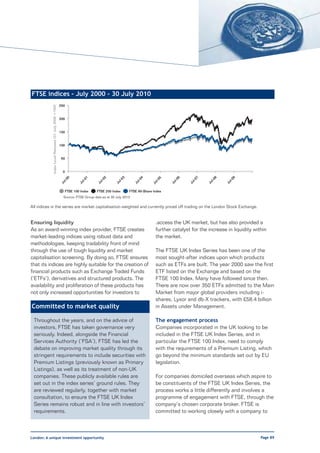
financial centre is a dramatically different offering   ensures that the UK is less exposed to specific
from most other markets, which primarily feature        conditions pertaining to any one economy. In
domestic securities and provide a snapshot of the       recent years, such factors have led to a wealth of
local economy.                                          companies showing an interest in Premium
                                                        Listings to qualify for the FTSE UK Index Series,
The UK’s headline tradable index – the FTSE 100         particularly the top two tradable indices – the
Index (the ‘FTSE 100’)– is a prime example of the       FTSE 100 Index and FTSE 250 Index.
diverse nature of the companies listed on the Main
Market. Most of its constituents’ operations are not    Inspiring investor confidence
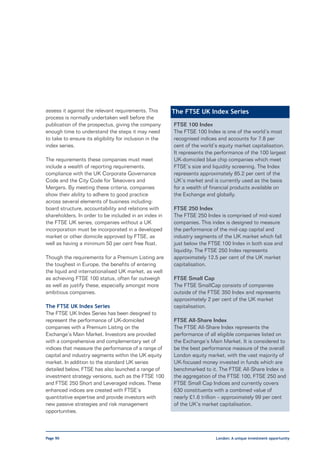
limited to the UK, with companies, including            As a financial market, London imposes some of the
GlaxoSmithKline and Vodafone, instead having a          highest standards in the world for governance and
corporate structure which reaches across the globe.     investor protection. This inspires confidence in
                                                        investors following the UK market and its major
Although the FTSE 100 is often thought of as a          indices. Governance comes in the form of listing
yardstick for the UK economy, its purpose is            rules, company law and market practice, all of
actually to capture the returns of the largest 100      which are designed to protect shareholder
companies domiciled in the UK. This index has           interests and allow them to hold management to
fulfilled this purpose since its inception in 1984,     account.
providing a global measure that spans far beyond
the UK economy.                                         This includes rules such as pre-emption rights,
                                                        which offer shareholders any new issue of shares
Setting standards                                       before being offered to non-shareholders. The
As companies in the UK continue to expand and           purpose of this rule is to ensure that shareholders
adapt their business models against a global            are able to prevent their stake from being diluted
backdrop, the UK stock market is set to grow and        by new issuance.
diversify further, creating a unique opportunity for
London. The following section covers some of the        Similarly, factors such as strict disclosure, which
key elements that underpin the UK market and set        are included in company law and the UK’s Listing
it apart from other financial centres                   Rules, are important, as they allow investors to
across the globe.                                       assess companies in an accurate and timely
                                                        manner. This focus on transparency remains the
A diversified investment landscape                      key to building trust amongst investors, which in
Situated in the middle of the world day, the UK         turn leads to strong market activity, creating a
market enjoys unique exposure during its trading        more liquid market.
hours to investors around the world. As a globally
recognised index provider, FTSE’s UK Index Series


Page 88                                                                     London: A unique investment opportunity
FTSE indices – July 2000 - 30 July 2010
                                                      250
            Index Level Rebased (31 July 2000 =100)


                                                      200


                                                      150


                                                      100


                                                       50


                                                        0
                                                            0


                                                                      1


                                                                                  2


                                                                                              3


                                                                                                          4


                                                                                                                              6


                                                                                                                                       7


                                                                                                                                                8


                                                                                                                                                         9
                                                                                                                     5
                                                        l-0


                                                                   l-0


                                                                              l-0


                                                                                          l-0


                                                                                                      l-0


                                                                                                                          l-0


                                                                                                                                   l-0


                                                                                                                                            l-0


                                                                                                                                                     l-0
                                                                                                                  l-0
                                                      Ju


                                                                 Ju


                                                                             Ju


                                                                                        Ju


                                                                                                     Ju


                                                                                                                         Ju


                                                                                                                                  Ju


                                                                                                                                           Ju


                                                                                                                                                    Ju
                                                                                                                Ju


                                                         FTSE 100 Index      FTSE 250 Index       FTSE All-Share Index
                                                        Source: FTSE Group data as at 30 July 2010

All indices in the series are market capitalisation-weighted and currently priced off trading on the London Stock Exchange.


Ensuring liquidity                                                                                                .access the UK market, but has also provided a
As an award-winning index provider, FTSE creates                                                                  further catalyst for the increase in liquidity within
market-leading indices using robust data and                                                                      the market.
methodologies, keeping tradability front of mind
through the use of tough liquidity and market                                                                     The FTSE UK Index Series has been one of the
capitalisation screening. By doing so, FTSE ensures                                                               most sought-after indices upon which products
that its indices are highly suitable for the creation of                                                          such as ETFs are built. The year 2000 saw the first
financial products such as Exchange Traded Funds                                                                  ETF listed on the Exchange and based on the
(‘ETFs’), derivatives and structured products. The                                                                FTSE 100 Index. Many have followed since then.
availability and proliferation of these products has                                                              There are now over 350 ETFs admitted to the Main
not only increased opportunities for investors to                                                                 Market from major global providers including i-
                                                                                                                  shares, Lyxor and db-X trackers, with £58.4 billion
Committed to market quality                                                                                       in Assets under Management.

 Throughout the years, and on the advice of                                                                       The engagement process
 investors, FTSE has taken governance very                                                                        Companies incorporated in the UK looking to be
 seriously. Indeed, alongside the Financial                                                                       included in the FTSE UK Index Series, and in
 Services Authority (‘FSA’), FTSE has led the                                                                     particular the FTSE 100 Index, need to comply
 debate on improving market quality through its                                                                   with the requirements of a Premium Listing, which
 stringent requirements to include securities with                                                                go beyond the minimum standards set out by EU
 Premium Listings (previously known as Primary                                                                    legislation.
 Listings), as well as its treatment of non-UK
 companies. These publicly available rules are                                                                    For companies domiciled overseas which aspire to
 set out in the index series’ ground rules. They                                                                  be constituents of the FTSE UK Index Series, the
 are reviewed regularly, together with market                                                                     process works a little differently and involves a
 consultation, to ensure the FTSE UK Index                                                                        programme of engagement with FTSE, through the
 Series remains robust and in line with investors’                                                                company’s chosen corporate broker. FTSE is
 requirements.                                                                                                    committed to working closely with a company to


London: A unique investment opportunity                                                                                                                             Page 89
assess it against the relevant requirements. This        The FTSE UK Index Series
process is normally undertaken well before the
publication of the prospectus, giving the company        FTSE 100 Index
enough time to understand the steps it may need          The FTSE 100 Index is one of the world’s most
to take to ensure its eligibility for inclusion in the   recognised indices and accounts for 7.8 per
index series.                                            cent of the world’s equity market capitalisation.
                                                         It represents the performance of the 100 largest
The requirements these companies must meet               UK-domiciled blue chip companies which meet
include a wealth of reporting requirements,              FTSE’s size and liquidity screening. The Index
compliance with the UK Corporate Governance              represents approximately 85.2 per cent of the
Code and the City Code for Takeovers and                 UK’s market and is currently used as the basis
Mergers. By meeting these criteria, companies            for a wealth of financial products available on
show their ability to adhere to good practice            the Exchange and globally.
across several elements of business including:
board structure, accountability and relations with       FTSE 250 Index
shareholders. In order to be included in an index in     The FTSE 250 Index is comprised of mid-sized
the FTSE UK series, companies without a UK               companies. This index is designed to measure
incorporation must be incorporated in a developed        the performance of the mid-cap capital and
market or other domicile approved by FTSE, as            industry segments of the UK market which fall
well as having a minimum 50 per cent free float.         just below the FTSE 100 Index in both size and
                                                         liquidity. The FTSE 250 Index represents
Though the requirements for a Premium Listing are        approximately 12.5 per cent of the UK market
the toughest in Europe, the benefits of entering         capitalisation.
the liquid and internationalised UK market, as well
as achieving FTSE 100 status, often far outweigh         FTSE Small Cap
as well as justify these, especially amongst more        The FTSE SmallCap consists of companies
ambitious companies.                                     outside of the FTSE 350 Index and represents
                                                         approximately 2 per cent of the UK market
The FTSE UK Index Series                                 capitalisation.
The FTSE UK Index Series has been designed to
represent the performance of UK-domiciled                FTSE All-Share Index
companies with a Premium Listing on the                  The FTSE All-Share Index represents the
Exchange’s Main Market. Investors are provided           performance of all eligible companies listed on

with a comprehensive and complementary set of            the Exchange’s Main Market. It is considered to

indices that measure the performance of a range of       be the best performance measure of the overall
capital and industry segments within the UK equity       London equity market, with the vast majority of
market. In addition to the standard UK series            UK-focused money invested in funds which are
detailed below, FTSE has also launched a range of        benchmarked to it. The FTSE All-Share Index is
investment strategy versions, such as the FTSE 100       the aggregation of the FTSE 100, FTSE 250 and
and FTSE 250 Short and Leveraged indices. These          FTSE Small Cap Indices and currently covers
enhanced indices are created with FTSE’s                 630 constituents with a combined value of
quantitative expertise and provide investors with        nearly £1.6 trillion – approximately 99 per cent
new passive strategies and risk management               of the UK’s market capitalisation.
opportunities.


Page 90                                                                    London: A unique investment opportunity
Preparing to list depositary receipts
           Raj S.Panasar and Stephen Glasper
        Cleary Gottlieb Steen & Hamilton LLP
www.clearygottlieb.com
Preparing to list depositary receipts

Depositary receipts (‘DRs’) are negotiable                  Structure of a typical DR listing
instruments issued by a depositary bank that
essentially repackages shares in another company.           A typical DR listing will adopt the following
DRs are securities in their own right and can be            structure:
listed and traded on the capital markets.
                                                            l    issuer’s shares (either newly-issued
DRs are typically listed by companies incorporated               shares, existing shares currently in the
outside the EU, frequently from emerging markets                 hands of a shareholder, or both) are
such as Russia and India. For such companies, a                  deposited with the custodian bank of the
listing of DRs on an international exchange such as              issuer’s depositary
the London Stock Exchange can provide access to             l    depositary becomes legal title holder of
a significantly wider pool of international                      shares and is entered into issuer’s share
professional investors than a listing of shares on a             register
company’s domestic exchange.                                l    depositary issues to investors DRs
                                                                 representing a certain number of issuer’s
Advantages of listing depositary receipts                        shares
Companies issue DRs principally to raise capital.           l    depositary holds the underlying shares on
DRs provide a particularly effective means for non-              bare trust for the holders of the DRs
EU issuers to raise capital because of their appeal         l    depositary will exercise its rights as a
to international professional investors: they offer a            shareholder – including voting rights and
means to invest in non-EU issuers while avoiding                 rights to unpaid dividends – in accordance
some of the inconveniences often associated with                 with investors’ wishes, subject to the
direct investments in the underlying shares,                     terms and conditions of the DRs
particularly as regards settlement.                         l    investors are free to sell DRs in the
                                                                 secondary market, or, alternatively, to
Structure of a depositary receipt listing                        instruct the depositary to cancel the DRs
                                                                 and deliver the underlying shares instead,
The depositary mechanism                                         subject to the terms and conditions of the
Setting up the requisite mechanics for a DR listing              DRs and relevant securities laws.
requires close coordination between the issuer, its
advisers (principally its legal counsel and             ‘Listing’ of depositary receipts
underwriters) and its chosen depositary bank (see       There are two distinct aspects to the process of
‘Establishing a depositary receipt programme’           ‘listing’ DRs in London, which occur simultaneously
chapter on page 105).                                   with each other:

The deposit agreement                                   l       Admission to the Official List (the ‘Official
The deposit agreement sets out the legal rights                 List’) of the United Kingdom Listing Authority
and obligations of the depositary and the issuer.               (‘UKLA’), the United Kingdom regulator for
More importantly, the deposit agreement details                 the purpose of securities listings. DRs will be
the rights of the DR holders, set out in the terms              admitted to the Standard segment of the
and conditions of the depositary receipts, which                Official List – Premium Listings are only
are typically annexed to the deposit agreement                  available to issuers of shares (the Premium
and reproduced in the listing prospectus.                       and Standard Listing taxonomy is discussed
                                                                in full in the UKLA’s chapter on page 14)


Preparing to list depositary receipts                                                                       Page 93
l     Admission to trading on the London Stock           ‘Reg S only’ deal. The main requirements of
      Exchange’s Main Market (the ‘Main                  Regulation S are that (i) the offer or sale of DRs is
      Market’) or the London Stock Exchange’s            made outside of the US in an offshore transaction;
      Professional Securities Market (the ‘PSM’).        and (ii) no marketing of the DRs takes place in the
                                                         US (referred to as ‘directed selling efforts’).
The admission of DRs to the Official List and to
trading on the Main Market will usually (though          For issuers that intend to market DRs to
not always) be conducted in conjunction with an          investors in the US (to access demand from US
offering of DRs to investors, to create the              institutional investors), the US portion of the
requisite ‘public float’ of 25 per cent of the DRs.      transaction is typically framed within the scope of
If a listing of DRs represents the first time an         Rule 144A of the US Securities Act, which
issuer has offered securities to investors, it will      provides an exemption for resales of securities to
be commonly referred to as the issuer’s initial          sophisticated institutional investors, known as
public offering (‘IPO’).                                 qualified institutional buyers (‘QIBs’). Such a
                                                         transaction, which would also need to rely on
Block listings                                           Regulation S in respect of sales to investors
It is common for a DR issuer to request admission        outside of the US, would be referred to as a
to the Official List of a greater number of DRs than     ‘Reg S/144A’ deal.
it intends to have admitted to trading on the Main
Market at the time of its IPO. This is sometimes
known as a ‘block listing’. A block listing of DRs        Example of a block listing
enables an issuer to have additional DRs admitted
to trading on the Main Market, up to the aggregate        l    issuer applies for up to 100 DRs to be
size of the block listing, without having to publish a         admitted to the Official List but limits the
new prospectus or submit new applications to the               IPO to 25 DRs (ie only 25 of the DRs will be
UKLA or the London Stock Exchange. For an issuer               admitted to trading on the Main Market)
planning to issue DRs on an incremental basis or          l    issuer is permitted to have up to 75
who cannot control secondary deposits into the DR              additional DRs admitted to trading on the
facility, a block listing is important.                        Main Market at any time following the IPO
                                                               and in as many increments as it wishes
US considerations                                              (provided the initial listing on the Official
US securities law is relevant to any listing of DRs.           List is maintained)
The US Securities Act 1933 (the ‘Securities Act’)         l    no requirement to apply to the UKLA or
requires any issuer that proposes to offer                     London Stock Exchange for subsequent
securities anywhere in the world to undertake a                DRs admitted to trading (up to the upper
lengthy US Securities and Exchange Commission                  limit of the block listing)
(‘SEC’) registration process, unless an exemption         l    no requirement for a new prospectus for
is available.                                                  subsequent DRs admitted to trading (up to
                                                               the upper limit of the block listing)
For issuers that do not intend to market DRs to           l    to enable the UKLA to monitor the status
investors in the US, an exemption from the SEC                 of a block listing, the issuer is required to
registration requirement is typically available under          submit a form on a six-monthly basis
Regulation S of the Securities Act (‘Reg S’). Such             stating how many of its DRs are admitted
a transaction would be referred to as a                        to trading.


Page 94                                                                           Preparing to list depositary receipts
Whether the DR listing is a Reg S only, or a Reg             time of admission to the Official List)
S/144A deal, great care must be taken to ensure         l    at least 25 per cent of the DRs for which
that the conditions of the relevant exemptions are           application is made must be in public hands
met; sanctions for breach of US securities                   (ie part of a public float, not held by major
legislation can be severe and concerns about                 shareholders or persons connected with the
compliance with the Securities Act can impede the            issuer) at the time of admission to the Official
ability of legal counsel to deliver the requisite            List and for the duration of the listing. In
opinions to underwriters, which can result in                certain limited circumstances the UKLA will
significant delays in the IPO process. Hence the             agree to lower the 25 per cent threshold
importance of complying with the ‘publicity             l    issuer must publish a prospectus approved by
guidelines’ drafted for the issuer and the parties           the UKLA. This requirement works in
working with the issuer on its IPO.                          conjunction with the FSA’s Prospectus Rules,
                                                             which set out the circumstances in which an
Assessing suitability and eligibility for listing            issuer must publish a prospectus. Note that
depositary receipts                                          the issuer’s ability to meet the disclosure
                                                             requirements for a prospectus – in particular,
Eligibility criteria                                         in relation to financial statements –
Issuers seeking admission of DRs to the Official             effectively operates as an additional criterion
List in connection with a Main Market listing must           for eligibility.
satisfy both the general eligibility requirements
that apply to all applicants to the Official List and   As noted above, issuers of DRs are not required to
the specific eligibility requirements that apply to     satisfy some of the more demanding eligibility
issuers of DRs (set out in Chapters 2 and 18 of         criteria that apply to an issuer conducting a
the Financial Service Authority’s (‘FSA’) Listing       Premium Listing of equity shares. For example, a
Rules, respectively):                                   DR issuer is not required to produce a three-year
                                                        financial track record that relates to at least 75 per
l     issuer must be duly incorporated and              cent of its business, nor is a DR issuer required to
      operating in accordance with its constitution     publish audited accounts no older than six months
l     DRs must (i) conform to the law of the            from the date of the prospectus, or satisfy the
      issuer’s place of incorporation; (ii) be duly     UKLA that it has sufficient working capital
      authorised according to the requirements of       available for at least the next 12 months. The
      the issuer’s constitution; and (iii) have any     prospectus does, however, need to contain all
      necessary statutory or other consents             material information, so financial statement
l     DRs must be admitted to trading on the Main       requirements still need serious consideration,
      Market                                            particularly where the issuer has made significant
l     DRs must be (i) freely transferable; and (ii)     acquisitions or disposals.
      fully paid-up and free from all liens and from
      any restriction on the right to transfer          Eligibility letter
l     DRs, once listed, must be expected to             To demonstrate compliance with the UKLA’s
      achieve an aggregate market value of at least     eligibility requirements, the issuer must submit to
      £700,000                                          the UKLA an ‘eligibility letter’ no later than on the
l     application must relate to the entire class of    date of the first filing of the prospectus (see
      the relevant DRs (ie the application must         example transaction timetable on pages 96 and
      cover all DRs in issue or to be issued at the     97). In addition, although not required by the rules,
                                                                                        continues on page 98


Preparing to list depositary receipts                                                                   Page 95
Example transaction timetable for listing DRs
Stage       Timeline               Action

Planning    24 weeks prior to      •   issuer and underwriters to plan strategy and structure of listing
            pricing (referred to   •   underwriters and legal advisers commence due diligence
            as T) (date on         •   assess issuer’s eligibility for listing
            which price of DRs     •   prepare and submit UKLA pre-eligibility letter (if appropriate)
            is agreed,             •   prepare and submit UKLA eligibility letter (no later than on date of first
            underwriting
            agreement is signed        submission of draft prospectus)
            and conditional
            dealing in DRs
            commences)

Document    T - 16 weeks           •   begin drafting prospectus
drafting                           •   conduct diligence meetings and drafting sessions
                                   •   when draft prospectus is substantially complete, submit to UKLA with
                                       annotations (directing the UKLA as to how the issuer has complied with
                                       its specific disclosure obligations) with:
                                       o cover letter (drafted and signed by issuer’s legal counsel)
                                       o prospectus disclosure checklist (not signed)
                                       o application for prospectus to be approved by the UKLA (Form A)
                                         (signed by issuer)
                                       o UKLA listing and document vetting fees
                                   •   UKLA requires 10 full working days for review of first submission and 5
                                       full working days for subsequent reviews
                                   •   work towards clearing UKLA comments on draft prospectus; make
                                       further submissions of the prospectus by filing:
                                       o comparison document showing amendments to prospectus since
                                         previously submitted version
                                       o updated prospectus disclosure checklist
                                       o completed document response sheet (demonstrating how UKLA
                                         comments have been resolved)


            T-8 weeks              •   begin negotiating underwriting agreement (‘UA’)

Marketing   T- 2-6 weeks           •   obtain ‘no further comments’ clearance on prospectus from UKLA
                                   •   arrange date for UKLA approval of the prospectus (‘stamp off’)
                                   •   ensure ancillary UKLA listing documents are submitted at least 20
                                       business days prior to desired date for stamp off (10 business days for
                                       issuers with securities already admitted to the Official List):
                                       o issuer contact details form
                                       o prospectus publication form
                                       o issuer board resolution authorising listing
                                   •   liaison with London Stock Exchange:
                                       o submit draft application for admission of securities to trading (Form 1 ),
                                         draft prospectus and other documentation requested by London Stock
                                         Exchange
                                       o underwriters to discuss conditional dealings (if required)
                                         with London Stock Exchange
                                   •   print preliminary prospectus (with all information finalised save for price)
                                   •   marketing/roadshow


Page 96                                                                             Preparing to list depositary receipts
Example transaction timetable for listing DRs (continued)

 Pricing             T                  •    issuer and underwriters to agree price
                                        •    issue press release to announce price
                                        •    finalise and sign UA
                                        •    DRs allocated to investors / conditional dealing (if required) begins
                                        •    obtain UKLA stamp off on prospectus by submitting:
                                             o two clean copies of final prospectus dated with the date of approval
                                             o comparison document showing any changes to prospectus since previous
                                               UKLA review
                                             o completed prospectus disclosure checklist (signed by issuer, dated date
                                               of approval)
                                        •    print and publish final prospectus
                                        •   arrange listing hearing with UKLA (for no sooner than 48 hours following
                                            prospectus stamp off) by submitting:
                                            o application form for listing hearing
                                            o application for admission to the Official List (signed by issuer)
                                            o stamped final prospectus
                                            o issuer board resolution confirming number of DRs to be issued
                                        •   arrange for London Stock Exchange to consider application for admission of
                                            DRs to trading (at least two business days before unconditional trading in
                                            DRs is requested to begin, if applicable) by submitting:
                                            o completed Form 1
                                            o copy of final prospectus
                                            o front cover of prospectus with UKLA stamp
                                            o London Stock Exchange fees to be paid following admission to trading


Closing             T+2                 •   DRs delivered to investors, payment transferred to issuer (‘settlement and
                                            delivery’)
                                        •   Listing admission hearings:
                                            o UKLA considers the application for admission of the DRs to the Official
                                              List
                                            o London Stock Exchange considers application for admission to trading of
                                              the DRs to trading on the Main Market


Admission           T+3                 •   DRs are admitted to listing and trading from 8:00am (when London stock
                                            Exchange publishes its dealing notice)
                                        •   settlement of trades with investors
                                        •   unconditional dealing in DRs begins
                                        •   announce admission of DRs via Regulatory Information Service (RIS) /
                                            press release


Not all DR transaction timetables include a period of Conditional Dealing (also known as When Issued Dealing (WID)). Issuers
should assess whether a period of WID dealing is required in conjunction with their advisers. WID is a period of conditional dealing
with deferred settlement ahead of full admission. Trades during the WID period, are conditional on the security being listed and can
only settle once trading has become unconditional. Where the security does not list, all transactions effected during the period of
WID are void. WID is made available by the Exchange on request and at its discretion. WID will normally last for a period of three
business days.


Preparing to list depositary receipts                                                                                       Page 97
it may be prudent to submit a pre-eligibility letter         l    meetings with key shareholders
to address any particular issues unique to the               l    review of material documents relating to the
issuer, for example, issues related to the financial              issuer and its group (usually the issuer will
disclosure the issuer plans to present in the                     create a physical or electronic data room for
prospectus.                                                       this purpose)
                                                             l    site visits to view the issuer’s principal
Since DR issuers are not required to appoint a                    assets and operations
sponsor, the issuer’s legal counsel will typically           l    prospectus drafting sessions, at which
liaise with the UKLA on the issuer’s behalf, initially            further questions are put to the issuer’s
to establish its eligibility for listing and ultimately to        senior management in the context of the
achieve the admission of its DRs to the Official List.            actual text of the draft prospectus
                                                             l    preparation of specialist reports, such as
Admission timetable                                               mineral experts or property valuation
The timetable for a DR listing will differ from deal              reports, or a report of financial reporting
to deal and will depend on each company’s                         procedures
individual circumstances. For illustrative purposes,         l    representations and warranties from the
the table on pages 96 and 97 presents an example                  company and selling shareholders
transaction timetable for an IPO of DRs on the               l    delivery of comfort letters from the
Main Market, based on a total transaction length                  accountants
of 24 weeks.                                                 l    delivery of legal opinions from counsel.

The prospectus                                               General content of the prospectus

Requirement for a prospectus                                 The overriding disclosure obligation
In connection with an application for DRs to be              The principal purpose of a prospectus is to provide
admitted to trading on the Main Market an issuer             potential investors with the information necessary
must publish a UKLA-approved prospectus. The                 to make an informed assessment of the issuer and
preparation of the prospectus requires a significant         the rights attaching to the DRs. In other words, the
effort on the part of the issuer and its advisory            prospectus must contain all information that could
team and is one of the principal determinants of             be relevant to an investor’s investment decision –
the deal timetable.                                          this is the overriding disclosure obligation. It
                                                             supplements the equivalent overriding disclosure
Due diligence                                                obligation under US rules if the transaction
Due diligence is typically undertaken by the                 includes a placement in the US.
underwriters and, particularly if the deal involves a
placement in the US, both the issuer’s and                   Detailed disclosure requirements
underwriter’s legal counsel. Due diligence helps             In addition to satisfying the overriding disclosure
protect the issuer, its directors, and the                   obligation, the prospectus must meet a number of
underwriters from liability and reputational damage.         detailed contents requirements, which are set out
                                                             in Annex X to the FSA’s Prospectus Rules.
The due diligence process might include:
                                                             The detailed disclosure requirements that apply
l     meetings with senior management and other              to prospectuses for DR listings differ in certain
      key personnel                                          respects from those that apply to prospectuses


Page 98                                                                              Preparing to list depositary receipts
for share listings. For example, unlike in a                 and the US are considered equivalent for this
prospectus relating to a share listing (either a             purpose)
Premium or a Standard Listing), there is no             l    interim financial statements (which may be
requirement for a DR prospectus to include a                 unaudited) covering at least the first six
working capital statement (to the effect that the            months of the year if the last audited annual
issuer and its group has sufficient working capital          financial statements will be older than nine
available for its requirements for the 12 months             months from the date on which the
following the date of the prospectus), and the               prospectus will be approved.
requirements relating to financial disclosure can
be more demanding in the context of a share             In certain cases, however, it is not sufficient for an
prospectus, particularly where the issuer has a         issuer to limit the financial disclosure in the
complex financial history.                              prospectus to the Annex X requirements. The
                                                        issuer also must meet the overriding obligation to
Despite these differences, the disclosure in a DR       disclose all material information, which in certain
prospectus is likely to look very much like that in a   circumstances will demand the disclosure of
share prospectus, largely because of the overriding     additional financial information, above and beyond
disclosure obligation to ensure that it contains all    that required under Annex X.
material information (an obligation which applies
equally to shares and DRs). This is particularly the    For example, it is not uncommon for an issuer to
case in DR deals that will be marketed to US            have been incorporated as a new holding company
investors – Reg S/144A deals – where the                for the listing. Such an issuer might not have any
document is likely to be drafted with a keen eye on     financial history of its own. In such circumstances,
the stringent disclosure requirements in the US.        investors would reasonably expect to see the
                                                        financial history of the underlying business in order
Financial disclosure                                    to make an informed investment decision.
The issuer’s consolidated financial statements and      Alternatively, the issuer might have recently
the accompanying analysis set out in the operating      purchased, or agreed to purchase, another large
and financial review section of the prospectus are      business. The disclosure will likely need to deal
critical to an investor’s investment decision. Under    with that new business, perhaps through pro forma
Annex X, a DR prospectus must include:                  and/or separate financial statements related to
                                                        that business depending on its materiality and
l     audited financial statements prepared in          other information that can be provided about that
      accordance with International Financial           business.
      Reporting Standards (‘IFRS’), covering the
      latest three financial years, or such shorter     To ensure that an issuer in circumstances such as
      period that the issuer has been in operation.     these meets the overriding disclosure obligation,
      Non-EU issuers that do not prepare IFRS           one typically cross-refers to the rules that apply to
      financials will be spared the requirement to      share listings. An issuer of shares whose financial
      restate their financials into IFRS if they have   statements do not provide investors with a full
      been prepared in accordance with generally        picture of the underlying business is deemed to
      accepted accounting standards (‘GAAP’) that       have a ‘complex financial history’.
      are ‘considered to be equivalent to IFRS’ (as
      of the date of publication the GAAP of            Such an issuer is required to disclose (i) the
      Canada, China, India, Japan, South Korea          financial statements of another entity (for


Preparing to list depositary receipts                                                                    Page 99
example, the entity that operates the issuer’s           Responsibility and liability
underlying business); and/or (ii) pro forma              A DR issuer is required to make a statement in its
financial statements that demonstrate the impact         listing prospectus to the effect that it takes
of a recent or anticipated transaction (such as the      responsibility for the contents of the prospectus. In
acquisition or sale of a large business) on the          addition, third-party experts who have prepared
issuer’s financial statements.                           information or reports for use in the prospectus
                                                         (such as reporting accountants and mineral
While the complex financial history regime for share     experts) are required to accept responsibility for
issuers does not apply to DR issuers, it is not          the contents of their reports. Unlike in a share
uncommon for DR issuers to look at it by analogy to      listing, there is no requirement for the issuer’s
help satisfy the overriding disclosure obligation – in   directors to take express personal responsibility
particular, by including the financial statements of     for the prospectus.
an entity other than the issuer. The issuer and its
legal counsel would usually address issues relating      Any party that takes responsibility for a
to the financial statement package with the UKLA         prospectus will be liable under the Financial
by means of a pre-eligibility letter and agree an        Services and Markets Act 2000 (‘FSMA’) to pay
approach at an early stage in the transaction.           compensation to any person who acquires DRs
                                                         and suffers a loss as a result of any untrue or
Drafting style                                           misleading statement, or a material omission, in
l   the prospectus should be drafted in a manner         the prospectus. Depending on the circumstances,
    that is comprehensible and easy to analyse           investors may be able to bring a claim under a
l   it should avoid bullish rhetoric and ‘marketing      different head of liability (for example, under the
    speak’ in favour of neutral language, balanced       common law either for negligent misstatement, or
    and complete descriptions, and factual               false or misleading pre-contractual misstatement)
    statements that can be substantiated                 against the issuer and potentially others; however,
l   discussion of the issuer’s prospects requires        the FSMA offers investors a clear, purpose-built
    particular care                                      route to recovery.
l   forward-looking statements will to some
    extent be necessary (for example, to describe        In practice, steps will be taken to help guard
    the issuer’s strategy or material capital            against the issuer’s (and its directors’) potential
    expenditure plans). These statements should          liability through the due diligence carried out by it
    be drafted carefully to avoid unnecessary            and its advisory team prior to, and in connection
    exposure to liability (ie if the anticipated         with, the drafting of the prospectus prior to its
    event or outcome does not occur)                     publication.
l   drafting should try to ensure that the issuer’s
    beliefs and expectations are not construed as        Advising the issuer after listing
    statements of fact and, for material matters,
    might be accompanied by discussions of the           Continuing obligations regime
    factors that could cause actual outcomes to          An issuer with DRs trading on the Main Market is
    differ from those envisaged                          required to comply with a range of continuing
l   profit forecasts – statements that could be          obligations. The majority of these requirements are
    taken to suggest, for example, that the issuer       set out under the FSA’s Disclosure and
    will generate a particular income in the future      Transparency Rules. The key theme in this context
    – should generally be avoided.                       is disclosure. Disclosure of pertinent information to


Page 100                                                                          Preparing to list depositary receipts
the market allows investors to make informed            which directly concerns it, save in a narrow set of
investment decisions. This, in turn, promotes           circumstances in which the rules entitle it to delay
investor confidence and facilitates the proper          disclosure.
functioning and development of the market.
                                                        In the context of DRs, inside information is
For many issuers, particularly those conducting an      information that:
IPO, the practice of disclosing material information
to the market is likely to represent a significant      l    is precise
divergence from previous practice. It is therefore      l    has not been made public
crucial that the issuer is properly advised of          l    relates (directly or indirectly) to the issuer or
exactly what it will be required to do once its DRs          the DRs
are listed. This advice must be delivered at a          l    would be likely to have a significant effect on
sufficiently early stage in the listing process to           the price of the DRs if made public (ie is
enable the issuer to introduce procedures to                 ‘price sensitive’).
ensure that it is able to comply with its continuing
obligations immediately after listing.                  The issuer must consider each set of
                                                        circumstances on its own merits and reach a
One of the very first steps a DR issuer needs to        judgement as to whether it is in possession of
take, in advance of listing, is to appoint a            inside information and, therefore, whether an
Regulated Information Service (‘RIS’), such as the      announcement is required (or, alternatively,
London Stock Exchange’s Regulatory News                 whether there are grounds to justify delaying an
Service. The issuer is required to make its             announcement). Very often, the key consideration
disclosures to the market via its appointed RIS.        is whether the information in question is price
                                                        sensitive. The requirement to disclose inside
Disclosure obligations                                  information is also discussed in the chapter ‘The
In overview, a DR issuer admitted to trading on the     legal framework for an IPO’ on page 31.
Main Market is required to disclose to the market
via its appointed RIS:                                  Periodic financial reporting
                                                        In addition to the requirement to disclose inside
l     information that could affect the price of the    information on an ad hoc basis, a DR issuer on
      DRs (‘inside information’) – as soon as           the Main Market must publish its annual financial
      possible after it arises                          report as soon as possible after it has been
l     periodic financial reports – DR issuers are       approved and, at the latest, four months after the
      required to publish an annual financial report,   end of the financial period to which it relates (six
      no later than four months after the relevant      months for issuers on the PSM).
      year end (six months for issues of DRs
      admitted to the PSM). In addition, DR issuers     In summary, the annual report must contain:
      customarily publish half-yearly reports.
                                                        l    audited consolidated IFRS financial statements
Disclosure of inside information                        l    management report, including a corporate
As soon as an issuer submits its application for its         governance statement (disclosing the
DRs to be admitted to trading on the Main Market             corporate governance code to which the
or the PSM, it is required to notify its appointed           issuer is subject; the extent of its
RIS as soon as possible of any inside information            compliance with such code; and a


Preparing to list depositary receipts                                                                  Page 101
description of the issuer’s internal control
     and risk management arrangements in                PDMRs
     relation to its financial reporting process)
l    responsibility statement, attesting to the         Some DR issuers comply with the PDMR
     accuracy of the information in the report.         regime on a voluntary basis as a matter of best
                                                        practice.
Unlike issuers of listed shares, DR issuers are not
required to produce half-yearly reports or interim      A PDMR is a director or a senior executive of
management statements. However, it is common            the issuer who:
for DR issuers to publish half-yearly reports as a
result of market expectation and best practice.         1. has regular access to inside information
                                                           relating, directly or indirectly, to the issuer;
Disclosure of transactions by persons                      and
discharging managerial responsibilities                 2. has power to make managerial decisions
The requirement to publish details of transactions         affecting the issuer’s future development and
in the issuer’s shares carried out by ’persons             business prospects.
discharging managerial responsibilities’
(‘PDMRs’) and their connected persons does not          If the regime were voluntarily followed to the
apply to DR issuers. However, the UKLA has at           letter, PDMRs and their connected persons
least informally stated that compliance with the        would notify the issuer in writing of the
PDMR regime by DR issuers would be best                 occurrence of all transactions conducted on
practice.                                               their own account in the issuer’s securities,
                                                        within four business days of the day on which
Regulation of market behaviour                          the relevant transaction occurred. The
In addition to the continuing obligations               notification would include:
disclosure regime described above, DR issuers,
by virtue of having securities admitted to trading      l    name of the PDMR or, where applicable,
on the Main Market, must refrain from certain                the connected person
behaviour – broadly referred to as ‘market abuse’       l    name of the issuer
– that could prejudice investors and jeopardise         l    reason for requirement to notify
the efficient operation of the market. Both civil       l    description of the relevant security
and criminal market abuse regimes apply to              l    nature of the transaction (for example, an
issuers with DRs listed on the London Stock                  acquisition or disposal)
Exchange, as well as to their directors and other       l    date and place of the transaction
officers.                                               l    price and volume of the transaction.

Continuing obligations that do not apply to             The issuer would then notify the above
issuers of depositary receipts                          information to an RIS as soon as possible (and,
As noted earlier, DR issuers are not subject to the     in any event, by the end of the business day
full demands of the continuing obligations regime       following receipt of the information by the
that applies to issuers of shares (particularly those   issuer).
with a Premium Listing of shares).


Page 102                                                                       Preparing to list depositary receipts
Disclosure
In terms of disclosures to the market, DR issuers
are not required to publish:

l     half-yearly financial reports or interim
      management statements
l     details of acquisitions or disposals of major
      shareholdings
l     details of transactions in the issuer’s
      securities carried out by PDMRs and their
      connected persons.

However, as noted above, many DR issuers make
some or all of the above disclosures on a voluntary
basis as a matter of best practice.

Corporate governance
DR issuers are not required by the rules to follow
the expansive corporate governance regime with
which issuers of Premium Listed equity shares
must comply, including:

l     Listing Principles
l     UK Code on Corporate Governance
l     Model Code (while the Model Code does not
      apply to DR issuers, the guidance it provides
      on when an issuer and its senior management
      may conduct trades in the issuer’s shares is
      instructive to DR issuers planning to conduct
      such trades)
l     requirement to obtain shareholder approval
      for related-party transactions
l     requirement to prepare circulars and obtain
      shareholder approval for major transactions.

An issuer might nevertheless give serious
consideration to complying with certain of these
corporate governance rules to assist with the
marketing of its DR listing and if it has ambitions
to progress to a Premium Listing of equity shares,
to acclimatise to the more demanding regime it
would be required to follow as a Premium Listed
issuer.


Preparing to list depositary receipts                 Page 103
Establishing a depositary receipt programme
                    Alex H.Hickson and Peter Russell
                                        J.P. Morgan
Capital without borders
        When companies need to access investors beyond their borders, they                                                               Best Depositary Receipts Bank
        turn to the recognized leader in Depositary Receipts. At J.P. Morgan, we                                                         The Asset, Triple A Transaction
        commit the entire resources of our firm to your success - that means                                                                  Banking Awards 2009
        focused advisory up front, aggressive support in the aftermarket, and
        the strength of our research and global reputation throughout.                                                                       Best Depositary Receipts
                                                                                                                                                    Program
                                                                                                                                             emeafinance, Achievement
        J.P. Morgan manages some of the world’s most widely held DR programs.
                                                                                                                                                   Awards 2009
        Our DR professionals use their market knowledge and strong deal
        execution capabilities to structure innovative, well-invested, liquid and
        cost-e ective DR programs for issuers. Since we created the world’s first
        depositary receipt program over 80 years ago, there is no question about
        our leadership or commitment to our clients.


        To learn more about our depositary receipt services, please contact:

        Asia           Kenneth Tse at +852 2800 1859, kenneth.k.tse@jpmorgan.com
        EMEA           Alex Hickson at +44 207 777 2805, alex.h.hickson@jpmorgan.com
        WHEM           Joseph Dooley at +1 212 622 9225, joseph.dooley@jpmorgan.com


The products and services featured above are o ered by JPMorgan Chase Bank, N.A., a subsidiary of JPMorgan Chase & Co. JPMorgan Chase Bank, N.A. is registered by the FSA for investment business
in the U.K. JPMorgan is a marketing name for Worldwide Securities Services businesses of JPMorgan Chase & Co. and its subsidiaries worldwide. © 2010 JPMorgan Chase & Co. All rights reserved.
Establishing a depositary receipt programme

Global Depositary Receipts (GDRs) have risen to          Benefits of GDRs
prominence in recent years, becoming the favoured
instrument used by companies from emerging               Benefits to an issuer:
markets, such as Russia and India, to raise capital      l   offers a flexible mechanism for capital
on western stock exchanges:                                  raising and a currency for mergers and
                                                             acquisitions
l     companies from more than 70 countries have         l   diversifies the shareholder base, with
      depositary receipt programmes providing them           potentially greater liquidity for the
      with new investors outside their home markets          underlying shares
l     more than 1,500 issuers have a sponsored           l   enhances visibility among international
      depositary receipt programme                           investors, consumers and commercial
l     more than 350 GDR programmes are listed on             customers
      stock exchanges, of which 190 are listed on        l   enables price parity with global peers
      the London Stock Exchange (the ‘Exchange’).            through the provision of internationally
                                                             recognised information
For investors, GDRs facilitate investment in these       l   may increase research coverage outside the
foreign issuers while limiting many of the                   home market.
complexities and costs associated with cross-
border investments, such as the settlement and           Benefits to an investor:
custody of shares and foreign exchange                   GDRs also offer tangible benefits to investors
transactions.                                            seeking to diversify their portfolios globally:

GDRs can carry many attributes of an issuer’s local      l     easier to purchase and to hold than an
shares; they can provide similar economic rights               issuer’s underlying ordinary shares
(including the right to receive dividends), and if       l     trade easily and conveniently in US dollars
stipulated in an issuer’s deposit agreement, voting            and settle through established clearing
rights in the issuer. For both issuers and investors,          houses
there are many more measurable benefits to               l     eliminate unfamiliar custody arrangements
establishing a GDR programme and listing on an           l     limit risks associated with limited
international exchange.                                        transparency or instability resulting from
                                                               changing regulatory procedures in emerging
Structuring the GDR programme                                  markets
GDRs have proven to be very flexible. When using         l     option to acquire the underlying shares
GDRs to access Western capital markets, issuers                directly upon cancellation.
interested in attracting international investors have
several options:                                         capital and increase their profile in the market in
                                                         which the offering will be conducted. A GDR
Public offering and listing                              offering can be aimed at European investors in a
In a public offering, GDRs are offered to                single tranche under Regulation S (‘Reg S’) which
institutional investors and listed on an international   exempts offerings conducted outside of the US
stock exchange outside the issuer’s home market.         from Securities and Exchange Commission (‘SEC’)
The offering will be underwritten by an investment       registration and reporting, or in two tranches: Reg S
bank. A public offering is generally used by             to non-US investors and to US institutional
companies seeking to raise substantial amounts of        investors via Rule 144A (see below). A listing on an


Establishing a depositary receipt programme                                                            Page 107
international exchange provides transparent trading      place outside a dedicated platform and therefore
outside the usual market hours. GDRs will typically      provides little visibility to the issuer.
be offered to investors in the exchange’s region.
For example, a listing on an exchange in Europe          Creating GDRs
would be aimed at attracting a substantial portion       A GDR is issued and administered by a depositary
of European investors.                                   bank on behalf of the (underlying) corporate issuer.
                                                         Depositary receipts can be created or cancelled
Rule 144A tranche                                        depending on supply and demand, with brokers
To access a broader pool of liquidity, GDR issuers       either bringing additional ordinary shares to the
can include a US institutional element through a         depositary to create more GDRs, or withdrawing
restricted private placement of DRs, which is            ordinary shares to cancel from the GDR facility.
exempt from US securities law registration and           GDRs are created when the shares of a foreign
reporting. Institutional investors legally able to       issuer – either those currently trading in its local
participate in Rule 144A offerings are known as          market or newly-issued shares in connection with
Qualified Institutional Buyers (‘QIBs’).                 an offering of securities – are deposited with a
                                                         depositary’s custodian in the issuer’s home
Listing                                                  market. The depositary then issues GDRs
Issuers can list their GDRs without raising capital      representing those shares. At any time thereafter,
– known as an ‘introduction’. By listing, issuers will   an investor can sell these GDRs in the secondary
have access to a wider group of institutional            market (eg the Exchange’s International Order
investors as well as increasing their visibility and     Book), or deliver the GDRs to the sponsoring
name recognition. From a documentation and               depositary bank for cancellation in order to receive
disclosure perspective, there is generally little        the underlying ordinary shares for settlement or
difference between an introduction and a capital         sale in the foreign issuer’s local market.
raising, other than the description of the sale of
shares that would be included in an offering             Typically, GDR programmes are governed by a
prospectus. While listing alone does not raise           Deposit Agreement agreed to by the issuer and
capital, it does enable companies to enter a             the depositary bank, which, among other things,
market and get to know the participants without          outlines the terms and conditions of the GDR
incurring the expense and requirements of a              programme.
capital raising. At the same time, an introduction
should only be considered together with initiatives      Setting the GDR-to-share ratio
aimed at raising secondary market liquidity.             The initial price of a GDR primarily depends on the
                                                         ratio between the number of GDRs and the
Placing (private placement)                              underlying shares (‘GDR ratio’). This ratio can vary
A placing is usually a more selective process            widely; one GDR may represent an ownership
whereby GDRs are offered to a small number of            interest in many shares of corporate stock or
selected institutions. While this route gives the        represent only fractional shares, depending on
issuer more control over the distribution, it can        whether the GDR is priced higher or lower than
restrict the shareholder base and naturally limit        the underlying ordinary shares.
liquidity. In the secondary market, such privately-
placed GDRs would be trading Over-The-Counter            There is no particular rule for setting the ratio, with
(‘OTC’). Unlike in the US, where OTC platforms           the ease of calculation and relevance of the GDR
are regulated, GDR OTC trading in London takes           price to the international norm for share prices


Page 108                                                                   Establishing a depositary receipt programme
being primary considerations. Most GDRs are               The deposit agreement
priced comparably to shares of peer companies             As a first step toward establishing a GDR
trading on the same exchanges. While many                 programme, the foreign issuer and its chosen
successful programmes are established with a              depositary bank jointly sign a deposit agreement.
ratio of 1:1, many issuers with low home market           This contract details the legal relationship and
prices have GDR-to-share ratios of 1:5, 1:10, or          obligations of the depositary bank and the issuer,
even 1:1000 etc. Companies deciding on a GDR              describes the services the depositary and issuer
price and the corresponding ratio should consider         will provide, and sets out the rights of GDR holders
that:                                                     and the fees they must pay the depositary bank.
                                                          While some terms are standard, deposit agreement
l     liquidity is enhanced when there is a significant   provisions may vary from programme to
      number of GDRs eligible for trading; investors      programme, depending on the legal requirements
      are more likely to buy GDRs that are perceived      of the foreign issuer’s home market and the
      to be liquid and fairly priced                      objectives of the issuer.
l     while the fundamentals may be the same, an
      investor typically prefers to buy 100 shares of     The deposit agreement includes provisions relating
      a US$20 stock instead of 10 shares of a             to the following:
      US$200 stock.
                                                          l    deposit of the issuer’s shares
The GDR ratio initially selected may affect the           l    execution and delivery of the GDRs
transaction costs that investors will pay. For            l    issuance of additional shares by the issuer in
instance, since fees for issuance (and cancellation)           compliance with applicable securities laws
are assessed in cents per GDR, a GDR that is              l    transfer and surrender of the GDRs
priced ‘too low’ can add incremental transaction          l    setting of record dates by the depositary
costs for investors (see chart ‘Issuance and                   bank
Cancellation of GDRs’ on page 113 for a                   l    voting of the foreign issuer’s underlying
description of the issuance and cancellation                   shares (ie the shares evidenced by the
process). A ratio is established at the outset, but            GDRs)
can be changed at any time by the issuer                  l    obligations and rights of the depositary bank
subsequently if the GDR price moves too far                    and holders of the GDRs
outside market parameters.                                l    distribution by the depositary bank of cash
                                                               dividends, stock dividends, rights to acquire
Most of the factors driving GDR prices are the                 additional shares of the issuer and other
same as those affecting the underlying shares:                 distributions made by the issuer
company fundamentals and track record, relative           l    circumstances in which reports and proxies
valuations and analysts’ recommendations and, of               are to be made available to GDR holders
course, market conditions. The international status       l    tax obligations of depositary receipt holders
of the company is also a key factor. Investors            l    fees and expenses to be incurred by the
buying GDRs pay in dollars but are investing in an             issuer, the depositary bank and GDR holders
asset that moves in line with a foreign currency          l    pre-release of GDRs
and foreign market. The ratio is simply part of the       l    protections for the depositary bank and the
structure surrounding the investment that makes it             issuer (ie limitations on liabilities).
easier to manage.


Establishing a depositary receipt programme                                                            Page 109
Admission to listing on the                             l      publishing an annual financial report, within
London Stock Exchange                                          four months of its fiscal year-end. The annual
There are two London Stock Exchange markets                    financial report must include audited financial
which admit GDRs to trading:                                   statements, a management report and
                                                               responsibility statements and must remain
l     the Main Market                                          publicly available for at least five years
l     the Professional Securities Market (‘PSM’).       l      publication of inside or price-sensitive
                                                               information via a Regulated Information
When applying to the Exchange for admission, the               Service (‘RIS’). By keeping the market
company specifies the market on which it would                 informed in a timely manner through press
like its GDRs to trade.                                        releases and other announcements, the issuer
                                                               allows all investors on all its markets to trade
Main Market                                                    in a knowledgeable manner and on an equal
Most GDR issuers choose to list on the Main                    footing. Further, if the issuer believes
Market. GDRs traded on the Main Market are                     information has been leaked regarding a
obliged to follow the rules for EU-regulated                   confidential or price-sensitive corporate
markets, which are enshrined in the FSA’s                      matter, it is required to communicate with the
Prospectus Rules, Listing Rules and Disclosure and             market to remove uncertainty regarding the
Transparency Rules. As in the case of any other                stock.
issuer, the FSA requires full disclosure of all major
risk factors in the prospectuses of GDR issuers.        It should also be noted that American Depositary
GDR issuers are also required to comply with the        Receipts (‘ADRs’) can also be listed on the
London Stock Exchange’s Admission & Disclosure          Exchange. For example, several Russian ADRs
Standards. For full details of the prospectus           have been listed by way of an introduction on the
contents requirements see ‘Preparing to list            London Stock Exchange.
depositary receipts’ chapter on page 91.
                                                        The Professional Securities Market
Listing requirements for entry include:                 The Professional Securities Market is operated by
                                                        the Exchange within the scope of its status as a
(i)   a prospectus prepared in accordance with the      Recognised Investment Exchange.
      Prospectus Directive, including IFRS
      accounting (this applies to both a capital        The PSM is only accessible by ‘wholesale’
      raising or listing by introduction)               investors and, as such, the FSA is able to exercise
(ii) three years of trading history (or such shorter    flexibility in the application of European directives.
      period for which the issuer has been in           Issuers wishing to list on the PSM must meet the
      operation)                                        following criteria:
(iii) a minimum GDR market capitalisation of
      £700,000; and                                     (ii)  latest three years of audited accounts (or
(iv) a minimum of 25 per cent of floated DRs in               such shorter period for which the issuer has
      public hands.                                           been operating)
                                                        (iii) minimum GDR market capitalisation of
By listing on the Main Market the company is                  £700,000; and
agreeing to abide by the relevant continuing            (iv) national GAAP may be used in the preparation
obligations. These include:                                   of the prospectus.


Page 110                                                                   Establishing a depositary receipt programme
Flexibility with respect to accounting requirements    and post-trade anonymity. Firms wishing to
may be a cost saving for many companies as             advertise their presence on the book can choose to
reconciling to IFRS, or providing additional           identify themselves by using Named Orders. An
disclosure as required by the Prospectus Directive,    optional netting service is available on the IOB,
could be very expensive. However, issuers may          provided by LCH.Clearnet, which enables firms to
need to provide a description of the key differences   net same-day, same-security trades at the CCP
between their local accounting standards and IFRS.     level for trades in cleared securities. Trades in DRs
                                                       executed on the Exchange’s Cleared IOB service
Issuers choosing the PSM will have their listing       settle within Euroclear.
particulars approved by the UK Listing Authority
(the ‘UKLA’, a division of the FSA). Although IFRS     GDRs (including those that are constituents of the
does not apply, disclosure obligations for listed      Main Market and the PSM) can be traded in
companies do apply to companies represented on         parallel on alternative platforms – quotation
the PSM.                                               platforms of other exchanges as well as multilateral
                                                       trading facilities (MTFs) such as Turquoise.
Issuers admitted to trading on the PSM must meet
certain continuing obligations, including:             Parties involved in establishing a GDR
                                                       programme
l     disclosing price-sensitive information and       Establishing a GDR programme requires close
      trading matters to the market as soon as         coordination between the issuer, its chosen
      possible                                         depositary bank and each firm’s legal advisers.
l     publishing an annual report and financial        When raising capital, the issuer also relies on
      accounts within six months of the year-end;      accountants, investment bankers and investor
      and                                              relations firms. The table ‘Key roles and
l     preparing and maintaining a list of persons      responsibilities of parties to a GDR programme’ on
      considered ‘insiders’.                           page 112 summarises the roles and responsibilities
                                                       of each programme partner.
Notable examples of celebrated GDR listings on
the Exchange include Tata Steel’s US$500m capital      GDR certificate
raising in July 2009 on the PSM and Rosneft’s          GDR certificates are typically not issued to
US$10.6bn offering on the Main Market in July          investors holding GDRs or those holding 144A
2006.                                                  DRs. A master certificate is issued either directly
                                                       to a securities depositary, such as the Depositary
Trading in GDRs                                        Trust Company, or to a Common Depositary which
GDRs, on both the Exchange’s EU-regulated Main         will hold the master certificate on behalf of
Market and the PSM, are traded on separate             settlement systems such as Euroclear and
segments of the Exchange’s International Order         Clearstream, investors and the depositary bank. As
Book (‘IOB’).                                          GDRs are issued and cancelled, the number of
                                                       GDRs represented by the master GDR is adjusted
The IOB trading matches and executes incoming          up and down accordingly.
electronic orders in DRs from over 46 countries
ranging from Central and Eastern Europe, Asia and      Euroclear and Clearstream are the two central
the Middle East. Central Counterparty (‘CCP’) is       depositaries in Europe, through which the trading
provided for over 70 of the most liquid DRs            and settlement of GDRs is documented
mitigating counterparty risk and ensuring both pre-    electronically. These two entities work under the


Establishing a depositary receipt programme                                                          Page 111
Key roles and responsibilities of parties to a GDR programme

Depositary bank
•        provides advice/perspective on type of programme, exchange or market on which to list or quote
•        advises on ratio of depositary shares to ordinary shares
•        appoints custodian
•        coordinates with all parties to complete programme implementation steps on schedule
•        coordinates with legal counsel on Deposit Agreement and securities law matters
•        announces GDR programme to market (brokers, traders, media, institutional investors via news releases and internet)
•        works with issuer to maintain active GDR programme
•        coordinates with issuer to announce and process corporate actions such as dividends and shareholders’ meetings
Custodian
•        receives local shares in issuer’s home country
•        confirms deposit of underlying shares
•        holds shares in custody for the account of depositary in the home market
Issuer
•        provides depositary and custodian with notices of dividends, rights offerings and annual and special shareholder meetings
•        interacts with listing authority and responds to all questions
•        IR/PR targeted programme
•        adheres to stock exchange regulations and accepted corporate governance standards, including reporting and transparency
Legal adviser (for the depositary and for the issuer)
•        reviews draft deposit agreement received from depositary bank
•        submits requisite documents to local regulatory authorities and exchanges
•        manages compliance with securities laws, rules and regulations and perfects any securities law exemptions
•        provides corporate action support, as appropriate
Accountant
•        prepares company’s accounts for insertion into prospectus
•        reviews prospectus and interacts with authorities
•        annual audit and prepares accounts in accordance with accepted standards such as IFRS
Investor relations adviser
•        develops long-term plan to raise awareness of issuer’s programme in the markets in which GDRs will trade
•        develops communications plan and information materials for launch activities (roadshow and presentations to investors,
         meetings with financial media)
•        coordinates with issuer’s advertising and public relations teams on specific programme plans to support and develop
         company image
Investment banks/Underwriters
•        advise on size, pricing, marketing of offering, type of programme and selection of exchange or market, and ratio of DRs to
         ordinary shares
•        act as placement agent or underwriter in offering
•        conduct roadshows with management/introduce issuer to institutional and other investors
•        lines up dealers and co-underwriters
•        cover issuer through research reports/promote DRs to investors
•        advise on roadshows, investor meetings, investors to target


Page 112                                                                                   Establishing a depositary receipt programme
Issuance and cancellation of GDRs
Issuances                                                           Cancellations
1. Investor calls broker with an order to buy 100 GDRs in an        1. Investor calls broker with an order to sell 100 GDRs in an
   issuer.                                                             issuer. At settlement (usually T+3), the investor will deliver
                                                                       the GDRs to the broker.
2. Broker can fill order by either buying GDRs on the               2. Broker completes the sell order by either selling GDRs on the
   international exchange on which they trade, or purchasing           international exchange on which they trade, or converting the
   ordinary shares in the local market and having them                 GDRs to ordinary shares and selling such underlying shares
   converted into GDRs.                                                in the local market.
3. If the broker chooses to buy in the local market, they will    3. If the broker sells in the local market, they will conduct their
   conduct their trade via a local broker. The broker will then      trade via a local broker. If the broker converts the GDRs to
   notify the depositary bank to expect the delivery of shares at    ordinary shares, the broker will deliver the GDRs to the
   the local custodian.                                              depositary bank for cancellation and provide the necessary
                                                                     delivery instructions for the ordinary shares.
4.The custodian notifies the depositary bank when the shares        4. The depositary bank instructs custodian to deliver local
  are credited to its account and instructs it to deliver the          shares to account provided by broker, subject to seller’s
  GDRs to an account specified by the broker.                          payment of GDR cancellation fees and any other applicable
                                                                       charges.

5.The depositary bank delivers GDRs to the investor’s broker,       5. Custodian delivers shares as instructed.
  subject to the buyer’s payment of GDR issuance fees.

6. Broker delivers GDRs to investor.                                6. Local broker receives shares.


rules of ‘client confidentiality and non-disclosure’                 When the dividend record date and payment date
and consequently neither the issuer nor the                          for the domestic shares have been established by
depositary is able to obtain and confirm information                 the issuer, the dates are given immediately to the
regarding the identity of beneficial holders of GDRs.                depositary so that it can:
Specialist vendors may assist with shareholder
identification using proprietary databases of                        l      set the record and payment dates for the GDR
custodian accounts and regulatory methods of                                based on the agreed-upon calendar and
engagement with institutional investors.                                    market requirements, and then communicate
                                                                            these dates to the markets. For example, the
Corporate actions and dividends                                             Exchange expects at least three business
With respect to corporate actions, the depositary                           days’ notice of any record date. This allows it
bank acts as a bridge between the issuer and GDR                            to notify the market and properly announce the
holders outside its home market. To the extent                              ex-date
possible, the depositary provides GDR holders with                   l      announce preliminary (estimated) dividend
benefits comparable to those received by the                                payment amounts based upon the exchange
issuer’s domestic shareholders.                                             rate between the issuer’s domestic currency
                                                                            and US dollars on the date of the
If dividends are to be paid on the underlying                               announcement
securities, the depositary bank provides for                         l      arrange for the dividend, received from the
dividends to be converted and net proceeds, after                           issuer directly or via the depositary’s
deduction of any taxes and fees, to be paid out in                          custodian, to be converted from the
the currency of the GDR, (typically US dollars). The                        domestic currency into US dollars. The final
GDR investor carries the foreign currency risk, as                          rate per GDR will be announced once the
the amount of the dividend will be affected by any                          dividend has been converted and the actual
movement of the US dollar against the investor’s                            rate per GDR has been calculated
home market currency.                                                l      distribute to GDR holders the dividend, net of
                                                                            any required tax withholding and/or any fees.


Establishing a depositary receipt programme                                                                                    Page 113
Where possible the depositary bank will also             directly using proxy solicitation vendors to discuss
facilitate dividend tax reclaim or relief at source to   any questions they have regarding the resolutions
allow GDR investors to benefit from favourable tax       and to encourage them to submit their vote.
rates under double taxation treaties.
                                                         Investor relations (‘IR’)
For more complex corporate actions, such as rights       As a company transitions to a publicly-listed entity,
issues and corporate restructurings, the depositary      it must provide the investment community with
is typically made a party to the transaction so that     increased transparency into the organisation,
it can work with the issuer and its advisers to          comply with regulations and communicate goals,
devise the appropriate structure and distribution        market opportunities and growth strategies. In
channel for the GDR investors.                           practice, this requires the issuer to develop its
                                                         readiness for IR in the pre-IPO phase and sustain
Shareholder meetings                                     clear and consistent communications after the
The deposit agreement outlines the issuer’s              GDRs begin trading.
responsibilities, if any, to GDR holders with respect
to shareholder meetings. For good corporate              Driving sufficient demand for a company’s GDRs,
governance purposes, issuers typically give their        over time, requires a comprehensive IR strategy
GDR holders the right to vote at the shareholder         aimed at continually raising the company’s visibility
meeting. The issuer’s depositary bank provides           among GDR investors and effectively
guidance as to the timing and mechanics for              communicating its investment story. It is important
distributing information and voting cards to GDR         that the depositary bank is well placed to provide
investors.                                               IR advisory services in support of the issuer’s GDR
                                                         programme.
The issuer provides the depositary bank with the
necessary information as far in advance as possible      A depositary bank can help enable the issuer to
of a shareholder’s meeting. Six to eight weeks’          make the best first impression in the capital
notice is optimal. This timeframe enables the            markets, immediately begin building trust with
depositary bank to prepare the voting instruction        GDR investors and set the stage for optimal
card, distribute it through the clearing systems to      valuation over the long term. The services provided
the GDR holders, receive voting instructions from        by a depositary bank’s IR advisory team include:
them and arrange to have the underlying shares
voted at the meeting in accordance with those            l    IR strategy and calendar – assistance in the
instructions.                                                 development and execution of an IR action
                                                              plan aimed at achieving specific goals
The depositary bank also assists the issuer with         l    investor targeting, with a focus on GDR-
preparation and review of the documentation                   specific investors (analysis to identify
required to comply with general GDR market                    investors for roadshows)
practices. This includes coordination with the local     l    best practice advice on investor
custodian and regulators to prepare authorisations            communications, including performance
and documentation to comply with local market                 guidance and disclosure
regulations and procedures for GDRs.                     l    internal IR reporting procedures.

Some issuers are keen to get a high level of
participation from their overseas holders. In this
case, issuers may contact their GDR investors


Page 114                                                                   Establishing a depositary receipt programme
Sample timetable for establishing a GDR programme
                                                                               Issuer   UKLA   LSE   Broker   Sponsor   Depo      A      L      IR

12-24 weeks before admission

Establish/organise transaction team                                              √                     √        √        √        √      √      √

Detailed timetable and responsibilities agreed                                   √       √      √      √        √        √        √      √      √

6-12 weeks before admission


Draft preliminary offering circular (Note: depositary bank provides
                                                                                 √                     √        √        √        √      √
‘description of GDRs’ for offering circular)


Initial review of pricing issues                                                 √                     √        √

Begin planning US and European roadshow and ongoing investor relations:
                                                                                 √                     √                 √                      √
create communications materials and target institutional investors

Select GDR/ordinary share ratio                                                  √                     √                 √                      √

3-6 weeks before roadshow

Due diligence on prospectus                                                      √                     √        √                 √      √

Roadshow meetings                                                                √                     √        √        √                      √

Formally submit and agree all documents with UKLA                                        √             √

Print pathfinder prospectus for Regulation S component if required                       √                      √                        √

Negotiate Deposit Agreement                                                      √                                       √               √

Translate Deposit Agreement, if applicable                                                                               √               √

Specific to Russia-incorporated issuers:

Prepare applications to FSFM and FAS, if applicable                              √                              √        √               √

Apply and receive FSFM approval for GDR programme establishment and
                                                                                 √                              √        √               √
FAS clearances

1 week before admission

All documents completed and approved by UKLA                                     √       √                      √                        √

Pricing and allocation meeting                                                   √                     √        √                 √      √

Register prospectus                                                                      √                      √                        √

Admission week

Formal application for London Stock Exchange listing and admission to
                                                                                         √      √      √        √
trading

Apply for PORTAL system eligibility (for Rule 144A programme in the US)          √                     √                 √               √
Arrange Euroclear, Clearstream and DTC eligibility for book-entry
                                                                                 √                     √                 √               √
settlement and delivery
Closing: execute Deposit Agreement; placement agent delivers cash
proceeds to issuer; depositary bank’s custodian receives underlying shares;
                                                                                 √                     √                 √
depositary delivers GDRs to lead placement agent through DTC,
Clearstream and/or Euroclear

Where permitted, send announcement of programme to broker community              √                     √                 √               √

Post-Closing

40 days after the last closing of the Regulation S-only issuance, the issuer
and depositary bank may file a Form F-6 with SEC to establish a Level I          √                                       √               √
ADR programme

Timeframes are indicative. Regulator’s involvement and issuer’s programme specifics may vary and can materially affect timing. The UKLA’s listing
rules require that the minimum amount of time between the initital submission of documents and approval is 20 working days.

Key to parties involved: UKLA = UK Listing Authority, I = Issuer, Depo = Depositary Bank, A = Accountant, L = Legal adviser; IR=Investor relations.
Other parties, specific to Russian-incorporated issuers: FSFM = Federal Service for Financial Markets, FAS: Federal Antimonopoly Service.
Useful contacts

London Stock Exchange                             Freshfields Bruckhaus Deringer LLP
UK companies: + 44 (0)20 7797 3429                Simon Witty, Partner
International companies: + 44 (0)20 7797 4208     Email: simon.witty@freshfields.com
                                                  Phone: +44 (0)20 7832 7018

Capita Registrars                                 David Cotton, Senior Associate
Paul Etheridge, Head of Corporate Advisory        Email: david.cotton@freshfields.com
Email: petheridge@capitaregistrars.com            Phone: +44 (0)20 7785 2686
Phone: +44 (0)20 7954 9706

Phil Roberts, Deputy Head of Corporate Advisory   J.P. Morgan
Email: proberts@capitaregistrars.com              Depositary Receipts Group
Phone: +44 (0)20 7954 9703                        Alex H. Hickson, Regional Head EMEA
                                                  Email: alex.h.hickson@jpmorgan.com
                                                  Phone: + 44 (0)20 7777 2805
Cleary Gottlieb Steen & Hamilton LLP
Raj S. Panasar, Partner                           Peter Russell, Investor Relations Advisory Services
Email: rpanasar@cgsh.com                          Email: peter.russell@jpmchase.com
Phone: +44 (0)20 7614 2374                        Phone: + 44 (0)20 7742 1480

Stephen Glasper, Associate
Email: sglasper@cgsh.com                          UBS
Phone: +44 (0)20 7614 2354                        UBS Investment Banking
                                                  John Woolland, Managing Director
                                                  Email: john.woolland@ubs.com
Ernst & Young LLP                                 Phone: +44 (0)20 7568 2336
David Wilkinson
UK IPO Partner                                    David Seal, Director
Email: dwilkinson@uk.ey.com                       Email: david-l.seal@ubs.com
Phone: +44 (0)20 7951 2335                        Phone: +44 (0)20 7568 2025

Guy Carr                                          UBS Equity Capital Markets
UK IPO Director                                   Christopher Smith, Managing Director
Email: gcarr1@uk.ey.com                           Email: christopher-mp.smith@ubs.com
Phone: +44 (0)20 7951 0166                        Phone: +44 (0)20 7568 4389

                                                  Alex Bloch, Associate Director
                                                  Email: alexander.bloch@ubs.com
Fishburn Hedges
                                                  Phone: +44 (0)20 7567 4597
Andy Berry, Director
Email: andy.berry@fishburn-hedges.co.uk
Phone: +44 (0)20 7839 4321


Useful contacts                                                                           Page 116
QUOTED


Whatever your company’s size or sector, we can put you at the heart
of one of the world’s most sophisticated financial communities.

The Main Market is home to approximately 1,400 companies from
over 60 countries, including some of the world’s most successful and
dynamic organisations. So far this year £20.8 billion has been raised
on the London Stock Exchange, of which £17.9 billion has been
raised on the Main Market.
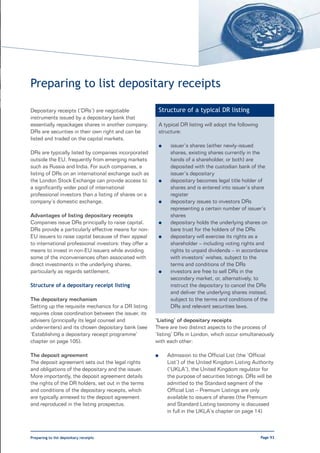
Here at the London Stock Exchange we help companies to access the
deepest pool of international capital. Premium Listed companies on the
Main Market meet the highest listing standards helping to raise their
corporate profile and increase their exposure to investors.

Learn more about the Main Market and why leading
companies choose to list on the London Stock Exchange –
www.londonstockexchange.com/mainmarket


Copyright November 2010 London Stock Exchange plc
London Stock Exchange, the coat of arms device and AIM are registered trademarks of the London Stock Exchange plc.

London Stock Exchange statistics as at end September 2010

Guidetolisting

  • 1.
    A guide tolisting on the London Stock Exchange Published by White Page Ltd in association with the London Stock Exchange, with contributions from:
  • 2.
    Publishing editor: NigelPage A guide to listing on the A guide to listing on the London Stock Exchange London Stock Exchange Publisher: Tim Dempsey is published by: © 2010 London Stock Exchange plc and White Page Ltd Design: London Stock Exchange plc White Page Ltd, 17 Bolton Street London W1J 8BH Copyright in individual chapters rests with the Printing and binding: Argent Litho Ltd United Kingdom authors. No photocopying: copyright licences Phone: + 44 20 7408 0268 do not apply. Fax: + 44 20 7408 0168 Email: mail@whitepage.co.uk This guide is written as a general guide only. It Web: www.whitepage.co.uk should not be relied upon as a substitute for specific legal or financial advice. Professional advice should always be sought before taking white page any action based on the information provided. Every effort has been made to ensure that the First published: November 2010 information in this guide is correct at the time of ISBN: 978-0-9565842-1-2 publication. The views expressed in the articles contained in this guide are those of the authors. London Stock Exchange, AIM and the coat of arms device are registered trademarks of London Stock Exchange plc. The publishers and authors stress that this publication does not purport to provide investment advice, nor do they bear the responsibility for any errors or omissions contained herein.
  • 3.
    A guide tolisting on the London Stock Exchange Contents 3 Foreword London Stock Exchange 5 The Main Market – the standard for excellence London Stock Exchange 13 The role of the UKLA The United Kingdom Listing Authority 19 Preparing for an IPO UBS Investment Bank 31 The legal framework for an IPO Freshfields Bruckhaus Deringer LLP 43 Accounting requirements and advice through the IPO process Ernst & Young LLP 57 Generating and capturing investor demand during an IPO UBS Investment Bank 69 Managing the company’s profile Fishburn Hedges 81 The role of the registrar in an IPO Capita Registrars 87 London: a unique investment opportunity FTSE Group 91 Preparing to list depositary receipts Cleary Gottlieb Steen & Hamilton LLP 105 Establishing a depositary receipt programme J.P. Morgan 116 Useful contacts
  • 4.
    A guide tolisting on the London Stock Exchange Foreword By Tracey Pierce, Director of Equity Primary Markets, London Stock Exchange With roots stretching back to the coffee houses of 17th century London, the London Stock Exchange is built on a long history of integrity, expertise and market knowledge. It has become one of the world’s largest and most international stock exchanges, playing a pivotal role in the development of global capital markets. We offer the widest choice of routes to market, which are available to both UK and international companies, and today we have close to 3,000 companies from over 70 countries listed and trading on our markets. In challenging market conditions, the London markets have proved their value by providing companies with access to capital when other funding channels have not been available. At the Exchange, we strive to build on this success by working with market regulators and the wider financial community to ensure that our markets are well-regulated, transparent, liquid and neutral. This success is underpinned by the dedicated community of advisers and investors that continues to support the companies on our markets. We understand that joining a public market is one of the most significant decisions a business will ever take; the sheer range of topics that need to be considered building up to IPO can seem like a daunting task. With this in mind, this guide has been developed with input from some of the key advisers experienced in bringing companies to our Main Market and our Professional Securities Market, providing you with a practical outline of the listing process, as well as an insight into life as a public company. I hope you find this publication useful and wish you every success, both in bringing your company to market and as a publicly-traded company. A guide to listing on the London Stock Exchange Page 3
  • 5.
    The Main Market– the standard for excellence London Stock Exchange
  • 6.
    QUOTED Whatever your company’ssize or sector, we can put you at the heart of one of the world’s most sophisticated financial communities. The Main Market is home to approximately 1,400 companies from over 60 countries, including some of the world’s most successful and dynamic organisations. So far this year £20.8 billion has been raised on the London Stock Exchange, of which £17.9 billion has been raised on the Main Market. Here at the London Stock Exchange we help companies to access the deepest pool of international capital. Premium Listed companies on the Main Market meet the highest listing standards helping to raise their corporate profile and increase their exposure to investors. Learn more about the Main Market and why leading companies choose to list on the London Stock Exchange – www.londonstockexchange.com/mainmarket Copyright November 2010 London Stock Exchange plc London Stock Exchange, the coat of arms device and AIM are registered trademarks of the London Stock Exchange plc. London Stock Exchange statistics as at end September 2010
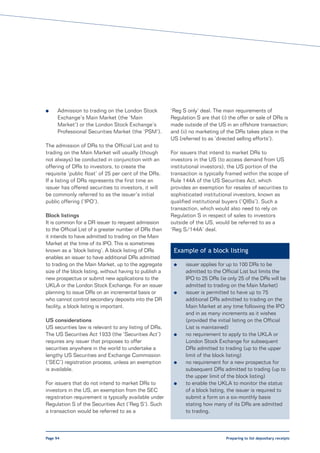
  • 7.
    The Main Market– the standard for excellence Established in 1698, the London Stock Exchange’s Why join a public market…? (the ‘Exchange’) Main Market has long been home Joining a public market – the Main Market or AIM to some of the UK’s, and indeed the world’s, (our market for smaller, growing companies) – is a largest and best-known companies. There are over way to grow and enhance your business. When 1,400 companies on the Main Market with a considering the available financing options, the combined market capitalisation of £3.7 trillion. following factors are frequently cited as the key Companies of all types, nationalities and sizes benefits of admission to a public market: together represent some 40 sectors. l providing access to capital for growth, As well as sectoral and geographical diversity, the enabling companies to raise finance for Main Market accommodates the admission to further development, both at the time of trading of companies with a Premium Listing or a admission and through further capital Standard Listing. The FSA’s listing categories are raisings described in detail in the chapter ‘The role of the l creating a market for the company’s shares, UK Listing Authority’ on page 13. broadening the shareholder base l placing an objective market value on the A listing on the Main Market demonstrates a company’s business commitment to high standards and provides l encouraging employees’ commitment and companies with the means to access capital from incentivising their long-term motivation and the widest set of investors. Over the last 10 years, performance, by making share schemes £366 billion has been raised through new and more attractive further issues by Main Market companies – capital l increasing the company’s ability to make that has seen companies through the good times acquisitions, using quoted shares as and the bad. currency Joining the Main Market Responsibility for the approval of prospectuses and admission of companies to the Official List lies with the UK Listing Authority (UKLA). The Exchange is responsible for the admission to trading of companies to the Main Market. Joining the Main Market consequently involves two applications: one to the UKLA and one to the Exchange. UKLA admits securities to London Stock Exchange the Official List admits securities to trading on the Main Market Official List notice issued Admission to trading notice to the market issued to the market The Main Market – the standard for excellence Page 7
  • 8.
    l creating a heightened public profile – A respected and balanced regulatory stemming from increased press coverage and environment analysts’ reports – helping to maintain The UKLA’s listing framework underpins London’s liquidity in the company’s shares reputation for balanced and globally-respected l enhancing the company’s status with standards of regulation and corporate governance. customers and suppliers. Regulatory requirements in London are principles- based and provide an appropriate balance of Companies that choose to seek admission to a investor protection, practitioner certainty and public market in London have a range of options flexibility. The Exchange aims to be involved in all depending on their size, stage of development and relevant processes where amendments or capital-raising requirements. The options open to additions to the regulatory framework are companies should be discussed in detail with their considered. This is to ensure that London’s team of advisers. competitive advantage remains undiminished; that listings and subsequent capital raisings are cost- Companies which are successful on AIM and reach effective and efficient for our companies; and that a certain size and stage of development, may seek investors have the appropriate amount of to transfer their securities from AIM to the Main information to make informed investment Market, provided that they meet the eligibility decisions. criteria. While a move to the Main Market may subject the company to increased regulatory Choice requirements, it can bring benefits in terms of a Companies with either a Premium or a Standard heightened profile and attracting different Listing can choose to admit to trading on the Main investors. Market. …and why the Main Market? A Premium Listing means that a company must meet standards that are over and above (often The success of the Main Market is built on a wide described as ‘super-equivalent’) those set forth in range of factors: the EU legislation, including the UK’s corporate governance code. Investors trust the super- l a respected and balanced regulatory equivalent standards as they provide them with environment additional protections. By virtue of these higher l choice standards, companies may have access to a l access to capital from a broad and broader range of investors and may enjoy a lower knowledgeable investor base cost of capital owing to heightened shareholder l expert advisory community confidence. A Premium Listing is only available to l enhanced profile and status. equity shares issued by commercial trading companies. The Main Market has attracted companies of all sizes and from all sectors over many years. With a Standard Listing, a company has to meet Irrespective of their sector, origin or strategic the requirements laid down by EU legislation. This direction, they have all sought to take advantage means that their overall compliance burden will be of the range of benefits a listing on the Main lighter, both in terms of preparing for listing and Market affords. Those benefits include: on an ongoing basis. Standard Listings cover the issuance of shares and Depositary Receipts Page 8 The Main Market – the standard for excellence
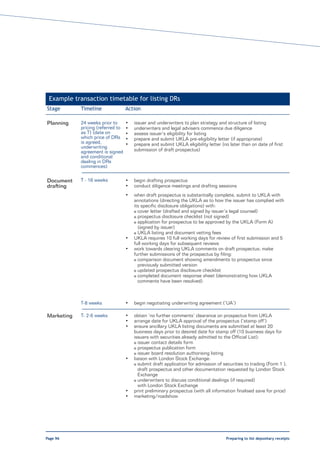
  • 9.
    (‘DRs’) as wellas a range of other securities, Underpinning the Main Market is a network of including fixed-income. Large companies from experienced advisers who will guide you on the emerging markets may wish to list their DRs, thus journey to an initial public offering (‘IPO’) and attracting investment from the significant provide ongoing advice once your company is international pool of capital available in London. listed. (A table showing the key differences between a Premium Listing and a Standard Listing can be Selecting the right advisers for you and your found in the chapter ‘The role of the UK Listing company is vital. Getting it right early on will help Authority’ on page 18). ensure that disruptions to the process are minimised and you are able to get on with the task In this guide, the chapters ‘Preparing to list at hand. Factors to consider when appointing depositary receipts’ and ‘Establishing a depositary advisers include the firm’s relevant and recent receipt programme’ are dedicated to the listing experience in relation to your business and the and admission to trading of DRs on both the Main sector you operate in, as well as the personal Market and the Professional Securities Market rapport you develop with the individuals with whom (‘PSM’). The PSM provides an alternative route to you will be working. a listing on the Exchange for issuers of DRs. The diagram on page 10 below shows the different Access to capital advisers typically involved in a flotation on the We provide access to the largest pool of Main Market and briefly highlights their varying international equity assets in the world. This roles and responsibilities. culture is embedded in London’s investment management community, which understands Profile companies from home and abroad and wants to Floating a company on the Main Market raises invest in the global economy. your company’s profile and helps you to meet your strategic objectives. You will have the opportunity Once they are listed and admitted to trading on to project your company onto a global stage with the Main Market, companies should not increased media coverage, investor interest and underestimate the value of being able to return to broad analyst coverage. the market to raise funds through further issues. Even during the recent difficult market conditions, With a Premium Listing comes the potential for the Exchange successfully facilitated significant inclusion in the FTSE UK series of indices which levels of capital raising. Further issues by Main includes the FTSE 100, FTSE 250 and FTSE Market companies provided capital injections that Small Cap indices. Access to these indices is were used to pay off debt, rebuild balance sheets often seen as one of the key benefits of achieving and fund further growth. a Premium Listing since so many investment mandates – particularly in respect of the vast Expert advisory community amount of capital represented by tracker funds – The decision to join the Main Market is a pivotal are driven by FTSE indexation. For more one. To achieve a successful listing and admission information see chapter ‘London: a unique to trading, companies must deliberate over many investment opportunity’ on page 87. considerations. Our commitment to the primary markets There is a continuous stream of proposed regulatory The Main Market – the standard for excellence Page 9
  • 10.
    Advisers’ roles andresponsibilities Sponsor Bookrunner • Overall co-ordination and project • Prepare company for roadshow management of IPO process • Facilitate research • Co-ordination of due diligence and prospectus • Build the book pre-float • Ensure compliance with applicable rules • Marketing and distribution • Develop investment case, valuation and • Pricing and allocation offer structure • Manage communication with LSE and UKLA • Act as adviser to the company’s board • Ongoing support/advice after flotation Lawyers • Legal due diligence Other advisers • Registrars THE COMPANY • Draft and verification of prospectus • Corporate restructuring • Financial printers • Provide legal opinions • Remuneration consultants Financial PR Reporting accountant • Develop communication strategy • Review financials – assess company’s to support pre-IPO process readiness for IPO • Enhance market perceptions to • Tax structuring develop liquidity and support • Financial due diligence - long form, share price short form and working capital reports • Pre- and post-IPO press releases changes affecting companies on our markets, with Once you are listed on the market, we are legislation stemming from changes here in the UK committed to helping you raise your profile and and in Brussels. With companies’ best interests keeping you abreast of market developments. We front of mind, we continue to lobby on their behalf help to do this through the provision of brand marks to ensure our markets are fit for purpose. It is (see page 11); a dedicated page on our website crucial that through our lobbying we continue to specific to your company (including latest news and promote a regulatory regime based on principles, pricing information on the trading of your seeking to limit disproportionate legislation securities); educational initiatives, such as seminars applicable to issuers that are admitted to trading on and practical guides; and investor-focused events our markets, while ensuring sufficient investor such as capital markets days that bring companies protection. and investors together. Page 10 The Main Market – the standard for excellence
  • 11.
    Main Market brandmarks LISTED LISTED LISTED STANDARD PREMIUM STANDARD SHARES DEPOSITARY RECEIPTS These brand marks are provided exclusively to companies listed on the Main Market. Companies may use the brand mark across corporate and investor relations materials to showcase their association with the London Stock Exchange and provide information as to their listing status. More information is available on the Exchange’s website: www.londonstockexchange.com/brandmarks And finally… Listing and admission to trading on the Main Market is an efficient way for companies to access capital to fund their growth, while simultaneously benefiting from enhanced profile and liquidity within a well-governed and regulated market structure. As an ambitious company with plans to take your business to the next level, joining the Main Market is an ideal way to assist you in realising your global aspirations. The Main Market – the standard for excellence Page 11
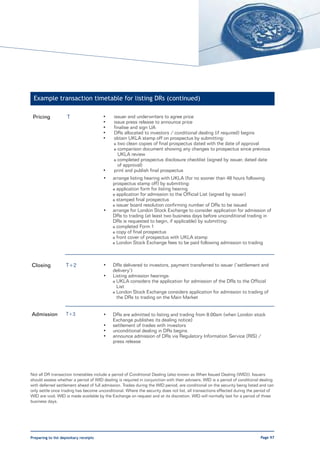
  • 12.
    The role ofthe UK Listing Authority UKLA
  • 13.
    The role ofthe UK Listing Authority The UK Listing Authority (‘UKLA’) is the name As a consequence, when a company wishes to used by the Financial Services Authority (‘FSA’) make an initial public offering (‘IPO’) of its when it acts as competent authority for listing, as securities onto a regulated market such as the competent authority for the purposes of the Main Market of the London Stock Exchange, the European Prospectus and Transparency Directives, UKLA has two principal roles to perform: to review and as competent authority for certain aspects of and approve the issuer’s prospectus, and to admit the Market Abuse Directive. These roles have a those securities to listing once it is happy that the statutory basis in Part VI of the Financial Services issuer complies with all relevant eligibility criteria. and Markets Act 2000 (‘FSMA’). Three sourcebooks in the FSA Handbook implement the Listing categories relevant rules. These are: The term ‘listed’ is used in a number of different contexts, but in the UK this technically means l Listing Rules – these rules include the admitted to the Official List of the UKLA. The eligibility requirements for admission to the UKLA has created a number of different listing Official List (or ‘listing’) and the continuing categories which determine the eligibility criteria obligations that apply thereafter. They come and continuing obligations that apply to the issuer partly from the European Consolidated and its securities. Admissions and Reporting Directive, but also include a significant body of rules that are The UKLA introduced the listing categories to help ‘super-equivalent’ or additional to the clarify that listing refers to admission to the European minimum requirements. These Official List of the UKLA, and does not relate to additional requirements include substantive the market to which a security is admitted to eligibility requirements such as the need for a trading. Listing categories are also intended to three-year track record, the class test and clarify the regulatory standards that apply to related party regimes, and the requirement different types of listing. A Standard Listing for a sponsor in relation to a Premium Listing. requires compliance only with EU minimum l Prospectus Rules – these rules stem standards, whilst a Premium Listing also requires primarily from the enactment of the European compliance with the more stringent super- Prospectus Directive and detail the equivalent standards. Note that only equity shares circumstances when a prospectus is required may be admitted to a Premium Listing; issuers of and the disclosures a prospectus should other securities may only seek a Standard Listing include. for their securities. A table showing the key l Disclosure and Transparency Rules (‘DTRs’) differences between Premium and Standard – these rules govern the periodic and ad hoc Listings can be found on page 18. disclosure of information by listed companies. Periodic information includes interim and Eligibility annual accounts, and ad hoc disclosures, An issuer will generally select its preferred market including major shareholding notifications and and listing category in consultation with its details of significant developments that might advisers prior to engagement with the UKLA. For affect the price of the securities. These rules issuers requesting a Premium Listing of their originate from the Transparency Directive and equity shares, contact with the UKLA will be part of the Market Abuse Directive, and also undertaken by the issuer’s appointed sponsor firm. from the 4th/7th Company Law Directives. The role of a sponsor is to guide the issuer on the application of the Listing Rules and the Prospectus Page 14 The role of the UKLA
  • 14.
    Listing segment Premium Standard Listing Equity Equity Equity Shares GDRs Debt & Securitised Misc. category shares shares shares debt-like derivatives securities Debt Commercial Closed- Open- Equity Options Examples of companies ended ended shares* securities types of investment investment Asset-backed Subscription funds companies Non-equity securities warrants companies/ shares Convertible securities securities - Preference shares (specialist securities) Listing Rule LR6 LR15 LR16 LR14 LR18 LR17 LR19 LR20 chapter * an investment entity will only be able to benefit from this Standard Listing category for a further class of equity shares if it already has (and only for so long as it maintains) a Premium Listing of a class of its equity shares Rules. This includes liaison with the UKLA on requirements. The UKLA suggests that such behalf of the issuer, and to provide certain letters are sent in as early as possible in the IPO declarations to the UKLA that provide comfort process and that they are as detailed as possible, that the relevant rules have been complied with including relevant background information on the and the issuer has established appropriate nature of the issuer’s business. This is because procedures. unnecessary delay can be caused to the timetable where significant eligibility concerns arise late in The UKLA maintains a list of approved sponsors the IPO process. and conducts supervisory activities in order to ensure that the list of sponsors contains only those Issuers seeking a Premium Listing of equity shares firms that meet the eligibility criteria for a sponsor. will be required to comply with the more For issuers that are seeking a Standard Listing, the substantive eligibility requirements that are UKLA has no preference as to whom the main imposed by the super-equivalent parts of the point of contact should be, although it should be Listing Rules, in addition to those requirements in someone that is reasonably knowledgeable about the Listing Rules based entirely on EU law. For the UKLA and its processes. commercial companies, these additional requirements include the requirement for a clean To start the eligibility process, the UKLA generally three-year track record of operations, and the expects that a letter is submitted detailing the requirement for a clean working capital statement issuer’s compliance with the applicable eligibility for at least the next 12 months. For investment The role of the UKLA Page 15
  • 15.
    entities, these requirementsinclude an additional The prospectus can be published once it has been degree of regulation in relation to the corporate formally approved by the UKLA. The actual timing governance of the issuer. Overseas issuers wishing of that approval will depend on the issuer’s choice to comply only with the minimum standards applied of issuance method – for example, if the issuance by the EU Directives can apply for a Standard involves a retail offering then approval and Listing of either equity shares or GDRs. The UKLA publication must occur sufficiently in advance of has recently also extended the Standard Listing the beginning of the offer. A prospectus relating category to UK issuers of equity shares which only to an introduction where no offer to the public could previously only have had a Premium is made may be approved as little as 48 hours prior (formerly ‘Primary’) Listing. to admission to listing. Prospectus review and approval Listing Particulars An admission of securities onto the Official List Although no prospectus is required for the and the Main Market of the London Stock admission of securities to unregulated markets Exchange requires the production of an approved such as the Professional Securities Market (the prospectus. As the UKLA is the UK’s competent ‘PSM’), the UKLA does require Listing Particulars authority for the purposes of the Prospectus for the admission of those securities to listing on Directive, it typically approves prospectuses the Official List. In these cases, the process for produced during an IPO. reviewing the document, and the content requirements, are very similar to the requirements Although final confirmation of an issuer’s eligibility for a prospectus. The principal difference is that can only be given once its prospectus has been the financial information in a prospectus must be approved, the UKLA will generally try to resolve prepared in accordance with IFRS or an any major eligibility issues prior to starting its equivalent GAAP. In the case of Listing review of an issuer’s prospectus. This review Particulars where securities are to be admitted to involves an iterative process of reviewing and the PSM, the financial information can be commenting on drafts of the prospectus until the prepared in accordance with local standards. UKLA is satisfied that all applicable rules have been complied with. The number of drafts Passporting necessary to reach this point will depend on the An overseas issuer may also seek to passport onto complexity of the issues and the quality of the a UK-regulated market, using a prospectus that submissions. By way of example, many large IPOs has been approved by another competent can involve the review of five or more substantive authority. Although in these circumstances the drafts for one reason or another. UKLA will rely upon the passport to satisfy the requirement for an approved prospectus, it will still The UKLA seeks to comply with its published separately assess the issuer against the relevant service standards for the document review and eligibility requirements. As part of this process, the approval process, and aims to provide comments UKLA reviews the issuer’s proposed prospectus to on an initial draft of a new applicant prospectus help in its assessment of eligibility, so again the within 10 working days, and comments on each UKLA recommends that an issuer makes contact subsequent draft within five working days. On sufficiently early in the process, and certainly average, the review and approval of a prospectus before the prospectus has been approved by the takes around 6-8 weeks for an IPO. home competent authority. Page 16 The role of the UKLA
  • 16.
    Post-IPO interaction withthe UKLA l Timetables – the UKLA staff (or ‘readers’) l DTRs – a listed issuer must comply with the allocated to a particular case will typically be DTRs on an ongoing basis, as failure to working on a large number of transactions at comply with these rules may result in the any one time. Whilst the UKLA makes every suspension of the listing of its securities. The effort to accommodate tight timetables it UKLA has a team dedicated to monitoring cannot deal with every issue immediately or issuers’ compliance with the DTRs, and to meet unrealistic timetables. Complex issues providing guidance on these rules on a real- will need time for proper consideration prior time basis. to resolution and therefore the UKLA always l Prospectus requirements – if the issuer advises that such issues should be brought to seeks admission of further securities of the its attention as early as possible. same class it will be required to produce a l Helpdesks – the UKLA offers several prospectus, unless an exemption applies. different helpdesks to provide guidance on Exemptions include, among other things, the the Listing Rules, Prospectus Rules, and the issue of shares under employee share DTRs. This enables complex issues to be schemes and bonus issues. The UKLA would discussed and agreed prior to the submission typically be required to approve any future of documents, or in relation to significant prospectus. transactions (Tel: +44 (0)20 7066 8333). l Significant transactions – if the issuer has a Premium Listing of its equity shares, it will be required to consider whether any significant transaction that it undertakes will need announcement or, if it is of sufficient size, shareholder approval. Lower size thresholds are applied if the transaction is being undertaken with a related party such as a director or substantial shareholder. The Listing Rules include rules governing the disclosure requirements in circulars where shareholder approval is sought, and also clarify which circulars require UKLA approval. The role of the UKLA Page 17
  • 17.
    A summary ofthe key differences between Premium and Standard listings Premium – Standard – Standard – Key eligibility criteria Equity Shares Shares Depositary Receipts Free float 25% 25% 25% Audited historical financial Three years or such Three years or such Three years information shorter period shorter period 75 per cent of applicant’s business supported by revenue- Required n/a n/a earning record for the three-year period Control over majority of the Required n/a n/a assets for the three-year period Requirement for clean Required n/a n/a working capital statement Sponsor Required n/a n/a Key continuing obligations Free float 25% 25% 25% Annual financial report Required Required Required Half-yearly financial report Required Required n/a Interim management statements Required Required n/a EU-IFRS or equivalent Required Required Required UK Corporate Governance Code Comply or explain n/a n/a Model Code Applies n/a n/a As required by relevant Pre-emption rights Required n/a company law Significant transaction Rules apply n/a n/a (‘Class tests’) Related-party transactions Rules apply n/a n/a 75 per cent No shareholder No shareholder Cancellation shareholder approval approval required approval required required This list is not exhaustive and should be read in conjunction with the FSA Handbook (Listing Rules, Prospectus Rules and Disclosure & Transparency Rules). Page 18 The role of the UKLA
  • 18.
    Preparing for anIPO John Woolland and David Seal UBS Investment Bank
  • 19.
    Advertisement Personal wealth management At UBS WealthManagement we Drawing on the expertise of the UBS opportunities, blending traditional asset classes with private equity, hedge funds, commodities and real estate (where suitable to the client). UBS provides brokerage services, foreign exchange execution and strategy, collateral backed lending and whole-of- market advice. Where there is a need for provides advice on structuring personal Most people who IPO a business want and corporate assets, pensions options to realise part of the value in cash. A and succession planning, with full back- higher proportion of their assets may up at every stage of life. now be in stocks or shares. Early wealth management advice can help the owners For more information about UBS Wealth extract and maximise the value of the Management please contact Michael investments they have built up. Bishop on +44-20-7568 9587. www.ubs.com/uk
  • 20.
    Preparing for anIPO Initial public offerings (‘IPOs’) are among the most allowed to list on a market. Unsurprisingly, a challenging transactions that a business can number of the UKLA’s requirements coincide with undertake. The decision on whether to list a the attributes which investors are looking for in a company’s shares on a public market is a company. The precise regulatory requirements are significant one; obtaining a public quote is a major covered in the chapter ‘The legal framework for an milestone in any company’s life. The process of IPO’ on page 31. Areas such as a demonstrable going public is time-consuming, but it is an trading record and appropriately experienced opportunity for a company to critically examine directors clearly help to satisfy both the regulators itself. A company, its management and its owners and the potential shareholders. Ultimately, the are likely to be in the public eye to a much greater ability to meet the market’s commercial extent than before. expectations is crucial. A company’s decision to launch an IPO must be For management and owners, an IPO may also based on a realistic assessment of its business, its crystallise the need to examine their tax planning management resources, its stage of development and personal wealth management. This should be and its prospects. Public ownership offers addressed early to avoid distraction during the significant advantages, such as access to the final, and often hectic, few weeks of the IPO public equity and debt markets to finance growth process. and strengthen a company’s financial position, as well as the creation of an open market for a Pre-IPO preparation company’s shares. However, a company will face Businesses often begin their preparations for heightened scrutiny and greater demands on its becoming public companies well before they launch management. the IPO process. Typically, pre-IPO preparations take four to six months, but they can take Planning is a key element in any IPO. In order to considerably longer. Advance preparation is a key avoid unnecessary delays and distraction, which success factor that allows for a smooth and could be costly, management should evaluate in efficient execution process and the ability to take detail how it will commit adequate resources to advantage of market windows. meet the pressing deadlines of an IPO process. Management team The run-up to a company seeking a listing on the A company’s management team will need to Main Market can be broadly divided into two explain the business, its strategy and prospects to phases – pre-IPO preparation and the IPO process investors, and demonstrate knowledge of the itself. Pre-IPO preparation includes the critical sector, as well as its challenges, in order to gain review of a company’s business plan and growth the support and confidence of the market. The prospects, assessing the management team, directors of a company will be accountable to its appointing an appropriate board, tightening new and existing shareholders for the performance internal controls, improving operational efficiency of the business when it is a public company. and resolving issues that may adversely affect the Therefore, as a company prepares for its IPO it listing early on. may need to ensure that its management has sufficient depth and breadth. The United Kingdom Listing Authority’s (‘UKLA’) Listing Rules set the specific regulatory Business plan requirements that a company has to meet to be For the purposes of an IPO, a company needs a Preparing for an IPO Page 21
  • 21.
    comprehensive business planthat sets out its existing shareholders (a primary offering) products, markets, competitive environment, l existing shareholders selling their shares to strategy, capabilities and growth objectives. new or other existing shareholders, ie no Companies engaging in successful IPOs tend to additional capital is raised for the business (a have a clearly defined vision for the future secondary offering); or performance of the business that can be l a combination of both. articulated credibly, clearly and quantifiably. If existing shareholders intend to sell in the IPO, it Companies that are in mature or shrinking is helpful to know the likely quantum early so that industries, operate within small markets, or the IPO can be planned accordingly. provide a narrow range of products to a small and highly specialised customer base may be Use of proceeds unsuitable for an IPO. If a company is raising new capital, the use of proceeds should be clearly articulated and in line Financial performance with its strategy. In many cases, the proceeds will A company should expect to show investors a be used to either pay down debt, fund capital consistent pattern of top- and bottom-line growth investment or to provide working capital for and a sound balance sheet post-IPO. For a company expansion. seeking a Premium Listing, its financial statements need to adhere to International Financial Reporting In determining the quantum of new capital, a Standards (‘IFRS’). Further technical requirements company needs to consider its future capital of the financial information required to be included structure and its ability to pay dividends at an in a prospectus are covered in the chapter appropriate level. ‘Accounting requirements and advice through the IPO process’ on page 43. Financial controls The market expects companies to have proper Growth prospects financial controls in place. In addition, the UKLA Before investing in a company, most investors requires the sponsor to provide written want to feel confident about its future growth confirmation of the adequacy of a company’s prospects. A company should develop a financial financial controls. Companies contemplating a model that quantifies its business plan and listing will therefore need to ensure that they have expected growth. The sponsor (see page 26) may systems in place to ensure a flow of accurate, work closely with management and external timely information. consultants/experts to develop this model and will conduct due diligence on the assumptions behind Board the model and stress-test the projections. A public company needs to satisfy corporate governance requirements. The principles are set Raising funds? out in the UK Corporate Governance Code (the The majority of listings take place with a ’Code’) and a company is required to comply with simultaneous share offering to investors. This can the Code, or explain why it has not, in its take the form of: prospectus. It is typically necessary to appoint new members to the board who are independent and to l raising additional capital for the business by form new committees (eg audit and remuneration). issuing new shares in a company to new and Identifying suitable candidates can take a Page 22 Preparing for an IPO
  • 22.
    significant amount oftime. Potential directors an IPO is an opportunity to realise or transfer part often want to be involved in the IPO process at an of their wealth. Early planning of their personal tax early stage. The sponsor frequently assists in the and financial affairs is advisable to avoid delay or recruitment and assessment of potential board difficulty in the final stages of an IPO. members for a company seeking a listing. Controlling shareholders Group reorganisation Potential investors may be influenced, negatively The reorganisation steps undertaken in preparation or positively, by the presence of a controlling for an IPO will vary, depending on the existing and shareholder. A company should assess what will intended group structure. One of the key steps is happen with such shareholders post an IPO, ie determining the jurisdiction of incorporation of the whether they will sell down some or all of their listing entity. At IPO it is essential to ensure that holdings, continue to have board representation or the group holds all assets, intellectual property and maintain veto rights on certain company decisions. contractual rights necessary to carry on its In most situations, any special rights will be business operations. Part of the group unwound and, where appropriate, a relationship reorganisation may involve their transfer where agreement may be entered into as part of the IPO they are currently held by related parties outside process to avoid potential future conflicts of of the group. interest. Change may be necessary to optimise a group’s Related-party transactions tax position, or to remove businesses or assets Any internal transactions, compensation that are not part of the group to be floated. For arrangements and relationships involving example, company-owned horses, boats and so on management or the board that might be are unlikely to be appropriate for a quoted appropriate for a private company but improper for company. a public company must be eliminated. A company should therefore consider whether any outside Determine employee and management affiliations will be negatively perceived by the compensation and incentive plans market. As part of the IPO process, many companies review the amount of equity owned by their top Investor relations (‘IR’) executives and employees. Additional equity IR is the term used to describe the ongoing activity options or other incentives at the IPO may be of companies communicating with the investment granted to increase management and employee community. While the communication that public ownership and to align incentives from the IPO companies undertake is a mix of regulatory and with a company’s new investors. Remuneration voluntary activities, IR is essentially the part of consultants can advise on the structure of any public life that sees companies interacting with schemes, as well as trends in the appropriate existing shareholders, potential investors, research industry. The recommendations should be analysts and journalists. Larger companies reviewed by the sponsor and bookrunner(s) to frequently create a separate IR function to meet ensure that the awards are in line with market the demands for information and to assist in all expectations. communications with the market. Please refer to the chapter ‘Managing the company’s profile’ on Wealth management and financial planning page 69 for more detail on this topic. For many managers and owners of a business, Preparing for an IPO Page 23
  • 23.
    IPO timetable Private execution phase Week 1 2 3 4 5 6 7 Process Execution kick-off meeting ⧫ Weekly meeting/conference calls ⧫ ⧫ ⧫ ⧫ ⧫ ⧫ Due diligence Long form report Preparation of audited numbers Valuation and capital structure Forecasts finalised ⧫ Working capital report Valuation discussion Capital structure discussions Agree offer size Documentation Draft prospectus Prospectus filed with UKLA ⧫ UKLA review prospectus Publish pathfinder prospectus Publish final prospectus Preparation of placing agreement Auditors’ comfort letters Marketing and roadshows PR process Analysts pres’n prepared and delivered Research prepared and reviewed Prepare and rehearse roadshow Announce intention to float Publish research Pre-marketing Price range set Roadshow Bookbuilding Pricing/allocation Settlement and closing Stabilisation Week 1 2 3 4 5 6 7 Active IPO execution Page 24 Preparing for an IPO
  • 24.
    Public execution phase 8 9 10 11 12 13 14 15 16 17 ⧫ ⧫ ⧫ ⧫ ⧫ ⧫ ⧫ ⧫ ⧫ ⧫ ⧫ ⧫ ⧫ ⧫ ⧫ ⧫ +30 days 8 9 10 11 12 13 14 15 16 17 Active IPO execution Preparing for an IPO Page 25
  • 25.
    IPO process Private phase Public phase Preparation Preliminary Analyst Investor Bookbuilding Aftermarket of the IPO valuation presentation education • Appoint all • Set initial • Preparations at • Announcement • Management • Admission advisers valuation range advanced stage of intention to roadshow float (’AITF’) • Stabilisation • Kick-off meeting/ • Existing • Due diligence • One-on-one weekly meetings shareholder views substantially • Publication of meetings • Research on price, complete research • Due diligence size, structure • Analyse demand • Investor relations • Analyst briefing • Target • Prepare key investors • Continuing prospectus and obligations other legal • Monitor market documents • Analyse feedback • Develop investment case • Refine size, valuation • Corporate housekeeping Ensure basic Decide to proceed Decide to proceed Decide to launch Price, sign placing preparedness of with analyst with pre-marketing (size, price range agreement and Life as a Plc company for the IPO presentation decision) allocate Key objectives High-quality Stable, rising Liquid trading IPO price maximised shareholder base aftermarket and quality research coverage The IPO Process extended period. Since acting as a sponsor requires The IPO process involves both a private and public a high degree of commitment, the appointment phase (see ‘IPO Process’ chart above). process is often ‘two-way’. Hence, the sponsor will also want fully to understand a company’s business Private phase before agreeing to take on the listing. Select the sponsor The sponsor has responsibilities both to the A company seeking a listing is required to appoint a company and to the UKLA. For example, the sponsor. The sponsor leads a company’s team of sponsor is required to submit an eligibility letter to professional advisers and coordinates their roles to the UKLA setting out how the company satisfies a ensure a company successfully completes the listing number of the Listing Rules. The sponsor is also process. A full list of approved sponsors and their obliged to consider whether “the admission of the contact details is available on the Financial Services equity shares would be detrimental to investors’ Authority (‘FSA’) website: www.fsa.gov.uk interests”. Often, companies approach the appointment of Appointment of other professional advisers advisers by holding ‘beauty parades’ with a series In addition to the sponsor, a company needs to of sponsors, asking each about their expertise, assemble a number of other advisers to guide it experience and fees, and getting a feeling for what through the process. This includes the it would be like to work closely with them over an bookrunner(s), lawyers (one firm advising the Page 26 Preparing for an IPO
  • 26.
    company and anotherfirm to advise the sessions will take place on various sections of the sponsor/bookrunner(s)), accountants, financial document. From a marketing perspective, the public relations advisers, remuneration prospectus outlines a company’s strengths, consultants, registrars and financial printers. strategy and market opportunity. The precise areas Experts in valuations or sector consultants may that must be covered in a prospectus, such as the also be appointed. inclusion of risks relating to a company, are covered in the chapter ‘The legal framework for an IPO timetable IPO’ on page 31. See ‘IPO timetable’ chart on pages 24 and 25. The sponsor is responsible for submitting drafts of An IPO can generally be completed within 15 to 20 the prospectus to the UKLA. The UKLA is allowed weeks. The exact timetable will vary depending on 10 business days after the first submission to market conditions, the scope and complexity of the respond to the sponsor with a comment sheet. The deal and a range of other factors. company and its advisers will then revise the prospectus so that the sponsor can submit an Kick-off meeting updated draft with the UKLA for a further review. A kick-off meeting is usually held in person and For the second and subsequent drafts, the UKLA involves discussions to make sure that the working responds via its comment sheet within five business group fully understands the structure of the days. As every transaction is unique, it is impossible transaction, the process, timetable and all other to predict exactly how long this process will take. relevant issues. The sponsor will usually provide a However, as a rule, the timeframe is approximately detailed organisation book that goes through all six to eight weeks from initial submission of the these issues in detail. prospectus to the UKLA (approximately three to four submissions) to preliminary approval ahead of Weekly meetings launching the transaction, often with a Pathfinder In order to ensure that the process remains on prospectus (see page 29). track, the sponsor is likely to organise weekly meetings/conference calls. These meetings give Due diligence an opportunity for all parties to be kept fully up to The overall purpose of due diligence is to ensure date on the process and for any key issues to be the accuracy, truthfulness and completeness of a raised. company’s prospectus, and to understand any issues associated with the company. While each Prospectus – UKLA process professional adviser performs a different role in Before a company can be listed, the sponsor must this process, the sponsor/bookrunner(s) will focus get a company’s prospectus approved by the on the diligence of a company’s operations, UKLA. Although the prospectus is a legal management, financial prospects, historical document, it is also a marketing tool to help to sell performance, competitive position and business shares to potential investors. A company’s lawyers strategy. The advisers will also look closely at usually take the primary responsibility for drafting factors such as a company’s suppliers, customers, the prospectus although the creditors and anything else that might have a sponsor/bookrunner(s) assist a company in bearing on the offering or viability of a company as crafting the appropriate marketing story. The a public company and on the accuracy and drafting of the prospectus takes several weeks and completeness of the prospectus. will involve all advisers. A number of drafting Preparing for an IPO Page 27
  • 27.
    Due diligence comprisesmany interrelated l litigation processes. Business due diligence is conducted l compliance with laws and regulations mainly by the sponsor and bookrunner(s) and is l title to principal assets designed to verify a company’s business strategy l corporate structure and potential for future growth. As part of the l debt covenants information and fact-gathering process, the l environmental issues sponsor/bookrunner(s) may conduct onsite l intellectual property. inspections, particularly for manufacturing and property-intensive businesses. They may also Legal restructuring, documentation and interview company officials, suppliers and agreements customers to understand fully every aspect of a During this stage, a company’s management, company’s business and its financial statements. sponsor and lawyers work together to draft the The knowledge obtained will later help the necessary legal documentation and implement any sponsor/bookrunner(s) and management to craft a required corporate restructuring. The collective strong, consistent message that can be used purpose of these documents is to assure investors during the marketing process. and regulators that the IPO has been objectively vetted for gaps, irregularities, misleading Financial due diligence is geared toward confirming statements and other potential problems. The a company’s historical financial results and documents include: understanding its operational and financial prospects. Key areas of focus include: l the placing agreement (if funds are being raised) l audited and interim financial statements l comfort letters l capital structure l legal opinions l breakdown of historical financials by business l lock-up agreements. l detailed review of budgets l meetings with auditors Continue to prepare a company to become a l budget versus actual financial statements public company l accounting policies and auditor management The sponsor/bookrunner(s) will assist a company letters on a number of matters critical to its l use of proceeds transformation into a public entity. These include: l financial control systems l working capital requirements l discussion of valuation l debt covenants. l development of investment case l the composition of the board and its The financial due diligence workstreams are committees covered in more detail in the chapter: ‘Accounting l internal controls requirements and advice through the IPO process’ l prevailing market conditions. on page 43. Marketing strategy Legal due diligence is conducted by the solicitors The bookrunner(s) and sponsor will set up a and is the process of verifying a company’s legal comprehensive marketing plan to target specific records, material contracts and litigation. Key investors. areas of focus include: Page 28 Preparing for an IPO
  • 28.
    Analyst presentation It iscommon practice for senior management to Considerations for overseas companies meet with the research analysts employed by the For inclusion in the FTSE UK Index Series, it is bookrunner(s) before the IPO and for such important for overseas companies to note that: analysts to publish pre-deal research on a company before the start of the roadshow. To l a company not incorporated in the UK will be prepare fully for the presentation, several required to publicly acknowledge adherence meetings and rehearsals with senior management to the principles of the UK Corporate are usually required. Material information must be Governance Code, pre-emption rights and the included in the prospectus, but considerable UK Takeover Code, as far as is practical; and additional information will be provided to the l a company not incorporated in the UK must analysts to ensure a full understanding of a have a free float of not less than 50 per cent. company’s business and sector. Details in relation to the FTSE UK Index Series Public phase are covered in the chapter: ’London: a unique The main components of the marketing process investment opportunity’ on page 87. are outlined below and explained at greater length in the chapter: ‘Generating and capturing investor investors using the research they have written. demand during an IPO’ on page 57. This takes place on larger IPOs and is in advance of the management roadshow. Announcement of Intention to Float (‘AITF’) The first time that a company provides specific Management roadshow presentation confirmation of its IPO plans is in a public The management roadshow is a series of announcement known as the AITF. At this stage meetings with potential investors. It typically the marketing process begins in earnest, often includes a formal presentation by the CEO and with publication of research by analysts connected CFO outlining the company’s business to the bookrunner(s). Larger companies are likely operations, financial results, performance, to have a carefully developed media PR campaign markets, products and services. As with the to promote knowledge of the business and analyst presentation, the role of the management to the media. sponsor/bookrunner(s) in this workstream includes assisting a company in the preparation Pathfinder prospectus of the presentation and organising rehearsals. At this stage in the process, a draft prospectus (also referred to as a Pathfinder prospectus) is Completion and pricing meeting often made available to prospective investors. This Following the management roadshow and the document is an almost final version of the pricing of the IPO, a completion meeting takes prospectus. Apart from details of the precise size place where all relevant documents and paperwork of the IPO and the subscription price of the new are reviewed in their final form by both the shares to be offered (which are unlikely to be directors and their advisers. The exchange of new finalised at this stage), it should include all other shares for funds typically occurs three business relevant details. days after pricing. During this three-day period, the shares may trade on a ‘when issued’ basis, Investor education meaning that the bargains are not settled until the Investor education is the process whereby the listing becomes effective. analyst(s) referred to above market the story to Preparing for an IPO Page 29
  • 29.
    Impact Day companies and certain financial companies. In This is typically the day after the completion some cases, expert reports will be required (eg to meeting and is the day on which the availability of report on oil and gas reserves). the prospectus is advertised and the listing is officially announced to the market. Occasionally, companies may be able to IPO when they do not meet the three-year rule on UKLA final approval financial statements, such as when they are The prospectus must be submitted in final form, seeking a Standard Listing. The requirements for which will include the relevant pricing and size listing should be discussed in advance with both information, to the UKLA for final approval. the sponsor and the London Stock Exchange or the UKLA. The UKLA also requires any supporting documents, including directors’ service contracts, Summary audited accounts and all reports referred to in the When contemplating an IPO, a company’s prospectus, to be delivered on the date of management and its owners should not approval. The UKLA only approves the prospectus underestimate the significant time, resources and on the day it is dated and published. planning required in listing a company on the Main Market. Applications for listing and trading At least 48 hours before admission, the formal There are two distinct stages: pre-IPO preparation application for a listing is submitted to the UKLA. and the IPO process itself. It is imperative for the At the same time, a formal application for success of an IPO that a company undertakes admission to trading is submitted to the Exchange. sufficient pre-IPO preparation to ensure it is suitable to become a public company. Admission This is the point at which a company’s shares are To assist in the planning process, a sponsor, which ‘admitted’ to listing and the shares are traded is usually an investment bank, should be publicly on the Main Market. The listing is officially appointed. A sponsor is able to advise a company granted by the UKLA in conjunction with through its pre-IPO preparation and will, during admission to trading being granted by the London the IPO process, lead a company’s team of Stock Exchange. professional advisers and coordinate their roles to ensure a smooth listing process. Specialist companies Specific rules apply to a variety of businesses including investment companies and resource Page 30 Preparing for an IPO
  • 30.
    The legal frameworkfor antitle Section IPO Simon Witty and David Cotton Freshfields Bruckhaus Deringer LLP
  • 31.
    An IPO isjust the beginning. In 2009, we helped our clients complete 14 initial public offerings (IPOs) globally, raising in excess of $15bn. We also completed 58 further issues, raising in excess of $62bn. We’re proud of those statistics, but they’re only a part of the story. We cover every kind of mandate and, because we work hard to maintain long-standing client relationships, we get to work with clients through the good times and the challenging. Freshfields Bruckhaus Deringer currently acts for over a third of the FTSE 100 and those clients know that, when the going gets really tough, we are the law firm they can turn to for business-focused advice on the most complex challenges. With over 2,500 lawyers in 27 offices, we are able to offer our clients the best legal advice for their business – wherever they need it, whatever the jurisdiction and through every stage of development. If you would like more information please contact any of sarah.murphy@freshfields.com, stephen.revell@freshfields.com or simon.witty@freshfields.com. www.freshfields.com Freshfields Bruckhaus Deringer LLP is proud to be the official legal services provider to the London 2012 Olympic and Paralympic Games.
  • 32.
    The legal frameworkfor an IPO This chapter provides an insight into the following (the ‘Official List’), and then for the Exchange to areas: admit those shares to trading on the Main Market. l regulations governing the Main Market and In order to obtain admission to the Official List, a an overview of the relevant rulebooks company must meet the requirements of the l eligibility criteria for companies seeking Listing Rules and have published, or passported Premium and Standard Listings into the UK, an approved prospectus. The l contents requirements for the prospectus requirements of the Listing Rules will vary l considerations for companies located outside according to the type of listing being sought – a the UK Premium Listing or a Standard Listing. In order to l continuing obligations. be admitted to trading on the Main Market, in addition to obtaining admission to the Official List, The legal and regulatory basis of a company must comply with the Exchange’s own the Main Market regulations as laid out in its Admission and The Main Market of the London Stock Exchange Disclosure Standards (‘A&DS’). (the ‘Exchange’) is governed by EU law, UK Acts of Parliament, regulations drawn up by the Eligibility for joining the Financial Services Authority (‘FSA’) and the Official List/Main Market Exchange’s rules. For shares to be admitted to the Official List and to trading on the Main Market, a company and the EU law, through various directives and regulations, shares it issues must satisfy the relevant Official provides the minimum standards (applicable EU- List and the Exchange’s eligibility requirements. A wide) that apply to the Main Market. The UK has, company also needs to bear in mind, and ensure where necessary, implemented these directives that it is able to comply with, the continuing and regulations through the Financial Services and obligations to which it will be subject following Markets Act 2000 (‘FSMA’) and through the listing and admission. These are described on Listing Rules, the Prospectus Rules and the page 39 and following. Disclosure and Transparency Rules. Among other things, FSMA gives statutory powers in relation to UKLA eligibility requirements listings and listed companies to the FSA, which The UKLA eligibility requirements are found in the also acts as the UK Listing Authority (‘UKLA’). Listing Rules. There are requirements that apply to The UKLA is also the UK’s ‘competent authority’ all listings, as well as additional requirements that for the purposes of EU legislation. Also relevant to apply only to Premium Listings. One such interpreting and applying the relevant EU and UK requirement that applies to companies seeking a legislation are guidance published by the Premium Listing is that they must appoint a Committee of European Securities Regulators ‘sponsor’, which will generally be an investment (‘CESR’), materials published by the FSA/UKLA bank, to advise them on the Listing Rules and (eg LIST!) and the UK Corporate Governance Prospectus Rules and to give confirmations as to Code (formerly the ‘Combined Code’), which is their compliance with those rules and certain other published by the Financial Reporting Council. matters to the UKLA. Although a sponsor is required to provide advice to the company, its Access to the Main Market is a two-stage process: primary responsibilities and obligations are owed first it is necessary for the UKLA to admit a to the UKLA. The Listing Rules contain provisions company’s shares to the official list of the FSA as to the independence of the sponsor and The legal framework for an IPO Page 33
  • 33.
    identifying and managingconflicts of interest ‘Free-float’ requirement between its relationship with the company and its In order to obtain a Premium or Standard Listing, role as sponsor (it is, for example, customary for a at least 25 per cent of the entire class of shares sponsor also to be a bookrunner or underwriter in must, by the time of their admission to listing, be an offering). See the chapter ‘Preparing for an held by ‘the public’ in one or more EEA states. The IPO’ on page 19 for more detail on the role of the amount of share capital held by the public is also sponsor and the chapter ‘Generating and capturing known as the ‘free-float’. Generally speaking, investor demand during an IPO’on page 57 for shares are deemed held by the public unless they more information on the role of the bookrunner(s). are held by one or more of the following: (i) directors of the company or group members; Eligibility requirements that apply to both (ii) persons connected with directors of the Standard and Premium Listings company or group members; (iii) trustees of any group employee share scheme or pension fund; (iv) Chapter 2 Listing Rules requirements a person who has the right to nominate a director; Chapter 2 of the Listing Rules contains basic and/or (v) persons who individually or acting in requirements that, subject to some modifications, concert have a 5 per cent or greater interest in the apply to listings of all types of securities. share capital. The first set of requirements relates to legal matters This rule is to ensure that there are sufficient and these require that the company is duly smaller and non company-related shareholders for incorporated, validly existing and operating in the market in the shares to operate properly – that conformity with its constitution and that its shares is, for there to be sufficient liquidity in the shares. comply with the laws of the company’s place of Given this, the UKLA does sometimes allow a incorporation, are duly authorised and have all smaller free-float than 25 per cent – for instance, necessary statutory and other consents. The shares where there are shares held outside the EEA that must also be admitted to trading on a recognised would be capable of being traded, or where the investment exchange, such as the London Stock company’s market capitalisation is so large that a Exchange (in practice, the listing and admission to smaller percentage might still allow for a trading will take place simultaneously), be freely sufficiently liquid market in the stock. transferable, fully paid and free from any liens or restrictions on the right of transfer (save for failure This rule is of particular interest in an IPO where to comply with a statutory notice requiring the existing owners intend to maintain a information about interests in shares). Neither usual substantial majority stake following the listing, as selling restrictions imposed as part of an offering it will limit the number of shares they can retain nor a contractual lock-up arrangement would be post-IPO, especially if there is also a ‘strategic’ considered a bar on transferability for these investor with more than 5 per cent. purposes. In addition, all the shares of the same class as the listed shares must be listed and the Eligibility requirements for a Premium Listing shares must have a minimum market capitalisation The eligibility requirements for a Premium Listing of £700,000. Finally, a prospectus relating to the are found in Chapter 6 of the Listing Rules (‘LR6’). shares must be approved by the FSA (or by another As indicated above, these go beyond the basic EEA state competent authority and passported into requirements of the EU legislation. the UK) and published. Page 34 The legal framework for an IPO
  • 34.
    Audited historical financialinformation after IPO, it is customary to put in place a A company seeking a Premium Listing must relationship agreement between those generally have published or filed accounts for at shareholders and the company to assist in least the last three financial years, audited without demonstrating its operational independence. modification (which will generally mean without qualification), and the most recent must be for a The requirements relating to the nature and period ended not more than six months prior to the duration of the company’s business activities are date of the prospectus. This requirement will often intended to enable investors to make a reasonable drive the IPO timetable and will necessitate the assessment of the future prospects of the preparation of interim audited accounts where the company’s business. Accordingly, an issuer may existing annual accounts are not sufficiently recent. not satisfy these provisions if its strategy, business or financial performance in the future is expected In addition to the above requirements, the auditors to be significantly different from that in its three- must be independent of the company and the year track record. company must obtain written confirmation from them that they comply with the relevant Working capital accounting and auditing independence guidelines. A company seeking a Premium Listing is required to satisfy the FSA that it has sufficient working capital 75 per cent of the business being supported by for at least the next 12 months. On a practical level, revenue-earning record, control of assets and this is generally satisfied by the working capital independence statement to this effect included in the prospectus At least 75 per cent of the business of a company and the sponsor’s declaration to the FSA. By seeking a Premium Listing must generally be contrast, an issuer seeking a Standard Listing need supported by a revenue-earning record covering the not have sufficient working capital for the next 12 period for which accounts are required under LR6 months, although if not it would need to explain in – namely, at least three years. In practical terms, its prospectus how it intends to procure such this means that a company that has made major capital. To support the working capital statement acquisitions (amounting to 25 per cent or more of and, where applicable, the related declaration, the its business) over the financial track record period company and its accountants will prepare a working must include financial information for these capital report. The sponsor will review this report businesses both before and after their acquisition. and conduct other related due diligence. The form this information will take will be Warrants or options to subscribe determined in accordance with the rules relating to The total of all issued warrants and options to ‘complex financial histories’ (rules contained, subscribe for equity share capital of the company amongst other places, in Regulation 211/2007, must not exceed 20 per cent of its issued share which amended the Prospectus Regulation capital. 809/2004 EC (the ‘EU PD Regulation’)). Mineral companies and scientific A company must also have controlled the majority research companies of its assets for at least the three-year period for Mineral companies and scientific research which accounts are required and be carrying on an companies are subject to additional eligibility independent business as its main activity. Where requirements, although they are not required to have shareholders continue to own a substantial stake a three-year, revenue-earning, audited track record. The legal framework for an IPO Page 35
  • 35.
    London Stock Exchangeeligibility requirements final draft of the prospectus that, in the context of The London Stock Exchange eligibility offers to institutional investors only, will be used as requirements are found in the A&DS. The essential part of the book-building and marketing process of requirement of the company is that it complies the IPO. A few days before the day of admission to with the requirements of the securities regulators both the Official List and trading on the Main by which it is regulated (ie the FSA and any other Market, a final, complete and UKLA-approved home state regulator) and any other stock prospectus will be published containing the price at exchange on which it has securities admitted to which the securities are offered for sale. If the trading. The A&DS also impose requirements offer is also being made to non-institutional relating to the trading and settlement of the investors, a pathfinder prospectus is not normally shares: the shares must be capable of being published, and instead a UKLA-approved ‘price traded in a fair, orderly and efficient manner and range’ prospectus is used, offering shares to they must be eligible for electronic settlement. investors within a specified indicative offer price range. A pricing statement would subsequently be The prospectus issued once the offer price is fixed at the end of A prospectus must be published by a company the book-building and marketing period. before its securities can be listed and admitted to trading on the Main Market. A prospectus sets out What must the prospectus contain? detailed information about a company’s business, The prospectus must contain the information management and financial information, and there are necessary for investors to make an informed detailed provisions in the FSA’s Prospectus Rules assessment of the assets and liabilities, financial and the EU PD Regulation regarding its content. The position, profits and losses and prospects of the prospectus and its contents also form the base for company, as well as the rights attaching to the marketing any offering to potential investors. securities being offered. This information must be presented in a way that is comprehensible and Passporting easy to analyse. The EU Prospectus Directive introduced the possibility of using a single prospectus approved These are the overarching requirements of FSMA, within one EU jurisdiction to enable companies to but there are also more detailed content offer or list securities throughout the EU. The requirements contained in the Prospectus Rules, requirements to effect the passporting into the UK which along with FSMA implement the Prospectus of a prospectus approved elsewhere in the EU are Directive and the EU PD Regulation (which will be minimal: the relevant regulator must provide the shortly amended, although mainly in the context of FSA with a copy of the prospectus and secondary offerings rather than IPOs). Additionally, confirmation of its approval and the summary certain of these detailed requirements are further section of the prospectus (expected to be no more described in guidelines and questions and answers than 2,500 words) must be available in English. published by CESR, which will be taken into account by the FSA when it is determining whether ‘Pathfinder’ or ‘Price Range’ prospectus the company has complied with its obligations By the time a company has completed its IPO it is regarding the prospectus. Further guidance on the likely that it will have produced a ‘pathfinder’ application and interpretation of the EU PD prospectus (strictly an advertisement rather than a Regulation and Prospectus Rules can be found in prospectus) as well as the UKLA-approved the LIST! newsletters published by the UKLA from prospectus. The pathfinder prospectus is a near- time to time. Page 36 The legal framework for an IPO
  • 36.
    Summary of prospectuscontents Summary This section must briefly (in no more than 2,500 words) convey in non-technical language the essential characteristics of, and the risks associated with, the company and its securities. This will usually include a summary of the company, its business, strategy and prospects along with a summary of its financial information and the risk factors. Risk factors This section must describe the principal risks of relevance to the company and an acquisition of its shares. The former should be specific to the company and its industry – often a prospectus will divide the risk factors so as to address these separately. It will generally take a considerable time to draft the risk factors. As part of the approval process, the FSA will check to ensure that the risk factors do not undermine any of the statements made in the rest of the prospectus, especially the working capital statement. Business description This section describes and discusses the company’s business and operations. It will generally start with an overview section, followed by a summary of the group’s strengths and strategies. Following this, there will be a description of the principal products or services sold by the group, together with details of where and how these are produced and sold, including information on the group’s customers and suppliers. An overview of the industry in which the group operates will also be included in this section, or included as a standalone section. The business description section will also typically include information on the group’s employees, research and development, the group’s competitors and the legal and regulatory framework in which the group operates. Operating and This section is intended to provide investors with the information necessary to enable them to financial review assess the key drivers of the group’s business, of relevance to both past and future performance, and to understand management’s perception of these matters. The operating and financial review will also include a description and explanation of the trends in the financial information included in the prospectus (including by business segment where appropriate) and a description of the group’s sources and uses of liquidity and capital resources. Financial information This section must include information about the company’s assets and liabilities, financial position and profits and losses for the three most recent financial years (or, unless a Premium Listing, such shorter period as the company has been in operation) as well as any interim results published. The financial information needs to be audited (subject to certain exceptions) and prepared in accordance with IFRS or an ‘equivalent’ GAAP (eg US GAAP). As well as the historical financial information, the prospectus must include a ‘pro forma’ table, illustrating the effect of the IPO (and any significant transactions that are not consolidated into the financial statements) on the balance sheet and income statement. If the company wishes (for marketing reasons) or is obliged (because it has previously published one that remains current) to include a profit forecast or estimate in its prospectus, that forecast or estimate must be reported on by an auditor and that report must be included in the prospectus. Working capital and The directors must make a working capital statement stating that the company has sufficient no significant change working capital for the requirements of its group for the 12 months following publication of the prospectus (or, in the case of a Standard Listing, if not, how it intends to procure sufficient working capital). In addition, the prospectus must include a statement confirming that there has been no significant change in the financial or trading position of the group since the end of the last annual or interim financial period (or, if there have been changes, include details). Other information l dividend policy about the company l material litigation l directors and senior management l related-party transactions l major shareholders, and l terms of the share offering and share capital. The legal framework for an IPO Page 37
  • 37.
    Who is responsiblefor the prospectus? state this will normally be the competent authority The company directors are obliged in the in its state of incorporation. prospectus to state that they accept responsibility for the information in it and that it is true to the best Eligibility requirements of their knowledge, having taken reasonable care to Subject to the additional eligibility requirement in make sure that this is the case. The issuer will also respect of non-EEA companies without a home be responsible for the prospectus, as potentially are listing (see below), the Official List and London certain others (for example, providers of any expert Stock Exchange eligibility requirements are the reports included in the prospectus). same for both UK and non-UK entities. However, non-UK companies may find it more difficult to Responsibility for the prospectus carries with it the comply with some of the Official List eligibility possibility of liability for the company, its directors requirements. and others. Quite apart from these considerations, the accuracy and completeness of the prospectus Absence of a home listing are of the utmost importance for commercial and Where the shares of a non-EEA company are not reputational reasons. As a consequence, also listed in that company’s country of procedures have developed around the preparation incorporation or the country in which the majority of any prospectus, collectively referred to as ‘due of its shares are held, the FSA must be satisfied diligence’, with this aim in mind. The process that the absence of a listing is not due to the need depends on the collective efforts of management to protect investors. For instance, the company as well as the banking, legal, accounting and other has not been delisted or refused a listing in its advisers. The due diligence exercise may also home country due to breaches of law or regulation. include a specific ‘verification’ exercise in which the steps taken to check material factual Financial information statements in the prospectus are recorded. A non-UK company that has not historically prepared its financial information to IFRS or an Timetable equivalent set of standards (eg US GAAP) will The process, from the start of due diligence to the need to restate its historical financial information final printing of the prospectus prior to UKLA to IFRS or an equivalent set of standards, which approval, is accordingly a complex one and can can be a lengthy and costly process. This would take four months or more to complete (see IPO apply to a listing anywhere in the EEA. timetable on pages 24 and 25 in the chapter ‘Preparing for an IPO’). Settlement To be eligible for admission, a company’s shares Considerations for overseas companies must be capable of being traded electronically. For There are a number of additional factors that a admission to the Exchange’s Main Market, this non-UK company needs to take into account. For means that the shares must be capable of being example, although non-UK companies can obtain a admitted to CREST, a system operated by Premium Listing, FTSE index inclusion (one of the Euroclear UK & Ireland Limited (‘Euroclear’) to main motivations for a Premium Listing) will not hold and transfer uncertificated securities. Only always be possible. A non-UK company also needs shares of a UK or Irish company can be admitted to consider which competent authority will be directly to CREST. For other issuers, depositary responsible for approving its prospectus. In the interests in respect of the underlying shares will case of companies incorporated in another EEA need to be created and admitted to CREST. Page 38 The legal framework for an IPO
  • 38.
    As well asgiving rise to an additional workstream facing this issue should consider the ramifications and extra costs, Euroclear imposes certain of being subject to two sets of rules and two eligibility requirements as to the laws of the regulators (including having a regulator other than country of incorporation before it will admit the FSA approve prospectuses). depositary interests in respect of shares. Not all countries have historically been able to meet these FTSE inclusion, Takeover Code, UK Corporate requirements (for example, Russia). A depositary Governance Code and pre-emption rights interest is similar to a global depositary receipt, Only securities with a Premium Listing are but it has the advantage that the shares potentially eligible for inclusion in the FTSE UK themselves are listed rather than receipts, which, indices series (see FTSE’s chapter, ‘London: a among other things, can increase the range of unique investment opportunity’ on page 87, for potential investors and permits a Premium Listing. more information on non-UK companies accessing the FTSE UK series of indices). Home member state In addition to the various obligations that will apply Ongoing obligations by virtue of being admitted to trading on a UK- A non-UK company should also consider the regulated market, a company will be subject to continuing obligations to which it will be subject certain ongoing obligations as to periodic following listing and admission to trading. Although disclosure of financial and other information, these continuing obligations do not generally differ disclosure of major shareholdings and treatment of between UK and non-UK entities, companies shareholders under the law of its ‘home member without prior experience of being subject to such state’ (see ‘Continuing obligations’ below). The obligations will need to ensure that the necessary securities regulator in a company’s home member systems and controls are in place and that their state will also be the regulator responsible for employees have been adequately trained to approval of prospectuses prepared by that issuer. comply with them following listing. In addition, The identity of a company’s home member state is some of those obligations may require changes to therefore important as it will affect both an IPO the company’s constitution to give shareholders process (and any future prospectuses) and pre-emption rights and impose a regime consistent ongoing obligations. with the UK Takeover Code. If a company is incorporated in the EEA, its home Continuing obligations member state will be its state of incorporation. If it A company will become subject to a number of is not incorporated in the EEA, the home member continuing obligations once its shares have been state may be chosen from the state(s) in which the listed on the Official List and admitted to trading issuer first makes an application to admit its on the Main Market. Certain obligations apply to shares to trading or makes an offer of those all listed companies, whether they have a Standard shares. For non-EEA entities seeking a listing in or Premium Listing, and there are additional London, the home member state will generally be obligations that apply only to Premium Listed the UK. However, it is not uncommon for non-EEA companies. The main obligations are set out below. groups to establish a non-UK EEA-incorporated Of particular note are the significant transaction holding company (for example, in Cyprus, and related-party transaction rules that apply to Luxembourg or the Netherlands), in which case the issuers with a Premium Listing. These restrict the issuer’s home member state will be the state of company’s ability to complete major transactions, incorporation of that holding company. An issuer or transactions outside the ordinary course of The legal framework for an IPO Page 39
  • 39.
    business with relatedparties, without first to shareholders and shareholder approval (with a publishing a detailed circular and obtaining simple majority). A Class 1 Circular needs to be shareholder approval. approved by the UKLA and will contain certain information in relation to the proposed transaction This section assumes that the company’s home and its expected effect on the listed company. member state is the UK, which will generally be Among other things, a Class 1 Circular is also the case for a London-listed company. If, however, required to include a working capital statement on its home member state is another EEA state, not the basis that the transaction has gone ahead, a all of these requirements will apply or apply in full no significant change statement and, if the Class 1 (for example, DTRs 3, 4 and 5). That said, similar Circular relates to an acquisition, financial requirements may well be imposed by that other information on the target. member state as many of these rules are taken from EU legislation. A reverse takeover is subject to the same requirements as a Class 1 transaction and, in Continuing obligations that apply only to addition, the UKLA will generally cancel the listing Premium Listed companies of the issuer and require the combined entity to reapply for listing (which will, among other things, Significant transactions require the combined group to comply with many A Premium Listed company is required to classify of the eligibility requirements of Chapter 6 of the certain transactions on the basis of the ‘class Listing Rules as if it were a new applicant). tests’, which produce a ratio of the transaction size to certain company indicators (eg market Related-party transactions capitalisation) set out in the Listing Rules. Not all Certain transactions entered into between transactions need to be classified, including Premium Listed companies and ‘related parties’, or transactions of a revenue nature in the ordinary which benefit a ‘related party’, require publication course of business and issues of securities or of a shareholder circular and shareholder approval transactions to raise finance that do not involve by a simple majority, with the related party not the acquisition or disposal of assets. An eligible voting. The shareholder circular must be approved transaction will be classified as ‘Class 3’ (ratios all by the UKLA and include a recommendation from less than 5 per cent), ‘Class 2’ (any ratio at least 5 an independent adviser (generally an investment per cent, but all less than 25 per cent), ‘Class 1’ bank) that the terms of the transaction are fair and (any ratio at least 25 per cent) or as a reverse reasonable as far as shareholders are concerned. takeover (an acquisition where any ratio is at least 100 per cent or that would result in a fundamental A ‘related party’ is a person who is or was within change in the board or voting control). Related the previous 12 months a substantial shareholder transactions within a 12-month period are (broadly speaking, a shareholder holding at least aggregated. 10 per cent), a director of the company or another group member, a person exercising significant Entry into a Class 3 or Class 2 transaction influence over the company, or an associate of any requires the notification of certain information on of these persons. the transaction to the market via a ‘Regulatory Information Service’ (‘RIS’) (see below). The entry Certain related transactions are exempt from the into a Class 1 transaction is a more significant requirement to publish a circular and obtain matter, requiring publication of a ‘Class 1 Circular’ shareholder approval. These include transactions Page 40 The legal framework for an IPO
  • 40.
    of a revenuenature in the ordinary course of next annual report and accounts and, if the actual business, very small transactions (below 0.25 per figures differ from them by 10 per cent or more, cent based on the class tests) and certain provide an explanation of the differences. transactions in relation to an issue of securities. In addition, for related-party transactions where the UK Corporate Governance (the ‘Code’) class test ratios are all below 5 per cent, a circular A Premium Listed company is required to comply and shareholder approval are not required, but an with the Code, or explain the reasons for non- independent adviser is required to confirm in compliance in its annual report. The Code is writing to the FSA that the terms of the published by the Financial Reporting Council and transaction are fair and reasonable as far as contains a number of rules governing the shareholders are concerned. composition and operation of the board of directors and board committees of a listed Sponsor company. Among other things, the Code requires A Premium Listed company is required to appoint a that (except for smaller companies outside the sponsor to advise it and, if applicable, to give FTSE 350) at least half the board (excluding the certain confirmations to the FSA – for example, Chairman) is comprised of independent non- where the company is to publish a Class 1 or executive directors. related-party circular or prospectus. Pre-emption rights and further issues Model Code A Premium Listed company is generally required to A Premium Listed company must require each of its make issues of new shares on a pre-emptive basis, ‘persons discharging managerial responsibilities’ except where pre-emption rights have been (PDMRs) to comply with a securities dealing code disapplied in accordance with the UK Companies at least as rigorous as the Model Code annexed to Act or equivalent national legislation. For non-UK the Listing Rules. The Model Code governs when entities where pre-emption rights do not exist as a and in what circumstances a PDMR is able to deal matter of law, this requirement will need to be in the company’s securities and imposes certain addressed in the articles of association or obligations on a PDMR in respect of his or her equivalent constitutional document. connected persons. When offering new shares to investors, a Premium In particular, the Model Code restricts PDMRs from Listed company is, in broad terms, required to trading during ‘close periods’ (that is to say, in the ensure that the offer price is at a discount of not weeks before publication of annual, semi-annual and more than 10 per cent to the existing market price quarterly reports) and during any other periods of those shares, unless a larger discount has been when the company is in possession of inside approved by shareholders, shareholder pre- information. There are some exceptions to these emption rights have been disapplied or the offering restrictions, but they are very limited. A similar takes the form of a rights issue. restriction applies to the company and members of its group dealing in the company’s securities. Repurchase of securities Various rules regarding the repurchase of Unaudited financial information and profit forecasts securities apply to Premium Listed companies. If a Premium Listed company has published These include a prohibition on repurchasing shares unaudited financial information or a profit forecast during a period in which PDMRs would be or estimate, it must reproduce the figures in its prohibited from dealing under the Model Code, The legal framework for an IPO Page 41
  • 41.
    limits on theprice at which shares can be company is in turn required to notify a RIS of any repurchased and a requirement for a tender offer notifications made to it under these rules. in relation to purchases in excess of 15 per cent of the company’s share capital. Periodic reporting A company will be required to publish annual and Continuing obligations that apply to all listed semi-annual reports including consolidated companies financial information for the relevant period, together with an accompanying review of the Disclosure of inside information company’s business for that period, within four A company is required to publish any ‘inside months and two months respectively of the end of information’ that directly concerns it on a RIS as the relevant financial period. The annual financial soon as possible. ‘Inside information’ is information information must be audited. The semi-annual that, if made public, would be likely to have a financial information need not be audited. As well significant effect on the price of the shares or as a report on the company’s business for the related financial instruments. There is limited ability period, certain other information is required, to delay disclosure of inside information – in including information on the risks and uncertainties practice this is normally limited to transactions facing the business. The reports are also required subject to ongoing negotiation, the disclosure of to include responsibility statements from the which could prejudice the outcome of those relevant directors of the issuer, for example the negotiations. Chief Financial Officer (‘CFO’). A company will also be subject to various other A company is also required to publish an interim rules on the control and management of inside management statement twice a year, between its information, including a requirement to maintain lists annual and semi-annual reports. This is not of persons who have access to inside information required to include any financial information but and to provide such lists to the FSA on request. should include an update on the group’s business and financial position in the period. A RIS is a service that disseminates regulatory information, such as company announcements, and Free float must be approved by the FSA. The Exchange An issuer is required to ensure that at least 25 per operates the Regulatory News Service (RNS), cent of its shares are at all times in ‘public hands’ which is a RIS. (see ‘Free float requirement’ on page 34 for a description of how this is calculated). Disclosure of dealings and shareholdings PDMRs and their connected persons are required to Further issues notify the company of all transactions in its shares Further issues of shares of 10 per cent or more of (including instruments relating to those shares). In the company’s share capital (aggregated on a 12- addition, persons who hold voting rights (or rights to month rolling basis) will generally require the voting rights – such as convertibles) must notify the publication of an approved prospectus. company if they reach, exceed or fall below 3 per cent, or any 1 per cent threshold in excess of 3 per cent, of the company’s total voting rights (for instance, if a shareholder moved from a 4 per cent holding to a 5 per cent holding or vice versa). The Page 42 The legal framework for an IPO
  • 42.
    Accounting requirements andadvice Section title through the IPO process David Wilkinson Ernst & Young LLP
  • 43.
    © 2010 EYGMLimited. All Rights Reserved. The IPO journey can be a rewarding yet complex one: with obligations and tax structuring as just some of the topics you will need to get to grips with. At Ernst and Young, we are committed to helping you every step of the way. Our multidisciplinary, cross-border teams provide a comprehensive life in the public spotlight and help you realise your full potential with investors post-IPO. Think IPO. Think Ernst & Young. ey.com/uk/ipo
  • 44.
    Accounting requirements andadvice through the IPO process Although the initial public offering (‘IPO’) event The equity growth story for the business to attract itself generally lasts for between four and six investors must be presented, however, other key months, the process of transforming a business information required includes: into a public company begins at least a year or two before the IPO, and continues well beyond it. l operating and financial review l current trading and significant changes in the An IPO is a key turning point in the life of a business company. As such, it should be seen as a business l key investment risks transformation process rather than simply a one- l audited financial record off financial transaction. The IPO is also an l unaudited interim financial information* opportunity for a business to simplify its l indebtedness, funding requirements and structures, formalise business practices and make capital structure improvements that will prepare it to face the l statement on the adequacy of working capital challenges of operating in the public spotlight. l pro forma financial information* l profit forecast.* This chapter summarises the principal financial * only required in certain circumstances information requirements for a company seeking a Premium Listing and admission to trading on the While some of these requirements must have an London Stock Exchange’s (the ‘Exchange’) market opinion from a reporting accountant/auditor, not all for listed securities. The prospectus requirements will lead to disclosure of financial information in the set out below apply equally to Standard and prospectus. They will, however, all need to be Premium Listings, but those eligibility requirements based upon financial information. under the Listing Rules, and the requirement to appoint a sponsor, only apply to a Premium Listing. Listing Rules These require a company (subject to certain Regulatory background industry-specific exemptions) to have accounts The Financial Service Authority’s (‘FSA’) that have been audited without qualification and: Prospectus Rules, Listing Rules and Transparency and Disclosure Rules (collectively, the ‘Rules’) l cover at least three years establish a regulatory framework that determines l have a final balance sheet that is not more the financial reporting requirements for a listing. In than six months before the date of the applying the Prospectus Rules, the FSA will take prospectus account of guidance issued by the Committee of l show a revenue-earning record that supports European Securities Regulators (‘CESR guidance’). at least 75 per cent of the company’s business. Financial information requirements The most significant requirements arise from: The financial information implications of these requirements should be carefully considered and, Prospectus requirements where necessary, they should be agreed with the A company seeking to list on the Main Market FSA at an early stage in the IPO process. It is must prepare a prospectus presenting detailed particularly important if major acquisitions have information on management and the underlying occurred during the period covered, as they can business. significantly impact the work required by both the company and the reporting accountants. Accounting requirements and advice Page 45
  • 45.
    Sponsor The sponsor will usually require the company to The Rules require that any company seeking a commission the reporting accountant to prepare Premium Listing of equity securities must appoint a reports covering both of these matters. sponsor (see chapter ‘Preparing for an IPO’ on page 19). The sponsor will make an assessment of the The reporting accountant’s role company’s suitability for IPO and the contents of The reporting accountant is instructed to prepare the prospectus. As part of its responsibilities, the a number of reports. These either: sponsor is required to make a declaration to the United Kingdom Listing Authority (‘UKLA’) which l meet specific regulatory requirements; or covers among other things: l assist the directors and sponsor in meeting their obligations. l whether the company has established appropriate financial reporting procedures As such, much of their work is based on accepted (‘FRP’) market practice and therefore results in reports l that the directors of the company are that are not published. satisfied at the time of the IPO that the company will be able to meet its future The directors bear legal responsibility for the reporting obligations as a listed company contents of the prospectus and the sponsor faces l the directors’ basis for the working capital considerable reputational risk should it prove to statement. This statement declares that the be deficient. The due diligence process is company will have adequate financial designed to mitigate these risks and the work resources for its present requirements, carried out by the reporting accountant is covering at least 12 months from the date of therefore extensive. the prospectus. Making this assessment will form an important aspect of the IPO preparation. Key reports prepared by the reporting accountant Long form report Working capital report A private due diligence report on significant aspects of the This is a private report that considers the basis for the working capital business – its exact scope will be determined by the company’s statement in the prospectus. This includes the company’s approach to circumstances (see table on pages 47 and 48). financial forecasting, its projections underpinning the working capital statement, as well as analysis of the impact of changes in the key assumptions, and the available banking facilities. FRP report A business should be able to meet its reporting obligations as a Other reports public company and therefore consideration of FRP is critical in If a company includes either a profit forecast or pro forma financial determining its listing suitability. The report assesses information in the prospectus, an Accountant’s report on the the suitability of the company’s reporting procedures, and compilation of information must be included in the prospectus. While controls, as a basis for the directors to make judgements companies rarely choose to include a profit forecast, owing to the on the company’s financial position and its prospects. additional risk, cost and time involved, pro forma financial information is commonly used to illustrate the effect of the IPO, recent Accountant’s report transactions or a reorganisation that are not reflected in the historical The company’s historical financial record contained in the prospectus financial information. When a profit forecast is reported on, it is usual must be reported on. While this can be achieved by audit opinions for the reporting accountant to prepare a detailed private report that provided for each set of financial statements included, market practice comments on the preparation of the forecast and the risks to is for an Accountant’s report to be issued on the entire financial its achievement. track record. This forms part of the prospectus and is equivalent The reporting accountant also provides a ‘comfort letter’ to the to an audit report, but provides greater flexibility as it does not need directors and sponsor to assist with the verification of other to be issued by the same firm that issued a previous audit opinion. financial information in the prospectus. Page 46 Accounting requirements and advice
  • 46.
    The following sectionsexplain what the various The table below illustrates the typical contents of a reporting entails and how disruption to the long form report and some of the issues that it may company’s business and cost can be minimised need to address. These will be raised with the through appropriate preparation. company and sponsor as the work progresses for consideration and/or timely action, as appropriate. Long form report The scope of the report is tailored to the This is an integral component of the IPO process. It requirements of each IPO and is agreed between is established practice in the UK, rather than a legal the reporting accountant, the company and the or regulatory requirement, for the report to be sponsor. prepared as part of the consideration of the company’s suitability to be admitted to a public The report’s extensive scope requires market. While the report is not made publicly management to make a significant commitment of available, it will influence the contents of the time and resources in order to provide the prospectus. necessary information and explanations. This coincides with competing demands on company The long form report is often prepared by the same resources arising from other aspects of the IPO, firm that audits the company’s accounts, but the and some of the same information will also be work is performed by personnel who are not part required by the other IPO advisers. Cooperation of the audit team. This is owing to the specialist between the various IPO advisers is required to nature of the work and the need to provide a more reduce the pressure on the management team. objective and independent view. Long form report contents Illustrative scope of work Illustrative due diligence issues Business overview • markets and competition • size of the market, growth potential • sales strategy, sales organisation and resilience to market conditions • customers, contracts and pricing • supply constraints, regulatory, • products range, description, economic or technological issues development, life-cycle, revenue and • opportunities for further expansion contribution • key customer and supplier reliance • purchasing strategy, purchasing • historical development of the organisation, principal suppliers (and business (organic vs acquisition) associated purchases) • scalability of business • manufacturing strategy, facilities, • impact of related inter-company capacity and utilisation transactions and intended relationship • distribution post-IPO • premises Organisational • management committees • suitability of current management structure, • directors' and senior executives' structures management and biographies • whether management appear personnel • organisation of personnel department qualified and/or experienced to and responsibilities manage a UK-listed business • analysis of employees (eg part/full-time, • staff shortages in key areas function, remuneration) • pensions and other employment and post-employment benefits, share incentive, share option and profit-sharing schemes Accounting requirements and advice Page 47
  • 47.
    Long form reportcontents (continued) Illustrative scope of work Illustrative due diligence issues Financial • historical trading performance, including • the historical results may be impacted performance analysis by business segments and by one-offs/non-recurring items, reasons for significant fluctuations provisions, acquisitions/disposals, • analysis of and commentary on changes in accounting ‘exceptional’ items policies/applications • adjusted EBITDA • drivers of year-on-year revenue and • current trading performance earnings growth • balance sheets at each year/period end • reliance on key products/geographies of significant trends and ‘on-balance • current trading performance/monthly sheet’ exposures run-rate may not support short-term • ‘off-balance sheet’ exposures and projections financing arrangements • overstated net assets or understated • cash flow performance liabilities (eg off-balance sheet items) • seasonality in working capital which might impact valuation requirements • cash conversion rate UK and overseas • status of agreement of tax filings and • tax compliance position may be taxation payments, details of any tax audits and substantially in arrears open correspondence with the tax • tax impact of any envisaged pre-IPO authorities restructuring work • impact of the IPO on the taxation • adequacy of tax balances in audited position balance sheet to cover the business’s • compliance with corporation tax, declared taxes, including deferred employment tax and sales tax taxes, and any additional tax liabilities regulations identified by due diligence • details of the provision for tax in the accounts Accounting • consistency of accounting policies and • inconsistent accounting policies policies and basis procedures applied over the period of preparation • compliance of policies with GAAP/law • aggressive accounting policies, • alignment with industry practice and ‘best not in line with listed peers practice’ • significant differences between • impact of any proposed changes local country GAAP and IFRS • inappropriate allocation bases used to derive ‘carve-out’ numbers, separation/standalone costs Information • significant information systems • core business applications and systems • significant application and hardware related IT infrastructure may not support • support and maintenance procedures current/future business requirements • controls over systems development and • additional unplanned IT investment data file access may be required • recovery and back-up procedures • governance procedures may not be • IT personnel sufficient for a UK-listed business • IT strategy • separation of company from parent may create certain gaps • company may require transitional IT services Page 48 Accounting requirements and advice
  • 48.
    Long form reportpreparation tips an initial gap analysis performed at least 12 months prior to the IPO. This will be particularly important if l start planning early and in particular: the company has made acquisitions that need to be – identify information requirements that integrated. might not be straightforward, eg GAAP conversions, complex The reporting accountant will normally prepare a transactions, and related-party and private report commenting on the FRP and give an inter-company transactions opinion as to whether it considers that the – check the quality and consistency of procedures provide the directors with a reasonable information across all subsidiaries basis on which to make judgements concerning the l assign a project manager to deal with company’s financial position and prospects. The information requests. It may be focus on prospect management has become appropriate to hire additional resource increasingly important in recent years. l establish an electronic data room. This can be particularly beneficial when The work performed would not typically extend to information is being drawn from many testing the relevant controls or procedures. sources and locations and/or different However, identifying the key performance indicators advisers require access to the same (‘KPIs’) is critical. Once these are identified, the information reporting accountant will assess whether the l start the due diligence in advance of the procedures are capable of producing information for other IPO work streams. A draft report the KPIs on a timely and reliable basis. can be prepared and then updated for current trading later in the IPO process. An example scope of work for FRP includes, but is This reduces pressure on the company’s not limited to, the following areas: resources and provides a useful basis from which to draft the prospectus. l high-level financial controls (eg ‘tone from the top’, risk identification and management, internal audit function, board and its FRP committees) Failure to make timely disclosure of financial and l design of internal controls price-sensitive information can damage a l budgeting and forecasting processes company’s reputation and result in fines for both l treasury management the company and its directors. Significant emphasis l accounting policies and procedures is therefore placed on a company’s FRP during the l management reporting framework IPO process, culminating in the sponsor’s l financial statement consolidation and declaration to the FSA that the company has reporting procedures established procedures that are fit for purpose. The l IT general controls and application controls lack of appropriate FRP can result in postponement for production of key financial information. and, in some cases, abandoned flotations. Historical financial information Most companies will need to improve their FRP, as Aside from a few specific exemptions (investment, it takes time to identify changes, and to design and mineral and scientific research-based companies) implement revised procedures. The key message is a company must be able to present financial that FRP needs to be addressed early with, ideally, information covering at least three years. Accounting requirements and advice Page 49
  • 49.
    FRP – aseparation case study The separation of a large energy business from its parent, and subsequent IPO onto the Main Market, involved the complex detachment of legal entities, assets, people, systems and shared/centrally- provided services. As the new entity had not previously operated as a standalone business, the design and implementation of new FRP was a priority. Ernst & Young identified the FRP gaps through an early readiness assessment and the following actions were undertaken: l A comprehensive separation plan was developed, which was led by a dedicated separation manager. The key areas covered were: – management and people – the scope of central services to be provided by the parent – shared and separated IT systems – contractual agreements – confidentiality considerations l An action plan was then developed to address the implementation required for new FRP relating to corporate governance, management and statutory reporting, preparation of IFRS management accounts, budgeting and forecasting. Ernst & Young’s readiness assessment and the resulting remediation plan enabled the company to avoid delays and unnecessary cost by ensuring its FRP were appropriate in advance of the IPO. The action plan also highlighted the additional expertise that the company would need to hire in order to implement the new FRP procedures successfully, particularly with regard to International Financial Reporting Standards (‘IFRS’). However, there are some additional, potentially Age of historical financial information onerous, requirements that are considered below. The financial information for Premium Listings must be drawn up to date no more than six months Reporting before the prospectus date. This could mean that The financial information must be reported on, full, audited financial statements are required to an either by means of an audit report or, more interim date, with comparative information, typically, an Accountant’s report. The opinion in although the latter can be unaudited. each of these reports is essentially the same, but an Accountant’s report may require additional Interim information should be prepared and audited work. Whichever form of report is used, it should early in the IPO planning process, as failure to do so be unqualified. Any audits must have been can cause a delay and incur additional costs. performed in accordance with auditing standards accepted in an EU member state or equivalent. If a company wishes to offer shares in the US to qualified investors under Rule 144A of the US Securities Act and the latest audited financial information is more than 135 days old, the auditors Page 50 Accounting requirements and advice
  • 50.
    Achieving successful financial mean that its existing financial information does reporting not reach the 75 per cent threshold. To reach this threshold, additional pre-acquisition financial The regulators do not want any surprises and information for acquired companies will have to be want to know that companies can meet their presented separately. reporting requirements in a timely fashion. Listed companies must be able to respond This inevitably adds to the work of the finance quickly and effectively to the rigorous team and the reporting accountants, particularly information demands of a listing on the Main when the financial information in question has not Market. previously been audited or was prepared using different accounting policies from those of the Companies should: company. l conduct an early gap analysis of FRP l allow time to resolve gaps in key controls Accounting policies and financial information gathering At least the last two years of the financial l embed policies and procedures into the information must be prepared using the accounting business, including the effect of IFRS policies that will be used in the first set of audited l ensure that FRP are scalable, to support accounts post-listing. For EU-registered both existing processes and future growth companies preparing consolidated accounts, this plans. will mean accounts prepared under IFRS as adopted by the EU. Non-EU registered companies have greater flexibility, as they can also use certain other approved GAAPs. may need to review more recent, unpublished financial information so that they can issue the Companies that do not already prepare accounts auditor’s comfort letter, required by the under IFRS should give advance consideration to underwriters to the offering. the conversion. This can be very time-consuming and could impact the IPO story if the trading track Financial track record and transactions record changes significantly when looked at A minimum of 75 per cent of the company’s through a different accounting lens. business must be supported by a revenue-earning track record for the three-year period. Adopting IFRS will necessitate a change in internal reporting and may require new or different internal The implications are that, even with this track controls that will also impact the FRP workstream. record, a company may still not be eligible for listing, if, for example, its core activity has changed Working capital statement fundamentally during the three-year period or the The prospectus will include a working capital level of operations has increased exponentially. In statement that considers both internal and external such cases, management should discuss the matter financial resources available to the issuer in order to with the FSA to determine whether the company meet its liabilities as they fall due. This statement will be eligible for listing at the present time. cannot be qualified, or stated to be subject to assumptions, although the Listing Rules provide If the company has made a significant acquisition potential concessions for certain regulated in the three years leading up to the IPO, it may companies. Accounting requirements and advice Page 51
  • 51.
    The directors thereforeneed to be satisfied that To prepare the projections, the company needs to: the company has sufficient working capital to finance its business plan and also sufficient margin l perform an analysis of its existing business or headroom to cover a reasonable worst-case l consider the strategy and plans of the scenario. business, the related implementation risks and resultant uncertainties Projections l identify assumptions that address the To prepare a working capital statement, the uncertainties, checking against external company will make unpublished financial evidence projections and identify the key assumptions. The l include capital expenditure and other projections take the form of an internally resource requirements of the business consistent cash flow, profit and loss and balance l identify the financing facilities available and sheet, on a monthly basis. While the statement required only covers 12 months after the proposed date of l perform sensitivity analysis to identify the listing, the projections typically extend to at impact of changes in key assumptions. least 18 months. IFRS conversion – a case study The complexities of a pre-IPO IFRS conversion were heightened for a private equity-backed consumer product business by a significant overseas acquisition made 18 months prior to the float. When asked after the successful IPO what he would have done differently, the company’s CFO stated that he would have started much earlier on the preparation of the IFRS historical financial information. His first challenge related to IFRS conversion. Issues arising included: l accounting for hedges and other financial instruments and, in particular, issues around demonstrating the effectiveness of hedge instruments for accounting purposes and valuations l fair value accounting and valuations for the intangible assets arising on the acquisitions made during the three years included in the track record l segmental reporting requirements l deferred taxation changes. The second challenge related to the overseas acquisition. The requirement in the Listing Rules for 75 per cent of the business to be supported by a historic revenue-earning record, meant that separate historic financial information had to be included for the overseas acquisition. At the IPO date, this made up more than one-third of the group’s business. The acquisition had not previously been subject to a full audit and its accounts were not prepared under IFRS. As a result, significant lead time was required by Ernst & Young to complete this process for the pre-acquisition period. In addition to preparing the historical financial information under IFRS, the team had to build the new accounting policies into the ongoing management reporting and forecasting processes. This also took significant time and effort to complete, but was essential for the company to operate on the same metrics used by market participants. Page 52 Accounting requirements and advice
  • 52.
    Finance facilities Working capital report In making a working capital statement, the company The reporting accountant will then prepare a may only include facilities to which it has secured private report* commenting on the: access at the time of making the statement. This means that committed bank facilities (for the l preparation of the projections period they are committed) and the proceeds of an l assumptions offering (if they are either fully underwritten, or, in l accuracy of the previous forecasting the case of a placing, firmly placed) can be taken l availability of financing into account when making the statement. l restrictions on cash movements within the group The company should also consider projected l sensitivity analysis compliance with any loan covenants (including l the directors’ basis for making the working under the sensitivity analysis, unless there are capital statement. mitigating actions) and the borrowing limits in its * There are additional requirements in place for mineral companies that have not been producing Articles of Association. on a commercial scale for the previous three years. Tax considerations Structure Float process l holding company location l availability of tax information and in-house l personal holding structure – 50 per cent tax tax resources rate, capital vs income l project management and coordination of tax l rollover/cash out of existing debt and equity structure, tax disclosure for long form, short structure, including share options form, working capital report, funds flows etc l tax clearances and transaction taxes (eg l likely UK GAAP to IFRS adjustments stamp duty) Tax status Post-float l ensure all tax filings and payments are up to l tax resource requirements date l post-close tax filings and payments l look to resolve any open items with the l ongoing tax compliance, planning and relevant tax authorities reporting l review the approach taken to any other areas l securing tax upsides of tax uncertainty l securing tax assets l tax assets (eg unprovided deferred tax l management of structure and optimising tax assets) profile Accounting requirements and advice Page 53
  • 53.
    Tax structuring –a case study Tax structuring Companies seeking admission to the Main Market Ernst & Young carried out a tax readiness review should consider their tax structure prior to listing, for a large private mining group in order to and in particular the location of key management. identify potential tax issues (and opportunities) A structure should be implemented that closely in preparation for its listing on the Main Market. aligns with the commercial and operational The determination of the tax residence of the management structure of the group to be listed, so parent company was identified as a key issue. it can be effectively managed in the future. Key management individuals were personally tax It is essential that management understands the resident in a number of jurisdictions, so the effect of the decisions taken about the IPO on structure was assessed in detail to ascertain future tax rates and the tax position of existing what was practical for the group, recognising investors. Failure to prepare early may constrain implementation issues. The most practicable the flexibility of management’s decision-making solution was a bespoke tax structure that aligned closer to the IPO event and may also create with the company’s commercial strategy. additional burdens on management’s time during the challenging later phases of preparation. If this issue had not been identified well in advance of the planned IPO, the potential and A range of potential tax implications should be significant tax consequences would have, at considered in order to determine the future optimal best, resulted in an additional tax charge; at structure. These are highlighted in the table on worst, a delay to the IPO process. page 53. In order to ensure that the structure was Overseas companies managed in a way expected of a company with Overseas companies thinking of listing in London a Premium Listing on the Exchange, new will need to be aware of the implications of procedures were needed for corporate becoming UK tax-resident and how appropriate governance, the physical location of key structuring and good governance can preserve management activities and the commercial non-resident status. structure of the entity to be listed. A UK listing does not automatically place the As the design, implementation and management business within the UK tax net if it comes through of tax residence were demanding matters, there an overseas holding company. was a risk that they would occupy significant management time. However, the process went Overseas companies with a free float of less than 50 smoothly because the issues had been per cent are not eligible for inclusion in the FTSE UK identified and acted upon early. Consequently, index series (see chapter ‘London: a unique much of the implementation of the tax investment opportunity’). Companies in this position structuring work had been completed in therefore tend to use a UK-incorporated company as advance of the IPO and management were not the listing vehicle. tied up in dealing with these matters during the key IPO execution phase. However, a successful challenge by the UK tax authorities on the parent company’s tax residence can result in profits of overseas subsidiaries being Page 54 Accounting requirements and advice
  • 54.
    brought into theUK tax net under existing or future controlled foreign company rules. The UK Implications of an IPO on employee tax authorities increasingly look at a group’s remuneration and incentives transfer pricing policies as a further way of bringing additional tax income into the UK. Pay structures in public companies differ significantly to those in private companies and Personal tax factors and employee incentives come under a great deal more scrutiny from UK tax rates are, at the time of writing, high and non-executive directors, external regulators and careful structuring of remuneration and investor bodies. shareholdings is crucial to protect employees’ tax position and avoid incurring higher company costs Companies planning for an IPO should consider: (eg tax and social security). Appropriate tax structuring though can result in a more effective l the quantum of pay, bonuses and structure and motivational reward package. of any share incentive schemes. Salary benchmarking is required to ensure these Becoming a listed company also provides are in line with comparable listed opportunities, through shares, to incentivise a businesses and market practice much wider group of employees. A range of l ensure institutions are comfortable with possible plans are available for executives and all level of dilution of pre- and post-IPO equity employees, some with specific tax breaks incentives, usually requiring shareholder approved by HM Revenue & Customs. approval on admission l early indication and communication to The implications of an IPO on employee investors of any likely charge going remuneration and incentives are summarised in the through the income statement table opposite. l appropriate performance targets post-IPO l ensure as far as possible that Ongoing obligations post-IPO remuneration and incentives are delivered Once the IPO has been completed and the in the most tax-efficient manner whilst company has been admitted to the Main Market, a being aware of the attitudes of investors in listed company will be subject to a number of this regard reporting obligations. These include: l ‘lock-in’ arrangements are likely to apply to management shareholders, in order to help Report and accounts retain key management, which is key to l audited annual report and accounts must be the value of the business from an investor published within four months of the year-end perspective and include corporate governance disclosures l the remuneration committee will set pay l unaudited figures must be prepared for the design and levels for executives half-year within two months of the half-year l current management shareholdings end investments and options will be impacted l interim management statements during each by any restructuring of the group of the first and second halves of the year. pre-listing and tax advice should be revisited as part of the listing process. Accounting requirements and advice Page 55
  • 55.
    Disclosure of price-sensitiveinformation A shareholder circular, and approval, is also l the company must make a prompt required for transactions with ‘related parties’ that announcement in connection with any exceed 5 per cent of any of the class tests. price-sensitive information. Transaction and document disclosure A business transformation process l many types of transactions have to be As this chapter shows, the work of the reporting disclosed to the market and some require accountant is extensive. It has to be performed at a shareholder approval. detailed level to satisfy the regulatory requirements and to provide the directors of the company and the Acquisitions and disposals post-IPO sponsor with the comfort they need. Providing all Transactions by Premium Listed companies are the information mandated by reporting subject to ‘class tests’ that compare the size of requirements presents an onerous task to the potential target to the listed company’s management. The burden will be particularly heavy existing business, based on a number of financial on the finance team, who will already be subject to measures. A proposed transaction that exceeds competing demands from other parties involved in the 25 per cent class test would be conditional the listing process. The reporting accountant can upon shareholder approval. Additionally, if the assist with many aspects where help is required, but 100 per cent threshold is breached, the company are precluded from some for independence reasons, enlarged by the acquired entity would need to so management should consider employing reapply for listing. The class tests are based on: additional temporary resources. l gross assets The key message that should come through from l profit before tax this chapter is the need to start this process early. l gross capital The earlier that management starts to identify the l consideration: market capitalisation. gaps in their company’s IPO readiness, the sooner they can address the tasks required to fill them. These requirements could introduce an element of Those companies that start to behave like a public uncertainty into a transaction, potentially affecting company before they list, will find their new the company’s competitiveness in an auction environment post-IPO very much easier to process. Additional costs are added with these navigate. For these reasons, it is essential to view requirements, including the need to provide a an IPO as part of a business transformation circular to shareholders to enable them to reach a process, rather than seeing it as a standalone decision. The company would need to appoint a transaction. sponsor to provide declarations to the FSA concerning the transaction and reports will also be required from a reporting accountant. Think and operate like a listed company pre-IPO. Early preparation is everything. Page 56 Accounting requirements and advice
  • 56.
    Generating and capturinginvestor demand during an IPO Christopher Smith and Alex Bloch UBS Investment Bank
  • 57.
    Market-leading capabilities and the extra mile. Your IPO marks the beginning of a new chapter for your business. With UBS, you’ll have one of the most experienced, highly-regarded teams in Europe working with you every step of the way, providing detailed analysis, sound judgement and guidance to ensure that the process meets your objectives and is smooth and successful. We are chosen as trusted advisers by hundreds of companies from around the world and our market-leading equities franchise delivers exceptional access to high quality investors. You can be confident that we’ll put the full strength and depth of our resources to work for you. Start your journey with us. Visit ubs.com/investmentbank Best Pan-European Equity House Thomson Reuters Extel 2001-2010 Contact us John Woolland +44-20-7568 2336 john.woolland@ubs.com Christopher Smith +44-20-7568 4389 christopher-mp.smith@ubs.com www.ubs.com © UBS 2010. All rights reserved.
  • 58.
    Generating and capturinginvestor demand during an IPO From a capital markets perspective, there are three investment horizon will be less influenced by main objectives of an initial public offering (‘IPO’): short-term trading considerations and are more likely to help the company achieve its l to raise sufficient proceeds for the company future ambitions and/or for the selling shareholders l the ability to invest further in the after- l to optimise the price at which shares are sold market – the IPO should not be seen as the (this is important both for selling shareholders end of the investment process and certain and to minimise the dilution impact of new shareholders will look to increase their money being raised for the company) holdings in the company after the IPO. Such l to provide the company with a strong investors lend important support to the stock shareholder base for its future development. in the after-market l the ability to act quickly and participate in The objectives of the IPO future equity raisings and/or sell-downs – In this chapter, we explore the process used to the company may have requirements to raise maximise investor interest and demand for an IPO additional equity at some point after the IPO on the Main Market, as this is critical in raising (eg in connection with an acquisition) or there adequate funds for the company and the overall may be further sell-downs by existing success of the transaction. There can sometimes shareholders. These transactions are likely to be a conflict between maximising the price at be best facilitated if the company’s largest which the shares are offered and optimising the shareholders are able to react quickly and are shareholder base for the company’s future. Whilst likely to be supportive. the ideal result would be an IPO which is priced highly with a very strong, long-term investor base, The overall goal of the IPO should therefore be to there is sometimes a degree of trade-off. To inform achieve transaction success whilst maximising the that debate, companies should build-up an quality of the share register with which the understanding of the characteristics of different company begins life as a public company on the potential shareholders as the make-up of the Main Market. register post-IPO is critical to the after-market and the company’s ability to access the equity market Appointing a syndicate to manage the offering in the future. Below is a list of some of the key In addition to the sponsor, who is responsible for investor qualities one should look for when advising the issuer on all market and regulatory establishing a strong shareholder base issues and for representing to the FSA that the through an IPO: issuer has met its responsibilities, a bank/broker or number of such institutions will be appointed to l a strong understanding of the company’s market the offering to investors. It is typical for the equity story and its positioning – it is sponsor to have a dual-role and also perform this important that a company’s shareholders function, but this need not necessarily be the case. should thoroughly grasp its investment case. For certain IPOs, it may be appropriate to have a Focusing the marketing process on investors single bank or broker performing the marketing role, who are thought leaders and highly but for larger transactions it is common to see a experienced will make this a more likely number of banks or brokers appointed. Such banks outcome or brokers are often called ‘bookrunners’ because l the ability to maintain a shareholding over they are responsible for running the order book of the long term – investors with a long-term demand which is built during the marketing process. Generating and capturing investor demand Page 59
  • 59.
    Average number ofbookrunners in a syndicate (IPOs on the London Stock Exchange since 2000) 3.0 2.5 Average number of bookrunners 2.0 1.5 1.0 0.5 0.0 < £50m £50m - £100m £100m - £300m £300m - £500m £500m - £1,000m > £1,000m Size of IPO The two important questions relating to this topic ‘Exchange’) of different sizes since 2000). It may which face any company considering an IPO are: help companies to decide on the optimum number of bookrunners required. (i) how many bookrunners should be appointed to handle the offering, and In order to select the right bookrunners for the (ii) which are the right bookrunners IPO, many companies and their shareholders will for the IPO? invite a number of potential candidates to a formal ‘beauty parade’ (so that they can hear the views of Whilst increasing the number of bookrunners each and make an informed decision on the back involved in the IPO will increase the syndicate’s of that information). This process has become potential marketing ‘reach’ with investors, there is more common in recent years and is well advised likely to be an optimal syndicate size for a given for any company considering an IPO. In certain deal. Beyond this, the additional marketing ‘reach’ circumstances, an independent adviser may be of an extra bookrunner will be outweighed by the hired to assist in the process of selecting additional complexities of involving another bank or bookrunners for the offering. broker in the process. The chart above illustrates the average number of bookrunners in a syndicate Some of the criteria that can be used to assess (for IPOs on the London Stock Exchange (the the candidates are listed below, but this should not Page 60 Generating and capturing investor demand
  • 60.
    be considered prescriptiveand each company will assets using long-only strategies on behalf of both look for different qualities in its IPO bookrunners: institutional and retail clients. l quality of project team and commitment UK long-only investors manage equity assets l relevant credentials and distribution representing approximately 45-50 per cent of the capabilities total UK market and are therefore of paramount l quality of research analyst and market importance to any company seeking to raise equity credibility capital in the UK. Many of these investors will only l industry knowledge, understanding of the have a mandate to invest in UK equities. In most issuer and its equity story IPOs on the Exchange, UK long-only investors are l ability to support the issuer in the after- the single biggest provider of demand. market l views on valuation and positioning International investors l proposed level of fees There is often a grey area between what might be l company’s relationship/rapport with the considered a UK investor and an international adviser. investor. A number of global investment institutions will have offices in London, some of The investor universe for a UK IPO which may only invest in the UK, making the The bookrunners will be able to advise the issuer distinction even less clear. However one treats on the specific characteristics of individual international investors with offices in London, investors but an understanding of the target there is also a separate class of investors that only investor community and its different constituents operate out of offices overseas. The most will assist the management team to prepare itself important regions for UK IPOs have tended to be properly for the marketing process. We set out the US and Europe and it is common for below general comments on the main investor companies to market their offerings in both regions groups for a UK IPO although in practice the lines (this is something that needs to be reviewed by between the long-only and hedge fund investors is the legal advisers as it impacts the due diligence blurred. Many long-only investors have in-house exercise and the offering documentation). hedge funds and many hedge funds run long-only funds and have long investment horizons and Many of those non-UK investors that are rigorous, research-based investment processes. interested in UK equities have a mandate to invest only outside of their domestic region and, in UK ‘long-only’ institutions certain cases, they may be running funds that The term ‘long-only’ is used to refer to investors solely invest in the UK or Europe. These types of that only take long positions in securities. A long fund managers are often as well-versed in UK position is one which generates a return to the equities as domestic, long-only institutions and investor if the share price increases. Long-only they form an important pool of additional demand investors are typically traditional institutions that for IPOs on the London Stock Exchange. are seeking to generate a return on their investments over a relatively longer time horizon Sector specialists than certain other market participants. Such While most investors will be interested in investors include pension funds, insurance companies in a variety of industries, some companies, investment trusts and mutual funds. investors are sector specialists that will only invest They include investment advisers who manage in certain sectors. This specialism can sometimes Generating and capturing investor demand Page 61
  • 61.
    be at aninstitutional level, but is more common at The marketing process a fund level. So, for example, within some of the The marketing of an IPO can be divided into a largest asset managers, there may be certain number of stages, not all of which are equally funds dedicated explicitly to investing in mining public in their nature. The process described in companies. Other sectors which lend themselves this section is a common one, but slight to specialist funds include real estate, financials modifications to it will be made in some and technology. For companies in these sectors instances. considering an IPO, it is critical to tap into this additional pool of demand and in-depth Syndicate analyst research and the understanding during the marketing process. process to publication Outside of the IPO process, investment banks Hedge funds employ research analysts to monitor the Hedge funds are investment vehicles which performance of different companies that they explicitly pursue absolute returns on their ‘cover’ in a certain sector and to make investment investments. While long-only investors target recommendations to their investor clients on those outperformance relative to their benchmark stocks. In most IPOs, the bookrunners’ research indices, hedge funds target positive returns to analysts will write detailed research notes on the their investors, irrespective of the wider market company in order to educate investors before the backdrop. Such funds are able to employ company’s management markets the transaction. strategies that allow them to generate positive The company’s management team typically returns when security prices are falling. The term presents to the syndicate analysts early on in the ‘hedge fund’ has come to incorporate any absolute preparatory process. This ensures that they have return fund applying non-traditional portfolio sufficient background information and management techniques (including shorting, understanding of the company and its prospects to leveraging, arbitrage, the use of derivatives write a research note. and so on). This is an important part of the preparatory These funds have become increasingly significant process for the IPO. Ensuring that the analysts in the market place. Whilst historically there has properly understand the company’s business been scepticism about their motivations among model and prospects is critical to ensuring that the some corporates, it is important to note that a investors have a good grasp of this before meeting number of these funds are extremely long-term in management. Whilst investors carry out their own their focus. Indeed, many of the most detailed analysis ahead of making an investment sophisticated asset managers in the investor decision, the work, forecasts and views of the community are now employed in such institutions. syndicate analysts will be important in informing Furthermore, the distinction between long-only investors’ opinions. As such, it is essential for the institutions and hedge funds is getting company’s equity story to be effectively conveyed increasingly less clear, as many investment to the syndicate analysts in this presentation. advisers now manage funds which employ both types of strategy. Lastly, these types of investors The analysts will have a period of one to two can provide a significant amount of demand and months to write their research note. During that liquidity in an IPO and will always form some time, they will be in regular dialogue with component of the final representatives of the company (including the book of demand. CFO) to have their questions on the business Page 62 Generating and capturing investor demand
  • 62.
    addressed. Draft researchnotes will be submitted This day marks the beginning of what is usually a to the company and the lawyers for a review of two-week process of investor education. their factual accuracy. The research note will need to be completed by the time the company issues Investor education its ‘Announcement of Intention to Float’ as at that Investor education is the process through which stage the analysts will begin a process of investor the market is educated about the company and its education, which is described further below. investment case. This is carried out by the research analysts of the various syndicate banks, Initial meetings with potential investors together with their equity sales forces. Equity (‘pilot fishing’) salespeople are individuals at an investment bank This exercise is one part of the marketing process who are responsible for discussing investment which certainly does vary from deal to deal. The ideas with the bank’s investor clients. They purpose of carrying out ‘pilot fishing’ meetings leverage the work of the research department in with investors is to introduce the company to them these client conversations. before the transaction is publicly launched so as to obtain feedback on how the market will assess and In the IPO process, it will be common for the value the company. Such meetings also help to equity salespeople to book a series of investor build relations with potential key investors early meetings in different regions.These provide the on. However, they are not always carried out and research analysts with an opportunity to educate may not be required if the company has a simple their institutional clients about the company. business model with known, listed peers and Feedback from the meetings will be collated by the limited valuation outturns. To the extent that such analyst, the salesperson responsible for that client meetings are held, they would be organised by the and by the equity capital markets teams. The bookrunners and limited to a very small number of feedback is used to refine the company’s thinking investors so as to maintain the transaction’s on and presentation of the investment case in its confidentiality. subsequent meetings. This is also the point in the marketing process when meaningful conversations Announcing the intention to float about valuation begin to be held with investors. The announcement of the intention to float is the Ultimately, the feedback from this exercise needs formal start of the public marketing exercise. The to be used to set a price range for the shares that content of this announcement should be carefully will be offered in the IPO. considered because it is likely to include a summary of the company’s investment case and information Management roadshow on the offering, potentially including its size (though The final stage in the marketing process is also the that may still be undetermined at this stage). most important. During this stage the management team (typically the CEO and CFO) will meet with a It is usual for a number of meetings to be held with significant number of investors (usually over a two- the media on the day the announcement is week period) to explain the business, the released. This ensures the most positive media investment case and the rationale for the IPO. reaction to the company and the IPO. Depending on the size of the transaction and the legal restrictions around the offering, this roadshow On the same day, the bookrunners (and any other will take place in a number of regions. For larger banks in the syndicate which have written IPOs, it is common for the management team to research) will publish their notes on the company. hold meetings in the UK, Europe and the US. In Generating and capturing investor demand Page 63
  • 63.
    certain instances therewill be more than one team and even analysts, but there are a number of of presenters attending these investor meetings. common methodologies which are often applied. In many cases, these methodologies will be similar to Almost all investors will want to have spent some those used by the analysts to value the company’s time with management before committing any listed peers. Examples of the techniques used meaningful amount of capital. These meetings are include applying the multiples at which the listed therefore fundamental to the entire process. The peers trade (or potentially a premium or discount analysts will have educated the market on the to those multiples depending on the company’s company and the investment case, but it will investment case); using a discounted cash flow ultimately be the management of the company that analysis, or using a valuation of the group’s must ‘sell’ its equity story to the investors. This is individual businesses to arrive at a combined ‘sum- crucial for encouraging them to participate in the of-the-parts’ valuation. offering at an attractive valuation for the company. Throughout the process of investor education, Pricing the offer the bookrunners’ analysts and salespeople will Participating in an IPO is an investment decision. discuss the valuation range contained in the Investors first need to establish whether they research note with investors and this will allow ‘believe’ in the investment case before deciding the bookrunners to assess the market’s reaction how much they are prepared to pay to buy the to that valuation. Investors, at this stage, will still shares being offered. Since there will be no public not have met management and some may still be market value for the business to inform them of familiarising themselves with the business model, the ‘right price’, their challenge is to establish so these initial discussions should be interpreted what that public market value should be. The accordingly. In many cases, there will be scope existing shareholders will be looking to maximise for the investor’s valuation to increase from the valuation of the business, either to minimise this point. their dilution or to maximise the proceeds of any shares they sell (or both). Having said that, Setting the price range existing shareholders and the company itself will At the end of the investor education exercise, the know that it is also important to establish a strong bookrunners, the company and its existing (but not excessive) share price performance in the shareholders will discuss the feedback from the after-market. There are therefore a number of investors meetings and agree a price range within dynamics which impact the pricing process and which the offering will be marketed. In certain managing these is one of the key roles of the cases (especially fund offerings), the IPO will be at bookrunners on the IPO. The process of pricing an a fixed price, but for most corporates a price range IPO involves a number of stages – discussed in will be used. detail below. The price range is used to generate a competitive Syndicate analyst research valuation range auction for the shares to ensure that pricing is The research reports written by the syndicate maximised, subject to having a stable after- analysts will typically each include a valuation market. There are different strategies for setting a range. These ranges will be the market’s first price range, but the ‘textbook’ approach is to set public attempt at putting a value on the company’s the bottom of the range where there is broad ‘buy- equity. The methodology used to value the in’ from the investor community. This allows the company will vary between companies, sectors bookrunners to generate sufficient demand to ‘get Page 64 Generating and capturing investor demand
  • 64.
    the book covered’(ie have demand for all the short discussion – in the ideal scenario, the book shares being offered) quickly. From this point on, will be many times covered by high-quality competitive tension between buyers can be investors at the top of the range. However, there is established to increase the price. If there is no often a balance to be sought between price and ‘hook’ at the bottom of the range, there is a risk of quality of investors. The debate will be about insufficient momentum, which potentially means where to set the IPO price so that proceeds to that the book might not be covered. sellers are maximised and/or dilution minimised, consistent with providing the company with a Typically, the price range is set before the strong shareholder register and stable after- management begin their roadshow, but in certain market performance. Having agreed on the price, circumstances it may be appropriate to delay the the bookrunners and the company will then agree setting of the range by a few days. This both on the allocation of the shares and these reduces the period of ‘market risk’ and can allow allocations will be confirmed to the investors the for a higher and tighter price range, if early following morning, before the shares begin trading. feedback from the management meetings is highly positive. The after-market Building the book of demand Typical trading patterns post IPO Once the price range has been set, the It is common after an IPO to see some turnover in bookrunners begin taking orders from investors. the shares in the first few days. Certain investors This process allows the bookrunners to build a book may be looking to buy more stock whilst others of demand, showing how much demand there is for who have participated may trim their exposure. the shares being offered at different prices. The The average volume of shares traded in the first system is electronic and pooled between the day post the IPO is 23 per cent of the shares bookrunners to give the company and each offered in the transaction (based on IPOs on the bookrunner a view of the combined demand London Stock Exchange over the last five years). generated. This process of bookbuilding lasts for This number increases to 34 per cent for the first the full duration of the management roadshow. week post-IPO. Over time, trading will settle down Orders can come in various styles – some investors and come more into line with the typical levels may put a price limit on their order (ie a cap on the seen elsewhere in the secondary market. amount they are willing to pay such that they have no demand above that price), others may give an Stabilisation unlimited order and some will give stepped orders Because there is a heightened sensitivity to the throughout the price range (ie giving precise share price performance immediately post-IPO, amounts of demand at different prices). regulators internationally permit one of the bookrunners to support the share price in the Setting the offer price and after-market (‘stabilisation’) through buying shares allocating the shares in the open market. In the UK, such stabilisation is At the end of the bookbuilding process and only permitted for a period of 30 days and the management roadshow, the time will come to set bookrunner selected to carry out this activity is the price of the shares in the offering. A meeting only allowed to buy stock in the market if the to agree that price will be held with the shares are trading below the issue price in the IPO, bookrunners, the company and certain of the and only for the express purpose of supporting the existing shareholders. Sometimes this will be a share price. Generating and capturing investor demand Page 65
  • 65.
    To allow thestabilisation process to occur, the the development of key messages and how they bookrunners initially over-allot shares in the IPO are best communicated to the market. Their role (up to a maximum of 15 per cent of the total includes capital markets and corporate number of ordinary shares which comprise the transactions advice and strategic non-transaction base offer in the UK). The proceeds from this over- advice such as dialogue on the company’s allotment may then be used to buy back up to that investment case, being a sounding board on key number of over-allotted shares if stabilisation is strategic issues (strategy, capital structure and required. By way of example, if the offer has been dividend policy) and providing support around key set at 100 shares, the bookrunners may actually investor events. The corporate broker will also sell, say, 115 shares to investors. They would provide its clients with relevant market intelligence borrow 15 shares from an existing shareholder to such as share price movements, trading strategies, deliver to new investors at the time of the IPO. If key market themes and macroeconomic events. In the share price drops below the IPO issue price, addition, a corporate broker will carry out investor the stabilisation bookrunner may elect to buy up to targeting exercises, organise investor meetings 15 shares and return these shares to the original and collate feedback from investors. owner. If the shares trade above the IPO issue price, no stabilisation will be carried out and the It is usual that the banks or brokers selected for proceeds of the sale of the over-allotted shares will this role will be some or all of those that acted as be paid to the original owner. bookrunners in the IPO. In many ways, they should be the firms that best understand the The ongoing role of the corporate broker company’s investment case and are therefore The IPO is the beginning of the company’s life as a best-placed to present that to the rest of the listed entity. A critical component of that life is market on an ongoing basis. In order to perform managing the company’s relations with the market the role well, the corporate broker must be – with research analysts, investors, the London thought of as a ‘trusted adviser’ by the company Stock Exchange, the regulators, the media and so and this is the relationship that is best forged on. Whilst the company’s corporate broker will be from the outset of the IPO process. responsible for advising the company on regulatory aspects, the broker will also be an important Other IPO considerations ‘voice’ for the company and will act as the company’s eyes and ears in the market. Retail offerings In some instances, the company or its existing The corporate broker’s research analyst will shareholders may wish to make the offering disseminate the company’s equity story widely to available to the general public, or to a subset of maximise the investor following and understanding it – the company’s customers, for instance. These of the story in the market. The salespeople will offers were a common feature of government ensure the message is disseminated to a privatisations. In most cases, the public will generalist audience as well as to the sector participate on the same terms as the institutional specialists who will also be the focus of the investors. Sometimes a discount or other reward research analyst. is given to encourage public participation. Retail demand can be meaningful in IPOs of certain The corporate broking professionals at the firm will types of companies. It is most applicable where advise the company on all aspects of the the company has a strong brand presence and company’s interaction with the market, including level of customer loyalty. A retail offer can be Page 66 Generating and capturing investor demand
  • 66.
    made as anoffering to the public, through public Summary application forms (which has certain technical The Exchange provides an excellent platform for implications on the timetable and documentation), marketing any IPO. Optimising the marketing or as an intermediaries’ offering which is made exercise is critical to the IPO's success and will available to clients of private client brokers only. ultimately impact the valuation achieved for the company and its shareholders. This exercise Employee offerings needs to be carefully designed by the These are similar to the above, but are only made bookrunners to achieve the objectives of raising available to the company’s employees. They are sufficient proceeds for the company or its relatively simple to execute and facilitate increased shareholders, optimising the price at which shares employee ownership of the business – often a are issued and establishing a strong share positive for the company and its staff. If this is register for the company's future. being considered, it is important to ensure that the appropriate legal steps have been taken where the The key areas to focus on, as discussed in detail employee base is international as this can in this chapter, are as follows: constitute an offering into other jurisdictions (giving rise to regulatory implications). l ensuring the right bookrunners are appointed to market the offering Additional considerations for l positioning the investment case in a way international issuers which effectively demonstrates the The Exchange is a popular listing venue amongst attractions to equity investors international issuers. Being incorporated outside l meeting enough and the right type of the UK is typically not an issue from a marketing investors on the management roadshow; and perspective. It may, however, encourage the l setting the price range to generate bookrunners to adjust the regions in which the momentum and a successful bookbuilding investor education and management roadshow are exercise. carried out to reflect potential investment interest from the company’s home country. Aside from this, Getting these critical points right is the key to and certain technical considerations around achieving a successful listing on the Main Market ensuring that the company is eligible for FTSE of the Exchange. index inclusion, there are limited differences to the marketing process on an IPO of a UK incorporated company and an international issuer on the Exchange. Generating and capturing investor demand Page 67
  • 67.
    Managing the company’sprofile Andy Berry Fishburn Hedges
  • 68.
    ! ! ! ! !
  • 69.
    Managing the company’sprofile For companies looking to join the Main Market and In this chapter we explain why good begin the flotation process, corporate communications are instrumental in achieving a communications can be an important and valuable successful IPO and how a well-constructed PR tool. An ongoing PR programme is fundamental to campaign can add value to your proposition establishing and maintaining a company’s profile through building and maintaining reputation. This and is a key component to ensuring a successful runs from the preparation stages of defining your flotation. objectives and understanding your audiences, through to executing an effective strategy within Joining the Main Market offers considerable the confines of the IPO timetable. We also look at benefits to companies. Gaining access to capital to life beyond the IPO and how communications, fund business growth and an enhanced international done well, can help you maintain the valuation your profile are key advantages. So, too, are offering a company deserves. new currency for acquisitions and the staff motivation that a listing encourages. But in order to Your communications objectives realise the full potential of these benefits, the positioning of your business is important. Investors Set your objectives early on are selective and will look to invest in those It is critical that communications objectives are set companies with a strong and well-established from the start of the IPO process. Of course, it is corporate reputation. As a company you will need to important to be flexible, but you will need a clear be transparent, committed to building long-term plan to follow, and it is vital that your value for both customers and shareholders and communications objectives dovetail with your become an active member of and contributor to the overall strategy. At the core of this is the need to: communities to which you belong. l build a strong, credible story – introduce Reputation adds value management to stakeholders and explain why So, does reputation have value for a company? the company is a ‘must have’ investment Absolutely. Reputation is intrinsically valuable and opportunity can set companies apart from their competitors. That might mean the difference between a high and Checklist for a successful IPO modest valuation, or – in tougher times – between a successful market debut and a failed issue. l define key overall objectives – maximise advantages and minimise risks It should also be recognised that, following the l preparation is paramount – build value in global financial crisis, the world is markedly advance to attract the investors you want different. In the UK, for example, an already cynical l set long-term expectations – a successful IPO media industry is now only too ready to voice strong is the starting point, not the finishing line opinions about companies that stand out for the l be ready to communicate in a clear, effective wrong reasons. There is also a growing view in many and transparent manner. quarters that companies do not just exist to create value for shareholders: they must also demonstrate And don’t forget… that they serve the interests of a wider group of stakeholders, which includes employees, analysts, l work towards the good times, but prepare potential investors, the media and the community in for the worst – you must have a crisis which the company operates. communications plan. Managing the company’s profile Page 71
  • 70.
    l build the relationships that matter – ensure interests of each group will allow you to run your you have a ‘fan-club’ ready to support you communications strategy smoothly. l position the IPO as a stage in the company’s development, not as an end in itself. A strong public relations campaign is central to any flotation, particularly in an environment where many Be prepared established norms are changing. It is important to As part of ensuring that the IPO runs smoothly, it understand the evolving media landscape and is necessary to prepare for unexpected events that consider how different forms of media can help you have the potential to impact negatively on the communicate with your stakeholders. Traditional process. You should have a crisis plan in place to print media has gone digital with specific online deal with any issues that arise, whether concerning coverage, podcasts and vodcasts; digital-only the IPO itself or from an operational perspective. publications have sprung up; and social media and user-generated content have exploded. In addition, Audiences and stakeholders: who are you we now have citizen journalism, where anyone with talking to? a mobile phone can report on a story and share their views with a wide audience. (see ‘Identifying your Understand your audiences audience’ chart on the next page). In order to achieve your objectives, it is important to identify who your different audiences are, as Coordinating the communications strategy well as understanding their needs, objectives and – In the past, PR was often seen as an added extra, crucially – how they interact with each other. bolted on towards the end of the IPO process shortly before the official ‘go live’ date. This The IPO will be one of your company’s most inevitably meant that external communications newsworthy events, and this news will be of interest were secondary to the rest of the IPO activity. But to a wide range of stakeholders including media, the increased scrutiny of quoted companies investors, analysts, employees, trade unions, trade brought about by the financial crisis means that associations, customers, partners, regulators, this is at best ill advised, and at worst potentially government and a variety of opinion formers. These damaging to the entire IPO process. stakeholders form a complex matrix, informing each other and shaping the response to your IPO. The Start your PR early structure of this network means that public market For this reason, PR considerations should be transactions can face a much higher level of worked into the overall strategic plan right from scrutiny now than in the past few years, and you the beginning of the IPO process. Indeed, it is need to be prepared for this. better to think of PR around the IPO as part of your overall communications strategy and not as a While communication across all stakeholder one-off project – just as the IPO itself should be groups must be consistent, it is also important to seen as an integral part of your company’s long- address the interests of individual audiences. For term business strategy. This holistic view will best example, all stakeholders will want assurance of be able to address the different but the company’s long-term growth potential, but interconnecting interests of your various potential investors will need convincing that they audiences, so achieving the overall aim of building can make a return on their money, and employees long-term value by establishing your company as a will want to know that their jobs are secure. superior investment opportunity. Anticipating and appreciating the needs and Page 72 Managing the company’s profile
  • 71.
    Identifying your audience Financial Stakeholders UK and international business Analysts Potential Financial correspondents investors trade media Media City editors (institutional, retail, high and net worth) commentators Industry Sector bodies correspondents Regulators Newswire journalists Communications no longer operates in silos: expect your story to be part of a discussion Government Regional news and business writers Trade Unions External media Influencers Business Staff partners Customers Competitors Corporate Influencers Identify your story Typically, this falls into three phases: To this end, your PR agency should work closely with you and your other advisers from early on in l the corporate or pre-offer phase – where the the process to identify and develop your corporate objective is to raise awareness and story. This will ensure that all regulatory guidelines understanding of the company as a potential are followed and, if you are working on a dual investment opportunity listing, that the needs of each regime are identified l the offer phase – where the emphasis is on and respected. Once the right story has been the details of the offer, the timetable and the developed, it will be included in IPO marketing subscription period materials, regulatory documents and l the post-offer phase – capitalising on the press releases. success of the flotation and building on the long-term, strategic goals of the company. Make the most of it Having the right communications story in place as Preparation, preparation, preparation early as possible will allow you to make the most Your communications strategy should be of the opportunities thrown up by the IPO process. coordinated around these phases. Focusing on PR Managing the company’s profile Page 73
  • 72.
    during the pre-offerphase means that you can Getting the story right start to raise the profile of the business prior to the live IPO work. The aim of this is to begin the value-building process early, raising awareness of This is crucial as it will run through the entire your company and thus laying a good foundation IPO process, linking up the work you do with for the later fundraising activities. potential investors, press, analysts and your own employees. The ‘story’ will need to answer Once you enter the offer phase, communications these questions, and potentially others: activity will take place around the most important events typically occurring in the IPO timetable: l What aspects make your company stand out? l announcement of the intention to float l Why is your company the best recipient of l announcement of the pricing range investors’ money? l announcement of the final pricing l Why are you right to come to a public l announcement of first-day dealings. market? l How will you use the money you raise? A regular stream of positive announcements and l How you will ensure long-term success? updates will help maintain momentum and keep the investment opportunity in front of your audience. You will need to be able to answer all these Announcement of intention to float questions and deliver your messages in a short, This will be the first time that you will be declaring succinct and memorable way. your plans publicly. Typically, your financial PR agency will work with you and your other advisers to choose the best time to ‘go live’ with the story Pricing range and decide which tactics to use in order to achieve With the issue of the pathfinder prospectus, a maximum profile. The press release that is issued further press release can be used to announce at this time will reflect the corporate story already the pricing range of the IPO. Media expectations identified, and will describe the company and its here need to be handled carefully to ensure that main attributes, set out the anticipated timetable the IPO will be perceived as a success. This is for the IPO and include quotations from the particularly important in the UK, as the media company’s management. will often look for bad news and want to highlight IPOs being priced towards the bottom If other supporting material (such as an analyst’s of their range. note) is also available, this can be packaged up with the press release to provide positive Announcement of final price accompanying commentary. Photography can also Once the marketing period is completed, the final be used – a good picture can enhance the IPO price can be announced. Again, care needs to attraction of the story. All in all, the intention to be taken here to ensure that this is positioned float announcement is a chance to start the appropriately. fundraising process in a positive, high-profile fashion – crucial when trying to compete for First-day dealings investment. An announcement can also be issued to mark the first day of dealings on the stock market. This is a Page 74 Managing the company’s profile
  • 73.
    The communications timetable Value Pre-offer Offer Post-offer Intention First-day to float dealings Corporate profile building Connected analyst research Over-subscription Preparation Pathfinder High-quality investor base Institutional roadshow Optimum valuation Pricing range Healthy after-market Pricing Strong investor rating Perception of success Raised corporate profile Time Awareness Understanding Endorsement of the company and IPO and high regard of equity story and offer terms good opportunity for management to brief external often, communication with staff is something of an research analysts on the story, as well as alerting afterthought, coming late in the process and, as a market commentators to the stock on its market consequence, failing either to counter the fears debut. staff may have or to help obtain maximum value from the flotation. While these are typically the fundamental stages in the IPO timetable, your PR agency and advisers will Keep your staff informed work to identify any other suitable opportunities to When considering a flotation, one of the first support the marketing process, if appropriate. internal communications steps is to decide when These could include profiles of senior management and how to advise staff of the decision to list. This and news of appointments or contract wins. will always be something of a balancing act: weighing up the desire for confidentiality with the Internal communications: don’t forget your staff need to ensure that staff are appropriately In their annual reports and accounts statement, it informed, and see the listing as a welcome and has become commonplace for chairmen of listed exciting event for themselves and for their companies to acknowledge that the company’s company. most valuable assets are its staff and to thank them for their efforts over the year. It is important to recognise that, in most industries, few members of staff will be familiar with the However, it is less common for companies to process of a company joining the market. They remember this when planning their IPO. All too may also harbour fears that the listing will prove to Managing the company’s profile Page 75
  • 74.
    Create momentum –make the most best practice, with meaningful dialogue with staff of set-piece moments established as the norm rather than the exception. If that is not the case, plan well in The communications strategy should flow from advance and work with your PR advisers to audit the objectives which have been set out at the and upgrade your internal communications as start. They should dovetail together in order to soon as possible. make a robust, distinctive, credible case about your company’s qualities and ensure a successful Make sure they understand the process flotation. You can probably afford to tell staff about the potential listing rather earlier than you might Effective co-ordination of communications imagine. Tell them what it means for the company enables the release of information to take place in and – vitally – what it means for them. If you plan to a controlled and strategic manner. This will introduce incentive programmes for staff at, or prior reinforce the perception that the flotation is being to the IPO, inform them, but make sure that you professionally managed by the company and its communicate clearly, avoiding financial jargon. Staff advisers. also need to understand what they can and cannot say to their contacts – most likely your customers. It is essential that the flow of communications There is little point in setting out on a campaign of should build momentum and keep the story intact, customer communications if the customers’ day-to- maintaining the focus on the business and the day contact points – your staff – are uninformed and investment case. Clear, consistent communication uncertain of what the listing means. with all stakeholders will not only help your company navigate through potential pitfalls, but None of this is to suggest that your staff should or will build and protect its reputation and brand in could become official spokespeople for your subsequent years. company at this important time. Rather it is to recognise that they need, at the very least, to be Throughout the duration of the campaign, it is aware of the issue and to whom any questions essential that the timing and sequence of should be referred. messages are carefully managed and the momentum of the campaign maintained. Without Engage and communicate careful preparation and guidance, it is all too easy The increasing use of social media will have a to create misleading perceptions or expectations, significant influence on the way that you should which will adversely affect the outcome of the communicate with your staff. You can be sure that flotation. Communication of key information must once informed of the listing, staff will discuss this be clear, comprehensively prepared and among themselves online, and equally sure that, as consistent with the agreed timetable. a result, this debate will be visible to the outside world. So any evidence of disquiet among staff will be only too clear to potential investors and others. be a catalyst for additional change within the Engage and communicate with staff, understand business – something that may threaten their job their concerns, address their questions and ensure security. that achieving the listing becomes a joint objective – something to which they can all Hopefully, internal communications procedures contribute. within the company are already compliant with Page 76 Managing the company’s profile
  • 75.
    When the IPOhas happened and you are quoted communicating with the market. Any sense that on the Main Market, you must continue to the market is being informed of anything less than communicate openly. Make sure your members of the full story will be punished by a lower valuation staff are all aware of their responsibilities in than might otherwise be achievable. connection with the handling of material or price- sensitive information. Remember them when you There is, of course, a balance to be struck here. are communicating company results or corporate Investor and analyst appetite for information on developments, such as major contracts or joint listed companies is potentially limitless. You must ventures. There can be few things more decide what information is most relevant, most demotivating for staff than finding out about news helpful and which – vitally – will not be damaging to affecting their company and their working lives your business if it were in the hands of competitors. from the newspapers or social media outlets. There is an increasing and welcome trend for Internal communications – done well – will add information given to investors in corporate significant value to your IPO and your presentations to be made available more widely, communications with staff could, over time, prove often via a dedicated Investor Relations section on to be the most valuable of all. the company’s website. Making information available in this way limits the scope for Post-flotation: ongoing financial PR strategy accusations of selective briefing of institutional After many months of preparation and much investors in advance of the dissemination of anticipation of a successful outcome, you have information to the wider market. finally made it – trading in your company’s shares has started, hopefully at a premium to the offer Make disclosure work for you price. You have become a member of one of the In the early meetings with your new investors, and world’s most exclusive clubs. It is unlikely to mean, in the information that is released more widely at however, that now is the time to relax. the same time, you will set the benchmark for what investors can expect from you on an ongoing basis. Keep up the good work Bare compliance with the rules will be noticed and The regulatory rules are clear on what is required may well be marked down. In contrast, fulsome from listed companies in terms of disclosure and disclosure in a style that indicates the value you communications – and the mindset which should be place on stakeholders’ understanding of your adopted throughout the IPO marketing process is business and the role it plays in its various no less meaningful once a company is on market. communities, will stand you in good stead. Remember, too, that the market may well be In order to achieve and retain an optimum suspicious of those companies that start with valuation for your shares, only those companies admirably high levels of disclosure but backtrack with the highest reputation for transparency will over time. succeed. Put simply, increasing cynicism from media and investors alike means that merely Take advantage of the communications complying with the minimum levels of disclosure opportunities required is not likely to be enough. Investors and Having set the tone and content for early the media are only too ready to judge companies, communications, what are the opportunities for not just on the accuracy and completeness of telling your story? Well, the good news is that the disclosure, but on their whole approach to financial calendar offers plenty of chances to Managing the company’s profile Page 77
  • 76.
    Typical financial calendar JAN FEB MAR APR MAY JUN JUL AUG SEP OCT NOV DEC Trading AGM update Comms (31 March Full-year review of the Interim Half-year Trading year Key dates Management full-year update results Interim (30 Sept results and look Statement end) announced Management announced half-year ahead to Statement next year end) Developing messaging Developing messaging Drafting statements Drafting statements Agreeing media Agreeing media strategy strategy Pre-close Pre-close Drafting Q&As Drafting Q&As meetings meetings Results with Rehearsals with Rehearsals analysts Analyst feedback analysts Analyst feedback Organising media Organising media interviews interview s Organising Organising analyst briefing analyst brie fi ng Monthly meetings with key media Positive share price movement Feature opportunities Media Corporate and personal Promoting analyst research Proactive/reactive commentary engagement profi le opportunities Bylined articles Site visits Analyst Introduction to new analysts Individual visits to broking houses One-to-one briefings engagement Site visits to addr ess sales teams Conferences Annual drinks event Events Roundtables/seminars Corporate hospitality JAN FEB MAR APR MAY MAY JUN JUL AUG SEP OCT NOV DEC update the market throughout the year (see chart company, expanding on the information in the press above). release and offering an opportunity for questions around your strategy and details of delivery. These There are of course the annual and six-month presentations – and the dialogue that they generate results announcements, when full disclosure is – are pivotal in developing relationships with the made of the financial results for the period. These analyst community and ensuring that those analysts also offer the opportunity to provide an update on understand your company and the markets in which current trading and the outlook for your business. you operate sufficiently well to provide realistic estimates of your expected financial performance. In addition, you can update the market in Interim Management Statements twice a year and again But while investors, analysts and the media will at your Annual General Meeting. want regular communication, beware of issuing too many press releases. You will want the market to Keep up the dialogue listen closely to what you have to say; that is far Following the formal announcement of your results, more difficult if they become used to a frequent analysts will expect a presentation from the stream of largely inconsequential announcements Page 78 Managing the company’s profile
  • 77.
    about your latestcustomer win. Consult closely with both brokers and financial PR advisers on this to ensure you get the balance right. You should also think carefully about your approach to social media and how to manage messaging in the digital age. News travels fast and can cross from customers to investors, and from analysts to financial journalists, in seconds. The power of the internet means that these conversations are increasingly conducted in public, via social media channels. Invest in PR and reap the rewards Most of all, the media demands transparency and ready access to the senior management of your company. You should expect to commit your own time to building relationships with important journalists and analysts. By helping them to understand your business and the challenges it faces, you are far more likely to get a fair hearing when things are tough – or to get the coverage that you want on a busy news day. Taking communications seriously from the beginning of the IPO process, right through to your life as a listed company, will add value to your business and pay dividends. Done correctly, it will allow you to take advantage of all the benefits of the raised profile that a listing on the Main Market can bring. Managing the company’s profile Page 79
  • 78.
    The role ofthe registrar in antitle Section IPO Paul Etheridge and Phil Roberts Capita Registrars
  • 79.
    Shaped to fityour business your Make the right choice Make the r To find out why so many companies T y so many companies for your IPO and share for your IPO and share choose Capita Registrars to handle their c Registrars to handle their IPO, please contact Paul Etheridge IPO, please contact Paul Etheridge registration services registration services on +44 (0)20 7954 9706 or email on +44 (0)20 7954 9706 or email petheridge@capitaregistrars.com petheridge@capitaregistrars.com More companies choose Capita than any other More any registrar. So far in 2010 we have managed more IPOs* registrar. have more than any of our competitors. No one offers a better any combination of value, service and reliability. reliability. We work in partnership with our clients to ensure they are totally satisfied e work in partnership with our clients to ensure they are totally satisfied throughout the project and beyond, delivering innovation, flexibility and a throughout the project and beyond, delivering innovation, flexibility and wide range of services. wide range of services. rv – Full range of receiving agent and corporate action services Full range of receiving agent and corporate action services – Specialist support from an experienced team of company secretaries Specialist support from an experienced team of company secretaries – Extensive investor relations capability Extensive investor relations capability – Market leading employee share plan expertise Market leading employee share plan expertise – And the strength and reliability of a FTSE 100 parent company And the strength and reliability of FTSE 100 parent company Fifty six appointments in the first nine months of 2010, are proof that we offer Fifty six appointments in the first nine months of 2010, are proof that we offer the IPO service that issuers are looking for. the IPO service that issuers are looking for. rv www www.capitaregistrars.com www.capitaregistrars.com w *In the UK, Ireland and Channel Islands. Source: Euroclear UK and Ireland. Figures correct as at 09 Sept 2010. *In the UK, Ireland and Channel Islands. Source: Euroclear UK and Ireland. Figures correct as at 09 Sept 2010. Capita Registrars Limited, Registered office: The Registry, 34 Beckenham Road, BR3 4TU. Registered in England No. 2605568. Capita Registrars Limited, Registered office: The Registry, 34 Beckenham Road, BR3 4TU. Registered in England No. 2605568.
  • 80.
    The role ofthe registrar in an IPO For companies considering an IPO, what a share Engagement period registrar actually does might be something of a As soon as it is brought into the IPO process, the mystery. Simply put, the role of the registrar is to registrar should begin by finding out as much update and maintain the official register of about your company as it can so that it can best members (or shareholders) of the company whilst advise you on the correct course of action. The reconciling the total number of shares authorised first – and initially most important – question is to and issued by the company on a daily basis. But evaluate the structure of the company coming to putting this apparently simple objective into market. From a registrar’s point of view these can practice requires a great deal of careful planning typically be divided into three categories: and specialised work – and this is where a good registrar will prove its worth many times over. l UK-incorporated entities, l offshore companies, usually established in Early involvement the Channel Islands, Isle of Man or Ireland; The complex and painstaking work that registrars or need to complete ahead of an IPO cannot be l international companies, incorporated carried out overnight, or as part of a last-minute overseas. rush. So whether you approach the registrar directly or through your advisers – be they a law As we will discuss later, the third of these options firm, investment bank or another adviser – you requires a very different approach to the first two should leave a minimum of four weeks between and, as a result, a longer lead time should be involving the registrar and the proposed date of taken into account. the flotation. Be aware that more complicated cases may require an additional four to six weeks But the engagement period does not begin and on top of that. For this reason, it is always end with your choice of location. The type of offer advisable to get your registrar involved as early you are wanting to bring to the market is also as possible in the IPO process. crucial. You may opt for an IPO targeting institutional investors, but it is possible to launch Because the relationship with your registrar is a to a mix of institutional and retail investors. long-term one and does not end with the Alternatively, you may only be interested in an successful flotation of your company, you should introduction to the market that does not involve look for a registrar that has strong capabilities in raising any capital. The answers to these initial both project management (a dedicated questions will dictate the core registration implementation manager to oversee your listing services your registrar provides on your behalf. plans is strongly advised) and relationship management, which can be of enormous value in As with any major project, a good understanding meeting future goals throughout your life as a between all the parties is vital if your goals are to listed company. be met successfully. The registrar will want to know a lot of detail about your business – your Accuracy is also paramount. Your registrar is growth strategy, your sector profile and your looking after an integral part of your business on goals, both short term and further ahead. It will your behalf, so you need to be confident that solid also want to get an insight into your company planning and attention to detail is present within ethos and values so that it can better advise you. its organisation. For example, if your firm has a strong online presence or a brand commitment to protecting The role of the registrar in an IPO Page 83
  • 81.
    the environment, theregistrar may well suggest Other early considerations running an online IPO. This kind of information is This is also a good time to talk about share plans best exchanged in an early project meeting – with and other share-based employee incentives. The you and all your advisers present. registrar will take into account your future plans for such schemes at the IPO stage, even if the This initial period of discussion is very valuable as share plans are not going to be put in place until the accuracy and clarity of the information later. This will help smooth the process when the provided at this stage will greatly assist the plans actually commence. registrar – both in meeting your needs going forward and in avoiding potential pitfalls later in Moving to a successful implementation the implementation phase. Based on your Following the engagement period and now armed responses, your registrar should be able to assign with a complete picture of your business and its an appropriate relationship manager with relevant future goals, your registrar will work, where sector knowledge and experience. applicable, with your other advisers, to establish the mechanics of effectively transferring the Supporting your company secretary shareholdings of the selling shareholders – This is also an excellent time to consider, in typically the founders of a company or private discussion with your advisers, the impact the equity investors – to the buying institutions (or flotation will have on your company secretariat. A retail shareholders, if applicable) at the IPO. The good registrar will consider itself to be an registrar will make sure all the documentation is extension of your company secretary’s office, but in place if new shares are being issued and on the even with its assistance, you will find that the day of the float it will ensure an effective delivery company secretary’s role expands hugely in the of shares. period before, during and especially after the IPO. When acting as a receiving agent to a public That is why it is advisable to look for a provider offer, your registrar will help write and comment that can offer value-added support for company on the prospectus and application forms to be secretaries in the form of pre- and post-IPO issued and provide despatching or online health checks. These will rigorously examine your services. Once the offer opens the registrar will articles of association and even the structure of provide banking facilities, and keep you and your your secretariat team to ensure that you are advisers up to date with the number of applicants ready to deal with the increased scrutiny and and the value or amount of stock applied for. governance that comes with being a listed company. In addition there are various technical and operational aspects of bringing a company to This kind of company secretarial advice is market. These are described in more detail particularly valuable for rapidly growing below. companies that may not have had experience of the kind of requirements involved in running a CREST set-up public company. It also applies to international Operated by Euroclear UK & Ireland Ltd, CREST companies that may not be familiar with the is the electronic settlement system for the UK requirements of a London listing and the level of and Ireland. Your registrar will guide you through governance that is necessary. the process of setting this up and ensuring that all Euroclear requirements have been complied Page 84 The role of the registrar in an IPO
  • 82.
    with so thatthe shares can be electronically Closing the deal settled from Day One. Throughout the progress of the IPO, your registrar should be keeping you up to date with Share certificates weekly progress meetings or conference calls to In a world of electronic trading of shares it might ensure that everyone is aware of key milestones seem old-fashioned to have to arrange for paper and what remains to be done. share certificates to be produced. However, it remains an essential part of the IPO process. As the IPO heads towards listing and admission Your registrar will create, proof and print share of the securities to the Main Market, the registrar certificates as required. ensures that everything is up and running for the first day of trading. Articles of Association Your registrar will undertake a careful review of Ahead of that date, the registrar will need to have your company’s Articles of Association, especially taken on the existing register of shareholders with a view to identifying any transfer restrictions incorporating any capital reorganisation required that might appear and the possible effect they on the register. The registrar will also make sure might have on the IPO. that any deadlines issued by CREST Euroclear are understood, and adhered to, by everyone Due diligence involved in the deal. Like all your professional advisers, your registrar is required to carry out due diligence. Once the IPO is complete and shares have begun to be traded and settled, the registrar will update Electronic communications the register to keep a record of the legal owner of Increasingly, companies coming to the market are the shares. opting to use electronic communications. As well as saving on the costs associated with printing After the IPO and postage, this is considered to be the After the dust has settled and your company has ‘greener’ option. E-comms also covers been successfully brought to market, the establishing an online portal that will give you registrar’s function does not stop – indeed you convenient access to consolidated register should aim to form a long-term relationship with information via the web, as well as the ability to your registrar. As well as being able to assist you generate management information. with your growth strategy by managing the operational aspects of key corporate tasks, such Investor relations strategies as takeovers, your registrar should also keep you As part of the value-added services that it offers, abreast of industry matters through regular news a registrar will typically provide investor relations updates and meetings. services . It will then be able to work with you to develop appropriate IR strategies, particularly in The compliance requirements can be one of the relation to fund manager and beneficial ownership biggest challenges for a company post-IPO, and information, combined with peer group and sector your registrar’s relationship manager should be comparisons. If you already have an IR provider, able to help you to meet some aspects of these the registrar will work alongside them to assist obligations. This will involve assisting with regular you. review meetings, reporting accounts, annual general meetings and dividends. The role of the registrar in an IPO Page 85
  • 83.
    As well asrelying on your registrar for advice and In summary, while you may not have worked with support, you should also ask it to put you in touch a share registrar before the point at which you with other clients who are in the same position as consider an IPO, you will find it an invaluable you now find yourself. These peer networks can adviser and ally as your listed company grows. be an excellent source of practical advice from other firms that have already faced and overcome similar challenges, and a good registrar should be more than happy to use the strength and diversity of its client base to help you. Depositary interests: a specialist solution for overseas companies Shares of international companies cannot always be because the relevant processes are all UK standard settled in CREST. As a result, some international practice). In the case of a DI, the additional companies choose to issue Depositary Interests (‘DI’). requirements can include a trust deed and depositary agreement, as well as a registrars’ agreement if What is a DI? appropriate. Furthermore, Euroclear requires various The DI is a method that allows overseas companies legal opinions, such as a UK tax opinion and two legal issuing shares to benefit from the competitive opinions from the country in which the company is advantages of being electronically traded on one of the incorporated – for example the Netherlands, the world’s leading equity exchanges, such as the London British Virgin Islands or another jurisdiction. Stock Exchange. This is achieved by a subsidiary of There are further considerations around complying with your registrar (authorised by the Financial Services local laws about where the share register (if one is Authority) acting as custodian and depository. That allowed) can be kept, along with other compliance and body will then hold all the shares related to the DI for disclosure requirements. There are also licences, the shares that are listed in London. takeover provisions and threshold limits to take into account. These considerations vary from jurisdiction to The instrument that is actually traded through CREST jurisdiction, so the registrar must undertake a good is a security in its own right, known as a DI – literally deal of preparatory work – both in London and the an interest in the depository shareholding. The chosen country. International Security Identification Number (‘ISIN’) of the share is identical to that of the DI, so there is no In essence then, the DI is an alternative solution for requirement to list the DI separately from the share. overseas entities, but one that requires an enormous amount of careful implementation on the part of the Why is a DI important? registrar to get right. So while it is a proven method The advantage of a DI is that it looks, feels and – around 250 international companies have DIs in behaves like a share. In addition, it gives you full London – it is advisable to choose a registrar that has transparency so that, for example, when it comes to long experience of bringing DIs to market and, investor relations, looking at a DI register is exactly particularly, developing new and existing jurisdictions. like looking at a share register. While the timeline for an IPO will usually be set by the lead adviser, it is always the case, as we noted earlier, that the sooner you can get the registrar involved the Your registrar will need to set up the necessary legal better. And this is especially the case for DIs. framework ahead of the IPO. That requires considerably more documentation – and time – than in the case of a UK or offshore company (which can be covered by a straightforward registrars’ agreement Page 86 The role of the registrar in an IPO
  • 84.
    London: a uniqueinvestment Section title opportunity FTSE Group
  • 85.
    London: a uniqueinvestment opportunity Given London’s vibrant and varied trading history, it is by no means confined to domestic investment, is not surprising that many UK companies listed on being widely followed by both retail and the London Stock Exchange are themselves institutional investors. geographically diverse with a broad range of business interests. In recent years, this dynamic has This ensures that no single group of investors been reflected in the origin of profits and the dominates the share registers of UK listed locations of operations for companies listed on the companies. The combination of this global Main Market. What this means for London as a economic exposure and attraction of global funds financial centre is a dramatically different offering ensures that the UK is less exposed to specific from most other markets, which primarily feature conditions pertaining to any one economy. In domestic securities and provide a snapshot of the recent years, such factors have led to a wealth of local economy. companies showing an interest in Premium Listings to qualify for the FTSE UK Index Series, The UK’s headline tradable index – the FTSE 100 particularly the top two tradable indices – the Index (the ‘FTSE 100’)– is a prime example of the FTSE 100 Index and FTSE 250 Index. diverse nature of the companies listed on the Main Market. Most of its constituents’ operations are not Inspiring investor confidence limited to the UK, with companies, including As a financial market, London imposes some of the GlaxoSmithKline and Vodafone, instead having a highest standards in the world for governance and corporate structure which reaches across the globe. investor protection. This inspires confidence in investors following the UK market and its major Although the FTSE 100 is often thought of as a indices. Governance comes in the form of listing yardstick for the UK economy, its purpose is rules, company law and market practice, all of actually to capture the returns of the largest 100 which are designed to protect shareholder companies domiciled in the UK. This index has interests and allow them to hold management to fulfilled this purpose since its inception in 1984, account. providing a global measure that spans far beyond the UK economy. This includes rules such as pre-emption rights, which offer shareholders any new issue of shares Setting standards before being offered to non-shareholders. The As companies in the UK continue to expand and purpose of this rule is to ensure that shareholders adapt their business models against a global are able to prevent their stake from being diluted backdrop, the UK stock market is set to grow and by new issuance. diversify further, creating a unique opportunity for London. The following section covers some of the Similarly, factors such as strict disclosure, which key elements that underpin the UK market and set are included in company law and the UK’s Listing it apart from other financial centres Rules, are important, as they allow investors to across the globe. assess companies in an accurate and timely manner. This focus on transparency remains the A diversified investment landscape key to building trust amongst investors, which in Situated in the middle of the world day, the UK turn leads to strong market activity, creating a market enjoys unique exposure during its trading more liquid market. hours to investors around the world. As a globally recognised index provider, FTSE’s UK Index Series Page 88 London: A unique investment opportunity
  • 86.
    FTSE indices –July 2000 - 30 July 2010 250 Index Level Rebased (31 July 2000 =100) 200 150 100 50 0 0 1 2 3 4 6 7 8 9 5 l-0 l-0 l-0 l-0 l-0 l-0 l-0 l-0 l-0 l-0 Ju Ju Ju Ju Ju Ju Ju Ju Ju Ju FTSE 100 Index FTSE 250 Index FTSE All-Share Index Source: FTSE Group data as at 30 July 2010 All indices in the series are market capitalisation-weighted and currently priced off trading on the London Stock Exchange. Ensuring liquidity .access the UK market, but has also provided a As an award-winning index provider, FTSE creates further catalyst for the increase in liquidity within market-leading indices using robust data and the market. methodologies, keeping tradability front of mind through the use of tough liquidity and market The FTSE UK Index Series has been one of the capitalisation screening. By doing so, FTSE ensures most sought-after indices upon which products that its indices are highly suitable for the creation of such as ETFs are built. The year 2000 saw the first financial products such as Exchange Traded Funds ETF listed on the Exchange and based on the (‘ETFs’), derivatives and structured products. The FTSE 100 Index. Many have followed since then. availability and proliferation of these products has There are now over 350 ETFs admitted to the Main not only increased opportunities for investors to Market from major global providers including i- shares, Lyxor and db-X trackers, with £58.4 billion Committed to market quality in Assets under Management. Throughout the years, and on the advice of The engagement process investors, FTSE has taken governance very Companies incorporated in the UK looking to be seriously. Indeed, alongside the Financial included in the FTSE UK Index Series, and in Services Authority (‘FSA’), FTSE has led the particular the FTSE 100 Index, need to comply debate on improving market quality through its with the requirements of a Premium Listing, which stringent requirements to include securities with go beyond the minimum standards set out by EU Premium Listings (previously known as Primary legislation. Listings), as well as its treatment of non-UK companies. These publicly available rules are For companies domiciled overseas which aspire to set out in the index series’ ground rules. They be constituents of the FTSE UK Index Series, the are reviewed regularly, together with market process works a little differently and involves a consultation, to ensure the FTSE UK Index programme of engagement with FTSE, through the Series remains robust and in line with investors’ company’s chosen corporate broker. FTSE is requirements. committed to working closely with a company to London: A unique investment opportunity Page 89
  • 87.
    assess it againstthe relevant requirements. This The FTSE UK Index Series process is normally undertaken well before the publication of the prospectus, giving the company FTSE 100 Index enough time to understand the steps it may need The FTSE 100 Index is one of the world’s most to take to ensure its eligibility for inclusion in the recognised indices and accounts for 7.8 per index series. cent of the world’s equity market capitalisation. It represents the performance of the 100 largest The requirements these companies must meet UK-domiciled blue chip companies which meet include a wealth of reporting requirements, FTSE’s size and liquidity screening. The Index compliance with the UK Corporate Governance represents approximately 85.2 per cent of the Code and the City Code for Takeovers and UK’s market and is currently used as the basis Mergers. By meeting these criteria, companies for a wealth of financial products available on show their ability to adhere to good practice the Exchange and globally. across several elements of business including: board structure, accountability and relations with FTSE 250 Index shareholders. In order to be included in an index in The FTSE 250 Index is comprised of mid-sized the FTSE UK series, companies without a UK companies. This index is designed to measure incorporation must be incorporated in a developed the performance of the mid-cap capital and market or other domicile approved by FTSE, as industry segments of the UK market which fall well as having a minimum 50 per cent free float. just below the FTSE 100 Index in both size and liquidity. The FTSE 250 Index represents Though the requirements for a Premium Listing are approximately 12.5 per cent of the UK market the toughest in Europe, the benefits of entering capitalisation. the liquid and internationalised UK market, as well as achieving FTSE 100 status, often far outweigh FTSE Small Cap as well as justify these, especially amongst more The FTSE SmallCap consists of companies ambitious companies. outside of the FTSE 350 Index and represents approximately 2 per cent of the UK market The FTSE UK Index Series capitalisation. The FTSE UK Index Series has been designed to represent the performance of UK-domiciled FTSE All-Share Index companies with a Premium Listing on the The FTSE All-Share Index represents the Exchange’s Main Market. Investors are provided performance of all eligible companies listed on with a comprehensive and complementary set of the Exchange’s Main Market. It is considered to indices that measure the performance of a range of be the best performance measure of the overall capital and industry segments within the UK equity London equity market, with the vast majority of market. In addition to the standard UK series UK-focused money invested in funds which are detailed below, FTSE has also launched a range of benchmarked to it. The FTSE All-Share Index is investment strategy versions, such as the FTSE 100 the aggregation of the FTSE 100, FTSE 250 and and FTSE 250 Short and Leveraged indices. These FTSE Small Cap Indices and currently covers enhanced indices are created with FTSE’s 630 constituents with a combined value of quantitative expertise and provide investors with nearly £1.6 trillion – approximately 99 per cent new passive strategies and risk management of the UK’s market capitalisation. opportunities. Page 90 London: A unique investment opportunity
  • 88.
    Preparing to listdepositary receipts Raj S.Panasar and Stephen Glasper Cleary Gottlieb Steen & Hamilton LLP
  • 89.
  • 90.
    Preparing to listdepositary receipts Depositary receipts (‘DRs’) are negotiable Structure of a typical DR listing instruments issued by a depositary bank that essentially repackages shares in another company. A typical DR listing will adopt the following DRs are securities in their own right and can be structure: listed and traded on the capital markets. l issuer’s shares (either newly-issued DRs are typically listed by companies incorporated shares, existing shares currently in the outside the EU, frequently from emerging markets hands of a shareholder, or both) are such as Russia and India. For such companies, a deposited with the custodian bank of the listing of DRs on an international exchange such as issuer’s depositary the London Stock Exchange can provide access to l depositary becomes legal title holder of a significantly wider pool of international shares and is entered into issuer’s share professional investors than a listing of shares on a register company’s domestic exchange. l depositary issues to investors DRs representing a certain number of issuer’s Advantages of listing depositary receipts shares Companies issue DRs principally to raise capital. l depositary holds the underlying shares on DRs provide a particularly effective means for non- bare trust for the holders of the DRs EU issuers to raise capital because of their appeal l depositary will exercise its rights as a to international professional investors: they offer a shareholder – including voting rights and means to invest in non-EU issuers while avoiding rights to unpaid dividends – in accordance some of the inconveniences often associated with with investors’ wishes, subject to the direct investments in the underlying shares, terms and conditions of the DRs particularly as regards settlement. l investors are free to sell DRs in the secondary market, or, alternatively, to Structure of a depositary receipt listing instruct the depositary to cancel the DRs and deliver the underlying shares instead, The depositary mechanism subject to the terms and conditions of the Setting up the requisite mechanics for a DR listing DRs and relevant securities laws. requires close coordination between the issuer, its advisers (principally its legal counsel and ‘Listing’ of depositary receipts underwriters) and its chosen depositary bank (see There are two distinct aspects to the process of ‘Establishing a depositary receipt programme’ ‘listing’ DRs in London, which occur simultaneously chapter on page 105). with each other: The deposit agreement l Admission to the Official List (the ‘Official The deposit agreement sets out the legal rights List’) of the United Kingdom Listing Authority and obligations of the depositary and the issuer. (‘UKLA’), the United Kingdom regulator for More importantly, the deposit agreement details the purpose of securities listings. DRs will be the rights of the DR holders, set out in the terms admitted to the Standard segment of the and conditions of the depositary receipts, which Official List – Premium Listings are only are typically annexed to the deposit agreement available to issuers of shares (the Premium and reproduced in the listing prospectus. and Standard Listing taxonomy is discussed in full in the UKLA’s chapter on page 14) Preparing to list depositary receipts Page 93
  • 91.
    l Admission to trading on the London Stock ‘Reg S only’ deal. The main requirements of Exchange’s Main Market (the ‘Main Regulation S are that (i) the offer or sale of DRs is Market’) or the London Stock Exchange’s made outside of the US in an offshore transaction; Professional Securities Market (the ‘PSM’). and (ii) no marketing of the DRs takes place in the US (referred to as ‘directed selling efforts’). The admission of DRs to the Official List and to trading on the Main Market will usually (though For issuers that intend to market DRs to not always) be conducted in conjunction with an investors in the US (to access demand from US offering of DRs to investors, to create the institutional investors), the US portion of the requisite ‘public float’ of 25 per cent of the DRs. transaction is typically framed within the scope of If a listing of DRs represents the first time an Rule 144A of the US Securities Act, which issuer has offered securities to investors, it will provides an exemption for resales of securities to be commonly referred to as the issuer’s initial sophisticated institutional investors, known as public offering (‘IPO’). qualified institutional buyers (‘QIBs’). Such a transaction, which would also need to rely on Block listings Regulation S in respect of sales to investors It is common for a DR issuer to request admission outside of the US, would be referred to as a to the Official List of a greater number of DRs than ‘Reg S/144A’ deal. it intends to have admitted to trading on the Main Market at the time of its IPO. This is sometimes known as a ‘block listing’. A block listing of DRs Example of a block listing enables an issuer to have additional DRs admitted to trading on the Main Market, up to the aggregate l issuer applies for up to 100 DRs to be size of the block listing, without having to publish a admitted to the Official List but limits the new prospectus or submit new applications to the IPO to 25 DRs (ie only 25 of the DRs will be UKLA or the London Stock Exchange. For an issuer admitted to trading on the Main Market) planning to issue DRs on an incremental basis or l issuer is permitted to have up to 75 who cannot control secondary deposits into the DR additional DRs admitted to trading on the facility, a block listing is important. Main Market at any time following the IPO and in as many increments as it wishes US considerations (provided the initial listing on the Official US securities law is relevant to any listing of DRs. List is maintained) The US Securities Act 1933 (the ‘Securities Act’) l no requirement to apply to the UKLA or requires any issuer that proposes to offer London Stock Exchange for subsequent securities anywhere in the world to undertake a DRs admitted to trading (up to the upper lengthy US Securities and Exchange Commission limit of the block listing) (‘SEC’) registration process, unless an exemption l no requirement for a new prospectus for is available. subsequent DRs admitted to trading (up to the upper limit of the block listing) For issuers that do not intend to market DRs to l to enable the UKLA to monitor the status investors in the US, an exemption from the SEC of a block listing, the issuer is required to registration requirement is typically available under submit a form on a six-monthly basis Regulation S of the Securities Act (‘Reg S’). Such stating how many of its DRs are admitted a transaction would be referred to as a to trading. Page 94 Preparing to list depositary receipts
  • 92.
    Whether the DRlisting is a Reg S only, or a Reg time of admission to the Official List) S/144A deal, great care must be taken to ensure l at least 25 per cent of the DRs for which that the conditions of the relevant exemptions are application is made must be in public hands met; sanctions for breach of US securities (ie part of a public float, not held by major legislation can be severe and concerns about shareholders or persons connected with the compliance with the Securities Act can impede the issuer) at the time of admission to the Official ability of legal counsel to deliver the requisite List and for the duration of the listing. In opinions to underwriters, which can result in certain limited circumstances the UKLA will significant delays in the IPO process. Hence the agree to lower the 25 per cent threshold importance of complying with the ‘publicity l issuer must publish a prospectus approved by guidelines’ drafted for the issuer and the parties the UKLA. This requirement works in working with the issuer on its IPO. conjunction with the FSA’s Prospectus Rules, which set out the circumstances in which an Assessing suitability and eligibility for listing issuer must publish a prospectus. Note that depositary receipts the issuer’s ability to meet the disclosure requirements for a prospectus – in particular, Eligibility criteria in relation to financial statements – Issuers seeking admission of DRs to the Official effectively operates as an additional criterion List in connection with a Main Market listing must for eligibility. satisfy both the general eligibility requirements that apply to all applicants to the Official List and As noted above, issuers of DRs are not required to the specific eligibility requirements that apply to satisfy some of the more demanding eligibility issuers of DRs (set out in Chapters 2 and 18 of criteria that apply to an issuer conducting a the Financial Service Authority’s (‘FSA’) Listing Premium Listing of equity shares. For example, a Rules, respectively): DR issuer is not required to produce a three-year financial track record that relates to at least 75 per l issuer must be duly incorporated and cent of its business, nor is a DR issuer required to operating in accordance with its constitution publish audited accounts no older than six months l DRs must (i) conform to the law of the from the date of the prospectus, or satisfy the issuer’s place of incorporation; (ii) be duly UKLA that it has sufficient working capital authorised according to the requirements of available for at least the next 12 months. The the issuer’s constitution; and (iii) have any prospectus does, however, need to contain all necessary statutory or other consents material information, so financial statement l DRs must be admitted to trading on the Main requirements still need serious consideration, Market particularly where the issuer has made significant l DRs must be (i) freely transferable; and (ii) acquisitions or disposals. fully paid-up and free from all liens and from any restriction on the right to transfer Eligibility letter l DRs, once listed, must be expected to To demonstrate compliance with the UKLA’s achieve an aggregate market value of at least eligibility requirements, the issuer must submit to £700,000 the UKLA an ‘eligibility letter’ no later than on the l application must relate to the entire class of date of the first filing of the prospectus (see the relevant DRs (ie the application must example transaction timetable on pages 96 and cover all DRs in issue or to be issued at the 97). In addition, although not required by the rules, continues on page 98 Preparing to list depositary receipts Page 95
  • 93.
    Example transaction timetablefor listing DRs Stage Timeline Action Planning 24 weeks prior to • issuer and underwriters to plan strategy and structure of listing pricing (referred to • underwriters and legal advisers commence due diligence as T) (date on • assess issuer’s eligibility for listing which price of DRs • prepare and submit UKLA pre-eligibility letter (if appropriate) is agreed, • prepare and submit UKLA eligibility letter (no later than on date of first underwriting agreement is signed submission of draft prospectus) and conditional dealing in DRs commences) Document T - 16 weeks • begin drafting prospectus drafting • conduct diligence meetings and drafting sessions • when draft prospectus is substantially complete, submit to UKLA with annotations (directing the UKLA as to how the issuer has complied with its specific disclosure obligations) with: o cover letter (drafted and signed by issuer’s legal counsel) o prospectus disclosure checklist (not signed) o application for prospectus to be approved by the UKLA (Form A) (signed by issuer) o UKLA listing and document vetting fees • UKLA requires 10 full working days for review of first submission and 5 full working days for subsequent reviews • work towards clearing UKLA comments on draft prospectus; make further submissions of the prospectus by filing: o comparison document showing amendments to prospectus since previously submitted version o updated prospectus disclosure checklist o completed document response sheet (demonstrating how UKLA comments have been resolved) T-8 weeks • begin negotiating underwriting agreement (‘UA’) Marketing T- 2-6 weeks • obtain ‘no further comments’ clearance on prospectus from UKLA • arrange date for UKLA approval of the prospectus (‘stamp off’) • ensure ancillary UKLA listing documents are submitted at least 20 business days prior to desired date for stamp off (10 business days for issuers with securities already admitted to the Official List): o issuer contact details form o prospectus publication form o issuer board resolution authorising listing • liaison with London Stock Exchange: o submit draft application for admission of securities to trading (Form 1 ), draft prospectus and other documentation requested by London Stock Exchange o underwriters to discuss conditional dealings (if required) with London Stock Exchange • print preliminary prospectus (with all information finalised save for price) • marketing/roadshow Page 96 Preparing to list depositary receipts
  • 94.
    Example transaction timetablefor listing DRs (continued) Pricing T • issuer and underwriters to agree price • issue press release to announce price • finalise and sign UA • DRs allocated to investors / conditional dealing (if required) begins • obtain UKLA stamp off on prospectus by submitting: o two clean copies of final prospectus dated with the date of approval o comparison document showing any changes to prospectus since previous UKLA review o completed prospectus disclosure checklist (signed by issuer, dated date of approval) • print and publish final prospectus • arrange listing hearing with UKLA (for no sooner than 48 hours following prospectus stamp off) by submitting: o application form for listing hearing o application for admission to the Official List (signed by issuer) o stamped final prospectus o issuer board resolution confirming number of DRs to be issued • arrange for London Stock Exchange to consider application for admission of DRs to trading (at least two business days before unconditional trading in DRs is requested to begin, if applicable) by submitting: o completed Form 1 o copy of final prospectus o front cover of prospectus with UKLA stamp o London Stock Exchange fees to be paid following admission to trading Closing T+2 • DRs delivered to investors, payment transferred to issuer (‘settlement and delivery’) • Listing admission hearings: o UKLA considers the application for admission of the DRs to the Official List o London Stock Exchange considers application for admission to trading of the DRs to trading on the Main Market Admission T+3 • DRs are admitted to listing and trading from 8:00am (when London stock Exchange publishes its dealing notice) • settlement of trades with investors • unconditional dealing in DRs begins • announce admission of DRs via Regulatory Information Service (RIS) / press release Not all DR transaction timetables include a period of Conditional Dealing (also known as When Issued Dealing (WID)). Issuers should assess whether a period of WID dealing is required in conjunction with their advisers. WID is a period of conditional dealing with deferred settlement ahead of full admission. Trades during the WID period, are conditional on the security being listed and can only settle once trading has become unconditional. Where the security does not list, all transactions effected during the period of WID are void. WID is made available by the Exchange on request and at its discretion. WID will normally last for a period of three business days. Preparing to list depositary receipts Page 97
  • 95.
    it may beprudent to submit a pre-eligibility letter l meetings with key shareholders to address any particular issues unique to the l review of material documents relating to the issuer, for example, issues related to the financial issuer and its group (usually the issuer will disclosure the issuer plans to present in the create a physical or electronic data room for prospectus. this purpose) l site visits to view the issuer’s principal Since DR issuers are not required to appoint a assets and operations sponsor, the issuer’s legal counsel will typically l prospectus drafting sessions, at which liaise with the UKLA on the issuer’s behalf, initially further questions are put to the issuer’s to establish its eligibility for listing and ultimately to senior management in the context of the achieve the admission of its DRs to the Official List. actual text of the draft prospectus l preparation of specialist reports, such as Admission timetable mineral experts or property valuation The timetable for a DR listing will differ from deal reports, or a report of financial reporting to deal and will depend on each company’s procedures individual circumstances. For illustrative purposes, l representations and warranties from the the table on pages 96 and 97 presents an example company and selling shareholders transaction timetable for an IPO of DRs on the l delivery of comfort letters from the Main Market, based on a total transaction length accountants of 24 weeks. l delivery of legal opinions from counsel. The prospectus General content of the prospectus Requirement for a prospectus The overriding disclosure obligation In connection with an application for DRs to be The principal purpose of a prospectus is to provide admitted to trading on the Main Market an issuer potential investors with the information necessary must publish a UKLA-approved prospectus. The to make an informed assessment of the issuer and preparation of the prospectus requires a significant the rights attaching to the DRs. In other words, the effort on the part of the issuer and its advisory prospectus must contain all information that could team and is one of the principal determinants of be relevant to an investor’s investment decision – the deal timetable. this is the overriding disclosure obligation. It supplements the equivalent overriding disclosure Due diligence obligation under US rules if the transaction Due diligence is typically undertaken by the includes a placement in the US. underwriters and, particularly if the deal involves a placement in the US, both the issuer’s and Detailed disclosure requirements underwriter’s legal counsel. Due diligence helps In addition to satisfying the overriding disclosure protect the issuer, its directors, and the obligation, the prospectus must meet a number of underwriters from liability and reputational damage. detailed contents requirements, which are set out in Annex X to the FSA’s Prospectus Rules. The due diligence process might include: The detailed disclosure requirements that apply l meetings with senior management and other to prospectuses for DR listings differ in certain key personnel respects from those that apply to prospectuses Page 98 Preparing to list depositary receipts
  • 96.
    for share listings.For example, unlike in a and the US are considered equivalent for this prospectus relating to a share listing (either a purpose) Premium or a Standard Listing), there is no l interim financial statements (which may be requirement for a DR prospectus to include a unaudited) covering at least the first six working capital statement (to the effect that the months of the year if the last audited annual issuer and its group has sufficient working capital financial statements will be older than nine available for its requirements for the 12 months months from the date on which the following the date of the prospectus), and the prospectus will be approved. requirements relating to financial disclosure can be more demanding in the context of a share In certain cases, however, it is not sufficient for an prospectus, particularly where the issuer has a issuer to limit the financial disclosure in the complex financial history. prospectus to the Annex X requirements. The issuer also must meet the overriding obligation to Despite these differences, the disclosure in a DR disclose all material information, which in certain prospectus is likely to look very much like that in a circumstances will demand the disclosure of share prospectus, largely because of the overriding additional financial information, above and beyond disclosure obligation to ensure that it contains all that required under Annex X. material information (an obligation which applies equally to shares and DRs). This is particularly the For example, it is not uncommon for an issuer to case in DR deals that will be marketed to US have been incorporated as a new holding company investors – Reg S/144A deals – where the for the listing. Such an issuer might not have any document is likely to be drafted with a keen eye on financial history of its own. In such circumstances, the stringent disclosure requirements in the US. investors would reasonably expect to see the financial history of the underlying business in order Financial disclosure to make an informed investment decision. The issuer’s consolidated financial statements and Alternatively, the issuer might have recently the accompanying analysis set out in the operating purchased, or agreed to purchase, another large and financial review section of the prospectus are business. The disclosure will likely need to deal critical to an investor’s investment decision. Under with that new business, perhaps through pro forma Annex X, a DR prospectus must include: and/or separate financial statements related to that business depending on its materiality and l audited financial statements prepared in other information that can be provided about that accordance with International Financial business. Reporting Standards (‘IFRS’), covering the latest three financial years, or such shorter To ensure that an issuer in circumstances such as period that the issuer has been in operation. these meets the overriding disclosure obligation, Non-EU issuers that do not prepare IFRS one typically cross-refers to the rules that apply to financials will be spared the requirement to share listings. An issuer of shares whose financial restate their financials into IFRS if they have statements do not provide investors with a full been prepared in accordance with generally picture of the underlying business is deemed to accepted accounting standards (‘GAAP’) that have a ‘complex financial history’. are ‘considered to be equivalent to IFRS’ (as of the date of publication the GAAP of Such an issuer is required to disclose (i) the Canada, China, India, Japan, South Korea financial statements of another entity (for Preparing to list depositary receipts Page 99
  • 97.
    example, the entitythat operates the issuer’s Responsibility and liability underlying business); and/or (ii) pro forma A DR issuer is required to make a statement in its financial statements that demonstrate the impact listing prospectus to the effect that it takes of a recent or anticipated transaction (such as the responsibility for the contents of the prospectus. In acquisition or sale of a large business) on the addition, third-party experts who have prepared issuer’s financial statements. information or reports for use in the prospectus (such as reporting accountants and mineral While the complex financial history regime for share experts) are required to accept responsibility for issuers does not apply to DR issuers, it is not the contents of their reports. Unlike in a share uncommon for DR issuers to look at it by analogy to listing, there is no requirement for the issuer’s help satisfy the overriding disclosure obligation – in directors to take express personal responsibility particular, by including the financial statements of for the prospectus. an entity other than the issuer. The issuer and its legal counsel would usually address issues relating Any party that takes responsibility for a to the financial statement package with the UKLA prospectus will be liable under the Financial by means of a pre-eligibility letter and agree an Services and Markets Act 2000 (‘FSMA’) to pay approach at an early stage in the transaction. compensation to any person who acquires DRs and suffers a loss as a result of any untrue or Drafting style misleading statement, or a material omission, in l the prospectus should be drafted in a manner the prospectus. Depending on the circumstances, that is comprehensible and easy to analyse investors may be able to bring a claim under a l it should avoid bullish rhetoric and ‘marketing different head of liability (for example, under the speak’ in favour of neutral language, balanced common law either for negligent misstatement, or and complete descriptions, and factual false or misleading pre-contractual misstatement) statements that can be substantiated against the issuer and potentially others; however, l discussion of the issuer’s prospects requires the FSMA offers investors a clear, purpose-built particular care route to recovery. l forward-looking statements will to some extent be necessary (for example, to describe In practice, steps will be taken to help guard the issuer’s strategy or material capital against the issuer’s (and its directors’) potential expenditure plans). These statements should liability through the due diligence carried out by it be drafted carefully to avoid unnecessary and its advisory team prior to, and in connection exposure to liability (ie if the anticipated with, the drafting of the prospectus prior to its event or outcome does not occur) publication. l drafting should try to ensure that the issuer’s beliefs and expectations are not construed as Advising the issuer after listing statements of fact and, for material matters, might be accompanied by discussions of the Continuing obligations regime factors that could cause actual outcomes to An issuer with DRs trading on the Main Market is differ from those envisaged required to comply with a range of continuing l profit forecasts – statements that could be obligations. The majority of these requirements are taken to suggest, for example, that the issuer set out under the FSA’s Disclosure and will generate a particular income in the future Transparency Rules. The key theme in this context – should generally be avoided. is disclosure. Disclosure of pertinent information to Page 100 Preparing to list depositary receipts
  • 98.
    the market allowsinvestors to make informed which directly concerns it, save in a narrow set of investment decisions. This, in turn, promotes circumstances in which the rules entitle it to delay investor confidence and facilitates the proper disclosure. functioning and development of the market. In the context of DRs, inside information is For many issuers, particularly those conducting an information that: IPO, the practice of disclosing material information to the market is likely to represent a significant l is precise divergence from previous practice. It is therefore l has not been made public crucial that the issuer is properly advised of l relates (directly or indirectly) to the issuer or exactly what it will be required to do once its DRs the DRs are listed. This advice must be delivered at a l would be likely to have a significant effect on sufficiently early stage in the listing process to the price of the DRs if made public (ie is enable the issuer to introduce procedures to ‘price sensitive’). ensure that it is able to comply with its continuing obligations immediately after listing. The issuer must consider each set of circumstances on its own merits and reach a One of the very first steps a DR issuer needs to judgement as to whether it is in possession of take, in advance of listing, is to appoint a inside information and, therefore, whether an Regulated Information Service (‘RIS’), such as the announcement is required (or, alternatively, London Stock Exchange’s Regulatory News whether there are grounds to justify delaying an Service. The issuer is required to make its announcement). Very often, the key consideration disclosures to the market via its appointed RIS. is whether the information in question is price sensitive. The requirement to disclose inside Disclosure obligations information is also discussed in the chapter ‘The In overview, a DR issuer admitted to trading on the legal framework for an IPO’ on page 31. Main Market is required to disclose to the market via its appointed RIS: Periodic financial reporting In addition to the requirement to disclose inside l information that could affect the price of the information on an ad hoc basis, a DR issuer on DRs (‘inside information’) – as soon as the Main Market must publish its annual financial possible after it arises report as soon as possible after it has been l periodic financial reports – DR issuers are approved and, at the latest, four months after the required to publish an annual financial report, end of the financial period to which it relates (six no later than four months after the relevant months for issuers on the PSM). year end (six months for issues of DRs admitted to the PSM). In addition, DR issuers In summary, the annual report must contain: customarily publish half-yearly reports. l audited consolidated IFRS financial statements Disclosure of inside information l management report, including a corporate As soon as an issuer submits its application for its governance statement (disclosing the DRs to be admitted to trading on the Main Market corporate governance code to which the or the PSM, it is required to notify its appointed issuer is subject; the extent of its RIS as soon as possible of any inside information compliance with such code; and a Preparing to list depositary receipts Page 101
  • 99.
    description of theissuer’s internal control and risk management arrangements in PDMRs relation to its financial reporting process) l responsibility statement, attesting to the Some DR issuers comply with the PDMR accuracy of the information in the report. regime on a voluntary basis as a matter of best practice. Unlike issuers of listed shares, DR issuers are not required to produce half-yearly reports or interim A PDMR is a director or a senior executive of management statements. However, it is common the issuer who: for DR issuers to publish half-yearly reports as a result of market expectation and best practice. 1. has regular access to inside information relating, directly or indirectly, to the issuer; Disclosure of transactions by persons and discharging managerial responsibilities 2. has power to make managerial decisions The requirement to publish details of transactions affecting the issuer’s future development and in the issuer’s shares carried out by ’persons business prospects. discharging managerial responsibilities’ (‘PDMRs’) and their connected persons does not If the regime were voluntarily followed to the apply to DR issuers. However, the UKLA has at letter, PDMRs and their connected persons least informally stated that compliance with the would notify the issuer in writing of the PDMR regime by DR issuers would be best occurrence of all transactions conducted on practice. their own account in the issuer’s securities, within four business days of the day on which Regulation of market behaviour the relevant transaction occurred. The In addition to the continuing obligations notification would include: disclosure regime described above, DR issuers, by virtue of having securities admitted to trading l name of the PDMR or, where applicable, on the Main Market, must refrain from certain the connected person behaviour – broadly referred to as ‘market abuse’ l name of the issuer – that could prejudice investors and jeopardise l reason for requirement to notify the efficient operation of the market. Both civil l description of the relevant security and criminal market abuse regimes apply to l nature of the transaction (for example, an issuers with DRs listed on the London Stock acquisition or disposal) Exchange, as well as to their directors and other l date and place of the transaction officers. l price and volume of the transaction. Continuing obligations that do not apply to The issuer would then notify the above issuers of depositary receipts information to an RIS as soon as possible (and, As noted earlier, DR issuers are not subject to the in any event, by the end of the business day full demands of the continuing obligations regime following receipt of the information by the that applies to issuers of shares (particularly those issuer). with a Premium Listing of shares). Page 102 Preparing to list depositary receipts
  • 100.
    Disclosure In terms ofdisclosures to the market, DR issuers are not required to publish: l half-yearly financial reports or interim management statements l details of acquisitions or disposals of major shareholdings l details of transactions in the issuer’s securities carried out by PDMRs and their connected persons. However, as noted above, many DR issuers make some or all of the above disclosures on a voluntary basis as a matter of best practice. Corporate governance DR issuers are not required by the rules to follow the expansive corporate governance regime with which issuers of Premium Listed equity shares must comply, including: l Listing Principles l UK Code on Corporate Governance l Model Code (while the Model Code does not apply to DR issuers, the guidance it provides on when an issuer and its senior management may conduct trades in the issuer’s shares is instructive to DR issuers planning to conduct such trades) l requirement to obtain shareholder approval for related-party transactions l requirement to prepare circulars and obtain shareholder approval for major transactions. An issuer might nevertheless give serious consideration to complying with certain of these corporate governance rules to assist with the marketing of its DR listing and if it has ambitions to progress to a Premium Listing of equity shares, to acclimatise to the more demanding regime it would be required to follow as a Premium Listed issuer. Preparing to list depositary receipts Page 103
  • 101.
    Establishing a depositaryreceipt programme Alex H.Hickson and Peter Russell J.P. Morgan
  • 102.
    Capital without borders When companies need to access investors beyond their borders, they Best Depositary Receipts Bank turn to the recognized leader in Depositary Receipts. At J.P. Morgan, we The Asset, Triple A Transaction commit the entire resources of our firm to your success - that means Banking Awards 2009 focused advisory up front, aggressive support in the aftermarket, and the strength of our research and global reputation throughout. Best Depositary Receipts Program emeafinance, Achievement J.P. Morgan manages some of the world’s most widely held DR programs. Awards 2009 Our DR professionals use their market knowledge and strong deal execution capabilities to structure innovative, well-invested, liquid and cost-e ective DR programs for issuers. Since we created the world’s first depositary receipt program over 80 years ago, there is no question about our leadership or commitment to our clients. To learn more about our depositary receipt services, please contact: Asia Kenneth Tse at +852 2800 1859, kenneth.k.tse@jpmorgan.com EMEA Alex Hickson at +44 207 777 2805, alex.h.hickson@jpmorgan.com WHEM Joseph Dooley at +1 212 622 9225, joseph.dooley@jpmorgan.com The products and services featured above are o ered by JPMorgan Chase Bank, N.A., a subsidiary of JPMorgan Chase & Co. JPMorgan Chase Bank, N.A. is registered by the FSA for investment business in the U.K. JPMorgan is a marketing name for Worldwide Securities Services businesses of JPMorgan Chase & Co. and its subsidiaries worldwide. © 2010 JPMorgan Chase & Co. All rights reserved.
  • 103.
    Establishing a depositaryreceipt programme Global Depositary Receipts (GDRs) have risen to Benefits of GDRs prominence in recent years, becoming the favoured instrument used by companies from emerging Benefits to an issuer: markets, such as Russia and India, to raise capital l offers a flexible mechanism for capital on western stock exchanges: raising and a currency for mergers and acquisitions l companies from more than 70 countries have l diversifies the shareholder base, with depositary receipt programmes providing them potentially greater liquidity for the with new investors outside their home markets underlying shares l more than 1,500 issuers have a sponsored l enhances visibility among international depositary receipt programme investors, consumers and commercial l more than 350 GDR programmes are listed on customers stock exchanges, of which 190 are listed on l enables price parity with global peers the London Stock Exchange (the ‘Exchange’). through the provision of internationally recognised information For investors, GDRs facilitate investment in these l may increase research coverage outside the foreign issuers while limiting many of the home market. complexities and costs associated with cross- border investments, such as the settlement and Benefits to an investor: custody of shares and foreign exchange GDRs also offer tangible benefits to investors transactions. seeking to diversify their portfolios globally: GDRs can carry many attributes of an issuer’s local l easier to purchase and to hold than an shares; they can provide similar economic rights issuer’s underlying ordinary shares (including the right to receive dividends), and if l trade easily and conveniently in US dollars stipulated in an issuer’s deposit agreement, voting and settle through established clearing rights in the issuer. For both issuers and investors, houses there are many more measurable benefits to l eliminate unfamiliar custody arrangements establishing a GDR programme and listing on an l limit risks associated with limited international exchange. transparency or instability resulting from changing regulatory procedures in emerging Structuring the GDR programme markets GDRs have proven to be very flexible. When using l option to acquire the underlying shares GDRs to access Western capital markets, issuers directly upon cancellation. interested in attracting international investors have several options: capital and increase their profile in the market in which the offering will be conducted. A GDR Public offering and listing offering can be aimed at European investors in a In a public offering, GDRs are offered to single tranche under Regulation S (‘Reg S’) which institutional investors and listed on an international exempts offerings conducted outside of the US stock exchange outside the issuer’s home market. from Securities and Exchange Commission (‘SEC’) The offering will be underwritten by an investment registration and reporting, or in two tranches: Reg S bank. A public offering is generally used by to non-US investors and to US institutional companies seeking to raise substantial amounts of investors via Rule 144A (see below). A listing on an Establishing a depositary receipt programme Page 107
  • 104.
    international exchange providestransparent trading place outside a dedicated platform and therefore outside the usual market hours. GDRs will typically provides little visibility to the issuer. be offered to investors in the exchange’s region. For example, a listing on an exchange in Europe Creating GDRs would be aimed at attracting a substantial portion A GDR is issued and administered by a depositary of European investors. bank on behalf of the (underlying) corporate issuer. Depositary receipts can be created or cancelled Rule 144A tranche depending on supply and demand, with brokers To access a broader pool of liquidity, GDR issuers either bringing additional ordinary shares to the can include a US institutional element through a depositary to create more GDRs, or withdrawing restricted private placement of DRs, which is ordinary shares to cancel from the GDR facility. exempt from US securities law registration and GDRs are created when the shares of a foreign reporting. Institutional investors legally able to issuer – either those currently trading in its local participate in Rule 144A offerings are known as market or newly-issued shares in connection with Qualified Institutional Buyers (‘QIBs’). an offering of securities – are deposited with a depositary’s custodian in the issuer’s home Listing market. The depositary then issues GDRs Issuers can list their GDRs without raising capital representing those shares. At any time thereafter, – known as an ‘introduction’. By listing, issuers will an investor can sell these GDRs in the secondary have access to a wider group of institutional market (eg the Exchange’s International Order investors as well as increasing their visibility and Book), or deliver the GDRs to the sponsoring name recognition. From a documentation and depositary bank for cancellation in order to receive disclosure perspective, there is generally little the underlying ordinary shares for settlement or difference between an introduction and a capital sale in the foreign issuer’s local market. raising, other than the description of the sale of shares that would be included in an offering Typically, GDR programmes are governed by a prospectus. While listing alone does not raise Deposit Agreement agreed to by the issuer and capital, it does enable companies to enter a the depositary bank, which, among other things, market and get to know the participants without outlines the terms and conditions of the GDR incurring the expense and requirements of a programme. capital raising. At the same time, an introduction should only be considered together with initiatives Setting the GDR-to-share ratio aimed at raising secondary market liquidity. The initial price of a GDR primarily depends on the ratio between the number of GDRs and the Placing (private placement) underlying shares (‘GDR ratio’). This ratio can vary A placing is usually a more selective process widely; one GDR may represent an ownership whereby GDRs are offered to a small number of interest in many shares of corporate stock or selected institutions. While this route gives the represent only fractional shares, depending on issuer more control over the distribution, it can whether the GDR is priced higher or lower than restrict the shareholder base and naturally limit the underlying ordinary shares. liquidity. In the secondary market, such privately- placed GDRs would be trading Over-The-Counter There is no particular rule for setting the ratio, with (‘OTC’). Unlike in the US, where OTC platforms the ease of calculation and relevance of the GDR are regulated, GDR OTC trading in London takes price to the international norm for share prices Page 108 Establishing a depositary receipt programme
  • 105.
    being primary considerations.Most GDRs are The deposit agreement priced comparably to shares of peer companies As a first step toward establishing a GDR trading on the same exchanges. While many programme, the foreign issuer and its chosen successful programmes are established with a depositary bank jointly sign a deposit agreement. ratio of 1:1, many issuers with low home market This contract details the legal relationship and prices have GDR-to-share ratios of 1:5, 1:10, or obligations of the depositary bank and the issuer, even 1:1000 etc. Companies deciding on a GDR describes the services the depositary and issuer price and the corresponding ratio should consider will provide, and sets out the rights of GDR holders that: and the fees they must pay the depositary bank. While some terms are standard, deposit agreement l liquidity is enhanced when there is a significant provisions may vary from programme to number of GDRs eligible for trading; investors programme, depending on the legal requirements are more likely to buy GDRs that are perceived of the foreign issuer’s home market and the to be liquid and fairly priced objectives of the issuer. l while the fundamentals may be the same, an investor typically prefers to buy 100 shares of The deposit agreement includes provisions relating a US$20 stock instead of 10 shares of a to the following: US$200 stock. l deposit of the issuer’s shares The GDR ratio initially selected may affect the l execution and delivery of the GDRs transaction costs that investors will pay. For l issuance of additional shares by the issuer in instance, since fees for issuance (and cancellation) compliance with applicable securities laws are assessed in cents per GDR, a GDR that is l transfer and surrender of the GDRs priced ‘too low’ can add incremental transaction l setting of record dates by the depositary costs for investors (see chart ‘Issuance and bank Cancellation of GDRs’ on page 113 for a l voting of the foreign issuer’s underlying description of the issuance and cancellation shares (ie the shares evidenced by the process). A ratio is established at the outset, but GDRs) can be changed at any time by the issuer l obligations and rights of the depositary bank subsequently if the GDR price moves too far and holders of the GDRs outside market parameters. l distribution by the depositary bank of cash dividends, stock dividends, rights to acquire Most of the factors driving GDR prices are the additional shares of the issuer and other same as those affecting the underlying shares: distributions made by the issuer company fundamentals and track record, relative l circumstances in which reports and proxies valuations and analysts’ recommendations and, of are to be made available to GDR holders course, market conditions. The international status l tax obligations of depositary receipt holders of the company is also a key factor. Investors l fees and expenses to be incurred by the buying GDRs pay in dollars but are investing in an issuer, the depositary bank and GDR holders asset that moves in line with a foreign currency l pre-release of GDRs and foreign market. The ratio is simply part of the l protections for the depositary bank and the structure surrounding the investment that makes it issuer (ie limitations on liabilities). easier to manage. Establishing a depositary receipt programme Page 109
  • 106.
    Admission to listingon the l publishing an annual financial report, within London Stock Exchange four months of its fiscal year-end. The annual There are two London Stock Exchange markets financial report must include audited financial which admit GDRs to trading: statements, a management report and responsibility statements and must remain l the Main Market publicly available for at least five years l the Professional Securities Market (‘PSM’). l publication of inside or price-sensitive information via a Regulated Information When applying to the Exchange for admission, the Service (‘RIS’). By keeping the market company specifies the market on which it would informed in a timely manner through press like its GDRs to trade. releases and other announcements, the issuer allows all investors on all its markets to trade Main Market in a knowledgeable manner and on an equal Most GDR issuers choose to list on the Main footing. Further, if the issuer believes Market. GDRs traded on the Main Market are information has been leaked regarding a obliged to follow the rules for EU-regulated confidential or price-sensitive corporate markets, which are enshrined in the FSA’s matter, it is required to communicate with the Prospectus Rules, Listing Rules and Disclosure and market to remove uncertainty regarding the Transparency Rules. As in the case of any other stock. issuer, the FSA requires full disclosure of all major risk factors in the prospectuses of GDR issuers. It should also be noted that American Depositary GDR issuers are also required to comply with the Receipts (‘ADRs’) can also be listed on the London Stock Exchange’s Admission & Disclosure Exchange. For example, several Russian ADRs Standards. For full details of the prospectus have been listed by way of an introduction on the contents requirements see ‘Preparing to list London Stock Exchange. depositary receipts’ chapter on page 91. The Professional Securities Market Listing requirements for entry include: The Professional Securities Market is operated by the Exchange within the scope of its status as a (i) a prospectus prepared in accordance with the Recognised Investment Exchange. Prospectus Directive, including IFRS accounting (this applies to both a capital The PSM is only accessible by ‘wholesale’ raising or listing by introduction) investors and, as such, the FSA is able to exercise (ii) three years of trading history (or such shorter flexibility in the application of European directives. period for which the issuer has been in Issuers wishing to list on the PSM must meet the operation) following criteria: (iii) a minimum GDR market capitalisation of £700,000; and (ii) latest three years of audited accounts (or (iv) a minimum of 25 per cent of floated DRs in such shorter period for which the issuer has public hands. been operating) (iii) minimum GDR market capitalisation of By listing on the Main Market the company is £700,000; and agreeing to abide by the relevant continuing (iv) national GAAP may be used in the preparation obligations. These include: of the prospectus. Page 110 Establishing a depositary receipt programme
  • 107.
    Flexibility with respectto accounting requirements and post-trade anonymity. Firms wishing to may be a cost saving for many companies as advertise their presence on the book can choose to reconciling to IFRS, or providing additional identify themselves by using Named Orders. An disclosure as required by the Prospectus Directive, optional netting service is available on the IOB, could be very expensive. However, issuers may provided by LCH.Clearnet, which enables firms to need to provide a description of the key differences net same-day, same-security trades at the CCP between their local accounting standards and IFRS. level for trades in cleared securities. Trades in DRs executed on the Exchange’s Cleared IOB service Issuers choosing the PSM will have their listing settle within Euroclear. particulars approved by the UK Listing Authority (the ‘UKLA’, a division of the FSA). Although IFRS GDRs (including those that are constituents of the does not apply, disclosure obligations for listed Main Market and the PSM) can be traded in companies do apply to companies represented on parallel on alternative platforms – quotation the PSM. platforms of other exchanges as well as multilateral trading facilities (MTFs) such as Turquoise. Issuers admitted to trading on the PSM must meet certain continuing obligations, including: Parties involved in establishing a GDR programme l disclosing price-sensitive information and Establishing a GDR programme requires close trading matters to the market as soon as coordination between the issuer, its chosen possible depositary bank and each firm’s legal advisers. l publishing an annual report and financial When raising capital, the issuer also relies on accounts within six months of the year-end; accountants, investment bankers and investor and relations firms. The table ‘Key roles and l preparing and maintaining a list of persons responsibilities of parties to a GDR programme’ on considered ‘insiders’. page 112 summarises the roles and responsibilities of each programme partner. Notable examples of celebrated GDR listings on the Exchange include Tata Steel’s US$500m capital GDR certificate raising in July 2009 on the PSM and Rosneft’s GDR certificates are typically not issued to US$10.6bn offering on the Main Market in July investors holding GDRs or those holding 144A 2006. DRs. A master certificate is issued either directly to a securities depositary, such as the Depositary Trading in GDRs Trust Company, or to a Common Depositary which GDRs, on both the Exchange’s EU-regulated Main will hold the master certificate on behalf of Market and the PSM, are traded on separate settlement systems such as Euroclear and segments of the Exchange’s International Order Clearstream, investors and the depositary bank. As Book (‘IOB’). GDRs are issued and cancelled, the number of GDRs represented by the master GDR is adjusted The IOB trading matches and executes incoming up and down accordingly. electronic orders in DRs from over 46 countries ranging from Central and Eastern Europe, Asia and Euroclear and Clearstream are the two central the Middle East. Central Counterparty (‘CCP’) is depositaries in Europe, through which the trading provided for over 70 of the most liquid DRs and settlement of GDRs is documented mitigating counterparty risk and ensuring both pre- electronically. These two entities work under the Establishing a depositary receipt programme Page 111
  • 108.
    Key roles andresponsibilities of parties to a GDR programme Depositary bank • provides advice/perspective on type of programme, exchange or market on which to list or quote • advises on ratio of depositary shares to ordinary shares • appoints custodian • coordinates with all parties to complete programme implementation steps on schedule • coordinates with legal counsel on Deposit Agreement and securities law matters • announces GDR programme to market (brokers, traders, media, institutional investors via news releases and internet) • works with issuer to maintain active GDR programme • coordinates with issuer to announce and process corporate actions such as dividends and shareholders’ meetings Custodian • receives local shares in issuer’s home country • confirms deposit of underlying shares • holds shares in custody for the account of depositary in the home market Issuer • provides depositary and custodian with notices of dividends, rights offerings and annual and special shareholder meetings • interacts with listing authority and responds to all questions • IR/PR targeted programme • adheres to stock exchange regulations and accepted corporate governance standards, including reporting and transparency Legal adviser (for the depositary and for the issuer) • reviews draft deposit agreement received from depositary bank • submits requisite documents to local regulatory authorities and exchanges • manages compliance with securities laws, rules and regulations and perfects any securities law exemptions • provides corporate action support, as appropriate Accountant • prepares company’s accounts for insertion into prospectus • reviews prospectus and interacts with authorities • annual audit and prepares accounts in accordance with accepted standards such as IFRS Investor relations adviser • develops long-term plan to raise awareness of issuer’s programme in the markets in which GDRs will trade • develops communications plan and information materials for launch activities (roadshow and presentations to investors, meetings with financial media) • coordinates with issuer’s advertising and public relations teams on specific programme plans to support and develop company image Investment banks/Underwriters • advise on size, pricing, marketing of offering, type of programme and selection of exchange or market, and ratio of DRs to ordinary shares • act as placement agent or underwriter in offering • conduct roadshows with management/introduce issuer to institutional and other investors • lines up dealers and co-underwriters • cover issuer through research reports/promote DRs to investors • advise on roadshows, investor meetings, investors to target Page 112 Establishing a depositary receipt programme
  • 109.
    Issuance and cancellationof GDRs Issuances Cancellations 1. Investor calls broker with an order to buy 100 GDRs in an 1. Investor calls broker with an order to sell 100 GDRs in an issuer. issuer. At settlement (usually T+3), the investor will deliver the GDRs to the broker. 2. Broker can fill order by either buying GDRs on the 2. Broker completes the sell order by either selling GDRs on the international exchange on which they trade, or purchasing international exchange on which they trade, or converting the ordinary shares in the local market and having them GDRs to ordinary shares and selling such underlying shares converted into GDRs. in the local market. 3. If the broker chooses to buy in the local market, they will 3. If the broker sells in the local market, they will conduct their conduct their trade via a local broker. The broker will then trade via a local broker. If the broker converts the GDRs to notify the depositary bank to expect the delivery of shares at ordinary shares, the broker will deliver the GDRs to the the local custodian. depositary bank for cancellation and provide the necessary delivery instructions for the ordinary shares. 4.The custodian notifies the depositary bank when the shares 4. The depositary bank instructs custodian to deliver local are credited to its account and instructs it to deliver the shares to account provided by broker, subject to seller’s GDRs to an account specified by the broker. payment of GDR cancellation fees and any other applicable charges. 5.The depositary bank delivers GDRs to the investor’s broker, 5. Custodian delivers shares as instructed. subject to the buyer’s payment of GDR issuance fees. 6. Broker delivers GDRs to investor. 6. Local broker receives shares. rules of ‘client confidentiality and non-disclosure’ When the dividend record date and payment date and consequently neither the issuer nor the for the domestic shares have been established by depositary is able to obtain and confirm information the issuer, the dates are given immediately to the regarding the identity of beneficial holders of GDRs. depositary so that it can: Specialist vendors may assist with shareholder identification using proprietary databases of l set the record and payment dates for the GDR custodian accounts and regulatory methods of based on the agreed-upon calendar and engagement with institutional investors. market requirements, and then communicate these dates to the markets. For example, the Corporate actions and dividends Exchange expects at least three business With respect to corporate actions, the depositary days’ notice of any record date. This allows it bank acts as a bridge between the issuer and GDR to notify the market and properly announce the holders outside its home market. To the extent ex-date possible, the depositary provides GDR holders with l announce preliminary (estimated) dividend benefits comparable to those received by the payment amounts based upon the exchange issuer’s domestic shareholders. rate between the issuer’s domestic currency and US dollars on the date of the If dividends are to be paid on the underlying announcement securities, the depositary bank provides for l arrange for the dividend, received from the dividends to be converted and net proceeds, after issuer directly or via the depositary’s deduction of any taxes and fees, to be paid out in custodian, to be converted from the the currency of the GDR, (typically US dollars). The domestic currency into US dollars. The final GDR investor carries the foreign currency risk, as rate per GDR will be announced once the the amount of the dividend will be affected by any dividend has been converted and the actual movement of the US dollar against the investor’s rate per GDR has been calculated home market currency. l distribute to GDR holders the dividend, net of any required tax withholding and/or any fees. Establishing a depositary receipt programme Page 113
  • 110.
    Where possible thedepositary bank will also directly using proxy solicitation vendors to discuss facilitate dividend tax reclaim or relief at source to any questions they have regarding the resolutions allow GDR investors to benefit from favourable tax and to encourage them to submit their vote. rates under double taxation treaties. Investor relations (‘IR’) For more complex corporate actions, such as rights As a company transitions to a publicly-listed entity, issues and corporate restructurings, the depositary it must provide the investment community with is typically made a party to the transaction so that increased transparency into the organisation, it can work with the issuer and its advisers to comply with regulations and communicate goals, devise the appropriate structure and distribution market opportunities and growth strategies. In channel for the GDR investors. practice, this requires the issuer to develop its readiness for IR in the pre-IPO phase and sustain Shareholder meetings clear and consistent communications after the The deposit agreement outlines the issuer’s GDRs begin trading. responsibilities, if any, to GDR holders with respect to shareholder meetings. For good corporate Driving sufficient demand for a company’s GDRs, governance purposes, issuers typically give their over time, requires a comprehensive IR strategy GDR holders the right to vote at the shareholder aimed at continually raising the company’s visibility meeting. The issuer’s depositary bank provides among GDR investors and effectively guidance as to the timing and mechanics for communicating its investment story. It is important distributing information and voting cards to GDR that the depositary bank is well placed to provide investors. IR advisory services in support of the issuer’s GDR programme. The issuer provides the depositary bank with the necessary information as far in advance as possible A depositary bank can help enable the issuer to of a shareholder’s meeting. Six to eight weeks’ make the best first impression in the capital notice is optimal. This timeframe enables the markets, immediately begin building trust with depositary bank to prepare the voting instruction GDR investors and set the stage for optimal card, distribute it through the clearing systems to valuation over the long term. The services provided the GDR holders, receive voting instructions from by a depositary bank’s IR advisory team include: them and arrange to have the underlying shares voted at the meeting in accordance with those l IR strategy and calendar – assistance in the instructions. development and execution of an IR action plan aimed at achieving specific goals The depositary bank also assists the issuer with l investor targeting, with a focus on GDR- preparation and review of the documentation specific investors (analysis to identify required to comply with general GDR market investors for roadshows) practices. This includes coordination with the local l best practice advice on investor custodian and regulators to prepare authorisations communications, including performance and documentation to comply with local market guidance and disclosure regulations and procedures for GDRs. l internal IR reporting procedures. Some issuers are keen to get a high level of participation from their overseas holders. In this case, issuers may contact their GDR investors Page 114 Establishing a depositary receipt programme
  • 111.
    Sample timetable forestablishing a GDR programme Issuer UKLA LSE Broker Sponsor Depo A L IR 12-24 weeks before admission Establish/organise transaction team √ √ √ √ √ √ √ Detailed timetable and responsibilities agreed √ √ √ √ √ √ √ √ √ 6-12 weeks before admission Draft preliminary offering circular (Note: depositary bank provides √ √ √ √ √ √ ‘description of GDRs’ for offering circular) Initial review of pricing issues √ √ √ Begin planning US and European roadshow and ongoing investor relations: √ √ √ √ create communications materials and target institutional investors Select GDR/ordinary share ratio √ √ √ √ 3-6 weeks before roadshow Due diligence on prospectus √ √ √ √ √ Roadshow meetings √ √ √ √ √ Formally submit and agree all documents with UKLA √ √ Print pathfinder prospectus for Regulation S component if required √ √ √ Negotiate Deposit Agreement √ √ √ Translate Deposit Agreement, if applicable √ √ Specific to Russia-incorporated issuers: Prepare applications to FSFM and FAS, if applicable √ √ √ √ Apply and receive FSFM approval for GDR programme establishment and √ √ √ √ FAS clearances 1 week before admission All documents completed and approved by UKLA √ √ √ √ Pricing and allocation meeting √ √ √ √ √ Register prospectus √ √ √ Admission week Formal application for London Stock Exchange listing and admission to √ √ √ √ trading Apply for PORTAL system eligibility (for Rule 144A programme in the US) √ √ √ √ Arrange Euroclear, Clearstream and DTC eligibility for book-entry √ √ √ √ settlement and delivery Closing: execute Deposit Agreement; placement agent delivers cash proceeds to issuer; depositary bank’s custodian receives underlying shares; √ √ √ depositary delivers GDRs to lead placement agent through DTC, Clearstream and/or Euroclear Where permitted, send announcement of programme to broker community √ √ √ √ Post-Closing 40 days after the last closing of the Regulation S-only issuance, the issuer and depositary bank may file a Form F-6 with SEC to establish a Level I √ √ √ ADR programme Timeframes are indicative. Regulator’s involvement and issuer’s programme specifics may vary and can materially affect timing. The UKLA’s listing rules require that the minimum amount of time between the initital submission of documents and approval is 20 working days. Key to parties involved: UKLA = UK Listing Authority, I = Issuer, Depo = Depositary Bank, A = Accountant, L = Legal adviser; IR=Investor relations. Other parties, specific to Russian-incorporated issuers: FSFM = Federal Service for Financial Markets, FAS: Federal Antimonopoly Service.
  • 112.
    Useful contacts London StockExchange Freshfields Bruckhaus Deringer LLP UK companies: + 44 (0)20 7797 3429 Simon Witty, Partner International companies: + 44 (0)20 7797 4208 Email: simon.witty@freshfields.com Phone: +44 (0)20 7832 7018 Capita Registrars David Cotton, Senior Associate Paul Etheridge, Head of Corporate Advisory Email: david.cotton@freshfields.com Email: petheridge@capitaregistrars.com Phone: +44 (0)20 7785 2686 Phone: +44 (0)20 7954 9706 Phil Roberts, Deputy Head of Corporate Advisory J.P. Morgan Email: proberts@capitaregistrars.com Depositary Receipts Group Phone: +44 (0)20 7954 9703 Alex H. Hickson, Regional Head EMEA Email: alex.h.hickson@jpmorgan.com Phone: + 44 (0)20 7777 2805 Cleary Gottlieb Steen & Hamilton LLP Raj S. Panasar, Partner Peter Russell, Investor Relations Advisory Services Email: rpanasar@cgsh.com Email: peter.russell@jpmchase.com Phone: +44 (0)20 7614 2374 Phone: + 44 (0)20 7742 1480 Stephen Glasper, Associate Email: sglasper@cgsh.com UBS Phone: +44 (0)20 7614 2354 UBS Investment Banking John Woolland, Managing Director Email: john.woolland@ubs.com Ernst & Young LLP Phone: +44 (0)20 7568 2336 David Wilkinson UK IPO Partner David Seal, Director Email: dwilkinson@uk.ey.com Email: david-l.seal@ubs.com Phone: +44 (0)20 7951 2335 Phone: +44 (0)20 7568 2025 Guy Carr UBS Equity Capital Markets UK IPO Director Christopher Smith, Managing Director Email: gcarr1@uk.ey.com Email: christopher-mp.smith@ubs.com Phone: +44 (0)20 7951 0166 Phone: +44 (0)20 7568 4389 Alex Bloch, Associate Director Email: alexander.bloch@ubs.com Fishburn Hedges Phone: +44 (0)20 7567 4597 Andy Berry, Director Email: andy.berry@fishburn-hedges.co.uk Phone: +44 (0)20 7839 4321 Useful contacts Page 116
  • 113.
    QUOTED Whatever your company’ssize or sector, we can put you at the heart of one of the world’s most sophisticated financial communities. The Main Market is home to approximately 1,400 companies from over 60 countries, including some of the world’s most successful and dynamic organisations. So far this year £20.8 billion has been raised on the London Stock Exchange, of which £17.9 billion has been raised on the Main Market. Here at the London Stock Exchange we help companies to access the deepest pool of international capital. Premium Listed companies on the Main Market meet the highest listing standards helping to raise their corporate profile and increase their exposure to investors. Learn more about the Main Market and why leading companies choose to list on the London Stock Exchange – www.londonstockexchange.com/mainmarket Copyright November 2010 London Stock Exchange plc London Stock Exchange, the coat of arms device and AIM are registered trademarks of the London Stock Exchange plc. London Stock Exchange statistics as at end September 2010