Laura Villanueva
ASSIGNMENT 1
PART 1
VISUAL ELEMENTS
LINE
OLIVIA
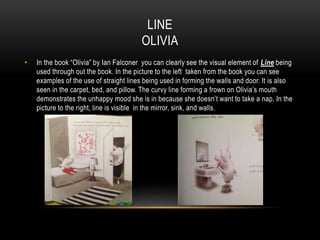
• In the book “Olivia” by Ian Falconer you can clearly see the visual element of Line being
used through out the book. In the picture to the left taken from the book you can see
examples of the use of straight lines being used in forming the walls and door. It is also
seen in the carpet, bed, and pillow. The curvy line forming a frown on Olivia’s mouth
demonstrates the unhappy mood she is in because she doesn’t want to take a nap. In the
picture to the right, line is visible in the mirror, sink, and walls.
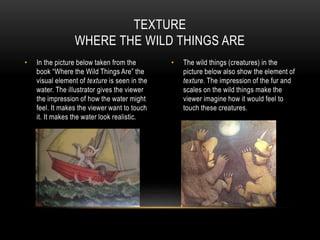
• In the picture below taken from the
book “Where the Wild Things Are” the
visual element of texture is seen in the
water. The illustrator gives the viewer
the impression of how the water might
feel. It makes the viewer want to touch
it. It makes the water look realistic.
• The wild things (creatures) in the
picture below also show the element of
texture. The impression of the fur and
scales on the wild things make the
viewer imagine how it would feel to
touch these creatures.
TEXTURE
WHERE THE WILD THINGS ARE
TEXTURE
THIS IS NOT MY HAT
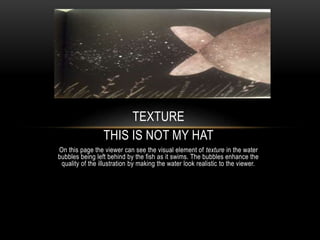
On this page the viewer can see the visual element of texture in the water
bubbles being left behind by the fish as it swims. The bubbles enhance the
quality of the illustration by making the water look realistic to the viewer.
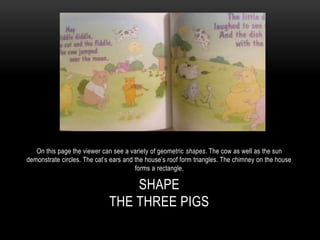
SHAPE
THE THREE PIGS
On this page the viewer can see a variety of geometric shapes. The cow as well as the sun
demonstrate circles. The cat’s ears and the house’s roof form triangles. The chimney on the house
forms a rectangle.
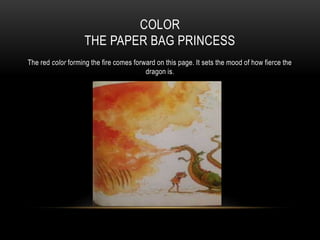
COLOR
THE PAPER BAG PRINCESS
The red color forming the fire comes forward on this page. It sets the mood of how fierce the
dragon is.
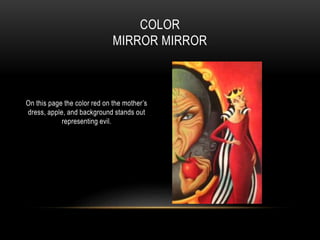
On this page the color red on the mother’s
dress, apple, and background stands out
representing evil.
COLOR
MIRROR MIRROR
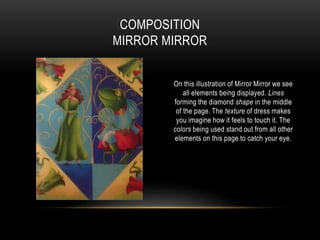
On this illustration of Mirror Mirror we see
all elements being displayed. Lines
forming the diamond shape in the middle
of the page. The texture of dress makes
you imagine how it feels to touch it. The
colors being used stand out from all other
elements on this page to catch your eye.
COMPOSITION
MIRROR MIRROR
TEXTURE
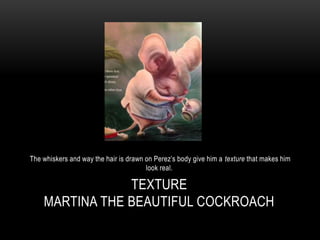
MARTINA THE BEAUTIFUL COCKROACH
The whiskers and way the hair is drawn on Perez’s body give him a texture that makes him
look real.
LINE
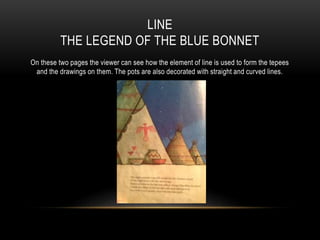
THE LEGEND OF THE BLUE BONNET
On these two pages the viewer can see how the element of line is used to form the tepees
and the drawings on them. The pots are also decorated with straight and curved lines.
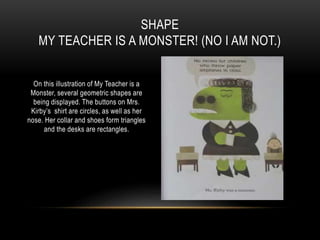
On this illustration of My Teacher is a
Monster, several geometric shapes are
being displayed. The buttons on Mrs.
Kirby’s shirt are circles, as well as her
nose. Her collar and shoes form triangles
and the desks are rectangles.
SHAPE
MY TEACHER IS A MONSTER! (NO I AM NOT.)
SHAPE
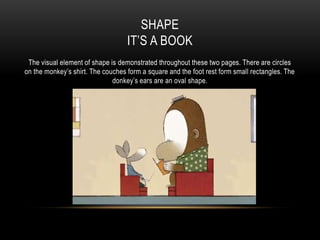
IT’S A BOOK
The visual element of shape is demonstrated throughout these two pages. There are circles
on the monkey’s shirt. The couches form a square and the foot rest form small rectangles. The
donkey’s ears are an oval shape.
PART 2
CRITERIA
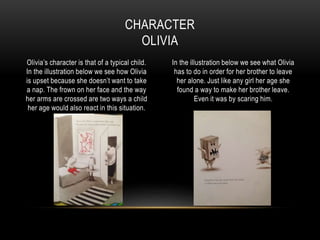
Olivia’s character is that of a typical child.
In the illustration below we see how Olivia
is upset because she doesn’t want to take
a nap. The frown on her face and the way
her arms are crossed are two ways a child
her age would also react in this situation.
In the illustration below we see what Olivia
has to do in order for her brother to leave
her alone. Just like any girl her age she
found a way to make her brother leave.
Even it was by scaring him.
CHARACTER
OLIVIA
PLOT
THE PAPER BAG PRINCESS
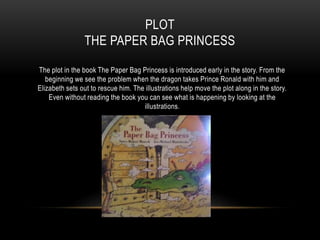
The plot in the book The Paper Bag Princess is introduced early in the story. From the
beginning we see the problem when the dragon takes Prince Ronald with him and
Elizabeth sets out to rescue him. The illustrations help move the plot along in the story.
Even without reading the book you can see what is happening by looking at the
illustrations.
SETTING
WHERE THE WILD THINGS ARE
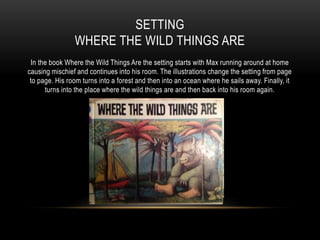
In the book Where the Wild Things Are the setting starts with Max running around at home
causing mischief and continues into his room. The illustrations change the setting from page
to page. His room turns into a forest and then into an ocean where he sails away. Finally, it
turns into the place where the wild things are and then back into his room again.
ILLUSTRATIONS
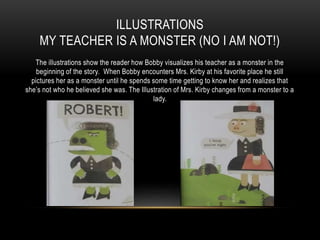
MY TEACHER IS A MONSTER (NO I AM NOT!)
The illustrations show the reader how Bobby visualizes his teacher as a monster in the
beginning of the story. When Bobby encounters Mrs. Kirby at his favorite place he still
pictures her as a monster until he spends some time getting to know her and realizes that
she’s not who he believed she was. The Illustration of Mrs. Kirby changes from a monster to a
lady.
THEME
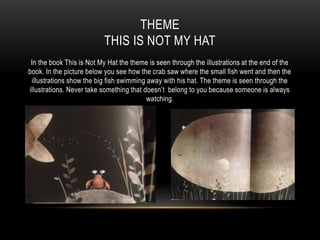
THIS IS NOT MY HAT
In the book This is Not My Hat the theme is seen through the illustrations at the end of the
book. In the picture below you see how the crab saw where the small fish went and then the
illustrations show the big fish swimming away with his hat. The theme is seen through the
illustrations. Never take something that doesn’t belong to you because someone is always
watching.
THEME
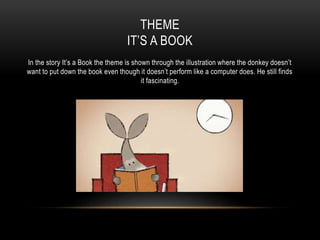
IT’S A BOOK
In the story It’s a Book the theme is shown through the illustration where the donkey doesn’t
want to put down the book even though it doesn’t perform like a computer does. He still finds
it fascinating.
STYLE
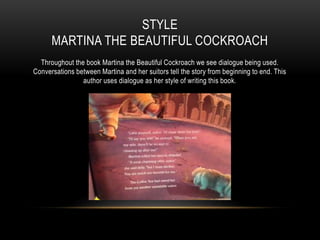
MARTINA THE BEAUTIFUL COCKROACH
Throughout the book Martina the Beautiful Cockroach we see dialogue being used.
Conversations between Martina and her suitors tell the story from beginning to end. This
author uses dialogue as her style of writing this book.
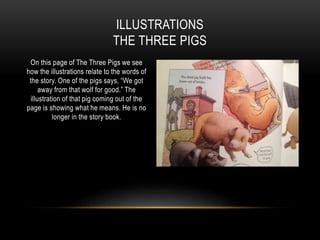
On this page of The Three Pigs we see
how the illustrations relate to the words of
the story. One of the pigs says, “We got
away from that wolf for good.” The
illustration of that pig coming out of the
page is showing what he means. He is no
longer in the story book.
ILLUSTRATIONS
THE THREE PIGS
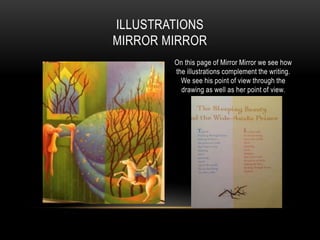
On this page of Mirror Mirror we see how
the illustrations complement the writing.
We see his point of view through the
drawing as well as her point of view.
ILLUSTRATIONS
MIRROR MIRROR
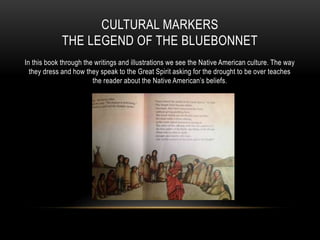
CULTURAL MARKERS
THE LEGEND OF THE BLUEBONNET
In this book through the writings and illustrations we see the Native American culture. The way
they dress and how they speak to the Great Spirit asking for the drought to be over teaches
the reader about the Native American’s beliefs.

Assignment 1

  • 1.
  • 2.
    LINE OLIVIA • In thebook “Olivia” by Ian Falconer you can clearly see the visual element of Line being used through out the book. In the picture to the left taken from the book you can see examples of the use of straight lines being used in forming the walls and door. It is also seen in the carpet, bed, and pillow. The curvy line forming a frown on Olivia’s mouth demonstrates the unhappy mood she is in because she doesn’t want to take a nap. In the picture to the right, line is visible in the mirror, sink, and walls.
  • 3.
    • In thepicture below taken from the book “Where the Wild Things Are” the visual element of texture is seen in the water. The illustrator gives the viewer the impression of how the water might feel. It makes the viewer want to touch it. It makes the water look realistic. • The wild things (creatures) in the picture below also show the element of texture. The impression of the fur and scales on the wild things make the viewer imagine how it would feel to touch these creatures. TEXTURE WHERE THE WILD THINGS ARE
  • 4.
    TEXTURE THIS IS NOTMY HAT On this page the viewer can see the visual element of texture in the water bubbles being left behind by the fish as it swims. The bubbles enhance the quality of the illustration by making the water look realistic to the viewer.
  • 5.
    SHAPE THE THREE PIGS Onthis page the viewer can see a variety of geometric shapes. The cow as well as the sun demonstrate circles. The cat’s ears and the house’s roof form triangles. The chimney on the house forms a rectangle.
  • 6.
    COLOR THE PAPER BAGPRINCESS The red color forming the fire comes forward on this page. It sets the mood of how fierce the dragon is.
  • 7.
    On this pagethe color red on the mother’s dress, apple, and background stands out representing evil. COLOR MIRROR MIRROR
  • 8.
    On this illustrationof Mirror Mirror we see all elements being displayed. Lines forming the diamond shape in the middle of the page. The texture of dress makes you imagine how it feels to touch it. The colors being used stand out from all other elements on this page to catch your eye. COMPOSITION MIRROR MIRROR
  • 9.
    TEXTURE MARTINA THE BEAUTIFULCOCKROACH The whiskers and way the hair is drawn on Perez’s body give him a texture that makes him look real.
  • 10.
    LINE THE LEGEND OFTHE BLUE BONNET On these two pages the viewer can see how the element of line is used to form the tepees and the drawings on them. The pots are also decorated with straight and curved lines.
  • 11.
    On this illustrationof My Teacher is a Monster, several geometric shapes are being displayed. The buttons on Mrs. Kirby’s shirt are circles, as well as her nose. Her collar and shoes form triangles and the desks are rectangles. SHAPE MY TEACHER IS A MONSTER! (NO I AM NOT.)
  • 12.
    SHAPE IT’S A BOOK Thevisual element of shape is demonstrated throughout these two pages. There are circles on the monkey’s shirt. The couches form a square and the foot rest form small rectangles. The donkey’s ears are an oval shape.
  • 13.
  • 14.
    Olivia’s character isthat of a typical child. In the illustration below we see how Olivia is upset because she doesn’t want to take a nap. The frown on her face and the way her arms are crossed are two ways a child her age would also react in this situation. In the illustration below we see what Olivia has to do in order for her brother to leave her alone. Just like any girl her age she found a way to make her brother leave. Even it was by scaring him. CHARACTER OLIVIA
  • 15.
    PLOT THE PAPER BAGPRINCESS The plot in the book The Paper Bag Princess is introduced early in the story. From the beginning we see the problem when the dragon takes Prince Ronald with him and Elizabeth sets out to rescue him. The illustrations help move the plot along in the story. Even without reading the book you can see what is happening by looking at the illustrations.
  • 16.
    SETTING WHERE THE WILDTHINGS ARE In the book Where the Wild Things Are the setting starts with Max running around at home causing mischief and continues into his room. The illustrations change the setting from page to page. His room turns into a forest and then into an ocean where he sails away. Finally, it turns into the place where the wild things are and then back into his room again.
  • 17.
    ILLUSTRATIONS MY TEACHER ISA MONSTER (NO I AM NOT!) The illustrations show the reader how Bobby visualizes his teacher as a monster in the beginning of the story. When Bobby encounters Mrs. Kirby at his favorite place he still pictures her as a monster until he spends some time getting to know her and realizes that she’s not who he believed she was. The Illustration of Mrs. Kirby changes from a monster to a lady.
  • 18.
    THEME THIS IS NOTMY HAT In the book This is Not My Hat the theme is seen through the illustrations at the end of the book. In the picture below you see how the crab saw where the small fish went and then the illustrations show the big fish swimming away with his hat. The theme is seen through the illustrations. Never take something that doesn’t belong to you because someone is always watching.
  • 19.
    THEME IT’S A BOOK Inthe story It’s a Book the theme is shown through the illustration where the donkey doesn’t want to put down the book even though it doesn’t perform like a computer does. He still finds it fascinating.
  • 20.
    STYLE MARTINA THE BEAUTIFULCOCKROACH Throughout the book Martina the Beautiful Cockroach we see dialogue being used. Conversations between Martina and her suitors tell the story from beginning to end. This author uses dialogue as her style of writing this book.
  • 21.
    On this pageof The Three Pigs we see how the illustrations relate to the words of the story. One of the pigs says, “We got away from that wolf for good.” The illustration of that pig coming out of the page is showing what he means. He is no longer in the story book. ILLUSTRATIONS THE THREE PIGS
  • 22.
    On this pageof Mirror Mirror we see how the illustrations complement the writing. We see his point of view through the drawing as well as her point of view. ILLUSTRATIONS MIRROR MIRROR
  • 23.
    CULTURAL MARKERS THE LEGENDOF THE BLUEBONNET In this book through the writings and illustrations we see the Native American culture. The way they dress and how they speak to the Great Spirit asking for the drought to be over teaches the reader about the Native American’s beliefs.