Wild Things:  Picture Books in the Classroom Readings:  Where the Wild Things Are  & Peterson Ch. 4. ENGL 403 1/24/11
What is a picture book? Different from an “illustrated text” or novel with pictures Book in which illustrations and text are equally balanced, equally important Words depend on the pictures to tell part of the story, and vice versa Neither element can “stand alone.”  Together , they complete the story—create a “third story” between them
Pictures not a “universal language” Different cultures “read” or interpret pictures differently Children learn to “read” pictures based on the culture in which they live Two excellent resources in studying picturebooks: Perry Nodelman,  Words About Pictures Maria Nikolajeva & Carole Scott,  How Picturebooks Work
Reading pictures a learned process Pictures won’t mean anything to a child until child is old enough to develop an understanding of its own environment Children seem to teach themselves picture reading skills at very early age Contemporary culture FILLED with visual images—children learn visual literacy long before they learn verbal literacy
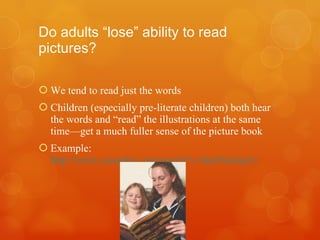
Do adults “lose” ability to read pictures? We tend to read just the words Children (especially pre-literate children) both hear the words and “read” the illustrations at the same time—get a much fuller sense of the picture book Example:  http://www.youtube.com/watch?v=tkteNuJepzU
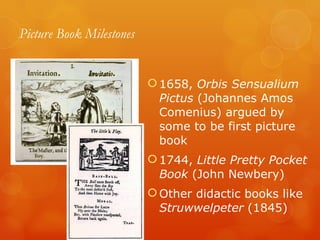
Picture Book Milestones 1658,  Orbis Sensualium Pictus  (Johannes Amos Comenius) argued by some to be first picture book 1744,  Little Pretty Pocket Book  (John Newbery) Other didactic books like  Struwwelpeter  (1845)
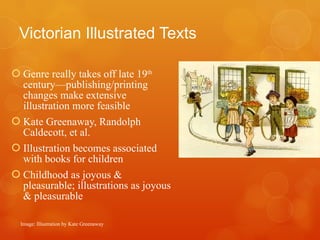
Victorian Illustrated Texts   Genre really takes off late 19 th  century—publishing/printing changes make extensive illustration more feasible Kate Greenaway, Randolph Caldecott, et al. Illustration becomes associated with books for children Childhood as joyous & pleasurable; illustrations as joyous & pleasurable Image: Illustration by Kate Greenaway
Format and First Impressions A book’s physical format directs our response to that book before we even open it Cover, shape, size, “feel” in our hands, kind of paper used, etc.  Think about your  favorite  picture book. Why do you like it so much? Color, pictures, layout, theme?
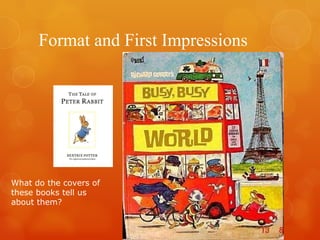
Format and First Impressions What do the covers of these books tell us about them?
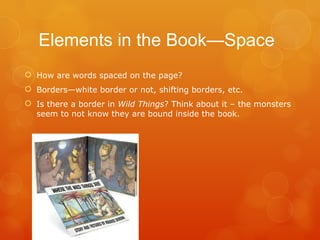
Elements in the Book—Space How are words spaced on the page? Borders—white border or not, shifting borders, etc. Is there a border in  Wild Things ? Think about it – the monsters seem to not know they are bound inside the book.
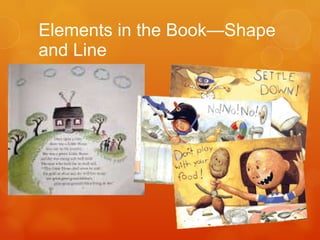
Elements in the Book—Shape and Line Rounded shapes associated with softness Straight, angular lines associated with rigidity, tension, energy Can strongly affect mood of story
Elements in the Book—Shape and Line
Literary Elements of Picture Book Plot—tension, action, conflict; closed ending vs. open Characterization—full, round characters vs. flat characters; dynamic vs. static Setting Point of view—through whose eyes is story told?  Is narrator a character, or outside the action?
Literary Elements of Picture Book Theme—even simplest picture book can offer more complex theme or significant meaning Importance of friendship & family, role of imagination, life coming out of death, etc. Tone—serious and somber, light and joyful, etc. What mood provoked in reader?
Text—Context—Subtext Text The words themselves But also the conventions that readers observe—symbolism, characterizations, genre, narrative style, open vs. closed ending, etc.
Text—Context—Subtext Context Historical context in which work was created How is the text “in community” with the era in which it was written/illustrated?
Text—Context—Subtext Subtext Ways textual elements and context work together to create meanings that are not always obvious What is the book’s possible ideology? Example:  The Story of Babar
Babar For those who don’t know the stories of Babar the Elephant:  Babar was a wild elephant who was taken in by a French noblewoman and taught to dress and act “properly.” He was taught to drive a car and many other typical things high-society humans did at the time this book was written. Many believe this story to be an allegory for the British colonization of India.
“ Power Up Picture Books:” Peterson Ch. 4 After reading the chapter by Main in the Peterson book, what other ideas do you have for bringing technology to picture books? Most elementary schools today have a computer lab available. Would you consider using this lab for your classroom to encourage students to create a power point based on a picture book they’re studying? What about using videos of picture books to help children’s comprehension? Watch this video and give that idea some thought. Would it be useful to show children a video like this?  http://www.youtube.com/watch?v=fSkHA6IjrlY&feature=related
“ Power Up Picture Books” If we could have had class on 1/24, we would have done a group project exploring Main’s chart of Student Tasks and What Technology This Involves on page 43 of the book. Think about these questions:  Are Main’s tasks for students appropriate for a typical classroom? How could these be accomplished if there is only one computer available for the classroom?  Could students be assigned to do these works as homework? Why or why not?
 
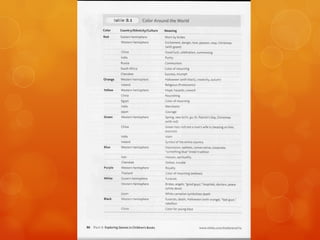
Color Assignment The previous slide contained a copy of the colors around the world chart that was passed out the first day of class.  Please remember this is simply a starting point. Next, you will find a recap of the assignment due on 1/31, followed by a sample of how to find more information on colors in other cultures. My sample uses the color Purple, which is not a prominent color in  Where the Wild Things Are.  Please remember that my work is only a sample to help you.
Picturebook Color Analysis The Assignment: You will be given a table titled “Color Around the World.”  This table explains the meanings of several colors to various cultures and societies around the world.  You will choose one color in  Where the Wild Things Are  and use this table as  a starting point  to write a 2-3 page analysis of the way your chosen color could be interpreted by at least 3 different cultures.  Use the table as a starting point.   Be sure your analysis explores (a) the way your chosen color is used in the book, (b) what the color represents (in your opinion) in the book, and (c) how 3 or more cultures around the world could interpret the way the color is used in  Where the Wild Things Are .  
SAMPLE Again, purple is not an acceptable color to use on the assignment as it is not prominent in the book. I’m using it for this sample to help you with the assignment. The next slide will list the steps I would take to write the paper including the search terms I would use to find information of how other cultures around the world view the color purple.
SAMPLE 1.  How is the color used in  Where the Wild Things Are? 2.  What do I think it means? 3.  What does it mean in 3 other cultures around the world? Here I would search Google for “Colors in other cultures,” “Purple and culture,” “purple in Australia” (NOTE you can use this search term with any culture. I’ve chosen Australia as an example for you) Then after finding 3 or 4 cultures, I’d take notes on what the color means to them. The final step of the project is simply writing out 2-3 pages that say “here’s how purple is used in  Wild Things , here’s what I think it means, and this is how three other cultures might interpret the meaning based on what purple means in their society.”  Simple enough.  Questions? Send me an email.

Wild things

  • 1.
    Wild Things: Picture Books in the Classroom Readings: Where the Wild Things Are & Peterson Ch. 4. ENGL 403 1/24/11
  • 2.
    What is apicture book? Different from an “illustrated text” or novel with pictures Book in which illustrations and text are equally balanced, equally important Words depend on the pictures to tell part of the story, and vice versa Neither element can “stand alone.” Together , they complete the story—create a “third story” between them
  • 3.
    Pictures not a“universal language” Different cultures “read” or interpret pictures differently Children learn to “read” pictures based on the culture in which they live Two excellent resources in studying picturebooks: Perry Nodelman, Words About Pictures Maria Nikolajeva & Carole Scott, How Picturebooks Work
  • 4.
    Reading pictures alearned process Pictures won’t mean anything to a child until child is old enough to develop an understanding of its own environment Children seem to teach themselves picture reading skills at very early age Contemporary culture FILLED with visual images—children learn visual literacy long before they learn verbal literacy
  • 5.
    Do adults “lose”ability to read pictures? We tend to read just the words Children (especially pre-literate children) both hear the words and “read” the illustrations at the same time—get a much fuller sense of the picture book Example: http://www.youtube.com/watch?v=tkteNuJepzU
  • 6.
    Picture Book Milestones1658, Orbis Sensualium Pictus (Johannes Amos Comenius) argued by some to be first picture book 1744, Little Pretty Pocket Book (John Newbery) Other didactic books like Struwwelpeter (1845)
  • 7.
    Victorian Illustrated Texts Genre really takes off late 19 th century—publishing/printing changes make extensive illustration more feasible Kate Greenaway, Randolph Caldecott, et al. Illustration becomes associated with books for children Childhood as joyous & pleasurable; illustrations as joyous & pleasurable Image: Illustration by Kate Greenaway
  • 8.
    Format and FirstImpressions A book’s physical format directs our response to that book before we even open it Cover, shape, size, “feel” in our hands, kind of paper used, etc. Think about your favorite picture book. Why do you like it so much? Color, pictures, layout, theme?
  • 9.
    Format and FirstImpressions What do the covers of these books tell us about them?
  • 10.
    Elements in theBook—Space How are words spaced on the page? Borders—white border or not, shifting borders, etc. Is there a border in Wild Things ? Think about it – the monsters seem to not know they are bound inside the book.
  • 11.
    Elements in theBook—Shape and Line Rounded shapes associated with softness Straight, angular lines associated with rigidity, tension, energy Can strongly affect mood of story
  • 12.
    Elements in theBook—Shape and Line
  • 13.
    Literary Elements ofPicture Book Plot—tension, action, conflict; closed ending vs. open Characterization—full, round characters vs. flat characters; dynamic vs. static Setting Point of view—through whose eyes is story told? Is narrator a character, or outside the action?
  • 14.
    Literary Elements ofPicture Book Theme—even simplest picture book can offer more complex theme or significant meaning Importance of friendship & family, role of imagination, life coming out of death, etc. Tone—serious and somber, light and joyful, etc. What mood provoked in reader?
  • 15.
    Text—Context—Subtext Text Thewords themselves But also the conventions that readers observe—symbolism, characterizations, genre, narrative style, open vs. closed ending, etc.
  • 16.
    Text—Context—Subtext Context Historicalcontext in which work was created How is the text “in community” with the era in which it was written/illustrated?
  • 17.
    Text—Context—Subtext Subtext Waystextual elements and context work together to create meanings that are not always obvious What is the book’s possible ideology? Example: The Story of Babar
  • 18.
    Babar For thosewho don’t know the stories of Babar the Elephant: Babar was a wild elephant who was taken in by a French noblewoman and taught to dress and act “properly.” He was taught to drive a car and many other typical things high-society humans did at the time this book was written. Many believe this story to be an allegory for the British colonization of India.
  • 19.
    “ Power UpPicture Books:” Peterson Ch. 4 After reading the chapter by Main in the Peterson book, what other ideas do you have for bringing technology to picture books? Most elementary schools today have a computer lab available. Would you consider using this lab for your classroom to encourage students to create a power point based on a picture book they’re studying? What about using videos of picture books to help children’s comprehension? Watch this video and give that idea some thought. Would it be useful to show children a video like this? http://www.youtube.com/watch?v=fSkHA6IjrlY&feature=related
  • 20.
    “ Power UpPicture Books” If we could have had class on 1/24, we would have done a group project exploring Main’s chart of Student Tasks and What Technology This Involves on page 43 of the book. Think about these questions: Are Main’s tasks for students appropriate for a typical classroom? How could these be accomplished if there is only one computer available for the classroom? Could students be assigned to do these works as homework? Why or why not?
  • 21.
  • 22.
    Color Assignment Theprevious slide contained a copy of the colors around the world chart that was passed out the first day of class. Please remember this is simply a starting point. Next, you will find a recap of the assignment due on 1/31, followed by a sample of how to find more information on colors in other cultures. My sample uses the color Purple, which is not a prominent color in Where the Wild Things Are. Please remember that my work is only a sample to help you.
  • 23.
    Picturebook Color AnalysisThe Assignment: You will be given a table titled “Color Around the World.”  This table explains the meanings of several colors to various cultures and societies around the world.  You will choose one color in Where the Wild Things Are and use this table as a starting point to write a 2-3 page analysis of the way your chosen color could be interpreted by at least 3 different cultures.  Use the table as a starting point.   Be sure your analysis explores (a) the way your chosen color is used in the book, (b) what the color represents (in your opinion) in the book, and (c) how 3 or more cultures around the world could interpret the way the color is used in Where the Wild Things Are .  
  • 24.
    SAMPLE Again, purpleis not an acceptable color to use on the assignment as it is not prominent in the book. I’m using it for this sample to help you with the assignment. The next slide will list the steps I would take to write the paper including the search terms I would use to find information of how other cultures around the world view the color purple.
  • 25.
    SAMPLE 1. How is the color used in Where the Wild Things Are? 2. What do I think it means? 3. What does it mean in 3 other cultures around the world? Here I would search Google for “Colors in other cultures,” “Purple and culture,” “purple in Australia” (NOTE you can use this search term with any culture. I’ve chosen Australia as an example for you) Then after finding 3 or 4 cultures, I’d take notes on what the color means to them. The final step of the project is simply writing out 2-3 pages that say “here’s how purple is used in Wild Things , here’s what I think it means, and this is how three other cultures might interpret the meaning based on what purple means in their society.” Simple enough. Questions? Send me an email.