PARVIS - Performance mAnagement of VIrtualized
Systems
Danilo Ardagna
joint work with Mara Tanelli and Marco Lovera
Dipartimento di Elettronica e Informazione, Politecnico di Milano
ardagna@elet.polimi.it
Milan, November 23 2010
Dipartimento di Elettronica e Informazione
2
Data Centers, Virtualization, and Cloud Computing
§  Nowadays, large Data Centers provide computational
capacity on demand to many customers by sharing a pool of
IT resources:
•  IBM Cloud
•  Amazon EC2
•  Windows Azure
•  …
§  Issues:
•  Workload variability and QoS guarantees
•  Energy consumption
Dipartimento di Elettronica e Informazione
Workload variability
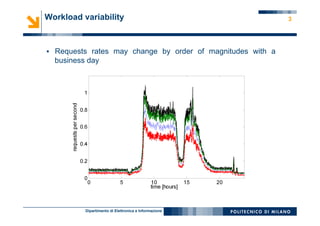
§  Requests rates may change by order of magnitudes with a
business day
3
Dipartimento di Elettronica e Informazione
Workload variability
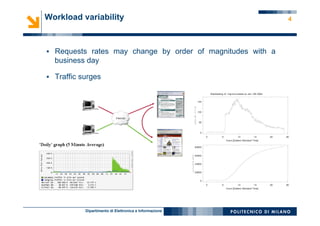
§  Requests rates may change by order of magnitudes with a
business day
§  Traffic surges
4
Dipartimento di Elettronica e Informazione
Workload variability
§  Requests rates may change by order of magnitudes with a
business day
§  Traffic surges
§  Sport events
5
Dipartimento di Elettronica e Informazione
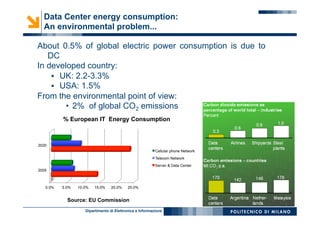
Data Center energy consumption:
An environmental problem...
About 0.5% of global electric power consumption is due to
DC
In developed country:
§  UK: 2.2-3.3%
§  USA: 1.5%
From the environmental point of view:
•  2% of global CO2 emissions
Source: EU Commission
0.0% 5.0% 10.0% 15.0% 20.0% 25.0%
2005
2020
% European IT Energy Consumption
Cellular phone Network
Telecom Network
Server & Data Center
Dipartimento di Elettronica e Informazione
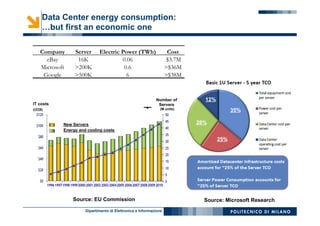
Data Center energy consumption:
…but first an economic one
New Servers
costsEnergy and cooling costs
IT costs
Number of
Servers
(M units)
Company Server Electric Power (TWh) Cost
eBay 16K 0.06 $3.7M	
Microsoft >200K 0.6 >$36M
Google >500K 6 >$38M
25%
28%
12%
35%
Source: EU Commission Source: Microsoft Research
Dipartimento di Elettronica e Informazione
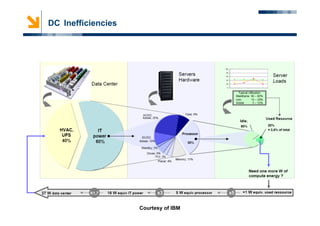
DC Inefficiencies
Courtesy of IBM
Dipartimento di Elettronica e Informazione
9Virtualization of Physical Resources
§  Virtualization, proposed in early ’70s, is driving again
the interest both of industry and academia
§  Enabling technology for server consolidation and cloud
computing
§  Advantages:
•  Physical resources are partitioned among competing running
VMs, improved security and reliability, performance isolation
•  Resource allocation parameters can be updated by in few
milliseconds without introducing any system overhead
Dipartimento di Elettronica e Informazione
10
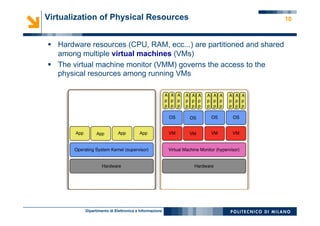
§  Hardware resources (CPU, RAM, ecc...) are partitioned and shared
among multiple virtual machines (VMs)
§  The virtual machine monitor (VMM) governs the access to the
physical resources among running VMs
Virtualization of Physical Resources
Dipartimento di Elettronica e Informazione
11Virtualization of Physical Resources:
Research Challenges
§  Performance modelling of virtualized environments is
challenging
§  Traditional queueing network models are inadequate to
model virtualized systems performance at a very fine-
grained time scale
Dipartimento di Elettronica e Informazione
PARVIS goals
§  Develop novel resource allocation policies virtualized
cloud infrastructures via an interdisciplinary approach:
§  Performance evaluation and optimization methods for the
long-term management of the physical infrastructure
§  System identification and control engineering methods to
derive load-dependent black-box models of virtualized
systems and to design short-term control systems
12
Dipartimento di Elettronica e Informazione
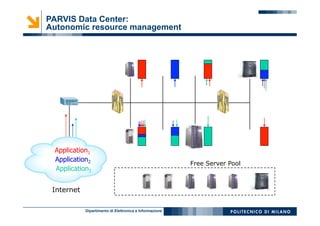
Internet
Application2
Application1
Application3
Free Server Pool
PARVIS Data Center:
Autonomic resource management
Dipartimento di Elettronica e Informazione
Virtual Machine Monitor
S.O.
App1
S.O.
App2
S.O.
Appn
…
VM1 VM2 VMn
Infrastructure
controller
System
Controller
Performance
metrics
Performance
goals
DFS
CPU weights
Admission control
Local
controller
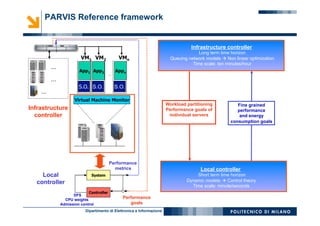
PARVIS Reference framework
Local controller
Short term time horizon
Dynamic models à Control theory
Time scale: minute/seconds
Fine grained
performance
and energy
consumption goals
Workload partitioning
Performance goals of
individual servers
Infrastructure controller
Long term time horizon
Queuing network models à Non linear optimization
Time scale: ten minutes/hour
...
...
...
Dipartimento di Elettronica e Informazione
PARVIS Reference framework
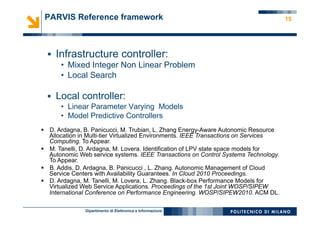
§  Infrastructure controller:
•  Mixed Integer Non Linear Problem
•  Local Search
§  Local controller:
•  Linear Parameter Varying Models
•  Model Predictive Controllers
15
§  D. Ardagna, B. Panicucci, M. Trubian, L. Zhang Energy-Aware Autonomic Resource
Allocation in Multi-tier Virtualized Environments. IEEE Transactions on Services
Computing. To Appear.
§  M. Tanelli, D. Ardagna, M. Lovera. Identification of LPV state space models for
Autonomic Web service systems. IEEE Transactions on Control Systems Technology.
To Appear.
§  B. Addis, D. Ardagna, B. Panicucci , L. Zhang. Autonomic Management of Cloud
Service Centers with Availability Guarantees. In Cloud 2010 Proceedings.
§  D. Ardagna, M. Tanelli, M. Lovera, L. Zhang. Black-box Performance Models for
Virtualized Web Service Applications. Proceedings of the 1st Joint WOSP/SIPEW
International Conference on Performance Engineering. WOSP/SIPEW2010. ACM DL.
Dipartimento di Elettronica e Informazione
16
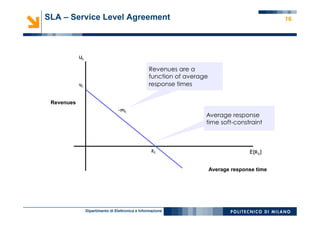
Revenues are a
function of average
response times
Average response
time soft-constraint
SLA – Service Level Agreement
Average response time
Revenues
Dipartimento di Elettronica e Informazione
17
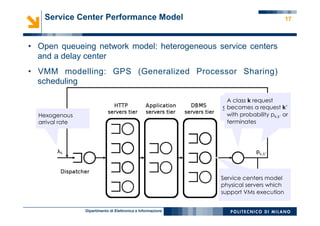
•  Open queueing network model: heterogeneous service centers
and a delay center
•  VMM modelling: GPS (Generalized Processor Sharing)
scheduling
Hexogenous
arrival rate
Session modelling
Service centers model
physical servers which
support VMs execution
A class k request
becomes a request k’
with probability pk,k’ or
terminates
Service Center Performance Model
Dipartimento di Elettronica e Informazione
18Optimization Problem
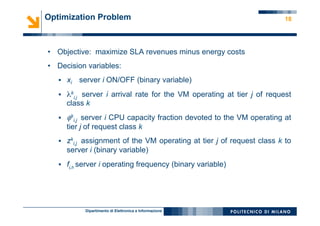
•  Objective: maximize SLA revenues minus energy costs
•  Decision variables:
§  xi server i ON/OFF (binary variable)
§  λk
i,j server i arrival rate for the VM operating at tier j of request
class k
§  φk
i,j server i CPU capacity fraction devoted to the VM operating at
tier j of request class k
§  zk
i,j assignment of the VM operating at tier j of request class k to
server i (binary variable)
§  fi,h server i operating frequency (binary variable)
Dipartimento di Elettronica e Informazione
19
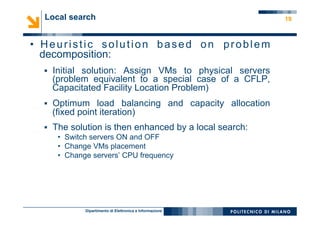
•  Heuristic solution based on problem
decomposition:
§  Initial solution: Assign VMs to physical servers
(problem equivalent to a special case of a CFLP,
Capacitated Facility Location Problem)
§  Optimum load balancing and capacity allocation
(fixed point iteration)
§  The solution is then enhanced by a local search:
•  Switch servers ON and OFF
•  Change VMs placement
•  Change servers’ CPU frequency
Local search
Dipartimento di Elettronica e Informazione
2020
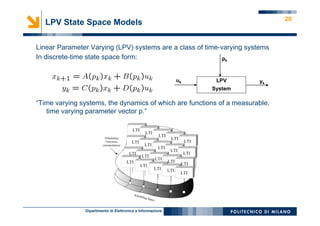
Linear Parameter Varying (LPV) systems are a class of time-varying systems
In discrete-time state space form:
“Time varying systems, the dynamics of which are functions of a measurable,
time varying parameter vector p.”
LPV State Space Models
LPV
System
uk yk
pk
Dipartimento di Elettronica e Informazione
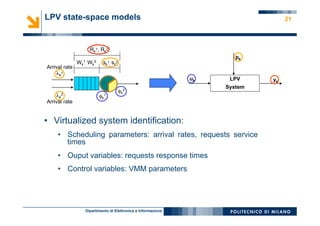
21LPV state-space models
LPV
System
uk yk
pk
λk
2
Arrival rate
Wk
1
, Wk
2 sk
1
, sk
2
Rk
1, Rk
2
Arrival rate
λk
1
φk
1
φk
2
•  Virtualized system identification:
•  Scheduling parameters: arrival rates, requests service
times
•  Ouput variables: requests response times
•  Control variables: VMM parameters
Dipartimento di Elettronica e Informazione
22
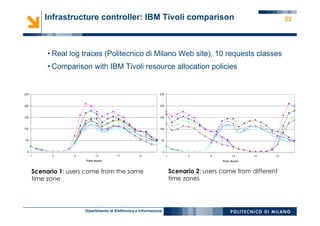
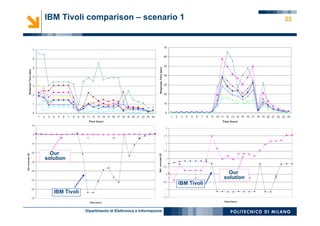
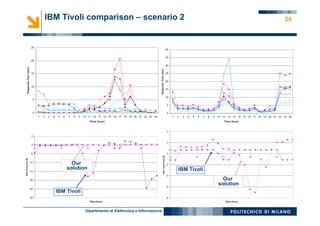
• Real log traces (Politecnico di Milano Web site), 10 requests classes
• Comparison with IBM Tivoli resource allocation policies
Scenario 1: users come from the same
time zone
Scenario 2: users come from different
time zones
Infrastructure controller: IBM Tivoli comparison
Dipartimento di Elettronica e Informazione
23IBM Tivoli comparison – scenario 1
Our
solution
IBM Tivoli
Our
solution
IBM Tivoli
Dipartimento di Elettronica e Informazione
24IBM Tivoli comparison – scenario 2
Our
solution IBM Tivoli
Our
solution
IBM Tivoli
Dipartimento di Elettronica e Informazione
25System Identification - Experimental setting
§  Two reference scenarios:
•  A Micro benchmarking instrumented Web application
•  SPECweb2005 industrial benchmark
§  VMM monitor: Xen 3.0 and Xen 3.3
§  Validation: Synthetic workload inspired by a real-world.
Log trace from a large financial system
Dipartimento di Elettronica e Informazione
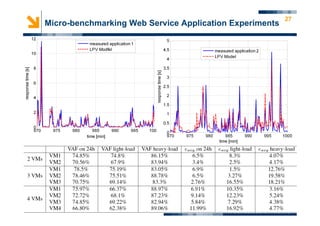
26Micro-benchmarking Web Service Application Experiments
§  Number of VMs varied between 2 and 4
§  For system identification purposes request arrival rates vary stepwise every
1 minute
§  Each request consumes si
k CPU time varied between 0.06 s and 1.1 s.
§  1,440 intervals (24 hours)
§  Parametrization [sk
i ρk
i]
Dipartimento di Elettronica e Informazione
27
Micro-benchmarking Web Service Application Experiments
Dipartimento di Elettronica e Informazione
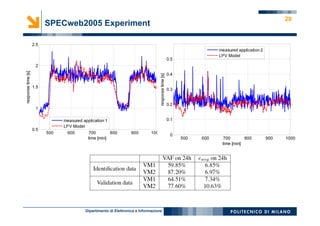
28SPECweb2005 Experiment
§  Two VMs running the banking and e-commerce loads
§  The number of users Ni
k accessing each of the two VMs varied stepwise every 1
minute, with values between 10 and 220
§  Proportional assignment scheme:
§  1,440 intervals (24 hours)
§  Parametrization [Nk
i ρk]
Dipartimento di Elettronica e Informazione
29
SPECweb2005 Experiment
Dipartimento di Elettronica e Informazione
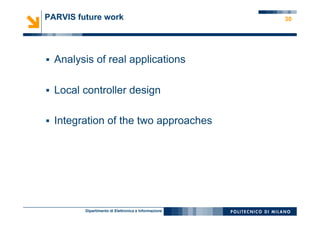
30PARVIS future work
§  Analysis of real applications
§  Local controller design
§  Integration of the two approaches
Dipartimento di Elettronica e Informazione
§  Mara Tanelli, Marco Lovera, Barbara Panicucci, Marco Bergamasco,
Alessandro Barenghi, Alessandro Colleoni, Bernardetta Addis, Giuliana
Carello, Antonio Capone, Politecnico di Milano
§  Folco Bombardieri, Danilo Ghirardelli, Gianluca Pisati, Giovanni Pirotta, Marco
Caldirola, Mauro Speroni, Paolo Sala, Marco Casiero, Stefano Vettor, Massimo
Bergami, Politecnico di Milano students
§  Marco Trubian, Università degli Studi di Milano
§  Li Zhang, IBM Research
§  Massimo Leoni, Carla Milani, IBM Italy
Akwnoledgements

D. Ardagna - PARVIS - Performance mAnagement of VIrtualized Systems

  • 1.
    PARVIS - PerformancemAnagement of VIrtualized Systems Danilo Ardagna joint work with Mara Tanelli and Marco Lovera Dipartimento di Elettronica e Informazione, Politecnico di Milano ardagna@elet.polimi.it Milan, November 23 2010
  • 2.
    Dipartimento di Elettronicae Informazione 2 Data Centers, Virtualization, and Cloud Computing §  Nowadays, large Data Centers provide computational capacity on demand to many customers by sharing a pool of IT resources: •  IBM Cloud •  Amazon EC2 •  Windows Azure •  … §  Issues: •  Workload variability and QoS guarantees •  Energy consumption
  • 3.
    Dipartimento di Elettronicae Informazione Workload variability §  Requests rates may change by order of magnitudes with a business day 3
  • 4.
    Dipartimento di Elettronicae Informazione Workload variability §  Requests rates may change by order of magnitudes with a business day §  Traffic surges 4
  • 5.
    Dipartimento di Elettronicae Informazione Workload variability §  Requests rates may change by order of magnitudes with a business day §  Traffic surges §  Sport events 5
  • 6.
    Dipartimento di Elettronicae Informazione Data Center energy consumption: An environmental problem... About 0.5% of global electric power consumption is due to DC In developed country: §  UK: 2.2-3.3% §  USA: 1.5% From the environmental point of view: •  2% of global CO2 emissions Source: EU Commission 0.0% 5.0% 10.0% 15.0% 20.0% 25.0% 2005 2020 % European IT Energy Consumption Cellular phone Network Telecom Network Server & Data Center
  • 7.
    Dipartimento di Elettronicae Informazione Data Center energy consumption: …but first an economic one New Servers costsEnergy and cooling costs IT costs Number of Servers (M units) Company Server Electric Power (TWh) Cost eBay 16K 0.06 $3.7M Microsoft >200K 0.6 >$36M Google >500K 6 >$38M 25% 28% 12% 35% Source: EU Commission Source: Microsoft Research
  • 8.
    Dipartimento di Elettronicae Informazione DC Inefficiencies Courtesy of IBM
  • 9.
    Dipartimento di Elettronicae Informazione 9Virtualization of Physical Resources §  Virtualization, proposed in early ’70s, is driving again the interest both of industry and academia §  Enabling technology for server consolidation and cloud computing §  Advantages: •  Physical resources are partitioned among competing running VMs, improved security and reliability, performance isolation •  Resource allocation parameters can be updated by in few milliseconds without introducing any system overhead
  • 10.
    Dipartimento di Elettronicae Informazione 10 §  Hardware resources (CPU, RAM, ecc...) are partitioned and shared among multiple virtual machines (VMs) §  The virtual machine monitor (VMM) governs the access to the physical resources among running VMs Virtualization of Physical Resources
  • 11.
    Dipartimento di Elettronicae Informazione 11Virtualization of Physical Resources: Research Challenges §  Performance modelling of virtualized environments is challenging §  Traditional queueing network models are inadequate to model virtualized systems performance at a very fine- grained time scale
  • 12.
    Dipartimento di Elettronicae Informazione PARVIS goals §  Develop novel resource allocation policies virtualized cloud infrastructures via an interdisciplinary approach: §  Performance evaluation and optimization methods for the long-term management of the physical infrastructure §  System identification and control engineering methods to derive load-dependent black-box models of virtualized systems and to design short-term control systems 12
  • 13.
    Dipartimento di Elettronicae Informazione Internet Application2 Application1 Application3 Free Server Pool PARVIS Data Center: Autonomic resource management
  • 14.
    Dipartimento di Elettronicae Informazione Virtual Machine Monitor S.O. App1 S.O. App2 S.O. Appn … VM1 VM2 VMn Infrastructure controller System Controller Performance metrics Performance goals DFS CPU weights Admission control Local controller PARVIS Reference framework Local controller Short term time horizon Dynamic models à Control theory Time scale: minute/seconds Fine grained performance and energy consumption goals Workload partitioning Performance goals of individual servers Infrastructure controller Long term time horizon Queuing network models à Non linear optimization Time scale: ten minutes/hour ... ... ...
  • 15.
    Dipartimento di Elettronicae Informazione PARVIS Reference framework §  Infrastructure controller: •  Mixed Integer Non Linear Problem •  Local Search §  Local controller: •  Linear Parameter Varying Models •  Model Predictive Controllers 15 §  D. Ardagna, B. Panicucci, M. Trubian, L. Zhang Energy-Aware Autonomic Resource Allocation in Multi-tier Virtualized Environments. IEEE Transactions on Services Computing. To Appear. §  M. Tanelli, D. Ardagna, M. Lovera. Identification of LPV state space models for Autonomic Web service systems. IEEE Transactions on Control Systems Technology. To Appear. §  B. Addis, D. Ardagna, B. Panicucci , L. Zhang. Autonomic Management of Cloud Service Centers with Availability Guarantees. In Cloud 2010 Proceedings. §  D. Ardagna, M. Tanelli, M. Lovera, L. Zhang. Black-box Performance Models for Virtualized Web Service Applications. Proceedings of the 1st Joint WOSP/SIPEW International Conference on Performance Engineering. WOSP/SIPEW2010. ACM DL.
  • 16.
    Dipartimento di Elettronicae Informazione 16 Revenues are a function of average response times Average response time soft-constraint SLA – Service Level Agreement Average response time Revenues
  • 17.
    Dipartimento di Elettronicae Informazione 17 •  Open queueing network model: heterogeneous service centers and a delay center •  VMM modelling: GPS (Generalized Processor Sharing) scheduling Hexogenous arrival rate Session modelling Service centers model physical servers which support VMs execution A class k request becomes a request k’ with probability pk,k’ or terminates Service Center Performance Model
  • 18.
    Dipartimento di Elettronicae Informazione 18Optimization Problem •  Objective: maximize SLA revenues minus energy costs •  Decision variables: §  xi server i ON/OFF (binary variable) §  λk i,j server i arrival rate for the VM operating at tier j of request class k §  φk i,j server i CPU capacity fraction devoted to the VM operating at tier j of request class k §  zk i,j assignment of the VM operating at tier j of request class k to server i (binary variable) §  fi,h server i operating frequency (binary variable)
  • 19.
    Dipartimento di Elettronicae Informazione 19 •  Heuristic solution based on problem decomposition: §  Initial solution: Assign VMs to physical servers (problem equivalent to a special case of a CFLP, Capacitated Facility Location Problem) §  Optimum load balancing and capacity allocation (fixed point iteration) §  The solution is then enhanced by a local search: •  Switch servers ON and OFF •  Change VMs placement •  Change servers’ CPU frequency Local search
  • 20.
    Dipartimento di Elettronicae Informazione 2020 Linear Parameter Varying (LPV) systems are a class of time-varying systems In discrete-time state space form: “Time varying systems, the dynamics of which are functions of a measurable, time varying parameter vector p.” LPV State Space Models LPV System uk yk pk
  • 21.
    Dipartimento di Elettronicae Informazione 21LPV state-space models LPV System uk yk pk λk 2 Arrival rate Wk 1 , Wk 2 sk 1 , sk 2 Rk 1, Rk 2 Arrival rate λk 1 φk 1 φk 2 •  Virtualized system identification: •  Scheduling parameters: arrival rates, requests service times •  Ouput variables: requests response times •  Control variables: VMM parameters
  • 22.
    Dipartimento di Elettronicae Informazione 22 • Real log traces (Politecnico di Milano Web site), 10 requests classes • Comparison with IBM Tivoli resource allocation policies Scenario 1: users come from the same time zone Scenario 2: users come from different time zones Infrastructure controller: IBM Tivoli comparison
  • 23.
    Dipartimento di Elettronicae Informazione 23IBM Tivoli comparison – scenario 1 Our solution IBM Tivoli Our solution IBM Tivoli
  • 24.
    Dipartimento di Elettronicae Informazione 24IBM Tivoli comparison – scenario 2 Our solution IBM Tivoli Our solution IBM Tivoli
  • 25.
    Dipartimento di Elettronicae Informazione 25System Identification - Experimental setting §  Two reference scenarios: •  A Micro benchmarking instrumented Web application •  SPECweb2005 industrial benchmark §  VMM monitor: Xen 3.0 and Xen 3.3 §  Validation: Synthetic workload inspired by a real-world. Log trace from a large financial system
  • 26.
    Dipartimento di Elettronicae Informazione 26Micro-benchmarking Web Service Application Experiments §  Number of VMs varied between 2 and 4 §  For system identification purposes request arrival rates vary stepwise every 1 minute §  Each request consumes si k CPU time varied between 0.06 s and 1.1 s. §  1,440 intervals (24 hours) §  Parametrization [sk i ρk i]
  • 27.
    Dipartimento di Elettronicae Informazione 27 Micro-benchmarking Web Service Application Experiments
  • 28.
    Dipartimento di Elettronicae Informazione 28SPECweb2005 Experiment §  Two VMs running the banking and e-commerce loads §  The number of users Ni k accessing each of the two VMs varied stepwise every 1 minute, with values between 10 and 220 §  Proportional assignment scheme: §  1,440 intervals (24 hours) §  Parametrization [Nk i ρk]
  • 29.
    Dipartimento di Elettronicae Informazione 29 SPECweb2005 Experiment
  • 30.
    Dipartimento di Elettronicae Informazione 30PARVIS future work §  Analysis of real applications §  Local controller design §  Integration of the two approaches
  • 31.
    Dipartimento di Elettronicae Informazione §  Mara Tanelli, Marco Lovera, Barbara Panicucci, Marco Bergamasco, Alessandro Barenghi, Alessandro Colleoni, Bernardetta Addis, Giuliana Carello, Antonio Capone, Politecnico di Milano §  Folco Bombardieri, Danilo Ghirardelli, Gianluca Pisati, Giovanni Pirotta, Marco Caldirola, Mauro Speroni, Paolo Sala, Marco Casiero, Stefano Vettor, Massimo Bergami, Politecnico di Milano students §  Marco Trubian, Università degli Studi di Milano §  Li Zhang, IBM Research §  Massimo Leoni, Carla Milani, IBM Italy Akwnoledgements