1
Vocational and Professional
Education and Training in Switzerland
Facts and Figures 2016
2
Impressum
Publisher: State Secretariat for Education, Research and Innovation (SERI) © 2016
Editor: VPET Policy SERI
Photos: Seilbahnen Schweiz and Iris Krebs, Bern
Graphics: Communication SERI
Printer: Sonderegger Publish AG, Weinfelden
Languages: ger/fr/it/en/sp
3
Contents
Overview 4
Swiss VPET system 6
One mission – three partners 8
Learning locations 10
Vocational education and training 11
Federal vocational baccalaureate 16
Professional education 18
Vocational qualifications for adults 22
Swiss VPET funding 23
VPET at international level 26
VPET research 28
4
Overview
The Swiss VPET system enables young people to enter the labour market and ensures that
there are enough skilled workers and managers in the future. It has a high labour market
relevance and is an integral part of the education system. The VPET system is divided into
two sectors: upper-secondary level vocational education and training (VET) and tertiary-level
professional education.
The most popular form of upper-secondary level
education and training
Two-thirds of all young people coming out of compulso-
ry education in Switzerland enrol in vocational education
and training (VET), which provides them with a solid
foundation in a given occupation. There are around 230
occupations to choose from. The VET sector forms the
basis for lifelong learning and opens up a wealth of job
prospects.
 More information on pages 11–15.
Career prospects
Tertiary-level professional education builds from up-
per-secondary level vocational education and training
(VET). It provides professionals with specific competenc-
es and prepares them for highly technical and manage-
rial positions. There are around 400 federal examinations
as well as 57 study programmes at colleges of higher
education in 8 different professional fields.
The Federal Vocational Baccalaureate (FVB) opens the
way to Swiss universities of applied sciences (UAS). FVB
holders who pass the University Aptitude Test (UAT) have
the option of enrolling in a cantonal university or one of
Switzerland’s two federal institutes of technology (FIT).
 More information on pages 16–21.
Dual-track approach to learning
Most VET programmes are of the dual-track variety (i.e.
part-time classroom instruction at a vocational school
combined with a part-time apprenticeship at a host com-
pany). The less common variety is a school-based VET
programme (i.e. full-time classroom instruction, no ap-
prenticeship). School-based VET programmes are gener-
ally offered by trade schools or commercial schools. Ter-
tiary-level professional education also combines classroom
instruction with work-based training, thereby ensuring
a smooth transition from dual-track VET programmes.
 More information on page 10.
Permeability
The Swiss VPET system is based on clearly defined educa-
tion and training options as well as on national qualifica-
tions procedures. Typically, VET and professional education
are very flexible: learners may pursue more advanced
education and training opportunities, switch from voca-
tional/professional pathways to general education/univer-
sity pathways and later change the course of their work-
ing lives with relative ease. Continuing education and
training (CET) options are also available at all levels.
 More information on pages 6–7.
Labour-market focus
Education and training are centred on acquisition of pro-
fessional competences that are actually in demand as
well as on occupations and professions for which there
are existing job vacancies. This direct link with the labour
market is the main reason why Switzerland has one of
the lowest youth unemployment rates in Europe.
 More information on pages 10 and12.
Collective governance
The VPET system is collectively governed by the Confed-
eration, the cantons and professional organisations. These
three main partners work together to maintain a high
level of quality within the VPET system. They also strive
to ensure that there is an adequate supply of apprentice-
ship/traineeship positions and training options. This part-
nership and respective areas of responsibility are set forth
in the Federal Vocational and Professional Education and
Training Act (VPETA) and its corresponding ordinance.
 More information on pages 8–9.
5
Upper-secondary level: vocational education and training (VET) Total Women Men
Federal VET Diploma 61128 33354 27774
Federal VET Certificate 5870 3094 2776
Non-formal two-year apprenticeships 374 318 56
Federal Vocational Baccalaureate 14177 7491 6686
University Aptitude Test 752 426 326
Tertiary level: professional education Total Women Men
Qualification awarded by colleges of higher education 8076 4149 3927
Advanced Federal Diploma of Higher Education 2635 1978 657
Federal Diploma of Higher Education 14537 9065 5472
Professional education not recognised by the Confederation 1825 666 1159
1
Federal Statistical Office (2015a). These figures refer to the number of qualifications awarded, not the number of holders (some of whom may
hold several qualifications).
Quality
The main purpose of having all three partners involved
is to ensure high quality within the VPET system. The
distribution of training content across two (or in some
cases three) different learning locations – i.e. vocational
schools, host companies and branch training centres –
helps to improve the quality of upper-secondary level VET
programmes. The responsibilities of each actor depend
on the tasks assigned to each of the three main partners
within the VPET system. In areas where responsibilities
overlap, the actors work together on the specific situa-
tions and matters at hand.
 More information on pages 8–9.
Efficiency
The consistent focus on the labour market allows VET
programmes to be efficiently and effectively organised.
One indication of this is the fact that the productive out-
put of learners during their apprenticeships exceeds the
gross costs of their training.
 More information on pages 23–25.
Completion rates for 20141
6
Swiss VPET system
Vocational education and training (VET) is provided at upper-secondary level. Professional
education is provided at tertiary level. Both VET and professional education use clearly defined
curricula and national qualification procedures. They are also characterised by a high degree
of permeability: recognition of prior learning to keep track of prior education and training
makes it much easier for learners to pursue further education and training opportunities, switch
between vocational/professional pathways and general education/university pathways and
change the course of their working lives. The Swiss VPET system offers a broad selection of
available training options. Courses cater to different abilities and are geared to the needs of
different age groups. A wealth of job-related continuing education and training (CET) courses
can also be found at all levels.
TRANSITIONAL OPTIONS
JOB-RELATEDCONTINUINGEDUCATIONANDTRAINING
PROFESSIONAL EDUCATIONAA UNIVERSITIES
UNIVERSITIES
FEDERAL INSTITUTES OF
TECHNOLOGY
UNIVERSITIES OF
APPLIED SCIENCES
COLLEGES OF
HIGHER EDUCATIONFEDERAL EXAMINATIONS
Master's degree
Bachelor's degree
Master's degree
Bachelor's degree
Advanced Federal Diploma
of Higher Education
Advanced Federal Diploma
of Higher Education
Federal Diploma
of Higher Education
PhD/doctorate
Master's degree
Bachelor's degree
UNIVERSITIES OF
TEACHER EDUCATION
COMPULSORY EDUCATIONAA
UPPESER-SNCONDRYAREVEVLEVLLL
VOCATIONAL EDUCAA ATION AND TRAININGAA GENERAL EDUCATION SCHOOLSAA
Federal Diploma of Vocational Education and Training
Federal Vocational
Baccalaureate
Federal Certificate of
Vocational Education and
Training
SPECIALISED
SCHOOLS
HOSTCOMPANIES,VOCATIONALSCHOOLS,
BRANCHCOURSES
HOSTCOMPANIES,
VOCATIONALSCHOOLS,
BRANCHCOURSES
Baccalaureate
BACCALAUREATE
SCHOOLS
Specialised
Baccalaureate
Specialised School
Certificate
SBFI 2016
Usual pathway Possible pathway
7
Upper-secondary level: vocational education and
training (VET)
VET programmes provide learners with solid profession-
al competences and pave the way for lifelong learning.
 More information on pages 11–17.
3-year or 4-year VET programmes for the Federal
VET Diploma
These VET programmes provide learners with the com-
petences needed to work in a specific occupation and
open access to tertiary-level professional education.
Learners also have the option of preparing for the Fed-
eral Vocational Baccalaureate (FVB) either during their
training or after graduation.
2-year VET programmes for the Federal VET
Certificate
These VET programmes provide young people with more
practical skills to obtain a recognised qualification for a
specific occupational profile. Graduates of a 2-year VET
programme may enrol directly in a 3- or 4-year VET pro-
gramme leading to the Federal VET Diploma.
Federal Vocational Baccalaureate (FVB)
Learners enrolled in a 3-year or 4-year VET programme
for the Federal VET Diploma have the option of preparing
for the Federal Vocational Baccalaureate (FVB). This pre-
paratory course covers general education subjects and
those who pass the FVB examination may enrol in a Swiss
university of applied sciences (UAS) without having to
take an entrance examination. Moreover, holders of the
FVB can prepare for the University Aptitude Test (UAT),
which opens the way for enrolment in a cantonal univer-
sity or federal institute of technology.
Transitional options between lower- and up-
per-secondary level
Transitional options are available to young people com-
pleting compulsory education who have been unable to
immediately transition to upper-secondary level. Such
options include practical training and pre-apprenticeships
and are generally designed to prepare young people for
enrolment in VET programmes.
Tertiary level: professional education
Holders of the Federal VET Diploma or equivalent quali-
fications may specialise or deepen their expertise at ter-
tiary level by pursuing a professional qualification. Prepa-
ration also includes acquisition of managerial skills. The
professional education sector is designed to meet the
needs of the labour market and builds on existing work
experience.
 More information on pages 18–21.
Federal examinations (level 1)
This federal examination is intended for professionals
who wish to improve their knowledge and skills and spe-
cialise in a given field after completing upper-secondary
level vocational education and training (VET). Successful
candidates are awarded the Federal Diploma of Higher
Education, which is generally a prerequisite for admit-
tance to the examination for the Advanced Federal Di-
ploma of Higher Education.
Federal examinations (level 2)
This examination is generally for professionals who have
acquired a great deal of expertise in their field and/or
who intend to hold a managerial position in a company.
Successful candidates are awarded the Advanced Feder-
al Diploma of Higher Education.
Study programmes at colleges of higher education
Study programmes at colleges of higher education are
intended for professionals holding a Federal VET Diploma
or equivalent qualifications who wish to improve their
knowledge and skills and hold managerial positions.
These degree programmes cover a broader and more
general range of topics than those addressed in the two
federal examinations described above. Successful candi-
dates are awarded a federally recognised qualification.
Job-related continuing education and training (CET)
A wide range of job-related CET options (i.e. non-formal
courses, seminars, etc.) can be found at all training levels
and are part of lifelong learning.
8
One mission – three partners
The provision of VET and professional education is a mission collectively
shouldered by the Confederation, the cantons and professional organisa-
tions. These three partners are jointly committed to the highest possible
standard of quality within the Swiss VPET system. They also strive to
ensure the availability of an adequate number of apprenticeships and
training courses.
Confederation
State Secretariat for Education, Research and
Innovation (SERI)
Is the federal government’s specialised agency for nation-
al and international matters concerning education, re-
search and innovation policy. SERI is responsible for reg-
ulating and co-funding the VET and professional
education sectors.
 www.sbfi.admin.ch
Swiss Federal Institute for Vocational Education
and Training (SFIVET)
Mainly provides basic and continuing training to teachers,
trainers, instructors and examiners working at both up-
per-secondary level (VET sector) and tertiary level (pro-
fessional education sector). SFIVET is also involved in
research, studies, pilot projects and the provision of ser-
vices. It has three regional campuses: in Lausanne, Luga-
no and Zollikofen.
 www.ehb-schweiz.ch/en/
Strategic management and development
• Quality assurance and further development of
the Swiss VPET system
• Comparability and transparency of courses
throughout Switzerland
• Enactment of around 230 VET ordinances
• Recognition of regulations for around 400 federal
examinations as well as 35 core syllabuses for
study programmes at colleges of higher education
• Recognition of study programmes and continuing
education and training at colleges of higher
education
• Recognition of training courses for teachers,
trainers, instructors and examiners within the VET
and professional education sectors as well as
training courses for vocational, educational and
career guidance counsellors
• Recognition of foreign qualifications
• Payment of one-fourth of public sector expendi-
ture for the VPET system
• Promotion of innovation and support for specific
activities in the public interest
Confederation
9
Professional organisations
Trade associations / branch organisations
Determine content of training and national qualification
procedures, organise courses at upper-secondary level
(VET sector) and tertiary level (professional education
sector).
Social partners, other relevant organisations and
VPET providers
Together with trade associations, they are also involved
in the further development of VPET.
Companies
Where possible, companies provide apprenticeships and
traineeships, thereby paving the way for the next gener-
ation of qualified workers. Their involvement in the Swiss
VPET system is voluntary.
Training content and apprenticeships
• Establishing the training content of VET pro-
grammes and study programmes at colleges of
higher education
• Establishing national qualification procedures for
VET programmes as well as for federal examina-
tions for the Federal Diploma of Higher Education
and the Advanced Federal Diploma of Higher
Education
• Creation of apprenticeship positions
• Imparting professional competences at tertiary
level (professional education)
• Developing new training courses
• Organising branch courses
• Managing VPET funds
Cantons
Swiss Conference of Cantonal Ministers of
Education (EDK)
The cantons are generally responsible for education and
training in Switzerland. National cooperation through
EDK complements and reinforces cantonal authority
over education.  www.edk.ch
26 cantonal VET offices
Responsible for implementing VET at cantonal level, VET
offices coordinate their activities through the Swiss Con-
ference of VET Offices (SBBK), a specialised conference
of the Swiss Conference of Cantonal Ministers of Edu-
cation (EDK).
 www.sbbk.ch
Vocational, educational and career guidance
services
Provide information and advice to both young people
and adults.
Implementation and supervision
• Implementing the Federal Vocational and
Professional Education and Training Act (VPETA)
• Supervising apprenticeships, vocational schools
and colleges of higher education
• Providing vocational, educational and career
guidance services
• Creating options that prepare young people for
enrolment in VET programmes
• Issuing permits authorising host companies to
take on apprentices and/or trainees
• Apprenticeship marketing
• Providing training to apprenticeship trainers in
host companies
Professional organisations
Cantons
Vocational schools
Vocational schools provide classroom instruction for both dual-track (i.e. combined work and school) and school-
based (i.e. full-time classroom instruction, no apprenticeship) VET programmes. They also prepare learners for the
Federal Vocational Baccalaureate examination.
10
Learning locations
The trademark and strength of the Swiss VPET system is the direct correlation with the
labour market. This is reflected in various learning locations.
Upper-secondary level: Vocational education and
training (VET)
Apprenticeship training at host companies
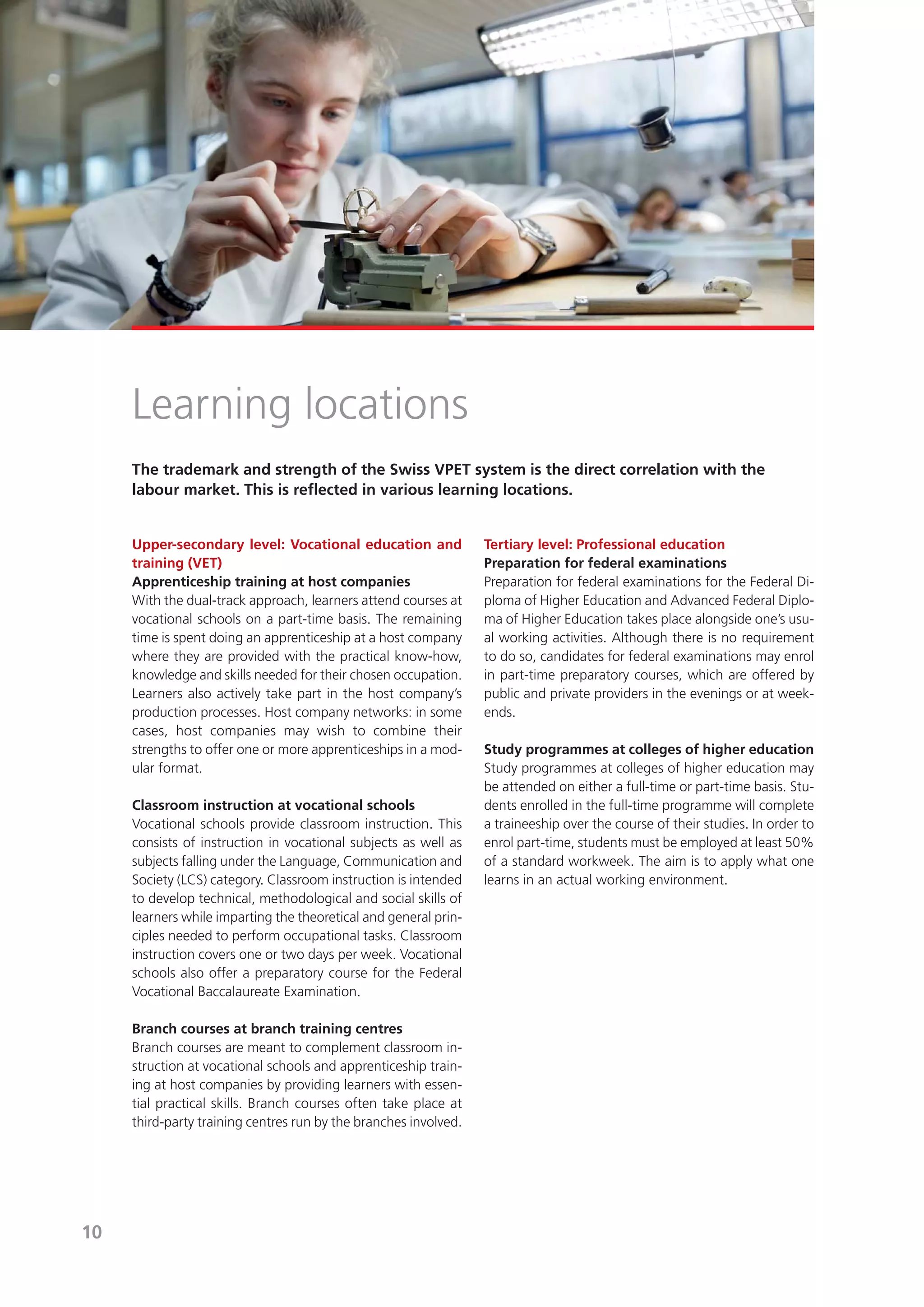
With the dual-track approach, learners attend courses at
vocational schools on a part-time basis. The remaining
time is spent doing an apprenticeship at a host company
where they are provided with the practical know-how,
knowledge and skills needed for their chosen occupation.
Learners also actively take part in the host company’s
production processes. Host company networks: in some
cases, host companies may wish to combine their
strengths to offer one or more apprenticeships in a mod-
ular format.
Classroom instruction at vocational schools
Vocational schools provide classroom instruction. This
consists of instruction in vocational subjects as well as
subjects falling under the Language, Communication and
Society (LCS) category. Classroom instruction is intended
to develop technical, methodological and social skills of
learners while imparting the theoretical and general prin-
ciples needed to perform occupational tasks. Classroom
instruction covers one or two days per week. Vocational
schools also offer a preparatory course for the Federal
Vocational Baccalaureate Examination.
Branch courses at branch training centres
Branch courses are meant to complement classroom in-
struction at vocational schools and apprenticeship train-
ing at host companies by providing learners with essen-
tial practical skills. Branch courses often take place at
third-party training centres run by the branches involved.
Tertiary level: Professional education
Preparation for federal examinations
Preparation for federal examinations for the Federal Di-
ploma of Higher Education and Advanced Federal Diplo-
ma of Higher Education takes place alongside one’s usu-
al working activities. Although there is no requirement
to do so, candidates for federal examinations may enrol
in part-time preparatory courses, which are offered by
public and private providers in the evenings or at week-
ends.
Study programmes at colleges of higher education
Study programmes at colleges of higher education may
be attended on either a full-time or part-time basis. Stu-
dents enrolled in the full-time programme will complete
a traineeship over the course of their studies. In order to
enrol part-time, students must be employed at least 50%
of a standard workweek. The aim is to apply what one
learns in an actual working environment.
11
Vocational education and training
Vocational education and training provides young people with their first exposure to working
life. It is the basis for lifelong learning and opens a wide range of career prospects.
Enrolment in upper-secondary level in 20132
Dual-track
VET programme
School-based
VET programme
Baccalaureate
school or
specialised school
68261
29172
8159
Transitions from lower- to upper-secondary level4
Around two-thirds of young people coming out of compul-
sory education in Switzerland enrol in an upper-secondary
level VET programme. This proportion has remained con-
stant for years. Dual-track VET programmes are by far the
most prevalent form of vocational education and training.
In the French- and Italian-speaking regions of Switzerland,
however, there is a marked preference for school-based VET
programmes compared to the German-speaking region: in
2013, only 4.4% of all VET programmes compared to the
German-speaking region were school-based whereas in the
French-speaking region the proportion stood at 26.6% and
in the Italian-speaking region at 31.4%.3
The vast majority of pupils coming out of compulsory
education, enrol in either a vocational school (VET sec-
tor) or in a baccalaureate school or a specialised school
(general education sector). Many young people who
were unable to transition directly to upper-secondary
level opted for a transitional option such as a 10th school
year or a preparatory course for VET. Others went on a
motivation semester or spent time abroad to improve
their language skills.
2
Federal Statistical Office (2015d). Dual-track and school-based VET programmes, incl. trade schools and IT schools, excl. non-formal two year
apprenticeships.
3
Federal Statistical Office (2015d). incl. trade schools and IT schools, excl. non-formal two year apprenticeships.
4
Federal Statistical Office (2015c), (2015d). VET, incl. non-formal two year apprenticeships. General education includes baccalaureate schools,
specialised schools and schools that prepare learners for the specialised baccalaureate. Transitional options include the 10th school year,
preapprenticeships and schools that prepare young people for enrolment in VET.
0%
10%
20%
30%
40%
50%
2011 2012 2013
47.5
26.2
13.4
45.8
26.5
12.8
44.3
26.5
12.4
Transitional optionsVocational school
Baccalaureate school or specialised school
12
Apprenticeship market
There are two sides to the apprenticeship market: the
supply side (host companies offering apprenticeship po-
sitions) and the demand side (young people looking for
apprenticeship positions). The State plays a mediating
role: it ensures the best possible general conditions for
host companies, encourages the provision of apprentice-
ship positions and helps young people to choose an oc-
cupation company. Various factors influence supply and
demand on the apprenticeship market. On the supply
side are structural changes, economic fluctuations and
the host company ratio (i.e. proportion of companies that
are willing and able to train apprentices). On the demand
side, demographic changes and the interests of young
people have an impact on the apprenticeship market.
Apprenticeship «Barometer»
The Apprenticeship «Barometer» is a survey con-
ducted twice each year (once in April and once in
August) to determine the current situation and short-
term trends on the apprenticeship market. Repre-
sentative surveys are conducted among companies
and young people to identify and monitor key indi-
cators of the present situation.
 www.sbfi.admin.ch/barometer
Apprenticeship
market
Structural changes
The supply of apprenticeship positions
reflects the long-term needs of the
labour market.
Economic fluctuations
Economic fluctuations affect the order
book of host companies and therefore
their ability to productively employ apprentices.
Host company ratio
Around 40% of the companies in Switzerland that could
offer apprenticeships actually do so. Smaller companies in
particular are either overly specialised or lack qualified
apprenticeship trainers, which makes it more difficult for
them to offer apprenticeships.
Demographic changes
Demographic changes affect the number of
young people completing compulsory education,
which in turn affects demand.
Interests of young people
The choice of occupation depends on the
hopes, aspirations and aptitudes of learners
as well as the availability of suitable apprentice-
ship positions. Career guidance services provide
young people with information and advice.
13
Focus on young people: Advice and support before
and during training
Vocational information and counselling
Cantonal career guidance services work closely with
schools to help young people choose an occupation and
find a suitable apprenticeship.
 www.adressen.sdbb.ch
List of apprenticeship positions
The list of apprenticeship positions enables young people
to search all open apprenticeships by occupation and
canton.
 www.berufsberatung.ch  Lehrstellensuche
Transitional options
Transitional options are intended for young people who
are not yet able to enrol in a VET programme for social
or scholastic reasons or who have been unable to find
an apprenticeship. In addition to courses aimed at im-
proving scholastic, linguistic or other skills, young people
attend a course to prepare them for enrolment in a VET
programme. The acquired skills increase their chances of
finding an apprenticeship.
Coaching and mentoring
Coaching and mentoring entails the provision of individ-
ual guidance to young people during the period of com-
pulsory education. One of the aims is to help young
people to improve occupational and social skills and op-
timise their CVs. The various projects and programmes
are sponsored by both the cantons and private organi-
sations.
VET Case Management
VET Case Management is intended to help young people,
who are particularly at risk of dropping out of VET pro-
grammes. The aim is also to improve the efficiency and
effectiveness of measures taken. VET Case Management
is a structured process: a case manager coordinates in-
stitutional activities in accordance with an established
plan so as to ensure that the young person receives ad-
equate support.
 www.sbfi.admin.ch/cmbb
Apprenticeship placement services
Apprenticeship placement services are available to young
people in the fourth quarter of the last year of lower-sec-
ondary school. The aim is to further assist young people
in their efforts to find an apprenticeship position.
Individual guidance
Individual guidance is for young people who encounter
learning difficulties. They receive comprehensive support
involving the host company, the vocational school, the
branch training centre and social surroundings. By law,
individual guidance is provided to young people enrolled
in two-year VET programmes. However, learners enrolled
in three- or four-year VET programmes may also make
use of these services.
Focus on companies: creation of apprenticeship
positions
Host company networks
The creation of host company networks enables small-
sized or specialised companies to pool their resources
together as a network or with other companies. Instead
of providing the full range of apprenticeship training
as a single company, each partner provides a portion
thereof.
 www.lbv.berufsbildung.ch
Marketing of apprenticeship positions
Cantonal VET offices are familiar with the conditions in
the various regions. They maintain contact with local
companies. Apprenticeship promoters contact companies
directly to encourage them to create apprenticeship po-
sitions and become involved in training apprentices.
14
The ten most frequently chosen occupations5
Apprentice satisfaction with choice of occupation6
Found apprenticeship in another occupation
VET was second choice
Other / Don't know / No information
2011 2012 2013
0%
20%
40%
60%
80%
100%
2014
Found apprenticeship in desired occupation
72
7
13
8
71
6
14
9
71
6
14
9
75
5
12
8
In Switzerland, there are VET programmes for around 230
different occupations. The ten most popular occupations
in 2014 account for over 50% of all newly signed ap-
prenticeship contracts.
The choice of occupation and search for an available
apprenticeship are important processes. Pupils begin this
process during compulsory education when they are be-
tween the ages 13 and 16. Over 70% of all young people
who enrolled in a VET programme in 2014 managed to
find an apprenticeship that matched their desired oc-
cupation. This proportion has remained constant over
the years.
Links
List of federally recognised vocational and
professional qualifications:
 www.sbfi.admin.ch/bvz
Enrolment in VET programme:
 www.education-stat.admin.ch  Bildungs-
system  Detaillierte Daten  Berufliche Grund-
bildung: Lehrverträge
Link
Portal for vocational, educational and career
guidance services:
 www.berufsberatung.ch
Occupations Total
Commercial employee 14637
Retail clerk 5212
Health care worker 4125
Social care worker 3061
Electrician 2168
IT technician 1959
Cook 1772
Logistician 1649
Mechanical engineer 1613
Draughtsman 1605
5
Federal Statistical Office (2015e).
6
Link Institute (2015).
15
Creation of a VET programme – An example of cooperation between three main partners
In Switzerland, VET programmes are developed by the private sector, i.e. the professional organisations that
represent the interests of economic branches. Every five years, the training content and structure of VET pro-
grammes are evaluated from an economic, technological, environmental and didactic standpoint and adapted
accordingly.
A new occupation emerges
When a professional organisation wishes to introduce a VET programme for a new occupation, it works closely
with the other main partners (i.e. the Confederation and the cantons). An important consideration for federal
approval is that learners who graduate from a given VET programme will actually be able to find work. Devel-
opment of a VET programme takes place in accordance with an established workflow.
First steps
Before work on the new VET programme can start, fundamental questions must first be answered: Which pro-
fessional organisation will sponsor the new VET programme? Has the occupational field been clarified? Is there
a need for the given occupation on the labour market and are there enough companies within the given branch
that are willing to create apprenticeship positions and hire graduates afterwards? Once these questions have
been answered, the professional organisation will contact the State Secretariat for Education, Research and
Innovation SERI and schedule a planning meeting with all of the partners involved.
Competence profile and VET ordinance
The main documents in a given VET programme are the job profile7
, the overview of all professional competenc-
es and the statement of the level of difficulty of the given occupation. The VET ordinance includes legal aspects8
applying to apprenticeship training in dual-track VET programmes as well as the various requirements for prac-
tical training within school-based VET programmes.
Consultation and approval
SERI examines the VET ordinance and training plan for quality control purposes. After examination has been
completed and any necessary adjustments have been made, SERI organises a consultation session with canton-
al agencies, federal agencies and other interested parties. SERI will then take the results of this consultation into
account and make whatever changes are needed to the VET ordinance and training plan. Any unresolved issues
will be settled in an editing meeting of the various partners. SERI will then issue the VET ordinance and approve
the training plan.
Implementation and subsequent modification
The committee for occupation development and quality that is responsible for the given occupation will then
meet at least every five years to re-examine the VET ordinance and training plan in view of economic, techno-
logical, environmental and didactic developments. Measures may then be taken on this basis to adapt the VET
programme accordingly. The Swiss Federal Institute for Vocational Education and Training (SFIVET) has a federal
mandate to provide support to the sponsoring professional organisation and the cantons.
7
The job profile describes what the person does in this occupation, his/her field of work and the importance that the occupation has within society.
8
Subject, duration, objectives and allocation of training content to learning locations, qualification procedure, qualifications and title.
16
Issued as a complement to the Federal VET Diploma, the Federal Vocational Baccalaureate (FVB) entitles
the holder to enrol in a Swiss university of applied sciences (UAS) without having to take an entrance
examination. If an FVB holder also takes the University Aptitude Test (UAT), then enrolment in a canton-
al university or one of Switzerland’s two federal institutes of technology (FIT) is also possible.
Proportion of VET graduates who obtained an FVB9
Federal vocational baccalaureate
FVB 1 FVB 2 Total
2011 2012 2014
0%
3%
6%
9%
12%
15%
2013
7.3 7.5 7.6 8.0
5.7
6.2 6.4 6.9
13.0
13.7 14.1 14.8
The preparatory course for the FVB examination is gen-
erally taught by vocational schools. There are two op-
tions: either to take this preparatory course alongside the
normal training regimen for the given VET programme
(FVB 1) or to do so after completion of the VET pro-
gramme (FVB 2). In recent years, the proportion of VET
graduates who also obtain the FVB has been increasing
steadily. The number of young people who take the pre-
paratory course for the FVB examination after graduation
(FVB 2) has risen at a faster rate than the number of
young people who choose the FVB 1 option.
From federal vocational baccalaureate to a univer-
sity of applied sciences
UAS offer a combination of theory and practical training
at tertiary level. Study programmes lead to a Bachelor’s
degree or a Master’s degree. At Bachelor’s degree level,
UAS impart general theory and research findings as well
as the competences needed to work in a given occupa-
tion. At Master’s degree level, UAS provide students with
in-depth, specialised knowledge, preparing them for a
more advanced qualification in their field. Admission to
UAS is generally open to holders of the FVB.
Links
Information about the FVB:
 www.sbfi.admin.ch/rlp-bm
Information about study programmes at UAS:
 www.sbfi.admin.ch/fh
Study programmes:
 www.studyprogrammes.ch
9
Federal Statistical Office (2015a).
17
Five orientations for federal vocational baccalaureate and corresponding fields of study at universities
of applied sciences
Orientation of FVB Corresponding fields of study at UAS10
Engineering, architecture, life sciences Engineering and information technology
Architecture, construction and planning
Chemistry and life sciences
Nature, agriculture and food Agriculture and forestry
Business and services Business and services
Creativity and art Design
Health and social care Health
Social work
University Aptitude Test11
2006 2008 2010 2012 2014
Female Male
0
100
200
300
400
500
90
58
237
132
426
326
406
304
339
282
334
254
286
201
267
177
275
194
267
155
The University Aptitude Test (UAT), which may be taken
by holders of the Federal Vocational Baccalaureate, en-
ables one to enrol in any study programme at a Swiss
university (i.e. cantonal universities and the two federal
institutes of technology). The preparatory course for the
UAT takes a year. This option has become increasingly
popular in recent years.
Link
Information about UAT:
 www.sbfi.admin.ch/passerelle-d
10
Fields of study that are unrelated to any VET programme are not listed (sports, music, theatre and other arts, applied linguistics, applied
psychology).
11
Federal Statistical Office (2015a).
18
Professional education
Swiss tertiary-level education is comprised of professional education, universities of applied sciences
(UAS) and cantonal universities/federal institutes of technology (FIT). The professional education sector
places great emphasis on the actual skills used in a given profession.
Transitions to professional education12
Female Male Total
2011 2012 20142013
0%
5%
10%
15%
20%
25%
30%
35%
18.6 19.1
20.9 22.0
29.3 29.6
31.4
32.5
24.7 25.0
26.8 27.8
Pathway leading to professional qualifications13
Qualification awarded by colleges of higher education
Advanced Federal Diploma of Higher Education
Federal Diploma of Higher Education
2011 2012 20142013
0
5
10
15
20
25
30
Other Total
Thousand
26702
25520
26573 27073
13160 13582
14042 14537
7009 6780
7627 8076
2950 2815 2786 2635
3583
2343 2118 1825
Professional education imparts competences needed to
handle challenging technical or managerial activities and
provides the labour market with highly skilled workers.
Admission to professional education is normally open to
holders of a Federal VET Diploma or equivalent upper-sec-
ondary level qualifications. The proportion of holders of
vocational qualifications who, after some years of work
experience, decide to pursue professional qualifications
has increased slightly in recent years.
Most people obtain their professional qualification af-
ter having passed a federal examination. The federally
regulated professional education sector accounted for
over 90% of the qualifications awarded in Switzerland
in 2014.
12
Federal Statistical Office (2015f).
13
Federal Statistical Office (2015a).
Link
List of all federally recognised vocational and
professional qualifications:
 www.sbfi.admin.ch/bvz
19
The ten most frequently taken federal examina-
tions (level 1) in 201414
14
Federal Statistical Office (2015a).
All professions combined Total
Technical sales specialist 932
Police officer 901
Human resources specialist 869
Training specialist 823
Marketing specialist 616
Finance and accountancy specialist 490
Social insurance specialist 451
Electrical safety specialist 371
Medical masseur 341
Logistician 338
The ten most frequently taken federal examina-
tions (level 2) in 201414
All professions combined Total
Company auditor 229
Master farmer 140
Electrician 133
Accounting and controlling expert 129
Sales manager 123
Social worker 115
IT specialist 113
Real estate broker 75
Taxation expert 69
Fiduciary 65
The ten most frequently completed study pro-
grammes at colleges of higher education in 201414
All fields combined Total
Nursing 1710
Business administration 965
Social pedagogy 469
Hotels, restaurants and catering 462
Business informatics 271
Child care 253
Machine manufacturing 237
Banking 225
Tourism 206
Business processes 198
In Switzerland, there are federal examinations at level 1
for around 220 different professions and at level 2 for
around 170 different professions. Both levels combined,
the ten most frequently taken examinations accounted
for over 40% of all federal examinations taken in 2014.
In Switzerland, there are study programmes available at
colleges of higher education for around 450 different
occupations. The ten most frequently completed study
programmes accounted for over 60% of all study pro-
grammes completed in 2014.
20
Completed tertiary-level training by economic branch in 201415
0% 10% 20% 30% 40% 50% 60% 70% 80%
15.1 3.1 26.7
15.6 2.7 17.0
16.7
12.8
13.1
14.2 55.1
17.1 5.6 45.1
17.2 1.8 23.0
14.6 2.5 57.3
19.8 4.1 29.7
10.3 1.3 65.0
18.6
1.0
,
5.3
19.9
1.3 12.8
0.8
0.4
12.1
Professional education Professional education and higher education Higher education
Distribution of holders of tertiary-level qualifications by company size16
Holders of tertiary-level professional qualifications are
more likely to work for small-sized companies on a con-
tractual basis whereas holders of higher education qual-
ifications tend to work for larger-sized companies.
In terms of employment position, there does not seem
to be any significant difference between holders of pro-
fessional qualifications and holders of higher education
qualifications.
1–9
FTEs
10–49
FTEs
more than
100 FTEs
50–99
FTEs
0%
10%
20%
30%
40%
50%
Professional education Higher education
27
22
25
23
1112
38
44
15
Federal Statistical Office (2015b).
16
Federal Statistical Office (2009). Own chart.
Industry
Transport; energy and water supply
Construction
Trade, repairs
Hotel, restaurant and catering
Financial services
Public administration and education
Health and social care
Other
Information and communication;
art and entertainment
Self-employed scientific and technical services
Land and housing; services
FTE= Full-time equivalent
21
Income from employment by vocational/professional qualification17
Professional education offers a good return on invest-
ment for qualification holders. Most students enrolling
in preparatory courses for federal examinations or study
programmes at colleges of higher education do so on
a part-time basis while working and therefore already
earn an income that increases once they obtain their
tertiary-level professional qualification. Compared to
holders of upper-secondary level vocational qualifica-
tions, holders of professional qualifications earn about
one-third more.
Upper-secondary level VET
2011 2012 2013
Index (100 = compulsory education)
157
100
140
200
120
160
180
2014
161 162
157
124 126 125 124
Tertiary-level professional education
Links
Information about the Swiss professional
education sector:
 www.sbfi.admin.ch/hbb
Statistics on Swiss professional education
sector:
 www.education-stat.admin.ch  Tertiärstufe:
Höhere Berufsbildung
Information about transition to a Swiss
university of applied sciences:
 www.swissuniversities.ch/en  Services 
Zulassung zur FH
17
Federal Statistical Office (2015g).
Transition from professional education to a
university of applied sciences
It is possible to transition from professional education to
a Swiss university of applied sciences. Depending on the
qualifications, holders of professional qualifications may
be admitted to a Swiss UAS without having to take an
entrance examination or after passing an admissions test.
22
Vocational qualifications for adults
In Switzerland, adults may also obtain vocational qualifications, either by undergoing the full training
regimen, including apprenticeship, or by validating their non-formal and informal learning.
Number of vocational qualifications awarded to
adults in 201418
Four established pathways
There are several ways for adults to obtain a Federal
VET Certificate (normally awarded upon completion of
a two-year VET programme) or a Federal VET Diploma
(normally awarded upon completion of a three- or four-
year VET programme). Two pathways do not require the
person to undergo the full spectrum of training: one is
direct admission to the final examination and the other
is validation of non-formal and informal learning. The
other two pathways are either to undergo the full VET
programme, including apprenticeship, or to undergo a
shortened version of the same.
Special for adults
Adults who already have prior knowledge and experience
can undergo an assessment to determine whether they
qualify for validation, direct access to the final examina-
tion or enrolment in a shortened VET programme. In the
first two cases, the person must have at least five years
of work experience. While the path to validation is only
possible for specific occupations, direct access to the final
examination is normally possible for all occupations.
Ten most frequently chosen fields for adults seeking
vocational qualifications in 201418
1st
quali-
fication
2nd
qualifi-
cation
Total
Regular VET
programme
3531 90 3621
Shortened VET
programme
1222 43 1265
Direct access to
final examination
2170 28 2198
Validation of
non-formal and
informal learning
565 4 569
Total 7488 165 7653
Total occupations Total
Health care 1171
Social care 933
Commerce 886
Logistics 345
Retail 322
Agriculture 223
Health and social care assistance 214
IT 184
Construction 141
Cooking 125
18
Federal Statistical Office (2015h), special analysis: Persons aged 25 and older.
23
Swiss VPET funding
The VET sector is funded by the Confederation, the cantons and professional organisations, each to
its own extent. Most of the costs of professional education and job-related CET programmes are borne
by companies and private individuals.
Public sector
Public expenditure for Switzerland’s VPET system stood
at around CHF 3.4 billion in 2014. The cantons are re-
sponsible for implementing VPET. As such, they cover at
least three-fourths of associated costs. The Confedera-
tion’s share of public funding of the VPET system corre-
sponds to one-fourth of the total costs. A total of 10%
of federal funding will be used to promote VPET devel-
opment projects as well as specific activities that serve
the public interest.
Private sector
Professional organisations provide both services and
funding for the Swiss VPET system: they do the ground-
work, run their own training centres and promote spe-
cific occupations (VET sector) and professions (profes-
sional education sector). For their part, companies help
to fund the system by creating apprenticeship positions.
Public expenditure for the VPET system in 201419
0% 10% 20% 30% 40% 50% 60% 70% 80%
228 Mio. CHF
2507 Mio. CHF
105 Mio. CHF
108 Mio. CHF
317 Mio. CHF
142 Mio. CHF
9 Mio. CHF
30 Mio. CHF
VET sector
Professional
education
sector
Share of total public expenditure for VPET system
19
State Secretariat for Education, Research and Innovation (2015).
Preparation for enrolment in VET
Vocational schools
Branch courses
Qualification procedures
Colleges of higher education
Preparation for federal examinations
(level 1 and level 2)
Training of professionals in both sectors
Projects and special services
24
Productive output by learners
Gross costs
Net benefits
0 1 2 3 4 5 6
Cost/benefit ratio for Swiss companies involved in VET programmes, survey year 200920
Costs and benefits by duration of training, in CHF
0
30000
60000
90000
120000
150000
54746 55146
86415
95128
115670
124057
418
8713 8387
2-year VET
programme21
Gross costs Productive output Net benefits
3-year VET
programme20
4-year VET
programme20
20
Strupler M. and Wolter S. C. (2012).
21
Fuhrer M. and Schweri J. (2010).
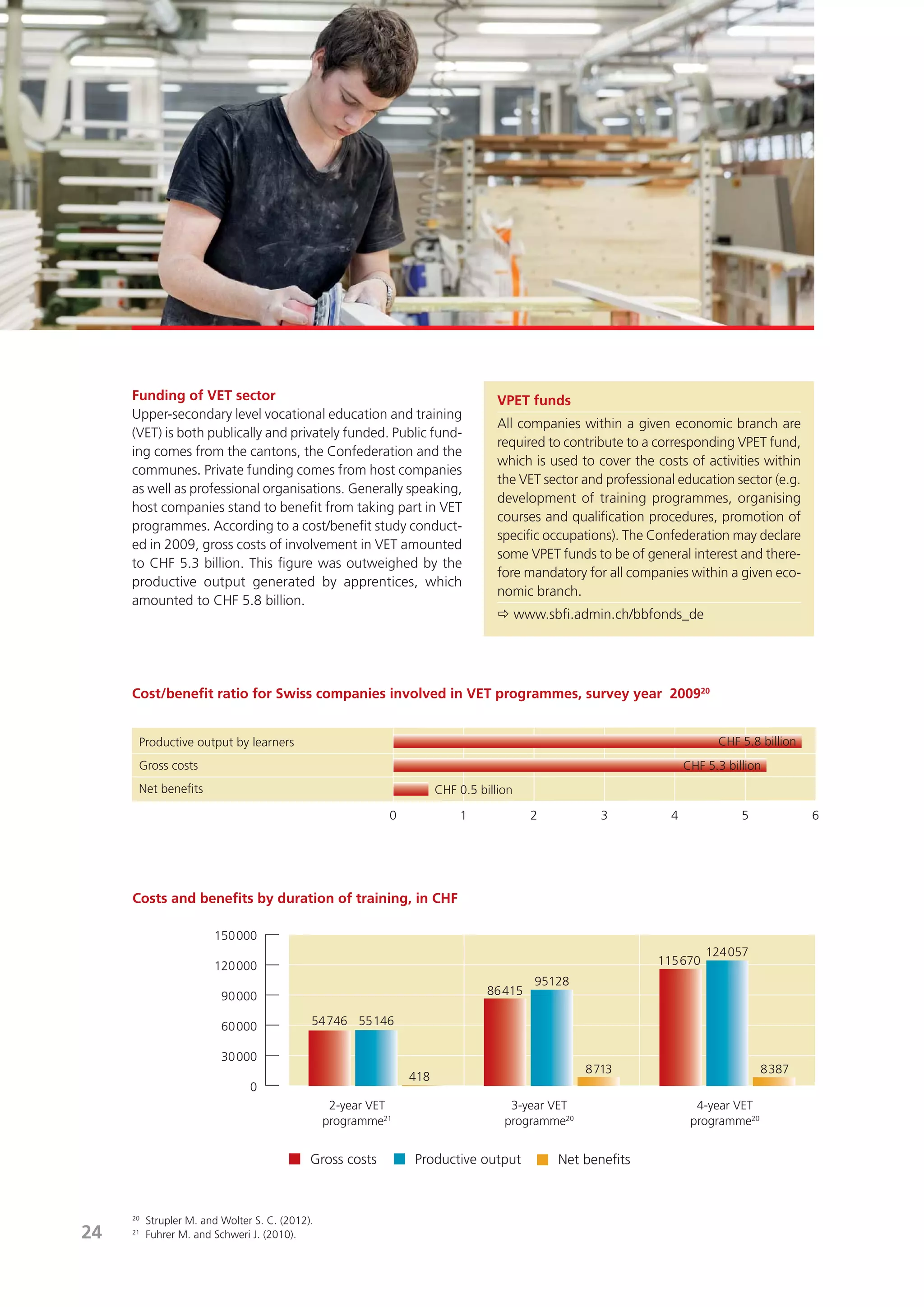
Funding of VET sector
Upper-secondary level vocational education and training
(VET) is both publically and privately funded. Public fund-
ing comes from the cantons, the Confederation and the
communes. Private funding comes from host companies
as well as professional organisations. Generally speaking,
host companies stand to benefit from taking part in VET
programmes. According to a cost/benefit study conduct-
ed in 2009, gross costs of involvement in VET amounted
to CHF 5.3 billion. This figure was outweighed by the
productive output generated by apprentices, which
amounted to CHF 5.8 billion.
CHF 5.8 billion
CHF 5.3 billion
CHF 0.5 billion
VPET funds
All companies within a given economic branch are
required to contribute to a corresponding VPET fund,
which is used to cover the costs of activities within
the VET sector and professional education sector (e.g.
development of training programmes, organising
courses and qualification procedures, promotion of
specific occupations). The Confederation may declare
some VPET funds to be of general interest and there-
fore mandatory for all companies within a given eco-
nomic branch.
 www.sbfi.admin.ch/bbfonds_de
25
Funding of professional education sector
Unlike the upper-secondary level VET sector, the ter-
tiary-level professional education sector relies much more
heavily on funding from students and employers. Feder-
al examinations in particular and the corresponding pre-
paratory courses are mostly paid for by the private sector.
Nevertheless, the public sector contributes substantial
funding. In 2014, public expenditure for professional
education and job-related continuing education and
training (CET) exceeded CHF 450 million.
Federal examinations
60% to 80% of the costs of conducting federal exami-
nations is paid for by the Confederation. In 2014, this
amounted to around CHF 22 million. Most individuals
who attend preparatory courses for federal examinations
do so on a part-time basis while remaining in employ-
ment. These preparatory courses are not regulated by the
state and are only partially funded by the public sector.
According to a study conducted in 2010, most of the
associated costs are paid for by the private sector (em-
ployers, students). The amount contributed by employers
is agreed upon on a case-per-case basis in discussions
with their employees.
Links
Information about funding of the professio-
nal education sector:
 www.sbfi.admin.ch/hbb  Finanzierung
Intercantonal Agreement on Funding Contri-
butions for Study Programmes at Colleges of
Higher Education (HFSV):
 www.edk.ch  Arbeiten  Finanzierungs-
Vereinbarungen  Höhere Fachschulen
Colleges of higher education
Since the 2015/2016 school year, public funding for
study programmes at Swiss colleges of higher educa-
tion is provided by the cantons under the terms of an
Intercantonal Agreement on Funding Contributions
for Study Programmes at Colleges of Higher Educa-
tion (HFSV). The cantons pay the colleges of higher
education lump sum contributions per student up to a
maximum of 50% of the average costs of each study
programme. When a given study programme is particu-
larly important to the general public (e.g. health), then
cantonal contributions can be as high as 90% of the av-
erage costs. The remaining costs are covered by tuition.
22
Econcept (2011). Repeat references possible.
Sources of funding for level 1 and level 2 federal examinations in 201022
0%
10%
20%
30%
40%
50%
60%
70%
80%
65.7 65.7
56.7
66.5
4.7 4.13.8 5.1
9.1
3.4
Funding from
public sector
Funding
from branch
Funding from
private sector
Contribution paid
by employers
Other contributions
Federal Diploma of Higher Education Advanced Federal Diploma of Higher Education
26
VPET at international level
The internationalisation of education and labour poses challenges for the Swiss system of
vocational and professional education and training (VPET). Switzerland has therefore taken
active steps at multiple levels to address this phenomenon. With the aim of further strength-
ening the position of Swiss dual-track VET programmes, the State Secretariat for Education,
Research and Innovation (SERI) is taking corresponding measures in coordination with the
cantons and professional organisations.
International cooperation in vocational education
and training (IC-VPET)
The main thrust of the strategy for international cooper-
ation in vocational and professional education and train-
ing (IC-VPET) is to support the following: international
recognition of vocational and professional qualifications,
transfer of expertise, maintaining the high quality of the
Swiss VPET system within an international context and
encouraging the international mobility of those who are
active within the VPET system. In addition to these ob-
jectives, the strategy also establishes priorities, measures
and criteria for IC-VPET.
 www.sbfi.admin.ch/ibbz
 www.ibbz.admin.ch
EU education programmes
Switzerland indirectly takes part in EU education and
youth programmes (Erasmus+). Among other things,
this includes funding for mobility and cooperation activ-
ities in the area of VET.
 www.ch-go.ch/en/
National Qualifications Framework (NQF VPET)
The Swiss National Qualifications Framework for Voca-
tional and Professional Qualifications (NQF VPET) makes
it easier to compare and appreciate the value of Swiss
vocational and professional qualifications at the interna-
tional level. In the future, all vocational and professional
qualifications will be assigned to a level within the NQF
VPET. In addition, each VET qualification will be accom-
panied by a corresponding certificate supplement and
each professional education qualification with a corre-
sponding diploma supplement. These documents explain
the competences acquired by the qualification holder
and will be available in Swiss national languages and
English.
 www.nqr-berufsbildung.ch
Recognition of foreign qualifications
SERI recognises a large number of foreign qualifications.
It facilitates access to regulated occupations and profes-
sions and employment of holders of foreign qualifica-
tions. In most cases, recognition involves comparison of
training as well as possible compensatory measures if
there are substantial differences. SERI works with profes-
sional organisations and training institutions, which helps
to ensure a high level of acceptance of its recognition
decisions.
 www.sbfi.admin.ch/diploma
Transfer of expertise
The Swiss VPET system has generated international in-
terest. Switzerland receives foreign delegations, shares
its expertise with interested countries in accordance with
the IC-VPET strategy and works closely with countries
that also have strong dual-track VET systems.
27
Pursuing international cooperation in VET through
international organisations
Work with international organisations such as the OECD
or the EU requires an understanding of VET at the inter-
national level. The State Secretariat for Education, Re-
search and Innovation (SERI) represents Switzerland in
various European bodies in matters pertaining to VET.
This has enabled Switzerland to present its positions and
exchange good practices. This cooperation has led to
international VET projects.
 www.sbfi.admin.ch/eu-berufsbildung
 www.sbfi.admin.ch/oecd
National and international skills competitions
Each year, numerous trade associations send their young
professionals to compete in national SwissSkills compe-
titions. At the same time, these competitions serve as a
means of selecting participants for EuropeSkills and
WorldSkills competitions. In 2014, the first centrally or-
ganized SwissSkills competition was held in Bern. After
the WorldSkills competition held in Brazil in 2015, the
next competition will take place in the Swedish city of
Göteborg in December 2016.
 www.swiss-skills.ch
Exchange and mobility within the VET sector:
Budget for Swiss participation in EU-sponsored traineeships abroad (Leonardo da Vinci)23
4,3 Mio. CHF
Number of young people doing traineeships abroad in 2015 1114
Outgoing 843
Incoming 271
NQF VPET:
Vocational and professional qualifications to be assigned by 2017 730
Recognition of foreign qualifications:
Number of qualifications processed in 2015 5400
Qualifications from EU/EFTA member states 4400
Qualifications from non-EU/EFTA member states: 1000
Foreign delegations:
Number of foreign delegations received in 2015 40
Swiss performance at last four WorldSkills competitions:
São Paulo 2015 4th
place
Leipzig 2013 2nd
place
London 2011 3rd
place
Calgary 2009 2nd
place
Key figures for international VET activities
23
In relation to transitional measures for Erasmus+ in 2016 (based on Federal Council proposal for compensatory budget to cover period
2015/16).
28
VPET research
The Swiss VPET system is an important asset for the Swiss economy and strengthens its
international competitiveness. Subsequent development and adaptation of the VPET system
to fresh challenges requires knowledge, which can be gained through VPET research
Legal mandate
The Federal Vocational and Professional Education and
Training Act (VPETA) states that the Confederation must
contribute to the development of the Swiss VPET system
through VPET research, among other things. Quality and
independence must be assured through qualified re-
search institutes.
Objectives
The Confederation will continue to support VPET research
until a lasting infrastructure is in place that conducts re-
search to an internationally recognised standard. VPET
research findings should enable continuous development
of the Swiss VPET system. In addition, research findings
should produce the knowledge needed to manage Swiss
VPET policy. Together with funding of projects aimed at
developing the VPET system and support for special ser-
vices, federal VPET research constitutes a viable means
of ensuring innovation within the VPET system.
Support instruments
The support programme sponsored by the State Secre-
tariat for Education, Research and Innovation (SERI) is
comprised of two support instruments: «Leading Hous-
es» and «Individual projects». Both of these instruments
complement one another. The Leading House instrument
pursues long-term objectives with the aim of establishing
new research structures. Leading Houses focus on clear-
ly defined, relevant research themes. In their respective
areas, each Leading House acts as a competence centre.
In contrast, individual projects pursue shorter-term ob-
jectives and generally last for a period of up to four years.
With these two instruments, it is possible to conduct both
fundamental and applied research in support of the VPET
system.
Links
Information about VPET research:
 www.sbfi.admin.ch/bbforschung
Information about support instruments:
 www.sbfi.admin.ch/bbforschung
 Leading Houses  Individual Projects
29
Useful links
Information about VPET from SERI
Up-to-date information about the Swiss VET and profes-
sional education sectors on the website of the State Sec-
retariat for Education, Research and Innovation (SERI).
 www.sbfi.admin.ch/berufsbildung
SERI documentation
Collection of SERI publications on VET and professional
education. Mostly available in different languages.
 www.sbfi.admin.ch/doku-bb
The VPET-campaign
Information portal about campaign to promote the Swiss
VPET system.
 www.vetplus.ch
VPET portal
Cantonal portal with extensive information about the
Swiss VPET system.
 www.berufsbildung.ch
VPET Lexicon
Key terms relating to upper-secondary level vocational
education and training and tertiary-level professional ed-
ucation along with brief explanations – in German,
French, Italian and English.
 www.lex.berufsbildung.ch
Swiss education statistics
Statistics, publications and interactive statistical tools
from the Federal Statistical Office (FSO).
 www.education-stat.admin.ch
Information about training of vocational school
teachers, apprenticeship trainers, branch courses
instructors and examiners
 www.sbfi.admin.ch/bbverantwortliche
Information about how to obtain the host
company label
 www.vignette.berufsbildung.ch
VET-related journal and newsletter
Range of products for professionals and institutions with-
in the VET and professional education sectors, vocation-
al, educational and career counsellors and labour market
authorities.
 www.panorama.ch
Swiss education information platform
Swiss education server with information and materials
concerning the Swiss education system.
 www.educa.ch/en/
Document server for education
Electronic repository of documents relating to education,
education management, planning, research and devel-
opment in Switzerland.
 www.edudoc.ch
30
References
Federal Statistical Office (2009), Personen mit einem Abschluss der höheren Berufsbildung auf dem Arbeitsmarkt.
Federal Statistical Office (2015a), Statistik der Bildungsabschlüsse.
Federal Statistical Office (2015b), Bildungssystem Schweiz – Indikatoren – Abschlüsse und Kompetenzen –
Abgeschlossene Ausbildungen der höheren Berufsbildung.
Federal Statistical Office (2015c), Bildungssystem Schweiz – Indikatoren – Verläufe und Übergänge – Übergang in
die Sekundarstufe II.
Federal Statistical Office (2015d), Schülerinnen, Schüler und Studierende 2013/14.
Federal Statistical Office (2015e), Statistik der beruflichen Grundbildung.
Federal Statistical Office (2015f). Bildungssystem Schweiz – Indikatoren – Abschlüsse und Kompetenzen –
Übergang zur höheren Berufsbildung.
Federal Statistical Office (2015g), Bildungssystem Schweiz – Indikatoren – Abschlüsse und Kompetenzen – Relati-
ves Erwerbseinkommen.
Federal Statistical Office (2015h), Spezialauswertung.
Econcept (2011), Befragung der Kandidatinnen und Kandidaten der eidgenössischen Prüfungen im Bereich der
höheren Berufsbildung – Schlussbericht.
Fuhrer M. und Schweri J. (2010), Kosten und Nutzen von zweijährigen beruflichen Grundbildungen aus der Sicht
der Betriebe, Schlussbericht, EHB Zollikofen.
Link Institut (2015), Lehrstellenbarometer August 2015 – Detaillierter Ergebnisbericht.
State Secretariat for Education, Research and Innovation (2015), Vollkostenrechnung der kantonalen Berufsbil-
dung 2013.
Strupler M. und Wolter S. C. (2012), Die duale Lehre eine Erfolgsgeschichte – auch für Betriebe. Ergebnisse der
dritten Kosten-Nutzen-Erhebung der Lehrlingsausbildung aus der Sicht der Betriebe, Rüegger Verlag: Glarus/Chur.
31
Orders
www.vetplus.ch
Contact
State Secretariat for Education, Research and Innovation, Einsteinstrasse 2, 3003 Bern,
Tel +41 (0)58 462 21 29, berufsbildungspolitik@sbfi.admin.ch, www.sbfi.admin.ch
32

Apprenticeships: Facts and Figures

  • 1.
    1 Vocational and Professional Educationand Training in Switzerland Facts and Figures 2016
  • 2.
    2 Impressum Publisher: State Secretariatfor Education, Research and Innovation (SERI) © 2016 Editor: VPET Policy SERI Photos: Seilbahnen Schweiz and Iris Krebs, Bern Graphics: Communication SERI Printer: Sonderegger Publish AG, Weinfelden Languages: ger/fr/it/en/sp
  • 3.
    3 Contents Overview 4 Swiss VPETsystem 6 One mission – three partners 8 Learning locations 10 Vocational education and training 11 Federal vocational baccalaureate 16 Professional education 18 Vocational qualifications for adults 22 Swiss VPET funding 23 VPET at international level 26 VPET research 28
  • 4.
    4 Overview The Swiss VPETsystem enables young people to enter the labour market and ensures that there are enough skilled workers and managers in the future. It has a high labour market relevance and is an integral part of the education system. The VPET system is divided into two sectors: upper-secondary level vocational education and training (VET) and tertiary-level professional education. The most popular form of upper-secondary level education and training Two-thirds of all young people coming out of compulso- ry education in Switzerland enrol in vocational education and training (VET), which provides them with a solid foundation in a given occupation. There are around 230 occupations to choose from. The VET sector forms the basis for lifelong learning and opens up a wealth of job prospects.  More information on pages 11–15. Career prospects Tertiary-level professional education builds from up- per-secondary level vocational education and training (VET). It provides professionals with specific competenc- es and prepares them for highly technical and manage- rial positions. There are around 400 federal examinations as well as 57 study programmes at colleges of higher education in 8 different professional fields. The Federal Vocational Baccalaureate (FVB) opens the way to Swiss universities of applied sciences (UAS). FVB holders who pass the University Aptitude Test (UAT) have the option of enrolling in a cantonal university or one of Switzerland’s two federal institutes of technology (FIT).  More information on pages 16–21. Dual-track approach to learning Most VET programmes are of the dual-track variety (i.e. part-time classroom instruction at a vocational school combined with a part-time apprenticeship at a host com- pany). The less common variety is a school-based VET programme (i.e. full-time classroom instruction, no ap- prenticeship). School-based VET programmes are gener- ally offered by trade schools or commercial schools. Ter- tiary-level professional education also combines classroom instruction with work-based training, thereby ensuring a smooth transition from dual-track VET programmes.  More information on page 10. Permeability The Swiss VPET system is based on clearly defined educa- tion and training options as well as on national qualifica- tions procedures. Typically, VET and professional education are very flexible: learners may pursue more advanced education and training opportunities, switch from voca- tional/professional pathways to general education/univer- sity pathways and later change the course of their work- ing lives with relative ease. Continuing education and training (CET) options are also available at all levels.  More information on pages 6–7. Labour-market focus Education and training are centred on acquisition of pro- fessional competences that are actually in demand as well as on occupations and professions for which there are existing job vacancies. This direct link with the labour market is the main reason why Switzerland has one of the lowest youth unemployment rates in Europe.  More information on pages 10 and12. Collective governance The VPET system is collectively governed by the Confed- eration, the cantons and professional organisations. These three main partners work together to maintain a high level of quality within the VPET system. They also strive to ensure that there is an adequate supply of apprentice- ship/traineeship positions and training options. This part- nership and respective areas of responsibility are set forth in the Federal Vocational and Professional Education and Training Act (VPETA) and its corresponding ordinance.  More information on pages 8–9.
  • 5.
    5 Upper-secondary level: vocationaleducation and training (VET) Total Women Men Federal VET Diploma 61128 33354 27774 Federal VET Certificate 5870 3094 2776 Non-formal two-year apprenticeships 374 318 56 Federal Vocational Baccalaureate 14177 7491 6686 University Aptitude Test 752 426 326 Tertiary level: professional education Total Women Men Qualification awarded by colleges of higher education 8076 4149 3927 Advanced Federal Diploma of Higher Education 2635 1978 657 Federal Diploma of Higher Education 14537 9065 5472 Professional education not recognised by the Confederation 1825 666 1159 1 Federal Statistical Office (2015a). These figures refer to the number of qualifications awarded, not the number of holders (some of whom may hold several qualifications). Quality The main purpose of having all three partners involved is to ensure high quality within the VPET system. The distribution of training content across two (or in some cases three) different learning locations – i.e. vocational schools, host companies and branch training centres – helps to improve the quality of upper-secondary level VET programmes. The responsibilities of each actor depend on the tasks assigned to each of the three main partners within the VPET system. In areas where responsibilities overlap, the actors work together on the specific situa- tions and matters at hand.  More information on pages 8–9. Efficiency The consistent focus on the labour market allows VET programmes to be efficiently and effectively organised. One indication of this is the fact that the productive out- put of learners during their apprenticeships exceeds the gross costs of their training.  More information on pages 23–25. Completion rates for 20141
  • 6.
    6 Swiss VPET system Vocationaleducation and training (VET) is provided at upper-secondary level. Professional education is provided at tertiary level. Both VET and professional education use clearly defined curricula and national qualification procedures. They are also characterised by a high degree of permeability: recognition of prior learning to keep track of prior education and training makes it much easier for learners to pursue further education and training opportunities, switch between vocational/professional pathways and general education/university pathways and change the course of their working lives. The Swiss VPET system offers a broad selection of available training options. Courses cater to different abilities and are geared to the needs of different age groups. A wealth of job-related continuing education and training (CET) courses can also be found at all levels. TRANSITIONAL OPTIONS JOB-RELATEDCONTINUINGEDUCATIONANDTRAINING JOB-RELATEDCONTINUINGEDUCATIONANDTRAINING PROFESSIONAL EDUCATIONAA UNIVERSITIES UNIVERSITIES FEDERAL INSTITUTES OF TECHNOLOGY UNIVERSITIES OF APPLIED SCIENCES COLLEGES OF HIGHER EDUCATIONFEDERAL EXAMINATIONS Master's degree Bachelor's degree Master's degree Bachelor's degree Advanced Federal Diploma of Higher Education Advanced Federal Diploma of Higher Education Federal Diploma of Higher Education PhD/doctorate Master's degree Bachelor's degree UNIVERSITIES OF TEACHER EDUCATION COMPULSORY EDUCATIONAA UPPESER-SNCONDRYAREVEVLEVLLL VOCATIONAL EDUCAA ATION AND TRAININGAA GENERAL EDUCATION SCHOOLSAA Federal Diploma of Vocational Education and Training Federal Vocational Baccalaureate Federal Certificate of Vocational Education and Training SPECIALISED SCHOOLS HOSTCOMPANIES,VOCATIONALSCHOOLS, BRANCHCOURSES HOSTCOMPANIES, VOCATIONALSCHOOLS, BRANCHCOURSES Baccalaureate BACCALAUREATE SCHOOLS Specialised Baccalaureate Specialised School Certificate SBFI 2016 Usual pathway Possible pathway
  • 7.
    7 Upper-secondary level: vocationaleducation and training (VET) VET programmes provide learners with solid profession- al competences and pave the way for lifelong learning.  More information on pages 11–17. 3-year or 4-year VET programmes for the Federal VET Diploma These VET programmes provide learners with the com- petences needed to work in a specific occupation and open access to tertiary-level professional education. Learners also have the option of preparing for the Fed- eral Vocational Baccalaureate (FVB) either during their training or after graduation. 2-year VET programmes for the Federal VET Certificate These VET programmes provide young people with more practical skills to obtain a recognised qualification for a specific occupational profile. Graduates of a 2-year VET programme may enrol directly in a 3- or 4-year VET pro- gramme leading to the Federal VET Diploma. Federal Vocational Baccalaureate (FVB) Learners enrolled in a 3-year or 4-year VET programme for the Federal VET Diploma have the option of preparing for the Federal Vocational Baccalaureate (FVB). This pre- paratory course covers general education subjects and those who pass the FVB examination may enrol in a Swiss university of applied sciences (UAS) without having to take an entrance examination. Moreover, holders of the FVB can prepare for the University Aptitude Test (UAT), which opens the way for enrolment in a cantonal univer- sity or federal institute of technology. Transitional options between lower- and up- per-secondary level Transitional options are available to young people com- pleting compulsory education who have been unable to immediately transition to upper-secondary level. Such options include practical training and pre-apprenticeships and are generally designed to prepare young people for enrolment in VET programmes. Tertiary level: professional education Holders of the Federal VET Diploma or equivalent quali- fications may specialise or deepen their expertise at ter- tiary level by pursuing a professional qualification. Prepa- ration also includes acquisition of managerial skills. The professional education sector is designed to meet the needs of the labour market and builds on existing work experience.  More information on pages 18–21. Federal examinations (level 1) This federal examination is intended for professionals who wish to improve their knowledge and skills and spe- cialise in a given field after completing upper-secondary level vocational education and training (VET). Successful candidates are awarded the Federal Diploma of Higher Education, which is generally a prerequisite for admit- tance to the examination for the Advanced Federal Di- ploma of Higher Education. Federal examinations (level 2) This examination is generally for professionals who have acquired a great deal of expertise in their field and/or who intend to hold a managerial position in a company. Successful candidates are awarded the Advanced Feder- al Diploma of Higher Education. Study programmes at colleges of higher education Study programmes at colleges of higher education are intended for professionals holding a Federal VET Diploma or equivalent qualifications who wish to improve their knowledge and skills and hold managerial positions. These degree programmes cover a broader and more general range of topics than those addressed in the two federal examinations described above. Successful candi- dates are awarded a federally recognised qualification. Job-related continuing education and training (CET) A wide range of job-related CET options (i.e. non-formal courses, seminars, etc.) can be found at all training levels and are part of lifelong learning.
  • 8.
    8 One mission –three partners The provision of VET and professional education is a mission collectively shouldered by the Confederation, the cantons and professional organisa- tions. These three partners are jointly committed to the highest possible standard of quality within the Swiss VPET system. They also strive to ensure the availability of an adequate number of apprenticeships and training courses. Confederation State Secretariat for Education, Research and Innovation (SERI) Is the federal government’s specialised agency for nation- al and international matters concerning education, re- search and innovation policy. SERI is responsible for reg- ulating and co-funding the VET and professional education sectors.  www.sbfi.admin.ch Swiss Federal Institute for Vocational Education and Training (SFIVET) Mainly provides basic and continuing training to teachers, trainers, instructors and examiners working at both up- per-secondary level (VET sector) and tertiary level (pro- fessional education sector). SFIVET is also involved in research, studies, pilot projects and the provision of ser- vices. It has three regional campuses: in Lausanne, Luga- no and Zollikofen.  www.ehb-schweiz.ch/en/ Strategic management and development • Quality assurance and further development of the Swiss VPET system • Comparability and transparency of courses throughout Switzerland • Enactment of around 230 VET ordinances • Recognition of regulations for around 400 federal examinations as well as 35 core syllabuses for study programmes at colleges of higher education • Recognition of study programmes and continuing education and training at colleges of higher education • Recognition of training courses for teachers, trainers, instructors and examiners within the VET and professional education sectors as well as training courses for vocational, educational and career guidance counsellors • Recognition of foreign qualifications • Payment of one-fourth of public sector expendi- ture for the VPET system • Promotion of innovation and support for specific activities in the public interest Confederation
  • 9.
    9 Professional organisations Trade associations/ branch organisations Determine content of training and national qualification procedures, organise courses at upper-secondary level (VET sector) and tertiary level (professional education sector). Social partners, other relevant organisations and VPET providers Together with trade associations, they are also involved in the further development of VPET. Companies Where possible, companies provide apprenticeships and traineeships, thereby paving the way for the next gener- ation of qualified workers. Their involvement in the Swiss VPET system is voluntary. Training content and apprenticeships • Establishing the training content of VET pro- grammes and study programmes at colleges of higher education • Establishing national qualification procedures for VET programmes as well as for federal examina- tions for the Federal Diploma of Higher Education and the Advanced Federal Diploma of Higher Education • Creation of apprenticeship positions • Imparting professional competences at tertiary level (professional education) • Developing new training courses • Organising branch courses • Managing VPET funds Cantons Swiss Conference of Cantonal Ministers of Education (EDK) The cantons are generally responsible for education and training in Switzerland. National cooperation through EDK complements and reinforces cantonal authority over education.  www.edk.ch 26 cantonal VET offices Responsible for implementing VET at cantonal level, VET offices coordinate their activities through the Swiss Con- ference of VET Offices (SBBK), a specialised conference of the Swiss Conference of Cantonal Ministers of Edu- cation (EDK).  www.sbbk.ch Vocational, educational and career guidance services Provide information and advice to both young people and adults. Implementation and supervision • Implementing the Federal Vocational and Professional Education and Training Act (VPETA) • Supervising apprenticeships, vocational schools and colleges of higher education • Providing vocational, educational and career guidance services • Creating options that prepare young people for enrolment in VET programmes • Issuing permits authorising host companies to take on apprentices and/or trainees • Apprenticeship marketing • Providing training to apprenticeship trainers in host companies Professional organisations Cantons Vocational schools Vocational schools provide classroom instruction for both dual-track (i.e. combined work and school) and school- based (i.e. full-time classroom instruction, no apprenticeship) VET programmes. They also prepare learners for the Federal Vocational Baccalaureate examination.
  • 10.
    10 Learning locations The trademarkand strength of the Swiss VPET system is the direct correlation with the labour market. This is reflected in various learning locations. Upper-secondary level: Vocational education and training (VET) Apprenticeship training at host companies With the dual-track approach, learners attend courses at vocational schools on a part-time basis. The remaining time is spent doing an apprenticeship at a host company where they are provided with the practical know-how, knowledge and skills needed for their chosen occupation. Learners also actively take part in the host company’s production processes. Host company networks: in some cases, host companies may wish to combine their strengths to offer one or more apprenticeships in a mod- ular format. Classroom instruction at vocational schools Vocational schools provide classroom instruction. This consists of instruction in vocational subjects as well as subjects falling under the Language, Communication and Society (LCS) category. Classroom instruction is intended to develop technical, methodological and social skills of learners while imparting the theoretical and general prin- ciples needed to perform occupational tasks. Classroom instruction covers one or two days per week. Vocational schools also offer a preparatory course for the Federal Vocational Baccalaureate Examination. Branch courses at branch training centres Branch courses are meant to complement classroom in- struction at vocational schools and apprenticeship train- ing at host companies by providing learners with essen- tial practical skills. Branch courses often take place at third-party training centres run by the branches involved. Tertiary level: Professional education Preparation for federal examinations Preparation for federal examinations for the Federal Di- ploma of Higher Education and Advanced Federal Diplo- ma of Higher Education takes place alongside one’s usu- al working activities. Although there is no requirement to do so, candidates for federal examinations may enrol in part-time preparatory courses, which are offered by public and private providers in the evenings or at week- ends. Study programmes at colleges of higher education Study programmes at colleges of higher education may be attended on either a full-time or part-time basis. Stu- dents enrolled in the full-time programme will complete a traineeship over the course of their studies. In order to enrol part-time, students must be employed at least 50% of a standard workweek. The aim is to apply what one learns in an actual working environment.
  • 11.
    11 Vocational education andtraining Vocational education and training provides young people with their first exposure to working life. It is the basis for lifelong learning and opens a wide range of career prospects. Enrolment in upper-secondary level in 20132 Dual-track VET programme School-based VET programme Baccalaureate school or specialised school 68261 29172 8159 Transitions from lower- to upper-secondary level4 Around two-thirds of young people coming out of compul- sory education in Switzerland enrol in an upper-secondary level VET programme. This proportion has remained con- stant for years. Dual-track VET programmes are by far the most prevalent form of vocational education and training. In the French- and Italian-speaking regions of Switzerland, however, there is a marked preference for school-based VET programmes compared to the German-speaking region: in 2013, only 4.4% of all VET programmes compared to the German-speaking region were school-based whereas in the French-speaking region the proportion stood at 26.6% and in the Italian-speaking region at 31.4%.3 The vast majority of pupils coming out of compulsory education, enrol in either a vocational school (VET sec- tor) or in a baccalaureate school or a specialised school (general education sector). Many young people who were unable to transition directly to upper-secondary level opted for a transitional option such as a 10th school year or a preparatory course for VET. Others went on a motivation semester or spent time abroad to improve their language skills. 2 Federal Statistical Office (2015d). Dual-track and school-based VET programmes, incl. trade schools and IT schools, excl. non-formal two year apprenticeships. 3 Federal Statistical Office (2015d). incl. trade schools and IT schools, excl. non-formal two year apprenticeships. 4 Federal Statistical Office (2015c), (2015d). VET, incl. non-formal two year apprenticeships. General education includes baccalaureate schools, specialised schools and schools that prepare learners for the specialised baccalaureate. Transitional options include the 10th school year, preapprenticeships and schools that prepare young people for enrolment in VET. 0% 10% 20% 30% 40% 50% 2011 2012 2013 47.5 26.2 13.4 45.8 26.5 12.8 44.3 26.5 12.4 Transitional optionsVocational school Baccalaureate school or specialised school
  • 12.
    12 Apprenticeship market There aretwo sides to the apprenticeship market: the supply side (host companies offering apprenticeship po- sitions) and the demand side (young people looking for apprenticeship positions). The State plays a mediating role: it ensures the best possible general conditions for host companies, encourages the provision of apprentice- ship positions and helps young people to choose an oc- cupation company. Various factors influence supply and demand on the apprenticeship market. On the supply side are structural changes, economic fluctuations and the host company ratio (i.e. proportion of companies that are willing and able to train apprentices). On the demand side, demographic changes and the interests of young people have an impact on the apprenticeship market. Apprenticeship «Barometer» The Apprenticeship «Barometer» is a survey con- ducted twice each year (once in April and once in August) to determine the current situation and short- term trends on the apprenticeship market. Repre- sentative surveys are conducted among companies and young people to identify and monitor key indi- cators of the present situation.  www.sbfi.admin.ch/barometer Apprenticeship market Structural changes The supply of apprenticeship positions reflects the long-term needs of the labour market. Economic fluctuations Economic fluctuations affect the order book of host companies and therefore their ability to productively employ apprentices. Host company ratio Around 40% of the companies in Switzerland that could offer apprenticeships actually do so. Smaller companies in particular are either overly specialised or lack qualified apprenticeship trainers, which makes it more difficult for them to offer apprenticeships. Demographic changes Demographic changes affect the number of young people completing compulsory education, which in turn affects demand. Interests of young people The choice of occupation depends on the hopes, aspirations and aptitudes of learners as well as the availability of suitable apprentice- ship positions. Career guidance services provide young people with information and advice.
  • 13.
    13 Focus on youngpeople: Advice and support before and during training Vocational information and counselling Cantonal career guidance services work closely with schools to help young people choose an occupation and find a suitable apprenticeship.  www.adressen.sdbb.ch List of apprenticeship positions The list of apprenticeship positions enables young people to search all open apprenticeships by occupation and canton.  www.berufsberatung.ch  Lehrstellensuche Transitional options Transitional options are intended for young people who are not yet able to enrol in a VET programme for social or scholastic reasons or who have been unable to find an apprenticeship. In addition to courses aimed at im- proving scholastic, linguistic or other skills, young people attend a course to prepare them for enrolment in a VET programme. The acquired skills increase their chances of finding an apprenticeship. Coaching and mentoring Coaching and mentoring entails the provision of individ- ual guidance to young people during the period of com- pulsory education. One of the aims is to help young people to improve occupational and social skills and op- timise their CVs. The various projects and programmes are sponsored by both the cantons and private organi- sations. VET Case Management VET Case Management is intended to help young people, who are particularly at risk of dropping out of VET pro- grammes. The aim is also to improve the efficiency and effectiveness of measures taken. VET Case Management is a structured process: a case manager coordinates in- stitutional activities in accordance with an established plan so as to ensure that the young person receives ad- equate support.  www.sbfi.admin.ch/cmbb Apprenticeship placement services Apprenticeship placement services are available to young people in the fourth quarter of the last year of lower-sec- ondary school. The aim is to further assist young people in their efforts to find an apprenticeship position. Individual guidance Individual guidance is for young people who encounter learning difficulties. They receive comprehensive support involving the host company, the vocational school, the branch training centre and social surroundings. By law, individual guidance is provided to young people enrolled in two-year VET programmes. However, learners enrolled in three- or four-year VET programmes may also make use of these services. Focus on companies: creation of apprenticeship positions Host company networks The creation of host company networks enables small- sized or specialised companies to pool their resources together as a network or with other companies. Instead of providing the full range of apprenticeship training as a single company, each partner provides a portion thereof.  www.lbv.berufsbildung.ch Marketing of apprenticeship positions Cantonal VET offices are familiar with the conditions in the various regions. They maintain contact with local companies. Apprenticeship promoters contact companies directly to encourage them to create apprenticeship po- sitions and become involved in training apprentices.
  • 14.
    14 The ten mostfrequently chosen occupations5 Apprentice satisfaction with choice of occupation6 Found apprenticeship in another occupation VET was second choice Other / Don't know / No information 2011 2012 2013 0% 20% 40% 60% 80% 100% 2014 Found apprenticeship in desired occupation 72 7 13 8 71 6 14 9 71 6 14 9 75 5 12 8 In Switzerland, there are VET programmes for around 230 different occupations. The ten most popular occupations in 2014 account for over 50% of all newly signed ap- prenticeship contracts. The choice of occupation and search for an available apprenticeship are important processes. Pupils begin this process during compulsory education when they are be- tween the ages 13 and 16. Over 70% of all young people who enrolled in a VET programme in 2014 managed to find an apprenticeship that matched their desired oc- cupation. This proportion has remained constant over the years. Links List of federally recognised vocational and professional qualifications:  www.sbfi.admin.ch/bvz Enrolment in VET programme:  www.education-stat.admin.ch  Bildungs- system  Detaillierte Daten  Berufliche Grund- bildung: Lehrverträge Link Portal for vocational, educational and career guidance services:  www.berufsberatung.ch Occupations Total Commercial employee 14637 Retail clerk 5212 Health care worker 4125 Social care worker 3061 Electrician 2168 IT technician 1959 Cook 1772 Logistician 1649 Mechanical engineer 1613 Draughtsman 1605 5 Federal Statistical Office (2015e). 6 Link Institute (2015).
  • 15.
    15 Creation of aVET programme – An example of cooperation between three main partners In Switzerland, VET programmes are developed by the private sector, i.e. the professional organisations that represent the interests of economic branches. Every five years, the training content and structure of VET pro- grammes are evaluated from an economic, technological, environmental and didactic standpoint and adapted accordingly. A new occupation emerges When a professional organisation wishes to introduce a VET programme for a new occupation, it works closely with the other main partners (i.e. the Confederation and the cantons). An important consideration for federal approval is that learners who graduate from a given VET programme will actually be able to find work. Devel- opment of a VET programme takes place in accordance with an established workflow. First steps Before work on the new VET programme can start, fundamental questions must first be answered: Which pro- fessional organisation will sponsor the new VET programme? Has the occupational field been clarified? Is there a need for the given occupation on the labour market and are there enough companies within the given branch that are willing to create apprenticeship positions and hire graduates afterwards? Once these questions have been answered, the professional organisation will contact the State Secretariat for Education, Research and Innovation SERI and schedule a planning meeting with all of the partners involved. Competence profile and VET ordinance The main documents in a given VET programme are the job profile7 , the overview of all professional competenc- es and the statement of the level of difficulty of the given occupation. The VET ordinance includes legal aspects8 applying to apprenticeship training in dual-track VET programmes as well as the various requirements for prac- tical training within school-based VET programmes. Consultation and approval SERI examines the VET ordinance and training plan for quality control purposes. After examination has been completed and any necessary adjustments have been made, SERI organises a consultation session with canton- al agencies, federal agencies and other interested parties. SERI will then take the results of this consultation into account and make whatever changes are needed to the VET ordinance and training plan. Any unresolved issues will be settled in an editing meeting of the various partners. SERI will then issue the VET ordinance and approve the training plan. Implementation and subsequent modification The committee for occupation development and quality that is responsible for the given occupation will then meet at least every five years to re-examine the VET ordinance and training plan in view of economic, techno- logical, environmental and didactic developments. Measures may then be taken on this basis to adapt the VET programme accordingly. The Swiss Federal Institute for Vocational Education and Training (SFIVET) has a federal mandate to provide support to the sponsoring professional organisation and the cantons. 7 The job profile describes what the person does in this occupation, his/her field of work and the importance that the occupation has within society. 8 Subject, duration, objectives and allocation of training content to learning locations, qualification procedure, qualifications and title.
  • 16.
    16 Issued as acomplement to the Federal VET Diploma, the Federal Vocational Baccalaureate (FVB) entitles the holder to enrol in a Swiss university of applied sciences (UAS) without having to take an entrance examination. If an FVB holder also takes the University Aptitude Test (UAT), then enrolment in a canton- al university or one of Switzerland’s two federal institutes of technology (FIT) is also possible. Proportion of VET graduates who obtained an FVB9 Federal vocational baccalaureate FVB 1 FVB 2 Total 2011 2012 2014 0% 3% 6% 9% 12% 15% 2013 7.3 7.5 7.6 8.0 5.7 6.2 6.4 6.9 13.0 13.7 14.1 14.8 The preparatory course for the FVB examination is gen- erally taught by vocational schools. There are two op- tions: either to take this preparatory course alongside the normal training regimen for the given VET programme (FVB 1) or to do so after completion of the VET pro- gramme (FVB 2). In recent years, the proportion of VET graduates who also obtain the FVB has been increasing steadily. The number of young people who take the pre- paratory course for the FVB examination after graduation (FVB 2) has risen at a faster rate than the number of young people who choose the FVB 1 option. From federal vocational baccalaureate to a univer- sity of applied sciences UAS offer a combination of theory and practical training at tertiary level. Study programmes lead to a Bachelor’s degree or a Master’s degree. At Bachelor’s degree level, UAS impart general theory and research findings as well as the competences needed to work in a given occupa- tion. At Master’s degree level, UAS provide students with in-depth, specialised knowledge, preparing them for a more advanced qualification in their field. Admission to UAS is generally open to holders of the FVB. Links Information about the FVB:  www.sbfi.admin.ch/rlp-bm Information about study programmes at UAS:  www.sbfi.admin.ch/fh Study programmes:  www.studyprogrammes.ch 9 Federal Statistical Office (2015a).
  • 17.
    17 Five orientations forfederal vocational baccalaureate and corresponding fields of study at universities of applied sciences Orientation of FVB Corresponding fields of study at UAS10 Engineering, architecture, life sciences Engineering and information technology Architecture, construction and planning Chemistry and life sciences Nature, agriculture and food Agriculture and forestry Business and services Business and services Creativity and art Design Health and social care Health Social work University Aptitude Test11 2006 2008 2010 2012 2014 Female Male 0 100 200 300 400 500 90 58 237 132 426 326 406 304 339 282 334 254 286 201 267 177 275 194 267 155 The University Aptitude Test (UAT), which may be taken by holders of the Federal Vocational Baccalaureate, en- ables one to enrol in any study programme at a Swiss university (i.e. cantonal universities and the two federal institutes of technology). The preparatory course for the UAT takes a year. This option has become increasingly popular in recent years. Link Information about UAT:  www.sbfi.admin.ch/passerelle-d 10 Fields of study that are unrelated to any VET programme are not listed (sports, music, theatre and other arts, applied linguistics, applied psychology). 11 Federal Statistical Office (2015a).
  • 18.
    18 Professional education Swiss tertiary-leveleducation is comprised of professional education, universities of applied sciences (UAS) and cantonal universities/federal institutes of technology (FIT). The professional education sector places great emphasis on the actual skills used in a given profession. Transitions to professional education12 Female Male Total 2011 2012 20142013 0% 5% 10% 15% 20% 25% 30% 35% 18.6 19.1 20.9 22.0 29.3 29.6 31.4 32.5 24.7 25.0 26.8 27.8 Pathway leading to professional qualifications13 Qualification awarded by colleges of higher education Advanced Federal Diploma of Higher Education Federal Diploma of Higher Education 2011 2012 20142013 0 5 10 15 20 25 30 Other Total Thousand 26702 25520 26573 27073 13160 13582 14042 14537 7009 6780 7627 8076 2950 2815 2786 2635 3583 2343 2118 1825 Professional education imparts competences needed to handle challenging technical or managerial activities and provides the labour market with highly skilled workers. Admission to professional education is normally open to holders of a Federal VET Diploma or equivalent upper-sec- ondary level qualifications. The proportion of holders of vocational qualifications who, after some years of work experience, decide to pursue professional qualifications has increased slightly in recent years. Most people obtain their professional qualification af- ter having passed a federal examination. The federally regulated professional education sector accounted for over 90% of the qualifications awarded in Switzerland in 2014. 12 Federal Statistical Office (2015f). 13 Federal Statistical Office (2015a). Link List of all federally recognised vocational and professional qualifications:  www.sbfi.admin.ch/bvz
  • 19.
    19 The ten mostfrequently taken federal examina- tions (level 1) in 201414 14 Federal Statistical Office (2015a). All professions combined Total Technical sales specialist 932 Police officer 901 Human resources specialist 869 Training specialist 823 Marketing specialist 616 Finance and accountancy specialist 490 Social insurance specialist 451 Electrical safety specialist 371 Medical masseur 341 Logistician 338 The ten most frequently taken federal examina- tions (level 2) in 201414 All professions combined Total Company auditor 229 Master farmer 140 Electrician 133 Accounting and controlling expert 129 Sales manager 123 Social worker 115 IT specialist 113 Real estate broker 75 Taxation expert 69 Fiduciary 65 The ten most frequently completed study pro- grammes at colleges of higher education in 201414 All fields combined Total Nursing 1710 Business administration 965 Social pedagogy 469 Hotels, restaurants and catering 462 Business informatics 271 Child care 253 Machine manufacturing 237 Banking 225 Tourism 206 Business processes 198 In Switzerland, there are federal examinations at level 1 for around 220 different professions and at level 2 for around 170 different professions. Both levels combined, the ten most frequently taken examinations accounted for over 40% of all federal examinations taken in 2014. In Switzerland, there are study programmes available at colleges of higher education for around 450 different occupations. The ten most frequently completed study programmes accounted for over 60% of all study pro- grammes completed in 2014.
  • 20.
    20 Completed tertiary-level trainingby economic branch in 201415 0% 10% 20% 30% 40% 50% 60% 70% 80% 15.1 3.1 26.7 15.6 2.7 17.0 16.7 12.8 13.1 14.2 55.1 17.1 5.6 45.1 17.2 1.8 23.0 14.6 2.5 57.3 19.8 4.1 29.7 10.3 1.3 65.0 18.6 1.0 , 5.3 19.9 1.3 12.8 0.8 0.4 12.1 Professional education Professional education and higher education Higher education Distribution of holders of tertiary-level qualifications by company size16 Holders of tertiary-level professional qualifications are more likely to work for small-sized companies on a con- tractual basis whereas holders of higher education qual- ifications tend to work for larger-sized companies. In terms of employment position, there does not seem to be any significant difference between holders of pro- fessional qualifications and holders of higher education qualifications. 1–9 FTEs 10–49 FTEs more than 100 FTEs 50–99 FTEs 0% 10% 20% 30% 40% 50% Professional education Higher education 27 22 25 23 1112 38 44 15 Federal Statistical Office (2015b). 16 Federal Statistical Office (2009). Own chart. Industry Transport; energy and water supply Construction Trade, repairs Hotel, restaurant and catering Financial services Public administration and education Health and social care Other Information and communication; art and entertainment Self-employed scientific and technical services Land and housing; services FTE= Full-time equivalent
  • 21.
    21 Income from employmentby vocational/professional qualification17 Professional education offers a good return on invest- ment for qualification holders. Most students enrolling in preparatory courses for federal examinations or study programmes at colleges of higher education do so on a part-time basis while working and therefore already earn an income that increases once they obtain their tertiary-level professional qualification. Compared to holders of upper-secondary level vocational qualifica- tions, holders of professional qualifications earn about one-third more. Upper-secondary level VET 2011 2012 2013 Index (100 = compulsory education) 157 100 140 200 120 160 180 2014 161 162 157 124 126 125 124 Tertiary-level professional education Links Information about the Swiss professional education sector:  www.sbfi.admin.ch/hbb Statistics on Swiss professional education sector:  www.education-stat.admin.ch  Tertiärstufe: Höhere Berufsbildung Information about transition to a Swiss university of applied sciences:  www.swissuniversities.ch/en  Services  Zulassung zur FH 17 Federal Statistical Office (2015g). Transition from professional education to a university of applied sciences It is possible to transition from professional education to a Swiss university of applied sciences. Depending on the qualifications, holders of professional qualifications may be admitted to a Swiss UAS without having to take an entrance examination or after passing an admissions test.
  • 22.
    22 Vocational qualifications foradults In Switzerland, adults may also obtain vocational qualifications, either by undergoing the full training regimen, including apprenticeship, or by validating their non-formal and informal learning. Number of vocational qualifications awarded to adults in 201418 Four established pathways There are several ways for adults to obtain a Federal VET Certificate (normally awarded upon completion of a two-year VET programme) or a Federal VET Diploma (normally awarded upon completion of a three- or four- year VET programme). Two pathways do not require the person to undergo the full spectrum of training: one is direct admission to the final examination and the other is validation of non-formal and informal learning. The other two pathways are either to undergo the full VET programme, including apprenticeship, or to undergo a shortened version of the same. Special for adults Adults who already have prior knowledge and experience can undergo an assessment to determine whether they qualify for validation, direct access to the final examina- tion or enrolment in a shortened VET programme. In the first two cases, the person must have at least five years of work experience. While the path to validation is only possible for specific occupations, direct access to the final examination is normally possible for all occupations. Ten most frequently chosen fields for adults seeking vocational qualifications in 201418 1st quali- fication 2nd qualifi- cation Total Regular VET programme 3531 90 3621 Shortened VET programme 1222 43 1265 Direct access to final examination 2170 28 2198 Validation of non-formal and informal learning 565 4 569 Total 7488 165 7653 Total occupations Total Health care 1171 Social care 933 Commerce 886 Logistics 345 Retail 322 Agriculture 223 Health and social care assistance 214 IT 184 Construction 141 Cooking 125 18 Federal Statistical Office (2015h), special analysis: Persons aged 25 and older.
  • 23.
    23 Swiss VPET funding TheVET sector is funded by the Confederation, the cantons and professional organisations, each to its own extent. Most of the costs of professional education and job-related CET programmes are borne by companies and private individuals. Public sector Public expenditure for Switzerland’s VPET system stood at around CHF 3.4 billion in 2014. The cantons are re- sponsible for implementing VPET. As such, they cover at least three-fourths of associated costs. The Confedera- tion’s share of public funding of the VPET system corre- sponds to one-fourth of the total costs. A total of 10% of federal funding will be used to promote VPET devel- opment projects as well as specific activities that serve the public interest. Private sector Professional organisations provide both services and funding for the Swiss VPET system: they do the ground- work, run their own training centres and promote spe- cific occupations (VET sector) and professions (profes- sional education sector). For their part, companies help to fund the system by creating apprenticeship positions. Public expenditure for the VPET system in 201419 0% 10% 20% 30% 40% 50% 60% 70% 80% 228 Mio. CHF 2507 Mio. CHF 105 Mio. CHF 108 Mio. CHF 317 Mio. CHF 142 Mio. CHF 9 Mio. CHF 30 Mio. CHF VET sector Professional education sector Share of total public expenditure for VPET system 19 State Secretariat for Education, Research and Innovation (2015). Preparation for enrolment in VET Vocational schools Branch courses Qualification procedures Colleges of higher education Preparation for federal examinations (level 1 and level 2) Training of professionals in both sectors Projects and special services
  • 24.
    24 Productive output bylearners Gross costs Net benefits 0 1 2 3 4 5 6 Cost/benefit ratio for Swiss companies involved in VET programmes, survey year 200920 Costs and benefits by duration of training, in CHF 0 30000 60000 90000 120000 150000 54746 55146 86415 95128 115670 124057 418 8713 8387 2-year VET programme21 Gross costs Productive output Net benefits 3-year VET programme20 4-year VET programme20 20 Strupler M. and Wolter S. C. (2012). 21 Fuhrer M. and Schweri J. (2010). Funding of VET sector Upper-secondary level vocational education and training (VET) is both publically and privately funded. Public fund- ing comes from the cantons, the Confederation and the communes. Private funding comes from host companies as well as professional organisations. Generally speaking, host companies stand to benefit from taking part in VET programmes. According to a cost/benefit study conduct- ed in 2009, gross costs of involvement in VET amounted to CHF 5.3 billion. This figure was outweighed by the productive output generated by apprentices, which amounted to CHF 5.8 billion. CHF 5.8 billion CHF 5.3 billion CHF 0.5 billion VPET funds All companies within a given economic branch are required to contribute to a corresponding VPET fund, which is used to cover the costs of activities within the VET sector and professional education sector (e.g. development of training programmes, organising courses and qualification procedures, promotion of specific occupations). The Confederation may declare some VPET funds to be of general interest and there- fore mandatory for all companies within a given eco- nomic branch.  www.sbfi.admin.ch/bbfonds_de
  • 25.
    25 Funding of professionaleducation sector Unlike the upper-secondary level VET sector, the ter- tiary-level professional education sector relies much more heavily on funding from students and employers. Feder- al examinations in particular and the corresponding pre- paratory courses are mostly paid for by the private sector. Nevertheless, the public sector contributes substantial funding. In 2014, public expenditure for professional education and job-related continuing education and training (CET) exceeded CHF 450 million. Federal examinations 60% to 80% of the costs of conducting federal exami- nations is paid for by the Confederation. In 2014, this amounted to around CHF 22 million. Most individuals who attend preparatory courses for federal examinations do so on a part-time basis while remaining in employ- ment. These preparatory courses are not regulated by the state and are only partially funded by the public sector. According to a study conducted in 2010, most of the associated costs are paid for by the private sector (em- ployers, students). The amount contributed by employers is agreed upon on a case-per-case basis in discussions with their employees. Links Information about funding of the professio- nal education sector:  www.sbfi.admin.ch/hbb  Finanzierung Intercantonal Agreement on Funding Contri- butions for Study Programmes at Colleges of Higher Education (HFSV):  www.edk.ch  Arbeiten  Finanzierungs- Vereinbarungen  Höhere Fachschulen Colleges of higher education Since the 2015/2016 school year, public funding for study programmes at Swiss colleges of higher educa- tion is provided by the cantons under the terms of an Intercantonal Agreement on Funding Contributions for Study Programmes at Colleges of Higher Educa- tion (HFSV). The cantons pay the colleges of higher education lump sum contributions per student up to a maximum of 50% of the average costs of each study programme. When a given study programme is particu- larly important to the general public (e.g. health), then cantonal contributions can be as high as 90% of the av- erage costs. The remaining costs are covered by tuition. 22 Econcept (2011). Repeat references possible. Sources of funding for level 1 and level 2 federal examinations in 201022 0% 10% 20% 30% 40% 50% 60% 70% 80% 65.7 65.7 56.7 66.5 4.7 4.13.8 5.1 9.1 3.4 Funding from public sector Funding from branch Funding from private sector Contribution paid by employers Other contributions Federal Diploma of Higher Education Advanced Federal Diploma of Higher Education
  • 26.
    26 VPET at internationallevel The internationalisation of education and labour poses challenges for the Swiss system of vocational and professional education and training (VPET). Switzerland has therefore taken active steps at multiple levels to address this phenomenon. With the aim of further strength- ening the position of Swiss dual-track VET programmes, the State Secretariat for Education, Research and Innovation (SERI) is taking corresponding measures in coordination with the cantons and professional organisations. International cooperation in vocational education and training (IC-VPET) The main thrust of the strategy for international cooper- ation in vocational and professional education and train- ing (IC-VPET) is to support the following: international recognition of vocational and professional qualifications, transfer of expertise, maintaining the high quality of the Swiss VPET system within an international context and encouraging the international mobility of those who are active within the VPET system. In addition to these ob- jectives, the strategy also establishes priorities, measures and criteria for IC-VPET.  www.sbfi.admin.ch/ibbz  www.ibbz.admin.ch EU education programmes Switzerland indirectly takes part in EU education and youth programmes (Erasmus+). Among other things, this includes funding for mobility and cooperation activ- ities in the area of VET.  www.ch-go.ch/en/ National Qualifications Framework (NQF VPET) The Swiss National Qualifications Framework for Voca- tional and Professional Qualifications (NQF VPET) makes it easier to compare and appreciate the value of Swiss vocational and professional qualifications at the interna- tional level. In the future, all vocational and professional qualifications will be assigned to a level within the NQF VPET. In addition, each VET qualification will be accom- panied by a corresponding certificate supplement and each professional education qualification with a corre- sponding diploma supplement. These documents explain the competences acquired by the qualification holder and will be available in Swiss national languages and English.  www.nqr-berufsbildung.ch Recognition of foreign qualifications SERI recognises a large number of foreign qualifications. It facilitates access to regulated occupations and profes- sions and employment of holders of foreign qualifica- tions. In most cases, recognition involves comparison of training as well as possible compensatory measures if there are substantial differences. SERI works with profes- sional organisations and training institutions, which helps to ensure a high level of acceptance of its recognition decisions.  www.sbfi.admin.ch/diploma Transfer of expertise The Swiss VPET system has generated international in- terest. Switzerland receives foreign delegations, shares its expertise with interested countries in accordance with the IC-VPET strategy and works closely with countries that also have strong dual-track VET systems.
  • 27.
    27 Pursuing international cooperationin VET through international organisations Work with international organisations such as the OECD or the EU requires an understanding of VET at the inter- national level. The State Secretariat for Education, Re- search and Innovation (SERI) represents Switzerland in various European bodies in matters pertaining to VET. This has enabled Switzerland to present its positions and exchange good practices. This cooperation has led to international VET projects.  www.sbfi.admin.ch/eu-berufsbildung  www.sbfi.admin.ch/oecd National and international skills competitions Each year, numerous trade associations send their young professionals to compete in national SwissSkills compe- titions. At the same time, these competitions serve as a means of selecting participants for EuropeSkills and WorldSkills competitions. In 2014, the first centrally or- ganized SwissSkills competition was held in Bern. After the WorldSkills competition held in Brazil in 2015, the next competition will take place in the Swedish city of Göteborg in December 2016.  www.swiss-skills.ch Exchange and mobility within the VET sector: Budget for Swiss participation in EU-sponsored traineeships abroad (Leonardo da Vinci)23 4,3 Mio. CHF Number of young people doing traineeships abroad in 2015 1114 Outgoing 843 Incoming 271 NQF VPET: Vocational and professional qualifications to be assigned by 2017 730 Recognition of foreign qualifications: Number of qualifications processed in 2015 5400 Qualifications from EU/EFTA member states 4400 Qualifications from non-EU/EFTA member states: 1000 Foreign delegations: Number of foreign delegations received in 2015 40 Swiss performance at last four WorldSkills competitions: São Paulo 2015 4th place Leipzig 2013 2nd place London 2011 3rd place Calgary 2009 2nd place Key figures for international VET activities 23 In relation to transitional measures for Erasmus+ in 2016 (based on Federal Council proposal for compensatory budget to cover period 2015/16).
  • 28.
    28 VPET research The SwissVPET system is an important asset for the Swiss economy and strengthens its international competitiveness. Subsequent development and adaptation of the VPET system to fresh challenges requires knowledge, which can be gained through VPET research Legal mandate The Federal Vocational and Professional Education and Training Act (VPETA) states that the Confederation must contribute to the development of the Swiss VPET system through VPET research, among other things. Quality and independence must be assured through qualified re- search institutes. Objectives The Confederation will continue to support VPET research until a lasting infrastructure is in place that conducts re- search to an internationally recognised standard. VPET research findings should enable continuous development of the Swiss VPET system. In addition, research findings should produce the knowledge needed to manage Swiss VPET policy. Together with funding of projects aimed at developing the VPET system and support for special ser- vices, federal VPET research constitutes a viable means of ensuring innovation within the VPET system. Support instruments The support programme sponsored by the State Secre- tariat for Education, Research and Innovation (SERI) is comprised of two support instruments: «Leading Hous- es» and «Individual projects». Both of these instruments complement one another. The Leading House instrument pursues long-term objectives with the aim of establishing new research structures. Leading Houses focus on clear- ly defined, relevant research themes. In their respective areas, each Leading House acts as a competence centre. In contrast, individual projects pursue shorter-term ob- jectives and generally last for a period of up to four years. With these two instruments, it is possible to conduct both fundamental and applied research in support of the VPET system. Links Information about VPET research:  www.sbfi.admin.ch/bbforschung Information about support instruments:  www.sbfi.admin.ch/bbforschung  Leading Houses  Individual Projects
  • 29.
    29 Useful links Information aboutVPET from SERI Up-to-date information about the Swiss VET and profes- sional education sectors on the website of the State Sec- retariat for Education, Research and Innovation (SERI).  www.sbfi.admin.ch/berufsbildung SERI documentation Collection of SERI publications on VET and professional education. Mostly available in different languages.  www.sbfi.admin.ch/doku-bb The VPET-campaign Information portal about campaign to promote the Swiss VPET system.  www.vetplus.ch VPET portal Cantonal portal with extensive information about the Swiss VPET system.  www.berufsbildung.ch VPET Lexicon Key terms relating to upper-secondary level vocational education and training and tertiary-level professional ed- ucation along with brief explanations – in German, French, Italian and English.  www.lex.berufsbildung.ch Swiss education statistics Statistics, publications and interactive statistical tools from the Federal Statistical Office (FSO).  www.education-stat.admin.ch Information about training of vocational school teachers, apprenticeship trainers, branch courses instructors and examiners  www.sbfi.admin.ch/bbverantwortliche Information about how to obtain the host company label  www.vignette.berufsbildung.ch VET-related journal and newsletter Range of products for professionals and institutions with- in the VET and professional education sectors, vocation- al, educational and career counsellors and labour market authorities.  www.panorama.ch Swiss education information platform Swiss education server with information and materials concerning the Swiss education system.  www.educa.ch/en/ Document server for education Electronic repository of documents relating to education, education management, planning, research and devel- opment in Switzerland.  www.edudoc.ch
  • 30.
    30 References Federal Statistical Office(2009), Personen mit einem Abschluss der höheren Berufsbildung auf dem Arbeitsmarkt. Federal Statistical Office (2015a), Statistik der Bildungsabschlüsse. Federal Statistical Office (2015b), Bildungssystem Schweiz – Indikatoren – Abschlüsse und Kompetenzen – Abgeschlossene Ausbildungen der höheren Berufsbildung. Federal Statistical Office (2015c), Bildungssystem Schweiz – Indikatoren – Verläufe und Übergänge – Übergang in die Sekundarstufe II. Federal Statistical Office (2015d), Schülerinnen, Schüler und Studierende 2013/14. Federal Statistical Office (2015e), Statistik der beruflichen Grundbildung. Federal Statistical Office (2015f). Bildungssystem Schweiz – Indikatoren – Abschlüsse und Kompetenzen – Übergang zur höheren Berufsbildung. Federal Statistical Office (2015g), Bildungssystem Schweiz – Indikatoren – Abschlüsse und Kompetenzen – Relati- ves Erwerbseinkommen. Federal Statistical Office (2015h), Spezialauswertung. Econcept (2011), Befragung der Kandidatinnen und Kandidaten der eidgenössischen Prüfungen im Bereich der höheren Berufsbildung – Schlussbericht. Fuhrer M. und Schweri J. (2010), Kosten und Nutzen von zweijährigen beruflichen Grundbildungen aus der Sicht der Betriebe, Schlussbericht, EHB Zollikofen. Link Institut (2015), Lehrstellenbarometer August 2015 – Detaillierter Ergebnisbericht. State Secretariat for Education, Research and Innovation (2015), Vollkostenrechnung der kantonalen Berufsbil- dung 2013. Strupler M. und Wolter S. C. (2012), Die duale Lehre eine Erfolgsgeschichte – auch für Betriebe. Ergebnisse der dritten Kosten-Nutzen-Erhebung der Lehrlingsausbildung aus der Sicht der Betriebe, Rüegger Verlag: Glarus/Chur.
  • 31.
    31 Orders www.vetplus.ch Contact State Secretariat forEducation, Research and Innovation, Einsteinstrasse 2, 3003 Bern, Tel +41 (0)58 462 21 29, berufsbildungspolitik@sbfi.admin.ch, www.sbfi.admin.ch
  • 32.