2012/2013
Tomorrow’s
Engineer
Generalist !is a Water,
Energy,
Environment,
E-Health,
Mechanics,
Information and
Communication technologies,
Urban planning,
Aeronautics and Aerospace,
Engineering Management,
Entrepreneurship and Innovation…
2012/2013Sceaux(Paris)•Troyes•Montpellier2013/2014
/enn
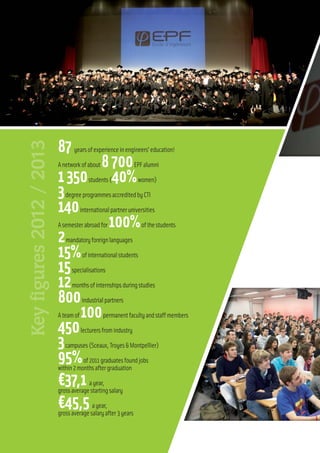
87yearsofexperienceinengineers’education!
Anetworkofabout8700EPFalumni
1350students(40%women)
3degreeprogrammesaccreditedbyCTI
140internationalpartneruniversities
Asemesterabroadfor100%ofthestudents
2mandatoryforeignlanguages
15%ofinternationalstudents
15specialisations
12monthsofinternshipsduringstudies
800industrialpartners
Ateamof100permanentfacultyandstaffmembers
450lecturersfromindustry
3campuses(Sceaux,Troyes&Montpellier)
95%of2011graduatesfoundjobs
within2monthsaftergraduation
¤37,1ayear,
grossaveragestartingsalary
¤45,5ayear,
grossaveragesalaryafter3years
Keyfigures2012/2013
EPF - Graduate School of Engineering
EPF’s generalist and polytechnic training programme prepares its graduates for a changing, globalised economy.
By acquiring a broad skills base and learning to act as managers, mediators and innovators, our engineers are perfectly
adapted to the new technological, industrial and human challenges of the companies. An EPF degree puts the wind in
your sails and offers an excellent career outlook.
Above all, EPF’s programme is characterised by the school’s ambition of helping each student successfully reconcile
their career goals and their personal goals to make their aspirations a reality.
Our school’s development meets this standard of openness and support, giving each student the possibility of having
many varied experiences, through internships, projects, research and entrepreneurship, in a variety of environments,
in France and abroad.
An EPF education gives every personality room to flourish, in an academic climate focused on social and gender balance,
in line with our original mission: building responsible male and female engineers who are committed and appreciated
in the companies.
EPF’S ENGINEERING STUDIES CURRICULUM.......................................... 02 - 03
EPF COURSE STRUCTURE ...................................................................04 - 05
MAJORS AND SPECIALISATIONS...........................................................06 - 11
GENERAL INFORMATION.....................................................................12 - 13
INTERNATIONAL PROGRAMMES............................................................ 14-15
INTERNSHIPS AND INDUSTRIAL PARTNERSHIPS.......................................16 - 17
OPPORTUNITIES FOR INTERNATIONAL STUDENTS.....................................18 - 19
STUDY FRENCH IN PARIS ....................................................................20 - 21
PRACTICAL INFORMATION.................................................................. 22 - 23
EPF CAMPUSES ............................................................................... 24 - 25
Jean-Michel NICOLLE, President
9 MILESTONES
Founded in 1925, EPF Ecole d’Ingénieurs, then known as “Ecole Polytechnique Féminine”, was one of the first engineering schools in France to admit
women. EPF has been coeducational since 1994, hence the acronym with the initials of the original full name.
✔ 1925 “Ecole Polytechnique Féminine” was founded by Marie- Louise Paris
✔ 1939 The “Commission des Titres d’Ingénieur” (Accreditation Board for Engineering Degrees) accredited the EPF Diplôme d’Ingénieur
✔ 1943 EPF came under the auspices of the French Ministry of Education
✔ 1991 EPF acquired the status of a state-approved Foundation
✔ 2001 EPF accredited to deliver a Master’s Degree with EPF Engineering Degree
✔ 2002 Extension of the main site, increasing its area by two thirds
✔ 2006 EPF becomes a charter member of the IngéFrance network
✔ 2010 Opening of a new campus in Troyes (180 km south east of Paris)
✔ 2012 Opening of a new campus in Montpellier (south east of France)
EPF has educated 8 700 alumnae and alumni for all sectors of manufacturing and service industries. Each class is currently made up of about
250 students. All EPF engineering degrees awarded - some in collaboration with foreign universities - are recognised by the official French
Accreditation Board for Engineering (Commission des Titres d’Ingénieur).
02
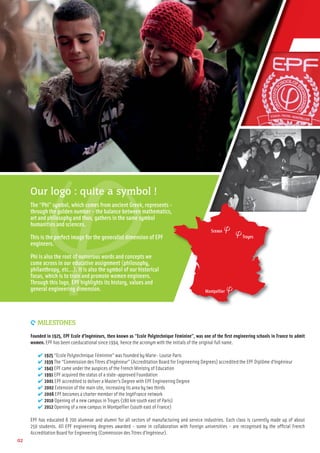
Our logo : quite a symbol !
The “Phi” symbol, which comes from ancient Greek, represents -
through the golden number - the balance between mathematics,
art and philosophy and thus, gathers in the same symbol
humanities and sciences.
This is the perfect image for the generalist dimension of EPF
engineers.
Phi is also the root of numerous words and concepts we
come across in our educative assignment (philosophy,
philanthropy, etc…). It is also the symbol of our historical
focus, which is to train and promote women engineers.
Through this logo, EPF highlights its history, values and
general engineering dimension.
Sceaux
Troyes
Montpellier
9 INTERNATIONAL EXPOSURE
Since 1984, EPF students have been able to benefit from international
experience, whether in the form of internships or study abroad.
Nowadays a growing European Union and globalising of trade have
made international training essential. International training and
study abroad enable students:
✔ to have an inside view of foreign universities and industry,
✔ to become really fluent in one or more foreign languages,
✔ to acquire experience abroad for first job applications, both in
French and international firms,
✔ to enhance their career prospects after the first years of
professional experience.
But the main reason for going abroad is that it is a character building
experience, which develops the student’s autonomy, adaptability,
knowledge and respect for differences, and his or her tolerance.
All these qualities are sought after by 21st
century companies.
9 GENERAL ENGINEERING
The education of the generalist engineer combines scientific, technical
and technological courses. This curriculum enables the graduate
engineer to participate in research, to manage projects considering all
their aspects (economic, financial, human relations etc.) and to exercise
their talents in a variety of sectors in France and abroad.
This career calls for extensive responsibilities in the scientific and
technical fields, as well as in economic, social and human aspects.
An engineer knows how to set an example in society, serving as a
stakeholder in the modern world. Sustainable development and ethics
are the foundations of their managerial approach. EPF’s generalist
engineers learn to take on three roles that fully define the part they
play in their companies:
✔ Leaders, active in decision-making processes (technical
solutions, financing and investment choices, etc.). Managing
and coordinating teams.
✔ Mediators, knowing how to get professionals from different
positions (financial, technical, communication, HR, etc.) to
communicate with each other and work together.
✔ Innovators, capable of investing in new fields and capable
of imagination and creativity in both products and services,
moving the company forward by helping it innovate.
03
EPF’S ENGINEERING STUDIES CURRICULUM
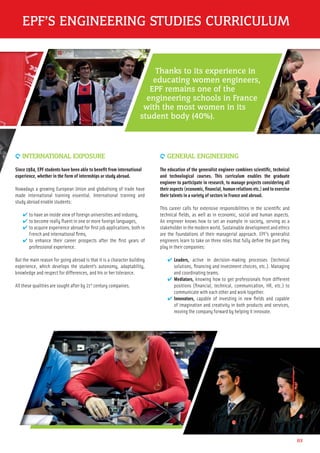
Thanks to its experience in
educating women engineers,
EPF remains one of the
engineering schools in France
with the most women in its
student body (40%).
04
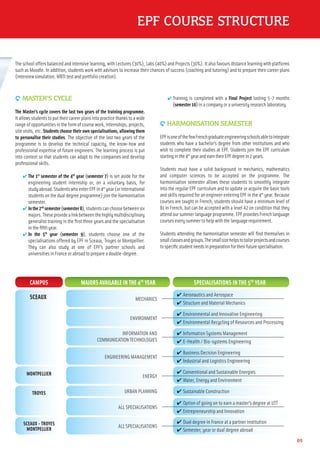
EPF provides a truly multidisciplinary generalist three-year curriculum,
with identical exams and course content on each site, in Sceaux, Troyes and Montpellier.
Students may change campuses according to the major they choose in the 4th
year.
30 ECTS1st
year
2nd
year
3rd
year
4th
year
5th
year
Semester S1 30 ECTS Semester S2
30 ECTS Semester S3 30 ECTS Semester S4
30 ECTS Semester S5
30 ECTS
30 ECTS
Semester S7
EPF Engineering Degree – Master’s Level
Semester S9
Continue studies to earn a doctorate
or other degree
Student Engineer Internship or Semester Abroad
Specialisation
30 ECTS
30 ECTS
30 ECTS
Semester S6
Semester S8
Semester S10
Major
Blue Collar
Internship
Final Project
S t S10
September February
Master’s Cycle
Licence Cycle
(Bachelor Equivalent)
January June
First job
9 GENERAL ENGINEERING COURSE CYCLE (1ST
, 2ND
AND 3RD
YEAR OF STUDIES)
The students take advantage of the first year of studies to adapt to the rhythm of higher education. This concerns not only the learning methods but also
the organisation of the personal workload. In this way, each student is able to follow a basic scientific and engineering course, which includes the study
of two foreign languages and practical courses on professional skills, in order to prepare for their first internship.
During the second year, the basis of the general engineering instruction is laid in order to allow a good transition to the final specialisation cycle. In
addition, the fundamental scientific knowledge is consolidated.
Starting in the 3rd year, there is a twofold objective: consolidating the foundations of the generalist coursework and ensuring a smooth transition to the
major cycle. During this time, EPF helps its students take on-board the professional tools they need to prepare for their 4th year Student Engineer
internship, with a broad range of projects (active learning, in which the student plays an active role in training) and elective classes (introduction to art,
design, ergonomics, astronomy, health, journalism, etc.). A systems’ engineering module is taught in cooperation with Dassault Systèmes.
05
EPF COURSE STRUCTURE
✔ Training is completed with a Final Project lasting 5-7 months
(semester 10) in a company or a university research laboratory.
9 HARMONISATION SEMESTER
EPFisoneofthefewFrenchgraduateengineeringschoolsabletointegrate
students who have a bachelor’s degree from other institutions and who
wish to complete their studies at EPF. Students join the EPF curriculum
startinginthe4th
yearandearntheirEPFdegreein2years.
Students must have a solid background in mechanics, mathematics
and computer sciences to be accepted on the programme. The
harmonisation semester allows these students to smoothly integrate
into the regular EPF curriculum and to update or acquire the basic tools
and skills required for an engineer entering EPF in the 4th
year. Because
courses are taught in French, students should have a minimum level of
B1 in French, but can be accepted with a level A2 on condition that they
attendoursummerlanguageprogramme.EPFprovidesFrenchlanguage
courses every summer to help with the language requirement.
Students attending the harmonisation semester will find themselves in
smallclassesandgroups.Thesmallsizehelpstotailorprojectsandcourses
tospecificstudentneedsinpreparationfortheirfuturespecialisation.
9 MASTER’S CYCLE
The Master’s cycle covers the last two years of the training programme.
It allows students to put their career plans into practice thanks to a wide
rangeofopportunitiesintheformofcoursework,internships,projects,
site visits, etc. Students choose their own specialisations, allowing them
to personalise their studies. The objective of the last two years of the
programme is to develop the technical capacity, the know-how and
professional expertise of future engineers. The learning process is put
into context so that students can adapt to the companies and develop
professional skills.
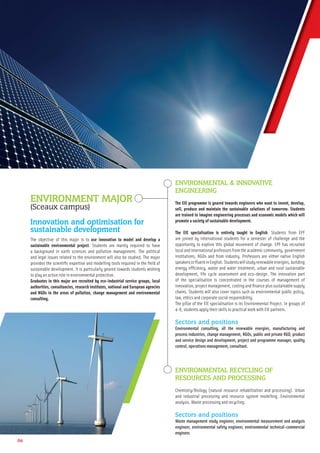
✔ The 1st
semester of the 4th
year (semester 7) is set aside for the
engineering student internship or, on a voluntary basis, for
studyabroad.StudentswhoenterEPFin4th
year(orinternational
students on the dual degree programme) join the Harmonisation
semester.
✔ Inthe2nd
semester(semester8),studentscanchoosebetweensix
majors.Theseprovidealinkbetweenthehighlymultidisciplinary
generalist training in the first three years and the specialisation
in the fifth year.
✔ In the 5th
year (semester 9), students choose one of the
specialisations offered by EPF in Sceaux, Troyes or Montpellier.
They can also study at one of EPF’s partner schools and
universities in France or abroad to prepare a double-degree.
✔ Option of going on to earn a master’s degree at UTT
✔ Entrepreneurship and Innovation
CAMPUS
SCEAUX
MONTPELLIER
SCEAUX - TROYES
MONTPELLIER
TROYES
MECHANICS
✔ Aeronautics and Aerospace
✔ Structure and Material Mechanics
ENVIRONMENT
✔ Environmental and Innovative Engineering
✔ Environmental Recycling of Resources and Processing
ENGINEERING MANAGEMENT
✔ Business Decision Engineering
✔ Industrial and Logistics Engineering
ENERGY
✔ Conventional and Sustainable Energies
✔ Water, Energy and Environment
URBAN PLANNING
ALL SPECIALISATIONS
ALL SPECIALISATIONS
✔ Sustainable Construction
✔ Dual degree in France at a partner institution
✔ Semester, year or dual degree abroad
INFORMATION AND
COMMUNICATION TECHNOLOGIES
✔ Information Systems Management
✔ E-Health / Bio-systems Engineering
MAJORS AVAILABLE IN THE 4TH
YEAR SPECIALISATIONS IN THE 5TH
YEAR
The school offers balanced and intensive learning, with Lectures (30%), Labs (40%) and Projects (30%). It also favours distance learning with platforms
such as Moodle. In addition, students work with advisors to increase their chances of success (coaching and tutoring) and to prepare their career plans
(interview simulation, MBTI test and portfolio creation).
06
ENVIRONMENT MAJOR
(Sceaux campus)
Innovation and optimisation for
sustainable development
The objective of this major is to use innovation to model and develop a
sustainable environmental project. Students are mainly required to have
a background in earth sciences and pollution management. The political
and legal issues related to the environment will also be studied. The major
provides the scientific expertise and modelling tools required in the field of
sustainable development. It is particularly geared towards students wishing
to play an active role in environmental protection.
Graduates in this major are recruited by eco-industrial service groups, local
authorities, consultancies, research institutes, national and European agencies
and NGOs in the areas of pollution, change management and environmental
consulting.
ENVIRONMENTAL & INNOVATIVE
ENGINEERING
The EIE programme is geared towards engineers who want to invent, develop,
sell, produce and maintain the sustainable solutions of tomorrow. Students
are trained to imagine engineering processes and economic models which will
promote a society of sustainable development.
The EIE specialisation is entirely taught in English. Students from EPF
are joined by international students for a semester of challenge and the
opportunity to explore this global movement of change. EPF has recruited
local and international professors from the academic community, government
institutions, NGOs and from industry. Professors are either native English
speakersorfluentinEnglish.Studentswillstudyrenewableenergies,building
energy efficiency, waste and water treatment, urban and rural sustainable
development, life cycle assessment and eco-design. The innovation part
of the specialisation is concentrated in the courses of management of
innovation, project management, costing and finance plus sustainable supply
chains. Students will also cover topics such as environmental public policy,
law, ethics and corporate social responsibility.
The pillar of the EIE specialisation is its Environmental Project. In groups of
4-6, students apply their skills to practical work with EIE partners.
Sectors and positions
Environmental consulting, all the renewable energies, manufacturing and
process industries, change management, NGOs, public and private R&D, product
and service design and development, project and programme manager, quality
control, operations management, consultant.
ENVIRONMENTAL RECYCLING OF
RESOURCES AND PROCESSING
Chemistry/Biology (natural resource rehabilitation and processing). Urban
and industrial processing and resource system modelling. Environmental
analysis. Waste processing and recycling.
Sectors and positions
Waste management study engineer, environmental measurement and analysis
engineer, environmental safety engineer, environmental technical-commercial
engineer.
MAJORS AND SPECIALISATIONS
07
MECHANICS MAJOR
(Sceaux campus)
Design and manufacture of complex
mechanical systems
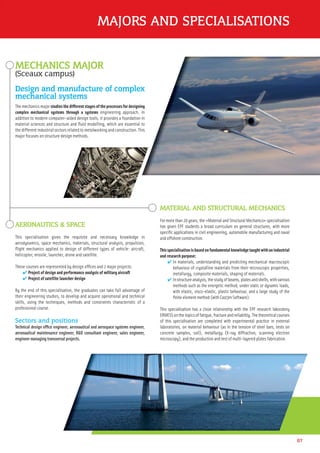
The mechanics major studies the different stages of the processes for designing
complex mechanical systems through a systems engineering approach. In
addition to modern computer-aided design tools, it provides a foundation in
material sciences and structure and fluid modelling, which are essential to
the different industrial sectors related to metalworking and construction. This
major focuses on structure design methods.
MATERIAL AND STRUCTURAL MECHANICS
For more than 20 years, the «Material and Structural Mechanics» specialisation
has given EPF students a broad curriculum on general structures, with more
specific applications in civil engineering, automobile manufacturing and naval
and offshore construction.
Thisspecialisationisbasedonfundamentalknowledgetaughtwithanindustrial
and research purpose:
✔ In materials, understanding and predicting mechanical macroscopic
behaviour of crystalline materials from their microscopic properties,
metallurgy, composite materials, shaping of materials.
✔ Instructureanalysis,thestudyofbeams,platesandshells,withvarious
methods such as the energetic method, under static or dynamic loads,
with elastic, visco-elastic, plastic behaviour, and a large study of the
finite element method (with Cast3m Software).
This specialisation has a close relationship with the EPF research laboratory
ERMESSonthetopicsoffatigue,fractureandreliability.Thetheoreticalcourses
of this specialisation are completed with experimental practice in external
laboratories, on material behaviour (as in the tension of steel bars, tests on
concrete samples, soil), metallurgy (X-ray diffraction, scanning electron
microscopy), and the production and test of multi-layered plates fabrication.
AERONAUTICS & SPACE
This specialisation gives the requisite and necessary knowledge in
aerodynamics, space mechanics, materials, structural analysis, propulsion,
flight mechanics applied to design of different types of vehicle: aircraft,
helicopter, missile, launcher, drone and satellite.
These courses are represented by design offices and 2 major projects:
✔ Project of design and performance analysis of military aircraft
✔ Project of satellite launcher design
By the end of this specialisation, the graduates can take full advantage of
their engineering studies, to develop and acquire operational and technical
skills, using the techniques, methods and constraints characteristic of a
professional course.
Sectors and positions
Technical design office engineer, aeronautical and aerospace systems engineer,
aeronautical maintenance engineer, R&D consultant engineer, sales engineer,
engineer managing transversal projects.
08
INFORMATION SYSTEMS MANAGEMENT
Information system architecture, management, Web, IT security, networks,
modelling, tests, quality, project management, etc.
SECTORS AND POSITIONS
System and network administrator, information systems architect, contractor and
client project management, application development, IT systems integration,
information systems migrator, software quality, information systems security
management,enterprisearchitect.
E-HEALTH
Thefoundationsofhealthsciences,healthcareITsystems,legalandeconomic
issues, smart home systems for home healthcare, the latest telemedicine
tools and medical imaging.
SECTORS AND POSITIONS
Healthcare IT systems architect, healthcare network manager, hospital engineer,
etc.
ICT MAJOR
(Sceaux campus)
Information and Communication
Technologies
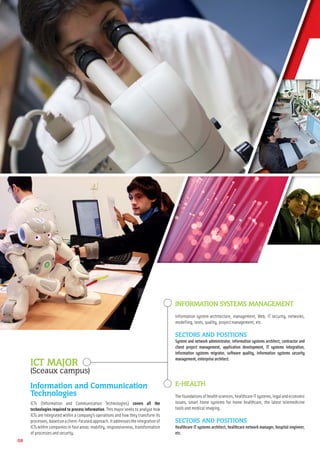
ICTs (Information and Communication Technologies) covers all the
technologies required to process information. This major seeks to analyse how
ICTs are integrated within a company’s operations and how they transform its
processes,basedonaclient-focusedapproach.Itaddressestheintegrationof
ICTs within companies in four areas: mobility, responsiveness, transformation
of processes and security.
09
MAJORS AND SPECIALISATIONS
ENGINEERING
MANAGEMENT MAJOR
(Sceaux campus)
This major aims to give students the knowledge and tools necessary to
understandacompanyfromageopolitical,strategic,
marketing and financial standpoint. It uses a
systemic approach to address the different
methods for optimising a company’s
processes. Company IT systems are
studied to control these processes.
BUSINESS DECISION ENGINEERING
The management part of the programme provides students with the
fundamental basics in Economics, Strategic Management, Marketing,
Negotiation,CommunicationandFinance.Thetechnicalpartoftheprogramme
focuses on Information Systems Security, Quantitative Marketing/Data
mining and Business Intelligence courses.
Since 2007, the EPF Engineering Management programme has included a
possible sub-specialisation in Finance (quantitative tools and methods,
financial programming, risk management in finance etc.) for engineers who
will support traders involved in increasingly sophisticated transactions. In
addition, through their participation in a hands-on, four-month project,
the students will act as junior consultants pitching for new business. The
commercial proposal they have to design in a competitive tender process will
encourage future engineers to actively find, integrate and apply technical and
managerial concepts and methodologies, provided mainly by teachers with an
operational background.
SECTORS AND POSITIONS
High-tech industries, information technology, infrastructure or processing
industries, consultancy firms, software publishing and implementation, financial
sector (banking, institutional investors), business development engineer, project
manager,ITorganisationconsultant,financialauditorinindustrialsectors,engineer
infinance(supportinformationsystemsformarketplaces).
INDUSTRIAL & LOGISTICS ENGINEERING
The “Industrial and Logistics Engineering” specialisation is intended for future
specialists in cross-disciplinary supply chain management, with a dual focus
on:
✔ The acquisition of strategic, tactical and operational skills, in particular
in industrial engineering and logistics, including the capacity to
understand all the profession’s needs, to reorganise processes and
industrial IT operation (ERP, flow simulation, etc.).
✔ The acquisition of project management tools by working on projects (in
line with ISO10006 on project management processes and PMBOOK),
team management, overall quality and deciding whether or not to
delegate, all with awareness of their impact on the environment To
help students quickly acquire new skills, throughout the final year,
theoretical coursework is paired with a joint project on managing a
company (OSIA Design Concept), including every step of the process,
from the design of to the selling of mid-range writing products.
These generalist engineers are taught the basics of HR, sales, marketing and
financetogetabroadviewofeverystepofthevaluechain.Inadditiontotheir
work on cross-disciplinary projects, each student is assigned a specific role in
this organisation, defined by the students themselves. This teaches them to
handle organisational complexity. Throughout every step of this project, the
teaching team will include committed coaches at the students’ disposal, to
help them develop their professional reflexes as quickly as possible.
SECTORS AND POSITIONS
Sectors include major industrial groups as well as small and midsized companies
and industries. Students may go on to work in a variety of sectors, such as:
food industry, chemicals, pharmaceuticals, automobile and aeronautics
manufacture(includingequipmentmanufacturers),luxuryindustries,packaging,
constructionandpublicworks,ITengineeringserviceproviders,organisationand
managementconsultingfirms,logisticsserviceproviders,publicandpara-public
organisations, energy and transport (EDF, GDF-SUEZ, etc.), mass retail, online
retail.
unundedersrstatandndaaccomompapanynyffroromm
marketing and finann
systemic approachh
methods for o
processes. Comm
studied to con
10
URBAN PLANNING MAJOR
(Troyes campus)
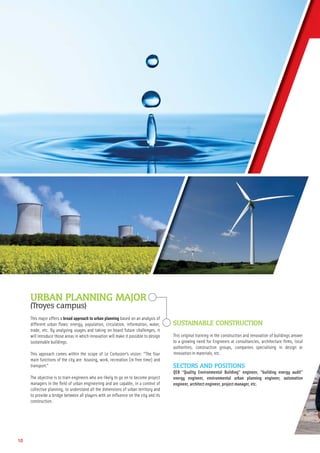
This major offers a broad approach to urban planning based on an analysis of
different urban flows: energy, population, circulation, information, water,
trade, etc. By analysing usages and taking on board future challenges, it
will introduce those areas in which innovation will make it possible to design
sustainable buildings.
This approach comes within the scope of Le Corbusier’s vision: “The four
main functions of the city are: housing, work, recreation (in free time) and
transport.”
The objective is to train engineers who are likely to go on to become project
managers in the field of urban engineering and are capable, in a context of
collective planning, to understand all the dimensions of urban territory and
to provide a bridge between all players with an influence on the city and its
construction.
SUSTAINABLE CONSTRUCTION
This original training in the construction and renovation of buildings answer
to a growing need for Engineers at consultancies, architecture firms, local
authorities, construction groups, companies specialising in design or
innovation in materials, etc.
SECTORS AND POSITIONS
QEB “Quality Environmental Building” engineer, “building energy audit”
energy engineer, environmental urban planning engineer, automation
engineer, architect engineer, project manager, etc.
MAJORS AND SPECIALISATIONS
11
ENERGY MAJOR
(Montpellier campus)
Water and energy resource
operation, management and
optimisation
The Energy major provides an understanding of the background and issues
linked to the integrated management of two resources: water and energy.
It addresses concepts relating to these two sectors through scientific and
technical coursework, as well as training in political, economic, legal and
environmental aspects. This major is geared towards students interested in
the core issues of water and energy management in future years.
WATER, ENERGY & ENVIRONMENT
This programme aims to teach professional skills in the fields of water and
energy. It should also train students to critically analyse the policies in effect
in these areas and encourage new ideas for the future.
More specifically, it fosters the following skills:
✔ The environmental impacts of energy management and water
management
✔ Anunderstandingofthepoliciesandregulationsgoverningwaterandenergy
✔ The design, integration and management of energy production
systems, with a primary focus on renewable energies
✔ The design, integration and management of water distribution and
treatment systems
✔ Optimised use of water and energy treatment systems
SECTORS AND POSITIONS
Study, evaluation, R&D engineering in energy and hydraulics, project or audit
manager, energy aggregator, etc.
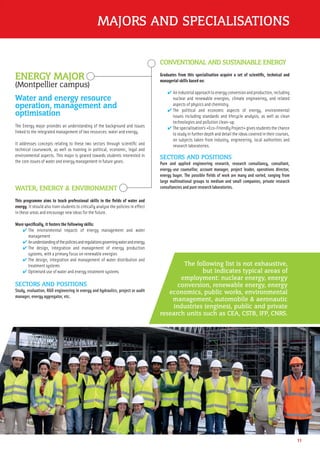
CONVENTIONAL AND SUSTAINABLE ENERGY
Graduates from this specialisation acquire a set of scientific, technical and
managerial skills based on:
✔ Anindustrialapproachtoenergyconversionandproduction,including
nuclear and renewable energies, climate engineering, and related
aspects of physics and chemistry.
✔ The political and economic aspects of energy, environmental
issues including standards and lifecycle analysis, as well as clean
technologies and pollution clean-up.
✔ The specialisation’s «Eco-Friendly Project» gives students the chance
to study in further depth and detail the ideas covered in their courses,
on subjects taken from industry, engineering, local authorities and
research laboratories.
SECTORS AND POSITIONS
Pure and applied engineering research, research consultancy, consultant,
energy-use counsellor, account manager, project leader, operations director,
energy buyer. The possible fields of work are many and varied, ranging from
large multinational groups to medium and small companies, private research
consultancies and pure research laboratories.
The following list is not exhaustive,
but indicates typical areas of
employment: nuclear energy, energy
conversion, renewable energy, energy
economics, public works, environmental
management, automobile & aeronautic
industries (engines), public and private
research units such as CEA, CSTB, IFP, CNRS.
9 ASSESSMENT
Duringthefirst2yearsofstudies,acontinuousassessmentofthestudents’workallowsthemtobeevaluatedregularly.Theacademicrequirementstopass
from one year to the next are 60 ECTS credits. For the EPF Engineering Degree, the weighted average of grades obtained during the final year of studies is
takeninto account.Butall300ECTScreditsarerequiredandstudentsmustalsovalidateanEnglishlanguagelevel,aswellasaninternationalexperience.
9 FOREIGN LANGUAGES
Foreign languages and intercultural skills are given a high priority in the EPF teaching programme. In order to train engineers with a truly international
profile, we require all students to study 2 foreign languages, one of which must be English (French for foreign students). The other languages currently
taught areChinese,German, Italian, Japanese, PortugueseandSpanish.Alllanguagesaretaughtbynativespeakersfromallovertheworld.
StudentsarerequiredtohavereachedlevelB2*inEnglishbeforetheyareawardedtheirEPFdegreeanditisrecommendedthattheyreachlevelB1intheir
second foreignlanguage.
* CEFRL(CommonEuropeanFrameworkofReferenceforLanguages)
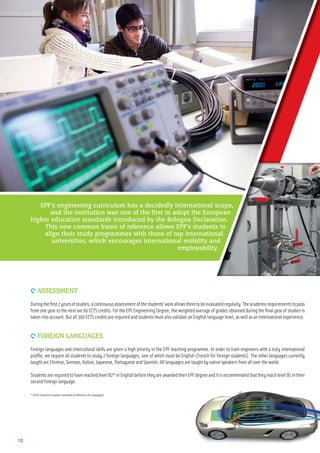
EPF’s engineering curriculum has a decidedly international scope,
and the institution was one of the first to adopt the European
higher education standards introduced by the Bologna Declaration.
This new common frame of reference allows EPF’s students to
align their study programmes with those of top international
universities, which encourages international mobility and
employability.
12
13
GENERAL INFORMATION
9 EPF’S INTERNATIONAL DEPARTMENT
The International Department works with the Department of Studies to
orient international experience.
✔ It develops partnerships with international universities: every
year, new agreements offer larger opportunities for student
exchanges, double-degree programmes and internship
placements.
✔ Itsendsstudentsabroadfordoubledegrees,exchangesemesters
or internships.
✔ It welcomes international students for double degrees, exchange
semesters or summer programmes…
9 RESEARCH
EPF’sresearchpolicyisdesignedtofosteratrue“researchculture”atthe
heartofitsteaching model.
This research policy aims to meet the needs of the modernisation of the
French higher education system in direct international competition and
theexpectations of theFrench governmentandtheAERESassessments.
It is also designed to help with updating the skills set of EPF generalist
engineersand offer newcareeroutlookstostudents.
EPF’s research policy is overseen by a Scientific Board and led by a
Research and Innovation Director. It draws first and foremost on UTT’s
laboratories, but also on one or two pivotal partnerships at each site
(Sceaux,Troyes and Montpellier).
9 THE “MARIE-LOUISE PARIS” RESEARCH
DEPARTMENT
EPF’s research department works on 3 strategic aspects that are
fundamentalforoursocietyandreflectthegeneralistengineermodel:
✔ the security of goods and communication
✔ sustainable energy
✔ natural resources
It forms part of the Marie-Louise Paris research division (named in
homagetotheschool’sfounderandherpioneeringspirit)andhasfour
principal research areas:
✔ Materials and mechanical components (ERMESS)
✔ Secure information
✔ Clean and sustainable chemical processes
✔ Production and management of renewable energies
9 THE PROMOTION OF EPF’S RESEARCH
EPF has developed industrial partnerships (services,PhD thesis with an
industrial partner), in particular in new fields (chemicals, energy and
IT) to add value to its research and in a bid to make it self-financing.
In this regard, EPF is participating in the project to create a common
laboratory with Thales and UTT, in the field of cyber-security and
strengthening its industrial partnerships in the fields of mechanics
(TOTAL, GDF-Suez) and chemicals (SEB-CALOR).
EPF’s students mainly gain exposure to research thanks to:
✔ EPF’s teachers-researchers or external academics (CNRS, CEA,
etc.), who transfer their expertise and methods;
✔ mentoredpersonalworkforallstudentsintheirthirdyearatEPF,
withabibliographicalreportonatargetsubject,ameetingwith
a researcher in the field and the production of a memoir or an
oral and visual work presentation;
✔ a research’s production involving the registration of patents
and/or the production of scientific publications, during an
internship in the fourth or fifth year in a research laboratory in
France or abroad for willing students.
9 INTERNATIONAL PARTNERSHIPS
The organisation of teaching adapted to the Bologna process allows EPF’s students
toharmonisetheiracademicstudieswiththoseoftheleadingforeignuniversities,
helping to promote international exchange. Students must have at least one
semester of international experience in order to graduate.
There are many possibilities to fit each student’s projects and ambitions: bi-
national training, double degrees, international degrees and internships
or study abroad programmes. To foster international exchange, EPF is a
member of the following organisations and networks: Campus France,
Erasmus, n+i, GE4, CREPUQ and UFA.
14
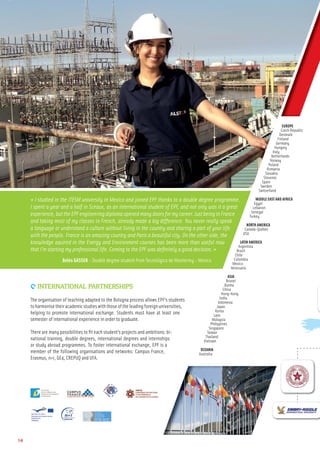
« I studied in the ITESM university in Mexico and joined EPF thanks to a double degree programme.
I spent a year and a half in Sceaux, as an international student of EPF, and not only was it a great
experience, but the EPF engineering diploma opened many doors for my career. Just being in France
and taking most of my classes in French, already made a big difference. You never really speak
a language or understand a culture without living in the country and sharing a part of your life
with the people. France is an amazing country and Paris a beautiful city. On the other side, the
knowledge aquired in the Energy and Environment courses has been more than useful now
that I’m starting my professional life. Coming to the EPF was definitely a good decision. »
Belén GASSER - Double degree student from Tecnológico de Monterrey - Mexico
EUROPE
Czech Republic
Denmark
Finland
Germany
Hungary
Italy
Netherlands
Norway
Poland
Romania
Slovakia
Slovenia
Spain
Sweden
Switzerland
MIDDLE EAST AND AFRICA
Egypt
Lebanon
Senegal
Turkey
NORTH AMERICA
Canada-Quebec
USA
LATIN AMERICA
Argentina
Brazil
Chile
Colombia
Mexico
Venezuela
ASIA
Brunei
Burma
China
Hong-Kong
India
Indonesia
Japan
Korea
Laos
Malaysia
Philippines
Singapore
Taiwan
Thailand
Vietnam
OCEANIA
Australia
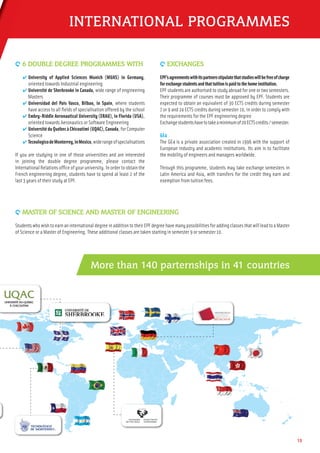
9 6 DOUBLE DEGREE PROGRAMMES WITH
✔ University of Applied Sciences Munich (MUAS) in Germany,
oriented towards Industrial engineering
✔ Université de Sherbrooke in Canada, wide range of engineering
Masters
✔ Universidad del Pais Vasco, Bilbao, in Spain, where students
have access to all fields of specialisation offered by the school
✔ Embry-Riddle Aeronautical University (ERAU), in Florida (USA),
oriented towards Aeronautics or Software Engineering
✔ UniversitéduQuébecàChicoutimi(UQAC),Canada,forComputer
Science
✔ TecnologicodeMonterrey,inMexico,widerangeofspecialisations
If you are studying in one of those universities and are interested
in joining the double degree programme, please contact the
International Relations office of your university. In order to obtain the
French engineering degree, students have to spend at least 2 of the
last 3 years of their study at EPF.
9 EXCHANGES
EPF’sagreementswithitspartnersstipulatethatstudieswillbefreeofcharge
forexchangestudentsandthattuitionispaidtothehomeinstitution.
EPF students are authorised to study abroad for one or two semesters.
Their programme of courses must be approved by EPF. Students are
expected to obtain an equivalent of 30 ECTS credits during semester
7 or 9 and 24 ECTS credits during semester 10, in order to comply with
the requirements for the EPF engineering degree
Exchangestudentshavetotakeaminimumof20ECTScredits/semester.
GE4
The GE4 is a private association created in 1996 with the support of
European industry and academic institutions. Its aim is to facilitate
the mobility of engineers and managers worldwide.
Through this programme, students may take exchange semesters in
Latin America and Asia, with transfers for the credit they earn and
exemption from tuition fees.
15
INTERNATIONAL PROGRAMMES
9 MASTER OF SCIENCE AND MASTER OF ENGINEERING
Students who wish to earn an international degree in addition to their EPF degree have many possibilities for adding classes that will lead to a Master
of Science or a Master of Engineering. These additional classes are taken starting in semester 9 or semester 10.
More than 140 parternships in 41 countries
16
INTERNSHIPS AND INDUSTRIAL PARTNERSHIPS
9 CORPORATE FORUM
EPF organises a corporate forum every autumn to put student engineers into contact with leading
engineering companies.
This forum gives EPF students an exceptional opportunity to network with our industrial
and services partners. Every year, this event gives 3rd- and 5th-year students a chance to
find internships and make decisions or contacts that will help their careers. Every field of
engineering is represented at the forum: aeronautics, telecommunications, IT, construction,
the environment, finance, and more.
9 COMPANIES AND EPF’S GOVERNANCE
For more than 50 years, EPF has shown mutual trust for its partner
companies, based on their recognition for our well-rounded engineers’
professional merit.
A testimony to this mutual relationship between the school and
companies, several large groups (EADS, EDF, GrDF, Dassault Aviation
and IBM) serve on EPF’s Board of Directors and its continuing
education board. They play an active role in setting out the academic
curriculum and providing advice on specialisations and coursework
(more than 300 professionals contribute to participate in the various
courses), taking part in professional conferences, sponsoring classes
and hosting students.
9 A DRIVE FOR PROFESSIONAL INTEGRATION
This special relationship between companies and EPF is the result of our
school’sseriousprofessionalintegrationpolicy,backedbyadepartment
dedicated to this issue.
This entity is in charge of preparing engineering students for
professional insertion. It organises conferences with large
corporations, prepares our students for recruitment processes (CV/
resume coaching and interview preparation) and promotes our
graduates’ projects through the «Les EPF ont du talent» competition.
With a focus on the industrial sector, this department encourages
students to take on internship and job opportunities and fosters EPF
students’ networking with companies.
9 SUPERVISED INTERNSHIPS & PROJECTS
In addition to training well-rounded engineers, one of EPF’s primary concerns is making its students capable of being adaptable and operational in the
companies. To meet this goal, the school has included several approved internships in its programme, throughout the curriculum. Internship projects
are done upon the company’s request, in France or abroad. Students are assisted by the internship department and advised by an EPF teacher and
supervised by an engineer from the company. Exchange Students have access to internships during their academic period.
17
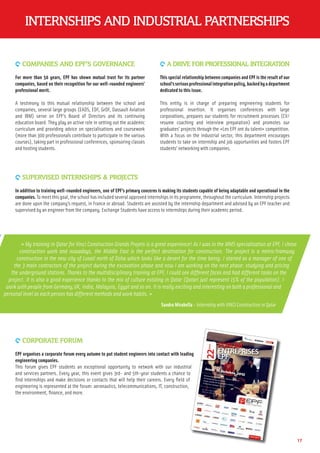
« My training in Qatar for Vinci Construction Grands Projets is a great experience! As I was in the MMS specialisation at EPF, I chose
construction work and nowadays, the Middle East is the perfect destination for construction. The project is a metro/tramway
construction in the new city of Lusail north of Doha which looks like a desert for the time being. I started as a manager of one of
the 3 main contractors of the project during the excavation phase and now I am working on the next phase: studying and pricing
the underground stations. Thanks to the multidisciplinary training at EPF, I could see different faces and had different tasks on the
project. It is also a good experience thanks to the mix of culture existing in Qatar (Qatari just represent 15% of the population). I
work with people from Germany,UK, India, Malaysia, Egypt and so on. It is really exciting and interesting on both a professional and
personal level as each person has different methods and work habits. »
Sandra Mirabella - Internship with VINCI Construction in Qatar
ng
l
9 DO YOU WANT TO STUDY AT EPF ?
First of all, you have to decide if you want to obtain the French
engineeringdegree,orjuststudyforashortperiod(1or2semesters).
Then, check if your university has an agreement with EPF (exchange
or double degree programme). EPF has a lot of bilateral agreements
worldwide and is also part of the GE4 programme. If your university
doesn’t have a bilateral agreement with EPF, please contact us.
For students who don’t speak French well, the n+i programme is the
most appropriate way to join EPF and obtain the French engineering
degree, because it includes a linguistic preparation.
9 DEGREE SEEKING STUDENTS
✔ Doubledegreeprogrammes(Bilbao,ERAU,TECdeMonterrey)
✔ n+i programme
If you have a good level in French and a bachelor’s degree, you can
also apply directly to EPF. You have to spend 2 years in France to
obtain the French engineering degree.
9 ERASMUS OR EXCHANGE STUDENT
ThankstothedifferentnetworksEPFbelongsto,itispossibletostudy
at EPF as an exchange student and build a specific programme, by
choosing courses in different years (usually in the 4th & 5th years).
Exchange students stay for 1 or 2 semesters. Credits obtained at EPF
are then transferred back to the home university.
Students who wish to take classes in French must provide a certificate
of a B1 level in French. Those who come to take classes taught in
English must provide proof of a B2 level in English.
9 1 MAJOR/ 2 SPECIALISATIONS TAUGHT
IN ENGLISH
International students who do not speak French may now take classes
in English in any semester.
✔ From January to end of June, they can attend the “Engineering
Management” Major which is totally taught in English.
✔ During all semester (September to December), students may
join one of the following two specialisations: “Environmental
and Innovative Engineering (EIE)” or “Business Decision
Engineering (BDE)”, also given in English.
18
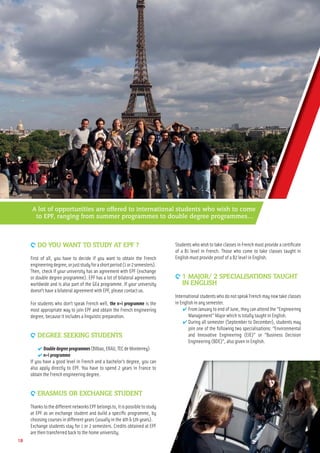
A lot of opportunities are offered to international students who wish to come
to EPF, ranging from summer programmes to double degree programmes…
HOW TO APPLY, IF YOU WANT TO STUDY AT EPF?
The list of courses, as well as the application package, are available on
our website in English. You can also download a practical information
guide for international students. If you have any questions, please
contact the International Students’ Advisor at EPF, sophie.telliez@epf.fr
ENVIRONMENTALANDINNOVATIVEENGINEERING
EPF has developed a programme entirely taught in English, open to
students who not only wish to specialize in the field of environmental
engineering, but who also wish to specialise knowledge of global
legal and regulatory backgrounds, economic aspects and tools,
innovative management, as well as ethical considerations for their
future engineering careers. This programme is offered from May to
the end of December (with a 2 months break in between).
Thespecialisationfocusesonthechallengesofsustainabledevelopment:
✔ Environmental and Energy Technology
✔ Economics & Business Tools
✔ Management & Ethics
BUSINESSDECISIONENGINEERING
The Engineering Management specialisation provides future
engineers with competences in design, negotiating and managing
ambitious technical projects in the industrial, IT and financial
sectors.
The programme consists of 80% management and 20% technical
courses, entirely taught in English.
The management part of the programme provides students with a
fundamental base in Economics, Strategic Management, Marketing,
Negotiation, Communication and Finance. The technical part of the
programme focuses on Information Systems Security, Quantitative
Marketing/Data mining and Business Intelligence courses.
9 N+I
« n+i » Network has designed a special programme to help students and
young professionals who have graduated in engineering or sciences to
complete their top training in France with a Master’s degree. It is open to
studentswithaminimumlevelofaBachelor’sdegree(Licence,B.Tech,B.Eng,
B.Sc, B.Phil, Licenciatura... or equivalent). The objective is to train future
high-levelindividuals,withinternationalambitions.
“n+i” offers a complete and original range of personalised services to ease
students’integrationintotheFrenchsystem.
BEFOREDEPARTURE
“n+i”helpsstudentswithchoosingtheircoursesandsecuringfinancialaid:
✔ asimplifiedapplicationprocedureonline,
✔ a search for scholarships or financial assistance from regional
authoritiesandcompanies.
UPONARRIVALINFRANCE
“n+i” and the students’ chosen institutes offer a complete welcome and
supportprogrammetailoredtotheirneeds:
✔ fullassistanceduringstudies,
✔ welcome service at the airport in Paris, insurance from the minute
studentsarriveinFrance,
✔ intensive summer French language course in one of France’s best
languagecentres(for2months),
✔ cultural,linguisticandmethodologicalintegrationperiods(for4months).
Afterthe6monthsofpreparation(2monthsofintensiveFrenchlanguagecourses
+4monthsofmethodologicalpreparation),“n+i”engineeringstudentsenterthe
engineeringinstitutiontheyselected,inordertocompletetheirstudiesinFrench.
19
OPPORTUNITIES
FOR INTERNATIONAL STUDENTS
“n+i” is a unique initiative
of the French Government
in partnership with French
companies and over
70 prestigious French
engineering institutes.
20
For more information , contact our Head
of the French Language Department
Christine MOURET - Christine.mouret@epf.fr
Tel : +33 - 1 - 55 52 11 00 - Fax : +33 - 1 - 46 60 39 94
9 E-LEARNING - PADEN
To facilitate integration of international students in French Engineering schools we provide them with an E-learning tutorial course called PADEN.
PADEN is a complement of our French for engineer’s programmes and helps to develop strategies to understand the methodology implied in French
scientific courses as well as cultural awareness.
>> http://paden.wp.institut-telecom.fr/
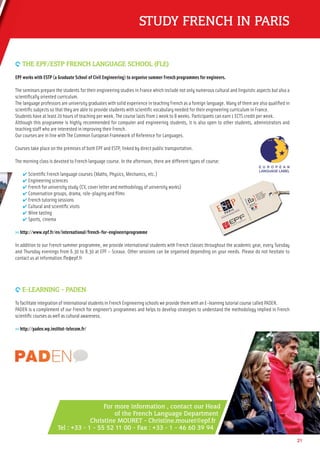
9 THE EPF/ESTP FRENCH LANGUAGE SCHOOL (FLE)
EPF works with ESTP (a Graduate School of Civil Engineering) to organise summer French programmes for engineers.
The seminars prepare the students for their engineering studies in France which include not only numerous cultural and linguistic aspects but also a
scientifically oriented curriculum.
The language professors are university graduates with solid experience in teaching French as a foreign language. Many of them are also qualified in
scientific subjects so that they are able to provide students with scientific vocabulary needed for their engineering curriculum in France.
Students have at least 20 hours of teaching per week. The course lasts from 1 week to 8 weeks. Participants can earn 1 ECTS credit per week.
Although this programme is highly recommended for computer and engineering students, it is also open to other students, administrators and
teaching staff who are interested in improving their French.
Our courses are in line with The Common European Framework of Reference for Languages.
Courses take place on the premises of both EPF and ESTP, linked by direct public transportation.
The morning class is devoted to French language course. In the afternoon, there are different types of course:
✔ Scientific French language courses (Maths, Physics, Mechanics, etc.)
✔ Engineering sciences
✔ French for university study (CV, cover letter and methodology of university works)
✔ Conversation groups, drama, role-playing and films
✔ French tutoring sessions
✔ Cultural and scientific visits
✔ Wine tasting
✔ Sports, cinema
>> http://www.epf.fr/en/international/french-for-engineersprogramme
In addition to our French summer programme, we provide international students with French classes throughout the academic year, every Tuesday
and Thursday evenings from 6.30 to 8.30 at EPF – Sceaux. Other sessions can be organised depending on your needs. Please do not hesitate to
contact us at information.fle@epf.fr
21
STUDY FRENCH IN PARIS
22
PRACTICAL INFORMATION
9 HOUSING
EPF doesn’t have its own student housing on campus but we have
negotiated an agreement with the CROUS (French institution which
manages student housing and restaurants) in order to obtain rooms
for our international students.
It is possible to reserve an individual room in one of the residences
located close to EPF (Antony, Bagneux, Châtenay Malabry or Fontenay
aux Roses). Costs vary depending on the type of room (e.g. private/
communal bathrooms).
We recommend that students stay close to EPF, in order to avoid
spending too much time commuting.
9 ADMINISTRATIVE ASSISTANCE
EPF takes care of all administrative procedures concerning the
residency permit (OFII long stay visa). Thanks to an agreement with
the Sous Prefecture and the OFII, we can handle the application
process, allowing students to get their papers faster and with less
effort (students just have to do a medical visit).
9 STUDENT ORGANISATIONS
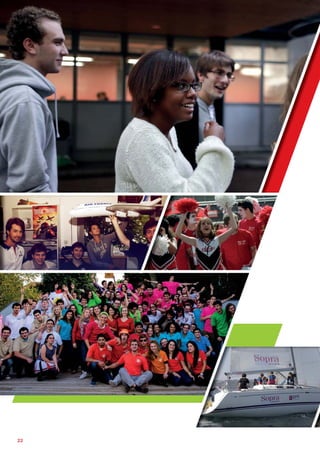
By joining an organisation, students take part in life at the school. EPF
currently has more than 30 active organisations in a variety of areas,
each representative of EPF’s spirit.
9 MELTING POTES
“Melting Potes” (formerly known as the « International Club ») is a
group of EPF students in charge of helping international students to
integrate in the school. They organise social events during the year
(welcoming party, international dinner, holiday celebrations...) as
well as trips to discover France. They are also in charge of tutoring
international students.
9 THE STUDENT OFFICE
The student office manages student life at EPF and organises many
events (evening entertainment, skiing weeks, etc.). Every autumn,
the student office organises an orientation trip.
9 EPF’S JUNIOR ENTERPRISE (JE)
EPF Projects is one of the French “Junior-Enterprises”: its role is
to search for paid studies or missions that are then performed
by consultants, who are EPF students, in highly varied areas. It
allows students to acquire experience in industry and services by
putting their expertise immediately to work while developing their
interpersonal skills.
9 EUROAVIA
With the European Association of Aerospace Students, EPF’s students,
in partnership with students from around ten foreign countries,
organise conferences and shows and develop contacts with companies
in the aeronautics sector.
9 THE SPORTS OFFICE
Football,rugby,volleyball,handball,athletics,boxing,rockclimbing,
tennis,badminton,swimming,basketball,footy(Australianfootball),
horse-riding, and even cheerleading: the sports office allows
students to practise their favourite sports and discover others. They
can play for fun or compete in tournaments and sporting weekends
throughout France like the “Challenge du Monde des Grandes Ecoles
et Universités”.
If you have any questions, please
contact the international Students’
Advisor at EPF : sophie.telliez@epf.fr
23
Charles de Gaulle Airport
Orly Airport
RERB
Châtelet - les Halles
Bourg la Reine
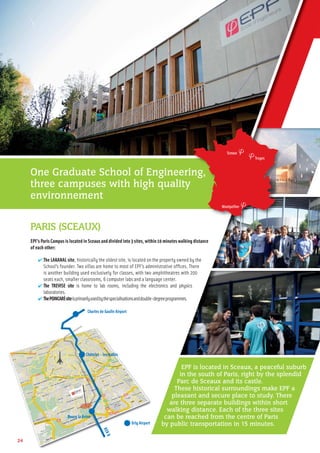
PARIS (SCEAUX)
EPF’s Paris Campus is located in Sceaux and divided into 3 sites, within 10 minutes walking distance
of each other:
✔ The LAKANAL site, historically the oldest site, is located on the property owned by the
School’s founder. Two villas are home to most of EPF’s administrative offices. There
is another building used exclusively for classes, with two amphitheatres with 200
seats each, smaller classrooms, 6 computer labs and a language center.
✔ The TREVISE site is home to lab rooms, including the electronics and physics
laboratories.
✔ ThePOINCARÉsiteisprimarilyusedbythespecialisationsanddouble-degreeprogrammes.
24
One Graduate School of Engineering,
three campuses with high quality
environnement
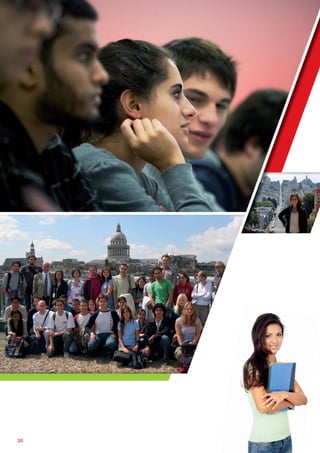
ng,
Sceaux
Troyes
Montpellier
EPF is located in Sceaux, a peaceful suburb
in the south of Paris, right by the splendid
Parc de Sceaux and its castle.
These historical surroundings make EPF a
pleasant and secure place to study. There
are three separate buildings within short
walking distance. Each of the three sites
can be reached from the centre of Paris
by public transportation in 15 minutes.
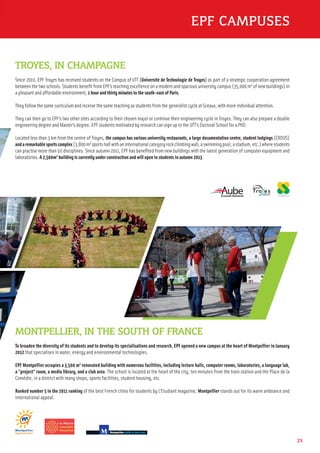
TROYES, IN CHAMPAGNE
Since 2010, EPF Troyes has received students on the Campus of UTT (Université de Technologie de Troyes) as part of a strategic cooperation agreement
between the two schools. Students benefit from EPF’s teaching excellence on a modern and spacious university campus (35,000 m² of new buildings) in
a pleasant and affordable environment, 1 hour and thirty minutes to the south-east of Paris.
They follow the same curriculum and receive the same teaching as students from the generalist cycle at Sceaux, with more individual attention.
They can then go to EPF’s two other sites according to their chosen major or continue their engineering cycle in Troyes. They can also prepare a double
engineering degree and Master’s degree. EPF students motivated by research can sign up to the UTT’s Doctoral School for a PhD.
Located less than 3 km from the centre of Troyes, the campus has various university restaurants, a large documentation centre, student lodgings (CROUS)
andaremarkablesportscomplex(3,800m²sportshallwithaninternationalcategoryrockclimbingwall,aswimmingpool,astadium,etc.)wherestudents
can practise more than 50 disciplines. Since autumn 2011, EPF has benefited from new buildings with the latest generation of computer equipment and
laboratories. A 2,500m² building is currently under construction and will open to students in autumn 2013.
EPF CAMPUSES
25
MONTPELLIER, IN THE SOUTH OF FRANCE
To broaden the diversity of its students and to develop its specialisations and research, EPF opened a new campus at the heart of Montpellier in January
2012 that specialises in water, energy and environmental technologies.
EPF Montpellier occupies a 3,500 m² renovated building with numerous facilities, including lecture halls, computer rooms, laboratories, a language lab,
a “project” room, a media library, and a club area. The school is located at the heart of the city, ten minutes from the train station and the Place de la
Comédie, in a district with many shops, sports facilities, student housing, etc.
Ranked number 5 in the 2011 ranking of the best French cities for students by L’Etudiant magazine, Montpellier stands out for its warm ambiance and
international appeal.
UTT
Main partners, networks and accredidations
MEMBREFONDATEUR
MEMBREFONDATEUR
ImprimeurréférencéImprim’Vert.PapierproduitdansuneusinecertifiéeISO9001,ISO14001,OHSAS18001etEMAS(managementenvironnemental).
IlpossèdelescertificationsFSCetPEFC(traçabilitédel’originedelapâteàpapieràpartirdeforêtsgérées)etaétéblanchiparleprocédéECF(sanschloreélémentaire).
2013April.Documentnoncontractuel.ConceptionITrenteFévrier0624886797.Merciàtousnospartenairesetélèvespourlesphotosqu’ilsnousontaimablementfournies.Créditphotos:Fotolia/JP.Riant/A.Cheziere/E.Ratsimbazafy/DassaultAviation
Main Campus Sceaux
3 bis rue Lakanal
92330 Sceaux
Tél. : +33(0)1 41 13 01 51
Troyes Campus
12 rue Marie Curie - BP 2060
10010 Troyes Cedex
Tél. : +33(0)3 51 59 11 42
Montpellier Campus
21 boulevard Berthelot
34000 Montpellier
Tél. : +33(0)4 99 65 41 81
Officially recognized foundation - Accredited by the French accreditation board, CTI

EPF Brochure

  • 1.
    2012/2013 Tomorrow’s Engineer Generalist !is aWater, Energy, Environment, E-Health, Mechanics, Information and Communication technologies, Urban planning, Aeronautics and Aerospace, Engineering Management, Entrepreneurship and Innovation… 2012/2013Sceaux(Paris)•Troyes•Montpellier2013/2014 /enn
  • 2.
  • 3.
    EPF - GraduateSchool of Engineering EPF’s generalist and polytechnic training programme prepares its graduates for a changing, globalised economy. By acquiring a broad skills base and learning to act as managers, mediators and innovators, our engineers are perfectly adapted to the new technological, industrial and human challenges of the companies. An EPF degree puts the wind in your sails and offers an excellent career outlook. Above all, EPF’s programme is characterised by the school’s ambition of helping each student successfully reconcile their career goals and their personal goals to make their aspirations a reality. Our school’s development meets this standard of openness and support, giving each student the possibility of having many varied experiences, through internships, projects, research and entrepreneurship, in a variety of environments, in France and abroad. An EPF education gives every personality room to flourish, in an academic climate focused on social and gender balance, in line with our original mission: building responsible male and female engineers who are committed and appreciated in the companies. EPF’S ENGINEERING STUDIES CURRICULUM.......................................... 02 - 03 EPF COURSE STRUCTURE ...................................................................04 - 05 MAJORS AND SPECIALISATIONS...........................................................06 - 11 GENERAL INFORMATION.....................................................................12 - 13 INTERNATIONAL PROGRAMMES............................................................ 14-15 INTERNSHIPS AND INDUSTRIAL PARTNERSHIPS.......................................16 - 17 OPPORTUNITIES FOR INTERNATIONAL STUDENTS.....................................18 - 19 STUDY FRENCH IN PARIS ....................................................................20 - 21 PRACTICAL INFORMATION.................................................................. 22 - 23 EPF CAMPUSES ............................................................................... 24 - 25 Jean-Michel NICOLLE, President
  • 4.
    9 MILESTONES Founded in1925, EPF Ecole d’Ingénieurs, then known as “Ecole Polytechnique Féminine”, was one of the first engineering schools in France to admit women. EPF has been coeducational since 1994, hence the acronym with the initials of the original full name. ✔ 1925 “Ecole Polytechnique Féminine” was founded by Marie- Louise Paris ✔ 1939 The “Commission des Titres d’Ingénieur” (Accreditation Board for Engineering Degrees) accredited the EPF Diplôme d’Ingénieur ✔ 1943 EPF came under the auspices of the French Ministry of Education ✔ 1991 EPF acquired the status of a state-approved Foundation ✔ 2001 EPF accredited to deliver a Master’s Degree with EPF Engineering Degree ✔ 2002 Extension of the main site, increasing its area by two thirds ✔ 2006 EPF becomes a charter member of the IngéFrance network ✔ 2010 Opening of a new campus in Troyes (180 km south east of Paris) ✔ 2012 Opening of a new campus in Montpellier (south east of France) EPF has educated 8 700 alumnae and alumni for all sectors of manufacturing and service industries. Each class is currently made up of about 250 students. All EPF engineering degrees awarded - some in collaboration with foreign universities - are recognised by the official French Accreditation Board for Engineering (Commission des Titres d’Ingénieur). 02 Our logo : quite a symbol ! The “Phi” symbol, which comes from ancient Greek, represents - through the golden number - the balance between mathematics, art and philosophy and thus, gathers in the same symbol humanities and sciences. This is the perfect image for the generalist dimension of EPF engineers. Phi is also the root of numerous words and concepts we come across in our educative assignment (philosophy, philanthropy, etc…). It is also the symbol of our historical focus, which is to train and promote women engineers. Through this logo, EPF highlights its history, values and general engineering dimension. Sceaux Troyes Montpellier
  • 5.
    9 INTERNATIONAL EXPOSURE Since1984, EPF students have been able to benefit from international experience, whether in the form of internships or study abroad. Nowadays a growing European Union and globalising of trade have made international training essential. International training and study abroad enable students: ✔ to have an inside view of foreign universities and industry, ✔ to become really fluent in one or more foreign languages, ✔ to acquire experience abroad for first job applications, both in French and international firms, ✔ to enhance their career prospects after the first years of professional experience. But the main reason for going abroad is that it is a character building experience, which develops the student’s autonomy, adaptability, knowledge and respect for differences, and his or her tolerance. All these qualities are sought after by 21st century companies. 9 GENERAL ENGINEERING The education of the generalist engineer combines scientific, technical and technological courses. This curriculum enables the graduate engineer to participate in research, to manage projects considering all their aspects (economic, financial, human relations etc.) and to exercise their talents in a variety of sectors in France and abroad. This career calls for extensive responsibilities in the scientific and technical fields, as well as in economic, social and human aspects. An engineer knows how to set an example in society, serving as a stakeholder in the modern world. Sustainable development and ethics are the foundations of their managerial approach. EPF’s generalist engineers learn to take on three roles that fully define the part they play in their companies: ✔ Leaders, active in decision-making processes (technical solutions, financing and investment choices, etc.). Managing and coordinating teams. ✔ Mediators, knowing how to get professionals from different positions (financial, technical, communication, HR, etc.) to communicate with each other and work together. ✔ Innovators, capable of investing in new fields and capable of imagination and creativity in both products and services, moving the company forward by helping it innovate. 03 EPF’S ENGINEERING STUDIES CURRICULUM Thanks to its experience in educating women engineers, EPF remains one of the engineering schools in France with the most women in its student body (40%).
  • 6.
    04 EPF provides atruly multidisciplinary generalist three-year curriculum, with identical exams and course content on each site, in Sceaux, Troyes and Montpellier. Students may change campuses according to the major they choose in the 4th year. 30 ECTS1st year 2nd year 3rd year 4th year 5th year Semester S1 30 ECTS Semester S2 30 ECTS Semester S3 30 ECTS Semester S4 30 ECTS Semester S5 30 ECTS 30 ECTS Semester S7 EPF Engineering Degree – Master’s Level Semester S9 Continue studies to earn a doctorate or other degree Student Engineer Internship or Semester Abroad Specialisation 30 ECTS 30 ECTS 30 ECTS Semester S6 Semester S8 Semester S10 Major Blue Collar Internship Final Project S t S10 September February Master’s Cycle Licence Cycle (Bachelor Equivalent) January June First job 9 GENERAL ENGINEERING COURSE CYCLE (1ST , 2ND AND 3RD YEAR OF STUDIES) The students take advantage of the first year of studies to adapt to the rhythm of higher education. This concerns not only the learning methods but also the organisation of the personal workload. In this way, each student is able to follow a basic scientific and engineering course, which includes the study of two foreign languages and practical courses on professional skills, in order to prepare for their first internship. During the second year, the basis of the general engineering instruction is laid in order to allow a good transition to the final specialisation cycle. In addition, the fundamental scientific knowledge is consolidated. Starting in the 3rd year, there is a twofold objective: consolidating the foundations of the generalist coursework and ensuring a smooth transition to the major cycle. During this time, EPF helps its students take on-board the professional tools they need to prepare for their 4th year Student Engineer internship, with a broad range of projects (active learning, in which the student plays an active role in training) and elective classes (introduction to art, design, ergonomics, astronomy, health, journalism, etc.). A systems’ engineering module is taught in cooperation with Dassault Systèmes.
  • 7.
    05 EPF COURSE STRUCTURE ✔Training is completed with a Final Project lasting 5-7 months (semester 10) in a company or a university research laboratory. 9 HARMONISATION SEMESTER EPFisoneofthefewFrenchgraduateengineeringschoolsabletointegrate students who have a bachelor’s degree from other institutions and who wish to complete their studies at EPF. Students join the EPF curriculum startinginthe4th yearandearntheirEPFdegreein2years. Students must have a solid background in mechanics, mathematics and computer sciences to be accepted on the programme. The harmonisation semester allows these students to smoothly integrate into the regular EPF curriculum and to update or acquire the basic tools and skills required for an engineer entering EPF in the 4th year. Because courses are taught in French, students should have a minimum level of B1 in French, but can be accepted with a level A2 on condition that they attendoursummerlanguageprogramme.EPFprovidesFrenchlanguage courses every summer to help with the language requirement. Students attending the harmonisation semester will find themselves in smallclassesandgroups.Thesmallsizehelpstotailorprojectsandcourses tospecificstudentneedsinpreparationfortheirfuturespecialisation. 9 MASTER’S CYCLE The Master’s cycle covers the last two years of the training programme. It allows students to put their career plans into practice thanks to a wide rangeofopportunitiesintheformofcoursework,internships,projects, site visits, etc. Students choose their own specialisations, allowing them to personalise their studies. The objective of the last two years of the programme is to develop the technical capacity, the know-how and professional expertise of future engineers. The learning process is put into context so that students can adapt to the companies and develop professional skills. ✔ The 1st semester of the 4th year (semester 7) is set aside for the engineering student internship or, on a voluntary basis, for studyabroad.StudentswhoenterEPFin4th year(orinternational students on the dual degree programme) join the Harmonisation semester. ✔ Inthe2nd semester(semester8),studentscanchoosebetweensix majors.Theseprovidealinkbetweenthehighlymultidisciplinary generalist training in the first three years and the specialisation in the fifth year. ✔ In the 5th year (semester 9), students choose one of the specialisations offered by EPF in Sceaux, Troyes or Montpellier. They can also study at one of EPF’s partner schools and universities in France or abroad to prepare a double-degree. ✔ Option of going on to earn a master’s degree at UTT ✔ Entrepreneurship and Innovation CAMPUS SCEAUX MONTPELLIER SCEAUX - TROYES MONTPELLIER TROYES MECHANICS ✔ Aeronautics and Aerospace ✔ Structure and Material Mechanics ENVIRONMENT ✔ Environmental and Innovative Engineering ✔ Environmental Recycling of Resources and Processing ENGINEERING MANAGEMENT ✔ Business Decision Engineering ✔ Industrial and Logistics Engineering ENERGY ✔ Conventional and Sustainable Energies ✔ Water, Energy and Environment URBAN PLANNING ALL SPECIALISATIONS ALL SPECIALISATIONS ✔ Sustainable Construction ✔ Dual degree in France at a partner institution ✔ Semester, year or dual degree abroad INFORMATION AND COMMUNICATION TECHNOLOGIES ✔ Information Systems Management ✔ E-Health / Bio-systems Engineering MAJORS AVAILABLE IN THE 4TH YEAR SPECIALISATIONS IN THE 5TH YEAR The school offers balanced and intensive learning, with Lectures (30%), Labs (40%) and Projects (30%). It also favours distance learning with platforms such as Moodle. In addition, students work with advisors to increase their chances of success (coaching and tutoring) and to prepare their career plans (interview simulation, MBTI test and portfolio creation).
  • 8.
    06 ENVIRONMENT MAJOR (Sceaux campus) Innovationand optimisation for sustainable development The objective of this major is to use innovation to model and develop a sustainable environmental project. Students are mainly required to have a background in earth sciences and pollution management. The political and legal issues related to the environment will also be studied. The major provides the scientific expertise and modelling tools required in the field of sustainable development. It is particularly geared towards students wishing to play an active role in environmental protection. Graduates in this major are recruited by eco-industrial service groups, local authorities, consultancies, research institutes, national and European agencies and NGOs in the areas of pollution, change management and environmental consulting. ENVIRONMENTAL & INNOVATIVE ENGINEERING The EIE programme is geared towards engineers who want to invent, develop, sell, produce and maintain the sustainable solutions of tomorrow. Students are trained to imagine engineering processes and economic models which will promote a society of sustainable development. The EIE specialisation is entirely taught in English. Students from EPF are joined by international students for a semester of challenge and the opportunity to explore this global movement of change. EPF has recruited local and international professors from the academic community, government institutions, NGOs and from industry. Professors are either native English speakersorfluentinEnglish.Studentswillstudyrenewableenergies,building energy efficiency, waste and water treatment, urban and rural sustainable development, life cycle assessment and eco-design. The innovation part of the specialisation is concentrated in the courses of management of innovation, project management, costing and finance plus sustainable supply chains. Students will also cover topics such as environmental public policy, law, ethics and corporate social responsibility. The pillar of the EIE specialisation is its Environmental Project. In groups of 4-6, students apply their skills to practical work with EIE partners. Sectors and positions Environmental consulting, all the renewable energies, manufacturing and process industries, change management, NGOs, public and private R&D, product and service design and development, project and programme manager, quality control, operations management, consultant. ENVIRONMENTAL RECYCLING OF RESOURCES AND PROCESSING Chemistry/Biology (natural resource rehabilitation and processing). Urban and industrial processing and resource system modelling. Environmental analysis. Waste processing and recycling. Sectors and positions Waste management study engineer, environmental measurement and analysis engineer, environmental safety engineer, environmental technical-commercial engineer.
  • 9.
    MAJORS AND SPECIALISATIONS 07 MECHANICSMAJOR (Sceaux campus) Design and manufacture of complex mechanical systems The mechanics major studies the different stages of the processes for designing complex mechanical systems through a systems engineering approach. In addition to modern computer-aided design tools, it provides a foundation in material sciences and structure and fluid modelling, which are essential to the different industrial sectors related to metalworking and construction. This major focuses on structure design methods. MATERIAL AND STRUCTURAL MECHANICS For more than 20 years, the «Material and Structural Mechanics» specialisation has given EPF students a broad curriculum on general structures, with more specific applications in civil engineering, automobile manufacturing and naval and offshore construction. Thisspecialisationisbasedonfundamentalknowledgetaughtwithanindustrial and research purpose: ✔ In materials, understanding and predicting mechanical macroscopic behaviour of crystalline materials from their microscopic properties, metallurgy, composite materials, shaping of materials. ✔ Instructureanalysis,thestudyofbeams,platesandshells,withvarious methods such as the energetic method, under static or dynamic loads, with elastic, visco-elastic, plastic behaviour, and a large study of the finite element method (with Cast3m Software). This specialisation has a close relationship with the EPF research laboratory ERMESSonthetopicsoffatigue,fractureandreliability.Thetheoreticalcourses of this specialisation are completed with experimental practice in external laboratories, on material behaviour (as in the tension of steel bars, tests on concrete samples, soil), metallurgy (X-ray diffraction, scanning electron microscopy), and the production and test of multi-layered plates fabrication. AERONAUTICS & SPACE This specialisation gives the requisite and necessary knowledge in aerodynamics, space mechanics, materials, structural analysis, propulsion, flight mechanics applied to design of different types of vehicle: aircraft, helicopter, missile, launcher, drone and satellite. These courses are represented by design offices and 2 major projects: ✔ Project of design and performance analysis of military aircraft ✔ Project of satellite launcher design By the end of this specialisation, the graduates can take full advantage of their engineering studies, to develop and acquire operational and technical skills, using the techniques, methods and constraints characteristic of a professional course. Sectors and positions Technical design office engineer, aeronautical and aerospace systems engineer, aeronautical maintenance engineer, R&D consultant engineer, sales engineer, engineer managing transversal projects.
  • 10.
    08 INFORMATION SYSTEMS MANAGEMENT Informationsystem architecture, management, Web, IT security, networks, modelling, tests, quality, project management, etc. SECTORS AND POSITIONS System and network administrator, information systems architect, contractor and client project management, application development, IT systems integration, information systems migrator, software quality, information systems security management,enterprisearchitect. E-HEALTH Thefoundationsofhealthsciences,healthcareITsystems,legalandeconomic issues, smart home systems for home healthcare, the latest telemedicine tools and medical imaging. SECTORS AND POSITIONS Healthcare IT systems architect, healthcare network manager, hospital engineer, etc. ICT MAJOR (Sceaux campus) Information and Communication Technologies ICTs (Information and Communication Technologies) covers all the technologies required to process information. This major seeks to analyse how ICTs are integrated within a company’s operations and how they transform its processes,basedonaclient-focusedapproach.Itaddressestheintegrationof ICTs within companies in four areas: mobility, responsiveness, transformation of processes and security.
  • 11.
    09 MAJORS AND SPECIALISATIONS ENGINEERING MANAGEMENTMAJOR (Sceaux campus) This major aims to give students the knowledge and tools necessary to understandacompanyfromageopolitical,strategic, marketing and financial standpoint. It uses a systemic approach to address the different methods for optimising a company’s processes. Company IT systems are studied to control these processes. BUSINESS DECISION ENGINEERING The management part of the programme provides students with the fundamental basics in Economics, Strategic Management, Marketing, Negotiation,CommunicationandFinance.Thetechnicalpartoftheprogramme focuses on Information Systems Security, Quantitative Marketing/Data mining and Business Intelligence courses. Since 2007, the EPF Engineering Management programme has included a possible sub-specialisation in Finance (quantitative tools and methods, financial programming, risk management in finance etc.) for engineers who will support traders involved in increasingly sophisticated transactions. In addition, through their participation in a hands-on, four-month project, the students will act as junior consultants pitching for new business. The commercial proposal they have to design in a competitive tender process will encourage future engineers to actively find, integrate and apply technical and managerial concepts and methodologies, provided mainly by teachers with an operational background. SECTORS AND POSITIONS High-tech industries, information technology, infrastructure or processing industries, consultancy firms, software publishing and implementation, financial sector (banking, institutional investors), business development engineer, project manager,ITorganisationconsultant,financialauditorinindustrialsectors,engineer infinance(supportinformationsystemsformarketplaces). INDUSTRIAL & LOGISTICS ENGINEERING The “Industrial and Logistics Engineering” specialisation is intended for future specialists in cross-disciplinary supply chain management, with a dual focus on: ✔ The acquisition of strategic, tactical and operational skills, in particular in industrial engineering and logistics, including the capacity to understand all the profession’s needs, to reorganise processes and industrial IT operation (ERP, flow simulation, etc.). ✔ The acquisition of project management tools by working on projects (in line with ISO10006 on project management processes and PMBOOK), team management, overall quality and deciding whether or not to delegate, all with awareness of their impact on the environment To help students quickly acquire new skills, throughout the final year, theoretical coursework is paired with a joint project on managing a company (OSIA Design Concept), including every step of the process, from the design of to the selling of mid-range writing products. These generalist engineers are taught the basics of HR, sales, marketing and financetogetabroadviewofeverystepofthevaluechain.Inadditiontotheir work on cross-disciplinary projects, each student is assigned a specific role in this organisation, defined by the students themselves. This teaches them to handle organisational complexity. Throughout every step of this project, the teaching team will include committed coaches at the students’ disposal, to help them develop their professional reflexes as quickly as possible. SECTORS AND POSITIONS Sectors include major industrial groups as well as small and midsized companies and industries. Students may go on to work in a variety of sectors, such as: food industry, chemicals, pharmaceuticals, automobile and aeronautics manufacture(includingequipmentmanufacturers),luxuryindustries,packaging, constructionandpublicworks,ITengineeringserviceproviders,organisationand managementconsultingfirms,logisticsserviceproviders,publicandpara-public organisations, energy and transport (EDF, GDF-SUEZ, etc.), mass retail, online retail. unundedersrstatandndaaccomompapanynyffroromm marketing and finann systemic approachh methods for o processes. Comm studied to con
  • 12.
    10 URBAN PLANNING MAJOR (Troyescampus) This major offers a broad approach to urban planning based on an analysis of different urban flows: energy, population, circulation, information, water, trade, etc. By analysing usages and taking on board future challenges, it will introduce those areas in which innovation will make it possible to design sustainable buildings. This approach comes within the scope of Le Corbusier’s vision: “The four main functions of the city are: housing, work, recreation (in free time) and transport.” The objective is to train engineers who are likely to go on to become project managers in the field of urban engineering and are capable, in a context of collective planning, to understand all the dimensions of urban territory and to provide a bridge between all players with an influence on the city and its construction. SUSTAINABLE CONSTRUCTION This original training in the construction and renovation of buildings answer to a growing need for Engineers at consultancies, architecture firms, local authorities, construction groups, companies specialising in design or innovation in materials, etc. SECTORS AND POSITIONS QEB “Quality Environmental Building” engineer, “building energy audit” energy engineer, environmental urban planning engineer, automation engineer, architect engineer, project manager, etc.
  • 13.
    MAJORS AND SPECIALISATIONS 11 ENERGYMAJOR (Montpellier campus) Water and energy resource operation, management and optimisation The Energy major provides an understanding of the background and issues linked to the integrated management of two resources: water and energy. It addresses concepts relating to these two sectors through scientific and technical coursework, as well as training in political, economic, legal and environmental aspects. This major is geared towards students interested in the core issues of water and energy management in future years. WATER, ENERGY & ENVIRONMENT This programme aims to teach professional skills in the fields of water and energy. It should also train students to critically analyse the policies in effect in these areas and encourage new ideas for the future. More specifically, it fosters the following skills: ✔ The environmental impacts of energy management and water management ✔ Anunderstandingofthepoliciesandregulationsgoverningwaterandenergy ✔ The design, integration and management of energy production systems, with a primary focus on renewable energies ✔ The design, integration and management of water distribution and treatment systems ✔ Optimised use of water and energy treatment systems SECTORS AND POSITIONS Study, evaluation, R&D engineering in energy and hydraulics, project or audit manager, energy aggregator, etc. CONVENTIONAL AND SUSTAINABLE ENERGY Graduates from this specialisation acquire a set of scientific, technical and managerial skills based on: ✔ Anindustrialapproachtoenergyconversionandproduction,including nuclear and renewable energies, climate engineering, and related aspects of physics and chemistry. ✔ The political and economic aspects of energy, environmental issues including standards and lifecycle analysis, as well as clean technologies and pollution clean-up. ✔ The specialisation’s «Eco-Friendly Project» gives students the chance to study in further depth and detail the ideas covered in their courses, on subjects taken from industry, engineering, local authorities and research laboratories. SECTORS AND POSITIONS Pure and applied engineering research, research consultancy, consultant, energy-use counsellor, account manager, project leader, operations director, energy buyer. The possible fields of work are many and varied, ranging from large multinational groups to medium and small companies, private research consultancies and pure research laboratories. The following list is not exhaustive, but indicates typical areas of employment: nuclear energy, energy conversion, renewable energy, energy economics, public works, environmental management, automobile & aeronautic industries (engines), public and private research units such as CEA, CSTB, IFP, CNRS.
  • 14.
    9 ASSESSMENT Duringthefirst2yearsofstudies,acontinuousassessmentofthestudents’workallowsthemtobeevaluatedregularly.Theacademicrequirementstopass from oneyear to the next are 60 ECTS credits. For the EPF Engineering Degree, the weighted average of grades obtained during the final year of studies is takeninto account.Butall300ECTScreditsarerequiredandstudentsmustalsovalidateanEnglishlanguagelevel,aswellasaninternationalexperience. 9 FOREIGN LANGUAGES Foreign languages and intercultural skills are given a high priority in the EPF teaching programme. In order to train engineers with a truly international profile, we require all students to study 2 foreign languages, one of which must be English (French for foreign students). The other languages currently taught areChinese,German, Italian, Japanese, PortugueseandSpanish.Alllanguagesaretaughtbynativespeakersfromallovertheworld. StudentsarerequiredtohavereachedlevelB2*inEnglishbeforetheyareawardedtheirEPFdegreeanditisrecommendedthattheyreachlevelB1intheir second foreignlanguage. * CEFRL(CommonEuropeanFrameworkofReferenceforLanguages) EPF’s engineering curriculum has a decidedly international scope, and the institution was one of the first to adopt the European higher education standards introduced by the Bologna Declaration. This new common frame of reference allows EPF’s students to align their study programmes with those of top international universities, which encourages international mobility and employability. 12
  • 15.
    13 GENERAL INFORMATION 9 EPF’SINTERNATIONAL DEPARTMENT The International Department works with the Department of Studies to orient international experience. ✔ It develops partnerships with international universities: every year, new agreements offer larger opportunities for student exchanges, double-degree programmes and internship placements. ✔ Itsendsstudentsabroadfordoubledegrees,exchangesemesters or internships. ✔ It welcomes international students for double degrees, exchange semesters or summer programmes… 9 RESEARCH EPF’sresearchpolicyisdesignedtofosteratrue“researchculture”atthe heartofitsteaching model. This research policy aims to meet the needs of the modernisation of the French higher education system in direct international competition and theexpectations of theFrench governmentandtheAERESassessments. It is also designed to help with updating the skills set of EPF generalist engineersand offer newcareeroutlookstostudents. EPF’s research policy is overseen by a Scientific Board and led by a Research and Innovation Director. It draws first and foremost on UTT’s laboratories, but also on one or two pivotal partnerships at each site (Sceaux,Troyes and Montpellier). 9 THE “MARIE-LOUISE PARIS” RESEARCH DEPARTMENT EPF’s research department works on 3 strategic aspects that are fundamentalforoursocietyandreflectthegeneralistengineermodel: ✔ the security of goods and communication ✔ sustainable energy ✔ natural resources It forms part of the Marie-Louise Paris research division (named in homagetotheschool’sfounderandherpioneeringspirit)andhasfour principal research areas: ✔ Materials and mechanical components (ERMESS) ✔ Secure information ✔ Clean and sustainable chemical processes ✔ Production and management of renewable energies 9 THE PROMOTION OF EPF’S RESEARCH EPF has developed industrial partnerships (services,PhD thesis with an industrial partner), in particular in new fields (chemicals, energy and IT) to add value to its research and in a bid to make it self-financing. In this regard, EPF is participating in the project to create a common laboratory with Thales and UTT, in the field of cyber-security and strengthening its industrial partnerships in the fields of mechanics (TOTAL, GDF-Suez) and chemicals (SEB-CALOR). EPF’s students mainly gain exposure to research thanks to: ✔ EPF’s teachers-researchers or external academics (CNRS, CEA, etc.), who transfer their expertise and methods; ✔ mentoredpersonalworkforallstudentsintheirthirdyearatEPF, withabibliographicalreportonatargetsubject,ameetingwith a researcher in the field and the production of a memoir or an oral and visual work presentation; ✔ a research’s production involving the registration of patents and/or the production of scientific publications, during an internship in the fourth or fifth year in a research laboratory in France or abroad for willing students.
  • 16.
    9 INTERNATIONAL PARTNERSHIPS Theorganisation of teaching adapted to the Bologna process allows EPF’s students toharmonisetheiracademicstudieswiththoseoftheleadingforeignuniversities, helping to promote international exchange. Students must have at least one semester of international experience in order to graduate. There are many possibilities to fit each student’s projects and ambitions: bi- national training, double degrees, international degrees and internships or study abroad programmes. To foster international exchange, EPF is a member of the following organisations and networks: Campus France, Erasmus, n+i, GE4, CREPUQ and UFA. 14 « I studied in the ITESM university in Mexico and joined EPF thanks to a double degree programme. I spent a year and a half in Sceaux, as an international student of EPF, and not only was it a great experience, but the EPF engineering diploma opened many doors for my career. Just being in France and taking most of my classes in French, already made a big difference. You never really speak a language or understand a culture without living in the country and sharing a part of your life with the people. France is an amazing country and Paris a beautiful city. On the other side, the knowledge aquired in the Energy and Environment courses has been more than useful now that I’m starting my professional life. Coming to the EPF was definitely a good decision. » Belén GASSER - Double degree student from Tecnológico de Monterrey - Mexico EUROPE Czech Republic Denmark Finland Germany Hungary Italy Netherlands Norway Poland Romania Slovakia Slovenia Spain Sweden Switzerland MIDDLE EAST AND AFRICA Egypt Lebanon Senegal Turkey NORTH AMERICA Canada-Quebec USA LATIN AMERICA Argentina Brazil Chile Colombia Mexico Venezuela ASIA Brunei Burma China Hong-Kong India Indonesia Japan Korea Laos Malaysia Philippines Singapore Taiwan Thailand Vietnam OCEANIA Australia
  • 17.
    9 6 DOUBLEDEGREE PROGRAMMES WITH ✔ University of Applied Sciences Munich (MUAS) in Germany, oriented towards Industrial engineering ✔ Université de Sherbrooke in Canada, wide range of engineering Masters ✔ Universidad del Pais Vasco, Bilbao, in Spain, where students have access to all fields of specialisation offered by the school ✔ Embry-Riddle Aeronautical University (ERAU), in Florida (USA), oriented towards Aeronautics or Software Engineering ✔ UniversitéduQuébecàChicoutimi(UQAC),Canada,forComputer Science ✔ TecnologicodeMonterrey,inMexico,widerangeofspecialisations If you are studying in one of those universities and are interested in joining the double degree programme, please contact the International Relations office of your university. In order to obtain the French engineering degree, students have to spend at least 2 of the last 3 years of their study at EPF. 9 EXCHANGES EPF’sagreementswithitspartnersstipulatethatstudieswillbefreeofcharge forexchangestudentsandthattuitionispaidtothehomeinstitution. EPF students are authorised to study abroad for one or two semesters. Their programme of courses must be approved by EPF. Students are expected to obtain an equivalent of 30 ECTS credits during semester 7 or 9 and 24 ECTS credits during semester 10, in order to comply with the requirements for the EPF engineering degree Exchangestudentshavetotakeaminimumof20ECTScredits/semester. GE4 The GE4 is a private association created in 1996 with the support of European industry and academic institutions. Its aim is to facilitate the mobility of engineers and managers worldwide. Through this programme, students may take exchange semesters in Latin America and Asia, with transfers for the credit they earn and exemption from tuition fees. 15 INTERNATIONAL PROGRAMMES 9 MASTER OF SCIENCE AND MASTER OF ENGINEERING Students who wish to earn an international degree in addition to their EPF degree have many possibilities for adding classes that will lead to a Master of Science or a Master of Engineering. These additional classes are taken starting in semester 9 or semester 10. More than 140 parternships in 41 countries
  • 18.
  • 19.
    INTERNSHIPS AND INDUSTRIALPARTNERSHIPS 9 CORPORATE FORUM EPF organises a corporate forum every autumn to put student engineers into contact with leading engineering companies. This forum gives EPF students an exceptional opportunity to network with our industrial and services partners. Every year, this event gives 3rd- and 5th-year students a chance to find internships and make decisions or contacts that will help their careers. Every field of engineering is represented at the forum: aeronautics, telecommunications, IT, construction, the environment, finance, and more. 9 COMPANIES AND EPF’S GOVERNANCE For more than 50 years, EPF has shown mutual trust for its partner companies, based on their recognition for our well-rounded engineers’ professional merit. A testimony to this mutual relationship between the school and companies, several large groups (EADS, EDF, GrDF, Dassault Aviation and IBM) serve on EPF’s Board of Directors and its continuing education board. They play an active role in setting out the academic curriculum and providing advice on specialisations and coursework (more than 300 professionals contribute to participate in the various courses), taking part in professional conferences, sponsoring classes and hosting students. 9 A DRIVE FOR PROFESSIONAL INTEGRATION This special relationship between companies and EPF is the result of our school’sseriousprofessionalintegrationpolicy,backedbyadepartment dedicated to this issue. This entity is in charge of preparing engineering students for professional insertion. It organises conferences with large corporations, prepares our students for recruitment processes (CV/ resume coaching and interview preparation) and promotes our graduates’ projects through the «Les EPF ont du talent» competition. With a focus on the industrial sector, this department encourages students to take on internship and job opportunities and fosters EPF students’ networking with companies. 9 SUPERVISED INTERNSHIPS & PROJECTS In addition to training well-rounded engineers, one of EPF’s primary concerns is making its students capable of being adaptable and operational in the companies. To meet this goal, the school has included several approved internships in its programme, throughout the curriculum. Internship projects are done upon the company’s request, in France or abroad. Students are assisted by the internship department and advised by an EPF teacher and supervised by an engineer from the company. Exchange Students have access to internships during their academic period. 17 « My training in Qatar for Vinci Construction Grands Projets is a great experience! As I was in the MMS specialisation at EPF, I chose construction work and nowadays, the Middle East is the perfect destination for construction. The project is a metro/tramway construction in the new city of Lusail north of Doha which looks like a desert for the time being. I started as a manager of one of the 3 main contractors of the project during the excavation phase and now I am working on the next phase: studying and pricing the underground stations. Thanks to the multidisciplinary training at EPF, I could see different faces and had different tasks on the project. It is also a good experience thanks to the mix of culture existing in Qatar (Qatari just represent 15% of the population). I work with people from Germany,UK, India, Malaysia, Egypt and so on. It is really exciting and interesting on both a professional and personal level as each person has different methods and work habits. » Sandra Mirabella - Internship with VINCI Construction in Qatar ng l
  • 20.
    9 DO YOUWANT TO STUDY AT EPF ? First of all, you have to decide if you want to obtain the French engineeringdegree,orjuststudyforashortperiod(1or2semesters). Then, check if your university has an agreement with EPF (exchange or double degree programme). EPF has a lot of bilateral agreements worldwide and is also part of the GE4 programme. If your university doesn’t have a bilateral agreement with EPF, please contact us. For students who don’t speak French well, the n+i programme is the most appropriate way to join EPF and obtain the French engineering degree, because it includes a linguistic preparation. 9 DEGREE SEEKING STUDENTS ✔ Doubledegreeprogrammes(Bilbao,ERAU,TECdeMonterrey) ✔ n+i programme If you have a good level in French and a bachelor’s degree, you can also apply directly to EPF. You have to spend 2 years in France to obtain the French engineering degree. 9 ERASMUS OR EXCHANGE STUDENT ThankstothedifferentnetworksEPFbelongsto,itispossibletostudy at EPF as an exchange student and build a specific programme, by choosing courses in different years (usually in the 4th & 5th years). Exchange students stay for 1 or 2 semesters. Credits obtained at EPF are then transferred back to the home university. Students who wish to take classes in French must provide a certificate of a B1 level in French. Those who come to take classes taught in English must provide proof of a B2 level in English. 9 1 MAJOR/ 2 SPECIALISATIONS TAUGHT IN ENGLISH International students who do not speak French may now take classes in English in any semester. ✔ From January to end of June, they can attend the “Engineering Management” Major which is totally taught in English. ✔ During all semester (September to December), students may join one of the following two specialisations: “Environmental and Innovative Engineering (EIE)” or “Business Decision Engineering (BDE)”, also given in English. 18 A lot of opportunities are offered to international students who wish to come to EPF, ranging from summer programmes to double degree programmes…
  • 21.
    HOW TO APPLY,IF YOU WANT TO STUDY AT EPF? The list of courses, as well as the application package, are available on our website in English. You can also download a practical information guide for international students. If you have any questions, please contact the International Students’ Advisor at EPF, sophie.telliez@epf.fr ENVIRONMENTALANDINNOVATIVEENGINEERING EPF has developed a programme entirely taught in English, open to students who not only wish to specialize in the field of environmental engineering, but who also wish to specialise knowledge of global legal and regulatory backgrounds, economic aspects and tools, innovative management, as well as ethical considerations for their future engineering careers. This programme is offered from May to the end of December (with a 2 months break in between). Thespecialisationfocusesonthechallengesofsustainabledevelopment: ✔ Environmental and Energy Technology ✔ Economics & Business Tools ✔ Management & Ethics BUSINESSDECISIONENGINEERING The Engineering Management specialisation provides future engineers with competences in design, negotiating and managing ambitious technical projects in the industrial, IT and financial sectors. The programme consists of 80% management and 20% technical courses, entirely taught in English. The management part of the programme provides students with a fundamental base in Economics, Strategic Management, Marketing, Negotiation, Communication and Finance. The technical part of the programme focuses on Information Systems Security, Quantitative Marketing/Data mining and Business Intelligence courses. 9 N+I « n+i » Network has designed a special programme to help students and young professionals who have graduated in engineering or sciences to complete their top training in France with a Master’s degree. It is open to studentswithaminimumlevelofaBachelor’sdegree(Licence,B.Tech,B.Eng, B.Sc, B.Phil, Licenciatura... or equivalent). The objective is to train future high-levelindividuals,withinternationalambitions. “n+i” offers a complete and original range of personalised services to ease students’integrationintotheFrenchsystem. BEFOREDEPARTURE “n+i”helpsstudentswithchoosingtheircoursesandsecuringfinancialaid: ✔ asimplifiedapplicationprocedureonline, ✔ a search for scholarships or financial assistance from regional authoritiesandcompanies. UPONARRIVALINFRANCE “n+i” and the students’ chosen institutes offer a complete welcome and supportprogrammetailoredtotheirneeds: ✔ fullassistanceduringstudies, ✔ welcome service at the airport in Paris, insurance from the minute studentsarriveinFrance, ✔ intensive summer French language course in one of France’s best languagecentres(for2months), ✔ cultural,linguisticandmethodologicalintegrationperiods(for4months). Afterthe6monthsofpreparation(2monthsofintensiveFrenchlanguagecourses +4monthsofmethodologicalpreparation),“n+i”engineeringstudentsenterthe engineeringinstitutiontheyselected,inordertocompletetheirstudiesinFrench. 19 OPPORTUNITIES FOR INTERNATIONAL STUDENTS “n+i” is a unique initiative of the French Government in partnership with French companies and over 70 prestigious French engineering institutes.
  • 22.
  • 23.
    For more information, contact our Head of the French Language Department Christine MOURET - Christine.mouret@epf.fr Tel : +33 - 1 - 55 52 11 00 - Fax : +33 - 1 - 46 60 39 94 9 E-LEARNING - PADEN To facilitate integration of international students in French Engineering schools we provide them with an E-learning tutorial course called PADEN. PADEN is a complement of our French for engineer’s programmes and helps to develop strategies to understand the methodology implied in French scientific courses as well as cultural awareness. >> http://paden.wp.institut-telecom.fr/ 9 THE EPF/ESTP FRENCH LANGUAGE SCHOOL (FLE) EPF works with ESTP (a Graduate School of Civil Engineering) to organise summer French programmes for engineers. The seminars prepare the students for their engineering studies in France which include not only numerous cultural and linguistic aspects but also a scientifically oriented curriculum. The language professors are university graduates with solid experience in teaching French as a foreign language. Many of them are also qualified in scientific subjects so that they are able to provide students with scientific vocabulary needed for their engineering curriculum in France. Students have at least 20 hours of teaching per week. The course lasts from 1 week to 8 weeks. Participants can earn 1 ECTS credit per week. Although this programme is highly recommended for computer and engineering students, it is also open to other students, administrators and teaching staff who are interested in improving their French. Our courses are in line with The Common European Framework of Reference for Languages. Courses take place on the premises of both EPF and ESTP, linked by direct public transportation. The morning class is devoted to French language course. In the afternoon, there are different types of course: ✔ Scientific French language courses (Maths, Physics, Mechanics, etc.) ✔ Engineering sciences ✔ French for university study (CV, cover letter and methodology of university works) ✔ Conversation groups, drama, role-playing and films ✔ French tutoring sessions ✔ Cultural and scientific visits ✔ Wine tasting ✔ Sports, cinema >> http://www.epf.fr/en/international/french-for-engineersprogramme In addition to our French summer programme, we provide international students with French classes throughout the academic year, every Tuesday and Thursday evenings from 6.30 to 8.30 at EPF – Sceaux. Other sessions can be organised depending on your needs. Please do not hesitate to contact us at information.fle@epf.fr 21 STUDY FRENCH IN PARIS
  • 24.
  • 25.
    PRACTICAL INFORMATION 9 HOUSING EPFdoesn’t have its own student housing on campus but we have negotiated an agreement with the CROUS (French institution which manages student housing and restaurants) in order to obtain rooms for our international students. It is possible to reserve an individual room in one of the residences located close to EPF (Antony, Bagneux, Châtenay Malabry or Fontenay aux Roses). Costs vary depending on the type of room (e.g. private/ communal bathrooms). We recommend that students stay close to EPF, in order to avoid spending too much time commuting. 9 ADMINISTRATIVE ASSISTANCE EPF takes care of all administrative procedures concerning the residency permit (OFII long stay visa). Thanks to an agreement with the Sous Prefecture and the OFII, we can handle the application process, allowing students to get their papers faster and with less effort (students just have to do a medical visit). 9 STUDENT ORGANISATIONS By joining an organisation, students take part in life at the school. EPF currently has more than 30 active organisations in a variety of areas, each representative of EPF’s spirit. 9 MELTING POTES “Melting Potes” (formerly known as the « International Club ») is a group of EPF students in charge of helping international students to integrate in the school. They organise social events during the year (welcoming party, international dinner, holiday celebrations...) as well as trips to discover France. They are also in charge of tutoring international students. 9 THE STUDENT OFFICE The student office manages student life at EPF and organises many events (evening entertainment, skiing weeks, etc.). Every autumn, the student office organises an orientation trip. 9 EPF’S JUNIOR ENTERPRISE (JE) EPF Projects is one of the French “Junior-Enterprises”: its role is to search for paid studies or missions that are then performed by consultants, who are EPF students, in highly varied areas. It allows students to acquire experience in industry and services by putting their expertise immediately to work while developing their interpersonal skills. 9 EUROAVIA With the European Association of Aerospace Students, EPF’s students, in partnership with students from around ten foreign countries, organise conferences and shows and develop contacts with companies in the aeronautics sector. 9 THE SPORTS OFFICE Football,rugby,volleyball,handball,athletics,boxing,rockclimbing, tennis,badminton,swimming,basketball,footy(Australianfootball), horse-riding, and even cheerleading: the sports office allows students to practise their favourite sports and discover others. They can play for fun or compete in tournaments and sporting weekends throughout France like the “Challenge du Monde des Grandes Ecoles et Universités”. If you have any questions, please contact the international Students’ Advisor at EPF : sophie.telliez@epf.fr 23
  • 26.
    Charles de GaulleAirport Orly Airport RERB Châtelet - les Halles Bourg la Reine PARIS (SCEAUX) EPF’s Paris Campus is located in Sceaux and divided into 3 sites, within 10 minutes walking distance of each other: ✔ The LAKANAL site, historically the oldest site, is located on the property owned by the School’s founder. Two villas are home to most of EPF’s administrative offices. There is another building used exclusively for classes, with two amphitheatres with 200 seats each, smaller classrooms, 6 computer labs and a language center. ✔ The TREVISE site is home to lab rooms, including the electronics and physics laboratories. ✔ ThePOINCARÉsiteisprimarilyusedbythespecialisationsanddouble-degreeprogrammes. 24 One Graduate School of Engineering, three campuses with high quality environnement ng, Sceaux Troyes Montpellier EPF is located in Sceaux, a peaceful suburb in the south of Paris, right by the splendid Parc de Sceaux and its castle. These historical surroundings make EPF a pleasant and secure place to study. There are three separate buildings within short walking distance. Each of the three sites can be reached from the centre of Paris by public transportation in 15 minutes.
  • 27.
    TROYES, IN CHAMPAGNE Since2010, EPF Troyes has received students on the Campus of UTT (Université de Technologie de Troyes) as part of a strategic cooperation agreement between the two schools. Students benefit from EPF’s teaching excellence on a modern and spacious university campus (35,000 m² of new buildings) in a pleasant and affordable environment, 1 hour and thirty minutes to the south-east of Paris. They follow the same curriculum and receive the same teaching as students from the generalist cycle at Sceaux, with more individual attention. They can then go to EPF’s two other sites according to their chosen major or continue their engineering cycle in Troyes. They can also prepare a double engineering degree and Master’s degree. EPF students motivated by research can sign up to the UTT’s Doctoral School for a PhD. Located less than 3 km from the centre of Troyes, the campus has various university restaurants, a large documentation centre, student lodgings (CROUS) andaremarkablesportscomplex(3,800m²sportshallwithaninternationalcategoryrockclimbingwall,aswimmingpool,astadium,etc.)wherestudents can practise more than 50 disciplines. Since autumn 2011, EPF has benefited from new buildings with the latest generation of computer equipment and laboratories. A 2,500m² building is currently under construction and will open to students in autumn 2013. EPF CAMPUSES 25 MONTPELLIER, IN THE SOUTH OF FRANCE To broaden the diversity of its students and to develop its specialisations and research, EPF opened a new campus at the heart of Montpellier in January 2012 that specialises in water, energy and environmental technologies. EPF Montpellier occupies a 3,500 m² renovated building with numerous facilities, including lecture halls, computer rooms, laboratories, a language lab, a “project” room, a media library, and a club area. The school is located at the heart of the city, ten minutes from the train station and the Place de la Comédie, in a district with many shops, sports facilities, student housing, etc. Ranked number 5 in the 2011 ranking of the best French cities for students by L’Etudiant magazine, Montpellier stands out for its warm ambiance and international appeal. UTT
  • 28.
    Main partners, networksand accredidations MEMBREFONDATEUR MEMBREFONDATEUR ImprimeurréférencéImprim’Vert.PapierproduitdansuneusinecertifiéeISO9001,ISO14001,OHSAS18001etEMAS(managementenvironnemental). IlpossèdelescertificationsFSCetPEFC(traçabilitédel’originedelapâteàpapieràpartirdeforêtsgérées)etaétéblanchiparleprocédéECF(sanschloreélémentaire). 2013April.Documentnoncontractuel.ConceptionITrenteFévrier0624886797.Merciàtousnospartenairesetélèvespourlesphotosqu’ilsnousontaimablementfournies.Créditphotos:Fotolia/JP.Riant/A.Cheziere/E.Ratsimbazafy/DassaultAviation Main Campus Sceaux 3 bis rue Lakanal 92330 Sceaux Tél. : +33(0)1 41 13 01 51 Troyes Campus 12 rue Marie Curie - BP 2060 10010 Troyes Cedex Tél. : +33(0)3 51 59 11 42 Montpellier Campus 21 boulevard Berthelot 34000 Montpellier Tél. : +33(0)4 99 65 41 81 Officially recognized foundation - Accredited by the French accreditation board, CTI