
Budapest, 5. 3. 2015
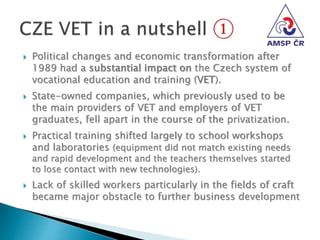
 Political changes and economic transformation after
1989 had a substantial impact on the Czech system of
vocational education and training (VET).
 State-owned companies, which previously used to be
the main providers of VET and employers of VET
graduates, fell apart in the course of the privatization.
 Practical training shifted largely to school workshops
and laboratories (equipment did not match existing needs
and rapid development and the teachers themselves started
to lose contact with new technologies).
 Lack of skilled workers particularly in the fields of craft
became major obstacle to further business development
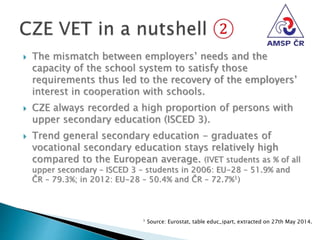
 The mismatch between employers’ needs and the
capacity of the school system to satisfy those
requirements thus led to the recovery of the employers’
interest in cooperation with schools.
 CZE always recorded a high proportion of persons with
upper secondary education (ISCED 3).
 Trend general secondary education - graduates of
vocational secondary education stays relatively high
compared to the European average. (IVET students as % of all
upper secondary – ISCED 3 – students in 2006: EU-28 – 51.9% and
ČR – 79.3%; in 2012: EU-28 – 50.4% and ČR – 72.7%1)
1 Source: Eurostat, table educ_ipart, extracted on 27th May 2014.
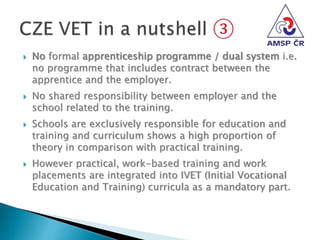
 No formal apprenticeship programme / dual system i.e.
no programme that includes contract between the
apprentice and the employer.
 No shared responsibility between employer and the
school related to the training.
 Schools are exclusively responsible for education and
training and curriculum shows a high proportion of
theory in comparison with practical training.
 However practical, work-based training and work
placements are integrated into IVET (Initial Vocational
Education and Training) curricula as a mandatory part.
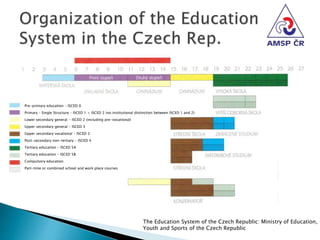
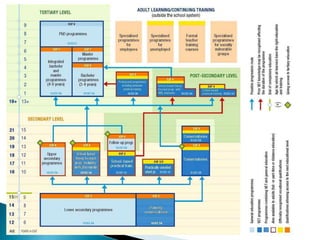
The Education System of the Czech Republic: Ministry of Education,
Youth and Sports of the Czech Republic
Pre-primary education - ISCED 0
Primary – Single Structure – ISCED 1 + ISCED 2 (no institutional distinction between ISCED 1 and 2)
Lower secondary general - ISCED 2 (including pre-vocational)
Upper secondary general - ISCED 3
Upper secondary vocational - ISCED 3
Post-secondary non-tertiary - ISCED 4
Tertiary education - ISCED 5A
Tertiary education - ISCED 5B
Compulsory education
Part-time or combined school and work place courses
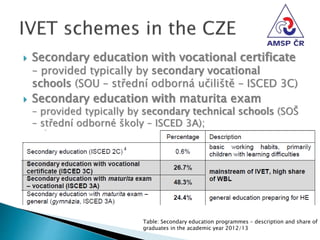
 Secondary education with vocational certificate
– provided typically by secondary vocational
schools (SOU – střední odborná učiliště – ISCED 3C)
 Secondary education with maturita exam
– provided typically by secondary technical schools (SOŠ
– střední odborné školy – ISCED 3A);
Table: Secondary education programmes – description and share of
graduates in the academic year 2012/13
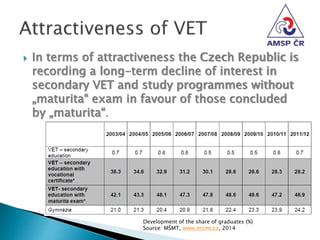
 In terms of attractiveness the Czech Republic is
recording a long-term decline of interest in
secondary VET and study programmes without
„maturita“ exam in favour of those concluded
by „maturita“.
Development of the share of graduates (%)
Source: MŠMT, www.msmt.cz, 2014
 The responsibility for funding of secondary VET
schools
◦ secondary vocational schools - střední odborná
učiliště – SOU, ISCED 3C;
◦ secondary technical schools - střední odborné školy –
SOŠ, ISCED 3A)
◦ and tertiary professional schools (vyšší odborné školy
– VOŠ, ISCED 5B)
is shared between the Ministry of Education, Youth and
Sports of the Czech Republic (MŠMT) and those
responsible for establishing schools, i.e. regional
authorities or in some cases private entities, churches,
ministries.
 POSPOLU - Promoting Cooperation Between
Schools and Companies Focused on Vocational
Training in Practice (POSPOLU = TOGETHER)
 One of the projects implemented by NÚV
(National Institute of Education), in cooperation
with Ministry of Education, Youth and Sports of
the Czech Republic and employers'
associations (Confederation of Industry,
Association of Engineering Technology etc.)
 Individual project from the ESF
 2012 - 2015
 Promoting cooperation between secondary
vocational schools and employers, leading to
◦ better prepared graduates,
◦ deepen the preparation of students in a real work
environment,
◦ and seeking additional opportunities for cooperation
besides school vocational training and work practice in
companies.
 The main objective of the project is to produce a
draft of systemic and legislative changes that
cooperation between schools and businesses
facilitate and enable its expansion.
 The concept of the cooperative model, it is
supposed that cooperation between schools
and businesses must be coordinated at the
national level to ensure that pupils achieve
comparable results and acquire comparable
qualifications regardless of where vocational
training or professional experience completed,
 Coordination should ensure the country
represented by the Ministry of Education, in
close collaboration with the representative
bodies of employers
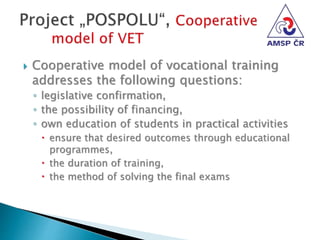
 Cooperative model of vocational training
addresses the following questions:
◦ legislative confirmation,
◦ the possibility of financing,
◦ own education of students in practical activities
 ensure that desired outcomes through educational
programmes,
 the duration of training,
 the method of solving the final exams
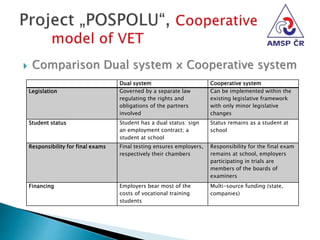
 Comparison Dual system x Cooperative system
Dual system Cooperative system
Legislation Governed by a separate law
regulating the rights and
obligations of the partners
involved
Can be implemented within the
existing legislative framework
with only minor legislative
changes
Student status Student has a dual status: sign
an employment contract; a
student at school
Status remains as a student at
school
Responsibility for final exams Final testing ensures employers,
respectively their chambers
Responsibility for the final exam
remains at school, employers
participating in trials are
members of the boards of
examiners
Financing Employers bear most of the
costs of vocational training
students
Multi-source funding (state,
companies)
 Programme Erasmus+ is a chance for
intensification in VET collaboration (former
Leonardo da Vinci)
 KA1 mobility of student and VET staff
 KA2 Strategic partnerships in VET
 AMSP ČR is involved in 2 projects from Call
2014
◦ VoCOL - Vocational Cooperative Learning
Triangles
◦ TUNED UP! - Tools Under the Need of Enhancing
Diversity
 Project objectives:
◦ To develop skills of staff to use COL to develop & assess
learners’ key competencies for employment
◦ To improve attractiveness & relevance of VET by ensuring
curriculum meets the employability needs of learners &
employers
◦ To strengthen alignment & collaboration between the
worlds of work & VET through innovative methods
◦ To enhance the modernisation & internationalisation of VET
systems in partner countries
Thank you for your kind attention!
Jakub ŠKÁBA / AMSP ČR
International Projects Manager
Sokolovská 100/94
186 00 Praha 8
Tel.: +420 603 433 114
E-mail: skaba@amsp.cz
Web: www.amsp.cz

Improving the Employability of Young People through Dual Vocational Training – V4 Conference

  • 1.
  • 2.
     Political changesand economic transformation after 1989 had a substantial impact on the Czech system of vocational education and training (VET).  State-owned companies, which previously used to be the main providers of VET and employers of VET graduates, fell apart in the course of the privatization.  Practical training shifted largely to school workshops and laboratories (equipment did not match existing needs and rapid development and the teachers themselves started to lose contact with new technologies).  Lack of skilled workers particularly in the fields of craft became major obstacle to further business development
  • 3.
     The mismatchbetween employers’ needs and the capacity of the school system to satisfy those requirements thus led to the recovery of the employers’ interest in cooperation with schools.  CZE always recorded a high proportion of persons with upper secondary education (ISCED 3).  Trend general secondary education - graduates of vocational secondary education stays relatively high compared to the European average. (IVET students as % of all upper secondary – ISCED 3 – students in 2006: EU-28 – 51.9% and ČR – 79.3%; in 2012: EU-28 – 50.4% and ČR – 72.7%1) 1 Source: Eurostat, table educ_ipart, extracted on 27th May 2014.
  • 4.
     No formalapprenticeship programme / dual system i.e. no programme that includes contract between the apprentice and the employer.  No shared responsibility between employer and the school related to the training.  Schools are exclusively responsible for education and training and curriculum shows a high proportion of theory in comparison with practical training.  However practical, work-based training and work placements are integrated into IVET (Initial Vocational Education and Training) curricula as a mandatory part.
  • 5.
    The Education Systemof the Czech Republic: Ministry of Education, Youth and Sports of the Czech Republic Pre-primary education - ISCED 0 Primary – Single Structure – ISCED 1 + ISCED 2 (no institutional distinction between ISCED 1 and 2) Lower secondary general - ISCED 2 (including pre-vocational) Upper secondary general - ISCED 3 Upper secondary vocational - ISCED 3 Post-secondary non-tertiary - ISCED 4 Tertiary education - ISCED 5A Tertiary education - ISCED 5B Compulsory education Part-time or combined school and work place courses
  • 7.
     Secondary educationwith vocational certificate – provided typically by secondary vocational schools (SOU – střední odborná učiliště – ISCED 3C)  Secondary education with maturita exam – provided typically by secondary technical schools (SOŠ – střední odborné školy – ISCED 3A); Table: Secondary education programmes – description and share of graduates in the academic year 2012/13
  • 8.
     In termsof attractiveness the Czech Republic is recording a long-term decline of interest in secondary VET and study programmes without „maturita“ exam in favour of those concluded by „maturita“. Development of the share of graduates (%) Source: MŠMT, www.msmt.cz, 2014
  • 9.
     The responsibilityfor funding of secondary VET schools ◦ secondary vocational schools - střední odborná učiliště – SOU, ISCED 3C; ◦ secondary technical schools - střední odborné školy – SOŠ, ISCED 3A) ◦ and tertiary professional schools (vyšší odborné školy – VOŠ, ISCED 5B) is shared between the Ministry of Education, Youth and Sports of the Czech Republic (MŠMT) and those responsible for establishing schools, i.e. regional authorities or in some cases private entities, churches, ministries.
  • 10.
     POSPOLU -Promoting Cooperation Between Schools and Companies Focused on Vocational Training in Practice (POSPOLU = TOGETHER)  One of the projects implemented by NÚV (National Institute of Education), in cooperation with Ministry of Education, Youth and Sports of the Czech Republic and employers' associations (Confederation of Industry, Association of Engineering Technology etc.)  Individual project from the ESF  2012 - 2015
  • 11.
     Promoting cooperationbetween secondary vocational schools and employers, leading to ◦ better prepared graduates, ◦ deepen the preparation of students in a real work environment, ◦ and seeking additional opportunities for cooperation besides school vocational training and work practice in companies.  The main objective of the project is to produce a draft of systemic and legislative changes that cooperation between schools and businesses facilitate and enable its expansion.
  • 12.
     The conceptof the cooperative model, it is supposed that cooperation between schools and businesses must be coordinated at the national level to ensure that pupils achieve comparable results and acquire comparable qualifications regardless of where vocational training or professional experience completed,  Coordination should ensure the country represented by the Ministry of Education, in close collaboration with the representative bodies of employers
  • 13.
     Cooperative modelof vocational training addresses the following questions: ◦ legislative confirmation, ◦ the possibility of financing, ◦ own education of students in practical activities  ensure that desired outcomes through educational programmes,  the duration of training,  the method of solving the final exams
  • 14.
     Comparison Dualsystem x Cooperative system Dual system Cooperative system Legislation Governed by a separate law regulating the rights and obligations of the partners involved Can be implemented within the existing legislative framework with only minor legislative changes Student status Student has a dual status: sign an employment contract; a student at school Status remains as a student at school Responsibility for final exams Final testing ensures employers, respectively their chambers Responsibility for the final exam remains at school, employers participating in trials are members of the boards of examiners Financing Employers bear most of the costs of vocational training students Multi-source funding (state, companies)
  • 15.
     Programme Erasmus+is a chance for intensification in VET collaboration (former Leonardo da Vinci)  KA1 mobility of student and VET staff  KA2 Strategic partnerships in VET  AMSP ČR is involved in 2 projects from Call 2014 ◦ VoCOL - Vocational Cooperative Learning Triangles ◦ TUNED UP! - Tools Under the Need of Enhancing Diversity
  • 16.
     Project objectives: ◦To develop skills of staff to use COL to develop & assess learners’ key competencies for employment ◦ To improve attractiveness & relevance of VET by ensuring curriculum meets the employability needs of learners & employers ◦ To strengthen alignment & collaboration between the worlds of work & VET through innovative methods ◦ To enhance the modernisation & internationalisation of VET systems in partner countries
  • 17.
    Thank you foryour kind attention! Jakub ŠKÁBA / AMSP ČR International Projects Manager Sokolovská 100/94 186 00 Praha 8 Tel.: +420 603 433 114 E-mail: skaba@amsp.cz Web: www.amsp.cz