Common Appraisal Errors
Halo/horns effect


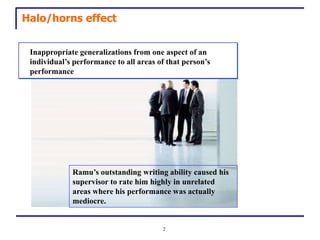
 Inappropriate generalizations from one aspect of an
 individual’s performance to all areas of that person’s
                  .
 performance


             Ramu’s outstanding writing ability caused his
             supervisor to rate him highly in unrelated
             areas where his performance was actually
             mediocre.


                                        2
First impression Error


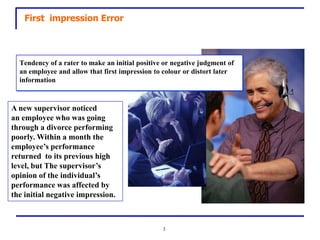
  Tendency of a rater to make an initial positive or negative judgment of
  an employee and allow that first impression to colour or distort later
  information


A new supervisor noticed
an employee who was going
through a divorce performing
poorly. Within a month the
employee’s performance
returned to its previous high
level, but The supervisor’s
opinion of the individual’s
performance was affected by
the initial negative impression.


                                                 3
Similar-to-me effect


The tendency of individuals to rate people who resemble themselves more highly than they rate
others


  Laxmi was a single mother with four
  children and was promoted to
  supervisor.
  Unknowingly she rated several other
  women who were also single mothers
  higher than their performance
  warranted.


                                                 4
Contrast Effect


 Tendency of a rater to evaluate people in comparison with
 other individuals rather than against the standards for the
 job


Think of the most attractive person
you know and rate this person on a
scale of 1 to 10. Now think of your
favorite glamorous movie star. Re-
rate your acquaintance. If you
rated your friend lower the second
time, contrast effect is at work.


                                              5
Stereotyping


  The tendency to generalize across groups and ignore individual differences


 Sanjay was quiet and reserved, however, he is well liked and respected by
 both internal and external customers. His boss rated him lower than the
 other customer service personnel since he didn’t “fit the mold.”


                                       6
Negative and Positive skew


   The opposite of central tendency: the rating of all
   individuals as higher or lower than their
   performance warrants


 Ajitha rates all of her employees higher
 than she feels they actually deserve , in the
 hope that this will cause them to live up to
 the high rating. While Laxmi sets
 impossibly high standards and is proud of
 never having met an employee who
 deserved a superior rating.


                                              7
Attribution bias


                   The tendency to attribute performance
                   failings to factors under the control of the
                   individual and performance successes to
                   external causes.


                   Srinivas, attributes the successes of her work
                   group to the quality of her leadership and
                   the failings to their bad attitudes and
                   inherent laziness.


                      8
Central tendency


  The inclination to rate people in the
  middle scale even when their performance
  clearly warrants a substantially higher or
  lower rating.


Because Harold had a concern that he would not
be able to deal with confrontation during an
appraisal session, he rated all of his employees as
“Meets Expectations.”


                                           9
Recency effect

      The tendency of minor events that have happened recently to
      have more influence on the rating than major events of many
      months ago.


                                            Rajitha kept no
                                            records of critical
                                            incidents. When she
                                            began writing the
                                            appraisals for her
                                            employees she
                                            discovered that she
                                            could only recall
                                            examples of either
                                            positive or negative
                                            performance for
                                            the last two months.


                                       10
Subscribe to HumanResourceOnLine by sending a Blank
                      mail to
 HumanResourceOnLine-subscribe@yahoogroups.com
            http://vinayhrmblogspot.com


For feedback send u r mails to vinaykumar07@yahoo.com


                         11

Appraial Errors Vinay Ravindran

  • 1.
  • 2.
    Halo/horns effect Inappropriategeneralizations from one aspect of an individual’s performance to all areas of that person’s . performance Ramu’s outstanding writing ability caused his supervisor to rate him highly in unrelated areas where his performance was actually mediocre. 2
  • 3.
    First impression Error Tendency of a rater to make an initial positive or negative judgment of an employee and allow that first impression to colour or distort later information A new supervisor noticed an employee who was going through a divorce performing poorly. Within a month the employee’s performance returned to its previous high level, but The supervisor’s opinion of the individual’s performance was affected by the initial negative impression. 3
  • 4.
    Similar-to-me effect The tendencyof individuals to rate people who resemble themselves more highly than they rate others Laxmi was a single mother with four children and was promoted to supervisor. Unknowingly she rated several other women who were also single mothers higher than their performance warranted. 4
  • 5.
    Contrast Effect Tendencyof a rater to evaluate people in comparison with other individuals rather than against the standards for the job Think of the most attractive person you know and rate this person on a scale of 1 to 10. Now think of your favorite glamorous movie star. Re- rate your acquaintance. If you rated your friend lower the second time, contrast effect is at work. 5
  • 6.
    Stereotyping Thetendency to generalize across groups and ignore individual differences Sanjay was quiet and reserved, however, he is well liked and respected by both internal and external customers. His boss rated him lower than the other customer service personnel since he didn’t “fit the mold.” 6
  • 7.
    Negative and Positiveskew The opposite of central tendency: the rating of all individuals as higher or lower than their performance warrants Ajitha rates all of her employees higher than she feels they actually deserve , in the hope that this will cause them to live up to the high rating. While Laxmi sets impossibly high standards and is proud of never having met an employee who deserved a superior rating. 7
  • 8.
    Attribution bias The tendency to attribute performance failings to factors under the control of the individual and performance successes to external causes. Srinivas, attributes the successes of her work group to the quality of her leadership and the failings to their bad attitudes and inherent laziness. 8
  • 9.
    Central tendency The inclination to rate people in the middle scale even when their performance clearly warrants a substantially higher or lower rating. Because Harold had a concern that he would not be able to deal with confrontation during an appraisal session, he rated all of his employees as “Meets Expectations.” 9
  • 10.
    Recency effect The tendency of minor events that have happened recently to have more influence on the rating than major events of many months ago. Rajitha kept no records of critical incidents. When she began writing the appraisals for her employees she discovered that she could only recall examples of either positive or negative performance for the last two months. 10
  • 11.
    Subscribe to HumanResourceOnLineby sending a Blank mail to HumanResourceOnLine-subscribe@yahoogroups.com http://vinayhrmblogspot.com For feedback send u r mails to vinaykumar07@yahoo.com 11