“Light and fast” funding for innovation:
           Making EU innovation policies fit for the web


David.osimo@tech4i2.com
@osimod


                                               1
Background

•   Europe’s lagging behind in web competitiveness
•   FP7 projects fail to generate substantial market
    impacts
•   Most innovative web companies don’t participate
    in FP7
•   Horizon2020 and Digital Agenda for Europe
    mention the need for “light and fast funding
    instruments”, but concrete measures focus on
    administrative simplification only


                                                       2
Questions


•   Is it necessary that future EU innovation
    policy include light and fast funding
    instruments, and why?
•   Is it feasible to adopt these instruments in
    the government context?
•   How could they be designed?


                                                   3
An Impact Assessment Approach


                                4
The problem


•   ““there are major barriers to involve the
    most innovative and growth oriented SMEs”
    (Aho 2008)
•   “Framework Programme contains limited
    countervailing activity that would stimulate
    disequilibrating, disruptive technologies and
    innovations that can unseat the established
    players and unleash the development of new
    industries” (Arnold 2011)

                                                    5
The reasons: an
innovation policy
   designed for
 capital-intensive
        R&I


(cfr. IBBT Ghent Manifesto 2009)
                                   6
The objective of “Light and
          Fast”, and its objections
•   Light and fast instruments are not allowed by
    financial regulations
•   They are much more labour intensive for the
    funding agency
•   They lack a critical mass to generate disruptive
    innovation on the market
•   They lack rationale for EU-level intervention
    since they are most effective at regional/local
    level


                                                       7
3 cases of light and fast
                 instruments


•   The Principi Attivi initiative of the Puglia
    Region (IT)
•   The Global Security Challenge (UK)
•   US government Challenge.gov service (US)


                                                   8
Principi Attivi
•   the Puglia Region Government launched and managed in-house a €10MLN call
    for proposals for micro-projects (up to €25.000)

•   strong “licence to experiment” by its management . Not funded by SF because
    of legal limitations

•   Restricted to informal groups of young people could participate

•   Very open, non prescriptive definition of the priorities

•   Simple application process (max. 13 pages form)

•   Open, peer-to-peer helpdesk that enabled the horizontal networking of
    participants

•   420 projects (involving 1279 young people) were funded out of 1500 proposals.
    Only 5% of proposals did not reach their goals but more than half changed their
    objectives throughout the process

•   80% of the projects are still active three years after the call has ended
                                                                                      9
Global Security Challenge


•   The TSWG co-funds the Global Security Challenge, organised by
    OmniCompete. Now in its 6th year.

•   prizes are a minor part of the total funding of the agency. In the case of
    the Security Challenge, about 1% of the budget is devoted to it

•   Open, non prescriptive participation, simple application form (1/2
    hour)

•   Any security-related innovative product can be submitted, global
    participation

•   Prize grants totalling $500,000 USD are available to the winners.

•   Top contenders from previous competitions have subsequently raised
    over $80 million in new capital.  Several products have then been
    bought by the final customers


                                                                                 10
Challenge.gov

•   Following a revision of legislation, any gov agency can organise
    inducement prizes and a dedicated platform is set up

•   Government agencies can post “challenges” that can be met by any
    citizens

•   The proposer of the best solution receives the prize money, typically
    around 50.000 Euros

•   Not only apps contests: e.g. NASA competition for writing “algorithm
    to fly three small SPHERES satellites around the cabin of the
    International Space Station”.

•   All federal agencies but two have used the platform to launch prizes

•   So far 38 million dollars in prizes have been distributed, including a 18
    million dollars prize for Solid State Lighting

•   Growing interest: new COECI created at NASA


                                                                                11
Answering the objections

•   Objection 1: they are not allowed by financial
    regulations
Unproven, but in any case regulations can be
  adapted (e.g. America Competes Act). “Light
  and fast” instruments call for regulatory
  intervention or at least regulatory
  clarifications and guidelines that help
  convincing administrators of the legitimacy of
  the acts.


                                                     12
•   Objection 2: they are much more labour intensive
    for the funding agency
All project officers confirmed the need for
    continuous, in depth interaction with project
    managers in order to fine-tune the ideas, but
    also underlined how this additional cost was
    highly beneficial for both the research team
    and the funding agency (similar to VC
    approach)
Innovative peer-to-peer solutions can also be
   used to reduce the workload
                                                       13
•   Objections n. 3: they lack a sufficient critical mass
    to generate disruptive innovation on the market
Untrue. Web-based innovation do not require
  strong initial investment. The GSC has
  attracted world-class participation and
  generated innovation with relatively small
  funding. Key is using “light and fast” as only
  the first step.


                                                            14
•   Objections n.4: small funding lacks a rationale for
    EU-level intervention since they are most effective
    at regional or local level
Untrue. Inducement prizes such as
  Challenge.gov show that global and federal (in
  the US sense) geographical coverage is
  meaningful and effective also for relatively
  small amounts of funding. The wide
  geographical scope is needed to raise the
  quality of the proposals, their visibility and
  the knowledge flows, not only because of the
  size of the investment.
                                                          15
Answering the initial questions

•   WHY? Current funding instruments are
    “ineffective by design” in delivering web
    innovation
•   IS IT FEASIBLE? light and fast funding
    instruments are applicable in the government
    context, not only in the private and non-
    profit sectors. There are examples that show
    this feasibility


                                                   16
HOW to do it?


•   Integrate (not substitute) existing funding
    with: Small funding, short project time, simple
    application process, open themes, multi-stage
    funding
•   Institutional change / clarification necessary
•   Management change: “license to experiment”,
    move to ex-post evaluation of results


                                                      17
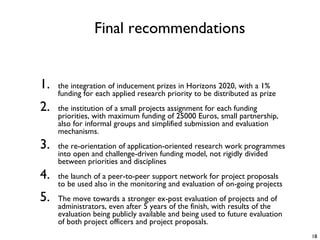
Final recommendations


1.   the integration of inducement prizes in Horizons 2020, with a 1%
     funding for each applied research priority to be distributed as prize
2.   the institution of a small projects assignment for each funding
     priorities, with maximum funding of 25000 Euros, small partnership,
     also for informal groups and simplified submission and evaluation
     mechanisms.
3.   the re-orientation of application-oriented research work programmes
     into open and challenge-driven funding model, not rigidly divided
     between priorities and disciplines
4.   the launch of a peer-to-peer support network for project proposals
     to be used also in the monitoring and evaluation of on-going projects
5.   The move towards a stronger ex-post evaluation of projects and of
     administrators, even after 5 years of the finish, with results of the
     evaluation being publicly available and being used to future evaluation
     of both project officers and project proposals.
                                                                               18

Osimo eurocpr

  • 1.
    “Light and fast”funding for innovation: Making EU innovation policies fit for the web David.osimo@tech4i2.com @osimod 1
  • 2.
    Background • Europe’s lagging behind in web competitiveness • FP7 projects fail to generate substantial market impacts • Most innovative web companies don’t participate in FP7 • Horizon2020 and Digital Agenda for Europe mention the need for “light and fast funding instruments”, but concrete measures focus on administrative simplification only 2
  • 3.
    Questions • Is it necessary that future EU innovation policy include light and fast funding instruments, and why? • Is it feasible to adopt these instruments in the government context? • How could they be designed? 3
  • 4.
  • 5.
    The problem • ““there are major barriers to involve the most innovative and growth oriented SMEs” (Aho 2008) • “Framework Programme contains limited countervailing activity that would stimulate disequilibrating, disruptive technologies and innovations that can unseat the established players and unleash the development of new industries” (Arnold 2011) 5
  • 6.
    The reasons: an innovationpolicy designed for capital-intensive R&I (cfr. IBBT Ghent Manifesto 2009) 6
  • 7.
    The objective of“Light and Fast”, and its objections • Light and fast instruments are not allowed by financial regulations • They are much more labour intensive for the funding agency • They lack a critical mass to generate disruptive innovation on the market • They lack rationale for EU-level intervention since they are most effective at regional/local level 7
  • 8.
    3 cases oflight and fast instruments • The Principi Attivi initiative of the Puglia Region (IT) • The Global Security Challenge (UK) • US government Challenge.gov service (US) 8
  • 9.
    Principi Attivi • the Puglia Region Government launched and managed in-house a €10MLN call for proposals for micro-projects (up to €25.000) • strong “licence to experiment” by its management . Not funded by SF because of legal limitations • Restricted to informal groups of young people could participate • Very open, non prescriptive definition of the priorities • Simple application process (max. 13 pages form) • Open, peer-to-peer helpdesk that enabled the horizontal networking of participants • 420 projects (involving 1279 young people) were funded out of 1500 proposals. Only 5% of proposals did not reach their goals but more than half changed their objectives throughout the process • 80% of the projects are still active three years after the call has ended 9
  • 10.
    Global Security Challenge • The TSWG co-funds the Global Security Challenge, organised by OmniCompete. Now in its 6th year. • prizes are a minor part of the total funding of the agency. In the case of the Security Challenge, about 1% of the budget is devoted to it • Open, non prescriptive participation, simple application form (1/2 hour) • Any security-related innovative product can be submitted, global participation • Prize grants totalling $500,000 USD are available to the winners. • Top contenders from previous competitions have subsequently raised over $80 million in new capital.  Several products have then been bought by the final customers 10
  • 11.
    Challenge.gov • Following a revision of legislation, any gov agency can organise inducement prizes and a dedicated platform is set up • Government agencies can post “challenges” that can be met by any citizens • The proposer of the best solution receives the prize money, typically around 50.000 Euros • Not only apps contests: e.g. NASA competition for writing “algorithm to fly three small SPHERES satellites around the cabin of the International Space Station”. • All federal agencies but two have used the platform to launch prizes • So far 38 million dollars in prizes have been distributed, including a 18 million dollars prize for Solid State Lighting • Growing interest: new COECI created at NASA 11
  • 12.
    Answering the objections • Objection 1: they are not allowed by financial regulations Unproven, but in any case regulations can be adapted (e.g. America Competes Act). “Light and fast” instruments call for regulatory intervention or at least regulatory clarifications and guidelines that help convincing administrators of the legitimacy of the acts. 12
  • 13.
    Objection 2: they are much more labour intensive for the funding agency All project officers confirmed the need for continuous, in depth interaction with project managers in order to fine-tune the ideas, but also underlined how this additional cost was highly beneficial for both the research team and the funding agency (similar to VC approach) Innovative peer-to-peer solutions can also be used to reduce the workload 13
  • 14.
    Objections n. 3: they lack a sufficient critical mass to generate disruptive innovation on the market Untrue. Web-based innovation do not require strong initial investment. The GSC has attracted world-class participation and generated innovation with relatively small funding. Key is using “light and fast” as only the first step. 14
  • 15.
    Objections n.4: small funding lacks a rationale for EU-level intervention since they are most effective at regional or local level Untrue. Inducement prizes such as Challenge.gov show that global and federal (in the US sense) geographical coverage is meaningful and effective also for relatively small amounts of funding. The wide geographical scope is needed to raise the quality of the proposals, their visibility and the knowledge flows, not only because of the size of the investment. 15
  • 16.
    Answering the initialquestions • WHY? Current funding instruments are “ineffective by design” in delivering web innovation • IS IT FEASIBLE? light and fast funding instruments are applicable in the government context, not only in the private and non- profit sectors. There are examples that show this feasibility 16
  • 17.
    HOW to doit? • Integrate (not substitute) existing funding with: Small funding, short project time, simple application process, open themes, multi-stage funding • Institutional change / clarification necessary • Management change: “license to experiment”, move to ex-post evaluation of results 17
  • 18.
    Final recommendations 1. the integration of inducement prizes in Horizons 2020, with a 1% funding for each applied research priority to be distributed as prize 2. the institution of a small projects assignment for each funding priorities, with maximum funding of 25000 Euros, small partnership, also for informal groups and simplified submission and evaluation mechanisms. 3. the re-orientation of application-oriented research work programmes into open and challenge-driven funding model, not rigidly divided between priorities and disciplines 4. the launch of a peer-to-peer support network for project proposals to be used also in the monitoring and evaluation of on-going projects 5. The move towards a stronger ex-post evaluation of projects and of administrators, even after 5 years of the finish, with results of the evaluation being publicly available and being used to future evaluation of both project officers and project proposals. 18