MICROECONOMICS
What is Economics?
•The efficient allocation of the
scarce means of production
toward satisfaction of human
needs and wants.
Origin of the word “Economics”
• from 2 Greek root words oikos – meaning household
and nomus- meaning system or management.
The word "economics" is derived from a Greek word
"oikonomia" which means "household
management" or "management of house affairs"
Central Problem of Economics?
•Scarcity is the heart of
the study of economics
and the basic and central
economic problem
confronting every man
and society.
Factors of Production
• A. Resources
Is anything that can be used to
produce goods and services. Resources are
also called inputs or factors of production
Four Categories of Resources
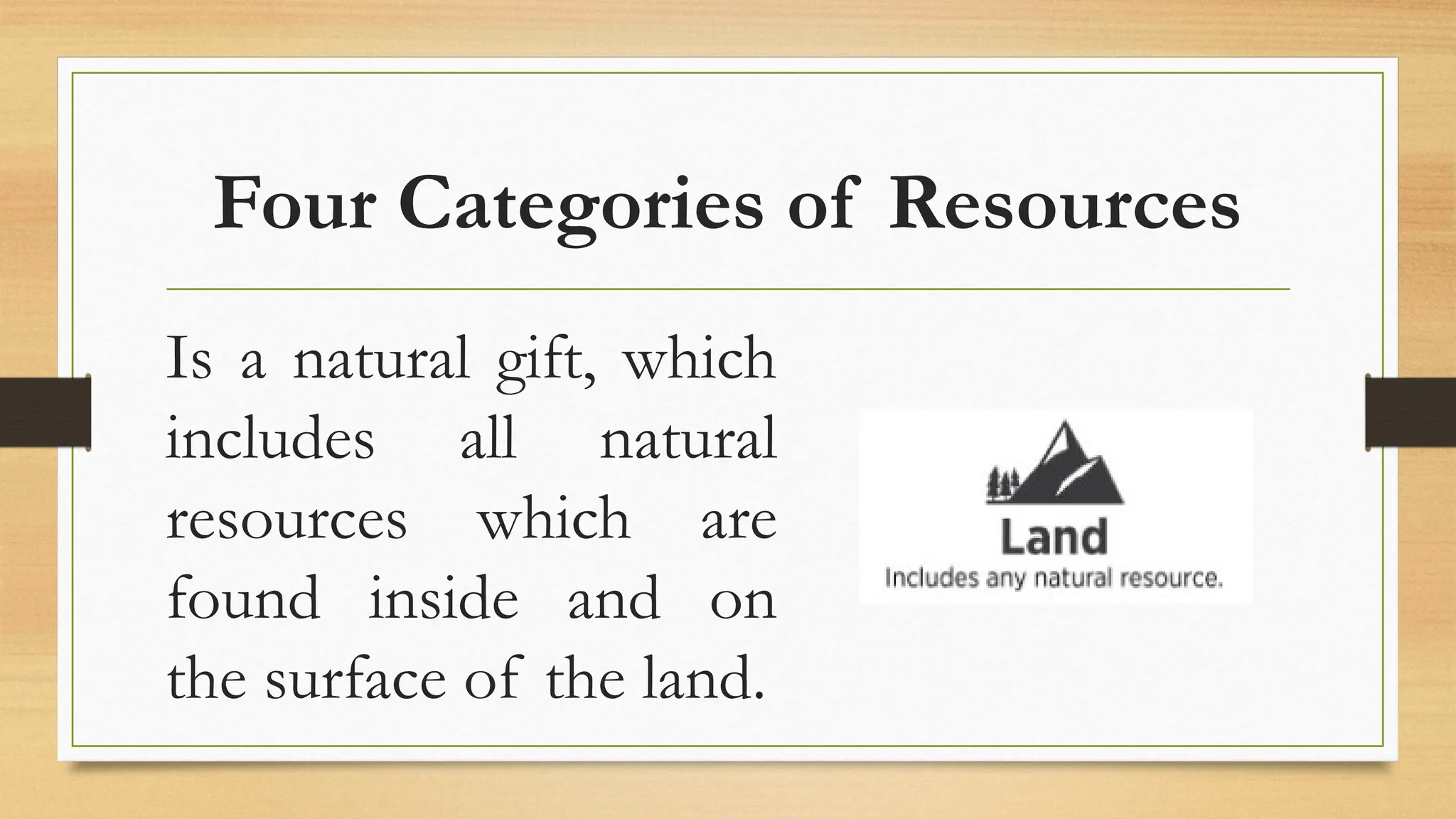
Is a natural gift, which
includes all natural
resources which are
found inside and on
the surface of the land.
Four Categories of Resources
Is mental and physical human
effort (ability) used in the
production process. The skill
and amount of labor will be
important in determining level
and quality of production.
Four Categories of Resources
Is a man-made means of production
used in the production process.
Here belong resources like:
• Machineries, equipment's, tools used in
the production process.
• Buildings and materials attached to it,
• Financial capital
Four Categories of Resources
It is managerial skill of organizing and
combining the above three resources for
production purposes. The above resources
cannot be productive and be changed into
goods and services without the creative
effort of entrepreneur. Entrepreneur is an
individual who organizes resources for
production, introduces new products or
techniques of production.
Factors of Production
Circular Flow Model
The circular flow model
demonstrates how money moves
through society. Money flows
from producers to workers as
wages and flows back to
producers as payment for
products. In short, an economy
is an endless circular flow of
money.
Basic Decision Problems
Consumption
Production
Distribution
Growth over time
Four Basic Economic Questions
What to produce?
How to produce?
How much to produce?
For whom to produce?
3 E`s in Economics
Efficiency
Effectiveness
Equity
Microeconomics and Macroeconomics
Microeconomics is the part of economics
which studies the decision making process by
individuals (households) and by firms. It studies
the behavior of individual components of the
economy like households and business firms.
Microeconomics and Macroeconomics
Macroeconomics, on the other hand, is the part of
economics which studies the behavior of the economy
taken as a whole. It deals with phenomenon at overall
economy level like: unemployment, inflation and
national income. It studies the function of the economy
taken as a whole.
Positive Economics versus
Normative Economics
Positive Economics is that part of economic
science which deals with specific statements that are
capable of verification, by reference to the facts
about economic behavior. That is, it is concerned
with describing and analyzing the economy as it is.
Positive Economics versus
Normative Economics
Normative Economics, on the other hand, is analysis
involving value judgment. It is that part of economic
science which involves someone’s value judgments about
what the economy should be like or what particular policy
action should be recommended to solve economic
problems based on a given economic generalization or
relationship.
Economic System
An economic system is a means by which societies
or governments organize and distribute available
resources, services, and goods across a geographic
region or country. Economic systems regulate the
factors of production, including land, capital, labor,
and physical resources
Types of Economic System
Traditional Economy
Command Economy
Market Economy
Mixed Economy
Socialism
Types of Economic System
Traditional Economy
The traditional economic system is based on goods, services,
and work, all of which follow certain established trends. It
relies a lot on people, and there is very little division of labor or
specialization. In essence, the traditional economy is very basic
and the most ancient of the four types.
Types of Economic System
Traditional Economy
Economic system is based on goods, services, and
work, all of which follow certain established trends. It
relies a lot on people, and there is very little division
of labor or specialization. In essence, the traditional
economy is very basic and the most ancient of the
four types.
Types of Economic System
Command Economy
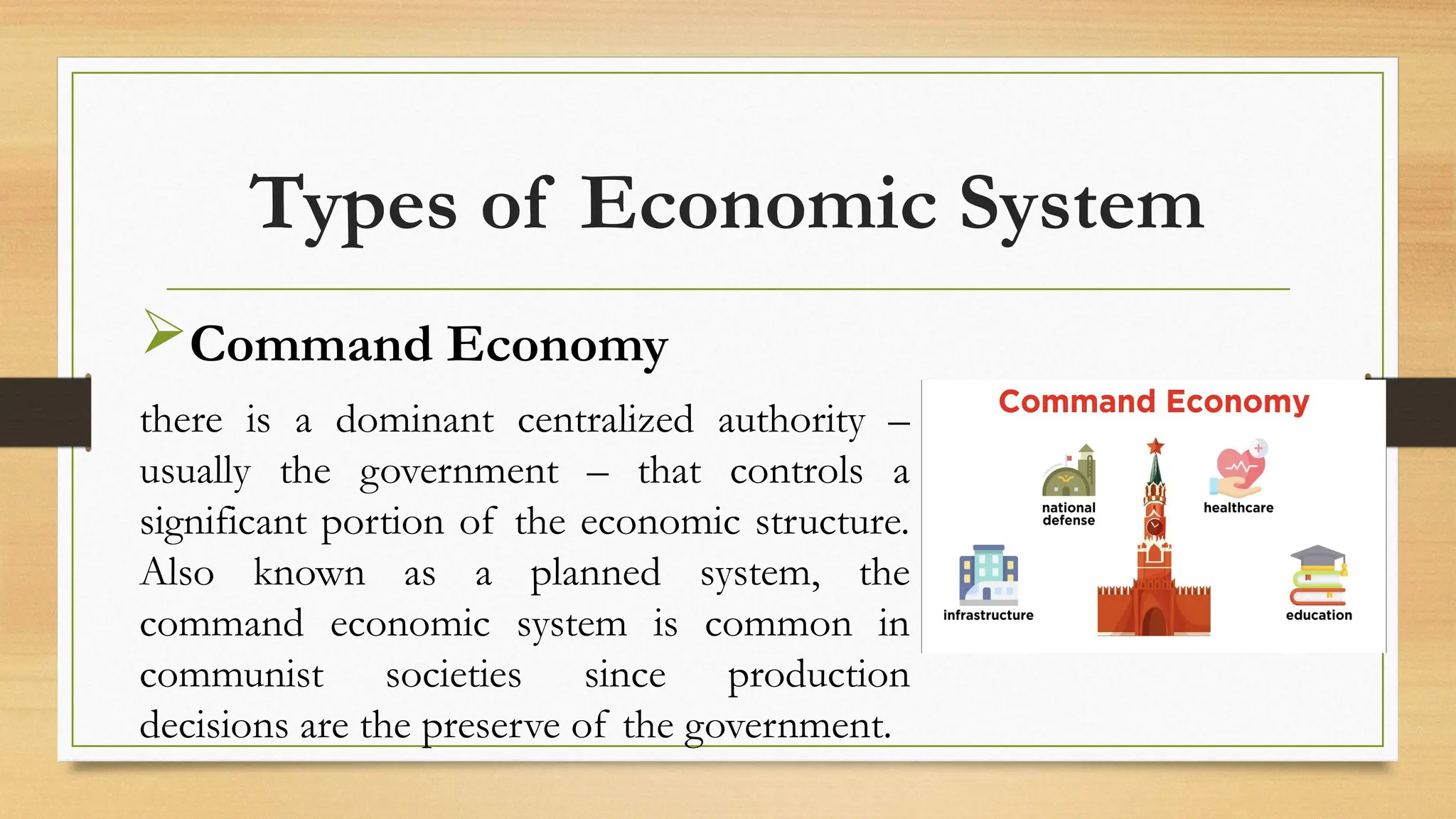
there is a dominant centralized authority –
usually the government – that controls a
significant portion of the economic structure.
Also known as a planned system, the
command economic system is common in
communist societies since production
decisions are the preserve of the government.
Types of Economic System
Market Economy
These are based on the concept of free
markets. In other words, there is very little
government interference. The government
exercises little control over resources, and it
does not interfere with important segments of
the economy. Instead, regulation comes from
the people and the relationship between
supply and demand.
Types of Economic System
Mixed Economy
Mixed systems combine the
characteristics of the market and
command economic systems. For this
reason, mixed systems are also known
as dual systems. Sometimes the term
is used to describe a market system
under strict regulatory control.

MICROECONOMICS for bs entrepreneurship....

  • 1.
  • 2.
    What is Economics? •Theefficient allocation of the scarce means of production toward satisfaction of human needs and wants.
  • 3.
    Origin of theword “Economics” • from 2 Greek root words oikos – meaning household and nomus- meaning system or management. The word "economics" is derived from a Greek word "oikonomia" which means "household management" or "management of house affairs"
  • 4.
    Central Problem ofEconomics? •Scarcity is the heart of the study of economics and the basic and central economic problem confronting every man and society.
  • 5.
    Factors of Production •A. Resources Is anything that can be used to produce goods and services. Resources are also called inputs or factors of production
  • 6.
    Four Categories ofResources Is a natural gift, which includes all natural resources which are found inside and on the surface of the land.
  • 7.
    Four Categories ofResources Is mental and physical human effort (ability) used in the production process. The skill and amount of labor will be important in determining level and quality of production.
  • 8.
    Four Categories ofResources Is a man-made means of production used in the production process. Here belong resources like: • Machineries, equipment's, tools used in the production process. • Buildings and materials attached to it, • Financial capital
  • 9.
    Four Categories ofResources It is managerial skill of organizing and combining the above three resources for production purposes. The above resources cannot be productive and be changed into goods and services without the creative effort of entrepreneur. Entrepreneur is an individual who organizes resources for production, introduces new products or techniques of production.
  • 10.
  • 11.
    Circular Flow Model Thecircular flow model demonstrates how money moves through society. Money flows from producers to workers as wages and flows back to producers as payment for products. In short, an economy is an endless circular flow of money.
  • 12.
  • 13.
    Four Basic EconomicQuestions What to produce? How to produce? How much to produce? For whom to produce?
  • 14.
    3 E`s inEconomics Efficiency Effectiveness Equity
  • 15.
    Microeconomics and Macroeconomics Microeconomicsis the part of economics which studies the decision making process by individuals (households) and by firms. It studies the behavior of individual components of the economy like households and business firms.
  • 16.
    Microeconomics and Macroeconomics Macroeconomics,on the other hand, is the part of economics which studies the behavior of the economy taken as a whole. It deals with phenomenon at overall economy level like: unemployment, inflation and national income. It studies the function of the economy taken as a whole.
  • 17.
    Positive Economics versus NormativeEconomics Positive Economics is that part of economic science which deals with specific statements that are capable of verification, by reference to the facts about economic behavior. That is, it is concerned with describing and analyzing the economy as it is.
  • 18.
    Positive Economics versus NormativeEconomics Normative Economics, on the other hand, is analysis involving value judgment. It is that part of economic science which involves someone’s value judgments about what the economy should be like or what particular policy action should be recommended to solve economic problems based on a given economic generalization or relationship.
  • 19.
    Economic System An economicsystem is a means by which societies or governments organize and distribute available resources, services, and goods across a geographic region or country. Economic systems regulate the factors of production, including land, capital, labor, and physical resources
  • 20.
    Types of EconomicSystem Traditional Economy Command Economy Market Economy Mixed Economy Socialism
  • 21.
    Types of EconomicSystem Traditional Economy The traditional economic system is based on goods, services, and work, all of which follow certain established trends. It relies a lot on people, and there is very little division of labor or specialization. In essence, the traditional economy is very basic and the most ancient of the four types.
  • 22.
    Types of EconomicSystem Traditional Economy Economic system is based on goods, services, and work, all of which follow certain established trends. It relies a lot on people, and there is very little division of labor or specialization. In essence, the traditional economy is very basic and the most ancient of the four types.
  • 23.
    Types of EconomicSystem Command Economy there is a dominant centralized authority – usually the government – that controls a significant portion of the economic structure. Also known as a planned system, the command economic system is common in communist societies since production decisions are the preserve of the government.
  • 24.
    Types of EconomicSystem Market Economy These are based on the concept of free markets. In other words, there is very little government interference. The government exercises little control over resources, and it does not interfere with important segments of the economy. Instead, regulation comes from the people and the relationship between supply and demand.
  • 25.
    Types of EconomicSystem Mixed Economy Mixed systems combine the characteristics of the market and command economic systems. For this reason, mixed systems are also known as dual systems. Sometimes the term is used to describe a market system under strict regulatory control.