APPLIED
ECONOMICS
(WEEK 1, MODULE 1)
ACTIVITY 1:WORD BANK
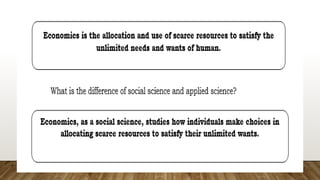
ECONOMICS?
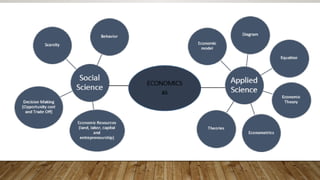
•is a social science that
involves the use of
scarce resources to
satisfy the unlimited
needs and
wants of human.
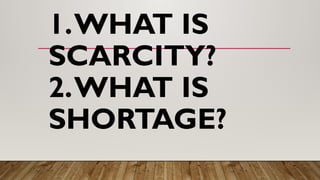
1.WHAT IS
SCARCITY?
2.WHAT IS
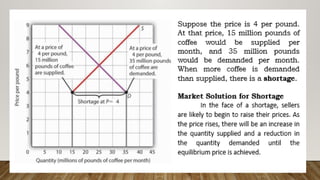
SHORTAGE?
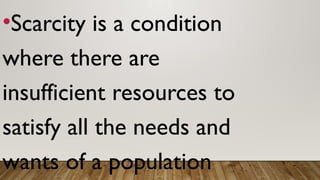
•Scarcity is a condition
where there are
insufficient resources to
satisfy all the needs and
wants of a population
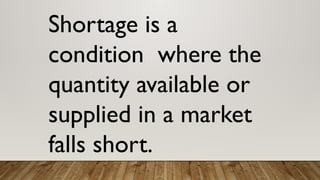
Shortage is a
condition where the
quantity available or
supplied in a market
falls short.
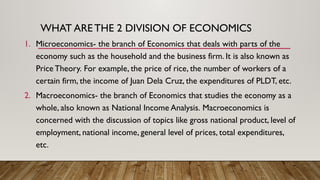
WHAT ARE THE 2 DIVISION OF ECONOMICS
1. Microeconomics- the branch of Economics that deals with parts of the
economy such as the household and the business firm. It is also known as
Price Theory. For example, the price of rice, the number of workers of a
certain firm, the income of Juan Dela Cruz, the expenditures of PLDT, etc.
2. Macroeconomics- the branch of Economics that studies the economy as a
whole, also known as National Income Analysis. Macroeconomics is
concerned with the discussion of topics like gross national product, level of
employment, national income, general level of prices, total expenditures,
etc.
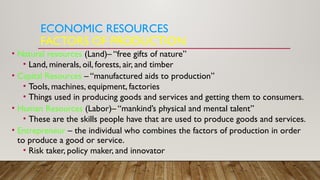
ECONOMIC RESOURCES
FACTORS OF PRODUCTION
• Natural resources (Land)– “free gifts of nature”
• Land, minerals, oil, forests, air, and timber
• Capital Resources – “manufactured aids to production”
• Tools, machines, equipment, factories
• Things used in producing goods and services and getting them to consumers.
• Human Resources (Labor)– “mankind’s physical and mental talent”
• These are the skills people have that are used to produce goods and services.
• Entrepreneur – the individual who combines the factors of production in order
to produce a good or service.
• Risk taker, policy maker, and innovator
3 BASIC ECONOMIC QUESTIONS
• What to produce and how much?
• With limited resources, deciding what is needed the most is often a
factor in determining what will be produced. What is the need or
want of this product?
• What is the point of making a product that no one is going to buy.
Businesses need to make money…so they choose products that
people want.
3 BASIC QUESTIONS CONT…
• How to produce?
• Technology, labor, capital, ect.
• getting the lowest cost to make the product.
• Are we going to make the product from scratch or will a machine be
making the product.
• What will each option cost?
• Will having new technology allow us to lower our expenses?
3 BASIC QUESTIONS CONT…
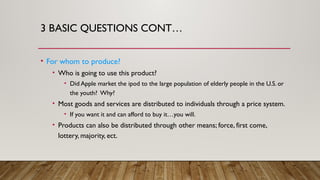
• For whom to produce?
• Who is going to use this product?
• Did Apple market the ipod to the large population of elderly people in the U.S. or
the youth? Why?
• Most goods and services are distributed to individuals through a price system.
• If you want it and can afford to buy it…you will.
• Products can also be distributed through other means; force, first come,
lottery, majority, ect.
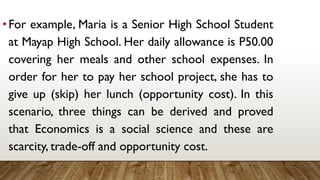
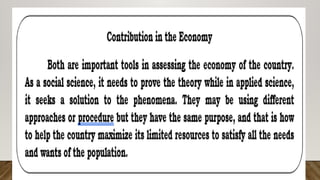
•For example, Maria is a Senior High School Student
at Mayap High School. Her daily allowance is P50.00
covering her meals and other school expenses. In
order for her to pay her school project, she has to
give up (skip) her lunch (opportunity cost). In this
scenario, three things can be derived and proved
that Economics is a social science and these are
scarcity, trade-off and opportunity cost.
INVESTMENTS
YOUR OPINION MATTERS……
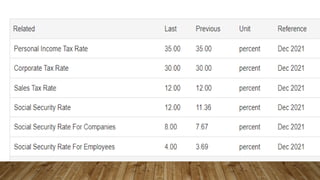
The annual inflation rate in the Philippines climbed to 6.9% in September 2022 from 6.3% in
August, topping market forecasts of 6.7%. It was the highest print since February 2009, above
the central bank's target of between 5.9 to 6.7% for the month, with food prices rising the
most in near four years (7.4% vs 6.3% in August). Additional upward pressures also came
from cost of housing (7.3% vs 6.8%), transport (14.5% vs 14.6%), alcoholic beverages (9.8% vs
9.3%), clothing (2.9% vs 2.8%), health (2.4% vs 2.5%), household maintenance (3.5% 3.4%),
communication (0.5% vs 0.4%), restaurant (4.6% vs 4.2%), recreation (2.7% vs 2.4%), and
miscellaneous (3.4% vs 3.3%). In contrast, cost of financial services was flat for the 6th
straight month after jumping 43.3% in early months of the year. On a monthly basis,
consumer prices rose 0.4%, the same pace as in August, matching consensus. The Statistics
Agency said inflation could rise further in October, likely due to more increases in food
prices. source: Philippine Statistics Authority
applied economics module 1 grade 11 st. thomas

applied economics module 1 grade 11 st. thomas

  • 1.
  • 2.
  • 3.
    ECONOMICS? •is a socialscience that involves the use of scarce resources to satisfy the unlimited needs and wants of human.
  • 4.
  • 5.
    •Scarcity is acondition where there are insufficient resources to satisfy all the needs and wants of a population
  • 6.
    Shortage is a conditionwhere the quantity available or supplied in a market falls short.
  • 7.
    WHAT ARE THE2 DIVISION OF ECONOMICS 1. Microeconomics- the branch of Economics that deals with parts of the economy such as the household and the business firm. It is also known as Price Theory. For example, the price of rice, the number of workers of a certain firm, the income of Juan Dela Cruz, the expenditures of PLDT, etc. 2. Macroeconomics- the branch of Economics that studies the economy as a whole, also known as National Income Analysis. Macroeconomics is concerned with the discussion of topics like gross national product, level of employment, national income, general level of prices, total expenditures, etc.
  • 8.
    ECONOMIC RESOURCES FACTORS OFPRODUCTION • Natural resources (Land)– “free gifts of nature” • Land, minerals, oil, forests, air, and timber • Capital Resources – “manufactured aids to production” • Tools, machines, equipment, factories • Things used in producing goods and services and getting them to consumers. • Human Resources (Labor)– “mankind’s physical and mental talent” • These are the skills people have that are used to produce goods and services. • Entrepreneur – the individual who combines the factors of production in order to produce a good or service. • Risk taker, policy maker, and innovator
  • 9.
    3 BASIC ECONOMICQUESTIONS • What to produce and how much? • With limited resources, deciding what is needed the most is often a factor in determining what will be produced. What is the need or want of this product? • What is the point of making a product that no one is going to buy. Businesses need to make money…so they choose products that people want.
  • 10.
    3 BASIC QUESTIONSCONT… • How to produce? • Technology, labor, capital, ect. • getting the lowest cost to make the product. • Are we going to make the product from scratch or will a machine be making the product. • What will each option cost? • Will having new technology allow us to lower our expenses?
  • 11.
    3 BASIC QUESTIONSCONT… • For whom to produce? • Who is going to use this product? • Did Apple market the ipod to the large population of elderly people in the U.S. or the youth? Why? • Most goods and services are distributed to individuals through a price system. • If you want it and can afford to buy it…you will. • Products can also be distributed through other means; force, first come, lottery, majority, ect.
  • 13.
    •For example, Mariais a Senior High School Student at Mayap High School. Her daily allowance is P50.00 covering her meals and other school expenses. In order for her to pay her school project, she has to give up (skip) her lunch (opportunity cost). In this scenario, three things can be derived and proved that Economics is a social science and these are scarcity, trade-off and opportunity cost.
  • 50.
  • 55.
    YOUR OPINION MATTERS…… Theannual inflation rate in the Philippines climbed to 6.9% in September 2022 from 6.3% in August, topping market forecasts of 6.7%. It was the highest print since February 2009, above the central bank's target of between 5.9 to 6.7% for the month, with food prices rising the most in near four years (7.4% vs 6.3% in August). Additional upward pressures also came from cost of housing (7.3% vs 6.8%), transport (14.5% vs 14.6%), alcoholic beverages (9.8% vs 9.3%), clothing (2.9% vs 2.8%), health (2.4% vs 2.5%), household maintenance (3.5% 3.4%), communication (0.5% vs 0.4%), restaurant (4.6% vs 4.2%), recreation (2.7% vs 2.4%), and miscellaneous (3.4% vs 3.3%). In contrast, cost of financial services was flat for the 6th straight month after jumping 43.3% in early months of the year. On a monthly basis, consumer prices rose 0.4%, the same pace as in August, matching consensus. The Statistics Agency said inflation could rise further in October, likely due to more increases in food prices. source: Philippine Statistics Authority