Applied Buddhism
in our daily lives
Bugs Tan Ph.D
BGF Ara Damansara, PJ
22nd September 2019
• We have listened to many Dhamma talks and
read many Dhamma books for many years.
• But how do we apply such Dhamma in our
daily lives?
• How can we use the teaching of the Buddha
Dhamma to improve things at home and at
work?
The Buddha
• Buddha = The Awaken One
• Sanskrit root word
“budh” – 'to wake'.
• He is a man who has woken
fully, as if from a deep sleep,
to discover that suffering can
be overcome.
The Buddha Dhamma
Things The Buddha
discovered
Teaching of The
Buddha
Formula created
by The Buddha
Things The Buddha Discovered
• He pointed to a Law running through everything that
exists:-
• However, true wisdom and compassion can be cultivated
which will lead a person to be free from suffering
• In the Buddha's words: -
'Suffering I teach and the way out of suffering.'
The universal law of kamma
Things The Buddha Discovered
• The Chain of Causation / The Twelve linked Chain of Causation
• This important doctrine teaches the interconnectedness of all
things and in particular the law of Karma and the mechanism
by which we create a world of suffering for ourselves and
others, and the opposite; the way to live that reduces
suffering for all, and leads to liberation.
Dependent of origination
The perceiving of impermanence, bhikkhus, developed and
frequently practiced, removes all sensual passion, removes all
passion for material existence, removes all passion for
becoming, removes all ignorance, removes and abolishes all
conceit of "I am.“
-SN 22.101
Things The Buddha Discovered
1) Greed,
2) Hatred
3) Illusion
When our action is motivated by these
3 evil roots, it’ll lead us to suffering
The 3 Unwholesome Roots
Things The Buddha Discovered
The 3 Characteristic of Lives
Anicca
Dukkha
Anatta
Impermanent are all component
things.
They arise and cease, that is their
nature.
They come into being and pass away.
Release from them is bliss supreme.
— Mahaa-Parinibbaana Sutta
(DN 16)[1]
Formula Created by the Buddha
The 4 Noble Truth
Formula Created by the Buddha
Noble 8 Fold Path
Formula Created by the Buddha
The 5 Precepts
Formula of the Buddha
The steps to learn the Dhamma
Step 1 Pariyatti:-
The learning of the theory of Buddha Dhamma
Step 2 Patipatti:-
To put the theory into practice
Step 3 Pativedha:-
Experience and realising the truth of it.
Let's examine further
Step 1 Pariyati: Learning the Dhamma.
Buddha said, the journey starts from the time a person contacted the
Dhamma. Here he goes and listens to the Dhamma from the learned
ones. Or he reads it from a book. Or whatever forms he gets to
acquire the teaching of the Buddha Dhamma.
Just like the durian fruit, the bees help to bring pollen to the durian
flower. Soon after pollination, it germinates into a durian flower.
Step 2 Patipatti: Practicing the Dhamma
After hearing the Dhamma, a person does his own research. He
investigates further to have a better understanding of the Dhamma.
He seeks from the learned ones to straighten his view until he fully
understands the Dhamma. He practice what he has learned.
Just like the durian flower, with time and proper conditioning, this
flower slowly turn into a durian tree.
Step 3 Pativedha: Understanding the Dhamma
As he practice the Dhamma in his daily life, the person begins to
understand the Dhamma much better. It is only by experiencing the
Buddha Dhamma can he enjoy the full benefit.
Just like the durian,
when it is ripe we eat it.
It is only by eating the durian,
one can fully enjoy the flavor
and goodness of this fruit.
Formula of the Buddha
The steps to achieve arahanthood
Step 1 Sila:-
To undertake morality parctice
Step 2 Samadhi:-
To train in the quality of deep concentration
Step 3 Paññā:-
To abolish the darkness of delusion
Threefold Partition Eightfold Path Method of Practice
SILA
VIRTUE / MORALITY
Right Speech
The five preceptsRight Action
Right Livelihood
SAMADHI
MIND / CONCENTRATION
Right Effort
Dwelling in the four jhanas
(meditation)
Right Mindfulness
Right Concentration
PANNA
WISDOM / KNOWLWDGE
Right View
Knowing Four Noble Truths
Right Intention / thought
The training that leads to the
abandonment of
Greed, Hatred, and Delusion
Teaching of the Buddha
Do Good, avoid evil and purify your mind
Teaching of the Buddha
The 4 Bhrama Vihara
Teaching of the Buddha
Meditation
How do we apply it?
Bro. Bugs Tan
DISCLAIMER:-
The views and opinions expressed in this presentation are those of
the authors and it is in no circumstances trying to boast his ego
Introduction to BUGS TAN PhD
An Award Winning Inventor
2019
A short introduction to Bugs Tan PhD
• 58 years old Malaysian born in 1961 in Klang
• Winner of 16 National award for inventions
• Sr. Innovation Consultant at Vitrox Technologies Bhd
• Chief Technology Officer at MASTEK Oil Tools Sdn Bhd KL
• Holds a Ph.D in Innovation
• Founder of Dr Innov8tion – Training for Technopreneur
A short introduction to Bugs Tan PhD
• Judge for a few Invention competitions in M’sia and abroad
• FELLOW at the University Technology of Malaysia
• Visiting Board Member of the Shah Alam General Hospital
• Selection Committee Member for the National Academic
Award (AAN)
• Presented a Technical paper an intl oil conference ADIPEC
2017 in Abu Dhabi UAE
A short introduction to Bugs Tan PhD
• Innovation Advisor to a few universities in Malaysia
• Elected into the Board of Governance for the Academia-
Business Laboratory (MyLAB) at the Ministry of Education.
• Author of several books on creativity, invention and
innovation.
• Trainer for programs that inculcate a culture of creativity in an
organisation - CIPCO
• Guest lecturer to various universities in Malaysia and abroad
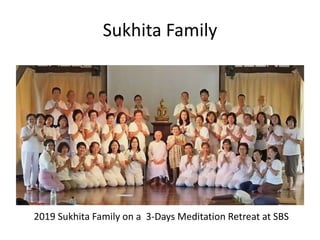
Sukhita Family
2019 Sukhita Family on a 3-Days Meditation Retreat at SBS
Malaysia Sangha Census Project
• The objective of this project is to support the sangha
members and prolong the sasana.
• The project involves the collection and compilation of the
demographic and welfare information of monastics in
Malaysia.
• The data will inform various Buddhist organizations so
that they could channel their resources for the overall
and optimal development of Buddhism in the country.
• Donation can be done in 3 steps:
• 1) Banked the amount into Maybank Account: Low Chee
Kong, Account number 107134 570321
• 2) Whatsapp the receipt to Janaka +6016 442 2065;
• 3) Inform us your donation by filling up this simple form:
https://forms.gle/vSaM5GYcY2TukD1D7 . Sadhu.
• Bugs Tan and Janaka Low.
3 Principles of life
1 Morality
Lead a simple life with high
discipline
2 Concentration
Focus on my role and deliver
my part with care and
responsibility
3 Wisdom
Life long learning process to
understand how nature works.

Applied buddhism

  • 1.
    Applied Buddhism in ourdaily lives Bugs Tan Ph.D BGF Ara Damansara, PJ 22nd September 2019
  • 2.
    • We havelistened to many Dhamma talks and read many Dhamma books for many years. • But how do we apply such Dhamma in our daily lives? • How can we use the teaching of the Buddha Dhamma to improve things at home and at work?
  • 3.
    The Buddha • Buddha= The Awaken One • Sanskrit root word “budh” – 'to wake'. • He is a man who has woken fully, as if from a deep sleep, to discover that suffering can be overcome.
  • 4.
    The Buddha Dhamma ThingsThe Buddha discovered Teaching of The Buddha Formula created by The Buddha
  • 5.
    Things The BuddhaDiscovered • He pointed to a Law running through everything that exists:- • However, true wisdom and compassion can be cultivated which will lead a person to be free from suffering • In the Buddha's words: - 'Suffering I teach and the way out of suffering.' The universal law of kamma
  • 6.
    Things The BuddhaDiscovered • The Chain of Causation / The Twelve linked Chain of Causation • This important doctrine teaches the interconnectedness of all things and in particular the law of Karma and the mechanism by which we create a world of suffering for ourselves and others, and the opposite; the way to live that reduces suffering for all, and leads to liberation. Dependent of origination
  • 7.
    The perceiving ofimpermanence, bhikkhus, developed and frequently practiced, removes all sensual passion, removes all passion for material existence, removes all passion for becoming, removes all ignorance, removes and abolishes all conceit of "I am.“ -SN 22.101
  • 8.
    Things The BuddhaDiscovered 1) Greed, 2) Hatred 3) Illusion When our action is motivated by these 3 evil roots, it’ll lead us to suffering The 3 Unwholesome Roots
  • 9.
    Things The BuddhaDiscovered The 3 Characteristic of Lives Anicca Dukkha Anatta Impermanent are all component things. They arise and cease, that is their nature. They come into being and pass away. Release from them is bliss supreme. — Mahaa-Parinibbaana Sutta (DN 16)[1]
  • 10.
    Formula Created bythe Buddha The 4 Noble Truth
  • 11.
    Formula Created bythe Buddha Noble 8 Fold Path
  • 12.
    Formula Created bythe Buddha The 5 Precepts
  • 13.
    Formula of theBuddha The steps to learn the Dhamma Step 1 Pariyatti:- The learning of the theory of Buddha Dhamma Step 2 Patipatti:- To put the theory into practice Step 3 Pativedha:- Experience and realising the truth of it.
  • 14.
    Let's examine further Step1 Pariyati: Learning the Dhamma. Buddha said, the journey starts from the time a person contacted the Dhamma. Here he goes and listens to the Dhamma from the learned ones. Or he reads it from a book. Or whatever forms he gets to acquire the teaching of the Buddha Dhamma. Just like the durian fruit, the bees help to bring pollen to the durian flower. Soon after pollination, it germinates into a durian flower. Step 2 Patipatti: Practicing the Dhamma After hearing the Dhamma, a person does his own research. He investigates further to have a better understanding of the Dhamma. He seeks from the learned ones to straighten his view until he fully understands the Dhamma. He practice what he has learned.
  • 15.
    Just like thedurian flower, with time and proper conditioning, this flower slowly turn into a durian tree. Step 3 Pativedha: Understanding the Dhamma As he practice the Dhamma in his daily life, the person begins to understand the Dhamma much better. It is only by experiencing the Buddha Dhamma can he enjoy the full benefit. Just like the durian, when it is ripe we eat it. It is only by eating the durian, one can fully enjoy the flavor and goodness of this fruit.
  • 16.
    Formula of theBuddha The steps to achieve arahanthood Step 1 Sila:- To undertake morality parctice Step 2 Samadhi:- To train in the quality of deep concentration Step 3 Paññā:- To abolish the darkness of delusion
  • 17.
    Threefold Partition EightfoldPath Method of Practice SILA VIRTUE / MORALITY Right Speech The five preceptsRight Action Right Livelihood SAMADHI MIND / CONCENTRATION Right Effort Dwelling in the four jhanas (meditation) Right Mindfulness Right Concentration PANNA WISDOM / KNOWLWDGE Right View Knowing Four Noble Truths Right Intention / thought The training that leads to the abandonment of Greed, Hatred, and Delusion
  • 18.
    Teaching of theBuddha Do Good, avoid evil and purify your mind
  • 19.
    Teaching of theBuddha The 4 Bhrama Vihara
  • 20.
    Teaching of theBuddha Meditation
  • 21.
    How do weapply it? Bro. Bugs Tan
  • 22.
    DISCLAIMER:- The views andopinions expressed in this presentation are those of the authors and it is in no circumstances trying to boast his ego
  • 23.
    Introduction to BUGSTAN PhD An Award Winning Inventor 2019
  • 24.
    A short introductionto Bugs Tan PhD • 58 years old Malaysian born in 1961 in Klang • Winner of 16 National award for inventions • Sr. Innovation Consultant at Vitrox Technologies Bhd • Chief Technology Officer at MASTEK Oil Tools Sdn Bhd KL • Holds a Ph.D in Innovation • Founder of Dr Innov8tion – Training for Technopreneur
  • 25.
    A short introductionto Bugs Tan PhD • Judge for a few Invention competitions in M’sia and abroad • FELLOW at the University Technology of Malaysia • Visiting Board Member of the Shah Alam General Hospital • Selection Committee Member for the National Academic Award (AAN) • Presented a Technical paper an intl oil conference ADIPEC 2017 in Abu Dhabi UAE
  • 26.
    A short introductionto Bugs Tan PhD • Innovation Advisor to a few universities in Malaysia • Elected into the Board of Governance for the Academia- Business Laboratory (MyLAB) at the Ministry of Education. • Author of several books on creativity, invention and innovation. • Trainer for programs that inculcate a culture of creativity in an organisation - CIPCO • Guest lecturer to various universities in Malaysia and abroad
  • 27.
    Sukhita Family 2019 SukhitaFamily on a 3-Days Meditation Retreat at SBS
  • 28.
    Malaysia Sangha CensusProject • The objective of this project is to support the sangha members and prolong the sasana. • The project involves the collection and compilation of the demographic and welfare information of monastics in Malaysia. • The data will inform various Buddhist organizations so that they could channel their resources for the overall and optimal development of Buddhism in the country. • Donation can be done in 3 steps: • 1) Banked the amount into Maybank Account: Low Chee Kong, Account number 107134 570321 • 2) Whatsapp the receipt to Janaka +6016 442 2065; • 3) Inform us your donation by filling up this simple form: https://forms.gle/vSaM5GYcY2TukD1D7 . Sadhu. • Bugs Tan and Janaka Low.
  • 29.
    3 Principles oflife 1 Morality Lead a simple life with high discipline 2 Concentration Focus on my role and deliver my part with care and responsibility 3 Wisdom Life long learning process to understand how nature works.

Editor's Notes