Applications of Analytic Geometry to
Electrostatic and Electricity Theory1
                                   ALEJANDRO DOMÍNGUEZ
         COLEGIO NACIONAL DE EDUCACIÓN PROFESIONAL TÉCNICA (CONALEP), PLANTEL “EL SOL”
                          NEZAHUALCÓYOTL, ESTADO DE MÉXICO, MÉXICO
                                      FEBRERO DE 1986


Introduction (in spanish)
Los presentes apuntes son un apoyo didáctico del curso de Matemáticas II que se ofrece a los
estudiantes de la carrera de Técnico Profesional en Electrónica Industrial, ofrecida por el Colegio
Nacional de Educación Profesional Técnica (CONALEP), y tienen un triple propósito. El primero es
presentar las ecuaciones de los lugares geométricos estudiados en geometría analítica (recta,
circunferencia, parábola, elipse e hipérbola). El segundo es presentar ejemplos de aplicaciones de la
geometría analítica a la electrostática y a la electricidad. El tercero es que los alumnos aprendan a leer
en inglés artículos técnicos.

La estructura de los apuntes es la siguiente: en cada sección se hace una introducción a un lugar
geométrico y a continuación se muestran algunos ejemplos de aplicación de las ecuaciones de
electrostática y/o electricidad, cuya expresión algebraica describe el lugar geométrico descrito.

Es importante aclarar que en estos apuntes no aparecen las interpretaciones geométrico-analíticas de
todas las ecuaciones de la electrostática y/o de la electricidad; sólo se muestran las ecuaciones
fundamentales cuyo estudio e interpretación geométrica son inmediatos en el contexto de la geometría
analítica.


The straight line
The main equation describing a straight line is given by the so-called “point-slope” equation:

                                                 y  y1  m  x  x1  .                               (1)

Here       is the slope of the straight line and defined as:


1
    This document is an improved and edited version of the hand written (original) one.


                                                           1
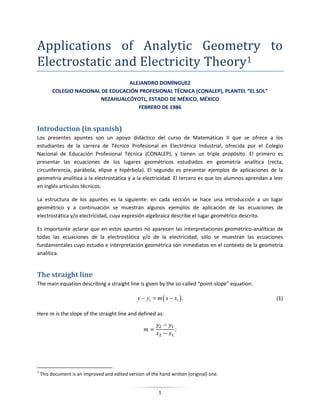
being (      ) and (       ) the coordinates of two points on the line
   (see Figure 1). Notice that is also the value of the tangent function
   of angle , being this angle measured with respect to -axis in
   counterclockwise.

   If equation (1) is expanded and rearranged, then it may be expressed
   as:

                      y  mx  b ;                               (2)

   where b  y1  mx1 . Since for                the value of ordinate is              Figure 1. A straight line.

        , it follows that number is interpreted as the point at
   which the straight line intersect -axis. Equation (2) is known as “slope-ordinate at origin” equation.

   Example 1. Ohm’s Law
   George Simon Ohm (1789-1854) formulated a law that relates three main quantities in an electric direct
   current (DC) circuit: voltage ( ), electric current ( ) and resistance ( ). In algebraic form, Ohm’s Law is
                                         expressed by

                                                     V  RI .                                                  (3)

                                              This means that voltage is proportional to , being resistance            the
                                              constant of proportionality.

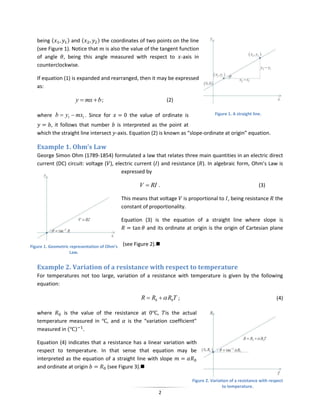
                                              Equation (3) is the equation of a straight line where slope is
                                                        and its ordinate at origin is the origin of Cartesian plane


Figure 1. Geometric representation of Ohm’s   (see Figure 2).
                    Law.


   Example 2. Variation of a resistance with respect to temperature
   For temperatures not too large, variation of a resistance with temperature is given by the following
   equation:

                                                      R  R0   R0T ;                                                  (4)

   where     is the value of the resistance at , is the actual
   temperature measured in , and is the “variation coefficient”
   measured in ( )

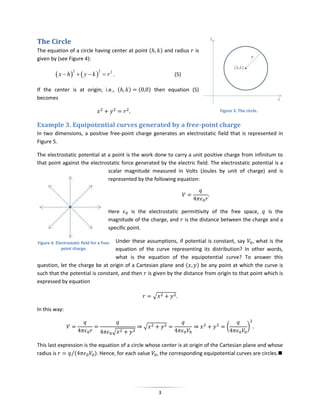
   Equation (4) indicates that a resistance has a linear variation with
   respect to temperature. In that sense that equation may be
   interpreted as the equation of a straight line with slope
   and ordinate at origin        (see Figure 3).

                                                                            Figure 2. Variation of a resistance with respect
                                                                                            to temperature.
                                                             2
The Circle
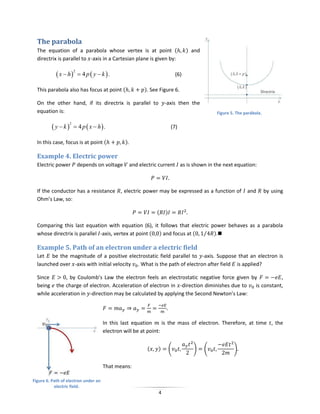
The equation of a circle having center at point (                ) and radius   is
given by (see Figure 4):

           x  h   y  k          r2 .
                   2              2
                                                                      (5)

If the center is at origin; i.e., (             )   (       ) then equation (5)
becomes

                                                                                     Figure 3. The circle.


Example 3. Equipotential curves generated by a free-point charge
In two dimensions, a positive free-point charge generates an electrostatic field that is represented in
Figure 5.

The electrostatic potential at a point is the work done to carry a unit positive charge from infinitum to
that point against the electrostatic force generated by the electric field. The electrostatic potential is a
                               scalar magnitude measured in Volts (Joules by unit of charge) and is
                               represented by the following equation:


                                        Here      is the electrostatic permittivity of the free space, is the
                                        magnitude of the charge, and is the distance between the charge and a
                                        specific point.

                                  Under these assumptions, if potential is constant, say , what is the
Figure 4. Electrostatic field for a free-
             point charge.        equation of the curve representing its distribution? In other words,
                                  what is the equation of the equipotential curve? To answer this
question, let the charge be at origin of a Cartesian plane and (    ) be any point at which the curve is
such that the potential is constant, and then is given by the distance from origin to that point which is
expressed by equation

                                                             √

In this way:

                                                        √                               (           )
                                            √

This last expression is the equation of a circle whose center is at origin of the Cartesian plane and whose
radius is      ⁄(         ). Hence, for each value , the corresponding equipotential curves are circles.


                                                                 3
The parabola
  The equation of a parabola whose vertex is at point (                            ) and
  directrix is parallel to -axis in a Cartesian plane is given by:

             x  h        4 p  y  k .
                       2
                                                                             (6)

  This parabola also has focus at point (                  ). See Figure 6.

  On the other hand, if its directrix is parallel to                 -axis then the
  equation is:                                                                                 Figure 5. The parábola.


         y k         4 p  x  h .
                   2
                                                                         (7)

  In this case, focus is at point (             ).

  Example 4. Electric power
  Electric power           depends on voltage        and electric current as is shown in the next equation:


  If the conductor has a resistance , electric power may be expressed as a function of                        and        by using
  Ohm’s Law, so:

                                                                (    )

  Comparing this last equation with equation (6), it follows that electric power behaves as a parabola
  whose directrix is parallel -axis, vertex at point ( ) and focus at ( ⁄ ).

  Example 5. Path of an electron under a electric field
  Let be the magnitude of a positive electrostatic field parallel to -axis. Suppose that an electron is
  launched over -axis with initial velocity . What is the path of electron after field is applied?

  Since       , by Coulomb’s Law the electron feels an electrostatic negative force given by           ,
  being the charge of electron. Acceleration of electron in -direction diminishes due to    is constant,
  while acceleration in -direction may be calculated by applying the Second Newton’s Law:


                                       In this last equation      is the mass of electron. Therefore, at time , the
                                       electron will be at point:


                                                            (    )       (           )     (           )


                                       That means:

Figure 6. Path of electron under an
           electric field.
                                                                 4
From the first equation it follows that        ⁄ , then substitution of this value in the second equation
gives:


This is the equation of a parabola having vertex at origin and focus at point (               ).


The ellipse
The equation of an ellipse having major axis parallel to -axis, center at point (     ), vertices at points
(       ), and maximum and minimum points at (            ) is given by (see Figure 8):

                                                      x  h         y k
                                                                2                2

                                                                                    1                            (8)
                                                          a2               b2

                                             If the ellipse has its major axis parallel to -axis, the equation
                                             is given by:

                                                      x  h         y k
                                                                2                2

                                                                                    1                            (9)
                                                          b2               a2
             Figure 7. The ellipse.           In any case, the standard equation of an ellipse may be
                                              written as:

                                           x  h         y k
                                                     2                2

                                                                          1;                                          (10)
                                             a12               a2 2

for any     and    positive real numbers, Equation (10) represents an ellipse whose major axis is parallel
to -axis if         , and an ellipse whose major axis is parallel to -axis if    .

Example 6. Electric power generated by a parallel electric circuit
Let    and     be the value of two resistances. In a similar way, let be a given constant-valued electric
current circulating around the electric circuit shown in Figure 8.

The problem consist of finding the values of electric currents and
such that the total electric power generated by the current is constant,
say .


                                                                                          Figure 8. Electric circuit.

                                                           5
On one hand the total electric power is given by equation                      ; while on the other hand, it can also
be computed by equation                     . Therefore:


                                                                                  ( √      )     ( √         )

In this way, the values of     and       such that    is constant should be on an ellipse.

That ellipse has its major axis parallel to -axis if:


                              √          √       √        √


Similarly, the ellipse has its major axis parallel to     -axis if:


                              √          √       √        √





The hyperbola
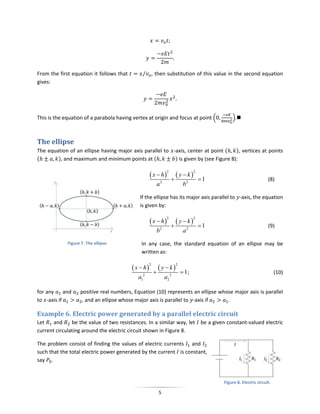
The equation of a hyperbola whose center is at point (                ) and focuses at (        )(      ) is given by (see
Figure 9):

                                                     x2 y 2
                                                            1.                                                               (11)
                                                     a 2 b2

Here                 . If          , then equation (11) becomes:

                                                     x2  y 2  a2.                                                            (12)

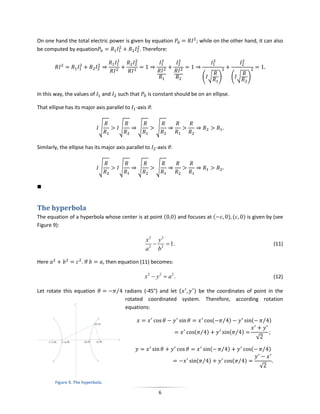
Let rotate this equation                ⁄ radians (-45°) and let ( ) be the coordinates of point in the
                                          rotated coordinated system. Therefore, according rotation
                                          equations:

                                                                                       (       ⁄ )               (       ⁄ )

                                                                              ( ⁄ )              ( ⁄ )
                                                                                                                     √

                                                                                      (    ⁄ )                   (       ⁄ )

                                                                               ( ⁄ )                 ( ⁄ )
                                                                                                                     √

        Figure 9. The hyperbola.

                                                           6
In this way, equation (12) becomes:


(        )    (         )             (       )    (       )
    √             √


Renaming     as   and       as , the last expression becomes:

  a2
y .                                                (13)
  2x

Equation (13) has a geometric representation given in Figure 10.
                                                                          Figure 10. Hyperbola after rotation.

Example 7. Variation of potential with distance

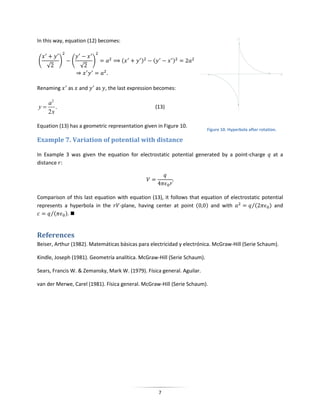
In Example 3 was given the equation for electrostatic potential generated by a point-charge                 at a
distance :


Comparison of this last equation with equation (13), it follows that equation of electrostatic potential
represents a hyperbola in the     -plane, having center at point ( ) and with             ⁄(      ) and
     ⁄(    ). 


References
Beiser, Arthur (1982). Matemáticas básicas para electricidad y electrónica. McGraw-Hill (Serie Schaum).

Kindle, Joseph (1981). Geometría analítica. McGraw-Hill (Serie Schaum).

Sears, Francis W. & Zemansky, Mark W. (1979). Física general. Aguilar.

van der Merwe, Carel (1981). Física general. McGraw-Hill (Serie Schaum).


                                                       7

Applications of analytic geometry

  • 1.
    Applications of AnalyticGeometry to Electrostatic and Electricity Theory1 ALEJANDRO DOMÍNGUEZ COLEGIO NACIONAL DE EDUCACIÓN PROFESIONAL TÉCNICA (CONALEP), PLANTEL “EL SOL” NEZAHUALCÓYOTL, ESTADO DE MÉXICO, MÉXICO FEBRERO DE 1986 Introduction (in spanish) Los presentes apuntes son un apoyo didáctico del curso de Matemáticas II que se ofrece a los estudiantes de la carrera de Técnico Profesional en Electrónica Industrial, ofrecida por el Colegio Nacional de Educación Profesional Técnica (CONALEP), y tienen un triple propósito. El primero es presentar las ecuaciones de los lugares geométricos estudiados en geometría analítica (recta, circunferencia, parábola, elipse e hipérbola). El segundo es presentar ejemplos de aplicaciones de la geometría analítica a la electrostática y a la electricidad. El tercero es que los alumnos aprendan a leer en inglés artículos técnicos. La estructura de los apuntes es la siguiente: en cada sección se hace una introducción a un lugar geométrico y a continuación se muestran algunos ejemplos de aplicación de las ecuaciones de electrostática y/o electricidad, cuya expresión algebraica describe el lugar geométrico descrito. Es importante aclarar que en estos apuntes no aparecen las interpretaciones geométrico-analíticas de todas las ecuaciones de la electrostática y/o de la electricidad; sólo se muestran las ecuaciones fundamentales cuyo estudio e interpretación geométrica son inmediatos en el contexto de la geometría analítica. The straight line The main equation describing a straight line is given by the so-called “point-slope” equation: y  y1  m  x  x1  . (1) Here is the slope of the straight line and defined as: 1 This document is an improved and edited version of the hand written (original) one. 1
  • 2.
    being ( ) and ( ) the coordinates of two points on the line (see Figure 1). Notice that is also the value of the tangent function of angle , being this angle measured with respect to -axis in counterclockwise. If equation (1) is expanded and rearranged, then it may be expressed as: y  mx  b ; (2) where b  y1  mx1 . Since for the value of ordinate is Figure 1. A straight line. , it follows that number is interpreted as the point at which the straight line intersect -axis. Equation (2) is known as “slope-ordinate at origin” equation. Example 1. Ohm’s Law George Simon Ohm (1789-1854) formulated a law that relates three main quantities in an electric direct current (DC) circuit: voltage ( ), electric current ( ) and resistance ( ). In algebraic form, Ohm’s Law is expressed by V  RI . (3) This means that voltage is proportional to , being resistance the constant of proportionality. Equation (3) is the equation of a straight line where slope is and its ordinate at origin is the origin of Cartesian plane Figure 1. Geometric representation of Ohm’s (see Figure 2). Law. Example 2. Variation of a resistance with respect to temperature For temperatures not too large, variation of a resistance with temperature is given by the following equation: R  R0   R0T ; (4) where is the value of the resistance at , is the actual temperature measured in , and is the “variation coefficient” measured in ( ) Equation (4) indicates that a resistance has a linear variation with respect to temperature. In that sense that equation may be interpreted as the equation of a straight line with slope and ordinate at origin (see Figure 3). Figure 2. Variation of a resistance with respect to temperature. 2
  • 3.
    The Circle The equationof a circle having center at point ( ) and radius is given by (see Figure 4):  x  h   y  k   r2 . 2 2 (5) If the center is at origin; i.e., ( ) ( ) then equation (5) becomes Figure 3. The circle. Example 3. Equipotential curves generated by a free-point charge In two dimensions, a positive free-point charge generates an electrostatic field that is represented in Figure 5. The electrostatic potential at a point is the work done to carry a unit positive charge from infinitum to that point against the electrostatic force generated by the electric field. The electrostatic potential is a scalar magnitude measured in Volts (Joules by unit of charge) and is represented by the following equation: Here is the electrostatic permittivity of the free space, is the magnitude of the charge, and is the distance between the charge and a specific point. Under these assumptions, if potential is constant, say , what is the Figure 4. Electrostatic field for a free- point charge. equation of the curve representing its distribution? In other words, what is the equation of the equipotential curve? To answer this question, let the charge be at origin of a Cartesian plane and ( ) be any point at which the curve is such that the potential is constant, and then is given by the distance from origin to that point which is expressed by equation √ In this way: √ ( ) √ This last expression is the equation of a circle whose center is at origin of the Cartesian plane and whose radius is ⁄( ). Hence, for each value , the corresponding equipotential curves are circles. 3
  • 4.
    The parabola The equation of a parabola whose vertex is at point ( ) and directrix is parallel to -axis in a Cartesian plane is given by:  x  h  4 p  y  k . 2 (6) This parabola also has focus at point ( ). See Figure 6. On the other hand, if its directrix is parallel to -axis then the equation is: Figure 5. The parábola. y k  4 p  x  h . 2 (7) In this case, focus is at point ( ). Example 4. Electric power Electric power depends on voltage and electric current as is shown in the next equation: If the conductor has a resistance , electric power may be expressed as a function of and by using Ohm’s Law, so: ( ) Comparing this last equation with equation (6), it follows that electric power behaves as a parabola whose directrix is parallel -axis, vertex at point ( ) and focus at ( ⁄ ). Example 5. Path of an electron under a electric field Let be the magnitude of a positive electrostatic field parallel to -axis. Suppose that an electron is launched over -axis with initial velocity . What is the path of electron after field is applied? Since , by Coulomb’s Law the electron feels an electrostatic negative force given by , being the charge of electron. Acceleration of electron in -direction diminishes due to is constant, while acceleration in -direction may be calculated by applying the Second Newton’s Law: In this last equation is the mass of electron. Therefore, at time , the electron will be at point: ( ) ( ) ( ) That means: Figure 6. Path of electron under an electric field. 4
  • 5.
    From the firstequation it follows that ⁄ , then substitution of this value in the second equation gives: This is the equation of a parabola having vertex at origin and focus at point ( ). The ellipse The equation of an ellipse having major axis parallel to -axis, center at point ( ), vertices at points ( ), and maximum and minimum points at ( ) is given by (see Figure 8):  x  h y k 2 2  1 (8) a2 b2 If the ellipse has its major axis parallel to -axis, the equation is given by:  x  h y k 2 2  1 (9) b2 a2 Figure 7. The ellipse. In any case, the standard equation of an ellipse may be written as:  x  h y k 2 2   1; (10) a12 a2 2 for any and positive real numbers, Equation (10) represents an ellipse whose major axis is parallel to -axis if , and an ellipse whose major axis is parallel to -axis if . Example 6. Electric power generated by a parallel electric circuit Let and be the value of two resistances. In a similar way, let be a given constant-valued electric current circulating around the electric circuit shown in Figure 8. The problem consist of finding the values of electric currents and such that the total electric power generated by the current is constant, say . Figure 8. Electric circuit. 5
  • 6.
    On one handthe total electric power is given by equation ; while on the other hand, it can also be computed by equation . Therefore: ( √ ) ( √ ) In this way, the values of and such that is constant should be on an ellipse. That ellipse has its major axis parallel to -axis if: √ √ √ √ Similarly, the ellipse has its major axis parallel to -axis if: √ √ √ √  The hyperbola The equation of a hyperbola whose center is at point ( ) and focuses at ( )( ) is given by (see Figure 9): x2 y 2   1. (11) a 2 b2 Here . If , then equation (11) becomes: x2  y 2  a2. (12) Let rotate this equation ⁄ radians (-45°) and let ( ) be the coordinates of point in the rotated coordinated system. Therefore, according rotation equations: ( ⁄ ) ( ⁄ ) ( ⁄ ) ( ⁄ ) √ ( ⁄ ) ( ⁄ ) ( ⁄ ) ( ⁄ ) √ Figure 9. The hyperbola. 6
  • 7.
    In this way,equation (12) becomes: ( ) ( ) ( ) ( ) √ √ Renaming as and as , the last expression becomes: a2 y . (13) 2x Equation (13) has a geometric representation given in Figure 10. Figure 10. Hyperbola after rotation. Example 7. Variation of potential with distance In Example 3 was given the equation for electrostatic potential generated by a point-charge at a distance : Comparison of this last equation with equation (13), it follows that equation of electrostatic potential represents a hyperbola in the -plane, having center at point ( ) and with ⁄( ) and ⁄( ).  References Beiser, Arthur (1982). Matemáticas básicas para electricidad y electrónica. McGraw-Hill (Serie Schaum). Kindle, Joseph (1981). Geometría analítica. McGraw-Hill (Serie Schaum). Sears, Francis W. & Zemansky, Mark W. (1979). Física general. Aguilar. van der Merwe, Carel (1981). Física general. McGraw-Hill (Serie Schaum). 7