Appendix A
Educational Leadership Goals and Learning Outcomes
Appendix A
Doctoral Program Goals and Learning Outcomes
The Doctor of Education (EdD) is designed to support the
mission of the Fischler School of Education and Human
Services. The program is designed to prepare adult learners to
fulfill their professional and personal academic goals. It
provides opportunities to enhance the core knowledge, skills
and values essential to competent and ethical practitioners and
leaders of organizations in the fields of education, human
services and related areas. The learning outcomes of the
program are focused on facilitating the transfer of theory into
practice in order to produce a new generation of local, national
and global leaders who will effect positive changes in a diverse
and multicultural society.
Program Learning Outcomes
Doctor of Education Degree (EdD) graduates will be able to:
1. Demonstrate knowledge learned in the program by applying it
to real settings. (Knowledge)
1. Conduct an independent research investigation that
contributes to the general body of knowledge in a specific field
or profession. (Research)
1. Solve diverse problems using information and skills acquired
in the program to create solutions. (Problem solving)
1. Make informed decisions based on ethical and legal
principles. (Ethics)
1. Formulate scholarly arguments supported by academic
resources. (Communication)
Educational Leadership Goals and Learning Outcomes
The primary goal of the concentration in Educational
Leadership (EDL) is to improve our K-12 schools by preparing
candidates for leadership and lifelong learning in the fields of
K-12 educational administration. The doctoral program fosters
an in-depth application of knowledge and skills, inquiry and
research, problem-solving, collaboration and communication,
professional development, and higher order thinking skills.
The graduates of the EDL concentration will be leaders in
improving schools and other learning environments; expanding
their administrative competence and modeling visionary
leadership; advocating and implementing educational
improvement using informed action research, effective
application of change theory, collaborative decision-making and
strategic planning, risk and creativity, and appropriate
evaluation; and identifying and addressing contemporary and
future educational issues in a changing world.
Goals
EDL goals are to enable candidates to:
1. Acquire practical knowledge and skills of effective
leadership at the school and district levels to improve teaching
and learning.
2. Develop abilities for research in the field of K-12
educational leadership.
3. Develop and apply technology as both an administrative
and instructional tool.
4. Broaden their professional background as it relates to the:
1. establishment and implementation of a vision;
1. assessment and improvement of the school and district
culture;
1. refinement of both internal and external communication
skills;
1. improvement of school and district operations;
1. alignment of the school and district curriculum, instructional
strategies, and assessment strategies;
1. planning and implementation of change theory;
1. improvement of school and community relations; and
1. processes of human resource management and development.
5. Prepare for K-12 leadership and administrative positions at
the school and district level.
6. Act with integrity in an ethical manner.
Educational Leadership Learning Outcomes
Graduates of the Ed.D. with a concentration in Educational
Leadership will demonstrate mastery of the following learning
outcomes as evidenced by their participation in class,
participation in problem-based projects, completion of class
assignments and class presentation, and/or field based
experiences. Graduates will be able to:
1. Implement a strategic plan that outlines actions for school
improvement and their implications. (Vision and Planning)
2. Evaluate the human resource program in terms of human
resource planning, recruitment of personnel, selection of
personnel, placement and induction of personnel, staff
development, evaluation of personnel, compensation of
personnel, and collective bargaining (if appropriate).
(Personnel)
3. Promote a positive culture within the school or district that
includes the design of comprehensive professional growth plans
for school personnel. (Culture)
4. Utilize practical applications of organizational theories to
manage the resources, budgeting process, physical plant or
plants, organizational operations, and the resources of a school
or district. (Organization, Operations, and Resources)
5. Develop and align the curriculum goals and objectives
with instructional strategies appropriate for varied teaching and
learning styles and specific student needs. (Curriculum and
Instruction)
6. Collaborate with internal and external stakeholders,
respond to their interests and needs, and mobilize resources.
(Collaboration and School in Larger Context)
Appendix B
Reflection and Vision for School Leaders – An Overview
Appendix B
Reflection and Vision for School Leaders – An Overview
Foreword
This course will help you complete the initial course for the
Doctor of Education with a concentration in Educational
Leadership (EDL). Although this syllabus is fairly prescriptive,
it is not intended that you color by the numbers. Rather it is
intended as a philosophical approach to what is expected in the
fulfillment of your doctoral studies. You are to use your own
creativity and experience to meet that philosophical
commitment. Before you begin writing, read the entire
document and discuss its contents with your peers, a group of
your colleagues, friends, family, and relatives. The result
should emerge and be informed by a cooperative effort of all
those individuals and more. You will be asked to assess your
knowledge, skills, and dispositions relative to the national
standards contained within this syllabus. While your opinion is
important, you should also indicate how others have seen you in
action. You will need to solicit the input of your work setting
colleagues and stakeholders, your family, and support your
conclusions, where feasible, with references to current research
the literature.
Organizational leadership is defined by change, and
organizational change is defined by leadership. They are
products of each other. The EDL concentration requires you to
express your understanding of leadership and change in a
personal and dynamic format. Ultimately, you will be required
to demonstrate your continuing growth as a catalyst for
educational improvement and as a master of the process of
change. This demonstration will be evidenced by three major
connected perspectives – “reflection,” “performance,” and
“vision.”
This course will also serve as a comprehensive needs
assessment for your doctoral studies, with an emphasis on the
word “comprehensive.” It is a comprehensive look at your life
and what lies ahead. Doctoral comprehensive exams normally
ask the candidate to integrate information learned from several
areas of study within some theoretical framework.
Often the examinee responds to significant issues within the
disciplines studied and uses research to support or refute
particular points of view. This is also our expectation of you
through the
Reflection and Vision for School Leaders.
To meet the developmental needs of candidates, assessment in
the EDL concentration will be engaging, action-centered, and
participatory. Through the combination of acceptable course
criteria as well as performance standards that describe the
expected quality of performance that must be met, you will
learn to examine their planning and decision-making. However,
not only do you need to know what is expected and what is
acceptable in terms of performance, you will need to be
provided with feedback that will serve as a basis for goal
setting and future performance. Essentially, specific feedback
should be viewed as a learning opportunity. To foster this
performance-based model of learning will require that you
review the feedback from the professors in the various courses.
Finally, the variety of activities you will experience during the
various courses, the field work, and your day-to-day
experiences on the job will provide a picture of you. This
combination of performances and assessments will need to
create a balance between challenge and encouragement (i.e.,
building on your strengths and moving them forward into areas
that need to be developed).
Section One – Reflection
Honest introspection. Reflection is a skill you have continued to
hone in your journey through the program and through your
practice as an educational leader. It is a difficult skill that
requires you to look at yourself as an object rather than a
subject. Reflection is not a fond remembrance of past victories.
It is not a reason to boast about your charisma and wonderful
empathy for children, parents, and colleagues. Reflection is a
learning tool. By reflecting on what you have done and why you
have done it, you are searching for the intricacies of process
and your and others’ personal involvement in process. You will
be browsing through the interplay of people, time, and events in
an effort to discern the cause and the purpose of something that
occurred or did not occur.
Reflection is a self-interrogation, stripping away each layer of
accommodation you have gained through years and years of
proving and protecting yourself. It is an examination of your
motives—about who you are, not the story you have made up
about who you are. We each are products of our experiences and
of our bias about those experiences. The perception is often
more alluring and powerful than the reality, so that the way we
see ourselves is not necessarily the way others see us. It is the
latter that we want to expose and accept.
Objectivity makes difficult demands on reflection. We must put
aside our pretension and pride and desire for public approval
and position. Thus, reflection is a very personal, intimate, and
honest act. It is best evidenced in the phrase, “Know thyself.”
Reflection is mindfulness about the past. Awareness is
mindfulness about the present.
Vision is mindfulness about the future.
The following tool can be used to guide your reflection on
action and your reflection for action. Think about some event,
an interaction, or a situation that occurred in your personal or
professional life that you feel is worth further reflection. You
might choose to examine a positive and encouraging experience,
or you might choose a more unsettling or challenging
experience.
Now consider the following series of questions to prompt your
reflective thinking about the experience. You may also wish to
write down your thoughts and later share them aloud with
another person.
First, what happened? This will serve as a description of what
took place. What did you do? What did others (i.e., students,
adults, etc.) do? What was my affect at the time? What were the
affects of others? What was going on around us? Where were
we? When during the day did it occur? Was there anything
unusual happening? Identifying all aspects of what took place
will provided the basis for your reflection.
Second, why did the event, interaction, or situation take place?
This will require your interpretation and analysis of the events.
Why do you think things happened the way they did? Why did
you choose to act the way you did? What can you surmise about
why the other person or persons acted they way they did? What
was going on for each participant in the situation? What were
you thinking and feeling? Were you thinking at the time? How
might your thinking have affected your choice of behavior?
How might the context have influenced the experience? Was
there something about the activities? Was there something about
the timing or location of events? Were there other potential
contributing factors? Something about what was said or done by
others that triggered your response? Were there past
experiences, either yours or those of others, that contributed to
the response? What are your hunches about why things
happened in the way they did? Your analysis of why something
occurred is crucial should you find yourself in a similar
situation in the future.
Third, so what? This will require you to think of the bigger
issues that you need to deal with. Do the overall meanings of
the events warrant further consideration? Why did this seem
like a significant event to reflect on? What have I learned from
the reflection on this event? How could I improve my behavior?
How might this change my future thinking, behavior, or
interactions? Many things that occur in our professional and
personal lives take a considerable amount of time. In the
scheme of things, you really need to consider if a particular
situation is worth the expenditure of time.
Finally, now what? Based upon your analysis, what are the
implications for your actions in the future? Are there other
people you should actively include in reflecting on this event?
If so, who and what would you interact about? Next time a
situation like this presents itself, what do you want to remember
to think about? How would you want to behave? How could you
set up conditions to increase the likelihood of productive
interactions and learning? This entire process will assist you to
make changes in your behavior where you feel they are
necessary.
Your leadership activity. The EDL concentration respects your
life as an educational leader. Leadership is not developed in
isolation. It needs activity. Look back on at least two years,
longer if you wish, and recall the defining times in your work
world, times that helped define you as a person, as a teacher, as
a learner, as a leader. Perhaps the most meaningful experiences
were relationships, both good and bad. How have your
relationships and reactions with your colleagues shaped you—
made you realize something about yourself.
Were there particular comments from students or from
supervisors that were especially significant?
Do you have a mentor or mentors? What lessons have you
learned from and about them?
Describe why these individuals have made a lasting impression
on you. How do you communicate with and use them? Will you
continue to seek their advice? How? Have you changed
positions or do you contemplate doing so? Why and when?
Describe whether you rely on your mentor or mentors for this
kind of decision.
You should consider the following questions to reflect upon
prior to describing your thoughts and feelings with regard to
your educational leadership activities:
that helped define you as a learner, teacher, and leader)?
and learning, and leadership?
tly upheld in your leadership
decision making?
action?
decision making in terms that refer to theory? Why do you favor
these theories and reject others?
day-to-day work? If yes, how?
colleagues, supervisors, and other administrators that was
particularly significant?
why not?
satisfaction equation?
How do you rate yourself on confronting inadequacies in
others? Many leaders find this their most daunting task. Some
find it just as difficult to give praise when others perform well.
Yet, performance issues that go unaddressed have a habit of
multiplying and setting a culture that condones mediocrity. Do
you consider yourself guilty, or is this an area in which you feel
confident and accomplished? Are you happy in your leadership
role? What things are most satisfying and what are the least?
What are you doing to increase the satisfaction side of the
equation?
You should consider the following questions to reflect upon
prior to describing your thoughts and feelings with regard to
your personal activities:
life?
-to-day
personal life?
making?
you changed the way you address dilemmas in your
personal life? If yes, how?
Reflection summary. Try to summarize your reflections
organized by several dominant themes that you have found to be
important to your values and future actions. One of the primary
goals in the EDL concentration is for you to be an informed
practitioner. Instructional leadership, an often used and abused
term, should assume familiarity with a knowledge base about
teaching and learning. Whereas “lead teacher” refers to some
kind of clinical teaching master, instructional leader implies an
understanding and use of learning and instructional theory.
Instructional leaders respond not only to the how and what of
education, but also to the why. Instructional leadership is
arguably the prime responsibility of educational leadership.
You should consider the following questions to reflect upon
prior to describing your thoughts and feelings with regard to
your overall reflections:
responsibilities (or lack of it)? How do you know?
lack of it)? How do you know?
al questions come to mind?
Section Two – Leadership Standards
Meeting the leadership standards. Demonstration of the
knowledge, skills, competencies, and dispositions is at the heart
of educational leadership. To foster the development of
educational leaders at all levels of education, sets of standards
have been developed by a number of constituency organizations
(i.e., American Association of School Administrators,
Association of Supervision and Curriculum Development,
Interstate School Leaders Licensure Consortium, National
Association of Elementary School Principals, National
Association of Secondary School Principals, National Board for
Professional Teaching Standards, National Policy Board for
Educational Administration, etc.). Based upon these standards,
the EDL concentration has designed curriculum that is
integrated and problem-based to promote an understanding of
the connectedness of the various knowledge and skill areas in
educational leadership. The standards necessarily segment the
total knowledge and skill base, but these separations are only
for the purpose of providing manageable descriptions of
essential content and practice within the EDL delivery system.
The application of knowledge and the development, integration,
and practice of professional skills are important components of
the EDL concentration. Therefore, the EDL concentration has
planned and developed a number of field-based components to
bridge the experiences between the various courses and the
workplace. Because life in schools is not compartmentalized as
are content areas for the convenience of instruction, teaching
for application of knowledge requires structures that provide
transitions from isolated, specialized concepts toward more
realistic and interconnected patterns.
There are three dimensions to the teaching and learning process
within the EDL concentration (a) awareness, defined as
acquiring concepts, information definitions, and procedures; (b)
comprehension, defined as interpreting knowledge to school
environments, integrating concepts with practice, and using
knowledge and skills in context; and (c) application, defined as
applying knowledge and skills to specific problems of practice.
The instructional design employs a variety of adult learning
strategies in the EDL concentration. Addressing authentic
problems generated by you as a basis for instruction and
requiring you to reflect on your experiences is a hallmark of the
EDL concentration.
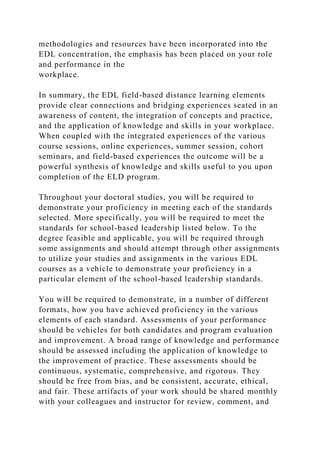
The standards are stated as results because program assessment
should be based on results criteria. The EDL concentration
goals and objectives focus on knowledge, skills, and attributes
required to lead and to manage an educational enterprise
centered on teaching and learning. While an array of
methodologies and resources have been incorporated into the
EDL concentration, the emphasis has been placed on your role
and performance in the
workplace.
In summary, the EDL field-based distance learning elements
provide clear connections and bridging experiences seated in an
awareness of content, the integration of concepts and practice,
and the application of knowledge and skills in your workplace.
When coupled with the integrated experiences of the various
course sessions, online experiences, summer session, cohort
seminars, and field-based experiences the outcome will be a
powerful synthesis of knowledge and skills useful to you upon
completion of the ELD program.
Throughout your doctoral studies, you will be required to
demonstrate your proficiency in meeting each of the standards
selected. More specifically, you will be required to meet the
standards for school-based leadership listed below. To the
degree feasible and applicable, you will be required through
some assignments and should attempt through other assignments
to utilize your studies and assignments in the various EDL
courses as a vehicle to demonstrate your proficiency in a
particular element of the school-based leadership standards.
You will be required to demonstrate, in a number of different
formats, how you have achieved proficiency in the various
elements of each standard. Assessments of your performance
should be vehicles for both candidates and program evaluation
and improvement. A broad range of knowledge and performance
should be assessed including the application of knowledge to
the improvement of practice. These assessments should be
continuous, systematic, comprehensive, and rigorous. They
should be free from bias, and be consistent, accurate, ethical,
and fair. These artifacts of your work should be shared monthly
with your colleagues and instructor for review, comment, and
revisions where necessary.
School-Based Administrative Leadership Standards
You should draw upon workplace records (i.e., minutes of
meetings, communications, policies, news events, projects,
etc.), public documents, articles published in professional
journals, videotaped situations, samples of work, analytic work,
essays, grading rubrics, problem-solving activities, action
research, projects, simulations, case studies, and so forth to
indicate that you have achieved proficiency in two particular
elements of each standard. After each standard, examples of
performance activities will be suggested. It should be noted that
the examples are merely that—examples. You should feel free
to select varied means and modes which will best exemplify
how you have met a particular standard. Examples of
performance activities you might engage in that might be
applicable for multiple standards; however, you may utilize any
of the following activities once:
ELCC Standard 1.0 – Developing and Implementing a School-
Level Vision
A building-level education leader applies knowledge that
promotes the success of every student by collaboratively
facilitating the development, articulation, implementation, and
stewardship of a shared school vision of learning through the
collection and use of data to identify school goals, assess
organizational effectiveness, and implement school plans to
achieve school goals; promotion of continual and sustainable
school improvement; and evaluation of school progress and
revision of school plans supported by school-based
stakeholders.
Research Support for ELCC Standard 1.0. Standard 1 confirms
that a building level education leader must have the knowledge
to promote the success of every student through understanding
principles for developing, articulating, implementing, and
stewarding a school vision of learning. This includes knowledge
of the importance of shared school vision, mission, and goals
for student success that is documented in the effective schools
literature and school improvement literature. It includes the
knowledge that when vision, mission, and goals are widely
shared, student achievement usually increases.
The importance of the knowledge presented in evidence
supporting Standard 1 was
recognized in the reviews of scholarship informing the
development of the
Interstate School
Leaders Licensure Consortium (ISLLC) 2008 Policy Standards
that highlighted the importance of knowledge facilitating the
development, articulation, implementation, and stewardship of a
vision of learning that is shared and supported by all
stakeholders.
Formation of the
ISLLC 2008 Standards was also based on considering
the importance of knowing the theoretical foundations for
leadership practice. Some reviews of scholarship highlighted
the importance of knowing how to collaboratively develop and
implement a shared vision and mission. The importance of
knowing how to use evidence in decision making was
highlighted in reports informing the formation of the
ISLLC 2008 Standards.
Other reports confirmed the importance of knowing how to
create and implement plans to achieve goals.
ELCC 1.1: Candidates understand and can collaboratively
develop, articulate, implement, and steward a shared vision of
learning for a school.
Content Knowledge. Candidates provide evidence of knowledge
of:
1.1a Collaborative school visioning.
1.1b Theories relevant to building, articulating, implementing,
and stewarding a school vision.
1.1c Methods for involving school stakeholders in the visioning
process.
Professional Leadership Skills. Candidates demonstrate skills
required to:
1.1a Design and support a collaborative process for developing
and implementing a school vision.
1.1b Articulate a school vision of learning characterized by a
respect for students and their families and community
partnerships.
1.1c Develop a comprehensive plan for communicating the
school vision to appropriate school constituencies.
1.1d Formulate plans to steward school vision statements.
ELCC 1.2: Candidates understand and can collect and use data
to identify school goals, assess organizational effectiveness,
and implement plans to achieve school goals.
Content Knowledge. Candidates provide evidence of knowledge
of:
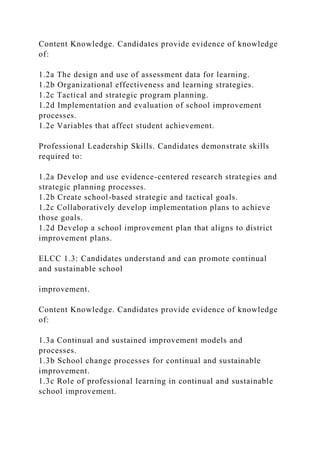
1.2a The design and use of assessment data for learning.
1.2b Organizational effectiveness and learning strategies.
1.2c Tactical and strategic program planning.
1.2d Implementation and evaluation of school improvement
processes.
1.2e Variables that affect student achievement.
Professional Leadership Skills. Candidates demonstrate skills
required to:
1.2a Develop and use evidence-centered research strategies and
strategic planning processes.
1.2b Create school-based strategic and tactical goals.
1.2c Collaboratively develop implementation plans to achieve
those goals.
1.2d Develop a school improvement plan that aligns to district
improvement plans.
ELCC 1.3: Candidates understand and can promote continual
and sustainable school
improvement.
Content Knowledge. Candidates provide evidence of knowledge
of:
1.3a Continual and sustained improvement models and
processes.
1.3b School change processes for continual and sustainable
improvement.
1.3c Role of professional learning in continual and sustainable
school improvement.
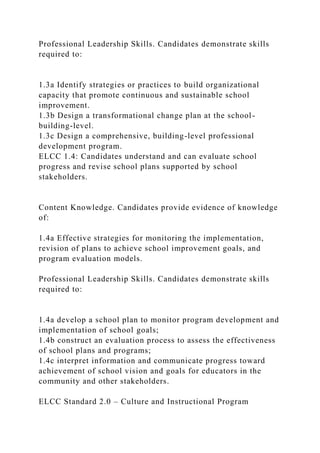
Professional Leadership Skills. Candidates demonstrate skills
required to:
1.3a Identify strategies or practices to build organizational
capacity that promote continuous and sustainable school
improvement.
1.3b Design a transformational change plan at the school-
building-level.
1.3c Design a comprehensive, building-level professional
development program.
ELCC 1.4: Candidates understand and can evaluate school
progress and revise school plans supported by school
stakeholders.
Content Knowledge. Candidates provide evidence of knowledge
of:
1.4a Effective strategies for monitoring the implementation,
revision of plans to achieve school improvement goals, and
program evaluation models.
Professional Leadership Skills. Candidates demonstrate skills
required to:
1.4a develop a school plan to monitor program development and
implementation of school goals;
1.4b construct an evaluation process to assess the effectiveness
of school plans and programs;
1.4c interpret information and communicate progress toward
achievement of school vision and goals for educators in the
community and other stakeholders.
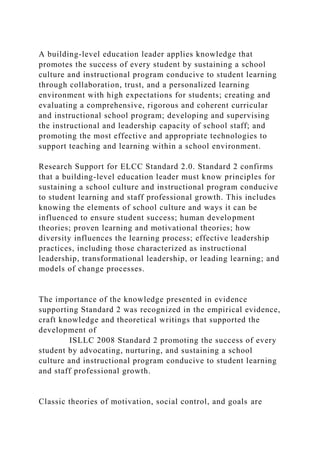
ELCC Standard 2.0 – Culture and Instructional Program
A building-level education leader applies knowledge that
promotes the success of every student by sustaining a school
culture and instructional program conducive to student learning
through collaboration, trust, and a personalized learning
environment with high expectations for students; creating and
evaluating a comprehensive, rigorous and coherent curricular
and instructional school program; developing and supervising
the instructional and leadership capacity of school staff; and
promoting the most effective and appropriate technologies to
support teaching and learning within a school environment.
Research Support for ELCC Standard 2.0. Standard 2 confirms
that a building-level education leader must know principles for
sustaining a school culture and instructional program conducive
to student learning and staff professional growth. This includes
knowing the elements of school culture and ways it can be
influenced to ensure student success; human development
theories; proven learning and motivational theories; how
diversity influences the learning process; effective leadership
practices, including those characterized as instructional
leadership, transformational leadership, or leading learning; and
models of change processes.
The importance of the knowledge presented in evidence
supporting Standard 2 was recognized in the empirical evidence,
craft knowledge and theoretical writings that supported the
development of
ISLLC 2008 Standard 2 promoting the success of every
student by advocating, nurturing, and sustaining a school
culture and instructional program conducive to student learning
and staff professional growth.
Classic theories of motivation, social control, and goals are
foundational sources of knowledge for education leaders
seeking to nurture a culture of trust and to motivate faculty and
students. Theories of human development and evidence found in
case studies of how improvements in teaching and learning can
be achieved confirm that both are essential to effective school
leadership. A review of literature on learning-centered
leadership concluded that instructionally focused leadership
paired with leadership processes are required for high
performing schools.
Earlier reviews found strong evidence that knowledge of
leadership approaches to developing school culture and climate
is critically important. Evidence of the importance of applied
knowledge of how to create a culture of trust, learning and high
expectations was found in scholarship on the effect that leaders
have on building learning communities.
Knowledge of the nature and practices of distributive leadership
was identified as essential in a number of scholarly works
consulted. Other reviews highlighted the importance of knowing
curriculum planning and how to develop motivating student
learning environments.
Infusing technology into leadership practices has become a
recognized domain of practical knowledge essential to effective
instructional leadership.
ELCC 2.1: Candidates understand and can sustain a school
culture and instructional program conducive to student learning
through collaboration, trust, and a personalized learning
environment with high expectations for students.
Content Knowledge. Candidates provide evidence of knowledge
of:
2.1a theories on human development behavior, personalized
learning environment, and motivation.
2.1b school culture and ways it can be influenced to ensure
student success.
Professional Leadership Skills. Candidates demonstrate skills
required to:
2.1a collaborate with others to accomplish school improvement
goals.
2.1b incorporate cultural competence in development of
programs, curriculum, and instructional practices.
2.1c monitor school programs and activities to ensure
personalized learning opportunities.
2.1d recognize, celebrate, and incorporate diversity in
programs, curriculum, and instructional practices.
2.1e facilitate the use of appropriate content-based learning
materials and learning strategies.
2.1f promote trust, equity, fairness, and respect among students,
parents, and school staff.
ELCC 2.2: Candidates understand and can create and evaluate a
comprehensive, rigorous,
and coherent curricular and instructional school program.
Content Knowledge. Candidates provide evidence of knowledge
of:
2.2 Curriculum development and instructional delivery theories.
2.2 Measures of teacher performance.
2.2 Multiple methods of evaluation, accountability systems,
data collection, and analysis of evidence.
2.2 School technology and information systems to support and
monitor student learning.
Professional Leadership Skills. Candidates demonstrate skills
required to:
2.2 Collaborate with faculty to plan, implement, and evaluate a
coordinated, aligned, and articulated curriculum.
2.2 Use evidence-centered research in making curricular and
instructional decisions.
2.2 Interpret information and communicate progress toward
achievement.
2.2 Design evaluation systems and make school plans based on
multiple measures of teacher performance and student
outcomes, and provide feedback based on evidence.
ELCC 2.3: Candidates understand and can develop and
supervise the instructional and leadership capacity of school
staff.
Content Knowledge. Candidates provide evidence of knowledge
of:
2.3a High-quality professional development for school staff and
leaders.
2.3b Instructional leadership practices.
2.3c Leadership theory, change processes, and evaluation.
2.3d Standards for high-quality teacher, principal, and district
practice.
Professional Leadership Skills. Candidates demonstrate skills
required to:
2.3a Work collaboratively with school staff to improve teaching
and learning.
2.3b Design the use of differentiated instructional strategies,
curriculum materials, and technologies to maximize high-
quality instruction.
2.3c Design professional growth plans to increase the capacity
of school staff and leaders that reflect national professional
development standards.
ELCC 2.4: Candidates understand and can promote the most
effective and appropriate technologies to support teaching and
learning in a school environment.
Content Knowledge. Candidates provide evidence of knowledge
of:
2.4a Technology and its uses for instruction within the school.
2.4b Infrastructures for the ongoing support, review, and
planning of instructional technology.
Professional Leadership Skills. Candidates demonstrate skills
required to:
2.4a Use technologies for improved classroom instruction,
student achievement, and continuous school improvement.
2.4b Monitor instructional practices within the school and
provide assistance to teachers.
2.4c Use technology and performance management systems to
monitor, analyze, and evaluate school assessment data results
for accountability reporting.
ELCC Standard 3.0 – Management and Organization
A building-level education leader applies knowledge that
promotes the success of every student by ensuring the
management of the school organization, operation, and
resources through monitoring and evaluating the school
management and operational systems; efficiently using human,
fiscal, and technological resources in a school environment;
promoting and protecting the welfare and safety of school
students and staff; developing school capacity for distributed
leadership; and ensuring that teacher and organizational time is
focused to support high-quality instruction and student learning.
Research Support for ELCC Standard 3.0. Standard 3 confirms
that a building-level education leader must have knowledge of
best practices regarding management of a school organization,
operations, and resources for a safe, efficient, and effective
learning environment. This includes knowledge of effective
management and effective leadership that are associated with
improved school conditions and subsequent school outcomes. It
also includes knowledge of human resource issues such as
educator work redesign; educator recruitment and selection;
educator induction, mentoring, and professional development;
educator appraisal, supervision, and evaluation; and educator
compensation. The importance of the knowledge presented in
evidence supporting Standard 3 was recognized in research
informing the formation of the
ISLLC 2008 Standards which also found an
understanding distributed leadership to be essential. More
recently, researchers have found in their investigation of links
to student achievement that distribution of leadership to include
teachers, parents, and district staff is needed in order to
improve student achievement.
ELCC 3.1: Candidates understand and can monitor and evaluate
school management and operational systems.
Content Knowledge. Candidates provide evidence of knowledge
of:
3.1a School management of organizational, operational, and
legal resources.
3.1b School management of marketing and public relations
functions.
Professional Leadership Skills. Candidates demonstrate skills
required to:
3.1a Analyze school processes and operations to identify and
prioritize strategic and tactical challenges for the school.
3.1b Develop school operational policies and procedures.
3.1c Develop plans to implement and manage long-range plans
for the school.
ELCC 3.2: Candidates understand and can efficiently use
human, fiscal, and technological resources to manage school
operations.
Content Knowledge. Candidates provide evidence of knowledge
of:
3.2a Methods and procedures for managing school resources,
including the strategic management of human capital, school
operations, and school facilities.
EDD 9462 – Reflection and Vision for School Leaders Page 58
of 110 May 2015
3.2b Alignment of resources to building priorities and
forecasting resource requirements for the school.
3.2c Technology and management systems.
Professional Leadership Skills. Candidates demonstrate skills
required to:
3.2a Develop multi-year fiscal plans and annual budgets aligned
to the school’s priorities and goals.
3.2b Analyze a school’s budget and financial status.
3.2c Develop facility and space utilization plans for a school.
3.2d Project long-term resource needs of a school.
3.2e Use technology to manage school operational systems.
ELCC 3.3: Candidates understand and can promote school-based
policies and procedures that protect the welfare and safety of
students and staff within the school.
Content Knowledge. Candidates provide evidence of knowledge
of:
3.3a School strategies supporting safe and secure learning
environments including prevention, crisis management, and
public relations;
3.3b School strategies supporting student development of self-
management, civic literacy, and positive leadership skills;
3.3c School-based discipline management policies and plans.
Professional Leadership Skills. Candidates demonstrate skills
required to:
3.3a Develop a comprehensive plan for providing school staff,
students, and visitors with a safe and secure school building
environment.
3.3b Plan an aligned building discipline management policies
and plan.
3.3c Evaluate and implement discipline management plans.
ELCC 3.4: Candidates understand and can develop school
capacity for distributed leadership.
Content Knowledge. Candidates provide evidence of knowledge
of:
3.4a The meaning of distributed leadership in a school
environment and how to create and sustain it.
Professional Leadership Skills. Candidates demonstrate skills
required to:
3.4a Identify leadership capabilities of staff.
3.4b Model distributed leadership skills.
3.4c Involve school staff in decision making processes.
ELCC 3.5: Candidates understand and can ensure teacher and
organizational time focuses on supporting high-quality school
instruction and student learning.
Content Knowledge. Candidates provide evidence of knowledge
of:
3.5 Supervision strategies that ensure that teachers maximize
time spent on high quality instruction and student learning.
3.5 Management theories on effective school time, priorities,
and schedules.
Professional Leadership Skills. Candidates demonstrate skills
required to:
3.5 Develop school policies that protect time and schedules to
maximize teacher instructional time and student learning.
3.5 Develop a school master schedule.
ELCC Standard 4.0 – Collaborating with Faculty and
Community Members
A building-level education leader applies knowledge that
promotes the success of every student by collaborating with
faculty and community members, responding to diverse
community interests and needs, and mobilizing community
resources on behalf of the school by collecting and analyzing
information pertinent to improvement of the school’s
educational environment; promoting an understanding,
appreciation, and use of the diverse cultural, social, and
intellectual resources within the school community; building
and sustaining positive school relationships with families and
caregivers; and cultivating productive school relationships with
community partners.
Research Support for ELCC Standard 4.0. Standard 4 confirms
that a building-level education leader must know strategies for
collaborating with faculty and community members; diverse
community interests and needs; and best practices for
mobilizing community resources. This includes knowing how to
collect and analyze information pertinent to the school
educational environment, and understanding the needs of
students, parents, and caregivers in order to develop
collaboration strategies. The importance of the knowledge
presented in the evidence supporting
ISLLC 2008 Standard 4 was recognized in research
showing that education leaders require such knowledge when
collaborating with faculty and community members and when
responding to diverse community interests and needs and
mobilizing community support used to support
ISLLC 2008 Standard 4. Reports on practices using
multiple types of evidence to inform decision making and
highlights the importance of knowledge of strategies for
evidence centered decision making.
ELCC 4.1: Candidates understand and can collaborate with
faculty and community members by collecting and analyzing
information pertinent to the improvement of the school’s
educational environment.
Content Knowledge. Candidates provide evidence of knowledge
of:
4.1a Collaboration and communication techniques to improve
the school’s educational environment.
4.1b Information pertinent to the school’s educational
environment.
Professional Leadership Skills. Candidates demonstrate skills
required to:
4.1a Use collaboration strategies to collect, analyze, and
interpret school, student, faculty, and community information.
4.1b Communicate information about the school within the
community.
ELCC 4.2: Candidates understand and can mobilize community
resources by promoting an understanding, appreciation, and use
of diverse cultural, social, and intellectual resources within the
school community.
Content Knowledge. Candidates provide evidence of knowledge
of:
4.2a Identify and mobilize effective community resources.
4.2b School-based cultural competence.
4.2c Diverse cultural, social, and intellectual community
resources.
Professional Leadership Skills. Candidates demonstrate skills
required to:
4.2a Identify and use diverse community resources to improve
school programs.
ELCC 4.3: Candidates understand and can respond to
community interests and needs by building and sustaining
positive school relationships with families and caregivers.
Content Knowledge. Candidates provide evidence of knowledge
of:
4.3a The needs of students, parents or caregivers.
4.3b School organizational culture that promotes open
communication with families and caregivers.
4.3c School strategies for effective oral and written
communication with families and caregivers.
4.3d Approaches to collaboration with families and caregivers.
Professional Leadership Skills. Candidates demonstrate skills
required to:
4.3a Conduct needs assessments of families and caregivers.
4.3b Develop collaboration strategies for effective relationships
with families and caregivers.
4.3c Involve families and caregivers in the decision-making
processes at the school.
ELCC 4.4: Candidates understand and can respond to
community interests and needs by building and sustaining
productive school relationships with community partners.
Content Knowledge. Candidates provide evidence of knowledge
of:
4.4a The needs of school community partners.
4.4b School organizational culture that promotes open
communication with community partners.
4.4c School strategies for effective oral and written
communication with community partners.
4.4d Collaboration methods to develop and sustain productive
relationships with community partners.
Professional Leadership Skills. Candidates demonstrate skills
required to:
4.4a Conduct needs assessment of community partners.
4.4b Develop effective relationships with a variety of
community partners.
4.4c Involve community partners in the decision-making
processes at the school.
ELCC Standard 5.0 – Ethics
A building-level education leader applies knowledge that
promotes the success of every student by acting with integrity,
fairness, and in an ethical manner to ensure a school system of
accountability for every student’s academic and social success
by modeling school principles of self-awareness, reflective
practice, transparency, and ethical behavior as related to their
roles within the school; safeguarding the values of democracy,
equity, and diversity within the school; evaluating the potential
moral and legal consequences of decision making in the school;
and promoting social justice within the school to ensure that
individual student needs inform all aspects of schooling.
Research Support for ELCC Standard 5.0. Standard 5 confirms
that a building-level education leader must know how to act
with integrity, fairness, and engage in ethical practice. This
includes understanding democratic values, equity, and diversity;
knowing about current ethical and moral issues facing
education, government, and business; and understanding the
relationship between social justice, school culture, and student
achievement.
The importance of the knowledge presented in evidence
supporting Standard 5 was recognized in research on practices
that promote social justice identified as important in the
ISLLC 2008 Standards. Support for the importance of
this knowledge was informed by scholarship on practices of
inclusive leadership, and leadership for diversity. Observations
by education experts affirm the central role that knowledge of
reflective practices has for education leaders if they are to
model principles of self-awareness and ethical behavior. A
number of theoretical and practice focused commentaries have
noted the critical need for education leaders to have knowledge
of the moral and legal consequences of decision making.
ELCC 5.1: Candidates understand and can act with integrity and
fairness to ensure a school system of accountability for every
student’s academic and social success.
Content Knowledge. Candidates provide evidence of knowledge
of:
5.1 Practices demonstrating principles of integrity and fairness.
5.1 Federal, state, and local legal and policy guidelines that
creates operational definitions of accountability, equity, and
social justice.
Professional Leadership Skills. Candidates demonstrate skills
required to:
5.1 Act with integrity and fairness in supporting school policies
and staff practices that ensure every students’ academic and
social success.
5.1 Create an infrastructure that helps to monitor and ensure
equitable practices.
ELCC 5.2: Candidates understand and can model principles of
self-awareness, reflective practice, transparency, and ethical
behavior as related to their roles within the school.
Content Knowledge. Candidates provide evidence of knowledge
of:
5.2 The basic principles of ethical behavior established by legal
and professional organizations.
5.2 The relationship between ethical behavior, school culture,
and student achievement.
5.2 The effect of ethical behavior on one’s own leadership.
Professional Leadership Skills. Candidates demonstrate skills
required to:
5.2 Formulate a school-level leadership platform grounded in
ethical standards and practices.
5.2 Analyze leadership decisions in terms of established ethical
practices.
ELCC 5.3: Candidates understand and can safeguard the values
of democracy, equity, and diversity within the school.
Content Knowledge. Candidates provide evidence of knowledge
of:
5.3a Democratic values, equity, and diversity.
Professional Leadership Skills. Candidates demonstrate skills
required to:
5.3a Develop, implement, and evaluate school policies and
procedures that support democratic values, equity, and diversity
issues.
5.3b Develop appropriate communication skills to advocate for
democracy, equity, and diversity.
ELCC 5.4: Candidates understand and can evaluate the potential
moral and legal consequences of decision making in the school.
Content Knowledge. Candidates provide evidence of knowledge
of:
5.4a Moral and legal consequences of decision making in
schools.
5.4b Strategies to prevent difficulties related to moral and legal
issues.
Professional Leadership Skills. Candidates demonstrate skills
required to:
5.4a Formulate sound school strategies to educational dilemmas.
5.4b Evaluate school strategies to prevent difficulties related to
moral and legal issues.
ELCC 5.5: Candidates understand and can promote social
justice within the school to ensure that individual student needs
inform all aspects of schooling.
Content Knowledge. Candidates provide evidence of knowledge
of:
5.5a The relationship between social justice, school culture, and
student achievement.
5.5b Theories of efficacy.
Professional Leadership Skills. Candidates demonstrate skills
required to:
5.5a Review and critique school policies, programs, and
practices to ensure that student needs inform all aspects of
schooling, including social justice, equity, confidentiality,
acceptance, and respect between and among students and faculty
within the school.
5.5b Develop the resiliency to uphold core values and persist in
the face of adversity.
ELCC Standard 6.0 – The School and the Larger Community
A building-level education leader applies knowledge that
promotes the success of every student by understanding,
responding to, and influencing the larger political, social,
economic, legal, and cultural context through advocating for
school students, families, and caregivers; acting to influence
local, district, state, and national decisions affecting student
learning in a school environment; and anticipating and assessing
emerging trends and initiatives in order to adapt school-based
leadership strategies.
Research Support for ELCC Standard 6.0. Standard 6 confirms
that a building-level education leader must know how to
respond to and influence the political, social, economic, legal,
and cultural context within a school and district. This includes
knowing policies, laws, and regulations enacted by state, local
and federal authorities; knowing how to improve the social
opportunities of students, particularly in contexts where issues
of student marginalization demand proactive leadership; and
understanding how culturally responsive educational leadership
can positively influence academic achievement and student
engagement. The widespread recognition in the practice and
policy community that education leaders must be prepared to
understand, respond to, and influence the political, social,
economic, legal and cultural context of education provided an
important impetus for the formation of this domain of the
ISLLC 2008 Standards. A recognition of the importance
of mindful practices and studying how people solve difficult
problems influenced the formation of the
ISLLC 2008 standards.
ELCC 6.1: Candidates understand and can advocate for school
students, families, and
caregivers.
Content Knowledge. Candidates provide evidence of knowledge
of:
6.1a Policies, laws, and regulations enacted by state, local, and
federal authorities that affect schools.
6.1b The effect that poverty, disadvantages, and resources have
on families, caregivers, communities, students, and learning.
Professional Leadership Skills. Candidates demonstrate skills
required to:
6.1a Analyze how law and policy is applied consistently, fairly
and ethically within the school.
6.1b Advocate based on an analysis of the complex causes of
poverty and other disadvantages.
6.1c Serve as a respectful spokesperson for students and
families within the school.
ELCC 6.2: Candidates understand and can act to influence local,
district, state, and national decisions affecting student learning
in a school environment.
Content Knowledge. Candidates provide evidence of knowledge
of:
6.2a The larger political, social, economic, legal, and cultural
context.
6.2b Ways that power and political skills can influence local,
state, or federal decisions.
Professional Leadership Skills. Candidates demonstrate skills
required to:
6.2a Advocate for school policies and programs that promote
equitable learning opportunities and student success.
6.2b Communicate policies, laws, regulations, and procedures to
appropriate school stakeholders.
ELCC 6.3: Candidates understand and can anticipate and assess
emerging trends and initiatives in order to adapt school-based
leadership strategies.
Content Knowledge. Candidates provide evidence of knowledge
of:
6.3 Future issues and trends that can affect schools (e.g.,
entrepreneurial approaches).
6.3 Contemporary and emerging leadership strategies to address
trends.
Professional Leadership Skills. Candidates demonstrate skills
required to:
6.3 Identify and anticipate emerging trends and issues likely to
affect the school.
6.3 Adapt leadership strategies and practice to address emerging
school issues.
Performance summary. Your knowledge and understanding of
the various elements of each standard will serve as a basis for
your future growth and development as a school-level leader.
You will be required to present
Section Three – Vision
Introduction
The previous reflection and performance summary will bring
you face-to-face with your vision. What are you going to do
about what you have learned through your experiences and your
reflections about them? Vision is a characteristic that most
people ascribe to leadership, and yet it is a very elusive notion.
As you develop the expression of your vision in this portfolio,
you may want to respond to some questions we pose as
organizers. Some have described vision as the ability to look
around corners, describing what will be in a world yet to be
defined, looking reflectively in a time warp, defining an
educational singularity, finding the silver bullet of education,
and so forth. You might start by describing to the reader what
the word “vision” means to you.
You should consider the following questions prior to attempting
to describe your thoughts and feelings with regard to your
vision:
Major events. What are the major events and activities in your
life that are deeply meaningful to you?
Common themes. Are there common themes to these events?
How might these point you toward a deeper awareness of your
purpose in life?
Reactive and creative orientation
. Do you notice yourself living in a reactive or
creative orientation most of the time at work and at home?
When you slip into a reactive orientation (i.e., one that is not
necessarily called for by the situation), what does it take for
you to shift into a creative orientation? When do you most
typically find yourself in a creative orientation? When you are
in a creative orientation, what are your thoughts, feelings, and
actions like?
Purpose. Given the common themes you have identified above,
try to answer the question, “Why do I exist?” What is the core
from where you lead your life? Awareness of purpose leads to
clarity in all of your decisions about what to embrace in life.
Vision. What does the word “vision” mean to you? Given the
purpose, what do you want to create? If you were to allow
yourself to dream without boundaries, what can you see yourself
bringing into existence that would be energizing and joyful?
What is a vision you would feel passionate about?
Assumptions, Beliefs, and Values
Assumptions are beliefs that we do not think about. Over the
years you have frequently acted on a set of assumptions. These
assumptions should have been examined and tested throughout
your life. Through your doctoral studies, you are going to test
them further. It is very important before you complete your
doctoral program that you exercise the habit of examining and
clarifying your professional and personal beliefs and values.
You may revisit the examination from time to time, but in the
swirl of everyday problems in your professional and personal
life, it is often difficult to distance yourself enough to sort out
and commit to what you really believe in. Yet we could say it is
the obligation of leaders regularly to do just that. Despite the
constant persuasions and temptations that tax our dedication to
values, we must make sure those values and beliefs are
unquestionably sincere, strong, articulated, visible, and lasting.
Making beliefs and values explicit takes an act of leadership.
Assumptions are less conscious than beliefs and values. They
are deeply imbedded and are very powerful. For example, you, a
group of your colleagues, the school, and district level
personnel may have underlying assumptions about children and
their ability to learn
(i.e., the empirical).
Norms bring together values, beliefs, and assumptions in group
expectations. “These prescriptions become the ‘behavioral
blueprints’ that people are supposed to follow.” Much of what
happens in schools is based on norms. Rules, dress,
instructional methods, child responses in classrooms, school
structure, and scheduling are all “supposed to” patterns that
everyone within the organization is suppose to follow. For
example, you may cherish as a value individual freedom. That
value may lead to a belief in individualized teaching and
learning, which in turn may be reinforced by the assumption
that all children can learn. This might confront the norm of
promotion by standardized testing at a particular grade level.
You should consider the following questions prior to attempting
to describe your thoughts and feelings with regarding the
assumptions, beliefs, and values that form the basis for your
vision:
education?
in your
leadership decision making, dealing with colleagues, and
completing assignments for the EDL concentration? What three
examples of evidence can you provide for each value to support
your answer to this question?
time you have been in the
EDL concentration?
the EDL concentration support the values you hold?
Articulate a handful of values and describe how they have been
evidenced in your work.
The EDL concentration imposes no dogmas on candidates, but
faculty members are explicit about their own value positions.
They require candidates to think through, articulate, and defend
their own value positions on crucial questions.
Educational Futures
This section is probably the most important and most difficult
part of the
Reflection and
Vision for School Leaders. It asks you to give your view of
future education and your role in that future. It can include your
informed opinions about current and controversial schooling
issues, about social inequalities and their implications, about
the place of the profession, about emerging theories of both
learning and administration or leadership. It will take your
previous expressions of values and beliefs and expand them to
their consequences in practice.
This is your “I believe” or “I have a dream” statement. Your
vision is what you want to create. It is not your purpose (i.e.,
what you strive to do), but rather something that will be a
tangible result of your efforts (i.e., what you will create). We
are most interested in your predictions within a timeframe of
your career or perhaps the lifetime of the next generation.
You should consider the following questions prior to attempting
to describe your thoughts and feelings with regard to the future
of education in your vision:
for the future of education?
in the future?
ions do you think would be most effective in
addressing these problems?
to what extent do you expect your dream to be realized within
the time frame of your career or perhaps the lifetime of the next
generation? Provide support for your answer based on your
informed professional judgment about current and controversial
educational issues, social inequalities and their implications,
the status of the education profession, and emerging theories of
learning and leadership.
your dream? Be sure to discuss the roles you hope to play in
these scenarios of the future. Why do you want to assume these
roles and what do you want to accomplish through them? Those
roles may possibly not be in the field of education, or at least
education, as we now know it. How you present this section will
be dependent upon your judgment and creativity.
Professional Growth and Career Plan
Previous sections asked you to comment on your life as an
educational leader as it relates to leadership development. We
now want to know what your next steps are. Most other sections
have dealt with your life as a leader and a doctoral candidate.
This section asks you to look at yourself as an independent
learner. Most of us are required as an employee to maintain a
professional growth plan. These are usually short term and
remedial in nature. However, the perspective in this course is
that if you are going to make an important impact on the future
of children, what do you need to do for yourself?
In the program you will be challenged with ideas, people,
writing, readings, field-based activities, group assignments, and
program-related work problems. Much of this will soon be over
in a defined period of time. What happens then? We expect that
you have acquired habits of learning that will not end with the
EDL concentration. If you have learned anything in this
relatively brief period, it is that leaders are learners. Change is
a process of learners.
Those who resist change are usually those who are ignorant of
its potential or complacent with their routine. They have
stopped learning. Those who accept and lead change are excited
about sharing with others in learning new ways and doing new
things. They believe that is their job. If that is the choice you
take, how are you going to continue your learning, or better,
how are you going to maintain the frame of mind that learning
is not separate from doing. It is this integration of doing and
learning that distinguishes the EDL concentration. It is the
separation of doing and learning that characterizes many teacher
“in-service” programs as dull and unproductive.
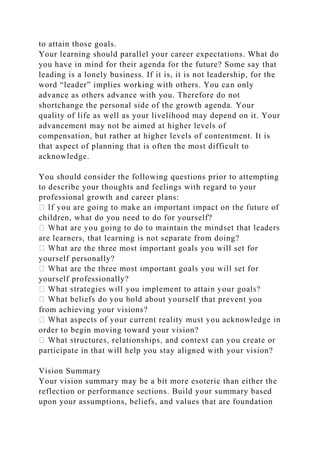
Set several personal and professional goals and devise strategies
to attain those goals.
Your learning should parallel your career expectations. What do
you have in mind for their agenda for the future? Some say that
leading is a lonely business. If it is, it is not leadership, for the
word “leader” implies working with others. You can only
advance as others advance with you. Therefore do not
shortchange the personal side of the growth agenda. Your
quality of life as well as your livelihood may depend on it. Your
advancement may not be aimed at higher levels of
compensation, but rather at higher levels of contentment. It is
that aspect of planning that is often the most difficult to
acknowledge.
You should consider the following questions prior to attempting
to describe your thoughts and feelings with regard to your
professional growth and career plans:
children, what do you need to do for yourself?
are learners, that learning is not separate from doing?
are the three most important goals you will set for
yourself personally?
yourself professionally?
lf that prevent you
from achieving your visions?
order to begin moving toward your vision?
participate in that will help you stay aligned with your vision?
Vision Summary
Your vision summary may be a bit more esoteric than either the
reflection or performance sections. Build your summary based
upon your assumptions, beliefs, and values that are foundation
of your purpose in life. Identify movements in education, in
business, in technology, in the demography of your work setting
and view the changes that are occurring in your state,
regionally, nationally, and internationally as a basis for what
you envision as the future of education. How will this impact
you and your personal growth? How will all of these factors
influence your purpose in life? Finally, what do you want to
create? What is your vision for education in the future? Again,
where possible, cite all the relevant research and literature.
Summary
Reflection and Vision for School Leaders is about you. If you
are going to realize your vision, you are probably going to have
to sell yourself. Educators often find this difficult and,
consequently, are not very good at it. There is no better way of
convincing others of your ability than through demonstrated
results. People in general and prospective employers recognize
that the best predictor of future behavior is past behavior.
Hence, a list of accomplishments on a resume may help, but a
truly thoughtful exposition of your ideas and your ability and
confidence to produce on those ideas will hold you a place of
special regard.
Another part of the work is for your eyes only. This is a part of
you that you share only with your spouse, significant other, or
closest friend. That personal expression will be intended to
provide you with a mental and spiritual map of the future. What
roads do you not want to take? What are your very special non-
public dreams for yourself and your loved ones? What political
or religious beliefs are you unwilling to compromise, and what
implications do those commitments have for your future career?
Finally, you may want to consider what career other that
teaching or school administration you should look at. K-12
education is not your only choice, but have you ever seriously
thought what else there might be? Too many people find
themselves caught up in the teacher-principal-superintendent
aspiration track when they would be much happier pursuing
another field. Unfortunately, that realization often comes too
late for risking a change. You are now at the top of your game
and as marketable as you will ever be. Don’t put unnecessary
limits on your horizons. We are certainly not suggesting that K-
12 education is not a wonderful and satisfying field. We are
saying that everyone should take career planning very seriously.
So many people become, or feel they become trapped. Too many
individuals count down the days to retirement. If you can't wait
to get it over, perhaps you should get it over. Take this pivotal
time in your life to look beyond your immediate surroundings
and comfort zone. At least consider the many opportunities you
have. And may your new title of doctor bring a happier and
more fulfilling life to you and those with whom you choose to
share it.
Appendix C
ASFSE Written Assignment Format
Appendix C
ASFSE Written Assignment Format
ASFSE – Written Assignment Format. All ASFSE candidates
are expected to use the following format for general written
class assignments. Each assignment will have at least three
sections:
1. Title Page
1. Body of Text
1. References
If other sections are required, they will be explained in the
syllabus or course guide. The page setup and general
specifications should adhere to the following:
1. Set 1” margins on all sides.
1. Use left margin justification
1. Set the font for 12 pt with New Times Roman or other serif
font.
1. Use no bold or underlining. Underlining may be used if
requested for certain assignments.
1. Use the “Insert” function to insert Arabic page numbers at
the upper right corner, with the same font as the text (no italics,
periods, hyphens, underlining, or bold).
1. Use white paper
The title page will contain three vertically and evenly spaced
and centered sections. It will contain no page number, although
it is considered page 1.
1. Top section:
Title of the Assignment
Upper and Lower Case Style
1. Middle section:
by
Full Name
Course code and CRN
Title of Course
1. Bottom section:
Nova Southeastern University
Month, day, year
The Body of Text will start with page “2” in the upper right
hand corner of the page.
1. Indent ½” for each new paragraph, the default on most word
processors.
1. Text is to be double spaced.
1. For subheadings, follow current APA style of flush left and
italicized.
In the following cases, single spacing will be used.
1. Block quotes of 40 or more words
1. Tables of Contents
1. Abstracts
1. Table titles
The References list will start on a new page that is also
numbered. The title is to be centered at the top of the page on
the first available line.
References
Use hanging indent and single spacing for each reference item.
Hanging indent can be found by clicking on “Format,” selecting
“Paragraph,” and choosing “Indentation,” change to “Hanging.”
Double space between items.
References are listed in alphabetical order and follow the
current APA format.
Appendix D
Ethical Statements Underlying Current Thinking and Practice
Appendix D
Ethical Statements Underlying Current Thinking and Practice
Please indicate your agreement (A) or disagreement (D) with
the following statements:
Standard 1: Development, Articulation, Implementation, and
Stewardship of a Vision
A D
1 All students can and will learn.
2Everything that occurs in the district should be focused on
student learning.
3It is important to work with all groups, including those whose
opinions may conflict.
4Students should be actively involved in the learning process.
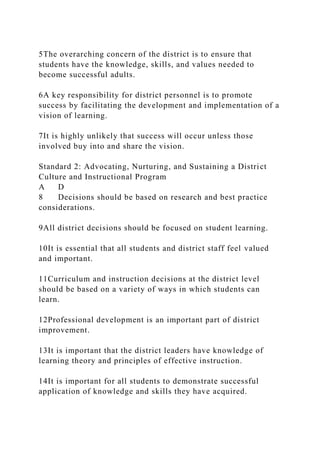
5The overarching concern of the district is to ensure that
students have the knowledge, skills, and values needed to
become successful adults.
6A key responsibility for district personnel is to promote
success by facilitating the development and implementation of a
vision of learning.
7It is highly unlikely that success will occur unless those
involved buy into and share the vision.
Standard 2: Advocating, Nurturing, and Sustaining a District
Culture and Instructional Program
A D
8 Decisions should be based on research and best practice
considerations.
9All district decisions should be focused on student learning.
10It is essential that all students and district staff feel valued
and important.
11Curriculum and instruction decisions at the district level
should be based on a variety of ways in which students can
learn.
12Professional development is an important part of district
improvement.
13It is important that the district leaders have knowledge of
learning theory and principles of effective instruction.
14It is important for all students to demonstrate successful
application of knowledge and skills they have acquired.
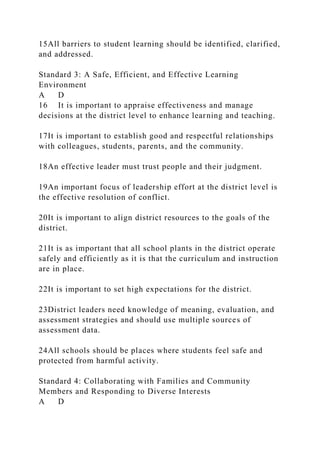
15All barriers to student learning should be identified, clarified,
and addressed.
Standard 3: A Safe, Efficient, and Effective Learning
Environment
A D
16 It is important to appraise effectiveness and manage
decisions at the district level to enhance learning and teaching.
17It is important to establish good and respectful relationships
with colleagues, students, parents, and the community.
18An effective leader must trust people and their judgment.
19An important focus of leadership effort at the district level is
the effective resolution of conflict.
20It is important to align district resources to the goals of the
district.
21It is as important that all school plants in the district operate
safely and efficiently as it is that the curriculum and instruction
are in place.
22It is important to set high expectations for the district.
23District leaders need knowledge of meaning, evaluation, and
assessment strategies and should use multiple sources of
assessment data.
24All schools should be places where students feel safe and
protected from harmful activity.
Standard 4: Collaborating with Families and Community
Members and Responding to Diverse Interests
A D
25 Diverse stakeholders within the district should be treated
equitably.
26It is essential to involve families and other stakeholders in
decision-making processes at the district level.
27It is important to give credence to and incorporate individuals
whose values and opinions my conflict.
28The district operates as an integral part of a larger
community.
29Families are partners in the education of their children.
30District resources of the family and community need to be
brought to bear on the education of students.
31It is very important that the public be informed about what is
occurring within their district.
Standard 5: Acting with Integrity, Fairness, and in an
Ethical Manner
A D
32 Schools should be freely open to public scrutiny.
33It is important that district leaders clearly examine and
understand their personal and professional values.
34The right of every student to a free, quality education should
be a primary value of all educators.
35All district decisions should be based on the inherent worth
and dignity of all.
36It is important to apply policy, procedures, and laws fairly,
wisely, and consistently.
37A leader should accept the consequences for upholding one’s
principles and actions and not try to blame others.
38The leader should use all the power of his or her office to
constructively and productively serve all students and their
families.
39District leaders cannot favor either instruction or operations
when planning their work efforts.
Standard 6: Understanding, Responding to, and
Influencing the Larger Context
A D
40 It is important to address district information about family
and community concerns and expectations.
41Programs and activities should recognize a variety of ideas,
values, and cultures.
42It is important to address emerging trends that support
district goals.
43A very important role of leadership is to actively participate
in the political and policymaking context in the service of
education at the district level.
44District leaders must work within a framework of laws to
protect student rights and improve student opportunities.
Adapted from Cunningham, W. G. (2007).
A handbook for educational leadership interns: A right
of passage. New York: Pearson.
Appendix E
References
Appendix E
References
Scholarly References
In preparation for your various written assignments, you will be
required to use the NSU Electronic Library or other resources to
find recent full-text articles, books, or web sites of professional
organizations to support your thoughts. These references are in
addition to the textbooks for this course. Note all references
should be within the past 5 years. These references can come
from full-text peer-reviewed articles from different journals or
periodicals (i.e., not different volumes or issues of the same
journal or periodical) and books. You may use the references
from the “suggested reading” and “additional resources.”
Furthermore, anonymous sources, secondary references which
are summaries of articles (i.e.,
Educational Digest, ERIC, ERIC Digest,
Dissertation Abstracts, etc.), web sites that are not
refereed by a professional association, or simplistic opinion-
based sources such as blogs and wikis (including Wikipedia) are
not appropriate at the doctoral level in this course.
Full-text Articles – are articles in an electronic database, which
are presented with the complete text, but may exclude non-
textual materials such as images or charts.
Peer Reviewed Articles –Peer review is the evaluation of
creative work or performance by other people in the same field
in order to maintain or enhance the quality of the work or
performance in that field. The word
peer is often defined as
a person of equal standing. However, in the context of
peer review it is generally used in a broader sense to refer to
people in the same profession who are of the same or higher
ranking. NSU has access to full-text articles that have been peer
reviewed within its many data bases
Peer review is based on the concept that a larger and more
diverse group of people will usually find more weaknesses and
errors in a work or performance and will be able to make a more
impartial evaluation of it than will just the person or group
responsible for creating the work or performance.
Peer review utilizes the independence, and in some cases the
anonymity, of the reviewers in order to discourage
cronyism (i.e., favoritism shown to relatives and
friends) and obtain an unbiased evaluation. Typically, the
reviewers are not selected from among the close colleagues,
relatives or friends of the creator or performer of the work, and
potential reviewers are required to disclose of any conflicts of
interest.
Peer review helps maintain and enhance quality both directly by
detecting weaknesses and errors in specific works and
performance and indirectly by providing a basis for making
decisions about rewards and punishment that can provide a
powerful incentive to achieve excellence. These rewards and
punishments are related to prestige, publication, research
grants, employment, compensation, promotion, tenure and
disciplinary action.
Peer review is used extensively in a variety of professional
fields, including academic and scientific research, medicine,
law, accounting and computer software development. Even trial
by jury is a form of peer review. Peer review is legislatively
mandated in some situations, particularly in law and medicine.
In others it is required by tradition or by administrative rules or
both (e.g., as in academia). In some fields, such as software
development, it occurs naturally without any formal structure or
requirements.
In the case of
peer reviewed journals, which are usually academic and
scientific periodicals, peer review generally refers to the
evaluation of articles prior to publication. But in a broader
sense, it could also refer to articles following publication, as
such articles often continue to be studied and debated for a
longer period and by a much wider audience. There are different
levels of peer review: (a) Manuscripts that are evaluated by
experts in the field at large, rather than solely by the editors,
(b) manuscripts evaluated anonymously, without readers’
knowing the author’s name or institutional affiliation, and (c) if
the editors send along a rating scale to be used by the reviews
to evaluate the manuscript.
Despite its advantages, there have also been some criticisms of
peer review. One is that it can be slow, particularly in the case
of academic journals, for which many months or even a year or
longer are sometimes required for submitted articles to be
reviewed and published.
Some critics believe that peer review has a built-in bias against
highly original works and results because reviewers (as do
people in general) tend to be more tolerant of works and results
that are consistent with their own views and more critical of
those that contradict them. It should be kept in mind that history
is replete with examples of innovations that were originally
ridiculed by their peers because they contradicted the common
wisdom of the day. The bias by academics against highly
innovative work may be in part a result of the fact that they
have vested interests in maintaining the status quo after having
spent many years or decades supporting it.
Many of the individuals responsible for the world's greatest
discoveries and inventions were originally mocked and ridiculed
by their peers. Among the more famous examples are Darwin's
discovery of evolution in the nineteenth century, the discovery
of continental drift (also referred to as
plate tectonics) by Alfred Wegener and others in the
early 20th century, and the Wright brothers' first heavier-than-
air flights at Kitty Hawk in 1903.
Moreover, it has been suggested that peer review is not always
good at detecting fraud, particularly in the case of articles
submitted to scientific journals. One reason for this is that the
reviewers often do not have immediate or full access to the data
on which the articles are based (except perhaps in fields such as
mathematics where it is easy to provide the data and attempt to
replicate the results). However, longer term peer review (i.e.,
after the articles have been published) has proven to be much
better at detecting fraud.
The Internet is beginning to have a major effect on peer review.
One way has been to increase the speed and lower the cost of
the communications involved in reviewing works, such as
articles prior to publication. In addition, the movement of
publications from hard copy format to online format, which is
still in its early stages, will further increase the speed of
publishing, reduce the cost of publishing, and make the
publications much more widely available, thereby facilitating
the post-publication review of articles by a larger number and
greater variety of people.
In addition, because it allows anyone to publish and to do so at
virtually no cost, the Internet makes it much easier to give swift
and widespread exposure to highly innovative and controversial
works that might have a difficult time being getting into
mainstream, peer reviewed hard copy publications. However,
there are so many articles and other items of obviously dubious
quality on the Internet that it can be difficult to find those that
are truly promising.
Appendix E
Ethical Statements Underlying Current Thinking and Practice
EDD 8462 – Reflection and Vision for School Leaders
Appendix E
Ethical Statements Underlying Current Thinking and Practice
Please indicate your agreement (A) or disagreement (D) with
the following statements:
Standard 1: Development, Articulation, Implementation, and
Stewardship of a Vision
A D
1 All students can and will learn.
2 Everything that occurs in the school should be focused on
student learning.
3 It is important to work with all groups, including those whose
opinions may conflict.
4 Students should be actively involved in the learning process.
5 The overarching concern of the school is to ensure that
students have the knowledge, skills, and
values needed to become successful adults.
6 A key responsibility for school personnel is to promote
success by facilitating the development and
implementation of a vision of learning.
7 It is highly unlikely that success will occur unless those
involved buy into and share the vision.
Standard 2: Advocating, Nurturing, and Sustaining a School
culture and Instructional
Program
A D
8 Decisions should be based on research and best practice
considerations.
9 All school decisions should be focused on student learning.
10 It is essential that all students and school staff feel valued
and important.
11 Curriculum and instruction decisions at the school level
should be based on a variety of ways in
which students can learn.
12 Professional development is an important part of school
improvement.
13 It is important that the school leaders have knowledge of
learning theory and principles of effective
instruction.
14 It is important for all students to demonstrate successful
application of knowledge and skills they
have acquired.
15 All barriers to student learning should be identified,
clarified, and addressed.
Standard 3: A Safe, Efficient, and Effective Learning
Environment
A D
16 It is important to appraise effectiveness and manage
decisions at the school level to enhance
learning and teaching.
17 It is important to establish good and respectful relationships
with colleagues, students, parents, and
the community.
18 An effective leader must trust people and their judgment.
19 An important focus of leadership effort at the school level is
the effective resolution of conflict.
20 It is important to align school resources to the goals of the
schools.
21 It is as important that all school plants in the district operate
safely and efficiently as it is that the
curriculum and instruction are in place.
22 It is important to set high expectations for the school.
23 School leaders need knowledge of meaning, evaluation, and
assessment strategies and should use
multiple sources of assessment data.
24 All schools should be places where students feel safe and
protected from harmful activity.
Standard 4: Collaborating with Families and Community
Members and Responding to
Diverse Interests
A D
25 Diverse stakeholders within the school should be treated
equitably.
26 It is essential to involve families and other stakeholders in
decision-making processes at the school
level.
27 It is important to give credence to and incorporate
individuals whose values and opinions may
conflict.
28 The school operates as an integral part of a larger
community.
29 Families are partners in the education of their children.
30 School resources of the family and community need to be
brought to bear on the education of
students.
31 It is very important that the public be informed about what is
occurring within their schools.
Standard 5: Acting with Integrity, Fairness, and in an Ethical
Manner
A D
32 Schools should be freely open to public scrutiny.
33 It is important that school leaders clearly examine and
understand their personal and professional
values.
34 The right of every student to a free, quality education should
be a primary value of all educators.
35 All school decisions should be based on the inherent worth
and dignity of all.
36 It is important to apply policy, procedures, and laws fairly,
wisely, and consistently.
37 A leader should accept the consequences for upholding one’s
principles and actions and not try to
blame others.
38 The leader should use all the power of his or her office to
constructively and productively serve all
students and their families.
39 School leaders cannot favor either instruction or operations
when planning their work efforts.
Standard 6: Understanding, Responding to, and Influencing the
Larger Context
A D
40 It is important to address school information about family
and community concerns and
expectations.
41 Programs and activities should recognize a variety of ideas,
values, and cultures.
42 It is important to address emerging trends that support
school goals.
43 A very important role of leadership is to actively participate
in the political and policymaking
context in the service of education at the school level.
44 School leaders must work within a framework of laws to
protect student rights and improve student
opportunities.
Adapted from Cunningham, W. G. (2007).
A handbook for educational leadership interns: A right
of passage. New
York, NY: Pearson.
Appendix G
Internship Application
EDD 8462 – Reflection and Vision for School Leaders
FAX COVER SHEET
To: Doctoral Enrollment Counselor
From: Date:
Contact Phone - Day Evening
Return Fax Number ( ) NSU ID #
NSU Email
Alternative Email
Candidates will need to contact a doctoral enrollment counselor
with regard to the EDL Internship at the
doctoral level. The doctoral enrollment counselor will review
your academic record to ensure that you have
met all the pre-requisites for the internship, and will assist you
in registering for the internship. On the
master schedule, EDD 8498A and EDD 8499A will be listed as
having no seats available. Hence, your need to
contact a doctoral enrollment counselor to be able to register for
the EDL internship.
Total Pages (including cover sheet): _____________
Abraham S. Fischler College of Education
ATTN: Educational Leadership Internship Program
1750 NE 167th Street
North Miami Beach, FL 33162
Internship Application
Internship – Candidate* and School or District-based Clinical
Faculty Information
(Doctoral)
Site ................................ Date Submitted...
Name (Ms./Mr.)............. NSU ID# ..............
Address...........................
Street City State Postal Code
Home Telephone............ Work Telephone.
NSU e-mail Address......
Current Position............ Internship Site ....
Internship Site Address
Street City State Postal Code
School-based Clinical Faculty
* Candidates beginning Fall 2010 or later seeking School or
District-Level Licensure
* Approval for licensure for School Administrator in the States
of Nevada and Pennsylvania.
(See Program Outlines for Nevada and Pennsylvania)
EDD 8498A– Educational Leadership Internship for School
Leaders (6 credits)
Prerequisites – EDD 8010, EDD 8431, EDD 8432, EDD 8434,
EDD 8472, and EDD 8462**
EDD 8498B,C – Educational Leadership Internship for District
Leaders (6 credits)
Prerequisites – EDD 8010, EDD 8431, EDD 8432, EDD 8434,
EDD 8472, and EDD 8463**
** Note – EDD 8462 and EDD 8463 may be taken concurrently
with EDD 8498A and EDD 8498B,C
Start Term (Check One) Fall Winter Summer 20
40

Appendix AEducational Leadership Goals and Learning Outcomes.docx

  • 1.
    Appendix A Educational LeadershipGoals and Learning Outcomes Appendix A Doctoral Program Goals and Learning Outcomes The Doctor of Education (EdD) is designed to support the
  • 2.
    mission of theFischler School of Education and Human Services. The program is designed to prepare adult learners to fulfill their professional and personal academic goals. It provides opportunities to enhance the core knowledge, skills and values essential to competent and ethical practitioners and leaders of organizations in the fields of education, human services and related areas. The learning outcomes of the program are focused on facilitating the transfer of theory into practice in order to produce a new generation of local, national and global leaders who will effect positive changes in a diverse and multicultural society. Program Learning Outcomes Doctor of Education Degree (EdD) graduates will be able to: 1. Demonstrate knowledge learned in the program by applying it to real settings. (Knowledge) 1. Conduct an independent research investigation that contributes to the general body of knowledge in a specific field or profession. (Research) 1. Solve diverse problems using information and skills acquired in the program to create solutions. (Problem solving) 1. Make informed decisions based on ethical and legal principles. (Ethics) 1. Formulate scholarly arguments supported by academic resources. (Communication) Educational Leadership Goals and Learning Outcomes The primary goal of the concentration in Educational Leadership (EDL) is to improve our K-12 schools by preparing candidates for leadership and lifelong learning in the fields of K-12 educational administration. The doctoral program fosters an in-depth application of knowledge and skills, inquiry and research, problem-solving, collaboration and communication, professional development, and higher order thinking skills. The graduates of the EDL concentration will be leaders in improving schools and other learning environments; expanding their administrative competence and modeling visionary leadership; advocating and implementing educational
  • 3.
    improvement using informedaction research, effective application of change theory, collaborative decision-making and strategic planning, risk and creativity, and appropriate evaluation; and identifying and addressing contemporary and future educational issues in a changing world. Goals EDL goals are to enable candidates to: 1. Acquire practical knowledge and skills of effective leadership at the school and district levels to improve teaching and learning. 2. Develop abilities for research in the field of K-12 educational leadership. 3. Develop and apply technology as both an administrative and instructional tool. 4. Broaden their professional background as it relates to the: 1. establishment and implementation of a vision; 1. assessment and improvement of the school and district culture; 1. refinement of both internal and external communication skills; 1. improvement of school and district operations; 1. alignment of the school and district curriculum, instructional strategies, and assessment strategies; 1. planning and implementation of change theory; 1. improvement of school and community relations; and 1. processes of human resource management and development. 5. Prepare for K-12 leadership and administrative positions at the school and district level. 6. Act with integrity in an ethical manner. Educational Leadership Learning Outcomes Graduates of the Ed.D. with a concentration in Educational Leadership will demonstrate mastery of the following learning outcomes as evidenced by their participation in class, participation in problem-based projects, completion of class assignments and class presentation, and/or field based experiences. Graduates will be able to:
  • 4.
    1. Implement astrategic plan that outlines actions for school improvement and their implications. (Vision and Planning) 2. Evaluate the human resource program in terms of human resource planning, recruitment of personnel, selection of personnel, placement and induction of personnel, staff development, evaluation of personnel, compensation of personnel, and collective bargaining (if appropriate). (Personnel) 3. Promote a positive culture within the school or district that includes the design of comprehensive professional growth plans for school personnel. (Culture) 4. Utilize practical applications of organizational theories to manage the resources, budgeting process, physical plant or plants, organizational operations, and the resources of a school or district. (Organization, Operations, and Resources) 5. Develop and align the curriculum goals and objectives with instructional strategies appropriate for varied teaching and learning styles and specific student needs. (Curriculum and Instruction) 6. Collaborate with internal and external stakeholders, respond to their interests and needs, and mobilize resources. (Collaboration and School in Larger Context)
  • 5.
    Appendix B Reflection andVision for School Leaders – An Overview Appendix B Reflection and Vision for School Leaders – An Overview Foreword
  • 6.
    This course willhelp you complete the initial course for the Doctor of Education with a concentration in Educational Leadership (EDL). Although this syllabus is fairly prescriptive, it is not intended that you color by the numbers. Rather it is intended as a philosophical approach to what is expected in the fulfillment of your doctoral studies. You are to use your own creativity and experience to meet that philosophical commitment. Before you begin writing, read the entire document and discuss its contents with your peers, a group of your colleagues, friends, family, and relatives. The result should emerge and be informed by a cooperative effort of all those individuals and more. You will be asked to assess your knowledge, skills, and dispositions relative to the national standards contained within this syllabus. While your opinion is important, you should also indicate how others have seen you in action. You will need to solicit the input of your work setting colleagues and stakeholders, your family, and support your conclusions, where feasible, with references to current research the literature. Organizational leadership is defined by change, and organizational change is defined by leadership. They are products of each other. The EDL concentration requires you to express your understanding of leadership and change in a personal and dynamic format. Ultimately, you will be required to demonstrate your continuing growth as a catalyst for educational improvement and as a master of the process of change. This demonstration will be evidenced by three major connected perspectives – “reflection,” “performance,” and “vision.” This course will also serve as a comprehensive needs assessment for your doctoral studies, with an emphasis on the word “comprehensive.” It is a comprehensive look at your life and what lies ahead. Doctoral comprehensive exams normally ask the candidate to integrate information learned from several
  • 7.
    areas of studywithin some theoretical framework. Often the examinee responds to significant issues within the disciplines studied and uses research to support or refute particular points of view. This is also our expectation of you through the Reflection and Vision for School Leaders. To meet the developmental needs of candidates, assessment in the EDL concentration will be engaging, action-centered, and participatory. Through the combination of acceptable course criteria as well as performance standards that describe the expected quality of performance that must be met, you will learn to examine their planning and decision-making. However, not only do you need to know what is expected and what is acceptable in terms of performance, you will need to be provided with feedback that will serve as a basis for goal setting and future performance. Essentially, specific feedback should be viewed as a learning opportunity. To foster this performance-based model of learning will require that you review the feedback from the professors in the various courses. Finally, the variety of activities you will experience during the various courses, the field work, and your day-to-day experiences on the job will provide a picture of you. This combination of performances and assessments will need to create a balance between challenge and encouragement (i.e., building on your strengths and moving them forward into areas that need to be developed). Section One – Reflection Honest introspection. Reflection is a skill you have continued to hone in your journey through the program and through your practice as an educational leader. It is a difficult skill that
  • 8.
    requires you tolook at yourself as an object rather than a subject. Reflection is not a fond remembrance of past victories. It is not a reason to boast about your charisma and wonderful empathy for children, parents, and colleagues. Reflection is a learning tool. By reflecting on what you have done and why you have done it, you are searching for the intricacies of process and your and others’ personal involvement in process. You will be browsing through the interplay of people, time, and events in an effort to discern the cause and the purpose of something that occurred or did not occur. Reflection is a self-interrogation, stripping away each layer of accommodation you have gained through years and years of proving and protecting yourself. It is an examination of your motives—about who you are, not the story you have made up about who you are. We each are products of our experiences and of our bias about those experiences. The perception is often more alluring and powerful than the reality, so that the way we see ourselves is not necessarily the way others see us. It is the latter that we want to expose and accept. Objectivity makes difficult demands on reflection. We must put aside our pretension and pride and desire for public approval and position. Thus, reflection is a very personal, intimate, and honest act. It is best evidenced in the phrase, “Know thyself.” Reflection is mindfulness about the past. Awareness is mindfulness about the present. Vision is mindfulness about the future. The following tool can be used to guide your reflection on action and your reflection for action. Think about some event, an interaction, or a situation that occurred in your personal or professional life that you feel is worth further reflection. You might choose to examine a positive and encouraging experience,
  • 9.
    or you mightchoose a more unsettling or challenging experience. Now consider the following series of questions to prompt your reflective thinking about the experience. You may also wish to write down your thoughts and later share them aloud with another person. First, what happened? This will serve as a description of what took place. What did you do? What did others (i.e., students, adults, etc.) do? What was my affect at the time? What were the affects of others? What was going on around us? Where were we? When during the day did it occur? Was there anything unusual happening? Identifying all aspects of what took place will provided the basis for your reflection. Second, why did the event, interaction, or situation take place? This will require your interpretation and analysis of the events. Why do you think things happened the way they did? Why did you choose to act the way you did? What can you surmise about why the other person or persons acted they way they did? What was going on for each participant in the situation? What were you thinking and feeling? Were you thinking at the time? How might your thinking have affected your choice of behavior? How might the context have influenced the experience? Was there something about the activities? Was there something about the timing or location of events? Were there other potential contributing factors? Something about what was said or done by others that triggered your response? Were there past experiences, either yours or those of others, that contributed to the response? What are your hunches about why things happened in the way they did? Your analysis of why something occurred is crucial should you find yourself in a similar situation in the future. Third, so what? This will require you to think of the bigger
  • 10.
    issues that youneed to deal with. Do the overall meanings of the events warrant further consideration? Why did this seem like a significant event to reflect on? What have I learned from the reflection on this event? How could I improve my behavior? How might this change my future thinking, behavior, or interactions? Many things that occur in our professional and personal lives take a considerable amount of time. In the scheme of things, you really need to consider if a particular situation is worth the expenditure of time. Finally, now what? Based upon your analysis, what are the implications for your actions in the future? Are there other people you should actively include in reflecting on this event? If so, who and what would you interact about? Next time a situation like this presents itself, what do you want to remember to think about? How would you want to behave? How could you set up conditions to increase the likelihood of productive interactions and learning? This entire process will assist you to make changes in your behavior where you feel they are necessary. Your leadership activity. The EDL concentration respects your life as an educational leader. Leadership is not developed in isolation. It needs activity. Look back on at least two years, longer if you wish, and recall the defining times in your work world, times that helped define you as a person, as a teacher, as a learner, as a leader. Perhaps the most meaningful experiences were relationships, both good and bad. How have your relationships and reactions with your colleagues shaped you— made you realize something about yourself. Were there particular comments from students or from supervisors that were especially significant? Do you have a mentor or mentors? What lessons have you
  • 11.
    learned from andabout them? Describe why these individuals have made a lasting impression on you. How do you communicate with and use them? Will you continue to seek their advice? How? Have you changed positions or do you contemplate doing so? Why and when? Describe whether you rely on your mentor or mentors for this kind of decision. You should consider the following questions to reflect upon prior to describing your thoughts and feelings with regard to your educational leadership activities: that helped define you as a learner, teacher, and leader)? and learning, and leadership? tly upheld in your leadership decision making? action? decision making in terms that refer to theory? Why do you favor these theories and reject others? day-to-day work? If yes, how? colleagues, supervisors, and other administrators that was particularly significant? why not?
  • 12.
    satisfaction equation? How doyou rate yourself on confronting inadequacies in others? Many leaders find this their most daunting task. Some find it just as difficult to give praise when others perform well. Yet, performance issues that go unaddressed have a habit of multiplying and setting a culture that condones mediocrity. Do you consider yourself guilty, or is this an area in which you feel confident and accomplished? Are you happy in your leadership role? What things are most satisfying and what are the least? What are you doing to increase the satisfaction side of the equation? You should consider the following questions to reflect upon prior to describing your thoughts and feelings with regard to your personal activities: life? -to-day personal life? making? you changed the way you address dilemmas in your personal life? If yes, how? Reflection summary. Try to summarize your reflections organized by several dominant themes that you have found to be important to your values and future actions. One of the primary goals in the EDL concentration is for you to be an informed practitioner. Instructional leadership, an often used and abused
  • 13.
    term, should assumefamiliarity with a knowledge base about teaching and learning. Whereas “lead teacher” refers to some kind of clinical teaching master, instructional leader implies an understanding and use of learning and instructional theory. Instructional leaders respond not only to the how and what of education, but also to the why. Instructional leadership is arguably the prime responsibility of educational leadership. You should consider the following questions to reflect upon prior to describing your thoughts and feelings with regard to your overall reflections: responsibilities (or lack of it)? How do you know? lack of it)? How do you know? al questions come to mind? Section Two – Leadership Standards Meeting the leadership standards. Demonstration of the knowledge, skills, competencies, and dispositions is at the heart of educational leadership. To foster the development of educational leaders at all levels of education, sets of standards have been developed by a number of constituency organizations (i.e., American Association of School Administrators, Association of Supervision and Curriculum Development, Interstate School Leaders Licensure Consortium, National Association of Elementary School Principals, National Association of Secondary School Principals, National Board for Professional Teaching Standards, National Policy Board for Educational Administration, etc.). Based upon these standards, the EDL concentration has designed curriculum that is integrated and problem-based to promote an understanding of the connectedness of the various knowledge and skill areas in
  • 14.
    educational leadership. Thestandards necessarily segment the total knowledge and skill base, but these separations are only for the purpose of providing manageable descriptions of essential content and practice within the EDL delivery system. The application of knowledge and the development, integration, and practice of professional skills are important components of the EDL concentration. Therefore, the EDL concentration has planned and developed a number of field-based components to bridge the experiences between the various courses and the workplace. Because life in schools is not compartmentalized as are content areas for the convenience of instruction, teaching for application of knowledge requires structures that provide transitions from isolated, specialized concepts toward more realistic and interconnected patterns. There are three dimensions to the teaching and learning process within the EDL concentration (a) awareness, defined as acquiring concepts, information definitions, and procedures; (b) comprehension, defined as interpreting knowledge to school environments, integrating concepts with practice, and using knowledge and skills in context; and (c) application, defined as applying knowledge and skills to specific problems of practice. The instructional design employs a variety of adult learning strategies in the EDL concentration. Addressing authentic problems generated by you as a basis for instruction and requiring you to reflect on your experiences is a hallmark of the EDL concentration. The standards are stated as results because program assessment should be based on results criteria. The EDL concentration goals and objectives focus on knowledge, skills, and attributes required to lead and to manage an educational enterprise centered on teaching and learning. While an array of
  • 15.
    methodologies and resourceshave been incorporated into the EDL concentration, the emphasis has been placed on your role and performance in the workplace. In summary, the EDL field-based distance learning elements provide clear connections and bridging experiences seated in an awareness of content, the integration of concepts and practice, and the application of knowledge and skills in your workplace. When coupled with the integrated experiences of the various course sessions, online experiences, summer session, cohort seminars, and field-based experiences the outcome will be a powerful synthesis of knowledge and skills useful to you upon completion of the ELD program. Throughout your doctoral studies, you will be required to demonstrate your proficiency in meeting each of the standards selected. More specifically, you will be required to meet the standards for school-based leadership listed below. To the degree feasible and applicable, you will be required through some assignments and should attempt through other assignments to utilize your studies and assignments in the various EDL courses as a vehicle to demonstrate your proficiency in a particular element of the school-based leadership standards. You will be required to demonstrate, in a number of different formats, how you have achieved proficiency in the various elements of each standard. Assessments of your performance should be vehicles for both candidates and program evaluation and improvement. A broad range of knowledge and performance should be assessed including the application of knowledge to the improvement of practice. These assessments should be continuous, systematic, comprehensive, and rigorous. They should be free from bias, and be consistent, accurate, ethical, and fair. These artifacts of your work should be shared monthly with your colleagues and instructor for review, comment, and
  • 16.
    revisions where necessary. School-BasedAdministrative Leadership Standards You should draw upon workplace records (i.e., minutes of meetings, communications, policies, news events, projects, etc.), public documents, articles published in professional journals, videotaped situations, samples of work, analytic work, essays, grading rubrics, problem-solving activities, action research, projects, simulations, case studies, and so forth to indicate that you have achieved proficiency in two particular elements of each standard. After each standard, examples of performance activities will be suggested. It should be noted that the examples are merely that—examples. You should feel free to select varied means and modes which will best exemplify how you have met a particular standard. Examples of performance activities you might engage in that might be applicable for multiple standards; however, you may utilize any of the following activities once: ELCC Standard 1.0 – Developing and Implementing a School- Level Vision A building-level education leader applies knowledge that promotes the success of every student by collaboratively facilitating the development, articulation, implementation, and stewardship of a shared school vision of learning through the collection and use of data to identify school goals, assess organizational effectiveness, and implement school plans to achieve school goals; promotion of continual and sustainable school improvement; and evaluation of school progress and revision of school plans supported by school-based stakeholders.
  • 17.
    Research Support forELCC Standard 1.0. Standard 1 confirms that a building level education leader must have the knowledge to promote the success of every student through understanding principles for developing, articulating, implementing, and stewarding a school vision of learning. This includes knowledge of the importance of shared school vision, mission, and goals for student success that is documented in the effective schools literature and school improvement literature. It includes the knowledge that when vision, mission, and goals are widely shared, student achievement usually increases. The importance of the knowledge presented in evidence supporting Standard 1 was recognized in the reviews of scholarship informing the development of the Interstate School Leaders Licensure Consortium (ISLLC) 2008 Policy Standards that highlighted the importance of knowledge facilitating the development, articulation, implementation, and stewardship of a vision of learning that is shared and supported by all stakeholders. Formation of the ISLLC 2008 Standards was also based on considering the importance of knowing the theoretical foundations for leadership practice. Some reviews of scholarship highlighted the importance of knowing how to collaboratively develop and implement a shared vision and mission. The importance of knowing how to use evidence in decision making was highlighted in reports informing the formation of the ISLLC 2008 Standards.
  • 18.
    Other reports confirmedthe importance of knowing how to create and implement plans to achieve goals. ELCC 1.1: Candidates understand and can collaboratively develop, articulate, implement, and steward a shared vision of learning for a school. Content Knowledge. Candidates provide evidence of knowledge of: 1.1a Collaborative school visioning. 1.1b Theories relevant to building, articulating, implementing, and stewarding a school vision. 1.1c Methods for involving school stakeholders in the visioning process. Professional Leadership Skills. Candidates demonstrate skills required to: 1.1a Design and support a collaborative process for developing and implementing a school vision. 1.1b Articulate a school vision of learning characterized by a respect for students and their families and community partnerships. 1.1c Develop a comprehensive plan for communicating the school vision to appropriate school constituencies. 1.1d Formulate plans to steward school vision statements. ELCC 1.2: Candidates understand and can collect and use data to identify school goals, assess organizational effectiveness, and implement plans to achieve school goals.
  • 19.
    Content Knowledge. Candidatesprovide evidence of knowledge of: 1.2a The design and use of assessment data for learning. 1.2b Organizational effectiveness and learning strategies. 1.2c Tactical and strategic program planning. 1.2d Implementation and evaluation of school improvement processes. 1.2e Variables that affect student achievement. Professional Leadership Skills. Candidates demonstrate skills required to: 1.2a Develop and use evidence-centered research strategies and strategic planning processes. 1.2b Create school-based strategic and tactical goals. 1.2c Collaboratively develop implementation plans to achieve those goals. 1.2d Develop a school improvement plan that aligns to district improvement plans. ELCC 1.3: Candidates understand and can promote continual and sustainable school improvement. Content Knowledge. Candidates provide evidence of knowledge of: 1.3a Continual and sustained improvement models and processes. 1.3b School change processes for continual and sustainable improvement. 1.3c Role of professional learning in continual and sustainable school improvement.
  • 20.
    Professional Leadership Skills.Candidates demonstrate skills required to: 1.3a Identify strategies or practices to build organizational capacity that promote continuous and sustainable school improvement. 1.3b Design a transformational change plan at the school- building-level. 1.3c Design a comprehensive, building-level professional development program. ELCC 1.4: Candidates understand and can evaluate school progress and revise school plans supported by school stakeholders. Content Knowledge. Candidates provide evidence of knowledge of: 1.4a Effective strategies for monitoring the implementation, revision of plans to achieve school improvement goals, and program evaluation models. Professional Leadership Skills. Candidates demonstrate skills required to: 1.4a develop a school plan to monitor program development and implementation of school goals; 1.4b construct an evaluation process to assess the effectiveness of school plans and programs; 1.4c interpret information and communicate progress toward achievement of school vision and goals for educators in the community and other stakeholders. ELCC Standard 2.0 – Culture and Instructional Program
  • 21.
    A building-level educationleader applies knowledge that promotes the success of every student by sustaining a school culture and instructional program conducive to student learning through collaboration, trust, and a personalized learning environment with high expectations for students; creating and evaluating a comprehensive, rigorous and coherent curricular and instructional school program; developing and supervising the instructional and leadership capacity of school staff; and promoting the most effective and appropriate technologies to support teaching and learning within a school environment. Research Support for ELCC Standard 2.0. Standard 2 confirms that a building-level education leader must know principles for sustaining a school culture and instructional program conducive to student learning and staff professional growth. This includes knowing the elements of school culture and ways it can be influenced to ensure student success; human development theories; proven learning and motivational theories; how diversity influences the learning process; effective leadership practices, including those characterized as instructional leadership, transformational leadership, or leading learning; and models of change processes. The importance of the knowledge presented in evidence supporting Standard 2 was recognized in the empirical evidence, craft knowledge and theoretical writings that supported the development of ISLLC 2008 Standard 2 promoting the success of every student by advocating, nurturing, and sustaining a school culture and instructional program conducive to student learning and staff professional growth. Classic theories of motivation, social control, and goals are
  • 22.
    foundational sources ofknowledge for education leaders seeking to nurture a culture of trust and to motivate faculty and students. Theories of human development and evidence found in case studies of how improvements in teaching and learning can be achieved confirm that both are essential to effective school leadership. A review of literature on learning-centered leadership concluded that instructionally focused leadership paired with leadership processes are required for high performing schools. Earlier reviews found strong evidence that knowledge of leadership approaches to developing school culture and climate is critically important. Evidence of the importance of applied knowledge of how to create a culture of trust, learning and high expectations was found in scholarship on the effect that leaders have on building learning communities. Knowledge of the nature and practices of distributive leadership was identified as essential in a number of scholarly works consulted. Other reviews highlighted the importance of knowing curriculum planning and how to develop motivating student learning environments. Infusing technology into leadership practices has become a recognized domain of practical knowledge essential to effective instructional leadership. ELCC 2.1: Candidates understand and can sustain a school culture and instructional program conducive to student learning through collaboration, trust, and a personalized learning environment with high expectations for students. Content Knowledge. Candidates provide evidence of knowledge of: 2.1a theories on human development behavior, personalized
  • 23.
    learning environment, andmotivation. 2.1b school culture and ways it can be influenced to ensure student success. Professional Leadership Skills. Candidates demonstrate skills required to: 2.1a collaborate with others to accomplish school improvement goals. 2.1b incorporate cultural competence in development of programs, curriculum, and instructional practices. 2.1c monitor school programs and activities to ensure personalized learning opportunities. 2.1d recognize, celebrate, and incorporate diversity in programs, curriculum, and instructional practices. 2.1e facilitate the use of appropriate content-based learning materials and learning strategies. 2.1f promote trust, equity, fairness, and respect among students, parents, and school staff. ELCC 2.2: Candidates understand and can create and evaluate a comprehensive, rigorous, and coherent curricular and instructional school program. Content Knowledge. Candidates provide evidence of knowledge of: 2.2 Curriculum development and instructional delivery theories. 2.2 Measures of teacher performance. 2.2 Multiple methods of evaluation, accountability systems, data collection, and analysis of evidence. 2.2 School technology and information systems to support and monitor student learning. Professional Leadership Skills. Candidates demonstrate skills
  • 24.
    required to: 2.2 Collaboratewith faculty to plan, implement, and evaluate a coordinated, aligned, and articulated curriculum. 2.2 Use evidence-centered research in making curricular and instructional decisions. 2.2 Interpret information and communicate progress toward achievement. 2.2 Design evaluation systems and make school plans based on multiple measures of teacher performance and student outcomes, and provide feedback based on evidence. ELCC 2.3: Candidates understand and can develop and supervise the instructional and leadership capacity of school staff. Content Knowledge. Candidates provide evidence of knowledge of: 2.3a High-quality professional development for school staff and leaders. 2.3b Instructional leadership practices. 2.3c Leadership theory, change processes, and evaluation. 2.3d Standards for high-quality teacher, principal, and district practice. Professional Leadership Skills. Candidates demonstrate skills required to: 2.3a Work collaboratively with school staff to improve teaching and learning. 2.3b Design the use of differentiated instructional strategies, curriculum materials, and technologies to maximize high-
  • 25.
    quality instruction. 2.3c Designprofessional growth plans to increase the capacity of school staff and leaders that reflect national professional development standards. ELCC 2.4: Candidates understand and can promote the most effective and appropriate technologies to support teaching and learning in a school environment. Content Knowledge. Candidates provide evidence of knowledge of: 2.4a Technology and its uses for instruction within the school. 2.4b Infrastructures for the ongoing support, review, and planning of instructional technology. Professional Leadership Skills. Candidates demonstrate skills required to: 2.4a Use technologies for improved classroom instruction, student achievement, and continuous school improvement. 2.4b Monitor instructional practices within the school and provide assistance to teachers. 2.4c Use technology and performance management systems to monitor, analyze, and evaluate school assessment data results for accountability reporting. ELCC Standard 3.0 – Management and Organization A building-level education leader applies knowledge that promotes the success of every student by ensuring the management of the school organization, operation, and resources through monitoring and evaluating the school management and operational systems; efficiently using human,
  • 26.
    fiscal, and technologicalresources in a school environment; promoting and protecting the welfare and safety of school students and staff; developing school capacity for distributed leadership; and ensuring that teacher and organizational time is focused to support high-quality instruction and student learning. Research Support for ELCC Standard 3.0. Standard 3 confirms that a building-level education leader must have knowledge of best practices regarding management of a school organization, operations, and resources for a safe, efficient, and effective learning environment. This includes knowledge of effective management and effective leadership that are associated with improved school conditions and subsequent school outcomes. It also includes knowledge of human resource issues such as educator work redesign; educator recruitment and selection; educator induction, mentoring, and professional development; educator appraisal, supervision, and evaluation; and educator compensation. The importance of the knowledge presented in evidence supporting Standard 3 was recognized in research informing the formation of the ISLLC 2008 Standards which also found an understanding distributed leadership to be essential. More recently, researchers have found in their investigation of links to student achievement that distribution of leadership to include teachers, parents, and district staff is needed in order to improve student achievement. ELCC 3.1: Candidates understand and can monitor and evaluate school management and operational systems. Content Knowledge. Candidates provide evidence of knowledge of:
  • 27.
    3.1a School managementof organizational, operational, and legal resources. 3.1b School management of marketing and public relations functions. Professional Leadership Skills. Candidates demonstrate skills required to: 3.1a Analyze school processes and operations to identify and prioritize strategic and tactical challenges for the school. 3.1b Develop school operational policies and procedures. 3.1c Develop plans to implement and manage long-range plans for the school. ELCC 3.2: Candidates understand and can efficiently use human, fiscal, and technological resources to manage school operations. Content Knowledge. Candidates provide evidence of knowledge of: 3.2a Methods and procedures for managing school resources, including the strategic management of human capital, school operations, and school facilities. EDD 9462 – Reflection and Vision for School Leaders Page 58 of 110 May 2015 3.2b Alignment of resources to building priorities and forecasting resource requirements for the school. 3.2c Technology and management systems. Professional Leadership Skills. Candidates demonstrate skills required to: 3.2a Develop multi-year fiscal plans and annual budgets aligned
  • 28.
    to the school’spriorities and goals. 3.2b Analyze a school’s budget and financial status. 3.2c Develop facility and space utilization plans for a school. 3.2d Project long-term resource needs of a school. 3.2e Use technology to manage school operational systems. ELCC 3.3: Candidates understand and can promote school-based policies and procedures that protect the welfare and safety of students and staff within the school. Content Knowledge. Candidates provide evidence of knowledge of: 3.3a School strategies supporting safe and secure learning environments including prevention, crisis management, and public relations; 3.3b School strategies supporting student development of self- management, civic literacy, and positive leadership skills; 3.3c School-based discipline management policies and plans. Professional Leadership Skills. Candidates demonstrate skills required to: 3.3a Develop a comprehensive plan for providing school staff, students, and visitors with a safe and secure school building environment. 3.3b Plan an aligned building discipline management policies and plan. 3.3c Evaluate and implement discipline management plans. ELCC 3.4: Candidates understand and can develop school capacity for distributed leadership. Content Knowledge. Candidates provide evidence of knowledge
  • 29.
    of: 3.4a The meaningof distributed leadership in a school environment and how to create and sustain it. Professional Leadership Skills. Candidates demonstrate skills required to: 3.4a Identify leadership capabilities of staff. 3.4b Model distributed leadership skills. 3.4c Involve school staff in decision making processes. ELCC 3.5: Candidates understand and can ensure teacher and organizational time focuses on supporting high-quality school instruction and student learning. Content Knowledge. Candidates provide evidence of knowledge of: 3.5 Supervision strategies that ensure that teachers maximize time spent on high quality instruction and student learning. 3.5 Management theories on effective school time, priorities, and schedules. Professional Leadership Skills. Candidates demonstrate skills required to: 3.5 Develop school policies that protect time and schedules to maximize teacher instructional time and student learning. 3.5 Develop a school master schedule. ELCC Standard 4.0 – Collaborating with Faculty and Community Members A building-level education leader applies knowledge that
  • 30.
    promotes the successof every student by collaborating with faculty and community members, responding to diverse community interests and needs, and mobilizing community resources on behalf of the school by collecting and analyzing information pertinent to improvement of the school’s educational environment; promoting an understanding, appreciation, and use of the diverse cultural, social, and intellectual resources within the school community; building and sustaining positive school relationships with families and caregivers; and cultivating productive school relationships with community partners. Research Support for ELCC Standard 4.0. Standard 4 confirms that a building-level education leader must know strategies for collaborating with faculty and community members; diverse community interests and needs; and best practices for mobilizing community resources. This includes knowing how to collect and analyze information pertinent to the school educational environment, and understanding the needs of students, parents, and caregivers in order to develop collaboration strategies. The importance of the knowledge presented in the evidence supporting ISLLC 2008 Standard 4 was recognized in research showing that education leaders require such knowledge when collaborating with faculty and community members and when responding to diverse community interests and needs and mobilizing community support used to support ISLLC 2008 Standard 4. Reports on practices using multiple types of evidence to inform decision making and highlights the importance of knowledge of strategies for evidence centered decision making. ELCC 4.1: Candidates understand and can collaborate with faculty and community members by collecting and analyzing information pertinent to the improvement of the school’s
  • 31.
    educational environment. Content Knowledge.Candidates provide evidence of knowledge of: 4.1a Collaboration and communication techniques to improve the school’s educational environment. 4.1b Information pertinent to the school’s educational environment. Professional Leadership Skills. Candidates demonstrate skills required to: 4.1a Use collaboration strategies to collect, analyze, and interpret school, student, faculty, and community information. 4.1b Communicate information about the school within the community. ELCC 4.2: Candidates understand and can mobilize community resources by promoting an understanding, appreciation, and use of diverse cultural, social, and intellectual resources within the school community. Content Knowledge. Candidates provide evidence of knowledge of: 4.2a Identify and mobilize effective community resources. 4.2b School-based cultural competence. 4.2c Diverse cultural, social, and intellectual community resources.
  • 32.
    Professional Leadership Skills.Candidates demonstrate skills required to: 4.2a Identify and use diverse community resources to improve school programs. ELCC 4.3: Candidates understand and can respond to community interests and needs by building and sustaining positive school relationships with families and caregivers. Content Knowledge. Candidates provide evidence of knowledge of: 4.3a The needs of students, parents or caregivers. 4.3b School organizational culture that promotes open communication with families and caregivers. 4.3c School strategies for effective oral and written communication with families and caregivers. 4.3d Approaches to collaboration with families and caregivers. Professional Leadership Skills. Candidates demonstrate skills required to: 4.3a Conduct needs assessments of families and caregivers. 4.3b Develop collaboration strategies for effective relationships with families and caregivers. 4.3c Involve families and caregivers in the decision-making processes at the school. ELCC 4.4: Candidates understand and can respond to community interests and needs by building and sustaining productive school relationships with community partners.
  • 33.
    Content Knowledge. Candidatesprovide evidence of knowledge of: 4.4a The needs of school community partners. 4.4b School organizational culture that promotes open communication with community partners. 4.4c School strategies for effective oral and written communication with community partners. 4.4d Collaboration methods to develop and sustain productive relationships with community partners. Professional Leadership Skills. Candidates demonstrate skills required to: 4.4a Conduct needs assessment of community partners. 4.4b Develop effective relationships with a variety of community partners. 4.4c Involve community partners in the decision-making processes at the school. ELCC Standard 5.0 – Ethics A building-level education leader applies knowledge that promotes the success of every student by acting with integrity, fairness, and in an ethical manner to ensure a school system of accountability for every student’s academic and social success by modeling school principles of self-awareness, reflective practice, transparency, and ethical behavior as related to their roles within the school; safeguarding the values of democracy, equity, and diversity within the school; evaluating the potential moral and legal consequences of decision making in the school; and promoting social justice within the school to ensure that individual student needs inform all aspects of schooling. Research Support for ELCC Standard 5.0. Standard 5 confirms
  • 34.
    that a building-leveleducation leader must know how to act with integrity, fairness, and engage in ethical practice. This includes understanding democratic values, equity, and diversity; knowing about current ethical and moral issues facing education, government, and business; and understanding the relationship between social justice, school culture, and student achievement. The importance of the knowledge presented in evidence supporting Standard 5 was recognized in research on practices that promote social justice identified as important in the ISLLC 2008 Standards. Support for the importance of this knowledge was informed by scholarship on practices of inclusive leadership, and leadership for diversity. Observations by education experts affirm the central role that knowledge of reflective practices has for education leaders if they are to model principles of self-awareness and ethical behavior. A number of theoretical and practice focused commentaries have noted the critical need for education leaders to have knowledge of the moral and legal consequences of decision making. ELCC 5.1: Candidates understand and can act with integrity and fairness to ensure a school system of accountability for every student’s academic and social success. Content Knowledge. Candidates provide evidence of knowledge of: 5.1 Practices demonstrating principles of integrity and fairness. 5.1 Federal, state, and local legal and policy guidelines that creates operational definitions of accountability, equity, and social justice.
  • 35.
    Professional Leadership Skills.Candidates demonstrate skills required to: 5.1 Act with integrity and fairness in supporting school policies and staff practices that ensure every students’ academic and social success. 5.1 Create an infrastructure that helps to monitor and ensure equitable practices. ELCC 5.2: Candidates understand and can model principles of self-awareness, reflective practice, transparency, and ethical behavior as related to their roles within the school. Content Knowledge. Candidates provide evidence of knowledge of: 5.2 The basic principles of ethical behavior established by legal and professional organizations. 5.2 The relationship between ethical behavior, school culture, and student achievement. 5.2 The effect of ethical behavior on one’s own leadership. Professional Leadership Skills. Candidates demonstrate skills required to: 5.2 Formulate a school-level leadership platform grounded in ethical standards and practices. 5.2 Analyze leadership decisions in terms of established ethical practices. ELCC 5.3: Candidates understand and can safeguard the values of democracy, equity, and diversity within the school.
  • 36.
    Content Knowledge. Candidatesprovide evidence of knowledge of: 5.3a Democratic values, equity, and diversity. Professional Leadership Skills. Candidates demonstrate skills required to: 5.3a Develop, implement, and evaluate school policies and procedures that support democratic values, equity, and diversity issues. 5.3b Develop appropriate communication skills to advocate for democracy, equity, and diversity. ELCC 5.4: Candidates understand and can evaluate the potential moral and legal consequences of decision making in the school. Content Knowledge. Candidates provide evidence of knowledge of: 5.4a Moral and legal consequences of decision making in schools. 5.4b Strategies to prevent difficulties related to moral and legal issues. Professional Leadership Skills. Candidates demonstrate skills required to: 5.4a Formulate sound school strategies to educational dilemmas. 5.4b Evaluate school strategies to prevent difficulties related to moral and legal issues. ELCC 5.5: Candidates understand and can promote social justice within the school to ensure that individual student needs
  • 37.
    inform all aspectsof schooling. Content Knowledge. Candidates provide evidence of knowledge of: 5.5a The relationship between social justice, school culture, and student achievement. 5.5b Theories of efficacy. Professional Leadership Skills. Candidates demonstrate skills required to: 5.5a Review and critique school policies, programs, and practices to ensure that student needs inform all aspects of schooling, including social justice, equity, confidentiality, acceptance, and respect between and among students and faculty within the school. 5.5b Develop the resiliency to uphold core values and persist in the face of adversity. ELCC Standard 6.0 – The School and the Larger Community A building-level education leader applies knowledge that promotes the success of every student by understanding, responding to, and influencing the larger political, social, economic, legal, and cultural context through advocating for school students, families, and caregivers; acting to influence local, district, state, and national decisions affecting student learning in a school environment; and anticipating and assessing emerging trends and initiatives in order to adapt school-based leadership strategies. Research Support for ELCC Standard 6.0. Standard 6 confirms that a building-level education leader must know how to respond to and influence the political, social, economic, legal,
  • 38.
    and cultural contextwithin a school and district. This includes knowing policies, laws, and regulations enacted by state, local and federal authorities; knowing how to improve the social opportunities of students, particularly in contexts where issues of student marginalization demand proactive leadership; and understanding how culturally responsive educational leadership can positively influence academic achievement and student engagement. The widespread recognition in the practice and policy community that education leaders must be prepared to understand, respond to, and influence the political, social, economic, legal and cultural context of education provided an important impetus for the formation of this domain of the ISLLC 2008 Standards. A recognition of the importance of mindful practices and studying how people solve difficult problems influenced the formation of the ISLLC 2008 standards. ELCC 6.1: Candidates understand and can advocate for school students, families, and caregivers. Content Knowledge. Candidates provide evidence of knowledge of: 6.1a Policies, laws, and regulations enacted by state, local, and federal authorities that affect schools. 6.1b The effect that poverty, disadvantages, and resources have on families, caregivers, communities, students, and learning. Professional Leadership Skills. Candidates demonstrate skills required to: 6.1a Analyze how law and policy is applied consistently, fairly and ethically within the school.
  • 39.
    6.1b Advocate basedon an analysis of the complex causes of poverty and other disadvantages. 6.1c Serve as a respectful spokesperson for students and families within the school. ELCC 6.2: Candidates understand and can act to influence local, district, state, and national decisions affecting student learning in a school environment. Content Knowledge. Candidates provide evidence of knowledge of: 6.2a The larger political, social, economic, legal, and cultural context. 6.2b Ways that power and political skills can influence local, state, or federal decisions. Professional Leadership Skills. Candidates demonstrate skills required to: 6.2a Advocate for school policies and programs that promote equitable learning opportunities and student success. 6.2b Communicate policies, laws, regulations, and procedures to appropriate school stakeholders. ELCC 6.3: Candidates understand and can anticipate and assess emerging trends and initiatives in order to adapt school-based leadership strategies. Content Knowledge. Candidates provide evidence of knowledge of:
  • 40.
    6.3 Future issuesand trends that can affect schools (e.g., entrepreneurial approaches). 6.3 Contemporary and emerging leadership strategies to address trends. Professional Leadership Skills. Candidates demonstrate skills required to: 6.3 Identify and anticipate emerging trends and issues likely to affect the school. 6.3 Adapt leadership strategies and practice to address emerging school issues. Performance summary. Your knowledge and understanding of the various elements of each standard will serve as a basis for your future growth and development as a school-level leader. You will be required to present Section Three – Vision Introduction The previous reflection and performance summary will bring you face-to-face with your vision. What are you going to do about what you have learned through your experiences and your reflections about them? Vision is a characteristic that most people ascribe to leadership, and yet it is a very elusive notion. As you develop the expression of your vision in this portfolio, you may want to respond to some questions we pose as organizers. Some have described vision as the ability to look around corners, describing what will be in a world yet to be defined, looking reflectively in a time warp, defining an educational singularity, finding the silver bullet of education, and so forth. You might start by describing to the reader what the word “vision” means to you.
  • 41.
    You should considerthe following questions prior to attempting to describe your thoughts and feelings with regard to your vision: Major events. What are the major events and activities in your life that are deeply meaningful to you? Common themes. Are there common themes to these events? How might these point you toward a deeper awareness of your purpose in life? Reactive and creative orientation . Do you notice yourself living in a reactive or creative orientation most of the time at work and at home? When you slip into a reactive orientation (i.e., one that is not necessarily called for by the situation), what does it take for you to shift into a creative orientation? When do you most typically find yourself in a creative orientation? When you are in a creative orientation, what are your thoughts, feelings, and actions like? Purpose. Given the common themes you have identified above, try to answer the question, “Why do I exist?” What is the core from where you lead your life? Awareness of purpose leads to clarity in all of your decisions about what to embrace in life. Vision. What does the word “vision” mean to you? Given the purpose, what do you want to create? If you were to allow yourself to dream without boundaries, what can you see yourself bringing into existence that would be energizing and joyful? What is a vision you would feel passionate about?
  • 42.
    Assumptions, Beliefs, andValues Assumptions are beliefs that we do not think about. Over the years you have frequently acted on a set of assumptions. These assumptions should have been examined and tested throughout your life. Through your doctoral studies, you are going to test them further. It is very important before you complete your doctoral program that you exercise the habit of examining and clarifying your professional and personal beliefs and values. You may revisit the examination from time to time, but in the swirl of everyday problems in your professional and personal life, it is often difficult to distance yourself enough to sort out and commit to what you really believe in. Yet we could say it is the obligation of leaders regularly to do just that. Despite the constant persuasions and temptations that tax our dedication to values, we must make sure those values and beliefs are unquestionably sincere, strong, articulated, visible, and lasting. Making beliefs and values explicit takes an act of leadership. Assumptions are less conscious than beliefs and values. They are deeply imbedded and are very powerful. For example, you, a group of your colleagues, the school, and district level personnel may have underlying assumptions about children and their ability to learn (i.e., the empirical). Norms bring together values, beliefs, and assumptions in group expectations. “These prescriptions become the ‘behavioral blueprints’ that people are supposed to follow.” Much of what happens in schools is based on norms. Rules, dress, instructional methods, child responses in classrooms, school structure, and scheduling are all “supposed to” patterns that everyone within the organization is suppose to follow. For example, you may cherish as a value individual freedom. That
  • 43.
    value may leadto a belief in individualized teaching and learning, which in turn may be reinforced by the assumption that all children can learn. This might confront the norm of promotion by standardized testing at a particular grade level. You should consider the following questions prior to attempting to describe your thoughts and feelings with regarding the assumptions, beliefs, and values that form the basis for your vision: education? in your leadership decision making, dealing with colleagues, and completing assignments for the EDL concentration? What three examples of evidence can you provide for each value to support your answer to this question? time you have been in the EDL concentration? the EDL concentration support the values you hold? Articulate a handful of values and describe how they have been evidenced in your work. The EDL concentration imposes no dogmas on candidates, but faculty members are explicit about their own value positions. They require candidates to think through, articulate, and defend their own value positions on crucial questions. Educational Futures This section is probably the most important and most difficult part of the Reflection and Vision for School Leaders. It asks you to give your view of future education and your role in that future. It can include your informed opinions about current and controversial schooling issues, about social inequalities and their implications, about
  • 44.
    the place ofthe profession, about emerging theories of both learning and administration or leadership. It will take your previous expressions of values and beliefs and expand them to their consequences in practice. This is your “I believe” or “I have a dream” statement. Your vision is what you want to create. It is not your purpose (i.e., what you strive to do), but rather something that will be a tangible result of your efforts (i.e., what you will create). We are most interested in your predictions within a timeframe of your career or perhaps the lifetime of the next generation. You should consider the following questions prior to attempting to describe your thoughts and feelings with regard to the future of education in your vision: for the future of education? in the future? ions do you think would be most effective in addressing these problems? to what extent do you expect your dream to be realized within the time frame of your career or perhaps the lifetime of the next generation? Provide support for your answer based on your informed professional judgment about current and controversial educational issues, social inequalities and their implications, the status of the education profession, and emerging theories of learning and leadership. your dream? Be sure to discuss the roles you hope to play in these scenarios of the future. Why do you want to assume these roles and what do you want to accomplish through them? Those roles may possibly not be in the field of education, or at least education, as we now know it. How you present this section will
  • 45.
    be dependent uponyour judgment and creativity. Professional Growth and Career Plan Previous sections asked you to comment on your life as an educational leader as it relates to leadership development. We now want to know what your next steps are. Most other sections have dealt with your life as a leader and a doctoral candidate. This section asks you to look at yourself as an independent learner. Most of us are required as an employee to maintain a professional growth plan. These are usually short term and remedial in nature. However, the perspective in this course is that if you are going to make an important impact on the future of children, what do you need to do for yourself? In the program you will be challenged with ideas, people, writing, readings, field-based activities, group assignments, and program-related work problems. Much of this will soon be over in a defined period of time. What happens then? We expect that you have acquired habits of learning that will not end with the EDL concentration. If you have learned anything in this relatively brief period, it is that leaders are learners. Change is a process of learners. Those who resist change are usually those who are ignorant of its potential or complacent with their routine. They have stopped learning. Those who accept and lead change are excited about sharing with others in learning new ways and doing new things. They believe that is their job. If that is the choice you take, how are you going to continue your learning, or better, how are you going to maintain the frame of mind that learning is not separate from doing. It is this integration of doing and learning that distinguishes the EDL concentration. It is the separation of doing and learning that characterizes many teacher “in-service” programs as dull and unproductive. Set several personal and professional goals and devise strategies

  • 46.
    to attain thosegoals. Your learning should parallel your career expectations. What do you have in mind for their agenda for the future? Some say that leading is a lonely business. If it is, it is not leadership, for the word “leader” implies working with others. You can only advance as others advance with you. Therefore do not shortchange the personal side of the growth agenda. Your quality of life as well as your livelihood may depend on it. Your advancement may not be aimed at higher levels of compensation, but rather at higher levels of contentment. It is that aspect of planning that is often the most difficult to acknowledge. You should consider the following questions prior to attempting to describe your thoughts and feelings with regard to your professional growth and career plans: children, what do you need to do for yourself? are learners, that learning is not separate from doing? are the three most important goals you will set for yourself personally? yourself professionally? lf that prevent you from achieving your visions? order to begin moving toward your vision? participate in that will help you stay aligned with your vision? Vision Summary Your vision summary may be a bit more esoteric than either the reflection or performance sections. Build your summary based upon your assumptions, beliefs, and values that are foundation
  • 47.
    of your purposein life. Identify movements in education, in business, in technology, in the demography of your work setting and view the changes that are occurring in your state, regionally, nationally, and internationally as a basis for what you envision as the future of education. How will this impact you and your personal growth? How will all of these factors influence your purpose in life? Finally, what do you want to create? What is your vision for education in the future? Again, where possible, cite all the relevant research and literature. Summary Reflection and Vision for School Leaders is about you. If you are going to realize your vision, you are probably going to have to sell yourself. Educators often find this difficult and, consequently, are not very good at it. There is no better way of convincing others of your ability than through demonstrated results. People in general and prospective employers recognize that the best predictor of future behavior is past behavior. Hence, a list of accomplishments on a resume may help, but a truly thoughtful exposition of your ideas and your ability and confidence to produce on those ideas will hold you a place of special regard. Another part of the work is for your eyes only. This is a part of you that you share only with your spouse, significant other, or closest friend. That personal expression will be intended to provide you with a mental and spiritual map of the future. What roads do you not want to take? What are your very special non- public dreams for yourself and your loved ones? What political or religious beliefs are you unwilling to compromise, and what implications do those commitments have for your future career? Finally, you may want to consider what career other that teaching or school administration you should look at. K-12 education is not your only choice, but have you ever seriously
  • 48.
    thought what elsethere might be? Too many people find themselves caught up in the teacher-principal-superintendent aspiration track when they would be much happier pursuing another field. Unfortunately, that realization often comes too late for risking a change. You are now at the top of your game and as marketable as you will ever be. Don’t put unnecessary limits on your horizons. We are certainly not suggesting that K- 12 education is not a wonderful and satisfying field. We are saying that everyone should take career planning very seriously. So many people become, or feel they become trapped. Too many individuals count down the days to retirement. If you can't wait to get it over, perhaps you should get it over. Take this pivotal time in your life to look beyond your immediate surroundings and comfort zone. At least consider the many opportunities you have. And may your new title of doctor bring a happier and more fulfilling life to you and those with whom you choose to share it.
  • 49.
    Appendix C ASFSE WrittenAssignment Format Appendix C ASFSE Written Assignment Format ASFSE – Written Assignment Format. All ASFSE candidates are expected to use the following format for general written class assignments. Each assignment will have at least three sections: 1. Title Page 1. Body of Text 1. References If other sections are required, they will be explained in the syllabus or course guide. The page setup and general specifications should adhere to the following: 1. Set 1” margins on all sides. 1. Use left margin justification 1. Set the font for 12 pt with New Times Roman or other serif font. 1. Use no bold or underlining. Underlining may be used if requested for certain assignments. 1. Use the “Insert” function to insert Arabic page numbers at the upper right corner, with the same font as the text (no italics, periods, hyphens, underlining, or bold). 1. Use white paper The title page will contain three vertically and evenly spaced
  • 50.
    and centered sections.It will contain no page number, although it is considered page 1. 1. Top section: Title of the Assignment Upper and Lower Case Style 1. Middle section: by Full Name Course code and CRN Title of Course 1. Bottom section: Nova Southeastern University Month, day, year The Body of Text will start with page “2” in the upper right hand corner of the page. 1. Indent ½” for each new paragraph, the default on most word processors. 1. Text is to be double spaced. 1. For subheadings, follow current APA style of flush left and italicized. In the following cases, single spacing will be used. 1. Block quotes of 40 or more words 1. Tables of Contents 1. Abstracts 1. Table titles The References list will start on a new page that is also numbered. The title is to be centered at the top of the page on the first available line. References Use hanging indent and single spacing for each reference item. Hanging indent can be found by clicking on “Format,” selecting “Paragraph,” and choosing “Indentation,” change to “Hanging.” Double space between items.
  • 51.
    References are listedin alphabetical order and follow the current APA format. Appendix D Ethical Statements Underlying Current Thinking and Practice Appendix D Ethical Statements Underlying Current Thinking and Practice Please indicate your agreement (A) or disagreement (D) with the following statements: Standard 1: Development, Articulation, Implementation, and Stewardship of a Vision A D 1 All students can and will learn. 2Everything that occurs in the district should be focused on student learning. 3It is important to work with all groups, including those whose opinions may conflict. 4Students should be actively involved in the learning process.
  • 52.
    5The overarching concernof the district is to ensure that students have the knowledge, skills, and values needed to become successful adults. 6A key responsibility for district personnel is to promote success by facilitating the development and implementation of a vision of learning. 7It is highly unlikely that success will occur unless those involved buy into and share the vision. Standard 2: Advocating, Nurturing, and Sustaining a District Culture and Instructional Program A D 8 Decisions should be based on research and best practice considerations. 9All district decisions should be focused on student learning. 10It is essential that all students and district staff feel valued and important. 11Curriculum and instruction decisions at the district level should be based on a variety of ways in which students can learn. 12Professional development is an important part of district improvement. 13It is important that the district leaders have knowledge of learning theory and principles of effective instruction. 14It is important for all students to demonstrate successful application of knowledge and skills they have acquired.
  • 53.
    15All barriers tostudent learning should be identified, clarified, and addressed. Standard 3: A Safe, Efficient, and Effective Learning Environment A D 16 It is important to appraise effectiveness and manage decisions at the district level to enhance learning and teaching. 17It is important to establish good and respectful relationships with colleagues, students, parents, and the community. 18An effective leader must trust people and their judgment. 19An important focus of leadership effort at the district level is the effective resolution of conflict. 20It is important to align district resources to the goals of the district. 21It is as important that all school plants in the district operate safely and efficiently as it is that the curriculum and instruction are in place. 22It is important to set high expectations for the district. 23District leaders need knowledge of meaning, evaluation, and assessment strategies and should use multiple sources of assessment data. 24All schools should be places where students feel safe and protected from harmful activity. Standard 4: Collaborating with Families and Community Members and Responding to Diverse Interests A D
  • 54.
    25 Diverse stakeholderswithin the district should be treated equitably. 26It is essential to involve families and other stakeholders in decision-making processes at the district level. 27It is important to give credence to and incorporate individuals whose values and opinions my conflict. 28The district operates as an integral part of a larger community. 29Families are partners in the education of their children. 30District resources of the family and community need to be brought to bear on the education of students. 31It is very important that the public be informed about what is occurring within their district. Standard 5: Acting with Integrity, Fairness, and in an Ethical Manner A D 32 Schools should be freely open to public scrutiny. 33It is important that district leaders clearly examine and understand their personal and professional values. 34The right of every student to a free, quality education should be a primary value of all educators. 35All district decisions should be based on the inherent worth and dignity of all. 36It is important to apply policy, procedures, and laws fairly, wisely, and consistently.
  • 55.
    37A leader shouldaccept the consequences for upholding one’s principles and actions and not try to blame others. 38The leader should use all the power of his or her office to constructively and productively serve all students and their families. 39District leaders cannot favor either instruction or operations when planning their work efforts. Standard 6: Understanding, Responding to, and Influencing the Larger Context A D 40 It is important to address district information about family and community concerns and expectations. 41Programs and activities should recognize a variety of ideas, values, and cultures. 42It is important to address emerging trends that support district goals. 43A very important role of leadership is to actively participate in the political and policymaking context in the service of education at the district level. 44District leaders must work within a framework of laws to protect student rights and improve student opportunities. Adapted from Cunningham, W. G. (2007). A handbook for educational leadership interns: A right of passage. New York: Pearson.
  • 56.
    Appendix E References Appendix E References ScholarlyReferences In preparation for your various written assignments, you will be required to use the NSU Electronic Library or other resources to find recent full-text articles, books, or web sites of professional
  • 57.
    organizations to supportyour thoughts. These references are in addition to the textbooks for this course. Note all references should be within the past 5 years. These references can come from full-text peer-reviewed articles from different journals or periodicals (i.e., not different volumes or issues of the same journal or periodical) and books. You may use the references from the “suggested reading” and “additional resources.” Furthermore, anonymous sources, secondary references which are summaries of articles (i.e., Educational Digest, ERIC, ERIC Digest, Dissertation Abstracts, etc.), web sites that are not refereed by a professional association, or simplistic opinion- based sources such as blogs and wikis (including Wikipedia) are not appropriate at the doctoral level in this course. Full-text Articles – are articles in an electronic database, which are presented with the complete text, but may exclude non- textual materials such as images or charts. Peer Reviewed Articles –Peer review is the evaluation of creative work or performance by other people in the same field in order to maintain or enhance the quality of the work or performance in that field. The word peer is often defined as a person of equal standing. However, in the context of peer review it is generally used in a broader sense to refer to people in the same profession who are of the same or higher ranking. NSU has access to full-text articles that have been peer reviewed within its many data bases Peer review is based on the concept that a larger and more diverse group of people will usually find more weaknesses and errors in a work or performance and will be able to make a more impartial evaluation of it than will just the person or group responsible for creating the work or performance. Peer review utilizes the independence, and in some cases the
  • 58.
    anonymity, of thereviewers in order to discourage cronyism (i.e., favoritism shown to relatives and friends) and obtain an unbiased evaluation. Typically, the reviewers are not selected from among the close colleagues, relatives or friends of the creator or performer of the work, and potential reviewers are required to disclose of any conflicts of interest. Peer review helps maintain and enhance quality both directly by detecting weaknesses and errors in specific works and performance and indirectly by providing a basis for making decisions about rewards and punishment that can provide a powerful incentive to achieve excellence. These rewards and punishments are related to prestige, publication, research grants, employment, compensation, promotion, tenure and disciplinary action. Peer review is used extensively in a variety of professional fields, including academic and scientific research, medicine, law, accounting and computer software development. Even trial by jury is a form of peer review. Peer review is legislatively mandated in some situations, particularly in law and medicine. In others it is required by tradition or by administrative rules or both (e.g., as in academia). In some fields, such as software development, it occurs naturally without any formal structure or requirements. In the case of peer reviewed journals, which are usually academic and scientific periodicals, peer review generally refers to the evaluation of articles prior to publication. But in a broader sense, it could also refer to articles following publication, as such articles often continue to be studied and debated for a longer period and by a much wider audience. There are different levels of peer review: (a) Manuscripts that are evaluated by experts in the field at large, rather than solely by the editors, (b) manuscripts evaluated anonymously, without readers’ knowing the author’s name or institutional affiliation, and (c) if
  • 59.
    the editors sendalong a rating scale to be used by the reviews to evaluate the manuscript. Despite its advantages, there have also been some criticisms of peer review. One is that it can be slow, particularly in the case of academic journals, for which many months or even a year or longer are sometimes required for submitted articles to be reviewed and published. Some critics believe that peer review has a built-in bias against highly original works and results because reviewers (as do people in general) tend to be more tolerant of works and results that are consistent with their own views and more critical of those that contradict them. It should be kept in mind that history is replete with examples of innovations that were originally ridiculed by their peers because they contradicted the common wisdom of the day. The bias by academics against highly innovative work may be in part a result of the fact that they have vested interests in maintaining the status quo after having spent many years or decades supporting it. Many of the individuals responsible for the world's greatest discoveries and inventions were originally mocked and ridiculed by their peers. Among the more famous examples are Darwin's discovery of evolution in the nineteenth century, the discovery of continental drift (also referred to as plate tectonics) by Alfred Wegener and others in the early 20th century, and the Wright brothers' first heavier-than- air flights at Kitty Hawk in 1903. Moreover, it has been suggested that peer review is not always good at detecting fraud, particularly in the case of articles submitted to scientific journals. One reason for this is that the reviewers often do not have immediate or full access to the data on which the articles are based (except perhaps in fields such as mathematics where it is easy to provide the data and attempt to replicate the results). However, longer term peer review (i.e., after the articles have been published) has proven to be much
  • 60.
    better at detectingfraud. The Internet is beginning to have a major effect on peer review. One way has been to increase the speed and lower the cost of the communications involved in reviewing works, such as articles prior to publication. In addition, the movement of publications from hard copy format to online format, which is still in its early stages, will further increase the speed of publishing, reduce the cost of publishing, and make the publications much more widely available, thereby facilitating the post-publication review of articles by a larger number and greater variety of people. In addition, because it allows anyone to publish and to do so at virtually no cost, the Internet makes it much easier to give swift and widespread exposure to highly innovative and controversial works that might have a difficult time being getting into mainstream, peer reviewed hard copy publications. However, there are so many articles and other items of obviously dubious quality on the Internet that it can be difficult to find those that are truly promising. Appendix E Ethical Statements Underlying Current Thinking and Practice EDD 8462 – Reflection and Vision for School Leaders Appendix E Ethical Statements Underlying Current Thinking and Practice Please indicate your agreement (A) or disagreement (D) with the following statements: Standard 1: Development, Articulation, Implementation, and Stewardship of a Vision A D 1 All students can and will learn. 2 Everything that occurs in the school should be focused on student learning. 3 It is important to work with all groups, including those whose
  • 61.
    opinions may conflict. 4Students should be actively involved in the learning process. 5 The overarching concern of the school is to ensure that students have the knowledge, skills, and values needed to become successful adults. 6 A key responsibility for school personnel is to promote success by facilitating the development and implementation of a vision of learning. 7 It is highly unlikely that success will occur unless those involved buy into and share the vision. Standard 2: Advocating, Nurturing, and Sustaining a School culture and Instructional Program A D 8 Decisions should be based on research and best practice considerations. 9 All school decisions should be focused on student learning. 10 It is essential that all students and school staff feel valued and important. 11 Curriculum and instruction decisions at the school level should be based on a variety of ways in which students can learn. 12 Professional development is an important part of school improvement. 13 It is important that the school leaders have knowledge of
  • 62.
    learning theory andprinciples of effective instruction. 14 It is important for all students to demonstrate successful application of knowledge and skills they have acquired. 15 All barriers to student learning should be identified, clarified, and addressed. Standard 3: A Safe, Efficient, and Effective Learning Environment A D 16 It is important to appraise effectiveness and manage decisions at the school level to enhance learning and teaching. 17 It is important to establish good and respectful relationships with colleagues, students, parents, and the community. 18 An effective leader must trust people and their judgment. 19 An important focus of leadership effort at the school level is the effective resolution of conflict. 20 It is important to align school resources to the goals of the schools. 21 It is as important that all school plants in the district operate safely and efficiently as it is that the curriculum and instruction are in place. 22 It is important to set high expectations for the school.
  • 63.
    23 School leadersneed knowledge of meaning, evaluation, and assessment strategies and should use multiple sources of assessment data. 24 All schools should be places where students feel safe and protected from harmful activity. Standard 4: Collaborating with Families and Community Members and Responding to Diverse Interests A D 25 Diverse stakeholders within the school should be treated equitably. 26 It is essential to involve families and other stakeholders in decision-making processes at the school level. 27 It is important to give credence to and incorporate individuals whose values and opinions may conflict. 28 The school operates as an integral part of a larger community. 29 Families are partners in the education of their children. 30 School resources of the family and community need to be brought to bear on the education of students. 31 It is very important that the public be informed about what is occurring within their schools.
  • 64.
    Standard 5: Actingwith Integrity, Fairness, and in an Ethical Manner A D 32 Schools should be freely open to public scrutiny. 33 It is important that school leaders clearly examine and understand their personal and professional values. 34 The right of every student to a free, quality education should be a primary value of all educators. 35 All school decisions should be based on the inherent worth and dignity of all. 36 It is important to apply policy, procedures, and laws fairly, wisely, and consistently. 37 A leader should accept the consequences for upholding one’s principles and actions and not try to blame others. 38 The leader should use all the power of his or her office to constructively and productively serve all students and their families. 39 School leaders cannot favor either instruction or operations when planning their work efforts. Standard 6: Understanding, Responding to, and Influencing the Larger Context A D 40 It is important to address school information about family and community concerns and
  • 65.
    expectations. 41 Programs andactivities should recognize a variety of ideas, values, and cultures. 42 It is important to address emerging trends that support school goals. 43 A very important role of leadership is to actively participate in the political and policymaking context in the service of education at the school level. 44 School leaders must work within a framework of laws to protect student rights and improve student opportunities. Adapted from Cunningham, W. G. (2007). A handbook for educational leadership interns: A right of passage. New York, NY: Pearson.
  • 66.
    Appendix G Internship Application EDD8462 – Reflection and Vision for School Leaders FAX COVER SHEET To: Doctoral Enrollment Counselor From: Date: Contact Phone - Day Evening Return Fax Number ( ) NSU ID # NSU Email Alternative Email Candidates will need to contact a doctoral enrollment counselor with regard to the EDL Internship at the doctoral level. The doctoral enrollment counselor will review your academic record to ensure that you have met all the pre-requisites for the internship, and will assist you in registering for the internship. On the master schedule, EDD 8498A and EDD 8499A will be listed as having no seats available. Hence, your need to contact a doctoral enrollment counselor to be able to register for the EDL internship. Total Pages (including cover sheet): _____________ Abraham S. Fischler College of Education ATTN: Educational Leadership Internship Program 1750 NE 167th Street North Miami Beach, FL 33162 Internship Application Internship – Candidate* and School or District-based Clinical Faculty Information (Doctoral) Site ................................ Date Submitted... Name (Ms./Mr.)............. NSU ID# .............. Address........................... Street City State Postal Code Home Telephone............ Work Telephone. NSU e-mail Address......
  • 67.
    Current Position............ InternshipSite .... Internship Site Address Street City State Postal Code School-based Clinical Faculty * Candidates beginning Fall 2010 or later seeking School or District-Level Licensure * Approval for licensure for School Administrator in the States of Nevada and Pennsylvania. (See Program Outlines for Nevada and Pennsylvania) EDD 8498A– Educational Leadership Internship for School Leaders (6 credits) Prerequisites – EDD 8010, EDD 8431, EDD 8432, EDD 8434, EDD 8472, and EDD 8462** EDD 8498B,C – Educational Leadership Internship for District Leaders (6 credits) Prerequisites – EDD 8010, EDD 8431, EDD 8432, EDD 8434, EDD 8472, and EDD 8463** ** Note – EDD 8462 and EDD 8463 may be taken concurrently with EDD 8498A and EDD 8498B,C Start Term (Check One) Fall Winter Summer 20 40