Dr Nitin Jha
(MBBS,MS,FIAGES)
Consultant
Laparoscopic,MIS and Bariatric surgeon
FORTIS Hospital, Noida. INDIA
drnitinjha@yahoo.com
Anatomic Aspects
Blind pouch off of cecum
Contains lymphoid tissue which peaks in
adolescence, atrophies with age
Function still unclear
Appendix can be anywhere within
peritoneal cavity
One study showed 65 % retrocecal, 31 %
pelvic
Review of 70,000 cases showed 4 % in
RUQ, 0.06 % LUQ, 0.04 % LLQ
Pathophysiology of Appendicitis
Lymphoid hyperplasia leads to luminal obstruction
Often follows viral illness
Epithelial cells secrete mucus
Appendix distends, bacteria multiply
Visceral pain begins an average of 17 hours after
obstruction
Increased pressure compromises blood supply
Somatic pain develops
Average time to perforation = 34 hrs.
Classic Presentation
Seen in 60 %
Anorexia
Periumbilical pain, nausea, vomiting
RLQ pain developing over 24 hrs.
Anorexia and pain are most frequent
Usually nausea, sometimes vomiting
Diarrhea, esp. with pelvic location
Usually tender to palpation
Rebound is a later finding
Physical Exam
Tenderness at McBurney's point
Cutaneous hyperesthesia in T 10 to 12
dermatomes
Rovsing's sign
Psoas sign
Obturator sign
High Risk Patients.
Pregnancy
Most common surgical emergency in
pregnancy
Mortality rate if missed = 2 % for mother,
up to 35 % for fetus
WBC elevated in pregnancy
Appendix changes location
High Risk Patients, cont'd.
Pediatrics
Most common surgical disorder in kids
Accounts for 5 % of abd. pain visits
Up to 50 % initially misdiagnosed
ƒ < 2 yrs. : perforation rate approaches 100 %
ƒ 3 to 5 yrs. = 71 %
ƒ 6 to 10 yrs. = 40 %
Most common misdiagnosis is AGE
Sequence of pain and vomiting may be helpful
Localized tenderness not a feature of AGE
High Risk Patients, cont'd.
Elderly
Vital signs and exam may not reflect
severity
> age 60 : only 5 to 10 % diagnosed
without delay
Perforation rate = 46 to 83 %
RLQ tenderness absent in 23 %
N/V, anorexia less common
Leukocytosis less pronounced
Only 20 % classic presentation
High Risk Patients, cont'd.
Immunocompromised
HIV, chronic steroids, sickle cell,
chemotherapy, DM, dialysis
Increased risk of complications and
misdiagnosis
Inflammatory response decreased
Differential diagnostics
Gastrointestinal
•Cholecystitis
•Crohn's disease
•Duodenal ulcer
•Gastroenteritis
•Intestinal obstruction
•Meckel's diverticulitis
•Mesenteric lymphadenitis
•Necrotizing enterocolitis
•Neoplasm (carcinoid,
carcinoma, lymphoma)
Gynecologic
•Ectopic pregnancy
•Endometriosis
•Ovarian torsion
•Pelvic inflammatory
disease
•Ruptured ovarian cyst
•Tubo-ovarian abscess
Systemic
 Diabetic ketoacidosis
 Henoch-Schonlein
purpura
Pulmonary
 Pleuritis
 Pneumonia (basilar)
 Pulmonary infarction
Genitourinary
 Kidney stone
 Pyelonephritis
 Wilms' tumor
Other
 Parasitic infection
 Psoas abscess
 Rectus sheath hematoma
Laboratory Studies
CBC
75 to 85 % have elevated WBC, but it is
nonspecific
WBC normal in 80 % in the first 24 hrs.
Can see elevated ANC in up to 89 %
WBC usually 12 to 18,000 in appendicitis
Chemistry panel
May help with diagnosis of dehydration
Laboratory Studies, cont'd.
Urinalysis
Specific gravity, ketones
Can see WBC’s, RBC’s, bacteria if inflamed
appendix close to ureter
> 30 WBC’s = probable UTI
HCG
Essential in women of child-bearing age
CRP
Acute phase reactant
Imaging Studies
Plain films
Low sensitivity and specificity
Appendicolith specific, but seen in only 2 %
May see local air-fluid levels, psoas
obliteration, soft tissue mass, gas in
appendix : all nonspecific
Imaging Studies, cont'd.
Ultrasound
75 to 90 % sensitive, 86 to 100 % specific
Noninvasive, low cost, but operator-
dependent
Good for diagnosing GYN disorders
3 criteria for diagnosis
ƒ Tender, noncompressible appendix
ƒ No peristalsis of appendix
ƒ Overall diameter > 6 mm
Imaging Studies, cont'd.
CT
Early studies showed low yield, but helical
CT much more accurate
Sensitivity 97 to 100 %, specificity 95 %
(similar no matter what type or whether
contrast is used)
Often shows alternative diagnosis
More expensive, radiation exposure
Imaging Studies, cont'd.
CT
Criteria for appendicitis :
ƒ Diameter > 6 mm
ƒ Failure to completely fill with contrast or
air
ƒ Appendicolith
ƒ Wall thickening or enhancement
Other contributory signs include fat
stranding, fluid, inflammatory mass,
adenopathy
Imaging Studies, cont'd.
CT
One study showed negative laparotomy
rates of 4 % in men, 8 % in ovulating
women with CT (typical is 20 % and 45 %
respectively), but no change in perforation
rate
Another study showed increase in CT use
led to earlier diagnosis, less severe
pathologic findings, and decreased length
of stay
Do We Need Imaging Studies?
Literature conflicting
Pediatric Imaging -Evidence-Based
Guidelines
Imaging most useful in clinically equivocal
cases
Costs of imaging minor compared to cost
of unnecessary surgery or delayed
diagnosis
US and CT both specific enough to rule in
appendicitis, but only CT sensitive enough
to rule it out
Risk Management
Misdiagnosis of appendicitis = 5th
leading cause of successful litigation
against EPs
7 features of misdiagnosed cases :
No nausea / vomiting
Lack of distress
No rebound
No guarding
No rectal exam (controversial)
Narcotic pain meds given
Diagnosis of acute gastroenteritis
Risk Management, cont'd.
When discharging, stress unclear
diagnosis, what to watch for
Follow up in 12 hours (PMD or E.D.)
Can always observe if unsure
"When in doubt, don't send them out."
TREATMENT
 1. OPEN APPENDECTOMY
2. Standard LAP APPENDECTOMY
3. SILS APPENDECTOMY
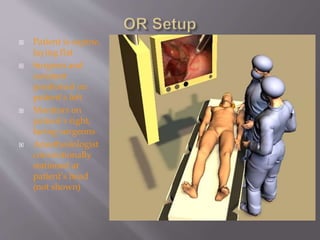
 Patient is supine,
laying flat
 Surgeon and
assistant
positioned on
patient’s left
 Monitors on
patient’s right,
facing surgeons
 Anesthesiologist
conventionally
stationed at
patient’s head
(not shown)
 10-mm trocar
placed through
umbilicus (this
port holds camera)
 5-mm trocar
placed at
suprapubic region
 5-mm trocar
placed at LLQ
 *A fourth port containing
extraction tube may be
placed closer to McBurney’s
point later in procedure.
Step 1: Port placement A 10-mm trocar is placed
at the umbilicus, and the abdominal cavity is
insufflated to a pressure of 15 mmHg. The
camera is also inserted through this larger trocar.
A 5-mm trocar is placed at the suprapubis, and a
second 5-mm trocar is placed at the LLQ.
(Placement of the third port may vary by surgeon
preference or as case dictates but LLQ is standard
placement)
Step 2: Inspect abdominal cavity The area is
inspected to orient the surgeon to the position of
the appendix. Inspection will also alert surgeon to
any anatomic variation or pathological conditions
that may be relevant (e.g. peritonitis).
Step 3: Expose appendix The bowel is
gently retracted rostrally using
atraumatic graspers to allow access to
appendix.
Step 4: Locate and separate appendicular
artery The mesoappendix is separated
from the body of the appendix, and the
mesenteric fat is separated to reveal the
appendicular artery. This is best done
using the “spreader” action of a
dissector.
Step 5: Divide appendix from cecum
Using an endoloop, two loops are placed
proximal to the cecum, and a third loop is
placed 1-2 cm distally to these. The
appendix is then divided between the
two proximal and 3rd distal loops using
scissors or cautery. Staples may be
substituted for loops.
UK surgeons tend to use the Endo GIA
tool, which simultaneously seals and
cuts, eliminating the need for loops or
staples.
Step 6: Divide appendicular artery The
artery is divided using the Endo GIA or
the endoloop method described above
(two ligatures proximally, one distally).
Step 7: Extract appendix A fourth
port (10 mm) may be placed
containing the extraction tube.
Alternately, the camera may be
withdrawn and the existing 10 mm
port used for extraction (a 5 mm
camera is inserted into one of the
smaller ports in these cases).
In either case, an extraction tube is
placed through the appropriate 10
mm port, and the extraction
bag tool is placed through the extraction tube. The appendix is placed in the
capture bag, and removed from the abdomen through the extraction tube.
*(It should be noted that in the accompanying video, a non-conventional extraction technique is used,
probably because the appendix had already ruptured and the extraction bag was deemed unnecessary. The
image above comes from a different case.)
Step 8: Irrigate The abdominal
cavity should be irrigated
thoroughly with sterile saline and
suctioned clean several times. In the
event of a rupture, great care should
be taken to ensure all pus or other
infectious fluids have been
removed.
Step 9: Final inspection The
abdominal and pelvic cavities are
inspected one final time for any signs
of infection, errors, or other potential
complications of which the surgeon
might need to be aware. This can
often be done simultaneously with
irrigation.
 VIDEO

Appendicitis treatment / surgery

  • 2.
    Dr Nitin Jha (MBBS,MS,FIAGES) Consultant Laparoscopic,MISand Bariatric surgeon FORTIS Hospital, Noida. INDIA drnitinjha@yahoo.com
  • 4.
    Anatomic Aspects Blind pouchoff of cecum Contains lymphoid tissue which peaks in adolescence, atrophies with age Function still unclear Appendix can be anywhere within peritoneal cavity One study showed 65 % retrocecal, 31 % pelvic Review of 70,000 cases showed 4 % in RUQ, 0.06 % LUQ, 0.04 % LLQ
  • 6.
    Pathophysiology of Appendicitis Lymphoidhyperplasia leads to luminal obstruction Often follows viral illness Epithelial cells secrete mucus Appendix distends, bacteria multiply Visceral pain begins an average of 17 hours after obstruction Increased pressure compromises blood supply Somatic pain develops Average time to perforation = 34 hrs.
  • 7.
    Classic Presentation Seen in60 % Anorexia Periumbilical pain, nausea, vomiting RLQ pain developing over 24 hrs. Anorexia and pain are most frequent Usually nausea, sometimes vomiting Diarrhea, esp. with pelvic location Usually tender to palpation Rebound is a later finding
  • 9.
    Physical Exam Tenderness atMcBurney's point Cutaneous hyperesthesia in T 10 to 12 dermatomes Rovsing's sign Psoas sign Obturator sign
  • 10.
    High Risk Patients. Pregnancy Mostcommon surgical emergency in pregnancy Mortality rate if missed = 2 % for mother, up to 35 % for fetus WBC elevated in pregnancy Appendix changes location
  • 11.
    High Risk Patients,cont'd. Pediatrics Most common surgical disorder in kids Accounts for 5 % of abd. pain visits Up to 50 % initially misdiagnosed ƒ < 2 yrs. : perforation rate approaches 100 % ƒ 3 to 5 yrs. = 71 % ƒ 6 to 10 yrs. = 40 % Most common misdiagnosis is AGE Sequence of pain and vomiting may be helpful Localized tenderness not a feature of AGE
  • 12.
    High Risk Patients,cont'd. Elderly Vital signs and exam may not reflect severity > age 60 : only 5 to 10 % diagnosed without delay Perforation rate = 46 to 83 % RLQ tenderness absent in 23 % N/V, anorexia less common Leukocytosis less pronounced Only 20 % classic presentation
  • 13.
    High Risk Patients,cont'd. Immunocompromised HIV, chronic steroids, sickle cell, chemotherapy, DM, dialysis Increased risk of complications and misdiagnosis Inflammatory response decreased
  • 14.
    Differential diagnostics Gastrointestinal •Cholecystitis •Crohn's disease •Duodenalulcer •Gastroenteritis •Intestinal obstruction •Meckel's diverticulitis •Mesenteric lymphadenitis •Necrotizing enterocolitis •Neoplasm (carcinoid, carcinoma, lymphoma) Gynecologic •Ectopic pregnancy •Endometriosis •Ovarian torsion •Pelvic inflammatory disease •Ruptured ovarian cyst •Tubo-ovarian abscess
  • 15.
    Systemic  Diabetic ketoacidosis Henoch-Schonlein purpura Pulmonary  Pleuritis  Pneumonia (basilar)  Pulmonary infarction Genitourinary  Kidney stone  Pyelonephritis  Wilms' tumor Other  Parasitic infection  Psoas abscess  Rectus sheath hematoma
  • 16.
    Laboratory Studies CBC 75 to85 % have elevated WBC, but it is nonspecific WBC normal in 80 % in the first 24 hrs. Can see elevated ANC in up to 89 % WBC usually 12 to 18,000 in appendicitis Chemistry panel May help with diagnosis of dehydration
  • 17.
    Laboratory Studies, cont'd. Urinalysis Specificgravity, ketones Can see WBC’s, RBC’s, bacteria if inflamed appendix close to ureter > 30 WBC’s = probable UTI HCG Essential in women of child-bearing age CRP Acute phase reactant
  • 18.
    Imaging Studies Plain films Lowsensitivity and specificity Appendicolith specific, but seen in only 2 % May see local air-fluid levels, psoas obliteration, soft tissue mass, gas in appendix : all nonspecific
  • 19.
    Imaging Studies, cont'd. Ultrasound 75to 90 % sensitive, 86 to 100 % specific Noninvasive, low cost, but operator- dependent Good for diagnosing GYN disorders 3 criteria for diagnosis ƒ Tender, noncompressible appendix ƒ No peristalsis of appendix ƒ Overall diameter > 6 mm
  • 20.
    Imaging Studies, cont'd. CT Earlystudies showed low yield, but helical CT much more accurate Sensitivity 97 to 100 %, specificity 95 % (similar no matter what type or whether contrast is used) Often shows alternative diagnosis More expensive, radiation exposure
  • 21.
    Imaging Studies, cont'd. CT Criteriafor appendicitis : ƒ Diameter > 6 mm ƒ Failure to completely fill with contrast or air ƒ Appendicolith ƒ Wall thickening or enhancement Other contributory signs include fat stranding, fluid, inflammatory mass, adenopathy
  • 22.
    Imaging Studies, cont'd. CT Onestudy showed negative laparotomy rates of 4 % in men, 8 % in ovulating women with CT (typical is 20 % and 45 % respectively), but no change in perforation rate Another study showed increase in CT use led to earlier diagnosis, less severe pathologic findings, and decreased length of stay
  • 23.
    Do We NeedImaging Studies? Literature conflicting Pediatric Imaging -Evidence-Based Guidelines Imaging most useful in clinically equivocal cases Costs of imaging minor compared to cost of unnecessary surgery or delayed diagnosis US and CT both specific enough to rule in appendicitis, but only CT sensitive enough to rule it out
  • 24.
    Risk Management Misdiagnosis ofappendicitis = 5th leading cause of successful litigation against EPs 7 features of misdiagnosed cases : No nausea / vomiting Lack of distress No rebound No guarding No rectal exam (controversial) Narcotic pain meds given Diagnosis of acute gastroenteritis
  • 25.
    Risk Management, cont'd. Whendischarging, stress unclear diagnosis, what to watch for Follow up in 12 hours (PMD or E.D.) Can always observe if unsure "When in doubt, don't send them out."
  • 26.
    TREATMENT  1. OPENAPPENDECTOMY 2. Standard LAP APPENDECTOMY 3. SILS APPENDECTOMY
  • 33.
     Patient issupine, laying flat  Surgeon and assistant positioned on patient’s left  Monitors on patient’s right, facing surgeons  Anesthesiologist conventionally stationed at patient’s head (not shown)
  • 34.
     10-mm trocar placedthrough umbilicus (this port holds camera)  5-mm trocar placed at suprapubic region  5-mm trocar placed at LLQ  *A fourth port containing extraction tube may be placed closer to McBurney’s point later in procedure.
  • 35.
    Step 1: Portplacement A 10-mm trocar is placed at the umbilicus, and the abdominal cavity is insufflated to a pressure of 15 mmHg. The camera is also inserted through this larger trocar. A 5-mm trocar is placed at the suprapubis, and a second 5-mm trocar is placed at the LLQ. (Placement of the third port may vary by surgeon preference or as case dictates but LLQ is standard placement) Step 2: Inspect abdominal cavity The area is inspected to orient the surgeon to the position of the appendix. Inspection will also alert surgeon to any anatomic variation or pathological conditions that may be relevant (e.g. peritonitis).
  • 36.
    Step 3: Exposeappendix The bowel is gently retracted rostrally using atraumatic graspers to allow access to appendix. Step 4: Locate and separate appendicular artery The mesoappendix is separated from the body of the appendix, and the mesenteric fat is separated to reveal the appendicular artery. This is best done using the “spreader” action of a dissector.
  • 37.
    Step 5: Divideappendix from cecum Using an endoloop, two loops are placed proximal to the cecum, and a third loop is placed 1-2 cm distally to these. The appendix is then divided between the two proximal and 3rd distal loops using scissors or cautery. Staples may be substituted for loops. UK surgeons tend to use the Endo GIA tool, which simultaneously seals and cuts, eliminating the need for loops or staples. Step 6: Divide appendicular artery The artery is divided using the Endo GIA or the endoloop method described above (two ligatures proximally, one distally).
  • 38.
    Step 7: Extractappendix A fourth port (10 mm) may be placed containing the extraction tube. Alternately, the camera may be withdrawn and the existing 10 mm port used for extraction (a 5 mm camera is inserted into one of the smaller ports in these cases). In either case, an extraction tube is placed through the appropriate 10 mm port, and the extraction bag tool is placed through the extraction tube. The appendix is placed in the capture bag, and removed from the abdomen through the extraction tube. *(It should be noted that in the accompanying video, a non-conventional extraction technique is used, probably because the appendix had already ruptured and the extraction bag was deemed unnecessary. The image above comes from a different case.)
  • 39.
    Step 8: IrrigateThe abdominal cavity should be irrigated thoroughly with sterile saline and suctioned clean several times. In the event of a rupture, great care should be taken to ensure all pus or other infectious fluids have been removed. Step 9: Final inspection The abdominal and pelvic cavities are inspected one final time for any signs of infection, errors, or other potential complications of which the surgeon might need to be aware. This can often be done simultaneously with irrigation.
  • 40.