Click to Edit Master Title Style
APLU Study of Capital Infrastructure and
Deferred Maintenance
> Data Collection Webinar 2/27/2015
Click to Edit Master Title StyleAgenda
> Overview of the purpose of the APLU Study– Ian Maw
> Basic Approach and Project Plan– Peter Reeves
> Overview of methodology, process, and timeline
> Outline of parameters to be used in identifying buildings to be included –
Peter Reeves
> Overview of data collection survey and building inventory – Peter Reeves
> Next Steps – Ian Maw & Peter Reeves
Click to Edit Master Title StyleBasic Approach
> Data collected through a survey approach
> Submission of a simplified building inventory(Building level data) for defined subset of agriculture
and related buildings.
> Response to a short survey regarding existing deferred maintenance study and campus
investment.
> Deferred maintenance estimation
> Utilizing a proprietary model, Sightlines will establish a building level deferred maintenance
estimate.
> For campuses with a existing deferred maintenance studies, campuses will submit data and
Sightlines will perform a validation test.
> Deliverable of results
> Sightlines will prepare a Country/regional level analysis in a report, highlighting the existing needs
for APLU/USDA facilities
> Sightlines will prepare and deliver a presentation at an APLU event
> Sightlines will provide each campus with their building specific data and deferred maintenance
estimates
3
Click to Edit Master Title StyleProcess will require collaboration
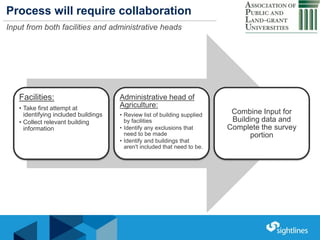
Input from both facilities and administrative heads
Facilities:
• Take first attempt at
identifying included buildings
• Collect relevant building
information
Administrative head of
Agriculture:
• Review list of building supplied
by facilities
• Identify any exclusions that
need to be made
• Identify and buildings that
aren't included that need to be.
Combine Input for
Building data and
Complete the survey
portion
Click to Edit Master Title StyleProject Plan
5
Pre - Weeks
Sightlines Prework to prepare define scope and develop
documents and Survey. November 17th - 28th
Pre - Week Sightlines Meets with Steering Committee
December 11th
Pre - Weeks
Sightlines incorporates Feedback from Steering Committee,
Finalizes webinar kick-off. December 11th - 31st
Week 1 & 2 Sightlines Holds 2 Kick-off meetings.
February 27th & March
12th
Week 1
Survey and Documents go live immediately follow kick-off
meeting February 27th
Week 6
Sightlines provides update on response rate & Meet with the
steering committee April 10th
Week 8 Sightlines Closes Survey and begins data analysis.
April 24th
Week 9 - 14
Sightlines conducts preliminary analysis, identifies any
institutions that need additional follow-up meetings. May 1st - 29th
Week 10 Review Preliminary Findings with the Steering Committee
Week of May 18th
Week 12-14(If Necessary)
Conduct follow-up meetings with any institutions deemed
necessary. May 18th - 29th
Week 14 Finalize Source data for Report
June 5th
Week 16 Present Final Data Analysis to the Steering Committee
Week of June 15th
Week 18 Circulate Draft Report to Steering Committee
June 29th
Week 20 Finalize written report & Presentation
July 15th
APLU Deferred Maintenance Study - Project Plan
Click to Edit Master Title Style
Parameters to be used in
identifying Included buildings
6
Click to Edit Master Title StyleDefining the included space
> Broadly Defined:
> “Any space involved in teaching, research, and extension related to agriculture
broadly defined”
> Practically Defined:
> Any University owned(i.e. not leased) facilities that fall under that University’s
School of Agriculture and would be eligible for USDA funding.
This may include, but not be limited to:
• Animal Sciences
• Vet schools (if part of school of
ag)
• Environmental Sciences
• Food Science (Nutrition)
• Plant Sciences
• Forestry
• Entymology
• Coastal and Marine Science
• Agriculture & resource
economics
• Textile and Clothing
• Biological and Agricultural
Engineering
• Natural Resources
• Off-site farms/Research Stations
• Owned Extension sites
Click to Edit Master Title StyleSome Specification to inclusions
For Off-site Facilities
Include if…
> They are owned or on long –term leases that include university responsibility for
capital improvements
> In the case of residences on farms/research stations, they are occupied by
researchers/caretakers
> In the case of marine/coastal functions, if they are onshore
Exclude if…
> They are leased space with no or minimal capital improvement responsibility
> Residences are rented out to non-university personnel
> They are off-shore facilities(boats, platforms, etc.)
8
Click to Edit Master Title StyleSome Specification to inclusions
For Multipurpose Facilities
> Include the entire building
> Building inventory will include a place to indicate approximate
percentage of building dedicated to included functions.
> i.e. Science building A (a four story building) has general science functions on
three floors with one floor of agriculture research. Building will be included, and
it will be indicated that it is 25% included functions
9
Click to Edit Master Title StyleSome Specification to inclusions
Other considerations
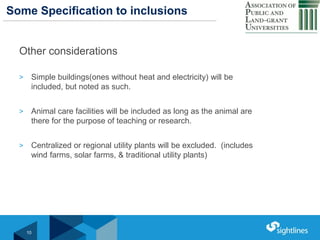
> Simple buildings(ones without heat and electricity) will be
included, but noted as such.
> Animal care facilities will be included as long as the animal are
there for the purpose of teaching or research.
> Centralized or regional utility plants will be excluded. (includes
wind farms, solar farms, & traditional utility plants)
10
Click to Edit Master Title Style
Overview of data collection
11
Click to Edit Master Title StyleData collection approach
12
> 2 major components
> Building inventory
> Online survey
> Building inventory documents will be sent out with survey
invitation, should be completed prior to beginning the
survey
> Survey asks basic institutional questions and allows for
building inventory and existing DM studies/Facilities
condition assessments to be uploaded.
> Survey timeline – 8 weeks
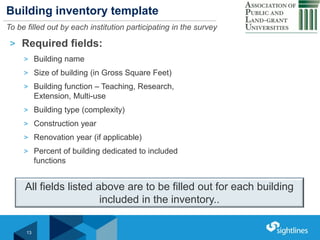
Click to Edit Master Title StyleBuilding inventory template
To be filled out by each institution participating in the survey
> Required fields:
> Building name
> Size of building (in Gross Square Feet)
> Building function – Teaching, Research,
Extension, Multi-use
> Building type (complexity)
> Construction year
> Renovation year (if applicable)
> Percent of building dedicated to included
functions
13
All fields listed above are to be filled out for each building
included in the inventory..
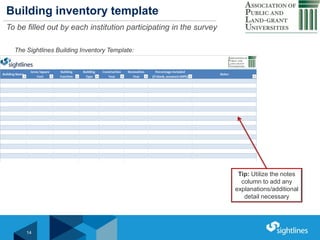
Click to Edit Master Title StyleBuilding inventory template
To be filled out by each institution participating in the survey
14
The Sightlines Building Inventory Template:
Tip: Utilize the notes
column to add any
explanations/additional
detail necessary
Click to Edit Master Title StyleBuilding inventory definitions
Defining Sightlines’ building functions
15
Building Function Definitions and Examples
Classroom/Teaching
Buildings with classrooms and/or faculty and administrative offices.
Includes libraries.
Sci. Research
Science building with lab space and other research space. Includes
veterinary hospitals/animal care facilities
Extension Buildings dedicated to extension function
Farm/Animal Buildings Barns, animal handling, feed mills, animal quarters, etc.
Greenhouses Glass or plastic greenhouses
Support Facilities buildings, storage garages.
Click to Edit Master Title StyleBuilding inventory definitions
Defining Sightlines’ building types based on complexity
16
Building Type Definitions and Examples
Complex
Buildings with complex systems. In addition to heating and cooling, they
have more sophisticated systems like Fume Hoods (>10), reheats,
greater outside air requirements and specilty dehumidification
equipments.
Basic
Buildings with basic systems. Standard Heating and cooling throughout.
Simple Buildings with simple systems. Most often just heating, possibly with
some local cooling.
Non-Utility Buildings without heating and electricity
Small Buildings under 5,000 GSF, with utility service.
Click to Edit Master Title StyleBuilding inventory definitions
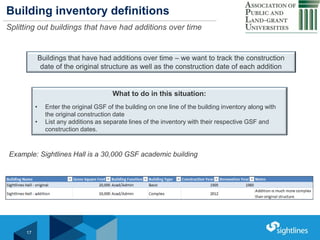
Splitting out buildings that have had additions over time
17
Buildings that have had additions over time – we want to track the construction
date of the original structure as well as the construction date of each addition
What to do in this situation:
• Enter the original GSF of the building on one line of the building inventory along with
the original construction date
• List any additions as separate lines of the inventory with their respective GSF and
construction dates.
Example: Sightlines Hall is a 30,000 GSF academic building
Click to Edit Master Title StyleBuilding inventory definitions
Defining a major renovation
18
Fill out the Renovation Year column for any building that underwent a “major renovation”
Definition of a major renovation:
• A large-scale renovation that cost at least 50% of the building's replacement value
and/or the scope of which involved work done on at least 50% of the building's various
components, resetting their lifecycles.
• More than a basic space renewal renovation that simply modernizes interior finishes
and furnishings - should also include work on mechanical/electrical/HVAC systems, the
building envelope (windows, roof, exterior shell), and/or safety or code projects (ADA
work, asbestos remediation, etc.)
• Example: A building originally constructed in 1910 underwent a renovation in 2011 that
replaced HVAC systems, windows, and completed a full interior modernization. The
building now feels like a 2011-era building. The renovation should be tracked as 2011
in the building inventory.
Click to Edit Master Title StyleOnline Survey Elements
19
> Data Elements:
> Institutional Contact
> Existing Deferred Maintenance / Facilities Condition
assessments
> When completed
> Methodology
> Uploading of documents
> Historical Investment profile
Click to Edit Master Title StyleInstitutional Contact Data
20
University Contact person should be
who we can follow up with regarding
the data if any issues arise.
Click to Edit Master Title StyleBasic Building and Campus information
21
Building inventory upload
here
Approximation of
average capital
investment over the last
5 years:
• All sources of funding
• Excludes new
construction
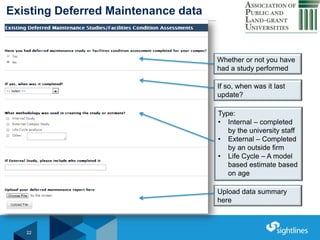
Click to Edit Master Title StyleExisting Deferred Maintenance data
22
Whether or not you have
had a study performed
If so, when was it last
update?
Upload data summary
here
Type:
• Internal – completed
by the university staff
• External – Completed
by an outside firm
• Life Cycle – A model
based estimate based
on age
Click to Edit Master Title Style
Next Steps
23
Click to Edit Master Title StyleWebinar Schedule
> February 27th – Survey and Documents Live
> April 10th – Sightlines provides first update on response rate
> April 24th – Survey closes for submissions
> May 2015 – Sightlines conducts preliminary analysis and follow
ups as needed
> May – June 2015 – Completion of data analysis and preparation
or report.
24
Click to Edit Master Title Style
Questions and Comments
25

Sightlines/APLU Capital Infrastructure and Deferred Maintenance Study - Kickoff Meeting

  • 1.
    Click to EditMaster Title Style APLU Study of Capital Infrastructure and Deferred Maintenance > Data Collection Webinar 2/27/2015
  • 2.
    Click to EditMaster Title StyleAgenda > Overview of the purpose of the APLU Study– Ian Maw > Basic Approach and Project Plan– Peter Reeves > Overview of methodology, process, and timeline > Outline of parameters to be used in identifying buildings to be included – Peter Reeves > Overview of data collection survey and building inventory – Peter Reeves > Next Steps – Ian Maw & Peter Reeves
  • 3.
    Click to EditMaster Title StyleBasic Approach > Data collected through a survey approach > Submission of a simplified building inventory(Building level data) for defined subset of agriculture and related buildings. > Response to a short survey regarding existing deferred maintenance study and campus investment. > Deferred maintenance estimation > Utilizing a proprietary model, Sightlines will establish a building level deferred maintenance estimate. > For campuses with a existing deferred maintenance studies, campuses will submit data and Sightlines will perform a validation test. > Deliverable of results > Sightlines will prepare a Country/regional level analysis in a report, highlighting the existing needs for APLU/USDA facilities > Sightlines will prepare and deliver a presentation at an APLU event > Sightlines will provide each campus with their building specific data and deferred maintenance estimates 3
  • 4.
    Click to EditMaster Title StyleProcess will require collaboration Input from both facilities and administrative heads Facilities: • Take first attempt at identifying included buildings • Collect relevant building information Administrative head of Agriculture: • Review list of building supplied by facilities • Identify any exclusions that need to be made • Identify and buildings that aren't included that need to be. Combine Input for Building data and Complete the survey portion
  • 5.
    Click to EditMaster Title StyleProject Plan 5 Pre - Weeks Sightlines Prework to prepare define scope and develop documents and Survey. November 17th - 28th Pre - Week Sightlines Meets with Steering Committee December 11th Pre - Weeks Sightlines incorporates Feedback from Steering Committee, Finalizes webinar kick-off. December 11th - 31st Week 1 & 2 Sightlines Holds 2 Kick-off meetings. February 27th & March 12th Week 1 Survey and Documents go live immediately follow kick-off meeting February 27th Week 6 Sightlines provides update on response rate & Meet with the steering committee April 10th Week 8 Sightlines Closes Survey and begins data analysis. April 24th Week 9 - 14 Sightlines conducts preliminary analysis, identifies any institutions that need additional follow-up meetings. May 1st - 29th Week 10 Review Preliminary Findings with the Steering Committee Week of May 18th Week 12-14(If Necessary) Conduct follow-up meetings with any institutions deemed necessary. May 18th - 29th Week 14 Finalize Source data for Report June 5th Week 16 Present Final Data Analysis to the Steering Committee Week of June 15th Week 18 Circulate Draft Report to Steering Committee June 29th Week 20 Finalize written report & Presentation July 15th APLU Deferred Maintenance Study - Project Plan
  • 6.
    Click to EditMaster Title Style Parameters to be used in identifying Included buildings 6
  • 7.
    Click to EditMaster Title StyleDefining the included space > Broadly Defined: > “Any space involved in teaching, research, and extension related to agriculture broadly defined” > Practically Defined: > Any University owned(i.e. not leased) facilities that fall under that University’s School of Agriculture and would be eligible for USDA funding. This may include, but not be limited to: • Animal Sciences • Vet schools (if part of school of ag) • Environmental Sciences • Food Science (Nutrition) • Plant Sciences • Forestry • Entymology • Coastal and Marine Science • Agriculture & resource economics • Textile and Clothing • Biological and Agricultural Engineering • Natural Resources • Off-site farms/Research Stations • Owned Extension sites
  • 8.
    Click to EditMaster Title StyleSome Specification to inclusions For Off-site Facilities Include if… > They are owned or on long –term leases that include university responsibility for capital improvements > In the case of residences on farms/research stations, they are occupied by researchers/caretakers > In the case of marine/coastal functions, if they are onshore Exclude if… > They are leased space with no or minimal capital improvement responsibility > Residences are rented out to non-university personnel > They are off-shore facilities(boats, platforms, etc.) 8
  • 9.
    Click to EditMaster Title StyleSome Specification to inclusions For Multipurpose Facilities > Include the entire building > Building inventory will include a place to indicate approximate percentage of building dedicated to included functions. > i.e. Science building A (a four story building) has general science functions on three floors with one floor of agriculture research. Building will be included, and it will be indicated that it is 25% included functions 9
  • 10.
    Click to EditMaster Title StyleSome Specification to inclusions Other considerations > Simple buildings(ones without heat and electricity) will be included, but noted as such. > Animal care facilities will be included as long as the animal are there for the purpose of teaching or research. > Centralized or regional utility plants will be excluded. (includes wind farms, solar farms, & traditional utility plants) 10
  • 11.
    Click to EditMaster Title Style Overview of data collection 11
  • 12.
    Click to EditMaster Title StyleData collection approach 12 > 2 major components > Building inventory > Online survey > Building inventory documents will be sent out with survey invitation, should be completed prior to beginning the survey > Survey asks basic institutional questions and allows for building inventory and existing DM studies/Facilities condition assessments to be uploaded. > Survey timeline – 8 weeks
  • 13.
    Click to EditMaster Title StyleBuilding inventory template To be filled out by each institution participating in the survey > Required fields: > Building name > Size of building (in Gross Square Feet) > Building function – Teaching, Research, Extension, Multi-use > Building type (complexity) > Construction year > Renovation year (if applicable) > Percent of building dedicated to included functions 13 All fields listed above are to be filled out for each building included in the inventory..
  • 14.
    Click to EditMaster Title StyleBuilding inventory template To be filled out by each institution participating in the survey 14 The Sightlines Building Inventory Template: Tip: Utilize the notes column to add any explanations/additional detail necessary
  • 15.
    Click to EditMaster Title StyleBuilding inventory definitions Defining Sightlines’ building functions 15 Building Function Definitions and Examples Classroom/Teaching Buildings with classrooms and/or faculty and administrative offices. Includes libraries. Sci. Research Science building with lab space and other research space. Includes veterinary hospitals/animal care facilities Extension Buildings dedicated to extension function Farm/Animal Buildings Barns, animal handling, feed mills, animal quarters, etc. Greenhouses Glass or plastic greenhouses Support Facilities buildings, storage garages.
  • 16.
    Click to EditMaster Title StyleBuilding inventory definitions Defining Sightlines’ building types based on complexity 16 Building Type Definitions and Examples Complex Buildings with complex systems. In addition to heating and cooling, they have more sophisticated systems like Fume Hoods (>10), reheats, greater outside air requirements and specilty dehumidification equipments. Basic Buildings with basic systems. Standard Heating and cooling throughout. Simple Buildings with simple systems. Most often just heating, possibly with some local cooling. Non-Utility Buildings without heating and electricity Small Buildings under 5,000 GSF, with utility service.
  • 17.
    Click to EditMaster Title StyleBuilding inventory definitions Splitting out buildings that have had additions over time 17 Buildings that have had additions over time – we want to track the construction date of the original structure as well as the construction date of each addition What to do in this situation: • Enter the original GSF of the building on one line of the building inventory along with the original construction date • List any additions as separate lines of the inventory with their respective GSF and construction dates. Example: Sightlines Hall is a 30,000 GSF academic building
  • 18.
    Click to EditMaster Title StyleBuilding inventory definitions Defining a major renovation 18 Fill out the Renovation Year column for any building that underwent a “major renovation” Definition of a major renovation: • A large-scale renovation that cost at least 50% of the building's replacement value and/or the scope of which involved work done on at least 50% of the building's various components, resetting their lifecycles. • More than a basic space renewal renovation that simply modernizes interior finishes and furnishings - should also include work on mechanical/electrical/HVAC systems, the building envelope (windows, roof, exterior shell), and/or safety or code projects (ADA work, asbestos remediation, etc.) • Example: A building originally constructed in 1910 underwent a renovation in 2011 that replaced HVAC systems, windows, and completed a full interior modernization. The building now feels like a 2011-era building. The renovation should be tracked as 2011 in the building inventory.
  • 19.
    Click to EditMaster Title StyleOnline Survey Elements 19 > Data Elements: > Institutional Contact > Existing Deferred Maintenance / Facilities Condition assessments > When completed > Methodology > Uploading of documents > Historical Investment profile
  • 20.
    Click to EditMaster Title StyleInstitutional Contact Data 20 University Contact person should be who we can follow up with regarding the data if any issues arise.
  • 21.
    Click to EditMaster Title StyleBasic Building and Campus information 21 Building inventory upload here Approximation of average capital investment over the last 5 years: • All sources of funding • Excludes new construction
  • 22.
    Click to EditMaster Title StyleExisting Deferred Maintenance data 22 Whether or not you have had a study performed If so, when was it last update? Upload data summary here Type: • Internal – completed by the university staff • External – Completed by an outside firm • Life Cycle – A model based estimate based on age
  • 23.
    Click to EditMaster Title Style Next Steps 23
  • 24.
    Click to EditMaster Title StyleWebinar Schedule > February 27th – Survey and Documents Live > April 10th – Sightlines provides first update on response rate > April 24th – Survey closes for submissions > May 2015 – Sightlines conducts preliminary analysis and follow ups as needed > May – June 2015 – Completion of data analysis and preparation or report. 24
  • 25.
    Click to EditMaster Title Style Questions and Comments 25