Open Standards for Getting
Your APIs into the
Geospatial Ecosystem
Gobe Hobona, PhD
Director of Product Management for Standards Copyright © 2024 Open Geospatial Consortium
Introduction
• The importance of location to your data and your APIs
• Vision and mission of the Open Geospatial Consortium (OGC)
• What is an OGC Standard?
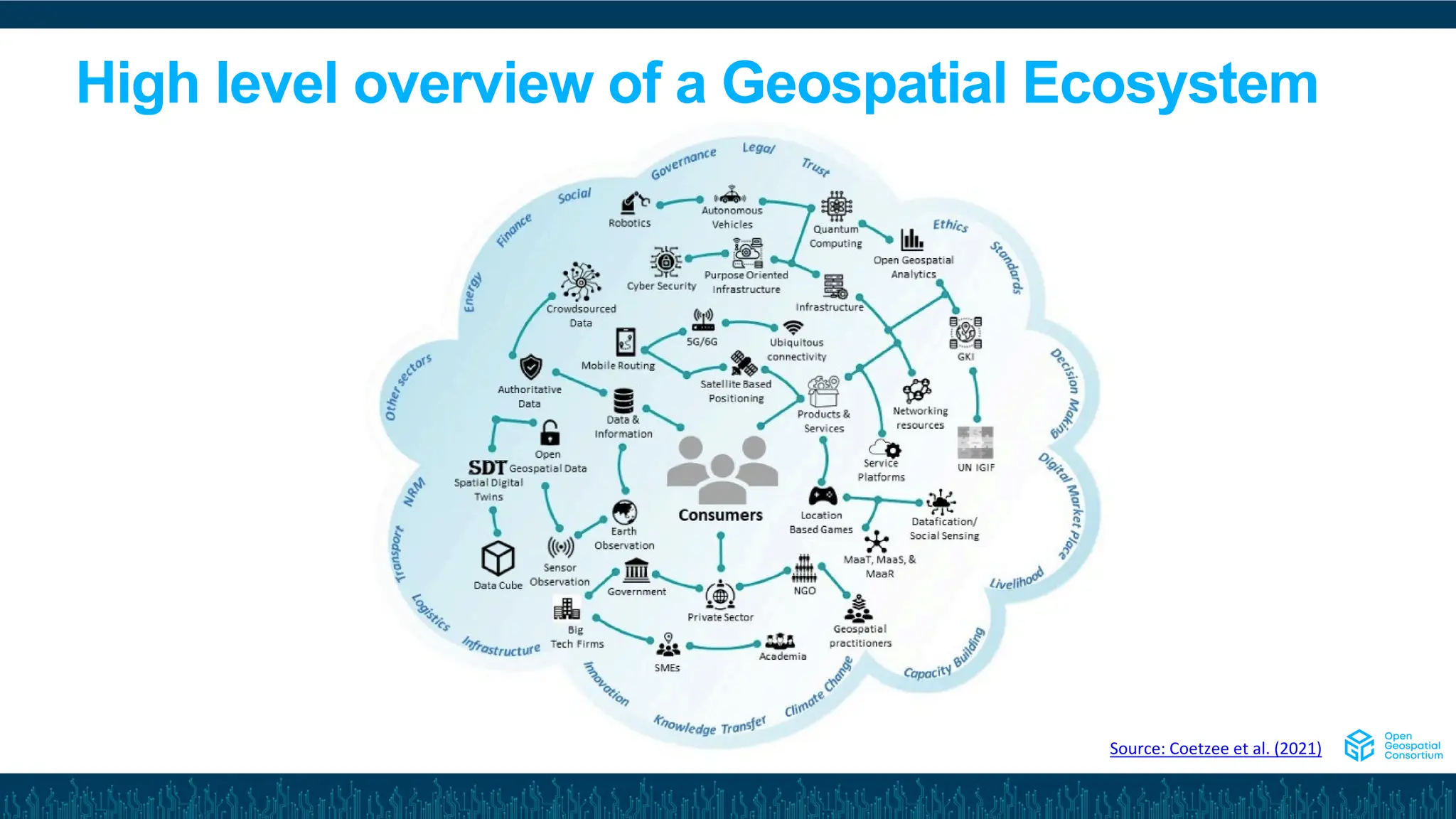
High level overview of a Geospatial Ecosystem
Source: Coetzee et al. (2021)
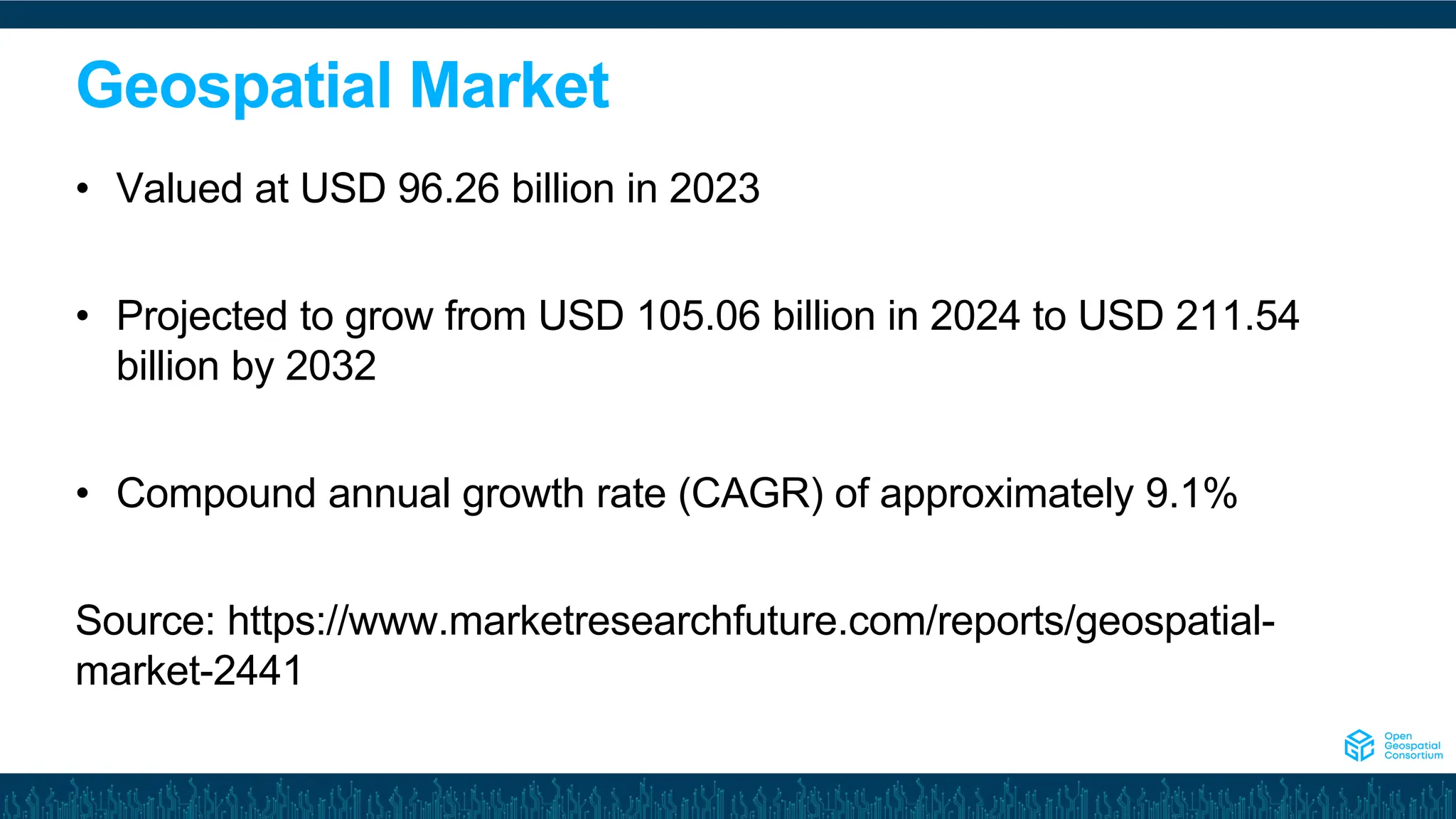
Geospatial Market
• Valued at USD 96.26 billion in 2023
• Projected to grow from USD 105.06 billion in 2024 to USD 211.54
billion by 2032
• Compound annual growth rate (CAGR) of approximately 9.1%
Source: https://www.marketresearchfuture.com/reports/geospatial-
market-2441
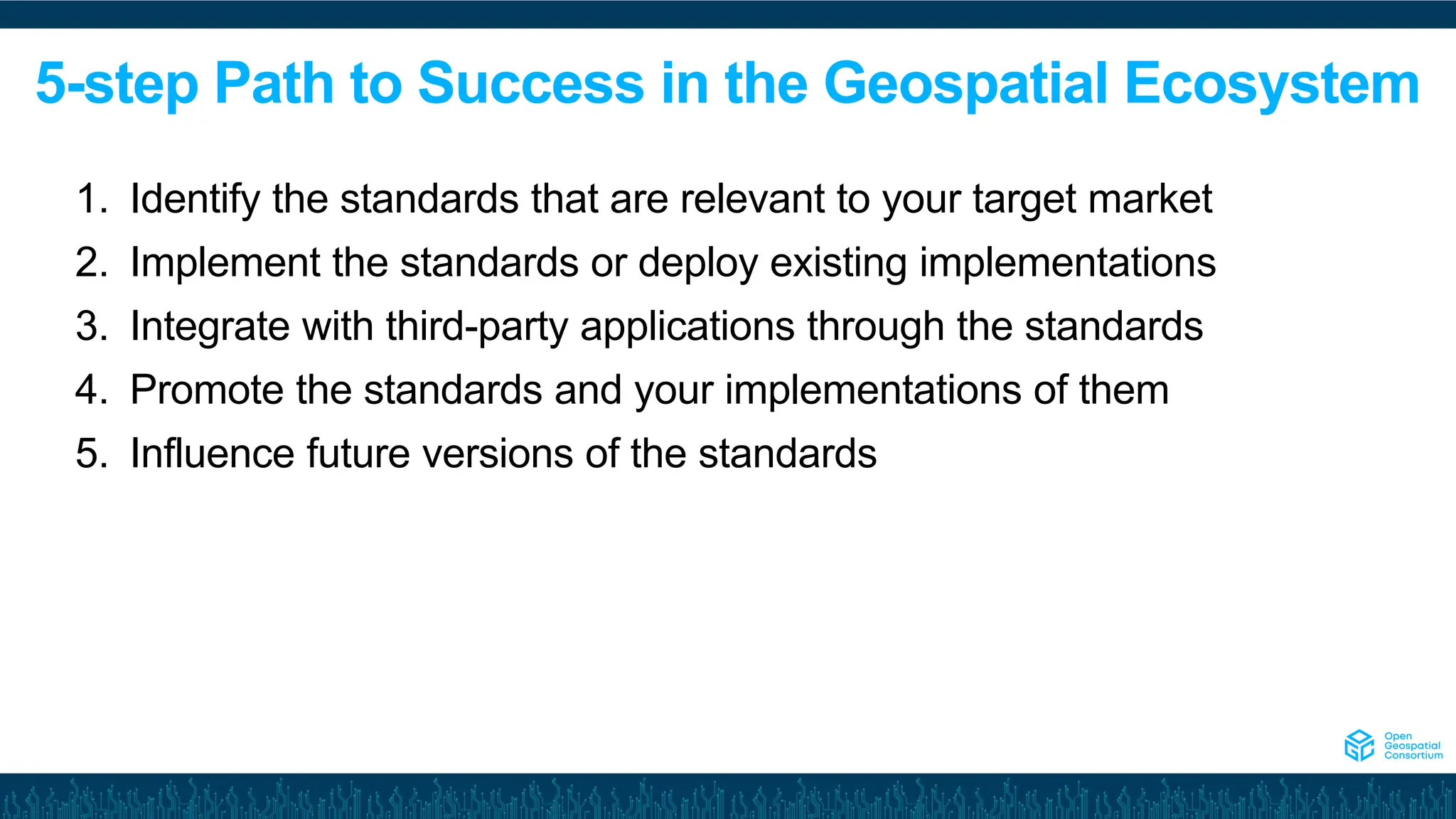
5-step Path to Success in the Geospatial Ecosystem
1. Identify the standards that are relevant to your target market
2. Implement the standards or deploy existing implementations
3. Integrate with third-party applications through the standards
4. Promote the standards and your implementations of them
5. Influence future versions of the standards
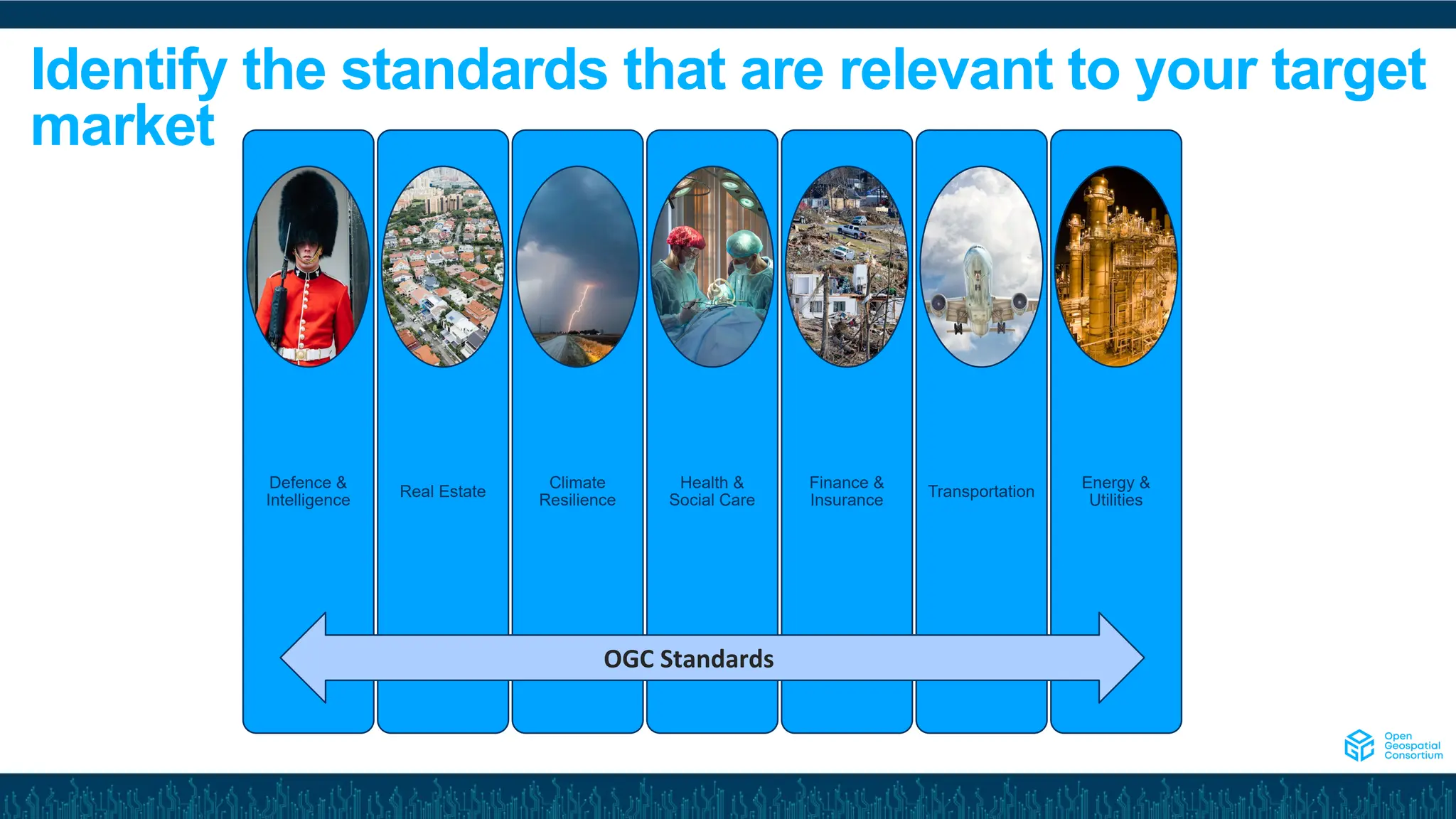
Identify the standards that are relevant to your target
market
Defence &
Intelligence
Real Estate
Climate
Resilience
Health &
Social Care
Finance &
Insurance
Transportation
Energy &
Utilities
OGC Standards
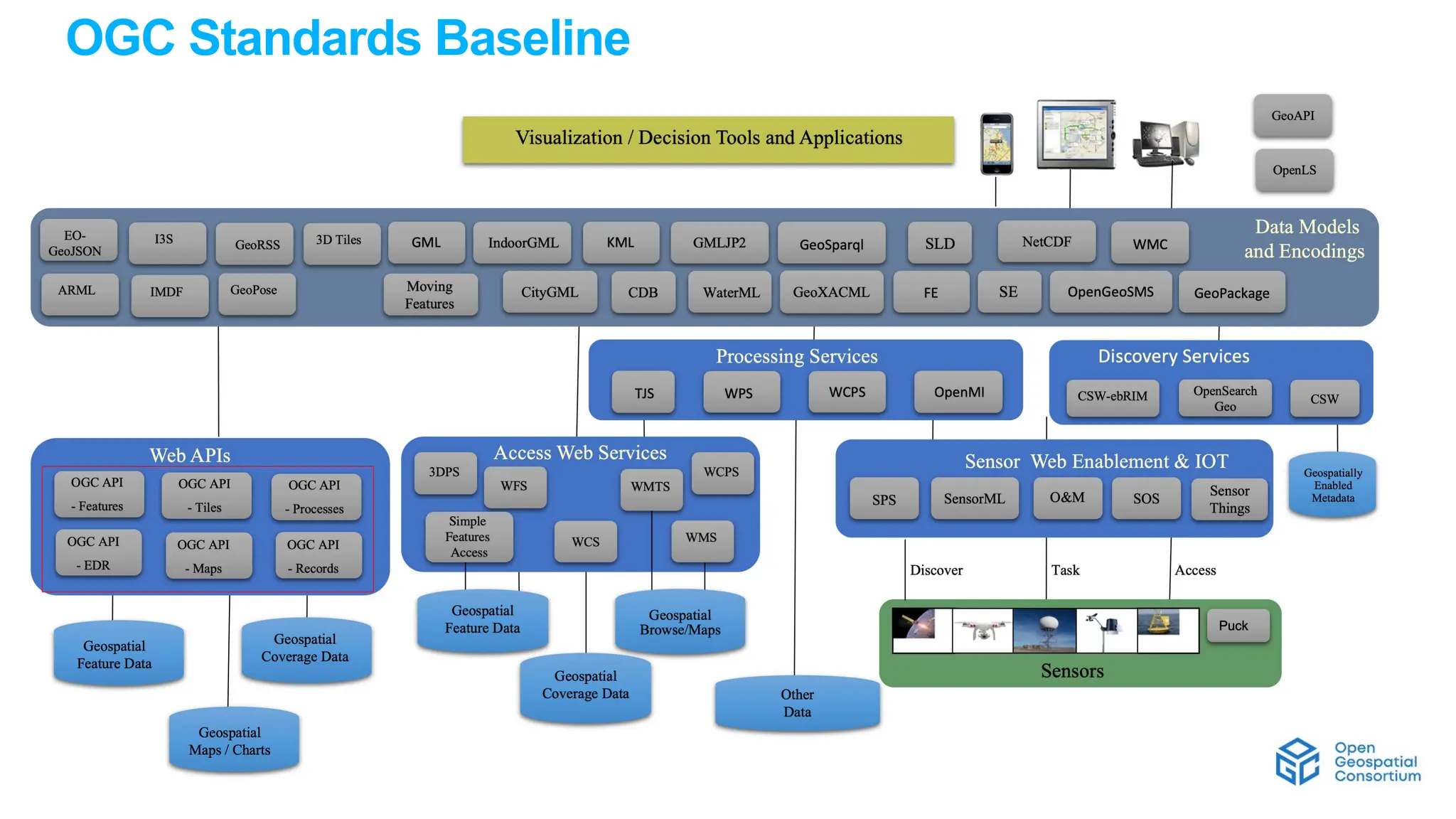
OGC Standards Baseline
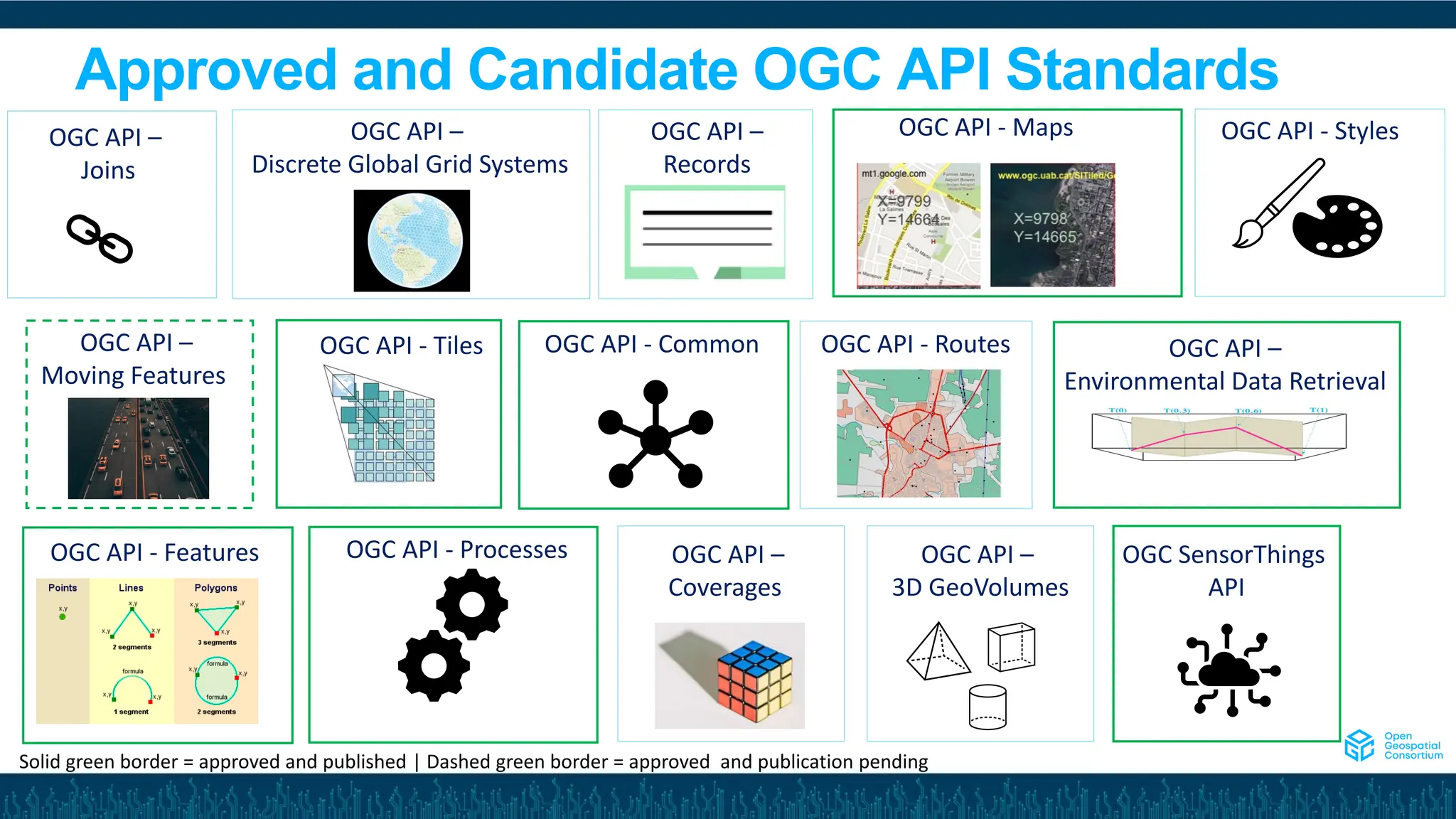
OGC API - Maps
OGC API - Tiles
OGC API - Features
OGC API –
Environmental Data Retrieval
OGC API –
Records
OGC API - Styles
OGC API –
Discrete Global Grid Systems
OGC API - Processes
OGC API - Common OGC API - Routes
OGC API –
Coverages
OGC API –
Moving Features
OGC API –
Joins
OGC API –
3D GeoVolumes
Solid green border = approved and published | Dashed green border = approved and publication pending
OGC SensorThings
API
Approved and Candidate OGC API Standards
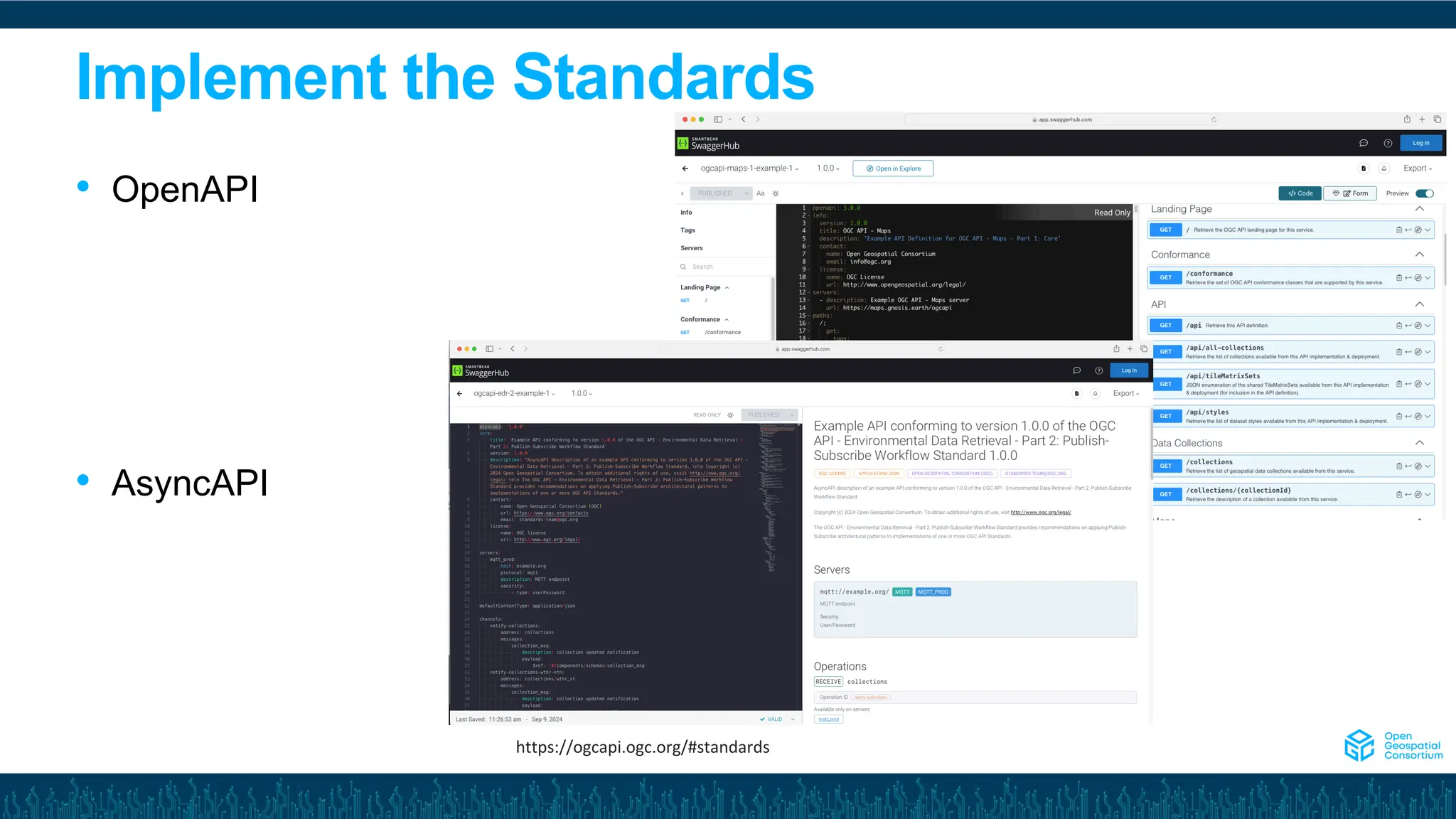
Implement the Standards
• OpenAPI
• AsyncAPI
https://ogcapi.ogc.org/#standards
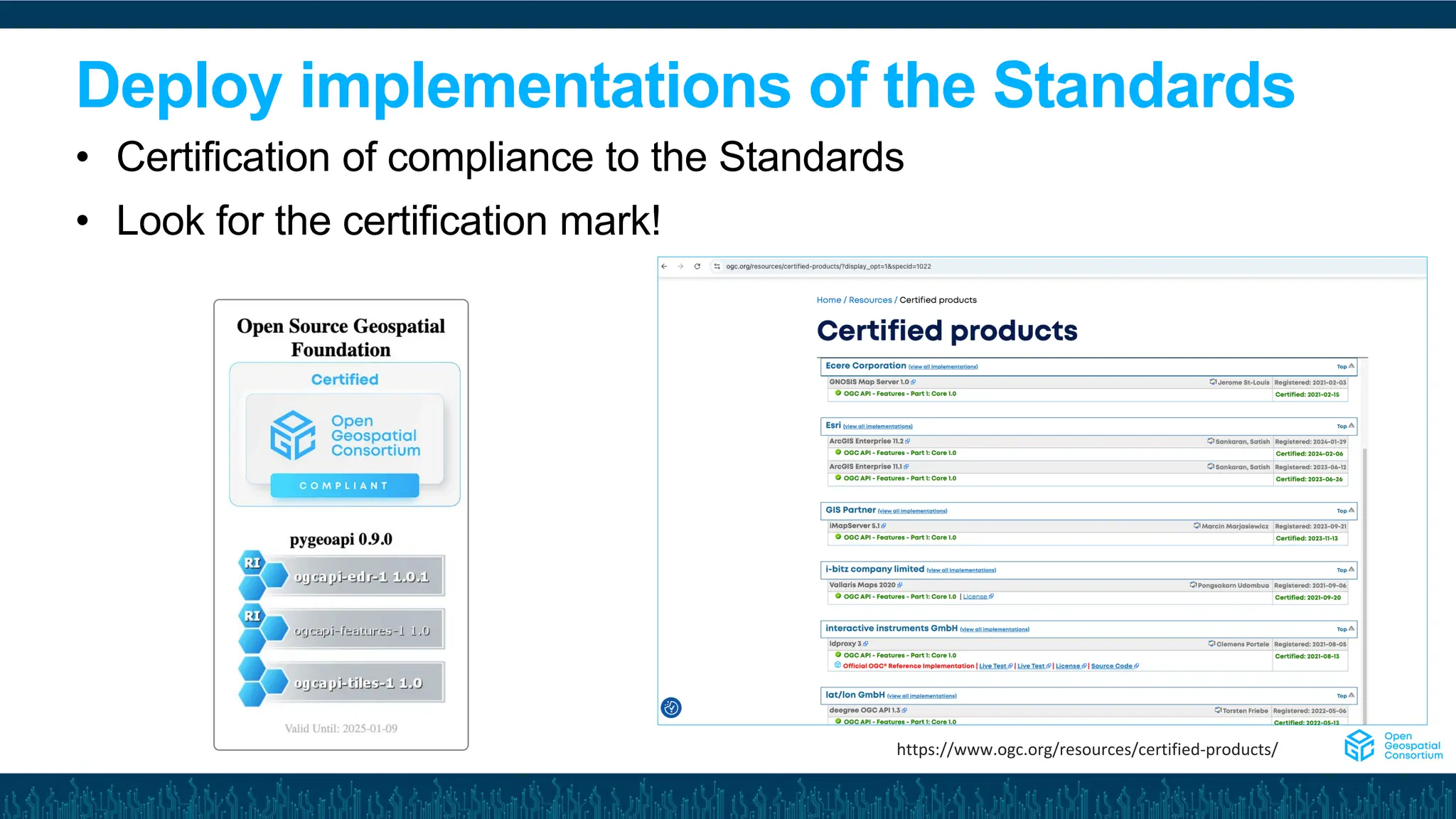
Deploy implementations of the Standards
• Certification of compliance to the Standards
• Look for the certification mark!
https://www.ogc.org/resources/certified-products/
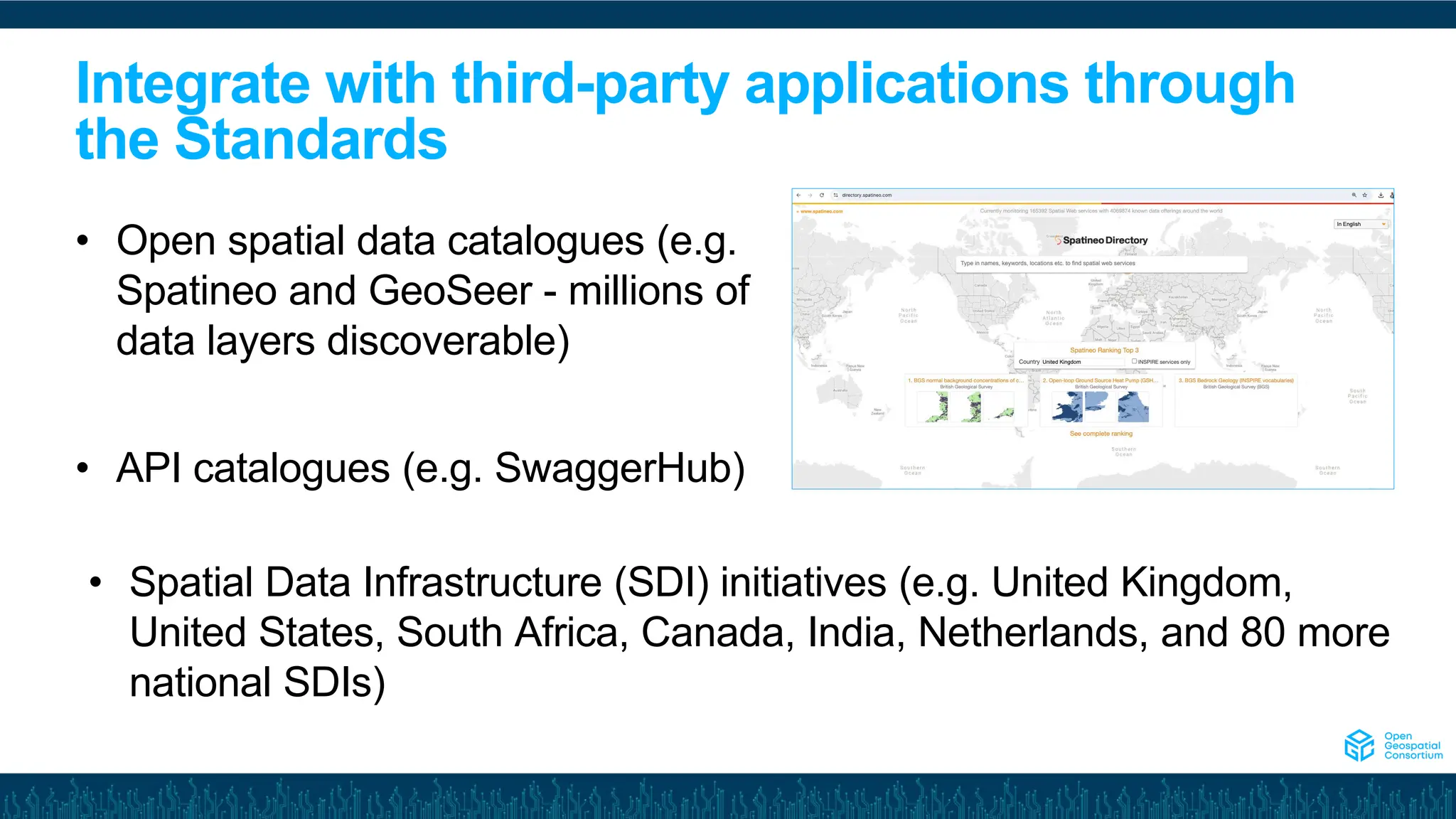
Integrate with third-party applications through
the Standards
• Open spatial data catalogues (e.g.
Spatineo and GeoSeer - millions of
data layers discoverable)
• API catalogues (e.g. SwaggerHub)
• Spatial Data Infrastructure (SDI) initiatives (e.g. United Kingdom,
United States, South Africa, Canada, India, Netherlands, and 80 more
national SDIs)
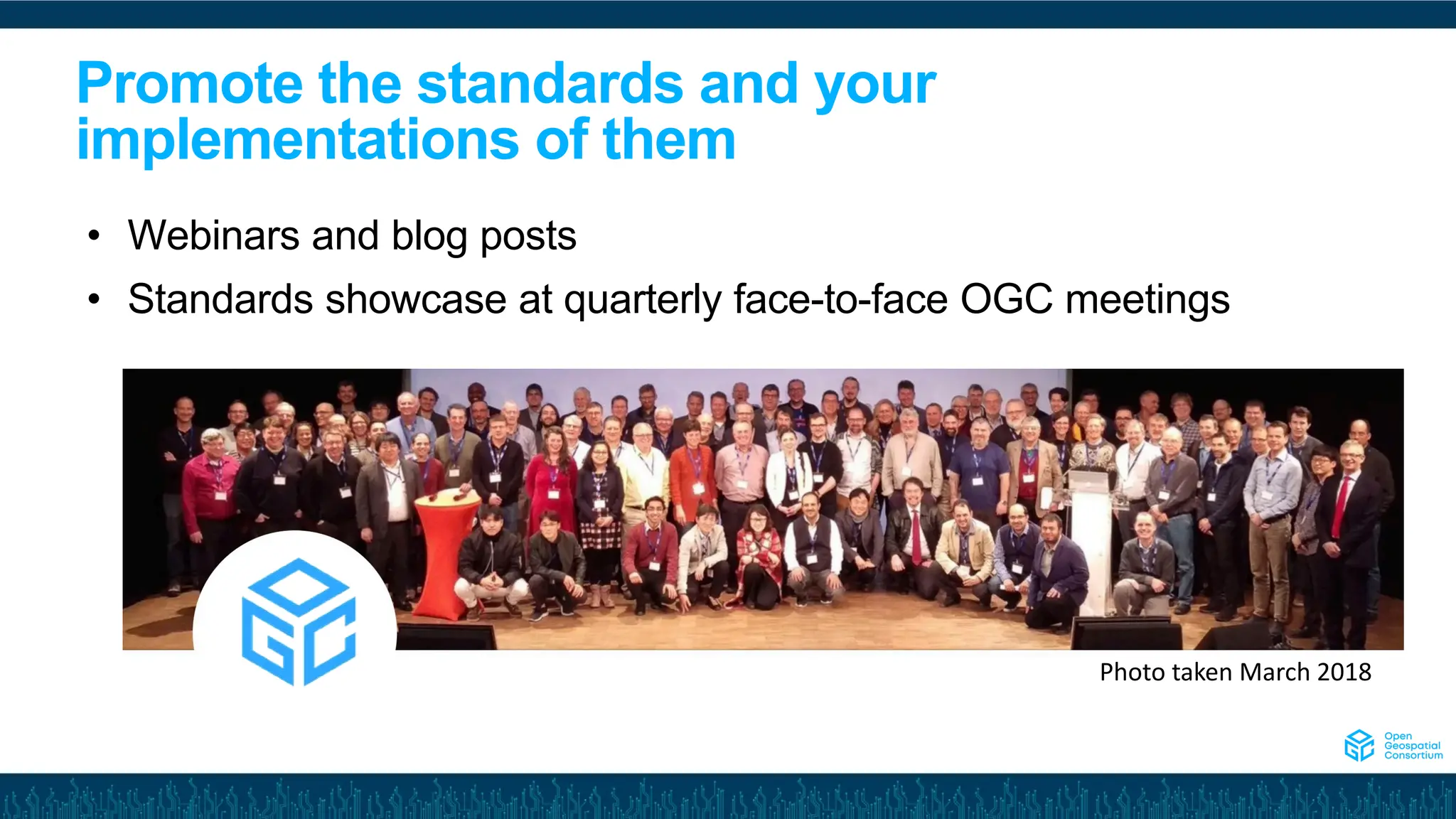
Promote the standards and your
implementations of them
Photo taken March 2018
• Webinars and blog posts
• Standards showcase at quarterly face-to-face OGC meetings
Influence future versions of the Standards
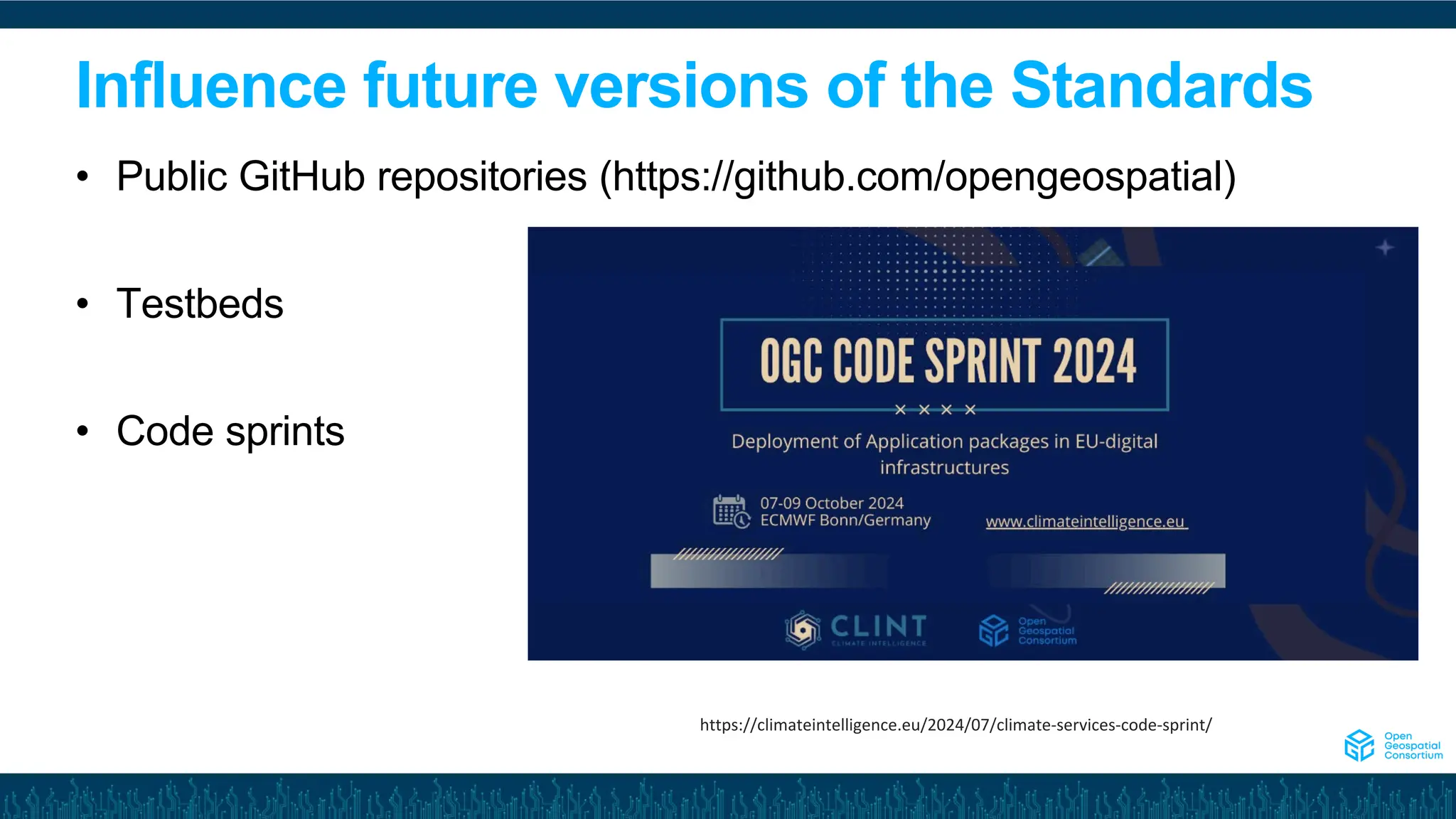
• Public GitHub repositories (https://github.com/opengeospatial)
• Testbeds
• Code sprints
https://climateintelligence.eu/2024/07/climate-services-code-sprint/
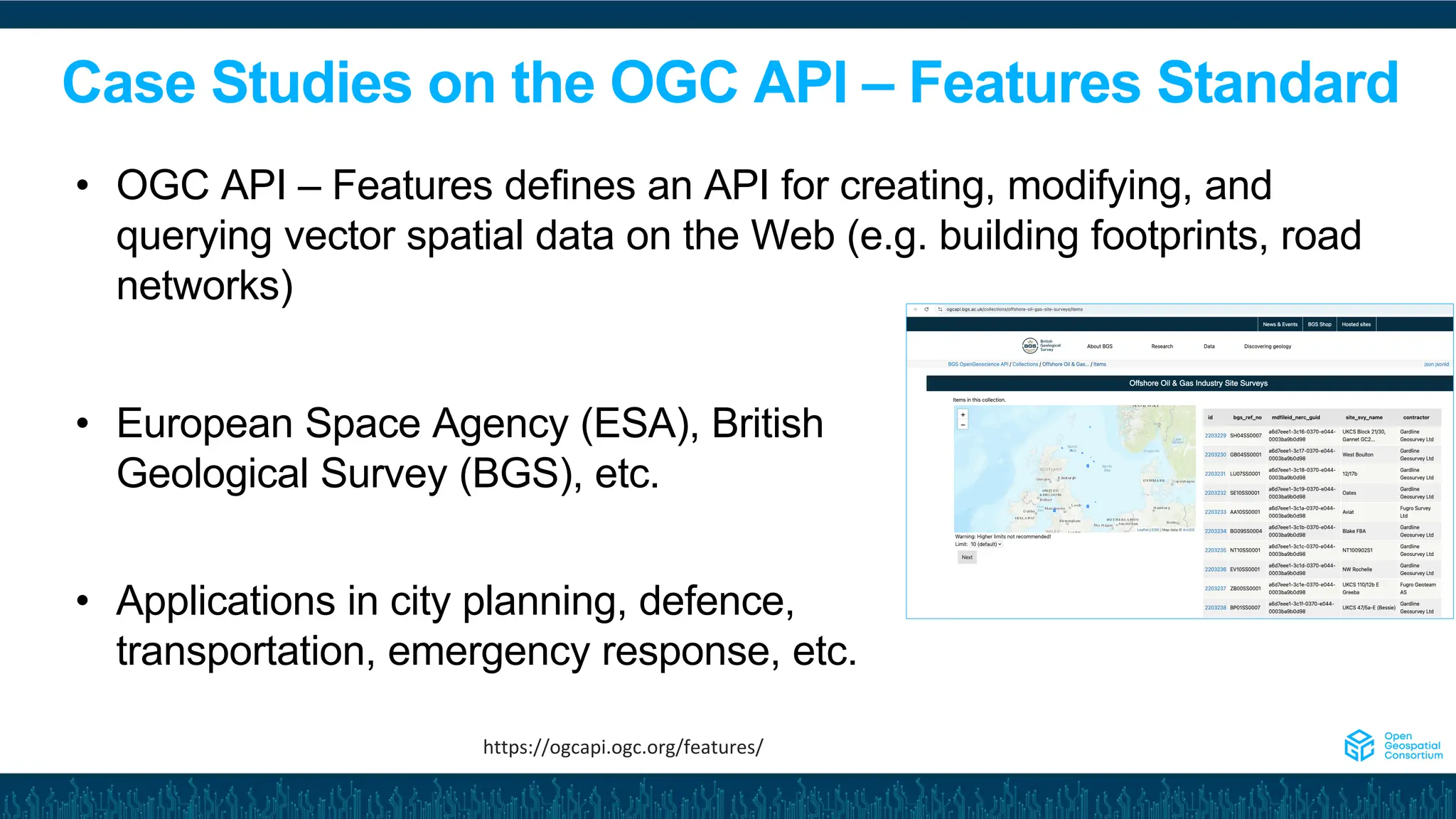
Case Studies on the OGC API – Features Standard
• European Space Agency (ESA), British
Geological Survey (BGS), etc.
• Applications in city planning, defence,
transportation, emergency response, etc.
• OGC API – Features defines an API for creating, modifying, and
querying vector spatial data on the Web (e.g. building footprints, road
networks)
https://ogcapi.ogc.org/features/
Case Studies on the OGC API – Environmental
Data Retrieval Standard
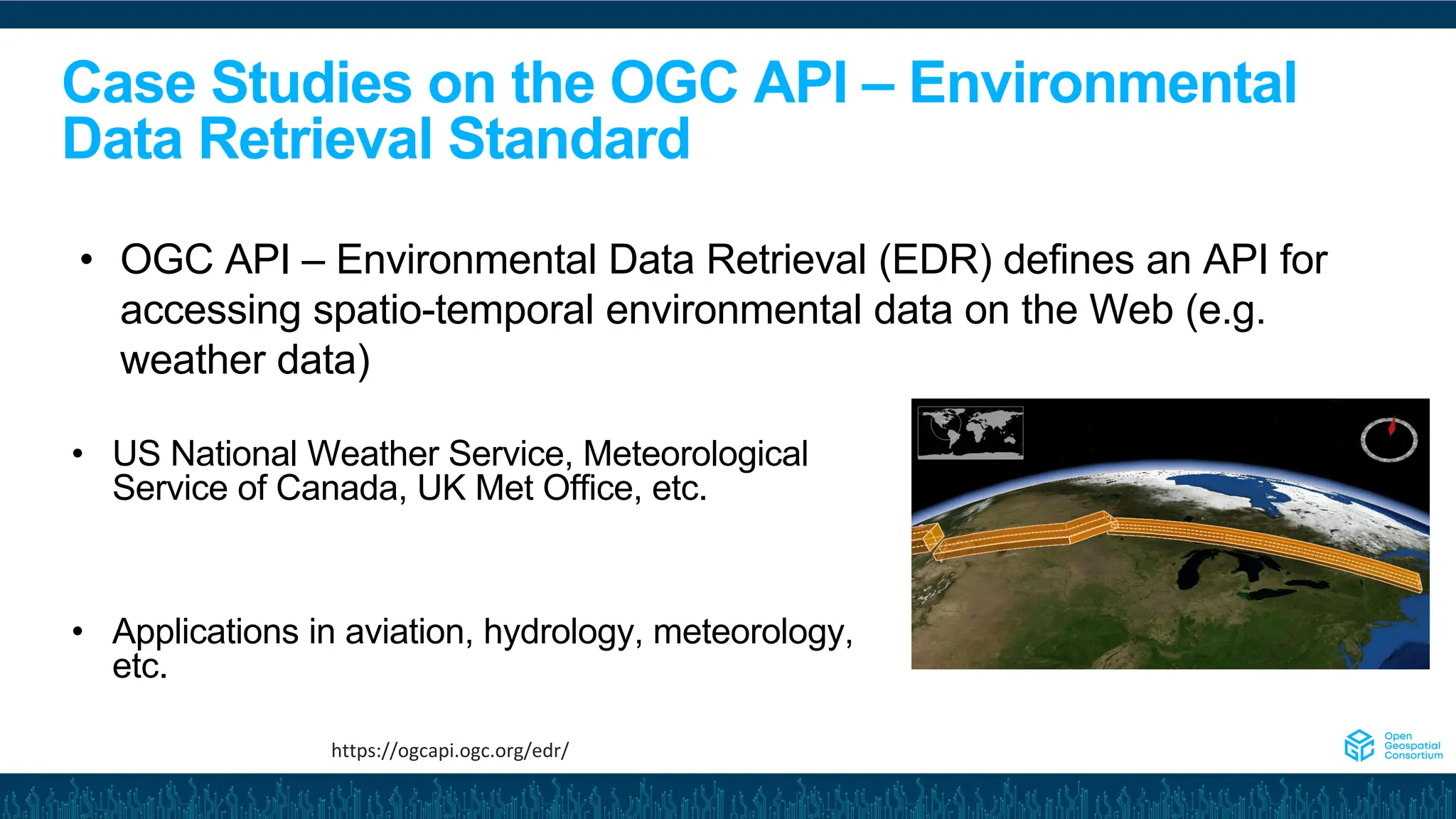
• US National Weather Service, Meteorological
Service of Canada, UK Met Office, etc.
• Applications in aviation, hydrology, meteorology,
etc.
• OGC API – Environmental Data Retrieval (EDR) defines an API for
accessing spatio-temporal environmental data on the Web (e.g.
weather data)
https://ogcapi.ogc.org/edr/
Case Studies on the OGC API – Processes
Standard
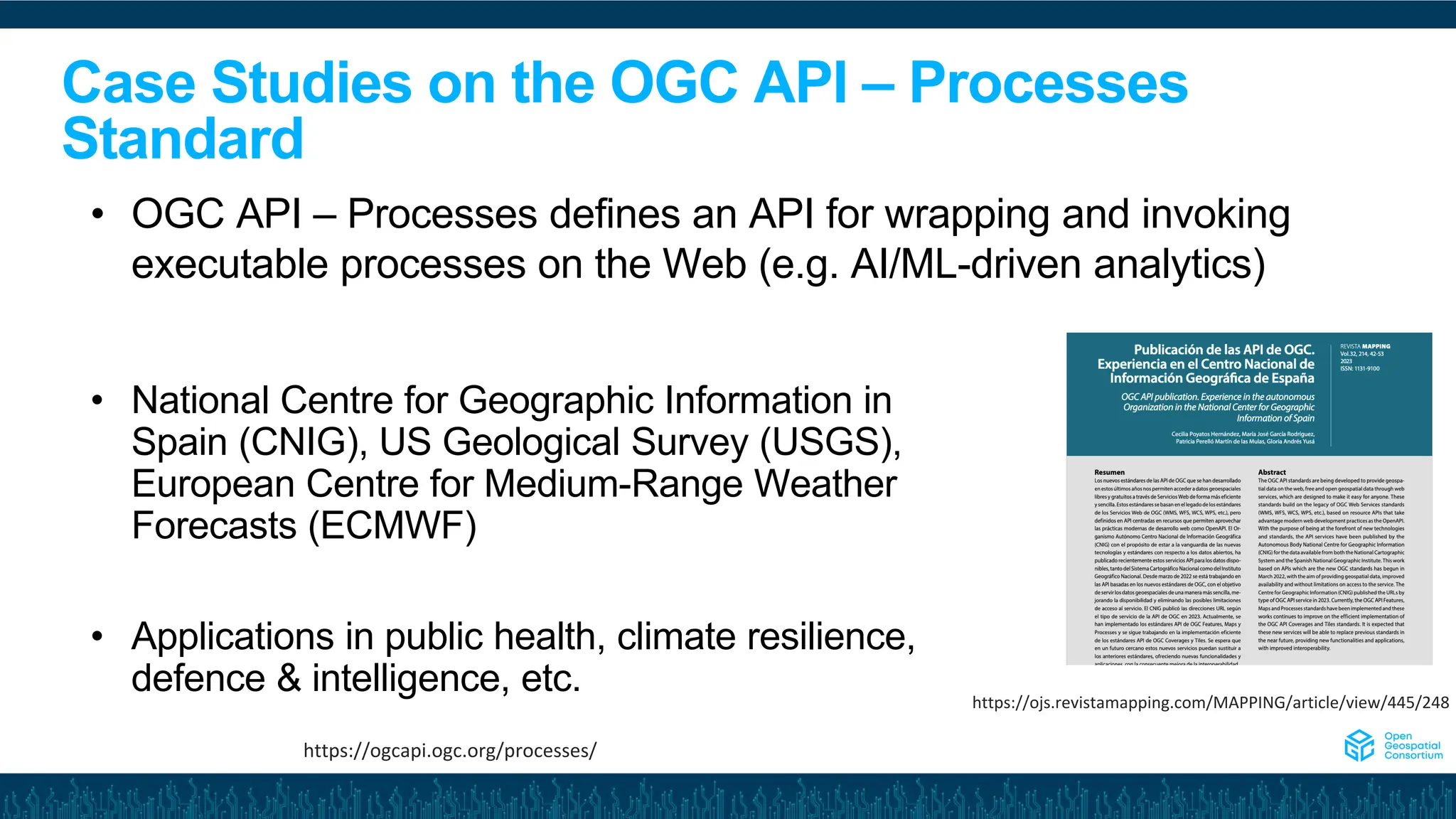
• National Centre for Geographic Information in
Spain (CNIG), US Geological Survey (USGS),
European Centre for Medium-Range Weather
Forecasts (ECMWF)
• Applications in public health, climate resilience,
defence & intelligence, etc.
• OGC API – Processes defines an API for wrapping and invoking
executable processes on the Web (e.g. AI/ML-driven analytics)
https://ogcapi.ogc.org/processes/
https://ojs.revistamapping.com/MAPPING/article/view/445/248
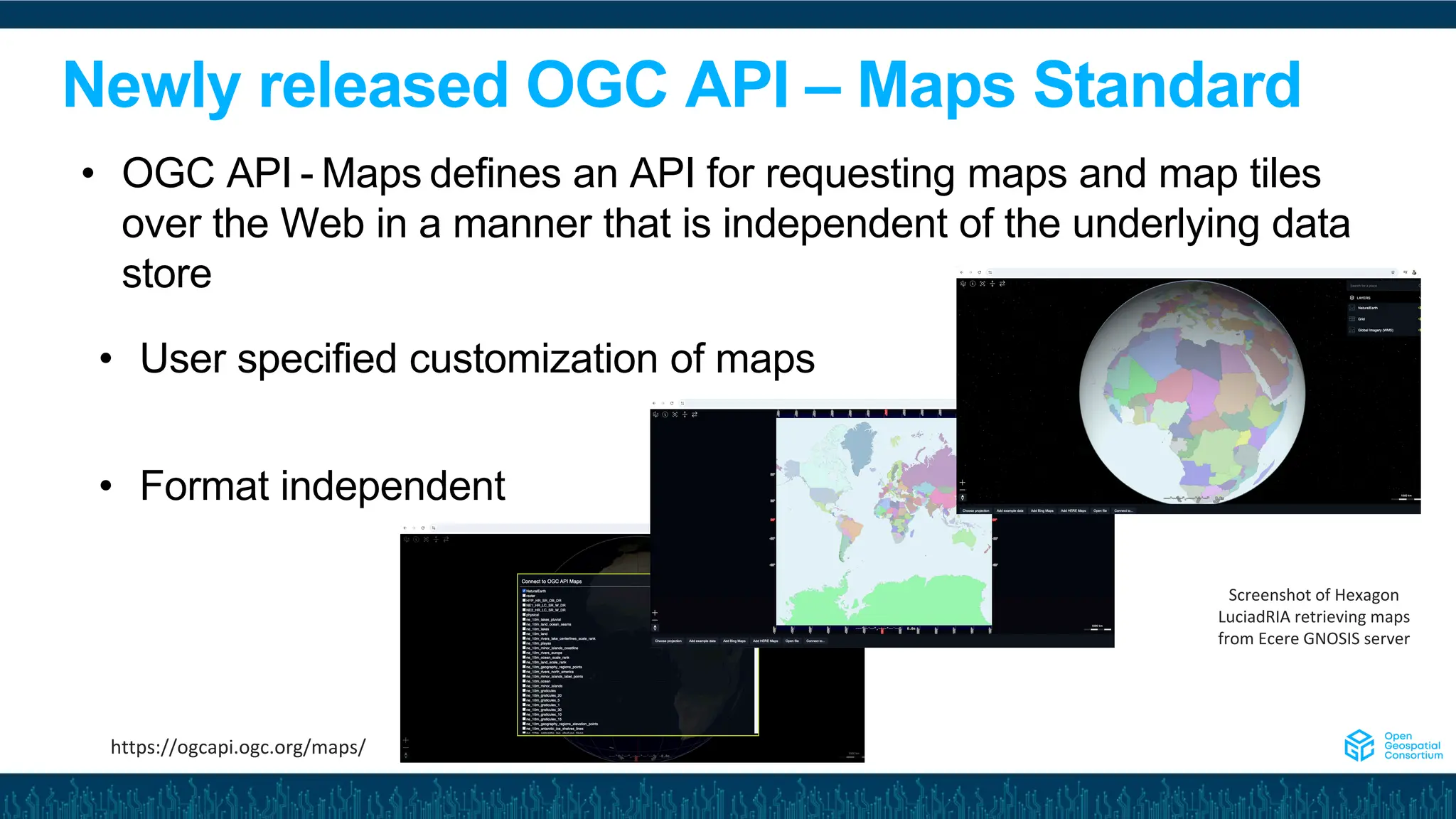
Newly released OGC API – Maps Standard
• User specified customization of maps
• Format independent
• OGC API - Maps defines an API for requesting maps and map tiles
over the Web in a manner that is independent of the underlying data
store
Screenshot of Hexagon
LuciadRIA retrieving maps
from Ecere GNOSIS server
https://ogcapi.ogc.org/maps/
Benefits of Adopting OGC API Standards
• Improve interoperability with a variety of 3rd party products and data
sources
• Reduce the risk of vendor lock-in
• Accelerate the development of solutions
• Reduce the cost of developing new capabilities
• Improve seamless integration through compliance testing & certification
Conclusions
• Geospatial ecosystems are built from spatial data infrastructures that
are enabled by open standards
• For APIs to be successful in the geospatial ecosystem, they must be
built in a modular way by implementing open standards
• Organizations should spatially enable their Web APIs through OGC API
Standards to ensure that their data is Findable, Accessible,
Interoperable, and Reusable (FAIR)
110+ Member Meetings
60+ Alliance and Liaison partners
50+ Standards Working Groups
45+ Domain Working Groups
25+ Years of Not for Profit Work
10+ Regional and Country Forums
Innovation
120+ Innovation Initiatives
380+ Technical reports
Quarterly Tech Trends monitoring
Standards
65+ Adopted Standards
300+ products with 1000+ certified implementations
1,700,000+ Operational Data Sets
Using OGC Standards
Copyright © 2024 Open Geospatial Consortium
Thank You
Community
Dr. Gobe Hobona
ghobona@ogc.org

Apidays London 2024 - Open Standards for Getting your APIs into the Geospatial Ecosystem, Gobe Hobona.pdf

  • 1.
    Open Standards forGetting Your APIs into the Geospatial Ecosystem Gobe Hobona, PhD Director of Product Management for Standards Copyright © 2024 Open Geospatial Consortium
  • 2.
    Introduction • The importanceof location to your data and your APIs • Vision and mission of the Open Geospatial Consortium (OGC) • What is an OGC Standard?
  • 3.
    High level overviewof a Geospatial Ecosystem Source: Coetzee et al. (2021)
  • 4.
    Geospatial Market • Valuedat USD 96.26 billion in 2023 • Projected to grow from USD 105.06 billion in 2024 to USD 211.54 billion by 2032 • Compound annual growth rate (CAGR) of approximately 9.1% Source: https://www.marketresearchfuture.com/reports/geospatial- market-2441
  • 5.
    5-step Path toSuccess in the Geospatial Ecosystem 1. Identify the standards that are relevant to your target market 2. Implement the standards or deploy existing implementations 3. Integrate with third-party applications through the standards 4. Promote the standards and your implementations of them 5. Influence future versions of the standards
  • 6.
    Identify the standardsthat are relevant to your target market Defence & Intelligence Real Estate Climate Resilience Health & Social Care Finance & Insurance Transportation Energy & Utilities OGC Standards
  • 7.
  • 8.
    OGC API -Maps OGC API - Tiles OGC API - Features OGC API – Environmental Data Retrieval OGC API – Records OGC API - Styles OGC API – Discrete Global Grid Systems OGC API - Processes OGC API - Common OGC API - Routes OGC API – Coverages OGC API – Moving Features OGC API – Joins OGC API – 3D GeoVolumes Solid green border = approved and published | Dashed green border = approved and publication pending OGC SensorThings API Approved and Candidate OGC API Standards
  • 9.
    Implement the Standards •OpenAPI • AsyncAPI https://ogcapi.ogc.org/#standards
  • 10.
    Deploy implementations ofthe Standards • Certification of compliance to the Standards • Look for the certification mark! https://www.ogc.org/resources/certified-products/
  • 11.
    Integrate with third-partyapplications through the Standards • Open spatial data catalogues (e.g. Spatineo and GeoSeer - millions of data layers discoverable) • API catalogues (e.g. SwaggerHub) • Spatial Data Infrastructure (SDI) initiatives (e.g. United Kingdom, United States, South Africa, Canada, India, Netherlands, and 80 more national SDIs)
  • 12.
    Promote the standardsand your implementations of them Photo taken March 2018 • Webinars and blog posts • Standards showcase at quarterly face-to-face OGC meetings
  • 13.
    Influence future versionsof the Standards • Public GitHub repositories (https://github.com/opengeospatial) • Testbeds • Code sprints https://climateintelligence.eu/2024/07/climate-services-code-sprint/
  • 14.
    Case Studies onthe OGC API – Features Standard • European Space Agency (ESA), British Geological Survey (BGS), etc. • Applications in city planning, defence, transportation, emergency response, etc. • OGC API – Features defines an API for creating, modifying, and querying vector spatial data on the Web (e.g. building footprints, road networks) https://ogcapi.ogc.org/features/
  • 15.
    Case Studies onthe OGC API – Environmental Data Retrieval Standard • US National Weather Service, Meteorological Service of Canada, UK Met Office, etc. • Applications in aviation, hydrology, meteorology, etc. • OGC API – Environmental Data Retrieval (EDR) defines an API for accessing spatio-temporal environmental data on the Web (e.g. weather data) https://ogcapi.ogc.org/edr/
  • 16.
    Case Studies onthe OGC API – Processes Standard • National Centre for Geographic Information in Spain (CNIG), US Geological Survey (USGS), European Centre for Medium-Range Weather Forecasts (ECMWF) • Applications in public health, climate resilience, defence & intelligence, etc. • OGC API – Processes defines an API for wrapping and invoking executable processes on the Web (e.g. AI/ML-driven analytics) https://ogcapi.ogc.org/processes/ https://ojs.revistamapping.com/MAPPING/article/view/445/248
  • 17.
    Newly released OGCAPI – Maps Standard • User specified customization of maps • Format independent • OGC API - Maps defines an API for requesting maps and map tiles over the Web in a manner that is independent of the underlying data store Screenshot of Hexagon LuciadRIA retrieving maps from Ecere GNOSIS server https://ogcapi.ogc.org/maps/
  • 18.
    Benefits of AdoptingOGC API Standards • Improve interoperability with a variety of 3rd party products and data sources • Reduce the risk of vendor lock-in • Accelerate the development of solutions • Reduce the cost of developing new capabilities • Improve seamless integration through compliance testing & certification
  • 19.
    Conclusions • Geospatial ecosystemsare built from spatial data infrastructures that are enabled by open standards • For APIs to be successful in the geospatial ecosystem, they must be built in a modular way by implementing open standards • Organizations should spatially enable their Web APIs through OGC API Standards to ensure that their data is Findable, Accessible, Interoperable, and Reusable (FAIR)
  • 20.
    110+ Member Meetings 60+Alliance and Liaison partners 50+ Standards Working Groups 45+ Domain Working Groups 25+ Years of Not for Profit Work 10+ Regional and Country Forums Innovation 120+ Innovation Initiatives 380+ Technical reports Quarterly Tech Trends monitoring Standards 65+ Adopted Standards 300+ products with 1000+ certified implementations 1,700,000+ Operational Data Sets Using OGC Standards Copyright © 2024 Open Geospatial Consortium Thank You Community Dr. Gobe Hobona ghobona@ogc.org