

Bodies and looks Didactic unit for 3º ESO-PALE virgi.pla  IES Serpis
Content objectives: Aspects, features and sphere of Aphrodite through the Western iconography:  -birth: Uranus’s castration, born of the sea-foam.  -lovers: Mars, Adonis.  -descendants: Cupid. The names of the Greek gods and goddesses. The erotism in the plastic Arts.Different schools of art. Language objectives: Body vocabulary. Present continuous. Superlatives. Expressing similarities, differences and comparisons:
Key vocabulary and structures: Olympic gods:   APHRODITE/VENUS,  Ares/Mars,  Zeus/Jupiter, Apollo,  Artemis/Diana,  Athena/Minerva,  Hephaestus/Vulcan, Hermes/Mercury,  Demeter/Ceres, Hera/Juno,  Poseidon/Neptune and Hestia/Vesta.  Other Greek   gods:   Dionyssos/Bacchus and Hades/Pluto. Some external parts of the body:   head, hair, face, forehead, eye, (glance), nose, neck, shoulder, chest, thorax, hand, breast, belly, navel, back, buttock, female genitals, flesh, skin, muscle, leg, hand...  Different styles of art:   the   Classicism, the Renaissance, the Baroque, the Impressionism, the Fauvism...
Similarities:  A is like B; A and B are very similar; there is a similarity between A and B; A and B both have....; A and B have a lot in common; Neither has....; Differences:  A is very different from B; A is quite unlike B; A and B have nothing in common; A and B are completely different;  Comparisons:   If we compare A with B... ; A is very ... in comparison with B; A is ... compared with/to B; Sentences with present continous Superlatives:  A is the most ...of them; A is the most ... in ...; Questions:  who; what; where; why; which one...
...Uranos came longing for love and lay on Gaia spreading himself upon her. Then Chronus, their son, when Uranos was nor aware, took with his right hand a sharp sickle from inside his mother Gaia and with the left his father’s genitals and cut off them with speed and decision and threw them away landing on the sea. The male member was  swept far away a long time and a white foam rose around it. From the mix of the immortal flesh and the foam-sea arose a marvellous maiden, Aphrodite. Then she headed to Kythera and from there to Kypros where grass grew up wheresoever she stepped. For all that she was called Aphrogeneia, born from the foam; Eustephanos, well crowned; Kythereia, because she reached Kythera; Kyprogenes, because she was born near Cypros, and Philommedes, because she sprang from the genitals...
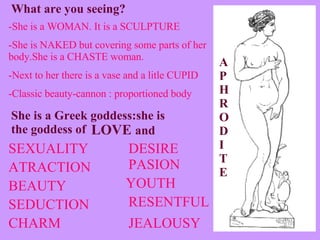
-She is a WOMAN. It is a SCULPTURE -She is NAKED but covering some parts of her body.She is a CHASTE woman. -Next to her there is a vase and a litle CUPID -Classic beauty-cannon : proportioned body What are you seeing? She is a Greek goddess:she is the goddess of LOVE  and CHARM BEAUTY SEXUALITY SEDUCTION ATRACTION JEALOUSY RESENTFUL PASION YOUTH APHRODITE DESIRE
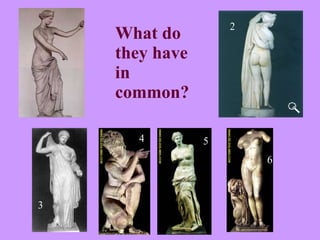
What do they have in common? 1 2 3 4 5 6
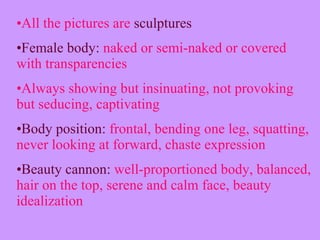
All the pictures are  sculptures Female body:  naked or semi-naked or covered with transparencies Always showing but insinuating, not provoking but seducing, captivating Body position:  frontal, bending one leg, squatting, never looking at forward, chaste expression Beauty cannon:  well-proportioned body, balanced, hair on the top, serene and calm face, beauty idealization
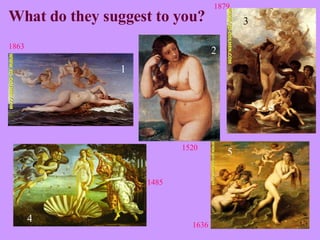
What do they suggest to you? 1879 1863 1485 1636 1520 1 2 3 4 5
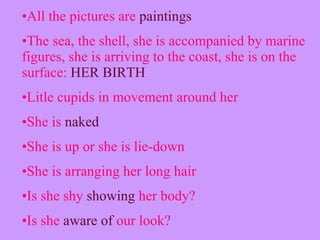
All the pictures are  paintings The sea, the shell, she is accompanied by marine figures, she is arriving to the coast, she is on the surface:  HER BIRTH Litle cupids in movement around her She is  naked  She is up or she is lie-down  She is arranging her long hair  Is she shy  showing  her body? Is she  aware of  our look?
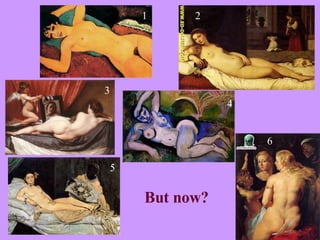
But now? 1 2 3 4 5 6
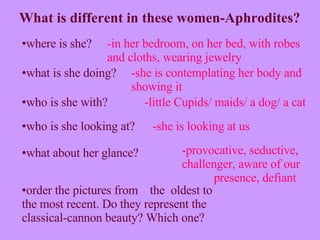
order the pictures from  the  oldest to the most recent. Do they represent the classical-cannon beauty? Which one? What is different in these women-Aphrodites? -provocative, seductive, challenger, aware of our  presence, defiant -in her bedroom, on her bed, with robes and cloths, wearing jewelry -she is contemplating her body and showing it -little Cupids/ maids/ a dog/ a cat -she is looking at us where is she? what is she doing? who is she with? who is she looking at? what about her glance?
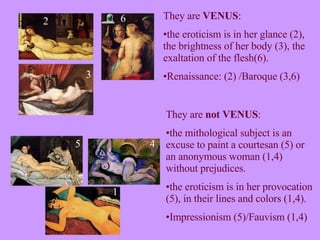
They are  VENUS : the eroticism is in her glance (2), the brightness of her body (3), the exaltation of the flesh(6). Renaissance: (2) /Baroque (3,6) They are  not VENUS : the mithological subject is an excuse to paint a courtesan (5) or  an anonymous woman (1,4)  without prejudices. the eroticism is in her provocation (5), in their lines and colors (1,4). Impressionism (5)/Fauvism (1,4)  2 6 3 5 4 1
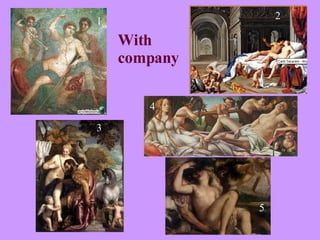
1 2 3 4 5 With company
Aphrodite accompanied by ..... Which one is the most sensual? Why?   -Litle cupids and Mars. -Helmet, shield, lance -Love scene The position of the bodies and their looks. Who is with Aphrodite?   Why do we know he is Mars?  Look at the objects  in all the pictures.   What are they doing? Which picture do you think is the oldest?  (1)
Instructional activities: 1- Describe  these pictures, try to  identify  the period and the artistic styles:  2- Make sentences  using similarities and differences expressions. 3- Look up  synonyms and antonyms for: beauty, young, charm... 4- Complete  the chart: pasion desire seduction atraction adjective verb noun
EXTRA INFORMATION 7th slide: 1-Venus of Capua 2-Aphrodite calipigia 3-Venus genetrix 4-Venus squating 5-Venus of Milos 6-Venus of Cyrene 9th slide: 1-Venus’ birth. Cabanel, 1863 2-Venus rising from the sea, “Venus Anadyomene”. Titian, 1520 3-Venus’ birth. Bouguereau, 1879 4-Venus’ birth. Boticelli, 1485 5-Venus’ birth. Cornelis de vos, 1636 (All the pictures are from Internet)
EXTRA INFORMATION 11th slide: 1-Red nude. Modigliani, 1917 2-Venus of Urbin. Titian, 1538 3-Venus at the mirror. Velázquez, 1648 4-The blue nude. Matisse, 1907 -Olimpia. Manet, 1863 Venus at the mirror. Rubens, 1613 14th slide:  1-Venus and Mars. Fresco painting from Pompeya. s I 2-Angels, Venus and Mars. Carlo Saraceni, 1615 3-Venus and Mars linked by Cupid. Veronés, 1580 4-Venus and Mars. Botticelli, 1482 -Mars, Venus and Cupid. Titian, s XVI (All the pictures are from Internet)

Unidad Didáctica Afrodita Pale

  • 1.
    Bodies and looksDidactic unit for 3º ESO-PALE virgi.pla IES Serpis
  • 2.
    Content objectives: Aspects,features and sphere of Aphrodite through the Western iconography: -birth: Uranus’s castration, born of the sea-foam. -lovers: Mars, Adonis. -descendants: Cupid. The names of the Greek gods and goddesses. The erotism in the plastic Arts.Different schools of art. Language objectives: Body vocabulary. Present continuous. Superlatives. Expressing similarities, differences and comparisons:
  • 3.
    Key vocabulary andstructures: Olympic gods: APHRODITE/VENUS, Ares/Mars, Zeus/Jupiter, Apollo, Artemis/Diana, Athena/Minerva, Hephaestus/Vulcan, Hermes/Mercury, Demeter/Ceres, Hera/Juno, Poseidon/Neptune and Hestia/Vesta. Other Greek gods: Dionyssos/Bacchus and Hades/Pluto. Some external parts of the body: head, hair, face, forehead, eye, (glance), nose, neck, shoulder, chest, thorax, hand, breast, belly, navel, back, buttock, female genitals, flesh, skin, muscle, leg, hand... Different styles of art: the Classicism, the Renaissance, the Baroque, the Impressionism, the Fauvism...
  • 4.
    Similarities: Ais like B; A and B are very similar; there is a similarity between A and B; A and B both have....; A and B have a lot in common; Neither has....; Differences: A is very different from B; A is quite unlike B; A and B have nothing in common; A and B are completely different; Comparisons: If we compare A with B... ; A is very ... in comparison with B; A is ... compared with/to B; Sentences with present continous Superlatives: A is the most ...of them; A is the most ... in ...; Questions: who; what; where; why; which one...
  • 5.
    ...Uranos came longingfor love and lay on Gaia spreading himself upon her. Then Chronus, their son, when Uranos was nor aware, took with his right hand a sharp sickle from inside his mother Gaia and with the left his father’s genitals and cut off them with speed and decision and threw them away landing on the sea. The male member was swept far away a long time and a white foam rose around it. From the mix of the immortal flesh and the foam-sea arose a marvellous maiden, Aphrodite. Then she headed to Kythera and from there to Kypros where grass grew up wheresoever she stepped. For all that she was called Aphrogeneia, born from the foam; Eustephanos, well crowned; Kythereia, because she reached Kythera; Kyprogenes, because she was born near Cypros, and Philommedes, because she sprang from the genitals...
  • 6.
    -She is aWOMAN. It is a SCULPTURE -She is NAKED but covering some parts of her body.She is a CHASTE woman. -Next to her there is a vase and a litle CUPID -Classic beauty-cannon : proportioned body What are you seeing? She is a Greek goddess:she is the goddess of LOVE and CHARM BEAUTY SEXUALITY SEDUCTION ATRACTION JEALOUSY RESENTFUL PASION YOUTH APHRODITE DESIRE
  • 7.
    What do theyhave in common? 1 2 3 4 5 6
  • 8.
    All the picturesare sculptures Female body: naked or semi-naked or covered with transparencies Always showing but insinuating, not provoking but seducing, captivating Body position: frontal, bending one leg, squatting, never looking at forward, chaste expression Beauty cannon: well-proportioned body, balanced, hair on the top, serene and calm face, beauty idealization
  • 9.
    What do theysuggest to you? 1879 1863 1485 1636 1520 1 2 3 4 5
  • 10.
    All the picturesare paintings The sea, the shell, she is accompanied by marine figures, she is arriving to the coast, she is on the surface: HER BIRTH Litle cupids in movement around her She is naked She is up or she is lie-down She is arranging her long hair Is she shy showing her body? Is she aware of our look?
  • 11.
    But now? 12 3 4 5 6
  • 12.
    order the picturesfrom the oldest to the most recent. Do they represent the classical-cannon beauty? Which one? What is different in these women-Aphrodites? -provocative, seductive, challenger, aware of our presence, defiant -in her bedroom, on her bed, with robes and cloths, wearing jewelry -she is contemplating her body and showing it -little Cupids/ maids/ a dog/ a cat -she is looking at us where is she? what is she doing? who is she with? who is she looking at? what about her glance?
  • 13.
    They are VENUS : the eroticism is in her glance (2), the brightness of her body (3), the exaltation of the flesh(6). Renaissance: (2) /Baroque (3,6) They are not VENUS : the mithological subject is an excuse to paint a courtesan (5) or an anonymous woman (1,4) without prejudices. the eroticism is in her provocation (5), in their lines and colors (1,4). Impressionism (5)/Fauvism (1,4) 2 6 3 5 4 1
  • 14.
    1 2 34 5 With company
  • 15.
    Aphrodite accompanied by..... Which one is the most sensual? Why? -Litle cupids and Mars. -Helmet, shield, lance -Love scene The position of the bodies and their looks. Who is with Aphrodite? Why do we know he is Mars? Look at the objects in all the pictures. What are they doing? Which picture do you think is the oldest? (1)
  • 16.
    Instructional activities: 1-Describe these pictures, try to identify the period and the artistic styles: 2- Make sentences using similarities and differences expressions. 3- Look up synonyms and antonyms for: beauty, young, charm... 4- Complete the chart: pasion desire seduction atraction adjective verb noun
  • 17.
    EXTRA INFORMATION 7thslide: 1-Venus of Capua 2-Aphrodite calipigia 3-Venus genetrix 4-Venus squating 5-Venus of Milos 6-Venus of Cyrene 9th slide: 1-Venus’ birth. Cabanel, 1863 2-Venus rising from the sea, “Venus Anadyomene”. Titian, 1520 3-Venus’ birth. Bouguereau, 1879 4-Venus’ birth. Boticelli, 1485 5-Venus’ birth. Cornelis de vos, 1636 (All the pictures are from Internet)
  • 18.
    EXTRA INFORMATION 11thslide: 1-Red nude. Modigliani, 1917 2-Venus of Urbin. Titian, 1538 3-Venus at the mirror. Velázquez, 1648 4-The blue nude. Matisse, 1907 -Olimpia. Manet, 1863 Venus at the mirror. Rubens, 1613 14th slide: 1-Venus and Mars. Fresco painting from Pompeya. s I 2-Angels, Venus and Mars. Carlo Saraceni, 1615 3-Venus and Mars linked by Cupid. Veronés, 1580 4-Venus and Mars. Botticelli, 1482 -Mars, Venus and Cupid. Titian, s XVI (All the pictures are from Internet)