Apartheid 
Ernesto Correa Colegio Seminario
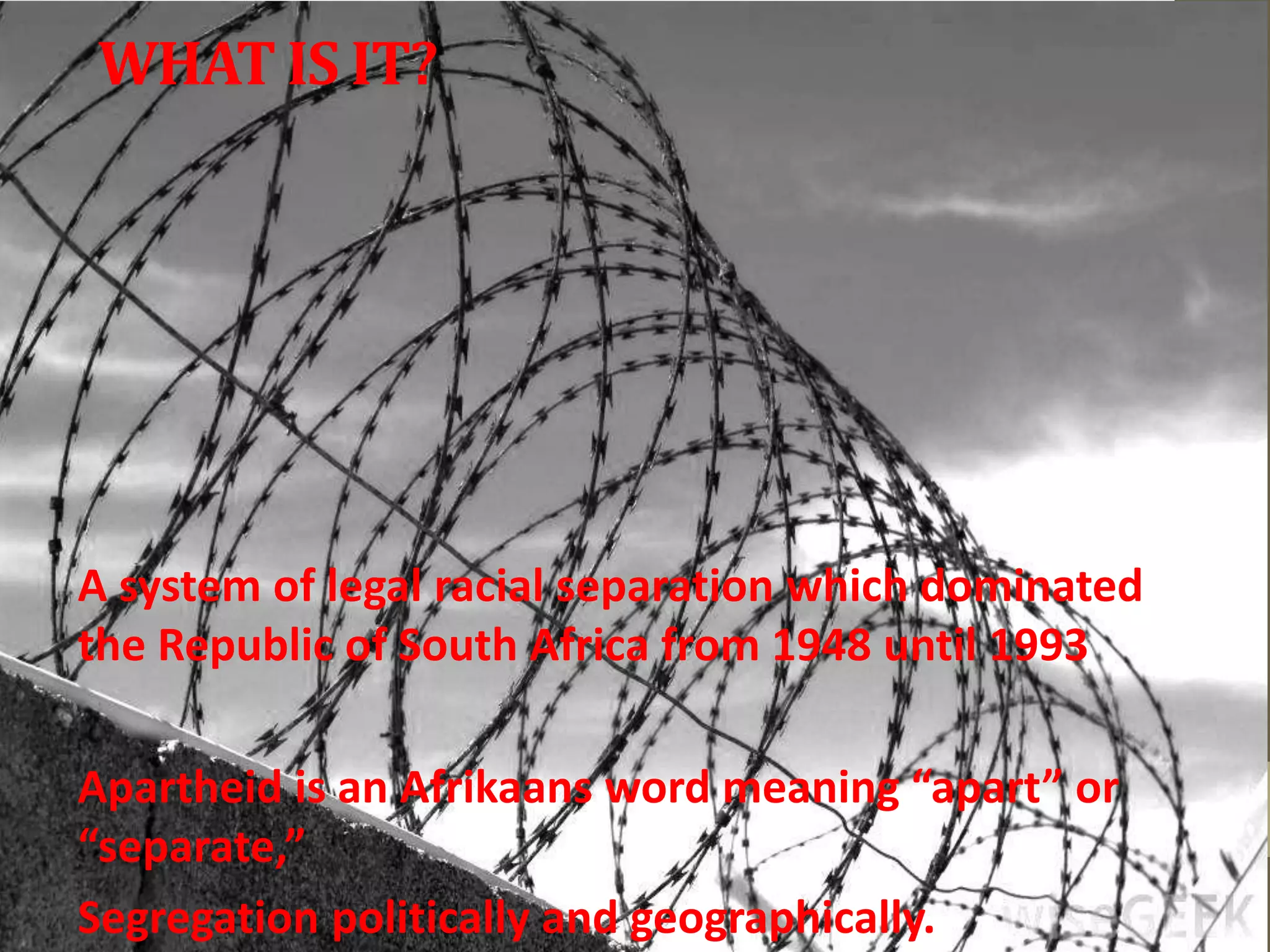
WHATIS IT? 
A system of legal racial separation which dominated 
the Republic of South Africa from 1948 until 1993 
Apartheid is an Afrikaans word meaning “apart” or 
“separate,” 
Segregation politically and geographically.
Meaning… 
• Apartheid laws in 1948, racial discrimination was 
institutionalized. 
• Race laws touched every aspect of social life: 
1. Prohibition of marriage between non-whites and whites 
2. the sanctioning of ``white-only'' jobs. 
3. The Population Registration Act required that all South 
Africans be racially classified into one of three categories: 
white, black (African), or colored (of mixed decent). The 
coloured category included major subgroups of Indians and 
Asians.
Classification 
• Was based on appearance, social acceptance, and descent. 
• A person could not be considered white if one of his or her 
parents were non-white. 
• A black person would be of or accepted as a member of an 
African tribe or race. 
• A colored person is one that is not black or white. 
• The Department of Home Affairs was responsible for the 
classification of the citizenry. 
• All blacks were required to carry ``pass books'' containing 
fingerprints, photo and information on access to non-black 
areas.

Apartheid

  • 1.
    Apartheid Ernesto CorreaColegio Seminario
  • 2.
    WHATIS IT? Asystem of legal racial separation which dominated the Republic of South Africa from 1948 until 1993 Apartheid is an Afrikaans word meaning “apart” or “separate,” Segregation politically and geographically.
  • 3.
    Meaning… • Apartheidlaws in 1948, racial discrimination was institutionalized. • Race laws touched every aspect of social life: 1. Prohibition of marriage between non-whites and whites 2. the sanctioning of ``white-only'' jobs. 3. The Population Registration Act required that all South Africans be racially classified into one of three categories: white, black (African), or colored (of mixed decent). The coloured category included major subgroups of Indians and Asians.
  • 4.
    Classification • Wasbased on appearance, social acceptance, and descent. • A person could not be considered white if one of his or her parents were non-white. • A black person would be of or accepted as a member of an African tribe or race. • A colored person is one that is not black or white. • The Department of Home Affairs was responsible for the classification of the citizenry. • All blacks were required to carry ``pass books'' containing fingerprints, photo and information on access to non-black areas.