Aortic Aneurysm
Introduction
*An aneurysm is an unusual swelling or bulging of an
artery.
*It is caused by a weak spot on the blood vessel wall.
*There is different types of aortic aneurysms classified by
location; thoracic aneurysm usually caused by
atherosclerosis, abdominal aneurysm, cerebral aneurysm,
and ventricular aneurysm.
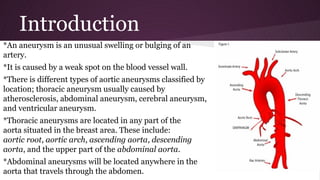
*Thoracic aneurysms are located in any part of the
aorta situated in the breast area. These include:
aortic root, aortic arch, ascending aorta, descending
aorta, and the upper part of the abdominal aorta.
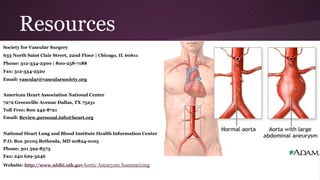
*Abdominal aneurysms will be located anywhere in the
aorta that travels through the abdomen.
Introduction
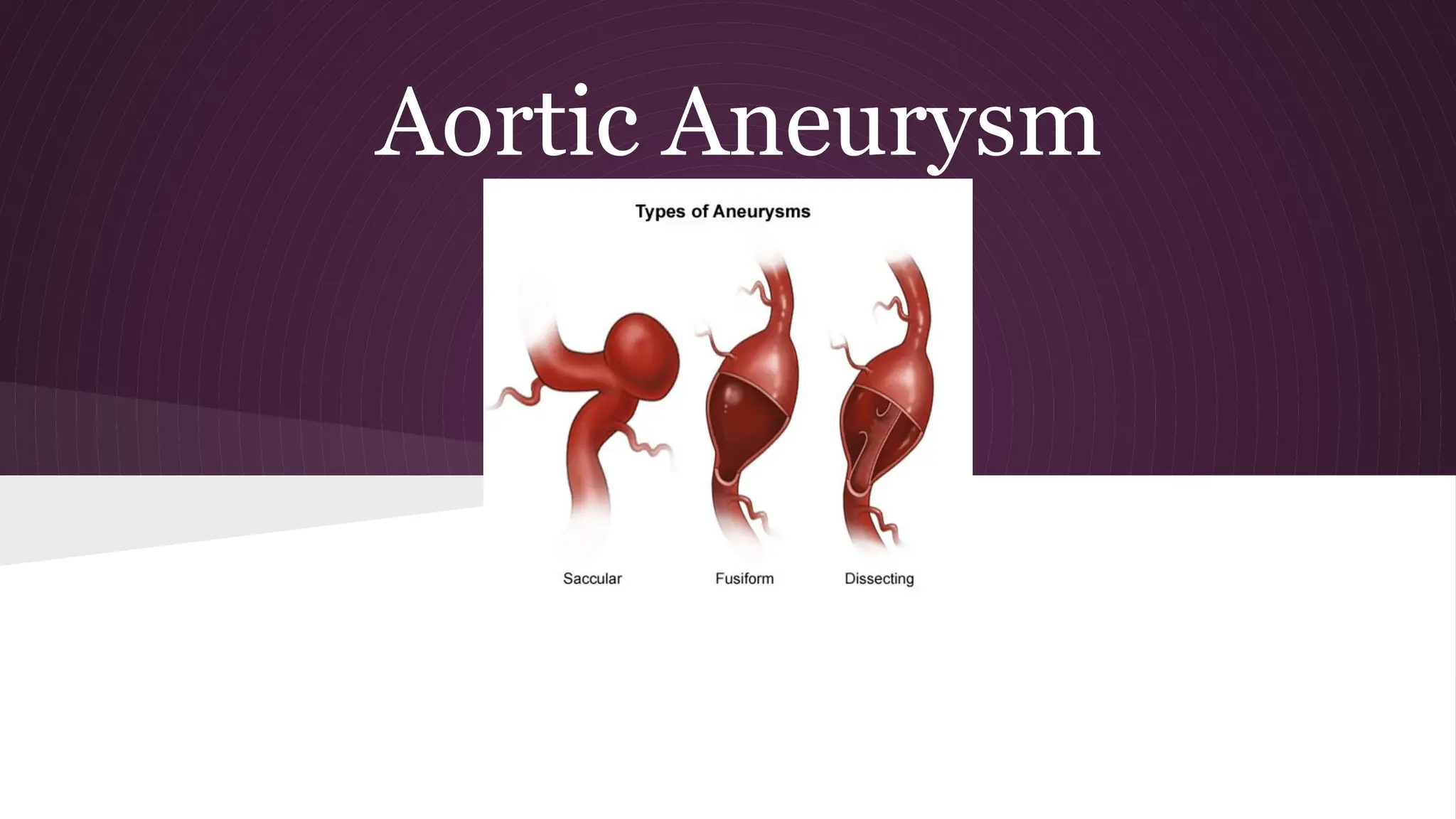
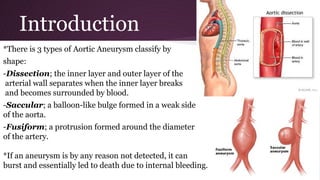
*There is 3 types of Aortic Aneurysm classify by
shape:
-Dissection; the inner layer and outer layer of the
arterial wall separates when the inner layer breaks
and becomes surrounded by blood.
-Saccular; a balloon-like bulge formed in a weak side
of the aorta.
-Fusiform; a protrusion formed around the diameter
of the artery.
*If an aneurysm is by any reason not detected, it can
burst and essentially led to death due to internal bleeding.
Symptoms
*Chest pain
*Trouble breathing depending on the location of the aneurysm
*Trouble swallowing
*Weak voice
*Changes in the rhythm of the heartbeat
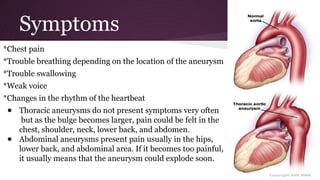
● Thoracic aneurysms do not present symptoms very often
but as the bulge becomes larger, pain could be felt in the
chest, shoulder, neck, lower back, and abdomen.
● Abdominal aneurysms present pain usually in the hips,
lower back, and abdominal area. If it becomes too painful,
it usually means that the aneurysm could explode soon.
Incidence
*Abdominal aneurysms are more often seen in men than in women in the age of 50.
*Thoracic aneurysms are seen often in men over 50 years who have hypertension
(high blood pressure).
*Causes of the disease are atherosclerosis, hypertension, defects at birth, physical
injuries, infections, and sexually transmitted diseases like syphilis.
*There is no current chart to express the amount of people diagnosed or that have
the disease per year.
Diagnosis
*An aneurysm is usually noticed in x-rays when the patient goes to a regular
examination or for other medical reasons.
*An aneurysm could also be thought by the doctor if the patient is experimenting
extreme pain in the abdominal, chest, or lower back area. They will order an X-ray to
verify their suspicion of the disease.
Treatment
*There is not a specific medicine to relieve the
condition. Only surgery can resolve it.
*Small aneurysms are usually closely watched by
the doctor with regular CT or MRI scans, a
medicament (statin) is given to maintain a good
cholesterol, and blood pressure is monitored
along with some prescribed blood pressure
medication, if indicated, to maintain the patient’s
body below hypertension.
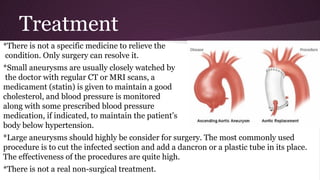
*Large aneurysms should highly be consider for surgery. The most commonly used
procedure is to cut the infected section and add a dancron or a plastic tube in its place.
The effectiveness of the procedures are quite high.
*There is not a real non-surgical treatment.
Prognosis/Prevention
*1-2 of the people diagnosed die from the surgical procedures.
*If the aortic aneurysm is left untreated and it cracks, usually less than half of the people
will survive it.
*People with the condition of atherosclerosis or high blood pressure could develop an
aneurysm.
*There is not an exact, and accurate way to prevent an aortic aneurysm; however, a
change in lifestyle, and diet could contribute to lower blood pressure to prevent it.
*One could also maintain the amount of fat in the bloodstream low to avoid the creation
of aortic aneurysms.
Resources
Society for Vascular Surgery
633 North Saint Clair Street, 22nd Floor | Chicago, IL 60611
Phone: 312-334-2300 | 800-258-7188
Fax: 312-334-2320
Email: vascular@vascularsociety.org
American Heart Association National Center
7272 Greenville Avenue Dallas, TX 75231
Toll Free: 800 242-8721
Email: Review.personal.info@heart.org
National Heart Lung and Blood Institute Health Information Center
P.O. Box 30105 Bethesda, MD 20824-0105
Phone: 301 592-8573
Fax: 240 629-3246
Website: http://www.nhlbi.nih.govAortic Aneurysm Summarizing
Works Cited
"Aneurysm." UXL Science. UXL, 2008. Student Resources in Context. Web. 24 Feb. 2015.
"Aortic Aneurysm." Aortic Aneurysm. NYU Langone Medical Center, 2015. Web. 24 Feb. 2015.
De Bellis, Dominic. "Aortic aneurysm." The Gale Encyclopedia of Medicine. Ed. Laurie J. Fundukian. 4th ed. Detroit: Gale, 2011. Science in
Context. Web. 24 Feb. 2015.
Images Cited
Azencott, Alain. Aortic Aneurysm. Digital image. Dr. Alain Azencott Chirurgie Vasculaire. Dr-azencott, 30 May 2010. Web. 27 Feb. 2015.
Bhimji, Shabir. Aortic Aneurysm. Digital image. Medline Plus. U.S. National Library of Medicine, 07 Oct. 2012. Web. 27 Feb. 2015.
Di Luozzo, Gabriele. Anatomy of the Aorta. Digital image. Aorta Repair. The Hackensack University Medical Center. Web. 27 Feb. 2015.
Di Luozzo, Gabriele. Ascending Aortic Aneurysm. Digital image. Aorta Repair. The Hackensack University Medical Center. Web. 27 Feb. 2015.
Thoracic Aortic Aneurysm. Digital image. Vascular Web. Society for Vascular Surgery, Dec. 2010. Web. 27 Feb. 2015.
Tinsley, Brian S. Aortic dissection. Digital image. Living My Life with an Aortic Dissection. Aortic Dissection. Web. 27 Feb. 2015.
Types of Aneurysm. Digital image. Johns Hopkins Medicine. The Johns Hopkins University. Web. 27 Feb. 2015.

Aortic Aneurysm detailed explanation pptx

  • 1.
  • 2.
    Introduction *An aneurysm isan unusual swelling or bulging of an artery. *It is caused by a weak spot on the blood vessel wall. *There is different types of aortic aneurysms classified by location; thoracic aneurysm usually caused by atherosclerosis, abdominal aneurysm, cerebral aneurysm, and ventricular aneurysm. *Thoracic aneurysms are located in any part of the aorta situated in the breast area. These include: aortic root, aortic arch, ascending aorta, descending aorta, and the upper part of the abdominal aorta. *Abdominal aneurysms will be located anywhere in the aorta that travels through the abdomen.
  • 3.
    Introduction *There is 3types of Aortic Aneurysm classify by shape: -Dissection; the inner layer and outer layer of the arterial wall separates when the inner layer breaks and becomes surrounded by blood. -Saccular; a balloon-like bulge formed in a weak side of the aorta. -Fusiform; a protrusion formed around the diameter of the artery. *If an aneurysm is by any reason not detected, it can burst and essentially led to death due to internal bleeding.
  • 4.
    Symptoms *Chest pain *Trouble breathingdepending on the location of the aneurysm *Trouble swallowing *Weak voice *Changes in the rhythm of the heartbeat ● Thoracic aneurysms do not present symptoms very often but as the bulge becomes larger, pain could be felt in the chest, shoulder, neck, lower back, and abdomen. ● Abdominal aneurysms present pain usually in the hips, lower back, and abdominal area. If it becomes too painful, it usually means that the aneurysm could explode soon.
  • 5.
    Incidence *Abdominal aneurysms aremore often seen in men than in women in the age of 50. *Thoracic aneurysms are seen often in men over 50 years who have hypertension (high blood pressure). *Causes of the disease are atherosclerosis, hypertension, defects at birth, physical injuries, infections, and sexually transmitted diseases like syphilis. *There is no current chart to express the amount of people diagnosed or that have the disease per year.
  • 6.
    Diagnosis *An aneurysm isusually noticed in x-rays when the patient goes to a regular examination or for other medical reasons. *An aneurysm could also be thought by the doctor if the patient is experimenting extreme pain in the abdominal, chest, or lower back area. They will order an X-ray to verify their suspicion of the disease.
  • 7.
    Treatment *There is nota specific medicine to relieve the condition. Only surgery can resolve it. *Small aneurysms are usually closely watched by the doctor with regular CT or MRI scans, a medicament (statin) is given to maintain a good cholesterol, and blood pressure is monitored along with some prescribed blood pressure medication, if indicated, to maintain the patient’s body below hypertension. *Large aneurysms should highly be consider for surgery. The most commonly used procedure is to cut the infected section and add a dancron or a plastic tube in its place. The effectiveness of the procedures are quite high. *There is not a real non-surgical treatment.
  • 8.
    Prognosis/Prevention *1-2 of thepeople diagnosed die from the surgical procedures. *If the aortic aneurysm is left untreated and it cracks, usually less than half of the people will survive it. *People with the condition of atherosclerosis or high blood pressure could develop an aneurysm. *There is not an exact, and accurate way to prevent an aortic aneurysm; however, a change in lifestyle, and diet could contribute to lower blood pressure to prevent it. *One could also maintain the amount of fat in the bloodstream low to avoid the creation of aortic aneurysms.
  • 9.
    Resources Society for VascularSurgery 633 North Saint Clair Street, 22nd Floor | Chicago, IL 60611 Phone: 312-334-2300 | 800-258-7188 Fax: 312-334-2320 Email: vascular@vascularsociety.org American Heart Association National Center 7272 Greenville Avenue Dallas, TX 75231 Toll Free: 800 242-8721 Email: Review.personal.info@heart.org National Heart Lung and Blood Institute Health Information Center P.O. Box 30105 Bethesda, MD 20824-0105 Phone: 301 592-8573 Fax: 240 629-3246 Website: http://www.nhlbi.nih.govAortic Aneurysm Summarizing
  • 10.
    Works Cited "Aneurysm." UXLScience. UXL, 2008. Student Resources in Context. Web. 24 Feb. 2015. "Aortic Aneurysm." Aortic Aneurysm. NYU Langone Medical Center, 2015. Web. 24 Feb. 2015. De Bellis, Dominic. "Aortic aneurysm." The Gale Encyclopedia of Medicine. Ed. Laurie J. Fundukian. 4th ed. Detroit: Gale, 2011. Science in Context. Web. 24 Feb. 2015.
  • 11.
    Images Cited Azencott, Alain.Aortic Aneurysm. Digital image. Dr. Alain Azencott Chirurgie Vasculaire. Dr-azencott, 30 May 2010. Web. 27 Feb. 2015. Bhimji, Shabir. Aortic Aneurysm. Digital image. Medline Plus. U.S. National Library of Medicine, 07 Oct. 2012. Web. 27 Feb. 2015. Di Luozzo, Gabriele. Anatomy of the Aorta. Digital image. Aorta Repair. The Hackensack University Medical Center. Web. 27 Feb. 2015. Di Luozzo, Gabriele. Ascending Aortic Aneurysm. Digital image. Aorta Repair. The Hackensack University Medical Center. Web. 27 Feb. 2015. Thoracic Aortic Aneurysm. Digital image. Vascular Web. Society for Vascular Surgery, Dec. 2010. Web. 27 Feb. 2015. Tinsley, Brian S. Aortic dissection. Digital image. Living My Life with an Aortic Dissection. Aortic Dissection. Web. 27 Feb. 2015. Types of Aneurysm. Digital image. Johns Hopkins Medicine. The Johns Hopkins University. Web. 27 Feb. 2015.