ANXIETY
DISORDERS
MENTAL HEALTH II
GEOFRY OUMA
INTRODUCTION
 Anxiety is usually considered a normal reaction to a realistic danger or threat
to biological integrity or self concept. Normal anxiety dissipates when the
danger or threat is no longer present.
 Anxiety can be considered abnormal or pathological if:
 It is out of proportion to the situation that is creating it.
 The anxiety interferes with social, occupational, or other important areas of
functioning
Impairments associated with anxiety
disorders
 Physical- sweatinng’, tachycardia, chest pressure, digestive disturbances,
difficulty in breathing, restlessness, shaking’.
 Cognitive- inability to concentrate, anxiuos thoughts, anticipating the worst
outcome, mind-blindness, Feelings of unreality, hyper vigilance, cloudy mind.
Thinking: Confused, distractible, low concentration, blocking. Conceptual –
negative evaluations, frightening visual images cognitive distortion
 Behavioral(longterm) – alcohol and drug use, avoidance of challenging
situations, overprotective factors. Inhibited, Flight, Restlessness, Postural
Collapse, hyperventilation, postural collapse, hyperventilation, tonic
immobility.
 Affective e.g. nervous, tense, frightened, jittery, jumpy, fearful,
apprehensive
Causes and risk factors
 Genetics- inheritance predisposition.
 Chemical substances such as drugs, medicines and alterations in the levels of
neurotransmitters.
 Environmental factors such as pandemics, wars and disasters.
 Physical conditons such as hyperthroidism.
 Traumatic events such as child abuse, severe illnesses which led to prolonged
hospitalizations and strained relationships in childhood.
 Personality traits such as low self esteem, avoidant behaviors.
Treatment of anxiety disorders
 Biopsychosocial model.
 Can be pharmacological or non- parmacological
 Pharmacotherapy such as benzodiazepines such as imipramine or SSRIs such as
sertraline.
 Psychotherapy .
 Cognitive behavioral therapy(CBT)- to dismantle the anxious or negative
thoughts about impending situations.
 Counselling to advice the patients about responses in situations.
 Distractions so that they don’t focus on the threatening stimuli.
 Systemic desenstization a behavioral therapy where by you expose the client
to the threatening situation gradually starting from the stimulus of the lowest
intensity as you increase step by step.
 Another one can be flooding or implosion- expose the client to the phobic
stimulus at its maximum intensity.
 Another technique used can be imitation/modelling whereby the therapist
expose themselves to the phobic stimuli while the patient imitates him/her.
 Thought stopping: For patients with obsessional thoughts. Obsessional
thoughts are interrupted by saying (stop) - either loud or sub vocally.
 Relaxation techniques- Good for insomnia that accompanies anxiety e.g. deep
breathing, music therapy, meditation and warm baths.
 Family therapy in treatment is important; Occupational therapy and
counseling and stress-reducing environment
Classification of common anxiety
disorders
 Specific phobia.e.g hydrophobia- fear of water, claustrophobia- fear of closed
spaces, entomophobia- fear of insects.
 Social anxiety disorder.
 Panic disorder
 Agoraphobia- fear of open spaces
 Generalized anxiety disorder
 Separation anxiety disorder- fear or worrying of losing someone you care
about.
 Selective mutism – a child may refuse to talk in public with the family
members
Separation Anxiety Disorder
 A. Developmentally inappropriate and excessive fear or anxiety concerning
separation from those to whom the individual is attached, as evidenced by
at least three of the following:
 1. Recurrent excessive distress when anticipating or experiencing separation
from home or from major attachment figures.
 2. Persistent and excessive worry about losing major attachment figures or
about possible harm to them, such as illness, injury, disasters, or death.
 3. Persistent and excessive worry about experiencing an untoward event (e.g.,
getting lost, being kidnapped, having an accident, becoming ill) that causes
separation from a major attachment figure.
 4. Persistent reluctance or refusal to go out, away from home, to school,
to work, or elsewhere because of fear of separation.
 .
 5. Persistent and excessive fear of or reluctance about being alone or
without major attachment figures at home or in other settings.
 6. Persistent reluctance or refusal to sleep away from home or to go to sleep
without being near a major attachment figure.
 7. Repeated nightmares involving the theme of separation.
 8. Repeated complaints of physical symptoms (e.g., headaches,
stomachaches, nausea, vomiting) when separation from major attachment
figures occurs or is anticipated
 B. The fear, anxiety, or avoidance is persistent, lasting at least 4 weeks in
children and adolescents and typically 6 months or more in adults.
 C. The disturbance causes clinically significant distress or impairment in
social, academic, occupational, or other important areas of functioning.
 D. The disturbance is not better explained by another mental disorder,
such as refusing to leave home because of excessive resistance to
change in autism spectrum disorder; delusions or hallucinations
concerning separation in psychotic disorders; refusal to go outside
without a trusted companion in agoraphobia; worries about ill health or
other harm befalling significant others in generalized anxiety disorder; or
concerns about having an illness in illness anxiety disorder.
Selective Mutism
 A. Consistent failure to speak in specific social situations in which
there is an expectation for speaking (e.g., at school) despite speaking in
other situations.
 B. The disturbance interferes with educational or occupational achievement
or with social communication.
 C. The duration of the disturbance is at least 1 month (not limited to the
first month of school).
 D. The failure to speak is not attributable to a lack of knowledge of, or
comfort with, the spoken language required in the social situation.
 E. The disturbance is not better explained by a communication disorder
(e.g., childhood-onset fluency disorder) and does not occur exclusively
during the course of autism spectrum disorder, schizophrenia, or another
psychotic disorder.
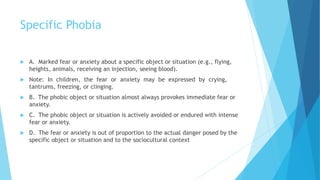
Specific Phobia
 A. Marked fear or anxiety about a specific object or situation (e.g., flying,
heights, animals, receiving an injection, seeing blood).
 Note: In children, the fear or anxiety may be expressed by crying,
tantrums, freezing, or clinging.
 B. The phobic object or situation almost always provokes immediate fear or
anxiety.
 C. The phobic object or situation is actively avoided or endured with intense
fear or anxiety.
 D. The fear or anxiety is out of proportion to the actual danger posed by the
specific object or situation and to the sociocultural context
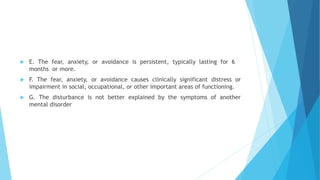
 E. The fear, anxiety, or avoidance is persistent, typically lasting for 6
months or more.
 F. The fear, anxiety, or avoidance causes clinically significant distress or
impairment in social, occupational, or other important areas of functioning.
 G. The disturbance is not better explained by the symptoms of another
mental disorder
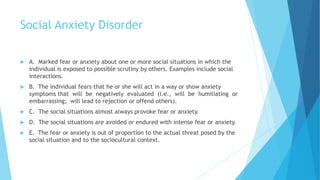
Social Anxiety Disorder
 A. Marked fear or anxiety about one or more social situations in which the
individual is exposed to possible scrutiny by others. Examples include social
interactions.
 B. The individual fears that he or she will act in a way or show anxiety
symptoms that will be negatively evaluated (i.e., will be humiliating or
embarrassing; will lead to rejection or offend others).
 C. The social situations almost always provoke fear or anxiety.
 D. The social situations are avoided or endured with intense fear or anxiety.
 E. The fear or anxiety is out of proportion to the actual threat posed by the
social situation and to the sociocultural context.
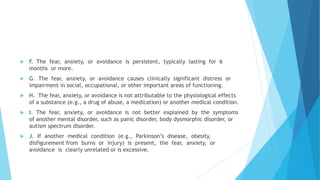
 F. The fear, anxiety, or avoidance is persistent, typically lasting for 6
months or more.
 G. The fear, anxiety, or avoidance causes clinically significant distress or
impairment in social, occupational, or other important areas of functioning.
 H. The fear, anxiety, or avoidance is not attributable to the physiological effects
of a substance (e.g., a drug of abuse, a medication) or another medical condition.
 I. The fear, anxiety, or avoidance is not better explained by the symptoms
of another mental disorder, such as panic disorder, body dysmorphic disorder, or
autism spectrum disorder.
 J. If another medical condition (e.g., Parkinson’s disease, obesity,
disfigurement from burns or injury) is present, the fear, anxiety, or
avoidance is clearly unrelated or is excessive.
Panic Disorder
 A. Recurrent unexpected panic attacks. A panic attack is an abrupt surge of
intense fear or intense discomfort that reaches a peak within minutes, and
during which time four (or more) of the following symptoms occur:
 1. Palpitations, pounding heart, or accelerated heart rate.
 2. Sweating.
 3. Trembling or shaking.
 4. Sensations of shortness of breath or smothering.
 5. Feelings of choking.
 6. Chest pain or discomfort.
 7. Nausea or abdominal distress.
 8. Feeling dizzy, unsteady, light-headed, or faint.
 9. Chills or heat sensations.
 10. Paresthesias (numbness or tingling sensations).
 11. Derealization (feelings of unreality) or depersonalization (being detached
from oneself).
 12. Fear of losing control or “going crazy.”
 13. Fear of dying.
 B. At least one of the attacks has been followed by 1 month (or more) of one
or both of the following:
 1. Persistent concern or worry about additional panic attacks or their
consequences (e.g., losing control, having a heart attack, “going crazy”).
 2. A significant maladaptive change in behavior related to the attacks
(e.g., behaviors designed to avoid having panic attacks, such as
avoidance of exercise or unfamiliar situations).
 C. The disturbance is not attributable to the physiological effects of a
substance (e.g., a drug of abuse, a medication) or another medical
condition (e.g., hyperthyroidism, cardiopulmonary disorders).
 D. The disturbance is not better explained by another mental disorder
(e.g., the panic attacks do not occur only in response to feared social
situations, as in social anxiety disorder; in response to circumscribed phobic
objects or situations, as in specific phobia; in response to obsessions, as
in obsessive-compulsive disorder; in response to reminders of traumatic
events, as in posttraumatic stress disorder; or in response to separation from
attachment figures, as in separation anxiety disorder).
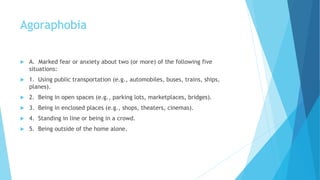
Agoraphobia
 A. Marked fear or anxiety about two (or more) of the following five
situations:
 1. Using public transportation (e.g., automobiles, buses, trains, ships,
planes).
 2. Being in open spaces (e.g., parking lots, marketplaces, bridges).
 3. Being in enclosed places (e.g., shops, theaters, cinemas).
 4. Standing in line or being in a crowd.
 5. Being outside of the home alone.
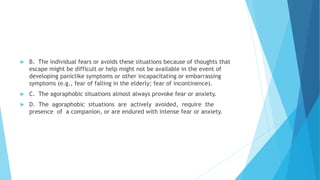
 B. The individual fears or avoids these situations because of thoughts that
escape might be difficult or help might not be available in the event of
developing paniclike symptoms or other incapacitating or embarrassing
symptoms (e.g., fear of falling in the elderly; fear of incontinence).
 C. The agoraphobic situations almost always provoke fear or anxiety.
 D. The agoraphobic situations are actively avoided, require the
presence of a companion, or are endured with intense fear or anxiety.
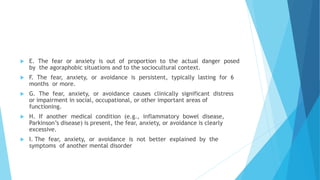
 E. The fear or anxiety is out of proportion to the actual danger posed
by the agoraphobic situations and to the sociocultural context.
 F. The fear, anxiety, or avoidance is persistent, typically lasting for 6
months or more.
 G. The fear, anxiety, or avoidance causes clinically significant distress
or impairment in social, occupational, or other important areas of
functioning.
 H. If another medical condition (e.g., inflammatory bowel disease,
Parkinson’s disease) is present, the fear, anxiety, or avoidance is clearly
excessive.
 I. The fear, anxiety, or avoidance is not better explained by the
symptoms of another mental disorder
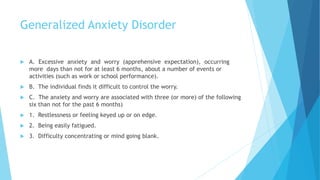
Generalized Anxiety Disorder
 A. Excessive anxiety and worry (apprehensive expectation), occurring
more days than not for at least 6 months, about a number of events or
activities (such as work or school performance).
 B. The individual finds it difficult to control the worry.
 C. The anxiety and worry are associated with three (or more) of the following
six than not for the past 6 months)
 1. Restlessness or feeling keyed up or on edge.
 2. Being easily fatigued.
 3. Difficulty concentrating or mind going blank.
 4. Irritability.
 5. Muscle tension.
 6. Sleep disturbance (difficulty falling or staying asleep, or restless,
unsatisfying sleep).
 D. The anxiety, worry, or physical symptoms cause clinically significant
distress or impairment in social, occupational, or other important areas of
functioning.
 E. The disturbance is not attributable to the physiological effects of a
substance (e.g., a drug of abuse, a medication) or another medical
condition (e.g., hyperthyroidism).
 F. The disturbance is not better explained by another mental disorder.
Substance/Medication-Induced Anxiety
Disorder
 A. Panic attacks or anxiety is predominant in the clinical picture.
 B. There is evidence from the history, physical examination, or laboratory
findings of both (1) and (2):
 1. The symptoms in Criterion A developed during or soon after
substance intoxication or withdrawal or after exposure to or withdrawal
from a medication.
 2. The involved substance/medication is capable of producing the symptoms
in Criterion A.
 C. The disturbance is not better explained by an anxiety disorder that
is not substance/medication-induced.
 D. The disturbance does not occur exclusively during the course of a
delirium.

ANXIETY DISORDERS.pptx

  • 1.
  • 2.
    INTRODUCTION  Anxiety isusually considered a normal reaction to a realistic danger or threat to biological integrity or self concept. Normal anxiety dissipates when the danger or threat is no longer present.  Anxiety can be considered abnormal or pathological if:  It is out of proportion to the situation that is creating it.  The anxiety interferes with social, occupational, or other important areas of functioning
  • 3.
    Impairments associated withanxiety disorders  Physical- sweatinng’, tachycardia, chest pressure, digestive disturbances, difficulty in breathing, restlessness, shaking’.  Cognitive- inability to concentrate, anxiuos thoughts, anticipating the worst outcome, mind-blindness, Feelings of unreality, hyper vigilance, cloudy mind. Thinking: Confused, distractible, low concentration, blocking. Conceptual – negative evaluations, frightening visual images cognitive distortion  Behavioral(longterm) – alcohol and drug use, avoidance of challenging situations, overprotective factors. Inhibited, Flight, Restlessness, Postural Collapse, hyperventilation, postural collapse, hyperventilation, tonic immobility.  Affective e.g. nervous, tense, frightened, jittery, jumpy, fearful, apprehensive
  • 4.
    Causes and riskfactors  Genetics- inheritance predisposition.  Chemical substances such as drugs, medicines and alterations in the levels of neurotransmitters.  Environmental factors such as pandemics, wars and disasters.  Physical conditons such as hyperthroidism.  Traumatic events such as child abuse, severe illnesses which led to prolonged hospitalizations and strained relationships in childhood.  Personality traits such as low self esteem, avoidant behaviors.
  • 5.
    Treatment of anxietydisorders  Biopsychosocial model.  Can be pharmacological or non- parmacological  Pharmacotherapy such as benzodiazepines such as imipramine or SSRIs such as sertraline.  Psychotherapy .  Cognitive behavioral therapy(CBT)- to dismantle the anxious or negative thoughts about impending situations.  Counselling to advice the patients about responses in situations.  Distractions so that they don’t focus on the threatening stimuli.
  • 6.
     Systemic desenstizationa behavioral therapy where by you expose the client to the threatening situation gradually starting from the stimulus of the lowest intensity as you increase step by step.  Another one can be flooding or implosion- expose the client to the phobic stimulus at its maximum intensity.  Another technique used can be imitation/modelling whereby the therapist expose themselves to the phobic stimuli while the patient imitates him/her.  Thought stopping: For patients with obsessional thoughts. Obsessional thoughts are interrupted by saying (stop) - either loud or sub vocally.
  • 7.
     Relaxation techniques-Good for insomnia that accompanies anxiety e.g. deep breathing, music therapy, meditation and warm baths.  Family therapy in treatment is important; Occupational therapy and counseling and stress-reducing environment
  • 8.
    Classification of commonanxiety disorders  Specific phobia.e.g hydrophobia- fear of water, claustrophobia- fear of closed spaces, entomophobia- fear of insects.  Social anxiety disorder.  Panic disorder  Agoraphobia- fear of open spaces  Generalized anxiety disorder  Separation anxiety disorder- fear or worrying of losing someone you care about.  Selective mutism – a child may refuse to talk in public with the family members
  • 9.
    Separation Anxiety Disorder A. Developmentally inappropriate and excessive fear or anxiety concerning separation from those to whom the individual is attached, as evidenced by at least three of the following:  1. Recurrent excessive distress when anticipating or experiencing separation from home or from major attachment figures.  2. Persistent and excessive worry about losing major attachment figures or about possible harm to them, such as illness, injury, disasters, or death.  3. Persistent and excessive worry about experiencing an untoward event (e.g., getting lost, being kidnapped, having an accident, becoming ill) that causes separation from a major attachment figure.  4. Persistent reluctance or refusal to go out, away from home, to school, to work, or elsewhere because of fear of separation.  .
  • 10.
     5. Persistentand excessive fear of or reluctance about being alone or without major attachment figures at home or in other settings.  6. Persistent reluctance or refusal to sleep away from home or to go to sleep without being near a major attachment figure.  7. Repeated nightmares involving the theme of separation.  8. Repeated complaints of physical symptoms (e.g., headaches, stomachaches, nausea, vomiting) when separation from major attachment figures occurs or is anticipated
  • 11.
     B. Thefear, anxiety, or avoidance is persistent, lasting at least 4 weeks in children and adolescents and typically 6 months or more in adults.  C. The disturbance causes clinically significant distress or impairment in social, academic, occupational, or other important areas of functioning.  D. The disturbance is not better explained by another mental disorder, such as refusing to leave home because of excessive resistance to change in autism spectrum disorder; delusions or hallucinations concerning separation in psychotic disorders; refusal to go outside without a trusted companion in agoraphobia; worries about ill health or other harm befalling significant others in generalized anxiety disorder; or concerns about having an illness in illness anxiety disorder.
  • 12.
    Selective Mutism  A.Consistent failure to speak in specific social situations in which there is an expectation for speaking (e.g., at school) despite speaking in other situations.  B. The disturbance interferes with educational or occupational achievement or with social communication.  C. The duration of the disturbance is at least 1 month (not limited to the first month of school).  D. The failure to speak is not attributable to a lack of knowledge of, or comfort with, the spoken language required in the social situation.
  • 13.
     E. Thedisturbance is not better explained by a communication disorder (e.g., childhood-onset fluency disorder) and does not occur exclusively during the course of autism spectrum disorder, schizophrenia, or another psychotic disorder.
  • 14.
    Specific Phobia  A.Marked fear or anxiety about a specific object or situation (e.g., flying, heights, animals, receiving an injection, seeing blood).  Note: In children, the fear or anxiety may be expressed by crying, tantrums, freezing, or clinging.  B. The phobic object or situation almost always provokes immediate fear or anxiety.  C. The phobic object or situation is actively avoided or endured with intense fear or anxiety.  D. The fear or anxiety is out of proportion to the actual danger posed by the specific object or situation and to the sociocultural context
  • 15.
     E. Thefear, anxiety, or avoidance is persistent, typically lasting for 6 months or more.  F. The fear, anxiety, or avoidance causes clinically significant distress or impairment in social, occupational, or other important areas of functioning.  G. The disturbance is not better explained by the symptoms of another mental disorder
  • 16.
    Social Anxiety Disorder A. Marked fear or anxiety about one or more social situations in which the individual is exposed to possible scrutiny by others. Examples include social interactions.  B. The individual fears that he or she will act in a way or show anxiety symptoms that will be negatively evaluated (i.e., will be humiliating or embarrassing; will lead to rejection or offend others).  C. The social situations almost always provoke fear or anxiety.  D. The social situations are avoided or endured with intense fear or anxiety.  E. The fear or anxiety is out of proportion to the actual threat posed by the social situation and to the sociocultural context.
  • 17.
     F. Thefear, anxiety, or avoidance is persistent, typically lasting for 6 months or more.  G. The fear, anxiety, or avoidance causes clinically significant distress or impairment in social, occupational, or other important areas of functioning.  H. The fear, anxiety, or avoidance is not attributable to the physiological effects of a substance (e.g., a drug of abuse, a medication) or another medical condition.  I. The fear, anxiety, or avoidance is not better explained by the symptoms of another mental disorder, such as panic disorder, body dysmorphic disorder, or autism spectrum disorder.  J. If another medical condition (e.g., Parkinson’s disease, obesity, disfigurement from burns or injury) is present, the fear, anxiety, or avoidance is clearly unrelated or is excessive.
  • 18.
    Panic Disorder  A.Recurrent unexpected panic attacks. A panic attack is an abrupt surge of intense fear or intense discomfort that reaches a peak within minutes, and during which time four (or more) of the following symptoms occur:  1. Palpitations, pounding heart, or accelerated heart rate.  2. Sweating.  3. Trembling or shaking.  4. Sensations of shortness of breath or smothering.  5. Feelings of choking.  6. Chest pain or discomfort.
  • 19.
     7. Nauseaor abdominal distress.  8. Feeling dizzy, unsteady, light-headed, or faint.  9. Chills or heat sensations.  10. Paresthesias (numbness or tingling sensations).  11. Derealization (feelings of unreality) or depersonalization (being detached from oneself).  12. Fear of losing control or “going crazy.”  13. Fear of dying.
  • 20.
     B. Atleast one of the attacks has been followed by 1 month (or more) of one or both of the following:  1. Persistent concern or worry about additional panic attacks or their consequences (e.g., losing control, having a heart attack, “going crazy”).  2. A significant maladaptive change in behavior related to the attacks (e.g., behaviors designed to avoid having panic attacks, such as avoidance of exercise or unfamiliar situations).  C. The disturbance is not attributable to the physiological effects of a substance (e.g., a drug of abuse, a medication) or another medical condition (e.g., hyperthyroidism, cardiopulmonary disorders).
  • 21.
     D. Thedisturbance is not better explained by another mental disorder (e.g., the panic attacks do not occur only in response to feared social situations, as in social anxiety disorder; in response to circumscribed phobic objects or situations, as in specific phobia; in response to obsessions, as in obsessive-compulsive disorder; in response to reminders of traumatic events, as in posttraumatic stress disorder; or in response to separation from attachment figures, as in separation anxiety disorder).
  • 22.
    Agoraphobia  A. Markedfear or anxiety about two (or more) of the following five situations:  1. Using public transportation (e.g., automobiles, buses, trains, ships, planes).  2. Being in open spaces (e.g., parking lots, marketplaces, bridges).  3. Being in enclosed places (e.g., shops, theaters, cinemas).  4. Standing in line or being in a crowd.  5. Being outside of the home alone.
  • 23.
     B. Theindividual fears or avoids these situations because of thoughts that escape might be difficult or help might not be available in the event of developing paniclike symptoms or other incapacitating or embarrassing symptoms (e.g., fear of falling in the elderly; fear of incontinence).  C. The agoraphobic situations almost always provoke fear or anxiety.  D. The agoraphobic situations are actively avoided, require the presence of a companion, or are endured with intense fear or anxiety.
  • 24.
     E. Thefear or anxiety is out of proportion to the actual danger posed by the agoraphobic situations and to the sociocultural context.  F. The fear, anxiety, or avoidance is persistent, typically lasting for 6 months or more.  G. The fear, anxiety, or avoidance causes clinically significant distress or impairment in social, occupational, or other important areas of functioning.  H. If another medical condition (e.g., inflammatory bowel disease, Parkinson’s disease) is present, the fear, anxiety, or avoidance is clearly excessive.  I. The fear, anxiety, or avoidance is not better explained by the symptoms of another mental disorder
  • 25.
    Generalized Anxiety Disorder A. Excessive anxiety and worry (apprehensive expectation), occurring more days than not for at least 6 months, about a number of events or activities (such as work or school performance).  B. The individual finds it difficult to control the worry.  C. The anxiety and worry are associated with three (or more) of the following six than not for the past 6 months)  1. Restlessness or feeling keyed up or on edge.  2. Being easily fatigued.  3. Difficulty concentrating or mind going blank.
  • 26.
     4. Irritability. 5. Muscle tension.  6. Sleep disturbance (difficulty falling or staying asleep, or restless, unsatisfying sleep).  D. The anxiety, worry, or physical symptoms cause clinically significant distress or impairment in social, occupational, or other important areas of functioning.  E. The disturbance is not attributable to the physiological effects of a substance (e.g., a drug of abuse, a medication) or another medical condition (e.g., hyperthyroidism).
  • 27.
     F. Thedisturbance is not better explained by another mental disorder.
  • 28.
    Substance/Medication-Induced Anxiety Disorder  A.Panic attacks or anxiety is predominant in the clinical picture.  B. There is evidence from the history, physical examination, or laboratory findings of both (1) and (2):  1. The symptoms in Criterion A developed during or soon after substance intoxication or withdrawal or after exposure to or withdrawal from a medication.  2. The involved substance/medication is capable of producing the symptoms in Criterion A.  C. The disturbance is not better explained by an anxiety disorder that is not substance/medication-induced.
  • 29.
     D. Thedisturbance does not occur exclusively during the course of a delirium.