
ON

“ADITYA BIRLA GRASIM

 By
ANURAG FARKYA
At
 AMITY UNIVERSITY RAJASTHAN
JAIPUR
                                                          
.

Company Profile
Grasim was incorporated on 25 August 1947, exactly 10 days after India achieved
independence. Grasim is more than an Industrial enterprise. It is the symbol of
INDIA’S surge for economic and industrial liberation. Grasim is world largest
producer of viscose staple fiber and edible oil and textile production.
Established in 1947, Grasim Industries Ltd. Has displayed remarkable business
acumen to grow both vertically and horizontally. Grasim has tapped opportunities as a
result of its dynamic approach to emerge as a leading industrial giant of our country.
Today, it is more than an industrial enterprise; it is a symbol of India’s search for
economic and industrial liberalization.
Starting as a textiles manufacturer in 1948, today Grasim's businesses comprise
viscose staple fibre (VSF), cement, chemicals and textiles.
Its core businesses are VSF and cement, which contribute to over 90 per cent of its
revenues and operating profits.
Group Profile
Group companies
 Grasim Industries Ltd.
 Hindalco Industries Ltd.
 Aditya Birla Nuvo Ltd.
 UltraTech Cement Ltd.
Indian companies
 PSI Data Systems 
 Aditya Birla Minacs Worldwide Limited 
 Essel Mining & Industries Ltd
 Idea Cellular Ltd.
 Aditya Birla Insulators 
 Aditya Birla Retail Limited 
 Bihar Caustic and Chemicals Ltd.
Joint ventures
 Birla Sun Life Insurance
 Birla Sun Life Asset Management Company Ltd. 
 Birla Sun Life Distribution Company Ltd.
 Tanfac Industries Ltd.

International establishments
Thailand
Philippines
Indonesia
Egypt
Egypt
China
Canada
Australia
Laos
North and South America
Grasim, Nagda
 Grasim is a flagship company of the Aditya Birla Group and is today a

dominant player in the manufacturing of Viscose Staple Fibre (VSF), an
extremely versatile textile fibre that has characteristics similar to cotton.
Our unit was established in 1954 with production capacity of 15 TPD. The
plant has grown organically with current installed capacity of 415 TPD.
With use of entirely indigenous resources including raw materials, knowhow and equipment Grasim has emerged as one of the world’s most costefficient VSF producers.
 The manufacturing facility is located close to river Chambal at

Nagda(M.P) a small town exactly mid-way on the rail route from New
Delhi to Mumbai.
 The company has also established an engineering division to

manufacture the plant and machinery used for producing VSF and is a
major exporter to south east and far eastern countries.
MAIN PRODUCTS OF GRASIM
1 Viscose staple fiber
 2 Rayon grade pulp
 3.Cement
 4.Textiles
 5 Sponge Iron
 6.Chemicals
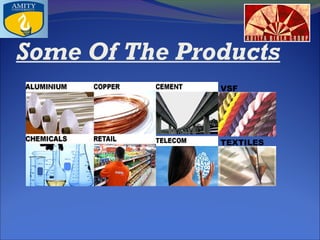
Some Of The Products
VSF

TEXTILES
Departments of Engineering Division
1.PPD (Project & Planning Department)
2.Fabrication shop
3.Machine shop
4.Assembly shop
5.EMT/MMT (Electrical or Mechanical

Maintenance)
6.QA/QC (Quality Control & Assurance)
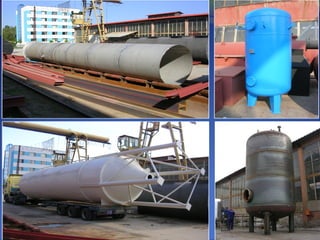
PRODUCTS MADE IN ENG. DIVISION

:-

 Reservoirs for propane-butane gas;
 Pressure vessels for air and nitrogen;
 Reservoirs for CO2;
 Ammonia receivers;
 Pressure vessels;
 Storage vessels for liquid gases, oils and other

liquids;
 Heat-exchangers;
PPD
Project & Planning Dep.  is defined as a

method for the effective planning of all
resources of a manufacturing company.
Ideally, it addresses operational planning in
units, financial planning, and has a
simulation capability to answer "what-if"
questions and extension of closed-loop .
. Characteristic basic modules in an
PPD system are:

 Master production schedule (MPS)
 Item master data (technical data)
 Bill of materials (BOM) (technical data)
 Production resources data (manufacturing technical data)
 Inventories and orders (inventory control)
 Purchasing management
 Material requirements planning (MRP)
 Shop floor control (SFC)
 Capacity planning or capacity requirements planning (CRP)
 Standard costing (cost control)
 Cost reporting / management (cost control)
together with auxiliary systems such as:
 Business planning
 Lot traceability
 Contract management
 Tool management.
 Engineering change control
 Configuration management
 Shop floor data collection
 Sales analysis and forecasting
 Finite capacity scheduling (FCS)
Fabrication
Manufacturing processes such as fusion welding

are widely used to produce many products, and
for some companies, these are the key
production features. Products may range from
simple to complex; examples include pressure
vessels, domestic and agricultural equipment,
cranes, bridges, transport vehicles and other
items.
 
TYPE OF MATERIAL USED
1.MS-MILD STEEL
2.SS-STAINLESS STEEL
3.CS-CARBIDE STEEL
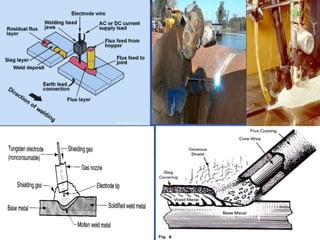
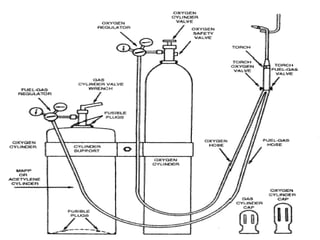
TYPES OF WELDING PROCESS
1.SUBMERGED ARC WELDING
2.OXY-ACTELYENE WELDING

3.CARBON ARC WELDING
4.TUNGSTEN ARC WELDING
5.SHIELDED ARC WELDING
http://www.twi.co.uk
MACHINES IN FABRICATION SHOP
1.BLANKING MACHINE
2.PUNCHING MACHINE
3.ROLLING MACHINE
4.PRESSING MACHINE
5.DRILLING MACHINE
MACHINE SHOP
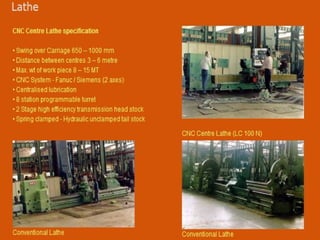
LATHE
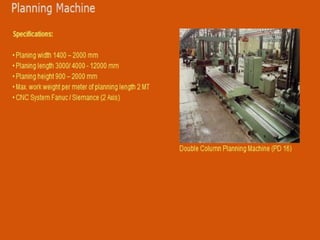
PLANNING
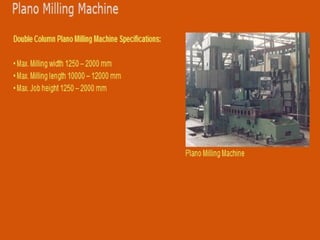
PLANO-MILLING
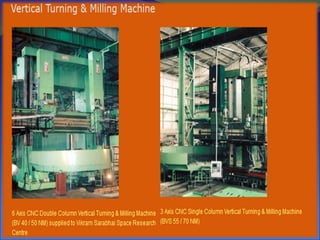
VERTICAL TURNING & MILLING
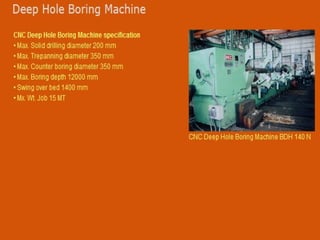
BORING
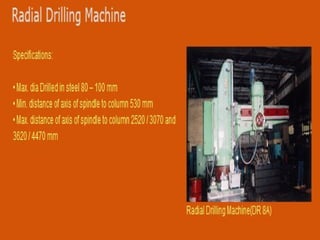
RADIAL DRILLING
TABLE LENGHT
ASSEMBLY SHOP
 A Completely assembly is a presentation of a product

or a structure put together parts in their operational
positions. The separate parts come to the assembly
department after their manufacturing are finished and
in this department they are put together according the
assembly drawings. Small machine be necessary
during assembly process such as drilling, reaming, or
hand finishing. For such cases, assembly include a
note explaining the required operation and give the
dimension for the alignment or location of machine
part.
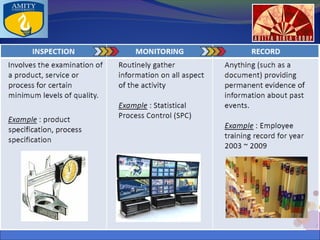
QA/QC
 In order to guarantee the application of all the

fabrication procedures and the required properties for
the product, appropriate inspections and tests shall be
implemented during the manufacturing process.
 Location and frequency of such inspections and/or

tests will depend on the contract and/or product
standard, on the welding process and on the type of
construction.

 
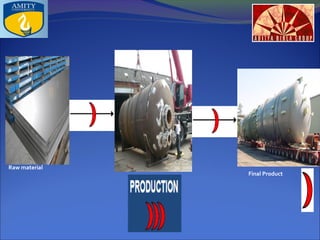
Raw material

Final Product
CONCLUSION
I completed my practical training at “ABG”
successfully. It was a great pleasure for me to
getting practical knowledge and experience with
an organization. I have tried my best to achieve
that objective of this INDUSTRIAL TRAINING
although it is open for further enhancement.

31
Anurag

Anurag

  • 1.
  • 3.
    . Company Profile Grasim wasincorporated on 25 August 1947, exactly 10 days after India achieved independence. Grasim is more than an Industrial enterprise. It is the symbol of INDIA’S surge for economic and industrial liberation. Grasim is world largest producer of viscose staple fiber and edible oil and textile production. Established in 1947, Grasim Industries Ltd. Has displayed remarkable business acumen to grow both vertically and horizontally. Grasim has tapped opportunities as a result of its dynamic approach to emerge as a leading industrial giant of our country. Today, it is more than an industrial enterprise; it is a symbol of India’s search for economic and industrial liberalization. Starting as a textiles manufacturer in 1948, today Grasim's businesses comprise viscose staple fibre (VSF), cement, chemicals and textiles. Its core businesses are VSF and cement, which contribute to over 90 per cent of its revenues and operating profits.
  • 4.
    Group Profile Group companies Grasim Industries Ltd.  Hindalco Industries Ltd.  Aditya Birla Nuvo Ltd.  UltraTech Cement Ltd. Indian companies  PSI Data Systems   Aditya Birla Minacs Worldwide Limited   Essel Mining & Industries Ltd  Idea Cellular Ltd.  Aditya Birla Insulators   Aditya Birla Retail Limited   Bihar Caustic and Chemicals Ltd. Joint ventures  Birla Sun Life Insurance  Birla Sun Life Asset Management Company Ltd.   Birla Sun Life Distribution Company Ltd.  Tanfac Industries Ltd. International establishments Thailand Philippines Indonesia Egypt Egypt China Canada Australia Laos North and South America
  • 5.
    Grasim, Nagda  Grasimis a flagship company of the Aditya Birla Group and is today a dominant player in the manufacturing of Viscose Staple Fibre (VSF), an extremely versatile textile fibre that has characteristics similar to cotton. Our unit was established in 1954 with production capacity of 15 TPD. The plant has grown organically with current installed capacity of 415 TPD. With use of entirely indigenous resources including raw materials, knowhow and equipment Grasim has emerged as one of the world’s most costefficient VSF producers.  The manufacturing facility is located close to river Chambal at Nagda(M.P) a small town exactly mid-way on the rail route from New Delhi to Mumbai.  The company has also established an engineering division to manufacture the plant and machinery used for producing VSF and is a major exporter to south east and far eastern countries.
  • 6.
    MAIN PRODUCTS OFGRASIM 1 Viscose staple fiber  2 Rayon grade pulp  3.Cement  4.Textiles  5 Sponge Iron  6.Chemicals
  • 7.
    Some Of TheProducts VSF TEXTILES
  • 8.
    Departments of EngineeringDivision 1.PPD (Project & Planning Department) 2.Fabrication shop 3.Machine shop 4.Assembly shop 5.EMT/MMT (Electrical or Mechanical Maintenance) 6.QA/QC (Quality Control & Assurance)
  • 9.
    PRODUCTS MADE INENG. DIVISION :-  Reservoirs for propane-butane gas;  Pressure vessels for air and nitrogen;  Reservoirs for CO2;  Ammonia receivers;  Pressure vessels;  Storage vessels for liquid gases, oils and other liquids;  Heat-exchangers;
  • 11.
    PPD Project & PlanningDep.  is defined as a method for the effective planning of all resources of a manufacturing company. Ideally, it addresses operational planning in units, financial planning, and has a simulation capability to answer "what-if" questions and extension of closed-loop .
  • 12.
    . Characteristic basicmodules in an PPD system are:  Master production schedule (MPS)  Item master data (technical data)  Bill of materials (BOM) (technical data)  Production resources data (manufacturing technical data)  Inventories and orders (inventory control)  Purchasing management  Material requirements planning (MRP)  Shop floor control (SFC)  Capacity planning or capacity requirements planning (CRP)  Standard costing (cost control)  Cost reporting / management (cost control)
  • 13.
    together with auxiliarysystems such as:  Business planning  Lot traceability  Contract management  Tool management.  Engineering change control  Configuration management  Shop floor data collection  Sales analysis and forecasting  Finite capacity scheduling (FCS)
  • 14.
    Fabrication Manufacturing processes suchas fusion welding are widely used to produce many products, and for some companies, these are the key production features. Products may range from simple to complex; examples include pressure vessels, domestic and agricultural equipment, cranes, bridges, transport vehicles and other items.  
  • 15.
    TYPE OF MATERIALUSED 1.MS-MILD STEEL 2.SS-STAINLESS STEEL 3.CS-CARBIDE STEEL
  • 16.
    TYPES OF WELDINGPROCESS 1.SUBMERGED ARC WELDING 2.OXY-ACTELYENE WELDING 3.CARBON ARC WELDING 4.TUNGSTEN ARC WELDING 5.SHIELDED ARC WELDING
  • 17.
  • 19.
    MACHINES IN FABRICATIONSHOP 1.BLANKING MACHINE 2.PUNCHING MACHINE 3.ROLLING MACHINE 4.PRESSING MACHINE 5.DRILLING MACHINE
  • 20.
  • 23.
  • 27.
    ASSEMBLY SHOP  ACompletely assembly is a presentation of a product or a structure put together parts in their operational positions. The separate parts come to the assembly department after their manufacturing are finished and in this department they are put together according the assembly drawings. Small machine be necessary during assembly process such as drilling, reaming, or hand finishing. For such cases, assembly include a note explaining the required operation and give the dimension for the alignment or location of machine part.
  • 28.
    QA/QC  In orderto guarantee the application of all the fabrication procedures and the required properties for the product, appropriate inspections and tests shall be implemented during the manufacturing process.  Location and frequency of such inspections and/or tests will depend on the contract and/or product standard, on the welding process and on the type of construction.  
  • 30.
  • 31.
    CONCLUSION I completed mypractical training at “ABG” successfully. It was a great pleasure for me to getting practical knowledge and experience with an organization. I have tried my best to achieve that objective of this INDUSTRIAL TRAINING although it is open for further enhancement. 31