Lect 7_Process Strategy & Capacity and Constraint Management.pptx
1.
BITS Pilani
Pilani Campus
OperationsManagement
MBAZG526/QMZG526
Dr Sandeep Singh
PhD (FPM-OM)-Indian Institute of Management Lucknow
Faculty- Operations Management Group
BITS Pilani, PilaniCampus
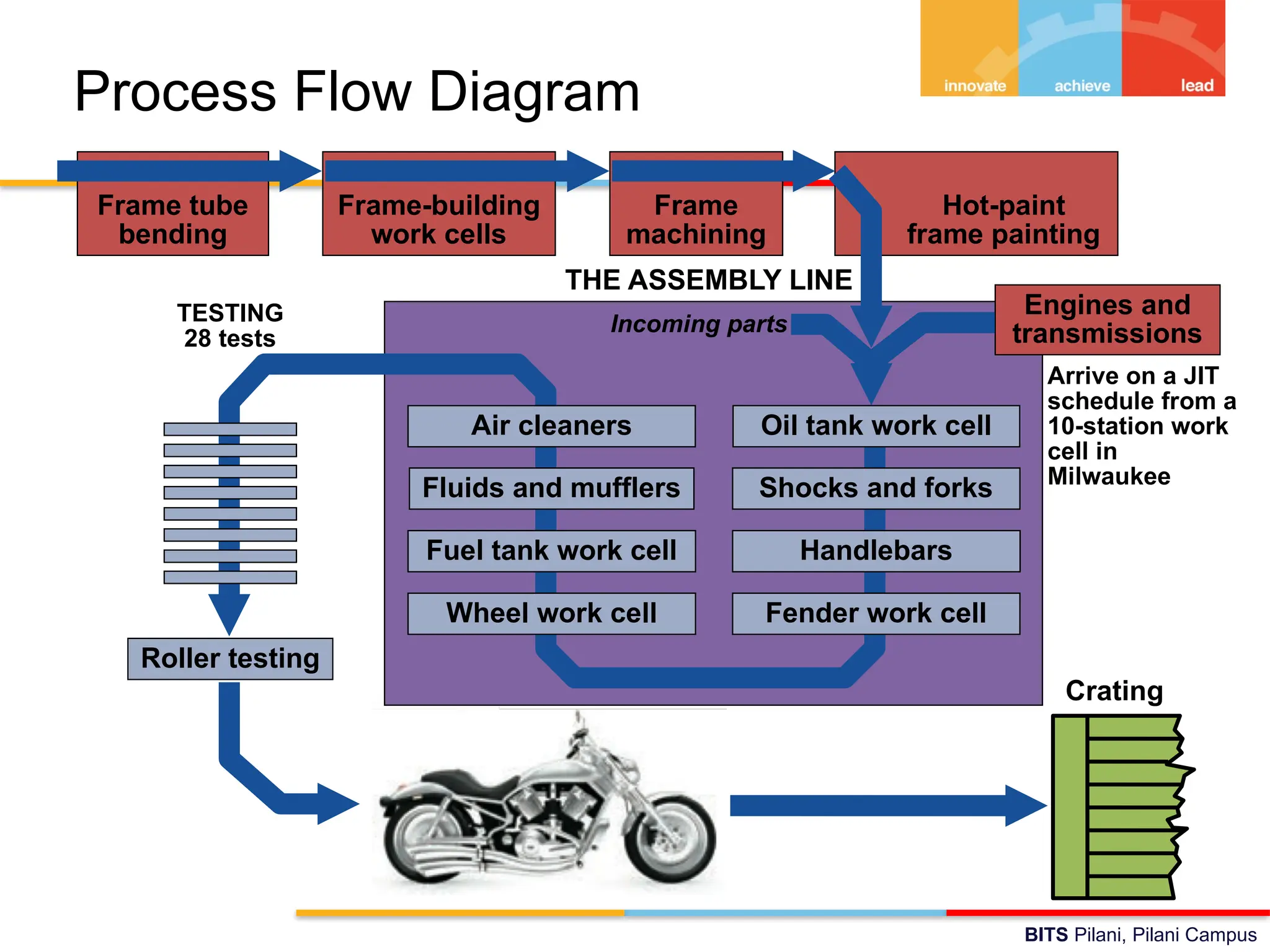
Process Flow Diagram
THE ASSEMBLY LINE
TESTING
28 tests
Oil tank work cell
Shocks and forks
Handlebars
Fender work cell
Air cleaners
Fluids and mufflers
Fuel tank work cell
Wheel work cell
Roller testing
Incoming parts
Arrive on a JIT
schedule from a
10-station work
cell in
Milwaukee
Engines and
transmissions
Frame tube
bending
Frame-building
work cells
Frame
machining
Hot-paint
frame painting
Crating
5.
BITS Pilani, PilaniCampus
Process Strategy
The objective is to create a process
to produce products that meets
customer requirements within cost
and other managerial constraints
6.
BITS Pilani, PilaniCampus
Process Strategies
► How to produce a product or provide a
service that
► Meets or exceeds customer requirements
► Meets cost and managerial goals
► Has long term effects on
► Efficiency and production flexibility
► Costs and quality
7.
BITS Pilani, PilaniCampus
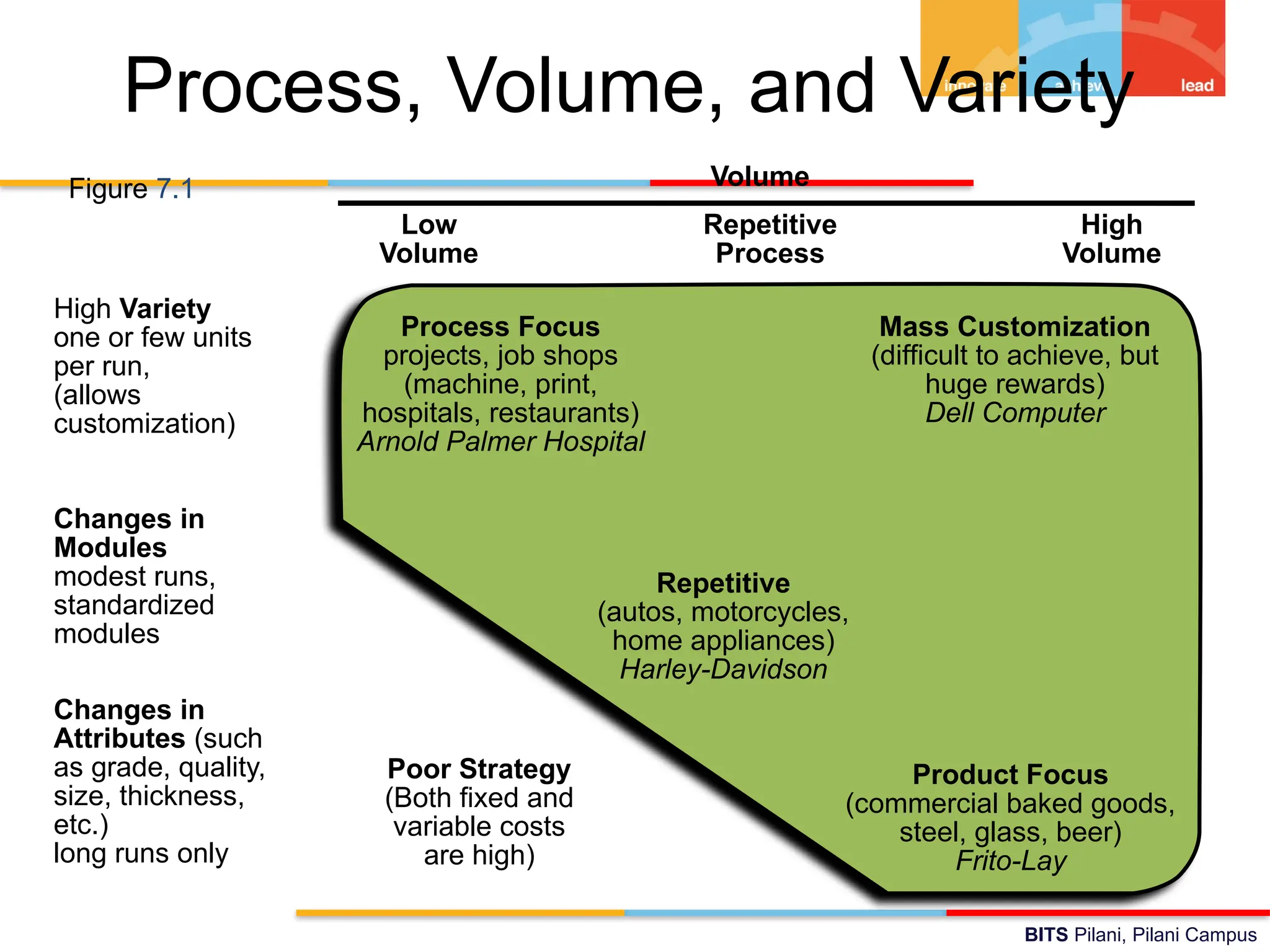
Process, Volume, and Variety
Process Focus
projects, job shops
(machine, print,
hospitals, restaurants)
Arnold Palmer Hospital
Repetitive
(autos, motorcycles,
home appliances)
Harley-Davidson
Product Focus
(commercial baked goods,
steel, glass, beer)
Frito-Lay
High Variety
one or few units
per run,
(allows
customization)
Changes in
Modules
modest runs,
standardized
modules
Changes in
Attributes (such
as grade, quality,
size, thickness,
etc.)
long runs only
Mass Customization
(difficult to achieve, but
huge rewards)
Dell Computer
Poor Strategy
(Both fixed and
variable costs
are high)
Low
Volume
Repetitive
Process
High
Volume
Volume
Figure 7.1
8.
BITS Pilani, PilaniCampus
Process Strategies
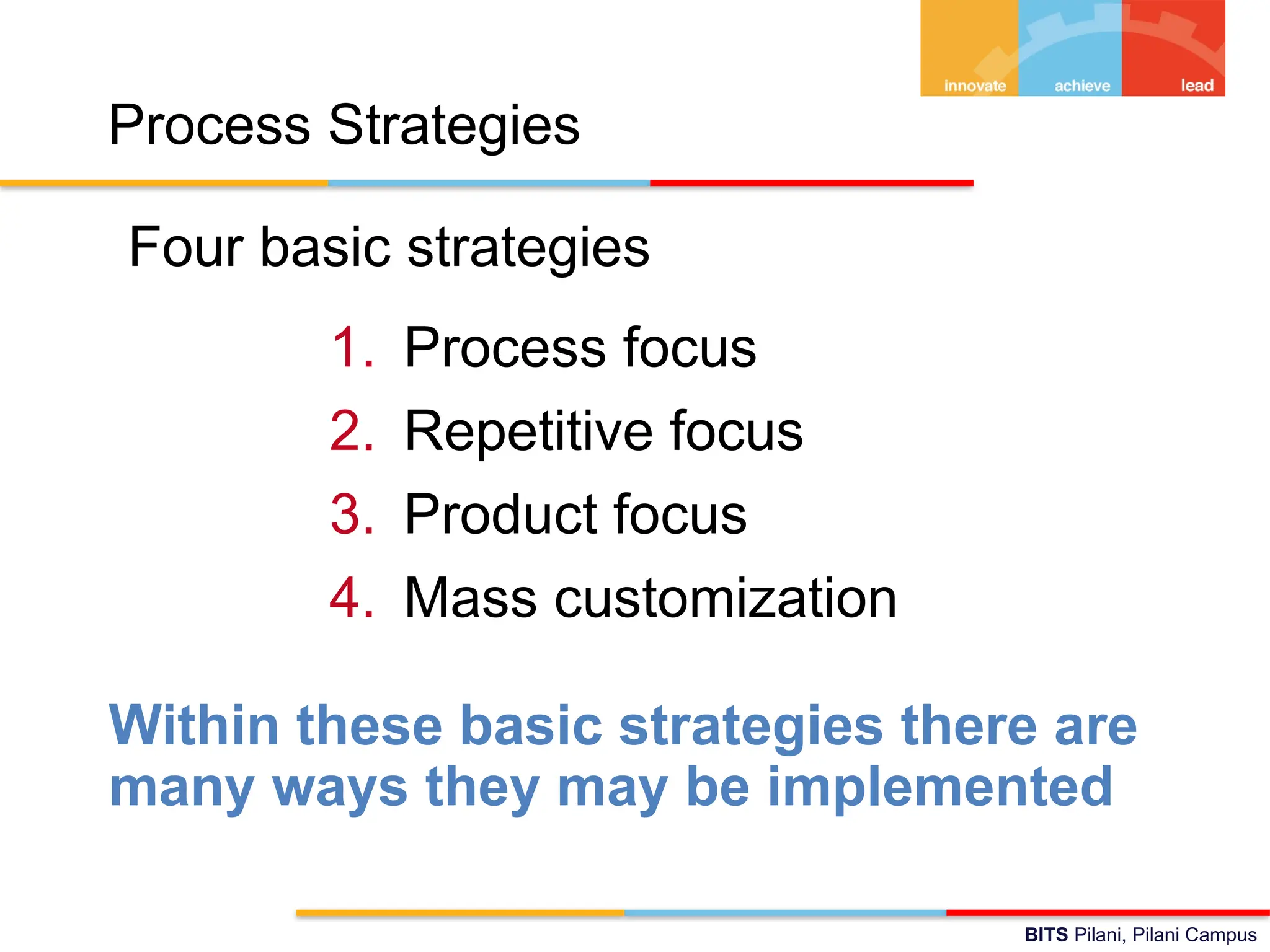
Four basic strategies
1. Process focus
2. Repetitive focus
3. Product focus
4. Mass customization
Within these basic strategies there are
many ways they may be implemented
9.
BITS Pilani, PilaniCampus
Process Focus
► Facilities are organized around specific
activities or processes
► General purpose equipment and skilled
personnel
► High degree of product flexibility
► Typically high costs and low equipment
utilization
► Product flows may vary considerably
making planning and scheduling a
challenge
10.
BITS Pilani, PilaniCampus
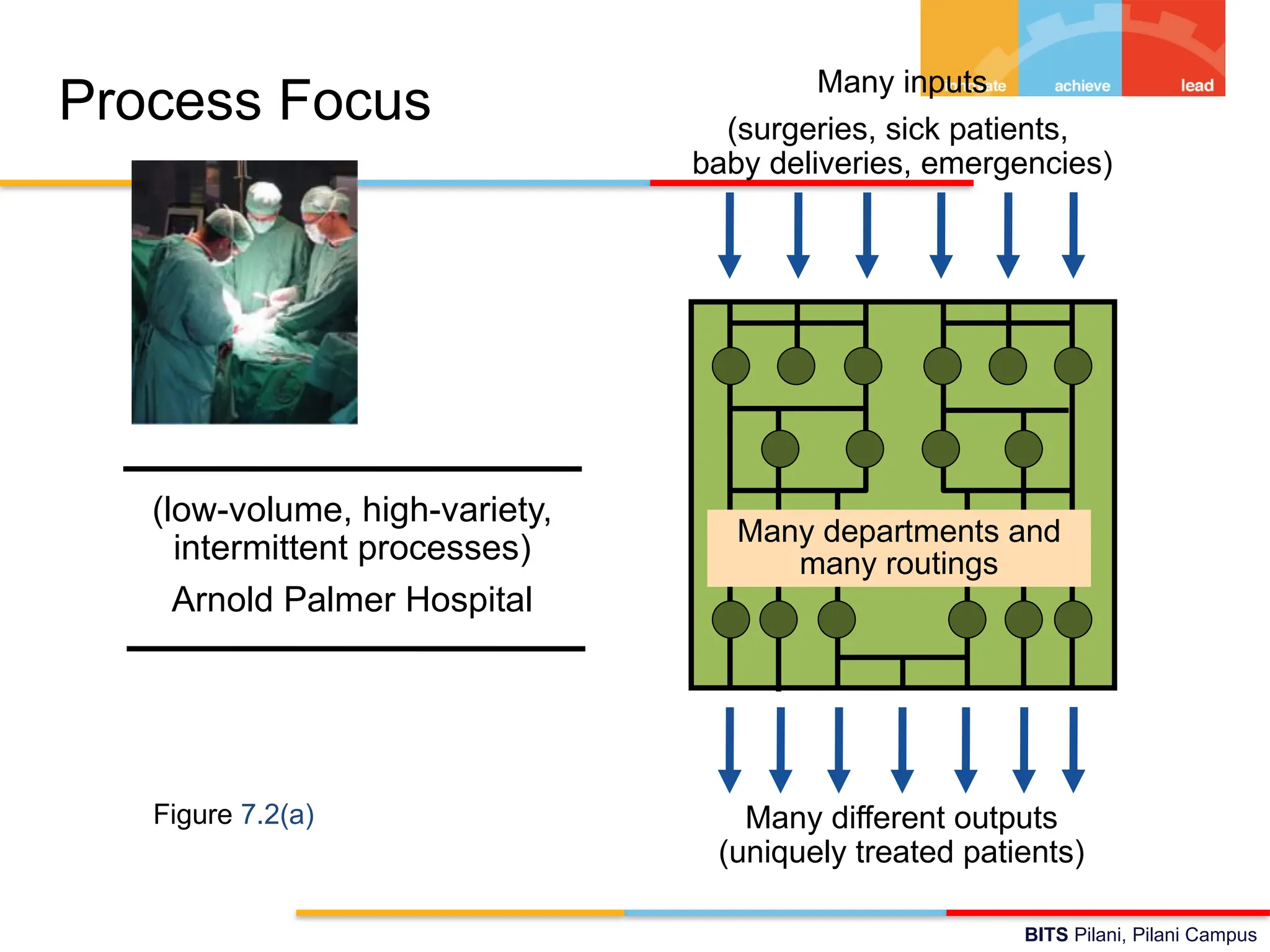
Process Focus Many inputs
(surgeries, sick patients,
baby deliveries, emergencies)
Many different outputs
(uniquely treated patients)
Many departments and
many routings
Figure 7.2(a)
(low-volume, high-variety,
intermittent processes)
Arnold Palmer Hospital
11.
BITS Pilani, PilaniCampus
Repetitive Focus
► Facilities often organized as assembly
lines
► Characterized by modules with parts and
assemblies made previously
► Modules may be combined for many
output options
► Less flexibility than process-focused
facilities but more efficient
12.
BITS Pilani, PilaniCampus
Repetitive Focus
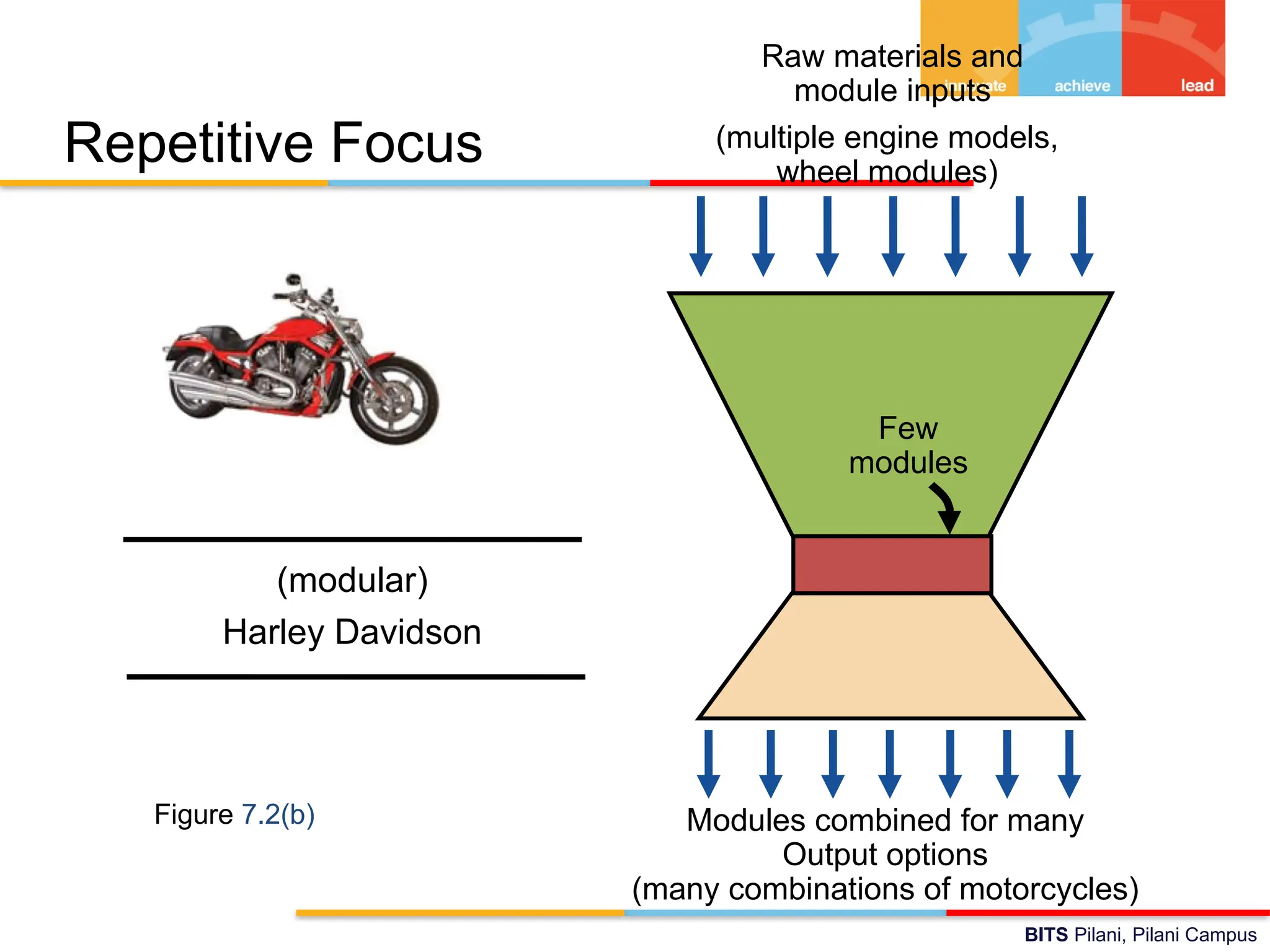
Raw materials and
module inputs
Modules combined for many
Output options
(many combinations of motorcycles)
Few
modules
(multiple engine models,
wheel modules)
Figure 7.2(b)
(modular)
Harley Davidson
13.
BITS Pilani, PilaniCampus
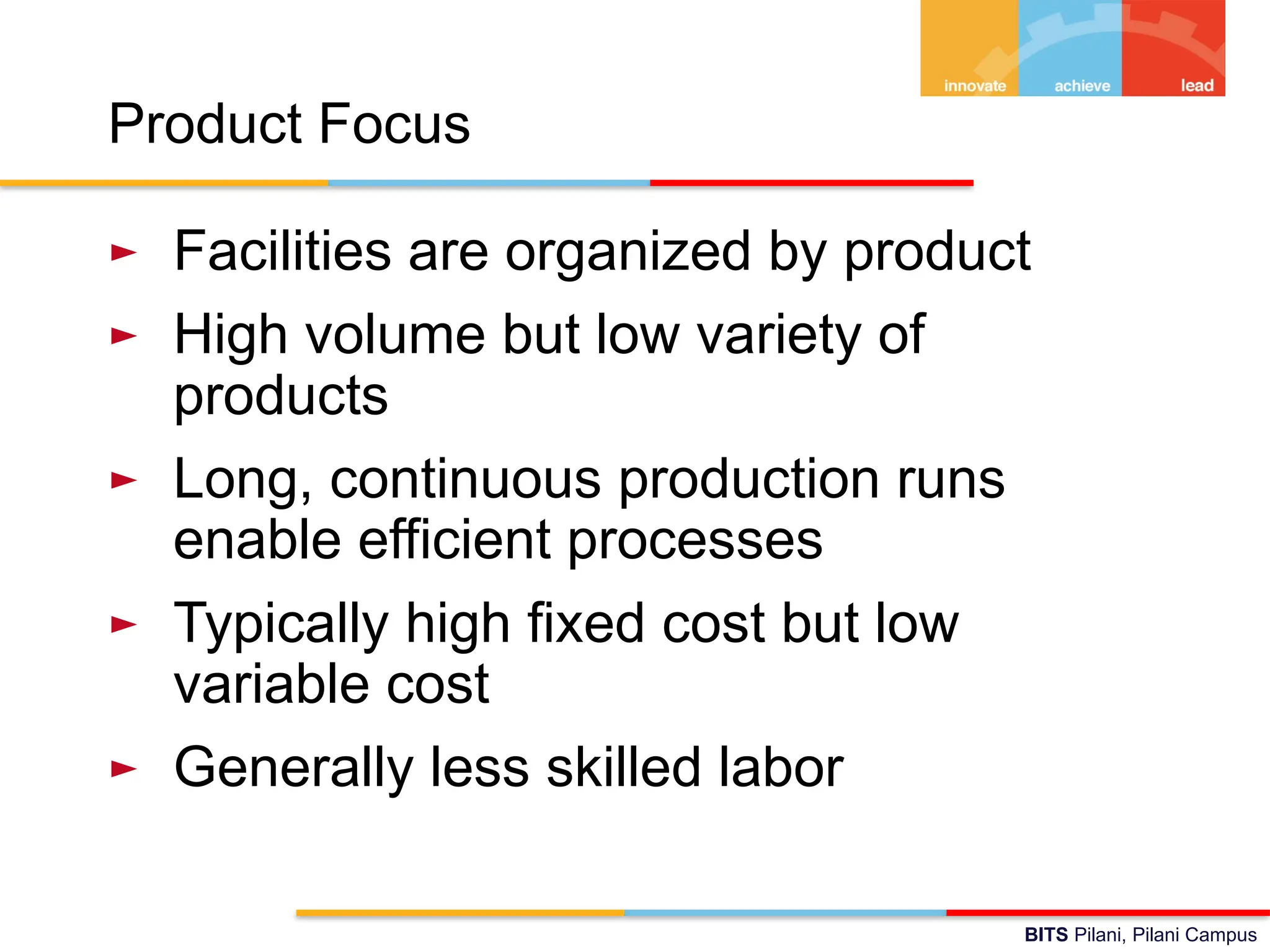
Product Focus
► Facilities are organized by product
► High volume but low variety of
products
► Long, continuous production runs
enable efficient processes
► Typically high fixed cost but low
variable cost
► Generally less skilled labor
14.
BITS Pilani, PilaniCampus
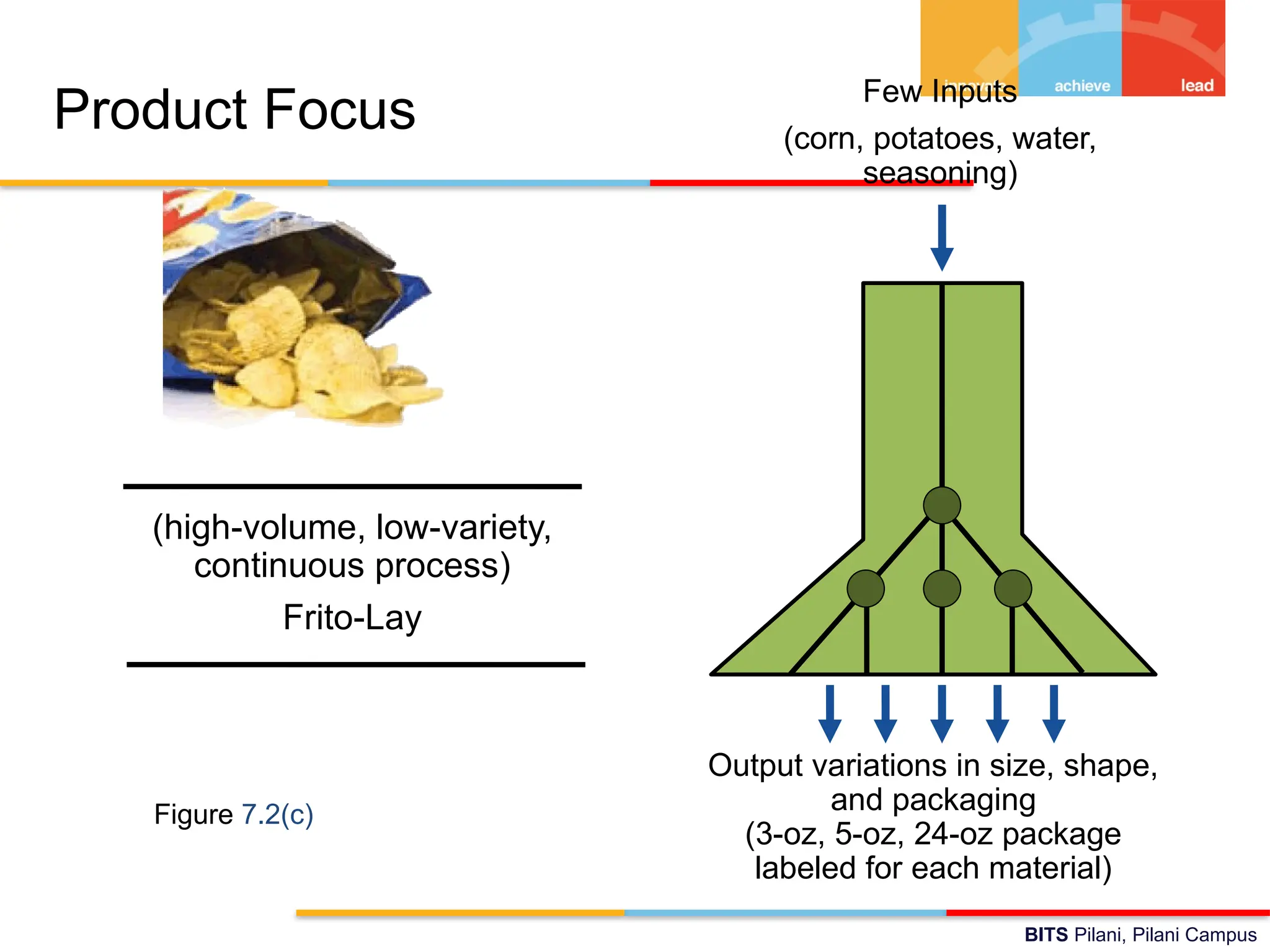
Product Focus Few Inputs
(corn, potatoes, water,
seasoning)
Output variations in size, shape,
and packaging
(3-oz, 5-oz, 24-oz package
labeled for each material)
Figure 7.2(c)
(high-volume, low-variety,
continuous process)
Frito-Lay
15.
BITS Pilani, PilaniCampus
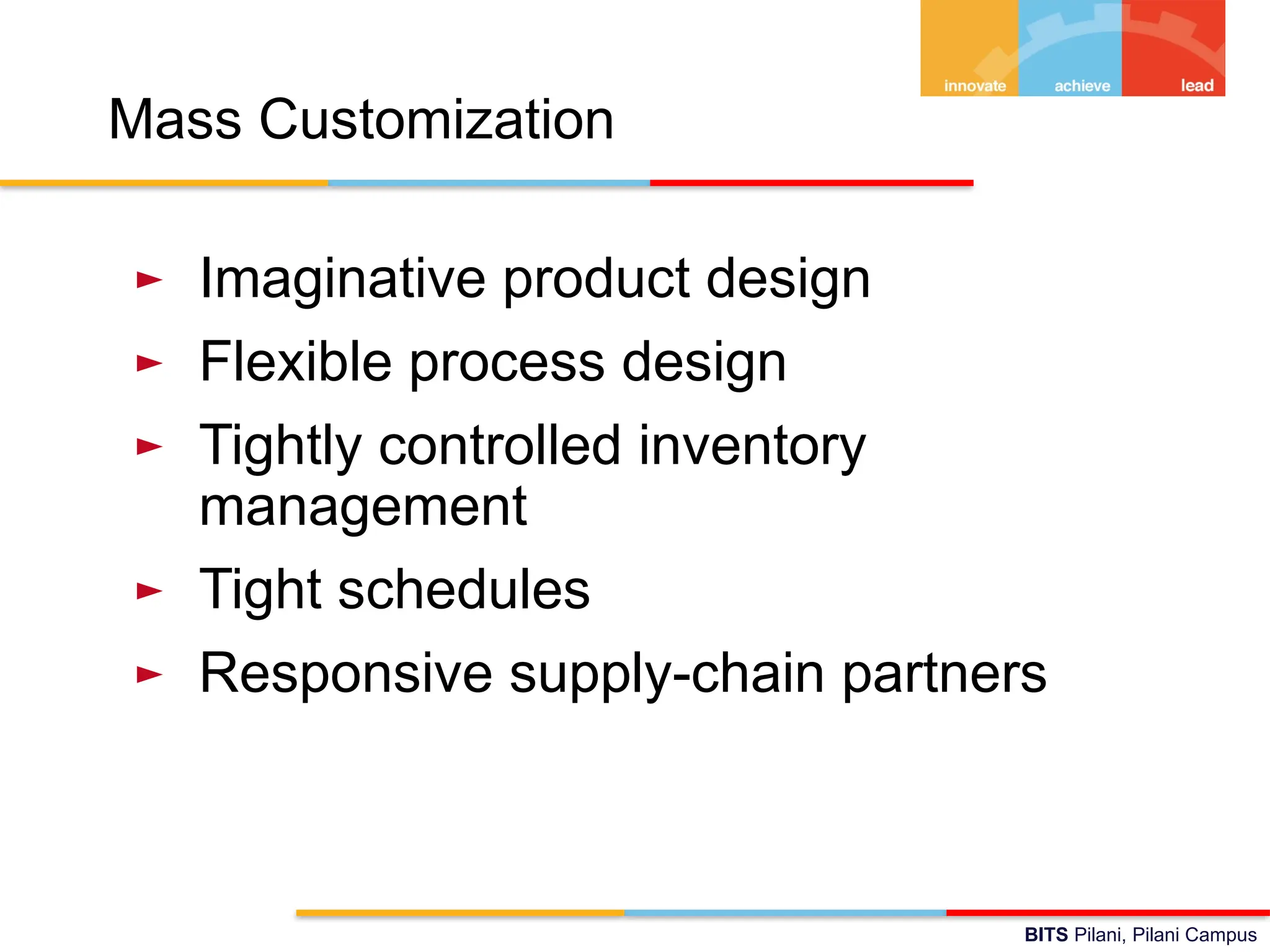
Mass Customization
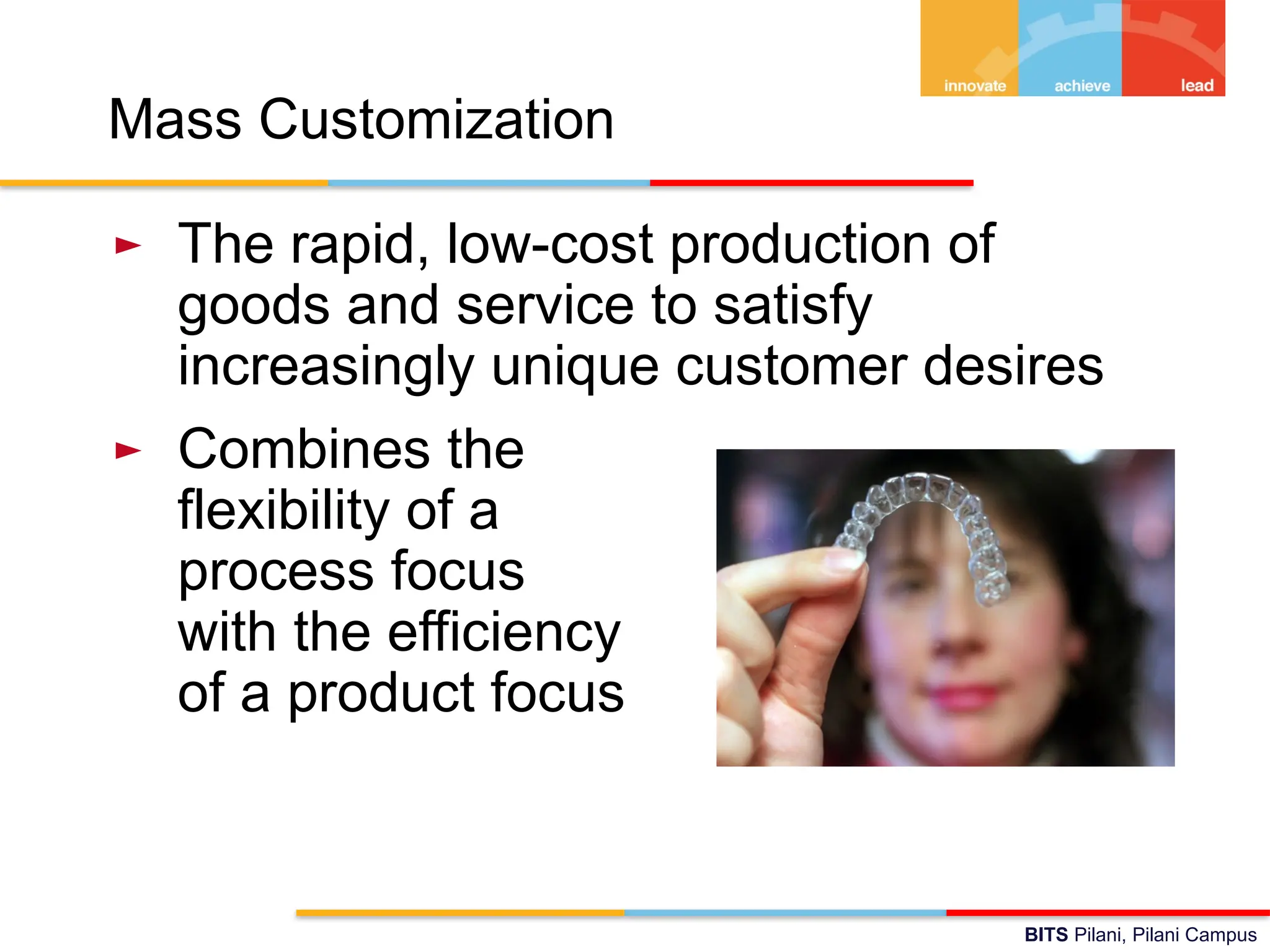
► The rapid, low-cost production of
goods and service to satisfy
increasingly unique customer desires
► Combines the
flexibility of a
process focus
with the efficiency
of a product focus
16.
BITS Pilani, PilaniCampus
Mass Customization
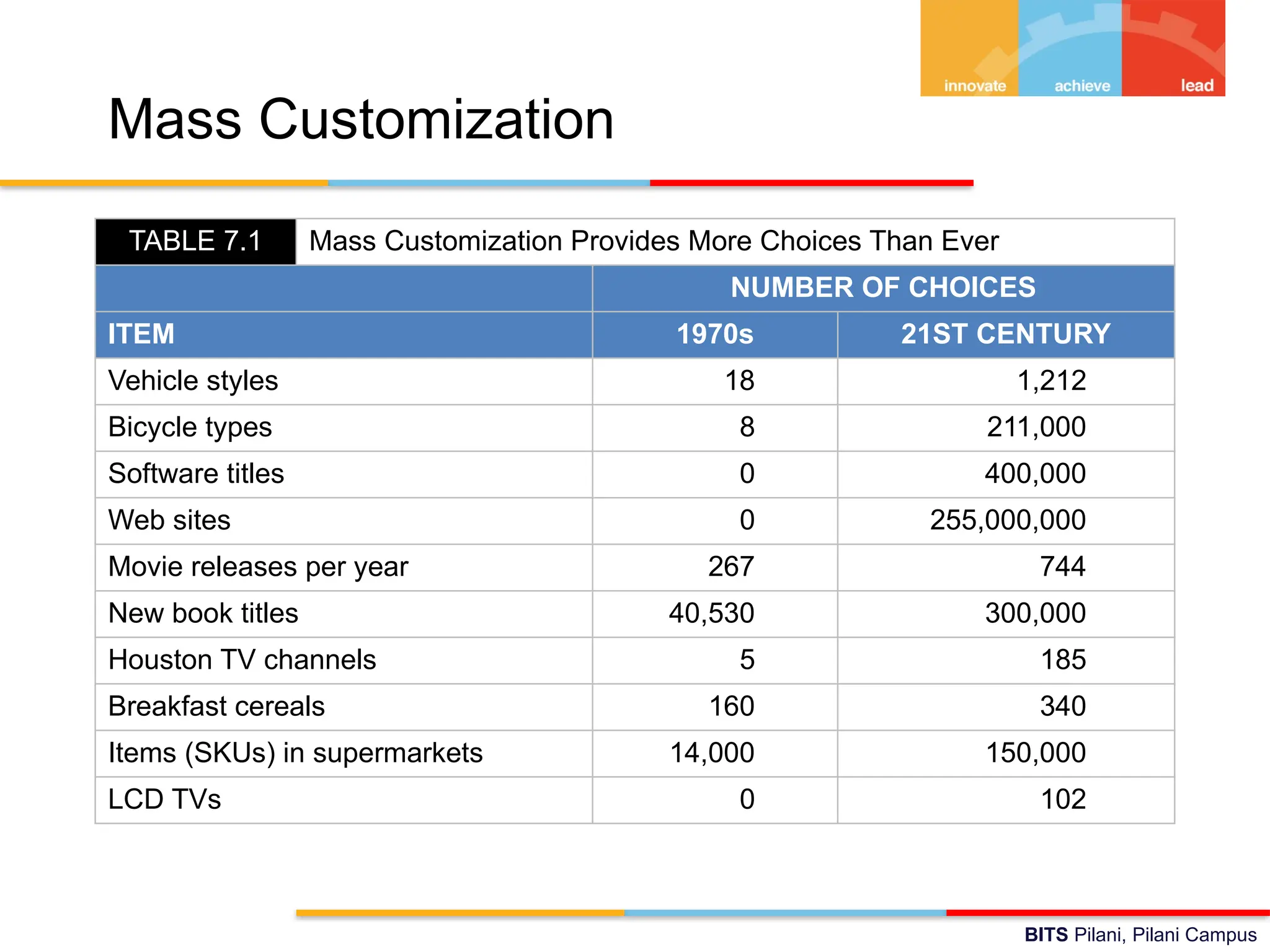
TABLE 7.1 Mass Customization Provides More Choices Than Ever
NUMBER OF CHOICES
ITEM 1970s 21ST CENTURY
Vehicle styles 18 1,212
Bicycle types 8 211,000
Software titles 0 400,000
Web sites 0 255,000,000
Movie releases per year 267 744
New book titles 40,530 300,000
Houston TV channels 5 185
Breakfast cereals 160 340
Items (SKUs) in supermarkets 14,000 150,000
LCD TVs 0 102
17.
BITS Pilani, PilaniCampus
Mass Customization
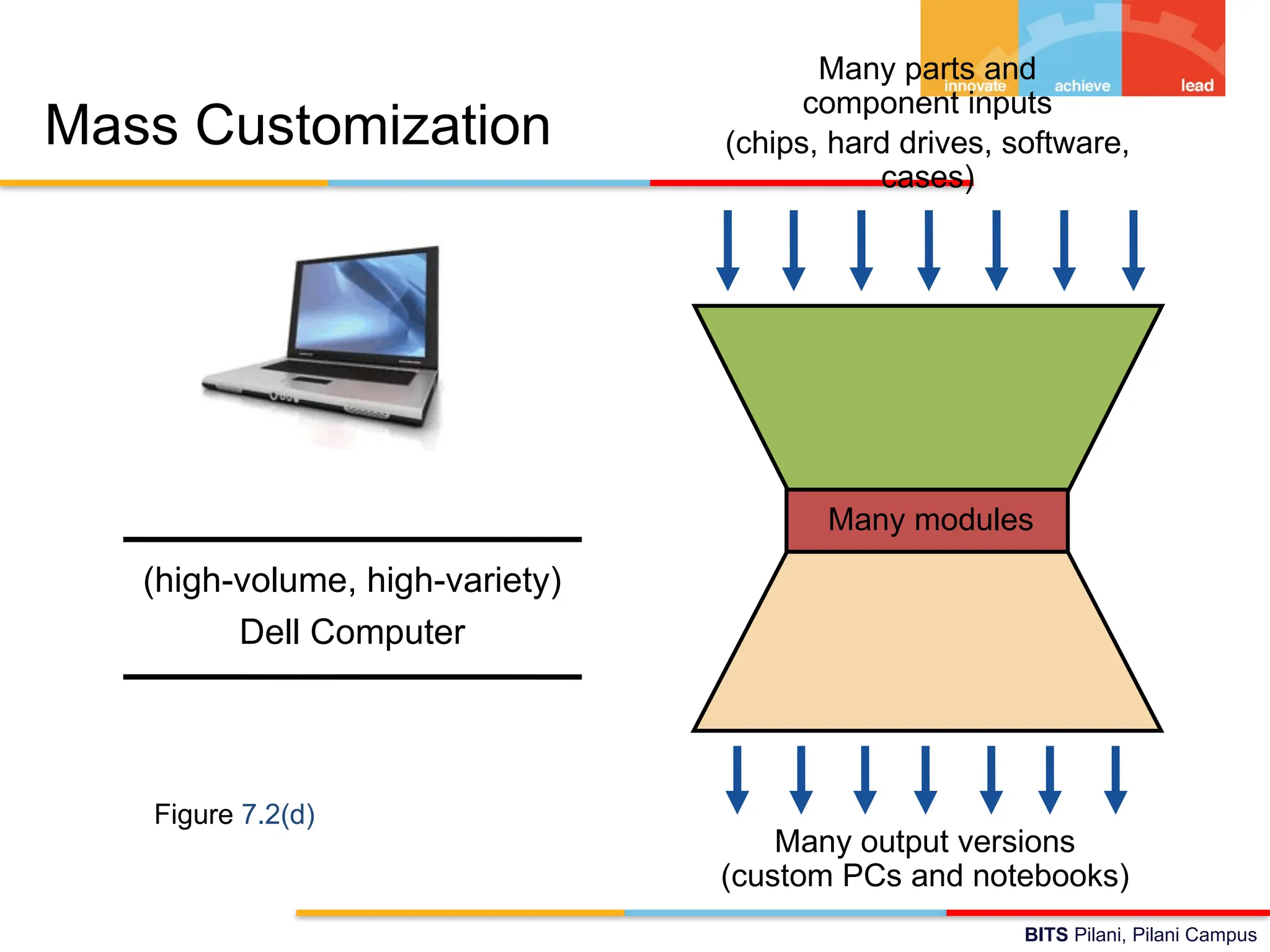
Many parts and
component inputs
Many output versions
(custom PCs and notebooks)
Many modules
(chips, hard drives, software,
cases)
Figure 7.2(d)
(high-volume, high-variety)
Dell Computer
BITS Pilani, PilaniCampus
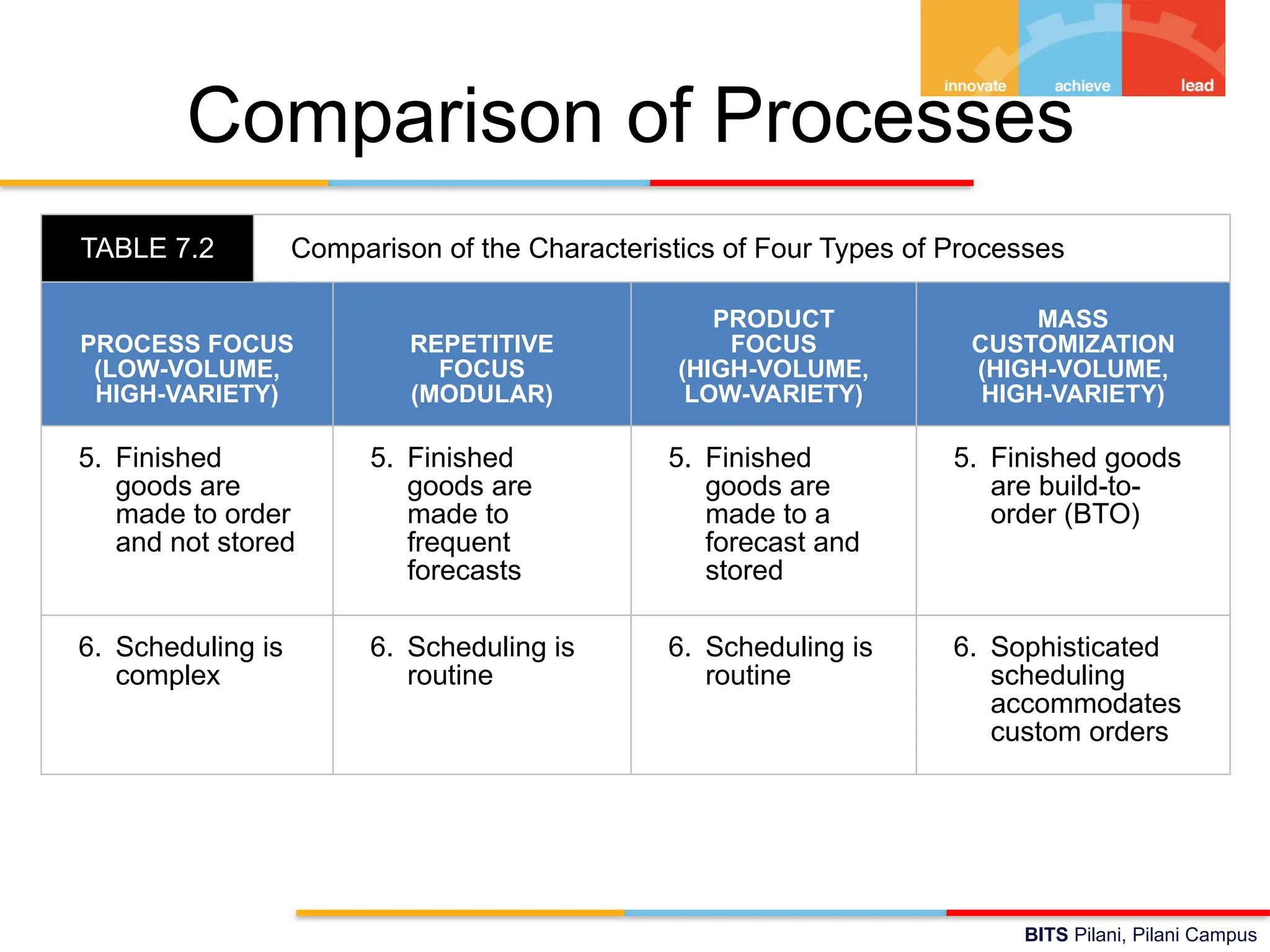
Comparison of Processes
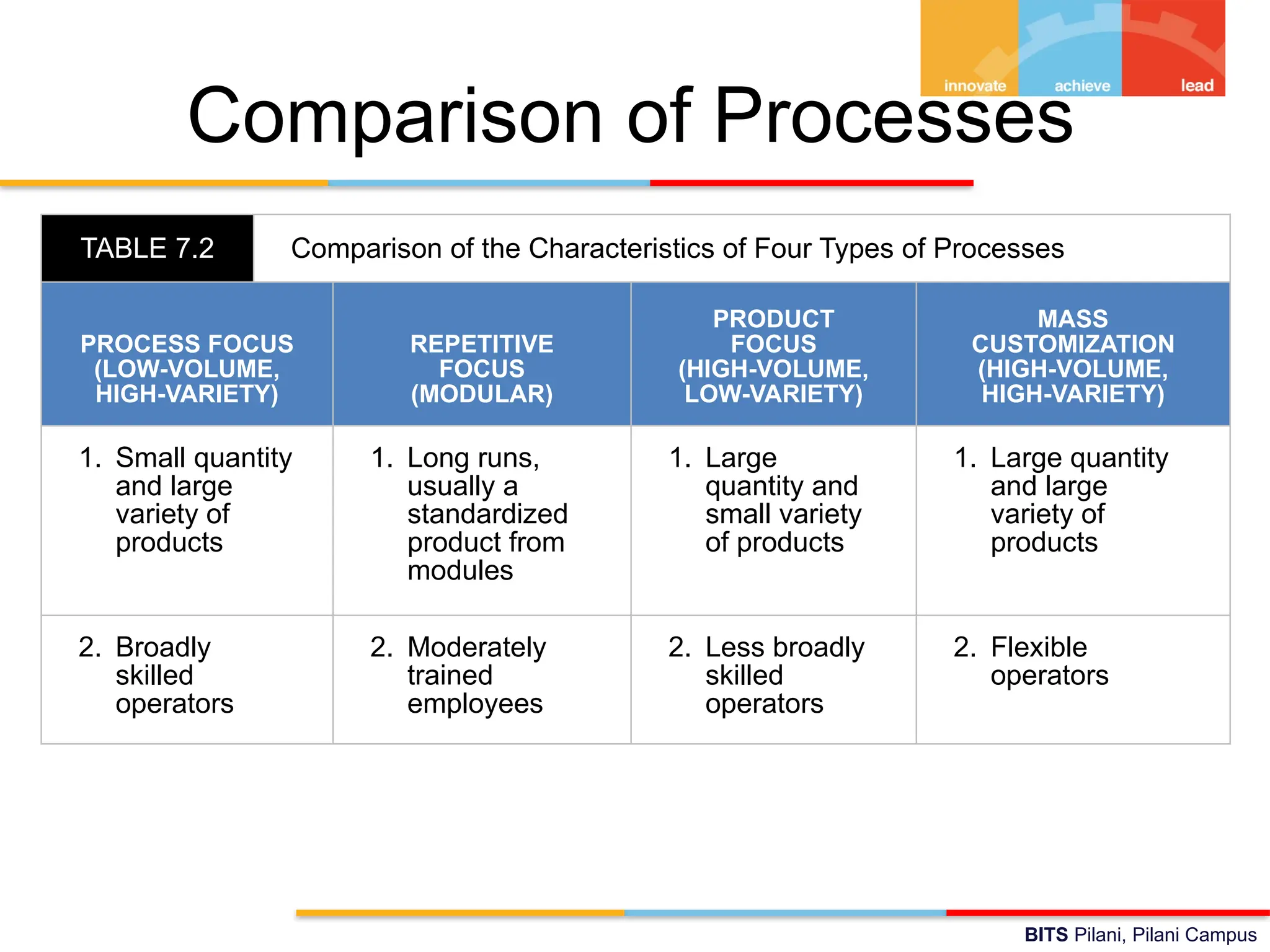
TABLE 7.2 Comparison of the Characteristics of Four Types of Processes
PROCESS FOCUS
(LOW-VOLUME,
HIGH-VARIETY)
REPETITIVE
FOCUS
(MODULAR)
PRODUCT
FOCUS
(HIGH-VOLUME,
LOW-VARIETY)
MASS
CUSTOMIZATION
(HIGH-VOLUME,
HIGH-VARIETY)
1. Small quantity
and large
variety of
products
1. Long runs,
usually a
standardized
product from
modules
1. Large
quantity and
small variety
of products
1. Large quantity
and large
variety of
products
2. Broadly
skilled
operators
2. Moderately
trained
employees
2. Less broadly
skilled
operators
2. Flexible
operators
20.
BITS Pilani, PilaniCampus
Comparison of Processes
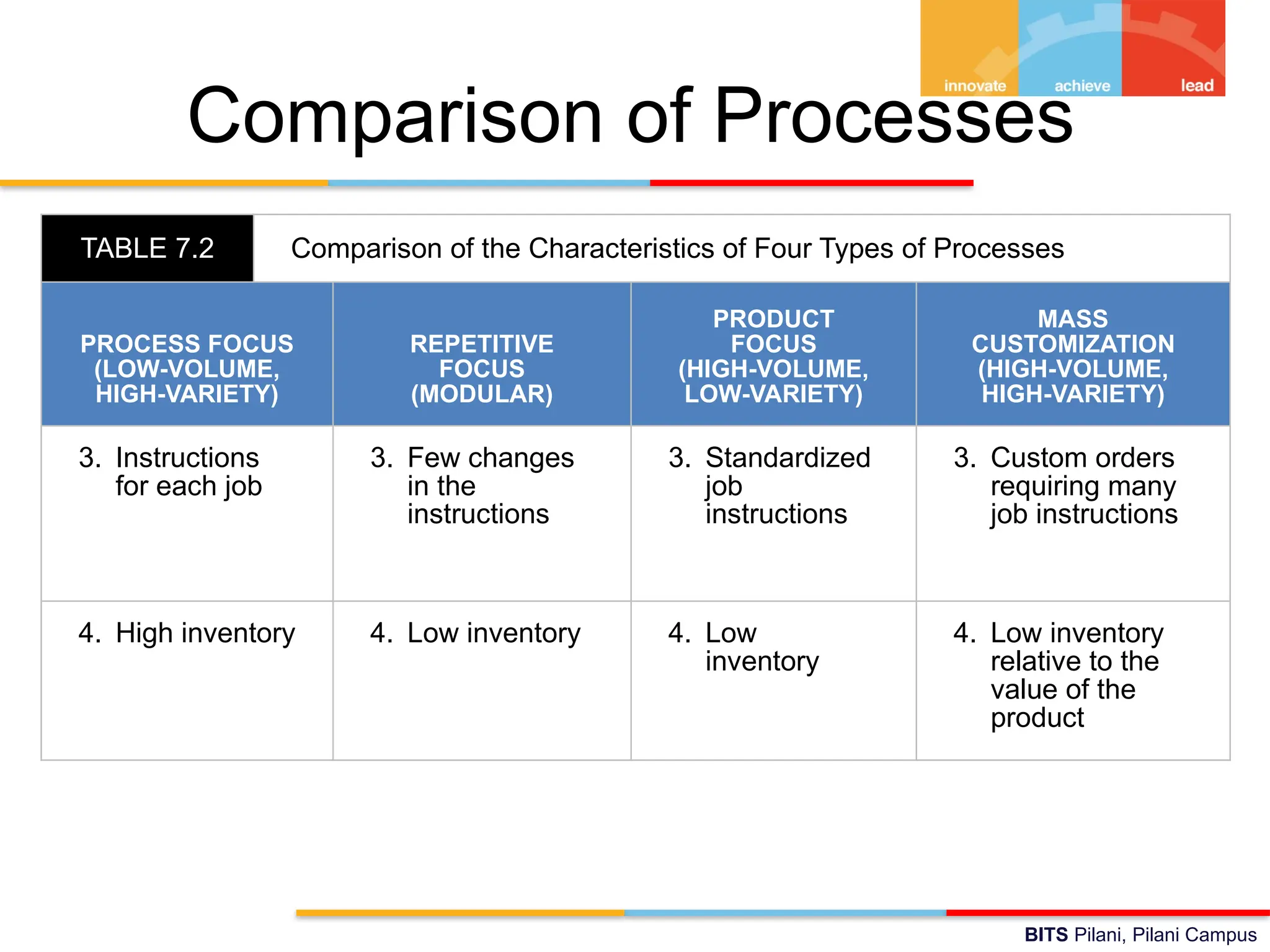
TABLE 7.2 Comparison of the Characteristics of Four Types of Processes
PROCESS FOCUS
(LOW-VOLUME,
HIGH-VARIETY)
REPETITIVE
FOCUS
(MODULAR)
PRODUCT
FOCUS
(HIGH-VOLUME,
LOW-VARIETY)
MASS
CUSTOMIZATION
(HIGH-VOLUME,
HIGH-VARIETY)
3. Instructions
for each job
3. Few changes
in the
instructions
3. Standardized
job
instructions
3. Custom orders
requiring many
job instructions
4. High inventory 4. Low inventory 4. Low
inventory
4. Low inventory
relative to the
value of the
product
21.
BITS Pilani, PilaniCampus
Comparison of Processes
TABLE 7.2 Comparison of the Characteristics of Four Types of Processes
PROCESS FOCUS
(LOW-VOLUME,
HIGH-VARIETY)
REPETITIVE
FOCUS
(MODULAR)
PRODUCT
FOCUS
(HIGH-VOLUME,
LOW-VARIETY)
MASS
CUSTOMIZATION
(HIGH-VOLUME,
HIGH-VARIETY)
5. Finished
goods are
made to order
and not stored
5. Finished
goods are
made to
frequent
forecasts
5. Finished
goods are
made to a
forecast and
stored
5. Finished goods
are build-to-
order (BTO)
6. Scheduling is
complex
6. Scheduling is
routine
6. Scheduling is
routine
6. Sophisticated
scheduling
accommodates
custom orders
22.
BITS Pilani, PilaniCampus
Comparison of Processes
TABLE 7.2 Comparison of the Characteristics of Four Types of Processes
PROCESS FOCUS
(LOW-VOLUME,
HIGH-VARIETY)
REPETITIVE
FOCUS
(MODULAR)
PRODUCT
FOCUS
(HIGH-VOLUME,
LOW-VARIETY)
MASS
CUSTOMIZATION
(HIGH-VOLUME,
HIGH-VARIETY)
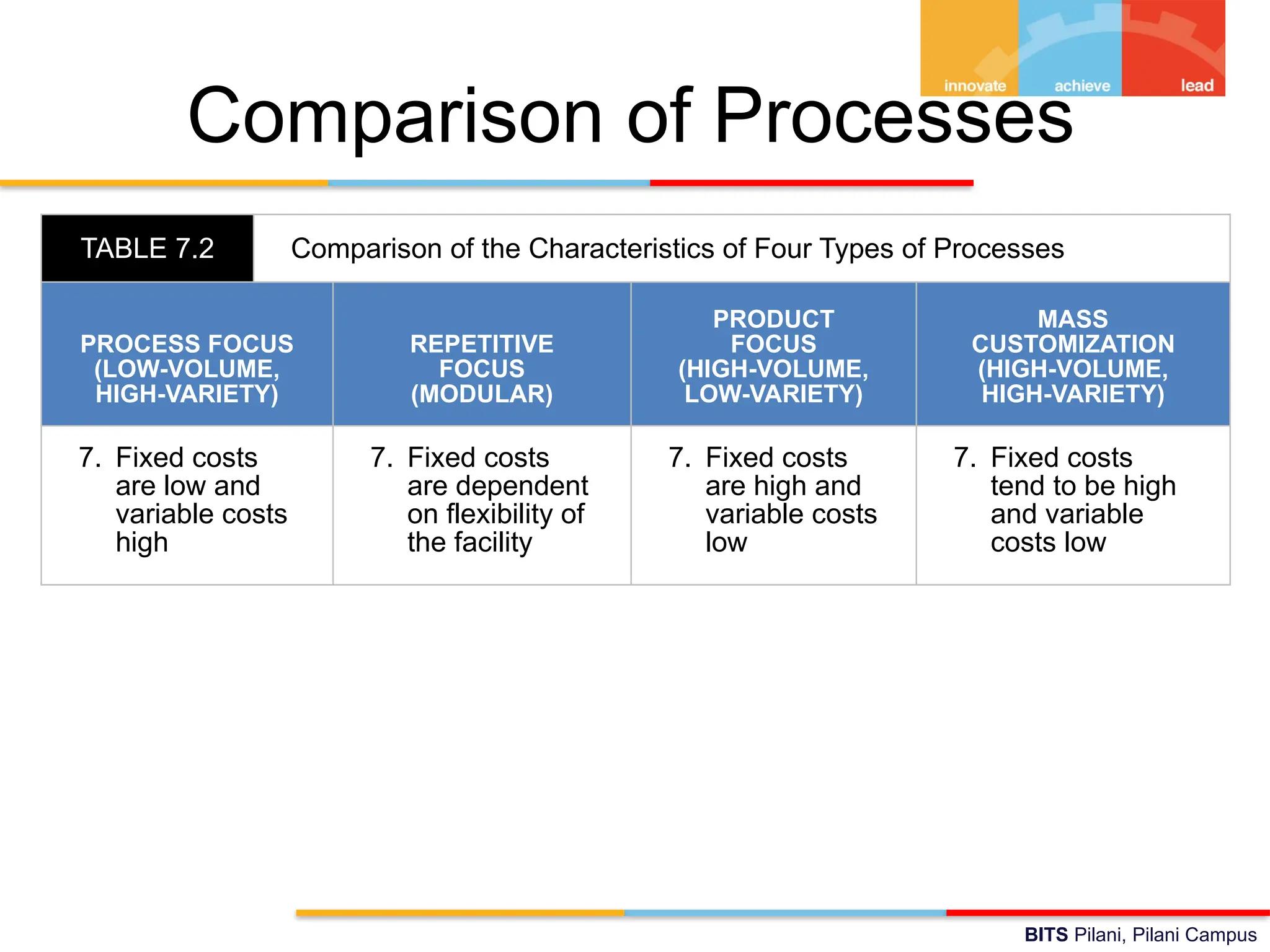
7. Fixed costs
are low and
variable costs
high
7. Fixed costs
are dependent
on flexibility of
the facility
7. Fixed costs
are high and
variable costs
low
7. Fixed costs
tend to be high
and variable
costs low
23.
BITS Pilani, PilaniCampus
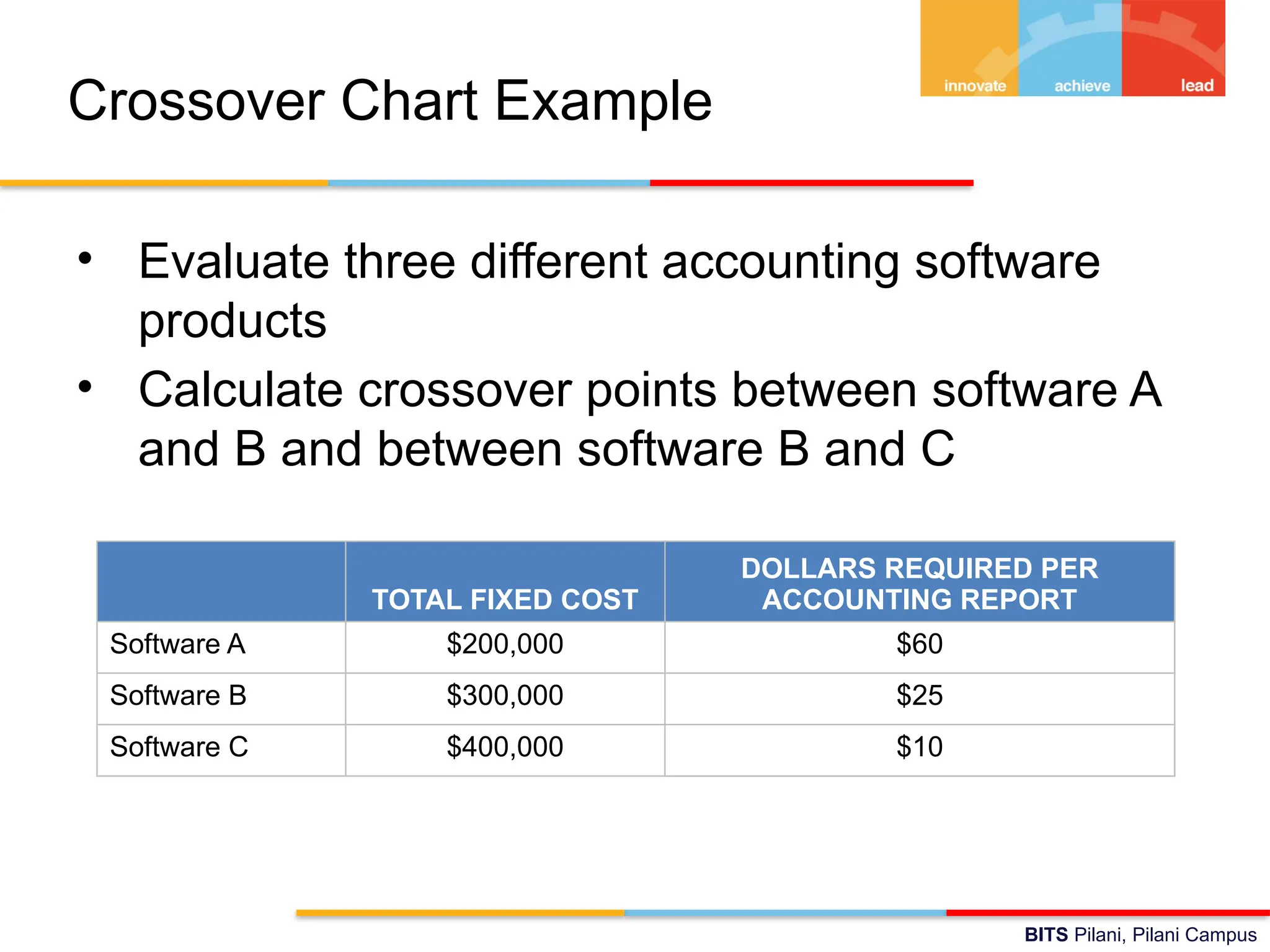
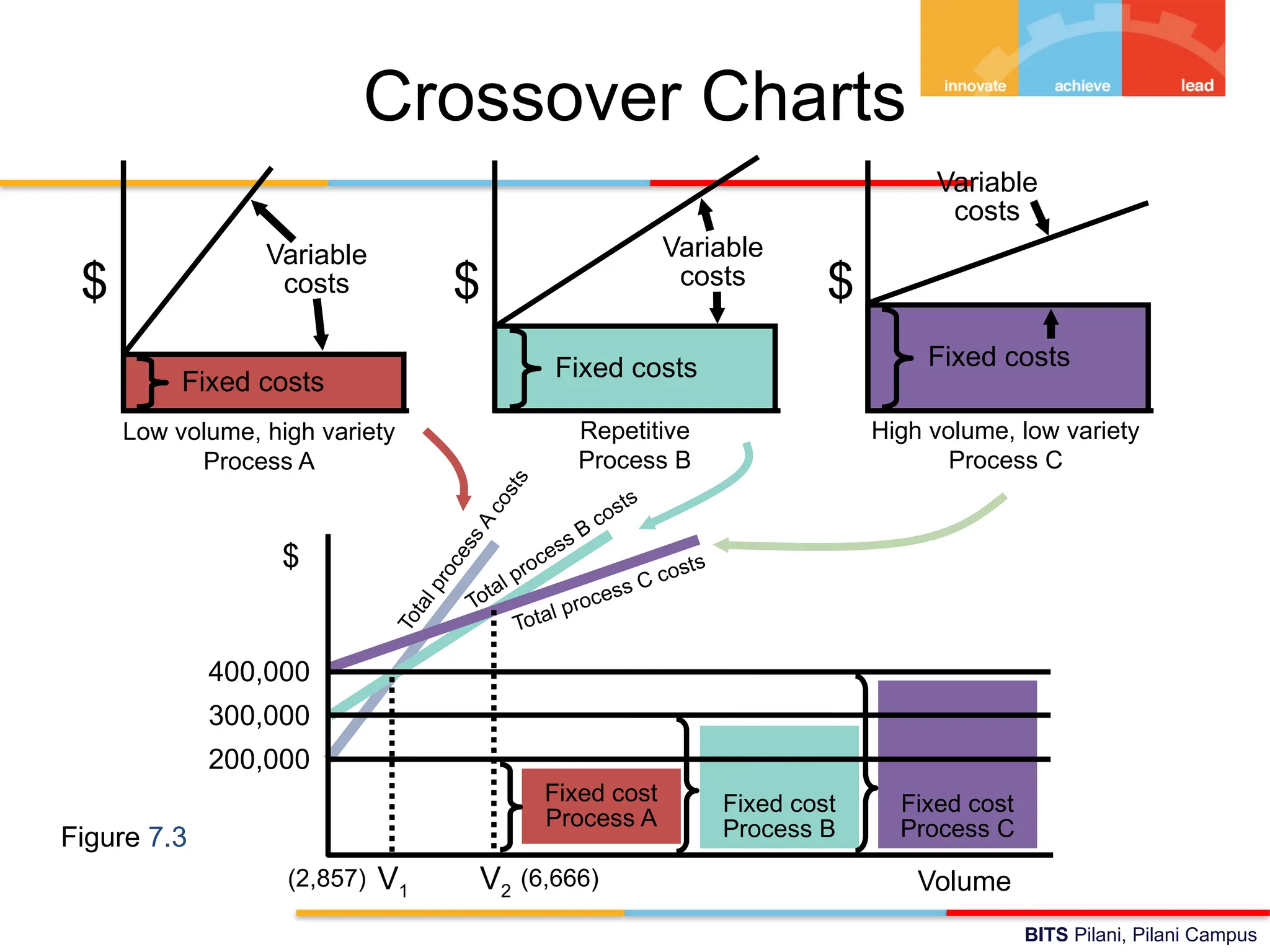
Crossover Chart Example
• Evaluate three different accounting software
products
• Calculate crossover points between software A
and B and between software B and C
TOTAL FIXED COST
DOLLARS REQUIRED PER
ACCOUNTING REPORT
Software A $200,000 $60
Software B $300,000 $25
Software C $400,000 $10
24.
BITS Pilani, PilaniCampus
Crossover Chart Example
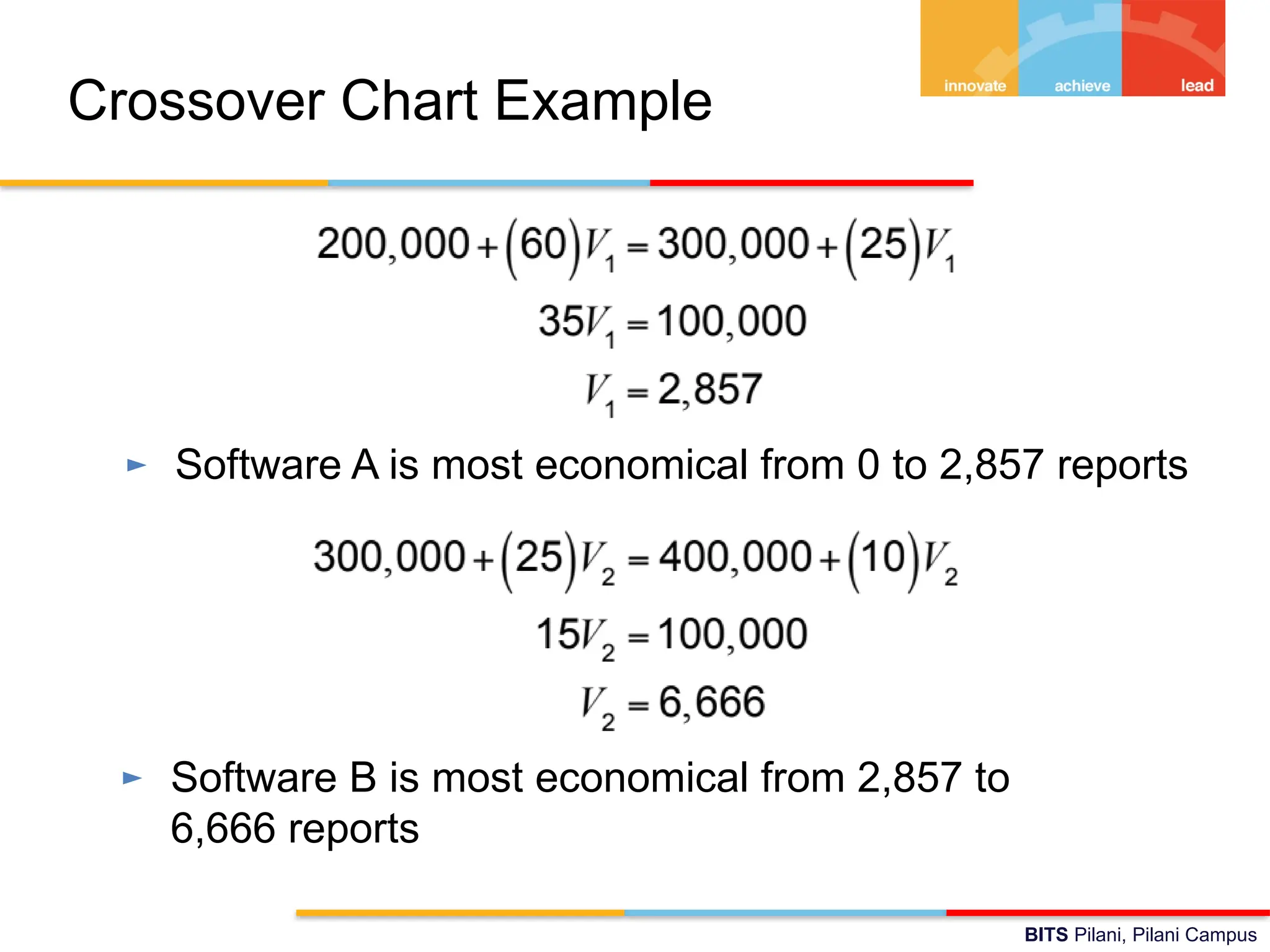
► Software A is most economical from 0 to 2,857 reports
► Software B is most economical from 2,857 to
6,666 reports
25.
BITS Pilani, PilaniCampus
Crossover Charts
Fixed costs
Variable
costs
$
High volume, low variety
Process C
Fixed costs
Variable
costs
$
Repetitive
Process B
Fixed costs
Variable
costs
$
Low volume, high variety
Process A
Fixed cost
Process A
Fixed cost
Process B
Fixed cost
Process C
T
o
t
a
l
p
r
o
c
e
s
s
A
c
o
s
t
s
Total process B
costs
Total process C costs
V1
(2,857) V2
(6,666)
400,000
300,000
200,000
Volume
$
Figure 7.3
26.
BITS Pilani, PilaniCampus
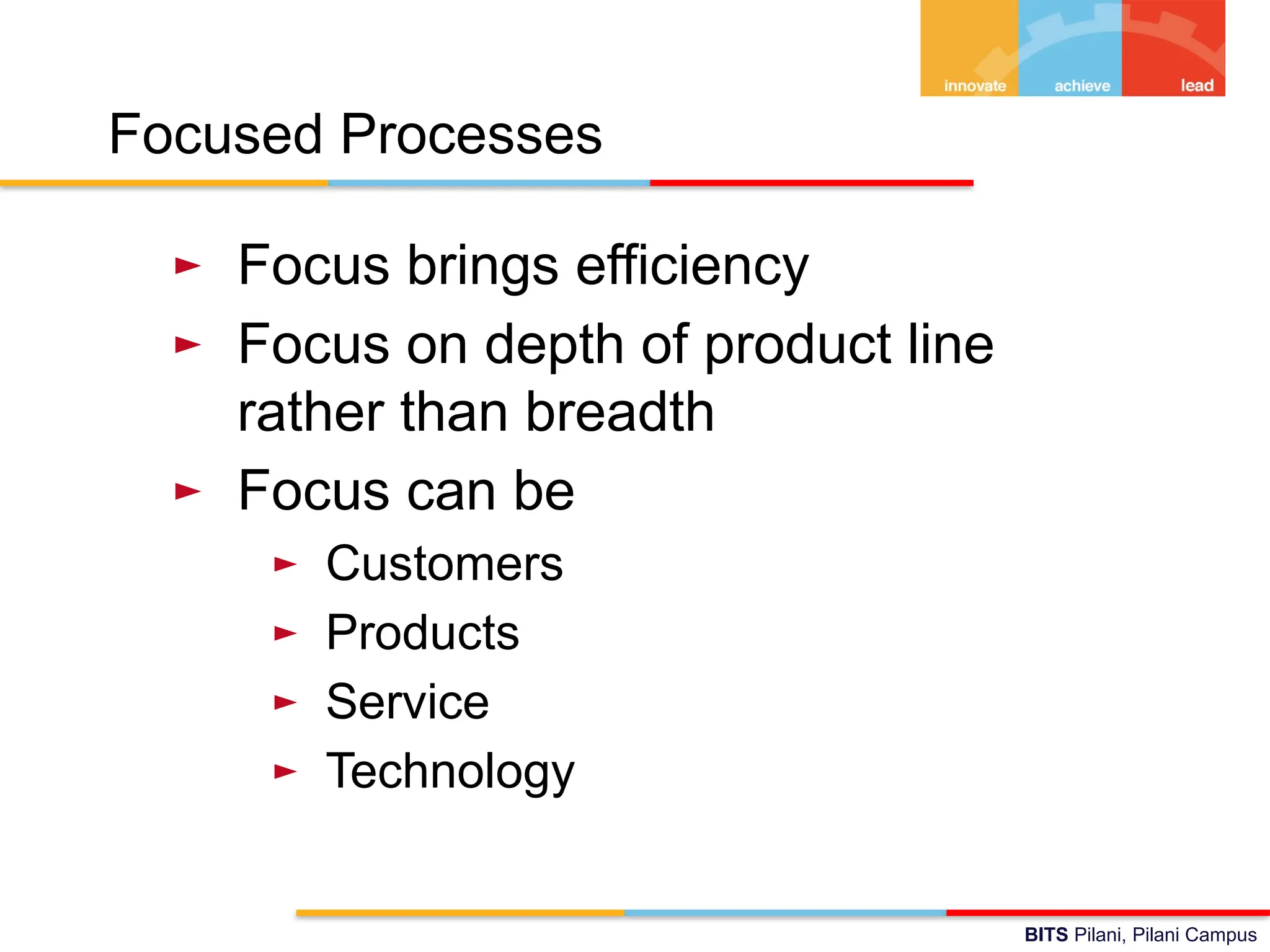
Focused Processes
► Focus brings efficiency
► Focus on depth of product line
rather than breadth
► Focus can be
► Customers
► Products
► Service
► Technology
27.
BITS Pilani, PilaniCampus
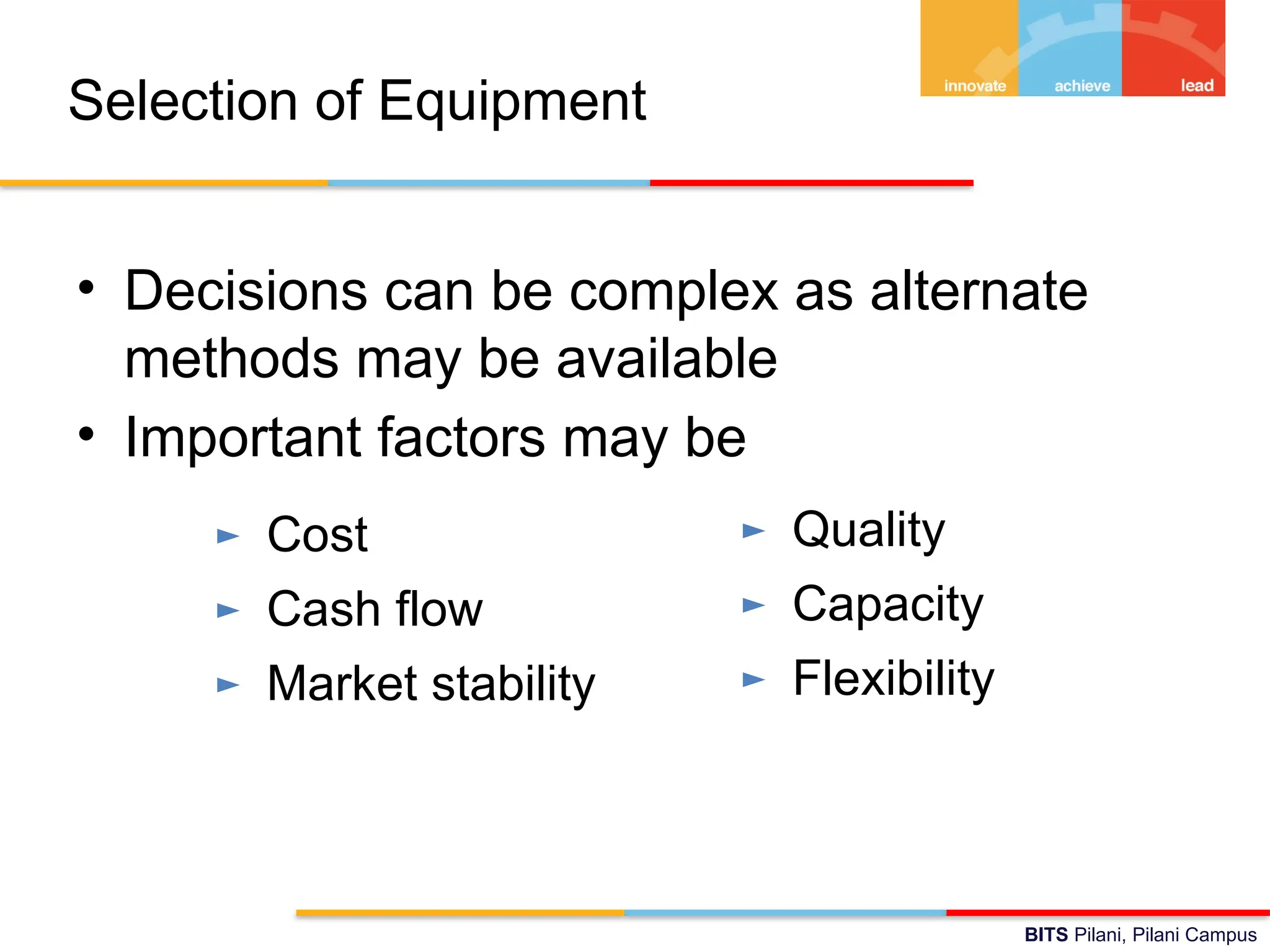
Selection of Equipment
• Decisions can be complex as alternate
methods may be available
• Important factors may be
► Cost
► Cash flow
► Market stability
► Quality
► Capacity
► Flexibility
28.
BITS Pilani, PilaniCampus
Equipment and Technology
► Possible competitive advantage
► Flexibility may be a competitive
advantage
► May be difficult and expensive and
may require starting over
► Important to get it right
29.
BITS Pilani, PilaniCampus
Process Analysis and Design
► Is the process designed to achieve a
competitive advantage?
► Does the process eliminate steps
that do not add value?
► Does the process maximize
customer value?
► Will the process win orders?
30.
BITS Pilani, PilaniCampus
Process Analysis and Design
► Flowcharts
► Shows the movement of materials
► Harley-Davidson flowchart
► Time-Function Mapping
► Shows flows and time frame
31.
BITS Pilani, PilaniCampus
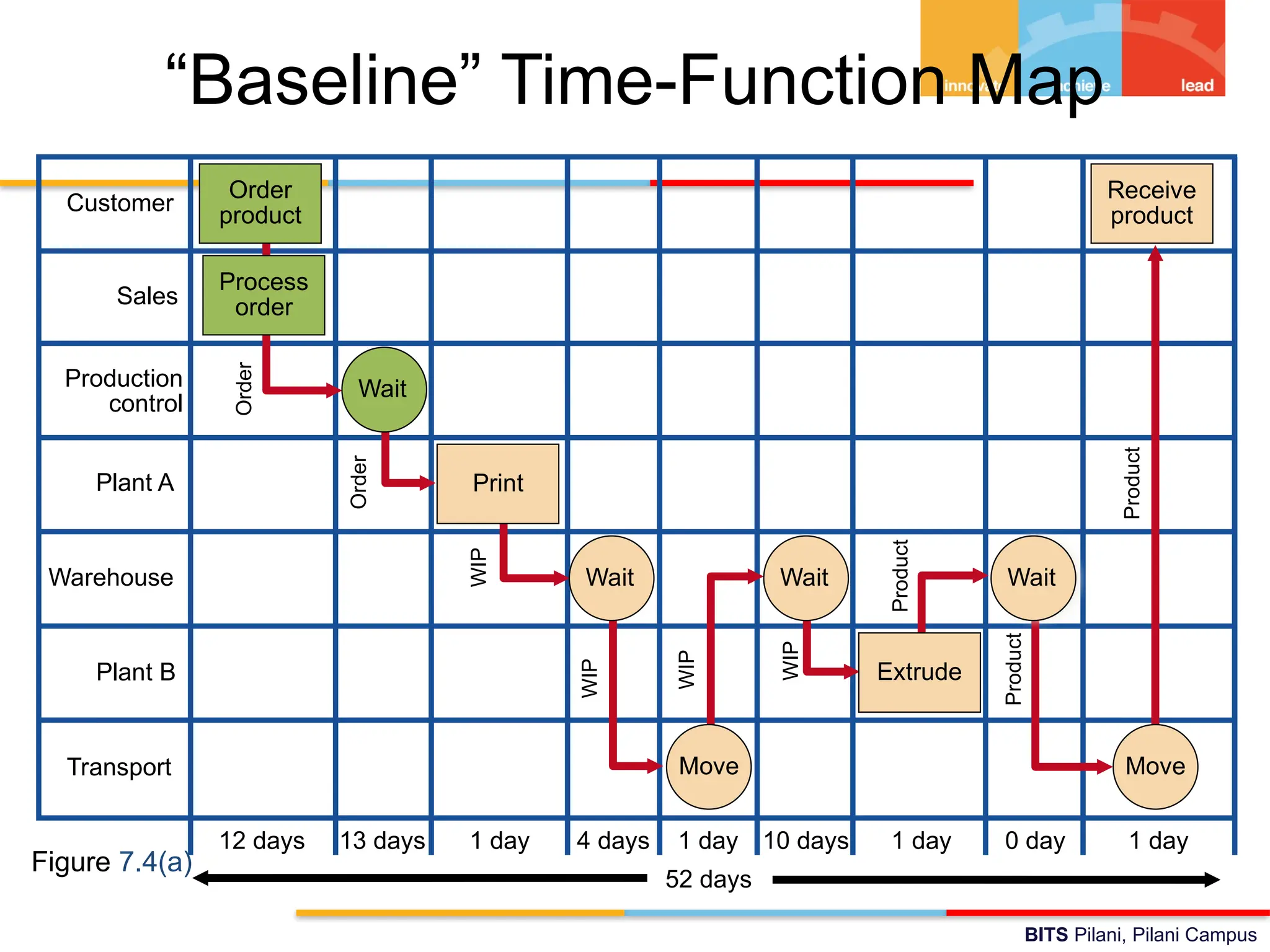
“Baseline” Time-Function Map
Customer
Sales
Production
control
Plant A
Warehouse
Plant B
Transport
12 days 13 days 1 day 4 days 1 day 10 days 1 day 0 day 1 day
52 days
Figure 7.4(a)
Move
Receive
product
Product
Product
Extrude
Wait
WIP
Product
Move
Wait
WIP
WIP
Print
Wait
Order
WIP
Order
product
Process
order
Wait
Order
32.
BITS Pilani, PilaniCampus
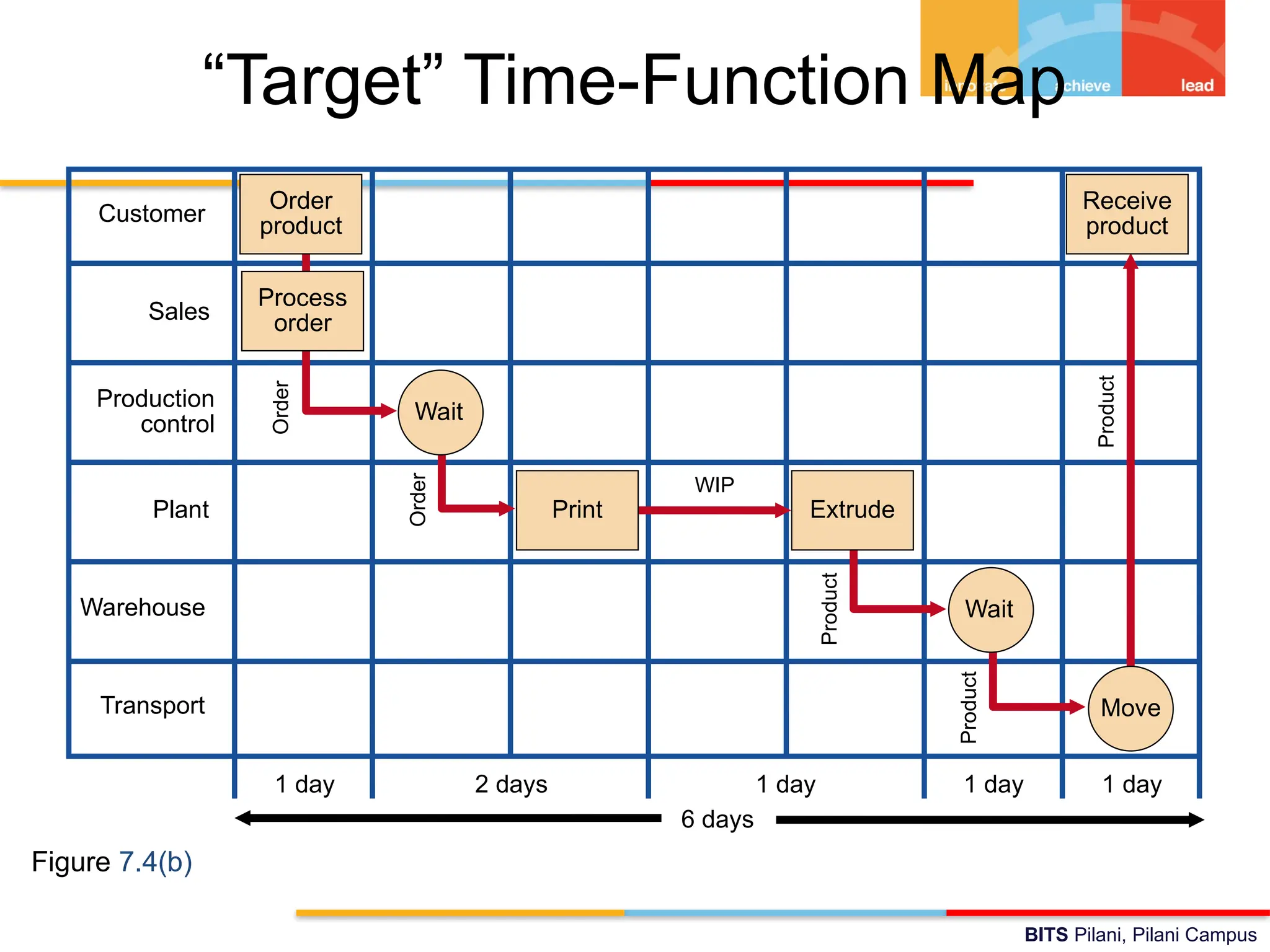
“Target” Time-Function Map
Customer
Sales
Production
control
Plant
Warehouse
Transport
1 day 2 days 1 day 1 day 1 day
6 days
Figure 7.4(b)
Move
Receive
product
Product
Product
Extrude
Wait
Print
Order
WIP
Product
Order
product
Process
order
Wait
Order
33.
BITS Pilani, PilaniCampus
Process Analysis and Design
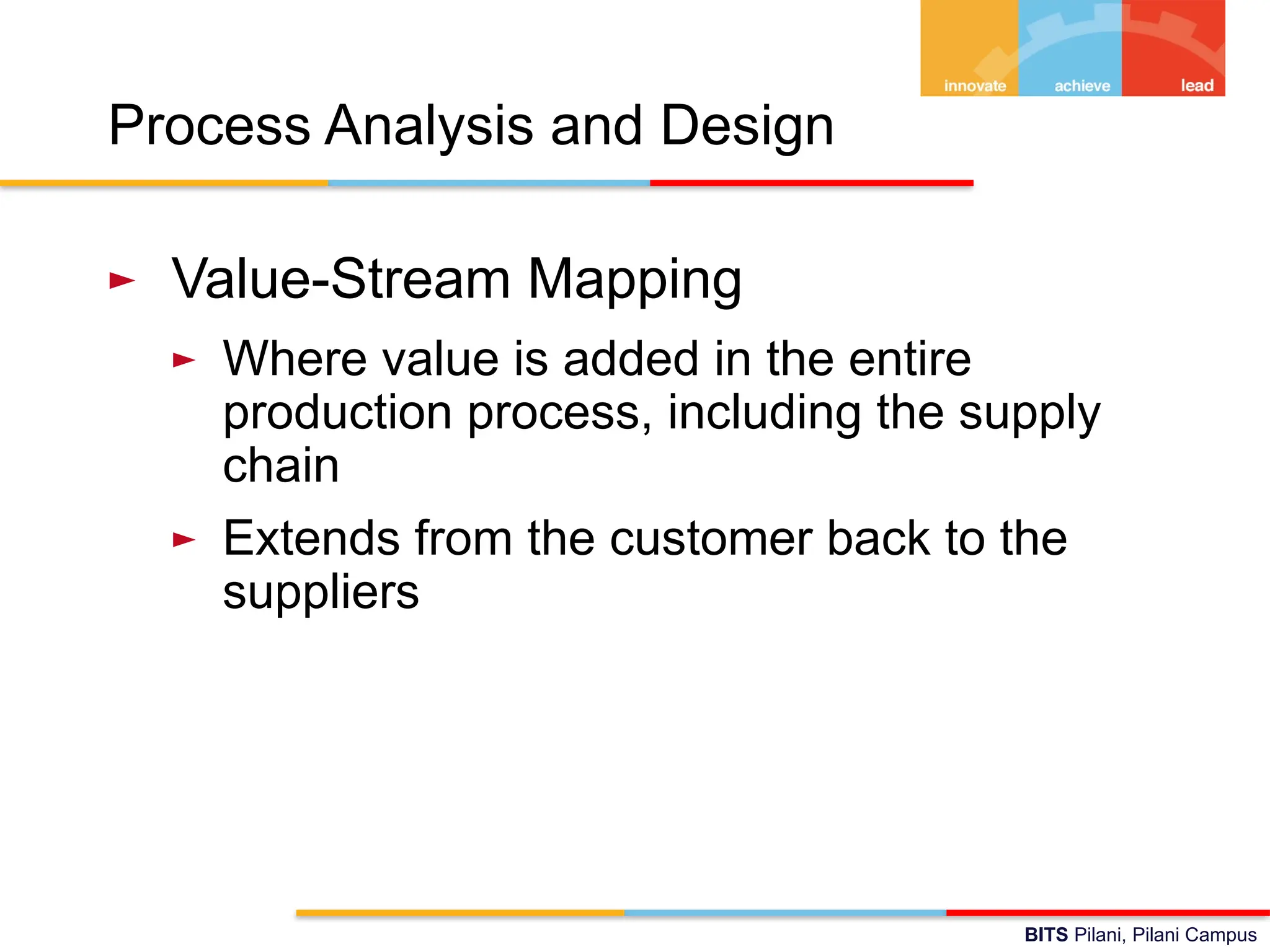
► Value-Stream Mapping
► Where value is added in the entire
production process, including the supply
chain
► Extends from the customer back to the
suppliers
34.
BITS Pilani, PilaniCampus
Value-Stream Mapping
1. Begin with symbols for customer, supplier,
and production to ensure the big picture
2. Enter customer order requirements
3. Calculate the daily production requirements
4. Enter the outbound shipping requirements
and delivery frequency
5. Determine inbound shipping method and
delivery frequency
35.
BITS Pilani, PilaniCampus
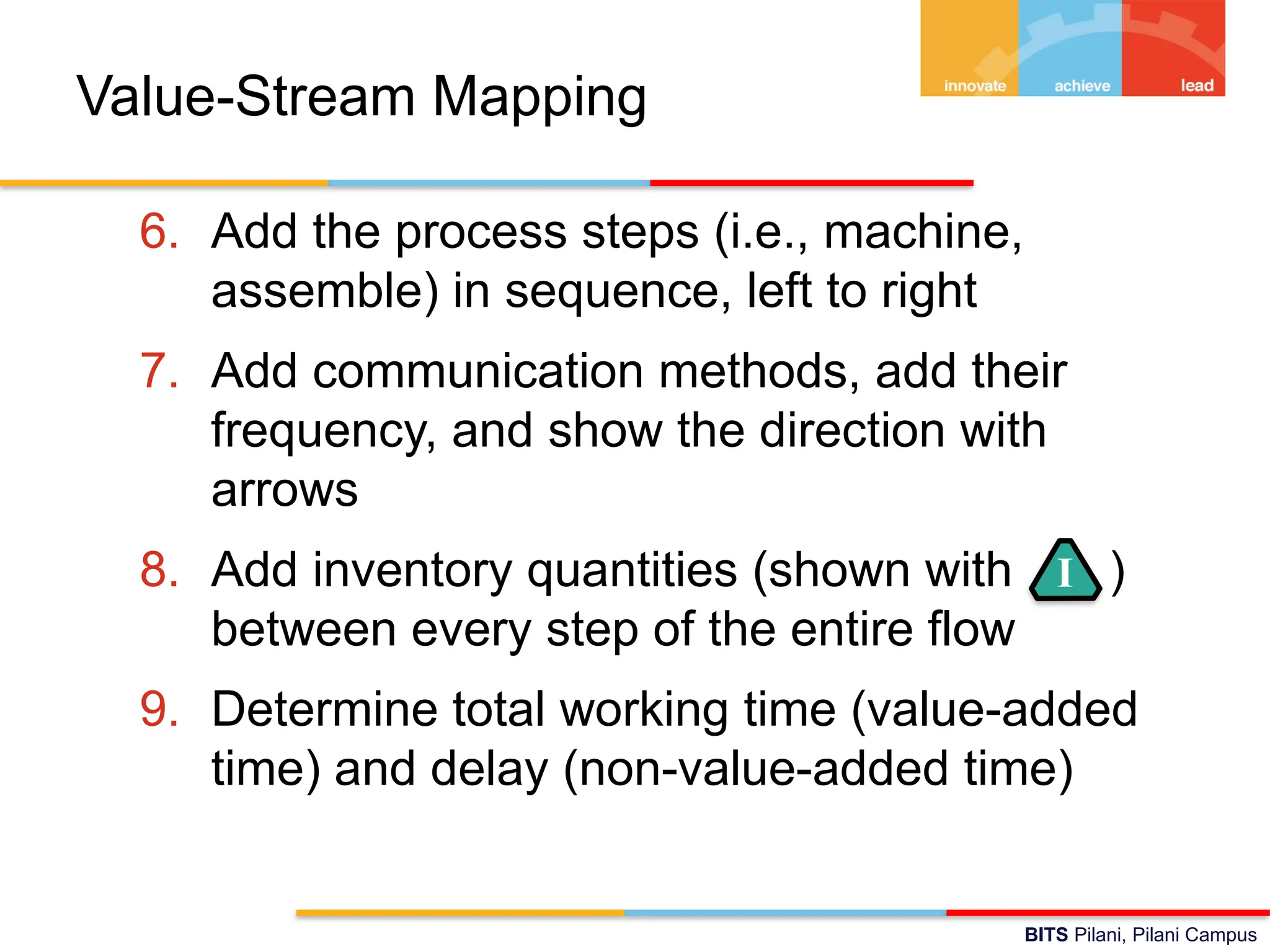
Value-Stream Mapping
6. Add the process steps (i.e., machine,
assemble) in sequence, left to right
7. Add communication methods, add their
frequency, and show the direction with
arrows
8. Add inventory quantities (shown with )
between every step of the entire flow
9. Determine total working time (value-added
time) and delay (non-value-added time)
I
BITS Pilani, PilaniCampus
Service Blueprinting
► Focuses on the customer and provider
interaction
► Defines three levels of interaction
► Each level has different management
issues
► Identifies potential failure points
39.
BITS Pilani, PilaniCampus
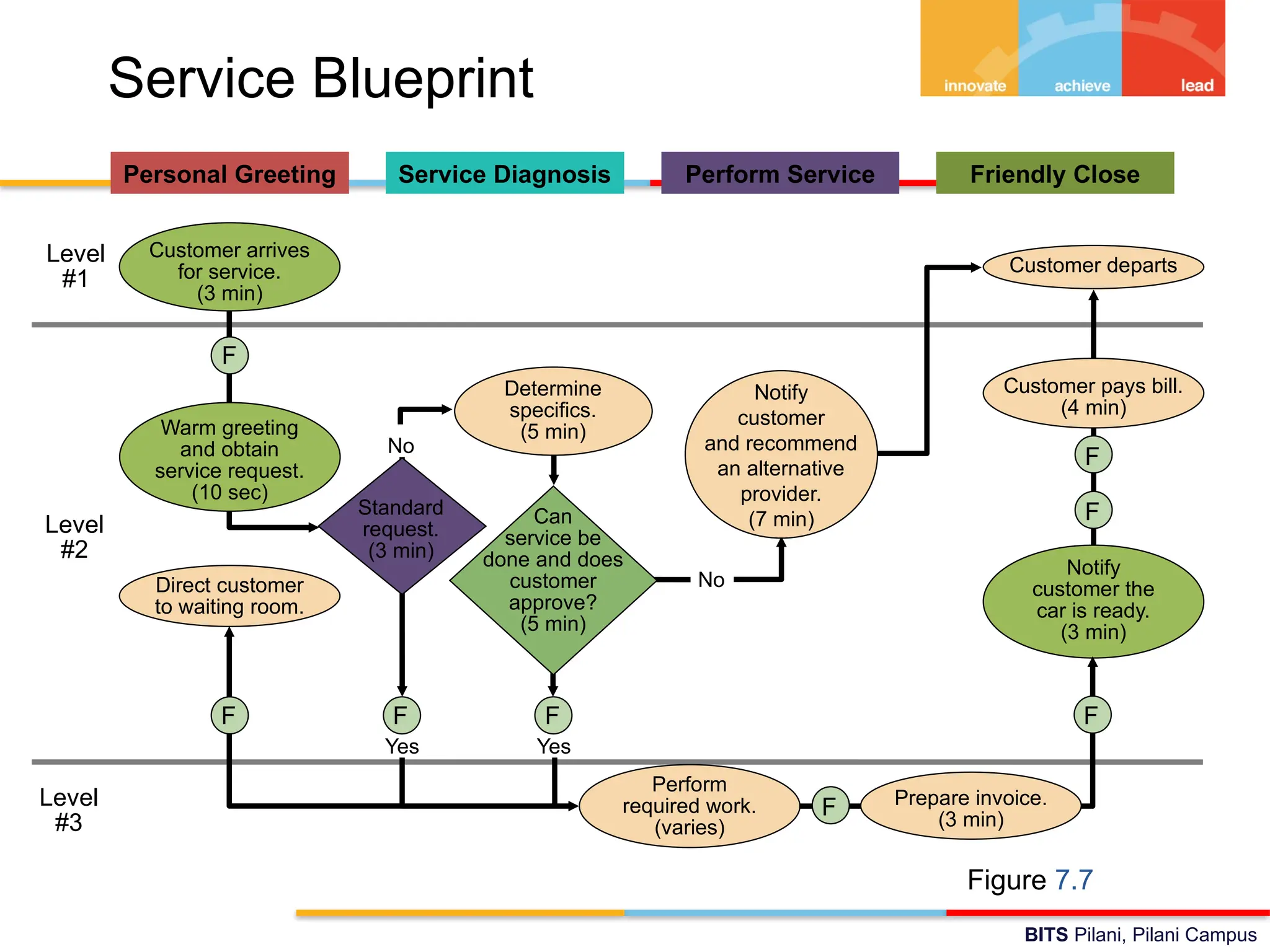
Service Blueprint
Personal Greeting Service Diagnosis Perform Service Friendly Close
Level
#3
Level
#1
Level
#2
Figure 7.7
No
Notify
customer
and recommend
an alternative
provider.
(7 min)
Customer arrives
for service.
(3 min)
Warm greeting
and obtain
service request.
(10 sec)
F
Direct customer
to waiting room.
F
Notify
customer the
car is ready.
(3 min)
Customer departs
Customer pays bill.
(4 min)
F
F
Perform
required work.
(varies)
Prepare invoice.
(3 min)
F
F
Yes
F
Yes
F
Standard
request.
(3 min)
Determine
specifics.
(5 min)
No
Can
service be
done and does
customer
approve?
(5 min)
40.
BITS Pilani, PilaniCampus
Special Considerations for Service
Process Design
► Some interaction with customer is
necessary, but this often affects
performance adversely
► The better these interactions are
accommodated in the process design, the
more efficient and effective the process
► Find the right combination of cost and
customer interaction
41.
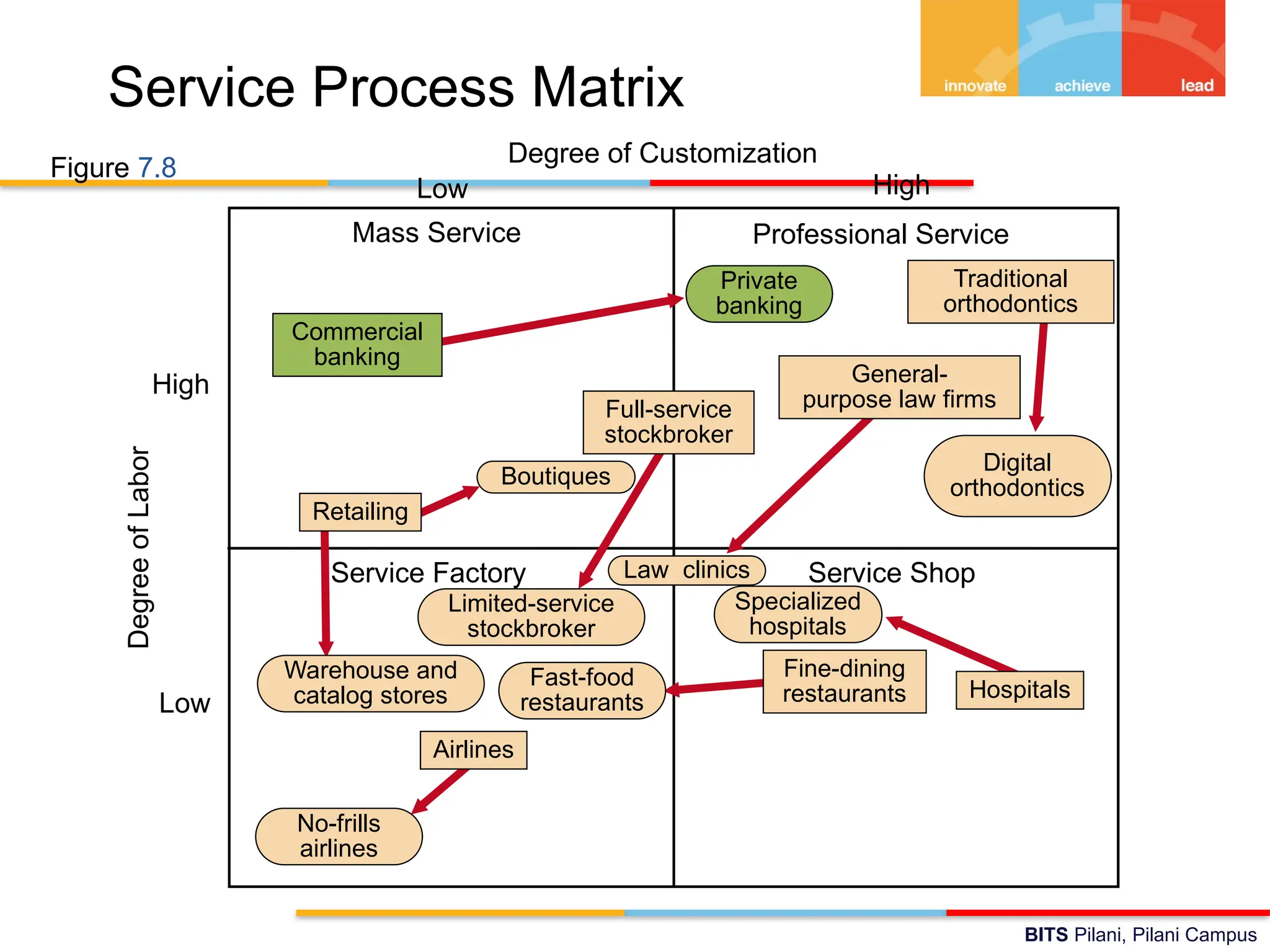
BITS Pilani, PilaniCampus
Service Factory Service Shop
Degree of Customization
Low High
Degree
of
Labor
Low
High
Mass Service Professional Service
Service Process Matrix
Commercial
banking
Private
banking
General-
purpose law firms
Law clinics
Specialized
hospitals
Hospitals
Full-service
stockbroker
Limited-service
stockbroker
Retailing
Boutiques
Warehouse and
catalog stores
Fast-food
restaurants
Fine-dining
restaurants
Airlines
No-frills
airlines
Figure 7.8
Digital
orthodontics
Traditional
orthodontics
42.
BITS Pilani, PilaniCampus
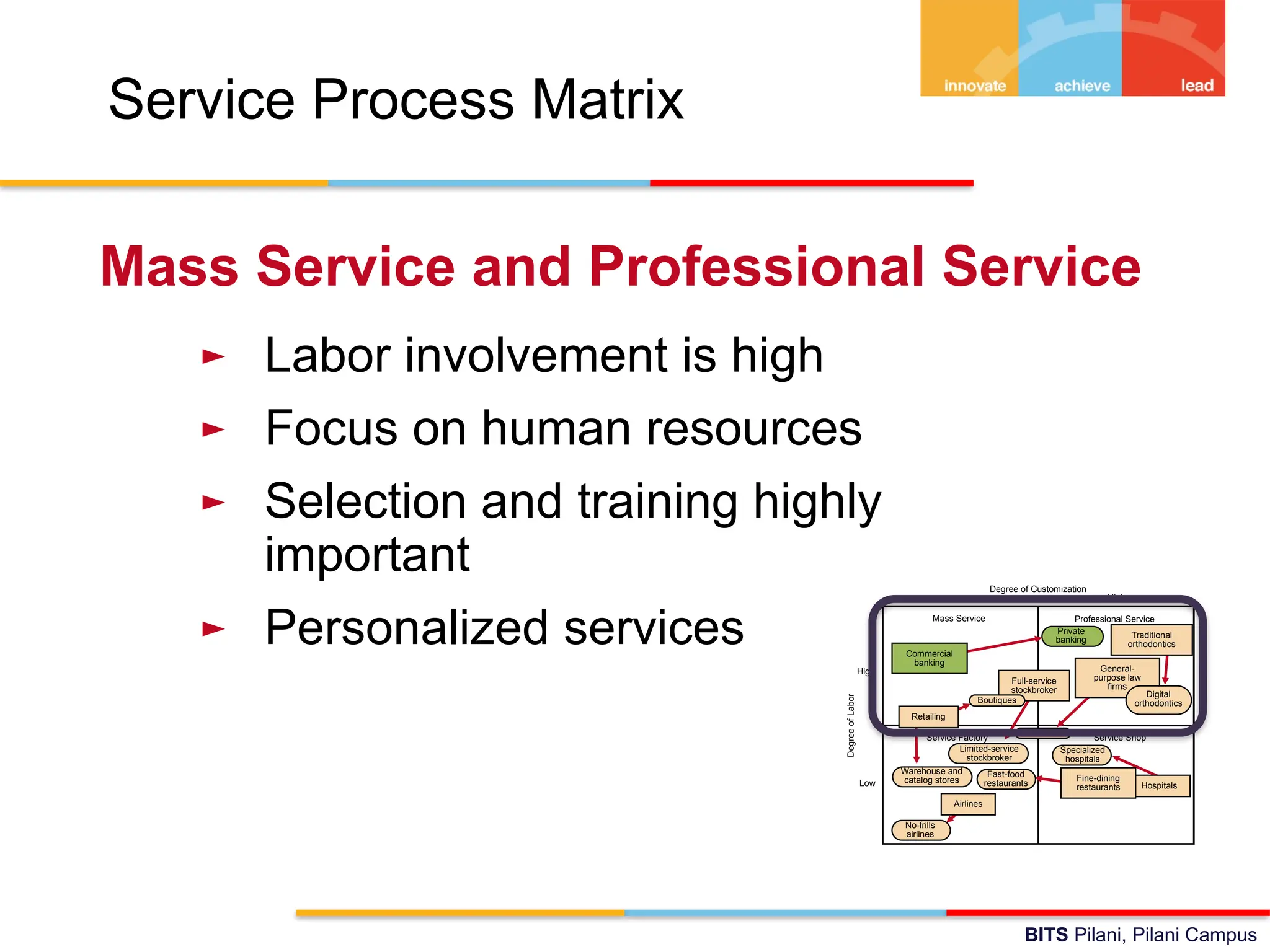
Service Process Matrix
► Labor involvement is high
► Focus on human resources
► Selection and training highly
important
► Personalized services
Mass Service and Professional Service
Service Factory Service Shop
Degree of Customization
Low High
Degree
of
Labor
Low
High
Mass Service Professional Service
Commercial
banking
Private
banking
General-
purpose law
firms
Law clinics
Specialized
hospitals
Hospitals
Full-service
stockbroker
Limited-service
stockbroker
Retailing
Boutiques
Warehouse and
catalog stores
Fast-food
restaurants
Fine-dining
restaurants
Airlines
No-frills
airlines
Digital
orthodontics
Traditional
orthodontics
43.
BITS Pilani, PilaniCampus
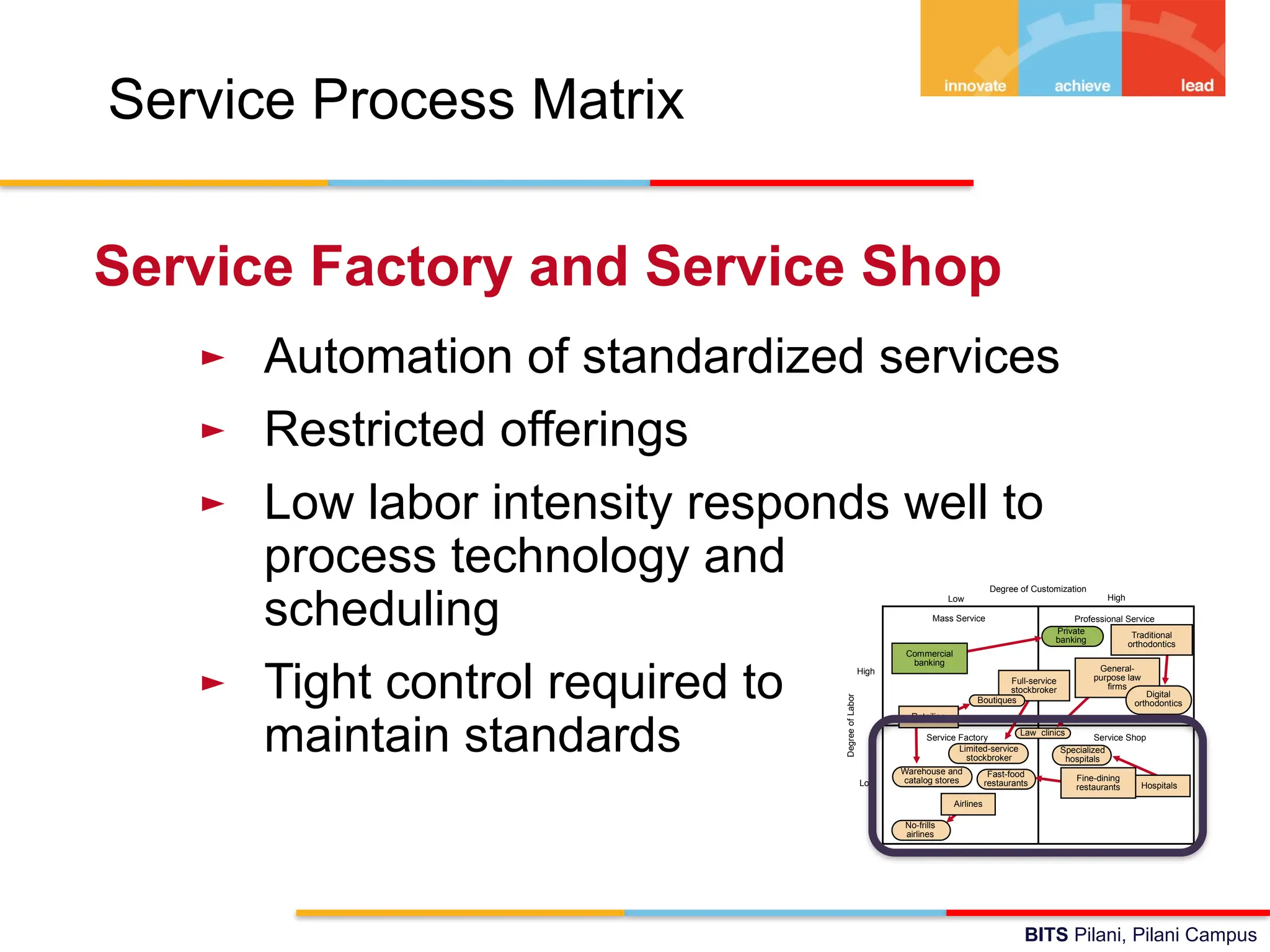
Service Process Matrix
Service Factory and Service Shop
► Automation of standardized services
► Restricted offerings
► Low labor intensity responds well to
process technology and
scheduling
► Tight control required to
maintain standards Service Factory Service Shop
Degree of Customization
Low High
Degree
of
Labor
Low
High
Mass Service Professional Service
Commercial
banking
Private
banking
General-
purpose law
firms
Law clinics
Specialized
hospitals
Hospitals
Full-service
stockbroker
Limited-service
stockbroker
Retailing
Boutiques
Warehouse and
catalog stores
Fast-food
restaurants
Fine-dining
restaurants
Airlines
No-frills
airlines
Digital
orthodontics
Traditional
orthodontics
44.
BITS Pilani, PilaniCampus
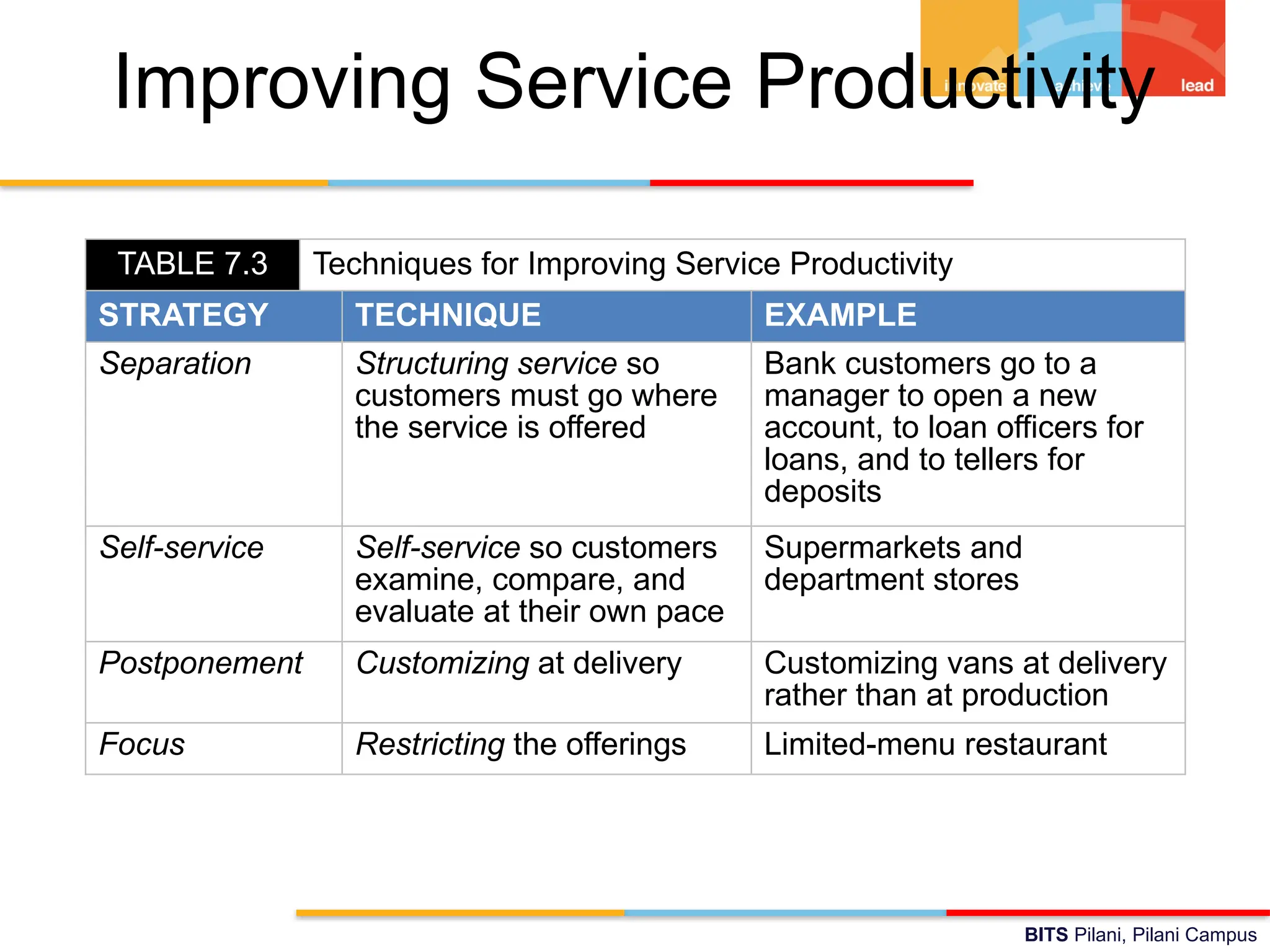
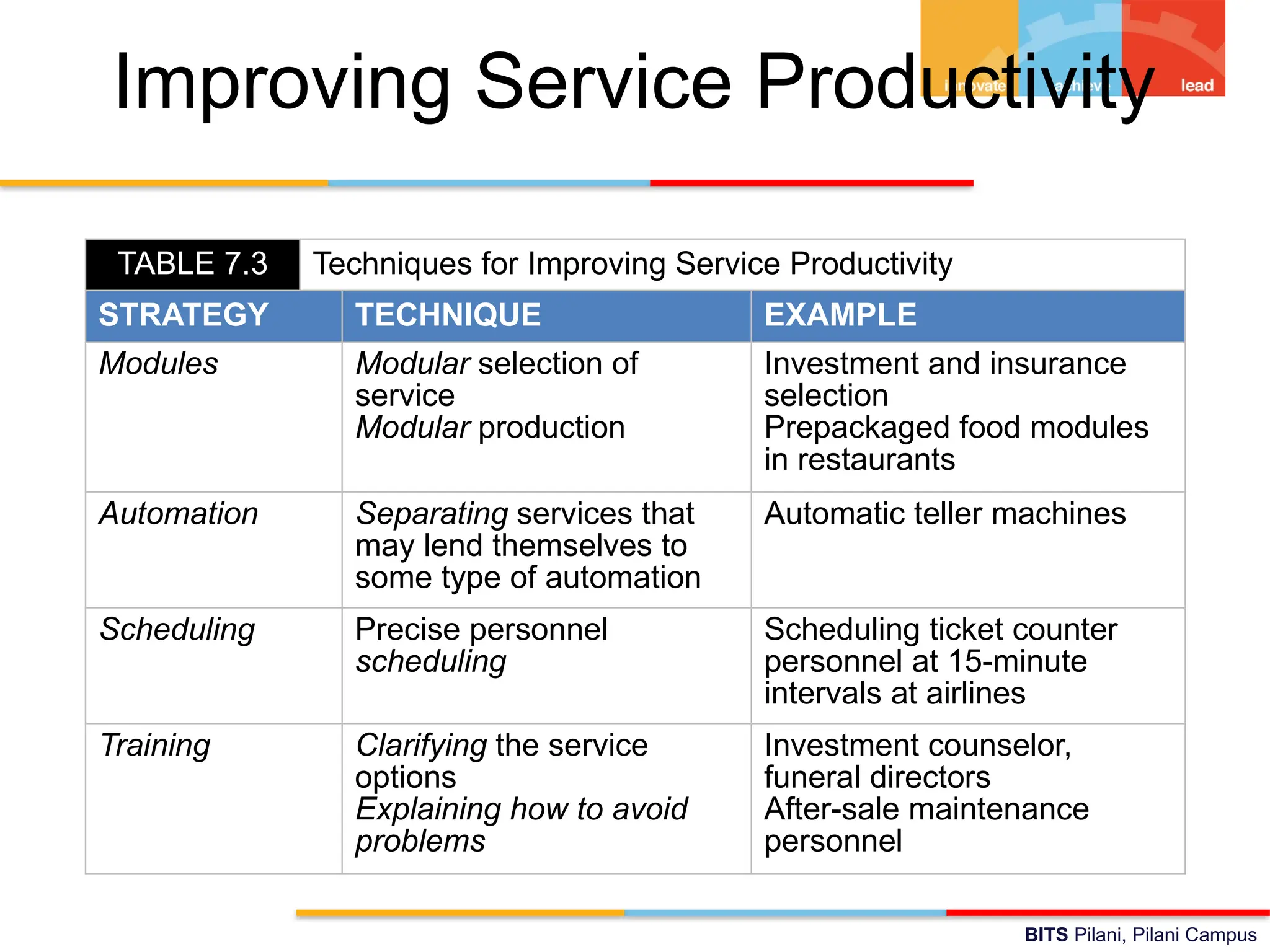
Improving Service Productivity
TABLE 7.3 Techniques for Improving Service Productivity
STRATEGY TECHNIQUE EXAMPLE
Separation Structuring service so
customers must go where
the service is offered
Bank customers go to a
manager to open a new
account, to loan officers for
loans, and to tellers for
deposits
Self-service Self-service so customers
examine, compare, and
evaluate at their own pace
Supermarkets and
department stores
Postponement Customizing at delivery Customizing vans at delivery
rather than at production
Focus Restricting the offerings Limited-menu restaurant
45.
BITS Pilani, PilaniCampus
Improving Service Productivity
TABLE 7.3 Techniques for Improving Service Productivity
STRATEGY TECHNIQUE EXAMPLE
Modules Modular selection of
service
Modular production
Investment and insurance
selection
Prepackaged food modules
in restaurants
Automation Separating services that
may lend themselves to
some type of automation
Automatic teller machines
Scheduling Precise personnel
scheduling
Scheduling ticket counter
personnel at 15-minute
intervals at airlines
Training Clarifying the service
options
Explaining how to avoid
problems
Investment counselor,
funeral directors
After-sale maintenance
personnel
46.
BITS Pilani, PilaniCampus
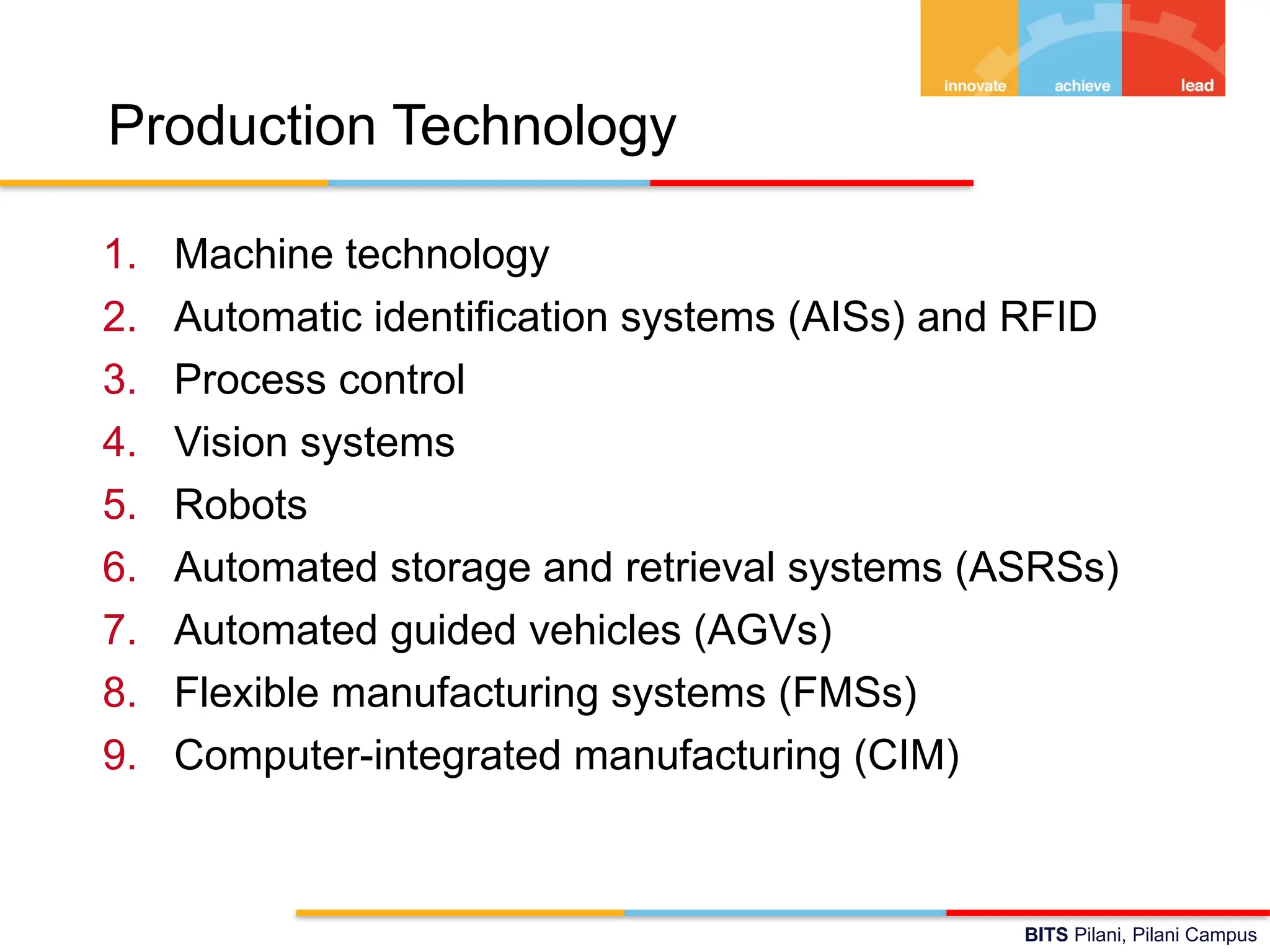
Production Technology
1. Machine technology
2. Automatic identification systems (AISs) and RFID
3. Process control
4. Vision systems
5. Robots
6. Automated storage and retrieval systems (ASRSs)
7. Automated guided vehicles (AGVs)
8. Flexible manufacturing systems (FMSs)
9. Computer-integrated manufacturing (CIM)
BITS Pilani, PilaniCampus
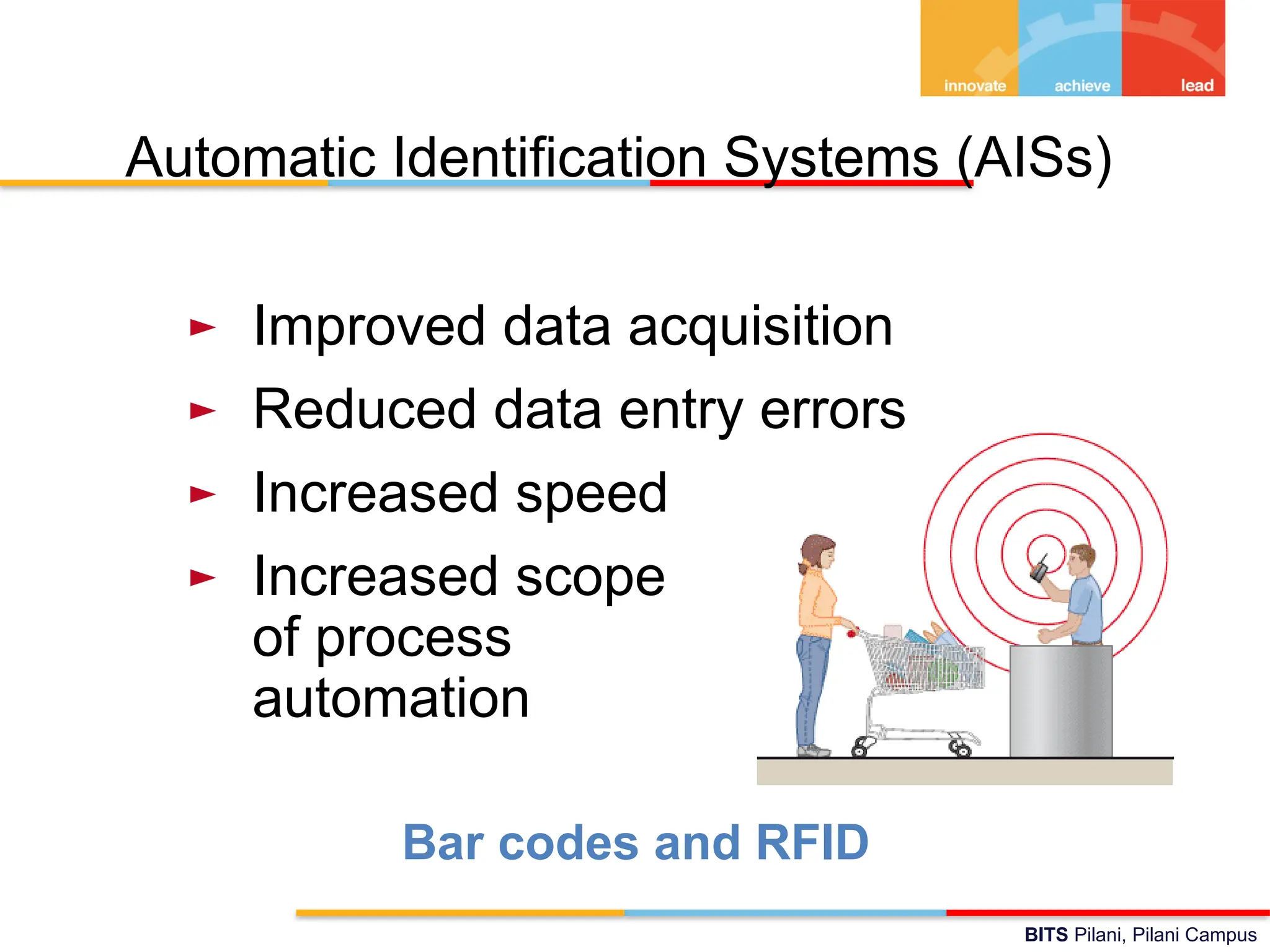
Automatic Identification Systems (AISs)
► Improved data acquisition
► Reduced data entry errors
► Increased speed
► Increased scope
of process
automation
Bar codes and RFID
49.
BITS Pilani, PilaniCampus
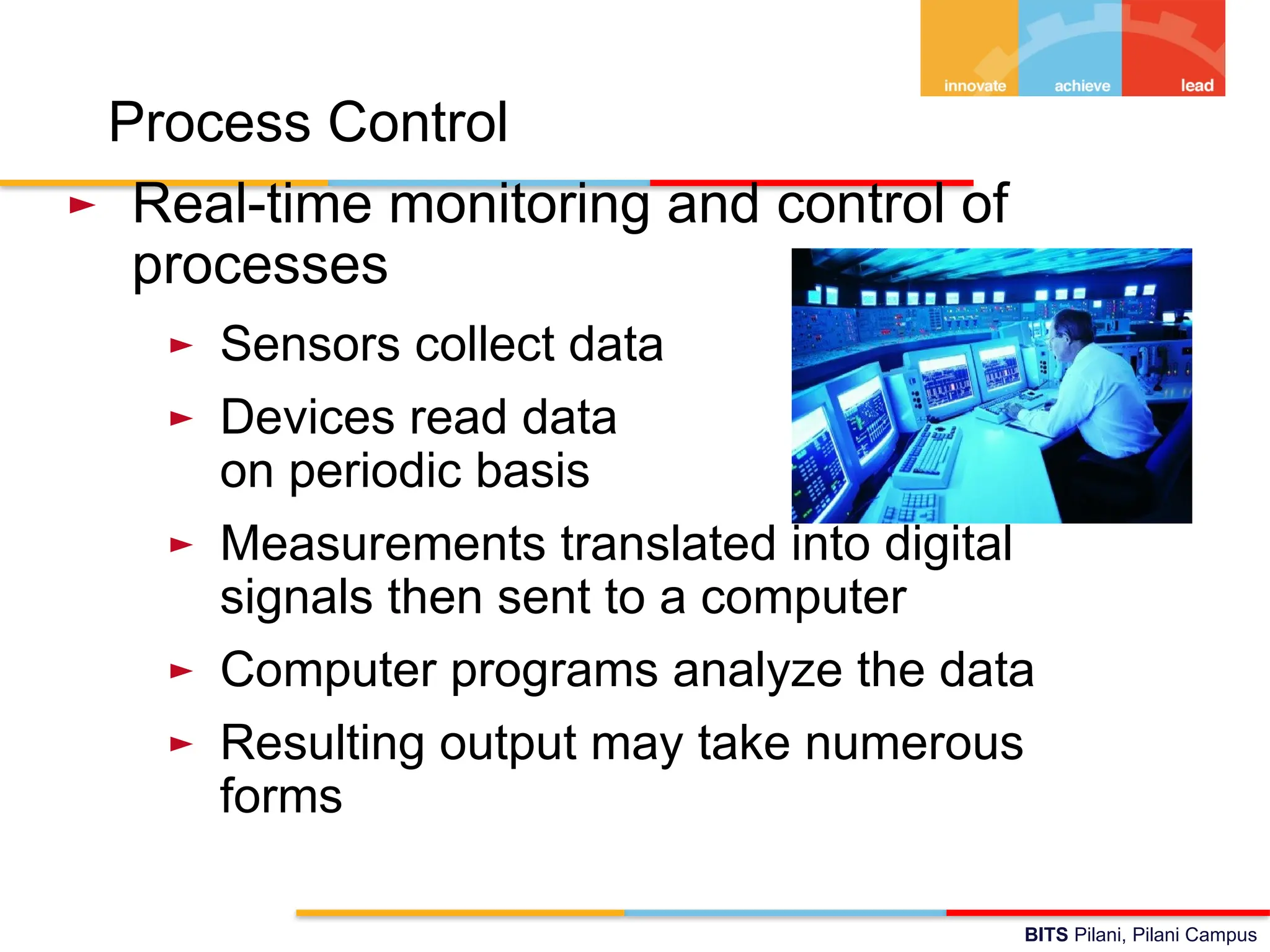
Process Control
► Real-time monitoring and control of
processes
► Sensors collect data
► Devices read data
on periodic basis
► Measurements translated into digital
signals then sent to a computer
► Computer programs analyze the data
► Resulting output may take numerous
forms
50.
BITS Pilani, PilaniCampus
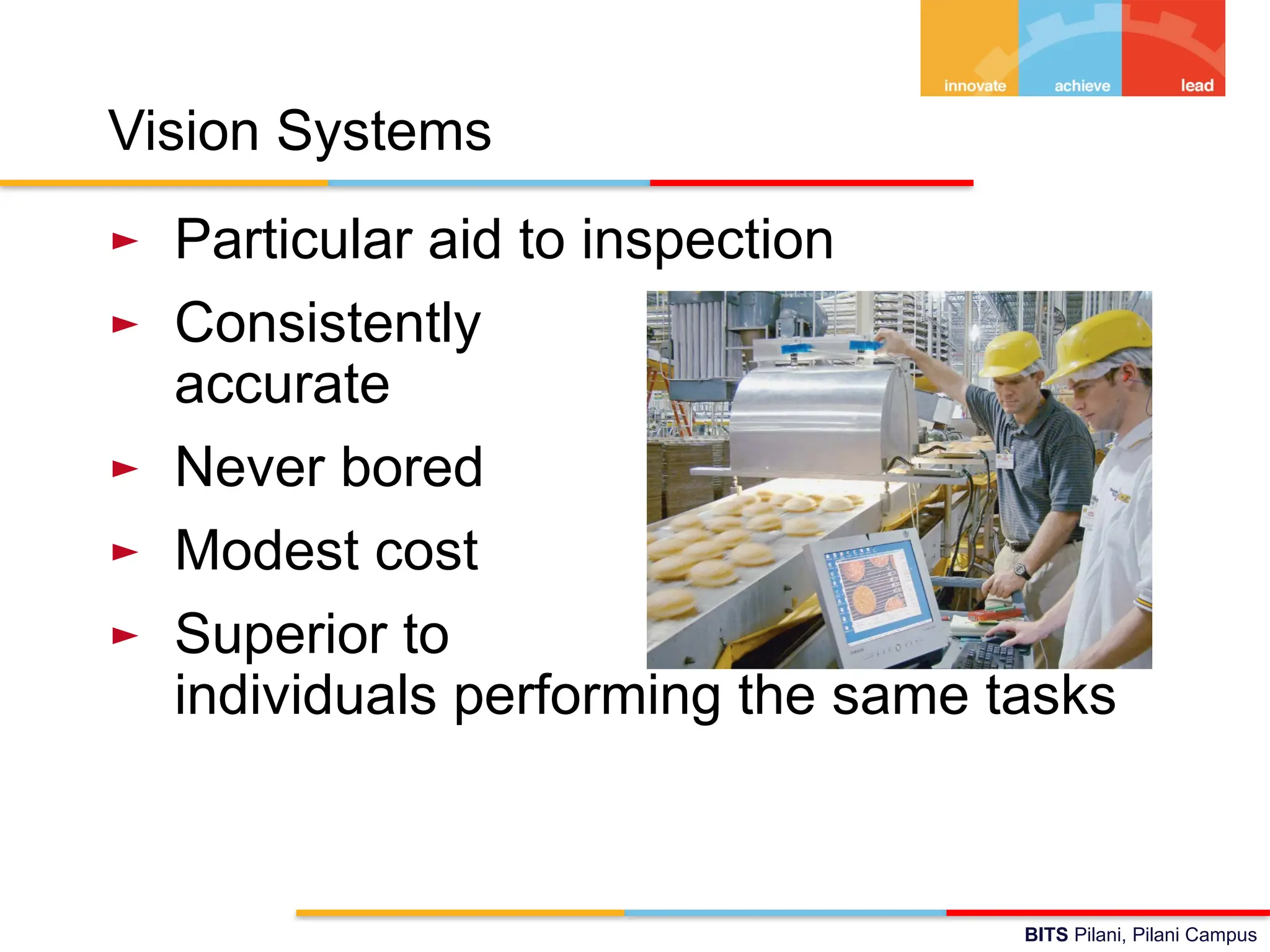
Vision Systems
► Particular aid to inspection
► Consistently
accurate
► Never bored
► Modest cost
► Superior to
individuals performing the same tasks
51.
BITS Pilani, PilaniCampus
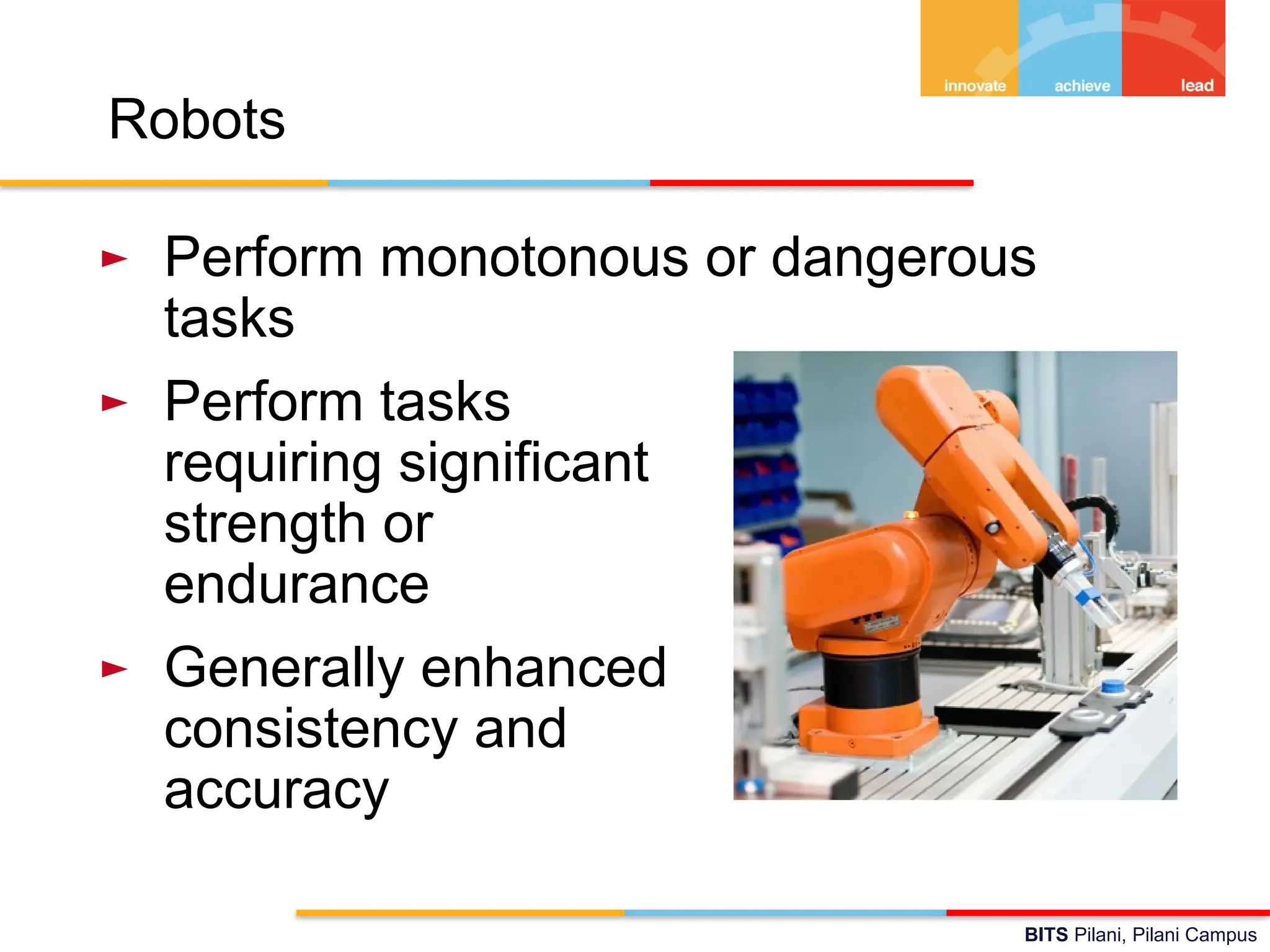
Robots
► Perform monotonous or dangerous
tasks
► Perform tasks
requiring significant
strength or
endurance
► Generally enhanced
consistency and
accuracy
52.
BITS Pilani, PilaniCampus
Automated Storage and Retrieval
Systems (ASRSs)
► Automated placement and withdrawal
of parts and products
► Reduced errors and labor
► Particularly useful in inventory and test
areas of manufacturing firms
53.
BITS Pilani, PilaniCampus
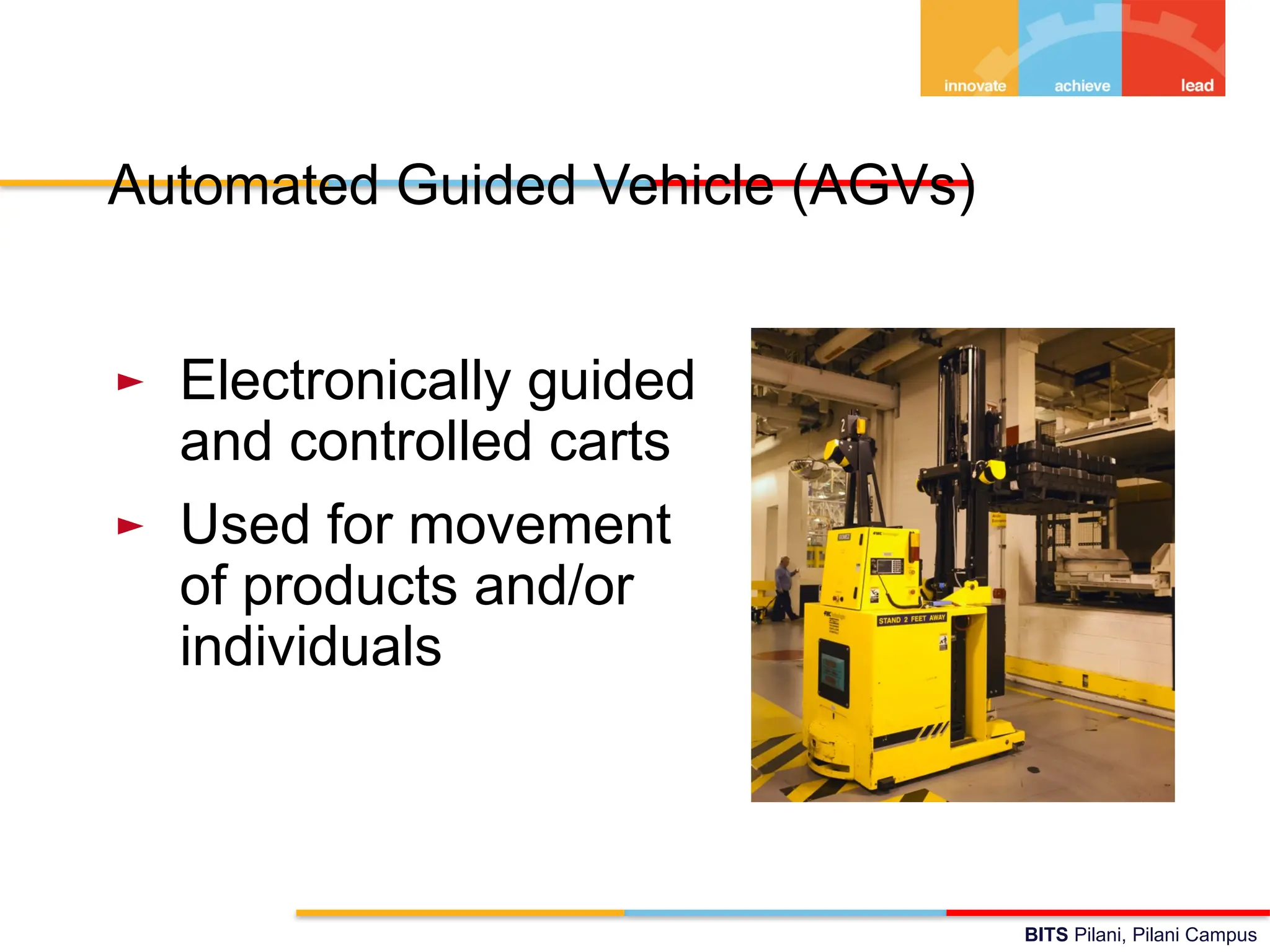
Automated Guided Vehicle (AGVs)
► Electronically guided
and controlled carts
► Used for movement
of products and/or
individuals
54.
BITS Pilani, PilaniCampus
Flexible Manufacturing Systems (FMSs)
► Computer controls both the workstation and
the material handling equipment
► Enhance flexibility and reduced waste
► Can economically produce low volume at high
quality
► Reduced changeover time and increased
utilization
► Stringent communication requirement between
components
55.
BITS Pilani, PilaniCampus
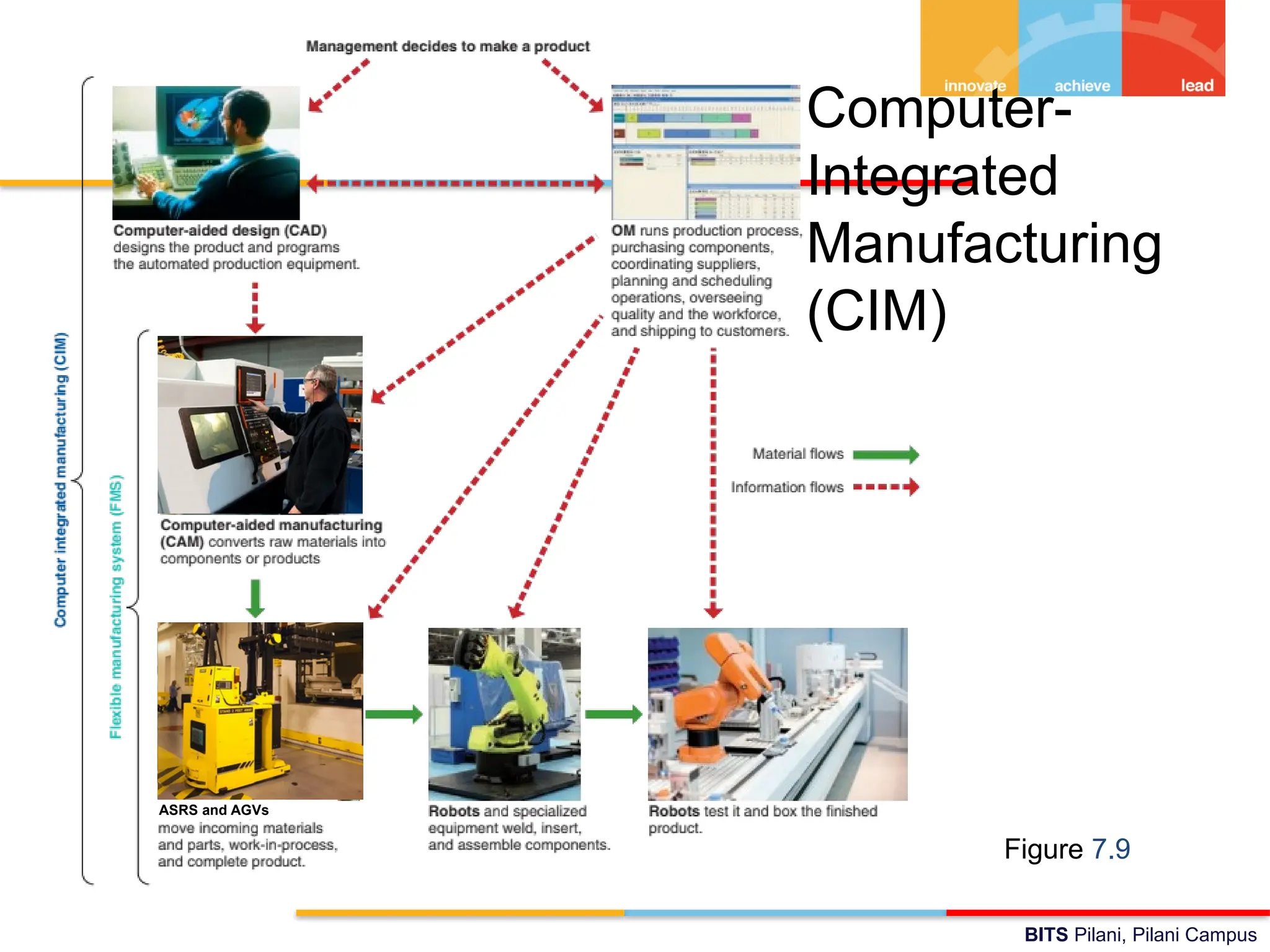
Computer-Integrated Manufacturing (CIM)
► Extend flexible manufacturing
► Backwards to engineering and inventory
control
► Forward into warehousing and shipping
► Can also include financial and customer
service areas
► Reducing the distinction between low-
volume/high-variety, and
high-volume/low-variety production
BITS Pilani, PilaniCampus
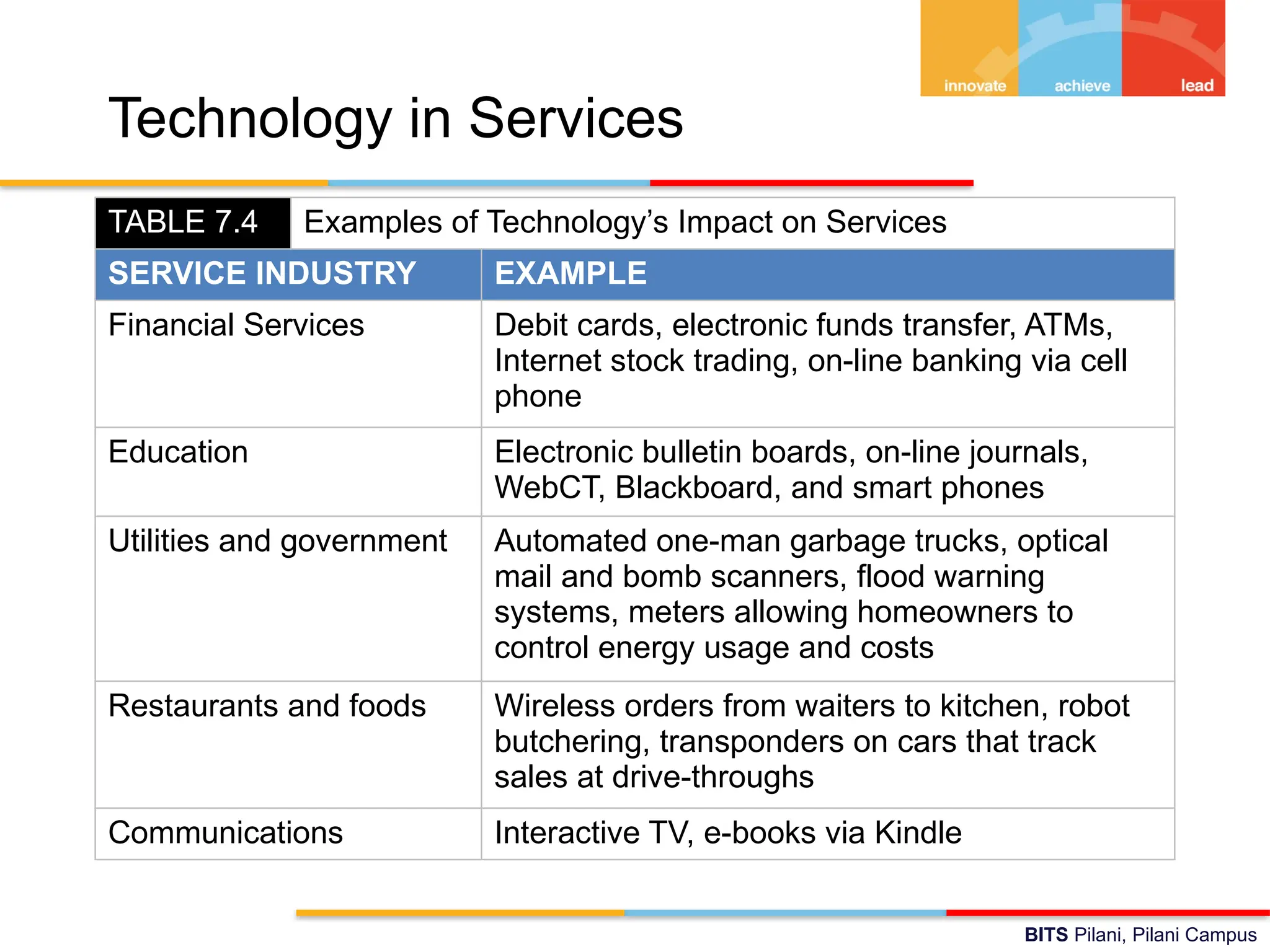
Technology in Services
TABLE 7.4 Examples of Technology’s Impact on Services
SERVICE INDUSTRY EXAMPLE
Financial Services Debit cards, electronic funds transfer, ATMs,
Internet stock trading, on-line banking via cell
phone
Education Electronic bulletin boards, on-line journals,
WebCT, Blackboard, and smart phones
Utilities and government Automated one-man garbage trucks, optical
mail and bomb scanners, flood warning
systems, meters allowing homeowners to
control energy usage and costs
Restaurants and foods Wireless orders from waiters to kitchen, robot
butchering, transponders on cars that track
sales at drive-throughs
Communications Interactive TV, e-books via Kindle
58.
BITS Pilani, PilaniCampus
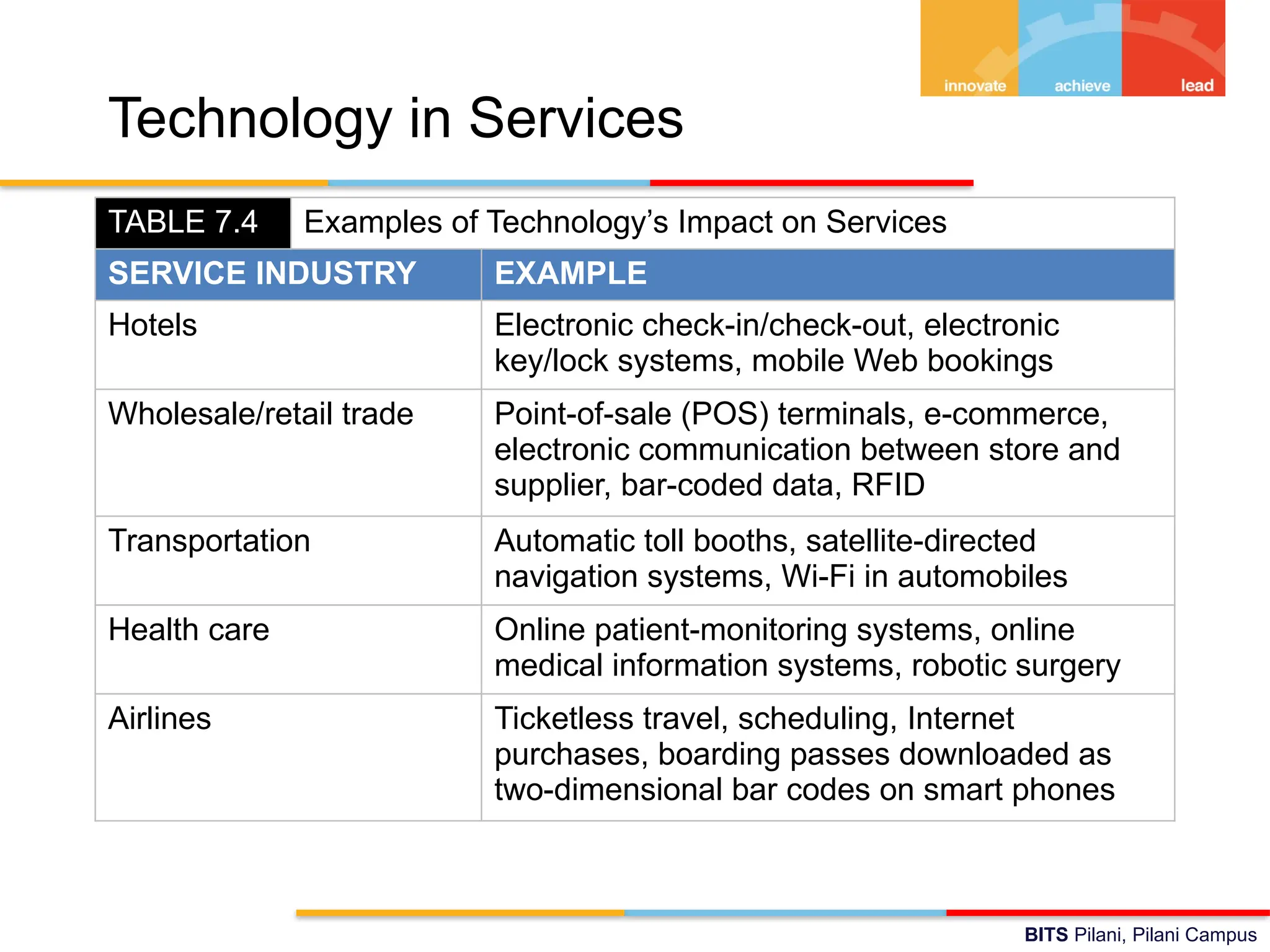
Technology in Services
TABLE 7.4 Examples of Technology’s Impact on Services
SERVICE INDUSTRY EXAMPLE
Hotels Electronic check-in/check-out, electronic
key/lock systems, mobile Web bookings
Wholesale/retail trade Point-of-sale (POS) terminals, e-commerce,
electronic communication between store and
supplier, bar-coded data, RFID
Transportation Automatic toll booths, satellite-directed
navigation systems, Wi-Fi in automobiles
Health care Online patient-monitoring systems, online
medical information systems, robotic surgery
Airlines Ticketless travel, scheduling, Internet
purchases, boarding passes downloaded as
two-dimensional bar codes on smart phones
59.
BITS Pilani, PilaniCampus
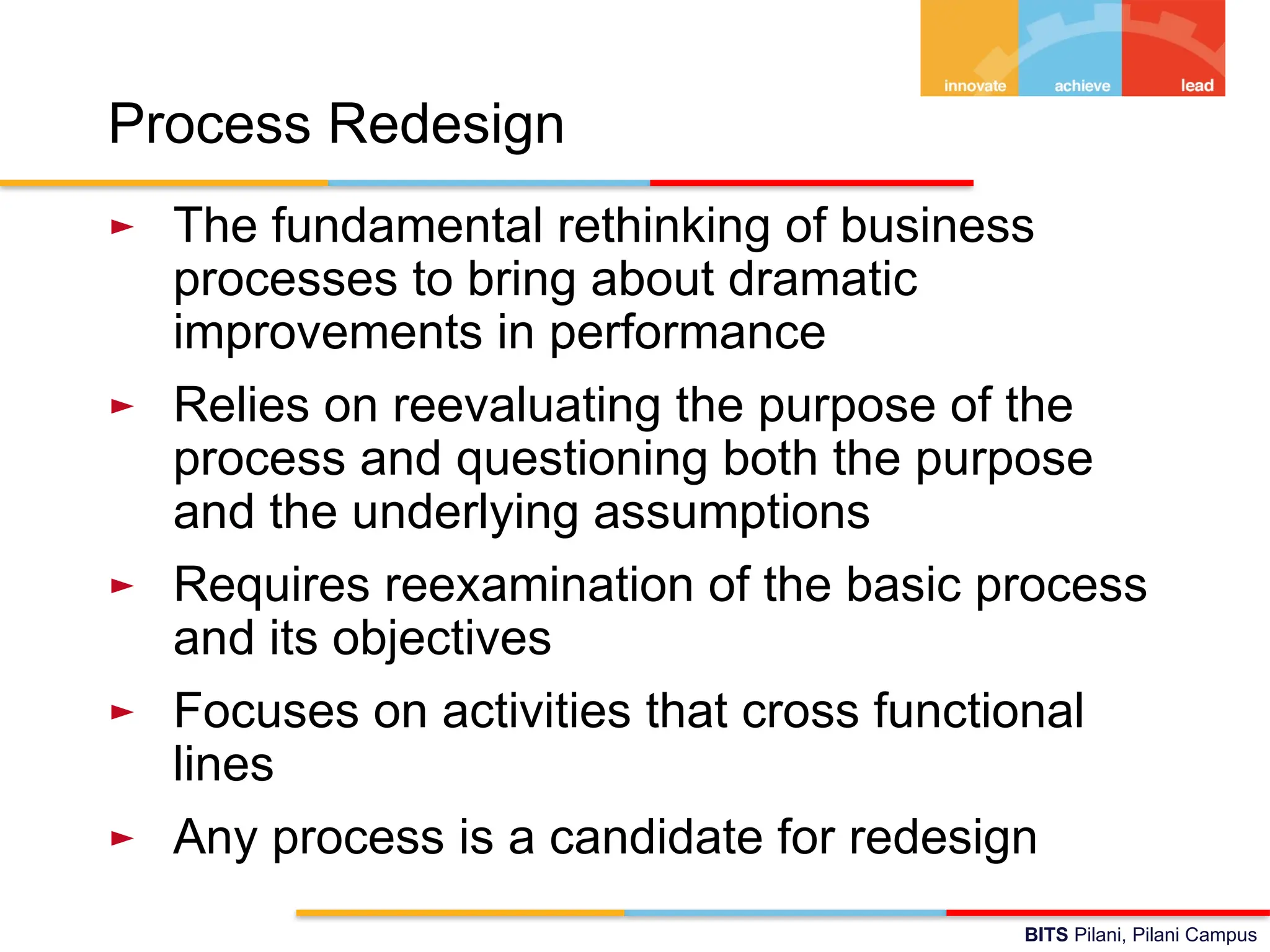
Process Redesign
► The fundamental rethinking of business
processes to bring about dramatic
improvements in performance
► Relies on reevaluating the purpose of the
process and questioning both the purpose
and the underlying assumptions
► Requires reexamination of the basic process
and its objectives
► Focuses on activities that cross functional
lines
► Any process is a candidate for redesign