solidlegalmarketing.com
YOUR LOGO
An Ultimate Guide
To Keyword
Research for Ads
& SEO
An Ultimate Guide To Keyword Research for
Ads & SEO
Any digital marketer, especially for SEO, PPC, and content marketing, need
extensive keyword research.
Keyword research gives SEOs and marketers a better understanding of what your
audience is looking for online, what difficulties they are having, and what solutions
and answers they require to solve their problems.
Without keyword research as a guide, your content may not be discovered by the
audiences for whom it is intended, which could harm your search engine rating and
performance.
Want to avoid getting lost in the search results page? Allow a seasoned digital
marketing firm that offers world-class SEO services to show you the ins and outs of
creating a thorough keyword list.
An Ultimate Guide To Keyword Research for
Ads & SEO
Topics that will be cover in the eBook
1. What is keyword research?
2. Why is keyword research important?
3. How to do keyword research for SEO?
4. How to prioritize keywords?
5. Key Takeaways
Keyword research is the act of locating and evaluating words and queries that people use to find
answers to their concerns or questions on search engines.
It's one of the first phases in the SEO process because it allows the marketer to discover and explore
your keyword area in order to determine what subjects or pages may be generated or strategically
added to your content for improved SERP position and website performance.
What is Keyword Research?
An Ultimate Guide To Keyword Research for
Ads & SEO
Is keyword research just another file to keep track of? This part may lose me points for relevancy or
even brevity, but it is for anyone who want to understand why keyword research is important:
1. To facilitate the identification of your keyword space. - As previously stated, keyword research
is vital since it allows a specialist in your website's keyword space to determine the variety of themes
and pages your website can generate to improve its SERP ranking.
2. To figure out which keywords to prioritise. - Search volume, cost per click, and traffic potential
(which we'll discuss more later) are all factors that can help you prioritise the search phrases you
want to rank for on your website.
Using high-volume keywords is no longer sufficient. First and foremost, is the keyword popular? Is
the keyword even related to your business? There are so many factors to consider that conducting
your research first will save you a lot of time in the long run when it comes to ideation and
optimization.
3. To quickly map emphasis keywords to a particular page - You can quickly map your present
and future pages using the keywords listed if you have a full keyword research file. There's no need
to be concerned about keyword cannibalism or having many focus keywords on a page because the
file will assist you in creating a hierarchy of relevant and necessary information for your brand and
business that will fulfil searchers' queries and purpose.
4. To inform you about your audience's needs - Knowing your keyword space is the largest hint
you can possibly have to get into the psyche of your target audience, aside from aiding you with your
strategy or optimizations.
Don't worry about what you think your audience wants to know. Keyword research gives you access
to crucial information that can tell you what people are looking for—a truth serum, if you will, on how
people act and behave on Search.
Why is keyword research important?
An Ultimate Guide To Keyword Research for
Ads & SEO
Keyword research is crucial because it captures your customers' feelings about what they want to
learn. Knowing your consumers' true feelings can have a significant impact on how you operate and
view your business strategy—not just in terms of search, but in general.
There are many more advantages to undertaking SEO keyword research; I only highlighted these
four to get you thinking about why you need to do it and why that file is more than just another
spreadsheet or document in your folder.
Why is keyword research important?
An Ultimate Guide To Keyword Research for
Ads & SEO
1. Create a list of seed keywords. - Seed keywords are broad and generic keywords that are basic
and short, in contrast to long-tail keywords. They are the'seeds' that will allow your keyword list to
expand and branch out in order to locate a more particular one that fits your content.
As a starting point, consider your industry and services.
If you offer bikes, for example, your seed keywords could range from the types of bikes you sell,
such as 'foldable bikes' and 'Japanese bikes,' to the general items in your product inventory, such as
'bike components' or 'bike accessories.'
2. Using your seed keywords, collect keywords from various sources. - Once you have your
seed keywords, you may gather and pull in as many keywords as you want using various data
sources and keyword tools to create a thorough list.
Here's a list of some of our favourite and most dependable keyword tools:
Google Search Console - If you already have a website with content, simply compile your
search queries from the previous three months or more to receive a comprehensive
breakdown of what your website is ranking for. To see what's already working for you,
combine data like Clicks, Impressions, CTR, and Position.
Who can say? Perhaps a few on-page adjustments and promotions here and there will propel
you to the top.
3. Google Keyword Planner - The Forecast Tool in Google Keyword Planner is a simple and
effective approach to determining and narrow down the future potential of any keyword or
combination of keywords.
Google determines the popular topics tomorrow or the next day based on years of recorded data
from the most searched topics yesterday and today. They also consider the seasonality of keywords
such as holidays, events, and so on.
How to Conduct SEO Keyword Research
An Ultimate Guide To Keyword Research for
Ads & SEO
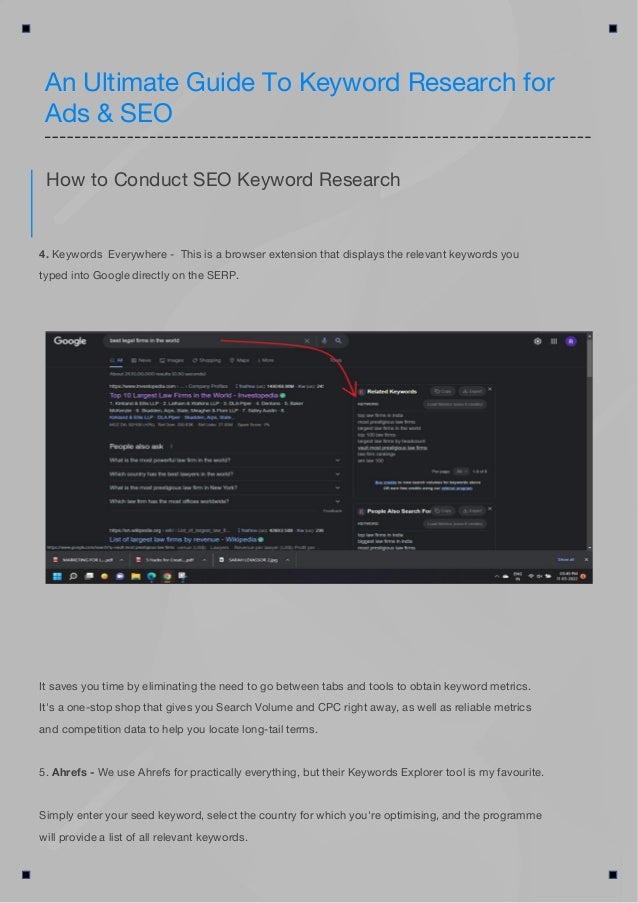
4. Keywords Everywhere - This is a browser extension that displays the relevant keywords you
typed into Google directly on the SERP.
It saves you time by eliminating the need to go between tabs and tools to obtain keyword metrics.
It's a one-stop shop that gives you Search Volume and CPC right away, as well as reliable metrics
and competition data to help you locate long-tail terms.
5. Ahrefs - We use Ahrefs for practically everything, but their Keywords Explorer tool is my favourite.
Simply enter your seed keyword, select the country for which you're optimising, and the programme
will provide a list of all relevant keywords.
How to Conduct SEO Keyword Research
An Ultimate Guide To Keyword Research for
Ads & SEO
You're probably wondering how you're going to sift through all of these keywords when you're
exporting keywords. It'll take an eternity. The first step is to go over your keyword list and filter it.
A. Remove keywords from your list that are repeated.
If you're using Excel or Sheets, simply select Remove Duplicates to eliminate duplicates.
B. Make a list of negative keywords.
If you made a list of keywords you want to rank for in the beginning, now is the time to make a list of
terms you don't want to rank for or even be connected with. Here are some questions to ask yourself
to help you make the list or figure out what kind of keywords you don't want:
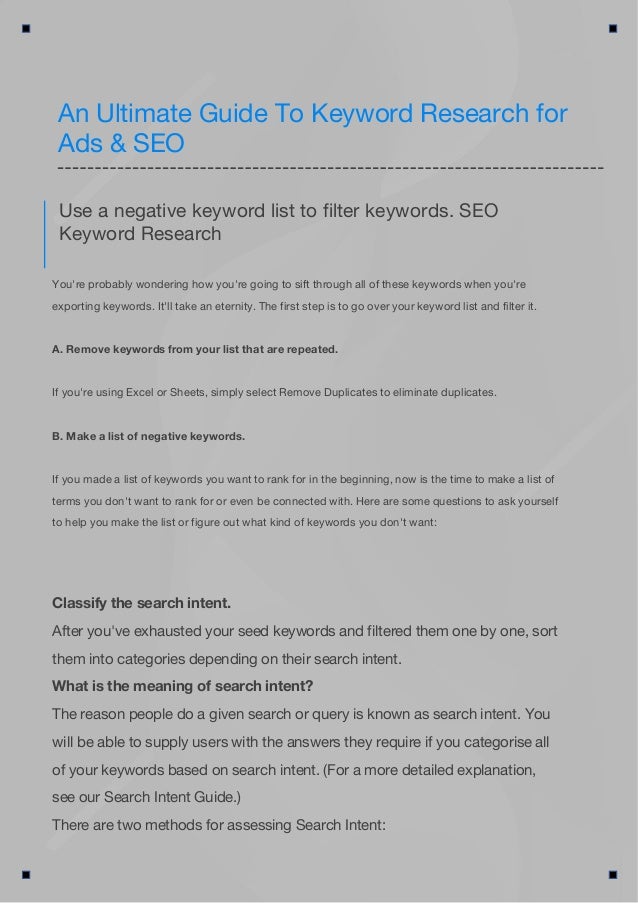
Classify the search intent.
After you've exhausted your seed keywords and filtered them one by one, sort
them into categories depending on their search intent.
What is the meaning of search intent?
The reason people do a given search or query is known as search intent. You
will be able to supply users with the answers they require if you categorise all
of your keywords based on search intent. (For a more detailed explanation,
see our Search Intent Guide.)
There are two methods for assessing Search Intent:
Use a negative keyword list to filter keywords. SEO
Keyword Research
An Ultimate Guide To Keyword Research for
Ads & SEO
Using keywords with common modifiers;
Each keyword is displayed using SERP Features.
Use a negative keyword list to filter keywords. SEO
Keyword Research
An Ultimate Guide To Keyword Research for
Ads & SEO
Informational Navigational
Commercial
Investigation
Transactiona
l
What Where Best Buy
How / How
to
Near me Top Discount/s
Who Alternative Review Deal/s
Where [location] Comparison Coupon/s
Why [Brand name] [Product] Size
Free
Shipping
Guide
[Specific name of a
product/service]
[Product] Color Order
Tutorial [Brand] Branch/es Sale
Ideas Promo
Tips
Appointme
nt
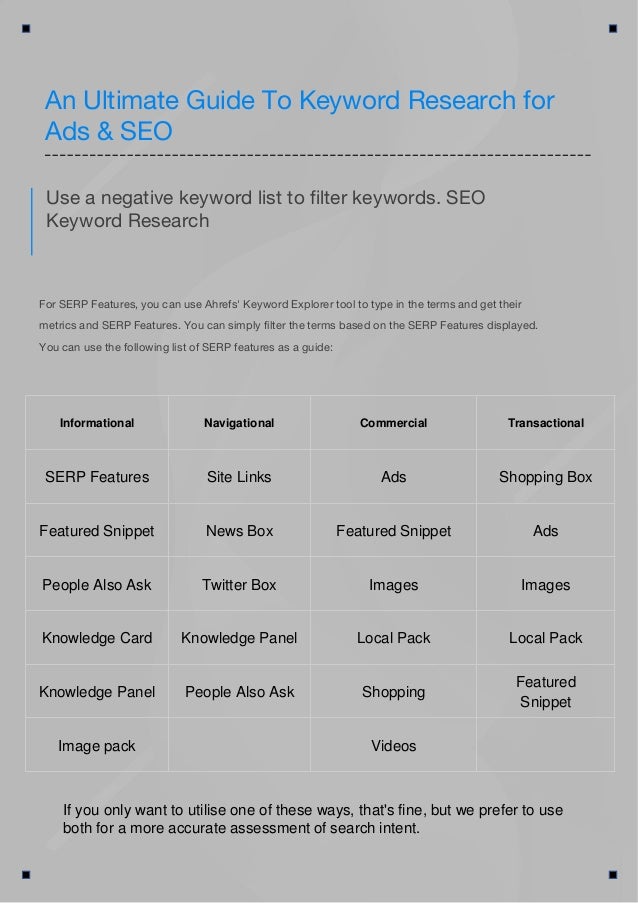
For SERP Features, you can use Ahrefs' Keyword Explorer tool to type in the terms and get their
metrics and SERP Features. You can simply filter the terms based on the SERP Features displayed.
You can use the following list of SERP features as a guide:
Use a negative keyword list to filter keywords. SEO
Keyword Research
An Ultimate Guide To Keyword Research for
Ads & SEO
Informational Navigational Commercial Transactional
SERP Features Site Links Ads Shopping Box
Featured Snippet News Box Featured Snippet Ads
People Also Ask Twitter Box Images Images
Knowledge Card Knowledge Panel Local Pack Local Pack
Knowledge Panel People Also Ask Shopping
Featured
Snippet
Image pack Videos
If you only want to utilise one of these ways, that's fine, but we prefer to use
both for a more accurate assessment of search intent.
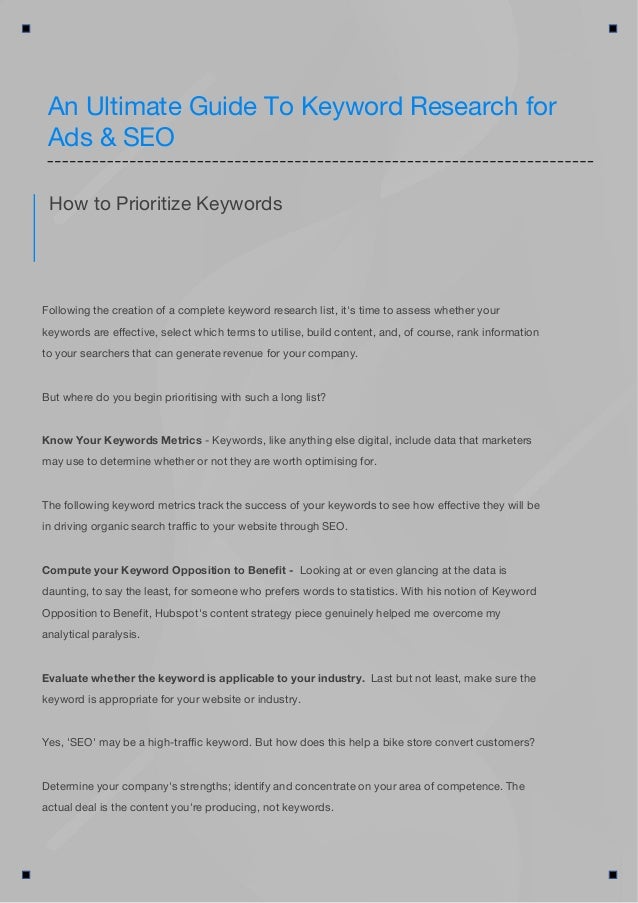
Following the creation of a complete keyword research list, it's time to assess whether your
keywords are effective, select which terms to utilise, build content, and, of course, rank information
to your searchers that can generate revenue for your company.
But where do you begin prioritising with such a long list?
Know Your Keywords Metrics - Keywords, like anything else digital, include data that marketers
may use to determine whether or not they are worth optimising for.
The following keyword metrics track the success of your keywords to see how effective they will be
in driving organic search traffic to your website through SEO.
Compute your Keyword Opposition to Benefit - Looking at or even glancing at the data is
daunting, to say the least, for someone who prefers words to statistics. With his notion of Keyword
Opposition to Benefit, Hubspot's content strategy piece genuinely helped me overcome my
analytical paralysis.
Evaluate whether the keyword is applicable to your industry. Last but not least, make sure the
keyword is appropriate for your website or industry.
Yes, 'SEO' may be a high-traffic keyword. But how does this help a bike store convert customers?
Determine your company's strengths; identify and concentrate on your area of competence. The
actual deal is the content you're producing, not keywords.
How to Prioritize Keywords
An Ultimate Guide To Keyword Research for
Ads & SEO
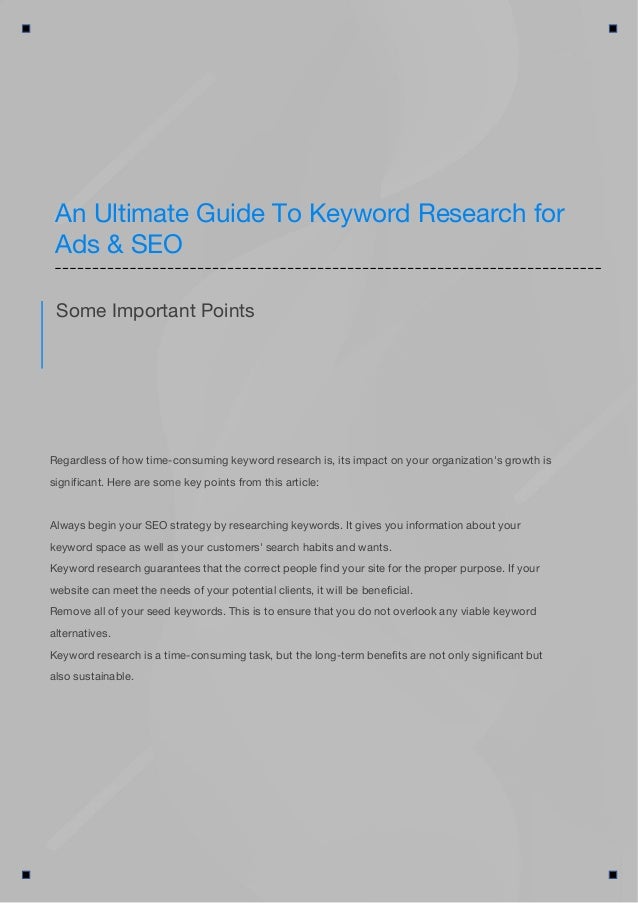
Regardless of how time-consuming keyword research is, its impact on your organization's growth is
significant. Here are some key points from this article:
Always begin your SEO strategy by researching keywords. It gives you information about your
keyword space as well as your customers' search habits and wants.
Keyword research guarantees that the correct people find your site for the proper purpose. If your
website can meet the needs of your potential clients, it will be beneficial.
Remove all of your seed keywords. This is to ensure that you do not overlook any viable keyword
alternatives.
Keyword research is a time-consuming task, but the long-term benefits are not only significant but
also sustainable.
Some Important Points
An Ultimate Guide To Keyword Research for
Ads & SEO
This eBook is created to give you a glance about what exactly Keyword research and how it’s work .
There is many tools to do keyword research it could be freemium. You can use which one best for
you.
If you need any Digital Marketing Service for your Law Firm don’t hesitate to chat or call with us.
For any query mail us at SALES@SOLIDLEGALMARKETING.COM
An Ultimate Guide To Keyword Research for
Ads & SEO
Thank You

An-Ultimate-Guide-To-Keyword-Research-for-Ads-SEO.pdf

  • 1.
    solidlegalmarketing.com YOUR LOGO An UltimateGuide To Keyword Research for Ads & SEO
  • 2.
    An Ultimate GuideTo Keyword Research for Ads & SEO Any digital marketer, especially for SEO, PPC, and content marketing, need extensive keyword research. Keyword research gives SEOs and marketers a better understanding of what your audience is looking for online, what difficulties they are having, and what solutions and answers they require to solve their problems. Without keyword research as a guide, your content may not be discovered by the audiences for whom it is intended, which could harm your search engine rating and performance. Want to avoid getting lost in the search results page? Allow a seasoned digital marketing firm that offers world-class SEO services to show you the ins and outs of creating a thorough keyword list.
  • 3.
    An Ultimate GuideTo Keyword Research for Ads & SEO Topics that will be cover in the eBook 1. What is keyword research? 2. Why is keyword research important? 3. How to do keyword research for SEO? 4. How to prioritize keywords? 5. Key Takeaways
  • 4.
    Keyword research isthe act of locating and evaluating words and queries that people use to find answers to their concerns or questions on search engines. It's one of the first phases in the SEO process because it allows the marketer to discover and explore your keyword area in order to determine what subjects or pages may be generated or strategically added to your content for improved SERP position and website performance. What is Keyword Research? An Ultimate Guide To Keyword Research for Ads & SEO
  • 5.
    Is keyword researchjust another file to keep track of? This part may lose me points for relevancy or even brevity, but it is for anyone who want to understand why keyword research is important: 1. To facilitate the identification of your keyword space. - As previously stated, keyword research is vital since it allows a specialist in your website's keyword space to determine the variety of themes and pages your website can generate to improve its SERP ranking. 2. To figure out which keywords to prioritise. - Search volume, cost per click, and traffic potential (which we'll discuss more later) are all factors that can help you prioritise the search phrases you want to rank for on your website. Using high-volume keywords is no longer sufficient. First and foremost, is the keyword popular? Is the keyword even related to your business? There are so many factors to consider that conducting your research first will save you a lot of time in the long run when it comes to ideation and optimization. 3. To quickly map emphasis keywords to a particular page - You can quickly map your present and future pages using the keywords listed if you have a full keyword research file. There's no need to be concerned about keyword cannibalism or having many focus keywords on a page because the file will assist you in creating a hierarchy of relevant and necessary information for your brand and business that will fulfil searchers' queries and purpose. 4. To inform you about your audience's needs - Knowing your keyword space is the largest hint you can possibly have to get into the psyche of your target audience, aside from aiding you with your strategy or optimizations. Don't worry about what you think your audience wants to know. Keyword research gives you access to crucial information that can tell you what people are looking for—a truth serum, if you will, on how people act and behave on Search. Why is keyword research important? An Ultimate Guide To Keyword Research for Ads & SEO
  • 6.
    Keyword research iscrucial because it captures your customers' feelings about what they want to learn. Knowing your consumers' true feelings can have a significant impact on how you operate and view your business strategy—not just in terms of search, but in general. There are many more advantages to undertaking SEO keyword research; I only highlighted these four to get you thinking about why you need to do it and why that file is more than just another spreadsheet or document in your folder. Why is keyword research important? An Ultimate Guide To Keyword Research for Ads & SEO
  • 7.
    1. Create alist of seed keywords. - Seed keywords are broad and generic keywords that are basic and short, in contrast to long-tail keywords. They are the'seeds' that will allow your keyword list to expand and branch out in order to locate a more particular one that fits your content. As a starting point, consider your industry and services. If you offer bikes, for example, your seed keywords could range from the types of bikes you sell, such as 'foldable bikes' and 'Japanese bikes,' to the general items in your product inventory, such as 'bike components' or 'bike accessories.' 2. Using your seed keywords, collect keywords from various sources. - Once you have your seed keywords, you may gather and pull in as many keywords as you want using various data sources and keyword tools to create a thorough list. Here's a list of some of our favourite and most dependable keyword tools: Google Search Console - If you already have a website with content, simply compile your search queries from the previous three months or more to receive a comprehensive breakdown of what your website is ranking for. To see what's already working for you, combine data like Clicks, Impressions, CTR, and Position. Who can say? Perhaps a few on-page adjustments and promotions here and there will propel you to the top. 3. Google Keyword Planner - The Forecast Tool in Google Keyword Planner is a simple and effective approach to determining and narrow down the future potential of any keyword or combination of keywords. Google determines the popular topics tomorrow or the next day based on years of recorded data from the most searched topics yesterday and today. They also consider the seasonality of keywords such as holidays, events, and so on. How to Conduct SEO Keyword Research An Ultimate Guide To Keyword Research for Ads & SEO
  • 8.
    4. Keywords Everywhere- This is a browser extension that displays the relevant keywords you typed into Google directly on the SERP. It saves you time by eliminating the need to go between tabs and tools to obtain keyword metrics. It's a one-stop shop that gives you Search Volume and CPC right away, as well as reliable metrics and competition data to help you locate long-tail terms. 5. Ahrefs - We use Ahrefs for practically everything, but their Keywords Explorer tool is my favourite. Simply enter your seed keyword, select the country for which you're optimising, and the programme will provide a list of all relevant keywords. How to Conduct SEO Keyword Research An Ultimate Guide To Keyword Research for Ads & SEO
  • 9.
    You're probably wonderinghow you're going to sift through all of these keywords when you're exporting keywords. It'll take an eternity. The first step is to go over your keyword list and filter it. A. Remove keywords from your list that are repeated. If you're using Excel or Sheets, simply select Remove Duplicates to eliminate duplicates. B. Make a list of negative keywords. If you made a list of keywords you want to rank for in the beginning, now is the time to make a list of terms you don't want to rank for or even be connected with. Here are some questions to ask yourself to help you make the list or figure out what kind of keywords you don't want: Classify the search intent. After you've exhausted your seed keywords and filtered them one by one, sort them into categories depending on their search intent. What is the meaning of search intent? The reason people do a given search or query is known as search intent. You will be able to supply users with the answers they require if you categorise all of your keywords based on search intent. (For a more detailed explanation, see our Search Intent Guide.) There are two methods for assessing Search Intent: Use a negative keyword list to filter keywords. SEO Keyword Research An Ultimate Guide To Keyword Research for Ads & SEO
  • 10.
    Using keywords withcommon modifiers; Each keyword is displayed using SERP Features. Use a negative keyword list to filter keywords. SEO Keyword Research An Ultimate Guide To Keyword Research for Ads & SEO Informational Navigational Commercial Investigation Transactiona l What Where Best Buy How / How to Near me Top Discount/s Who Alternative Review Deal/s Where [location] Comparison Coupon/s Why [Brand name] [Product] Size Free Shipping Guide [Specific name of a product/service] [Product] Color Order Tutorial [Brand] Branch/es Sale Ideas Promo Tips Appointme nt
  • 11.
    For SERP Features,you can use Ahrefs' Keyword Explorer tool to type in the terms and get their metrics and SERP Features. You can simply filter the terms based on the SERP Features displayed. You can use the following list of SERP features as a guide: Use a negative keyword list to filter keywords. SEO Keyword Research An Ultimate Guide To Keyword Research for Ads & SEO Informational Navigational Commercial Transactional SERP Features Site Links Ads Shopping Box Featured Snippet News Box Featured Snippet Ads People Also Ask Twitter Box Images Images Knowledge Card Knowledge Panel Local Pack Local Pack Knowledge Panel People Also Ask Shopping Featured Snippet Image pack Videos If you only want to utilise one of these ways, that's fine, but we prefer to use both for a more accurate assessment of search intent.
  • 12.
    Following the creationof a complete keyword research list, it's time to assess whether your keywords are effective, select which terms to utilise, build content, and, of course, rank information to your searchers that can generate revenue for your company. But where do you begin prioritising with such a long list? Know Your Keywords Metrics - Keywords, like anything else digital, include data that marketers may use to determine whether or not they are worth optimising for. The following keyword metrics track the success of your keywords to see how effective they will be in driving organic search traffic to your website through SEO. Compute your Keyword Opposition to Benefit - Looking at or even glancing at the data is daunting, to say the least, for someone who prefers words to statistics. With his notion of Keyword Opposition to Benefit, Hubspot's content strategy piece genuinely helped me overcome my analytical paralysis. Evaluate whether the keyword is applicable to your industry. Last but not least, make sure the keyword is appropriate for your website or industry. Yes, 'SEO' may be a high-traffic keyword. But how does this help a bike store convert customers? Determine your company's strengths; identify and concentrate on your area of competence. The actual deal is the content you're producing, not keywords. How to Prioritize Keywords An Ultimate Guide To Keyword Research for Ads & SEO
  • 13.
    Regardless of howtime-consuming keyword research is, its impact on your organization's growth is significant. Here are some key points from this article: Always begin your SEO strategy by researching keywords. It gives you information about your keyword space as well as your customers' search habits and wants. Keyword research guarantees that the correct people find your site for the proper purpose. If your website can meet the needs of your potential clients, it will be beneficial. Remove all of your seed keywords. This is to ensure that you do not overlook any viable keyword alternatives. Keyword research is a time-consuming task, but the long-term benefits are not only significant but also sustainable. Some Important Points An Ultimate Guide To Keyword Research for Ads & SEO
  • 14.
    This eBook iscreated to give you a glance about what exactly Keyword research and how it’s work . There is many tools to do keyword research it could be freemium. You can use which one best for you. If you need any Digital Marketing Service for your Law Firm don’t hesitate to chat or call with us. For any query mail us at SALES@SOLIDLEGALMARKETING.COM An Ultimate Guide To Keyword Research for Ads & SEO Thank You